HOA Towed All 8 of My Tractors — Then 31 Farming Families Sued and the Entire Board Got Recalled
“You had your warning, Mr. Cole.”
“These are my tractors. You have no right.”
“I have every right. Every machine goes.”
“Thirty-one families depend on these.”
“Not my problem.”
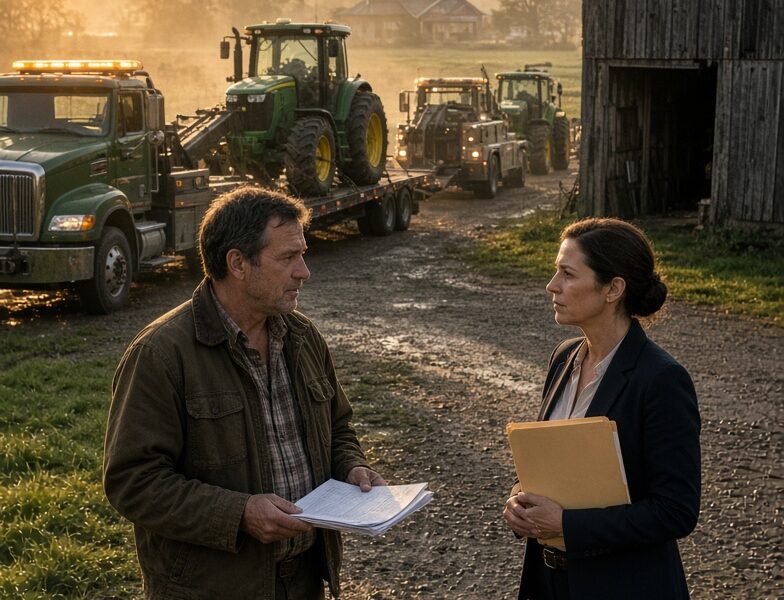
Vanessa Caldwell didn’t blink when Ethan Cole held up the ownership papers.
She had the board’s backing.
She had the tow crews, and she believed she had an airtight case.
To her, those eight machines were the last visible symbol of everything she wanted erased from Oak Valley.
The worn equipment, the working barns, the agricultural identity she had decided the neighborhood needed to leave behind.
What she hadn’t stopped to consider was what those tractors actually represented to the people who depended on them.
Not clutter.
Not an eyesore.
The shared lifeline keeping 31 farming families viable through the most critical harvest window of the year.
With a major storm already building on the edge of the forecast, when the last trailer pulled away, Ethan stood in the empty lot and didn’t say a word.
But if 31 families had built their entire harvest season around those eight machines, why did Vanessa believe that taking them would be so simple?
If stories like this one, where the people who get pushed around push back harder than anyone expected, are your kind of thing, subscribe and stick around.
This one earns it.
Ethan Cole had never set out to become the person 31 families depended on.
He had simply inherited his grandfather’s 12 acres in Oak Valley Estates, kept the land producing, and over time found himself collecting broken-down John Deere tractors the way other men collect regrets, one at a time, for reasons that made sense in the moment.
By the time he had eight of them parked along the gravel lot beside his barn, he had also quietly become the reason most of his neighbors could still afford to call themselves farmers.
Oak Valley was that kind of place, neither fully rural nor fully suburban, caught somewhere between the two in a way that suited people who weren’t quite one thing or the other.
The houses had yards, but the yards bled into fields.
Some lots were a quarter acre, others stretched to 15.
Between the newer homes with their clean driveways and tidy landscaping, older families had held on to wider parcels that still produced corn, soybeans, hay, and the kind of vegetables people used to grow without calling it anything special.
These weren’t wealthy landowners.
They were mechanics who ran a few rows of corn on evenings and weekends, retired couples tending small herds, teachers keeping alive the land their parents had worked.
What they shared, almost universally, was that modern farm equipment had become too expensive to own alone.
Six years before the morning the tow trucks arrived, Ethan had started something he called the Oak Valley Harvest Circle, informally at first, just a few neighbors chipping in for diesel and repairs in exchange for scheduled time on his machines.
Over time, 31 households had joined.
Each contributed toward fuel, parts, tires, and seasonal maintenance.
In return, Ethan’s tractors moved from property to property on a carefully built schedule that he kept in a hand-marked calendar hanging inside his barn door.
One machine pulled grain carts, another ran a baler, others handled tillage, mowing, seeding, and field prep.
The arrangement saved each family tens of thousands of dollars they didn’t have and replaced the kind of equipment cooperation that farming communities had practiced for generations before individual ownership became the expectation.
Ethan had one rule, spoken plainly the first time he explained the system and never repeated because it never needed to be.
No family gets left behind during harvest.
That September, the stakes were higher than usual.
A wet spring had delayed planting by nearly two weeks, and then an unusually dry August compressed the timeline at the other end, pushing crops toward maturity faster than anyone had planned.
Forecasters were already tracking a strong storm system building to the southwest.
If it arrived before the Harvest Circle finished its work, some families stood to lose tens of thousands of dollars.
For a few of them, one bad harvest wasn’t a setback.
It was the end.
Walter Briggs, 72 years old and the longest-tenured resident in all of Oak Valley, had been stopping by Ethan’s barn for coffee most mornings that summer.
His family had owned land there before the developers arrived, back when the whole area was working farmland and nobody called it an estate.
Walter had a habit of sitting on an upturned bucket near the barn door and saying things that sounded like small talk but weren’t.
One morning he mentioned, almost to himself, that the original agreements between the early landowners and the developers had contained some unusual language, something about agricultural rights that the developers had agreed to in order to bring the old farming families on board.
He couldn’t remember the exact wording.
Ethan had nodded, refilled his cup, and not thought much more about it, because there was always something more pressing to think about in September.
That was still true when the certified letter arrived.
The violation notice accused Ethan of storing unauthorized commercial agricultural machinery within residential boundaries.
He read it twice and decided it must be a misunderstanding.
He emailed the new HOA president, a woman named Vanessa Caldwell, and attached the Harvest Circle schedule, 31 addresses, dates, fields, equipment assignments, to show that the tractors weren’t commercial equipment in any meaningful sense.
They were shared tools serving the neighborhood’s own farming families.
Vanessa had moved to Oak Valley two years earlier into one of the newer luxury homes on the eastern side of the development.
She had different ideas about what the community should look like, cleaner sight lines, higher property values, less visible machinery, fewer working barns, the gradual softening of everything that made Oak Valley feel agricultural.
She had begun her term as president by talking about modernization, and she wasn’t using the word loosely.
The eight green machines parked beside Ethan’s barn were, to her, exactly the wrong kind of advertisement for the neighborhood she was trying to build.
She did not respond to his email the way he hoped.
She told him the board had made its determination.
The equipment violated community standards.
The appeal process ran its course without producing a hearing.
Fines arrived instead.
Five hundred dollars.
Then a thousand.
Then twenty-five hundred.
Ethan kept paying, kept appealing, and kept assuring the Harvest Circle members that the machines would be available when harvest started.
Then the second certified letter came, and it wasn’t about fines.
The HOA gave him 24 hours to remove all eight tractors from Oak Valley.
Failure to comply would result in the board arranging removal at his expense.
Ethan read it and decided it was a bluff.
Moving eight pieces of large farm equipment required specialized haulers, commercial trailers, permits, drivers, and real money.
He couldn’t imagine Vanessa actually doing it, not over landscaping aesthetics, not with harvest three weeks away.
He was wrong about that.
At 6:10 the following morning, he woke to the sound of diesel engines.
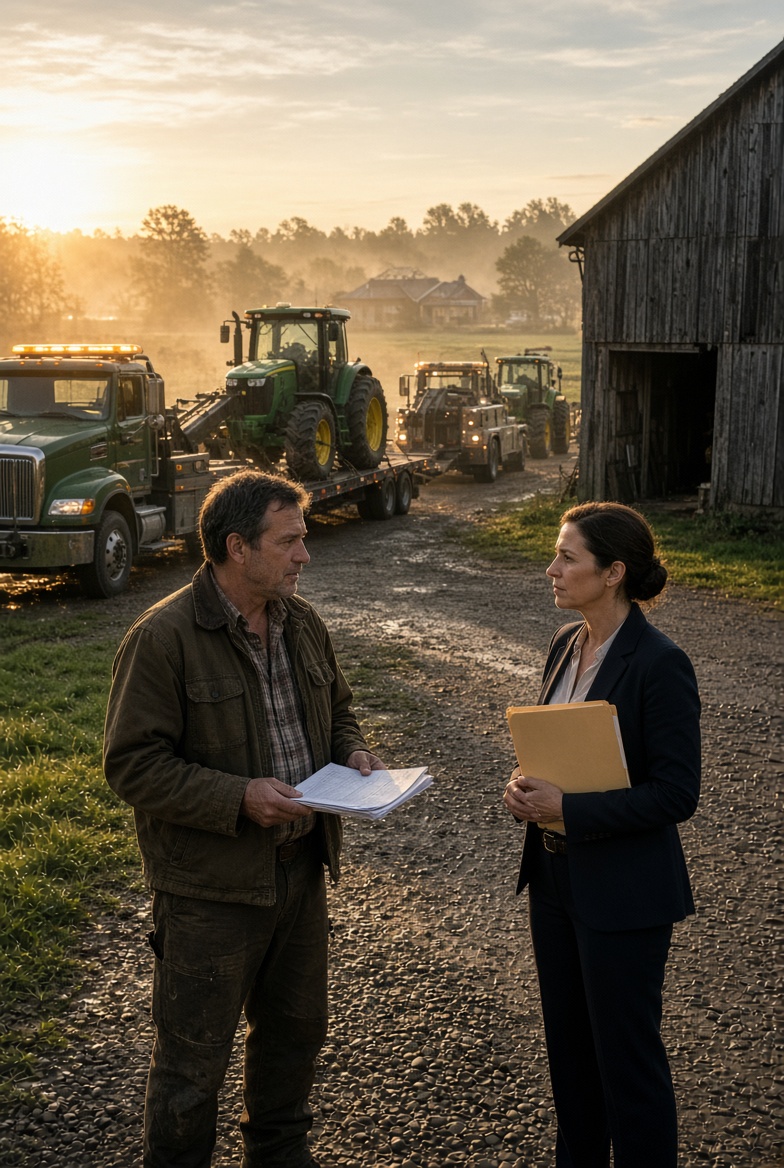
Five heavy tow trucks had pulled onto his property.
Three equipment trailers were already positioned.
Workers were moving between the tractors, attaching chains and checking axle clearances with the practiced efficiency of people who had done this kind of job many times.
Vanessa stood near the road holding a manila folder, wearing the expression of someone who had made a decision and had no intention of reconsidering it.
Ethan ran outside and met them at the barn.
He held out the ownership documents, explained the harvest schedule, described what those machines meant to 31 families currently watching the weather.
Vanessa listened without expression and said he had been given his warning.
The workers kept moving.
One by one, the tractors were loaded onto the trailers, the same machines he had spent years sourcing and rebuilding, the same machines people across Oak Valley were counting on.
Within two hours, all eight John Deeres were gone, and the gravel lot beside his barn was empty for the first time in years.
Ethan stood there for a long moment looking at the space where they had been.
Then he went inside and sent a single message to every member of the Harvest Circle.
The HOA took all eight tractors.
We have a problem.
The first responses came within minutes.
Then the calls started.
Thirty-one households, most of them already watching the weather forecast with the kind of attention that farmers develop into a second sense, understood immediately that this wasn’t a bureaucratic inconvenience that would sort itself out by the weekend.
The narrow harvest window they had been managing around all season had just become narrower, and the equipment they had built their schedules around was sitting in a commercial impound lot nearly 40 miles away.
They searched for alternatives the way people search when they already suspect there aren’t any.
One neighbor called every equipment rental company within 60 miles and came back empty.
Everything appropriate was already reserved for the season.
Another located two tractors in a neighboring county, both already spoken for.
A third reached out to three custom harvest crews.
The earliest available opening was 11 days out.
The soybeans didn’t have 11 days.
The corn didn’t have 11 days.
The storm system that had been sitting on the edge of the forecast was now being tracked more seriously, and some meteorologists were putting its arrival closer to six days than eight.
Meanwhile, Ethan was trying every practical and legal route he could find.
The impound yard confirmed what he already suspected.
The HOA had placed an administrative hold on all eight machines, and nothing moved without board authorization.
Vanessa refused every request.
The fines continued accumulating.
The storage fees climbed.
The tractors sat.
What changed, slowly and then all at once, was the way the Harvest Circle members understood the situation.
In the first day, it had felt like Ethan’s problem.
His machines.
His violation notice.
His fight with the HOA board.
By the second day, as families started pricing emergency alternatives and realizing what a two-week delay would actually cost them, it became something else entirely.
One older farmer who ran 12 acres of soybeans sat down and worked out the numbers.
Every day the equipment stayed impounded could cost him several thousand dollars.
A younger family with a feed operation wasn’t far behind.
When Ethan started collecting the estimates, the total potential losses across all 31 properties climbed fast, past $60,000, past $90,000, past numbers that represented not just income but operating loans, land payments, and in a few cases the thin margin between continuing and selling.
Vanessa, watching from a distance, appeared to read the rising pressure as confirmation that her strategy was working.
She was waiting for Ethan to break.
He didn’t break.
But he drove to the impound lot, looked at his tractors through a chain-link fence, and felt something shift in him that wasn’t surrender, but wasn’t confidence either.
He had one rule.
He was watching it become impossible to keep.
It was Walter Briggs who changed everything, arriving at Ethan’s barn on the third morning not for coffee but carrying a cardboard box that had clearly spent years on a shelf somewhere undisturbed.
Inside were documents, photocopies, some of them yellowed, bound with rubber bands that crumbled when Walter removed them.
They were copies of the original Oak Valley Covenants, the agreements drawn up when the development was first built from old farmland, when several long-time landowners had resisted joining and the developers had made accommodations to bring them in.
Walter had been thinking about a particular sentence since the morning the tow trucks arrived.
It had taken him two days to find the box and another day to locate the right page.
When he did, he set the document in front of Ethan without saying anything and pointed.
“Agricultural machinery reasonably necessary for seasonal planting, maintenance, and harvesting shall not be prohibited from participating agricultural properties.”
Ethan read it once, then again.
The tractors hadn’t merely been tolerated under a gray area in the rules.
They had been specifically protected under the founding documents of the community itself.
What Walter pointed out next made it larger still.
The clause didn’t apply only to Ethan’s property.
It applied to every qualifying agricultural parcel in Oak Valley, and all 31 Harvest Circle farms qualified.
When Ethan’s attorney reviewed the documents alongside the written seasonal equipment agreements each Harvest Circle household had signed, the picture became precise in a way that Vanessa had not anticipated.
Thirty-one addresses.
Thirty-one harvest schedules.
Thirty-one documented service agreements showing exactly when Ethan’s machines were contracted to appear.
The damages weren’t theoretical.
They were itemized, dated, and tied to specific properties.
Within days of that discovery, all 31 households had coordinated through a single law firm, and the HOA office received not one complaint but 31 simultaneous legal actions covering interference with protected agricultural activity, improper towing, financial losses, crop damage, and violation of the original community covenants.
Local media picked up the story by the end of the week.
What had begun as a property standards dispute in a semi-rural HOA had become a community-wide legal crisis, and Vanessa’s small enforcement action was at the center of it.
But while Ethan’s attorney was preparing for the emergency hearing, a routine request for internal HOA records returned something that reframed the entire situation.
Among hundreds of pages of board correspondence was an email sent nine days before the tow trucks arrived.
It came from the HOA’s own outside legal counsel, addressed directly to Vanessa, and its language was unambiguous.
The attorney had reviewed Ethan’s appeal and the agricultural covenant language, and he advised the board not to remove any equipment until a formal legal interpretation had been obtained.
The seasonal agricultural clause, he wrote, could very likely protect the machinery from exactly the kind of enforcement action Vanessa was considering.
Vanessa had received that email.
She had forwarded it to two board members.
Then she had authorized the towing anyway.
Ethan read it three times and felt the ground shift under the whole story.
He had assumed, until that moment, that Vanessa had acted out of arrogance and impatience, that she had made a serious mistake without understanding its consequences.
The email made that interpretation impossible.
She had understood the risk and moved forward anyway, which meant the question was no longer whether she had been reckless.
The question was what she had been trying to accomplish that was worth that risk.
The answer came from deeper in the records.
For nearly a year, Vanessa had been quietly advancing something she called the Oak Valley Residential Modernization Initiative, a phased plan to restrict livestock, agricultural buildings, visible farm operations, equipment storage, and commercial agricultural activity within the development.
Her correspondence with several outside investors and real estate developers showed serious interest in acquiring groups of the larger parcels if the agricultural character of the community could be reduced.
The obstacle, repeated across multiple documents, was the same.
Oak Valley still had active farming operations protected by its founding covenants.
As long as those farms remained economically viable, stripping their rights would be difficult.
And the primary reason those farms remained viable was Ethan’s Harvest Circle.
Shared equipment meant that families who couldn’t afford to buy a tractor could still plant and harvest.
Without it, many of them would have faced a choice between spending money they didn’t have or walking away from the land.
The eight tractors weren’t what Vanessa had been trying to remove.
They were the support system underneath 31 families, and without that support, the farming identity of Oak Valley would eventually hollow out on its own.
Ethan understood, finally, what he was actually fighting.
This had never been about how the equipment looked from the road.
Vanessa’s response to the 31 lawsuits was not to retreat.
She escalated.
The HOA filed a counterclaim against Ethan, seeking accumulated fines, towing expenses, legal costs, and alleged damages that together reached into the hundreds of thousands of dollars.
Warning letters went out to several farming families about unpaid assessments and potential liens on their properties.
The message was calculated.
This fight will cost you more than it costs us, and most of you can’t afford to find out how much more.
She wasn’t wrong that some of them couldn’t.
Several Harvest Circle families were operating on thin margins, even in good years, and fear spread through the group the way it always does, quietly, person by person, in conversations that didn’t make it back to Ethan until he could see it in the way people looked at him at the gas station or the feed store.
Then the impound yard called him privately with news that made everything worse.
Several tractors had been moved to an outdoor overflow lot.
One had suffered hydraulic damage during the original loading.
Another showed signs of front axle stress.
A third had been sitting exposed through two days of heavy rain.
The storm forecast had tightened again.
The main system was now projected to arrive in roughly 36 hours.
Two soybean fields were already losing beans to over-ripening.
One family quietly told Ethan that missing the next 48 hours could put them in default on their operating loan.
Another farmer, a man in his mid-60s who had worked his father’s land since he was a teenager, told Ethan in a low voice one evening that one more bad harvest might be the thing that finally forced him to sell.
Ethan had heard variations of that sentence from farmers his whole life, but this time it landed differently, because this time it was his decision, or close enough to it, that had put the man in that position.
Then Vanessa made contact directly.
Her offer was simple and final.
She would authorize the immediate release of all eight tractors if Ethan withdrew his claims, persuaded every Harvest Circle member to withdraw theirs, ended the cooperative arrangement permanently, and agreed never to store large agricultural equipment on his property within Oak Valley again.
The machines could be home within hours.
The harvest could still be saved.
All it required was that he concede everything and walk away.
He told the Harvest Circle he was considering it.
He believed, in that moment, that protecting their harvests might be worth more than winning the fight, that it wasn’t his right to ask 31 families to absorb real losses for the sake of a principle, however sound.
He showed up to the old Oak Valley community hall that evening expecting to deliver that message and find people who were relieved to hear it.
Every one of the 31 households was already there.
Nobody asked him to surrender.
Nobody talked about what they stood to lose.
Walter Briggs stood up from his chair near the back of the room and walked to the front.
And when he spoke, he didn’t raise his voice.
He told Ethan that the tractors might have his name on the titles, but the fields belonged to all of them.
That Ethan hadn’t dragged anyone into his fight.
Vanessa had finally shown them it was their fight, too.
One family brought an envelope with cash for legal fees.
A mechanic offered his shop for emergency repairs.
Teenagers volunteered to run fuel and wagons.
Retired farmers said they could work nights.
Nobody withdrew.
Not one household accepted Vanessa’s terms.
Ethan drove to the courthouse the next morning understanding something he hadn’t fully grasped before.
The thing Vanessa had tried to dismantle had already become stronger than eight tractors.
The emergency hearing was direct and fast-moving.
Vanessa’s attorneys argued that Ethan had operated an unauthorized commercial machinery operation within a residential community.
Ethan’s attorney responded with the founding covenant, the Harvest Circle service agreements, the 31 documented harvest schedules, the crop loss calculations, and the email from the HOA’s own legal counsel warning Vanessa not to proceed.
That email changed the texture of the entire proceeding.
The question before the court was no longer whether large tractors were visually appropriate in a residential neighborhood.
It was why the HOA had deliberately removed protected equipment after receiving written advice that doing so might be illegal.
The records tied to the Residential Modernization Initiative, the developer correspondence, and the board documents noting that shared equipment made small farms viable gave the judge a clear picture of what had actually been driving the board’s decisions.
The judge ordered the HOA to authorize the release of all eight tractors while the broader litigation continued.
Enforcement of the disputed fines was temporarily frozen.
Ethan had the right to retrieve the machines.
What he hadn’t yet done was save the harvest.
When he arrived at the impound lot, the road leading in was already lined with vehicles.
Pickup trucks, flatbeds, service rigs, fuel tanks, neighbors and farmers from outside Oak Valley, and local mechanics who had followed the story in the county paper.
A John Deere technician arrived straight from his regular shift and began inspecting the damaged machines without being asked.
Nobody waited for direction.
Seven tractors were made road-ready within hours.
The eighth stayed behind for more extensive repair.
Ethan abandoned the original harvest schedule entirely.
There was no longer time to work through properties in sequence.
Instead, the community divided Oak Valley into harvest zones and put a crew on every operational machine simultaneously.
Drivers, fuel support, wagon runners, meals, and mobile maintenance at each site.
Families that finished first moved directly to the next farm.
The operation ran through the night and into the following day, with headlights sweeping across cornfields after midnight and teenagers shuttling diesel between fields and retired farmers climbing into tractor cabs for the first time in years.
The storm arrived before they finished.
Rain hit the last crews while wagons were still coming in from the far fields, and not every acre made it.
Several families lost portions of their crop, and Ethan made no effort to minimize that those losses became part of the ongoing legal claims.
But when the rain finally stopped and the numbers were tallied, nearly 90% of the vulnerable harvest had been saved.
Thirty-one small farms had come through.
Vanessa had believed that removing eight tractors would stop them.
Instead, she had turned them into one enormous harvest crew, and the community she had most wanted to quietly dismantle had demonstrated in front of the entire county exactly why it still mattered.
A year later, the lawsuits had run their course.
The full scope of the Residential Modernization Initiative, including Vanessa’s correspondence with outside developers, had become part of the public record.
Residents who had never attended a board meeting began showing up to every one.
When the recall vote came, Vanessa and the board members who had supported the towing lost their seats.
New members were elected.
The original agricultural protections were formally reaffirmed, and new procedures were adopted requiring broader homeowner approval before any restrictions affecting agricultural land could be imposed.
But the bigger change had nothing to do with the HOA.
After the story spread through the county, farmers from surrounding communities began calling Ethan.
They had land, they had knowledge, they had the will to keep working.
What they didn’t have was equipment.
Walter asked Ethan one morning why he would rebuild the old Harvest Circle exactly as it had been, rather than build something larger.
The 31 original families incorporated the Oak Valley Farm Equipment Cooperative, with membership fees funding maintenance, local mechanics on payroll, and a computerized dispatch system replacing the handwritten calendar on the barn door.
One year after the towing, 31 participating farms had grown to 112.
And the original eight tractors were part of a working fleet of 23 machines.
Ethan kept the original eight John Deeres at the front of the maintenance barn.
He didn’t repaint them.
The scratches stayed.
One still carried a dent from the loading chains.
Above them hung a simple sign.
Oak Valley Farm Equipment Cooperative, founded by 31 families.
On a morning the following September, Ethan stood outside the barn before sunrise.
The air smelled like diesel and cut grass the way Oak Valley had always smelled in September, the way it was going to keep smelling.
Behind him, engines were turning over one by one, headlights coming alive in the gray dark, drivers settling into cabs and heading out toward farms spread across the county.
The original eight led the convoy down the road and disappeared into the morning mist.
Vanessa had thought those tractors were making Oak Valley look poor.
A year later, they were helping more than 100 farms stay alive.
She had tried to tow away eight machines.
Instead, she had given 31 families a reason to build something no HOA could ever tow away.









