
HOA Locked My Gate for Their Fancy Christmas Gala — So I Stopped Every Delivery Before Dinner Started
By 4:00 on Christmas Eve, HOA President Elaine Barlo had turned Bryce Donnelly’s private farm gate into the grand entrance for her luxury Christmas gala.
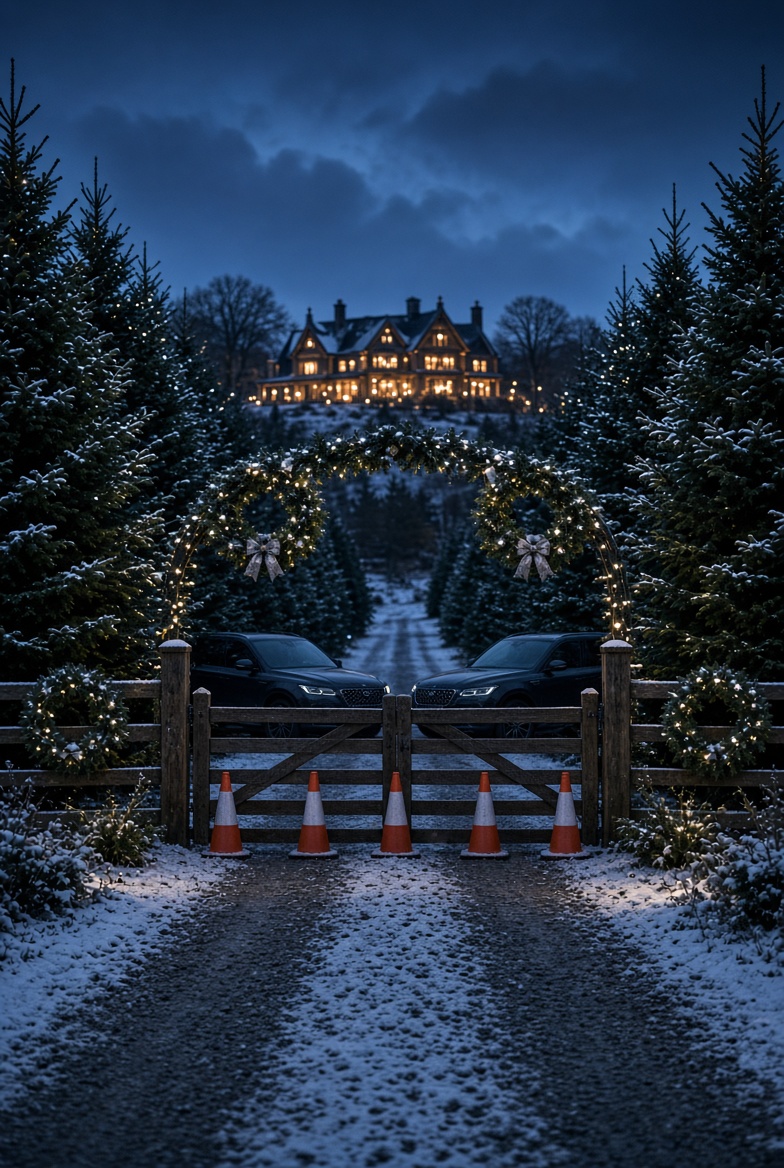
Valet cones blocked both hinges.
Fourteen guest SUVs lined his fence.
A wreath-covered sign actually read: HOA Event Access Only.
When Bryce asked her to open his own road, she only smiled.
“Tonight, this belongs to us,” she said.
She had forgotten one small detail.
Every caterer, rental truck, florist, wine supplier, and heating contractor had been routed through that road under his revocable permission.
Bryce didn’t touch her barricades.
He made six phone calls instead.
—
Six years before that Christmas Eve, the road that would decide everything was nothing more than a strip of packed gravel running between rows of Fraser firs.
Bryce Donnelly owned every inch of it.
His family’s land, Donnelly Tree Farm, covered ninety-six acres of rolling hillside on the western edge of the county, and for three generations, it had supplied Christmas trees to half the towns within a day’s drive.
Bryce had taken over at thirty-one.
After his father’s heart gave out in the middle of a December harvest, he was quiet, patient, and unusually careful with paperwork.
He read every contract twice.
He kept every deed in a fireproof cabinet.
He believed that most fights could be won before they started if a man simply knew what he had signed.
Then the developers came.
On the farm’s eastern boundary, a company carved out Northgate Ridge, an upscale community of stone-faced homes, manicured cul-de-sacs, and a sprawling clubhouse set at the very back of the property.
The front entrance was a showpiece.
It had a low stone arch, a tight decorative curve, and an ornamental bridge over a man-made creek.
It photographed beautifully.
It was nearly useless for anything larger than a pickup truck.
Refrigerated catering trucks could not clear the arch.
Rental box trucks could not make the curve.
The bridge carried a weight limit that ruled out heavy staging and lighting equipment.
The loading dock behind the clubhouse sat stranded a few hundred yards from a road nobody at Northgate Ridge owned.
That road was West Farm Lane.
It was wide and built for the heavy trucks that hauled Bryce’s trees to market every winter, and it ran entirely across his parcel before ending near the clubhouse’s back fence.
The original HOA board approached him with a generous offer to buy a permanent easement.
Bryce listened politely and said no.
He had seen what happened to farms that sold pieces of themselves for convenience.
One easement became two.
Two became a utility corridor.
Then came a lawsuit over who had to fix the potholes.
Instead, the two sides signed a revocable access license.
Under it, Northgate Ridge could route service vehicles down West Farm Lane during special events, but only under three conditions.
The HOA could never block the farm’s main gate.
HOA guests could never park on Bryce’s road.
And Bryce could revoke the license immediately if any condition was broken.
Section seven spelled out that last point plainly, stating that obstruction of the owner’s access was grounds for instant termination.
Further down, in a sentence Bryce insisted on adding himself, the agreement declared that it created no permanent easement or property interest of any kind.
Years later, Elaine Barlo would choose to forget that sentence.
—
Elaine had been HOA president for less than a year, and she governed Northgate Ridge the way some people decorate a mansion—as if every surface existed to reflect her.
She had replaced the board’s newsletter with a glossy magazine.
She had renamed the pool deck after a donor.
She had fined a retired couple for the color of their mailbox.
This Christmas, she wanted something bigger.
She planned a gala for more than two hundred adult guests with premium catering, a live band, full bar service, towering floral installations, and a heated terrace.
At the end of the night, she promised she would unveil a major project for the future of Northgate Ridge, though no one on the board knew exactly what it was.
Three weeks before the event, the gala’s planner, Megan Crowley, emailed Bryce a delivery schedule and asked to use West Farm Lane, just as the HOA had every year.
Bryce approved it as he always did, but he added one line and made it unmistakable.
“Keep my main gate completely clear,” he wrote. “Because December 24th is still a working day for the farm.”
Megan replied with a single word: “Understood.”
Elaine Barlo was copied on both messages.
Whatever happened later, no one could ever say she hadn’t been told.
—
On December 23rd, Bryce drove past the clubhouse on his way back from a delivery and slowed down.
A crew was hammering a new sign into the frozen ground near the edge of his fence line.
It was tall, professionally printed, and trimmed with pine garland.
In gold letters, it read: Northgate Ridge Christmas Gala—VIP Service and Valet Entrance.
Beneath the words, a bold red arrow pointed straight at his gate.
Bryce called Megan that same evening, and she swore the sign was only meant to guide vendor trucks toward the service lane.
He chose to believe her because it was Christmas and he still had more than forty trees left to deliver.
By 3:40 on the afternoon of Christmas Eve, he was finally heading home, his flatbed empty and his gloves stiff with sap.
Half a mile from the farm, he saw the lights.
Amber flashers pulsed along the shoulder.
Uniformed valets jogged between parked cars, and a line of headlights crept toward his property like a parade.
As he got closer, he slowed to a crawl, unable to believe what he was seeing.
Elaine Barlo had turned the front of Donnelly Tree Farm into the entrance of her gala.
Fourteen SUVs and sedans sat bumper-to-bumper along his fence, and two rows of orange valet cones funneled traffic toward his gate.
A towering arch of wreaths and white lights had been erected directly in front of the posts.
A sign reading “HOA Event Access Only” stood beside a check-in table draped in red velvet, set up squarely on his land, while two security guards in black jackets watched the road with folded arms.
Worst of all, two large SUVs had been parked nose to nose across the mouth of the gate, sealing both panels shut.
Bryce stopped his truck and stepped out.
He didn’t shout.
He didn’t slam the door.
He took out his phone, started recording, and asked the nearest guard who had authorized the use of this property as a valet entrance.
The guard glanced toward the check-in table.
A moment later, Elaine came striding across the gravel in a floor-length emerald gown and a white faux fur wrap, looking about as worried as a woman greeting the caterer.
She explained, in the tone of someone correcting a child, that Northgate Ridge needed a wider entrance for the volume of guests and that the HOA had been using this route for years.
Bryce reminded her that letting delivery trucks pass under a license was not the same as turning his frontage into a parking lot.
“We only need it for a few hours,” Elaine said.
Bryce told her he had farm equipment to bring in before dark and asked her to clear the gate within fifteen minutes.
Elaine didn’t even pretend to consider it.
“You can use your north entrance tonight,” she said. “This event is already in motion.”
It sounded reasonable to anyone who didn’t know the land.
The north entrance sat nearly two miles away at the end of a rutted dirt track, a gate built for hunters and fence crews, not for a working commercial farm.
Bryce asked the question one more time, slowly and clearly, so the phone in his hand would capture every word.
“Are you refusing to open my gate?”
Elaine looked directly into the camera.
“Until the gala is over,” she said. “Yes.”
Bryce simply nodded.
He didn’t call a tow truck.
He didn’t touch a single car, cone, or sign.
He walked back to his pickup, climbed into the cab, and opened the laptop he kept on the passenger seat for invoices.
In a folder labeled “Northgate,” he found the signed access license and jumped to section seven.
Obstruction of the owner’s access to his property, it said, was grounds for immediate termination.
He read it twice, the way he read everything.
Then he checked the clock on the dashboard.
It was 4:07.
According to Megan’s delivery schedule, the first refrigerated catering truck was due at 4:45, and dinner service was set to begin at 7:00 sharp.
Bryce had thirty-eight minutes.
He didn’t call Elaine back.
Instead, he opened the gala’s vendor list, found the first name on it, and dialed Clayton Fisk Catering.
—
Over the next twenty minutes, Bryce made six calls, one to each company holding a contract with the gala: the caterer, the event rental firm, the florist, the beverage supplier, the audio and lighting contractor, and the outfit providing heaters for the terrace.
He never told anyone to cancel anything.
He never threatened a lawsuit or raised his voice.
He simply delivered the same fact six times in a row.
Northgate Ridge’s permission to use West Farm Lane had been revoked, and any vehicle entering the lane from that moment on would be entering private property without authorization.
To every dispatcher, he emailed three documents.
The first was his recorded deed showing that West Farm Lane lay entirely inside his parcel.
The second was the access agreement with section seven highlighted.
The third was a written notice of revocation, timestamped at 4:12.
It was only one sentence long: “Effective immediately, Northgate Ridge HOA and its contractors no longer have permission to enter West Farm Lane.”
The dispatchers did exactly what Bryce expected, forwarding everything straight to their managers, their lawyers, and their insurance carriers.
Clayton Fisk called back first.
He had been in the catering business for twenty-two years, and he did not like surprises on Christmas Eve.
He asked whether there was another route that could handle a twenty-six-foot refrigerated truck.
Bryce told him there was the HOA’s main entrance on the east side, but he would have to ask the HOA whether his truck could fit.
Clayton went silent, because he already knew the answer.
His company had surveyed that entrance two years earlier for a wedding and concluded that nothing larger than a van could clear the stone arch safely.
Next, Bryce sent the revocation notice to Elaine, to Megan, and to every member of the HOA board.
Elaine’s call came less than four minutes later.
“You cannot cancel our Christmas gala,” she snapped.
“I’m not canceling your gala,” Bryce said evenly. “I’m canceling your right to drive on my land.”
Elaine announced that the HOA held an easement, and Bryce asked her to read him the recording number from the county recorder’s office.
For several seconds, there was nothing on the line but distant music.
“We have authorization,” Elaine finally said.
Bryce asked what authorization she meant and from whom.
Elaine hung up.
Bryce set the phone on the dashboard and dialed the sheriff’s office non-emergency line.
He didn’t ask anyone to arrest Elaine, and he didn’t ask for the cars to be towed.
He wanted only an incident number documenting that his property access was being obstructed.
Sheriff Amos Ridley, who prided himself on favoring no one, sent a deputy to take a report.
The deputy arrived just after 4:30.
He was young, polite, and careful, and he studied the deed and the agreement on Bryce’s laptop for a long time before speaking.
Then he said something that changed the shape of the evening.
If the license was truly revocable, and if it had been revoked according to its own terms, the sheriff’s office could not force Bryce to allow commercial vehicles across his land, which made it a civil dispute.
“Unless,” the deputy added, “someone tries to prove access with documents that turn out to be fake. Then it’s a different conversation.”
Elaine had walked over in time to hear that last sentence, and Bryce noticed what happened to her face.
The confident smile flickered for just an instant.
Then she turned on her heel and hurried back toward the clubhouse with her phone pressed to her ear, and she was gone for nearly ten minutes.
—
At 4:43, a white refrigerated truck bearing the Clayton Fisk logo appeared at the far end of the road.
At almost the same moment, Elaine returned, holding a thin stack of papers with an official county seal printed in the upper corner.
Elaine reached the truck before anyone else.
She stepped into the road and waved the driver toward the gate as if she were guiding a jet onto a runway.
Bryce didn’t move to block the truck, because he didn’t need to.
He simply stood just inside his property line, hands in his coat pockets, and waited.
The driver rolled to a stop, lowered his window, and picked up his radio, since his dispatcher had already received the revocation notice.
A moment later, Clayton Fisk’s voice came through the speaker, flat and final: without written permission from the property owner, his truck was not going in.
Elaine lifted her papers high.
She announced that the HOA held a temporary county event access authorization, designating West Farm Lane as secondary commercial event access for the night.
Bryce asked to see it, and Elaine refused to hand it over.
She only held it in the air and told the driver to go ahead.
The driver looked at the papers, then at Bryce, then at the deputy standing beside his cruiser.
Then he shook his head, shifted into reverse, and swung the truck around in a slow, wide arc.
The first delivery of the night disappeared back down the road.
It was only the beginning.
At two minutes before five, the rental truck carrying tables, chairs, and linens arrived, and it turned around.
At six minutes past five, the florist’s van pulled up with the centerpieces, and it turned around too.
At eighteen minutes past five, the lighting contractor idled at the edge of the road while the crew chief argued with his office, then drove away.
At twenty-seven minutes past five, the beverage shipment arrived, and its dispatcher refused to let the driver anywhere near the lane.
What enraged Elaine most was that Bryce wasn’t the one turning them away.
He hadn’t said a word to most of the drivers.
Their own companies, their own legal departments, and their own insurers were refusing to send employees onto property where they no longer had authorization.
No insurer wanted to cover a driver who damaged a gate or injured someone on land his company had been formally warned to stay off.
Elaine tried rerouting everyone through the HOA’s main entrance, and every old problem came back at once.
The catering truck could not clear the arch.
The rental truck was too long for the curve.
The lighting rig exceeded the weight limit on the decorative bridge.
Elaine told the drivers to just try it, and not one of them agreed.
By then, Megan Crowley had arrived, clutching a clipboard and a phone that would not stop buzzing.
Her entire schedule was collapsing in real time, and she looked as though she hadn’t breathed in an hour.
Elaine turned on her immediately, demanding to know why the vendors had not been properly coordinated.
Megan stared at her.
“I told you to keep the Donnelly gate clear,” she said.
Elaine flatly denied it.
Megan didn’t argue.
She opened her phone, searched for a few seconds, and turned the screen toward the deputy and Bryce.
It was an email Elaine had sent her three days earlier.
“We’re using his entire frontage for valet,” it read. “He’ll complain, but he always backs down.”
The deputy read it without expression, and Bryce said nothing at all.
Elaine changed the subject so quickly it was almost graceful, waving the county authorization again.
This time, the deputy held out his hand and asked to see it.
Elaine hesitated, then reluctantly surrendered the pages.
The deputy flipped through them slowly while Bryce leaned in to read over his shoulder.
The language was dense and official, and the seal looked convincing.
At the bottom of the final page, above a neatly typed line reading “Property owner consent,” was a signature that said Bryce Donnelly.
Bryce had never seen the document before in his life.
He had certainly never signed it.
In a single moment, a fight over a Christmas party had become a far simpler and far more dangerous question.
Who had forged his name on a paper bearing the county seal?
—
The deputy called Sheriff Ridley before Bryce had even finished saying the signature wasn’t his.
While they waited, Bryce pointed out another problem.
The document described West Farm Lane as an HOA-controlled secondary access route, which was not a matter of interpretation but simply false.
The HOA had never controlled one foot of that lane, and every agreement it had ever signed said so in writing.
Elaine stood a few feet away with her arms crossed, insisting to anyone who would listen that this was a misunderstanding that could be sorted out after the holidays.
Sheriff Ridley arrived twenty minutes later, a tall, gray-mustached man who moved slowly and missed nothing.
He did not arrest Elaine on the spot, and he did not raise his voice.
He did his job in order.
First, he called the county planning office’s after-hours line and asked the on-call supervisor to verify the permit number printed on the authorization.
There was no such permit.
Then he described the form itself.
The supervisor told him the county had never used that template and that the seal resembled the official one but matched a version retired years earlier.
Elaine’s story began to shift.
At first, she said the county had issued the document directly.
When that collapsed, she said the event planner had handled it, and Megan denied it so loudly that two arriving guests turned to stare.
Then Elaine claimed a consultant had prepared the paperwork on the HOA’s behalf.
Sheriff Ridley asked for the consultant’s name.
Elaine opened her mouth, closed it again, and said nothing.
Meanwhile, Bryce studied the pages more closely, and he noticed something that made his jaw tighten.
The parcel number was correct down to the last digit.
That was not a detail anyone could invent or guess.
Whoever built this document had gone to the county records, pulled his deed, and copied the number exactly before forging his consent on top of it.
This had not been a careless mistake made in a holiday rush.
It had been planned.
Joanna Pritchard, the HOA treasurer, had just reached the clubhouse and followed the voices out to the road.
She was a retired accountant in her sixties, soft-spoken and methodical, the kind of board member who read the budget footnotes nobody else bothered with.
When she saw the authorization in the sheriff’s hand, her face went pale.
She had seen it before, she said quietly.
Elaine had circulated it to the board nearly two weeks earlier, claiming Bryce had agreed to open permanent access for the gala.
Joanna turned to Bryce, confused, asking why he was denying it now.
Bryce handed her his laptop with the real agreement on the screen.
Joanna read section seven, then the clause stating that no easement or property interest was created, and Bryce watched the realization settle over her.
The board had approved vendor contracts, valet staffing, security, and signage based on a document they believed Bryce had signed.
Sheriff Ridley turned to Elaine and instructed her, in a voice that left no room for debate, not to delete a single email, file, or record connected to the gala or the authorization.
The atmosphere around the clubhouse had changed completely.
The lights still twinkled.
The wreath still glowed.
Soft jazz still drifted across the lawn.
But just beyond the arch, the president of the HOA was being asked to explain a forged signature, and the clock kept running.
—
At ten minutes before six, Clayton Fisk called Megan with a final warning.
If his truck did not begin unloading within fifteen minutes, dinner could not be served on time.
Megan looked at Elaine.
“What do you want me to tell them?”
Elaine didn’t hesitate.
“Tell them to wait.”
Bryce spoke before Megan could answer.
“They can wait anywhere they want,” he said. “Just not on my road.”
Elaine shot him a look of pure hatred and walked away.
A moment later, Joanna touched Bryce’s arm and drew him a few steps aside, out of earshot.
She glanced back at the glowing clubhouse and lowered her voice.
“You think tonight is just about a Christmas party?” she asked. “You need to know what Elaine is planning to announce after dinner.”
Joanna didn’t get the chance to explain right away, because by 6:00, the guests had begun arriving in earnest.
From the outside, the clubhouse looked flawless.
Thousands of white lights traced the roof lines.
A string quartet played carols in the foyer.
Couples in tuxedos and sequined gowns stepped out of luxury cars into the cold night air.
Most of the decorations had been installed the day before, so the ballroom itself still glittered.
To the guests walking through the doors, nothing appeared wrong.
Behind the scenes, it was a catastrophe.
Everything that had to arrive on the day of the event was missing.
There was no hot dinner, no dessert, no ice, and almost nothing for the bar.
The premium linens, half the cocktail tables, the extra sound equipment, the floral centerpieces, and the terrace heaters were all sitting in trucks miles away.
Elaine launched a rescue effort, ordering HOA volunteers to take their own SUVs and pick up whatever they could carry.
A few small things came back, including bags of gas station ice and a handful of folding tables from someone’s garage, but no one could move hundreds of hot plated dinners in the back of a family SUV.
Clayton Fisk refused to release food to people without proper refrigeration and warming equipment, because one case of food poisoning at a gala this size could put him out of business.
Elaine suggested he break the order into smaller vans, and Clayton refused to rebuild his logistics on Christmas Eve with half his staff already gone home.
Then Elaine offered him an extra ten thousand dollars.
Clayton told her that money did not change the fact that his trucks had nowhere legal to go.
At 6:15, guests began asking why the ballroom tables were still half-dressed.
At 6:25, the bar manager announced that he could not provide the service package the HOA had paid for, because his shipment had never arrived.
At 6:34, the band admitted they had only their basic equipment, while their sound system was still sitting in a truck on the highway.
Elaine began blaming Bryce openly.
Standing among a cluster of board members near the coat check, she told them the farmer was trying to extort the HOA.
Bryce heard it, because he had walked up to the clubhouse with the deputy and was standing near the door.
He stepped forward and handed Joanna his phone, already open to three items.
The first was his email asking that the gate be kept completely clear.
The second was the written revocation notice.
The third was the video of Elaine stating, on camera, that she would keep his gate closed until the gala was over.
There was no demand for money anywhere, and no offer to reopen the road in exchange for payment.
He had simply withdrawn a permission that had always been his to give.
Joanna studied all three and handed the phone back, and the board members around her had gone quiet.
They were beginning to understand what Elaine had not.
There was no version of this story in which Bryce could be made the villain.
—
At 6:42, Clayton Fisk emailed Megan a formal notice.
The catering contract was being closed out as a service failure caused by an inaccessible delivery location, and his crew was being released for the night.
There would be no dinner.
Not a late dinner.
No dinner at all.
From the clubhouse steps, Elaine watched the last two vendor trucks, which had been idling on the public shoulder in hope of a resolution, finally pull away.
Their red taillights stretched into the darkness and disappeared one by one.
Bryce checked his watch.
It was not yet 7:00.
Every delivery that mattered had been stopped before dinner, and he had never laid a hand on a single cone.
But Joanna wasn’t watching the trucks.
She was watching Elaine.
And she said quietly that the gala was the smallest part of this, because Elaine had needed West Farm Lane for something far bigger.
Joanna opened a folder on her phone and handed it to Bryce.
Inside was a presentation she had received weeks earlier, with a title page reading: “Northgate Ridge 2027 Expansion Access Certification.”
Bryce swiped to the site map.
West Farm Lane was outlined in thick red ink, cutting straight across his farm.
Beside it, in bold capital letters, was a label he had never expected to see anywhere.
It read: “Permanent HOA Service Corridor.”
The presentation explained everything.
Warren Slade, a regional developer known for turning sleepy clubhouses into lucrative event venues, was preparing to invest in a $3.8 million expansion of the Northgate Ridge Clubhouse.
The plan included a ballroom extension, a full commercial kitchen, a fitness wing, and new space the HOA could rent out for weddings and corporate events.
On paper, it would transform the neighborhood.
But an engineering review had uncovered a problem.
The main entrance could not handle construction traffic, and it could never handle the commercial deliveries a professional venue would need.
Without West Farm Lane, the project would require an entirely new access road across HOA land, at enormous expense.
So Elaine had promised Warren that the HOA controlled Bryce’s road.
The Christmas gala was supposed to be her proof.
More than two hundred guests, a valet entrance, vendor trucks rolling down the lane, HOA signage, and uniformed security would all be on display at once.
If the night had gone as planned, Elaine intended to film promotional footage for the developer and tell him that West Farm Lane had functioned as HOA access for years.
She wanted to dress up a revocable permission until it looked exactly like a permanent right.
Joanna had found an email that proved it, one a fellow board member had forwarded to her by mistake.
“Once we establish full event use this Christmas,” Elaine had written, “Donnelly will have a much harder time pretending that lane isn’t part of our access system.”
Bryce read the line twice, and suddenly Elaine’s behavior at the gate made perfect sense.
She hadn’t refused to move two SUVs because of valet logistics or guest convenience.
She had refused because she needed the entire night to look as if the HOA owned the road.
Now Bryce also understood why his name had appeared on a fake county authorization.
If Warren discovered that the HOA had no easement, the deal could collapse before it ever began.
So Elaine had needed paper to match her performance.
As it happened, Warren Slade was at the gala that night, standing near the empty bar with a club soda he had fetched from the kitchen himself.
Joanna walked straight up to him and handed him the real access agreement, freshly printed in the clubhouse office.
Warren read the first two pages in silence.
Then he turned to Elaine, who had followed them across the ballroom.
“You told me the HOA owned permanent access,” he said.
Elaine smiled tightly.
“I said we controlled access.”
Warren didn’t blink.
“No,” he said. “You said owned.”
The guests nearest them stopped talking, and when Elaine began explaining that ownership and control were functionally the same, Warren raised a hand to stop her.
Megan, meanwhile, had been searching the gala’s shared inbox, and she found something that made her stomach drop.
It was a note Elaine had sent her two weeks earlier, after Megan suggested double-checking the gate arrangements with Bryce.
“Do not contact Donnelly again,” it read. “We have authority to proceed.”
Megan showed it to Joanna without a word.
Then Joanna delivered the next blow, pointing to a line buried deep in the expansion budget.
$420,000 in access improvements, all of it earmarked for West Farm Lane.
In other words, Elaine had planned to spend hundreds of thousands of dollars of homeowners’ money paving and widening a road the HOA did not own.
The board had never been shown the original access agreement, and they had approved the budget on Elaine’s word alone.
Warren listened with the stillness of a man calculating his losses.
Then he closed the folder, tucked it under his arm, and spoke directly to Elaine, loudly enough for the board members around her to hear.
“Until ownership and access are resolved,” he said, “the expansion deal is suspended.”
Elaine stood frozen beneath a chandelier hung with silver ornaments.
An hour earlier, she had been the most powerful woman in Northgate Ridge, hosting the grandest party the neighborhood had ever seen.
Now her gala had lost its dinner, and she was about to lose the very project the gala had been staged to sell.
—
At 7:10, the moment dinner should have been served, the HOA board was instead crowded into a small conference room off the main hallway.
Joanna had called an emergency session.
Elaine objected immediately, insisting they could not hold a board meeting in the middle of a gala.
Joanna didn’t sit down.
“We’re not in the middle of a gala,” she said. “We’re in the middle of a liability event.”
Five board members took their seats.
Sheriff Ridley stood quietly near the door, and Bryce was invited to present what he had.
He didn’t give a speech.
He laid out his evidence one item at a time, like a man setting cards on a table.
First came the deed showing that West Farm Lane belonged entirely to him.
Second came the access agreement, with its clear statement that no permanent easement existed.
Third was his email asking that the gate be kept completely clear.
Fourth was the video of Elaine refusing to open it.
Fifth was the forged county authorization bearing his name.
Sixth was Elaine’s email ordering Megan never to contact Bryce again.
And seventh was the expansion presentation, labeling his road a permanent HOA service corridor.
Bryce didn’t connect the pieces for them, because he didn’t have to.
By the time the seventh document crossed the table, every face in the room had changed.
Elaine tried to call the forged authorization an administrative error, a paperwork mix-up by someone overwhelmed with holiday planning.
Sheriff Ridley spoke for the first time since entering the room.
“What kind of administrative error,” he asked, “produces a property owner’s signature?”
Nobody answered.
Joanna called for a vote, and the board unanimously suspended all of Elaine’s authority as HOA president pending an internal investigation.
Her corporate credit card was frozen before she left the room, and her power to sign contracts on behalf of the association was revoked.
Joanna was named interim president.
Elaine sat motionless at the end of the table, staring at the forged document as if it might change shape if she looked at it long enough.
Joanna’s first decision as acting president was to end the gala.
There was no reason to keep two hundred guests in a ballroom with no dinner, a half-stocked bar, and a band that could barely be heard past the third row.
She walked to the microphone, thanked everyone for coming, apologized for unforeseen circumstances, and wished them a merry Christmas.
The guests filed out, some confused, some amused, many whispering about what they had glimpsed through the conference room window.
Outside, the valets began pulling up the cones, and a maintenance worker unscrewed the HOA Event Access Only sign from its post.
The two SUVs that had sealed Bryce’s gate all afternoon were finally driven away.
And for the first time since that morning, both panels of the Donnelly Tree Farm gate could swing fully open.
Elaine came outside wrapped in her white fur and stood at the edge of the gravel, watching two workers dismantle the wreath arch she had ordered built only hours before.
The lights came down one strand at a time.
Bryce didn’t say a word to her, and he didn’t smirk or gloat.
He simply opened his gate, drove his pickup through onto his own road, and closed it behind him.
It was the smallest of gestures, and it said everything.
Elaine had spent the entire night trying to prove she controlled that gate, and she had lost control of it in front of the very people she had invited to witness her power.
But the board’s night was not over.
As they gathered their coats, Megan returned to the conference room and set a thick stack of cancellation invoices on the table.
Joanna picked up the summary page and read the number at the bottom.
The room went completely silent.
—
By the next morning, Northgate Ridge was counting the cost.
It was not some absurd figure in the millions, but a list of real, specific charges, each painful enough on its own.
The catering cancellation, and the prepared food that had to be thrown away, came to roughly $18,600.
Rental logistics and restocking fees added $7,400 more.
The floral order cost $4,900.
The beverage cancellation, $6,300.
The audio and lighting crew, $3,700.
And the temporary heating, $2,800.
Then came Megan’s overtime and cancellation fees, the valet and security contracts, and the refunds owed for gala tickets and for sponsorship packages.
Local businesses had bought those packages expecting their names on a glamorous evening.
When Joanna finished adding it up, the direct losses topped $70,000.
And that was the smaller problem.
On December 26th, Warren Slade formally suspended the $3.8 million expansion.
His company informed the board that it would not return to negotiations until an independent title opinion confirmed every access right the project depended on.
The HOA hired a new attorney, a real estate litigator named Daniel Hargrove, who reviewed the access agreement over a weekend and delivered his opinion without softening it.
Northgate Ridge did not own West Farm Lane.
There was no recorded easement.
Nor was there any reasonable claim that the HOA had earned one through long use, because for six years it had openly acknowledged in writing that it crossed Bryce’s land only by permission.
Elaine’s strategy had backfired completely.
The very license she had tried to bury was the strongest proof that the HOA had always known the road belonged to Bryce.
—
The county opened its own investigation into the forged authorization.
Sheriff Ridley had never needed a dramatic arrest in the middle of a Christmas gala with handcuffs flashing under the holiday lights.
He wanted something more durable.
Investigators collected the HOA’s emails, the original digital files, and the metadata showing when the document had been created and edited.
They wanted to know exactly who had copied Bryce’s parcel number, who had produced the outdated county seal, and who had typed his name above the consent line.
That slow, methodical approach made the consequences far heavier.
Elaine could no longer simply claim she didn’t know where the paper came from, because the file had passed through the HOA’s own accounts.
Joanna, working with the association’s IT contractor, discovered that the authorization had been uploaded to the shared board drive from the president’s office computer, using Elaine’s login, late on a Sunday night when the clubhouse was closed.
She turned the records over to investigators that same day.
At a special meeting in early January, the board voted to formally remove Elaine Barlo from the office of president.
They also voted that Northgate Ridge would not spend a single dollar of HOA funds defending any personal actions she had taken outside the authority the board had granted her.
Elaine had once planned to stand before two hundred guests and announce the future of the neighborhood.
Now she was hiring her own attorney to explain a document she had once believed would keep Bryce Donnelly quiet forever.
—
A few days after Christmas, the reorganized board asked Bryce to meet them at the clubhouse.
The ballroom was empty now, the tables stacked and the chandeliers dark.
Joanna did not ask him to let anything slide, and she did not ask him to pretend the night had never happened.
Instead, she admitted that the board had trusted Elaine far too easily and that they had approved decisions about his land without ever reading the agreement that governed it.
Then she asked whether he would consider restoring the access license.
Bryce said no to the old version.
If Northgate Ridge wanted to use West Farm Lane again, he explained, it would sign a new agreement with conditions that left no room for interpretation.
Every event would require advanced written notice, and every vendor would have to provide proof of insurance before setting a wheel on the lane.
There would be no guest parking, no valet operations, and no signage that could make anyone believe the road belonged to the HOA.
There would be no construction traffic of any kind.
The HOA would also agree in writing that no use of the lane could ever be cited to support a permanent easement claim, and a single serious violation would end the agreement permanently, with no second chances and no renegotiation.
Bryce slid the draft across the table.
Joanna read every page, then passed it down the line, and the board approved it unanimously.
—
Months later, Warren Slade’s expansion was redesigned around a new service road built entirely on HOA land, curving behind the community to the clubhouse dock.
It cost considerably more than Elaine’s version.
But as Joanna told the homeowners at the annual meeting, that was the real price of owning infrastructure instead of pretending to own someone else’s.
Some residents grumbled about the expense.
Most of them, having heard the full story, simply nodded.
There was one loose end.
On the morning after the gala, Bryce had found the old HOA Event Access Only sign leaning against his fence where the maintenance crew had abandoned it.
He didn’t keep it as a trophy or hang it in his barn.
He handed it to the county investigator, along with his photos from Christmas Eve, because that sign proved Elaine had publicly claimed control over his property hours before she ever refused to open his gate.
Afterward, Sheriff Ridley lingered by his truck, looking out over the rows of firs.
“She might have walked away from all this,” he said, “if she’d just moved those two cars.”
Bryce shook his head.
“No,” he said. “Those two cars were just how I found out what she was doing.”
The sheriff thought about that for a moment, then nodded slowly and drove away.
Bryce stood at the gate a while longer, remembering Christmas Eve.
Elaine had believed that two hundred guests, a wall of lights, and a glittering gala would make him too embarrassed to cause a scene.
She had counted on social pressure to do what the law never would.
She had assumed a quiet man would always choose to back down.
Bryce had done the opposite, and he had done it without a single act of aggression.
He hadn’t shouted.
He hadn’t damaged anything.
He hadn’t blocked a public road or confronted a single guest.
He had simply taken back the one thing the HOA had never owned: the right to cross his land.
And once that right disappeared, every contract, every promise, and every plan Elaine had built on top of it fell like a row of dominoes.
Late that afternoon, Bryce swung the farm gate open.
There were no valet cones anymore, no idling SUVs, and no wreath-covered signs.
There was only West Farm Lane, running quiet and empty between the long green rows of Fraser firs, with a light dusting of snow settling on the gravel.
He looked at the spot where the wreath arch once stood, and for the first time in days, he smiled.
“Elaine blocked my gate because she thought Christmas Eve made her untouchable,” he said to no one in particular. “Six phone calls later, every truck she needed had turned around before dinner.”
He pulled the gate closed behind him and latched it.
“The funny part is,” he added, “I never shut down her gala.”









