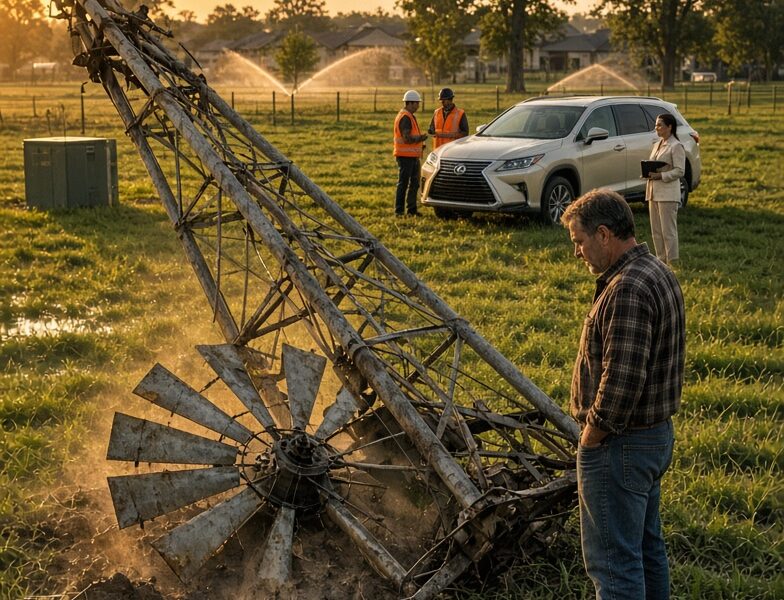
HOA Destroyed My Windmill — Then the Power Company Called Asking Why Everything Went Dark
“Take that tower down today, or I’ll have the HOA fine you $500 a day and remove it ourselves.”
Vanessa Whitmore said it from the edge of my pasture like she was reading a grocery list, one hand resting on a cream-colored folder and the other pointing at the windmill my father had kept standing for 37 years.
The morning air smelled like wet grass and machine oil.
Somewhere beyond the fence, sprinklers clicked across the new subdivision, neat little bursts of water flashing silver in the sunrise.
I looked at Vanessa, then at the old steel tower.
“You don’t have authority on this parcel,” I said.
Her smile tightened.
“Community safety gives us all the authority we need.”
That was when I heard the chainsaw.
It came from behind the maintenance truck parked near my north fence, a sharp mechanical whine climbing through the quiet.
Two contractors stepped into view wearing bright orange vests.
One carried the saw.
The other held a clipboard stamped with the HOA logo.
My boots crunched over gravel as I moved toward them.
“Stop.” I kept my voice level. “That equipment is on private property.”
Vanessa lifted the folder.
“Removal authorization.”
She sounded almost cheerful.
The chainsaw bit into the first brace.
Metal vibrated through the ground beneath my feet.
A flock of blackbirds jumped from the cottonwoods beside the creek.
I could smell hot steel now, faint but unmistakable.
“Vanessa,” I said, “you need to call this off.”
She checked her watch.
“You had 30 days.”
The second brace gave with a hollow pop.
For a moment, the windmill stayed perfectly still, 42 feet of weathered steel holding against gravity like it had done through every thunderstorm of my childhood.
Then the tower leaned, slowly at first.
One blade turned half a revolution in the breeze.
The gearbox clicked once.
I knew that sound.
Dad used to grease those gears every April, leaving blue pencil marks on the housing so he could track each service.
The tower tipped farther.
Vanessa stepped back toward her white Lexus.
The contractors cleared away.
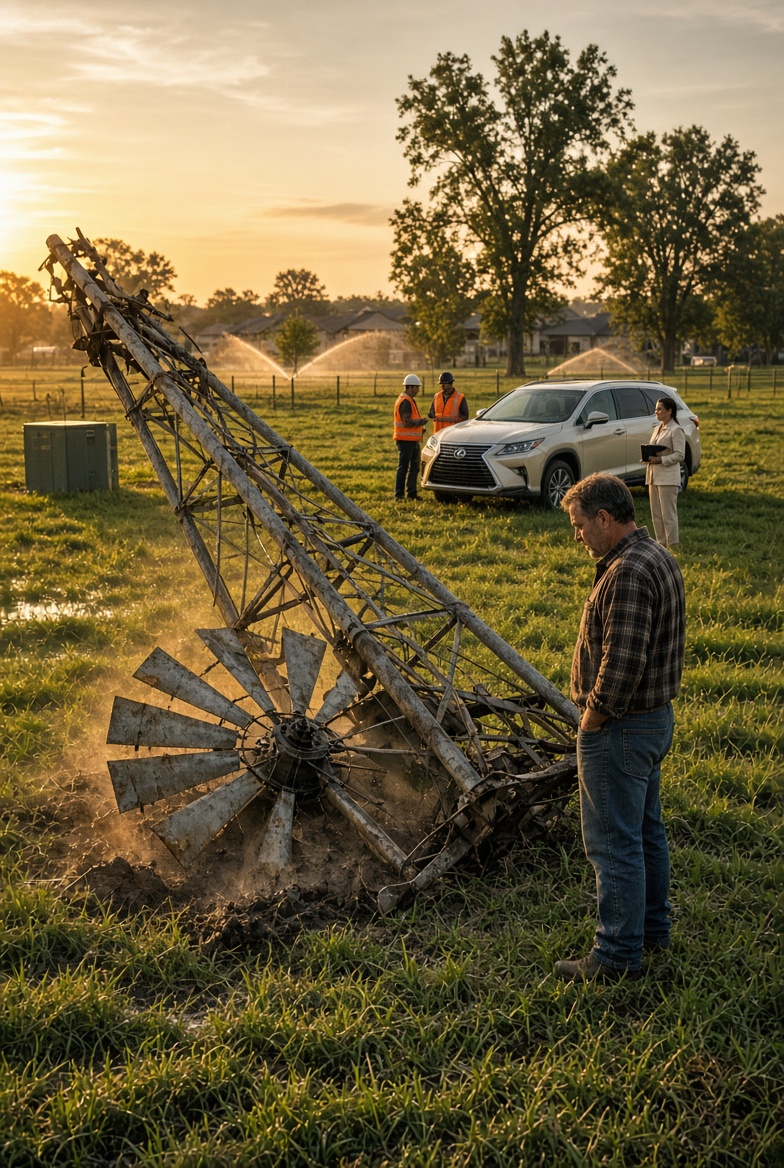
Steel met earth with a deep booming crash that rattled the porch windows behind me.
Dust rolled low across the pasture.
Then something stranger happened.
The usual hum from the north well disappeared.
Not faded.
Stopped.
Clean silence replaced it.
I stared at the collapsed tower, at the bent shaft disappearing into the grass, and felt the back of my neck go cold.
Vanessa brushed dust from her sleeve.
“There,” she said. “That wasn’t so difficult.”
My phone rang.
The caller ID read Utility Operations.
I answered without taking my eyes off the wreckage.
“Caleb.” Daniel Reeves sounded distracted, like he was looking at three screens at once. “Did somebody shut down your north well?”
I looked toward Vanessa.
Her expression had changed slightly.
Not fear, not yet.
Just irritation that my phone call was interrupting her victory.
“Nobody shut it down,” I said. “They cut the windmill down.”
Silence came through the phone first.
Then I heard Daniel tap a keyboard.
“Hold on.”
Another pause.
The wind pushed one fallen blade against the grass with a dry metallic scrape.
Daniel came back on the line, and his voice was different.
“Caleb, we just lost both downstream pumps.”
Vanessa stopped smiling.
I kept the phone against my ear while Daniel asked me not to touch anything until he arrived.
And that morning, I looked at the fallen tower the way my father had taught me to look at a machine, not as one piece but as a chain of parts, each one responsible for the next.
My name is Caleb Mercer, and I was 46 years old.
But standing there in that pasture, I felt 12 again, following Frank Mercer through waist-high grass with a grease gun in one hand and a coffee thermos in the other.
He never called the structure a windmill unless he was talking to somebody who did not know better.
To him, it was the North Drive, a mechanical head sitting above a deep well, turning wind into motion through a gearbox, a shaft, and a pump assembly buried far below the limestone.
The tower was 42 feet tall, galvanized steel weathered almost gray, with eight broad blades that clicked softly whenever a south wind came across our 38 acres.
Every April, Dad climbed the service ladder with the same faded canvas pouch, checked every bearing, packed fresh grease into the gearbox, and marked the housing with a short blue line from a carpenter’s pencil.
Those blue marks were still there now, visible through the dust on the twisted housing.
Each one a small record of a spring morning I had almost forgotten.
When I was a kid, I thought the whole system existed to water cattle and keep the old stock tank full during dry Texas summers.
That was only part of it.
Years later, after the subdivision went up beyond our eastern fence, utility trucks began appearing every spring, white pickups with blue logos parking beside the locked green cabinet at the base of the tower.
Two technicians would check gauges, write numbers on clipboards, and disappear before lunch.
I never asked many questions because Dad handled that side of things.
And when he died six years earlier, I inherited the land, the maintenance routine, and a filing cabinet full of papers I had promised myself I would someday organize.
One thing I did remember clearly was his warning.
He said it every time a contractor, surveyor, or curious neighbor asked whether the tower could be moved.
“Never move that tower without calling the water people first.”
He never explained why, and I never pressed him.
Back then, it sounded like one more rule from a man who labeled spare bolts by size and kept receipts for parts that had outlived three presidents.
Now the tower was on the ground, the north well was silent, and Daniel had just told me two downstream pumps had stopped within seconds of the collapse.
I crouched beside the gearbox and brushed dust from the brass plate riveted to its side.
Most of the lettering was faded, but beneath the manufacturer’s name were three stamped words I had seen hundreds of times without really reading them.
Auxiliary Water Drive.
Behind me, Vanessa was telling her contractors to load their equipment.
I heard a truck door slam, then the soft chirp of her Lexus unlocking.
My phone was still in my hand when Daniel spoke again.
“Caleb, do not let anyone leave with a single piece of that system.”
I stepped between the contractors and the fallen gearbox before either man could lift a wrench.
“Daniel Reeves from Utility Operations is on his way,” I said. “He asked that nothing be removed.”
The older contractor looked at Vanessa instead of me, which told me exactly who he believed was paying the bills.
Vanessa closed her folder with a crisp snap.
“This is an HOA matter, Caleb. The utility company has no jurisdiction over neighborhood aesthetics.”
There was that word again.
Aesthetics.
The polite wrapper she had been using for months whenever she wanted something on my land to disappear.
It had started in February with a handwritten note tucked beneath my mailbox flag.
She had called the windmill visually incompatible with the character of Willowbrook Reserve, the subdivision that had spread along my eastern fence like fresh concrete.
At first, her voice had been warm enough to sound reasonable.
“Would you consider repainting it?” she had asked, standing beside my gate in a cream blazer that probably cost more than the pump bearings I replaced every spring.
“Something neutral, maybe charcoal.”
I had told her the galvanized finish was there for a reason.
Two weeks later, she suggested landscaping screens, then taller cedar trees, then removing the blades because sunlight flashed off them during afternoon showings at the new model homes.
Every request arrived with the same smile and the same phrase.
Protecting property values.
I refused every one politely.
My property was outside the association boundary, and the survey pins had not moved since 1989.
That should have ended it.
Instead, Vanessa began sending notices.
First came a warning about an obsolete agricultural structure.
Then a demand for an engineering inspection.
Then a letter claiming the tower created a visual hazard visible from HOA common property.
I answered each one with the property survey, tax map, and deed page showing the exact boundary.
Vanessa never acknowledged the documents.
She simply sent another envelope.
By April, the envelopes were certified.
By May, they carried daily fine language.
By June, she had convinced the board to label the windmill an emergency nuisance, even though no inspector had set foot on my acreage.
That was when I understood she was not trying to improve anything.
She wanted the tower gone.
The reason became obvious one Saturday afternoon when I drove past the subdivision entrance and saw a 12-foot rendering mounted beside the sales office.
It showed a landscaped boulevard, stone monuments, and an uninterrupted hill country view stretching west toward my pasture.
The artist had removed one inconvenient detail from the horizon.
My windmill.
Vanessa was selling a view she did not own.
Now, standing beside the real tower she had finally managed to erase, she seemed satisfied for about 30 seconds.
Then a white utility pickup turned through my gate with amber lights blinking above the windshield.
Daniel stepped out before the truck fully stopped, wearing a navy work shirt, steel-toe boots, and the expression of a man who had been called away from a problem he already disliked.
He did not greet Vanessa.
He walked straight past her, crouched beside the brass plate, and wiped dust away with his thumb.
Then he looked at the severed drive assembly.
He froze.
“Who authorized this?” he asked.
Vanessa stepped forward before I could answer, holding her folder against her chest.
“Willowbrook Reserve authorized removal of a hazardous structure under its emergency nuisance authority.”
Daniel looked past her toward the crushed tower, then toward the green cabinet at its base.
“This parcel is outside your association.”
Vanessa opened the folder and pulled out three pages covered in signatures and legal language.
“Our counsel disagrees.”
Her tone carried the calm confidence of someone who believed paper could turn trespassing into policy.
Daniel did not argue.
He took photographs, called his control room, and asked for the morning telemetry logs.
Ten minutes later, another utility truck rolled through my gate, followed by a county service vehicle I had never seen before.
That was when Vanessa made her first phone call to the HOA attorney.
I could hear only fragments.
Utility dispute.
Private contractor.
Board authorization.
The contractors stopped packing and stood beside their truck, suddenly interested in the gravel beneath their boots.
The older man finally handed me his work order.
At the bottom, beneath Vanessa’s signature, was a sentence stating that the association accepted responsibility for property access and site authorization.
I read it twice.
Vanessa noticed.
“That language is standard.”
“Good,” I said. “Then you should be comfortable with everyone reading it.”
Her smile disappeared.
Around noon, a deputy sheriff arrived because Vanessa had called earlier, claiming I was interfering with authorized HOA work.
I showed him my deed.
Vanessa showed him her nuisance resolution.
The deputy studied both, rubbed his jaw, and said the kind of sentence nobody wants to hear during a property dispute.
“This is not something I can settle at the roadside.”
He told everyone to preserve records and let the civil and utility process sort out authority.
Vanessa heard only the part she wanted.
She straightened her blazer as if she had just won.
Her attorney sent me an email before the deputy even left.
It demanded that I refrain from obstructing HOA contractors and warned me against reinstalling any structure without architectural review.
Five minutes later, Daniel gave me a different warning.
“Do not reconnect anything yet.”
He pointed toward the severed drive and the cabinet.
“We need the system exactly as it is until engineering documents the failure.”
That hurt more than I expected.
Every instinct I had told me to grab tools, straighten what I could, and get the well moving again.
Instead, I had to stand there while the pasture went quiet.
By late afternoon, Willowbrook Reserve’s irrigation pressure had dropped.
Two decorative fountains were off, and residents were calling the management office.
Vanessa blamed aging utility equipment.
She told one board member, loudly enough for me to hear, that my obsolete farm machinery had finally proved her point.
Then she walked to the edge of my fence, looked west across the newly empty skyline, and folded her arms.
“Looks like the neighborhood finally gets its view.”
I looked at the flattened tower, the motionless blades, and the brass plate half buried in dust.
For the first time that day, I wondered if she might actually get away with it.
Then Daniel’s radio crackled behind me, and the dispatcher said something that made every utility worker turn toward the road immediately.
Daniel lifted his radio and listened while the dispatcher repeated the message.
Pressure had dropped across the eastern loop, and one booster station had entered automatic protection mode.
Nobody was without water yet, but the system was behaving like someone had pulled a plug.
Daniel looked at me, then at the tower.
“Show me everything.”
We started at the green cabinet.
Its lock was untouched, but the conduit beside it had gone slack when the tower fell.
Daniel opened a panel with a utility key and stared at two dead indicator lights.
He checked a gauge, then another.
“This was not decoration,” he said. “This was feeding our control sequence.”
That sentence changed the temperature of the afternoon.
Vanessa stopped talking to her attorney long enough to hear it.
The older contractor lowered his clipboard.
Daniel asked me when the tower had last been serviced.
I told him April.
He asked who performed the work.
“I did,” I said. “Same way my father taught me.”
He crouched beside the gearbox and found one of Dad’s blue marks under the dust.
Then he photographed the brass plate and called a supervisor.
I caught only half the conversation, but I heard three words clearly.
Legacy mechanical interface.
Vanessa heard them, too.
Her face tightened.
“What exactly does that mean?” she asked quietly.
Daniel stood and wiped his hands on a shop towel.
“It means this well predates your subdivision, and our records show it was incorporated into a backup pumping arrangement years ago. I need the original agreement.”
I almost laughed.
Original agreement.
Dad probably knew exactly where it was.
I only had to find it now.
I left Daniel with the utility crew and headed for the farmhouse.
The mudroom still smelled faintly of cedar, coffee, and the penetrating oil Dad used on stubborn hinges.
His old metal filing cabinet stood beneath the workbench, four drawers painted government gray.
I had avoided opening the bottom drawer for years after he died.
The handle squeaked when I pulled it.
Tax receipts, fence surveys, equipment manuals, county letters tied with faded string.
Then, behind a stack of well invoices, I saw a blue folder with my father’s block handwriting across the front.
North Well.
My chest tightened.
Inside sat a survey, maintenance logs, and a recorded utility agreement.
I carried the folder outside like it weighed 50 pounds.
Daniel spread the papers across my tailgate while the wind fluttered their corners.
He traced one line with his finger from my well to a notation beyond the eastern boundary.
Then he found the signature page.
Frank Mercer, County Water Cooperative, dated 1987.
Vanessa approached slowly.
“That cannot possibly apply anymore.”
Daniel did not look up.
“Recorded easements and utility agreements do not disappear because somebody builds expensive houses nearby.”
He turned another page.
A maintenance clause required advanced notice before alteration of any connected mechanical equipment.
Vanessa’s contractor stared at her.
She stared at the document silently.
Then Daniel’s tablet chimed.
He opened the telemetry graph and rotated the screen toward us.
A line ran steady until 8:16 and 43 seconds.
Then it dropped.
Nine seconds later, the first downstream pump shut down.
Seven seconds after that, the second one followed.
Daniel pointed at the timestamp.
“When did the chainsaw start?”
I checked the time on my phone and felt something inside me settle into place.
“8:16 and 43,” I said.
Daniel looked at the graph again, then at the contractors.
“That is the vibration spike.”
Vanessa folded her arms.
“Coincidence?”
Daniel gave her a long, quiet look.
“No.”
He zoomed in on the telemetry and showed us a second line beneath the first.
“This is shaft rotation from the north drive. It was steady all morning. At 8:16 and 43, it dropped to zero.”
The contractor holding the chainsaw stared at his boots.
Vanessa said nothing.
Daniel asked me whether I had security cameras facing the pasture.
I did.
One covered the gate.
Another watched the equipment shed.
And a third caught the north field from beneath the porch roof.
I pulled the footage onto my phone.
The recording showed Vanessa arriving at 7:58.
It showed her speaking with the crew, pointing toward the tower, and checking her folder.
At 8:16 and 39, the chainsaw started.
Four seconds later, the telemetry registered the first vibration.
I watched Vanessa watch the video.
Her face stayed composed, but her fingers tightened around the folder.
Daniel told everyone the site was now part of a utility incident review and nothing could be moved without documentation.
Vanessa objected immediately.
“You cannot freeze private HOA operations.”
Daniel nodded toward my pasture.
“These are not private HOA operations. This is his land, and that equipment connects to ours.”
That was the moment her certainty finally cracked.
Not dramatically.
No shouting, no scene.
Just a tiny pause before she answered, as if she needed time to find another rule to hide behind.
I knew that pause.
I had heard it from customers when a machine stopped obeying excuses entirely.
Megan Holt called me 20 minutes later after I sent photographs of the blue folder and the agreement.
She was a property attorney in town who had handled an irrigation easement dispute for my neighbor years earlier.
She read quietly, then asked one question.
“Did Vanessa sign the work order?”
I looked at the page still lying across my tailgate.
“Yes.”
Megan exhaled slowly.
“Then do not fix anything yourself. Photograph every cut, every bolt, every mark, every piece of disturbed ground. Let the utility document the system before anybody touches it.”
I hated that advice because it made sense.
By sunset, the pasture looked less like home and more like an inspection site.
Small orange flags marked the buried line.
A utility technician photographed the green cabinet.
Daniel measured the severed assembly twice.
Every click of his camera sounded louder than Vanessa had all morning.
Evidence had its own voice.
The neighborhood across the fence had gone strangely quiet, too.
Sprinklers were off.
The fountains near the entrance sat still.
Residents stood on sidewalks looking toward the utility trucks clustered on my property.
Vanessa began telling them the outage was temporary and unrelated.
Daniel heard her once and frowned hard.
He walked back to me as darkness settled over the field and handed me a printed incident sheet.
“Caleb, there is one more thing.”
I looked at the page.
Beneath the telemetry graph was a maintenance note from 1998.
Daniel tapped it once.
“Your father documented everything carefully.”
Daniel handed me the incident sheet while the last light drained behind the pasture, turning every utility truck window orange and every piece of fallen steel almost black.
The maintenance note was short, typed on paper yellowed at the edges.
Frank Mercer had recorded a pressure instability during a summer drought, then added a mechanical bypass recommendation beneath his signature.
Daniel traced the old diagram with one finger.
“Your father designed this connection so the north well could stabilize flow when the electric boosters were strained.”
I stared at the lines, suddenly understanding why those spring utility visits had mattered.
“He never told me that.”
Daniel nodded.
“Maybe he figured you would find the paperwork when you needed it.”
That landed harder than I expected.
Dad had always believed machinery should explain itself if you were patient enough to listen.
The next morning, patience became my only useful tool.
Megan arrived before 8 with a leather case, a travel mug, and none of Vanessa’s theatrical confidence.
She walked the boundary, photographed the survey stakes, then compared the recorded agreement with the homeowners association map.
“They have no ownership interest here,” she said. “Not an easement, not a maintenance right, nothing.”
Vanessa appeared 10 minutes later with two board members and her attorney, Charles Barlo, a silver-haired man carrying enough paper to make authority look portable.
Charles announced that the association expected immediate restoration of community water service.
Megan almost smiled.
“By whom?” she asked.
“The equipment owner,” Charles said, pointing toward me. “Your client.”
I looked at Daniel.
He shook his head once.
“No restoration until our inspection is complete.”
Charles tried another angle.
“Residents are being affected.”
Daniel answered without raising his voice.
“Then you should ask who authorized demolition of a connected water asset without contacting the utility.”
Nobody answered.
That silence was cleaner than any argument I could have made.
By noon, the homeowners association office was flooded with calls about weak irrigation pressure, inactive fountains, and temporary conservation notices.
Vanessa sent a community email blaming unexpected maintenance complications.
Megan read it twice, then forwarded it directly to the utility compliance officer.
“Save everything,” she told me. “Especially anything where she rewrites the timeline.”
So I did.
I saved emails, photographs, security footage, work orders, inspection notes, and the original telemetry graph.
Every file went into folders labeled by date and time.
Dad would have approved immediately.
Late that afternoon, Daniel’s team finished mapping the connection.
Orange flags now crossed my pasture in a clean line from the north well toward the subdivision.
Residents gathered behind the fence, watching technicians work.
Vanessa moved among them, explaining too much, smiling too hard.
Then one older neighbor called out.
“If Caleb caused this, why are all the utility trucks on his land?”
Vanessa pretended not to hear.
Megan did.
She leaned closer to me.
“Public stories collapse when physical evidence stops cooperating.”
I remembered the blue marks on the gearbox, the brass plate, the green cabinet, and my father’s warning about calling the water people before moving the tower.
Every detail Vanessa had dismissed as old farm clutter was now part of a documented system she had chosen to ignore.
As sunset reached the subdivision roofs, Daniel approached us carrying a sealed evidence envelope.
“You need to see this.”
Daniel opened the sealed envelope on my tailgate and pulled out three printed pages.
“These came from the contractor’s project file,” he said. “Their foreman gave them to compliance after realizing what they had cut.”
Megan stepped closer while Vanessa watched from across the pasture beside her attorney silently.
The first page was an email sent six weeks earlier from the contractor to Vanessa.
It asked whether underground utilities, easements, or connected mechanical systems had been cleared before demolition.
Her reply sat beneath the question in one clean sentence.
“Proceed under homeowners association authority. No outside approval required.”
I read it twice.
The paper felt dry and warm from the evening air, but my fingertips went cold.
Vanessa had not simply misunderstood the boundary.
Someone had warned her to check, and she had chosen not to.
Megan turned to the second page.
“This is worse,” she said softly.
It was a rendering of Willowbrook Reserve’s proposed western entrance, the same polished picture I had seen beside the sales office.
Stone columns framed the boulevard.
New cedar landscaping covered the fence line.
My pasture stretched behind it beneath a clean, empty horizon.
The windmill was missing entirely from view.
A handwritten note ran along the bottom margin.
“Once tower is gone, Mercer has less leverage on West Parcel.”
I looked at Megan.
She looked back at me.
Suddenly, every polite request made sense.
The paint suggestion, the cedar screen, the nuisance notices, the emergency resolution.
None was random.
Vanessa had wanted more than a prettier skyline.
The association had been positioning itself to control the strip of land between its entrance and my north field.
As long as the tower remained there, the old utility agreement complicated any expansion, purchase, or access plan involving that parcel.
Now I understood why she had been so impatient.
Daniel unfolded the third page.
It was another email, this one from Vanessa to the treasurer and the association attorney.
“Removal Monday morning avoids another delay from Mercer. Contractor is indemnified.”
Megan exhaled through her nose.
“Save that sentence,” she said.
Across the field, Vanessa noticed us reading and started walking over.
Her white shoes collected dust with every step.
“Those are internal communications,” she said.
Megan folded the pages carefully.
“Then you should probably discuss them with your attorney.”
Charles Barlo was already beside her, and his expression hardened.
For the first time since the tower fell, Vanessa did not answer.
Behind us, a utility technician tested the dead cabinet and called out another reading.
Daniel wrote it down.
No speeches, no accusations.
Just numbers, timestamps, signatures, and equipment sitting exactly where the morning had left it.
Evidence accumulated.
The next morning, the association board called an emergency meeting.
Vanessa sent residents a notice describing the situation as a complex infrastructure misunderstanding.
Megan forwarded me the message with four words.
“Do not respond yet.”
I listened.
By noon, two board members had requested copies of Daniel’s timeline, and the contractor had formally withdrawn from every remaining homeowners association project on my boundary.
The pressure problem was still being managed through temporary utility controls, so Daniel kept the north well untouched.
Vanessa had wanted me desperate enough to surrender leverage.
Instead, every silent pump was buying evidence.
By the time the emergency meeting began, every folding chair in the Willowbrook Clubhouse was filled, and the room smelled like coffee, printer toner, and nervous air conditioning.
I stood beside Megan near the back wall while Daniel arranged three folders across the board table.
Vanessa sat at the center, Charles Barlo beside her, both looking far more careful than they had two days earlier.
Daniel started with the telemetry.
At 8:16 and 43 seconds, the north well registered the vibration event.
Nineteen seconds later, its output dropped to zero.
The first downstream pump entered protective shutdown, and the second followed seven seconds after that.
Daniel placed my father’s recorded utility agreement beside the telemetry records.
Nobody spoke.
I could hear the refrigerator humming behind the refreshments table and the faint rattle of the air vent above us.
Megan passed copies of the contractor emails down the table.
One board member stopped at the sentence about removing the tower before I could delay them again.
Another stared at the western entrance rendering and asked why my property appeared in planning notes when I had never offered a single acre for sale.
Vanessa answered with the same smooth voice she had used at my fence.
She called the project conceptual.
She called the demolition a safety decision.
She called the emails informal discussion.
Then Megan asked one question.
“Which county inspector declared my tower unsafe?”
Vanessa looked toward Charles.
Charles looked down at his legal pad.
No answer came.
That silence did more work than any speech could have done.
The treasurer requested the signed work order.
Megan slid it forward.
Vanessa’s signature sat beneath the authorization language and the contractor indemnification.
The same document that had once made her look untouchable now made responsibility impossible to hide.
The board voted that night to suspend Vanessa pending an independent review.
She resigned two weeks later, one day before the scheduled removal vote.
The association’s insurer accepted the property claim.
The contractor’s carrier covered part of the restoration, and every notice against me was formally withdrawn.
Megan made sure the new board recorded a boundary acknowledgement stating that the association had no authority over my 38 acres.
The old utility agreement was referenced by recording number in black ink this time, where nobody could pretend not to see it.
Restoration took most of the summer.
We replaced the damaged blades, realigned the shaft, serviced the gearbox, and upgraded the green cabinet with fresh controls.
I kept the original housing because one of Dad’s blue grease marks was still visible beneath the dust.
On the morning we brought the system back online, a steady south wind moved across the pasture.
Daniel stood beside me with his tablet while the restored wheel turned slowly overhead.
The gearbox clicked once, then settled into the rhythm I remembered from childhood.
Pressure climbed through the north well connection.
Daniel watched the reading stabilize before calling the utility control room.
A moment later, the eastern boosters returned to normal service.
Across the road, the subdivision fountain started again, sending silver arcs into the morning light.
I rested my palm against the old gearbox housing and found that faded blue mark.
Dad was gone six years, but his lesson remained.
Justice does not shout.
It hums.









