Hitler’s Secret Road to World War II: How Four Years of Parades, Pacts, and Propaganda Pushed the World Over the Edge, From 1939 to the Horror of 1942
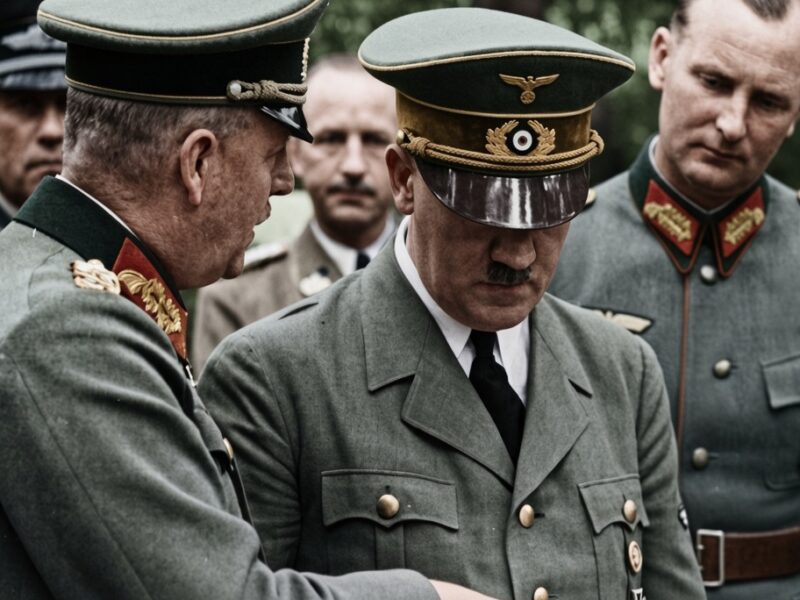
One of the men standing in Hitler’s inner circle in the summer of 1939 would later watch the dictator drive through a combat zone in an open car, grinning like a man in his element.
That image says almost everything about the story you are about to read.
It is a story of parades that hid war plans, treaties that were never meant to last, and a population that kept dancing on the edge of a cliff.
It is also the story of how a handful of amateur filmmakers, with cheap cameras and expensive color film, captured the Third Reich at its most confident and most terrifying.
Let’s go back to the spring of 1939, when Berlin still looked like a capital at peace.
On the 20th of April 1939, Adolf Hitler turned 50.
Propaganda minister Joseph Goebbels was not about to let the day pass quietly.
He staged a spectacle in Berlin so enormous that it was meant to be seen, and feared, far beyond Germany’s borders.
The parade rolled down the newly completed east-west axis for nearly five hours.
Tanks, guns, and marching columns filed past while the commander inspected his troops.
The message to the Western powers was blunt: do not mess with Germany.
Goebbels wrote in his diary that the Führer was fated like no other mortal had ever been.
It was exactly the kind of sentence he wanted history to remember.
Yet Hitler, the man at the center of all that pageantry, spent surprisingly little time in the capital that summer.
He preferred to plan his war over Danzig and against Poland far away from Berlin.
Ordinary Germans sensed that something terrible was coming.
Most understood that peace in Europe was hanging by a thread.
Still, many hoped Hitler would once again get what he wanted without bloodshed, the way he had before.
One journalist noticed an odd mood in the country.
People, he wrote, were enjoying themselves with reckless abandon.
On the 31st of July 1939, Hitler attended the Day of German Art in Munich.
A group of hobby filmmakers had prepared for the event for weeks.
They covered the day with several cameras and costly color film, giving us some of the most vivid images of the era.
Everybody who was anybody in the Third Reich sat on the VIP rostrum that afternoon.
They waited eagerly for the festive procession, a series of living pictures meant to show 2,000 years of Germanic history.
The pageant carried a clear and pretentious implication.
Not only the future, but the past too, was National Socialist.
An American observer was not fooled.
The Nazi procession, he wrote, was an admission of Hitler’s tireless plans of conquest.
When the festival ended, Hitler retreated to the Obersalzberg, his mountain hideaway.
He spent most of August there, receiving only a few guests at the Berghof.
One of them was the Italian foreign minister, Count Ciano.
To his ally, Hitler revealed a secret that would change the world.
He had decided to attack Poland before the end of the month.
SS chief Heinrich Himmler and security chief Reinhard Heydrich were to stage incidents on the Polish border.
Those fake provocations would give Germany the excuse it needed.
The man who influenced Hitler’s policy more than anyone else that August was Joachim von Ribbentrop.
For weeks, the Reich’s foreign minister had been negotiating with the Soviets.
His goal was a rapprochement between two countries that hated each other.
If it worked, the Soviet Union would stay out of the way when Germany marched on Poland.
On the 23rd of August, Ribbentrop flew to Moscow.
There he signed a treaty with the greatest ideological enemy the Nazis had.
The German-Soviet Non-Aggression Pact meant, from Berlin’s point of view, that the road to Poland was open.
Historians have described it as a devil’s pact that served both sides brilliantly at the time.
For Germany, the eastern flank was suddenly secure.
It could attack Poland with complete impunity as far as the Soviet Union was concerned.
For Stalin, the deal bought something just as valuable: time.
He knew Hitler would invade one day.
He believed that day would come in 1942 or 1943, and if he could hold out until then, the Red Army would be ready.
So the pact served both dictators for a while.
For the West, its meaning was grim.
War was no longer just likely.
It was certain, and it was certain in the very near future.
Danzig became a plaything in Hitler’s diplomacy of intimidation.
Most of the city’s population was German, yet it sat surrounded by Polish territory.
Under the Treaty of Versailles, the Baltic seaport stood under the protection of the League of Nations.
Nazi propaganda howled that Danzig must come home to the Reich.
Few believed that Poland’s allies, France and Great Britain, would send their soldiers to die for it.
That was exactly what Hitler was counting on.
In his own mind, the Western powers had refused to fight for the Sudetenland, so why would they fight for Danzig?
By focusing on one city, he hoped to break the link between the West and Poland.
But Danzig was never the real prize.
Hitler told his military leaders plainly that this was not about Danzig at all.
It was about Lebensraum, living space for Germany, and about expansion.
On the 23rd of August, the same day Ribbentrop signed in Moscow, mobilization began in Germany.
Hundreds of thousands of men fit for service poured into barracks across the Reich.
German newsreels suggested that, just like in 1914, the soldiers were keen to go to war.
Neutral observers saw something very different.
Everyone is against the war, wrote one American reporter.
How, he wondered, could a country enter such a decisive conflict when its people were so war-weary?
The answer came in the early hours of the 1st of September 1939.
A radio announcement claimed that Polish regular soldiers had fired on German territory for the first time, and that Germany had been returning fire since 5:45 a.m.
It was a lie.
An hour earlier, at a quarter to five in the morning, German troops had already crossed into Polish territory.
In the dark, they took Danzig by surprise and seized every official building.
The city’s last defenders had no choice but to surrender.
Two days later, Great Britain and France declared war on Germany.
Even then, Hitler believed he could still strike a deal.
He hoped the Western powers would stay out, allowing Germany to destroy Poland in a limited war.
But London and Paris stood firm.
Between the German attack on the 1st and the declarations of war on the 3rd, diplomats kept trying to maneuver.
By that point, though, there was little hope left.
The British made it clear they would do nothing unless the Germans pulled back from Poland.
Hitler would not.
From the 4th of September onward, the Führer stayed close to the front.
A rare amateur film shows him visiting German troops in Poland.
It is plain to see that he is in his element.
The war energized him so much that he insisted on driving through combat zones in an open car.
Even before the campaign began, he had declared that his goal was the obliteration of Poland.
On the 5th of September, the Chief of the General Staff wrote in his notes that the enemy was practically defeated.
The Wehrmacht, with its 1.5 million soldiers, was simply too strong.
On the 6th of October, Poland’s last defenders surrendered.
The armed forces honored their Führer with a victory parade through the streets of Warsaw.
A coup or an assassination might have stopped Germany’s descent into barbarity.
But army officers who criticized the regime could not bring themselves to act.
Then, on the evening of the 8th of November, a bomb exploded in a Munich beer hall.
It went off after Hitler had already left.
He had been forced to leave earlier than planned.
The Nazis accused Great Britain of being behind the attempt.
In truth, the man responsible had already been caught by border police while trying to flee the country.
Georg Elser was a carpenter, and he had built the bomb himself.
His goal was simple: to free Germany from its tyrant.
Hitler, who had said many times that destiny had chosen him for his task, now took the failed attempt as proof.
What had once been a pathetic cliché, one historian observed, became an iron law.
An opponent of the regime wrote in her diary that a terrible end now seemed more bearable than terror without end.
There was another war being waged at the same time, and it was aimed at Germans themselves.
Since 1933, the Nazi state had permitted compulsory sterilization to prevent children with hereditary diseases.
Now, with the country at war, the regime felt free to go much further.
Propaganda presented the killing of the mentally handicapped as a mercy, a release from suffering.
In October 1939, Hitler signed the decree for Action T4.
Around 90,000 patients would be murdered under the program.
War made radical measures much easier to enforce.
Action T4 was the first of the atrocious laws, and its purpose was the obliteration of people with mental or physical disabilities.
The killers even devised a way to keep it quiet.
Families received a letter saying their child had died of pneumonia and that the ashes would be sent to them.
The lie was meant to protect the relatives from knowing the truth.
It protected the regime far more.
At the beginning of 1940, Hitler received delegations of workers and farmers in the Reich Chancellery.
The war had pulled hundreds of thousands of men out of factories and fields.
Now there were gaps in industry and agriculture that the regime could not afford.
Keeping the home front motivated suddenly mattered.
The armaments program was a bigger problem.
It did not meet the dictator’s demands.
The planners had built it on the assumption that war would not begin until 1942, and they were now three years ahead of schedule.
None of this slowed Hitler down.
Preparations were already under way for an attack on Scandinavia, under the codename Operation Weserübung.
In the early hours of the 9th of April 1940, German troops landed in numerous Norwegian and Danish ports.
The citizens of Copenhagen watched with curiosity as more and more German forces came ashore.
At the same time, Norway was occupied.
The conquests carried a hidden benefit for the Reich.
Whenever the Germans took over a country, they set its required contribution at twice the amount of its last budget.
That is how the Nazi regime stayed fiscally afloat.
It was not the only reason for the war, but it was a decisive one.
Seen that way, the regime was never going to settle for a compromise.
It had never been willing to compromise in the first place.
The strain on ordinary people still showed.
A Nazi television report spoke of weeks of appeals to donate metal for the Führer’s birthday.
Yet even those donations on the 20th of April could not fix the shortage of raw materials.
Germans put up with the burdens, partly because in other ways the government left them more or less alone.
The soldiers, meanwhile, took care of the urgently needed supplies.
Some of the images from these months were shot by Edgar Forsberg, an army lieutenant stationed in occupied Poland.
By then, the Jews of Poland were living a different reality.
From November 1939, they had to wear a white armband with a blue Star of David.
In mid-1940, the Nuremberg race laws took effect in occupied territory too.
Jewish citizens were systematically stripped of their rights and robbed.
Whenever a German authority needed laborers, Jews were picked up on the street and driven away in convoys.
Soon, so-called Jewish councils were set up, and one of their tasks was to supply workers whenever the Germans demanded them.
In the spring of 1940, Hitler retreated to the Berghof near Berchtesgaden.
Private footage from that time shows his entourage gathered on the terrace: adjutants, secretaries, and old companions.
Behind the quiet scene, the dictator was planning a war against France.
His reasoning was simple.
If he could win before Great Britain gained a foothold on the continent, the British would beg for peace.
Along the French border, everything was locked down.
Ever since France declared war on Germany, the frontier between the two countries had been fortified and all traffic connections severed.
Edgar Forsberg’s division had been transferred to the Saarland.
There it practiced for battle with gas masks and smoke grenades.
For months, the Western Front stayed quiet.
The French gave this period a name that stuck: the drôle de guerre, the phony war.
It ended on the 10th of May 1940.
That was the day Operation Case Yellow began, and with it the blitzkrieg against France.
A total of 118 Wehrmacht divisions pushed through neutral Belgium, Holland, and Luxembourg and rolled toward France.
Within days, France lost tens of thousands of soldiers.
More than a million would be taken prisoner.
Historians still argue about how the Germans overran British and French forces so easily.
On paper, the Allies had more soldiers than the Wehrmacht, and twice as many artillery pieces.
Hundreds of thousands of civilians fled as refugees.
Charles de Gaulle would later write in his memoirs that France’s fate was sealed in a single week.
The advance moved so fast that German propaganda could hardly keep up.
In the summer of 1940, the Battle of France was reenacted for a color film called Artillery Intervenes.
The truth was much simpler.
The resistance of the French and British had been broken in just a few weeks.
Hundreds of thousands of Allied soldiers were cut off and trapped near Dunkirk.
Then Hitler made a decision that still puzzles historians.
He ordered his panzer divisions to halt, wanting to save them for the push south.
Luftwaffe commander Hermann Göring had promised to finish off the trapped enemy with his aircraft.
But despite heavy bombing, nearly 340,000 British and French soldiers escaped by ship.
On the 2nd of June 1940, Hitler landed at the airfield in Cambrai in northern France.
For the cameras, wounded German soldiers had been hastily flown in to serve as props for the Führer’s appearance.
Hitler’s pilot, Hans Bauer, recorded the scene with his own camera.
Another shot shows the victorious Wehrmacht leaders at lunch.
On the 13th of June, the French government declared Paris an open city.
The Wehrmacht marched in the next day.
Four days after that, the government under Marshal Pétain asked for an armistice.
A triumphant Hitler then toured occupied Paris at dawn.
Film taken on the front terrace of the Palais de Chaillot, near the Trocadéro, shows him with his entourage.
Albert Speer later said that this was the moment Hitler gave up his plan to destroy Paris.
When we are finished in Berlin, Hitler reportedly told his architect, Paris will only be a shadow.
On the afternoon of the 21st of June 1940, he arrived in Compiègne, northeast of Paris.
He wanted to be there in person when France signed its submission.
For the occasion, he had the very same railway carriage in which Germany had signed the armistice ending World War I pulled out of its museum.
It was theater, and he was the director.
Yet his terms were surprisingly moderate.
All his words, the Italian foreign minister noted, showed a desire to wrap things up quickly.
Hitler, he wrote, was like a player who had broken the bank and now wanted to leave the table without risking anything more.
There was a reason for the leniency.
Hitler was already thinking about his next step, and that step was the Soviet Union.
Within weeks of the stunning victory over France, he told his generals to start preparing for war against Moscow.
He imagined it taking place in the spring of 1941.
The logic he gave them was strategic.
He could not drive the British out of the war.
They refused to talk terms with Germany, even after France fell.
So Hitler argued that Britain’s last hope on the continent had to be destroyed, and that hope was the Soviet Union.
If the Soviet Union fell, Britain would be forced to the table.
America, standing in the shadows behind Britain, would stay in its own hemisphere.
Germany would effectively have won the war.
The notion was simple: defeat London via Moscow.
On the 6th of July 1940, Hitler returned to Berlin as a conquering commander-in-chief.
Nazi Germany was in a state of triumphant euphoria.
Peace had, for the moment, returned to the Reich’s capital.
The war seemed far away, and Germans enjoyed the summer.
Just like every other year, Berliners spread out to bask in the sun along the shores of the Wannsee.
In his diary, Goebbels noted absolute calm in politics and warfare.
Hitler’s lover, Eva Braun, was on holiday in Italy that summer, relaxing on a beach near Portofino.
She was allowed to travel only with her sister and her mother.
Only Hitler’s inner circle knew she existed.
She was kept hidden from the public eye.
Across the Channel, the mood was entirely different.
Neville Chamberlain had resigned on the 10th of May 1940, and Winston Churchill took his place as Prime Minister.
Within weeks, he became Hitler’s worst enemy.
Churchill grew into the complete opposite of Hitler, a symbol of British defiance and resistance.
In late May, he persuaded the War Cabinet not to seek terms with Hitler through Mussolini but to stay in the war.
At that moment he had no real hope of help from America.
Britain stayed in the fight, and the troops came back from Dunkirk.
Churchill turned a major defeat into something close to a triumph, and he spoke of the miracle of Dunkirk.
From late May 1940 on, his speeches became a rhetorical weapon of British resistance.
They also did something just as important: they shored up the nation’s morale.
In July 1940, the Battle of Britain began.
The goal was to prepare an invasion of the island.
Germany now had airfields in Belgium, Holland, and northern France, which let its aircraft fly on less fuel and carry bigger payloads.
Despite the disaster in France, morale in Britain stayed high, thanks in large part to Churchill’s fervent speeches.
In the skies over England, Royal Air Force pilots inflicted heavy losses on the Luftwaffe.
Hitler celebrated his victory over France by promoting a dozen generals to Field Marshal and naming Göring Reichsmarschall.
He also appealed to the British to yield to reason.
The government in London flatly rejected any negotiation with the Nazis.
That refusal risked an invasion by the Wehrmacht, which was already being planned under the codename Operation Sea Lion.
The Führer promised his allies that he would soon break the resistance of the island kingdom.
Privately, he had doubts from the start.
It was a risky venture from the German point of view.
There was not enough time to gather enough ships for a swift landing.
The fear was that the British fleet, parked at Scapa Flow off Scotland, would sail south and destroy the invasion force.
Then the Luftwaffe failed to destroy the RAF, and instead suffered severe losses of its own.
Operation Sea Lion was postponed until the spring of 1941.
In reality, it was postponed forever.
The bombing, however, did not stop.
London became the main target of raids that dragged on for months.
Hitler’s stated aim was to wipe the capital of the Empire from the face of the earth.
His bombers also struck industrial cities such as Coventry, hoping to break the morale of the population.
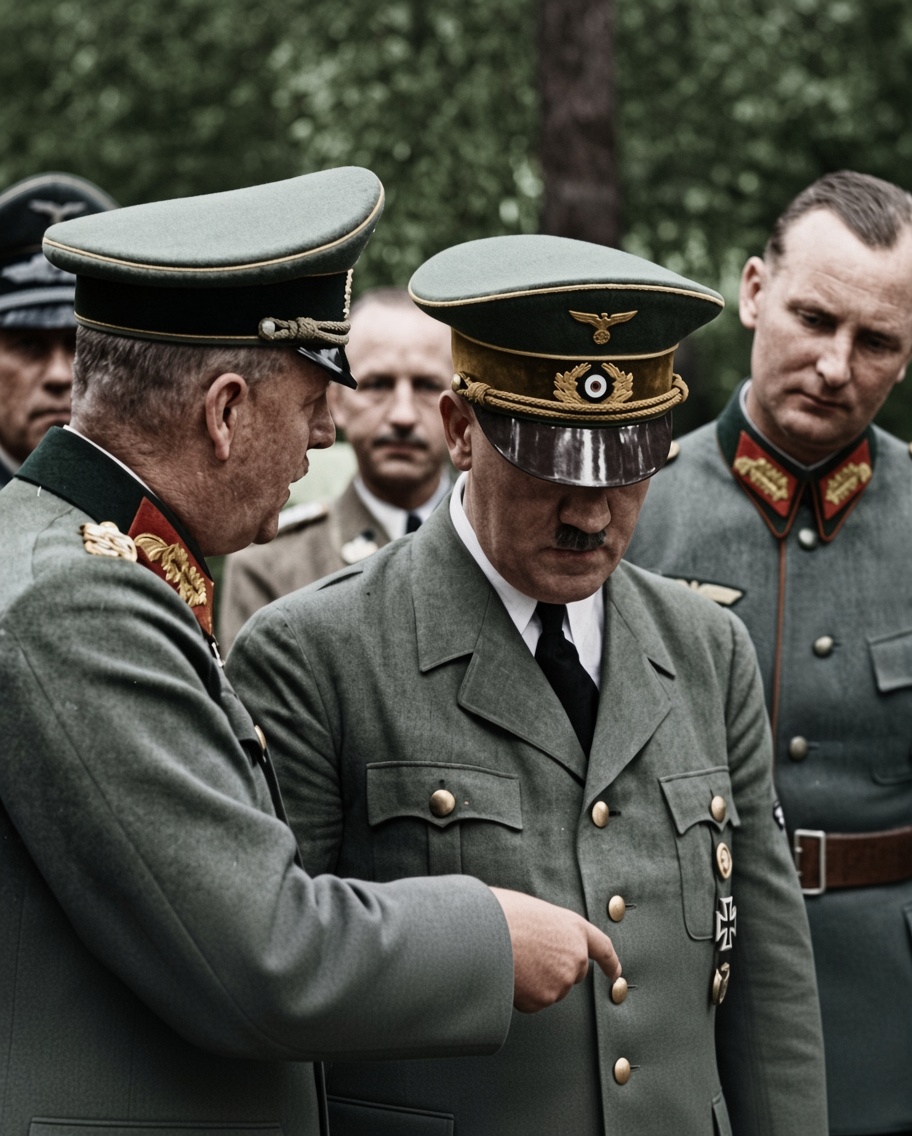
By the end of 1940, around 23,000 people had died in the airstrikes in Britain.
Berliners, on the other hand, stared in astonishment when a bomb hit their city.
The first RAF raids on German cities came in the summer of 1940.
A few times, the bombers even reached the capital.
Churchill wanted the Nazis to understand that their center of power was within reach and vulnerable.
Hitler was outraged.
Goebbels, strangely, was pleased.
Now Berlin was in the middle of the war too, he wrote, and he called that a good thing.
In November, Soviet foreign minister Vyacheslav Molotov was visiting Berlin when an air raid hit.
Since the Non-Aggression Pact, Stalin had led a costly campaign against Finland.
Thanks to the pact’s secret protocol, he had also annexed eastern Poland and the Baltic states.
The alliance still held.
But before the year ended, Hitler decreed that planning for the war against the Soviet Union should be finished by May 1941.
Meanwhile, in occupied Poland, the regime was redrawing the map.
One part of the country had been absorbed into the Reich.
The rest was named the General Government and placed under German administration.
About 1.4 million Jews lived in those territories.
To this day, no one knows exactly what the Nazi leadership planned for them at that stage.
After the victory over France, one idea was debated for a while: banish all Jews from German-controlled areas to the island of Madagascar.
At the same time, plans for mass deportations to the far east of the General Government were already on the table.
Concentration camps were to be built there.
For now, many Jews were put to work as slave laborers.
After the recent victories, plenty of Germans naively believed that peace would return.
The few remaining critics of the regime knew better.
Karl Friedrich Goerdeler wrote that the German Reich’s debt was so high that it could not be repaid even if Poland and France were pillaged completely.
If the war ended now in a compromise peace, he warned, the German people would face an unavoidable budget crunch.
He believed the Nazi regime would take the easy path instead.
It would keep fighting and keep attacking more countries.
That winter of 1940 and 1941, more and more young men were drilled for Hitler’s new war plans.
One of them was Goertz Hirtreger, who trained as a radio operator at the Schlieffen barracks near Berlin.
He was also a filmmaker, and his camera would soon capture history.
In Paris, German soldiers marched down the Champs-Élysées.
The military presence was impossible to miss.
More than 20,000 Wehrmacht troops were stationed in the French capital, and the victors were eager to show the defeated who was boss.
The orders of the occupiers were enforced without mercy.
The occupation regime bent the country’s entire economy to German budget planning.
Jewish businesses were systematically seized and handed over to non-Jews.
Those who had money and connections fled the country.
The Germans also introduced a clever financial trick.
Soldiers stationed in occupied countries could take money with them or have it sent to them, and then exchange it for local currency.
So a soldier would bring his marks to the paymaster’s office in, say, France.
The money went straight into the Reich’s treasury as tax revenue.
In return, the soldier got French francs, Norwegian kroner, or Polish zloty, paid out of the occupation costs of that country.
That came, of course, at the expense of the local economy.
For the occupiers, life in the conquered cities could be sweet.
Wehrmacht doctors organized and supervised it.
They requisitioned brothels across France, where prostitutes entertained the troops.
Officers preferred more refined services.
Rare footage survives from one such upscale establishment, probably in occupied Paris.
On the 1st of May 1941, Hitler visited Vienna.
Just as during his visit in 1938, Austrians lined the streets to cheer their Führer.
His charisma, it seemed, was still intact.
He believed he was ready for the campaign against the Soviet Union.
But in April 1941, his plans had suddenly changed.
He first had to send his troops to another front.
Mussolini’s Italian forces had intervened in Greece, and the effort was about to turn into a disaster.
So the Wehrmacht invaded Yugoslavia first, then marched into Greece.
Among the troops was Gottfried Kessel, an officer in the infantry regiment Großdeutschland.
He was a keen hobby filmmaker, and his unit gave him an unusual assignment: keep a war diary on film.
After eleven days of fighting, the Yugoslav army surrendered unconditionally.
Some 350,000 soldiers became prisoners of war.
Kessel filmed in occupied Belgrade soon after the surrender.
His footage shows Serbian soldiers locked up in the citadel of the Yugoslav capital.
On the 22nd of April, he recorded something much darker.
It was a brutal act of retaliation by the Wehrmacht.
Partisans had killed two SS officers and nine civilians.
As a reprisal, twelve former Serbian soldiers were executed by the cemetery wall in Pančevo.
Then came one of the strangest episodes of the entire war.
Rudolf Hess, Hitler’s deputy, had been losing influence ever since the war began.
He knew a campaign against Stalin was coming.
And he nursed a private hope of reaching a peace agreement with Great Britain first.
On the 10th of May 1941, Hess flew alone to Scotland in a Messerschmitt.
He believed he could kick-start peace talks with the British government.
The attempt was hopeless.
Hess hoped to persuade Britain to join an alliance with Germany, something Hitler had always wanted but which had long since been destroyed by events.
At the last minute, worried about a two-front war, he thought he could step in personally.
He imagined he could use contacts in the British establishment, perhaps even reach the king, and convince Britain to see sense.
At the very least, he hoped it would stay out of Germany’s way.
All that happened was that he was arrested and imprisoned.
Surprisingly, the British did not turn it into the propaganda coup many expected.
In Germany, the flight was presented as an act of treason.
Hitler declared that Hess was delusional and stripped him of every party office.
The Führer was devastated, Goebbels wrote in his diary.
What an image for the world to see, he added: a mentally disturbed man as the Führer’s second in command.
He called it appalling and unthinkable.
All through 1941, the British stepped up their air raids on German cities.
Time after time, RAF bombers broke through the German anti-aircraft defenses.
Footage of the aftermath of a raid on Berlin was filmed in secret.
Films like that were forbidden.
The regime did not want the population’s resolve to weaken.
Then, in the early hours of the 22nd of June 1941, the largest invasion in history began.
It was called Operation Barbarossa.
From East Prussia, the 20th Panzer Group of Army Group Center crossed into Belarus.
Goertz Hirtreger, the radio operator on duty, filmed the first days of the war.
The Red Army was taken by surprise.
Within four weeks, Hitler’s soldiers had advanced deep into Ukraine.
The Nazi leadership thought it could crush the giant with feet of clay in a single blow.
This war was not a normal one.
It was, quite clearly, a war with economic and political goals.
From the start, the planning rested on an assessment by the Reich Ministry of Nutrition.
Tens of millions of people in the Soviet Union would have to die so that Germans could take the agricultural output of Ukraine.
The directive was drawn up several weeks before the war even began.
The other main goal was raw materials.
Germany wanted the oil fields at Baku, and the coal and iron ore deposits, to feed its war machine.
Hitler’s battle-hardened divisions inflicted heavy defeats on the Red Army.
Hundreds of thousands of Soviet troops were captured.
The Führer ordered that all political commissars be executed immediately.
The rest were penned into makeshift camps.
Survivors were taken to Germany to become slave laborers.
In the first days, Soviet troops were poorly placed to resist.
Massive numbers were captured, and the progress was swift.
The war looked as if it would be over in no time, just as the German leadership had expected.
Hitler himself said four or five months.
Some of his military leaders thought even less.
They were not alone.
British and American intelligence both believed Germany would win within weeks, not months.
After a couple of weeks, the Chief of the General Staff, Franz Halder, thought the war was practically won.
He would have to change his mind quickly.
In late August, the dictator arrived in Ukraine to visit the troops.
The vast spaces of Russia, Hitler declared, would soon become Lebensraum for German settlers.
The soldiers greeted their supreme commander with frenzied cheers.
Most of them did not know that a genocide was already under way behind the front.
No written order was ever found.
What historians have found are several authorizations from Hitler, issued in the summer or even the spring of 1941, before Barbarossa began, for the destruction of the Jews in the Soviet Union.
In the autumn of 1941 came orders for the deportation of German Jews into an area where genocide was already taking place.
For roughly six months, partial genocides grew larger and spread wider.
By the spring of 1942, outright genocide of all Jews in German-occupied Europe was in view.
SS chief Himmler visited a camp for Soviet prisoners of war near Minsk, accompanied by a camera crew.
From the 2nd of July, SS task forces had operated behind the front lines.
Their orders were to liquidate Soviet party officials and Jews.
The murders were called retaliatory measures.
In late July 1941, on the outskirts of Libau, now Liepāja in Latvia, a sailor named Reinhard Wiener filmed the execution of Jews by one such task force.
In the first five months of Barbarossa, more than half a million Jews fell victim to German killing squads.
Ghettos were set up all over occupied Poland.
In Krakow, the remaining Jews were forced into a ghetto, allowed to take only a few belongings with them.
Like a huge dragnet, the Nazis herded their victims in from all over Europe.
Conditions for the deported would soon worsen rapidly.
For the first two years of the war, Germany had actually supplied occupied Poland with food.
Then, at the end of 1941, the nutrition minister said they would have to send food to Germany instead, and he traveled to Krakow to bring the news to the occupation administration.
They protested.
They said they could not do it without risking hunger riots, and they did not have enough police to enforce it.
His answer was chilling: soon, he said, this land would be cleansed of Jews.
The meaning was obvious.
They would all be exterminated, and there would be two million fewer mouths to feed.
Hans Frank, an old companion of Hitler, had been Governor General of Poland since October 1939.
The eloquent lawyer was one of the architects of the genocide from the beginning.
The two million Jews living under his rule were oppressed with ruthless brutality.
At the front, the great gamble was running out of time.
Rain and mud slowed the German advance deeper into the Soviet Union.
By the original plan, Moscow should already have fallen.
Supplies were running short, and equipment was inadequate.
It is a well-known fact that the German army marched into the Soviet Union without winter equipment.
Dragging it along would have slowed the advance, so the troops set off with light gear.
It reflected a pattern in Hitler’s thinking.
Everything was calculated on a three-month war.
We either make it or we don’t, the logic ran, and if we don’t, we go down.
To win, they had to put all their eggs in one basket.
That, in the end, led to the disaster outside Moscow and Leningrad in the winter of 1941 and 1942.
Hitler ordered an attack on Moscow.
But the exhausted troops at the front had to stop in the snowdrifts.
German propaganda, of course, painted a different picture.
Newsreels showed Panzer Group Guderian attacking southwest of Moscow and proclaimed that only the best soldiers in the world could master such tremendous hardships.
At home in Germany, another kind of propaganda was being filmed.
In early November 1941, cameras entered a special shop for Jews on Seestraße in Stuttgart.
At that time, 163,000 Jews still lived in the Third Reich, and they were required to wear the Star of David on their clothes.
The film, titled The Jewish Store, was meant to show that Jews in Germany could buy food just like the Aryan population.
It was a staged lie.
On the 7th of December, the entire shape of the war changed.
Japanese bombers and fighters attacked the U.S. naval base at Pearl Harbor in Hawaii.
For President Roosevelt, the attack came at the right moment, and it plunged America into a patriotic frenzy.
The United States declared war on Japan, and Hitler responded quickly.
On the 11th of December, three days after the outbreak of war between Japan and the USA, he addressed the German nation from the Reichstag.
Germany and Italy, he declared, had decided to fight alongside Japan against the United States and England.
To Hitler, the attack by Japan looked like a chance.
The Japanese would tie down the Americans in the Pacific, he thought, and that would free his U-boats to strike in the Atlantic.
He believed the Battle of the Atlantic would be decisive.
If German submarines could stop American ships from reaching Britain, then Britain would be forced back to the conference table.
Germany would have effectively won the war in Europe.
For a moment, Pearl Harbor seemed to hand Hitler exactly the opening he had been waiting for.
With confidence, Nazi Germany sent its U-boats to the American coast.
The goal was to cut the supply lines between America and Britain.
German propaganda proudly showed images of New York, filmed by a newsreel cameraman.
At first, Operation Drumbeat worked.
In one newsreel, a tanker is spotted at nightfall, the U-boat takes up its attack position, a hatch is declared clear, and a hit is called.
After returning, Lieutenant Commander Topp boasted that the Americans had been given a torchlight procession of burning tankers.
U-boat captains gladly fed the propaganda machine a distorted picture of a chivalrous war.
One report claimed that Topp’s boat had sunk 208,000 tons of enemy shipping.
On his last mission alone, it said, he had sent seven enemy merchant ships, five of them fully loaded tankers, to the bottom of the sea.
Goebbels made sure Germans soaked up such reports.
Hitler now rarely appeared in public, so Goebbels stepped into the dictator’s role on the home front.
Footage survives of one speech in Munich, which was never shown in German cinemas.
The time was not yet ripe for Goebbels’s total war.
Behind the headlines, the fate of millions was being sealed.
Over three million Soviet soldiers had been captured during Operation Barbarossa.
Propaganda portrayed them as subhumans, Untermenschen, who deserved no pity or help from the German population.
The prisoners were left in terrible neglect.
Hundreds of thousands of them died in the camps in 1942.
In late April 1942, Benito Mussolini visited Hitler on the Obersalzberg.
The two dictators put on a show of unity and strength.
The reality was shakier.
Their joint campaign against the Soviet Union was stuck, and in North Africa their troops were under pressure.
The Afrika Korps could hold its ground for a while, and even managed to weaken the British expeditionary forces.
An unknown amateur filmmaker captured images from that time.
One shows a private being awarded the Knight’s Cross.
It was one of the highest military decorations for bravery, but it was handed out more and more often as the war went on.
The soldiers were still carefree and confident of victory.
Back in Germany, a different scene was unfolding.
Jews from Stuttgart were gathered in an assembly camp, waiting to begin their journey to the East at the request of the German authorities.
Most of them believed they were headed to labor camps.
Officials in the ministries and the security services knew better.
They had long known that the Final Solution was already under way.
Eleven million European Jews were to be deported to extermination camps.
By spring 1942, the process of partial genocides had hardened into a single all-out attempt to physically destroy the Jews across Europe.
And now that process was unstoppable.
The machinery was in place, and so was the bureaucratic apparatus.
Jews were being caught and deported in every country where they could be found.
A momentum had been set in motion that no longer depended on any single person.
It would continue until the Jews were destroyed.
Nowhere was the horror more visible than in Warsaw.
The ghetto held about 400,000 people, packed together like sardines in appalling conditions.
A classified report from the German propaganda department, dated the 21st of March 1942, noted that deaths in the ghetto still hovered around 5,000 a month.
A doctor inside the ghetto reported that people fell asleep in a bed or on the street and were dead by the next morning.
And the German governor of Warsaw predicted that all that would remain of the Jewish question would be a cemetery.
From the glittering birthday parade of 1939 to the ghetto streets of 1942 is just three years.
In that short span, a dictator who staged his own legend ended up driving a continent into the abyss.
It is a reminder that catastrophes rarely announce themselves.
They arrive disguised as parades, as treaties, as sunny days at the lake, and as newsreels that insist everything is under control.









