His Puppy Barked at the Snowy Woods — What They Found Forced a Broken Marine to Face the Friend He Abandoned
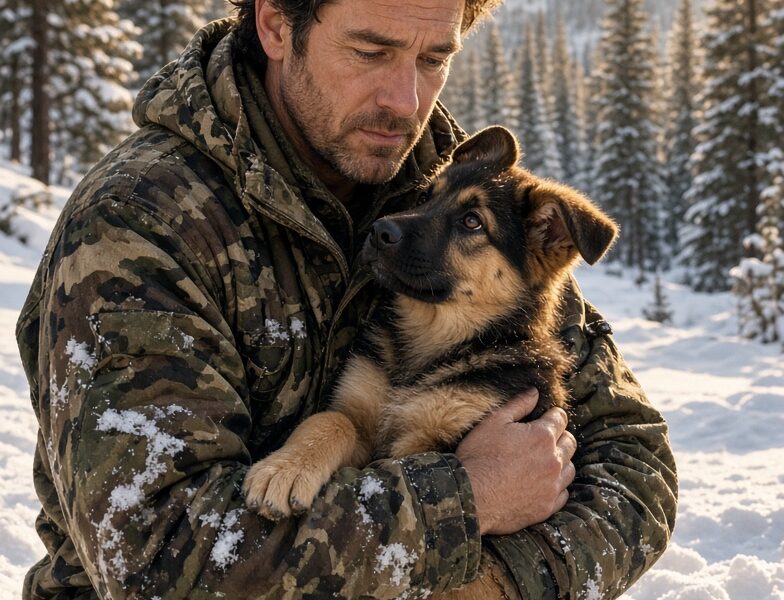
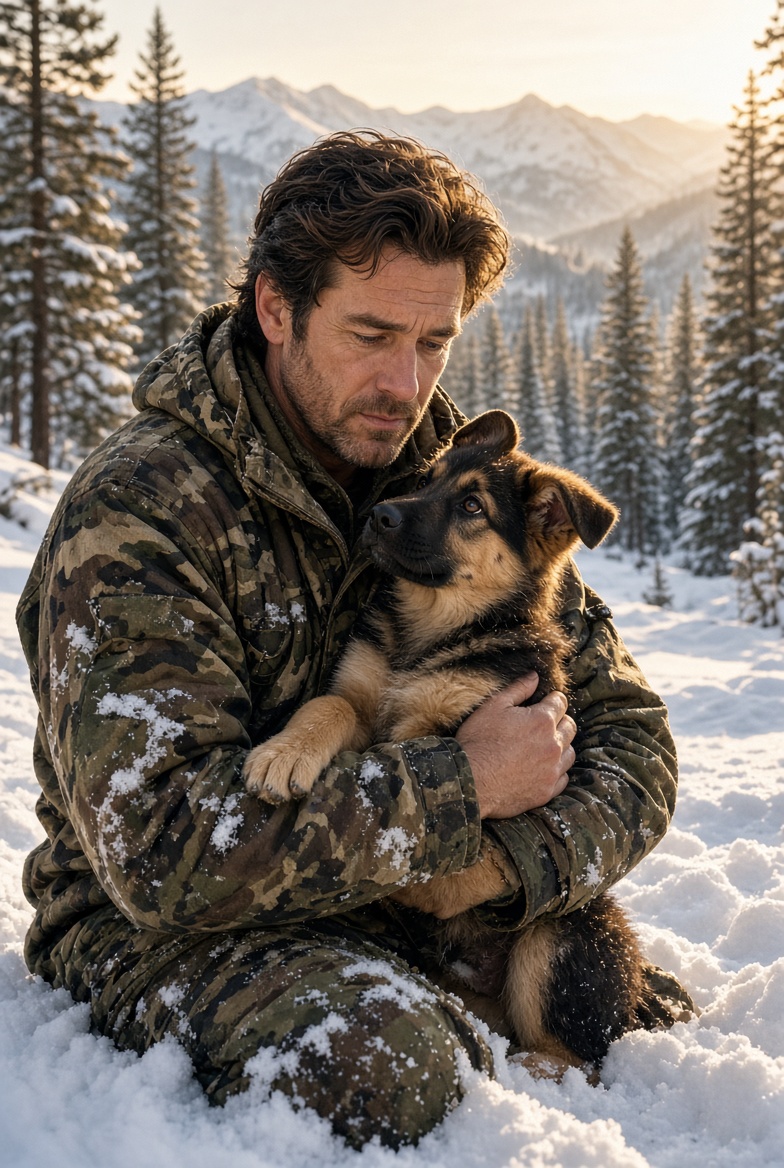
A tiny German Shepherd whimpered in the back of a weathered pickup, his crooked ear trembling as he stared into the snow-covered pines.
Four-month-old Bumper usually spent his days stealing his owner’s gloves, but now no treat could quiet him.
Former Marine Logan Thayer pulled over, followed the puppy’s frantic gaze, and spotted tire tracks disappearing down a steep ravine.
Below, a silver SUV lay trapped between trees.
Someone inside tapped faintly on the window.
Logan rushed to summon help, unaware that the woman inside was the sister of the friend he’d abandoned after a terrible military accident.
She carried a recording and a question about a missing safety warning that threatened to unravel four years of guilt.
But the greatest test of Logan’s courage would come when danger reached his own workshop, and Bumper needed him most.
The first thing Logan Thayer heard that morning was a thump beneath his truck, followed by the unmistakable sound of something expensive being dragged across gravel.
He closed his eyes.
“Bumper.”
A second thump answered him.
Outside, Snow Glass Landing was waking beneath a brilliant Colorado sky.
Sunlight spilled across rooftops buried in fresh snow.
Smoke curled lazily from stone chimneys.
And beyond the scattered houses, Lake Granby shimmered between the dark green shoulders of the mountains.
The air smelled of pine, wood smoke, and the sharp, clean cold that made every breath feel newly invented.
It was the kind of morning people moved to Colorado hoping to find.
Logan had moved there hoping nobody would find him.
He stood beside his weathered blue-gray Ford F-150, one gloved hand resting on the open passenger door.
At 44, he was tall and broad-shouldered with the compact strength of a man who still treated physical work as a daily obligation.
His dark chestnut hair waved stubbornly above the collar of his woodland camouflage field jacket, a few silver strands showing at his right temple.
Short stubble shadowed his angular jaw, and his blue-gray eyes carried the patient exhaustion of someone who had spent too many nights arguing with memories.
A small orange-brown repair patch marked the left breast pocket of his jacket.
Under the passenger seat, two amber eyes blinked back at him.
Bumper, his four-month-old German Shepherd, had both front paws planted firmly on a leather work glove.
The glove belonged to Logan.
So had the previous two Bumper had stolen that week.
“Give it back.”
The puppy tilted his head.
His right ear stood straight, while the tip of his left folded forward as though it had missed an important instruction.
“That wasn’t a suggestion.”
Bumper considered this.
Then he seized the glove and scrambled out the opposite side of the truck.
Logan watched a blur of black and rich tan fur race around the front bumper, tiny paws scattering powdery snow.
“Oh, you’re proud of yourself.”
Bumper’s tail swept back and forth.
Logan took one step toward him.
The puppy took three backward.
For almost two minutes, they circled the truck in a ridiculous negotiation that neither seemed willing to lose.
Finally, Logan reached into his jacket pocket and produced a rubber chew toy.
Bumper dropped the glove immediately.
“That’s what I thought.”
The puppy accepted his prize with the confidence of a businessman who had negotiated an excellent contract.
A few minutes later, Logan settled him onto the passenger seat while the truck remained parked outside the workshop.
He lowered the window partway to let in the crisp morning air.
Bumper rose onto his front paws, stretched his small head toward the opening, and began barking at his reflection in the glass.
The image looking back had the same black muzzle, the same oversized paws, and the same ridiculous crooked ear.
Apparently, this was unacceptable.
Bumper barked louder.
Logan stared at him.
“Are you seriously arguing with yourself?”
Another bark.
“I bought this truck 15 years ago. Somehow, you’ve owned it for two months.”
A woman walking past with a grocery bag laughed so hard she had to stop.
Across the street, Harriet Moss appeared outside her diner wearing her plum-colored cardigan and cream floral apron.
“Morning, Logan,” she called.
“Looks like your new manager’s got another complaint.”
“He’s refusing to work unless I pay him in bacon.”
“Sounds smarter than most of the men I’ve hired.”
Her laughter carried across the snowy street.
Logan shook his head, but the corner of his mouth lifted.
Bumper barked once more, apparently pleased with the attention.
For a moment, the morning felt wonderfully ordinary.
Then Logan glanced at the empty passenger seat beside the puppy, and something quiet settled behind his smile.
There had been a time when he could fill a truck with conversation.
He remembered another man laughing beside him, boots propped carelessly against the floor, telling a story so badly that the punchline arrived before the beginning.
Aaron Wren.
Logan looked away.
The workshop behind him had once been a boat house.
Its wooden siding weathered silver by years of wind off the lake.
Now it held engine blocks, hydraulic hoses, winter rescue equipment, and a workbench arranged with almost uncomfortable precision.
Everything had its place.
Wrenches hung in descending order.
Bolts were separated by size.
Manuals stood upright along a shelf.
Machines, Logan had discovered, were easier to understand than people.
A machine failed for a reason.
Sometimes the reason took hours to find, but it existed somewhere among the worn bearings, loose connections, or damaged parts.
Human beings were considerably less cooperative.
Four years earlier, Logan had served as a Marine technical sergeant attached to a cold weather emergency support operation in Alaska.
His team had been helping evacuate people stranded after a severe winter storm.
He still remembered the metallic clicking sound from a hydraulic lifting device.
Not loud, not dramatic, just an irregular little knock that appeared whenever the locking mechanism was exposed to deep cold.
He had written a request for further testing on the preliminary inspection sheet.
Later, an authorized equipment section reported that the device had passed its required checks.
Logan had accepted the confirmation.
He had still felt uneasy.
During the operation, the locking mechanism became unstable.
Equipment shifted unexpectedly.
Aaron moved another team member clear and suffered serious injuries to his leg and hip.
Everyone survived.
That fact mattered.
Logan repeated it whenever the memory returned, but it never changed the image of Aaron being carried toward medical care, trying to smile through his exhaustion while Logan stood nearby, unable to find a single useful word.
Aaron had needed months of treatment and years of rehabilitation.
Logan had needed only a telephone to remain his friend.
Somehow, he had failed at the simpler task.
The first calls came while Logan was still in the service.
Later, there were messages, letters, and invitations to visit.
He answered none of them.
Eventually, he left the Marines, found Snow Glass Landing on a map, and bought a workshop that needed more repairs than its previous owner had admitted.
He told himself the move was practical.
The truth was less flattering.
In a town where nobody knew his history, nobody would ask him what he should have done differently.
At least, not until Finn Baird came along.
The workshop bell jingled shortly after 10.
Finn stepped inside, brushing snow from his mustard yellow parka.
His teal knitted cap sat crookedly above a mop of light brown curls.
“Mr. Thayer, you busy?”
Logan looked up from an engine housing.
“Depends. Are you here to borrow a tool or return one?”
“Neither.”
“That’s suspicious.”
Finn grinned and unfolded a glossy brochure across the bench.
Bumper, who had been sleeping beneath a stool, immediately appeared and attempted to inspect the paper with his mouth.
“Hey, buddy.”
Finn laughed, crouching to scratch the puppy’s chest.
The little diamond-shaped cream patch between Bumper’s front legs disappeared beneath Finn’s fingers.
“Dad says Nora’s rescue team might be getting these,” Finn explained.
“They want better lifting equipment for vehicles stuck in the snow. I thought maybe you could look at the brochure.”
Logan wiped his hands on a rag.
The cover showed a hydraulic rescue lift standing beneath a winter service vehicle.
He read the manufacturer’s name, then the model family.
His expression changed before he could stop it.
The design was newer.
The advertised locking system had been revised, but he recognized the arrangement immediately.
For a few seconds, the workshop disappeared behind the memory of a bitterly cold Alaskan morning and a metallic click he had never managed to forget.
Finn noticed.
“Is something wrong?”
Logan set the brochure down.
“Where’d you get this?”
“At the volunteer rescue demonstration. They said it was designed for really cold weather.”
“Did they?”
“Yeah. Nora wants everybody to learn about it before they approve the purchase. She said you know more about this stuff than almost anyone in town.”
Logan folded the brochure once, carefully, and returned it.
“Tell Nora she’ll need somebody else.”
Finn blinked.
“But you haven’t even looked at the specifications.”
“I’ve seen enough.”
The words came out sharper than intended.
Finn lowered his eyes.
Logan felt an immediate flicker of regret.
But finding a gentler explanation would mean opening a conversation he had spent four years avoiding.
So he said nothing.
Finn tucked the brochure beneath his arm.
“Okay.”
Bumper nudged the boy’s hand.
Finn knelt and rubbed the puppy’s ears.
“At least somebody around here isn’t afraid of a challenge.”
Logan raised an eyebrow.
“Yesterday he was afraid of a cardboard box.”
“Yeah, but he went back and barked at it.”
Finn smiled faintly, then headed for the door.
After he left, Logan remained beside the workbench.
Through the window, he watched Finn cross the street toward Harriet’s Diner.
Bumper trotted over and dropped his rubber toy against Logan’s boot.
Logan looked down.
“You don’t know when to leave a man alone, do you?”
The puppy sat, waiting.
“No. Of course you don’t.”
That was how Bumper had entered his life.
Two months earlier, Logan had visited a local breeder intending only to ask about an available puppy.
He had convinced himself that a dog might make the house feel less empty without demanding the explanations people always seem to want.
The smallest black and tan puppy had promptly stepped into his boot, chewed the shoelace, and fallen asleep against his ankle.
Logan had brought him home that afternoon.
Since then, nothing had remained where it belonged.
Socks appeared in the water bowl.
A rubber screwdriver vanished behind the sofa.
Bumper treated the bathroom door like the entrance to a restricted military facility and waited outside with exaggerated suspicion.
Logan had bought a separate dog bed.
Bumper had responded by dragging one corner of Logan’s blanket onto the floor every night.
Yet the phone that once contained little beyond repair invoices now held hundreds of photographs.
Bumper sleeping with his paws over his nose.
Bumper discovering snow.
Bumper falling backward into a drift after attempting to catch a falling leaf.
Bumper staring at a pine cone as though it had personally insulted him.
Logan had not realized how long it had been since he wanted to remember ordinary days.
By early afternoon, Harriet arrived carrying two sandwiches wrapped in paper.
She set them on the workbench, well beyond Bumper’s reach.
“Nora called,” she said.
Logan sighed.
“That woman has excellent timing.”
“She has a safety consultant coming into town, a woman from out of state. Wants to speak with you tomorrow about those rescue lifts.”
“I’m not interested.”
“Didn’t say you were.”
Harriet inspected the workshop.
A cardboard box stood near the office door, filled with old manuals and personal belongings.
She nodded toward it.
“You moving things again? Thinking about selling? You’ve been thinking about selling for three years.”
“This time I might actually do it.”
Harriet studied him for a moment.
Then she looked at Bumper, who was attempting to sit on Logan’s discarded rag.
“Does your business partner agree?”
Logan glanced down.
Bumper sneezed, lost his balance, and sat down hard.
Harriet smiled.
“Thought not. Mind you.”
She left the sandwiches and returned to her diner without offering advice.
That was one reason Logan liked her.
She had learned that silence was sometimes more generous than encouragement.
Later, after finishing a repair on an old snow removal truck, Logan took Bumper for a walk along the cleared path behind the workshop.
The puppy attacked a harmless mound of snow, emerged wearing half of it on his muzzle, then tried to chase his own tail.
Logan laughed, not politely, not because somebody expected him to.
A real laugh that escaped before he thought to restrain it.
Bumper froze, stared up at him, then bounded closer as though he wanted to hear it again.
Logan crouched and brushed snow from the puppy’s face.
“Come on, troublemaker. We’re out of food.”
By late afternoon, they had picked up puppy food and a replacement chew toy from the neighboring town.
Bumper rode secured in his navy Y-shaped safety harness on the rear seat of the Ford, watching snowy branches slide past the windows.
The road curved along the forested edge of Lake Granby.
Sunlight filtered between the pines, scattering long blue shadows across the snow.
Here and there, frozen streams glimmered beneath thin layers of ice.
The distant mountains stood against the sky like enormous folded sheets of white paper.
Logan drove with one hand resting lightly on the wheel.
A quiet country song played from the radio.
For once, he wasn’t thinking about the unfinished work waiting at home.
Then Bumper stopped moving.
The change was small.
His tail became still.
His nose lifted.
The right ear stood sharply upright, while the folded tip of the left twitched toward the passenger side woods.
A low whine rose from the back seat.
Logan glanced into the mirror.
“What is it?”
Bumper barked.
Then again.
Logan slowed.
“Probably a squirrel.”
The puppy leaned against his harness, staring toward the slope beyond the trees.
Another bark, louder this time.
Logan switched off the radio.
Between the tires humming against the winter road and the wind moving through the pines, he heard something else, a faint mechanical sound.
One brief note.
Then silence.
He continued at reduced speed, listening.
The sound came again, a distant horn.
Logan’s hands tightened on the wheel.
He pulled into a broad roadside turnout, parked clear of traffic, engaged the brake, and switched on the hazard lights.
Bumper was still barking when Logan stepped out into the cold.
The forest seemed strangely quiet.
He walked several yards toward the guardrail, boots crunching through fresh snow.
There, beneath the pale powder, two dark tire tracks curved sharply away from the road.
They continued toward a broken stand of saplings and disappeared over the edge of a wooded slope.
Logan followed their direction with his eyes.
Far below, between the black trunks of the pines, something silver caught the afternoon sunlight.
An SUV lay tilted in a deep roadside ditch.
A thin white plume drifted from beneath its damaged hood.
Logan immediately took out his phone, called emergency dispatch, and gave the nearest road marker.
He described the vehicle, its location, and the uncertain condition of anyone inside.
Behind him, Bumper continued barking from the truck.
Logan looked down the slope, measuring the distance and searching for a safe approach.
Then he heard it, three faint taps, a pause, one more.
Someone was knocking against the SUV’s window, and someone down there was waiting for help.
The knocking came again.
Three faint taps against glass, followed by a silence that seemed to swallow the entire mountainside.
Logan Thayer stood at the edge of the snowy road, his phone pressed tightly against his ear.
“There’s someone inside,” he told the dispatcher.
“Silver SUV, approximately 30 feet below the roadway. Vehicle’s resting against two trees. I can see vapor coming from the engine compartment.”
“Emergency units are responding, sir. Can you confirm your location?”
Logan repeated the mile marker and described the narrow turnout where his blue-gray Ford F-150 stood with its hazard lights flashing.
Behind the truck’s rear window, Bumper continued barking.
The four-month-old German Shepherd had been making noise for most of the afternoon, but Logan could hear the difference now.
These weren’t the impatient little complaints Bumper made when dinner arrived three minutes late.
Something unfamiliar had caught the puppy’s attention, and he wasn’t letting it go.
Logan glanced toward the vehicle.
Bumper was secured in his safety harness on the rear seat.
His black muzzle pressed toward the window.
His right ear stood straight, while the folded tip of his left ear trembled with every bark.
“Easy, buddy,” Logan murmured.
“I hear it.”
He checked the truck’s position, made sure the doors were secure, and asked dispatch to have the first responding unit check on the puppy.
The cabin was still warm from the drive, but Logan had no intention of leaving Bumper alone longer than necessary.
Then he retrieved his compact emergency kit and studied the slope.
He knew this road.
Winter sunlight could soften the upper layer of snow by noon, leaving an invisible glaze of ice when the temperature dropped again.
Beneath the guardrail, the ground descended through loose stones and tightly packed pine roots before leveling near a shallow drainage channel.
Going straight down would be foolish.
Logan moved 40 yards along the shoulder until he found a gentler approach.
“I’m descending on foot,” he informed the dispatcher.
“I’ll keep the line open.”
His boots compressed the snow with soft, deliberate crunches.
The forest smelled of cold bark and wet stone.
Sunlight slipped between the branches in narrow golden bands, illuminating tiny crystals suspended in the air.
Below him, the SUV remained still.
It was silver, relatively new, with its front corner wedged between two thick young pines.
The windshield had developed a web of cracks near the passenger side.
White vapor drifted from the front grille, dissolving into the winter air.
Logan stopped a safe distance away and listened.
A small voice came through the closed window.
“Hello?”
“I’m here,” he called.
“My name’s Logan. Help is on the way.”
He approached from the stable side of the vehicle, carefully checking the ground and the position of the damaged front end.
Inside, a woman sat at an awkward angle behind the steering wheel.
She appeared to be in her late 30s.
Copper brown hair had come loose around her face, and her cream-colored winter coat was twisted beneath the seatbelt.
A burgundy scarf lay across her shoulder, one end trapped near the center console.
Her right foot was caught beneath the lower dashboard.
Her face was pale, but her hazel green eyes remained remarkably alert.
She looked at Logan, then toward the damaged hood.
“Please tell me you know something about cars.”
“I do.”
“Wonderful.”
She swallowed.
“Is mine repairable?”
Logan studied the crumpled corner of the SUV.
“I’m giving the person inside priority.”
For a second, she stared at him.
Then she laughed.
It was a small, surprised sound, interrupted almost immediately by discomfort.
“That’s probably a sensible policy. I’ve had worse ones.”
He checked the visible condition of the vehicle without disturbing its position.
Then explained that he wanted her to remain as still as possible until the rescue team arrived.
She nodded.
“My leg’s stuck.”
“I can see that. Don’t try to pull it free.”
“Wasn’t planning on dancing.”
Logan almost smiled.
The dispatcher confirmed that a local rescue crew was approaching from the north along with medical assistance.
He relayed what he could observe and stayed beside the window, speaking to the woman in an even voice.
“What should I call you?”
“Celia.”
“All right, Celia. We’re going to take this one step at a time.”
She closed her eyes briefly.
Then opened them again.
“Are you always this calm?”
“No.”
“You’re very convincing.”
“Years of practice.”
He didn’t explain what kind.
Above them, somewhere beyond the pines, a raven called twice.
Celia glanced toward the sound.
“I was supposed to be in town by 4:00.”
“Someone waiting for you?”
“A meeting. Maybe two. Depends how unhappy people get with the first one.”
“What kind of meeting?”
“Equipment safety.”
Logan looked at her more closely.
She continued speaking slowly between breaths.
“I’m an independent safety auditor. Nora Kessick asked me to review some procurement documents for the local rescue program.”
Logan felt something tighten beneath his ribs.
“What equipment?”
“Hydraulic lifting systems. Cold weather rescue units. A company called Pell Response Equipment supplied them.”
He said nothing.
It was the same company whose brochure Finn had brought to his workshop that morning.
Celia noticed the silence.
“You know them?”
“I know the equipment.”
“Then we may have something to talk about when I’m not sitting in a ditch.”
Logan looked away toward the pale slope.
“Let’s get you out of the ditch first.”
She seemed willing to accept that answer.
For several moments they listened to the faint ticking of cooling metal.
Then Celia spoke again.
“There was another vehicle.”
Logan turned back.
“What kind?”
“A small snow removal truck. One of those compact utility machines with a blade in front.”
“Did it hit you?”
“I don’t think so.”
She drew a careful breath.
“It came around the curve ahead of me. Slowed almost to a stop, then moved across my lane.”
Logan glanced toward the road above.
“I tried to steer around it,” Celia continued.
“The tires lost traction. I remember the guardrail, the trees, and then—”
She stopped.
Her fingers tightened around the seatbelt.
“The other driver didn’t come back.”
Logan let the silence settle before asking another question.
“Did you see a company name or license plate?”
“No, just a dark cab and the blade. Everything happened too quickly.”
“All right.”
“You don’t believe me?”
“I believe that’s what you remember.”
Celia studied his face.
“That sounds carefully worded.”
“It is.”
Logan had learned long ago how dangerous certainty could become when it arrived before the facts.
He remembered the two sets of marks near the road.
One broad enough to belong to a maintenance vehicle.
He had also noticed something yellow half buried near the guardrail.
Possibly a portable road marker.
But he hadn’t examined either closely.
He wasn’t going to turn a frightened woman’s memory into a conclusion simply because the pieces seemed to fit.
A distant engine interrupted his thoughts, then another.
Through the trees came the low, unmistakable sound of approaching rescue vehicles.
“That’s your ride,” Logan told her.
“Please tell me it’s a better driver.”
“I’m willing to bet on it.”
This time, Celia managed a genuine smile.
Nora Kessick appeared at the top of the slope several minutes later.
Her forest green rescue parka brightened by orange reflective strips.
Even from a distance, Logan recognized her purposeful stride.
“Thayer,” she called.
“You always find the complicated jobs.”
“Only on weekdays.”
“It’s Saturday.”
“I’ve lost track.”
Under other circumstances, he might have enjoyed the exchange.
Nora directed her team down the safer route Logan had used.
Once they reached the SUV, she checked the vehicle’s stability and coordinated the medical crew’s access.
Logan stepped aside when necessary, answering questions and helping position equipment at Nora’s direction.
He didn’t try to take over.
That surprised him more than he cared to admit.
In the past, uncertainty had often made him work harder, faster, as though enough effort could prevent every possible mistake.
Here, Nora knew her job and he trusted her to do it.
The rescue took patience.
The team stabilized the vehicle and created sufficient clearance around Celia’s trapped foot.
Logan remained nearby, speaking to her whenever the unfamiliar movements made her tense.
At one point, Celia looked toward him and said quietly, “You haven’t left.”
“Wasn’t planning to.”
“Good.”
Eventually, the responders helped her onto a rescue stretcher.
The tension that had held her face so tightly began to fade.
As they prepared to move her uphill, she suddenly caught Nora’s sleeve.
“My phone.”
Nora stopped.
“Where is it?”
“Front console. I dropped it when the car went down.”
“We’ll check when it’s safe.”
“Please. There are audit notes on it. Some haven’t been backed up yet.”
Her voice softened.
“And a recording of my brother.”
Something about that last sentence made Logan look at her.
Not the request itself.
The way she said brother.
As though the word belonged to a room she rarely let anyone enter.
Nora assured her the team would look for it.
Once the vehicle had been secured and the immediate rescue completed, one of the responders retrieved a phone from the accessible front console.
Its protective case was scratched, but the device still powered on.
Celia accepted it with both hands.
“Thank you,” she whispered.
By the time they reached the roadside, the afternoon light had begun to soften toward amber.
Logan went directly to his truck.
Bumper greeted him with a burst of indignant barking, bouncing against the restraint as though Logan had been away for three years rather than less than an hour.
“I know,” Logan said, opening the rear door.
“Terrible service. One star.”
After checking that the rescue area was secure, he clipped on Bumper’s lead and lifted him down.
The puppy landed in the snow, sniffed a nearby pine cone, and immediately forgot whatever complaint he had been preparing.
Logan kept him well away from the emergency vehicles.
But when Celia was moved past on the stretcher toward the waiting ambulance, Bumper noticed her.
His tail began to wag.
Celia extended a hand.
“Is that the little fellow who raised the alarm?”
“That’s Bumper.”
“Bumper?”
“He runs into things.”
“Frequently?”
“Professionally.”
She laughed.
Logan allowed the puppy to approach close enough for a brief greeting while the medical crew paused.
Bumper sniffed her glove, looked up at her face, and then discovered the loose end of her burgundy scarf.
Before anyone could object, he gently caught the fabric between his teeth.
“Bumper,” Logan warned, drawing him back.
“Not everyone you meet needs their luggage inspected.”
Celia burst into laughter.
A moment earlier, she had been studying the ambulance doors with visible unease.
Now she was laughing at a puppy who seemed convinced he’d discovered the greatest prize in Colorado.
“I’m beginning to understand his name. He’s working hard to earn it.”
Bumper wagged his tail harder.
Celia smiled at him, then lifted her gaze toward Logan.
Her eyes settled on the subdued name tape above the right pocket of his field jacket.
“Thayer.”
Her expression changed.
“Logan Thayer?”
He nodded.
“That’s me.”
She stared for another moment.
“My full name is Celia Wren.”
The wind moved lightly across the roadside.
Logan didn’t speak.
Celia watched his face carefully.
“Did you serve with Aaron Wren?”
For one suspended second, the distant traffic, the radio chatter, even Bumper’s excited breathing seemed to fade.
Logan’s hand tightened around the leash.
“Yes.”
“He’s my older brother.”
Logan looked down at the snow.
He had known Aaron had a younger sister.
Aaron used to talk about her relentlessly, usually while complaining that she could detect a dishonest calculation faster than a military accountant.
Logan had never met her.
“He’s doing well,” Celia said gently.
“Better than he was last year. He’s walking longer distances now.”
Logan swallowed.
“I’m glad.”
The words sounded painfully inadequate.
Celia shifted the cracked phone in her hands.
“He was the one who suggested I find you. He said if anyone remembered the locking mechanism on those lifts, it would be you.”
Logan stared at the device.
“Aaron knows you’re here?”
“He does.”
She hesitated.
“He also said you might not want to talk.”
Logan could not find a response.
Celia unlocked the phone.
“There’s something he recorded for me recently. It’s about the equipment, not a personal message. He said I could share it with you.”
A small speaker crackled.
Then a man’s voice came through.
Slightly muffled, but unmistakable.
“Celia, there’s this clicking noise I remember. Not a normal hydraulic sound. Three uneven knocks when the locking arm cooled down. Logan heard it before anybody else. He wanted another test.”
Logan’s breath caught.
The voice was older, slower, but it was Aaron.
The same dry warmth.
The same habit of shortening his sister’s name.
For four years, Logan had avoided telephone calls, unopened letters, and every reminder of the man who had once been his closest friend.
Now Aaron was speaking from a cracked phone beside a snowy Colorado road, and he was still talking about Logan.
Not with anger, not with accusation, as though his old friend still belonged somewhere in the conversation.
“Could you stop it?” Logan asked quietly.
Celia pressed pause.
“Of course.”
He stepped back.
He wanted to ask a hundred questions.
Did Aaron still laugh at his own jokes?
Did he sleep well?
Did he ever talk about the operation?
Had he truly wanted Logan to hear this?
Instead, Logan said, “The ambulance should get you checked.”
Celia nodded.
She didn’t attempt to stop him when he turned away.
“Thank you for finding me,” she said.
Logan looked over his shoulder.
“Thank the noisy one.”
Bumper gave an enthusiastic bark as though accepting official recognition.
Celia smiled one final time before the ambulance doors closed.
Logan stood beside his truck until it disappeared around the bend.
Only then did he realize how cold his hands had become.
A county vehicle arrived shortly afterward.
Iris Malloy stepped out wearing a dark navy field jacket, her black notebook already in hand.
A narrow silver streak ran through the hair pulled tightly back from her left temple.
She introduced herself and asked Logan to describe the discovery.
He told her about Bumper barking, the faint horn, the tire tracks, and the tapping from the SUV.
Iris listened without interruption.
Together, they walked toward the point where the silver vehicle had left the road.
A portable yellow warning marker lay partly buried in snow several yards from its apparent placement area.
Nearby, broad tread impressions curved across the shoulder, separate from the narrower tracks leading down the slope.
Iris photographed the marks.
“Could be maintenance activity,” Logan said.
“Could be,” she agreed.
“Celia mentioned a snow removal truck.”
“I’ll check the route assignments and available road cameras.”
She closed her notebook.
“Bad weather can explain a lot, Mr. Thayer, but I prefer knowing which parts it actually explains.”
Logan respected that answer.
He returned to the truck, settled Bumper into his rear seat harness, and drove home beneath a sky turning lavender over the mountains.
By the time they reached the workshop, darkness had gathered along the shoreline.
Inside the house, Bumper immediately raced across the living room, attempted an ambitious leap onto the sofa, and slid backward onto the thick rug.
Logan laughed before he could stop himself.
“You’ll need a flight plan next time.”
Bumper shook himself, entirely unembarrassed.
But the laughter faded when Logan noticed a small framed photograph on the bookshelf.
He took it down.
Two younger Marines stood beside a winterized military vehicle beneath an enormous blue sky.
Aaron had one arm thrown around Logan’s shoulders.
Both men were laughing.
Logan remembered the moment the photograph was taken.
Aaron had just told a spectacularly bad joke about frozen coffee, and Logan had laughed because his friend looked so pleased with himself.
For four years, he’d kept the photograph turned toward the back of the shelf.
Tonight, he carried it to the living room floor.
He sat with his back against the sofa, still wearing his field jacket, the old picture resting between his hands.
Aaron had been trying to reach him.
Not for one month, not for one year, for years.
And Logan had mistaken his own silence for something noble.
Bumper padded across the room.
The puppy disappeared beneath the coffee table, then returned carrying the familiar brown leather glove.
He dropped it directly into Logan’s lap.
Logan looked down.
“Not now, buddy.”
Bumper waited.
When Logan didn’t move, the puppy climbed beside him, pressed his warm body against his leg, and laid one oversized paw across his thigh.
Logan stared at the photograph.
For a long time, neither of them moved.
Then his phone vibrated on the floorboards.
A message from Nora Kessick appeared.
“Celia Wren is the safety consultant reviewing our new rescue equipment. She asked whether you’d be willing to attend tomorrow morning’s technical meeting. 9:00 at the volunteer station. I think we need you there, Logan.”
He read the message twice.
Bumper rested his chin against the leather glove.
Outside, snow began drifting softly past the dark windows.
Logan looked from Nora’s message to the photograph of Aaron, then down at the little dog waiting beside him.
For the first time in four years, the past wasn’t merely something behind him.
It was knocking at his door again.
By 8:00 the next morning, Bumper had stolen a sock, overturned an empty water bowl, and declared war on a cardboard box that had been sitting peacefully beside the kitchen door for three days.
Logan Thayer considered all three incidents evidence that his puppy was developing a criminal career.
“Four months old,” he muttered, watching the little German Shepherd drag the sock beneath the breakfast table.
“You’ve got your whole life ahead of you, and you’ve already chosen organized crime.”
Bumper looked up with the sock hanging from his black muzzle.
His right ear stood proudly upright.
The tip of his left ear folded forward, giving him the permanently puzzled expression of a student who had missed the first half of a lecture.
Logan held out his hand.
The puppy dropped the sock.
For one beautiful second, Logan believed their training was improving.
Then Bumper picked it up again and ran.
Outside, Snow Glass Landing glittered beneath a brilliant winter sun.
Fresh snow covered the rooftops, and long ribbons of pale gold stretched across Lake Granby.
On Main Street, workers were hanging strings of white lights between wooden storefronts in preparation for the upcoming winter festival.
It was a morning made for starting something new.
Logan wished it were a morning he could sleep through.
On the kitchen counter lay his phone, still displaying Nora Kessick’s message from the previous night.
9:00.
Volunteer rescue station.
Technical meeting.
He had read it 11 times.
He had almost deleted it twice.
At 8:15, he finally typed a reply.
“I’ll come. Doesn’t mean I’m agreeing to anything.”
Nora answered almost immediately.
“Wouldn’t dream of it. Bring your brain anyway.”
Logan stared at the screen.
Then, despite himself, he smiled.
Bumper appeared beneath the counter carrying the stolen sock.
“Don’t look at me,” Logan told him.
“Apparently, we’re both reporting for duty.”
The volunteer rescue station occupied a renovated brick building near the center of town.
Snow removal equipment stood outside beneath a long metal awning, and a row of emergency vehicles gleamed in the morning light.
Logan left Bumper comfortably settled in his secure puppy area at home with water and a chew toy before driving to the meeting.
Nora greeted him with a raised eyebrow.
“Well, look what the wind dragged in.”
“Don’t make me regret it.”
“Too early. Give me 10 minutes.”
Inside, Celia Wren stood beside a folding table covered with technical documents.
She was wearing the same ivory wool coat and burgundy scarf Logan remembered from the roadside.
A dark brace supported her right ankle, and a single crutch rested against the chair beside her.
Her chestnut hair fell in loose waves around her face.
When she noticed Logan, something softened in her hazel green eyes.
“You came.”
“Nora’s difficult to ignore.”
“I’ve noticed. She once argued with a county snow plow until the driver apologized to the road.”
Nora turned from the coffee station.
“The road was improperly cleared.”
Celia laughed.
Logan almost did, too.
The meeting began without ceremony.
Nora explained that Snow Glass Landing’s volunteer rescue program needed improved hydraulic lifting equipment to assist with vehicle recoveries and winter emergencies.
Their older systems remained serviceable, but some tasks required more personnel and time than the department could reliably provide.
A regional supplier, Pell Response Equipment, had offered a modernized solution.
Celia opened a folder.
“My concern isn’t the basic design,” she explained.
“It’s the relationship between the hardware being delivered and the certifications attached to it.”
She spread several pages across the table.
There were diagrams, component numbers, environmental test summaries, and supplier declarations.
Logan recognized the architecture of the locking mechanism almost immediately.
It was not identical to the system used in Alaska.
The housing had changed.
The lever geometry appeared revised.
Even the manufacturer’s labeling was different, but the cold weather locking principle looked painfully familiar.
He leaned closer before realizing he had moved.
Celia noticed, though she didn’t interrupt.
“Some of the documents referred to an earlier component version,” she continued.
“That doesn’t automatically mean the current equipment is unsafe. It means we need a clear explanation of what was changed and which testing applies.”
Nora folded her arms.
“And until we have one, I recommend holding final acceptance of the units under review.”
Logan nodded slowly.
He studied a cross-sectional drawing.
There it was again, a narrow locking arm, a spring-loaded engagement point, a place where cold could change the way two metal surfaces met.
For a moment, he heard the old sound.
Click.
A pause.
Two uneven knocks.
His fingers stopped moving.
“Mr. Thayer?” Celia’s voice brought him back.
“You’ve seen something?”
Logan straightened.
“Maybe. I’d need to compare the actual components with the drawings.”
“Would you be willing?”
He looked toward the bright windows.
“I can explain how the mechanism works.”
Celia accepted the distinction.
“That would help.”
She didn’t ask about Alaska.
He was grateful for that.
By late morning, the meeting had finished.
Nora needed to check an equipment inventory and Celia wanted a more practical explanation of the mechanical differences.
Logan reluctantly invited her to the workshop.
He had barely opened the door when a familiar pattering of paws announced that Bumper had heard them arrive.
The puppy came charging from the adjoining living area, claws clicking over the wooden floor.
“Bumper, slow—”
Too late.
The little German Shepherd crossed the entry mat, skidded sideways, and slid nose first into a basket of work gloves.
For a second, only his hindquarters were visible.
Then he backed out wearing one glove over his muzzle.
Celia stared.
Logan sighed.
“That’s my security department.”
Bumper shook off the glove, noticed the newcomer, and immediately decided she was the most interesting person he had ever met.
Celia crouched carefully, keeping her braced ankle steady.
“Hello again, handsome.”
Bumper sniffed her outstretched hand.
His tail began sweeping back and forth.
Then he saw the loose end of her burgundy scarf.
Logan recognized the look in the puppy’s eyes.
“No.”
Bumper opened his mouth.
“Absolutely not.”
The puppy caught the dangling fabric and backed away triumphantly.
Celia burst into laughter.
“Oh, you’ve got to be kidding.”
Logan stepped forward.
“Bumper, drop it.”
The puppy considered the order.
Then he trotted behind the workbench dragging the scarf like a victorious explorer pulling a flag across newly discovered territory.
Logan retrieved his rubber chew toy from a shelf.
“Trade.”
Bumper released the scarf instantly.
Celia laughed so hard she had to sit on a stool.
“Does he always negotiate like this?”
“He’s never done an honest day’s work in his life.”
“He looks very satisfied with himself.”
“That’s because crime pays.”
For several minutes the workshop rang with laughter.
Logan had become accustomed to the sound of engines, rattling tools, and wind against the siding.
Laughter seemed to belong to a different kind of building.
Yet Celia’s filled the room without making it feel unfamiliar.
Once Bumper settled beneath the workbench, they returned to the documents.
Logan drew a simplified diagram on a large sheet of brown paper.
He explained how the primary hydraulic mechanism carried the load while the mechanical lock provided secondary protection against unintended movement.
He described how material contraction and temperature changes could affect the tolerances between components.
Celia listened carefully.
She didn’t pretend to understand something simply to move the conversation forward.
When Logan used a technical term she didn’t recognize, she asked him to explain it.
When he sketched two surfaces meeting at the wrong angle, she leaned closer.
“So even if the hydraulic system operates normally,” she said, “the backup lock could still behave unpredictably under the wrong conditions.”
“Yes, but that doesn’t mean this version does. We’d need proper testing.”
She nodded.
“Good. I don’t want an assumption dressed up as a conclusion.”
Logan looked at her.
“Neither do I.”
For the first time since meeting her, he forgot who her brother was.
For nearly an hour, he was simply a mechanic explaining a machine to someone who genuinely wanted to understand it.
He hadn’t realized how much he missed that feeling.
A knock sounded at the open workshop door.
Finn Baird appeared in his mustard yellow parka, a teal knitted cap pulled low over his curls.
“Oh, hey, Mr. Thayer.”
His eyes widened when he noticed Celia.
“Are you the safety lady?”
Celia raised an eyebrow.
“Depends. Have I done something wrong?”
“No. I mean, you’re the one checking the rescue equipment.”
“That’s me.”
Finn grinned.
“Cool.”
Bumper scrambled to his feet and hurried over.
Finn bent to scratch the puppy’s chest.
“Hey, buddy. You keeping him out of trouble?”
“He’s the trouble,” Logan said.
Finn reached into his coat and unfolded the same glossy product brochure he’d brought the day before.
“I wanted to ask something.”
He pointed to a small illustration.
“This locking piece here, is it supposed to look like that?”
Logan examined the drawing.
Finn turned to another page.
“Because the one Dad was working on looked different. The arm was shorter and there was this little notch on the side.”
Celia stepped closer.
“Where did you see it?”
“At the public demonstration. Dad showed me the outside of one of the units. He said it was the new version.”
“Did you take a photograph?”
Finn shook his head.
“Didn’t think it mattered.”
Logan compared the two illustrations.
The dimensions weren’t detailed enough to establish anything, but Finn was right about the visible shape.
Celia wrote down the model number.
“That is a good question,” she told him.
Finn brightened.
“Really?”
“Really. It may have a perfectly ordinary explanation, but now we know what to ask.”
The boy looked immensely pleased.
Logan glanced at him.
“You notice more than most people twice your age.”
Finn smiled.
“Dad says I notice everything except dirty dishes.”
“Your dad’s a smart man.”
Bumper chose that moment to steal Finn’s pencil.
The puppy trotted away holding it carefully between his teeth.
Finn groaned.
“Hey.”
Logan looked toward the ceiling.
“Wonderful. I’ve got a 13-year-old engineer and a 4-month-old thief.”
Celia covered her smile.
“I think the thief’s requesting a promotion.”
By mid-afternoon, Nora stopped by the workshop to review the outstanding questions.
She listened while Celia explained the differences in component labeling and the need for clarification from the supplier.
Nora’s expression grew thoughtful.
“Those lifts would help us,” she admitted.
“Last winter, we had two vehicles stuck on a remote service road. Took six volunteers almost half a day to finish the recovery safely with the equipment we had.”
Logan understood.
Nora wasn’t being careless.
She was trying to give her volunteers the tools they needed.
“We can keep using the existing gear,” Nora continued.
“But I need to know whether we’re delaying a useful purchase or avoiding a genuine problem.”
“You’re asking the right question,” Logan said.
Nora studied him.
“You know, I’ve asked you to help us for three years.”
“I know.”
“You’ve turned me down every time.”
“I know that, too.”
She glanced at his drawing.
“Funny. You seem pretty good at helping when you forget you’re trying not to.”
Logan looked away.
Nora didn’t press.
She gathered the documents Celia had prepared and left with a promise to request written clarification from Pell Response Equipment.
By evening, a pale lavender light hung over Snow Glass Landing.
Harriet’s Diner glowed warmly across the street, its windows misted at the corners.
Celia suggested dinner, and Logan surprised himself by agreeing before thinking of an excuse.
Harriet welcomed them into the enclosed, heated side room where well-behaved dogs were allowed.
Bumper settled on his mat beside Logan’s chair, secured by a short lead, though he remained convinced every approaching plate required personal inspection.
Harriet brought two bowls of stew and looked between her guests.
“Well, this is interesting.”
Logan frowned.
“What’s interesting?”
“Nothing at all.”
“You’ve got that look.”
“I have a face, Logan. Can’t help it.”
Celia laughed.
Harriet walked away wearing the satisfied expression of a woman who had no intention of explaining herself.
For a while, they talked about ordinary things.
Celia had grown up in Virginia.
She loved old bookstores, hated poorly made coffee, and had once spent six hours correcting an accounting error that turned out to be a misplaced decimal point.
Logan admitted he enjoyed rebuilding old engines more than buying new ones.
“Because old things have stories?” Celia asked.
“Because new ones cost too much.”
She laughed into her coffee.
Then the conversation shifted.
“Aaron still drinks his coffee black,” Celia said.
Logan’s spoon stopped against the bowl.
“He always did.”
“And far too strong. He once told a cook that weak coffee was an insult to beans.”
Celia smiled.
“That sounds like him.”
For the first time, Logan allowed himself to remember Aaron without immediately reaching for the worst day of their friendship.
He remembered terrible jokes, cold mornings, two men arguing over who had misplaced a tool that was sitting between them.
A smile flickered across his face.
Celia noticed.
“He tried to reach you, you know.”
Logan stared at his hands.
“I know.”
“For a long time.”
“I got the messages.”
“Why didn’t you answer?”
He took a slow breath.
“Because every time I heard his name, I remembered the equipment. The sound it made. I kept thinking if I’d insisted on another inspection—”
He stopped.
Celia waited.
Logan looked toward Bumper, who was asleep with one paw resting on his rubber toy.
“I thought staying away would make things easier for him.”
Celia’s voice remained gentle.
“Did you ever ask him whether that was what he wanted?”
Logan had no answer.
The question followed him through the rest of dinner.
Later, he helped Celia back to Harriet’s upstairs guest rooms.
Bumper waited in the parked truck with Logan during their brief goodbye, happily leaning toward the partly lowered passenger window.
Celia bent to scratch the puppy’s crooked ear.
“You’ve got your hands full with this one.”
Logan smiled.
“You have no idea.”
Bumper gave one delighted bark.
Celia straightened, meeting Logan’s eyes.
“Thank you for today.”
“I didn’t do much.”
“You listened. You answered questions. You didn’t walk away.”
The words settled between them.
For a moment, Logan wanted to say something more.
Instead, he nodded.
“Goodnight, Celia.”
“Goodnight, Logan.”
At home, Bumper fell asleep almost immediately, exhausted by a day of stealing office supplies and charming strangers.
Logan carried his notes into the workshop.
He had barely sat down when an email from Celia appeared on his phone.
“I found an older inspection document connected to the equipment family. Thought you should see it before tomorrow.”
He opened the attachment.
The first page showed a familiar manufacturer, a test reference, and a date from four years earlier.
Then he saw the signature.
His own.
Logan Thayer.
He read the page twice.
It was a preliminary inspection record from the Alaska operation.
The document confirmed that he had examined the equipment, but the section where he remembered writing a request for additional cold weather testing was blank.
No warning, no qualification, no reference to the clicking sound.
Logan sat very still.
Outside, wind brushed against the workshop windows.
He rose, crossed to the old wooden desk, and unlocked the bottom drawer.
Beneath a stack of service manuals lay a small field notebook with softened corners and a faded brown cover.
He had carried it through the Alaska operation.
He had not opened it since leaving the Marines.
Logan turned the brittle pages until he reached the date of the inspection.
There, in his own cramped handwriting, were the words he had spent four years trying to forget.
“Irregular locking arm contact under low temperature conditions. Additional testing required before operational approval.”
Below the note was a second line.
“Do not rely on supplier clearance without verification.”
Logan stared at the page.
Then he looked back at the document on his phone.
His warning had not disappeared from his memory.
It had disappeared from the record.
And for the first time in four years, Logan wondered whether the story he had been telling himself about that day was missing something far more important than he had ever dared to imagine.
By the following afternoon, Logan Thayer had read the same 11 words in his old field notebook so many times that they no longer looked like English.
“Additional testing required before operational approval.”
He had written them four years earlier in a cramped equipment shelter in Alaska with numb fingers and a pencil that kept breaking.
Now those words lay beneath the warm yellow light of his Colorado workshop.
Outside, snow drifted lazily past the windows.
Across the street, volunteers were hanging white Christmas-style lights around the entrance to Snow Glass Landing’s Community Hall.
Children chased one another along the cleared sidewalk, their laughter rising above the scrape of shovels and the distant chime of the diner door.
It was an ordinary winter afternoon.
Logan wished he could borrow a little of its simplicity.
Bumper sat beneath the workbench carefully chewing a rubber toy shaped like a duck.
Every few minutes, the four-month-old German Shepherd lifted his black muzzle and studied Logan with enormous amber-brown eyes.
His right ear stood straight.
The tip of his left folded forward as though he was waiting for a question nobody had asked yet.
Logan closed the notebook.
“You ever wish you could take something apart and put it back together differently?”
Bumper squeaked the duck.
“Yeah, that’s about what I figured.”
Logan slipped the notebook into his desk drawer, put on his woodland camouflage field jacket, and headed for the community meeting.
He had no intention of speaking.
That was his first mistake.
The Snow Glass Landing Community Hall smelled of fresh coffee, damp wool, and the cinnamon cookies somebody had arranged beside the entrance.
Nearly every folding chair was occupied.
Nora Kessick stood near the front beside a projector screen.
Her forest green rescue parka still zipped to the collar.
Celia Wren sat nearby with her injured ankle supported on a low chair, her ivory coat folded neatly across the backrest, and her burgundy scarf wrapped loosely around her shoulders.
When Logan entered, Celia looked up.
Their eyes met.
She offered a small reassuring smile.
He managed a nod before taking an empty seat near the rear.
A few rows ahead, Theo Baird sat with his hands clasped between his knees.
His thin-framed glasses had slipped halfway down his nose, and he kept rubbing one thumb against the seam of his navy mechanic’s coveralls.
Logan noticed the gesture.
It was the kind of movement a man made when he was worried, but didn’t want anyone to see.
Nora began without wasting time.
“The equipment we’re discussing is important to this town,” she said.
“Nobody is questioning that. What we’re questioning is whether the units we’ve received have been properly verified for the conditions in which we intend to use them.”
She gestured toward Celia.
Celia rose carefully, supporting herself with one hand against the table.
Her voice carried clearly through the hall.
“The supplier’s documents contain inconsistencies between component identification numbers, certification references, and the hardware delivered for evaluation.”
A man near the front raised his hand.
“Does that mean the equipment is dangerous?”
“It means we don’t yet have enough verified information to say it meets every requirement being claimed,” Celia answered.
“Those are different statements.”
She explained the need for independent testing, emphasizing that uncertainty was not proof of wrongdoing.
Logan listened.
He liked that she refused to make the evidence larger than it was.
Unfortunately, someone else in the room had no such hesitation.
Gordon Pell rose from the second row.
He was a broad-faced man in his mid-50s, silver-blonde hair combed neatly backward, his charcoal overcoat hanging perfectly from his shoulders.
A square silver ring caught the overhead light as he adjusted his cuff.
“May I remind everyone,” Gordon began, “that my company has supported this community for nearly 15 years?”
Several people nodded.
He had contributed to road repairs after winter storms, donated equipment to volunteer programs, and employed local families.
Gordon knew exactly how much those facts mattered.
“Every week we delay acceptance,” he continued, “is another week your volunteers operate without equipment they’ve specifically requested. We’re discussing machinery designed to save time when time matters.”
Nora’s expression hardened.
“That’s precisely why I want it properly checked. And I support proper checks.”
Gordon replied smoothly.
“But I won’t pretend that an administrative discrepancy automatically makes a machine defective.”
A murmur passed through the room.
Someone asked about the cost of additional testing.
Another worried that canceling the purchase would delay winter rescue preparations.
Logan watched Celia straighten her papers.
She was not rattled, but he could see the effort it took to keep the discussion anchored to facts.
Then Gordon reached into a leather folder.
“There is another point everyone deserves to understand.”
He placed a document beneath the projector.
A familiar form appeared on the screen.
Logan stopped breathing for a moment.
He knew the format before he read a single line.
Military equipment inspection record.
Alaska, four years earlier.
And at the bottom, clearly visible beneath a dated signature box, stood his name.
Logan Thayer.
Gordon turned toward the audience.
“This document concerns an earlier version of the same equipment family. It was inspected during a military support operation. One of the technicians who signed that inspection is with us today.”
Faces turned toward the back row.
Logan remained seated.
Gordon continued.
“Mr. Thayer now raises concerns about equipment substantially improved since that earlier model. Yet his own signature appears on the historical inspection.”
The room grew uncomfortable.
Logan stared at the projected page.
He recognized the document, but something was missing.
The lower section had been cropped immediately after the signature area.
The remarks field where he had documented the irregular locking arm contact and requested further testing was absent.
He felt the old familiar pressure gather behind his ribs.
Gordon looked directly at him.
“Mr. Thayer, is that your signature?”
Logan’s mouth had gone dry.
Nora turned.
“Logan?”
He stood slowly.
“Yes.”
The word seemed to travel farther than it should have.
A woman near the aisle frowned.
“Then why are we being told these machines might have a problem if you signed off on one before?”
Logan looked at the screen again.
“That was a preliminary inspection, not final operational approval.”
Gordon spread his hands.
“Nevertheless, you signed the form.”
“I did.”
“And the equipment was subsequently used?”
“Yes.”
“Then surely you understand why we’re cautious about accepting your present concerns without further evidence.”
Logan could feel the eyes of the room resting on him.
He remembered the Alaskan equipment shelter.
The dry scrape of a pencil.
The cold metal beneath his gloves.
He remembered the message that the manufacturer-supported testing had passed.
He remembered accepting it.
A man near the window spoke.
“If you thought something was wrong, why did you let anybody use it?”
Logan looked toward the floor.
For four years, he had asked himself that question in a hundred different ways.
Finally, he answered, “Because another section reported that the device had passed its required checks.”
“I accepted that confirmation, even though I’d asked for additional testing.”
The hall went still.
He continued, his voice lower, “And I didn’t insist that operation stop until I personally understood the results.”
Someone shifted in a chair.
Gordon lowered his eyes as though receiving a difficult confession.
Logan saw the gesture and understood how his words might sound to people who knew nothing about the process, but he would not replace one incomplete account with another.
“That doesn’t mean this new equipment is safe,” he added.
“And it doesn’t mean the earlier record is complete.”
Celia stepped forward.
“The document on the screen is a partial copy,” she said firmly.
“We should not use it to establish what an entire inspection concluded, much less assign responsibility for an event four years ago.”
She looked toward Gordon.
“I’d like the complete original record and the accompanying approval documentation.”
Gordon’s smile tightened.
“Of course, if those records are available, then we can examine them.”
Celia answered.
“Until then, the current equipment should be evaluated on its own verified evidence.”
Nora returned to the microphone.
“The rescue team will not place the units under review into operational service until their suitability is established. We’ll continue using our existing equipment and arrange additional support if needed.”
The decision drew mixed reactions.
Some people looked relieved, others appeared worried.
Gordon gathered his papers with precise, economical movements.
He did not raise his voice.
He simply buttoned his overcoat, thanked the room for its attention, and left before the meeting had fully ended.
Logan watched the door close.
For the first time in years, he felt as though Alaska had followed him all the way to Colorado.
He left through the side entrance before Celia could reach him.
Snowflakes settled on the shoulders of his camouflage jacket as he crossed the street.
Harriet stood outside her diner holding an empty bread tray.
She saw his face.
Whatever joke she had been preparing disappeared.
“You want coffee?” she asked.
“Not today.”
“All right.”
He kept walking.
“Logan.”
He stopped.
Harriet looked at him steadily.
“One bad afternoon doesn’t tell me everything about a man.”
He couldn’t answer.
So he went home.
By the time Celia arrived at his workshop, the sky had faded to a cold pearl gray.
Logan was standing beside his workbench staring at a small notebook he had taken from the desk drawer.
Bumper slept nearby, his brick red collar shining softly against black and tan fur.
Celia knocked on the open workshop door.
“Can we talk?”
Logan closed the notebook.
“There’s not much to talk about.”
“I disagree.”
She entered carefully, her ankle brace visible beneath her burgundy dress and ivory coat.
“I’ve requested the full historical file,” she said.
“But the way Gordon presented that page—”
“I know how he presented it.”
“Then you know why we need the complete record.”
Logan slipped the notebook toward the drawer.
Celia noticed.
“Is that from Alaska?”
He hesitated.
“Just an old field notebook.”
“Your notebook?”
“Yes.”
“Does it contain observations about the lifting equipment?”
Logan looked away.
“Some.”
Celia remained silent for a moment.
“Logan, why didn’t you tell me you still had it?”
“Because it isn’t an official test report.”
“That wasn’t my question.”
He rested both hands on the edge of the bench.
“It has handwritten notes. Things I heard. Things I thought might matter. Nothing that proves why the mechanism failed.”
“Maybe it doesn’t,” she said.
“But those notes could help us identify records worth requesting.”
He said nothing.
“Were you afraid I’d blame you?”
Logan gave a humorless laugh.
“Would you?”
Celia’s expression changed.
“I’m trying to understand what happened.”
“So am I.”
“No. You decided what happened four years ago and you’ve been punishing yourself for that version ever since.”
The words struck harder because there was truth in them.
Logan turned away.
“You weren’t there.”
Celia went still.
He regretted the sentence as soon as it left him, but she didn’t retreat.
“No,” she said quietly.
“I wasn’t there when the equipment failed.”
She drew a careful breath.
“But I was there when Aaron couldn’t walk across our parents’ living room without help. I was there for the appointments, the setbacks, and the days he didn’t want to speak to anybody.”
Logan closed his eyes.
“I know.”
“Do you?”
He looked at her.
Celia’s eyes shone, but her voice remained steady.
“He kept asking whether you’d called. For a long time, Logan.”
The workshop seemed unbearably quiet.
She continued, “I don’t blame you for being afraid, but you can’t ask people to trust you while you’re still hiding the parts of the truth that frighten you.”
Logan stared at the notebook.
He wanted to tell her about the nights when he had heard that mechanical clicking in his sleep, about the messages he had deleted without listening, about the shame of knowing he had raised a concern but had not insisted on resolving it.
Instead, he said nothing.
Celia waited.
Then she nodded very slightly.
“All right.”
She turned toward the door.
“I’ll see you when you’re ready to talk.”
After she left, Logan stood motionless.
The workshop clock ticked above the shelves.
From his bed, Bumper lifted his head.
The puppy trotted across the floor, collected an old leather glove from beneath the bench, and dropped it against Logan’s boot.
A tiny bark followed.
Logan barely looked down.
“Bumper, not now.”
The sudden sharpness startled the puppy.
He stepped backward, his crooked left ear folding lower.
His tail slowed.
For a moment, he watched Logan as though trying to understand the change.
Then he walked to the doorway and lay down.
Logan stared after him.
He had spent the afternoon resenting people for judging him through an incomplete story.
And now he had frightened the one creature in the room that had never judged him at all.
“Bumper.”
The puppy lifted his head, but stayed where he was.
Logan crouched.
“Hey, little man.”
He sat on the floor, leaving space between them.
“I’m sorry.”
Bumper watched him for another moment.
Then he rose, pattered across the wooden boards, and pressed his warm muzzle into Logan’s palm.
Logan stroked the soft fur behind his ears.
“There wasn’t anything wrong with you,” he whispered.
“You were just trying to get me to play.”
Bumper leaned closer.
Logan gathered him gently into his arms.
The puppy’s heartbeat was quick and steady against his jacket.
For several minutes, Logan stayed on the floor, holding him while the last daylight drained from the windows.
The next morning, Nora called.
The independent laboratory had completed an initial controlled temperature examination of a sample locking mechanism.
The result was concerning.
The locking arm had shown inconsistent engagement under certain low temperature conditions.
More testing would be necessary to determine the precise cause, the extent of the issue, and whether the results applied across the supplied units.
But the preliminary findings supported keeping the equipment out of service.
Logan listened without interrupting.
“Does Celia know?” he asked.
“She’s reviewing the results.”
He nodded, though Nora couldn’t see him.
“Good.”
Across town, Theo Baird received a different kind of news.
Gordon had circulated instructions reminding employees not to discuss internal records with outside parties without authorization.
Theo read the message at his kitchen table, a half-finished cup of coffee cooling beside him.
He knew the maintenance logs he had prepared contained observations that might matter.
He also knew the rent was due soon.
Finn needed winter boots.
The heating bill had been higher than expected.
Theo had no savings large enough to make losing his job a simple matter.
He folded the notice and slipped it beneath a stack of household bills.
That evening, Finn arrived at Logan’s workshop with his hands shoved deep into the pockets of his mustard-yellow parka.
Bumper welcomed him enthusiastically, nearly tripping over his own oversized paws.
Finn smiled, but Logan could see something was wrong.
“Dad’s been acting weird,” the boy said.
Logan set down his wrench.
“Weird how?”
“He doesn’t sleep much. And yesterday I heard him on the phone saying he wasn’t signing any more forms with numbers he hadn’t checked.”
Logan remained quiet.
Finn watched Bumper chase a rubber duck beneath a stool.
“Can grownups be scared even when they’re trying to do the right thing?”
Logan leaned against the workbench.
“Yes.”
“Really?”
“Sometimes doing the right thing is what scares people the most.”
Finn considered that.
“Then how do you know you’re brave?”
Logan looked toward the snowy windows.
“Maybe you don’t know until you do it anyway.”
The boy nodded slowly.
Then he asked, “Are you still going to sell the workshop and move away?”
Logan’s answer should have been easy.
Three days earlier, he’d been certain.
Now he looked around at the tools, the worn floorboards, the puppy chewing happily beside Finn’s boot.
“I don’t know,” he admitted.
Finn accepted the answer without pressing him.
After the boy left, darkness gathered over Snow Glass Landing.
Logan returned to the old notebook.
He read every page from the Alaska operation.
There were sketches, measurements, temperature readings, ordinary reminders, and several notes written in a hurry.
Nothing in the notebook could establish the entire truth by itself.
But the words were his.
They showed what he had noticed, what he had questioned, and what he had failed to pursue.
For years, Logan had believed admitting that last part would destroy whatever remained of his self-respect.
Now he wondered whether refusing to admit it had done more damage.
He picked up his phone.
Celia answered after the third ring.
“Logan?”
“I owe you an apology.”
She said nothing.
“I should have told you about the notebook. I was afraid of what it might show, even though I already knew what was in it.”
A quiet breath came through the speaker.
“Thank you for telling me.”
“I’d like Iris to examine it properly. Alongside the original records, if she can get them.”
“We can arrange that.”
“And Celia?”
“Yes?”
“I was wrong to say you didn’t understand.”
Her voice softened.
“I know you were hurting.”
“That doesn’t excuse it.”
“No,” she said.
“But it matters that you’re trying.”
They agreed to meet the following morning.
After ending the call, Logan remained beside the workbench.
For once, the silence did not feel like punishment.
Bumper was asleep near his boots, one paw draped across the stolen leather glove.
Logan bent to pick him up when headlights moved across the workshop windows.
A vehicle had stopped outside.
He straightened.
Through the glass, he saw a broad-shouldered man step carefully from the passenger side of the car.
The stranger wore a brown winter coat and held a graphite-colored walking cane.
He stood beside the vehicle for a moment, looking toward the cedar-sided workshop.
Then he began crossing the snowy yard.
His steps were measured, one leg moving a little more slowly than the other.
Logan felt the air leave his lungs.
He knew the sandy blond hair, the familiar set of those shoulders, the way the man paused before approaching, as though gathering courage for something more difficult than the cold.
Four years had changed the way Aaron Wren walked, but Logan would have recognized his oldest friend anywhere.
And now Aaron was coming toward his door.
For four years, Logan Thayer had imagined what he would say if Aaron Wren ever stood in front of him again.
He had rehearsed apologies while repairing engines, imagined explanations during sleepless nights, and sometimes whispered entire conversations into the darkness of his empty house.
Now Aaron was standing outside his workshop beneath the falling snow, and Logan couldn’t remember a single word.
Through the window, he watched his old friend make his way across the yard.
Aaron’s brown winter coat hung loosely over his shoulders.
His sandy blond hair had begun turning silver near the temples, and a graphite-colored walking cane supported him whenever his right leg crossed an uneven patch of ground.
He was thinner than Logan remembered, but when Aaron looked toward the door, Logan recognized the same crooked smile that had once made 12-hour military shifts feel almost bearable.
Logan opened the door.
Cold air rushed inside.
For a moment, neither man moved.
“Aaron.”
His friend’s smile widened.
“You still look like a man who thinks he can fix a truck by glaring at it.”
A short laugh escaped Logan before he could stop it.
Then his eyes filled unexpectedly.
Aaron glanced at the orange-brown repair patch on Logan’s woodland camouflage jacket.
“Still sewing your own clothes badly, I see.”
“It’s held for three years.”
“That’s what makes it remarkable.”
They stood facing each other beneath the porch light.
Two men who had once known nearly everything about each other and now seemed uncertain how to cross six feet of snowy ground.
Then a small bark erupted from behind Logan.
Bumper came trotting through the workshop, his brick-red collar jingling against his black and rich tan fur.
The four-month-old German Shepherd stopped abruptly when he saw Aaron.
His right ear stood straight.
The tip of his left folded forward as he examined the stranger and the walking cane with deep suspicion.
Aaron looked down.
“Well, who’s this little officer?”
“Bumper.”
“Bumper?”
“Don’t ask.”
Aaron carefully bent one knee and offered his hand.
Bumper sniffed his fingers, inspected the cane, and decided the unfamiliar man was acceptable.
Then he noticed the loose end of Aaron’s scarf.
Within seconds, the puppy had captured it.
“Bumper!”
Logan reached forward.
Aaron burst into laughter.
“Are you training that dog, Thayer, or is he training you?”
“Depends on the day.”
“Today?”
“I’m losing badly.”
Logan traded the scarf for Bumper’s rubber duck.
Aaron laughed again, and the sound struck Logan with an unexpected tenderness.
He hadn’t heard that laugh in four years.
Not on a recording.
Not through a telephone.
Right here.
Standing outside his own home.
“Come inside,” Logan said quietly.
“It’s freezing.”
Aaron stepped over the threshold.
The workshop was warm, smelling of cedar, machine oil, and coffee that had been sitting on the burner too long.
Logan guided him into the adjoining living room, where a broad window overlooked the snow-covered trees descending toward Lake Granby.
Aaron lowered himself carefully into a wooden chair.
Bumper immediately settled beside his boots, clearly delighted to have acquired another person willing to scratch his ears.
Logan poured two cups of coffee.
Aaron tasted his and made a face.
“Still terrible.”
“You haven’t changed.”
“I have excellent taste.”
“That’s not a flaw.”
Logan sat opposite him.
They spoke first about safe things.
The weather, the town, the old Ford parked outside, Aaron’s drive through the mountains, a restaurant he had passed where the sign advertised the best pancakes in Colorado.
Aaron mentioned that his rehabilitation had gone well enough for longer walks, although icy surfaces still demanded patience.
Logan listened carefully.
He tried not to stare at the cane.
Aaron noticed anyway.
“You can look at it, you know.”
Logan lowered his eyes.
“Sorry.”
“It’s a cane, Logan, not an unexploded mystery.”
Aaron tapped its rubber tip lightly against the floor.
“Graphite frame.”
“Good grip.”
“Helps when the ground decides to move around without consulting me.”
Logan managed to smile, but Aaron wasn’t smiling now.
“There’s something we need to talk about.”
The room grew quiet.
Outside, wind brushed loose snow against the window.
Bumper turned over in his sleep, one oversized paw resting on Aaron’s boot.
Aaron looked down at him before speaking.
“The first year was rough,” he said.
“Rehabilitation took longer than anyone expected. Some mornings, getting from the bedroom to the kitchen felt like crossing a mountain.”
Logan kept his hands wrapped around his coffee cup.
“I heard.”
“From whom?”
“People.”
“Everybody except me.”
The words were not shouted.
That made them harder to hear.
Aaron leaned back.
“I called you, Logan. I wrote letters. I asked a couple of the guys to tell you I’d like to hear from you.”
“I know.”
“Then why didn’t you answer?”
Logan stared at the dark coffee.
He had prepared excuses for this moment.
None of them survived Aaron’s question.
“Because I couldn’t stand the thought of seeing you like that.”
Aaron was silent.
Logan swallowed.
“I kept thinking about that equipment, about the noise it made before we used it, about the inspection I should have pushed harder on.”
He rubbed a thumb along the cup’s handle.
“I thought if I stayed away, maybe you wouldn’t have to remember what happened every time you looked at me.”
Aaron gave a quiet breath.
“You really believe that?”
“I wanted to.”
His friend studied him for a long moment.
“Logan, I didn’t need you to bring a time machine and repair that day. I needed somebody to sit with me when I was tired of being told to stay positive.”
Logan looked up.
“I needed someone to complain to about hospital food, somebody who remembered that I liked black coffee and hated crossword puzzles.”
Aaron’s voice tightened.
“I needed my friend.”
Logan felt the words settle somewhere he had kept carefully closed.
“I thought you blamed me.”
“I was angry with you,” Aaron admitted.
Logan went still.
“But not for the reason you think.”
Aaron rested both hands on the head of his cane.
“I was angry because you disappeared. You decided what I felt without asking me. You took the friendship away because you thought you knew what was best for both of us.”
Logan’s eyes burned.
“I’m sorry.”
“I know you are.”
“No, Aaron. I’m sorry I wasn’t there.”
For a while, neither spoke.
Then Aaron reached down to stroke Bumper’s head.
The puppy shifted closer, blissfully unaware that two grown men were struggling to repair something far more complicated than an engine.
Aaron eventually looked toward the window.
“Do you remember the equipment shelter in Alaska?”
Logan nodded.
“The locking arm?”
“Yeah.”
He described the irregular metallic sound they had heard during the inspection, Logan’s concern, the written request for additional testing, the later notification that the device had passed its checks.
“I remember you saying the sound wasn’t right,” Aaron said.
“I also remember us being told the equipment was cleared for use.”
Logan rubbed a hand over his face.
“I should have insisted.”
“Maybe we should have asked more questions. All of us.”
Aaron paused.
“But when the lift became unstable, I chose to move that other man out of the way. Nobody ordered me to.”
Logan’s breath caught.
“And you came back for me,” Aaron continued.
“You helped the rescue team get me somewhere safe. You seem to have edited that part out of your memory.”
“I remember.”
“Then stop telling the story as though you stood there doing nothing.”
Logan looked at him.
The old guilt did not disappear.
It still lived in the questions he could never fully answer.
But for the first time, he could hear Aaron’s version without trying to correct it.
His friend gave a faint smile.
“I had to learn how to walk again, Logan.”
He paused.
“And from what I can see, you’ve got some learning of your own to do.”
Logan lowered his head.
A moment later, Aaron reached across the table.
Logan clasped his hand.
Neither man pretended that four years could be recovered in a single evening, but when Aaron finally stood to leave, Logan walked beside him instead of turning away.
And before his friend reached the car, Logan said something he hadn’t expected himself to say.
“Come back tomorrow.”
Aaron smiled.
“I was hoping you’d ask.”
Over the following days, Snow Glass Landing changed in ways Logan could feel before he could explain them.
Aaron remained in town, staying at a small guest house near the lake.
Nora had already invited him to serve as an operational advisor during the equipment review.
With Aaron’s experience and limitations clearly documented, Logan began arriving at the volunteer station each morning.
He still disliked crowded rooms and public attention, but sitting beside Aaron at a work table felt strangely natural.
Their old rhythm returned in fragments.
Aaron misplaced a measuring tape.
Logan found it beneath his own notebook.
Aaron accused him of stealing it.
Logan reminded him that the tape had Aaron’s initials written across the case in enormous letters.
Celia, watching from the other end of the table, suggested that neither man should be trusted to manage stationery.
The testing process itself remained careful and methodical.
An independent laboratory examined the supplied locking components under controlled cold weather conditions.
Logan explained the practical operating sequence.
Aaron described what he remembered from field use, and Nora documented what her volunteers would need from any replacement system.
Celia compared component specifications, certification dates, and maintenance records.
No single document solved the problem.
Instead, questions began connecting.
A component number that had changed without a corresponding test report, a certification referring to a different version of the locking arm, repeated requests for clarification that had received incomplete answers.
One afternoon, Theo Baird requested a private meeting with Iris Malloy.
He arrived carrying a folder of maintenance logs he had personally prepared during his employment with Pell Response Equipment.
Before providing them, he had obtained advice about the proper way to cooperate with the investigation and protect records relevant to public safety.
His hands trembled slightly when he placed the folder on Iris’s desk.
“I don’t want to hurt the people who work there,” he said.
Iris waited.
“But I don’t want anybody using equipment we haven’t properly checked.”
Theo explained that he had documented several inconsistencies and had been asked to revise some entries before the final paperwork was submitted.
He had retained legitimate records of his own work.
When Iris asked what had changed his mind, Theo looked toward the window.
“Finn asked me why I tell him to be honest if I’m afraid to do it myself.”
His voice softened.
“He didn’t say it to hurt me. He genuinely wanted an answer.”
Iris nodded.
“Then we’ll make sure what you know is documented accurately.”
Across town, Celia examined the records against the supplier’s published specifications.
The changes in component identification were not accompanied by a complete trail of supporting test evidence.
That did not establish every person’s responsibility, but it strengthened the case for keeping the equipment out of service while the investigation continued.
Iris also made progress concerning Celia’s roadside accident.
Route assignments, vehicle location records, and footage from a business near the highway identified a compact snow removal truck operating in the area that afternoon.
Its driver was a contractor who occasionally worked for Pell Response Equipment.
During questioning, he acknowledged that he had been asked to delay Celia’s arrival at the meeting.
He maintained that he had never intended to cause an accident.
Iris recorded his account and began checking the communication surrounding his assignment.
She was unwilling to assume who had issued the instruction until the supporting records were examined.
Logan respected that restraint.
Four years earlier, too many people had been willing to accept a convenient explanation.
He no longer wanted convenience mistaken for truth.
The serious work occupied their mornings.
Bumper took responsibility for ruining whatever dignity remained in the afternoons.
Aaron announced one day that he intended to teach the puppy a proper sit and stay command.
Logan stood nearby with his arms folded.
“Good luck.”
“I’ve trained Marines.”
“You’ve never trained this Marine.”
Aaron held a small puppy treat above Bumper’s nose.
“Sit.”
Bumper stared at the treat.
His hindquarters touched the floor.
Aaron smiled triumphantly.
“See?”
Then he lowered the treat.
Bumper sprang up, snatched it gently, and raced behind the sofa.
Aaron stared after him.
Logan nodded.
“Outstanding discipline.”
Celia, seated beside the window, laughed.
“I think Bumper is the smartest person in this house.”
“That’s because he doesn’t pay the electricity bill,” Logan replied.
From behind the sofa came the squeak of a rubber duck.
Aaron shook his head.
“I surrender.”
It was the first time Logan had seen his friend laugh so freely since their reunion.
Something about that small victory over sadness meant more than any official report.
That evening, Harriet insisted that everyone meet at her diner.
She reserved a large table in the heated side room where Bumper could rest on his mat.
Finn arrived with Theo.
Nora joined them after her shift.
Aaron took the chair nearest the wall.
Celia settled beside Logan.
And Harriet appeared with enough food to supply a small rescue crew.
“Anybody leaves hungry,” she declared, “it’s a personal insult.”
Dinner became wonderfully chaotic.
Finn asked Aaron whether military vehicles were harder to fix than ordinary trucks.
Aaron said the answer depended entirely on who had last touched the engine.
Logan threw a napkin at him.
Celia helped Theo untangle an accounting discrepancy from an old parts invoice while Nora argued with Harriet about whether cinnamon belonged in chili.
Bumper slept beneath the table, occasionally opening one amber eye whenever somebody moved a plate.
There was no dramatic revelation, no speech about courage, just silverware touching dishes, familiar voices crossing one another, and the soft hum of people who had decided to share an evening.
For years, Logan had believed gatherings like this belonged to a life he had forfeited.
Yet nobody at the table treated him as a man who needed to earn his chair.
They simply made room, and he stayed.
Later, he walked Celia along the cleared lakeside path while Bumper trotted between them on his leash.
The Winter Festival lights shimmered across the snow.
Beyond the trees, Lake Granby lay quiet beneath the evening sky.
Celia moved carefully on her recovering ankle, and Logan matched her pace without mentioning it.
After a while, she spoke.
“I used to get angry with Aaron for pushing himself too hard.”
Logan glanced toward her.
“During rehabilitation?”
She nodded.
“I was frightened he’d get hurt again. Every time he wanted to try something new, I had a list of reasons he should wait.”
“What changed?”
“He told me I couldn’t love him by making every decision for him.”
Logan looked down at Bumper.
The puppy had discovered a snow-covered twig and was examining it with extraordinary seriousness.
Celia smiled.
“Aaron was right. I couldn’t protect him from every difficult thing. I could only be there when he needed me.”
They walked another few yards, then Logan said, “I’m afraid of starting something good.”
Celia turned toward him.
“Why?”
“Because once I care about it, I start thinking about everything I could do wrong.”
She considered his answer.
“Then maybe we shouldn’t begin with promises about forever.”
He looked at her.
“What should we begin with?”
“One cup of coffee. Tomorrow. Just the two of us.”
Logan smiled slowly.
“I think I can manage that.”
“Excellent. I’ll bring a calculator in case you try to divide the bill incorrectly.”
He laughed.
At that exact moment, Bumper sat down in the middle of the path and refused to move.
Logan gave the leash a gentle invitation.
“Come on, buddy.”
Bumper remained planted.
Celia crouched and scratched behind his crooked left ear.
Immediately, the puppy stood and continued walking.
Logan stared.
“You’re embarrassing me in front of a woman?”
Celia grinned.
“He’s negotiating for better treatment.”
For a little while, the world seemed remarkably simple.
Then Celia’s phone rang.
She answered, listened, and gradually stopped smiling.
It was Iris.
Pell Response Equipment had requested the movement of several stored equipment lots, citing redistribution to another facility.
Investigators were urgently reviewing the available legal measures for preserving records and relevant units before any transfer.
Iris also wanted Celia to know that the company’s representative had contacted Logan about reclaiming a demonstration sample held at his workshop with Nora’s permission.
Logan listened as Celia repeated the information.
He understood what the request might mean.
He also understood what it did not mean.
The company still had legal rights that needed to be respected.
The equipment had to be handled through proper channels, and the investigation belonged to the authorities.
He wasn’t going to solve anything by confronting a truck driver in a snowy yard.
After walking Celia back to her guest house, Logan took Bumper home.
The puppy was exhausted from dinner, walking, and the important business of making new friends.
He curled up on his soft bed in the little room beside the workshop, one front paw resting on his battered rubber duck.
Logan stood in the doorway for a moment.
The workshop was quiet.
Outside, the first fine flakes of another snowfall drifted beneath the porch light.
His phone lay on the workbench beside Nora’s contact information.
Tomorrow he would call her, confirm the custody and return arrangements for the sample equipment, and make sure everything was documented correctly.
He would not hide.
He would not chase anyone.
And he would not pretend he had to carry the entire problem alone.
Logan switched off the workshop lights and checked the lock on the outer door.
From the small room, Bumper gave a sleepy little sigh.
Logan smiled into the darkness.
“Good night, Sergeant Bumper.”
The puppy’s tail thumped once against his bed.
For the first time in a very long while, Logan went to sleep without feeling that the next morning was something he needed to survive.
He had people to see, work worth doing, a friend who had come back, and a little dog who would undoubtedly steal his glove before breakfast.
The snow began falling before sunrise, soft and steady, covering Snow Glass Landing in a silence so complete that Logan Thayer could hear the old refrigerator humming from the other end of his kitchen.
He stood beside the window with a mug of coffee growing cold between his hands.
Beyond the glass, the mountains were barely visible through drifting white.
The lake had disappeared beneath a veil of pale mist, and the narrow road leading past his workshop looked like a ribbon of powdered sugar.
It should have been a peaceful morning, but something about the quiet made him uneasy.
Behind him came a familiar scraping sound.
Logan turned.
Bumper was dragging one of his brown leather work gloves across the kitchen floor.
The four-month-old German Shepherd stopped when he realized he had been caught.
His amber brown eyes widened.
His right ear stood straight while the tip of his left folded forward beneath the weight of what appeared to be tremendous guilt.
Logan raised an eyebrow.
“Again?”
Bumper sat.
The glove remained firmly between his teeth.
“You understand that’s the fourth time this week?”
The puppy wagged his tail.
Logan crouched and held out his hand.
“Trade.”
Bumper considered the offer, then looked toward the pocket where Logan kept his favorite rubber duck.
Logan sighed.
“You’re charging me ransom for my own property.”
He produced the toy.
The glove dropped instantly.
Bumper accepted the duck and trotted away looking unbearably pleased with himself.
Logan watched him disappear into the adjoining workshop.
A smile crossed his face.
It was a small thing, having somebody waiting for him every morning.
Somebody who didn’t care how many mistakes he had made, whether his name appeared in an investigation, or why he sometimes went quiet halfway through a conversation.
Bumper only cared that breakfast arrived on time.
The world contained interesting smells, and Logan belonged to him.
For months, that simple arrangement had been enough to keep the house from feeling empty.
Lately, Logan had begun to suspect it was doing something more.
By 8:00, he was in the workshop wearing his familiar woodland camouflage field jacket with the little orange-brown repair patch above the left breast pocket.
On the workbench rested the demonstration unit from Snow Glass Landing’s volunteer rescue program.
Its hydraulic mechanism had been disconnected from the lifting assembly, leaving the locking component available for visual inspection without operating it under load.
Logan had already completed his observations, measurements, photographs, and component markings, and the visible differences between the supplied hardware and the manufacturer’s technical drawings were organized into a neat folder.
He wasn’t trying to prove the equipment was defective.
That question belonged to qualified laboratories and the authorities responsible for the investigation.
His task was simpler: describe exactly what was there.
For someone who had spent four years punishing himself over what he should have done differently, the distinction mattered.
He looked at his notes.
No assumptions.
No missing observations.
No conclusions beyond what the evidence supported.
A quiet satisfaction settled over him.
He hadn’t felt that kind of certainty in a long time.
His phone vibrated.
Nora Kessick.
“Morning, Thayer.”
“Morning.”
“You still have the sample secured?”
“On the bench. Untouched since yesterday’s documentation.”
“Good. I’m waiting for confirmation about the return arrangement. Don’t release it to anyone until we’re all clear on the paperwork.”
“Wasn’t planning to.”
Nora hesitated.
“Logan, I appreciate the help.”
He looked toward the doorway where Bumper had fallen asleep with his rubber duck tucked between his front paws.
“Don’t get sentimental on me, Nora.”
“Wouldn’t dream of it.”
He could hear the smile in her voice.
After the call, Logan set the folder beside the component and covered the unit with a clean protective cloth.
Outside, the snowfall thickened.
Across the road, Harriet’s Diner windows glowed amber against the white morning.
A delivery driver was brushing snow from his windshield, and somewhere down the street a plow scraped steadily along the pavement.
Life continued in its ordinary, imperfect rhythm.
Logan was beginning to appreciate how much courage that sometimes required.
At the main Pell Response Equipment warehouse, Iris Malloy was overseeing a separate investigation.
Authorized personnel were preserving relevant supply records, maintenance documents, and equipment information under the procedures approved for their inquiry.
Nothing about the work was dramatic.
There were serial numbers to verify, records to inventory, and questions to ask carefully.
Iris preferred it that way.
Evidence that survived scrutiny mattered more than any exciting accusation.
Meanwhile, Gordon Pell’s company had requested the immediate return of the sample stored at Logan’s workshop.
Logan received the message shortly after 9:00.
A representative would arrive to collect it.
He replied that any transfer needed confirmation from Nora and proper documentation of the sample’s condition and custody.
Then he returned to his work.
Bumper appeared at his feet with the leather glove again.
Logan stared down at him.
“Didn’t we settle this?”
The puppy dropped the glove.
One soft bark.
Logan laughed.
“You’re a terrible negotiator. You keep selling me the same thing.”
Bumper wagged his tail so hard that his hindquarters swayed.
Logan gave him the rubber duck, then guided him into the warm little resting room behind the workshop.
A thick cushion lay beneath the window.
His water bowl stood beside a low wooden cabinet, and a soft blanket was folded across the end of his bed.
“Stay here a while, partner.”
Bumper circled twice before settling down.
Logan scratched the soft fur beneath his chin.
“I’ve got boring grown-up work to do.”
The puppy yawned directly into his hand.
“Exactly.”
Logan closed the short interior gate and returned to the main workshop.
Twenty minutes later, tires crunched across the snowy driveway.
A small commercial truck had pulled through the entrance towing a flat utility trailer loaded with metal storage frames and equipment racks.
Two men climbed down.
Their dark work jackets bore the Pell Response Equipment logo.
The taller man approached first.
“Mr. Thayer?”
“That’s me.”
“We’re here for the demonstration unit.”
Logan stepped outside, pulling his gloves tight.
“Did Nora confirm the release?”
The man glanced at his companion.
“We’ve got instructions from the office.”
“That’s not what I asked.”
The second employee opened a folder and held out a collection sheet.
Logan examined it briefly.
It listed a pickup request but contained no confirmation from the volunteer rescue program concerning the disputed sample.
“I can’t release it on this,” he said.
The taller man’s expression tightened.
“Mr. Pell wants all company equipment returned to the warehouse.”
“Then he can arrange that through the people responsible for it. We’re just doing our jobs.”
“I understand.”
Logan kept his voice level.
He knew what it meant to stand in the middle of a dispute created by someone higher up.
He wasn’t interested in making the employees’ morning harder, but the equipment had become part of an important safety review.
He wasn’t going to let impatience decide what happened to it.
“I’ll call Nora,” he said.
“If everything checks out, we can arrange a documented handover.”
He made the call while the two employees waited beside their truck.
Nora confirmed that no collection had been authorized for that morning.
Logan relayed the information.
The taller employee pressed his lips together.
“Fine. We’ll report back.”
“That’s all I’m asking.”
For an instant, the man looked as if he might argue.
Instead, he climbed into the cab.
The other employee followed.
Logan watched them start the engine.
He felt a familiar pressure building behind his eyes.
Once, he would have continued arguing until everyone understood exactly why he was right.
Today, he had said what needed saying.
It was enough.
He turned toward the workshop.
Then came the sound, a metallic rattle.
Not loud at first, just a rapid trembling noise from the utility trailer as the truck turned across the icy driveway.
Logan glanced back.
One of the tall storage frames had shifted.
The truck’s rear wheels slipped slightly as the driver corrected the turn.
The frame tilted farther.
“Stop!” Logan called, but his voice was swallowed by the engine and the scrape of tires against snow.
A sharp clang rang across the yard.
Part of the unsecured metal load tipped against the side of the trailer, then struck the fence bordering the workshop storage area.
The impact shook the wooden panels.
A second noise followed, deeper and heavier, as several empty storage racks inside the adjoining shed toppled against one another.
Logan stopped moving.
The sound was horribly familiar.
Metal under strain.
An unexpected movement.
That fraction of a second when a machine no longer behaved the way someone expected.
For an instant, he was somewhere else.
A cold equipment shelter.
A different winter.
A voice calling his name.
Then a bark tore through the workshop.
Bumper.
High-pitched.
Urgent.
Frightened.
Logan turned toward the building.
The rear storage wall had taken part of the impact.
A section of its exterior siding hung loose.
And a metal frame outside remained awkwardly balanced against the damaged fence.
The puppy’s resting room was beyond the interior corridor, separated from the storage area, but close enough for the noise to have startled him badly.
Logan could hear his small paws scrambling against the floor.
Another bark.
Then another.
At the far end of the driveway, the company truck was moving toward the road.
For one brief, dangerous moment, Logan wanted to follow it.
He wanted to make the driver stop.
He wanted a name, an explanation.
Someone to acknowledge what had happened.
Four years of frustration surged through him with astonishing speed.
There it was again.
Carelessness.
A warning too late.
People walking away while someone else dealt with the consequences.
His hands curled into fists.
Then Bumper cried out again from inside.
Not in pain.
In fear.
The little dog was calling for the only person he trusted to make sense of the frightening noise.
Logan looked once toward the departing truck.
Then he turned his back on it.
“Bumper, I’m coming.”
He entered through the undamaged front doorway, keeping clear of the storage wall and the unstable racks.
The interior corridor remained open.
He reached the resting room and lifted the gate.
Bumper was standing beside his bed, trembling.
His right ear was upright, but his left had folded almost flat.
His little tail hung low, and his amber eyes searched Logan’s face.
The moment Logan knelt, the puppy hurried toward him.
“Hey. Hey, buddy. I’ve got you.”
Logan gathered him carefully into his arms.
Bumper pressed his black muzzle against the front of the camouflage jacket, tiny paws clutching at the fabric.
Outside, a final piece of loose metal clattered against the fence.
The puppy flinched.
Logan held him securely.
“It’s all right. We’re going somewhere quieter.”
He carried Bumper through the safe front entrance and across the yard to the covered porch, well away from the damaged storage section.
Only after checking that they were both unharmed did he take out his phone.
He reported the incident, provided the truck description, and contacted Nora.
The exterior security camera had recorded the driveway.
Logan preserved the footage and told the authorities it was available.
He did not chase the truck.
He did not try to solve the entire incident alone.
And when everything necessary had been reported, he sat down on the sheltered front steps with Bumper wrapped in a small blanket.
That was when his hands began to shake.
Snowflakes drifted beyond the porch roof.
Across the road, the diner door opened and closed, and somebody laughed at something Logan couldn’t hear.
The ordinary world had continued, but beneath his jacket, Bumper’s little heart was still beating quickly.
Logan looked down.
The puppy had tucked his head beneath Logan’s arm as close as he could possibly get.
“Boy,” Logan whispered, “you scared me.”
Bumper lifted his head.
His crooked ear twitched.
Logan tried to smile.
“I know you didn’t mean to.”
The puppy nudged his chin, and something inside Logan, something he had kept rigid for four years, began to loosen.
He had spent so long believing that being responsible meant preventing every possible mistake, that strength meant anticipating every danger, that if he had been quicker, more insistent, more capable, Aaron would never have needed those years of rehabilitation.
But this morning, he’d faced a choice.
A vehicle was leaving.
Someone had made a careless decision.
His old instincts had demanded that he pursue the problem until he found the person responsible.
Yet Bumper had been frightened.
So Logan had turned around.
He hadn’t captured anyone.
He hadn’t uncovered a secret.
He’d simply carried a small dog to safety.
And for the first time in years, that felt like enough.
His eyes filled.
“You know something, little man?”
Bumper looked at him.
“I keep thinking I’m supposed to fix everything.”
His voice faltered.
“But I nearly forgot the one thing that needed me right then.”
The puppy stretched up and licked his cheek.
Logan laughed softly through the tears.
“Yeah, terrible timing for a kiss.”
Bumper licked him again.
Logan pressed his forehead gently against the puppy’s.
Snow whispered against the steps.
For a long moment, he simply held him.
Celia arrived shortly afterward.
Her cream wool coat stood out against the snowy yard, and her burgundy scarf fluttered behind her as she hurried toward the porch, taking care with her still-recovering ankle.
“Logan?”
He looked up.
“We’re all right.”
She stopped in front of him.
“Are you sure?”
He nodded.
“Neither of us is hurt.”
Celia crouched carefully beside the steps.
Bumper lifted his head, sniffed her glove, and immediately showed interest in the end of her scarf.
She let out a breath that was almost a laugh.
“Well, there’s the little criminal I know.”
The puppy caught the hanging fabric gently between his teeth.
Celia sat beside Logan.
For a while, neither spoke.
She rested one hand against Bumper’s back.
His trembling had begun to ease.
Logan looked toward the damaged fence.
“I nearly went after that truck.”
Celia followed his gaze.
“But you didn’t.”
“No.”
He swallowed.
“I spent four years telling myself that if I’d been stronger, faster, or smarter, I could have stopped what happened to Aaron.”
Celia turned toward him.
“I know.”
“I thought being responsible meant never letting anything go wrong.”
He looked down at Bumper.
“Today, I couldn’t fix the whole situation. I could only take care of him.”
Celia’s expression softened.
“No one can protect everybody from everything, Logan.”
He drew a slow breath.
“I know.”
Then he gave a small, unsteady smile.
“It took me four years to believe it.”
Celia put her arm around his shoulders.
Bumper shifted between them, making certain he remained the center of attention.
A little later, Aaron arrived with Nora.
Aaron crossed the cleared path carefully, his graphite walking cane pressing small, round marks into the snow.
He took one look at Bumper nestled in Logan’s arms.
“Four months old,” he said.
“And he’s already got you working overtime.”
Logan laughed.
“I’m considering a formal complaint.”
Aaron lowered himself onto the bench nearby.
“Don’t bother. I think he outranks you.”
Nora checked that the storage area remained isolated and that nobody had entered the affected section.
Then she began coordinating the inspection and cleanup with the appropriate personnel.
Aaron stayed beside Logan.
After a moment, he spoke more quietly.
“I used to hope you’d find your way back, you know.”
Logan looked at him.
“But I couldn’t make that decision for you.”
Aaron glanced at Bumper.
“I’m glad you found a reason to stay.”
Logan brushed a little snow from the puppy’s head.
“Maybe the reason was right beside me all along.”
He looked toward the workshop, then at Celia and Nora.
“And maybe I was too busy looking backward to notice the rest.”
Aaron smiled.
“That sounds more like the man I remember.”
By late afternoon, Iris had confirmed that investigators had identified the truck and the employees involved in the workshop incident.
Their accounts would be examined alongside the security footage and other available evidence.
At the main warehouse, the authorized team had also preserved relevant supply documents, technical records, and equipment information.
The larger investigation would take time.
Responsibility would have to be established carefully.
But Logan no longer felt compelled to make the process happen faster through sheer force of will.
He had reported what he knew.
He had protected Bumper.
He had allowed other people to do their jobs.
That evening, he took the puppy to the veterinary clinic for a precautionary examination.
Bumper was physically unharmed, though he still startled at sudden, sharp noises.
The veterinarian recommended a calm routine, plenty of rest, and gentle, positive experiences to help him regain confidence.
Logan listened to every word.
When a metal tray rattled faintly in another room, Bumper lifted his head.
Logan rested a hand against his shoulder.
“Easy, buddy. You’re safe.”
The puppy leaned into his touch.
Back at home, Logan placed Bumper’s bed beside the living room sofa.
He added the familiar blanket and the battered rubber duck.
Bumper sniffed everything carefully, circled twice, and lay down.
Logan turned toward the kitchen.
A faint scraping sound made him stop.
He looked back.
Bumper had caught the edge of his blanket and was dragging it across the rug toward Logan’s boots.
Logan watched for a moment.
Then he sat on the floor.
“All right,” he said softly.
“You win.”
Bumper climbed into his lap with a contented sigh.
Outside, the snowfall thinned, revealing a few stars above the dark trees.
Logan leaned against the sofa and stroked the puppy’s warm back.
He thought about Aaron learning to walk again, about Celia sitting beside him in the snow, about Nora taking charge without needing him to prove anything, about Finn asking whether grownups could be afraid of doing the right thing.
For years, Logan had treated his life as a debt that could never be repaid.
Tonight, he began to see something different.
He could acknowledge his mistakes without becoming only those mistakes.
He could care for the people beside him without pretending to control their futures.
And he could accept help without surrendering his dignity.
Bumper fell asleep against his chest.
Logan waited until the little dog’s breathing became slow and even.
Then he reached for his phone.
He opened Aaron’s contact.
For years, that name had been a doorway he refused to enter.
Now he typed a message.
“Want to stop by the workshop tomorrow? I think we’ve still got a lot of things we could fix together.”
He read it once, then pressed send.
The reply appeared almost immediately.
“I’ve been waiting four years for you to ask.”
Logan stared at the words.
A quiet laugh escaped him, followed by tears he made no effort to hide.
Bumper stirred, lifted his head, and placed one small paw against Logan’s chest.
Logan covered it gently with his hand.
“Looks like we’re going to have company tomorrow, buddy.”
The puppy gave a sleepy sigh and settled back into his arms.
And in the warm little house beside the winter lake, Logan finally allowed himself to believe that tomorrow was something worth looking forward to.
By the first week of March, the snow in Snow Glass Landing had begun to change.
It still covered the rooftops, fences, and pine-covered hills surrounding Lake Granby, but the mornings no longer belonged entirely to winter.
Sunlight lingered on the mountain slopes a little longer each evening.
Water dripped from wooden eaves.
Children returned to the snowy town square, and the frozen edges of the lake reflected ribbons of gold beneath an enormous blue sky.
Inside Logan Thayer’s workshop, however, one particular season showed no sign of ending.
The season of stolen gloves.
Bumper, a small black and tan head, appeared from beneath the workbench.
Logan folded his arms.
“Where’s my other glove?”
The nearly six-month-old German Shepherd blinked innocently.
His right ear stood perfectly straight.
The tip of his left still folded forward, giving him the expression of a puppy who had just heard a very complicated question.
Logan crouched.
“Don’t give me that face. I’ve seen that face before.”
Bumper wagged his tail.
Then, from somewhere beneath the bench, came the unmistakable squeak of a rubber duck.
Logan sighed.
“Outstanding. You’re hiding evidence with an accomplice.”
He reached beneath the bench and retrieved the missing glove.
Bumper immediately attempted to reclaim it.
For the first time in years, Logan laughed without wondering how long the feeling would last.
Outside, a familiar vehicle pulled into the driveway.
Aaron Wren had arrived for coffee.
And Logan had been looking forward to it all morning.
The investigation into Pell Response Equipment remained active.
Independent testing had confirmed that several samples of the supplied locking components failed to meet the advertised cold weather performance requirements.
The affected equipment was removed from consideration for operational use.
Nora Kessick arranged temporary support through neighboring rescue teams while seeking properly verified replacements.
It required extra coordination, longer preparation, and several frustrating conversations about funding.
But nobody in Snow Glass Landing complained that she was being too careful anymore.
Theo Baird and other employees had cooperated with investigators, providing maintenance records and explaining discrepancies in the company’s documentation.
Those records strengthened concerns that Gordon Pell had been aware of unresolved technical limitations while continuing to promote the equipment as fully suitable for winter rescue work.
The legal process was far from finished.
Gordon faced an expanding investigation into his company’s practices, while separate inquiries examined the roadside incident involving Celia and the careless trailer operation at Logan’s workshop.
There were no instant confessions, no miraculous verdicts.
Just records being examined, witnesses being heard, and people finally asking questions that should have been asked much earlier.
For Logan, that was enough.
The danger to the rescue volunteers had been addressed, and the silence that had protected questionable decisions was beginning to break.
One afternoon, Celia arrived with news from the review of the historical Alaska records.
She spread several documents across Logan’s workbench.
The complete preliminary inspection confirmed that he had requested additional cold weather testing before the equipment was cleared for use.
The subsequent operational approval had come through another authorized section.
The findings did not erase every question about Logan’s decisions, but they established that the incomplete copy shown at the town meeting had concealed important context.
A formal review of the earlier incident was now underway.
Logan studied the documents for a long time.
Celia watched him carefully.
“Are you all right?”
He nodded.
“I think so.”
“You don’t look relieved.”
He traced one finger along the edge of the paper.
“For four years, I thought I needed somebody to tell me I wasn’t responsible for anything.”
He looked up.
“Now, I think I needed to understand what I was responsible for, and what I wasn’t.”
Celia smiled faintly.
“That’s a harder answer.”
“Usually, the useful ones are.”
Bumper, lying beneath the bench, chose that moment to sneeze directly onto Logan’s boot.
Celia laughed.
Logan looked down.
“Thank you for your contribution.”
Two days later, Nora asked Logan to lead a workshop for the town’s volunteer rescue team.
His first instinct was to refuse.
He could already imagine standing before those familiar faces, remembering the questions from the community meeting and the uncomfortable silence that had followed his admission.
But he remembered something Aaron had said.
“You don’t have to repair yesterday before you’re allowed to show up tomorrow.”
So Logan agreed.
The session took place in the rescue station’s bright training room.
A dozen volunteers gathered around tables covered with maintenance records, inspection forms, and examples of equipment documentation.
Logan stood at the front in his woodland camouflage field jacket, the small orange-brown patch visible above his left pocket.
He didn’t deliver a heroic speech.
Instead, he described the mistake that had stayed with him for four years.
He told them how he had noticed an unusual sound, requested another test, and later accepted a clearance without fully resolving his concerns.
“I thought being experienced meant I should always know the answer,” he said.
He looked around the room.
“But sometimes experience means recognizing when you don’t have one.”
Nobody interrupted.
Logan continued, “If something doesn’t make sense, ask. If a document is incomplete, say so. And if you make a mistake, don’t spend the rest of your life hiding from the people who might help you correct it.”
When he finished, the room remained quiet.
There was no standing ovation.
A volunteer raised his hand and asked about an older piece of equipment the team still used.
Another wanted advice about organizing maintenance records.
A young man approached afterward and asked whether Logan ever took apprentices at his shop.
Logan looked toward Nora, who stood beside the doorway with an almost imperceptible smile.
“Maybe,” he answered.
It was a small word, but it opened a door he had kept closed for years.
One bright morning, Aaron arrived carrying a narrow cardboard box.
He placed it on Logan’s workbench.
“Delivery.”
Logan raised an eyebrow.
“Did you finally buy that coffee maker that doesn’t insult coffee?”
“Better.”
Inside lay an old military wristwatch.
Logan recognized it immediately.
The brushed metal case was scratched near the crown.
The dark leather strap had softened with age, and a faint mark remained across the back where it had once caught against a toolbox.
The watch had stopped running around the time Logan left the Marines.
For years he had kept it in a drawer.
A few weeks earlier he had finally asked Aaron to take it to Theo for repair.
Now the second hand was moving.
Tick.
Tick.
Tick.
Logan lifted it carefully.
He had forgotten how quietly the mechanism sounded when it worked.
Aaron leaned against the bench.
“Don’t worry. Theo only repaired the movement. He’s not charging you for the four years you lost.”
Logan chuckled.
He fastened the watch around his wrist.
For a moment he simply watched the thin second hand complete its circle.
Then he looked at Aaron.
“I’m sorry I made you wait so long.”
Aaron’s smile softened.
“Then don’t do it again.”
Logan stepped forward.
The two men clasped hands, but neither let go immediately.
Then Aaron pulled him into a hug.
Logan closed his eyes.
He could feel the familiar strength of his friend’s shoulders, the careful shift of weight around his recovering leg.
Aaron was here.
Not as a memory, not as a reminder of something terrible, as his friend.
Alive, laughing, and still capable of making dreadful jokes about coffee.
When they stepped apart, Aaron cleared his throat.
“Now, before either of us get sentimental, tell me why your dog is chewing my glove.”
Logan turned.
Bumper sat beneath the doorway with another leather glove between his paws.
Logan looked toward the ceiling.
“I’m beginning to think he’s running an international operation.”
By the middle of March, Logan had officially abandoned his plan to sell the workshop.
Instead, he worked with Nora, Theo, and Aaron to establish a small community repair and safety program.
Families struggling with winter maintenance could bring in basic equipment for inspection.
Volunteers could learn practical skills, and residents would have somewhere to ask questions before small mechanical problems became larger ones.
Finn Baird became the program’s youngest helper.
His responsibilities were modest: organizing approved tools, labeling storage boxes, and learning under close adult supervision.
He nevertheless informed nearly everyone in town that he worked with a former Marine.
Harriet supplied sandwiches on the first official afternoon.
She also made Bumper a small red cloth for his bed near the front window.
The puppy accepted his new position as workshop mascot with enormous enthusiasm.
Unfortunately, he misunderstood the responsibilities.
Halfway through Nora’s explanation of the tool inventory, Bumper trotted into the center of the room carrying one of her black gloves.
Nora stopped speaking.
Everyone looked down.
Bumper sat proudly.
Logan sighed.
“I apologize. Our inventory manager is experiencing technical difficulties.”
Nora folded her arms.
“I’m beginning to understand why you always need spare tools.”
“The tools are fine,” Logan replied.
“Management remains under investigation.”
The room erupted in laughter.
Bumper wagged his tail, delighted with the attention.
Logan looked around at the smiling faces.
Aaron was sitting beside Finn, helping him examine a harmless practice component.
Theo was speaking with a young volunteer.
Harriet stood near the door, distributing sandwiches and pretending she hadn’t eaten one herself.
It was a crowded, noisy, gloriously imperfect afternoon, and Logan belonged there.
He didn’t need to earn that belonging by being flawless.
He only needed to keep showing up.
Celia decided to remain in Snow Glass Landing for a longer assignment, helping develop clearer equipment review procedures for regional volunteer organizations.
Her relationship with Logan grew slowly.
There were mornings at Harriet’s Diner, long conversations beside the lake, and occasional arguments about where Logan should store his tools.
Celia believed labels belonged on every drawer.
Logan believed any competent mechanic should remember where his tools were.
Bumper believed all objects belonged under the sofa.
Nobody won that particular argument.
One evening, Celia arrived at Logan’s house carrying a freshly baked apple pie.
She found him sitting on the living room floor studying a puppy training manual.
Bumper lay on his back beside him, all four paws pointing toward the ceiling.
Celia stopped in the doorway.
“Are you teaching him or is he teaching you?”
Logan glanced at the open book.
“I’m beginning to suspect he graduated before I enrolled.”
She laughed and sat beside him.
Bumper immediately rolled upright, squeezed between them, and rested his head across Celia’s lap while placing one oversized paw on Logan’s hand.
“Subtle,” Logan murmured.
Celia stroked the puppy’s ears.
“He wants everyone included.”
Logan looked around the room.
The fireplace glowed softly.
A pie cooled on the coffee table.
Celia’s laughter mingled with the occasional squeak of Bumper’s rubber duck.
He remembered the years when the only sounds in this house had been wind against the siding and the clock above the kitchen door.
Back then, he had believed peace meant nobody asking questions.
Now he understood how lonely that kind of peace could become.
Celia leaned against his shoulder.
Logan took her hand.
There was nothing dramatic about the gesture.
That was why it mattered.
A few days later, Logan drove Celia and Bumper to a quiet overlook above Lake Granby.
The afternoon sun rested low over the snowy mountains, turning the lake into a broad sheet of gold.
Tall pines stood along the roadside, their branches sparkling with melting frost.
Logan parked his blue-gray Ford F-150 in the designated turnout, well clear of traffic.
During the drive, Bumper had remained safely secured in his navy harness on the rear seat.
Now, with the truck stationary, Logan helped the growing puppy onto the passenger seat and lowered the window partway.
Bumper immediately placed his front paws on the protected window ledge.
His black and tan head appeared above the door, mouth open in a delighted pant, crooked left ear trembling in the cold air.
Celia laughed and lifted her phone.
“Hold still, Bumper.”
The puppy did nothing of the sort.
His reflection appeared in the glass beside him, creating the illusion of another German Shepherd puppy grinning back.
Celia captured the photograph anyway.
“Do you remember the first time he did that?” she asked Logan.
Logan smiled.
“I thought he was trying to take command of the truck.”
“And now?”
He looked at Bumper.
“Now I think he just wanted me to look outside more often.”
Celia rested her head against his shoulder.
For a moment, neither said anything.
Beyond the trees, Snow Glass Landing glowed in the distance.
Small houses clustered near the shoreline, their windows catching the last sunlight.
Logan remembered bringing Bumper home at eight weeks old.
The puppy had been small enough to fit along his forearm, all oversized paws and sleepy eyes.
That first night, Logan had sat beside the tiny dog bed for almost an hour, afraid the little creature might wake frightened in an unfamiliar house.
He had believed he was giving a lonely puppy a home, but Bumper had quietly changed the meaning of home itself.
There had been mornings when Logan didn’t want to get out of bed and Bumper arrived carrying a sock or squeaking his rubber duck.
There had been evenings when the silence became heavy and a warm little body pressed against his boot.
There had been days when Logan wanted to disappear from the world, and Bumper insisted that the world was full of interesting things that deserved immediate investigation.
Snowflakes, pine cones, passing birds, open truck windows, people who might become friends.
Logan opened the passenger door and knelt beside the parked truck.
Bumper turned toward him.
The puppy’s amber eyes were bright in the sunlight.
Logan rubbed the soft fur behind his crooked ear.
“You know something, little man?”
Bumper tilted his head.
Logan’s throat tightened.
“I used to think I was supposed to teach you how to live in this world.”
The puppy leaned closer.
Logan smiled through the tears gathering in his eyes.
“Turns out you were the one teaching me that there’s still so much in this world worth loving.”
Bumper reached forward and licked his cheek.
Logan laughed softly, unable to hide the tears.
Celia placed a hand on his shoulder.
He rose and took her hand.
They stood beside the truck watching the sun descend over Lake Granby while Bumper examined the snow with the serious concentration of a very small explorer.
Eventually, Logan reached for the glove he’d left on the passenger seat.
It was gone.
He looked down.
Bumper stood in the snow at the end of his leash.
The missing glove proudly displayed between his teeth.
“Bumper.”
The puppy trotted a delighted little circle within the safe overlook.
Logan burst into laughter.
“I just had a beautiful emotional conversation with you.”
Celia laughed until tears ran down her cheeks.
Bumper dropped the glove, wagging his tail as though he considered the whole afternoon an enormous success.
Logan scooped him gently into his arms.
“All right, you little criminal. Time to go home.”
He returned Bumper to his secure rear seat harness, checked the buckle, and closed the door.
Celia settled beside him.
When the truck pulled onto the cleared lakeside road, the dashboard clock showed the beginning of another ordinary evening.
Logan’s repaired watch ticked steadily against his wrist.
Tomorrow, Aaron would stop by for coffee.
Finn would come to the workshop after school.
Nora had promised to bring another stack of inspection forms.
Celia would be there, and Bumper would almost certainly steal something before breakfast.
Logan smiled.
For four years, he had looked at the road behind him and counted everything he believed he had lost.
Now, he watched the road ahead.
He didn’t know exactly what tomorrow would bring.
For once, that uncertainty didn’t frighten him.
It made him curious.
Behind him, Bumper released a sleepy sigh, then settled deeper into his blanket.
Logan reached across the console and took Celia’s hand.
The lake disappeared slowly behind the darkening trees, while the lights of Snow Glass Landing appeared ahead.
And somewhere between the last golden light of winter and the warmth of the town waiting for them, Logan finally understood something his little dog had known from the beginning.
Life did not have to be perfect to be beautiful.
Sometimes, finding your way back required nothing more extraordinary than someone who loved you without conditions, a window open toward the world, and the courage to believe there was still light waiting on the other side.
For four years, Logan believed that being a good man meant fixing every mistake and carrying every burden alone.
But a mischievous little German Shepherd taught him something he had forgotten.
Sometimes the bravest choice isn’t facing what went wrong.
It’s turning toward someone who needs your love right now.
Maybe there’s someone in your life you’ve been meaning to call, forgive, or simply spend more time with.
Don’t wait for everything to be perfect.
The smallest act of love today may become someone’s reason to believe in tomorrow.









