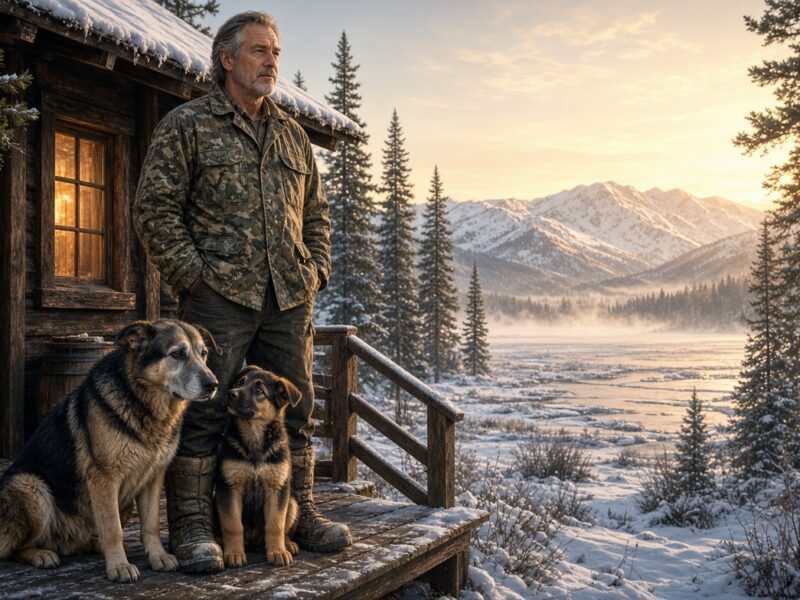
His Old Dog Brought Home a Half-Frozen Puppy… And the Tiny Red Wool Stitched to Her Collar Changed Everything
Snow swept sideways across the Montana wetlands as Merritt Shaw stood in the doorway, one hand gripping the frame, his faded NWU type 3 blouse hanging loose over broad shoulders that had carried too many winters already.
At his boots, his eleven-year-old German Shepherd, Cedar, refused to come inside.
The old dog’s silvered muzzle pointed toward something trembling on the porch.
A half-frozen German Shepherd puppy soaked through, one ear folded, too weak to stand straight.
Merritt reached for her, but Cedar stepped between them, silent and firm, until Merritt finally understood.
The dog wasn’t asking permission.
He was asking for help.
Merritt carried the puppy inside.
Then he saw the scrap of red wool stitched to her collar.
He knew those uneven cream stitches.
His late wife had made them, and that tiny piece of fabric would lead him back to the exact place where Cedar’s own life had begun.
At 5:30 every morning, the house made three sounds.
The furnace clicked awake beneath the floorboards.
The old refrigerator gave a tired metallic hum, and Cedar rose from his bed beside the mudroom door, shook once from nose to tail, and sent his collar tags tapping against each other in the dark.
Merritt Shaw no longer needed an alarm.
By the first week of January, winter had pressed itself flat across the north end of Flathead Lake.
Snow lay clean and blue in the early light, smoothing fences, sheds, fallen logs, and the low frozen wetlands beyond Merritt’s property into shapes that looked simpler than they really were.
Farther west, pine-covered slopes rose beneath a sky so pale it seemed made of cold glass.
The lake itself caught the morning sun in hard silver bands.
Merritt preferred winter for the same reason he preferred machinery.
Damage showed.
A cracked belt squealed.
A frozen pipe stopped flowing.
A roof carried too much snow and bowed honestly beneath it.
People were less cooperative.
At forty-seven, Merritt was still built like a man accustomed to lifting things no one had designed handles for.
He stood nearly six foot three, broad through the shoulders, with a lean, work-hardened frame that had survived years of military construction assignments, and then years of pretending civilian life required no adjustment at all.
His ash-brown hair had silvered heavily near the temples.
A short mustache carried the same gray.
His nose leaned slightly left from an old break, giving his long face an asymmetry his late wife had once called proof the government couldn’t straighten everything.
He had not heard anyone make that joke in one year, ten months, and twelve days.
He did not count on purpose.
That was worse.
He pulled on an old woodland pattern work blouse over a charcoal thermal shirt, stepped into insulated boots, and opened the back door.
Cold struck him cleanly.
Cedar moved past his leg without hurry.
The German Shepherd was eleven now.
A large black and tan male whose once dark muzzle had gone silver beneath the eyes and around the mouth.
His back still carried a broad black saddle, but winter sunlight brought out deep honey along his chest and legs.
The tip of his right ear leaned slightly outward, an old imperfection that made him look as though he were permanently considering a second opinion.
“Easy,” Merritt said.
Cedar ignored him with dignity and descended the steps.
Merritt took the snow shovel from beside the door.
There were rituals for surviving things.
Clear the porch.
Break the thin ice from the water trough near the workshop.
Check the propane gauge every Sunday.
Leave the kitchen radio on low even when no one was listening.
Repair what broke.
Do not enter the sewing room.
That last rule had no practical reason.
The room sat at the end of the upstairs hall behind a white painted door.
Nothing dangerous waited inside.
No unfinished legal papers, no medical equipment, no hidden letter that would suddenly explain grief in a more useful language.
Just fabric, thread, a maple sewing table, a yellow pin cushion shaped like a tomato, and the absence of Clare Shaw.
For almost two years, Merritt had kept the room largely as she had left it.
He had dusted the hallway around its door.
He had changed the batteries in the smoke detector above it.
Once during a particularly cold February, he had opened the door six inches to make sure a heating vent was not blocked.
That counted as maintenance.
Maintenance, he understood.
Living was less organized.
Cedar stopped near the back fence.
Merritt noticed only because the dog remained there too long, head raised toward the frozen wetland.
“You hear something?”
Cedar looked back.
His amber-brown eyes had become quieter with age, not dull.
If anything, they seemed more selective about what deserved a reaction.
Then he turned away and continued along the fence.
Merritt went back to shoveling.
For the past four mornings, Cedar had disappeared from view for stretches of forty minutes, sometimes nearly an hour.
The property covered several wooded acres, all fenced, and the old dog had always enjoyed making a slow perimeter after snow.
Merritt assumed age had simply made the route longer.
He had considered following.
He had not.
There was a point, he believed, where concern became insult.
By seven, Cedar would reappear with snow dusting his lower legs, drink half a bowl of water, and sleep beside the wood stove until breakfast.
Nothing about it had seemed urgent.
That morning he returned after fifty-three minutes.
Merritt knew because he had looked at the clock twice.
He disliked that he had looked at all.
“Taking your time lately?”
Cedar lowered himself onto his bed with a quiet exhale.
Merritt poured coffee into one mug, then by habit reached toward the cupboard for another.
His hand stopped.
The second mug had small painted yellow flowers around the rim.
He closed the cupboard.
“That one never gets funny,” he muttered.
Cedar opened one eye.
“Mind your business.”
The eye closed again.
By mid-morning, Merritt was in the workshop repairing a neighbor’s snowblower.
The carburetor was fouled, the pull cord frayed, and someone had used the wrong size socket on two bolts and rounded their corners.
This was comforting.
Human error he could hold in one hand.
He was replacing the fuel line when he noticed Cedar was gone again.
Merritt straightened.
The side door to the workshop stood partly open where he had left it for ventilation.
Fresh tracks crossed the yard.
Large shepherd prints.
They disappeared behind the woodshed toward the far end of the property.
Merritt wiped his hands on a rag.
“Cedar.”
No response.
He waited.
A raven called from somewhere above the pines.
Wind combed loose snow from the workshop roof in a glittering sheet.
Merritt started toward the yard, then stopped himself.
The dog was eleven, not helpless.
The fence was secure.
He had checked it in November, probably.
Merritt looked toward the distant tree line.
“You’re turning into an old busybody,” he told himself.
The accusation lacked conviction.
He returned to the snowblower.
Twenty minutes later, a bell began ringing at the back door.
Not once, not Cedar’s normal single push with his nose.
Clang, clang, clang.
A pause.
Clang.
Merritt dropped the wrench.
He crossed the mudroom in six strides and pulled open the door.
Cedar stood on the top step.
Snow clung wetly to his chest and lower belly.
His breathing was heavier than Merritt liked, though not panicked.
The old dog looked up at him, then down.
Merritt followed his gaze.
For several seconds, the thing between Cedar’s front legs did not register as a German Shepherd.
It was too small, too wet, too badly assembled.
A puppy stood hunched on the snow-covered step, maybe eleven or twelve weeks old, with black and caramel fur clumped into damp spikes.
Her legs seemed absurdly long for her narrow body.
One ear stood upright with great ambition, while the other folded over near the tip as if it had reconsidered the project halfway through.
She stared at Merritt.
Merritt stared back.
The puppy sneezed.
Cedar looked away.
“No.”
The puppy tilted her head.
“No,” Merritt repeated.
“Whatever arrangement the two of you made outside, renegotiate it.”
Cedar sat.
That somehow felt disrespectful.
Merritt pointed past him toward the yard.
“Where did you even—”
The puppy shot forward.
She squeezed between Merritt’s boots before he could close his stance, hit the smooth mudroom floor at speed, lost all four feet simultaneously, and slid sideways into a basket of split kindling.
Wood scattered.
The puppy vanished beneath it.
There was a stunned silence.
Then one small black nose emerged between two pieces of birch.
Merritt closed his eyes.
Behind him, Cedar entered the house at a dignified walk and lay down beside the door.
“You.”
Cedar rested his chin on his paws.
“You brought her.”
No response.
The puppy climbed free of the wood pile, shook violently, and sent droplets across the wall Merritt had painted in October.
Merritt stared at the spots.
The puppy stared at him.
Then she trotted deeper into the house.
“Oh, absolutely not.”
He caught her gently before she reached the kitchen.
Only then did he feel how little she weighed.
Beneath the wet fur were ribs, not sharply visible, but too easy to count with his fingers.
His annoyance changed shape.
He sat her down on a towel and crouched.
“Hold still.”
She immediately attempted to eat the corner of the towel.
“Excellent start.”
Around her neck was a soft green breakaway collar, dirty but intact.
Something had been sewn onto it.
Red wool.
Merritt’s hand stopped.
It was only a strip, no wider than two fingers.
Old wool faded from a once deeper red, attached to the collar with thick cream-colored thread.
The stitches were uneven.
Three close together, then one longer, then two small.
Merritt knew that pattern.
He should not have, but he did.
Clare had never been patient enough to make hidden repairs beautiful.
She fixed things fast, then laughed when Merritt complained that her stitches looked like an argument between a needle and gravity.
His thumb passed over the cream thread.
The room seemed to lose sound.
Cedar lifted his head.
Merritt looked at him.
“Where did you find this?”
Cedar’s gaze stayed on the puppy.
Of course.
Merritt stood too quickly.
The puppy tried to follow, stepped on the towel, and rolled once onto her side.
He barely noticed.
He climbed the stairs.
The hallway felt colder than downstairs.
At the far end stood the white door.
For several seconds, Merritt simply faced it.
He had been under incoming weather in unfinished structures.
He had crossed temporary bridges that moved under heavy equipment.
He had once spent fourteen straight hours helping stabilize a washed-out road with half the material the job actually required.
None of those things made turning this doorknob easier.
The latch clicked.
A faint smell met him.
Cotton, old cedar drawers, dust.
Nothing mystical.
Nothing preserved.
Clare was not in the room.
That hurt in a way photographs never managed.
Afternoon light fell across the sewing table.
Spools of thread remained arranged by color in a wooden tray.
A measuring tape hung from the back of the chair.
On the wall, a corkboard still held three fabric swatches and a grocery receipt dated two weeks before her final hospital stay.
Merritt moved to the closet.
On the top shelf sat a flat cardboard box.
He brought it down.
The lid had a handwritten label.
Winter wool.
He opened it.
Two scarves.
A pair of gloves missing its mate.
A knitted cap.
Empty space where a thick red blanket-sized scarf had once been folded.
Merritt stared at that space until memory finally surfaced.
Six weeks earlier, a Saturday, he had forced himself to clear one closet.
Three bags for donation, old coats, blankets, dog bedding, a cardboard box marked for North Fork Winter Animal Network because Clare used to send things there every year.
He had picked up the red wool, hesitated, then thrown it into the box before he could change his mind.
Not because he was ready, because he had been angry at himself for not being ready.
Merritt lowered himself onto the sewing chair.
Downstairs, something crashed.
He shut his eyes.
Another smaller thump followed.
Then silence.
Fantastic.
When he returned to the mudroom, Cedar had not moved.
The puppy had.
She stood with Merritt’s right work boot over her entire head.
Only her ears, one upright, one folded, protruded above the leather.
She walked backward.
The boot went with her.
Merritt stared.
Cedar stared.
The puppy backed into the wall.
Thunk.
She froze.
For the first time that morning, something inside Merritt loosened unexpectedly.
Not enough to become laughter.
Almost.
He crouched and took hold of the boot.
“Come here, criminal.”
The puppy pulled backward.
“Your strategy needs work.”
He eased the boot from her head.
Her face appeared, whiskers damp, expression deeply offended.
Then she put one paw against his wrist.
Merritt went still.
The paw was cold, not snow cold, deep cold.
He touched the other front foot.
The pads were chilled, and the small leg trembled beneath his fingers.
He looked more carefully now, the damp fur, the hollow behind the ribs, the exhaustion hidden beneath all that foolish energy.
His gaze shifted to Cedar.
The old shepherd watched him steadily.
Merritt’s curiosity disappeared.
Whatever story belonged to the red wool could wait.
He scooped the puppy into both arms.
She resisted for perhaps two seconds before collapsing against his chest, suddenly too tired to pretend she was not tired.
Merritt felt her shivering through his thermal shirt.
“Okay,” he said quietly.
Not to Cedar.
Not entirely to the puppy.
“Okay, first we get you warm.”
Outside, beyond the frosted mudroom window, sunlight flashed across the snow.
Far behind the house, where the property fence disappeared into the pines, a bent section of wire lay pressed beneath the weight of a fallen tree.
Through the narrow opening below ran two sets of tracks, one large, one very small.
By 8:15, the puppy had been warmed, towel-dried, fed a careful amount of softened food, and had attempted to steal the towel twice.
Merritt considered this an improvement.
The drive into town took twenty-seven minutes when the roads were clear.
That morning, packed snow shone along the shoulders of Highway 93, while low winter sun spilled through breaks in the clouds, flashing off frozen fields and the distant white shoulders of the mountains.
The puppy rode in a laundry basket lined with two blankets because Merritt had not owned a puppy crate in years.
Cedar sat behind her.
That arrangement lasted four minutes.
At the first long bend in the road, Cedar shifted to the opposite side of the back seat.
The puppy woke.
She lifted her head, saw empty space where the old shepherd had been, and screamed.
It was not a bark.
It was a noise Merritt would have expected from a smoke detector discovering religion.
“All right,” he checked the mirror.
Cedar looked out the window.
The puppy climbed one side of the basket, tipped it halfway over, and screamed again.
“Cedar.”
The old dog turned his head.
“Could you please maintain visual contact with your dependent?”
Cedar looked at Merritt in the mirror.
Then, with the resignation of someone forced into a committee assignment, he moved back beside the basket.
The puppy stopped instantly.
Merritt stared at the road.
“Unbelievable.”
She curled against the blanket and fell asleep before they reached the next curve.
Coleman Veterinary sat behind a grocery store on the edge of town, a low stone building with blue trim and a carved wooden dog over the entrance wearing a painted red scarf.
Merritt had always thought the scarf made the animal look embarrassed.
The parking lot had been plowed into gray-white ridges.
He lifted the puppy basket from the passenger side, then opened the rear door for Cedar.
The German Shepherd jumped down, or tried to.
His front feet landed cleanly, but his back end followed more slowly than Merritt expected.
Cedar stood beside the truck for a moment without moving.
Then came two short coughs.
Dry, low.
Cedar lowered his head and drew a deeper breath.
Merritt’s hand tightened around the basket handle.
Cold air.
Cedar looked up.
His breathing settled.
Merritt watched another three seconds.
“Eleven years old,” he told himself.
That was what eleven looked like.
Nothing more.
Inside, warm air carried disinfectant, coffee, and the unmistakable smell of animals trying to behave in public.
The puppy came awake immediately.
A beagle stared at her from beneath a chair.
She stared back.
The beagle sneezed.
She attempted to climb out of the basket.
Merritt pushed her gently down.
“Absolutely not.”
A voice from the hallway said, “That usually works beautifully with puppies.”
Dr. Lena Moravec appeared in the doorway, pulling one sleeve of a charcoal fleece over deep teal scrubs.
She was forty-four, narrow-shouldered and quick-moving, with chestnut hair twisted into a loose knot that had surrendered several curls around her face.
Thin tortoiseshell glasses sat halfway down her nose.
Merritt had known her long enough to understand that the calmer she sounded, the less likely she was to let him escape with a bad explanation.
Her eyes moved from Merritt to the basket, then to Cedar, then back to Merritt.
“What did you do?”
“I opened a door.”
“That has consequences.”
“She came with Cedar.”
Lena paused.
“Of course she did.”
The puppy stood with both front paws on the basket rim.
Lena crouched.
“Well, hello.”
The puppy attempted to eat her zipper.
“Strong first impression.”
Merritt carried her into an examination room.
The instant Cedar remained in the hallway.
The puppy twisted in Merritt’s arms and began clawing toward the door.
Lena watched.
“Bring him in.”
“He’ll crowd the room.”
“She’d rather have the room crowded than believe the planet swallowed him.”
Cedar entered and settled beside the wall.
The puppy relaxed so quickly Merritt felt the change through his hands.
Lena noticed that, too.
She noticed most things.
The examination started with weight.
The number made Lena’s mouth flatten slightly.
“Light.”
“How light?”
“Light enough that I don’t want you deciding breakfast should make up for the last week.”
“I didn’t.”
“Good. Because people feel guilty, then feed with emotion.”
Merritt looked at her.
“You say that like it’s common.”
“I work with people who own Labradors.”
The puppy objected strongly to having her temperature taken, objected moderately to the stethoscope, and considered the otoscope an unforgivable insult.
Through all of it, Cedar remained near the wall, not touching, just present.
When the puppy wriggled hard enough to nearly slide from the table, Cedar stood.
Nothing else.
The puppy saw him and stopped struggling.
Lena glanced over her glasses.
“That’s interesting.”
“He’s always been steady around young dogs.”
“This is more than steady.”
Merritt did not answer.
Lena continued the examination.
No fracture, no obvious joint injury, no significant cuts beneath the coat.
The pads were irritated but intact.
Her gums suggested mild dehydration.
The hollows behind her ribs were more pronounced once the fur dried.
“She hasn’t been eating enough,” Lena said.
“Maybe several days, maybe longer, depending on what she found.”
“Frostbite?”
“I don’t see evidence of serious cold injury. She got lucky. Or she found shelter.”
Merritt thought of the tracks beyond the fence.
“How long was she outside?”
“If she could answer that, my job would be much easier.”
The puppy seized the end of Lena’s stethoscope.
Lena stared down at her.
The puppy pulled.
“Apparently,” Lena said, “we’re entering negotiations.”
Merritt took the tubing gently from the puppy’s mouth.
“What about a chip?”
They scanned her twice.
“Nothing.”
Lena examined the green collar next.
The small patch of red wool looked darker now that it had dried.
She turned the collar in her fingers, studying the thick cream stitches.
Merritt found himself watching her face.
“Clare did that stitching.”
Lena looked up.
He rarely said his wife’s name aloud without preparation.
The sound of it seemed to remain in the room after he stopped speaking.
“You’re sure?”
“She repaired things fast. Never pretty.”
One corner of Lena’s mouth lifted.
“I remember.”
Merritt looked at her.
“From what?”
“Clare once brought Cedar in with a blanket she had repaired using green thread, white thread, and what I’m fairly certain was dental floss.”
“That sounds right.”
The memory did not crush him.
That surprised him.
It came and went like a bird crossing snow.
Lena turned the collar over.
Stamped into the underside of the buckle were four small letters.
NFWAN.
She looked at them again.
“North Fork Winter Animal Network.”
Merritt knew the name.
He just had not expected it to arrive around a puppy’s neck.
“That’s who got the donation box.”
“They coordinate overflow, foster care, storm intake, transport. Small operation, mostly volunteers.”
“Then this gets simple.”
Lena looked at him.
“I call them, find whoever is responsible for her, and she goes back.”
The puppy had found Lena’s discarded glove on the counter.
She backed away with it, clamped proudly in her mouth.
Lena pointed.
“You should probably tell her.”
Merritt retrieved the glove.
The puppy ran around his boots.
“She’s staying one night.”
“You keep saying that like she signed something.”
Merritt ignored her.
Lena opened a clinic drawer, removed a packet of electrolyte solution, and began explaining feeding amounts.
The puppy climbed onto Merritt’s boot.
“What are we calling her until North Fork calls back?”
“We aren’t.”
Lena leaned against the counter.
“Animal records work better with nouns.”
“Puppy, I’m going to make you regret that.”
The puppy released his boot lace, spotted Lena’s second glove, and sprang for it.
She missed by six inches, landed sideways, recovered instantly, and tried again.
Lena watched her.
“Moxy.”
“No.”
“Moxy Shaw.”
“Absolutely not.”
“I didn’t say you were adopting her.”
“You added my name.”
“That was administrative mischief.”
The puppy finally captured the glove.
Lena nodded.
“Moxy.”
Merritt looked down.
The puppy stood with half a nitrile glove hanging from her mouth like a blue flag.
He sighed.
“For the chart, of course. Moxy. Temporarily.”
Lena typed the name.
The puppy became Moxy.
Merritt disliked how little ceremony the moment required.
They were almost finished when Lena looked toward Cedar.
“Bring him up.”
Merritt frowned.
“He’s fine.”
“He coughed in the parking lot.”
“You heard that?”
“I saw it.”
“He’s eleven.”
“That’s his age, not a diagnosis.”
Cedar climbed onto the low platform scale with the practiced reluctance of a dog who remembered exactly how veterinary medicine worked.
Lena listened to his chest.
She moved the stethoscope, listened again.
Her face did not change enough to alarm anyone who did not know her.
Merritt knew her.
“What?”
“Quiet.”
“That is never reassuring when a doctor says it.”
She repositioned the chest piece.
Cedar stood patiently.
Moxy sat beneath Merritt’s chair, chewing his lace.
Lena finally straightened.
“I’m hearing something I haven’t heard before.”
Merritt’s attention narrowed.
“A murmur?”
“Possibly. There’s an irregularity I want evaluated properly.”
“How serious?”
“I don’t know yet.”
“Give me a range.”
“No, Lena.”
“No, because you’ll take the worst end of the range and move into it before we have test results.”
Merritt looked at Cedar.
The gray around the dog’s muzzle suddenly seemed much whiter.
Lena closed the chart.
“I want an echocardiogram. Within the next few days. That’s all I know today.”
“He’s been slowing down.”
“He’s eleven.”
“You just told me that wasn’t a diagnosis.”
“It still isn’t.”
The contradiction almost sounded deliberate.
Merritt rubbed his thumb against the edge of his watch band.
Lena noticed.
“Don’t bury him in your head before anything has happened.”
His hand stopped.
“I wasn’t.”
“You were halfway through the funeral.”
For several seconds, neither spoke.
Then Moxy pulled Merritt’s boot lace completely free.
Lena looked down.
“Fortunately, you have another medical emergency.”
Merritt breathed out through his nose.
On the drive home, Cedar remained beside the laundry basket without being asked.
Moxy slept with her head resting against one of his front paws.
Merritt checked the rearview mirror too often.
Each time, Cedar was still there.
Each time, Merritt looked away first.
The house changed the moment Moxy crossed its threshold.
Not emotionally.
Structurally.
By noon, a sock disappeared from the bedroom and reappeared beneath the dining table.
At 12:15, Merritt discovered Moxy asleep inside a plastic laundry basin containing two clean towels and one of his T-shirts.
At 12:30, she met her reflection in the glass patio door.
The confrontation lasted forty seconds.
Moxy barked.
The reflection barked.
Moxy jumped sideways.
The reflection shamelessly did the same.
Cedar watched from his bed with the expression of an animal reconsidering several life decisions.
“You brought her,” Merritt reminded him.
An hour later, Moxy attempted to climb onto the sofa.
Misjudged the height and remained on her back as though she had intended to inspect the ceiling.
Merritt laughed.
It escaped before he could decide whether to permit it.
The sound felt strange in the house.
Moxy looked at him.
Cedar lifted his head.
Merritt immediately busied himself with the wood stove.
At feeding time, Moxy emptied her measured portion, licked the bowl, pushed it across the floor, then sat beside Cedar’s dish.
Cedar continued eating.
Moxy leaned forward.
Cedar stopped.
He turned his head.
Nothing dramatic happened.
No growl, no snap, just one long stare.
Moxy slowly sat back.
Merritt leaned against the counter.
“Good talk.”
The pattern continued.
When Moxy discovered the basement stairs and tried to descend at full speed, Cedar stepped across the entrance.
She moved left.
He moved left.
She tried right.
He shifted once.
She sat down and barked directly into his chest.
Cedar remained unimpressed.
Later, she wandered too close to the hot wood stove.
Cedar rose, placed his shoulder against her side, and redirected her without force.
When she finally collapsed beneath the kitchen table that evening, Cedar lay several feet away, close enough to see her, far enough to let her sleep.
Merritt found himself watching the space between them.
That bothered him more than watching either dog.
Distance could mean many things.
Guarding, tolerance, attachment.
A man could ruin an ordinary thing quickly by needing it to mean too much.
At 4:30, Merritt called the number printed on the North Fork website.
A woman answered on the fifth ring.
“North Fork Winter Animal Network. Dela speaking.”
Her voice was older, low, and unhurried.
“My name is Merritt Shaw. I may have one of your puppies.”
There was movement on the other end.
“What puppy?”
“German Shepherd, female, about twelve weeks. Green safety collar, red wool sewn onto it.”
Silence.
Not bad reception.
Silence with attention inside it.
“Where are you?” the woman asked.
“Near Flathead Lake, west side.”
“And she’s alive.”
Merritt looked beneath the table.
Moxy was sleeping on her side with one rear paw resting over her nose.
“Yes.”
Dela exhaled.
“We lost one during the relocation.”
“What relocation?”
“A tree came down across part of the temporary kennel area after the storm. We moved the litter. One puppy slipped away while people were carrying dogs between buildings.”
“When?”
“Three nights ago.”
Merritt’s eyes shifted to Cedar.
The old shepherd was awake now, watching him.
“I can bring her back tonight.”
“No.”
Merritt frowned.
“No?”
“The damaged section isn’t fully repaired. The mother and other puppies are safe at another foster location, but we’ve got animals spread everywhere right now.”
“I can take her wherever they are.”
Another pause.
Then Dela said, “How is she with your dog?”
Merritt looked down.
Moxy woke, stretched, stood, and wandered straight to Cedar.
She circled twice before lying down near his four legs.
Cedar did not move away.
“She follows him.”
“Does he tolerate her?”
“That’s one word for it.”
“What kind of dog?”
“German Shepherd. Eleven.”
Dela became quiet again.
Merritt disliked silences from strangers almost as much as he disliked questions whose purpose he could not identify.
Finally, she said, “Don’t rush her anywhere tonight.”
“I’m not keeping her.”
“I didn’t ask you to.”
“She belongs with your organization.”
“She belongs somewhere safe while we figure out the rest.”
Merritt looked toward the kitchen window.
Outside, late sunlight stretched gold across the snow, making the entire frozen yard look warmer than it was.
Dela continued, “I’d like to come out tomorrow. See the puppy, see your dog, and see that red patch.”
“Why the patch?”
“I’ll explain when I’m looking at it.”
Merritt almost refused on principle.
Instead, he said, “Fine.”
“And Mr. Shaw.”
“Yes.”
“If that puppy decided your old dog is the safest thing in the room, moving her tonight because paperwork says she came from us may not be the smartest first step.”
Merritt disliked the word decided.
Animals responded to warmth, food, smell, habit.
People added stories afterward.
Still, when he ended the call, relief moved through him before he could stop it.
Small, immediate, embarrassing.
Moxy did not have to leave tonight.
Merritt stared at the phone, then at the puppy, then at Cedar.
“Temporary,” he said.
Cedar lowered his head back to his paws.
Moxy rolled over in her sleep and kicked him in the jaw.
Cedar closed his eyes.
Merritt almost laughed again.
This time, he let himself.
Dela Crowe arrived at 9:16 the next morning in a mud-salted Subaru that looked as though it had survived several arguments with winter and won most of them.
Merritt watched from the kitchen window as she parked crooked beside the workshop, climbed out, and immediately opened the rear hatch instead of coming to the door.
She was smaller than he had expected from her voice.
Sixty-eight, maybe, five foot three, built solidly beneath a rust-brown parka.
Silver hair escaped from beneath a mustard knit cap and curled against her jaw.
She removed a canvas bag the size of field luggage, slung it over one shoulder, and kicked the hatch closed with the heel of an insulated boot.
Moxy had already discovered her.
The puppy pressed both front paws against the glass door and produced a bark too large for her body.
Dela looked up.
Moxy barked again.
Dela raised one gloved finger.
“Don’t start.”
Merritt heard it through the glass.
He opened the door.
“You talk to all animals before introductions.”
“Only the opinionated ones.”
Moxy shoved her nose into the opening.
Cedar appeared behind her, moving at his own pace.
Dela’s expression changed when she saw him, not softened, focused.
She let Merritt invite her inside before crouching, one knee cracking audibly beneath the parka.
“Morning, old man.”
Cedar approached far enough to smell her glove, then stepped away.
Dela nodded as though he had answered a formal question.
“Fair enough.”
Moxy offered no such restraint.
She climbed directly into Dela’s lap.
“Ah, and here’s the criminal.”
“She stole a dish towel at six.”
“Rehabilitation is going badly.”
“She also discovered the toilet paper roll.”
“Career criminal.”
Merritt almost smiled.
Dela took off her gloves.
Her hands were broad, knuckles enlarged with age, nails cut short.
Hands that had opened thousands of kennel gates and washed thousands of bowls.
She examined Moxy without trying to restrain her.
Checked the ears, the paws, the belly.
Let the puppy investigate every finger.
Then she reached for the collar.
The red wool rested against Moxy’s dark neck like a small ember.
Dela went still.
“That’s it.”
Merritt leaned against the counter.
“You recognize it.”
“I cut it.”
The answer landed differently than he expected.
Dela turned the collar slightly.
“Your donation came in. You remember one scarf from one box?”
“I remember good wool.”
“That’s your reason?”
“It’s Montana.”
She looked up.
“Good wool outranks sentiment nine months of the year.”
Merritt gave her nothing.
Dela’s mouth twitched.
Then she grew more serious.
“The box had your address. Your wife’s handwriting, I think.”
Merritt’s eyes moved to the red patch.
“There was a note.”
“Not exactly.”
Dela reached into the canvas bag and pulled out a folded intake sheet inside a clear plastic sleeve.
At the top was a photocopy of the writing from the cardboard box.
Old wool, still usable for kennel bedding.
That was all.
No inspirational sentence.
No date, no name, just Clare’s practical block letters.
The final G slightly tilted because she never lifted her pen correctly when she was in a hurry.
Merritt stared at the page.
Of all the things grief preserved badly, handwriting was cruelly precise.
He could see her standing in the mudroom years ago with a marker clenched between her teeth, sorting coats and blankets into boxes while arguing that people kept too many things simply because objects were incapable of asking to be released.
He remembered disagreeing.
He had become proof she was right.
Dela set the sheet down.
“That box arrived six weeks ago. I know the red wool was too worn along the center to send to a thrift store. So I washed it and cut the best sections for bedding.”
Moxy tried to climb onto Cedar.
Cedar stood.
Moxy slid off.
She looked offended.
Dela watched them briefly.
“We had three shepherd pups that looked almost identical from above. I stitched different cloth markers onto breakaway collars so the volunteers could tell them apart quickly during weigh-ins.”
“And Moxy got red.”
“She wasn’t Moxy then.”
“What was she?”
“Red collar.”
Merritt looked at the puppy.
Moxy had found Dela’s canvas bag and was attempting to pull out a rolled leash twice her length.
“Moxy is better.”
“I agree.”
That annoyed him because he had not meant the sentence as approval.
Dela sat at the kitchen table while Merritt poured coffee.
He offered milk.
She said yes.
“Sugar?”
“No, I still have standards.”
The story came without theatrical pauses.
North Fork had taken in a German Shepherd mother and five puppies from a foster placement that could no longer keep them through winter.
They had been temporarily housed in a heated kennel structure on the edge of North Fork’s property while new foster homes were arranged.
Three nights earlier, wet snow had accumulated on a lodgepole pine already weakened by wind.
The tree came down after dark.
It did not crush the kennel building.
It damaged the fencing and tore part of the covered run open.
“We had six people there within forty minutes,” Dela said.
“Everyone was moving dogs before the weather got worse.”
Merritt glanced at Moxy.
“She got loose then?”
Dela nodded.
“One volunteer was carrying two puppies. Someone opened a gate behind her. A metal panel shifted. One of the pups panicked. She twisted free before anyone had a hand on her.”
“Why wasn’t she found?”
“We looked.”
The flatness of Dela’s answer made him look back at her.
She did not defend herself.
“We searched until two in the morning, again before daylight. Tracks crossed tracks. Snow came hard enough to erase half of what we had. The mother and the other four puppies were moved to a foster home north of town. All alive, all fine.”
Merritt had not realized he needed that answer until he heard it.
“Moxy was the only one missing.”
Dela looked toward the puppy.
“And apparently she found another arrangement.”
Cedar had returned to his bed.
Moxy lay against the outer edge of it, not touching him, nose tucked beneath one foreleg.
Merritt lowered his coffee.
“She didn’t find him at my house.”
“No, he was leaving every morning.”
“Then he found her somewhere.”
Merritt looked toward the snowy yard.
Yesterday, those disappearing mornings had been mildly irritating.
Now they had shape.
Dela followed his gaze.
“Want to know where?”
He already had his coat on five minutes later.
Before leaving, Dela filled out the temporary foster paperwork at the kitchen table.
Merritt signed where she pointed.
The phrase temporary foster appeared twice.
He appreciated that.
Moxy stayed behind in the warmed mudroom behind a puppy gate with water, bedding, and an expression suggesting civilization had betrayed her.
Cedar came with them.
Merritt almost said no because of the cough at the clinic.
Instead, he remembered Lena telling him that concern and confinement were not the same thing.
“One short walk,” he told the dog.
Dela zipped her parka.
“You always negotiate with him out loud.”
“He’s more reasonable than most contractors.”
They started behind the workshop.
Yesterday’s sun had crusted the snow, preserving older depressions beneath a thin, glittering surface.
Cedar moved ahead slowly, nose lowered, though he did not appear excited.
At the far edge of Merritt’s property, the fence vanished behind a cluster of young firs.
He saw the damage before Cedar reached it.
A lodgepole pine had come down at an angle during the last heavy snow.
The trunk had not broken the wire fence completely.
It had bent the top rail downward and pressed the mesh close to the ground.
Beneath the lowest edge was a dark hollow, large enough for a dog.
Merritt stopped.
“I checked this fence in November.”
Dela looked at the tree.
“It’s January.”
He stepped closer.
Snow around the gap had been disturbed repeatedly.
One set of paw marks was broad and deep.
Cedar.
There were older impressions beneath them.
“You were coming through here.”
Cedar sniffed the opening.
Merritt felt an irrational impulse to be offended.
Not because the dog had escaped, because Cedar had discovered a flaw in something Merritt believed secure.
He had spent years trusting structures by inspecting them.
He had somehow assumed that meant structures stayed inspected.
Dela pointed beyond the fence.
“Small tracks.”
Merritt crouched.
The prints were faint and partly filled.
Small paws.
They ran parallel to Cedar’s older trail for several yards before vanishing where wind had swept the open ground clean.
They passed through the gap one at a time.
Beyond the fence, the land descended gradually toward frozen wetlands broken by willow, cattail stubble, and narrow stands of alder.
North Fork’s property lay farther northwest beyond a line of low timber.
Dela gestured toward the terrain.
“If the puppy ran from our place, this is the easiest low route.”
“Why come this way?”
“Cover.”
She pointed.
“The tree line blocks the worst west wind. Snow stays shallower under the brush.”
Merritt examined the corridor.
He saw it now.
Not fate.
Topography.
An animal frightened by open ground would choose the edges.
Windbreak, brush, low snow.
A route could look meaningful after the fact simply because geography had made it practical.
They continued.
Cedar traveled without hesitation.
The old dog knew the path.
That disturbed Merritt more than if he had searched.
Several hundred yards beyond the fence, the wetland narrowed near a stand of cottonwoods.
Something dark appeared between the trunks.
A roof line.
Merritt stopped walking.
Dela took three more steps before noticing.
“What?”
He did not answer.
Snow had collected along one side of the little structure, almost reaching the bottom of the window opening.
Gray boards leaned against each other under a roof patched with weather-blackened tin.
One corner had settled into the ground enough to make the entire building look tired.
Ten years collapsed into a single image.
Clare kneeling in snow, red wool around her shoulders, something black and tan moving beneath it.
Merritt had not been with her when she found Cedar.
He had been home on leave, repairing a frozen pipe beneath the kitchen sink.
She had gone walking after lunch and returned nearly three hours later with a wet puppy inside her coat and one boot lace missing.
He had asked what happened to the lace.
She said the puppy had eaten half of it.
He had asked why she brought it home.
She said, because leaving it there had not been an option.
Only later had Merritt walked out with her to see the place.
This place.
“The warming shack,” he said.
Dela looked from him to the building.
“You know it.”
“Cedar was found here.”
She became still.
“More than ten years ago.”
Cedar had already moved ahead.
He stopped in the doorway.
Not dramatically.
He simply stood there sniffing.
Dela glanced at Merritt.
He could see the question on her face.
“Clare found him,” he said.
“Same building.”
Dela did not say what people usually said when coincidence arrived carrying emotional ammunition.
No meant to be.
No sign.
She merely looked at the landscape behind them.
“That makes geographic sense.”
Merritt almost laughed.
It was exactly the wrong sentence and therefore exactly the right one.
They approached the shack.
Inside, the air held the dry smell of old timber, dust, and frozen earth.
Wind threaded through gaps in the wall.
Dela switched on a small flashlight.
There, a few strands of black and tan puppy fur clung to a rough board near the floor.
Farther in, small paw impressions had dried into a patch of frozen mud.
Merritt crouched.
Beside the back wall lay flattened grass and a shallow depression in blown snow where something had slept.
Next to it was a larger hollow.
Dela ran her glove near the edge without disturbing it.
“Big dog.”
Merritt looked at Cedar.
The shepherd remained near the entrance.
A tiny piece of faded red wool hung from a rusty nail beside the wall.
Dela lifted it carefully.
“From the collar.”
Merritt stared at the two depressions, one small, one large.
The wind made the tin roof tick above them.
“How long?”
“Hard to say exactly.”
She examined the layering along the edges.
“But this wasn’t one visit.”
Merritt looked at her.
Dela pointed to overlapping tracks near the doorway.
“Older prints underneath, newer ones over them. Your dog came back.”
Merritt’s throat tightened.
“The night before he brought her home.”
“Looks like he stayed here a while with her, probably.”
The human mind disliked empty space.
It rushed to fill it.
Merritt saw Cedar as a puppy.
Clare carrying him home.
Then Cedar returning a decade later and finding Moxy in the same frozen room.
The symmetry was almost offensive, too neat, too ready to become a story.
“He remembered this place.”
Dela shrugged.
“Maybe the wool. Maybe he recognized something about it.”
“He brought her back to the same house.”
“Yes.”
Merritt turned toward her.
“You don’t think that means anything?”
Dela tucked the red fiber into a small evidence envelope.
“I think people are always in a hurry to make animals explain our lives for us.”
The word struck hard enough that he looked away.
Dela continued more gently.
“Maybe Cedar remembered this place. Maybe the wool smelled familiar. Maybe he knew the puppy was in trouble.”
She glanced at the old shepherd.
“Or maybe he saw a small animal freezing in a shack and stayed because leaving felt wrong.”
Merritt looked toward Cedar.
The dog’s silvered muzzle caught the pale light from the doorway.
For the first time, Merritt considered a possibility that did not require destiny.
Clare had once found Cedar in the cold.
She had stayed.
Cedar had lived ten years in a house where staying had become ordinary.
Perhaps kindness did not need to be understood to be repeated.
Perhaps it could become behavior before anyone turned it into meaning.
A quiet thought.
A dangerous one, because the moment Merritt allowed himself to feel its warmth, another thought followed.
Cedar was eleven.
Cedar had coughed yesterday.
Lena had heard something wrong in his heart.
Merritt looked again at the large hollow beside the small one.
The old dog had spent a winter night here with a puppy that was not his, then guided her home.
The explanation forming inside Merritt was less reasonable than Dela’s.
He knew that.
Knowing did not stop it.
What if Cedar had sensed his own time narrowing?
What if the dog had brought Moxy home because some instinct told him Merritt would soon need another set of paws in the house?
He hated the thought, then hated himself for being unable to let it go.
Dela stepped outside.
Cedar followed.
Merritt remained in the shack another moment.
The wind crossed the wetlands and whispered through the cracks.
Near his boot, the two sleeping hollows lay side by side, one large, one small.
Merritt had spent most of his life believing structures failed for identifiable reasons.
Load, weather, fatigue, neglect.
Standing there, he realized fear worked differently.
It could take two paw prints in snow and build an entire future from them.
Outside, Cedar waited in the winter sun.
Merritt pulled the door nearly shut behind him and walked toward the dog.
The ultrasound room had no windows.
Merritt noticed that first.
No snowlight, no mountains, no lake flashing silver beyond the highway.
Just a dim rectangle of a room, the steady whisper of a machine, and Cedar lying on a padded table while blue-white images moved across a monitor.
His heart looked nothing like a heart.
It looked like weather.
Dark chambers opened and closed.
Pale lines trembled.
Numbers appeared at the edge of the screen and changed before Merritt could decide which ones mattered.
Dr. Lena Moravec moved the probe carefully across Cedar’s chest.
Cedar tolerated the indignity with the expression of a retired official attending a meeting he had already voted against.
Merritt stood near his head.
His hand rested against Cedar’s neck.
He had not stopped touching him since the examination began.
Lena finally set the probe down.
“All right.”
Merritt hated those two words immediately.
“How bad?”
She wiped the gel from Cedar’s coat.
“I didn’t say bad.”
“You didn’t say good.”
“I’m a veterinarian, Merritt. Not a fortune cookie.”
He waited.
Lena turned the monitor slightly.
“There are early changes in his heart. Nothing here says emergency. Nothing here says you should start measuring his life in days. But there is always a but.”
She pointed to the image.
“His heart is working harder than I wanted to. We’re catching this before he’s in serious trouble, which matters. I’m starting him on medication, and I want his weight kept lean. No marathon hikes. No chasing something uphill for forty minutes because he has decided a squirrel is morally offensive.”
Merritt looked at Cedar.
Cedar looked back.
“Short walks.”
“Yes.”
“Snow?”
“He lives in Montana.”
“Cold weather stresses the heart.”
“So does being wrapped in bubble plastic by an anxious former CB.”
Merritt folded his arms.
Lena took off her glasses.
“This is not a death sentence.”
He heard the words.
They reached him.
They simply had to push through three others first.
Old.
Heart.
Limit.
“What happens next?”
“Medication. Moderate exercise. Watch his breathing. Watch for unusual fatigue, repeated coughing, fainting, appetite changes. We recheck. And after that, we make decisions based on the dog standing in front of us, not the dog you’re afraid of losing six months from now.”
Merritt said nothing.
Lena knew that silence.
She leaned against the counter.
“He can still walk. He can still play. He can still be Cedar.”
“For how long?”
“I don’t know.”
That answer followed Merritt all the way home.
Not the hopeful part, not the early detection, not the medication.
I don’t know.
By the next morning, Cedar’s world had become smaller.
Merritt shortened their walk to the end of the driveway.
When Cedar turned toward the fence line, Merritt called him back.
Cedar stopped, looked toward the trees, then returned.
At noon, Moxy dropped into the play bow she had recently discovered and considered applicable to every living creature, household object, and weather condition.
She bounced toward Cedar.
Cedar rose.
Merritt stepped between them.
“Easy.”
Moxy skidded to a stop.
Cedar stared at Merritt’s leg as if it were an unexpected piece of furniture.
“No rough stuff.”
Moxy sneezed.
Cedar walked away.
That afternoon, Cedar started toward the stairs.
Merritt blocked him.
“Stay down here.”
Cedar looked upstairs, then at Merritt.
“You don’t need anything up there.”
Cedar continued looking.
Merritt pointed toward the living room.
“Come on.”
The dog turned away.
By the second day, Merritt had relocated Cedar’s favorite blanket, moved his food station closer to the kitchen, added a non-slip runner over the hallway floor, and placed a second water bowl beside the wood stove.
By the third morning, he carried the water bowl directly to Cedar’s bed.
Cedar raised his head.
Merritt set the bowl down.
“There.”
Cedar looked at the water, then at Merritt, then stood and walked into the kitchen to drink from the original bowl.
Merritt remained crouched beside the untouched one.
Moxy came over and drank from it enthusiastically.
“Traitor.”
Moxy wagged.
Something else changed.
Cedar stopped choosing the room Merritt occupied.
If Merritt went into the workshop, Cedar stayed in the mudroom.
If Merritt sat by the stove, Cedar settled beneath the kitchen table.
When Merritt moved closer, Cedar often rose a few minutes later and found another place.
The distance was never dramatic, three feet, six, a doorway.
That was enough.
Merritt noticed every inch.
On the fourth afternoon, Lena came by to check how Cedar was tolerating the medication.
She found Merritt standing at the bottom of the stairs with one hand spread across Cedar’s chest.
Cedar wanted up.
Merritt wanted otherwise.
Lena removed her boots.
“What are we doing?”
“Preventing unnecessary exertion.”
“By arresting him?”
“He doesn’t need the stairs.”
Cedar stepped sideways.
Merritt stepped with him.
Lena watched the maneuver.
“Move.”
“What?”
“Move out of his way.”
“He has a heart condition.”
“He has early heart disease. He still has legs.”
“The stairs are steep.”
“He climbed them yesterday.”
“No.”
“The day before?”
“No.”
“Because he couldn’t?”
“Because I didn’t let him.”
Lena gave him a long look.
Merritt hated long looks from medical professionals.
They usually preceded sentences constructed entirely from things he did not want to hear.
She pointed toward the living room.
“Sit down.”
“I’m fine.”
“This is not about your blood pressure, though we can absolutely make it that.”
Merritt sat.
Cedar remained by the stairs.
Lena knelt several feet from him and listened to his chest.
Moxy arrived carrying one of Merritt’s wool socks.
No one acknowledged it.
Lena checked Cedar’s pulse, gums, breathing, then stood.
“He’s tolerating the medication.”
“So this is working.”
“The medicine is.”
Merritt’s jaw tightened.
She glanced at Cedar.
“He’s also avoiding you.”
“He’s tired.”
“No.”
Merritt looked toward the dog.
Cedar had moved to the hallway.
Lena folded her arms.
“You turned fear into a management plan. That’s better than ignoring it.”
“Those are not the only two options.”
“He’s eleven.”
“Yes, he has heart disease. Yes. And you want me to pretend nothing changed?”
“I want you to acknowledge what changed without inventing five more restrictions because you’re frightened.”
The word landed badly.
“I’m not frightened.”
Moxy dropped the stolen sock.
Lena looked down at it, then back at Merritt.
“Of course not.”
He leaned back.
“You weren’t in that shack.”
“No.”
“You didn’t see where he slept beside her.”
“No.”
“He brought that puppy home after going back for days.”
“I know.”
“He knew something.”
Lena’s expression sharpened.
There it was.
The thought Merritt had not said aloud since leaving the warming shack.
“He knew what?” Merritt looked toward Cedar.
“That he wouldn’t be around forever.”
The house became very quiet.
Even the fire had burned down to a low crackle.
Lena sat opposite him.
“You think Cedar found Moxy because he knew he was dying?”
“I didn’t say dying.”
“You decorated it, but yes, you did.”
Merritt looked away.
“He brought her here. He brought a cold puppy somewhere safe. To me. To his home.”
“That’s different.”
“It can be.”
Merritt rubbed his thumb along the edge of his watch band.
“You don’t think animals know when something is wrong?”
“I think animals notice things we miss all the time. That’s not an answer.”
“It is the only honest one.”
She leaned forward.
“Maybe he felt tired. Maybe he recognized the route. Maybe the wool smelled familiar. Maybe he found a frightened puppy and stayed because he is a socially stable dog who has spent eleven years being cared for.”
Merritt’s face hardened slightly.
“That sounds clinical.”
“It sounds less romantic than him arranging your emotional future before his funeral.”
He stared at her.
Lena did not retreat.
“You are allowed to be scared of losing him. You are not allowed to turn that fear into Cedar’s biography.”
For several seconds, Merritt said nothing.
Moxy chose that moment to pick up the sock again.
She trotted toward the mudroom.
Cedar was lying near the back door.
Beside his head hung the brass bell.
Moxy had been studying it for days.
Cedar used the bell simply.
One push of the nose when he wanted the door opened.
No drama.
Moxy approached it, sniffed, pulled her head back, then lunged.
Clang.
The bell struck her forehead.
Moxy jumped backward as if the house had attacked her.
Lena pressed her lips together.
Merritt failed first.
A laugh escaped him.
Moxy glared at the bell.
Cedar lifted his head, then put it back down.
The next morning, Moxy tried again.
This time, she tapped the bell successfully.
Clink.
Merritt came from the kitchen.
“What?”
Moxy raced to her food bowl.
It was empty.
Merritt stared at her.
“No.”
She sat.
“No. You’ve had breakfast.”
She tapped the bowl with one paw.
“No.”
From the living room, Cedar watched.
Two days later, the bell rang again.
Merritt opened the back door.
Cold air swept inside.
No dog stood outside.
Moxy was behind him.
He turned slowly.
She looked up at him, then ran to the cabinet where he kept treats.
Merritt closed the door.
“You have corrupted emergency communications.”
Moxy sat beside the cabinet.
He pointed at the bell.
“That is not a room service button.”
Cedar lay by the stove, watching.
Merritt reached toward the bell’s leather strap.
For one irritated second, he considered removing it.
Then he looked at Cedar.
The old dog’s head remained on his paws, amber eyes steady.
Merritt released the strap.
“Fine.”
The bell stayed.
That Saturday, someone knocked at the front door just before noon.
Merritt expected Dean Reic.
He got Dean plus a ten-year-old boy hiding half a step behind him.
Dean owned the sheep property immediately east of Merritt’s land.
At forty-two, he was broad and compact with close-cut reddish-brown hair and a copper beard that never seemed completely free of hay dust.
His tan canvas coat carried a dark grease streak near one pocket.
“This is Milo,” he said.
Merritt knew the boy by sight.
Milo’s dark blonde hair stuck from beneath a burnt orange knit cap.
He had narrow shoulders inside a navy puffer jacket and wore one orange glove and one gray one.
“Lost the other one again?” Merritt asked.
Milo looked at his hands.
“Maybe.”
Dean sighed.
“It’s in our kitchen.”
“That narrows the search.”
They had come for a repaired portable heater Merritt had finished the previous evening.
Everything went smoothly until Moxy appeared.
She saw Milo.
Milo saw her.
Moxy interpreted this as the beginning of the greatest friendship in recorded history.
She launched across the room.
Milo stepped backward.
Dean immediately reached for his son’s shoulder.
“Moxy.”
Merritt caught the puppy before she reached him.
Her legs bicycled happily in the air.
“Sorry.”
Milo shook his head too quickly.
“It’s okay.”
It was not.
Merritt could see the boy’s face had gone pale.
Dean noticed too.
“Dog chased him last summer,” he explained quietly.
“Loose one down by the boat launch.”
Milo stared at the floor.
“It didn’t get me.”
“No one said it did,” Dean replied.
Across the room, Cedar had risen.
Merritt tensed automatically.
Cedar looked at Milo, then walked to the far side of the stove and lay down, six or seven feet away, no closer.
Milo watched him.
Cedar looked elsewhere.
That was all.
The next time Milo came with Dean, Cedar did the same thing.
Moxy had to be held for the opening minute until her enthusiasm dropped below weather event status.
Cedar simply occupied space.
On the third visit, Milo sat on the floor to help Merritt sort washers from a tin box.
Cedar lay near the hallway five feet away.
Milo noticed.
He kept working.
A week later, the distance became four feet.
Not because Cedar moved.
Milo did.
No one commented.
One afternoon, Merritt came in from the workshop and found Milo sitting on a low stool near the stove while Dean examined a broken gate hinge at the kitchen table.
Cedar rested on the rug.
Milo’s boot was perhaps two feet from his front paws.
The boy was reading a paperback.
Cedar was asleep.
Moxy naturally had her head stuck under the stool, looking for crumbs that did not exist.
Merritt stopped in the doorway.
No command had produced this.
No schedule, no carefully managed exposure.
Cedar had never asked Milo to prove he was brave.
He had simply stayed far enough away that the boy could decide when fear no longer needed all that room.
Merritt looked down at the leash in his own hand.
He had clipped it to Cedar merely to walk from the workshop to the house.
Thirty yards.
Cedar woke.
His eyes moved from the leash to Merritt.
Merritt felt something uncomfortable loosen in his chest.
He bent and unclipped it.
“You know where the house is.”
Cedar stood for a second.
Merritt expected him to walk away.
Instead, the old shepherd stretched, crossed the room, and settled beside the stove again.
Not beside Merritt.
Not yet.
Merritt hung the leash by the door.
Outside, winter sunlight rested pale and clear over the snow.
Inside, Milo turned another page.
Moxy finally found a crumb, and Merritt began to understand that fear did not always need to be defeated.
Sometimes it only needed enough space to become smaller on its own.
The orange survey flag appeared in the snow before Merritt remembered agreeing to let anyone put it there.
It stood beyond the workshop, bright as a warning flare against four acres of white, tied to a thin metal stake near the line of cottonwoods that separated his property from the frozen wetland.
Cedar stopped beside it.
Moxy attacked it.
The puppy hit the ribbon at full speed, missed, spun once on the crusted snow, then came back with greater confidence and less accuracy.
“Moxy.”
She jumped again.
The ribbon snapped against her nose.
She sneezed, looked personally betrayed, and tried to bite the stake.
Merritt took hold of the back of her harness.
“That is property law.”
Moxy pulled harder.
“Apparently you oppose development.”
Cedar had already moved on.
His stride was not young, but it had become easier since the medication settled into his routine.
He still tired sooner than before.
Merritt watched his breathing more carefully than he admitted.
But Cedar could walk the lower fence line, stop to investigate rabbit tracks, and return without the weakness Merritt had spent two weeks imagining into every movement.
Lena had been right.
Merritt found that deeply inconvenient.
He looked again at the orange ribbon.
Three months earlier, before Moxy, before the warming shack, before a red scrap of wool had entered his house wearing a puppy, Merritt had contacted a land company about selling the rear section of his property.
The offer arrived officially that morning.
Glacier North Cabin Development wanted twenty-two acres along the outer boundary, enough to build a small cluster of winter rental cabins with road access from the county side.
The number printed at the bottom of the proposal was large enough to change his life, or at least relocate it.
Merritt folded the papers and put them beneath the sugar bowl.
He did not know why.
He did not use sugar.
By noon, he had read the offer four times.
The company would handle the survey.
They would cover the legal work.
Closing could happen before summer.
He could sell the remaining house afterward, buy something smaller closer to town, and stop spending winter mornings repairing fence line no one else cared about.
Practical, clean, forward.
He liked words that could pass inspection.
That afternoon, he went upstairs and stood outside Clare’s sewing room.
He did not enter.
He simply looked at the white door.
If he sold the place, someone else would open it eventually.
Someone would pull down the remaining boxes, repaint the walls, perhaps turn the room into an office or a nursery or a storage closet for skis.
The thought hurt.
He immediately used that pain as evidence that selling was necessary.
People could build prisons out of anything if they gave the bars respectable names.
Memory, loyalty, home.
Downstairs, the bell rang once.
Merritt closed his eyes.
“Not now.”
The bell rang again.
He descended the stairs.
Moxy sat beneath it.
She was no longer the narrow half-frozen animal Cedar had brought home.
Several weeks of measured food and unrestricted enthusiasm had put substance across her ribs.
Her paws were still too large, her body still uncertain what proportion it intended to become, and her right ear now stood almost upright unless she was tired.
She looked at Merritt, then at the treat cabinet.
“No.”
Moxy tapped the bell.
Clink.
“No.”
She looked toward Cedar.
Cedar lay near the wood stove.
Moxy looked back at Merritt.
Clink.
Merritt pointed toward the kitchen.
“You have weaponized communication.”
The puppy wagged.
He went to the cabinet, took out one piece of kibble, not a treat, and held it up.
“Come.”
Moxy came.
He rewarded her.
“Sit.”
She sat before he finished the word.
Another piece.
Then he moved toward the mudroom.
“Bell.”
Moxy ran to the treat cabinet.
Merritt stared.
Cedar exhaled from across the room.
“Your student is defective.”
Cedar did not accept responsibility.
Training became part of the days.
Not because Merritt had planned it.
Planning was precisely how Moxy had entered his life.
By ignoring it.
He began with simple signals.
Come, wait, plus leave it.
The last one remained philosophical rather than practical.
Moxy could leave an object if the replacement object was visibly better.
Socks outranked kibble.
Gloves outranked dignity.
A leather zipper pull on Merritt’s old field coat apparently outranked civilization.
Cedar watched most sessions without joining.
Sometimes Merritt incorporated the nosework games Cedar had learned years ago.
Clare had started them when Cedar was young because winter made long outdoor exercise difficult.
She would hide a glove behind furniture, give Cedar a smell from its pair, and tell him to find it.
Later, they used outdoor trails.
No tactical purpose, no certification, just a smart dog being given something worth thinking about.
Merritt began the same way with Moxy.
He let her smell one of Milo Reddick’s mismatched gloves, then hid the other behind a wood box while Milo watched from the kitchen.
“Find.”
Moxy ran directly to Cedar.
“No.”
She searched beneath the table, then inside an empty grocery bag.
Then behind Milo.
Milo laughed.
The sound startled him almost as much as it startled Merritt.
Moxy finally discovered the glove behind the wood box and returned carrying it by one finger.
Milo crouched instinctively to take it, then stopped.
Cedar was lying nearby.
Three feet away now.
Milo looked at him.
Cedar did not lift his head.
The boy took the glove from Moxy.
“Good girl.”
Moxy responded by trying to keep half of it.
“Mostly good girl,” Merritt corrected.
The door opened behind them.
Dela Crowe stepped inside carrying a canvas sack and a clipboard.
She had stopped knocking after her fourth visit, though she always announced herself loudly enough to avoid being bitten by what she called Merritt’s hospitality.
“Paperwork,” she said.
Merritt frowned.
“What paperwork?”
“Foster extension. Moxy needs an extension.”
“You do.”
Milo stood.
“I should go help Dad.”
Dela moved aside for him.
Cedar remained where he was as Milo passed.
The boy hesitated near the dog.
For one second, Merritt wondered whether this would be the moment Milo touched him.
It was not.
Milo merely said, “Bye, Cedar.”
Then left.
Merritt was glad.
Some progress spoiled when witnesses started applauding it.
Dela put the clipboard on the table.
“The kennel repairs are finished.”
Merritt looked at her.
That information should have produced one emotion.
It produced several.
None arrived in useful order.
“So she can go back.”
“She can.”
Moxy had found Merritt’s field coat draped over a chair.
Her teeth closed around the zipper pull.
“Moxy.”
She froze.
The zipper remained in her mouth.
“Leave it.”
She considered the request, then chewed once.
Merritt stood.
“I swear to—”
Cedar raised his head.
Merritt took the zipper from Moxy and crouched to inspect it.
Bent, of course.
He glanced toward Cedar.
“I don’t need her replacing you.”
The sentence came out before he understood why it existed.
The room changed.
Not dramatically.
No music, no sudden stillness from the dogs.
Only Dela behind him setting down her canvas bag.
“Then don’t make her.”
Merritt remained crouched.
He turned.
Dela removed her coat.
“I wasn’t talking to you.”
“That has never stopped me.”
“She’s a dog.”
“Yes, I know that.”
“Good.”
Her tone irritated him more than accusation would have.
Merritt stood.
“I mean, Cedar brought her here. Then we find out about his heart. You understand why.”
“No.”
He looked at her.
Dela sat down.
“You keep building a job description for that puppy. I’m not.”
“She’s replacing Cedar. She’s replacing silence. She’s replacing your wife. She’s proving Cedar had a plan. She’s proving Clare’s kindness came back around exactly when you needed it.”
Merritt’s face hardened.
“That’s not what I said.”
“No, you’re quieter than that.”
Moxy wandered beneath the table.
Dela watched her.
“What if she doesn’t mean anything?”
Merritt disliked the question instantly.
Dela continued.
“What if she’s just Moxy?”
The puppy surfaced with a dust cloth.
Dela pointed.
“A menace with feet.”
Merritt almost objected.
Instead, he sat.
Outside, wind moved through the eaves with a low wooden hum.
The orange survey ribbon flashed beyond the window.
Dela noticed it.
“That the cabin people?”
“Yes.”
“You selling?”
“I haven’t decided.”
“You asked them for an offer months ago. Before this.”
She gestured vaguely toward Cedar, Moxy, the bell, perhaps the entire house.
“Yes.”
Dela studied him.
Merritt expected her to tell him not to sell.
People love telling grieving men that leaving was running away and staying was courage.
She surprised him.
“If you want to sell it, sell it.”
He frowned.
“That’s your advice?”
“No. That’s permission you don’t need.”
She poured herself coffee without asking.
Then added milk.
No sugar.
Merritt waited.
Dela took a drink.
“What I’d want to know is whether you actually want another place.”
He leaned back.
“A smaller property would be easier.”
“Not what I asked.”
“Closer to town.”
“Also not what I asked.”
Merritt’s jaw shifted.
Dela looked toward the sewing room ceiling as if she could see through it.
“Do you want to go somewhere else, Merritt?”
He did not answer.
She turned toward the orange ribbon outside.
“Or do you just want to live somewhere nothing can change in front of you?”
That irritated him enough to become memorable.
Dela signed her portion of the foster extension and left twenty minutes later.
Merritt did not mention the question.
That meant he thought about it for the rest of the day.
Somewhere nothing can change.
A new house would not contain Clare’s handwriting.
No scratched floor where Cedar had learned to turn corners as a puppy.
No brass bell beside the door, no warming shack beyond the wetland, no places where memory could surprise him while he was trying to carry groceries.
He had called that freedom.
Perhaps it was.
But a clean room could be another kind of hiding place.
That evening he took Cedar for a controlled walk beyond the workshop.
No unnecessary leash, no carrying water, no treating the old dog like porcelain with a pulse.
Cedar moved slowly through the snow, stopping whenever he wanted.
Moxy raced ahead and doubled back so many times she traveled three miles for every one of theirs.
Cedar observed first.
Moxy collided first and gathered information afterward.
Cedar stepped around a buried branch.
Moxy stepped on it, startled when it moved, then barked at it.
Merritt watched them.
They were nothing alike.
The realization should have been obvious.
Instead, it felt like discovering he had been using the wrong measurement.
Back at the house, he worked with Moxy at the bell again.
He touched the leather strap.
“Bell.”
She looked at the cabinet.
“No.”
He waited.
Moxy looked at Cedar.
Cedar was lying near the door.
Moxy stepped forward and tapped the bell with her nose.
Clink.
Merritt immediately came to her, knelt, and rewarded her again.
Clink.
He moved away again.
Clink.
He returned.
No door opening, no food bowl, no emergency, just one lesson.
Bell meant Merritt came.
Milo watched during later sessions and helped hide gloves for scent games.
Moxy became better, though confidence continued to travel several yards ahead of skill.
Cedar sometimes joined the easier searches.
Merritt let him.
One cold morning, Cedar found Milo’s orange glove beneath a pine branch in less than a minute and returned at an easy trot.
Merritt felt the familiar instinct rise.
Slow down.
Don’t.
Careful.
He swallowed all three.
Cedar brought the glove to Milo.
The boy accepted it.
Their hands and muzzle came within inches.
Nobody mentioned that either.
Two days later, Merritt sat at the kitchen table with the land offer in front of him.
The signature line waited at the bottom.
Outside, the survey flag moved in the wind.
He picked up a pen.
Moxy slept under the table with her back against one of his boots.
Cedar rested beside the stove, breathing evenly.
Merritt did not think of Clare telling him what to do.
She was not there to tell him.
That fact no longer needed a lesson attached to it.
He placed the pen down, then called the company.
“I’m not declining the offer,” he said when the representative answered.
He looked toward the window.
“I’m not accepting it either.”
A pause.
“I’ll give you an answer at the end of spring.”
When the call ended, Merritt folded the papers and put them in the desk drawer.
Not the trash, not a frame, a drawer.
For nearly two years, uncertainty had felt like a failed decision.
That evening, for the first time, it felt like honesty.
Moxy woke and wandered toward the mudroom.
A moment later, clink.
Merritt looked over.
She was standing under the bell, not at the food cabinet, not at the door, looking directly at him.
Merritt rose.
“All right,” he said.
He went to her.
The first sign of trouble was not rain.
It was the sound.
All winter the land around Merritt’s house had been quiet in the way only deep snow could make it.
Boots landing soft.
Fence wire humming faintly in the wind.
The distant lake sealed beneath a cold metallic hush.
Then, near the end of February, the ground began to murmur.
Water moved beneath the snow.
At first, it was only a thin rushing sound under the culvert near the county road.
By noon, it was everywhere.
A chinook had pushed warm air down from the mountains overnight, lifting the temperature so quickly that icicles began dripping before sunrise.
The snowpack sagged.
Roof edges released heavy slabs with sudden thumps.
Rain arrived before lunch, not hard, but cold and persistent, needling dark holes into the white fields.
Merritt stood outside the workshop and watched a shallow trench open along the fence line.
Yesterday it had been solid snow.
Now brown water ran beneath it.
He did not like hidden water.
Water lied about structure.
It hollowed underneath first.
By the time the surface admitted anything was wrong, the failure had already happened.
He checked the ditch near the drive, cleared a blocked grate with a shovel, then walked the lower edge of the property to make sure runoff had somewhere to go.
Cedar stayed near the house.
That was normal now.
Moxy was not normal anywhere.
At nearly five months old, she had grown into her feet without fully learning what to do with them.
She tore across the yard, stopped to investigate a collapsing snowbank, shoved her nose into it, and came out looking as though someone had dusted her face with flour.
“Moxy.”
She sneezed.
Inside, she ran in the opposite direction.
Merritt pointed toward the mudroom.
“Moxy.”
Cedar looked at her.
The puppy stopped.
Merritt stared at the old dog.
“Show-off.”
By mid-afternoon, the rain had softened to mist.
Across the neighboring field, Dean Reic was working near the sheep barn, hauling a section of temporary fencing away from a muddy patch before it sank.
Milo came outside wearing his navy coat and burnt orange cap.
Dean pointed toward the livestock gate.
“Latch the south one, buddy.”
Milo lifted a gloved hand.
“Got it.”
The gate stood less than a hundred yards from the barn.
Routine, visible, ordinary.
That was how accidents preferred to begin.
Milo fastened the latch, tested it once, then heard a thin bleat beyond the far fence.
A lamb stood outside the enclosure.
Not far, just past the corner post, where runoff had softened the snow beneath the wire enough to leave a gap.
“Hey.”
The lamb backed away.
Milo moved slowly.
He had helped with sheep long enough to know chasing made them stupid faster.
“Come on.”
The lamb turned.
Trotted farther.
Milo glanced toward the barn.
Dean was bent over a fence panel with his back turned.
Milo took another step, then another.
The lamb crossed a narrow band of snow over what looked like frozen ground.
Milo followed.
The surface beneath his right boot gave a hollow crack.
He froze.
Another crack answered from behind him.
Snow dropped away in two places at once.
Not explosively.
Quietly.
A section the size of a kitchen table folded downward, revealing fast, dark water beneath it.
Milo jumped forward.
He landed on a narrow tongue of raised earth between two channels.
Behind him, the path back was gone.
Ahead, meltwater widened through the ditch.
The lamb had already scrambled onto firmer ground.
Milo stood very still.
“Dad.”
The water swallowed the word.
He cried louder.
“Dad!”
At Merritt’s house, Cedar lifted his head.
Merritt did not see it.
He was inside the workshop with the radio off, tightening a bracket on the snowblower he had repaired weeks before.
Cedar stood.
Moxy, asleep beneath the workbench, opened one eye.
The old shepherd moved to the side door, stopped, listened, then went outside.
Moxy followed because Moxy followed almost anything that moved with purpose.
Cedar crossed the yard at a brisk walk.
At the lower fence, runoff had carved a shallow channel beneath one post.
The soil had collapsed enough to leave a gap between the ground and wire.
Cedar lowered himself through it.
Moxy squeezed after him.
Neither barked.
Merritt heard nothing.
On the far side, Cedar stopped with his nose raised.
Rain speckled his silver muzzle.
A scent came across wet grass, sheep, mud, wool, runoff, and something familiar.
Milo.
The boy had been in Merritt’s kitchen nearly every other day for weeks.
His gloves, his coat, his boots, his hands.
Cedar turned east.
Moxy bounded after him.
Milo had stopped shouting, not because he felt safe, because he understood nobody could hear him.
The strip of ground beneath his boots was barely six feet long and narrowing as the water chewed at both edges.
He crouched.
That felt safer.
Then he saw movement through the brush.
Black saddle, honey-colored legs, silver muzzle.
Cedar.
The dog emerged from between two willows.
Milo’s face changed instantly.
“Cedar.”
The old shepherd stopped at the near edge of the channel.
For one second, Milo thought Cedar would try to jump.
“Don’t.”
Cedar did not.
A narrow ridge of compacted earth still connected to Milo’s side farther downstream.
It was only wide enough for a dog.
Cedar moved carefully across it.
Moxy tried to follow.
Halfway there, a chunk of snow collapsed into the current.
The puppy jumped backward.
Cedar continued.
He reached Milo.
The boy dropped to his knees and wrapped both arms around Cedar’s neck.
Cedar stood through it, then lowered himself beside Milo.
Milo pressed against him.
“You found me.”
Cedar began barking.
One bark.
Pause.
Another.
Measured.
Moxy paced the opposite bank.
She whined, tried the ridge again.
Water broke through another section.
Moxy retreated.
Cedar barked.
The puppy stared, then turned and ran.
Back at the workshop, Merritt straightened.
Something was missing.
It took him three seconds to identify what.
Silence.
No nails clicking on concrete.
No puppy breathing beneath the bench.
He looked toward the open door.
“Cedar.”
Nothing.
“Moxy.”
He stepped outside.
The yard was empty.
Merritt scanned the fence, then saw the runoff channel beneath the lower section.
His stomach tightened.
He grabbed his coat from the peg and moved toward it.
Two sets of tracks crossed the mud, one large, one smaller.
“Damn it.”
He went back inside for a leash, flashlight, and phone.
Before he reached the mudroom, the bell rang.
Clink.
Merritt stopped.
The door stood closed.
Clink.
He opened it.
Moxy stood on the step, soaked from chest to paws.
“Moxy.”
She spun and ran into the yard.
Ten yards, stopped, looked back.
Merritt frowned.
“What?”
She ran toward him again, caught the loose fabric at his pant leg, tugged once, released it, then sprinted toward the lower fence.
Not the cabinet.
Not food.
Not play.
Merritt’s pulse changed.
“Where’s Cedar?”
Moxy ran again.
Merritt followed.
He called Dean while moving.
Dean answered on the second ring.
“Yeah.”
“Is Milo with you?”
A pause.
“He’s closing the south gate.”
“Go check.”
“What happened?”
“Cedar and Moxy went through my lower fence. Moxy came back alone.”
Dean’s breathing changed.
Merritt could hear boots splashing.
“Milo.”
No answer.
“Milo!”
Then Dean swore under his breath.
“He’s not here.”
“Call fire.”
“I’m calling now.”
“I’ll follow Moxy.”
“No, wait—”
Merritt ended the call.
He did not run blindly.
That instinct belonged to fear.
He forced himself to look.
Ground, water, slope, Moxy’s tracks.
The puppy led him east toward the Reic pasture.
Twice Merritt had to detour around collapsed snow bridges where brown water ran beneath.
The second time he heard barking.
Cedar.
Farther ahead.
Merritt stopped.
“Cedar!”
The answer came again.
He moved faster.
By the time he reached the ditch, Dean was coming from the opposite side.
“Milo!”
“Dad!”
Dean nearly stepped onto the weakened snow.
Merritt caught his sleeve.
“Don’t.”
Dean jerked free.
“That’s my kid.”
“And that surface is hollow.”
Then he saw them.
Milo sat on the narrow island of earth.
Cedar lay pressed against his side.
Water curled around both sides, dark and quick, beneath shelves of melting snow.
Dean’s face lost color.
“Milo.”
“I’m okay.”
“Stay exactly where you are.”
“I know.”
Even frightened, the boy sounded offended.
Merritt looked at the channel, too wide to step, too unstable to trust.
The soil ridge Cedar had used was already breaking apart.
Sirens sounded faintly through the wet air.
Dean paced once.
“We can get a ladder.”
“Maybe.”
“Maybe, if the bank holds.”
Merritt crouched, studying the ground.
Old habits surfaced.
Not heroics.
Geometry.
Load.
Anchors.
Failure points.
A red rescue truck appeared beyond the Reic barn several minutes later.
Three people came down the field carrying rope bags and medical gear.
The woman in front was Renee Calder.
Merritt knew her by sight from county emergency meetings.
A compact, athletic woman in a dark red waterproof rescue jacket, black hair cut short beneath a helmet, radio clipped high on her left shoulder.
She reached the ditch, looked once at Milo, once at the water, once at the banks.
“Everybody stays back from the lip.”
Dean pointed.
“My son.”
“I see him.”
“He’s freezing.”
“I know.”
Renee turned to Merritt.
“You know this ground?”
“Yes.”
“Any buried culvert?”
“Thirty yards north. This branch usually drains into it, but meltwater’s cutting a second channel.”
She nodded.
“Anchor options?”
“Cottonwood behind us. Healthy trunk.”
“Better than the fence posts.”
“Agreed.”
No argument.
No speech.
Work began.
One volunteer ran webbing around the cottonwood.
Another prepared a downstream safety line.
Renee studied the water and chose the shallower downstream approach rather than the direct route.
Merritt helped establish the anchor and checked the rope angle.
He did not take command.
He did not need to.
Renee did.
“Milo,” she called.
“I’m Renee. Can you hear me?”
“Yes.”
“Good. Stay seated. Keep your arms around the dog if he’s warm.”
Milo looked down at Cedar.
“He is.”
Cedar barked once.
Renee almost smiled.
“Good dog.”
Moxy strained beside Merritt.
He held her harness.
“Not your turn.”
She whined.
The downstream rescuer entered with a secured line, testing every step.
Water reached his knees in the deeper section.
The bank shifted once beneath him.
Everyone froze.
He moved sideways.
Found firmer ground.
Reached Milo.
Dean exhaled so hard it sounded painful.
The rescuer clipped Milo into a small harness.
“We’re taking you first.”
Milo looked at Cedar.
“What about him?”
“We’re coming back.”
“He can’t stay.”
“He won’t.”
Milo hesitated.
Cedar nudged his arm.
The boy let go.
They brought Milo across slowly.
No dramatic leap.
No impossible strength.
Rope tightened, boots slid, hands adjusted.
Then Milo reached solid ground.
Dean pulled him into his chest so quickly the rescue harness twisted sideways.
Milo started talking all at once.
“I was getting the lamb and the snow fell and Cedar found me and Moxy—”
Dean closed his eyes.
Later.
Renee was already turning back.
“Dog next.”
Cedar had stood.
That worried Merritt immediately.
The old shepherd’s legs looked stiff.
His sides moved too fast.
The rescuer reached him with a support sling.
Cedar resisted the first touch.
“Merritt,” Renee said.
Merritt stepped as close as the safe line allowed.
“Cedar.”
The dog looked at him.
“Easy.”
Cedar stopped resisting.
The sling went beneath his chest and abdomen.
They guided him across, half carried, half walking.
The moment Cedar reached solid earth, Merritt crouched.
“You stubborn old—”
Cedar took one step, then another.
His back legs folded.
Merritt caught him before his shoulder hit the ground.
“Cedar!”
The dog’s breathing came fast and shallow.
Too fast.
Merritt put one hand against his chest and felt a rhythm that made no sense.
Renee was beside him immediately.
“Give me space.”
Merritt moved just enough.
She checked Cedar’s gums, pulse, breathing.
“How long was he out there?”
“We don’t know.”
“Heart history?”
“Early disease. Medication.”
“What medication?”
Merritt told her.
Renee looked toward the rescue truck.
“He needs a vet now.”
Dean still held Milo wrapped in a thermal blanket.
“I’ll drive you.”
“No,” Merritt said.
“Stay with him.”
Renee helped lift Cedar carefully.
Moxy followed close enough to trip everyone until Merritt caught her harness.
Twenty minutes later, the truck tires hissed over wet pavement toward town.
Cedar lay on blankets across the rear cargo area.
Moxy lay beside him.
For once she did not chew the blanket, did not climb over him, did not ring anything.
She simply placed one front paw against Cedar’s back and left it there.
Merritt drove.
Rain streaked the windshield.
The road ahead blurred silver beneath the headlights.
He checked the mirror.
Cedar’s chest rose, fell, rose again.
Merritt looked back at the road.
There had been a time when he would have bargained with whatever future waited beyond the next mile.
One more year, one more winter, one more morning.
This time he did not.
He only tightened both hands around the wheel and drove Cedar toward the people who might help him.
For once, love had no plan, only the next right thing.
Cedar did not die that night.
For the first six hours, Merritt refused to build any meaning around that fact.
He sat beneath the fluorescent lights of the emergency clinic with Moxy asleep against his boots and let the world remain brutally simple.
A door opened.
A technician crossed the hall.
A phone rang behind the desk.
Rainwater dried in dark crescents on Merritt’s work pants.
At 1:47 in the morning, Lena came through the double doors with a cardiologist Merritt had met only once before.
Neither woman smiled.
That frightened him less than a smile would have.
Lena sat across from him.
“His rhythm is stable.”
Merritt’s shoulders moved almost imperceptibly.
“Stable.”
“Yes, that means it means stable.”
The cardiologist explained that the cold, stress, and exertion had likely pushed Cedar’s already compromised heart into an abnormal rhythm.
They had warmed him gradually, monitored him, adjusted medication, and watched his breathing.
He would remain under observation.
There would be new limits.
No prolonged exposure to severe cold.
No sustained heavy exercise.
Shorter controlled walks.
Closer monitoring.
More frequent follow-ups.
Merritt listened.
This time he forced himself to hear the entire sentence instead of collecting only the dangerous words.
“When can he come home?”
“Not tonight,” Lena said.
Merritt looked toward the treatment doors.
Lena leaned forward.
“I need you to understand something.”
He waited.
“Cedar is old.”
The words hurt, but they did not surprise him anymore.
“One day,” she continued, “you are going to lose him.”
Merritt looked down at Moxy.
The puppy slept with her chin on his boot.
“But not tonight,” Lena said.
Silence settled between them.
Merritt nodded.
For weeks, he had been practicing grief for a day that had not arrived.
He had shortened walks Cedar could still enjoy.
Stopped games Cedar could still play.
Moved water Cedar could still walk toward.
Treated every gray hair like evidence.
He had believed he was preparing himself.
Instead, he had been spending days that still belonged to Cedar, mourning days that did not.
Merritt rubbed both hands over his face.
Lena stood.
“Go home.”
“I can stay.”
“You can. Then I will.”
She studied him.
“Fine.”
Merritt expected an argument.
Instead, Lena handed him a terrible cup of coffee.
“Then at least suffer properly.”
By sunrise, the rain had stopped.
Three days later, Cedar came home.
Moxy had spent most of those three days waiting at the back door.
Not constantly.
She still ate.
Still stole one glove from the mudroom.
Still chased a loose paper towel across the kitchen as if preventing a national emergency.
But every few hours she returned to the door, curled beneath the brass bell, and slept.
The house sounded wrong without Cedar’s nails crossing the floor.
Merritt noticed that more than he expected.
He also noticed something else.
He did not try to fill the silence.
He let it exist.
On the afternoon Cedar was discharged, sunlight broke through the clouds and turned the remaining snow almost painfully bright.
Merritt backed the truck near the house.
Moxy saw it from the window.
The bell exploded.
Clang, clang, clang.
“Moxy.”
By the time Merritt opened the truck door, she had reached the yard.
She ran too fast.
Her front paws hit a slick patch near the steps.
All four legs left their assigned positions.
Moxy slid sideways, rotated nearly half a turn, struck a snowbank shoulder first, disappeared briefly, then emerged covered in white.
Merritt stared from the passenger side.
Lena said, “Impressive.”
Moxy shook herself and resumed running.
Then Cedar appeared.
Merritt had placed a ramp beside the truck.
The old shepherd descended slowly, one front paw, then the other.
Pause.
Rear legs carefully down.
Moxy was ten feet away when she stopped.
Her body seemed to remember speed before her mind did.
For a second, she vibrated in place.
Then she walked back.
Not perfectly, she still bounced once, but she reached Cedar and moved beside him.
Slowly.
Merritt watched the two dogs cross the yard.
No one had taught Moxy that.
He also refused to turn it into something mystical.
Maybe Cedar’s pace controlled hers.
Maybe she smelled the clinic.
Maybe dogs simply noticed weakness better than people gave them credit for.
The reason did not matter.
Cedar reached the porch steps and paused.
His breathing remained even, but Merritt saw the effort.
He moved toward the door.
Moxy got there first.
The brass bell hung beside the frame.
She looked at it, then tapped it with her nose.
Clink.
Merritt opened the door.
Cedar entered.
Moxy followed.
That was all.
No ceremony.
No invisible hand passing responsibility from one dog to another.
Merritt still had to turn his face away.
He laughed once under his breath, then wiped his eye with the back of his wrist before Lena could comment.
She commented anyway.
“Cold air. Extremely localized. Terrible condition.”
Cedar went directly to his old place near the stove.
Moxy collapsed beside him.
Not on him, for once.
Merritt stood watching.
For months he had wanted Cedar’s decision to mean something enormous, a prophecy, a farewell, a plan.
Now the simpler explanation felt larger.
Cedar had once been cold and alone.
Years later, he found something else cold and alone.
He stayed.
That was enough.
Two weeks later, Merritt signed the adoption papers.
Dela placed the final sheet in front of him at the kitchen table.
“You’re sure?”
Merritt looked beneath the table.
Moxy was chewing the corner of Dela’s canvas bag.
“No.”
Dela nodded.
“Good.”
Merritt frowned.
That wasn’t the expected answer.
“People who are absolutely sure about puppies usually haven’t met one.”
He signed.
Moxy Shaw became official.
Nothing magical happened.
She stole Dela’s pen five minutes later.
Spring arrived slowly.
Snow retreated from the fields in gray islands.
The frozen wetland softened.
Waterfowl returned in ragged lines across the sky.
Mud appeared everywhere.
Moxy believed mud should be personally investigated.
Merritt called Glacier North Cabin Development.
This time he did not postpone.
He declined.
Not because Clare would have wanted him to keep the land.
Not because Cedar needed it, not because the house had finally spoken to him.
Merritt stayed because for the first time in nearly two years he knew he wanted to.
That distinction mattered.
The sewing room changed next.
He opened the curtains, moved the boxes, sorted fabric, kept some, donated more.
He did not erase Clare.
He stopped arranging the house around her absence.
Half the room became storage for North Fork blankets, collapsible crates, leashes, insulated bowls, donated coats.
Dela walked in the first day, looked around, and said she had too much fabric.
Merritt laughed.
She knew the old warming shack changed, too.
Merritt proposed the idea carefully.
Not a shelter, not a public rescue center, a small emergency holding point for lost animals during winter storms.
North Fork would operate it.
Merritt would repair it.
Dela would manage access.
The county approved the basic use after Renee reviewed the access route and emergency concerns.
Dean helped replace rotten siding.
Milo painted the door dark green and managed to paint his left sleeve the same color.
Lena stocked a sealed first aid cabinet and gave everyone a lecture about what volunteers should never attempt without veterinary guidance.
Renee installed reflective markers along the safest winter approach.
Merritt insulated the walls, installed ventilation, mounted a camera, added two temporary kennels, and above the interior shelf, he framed the remaining red wool.
No plaque, no poetic inscription, just the fabric.
By May, Cedar spent mornings on the porch.
His world was smaller now, but it was still his.
He walked to the mailbox, inspected the workshop, supervised Moxy’s increasingly ambitious mistakes.
Some days he tired quickly.
Some days he seemed almost like himself from a year earlier.
Merritt learned not to grade the days.
One warm afternoon, Milo came over carrying a paperback.
He sat on the porch step.
Cedar lay nearby, silver muzzle resting across his paws.
Moxy was in the yard attempting to understand why a sprinkler could not be bitten into submission.
Milo read for almost twenty minutes.
Then, without looking at anyone for permission, he lowered his hand.
His fingers rested lightly in the fur along Cedar’s neck.
Cedar opened one eye.
Milo froze.
Cedar closed it again.
The boy smiled.
Merritt saw.
He said nothing.
Some moments became smaller when named.
Summer passed.
Then fall.
Cedar remained.
The fact no longer felt borrowed.
Winter returned almost exactly one year after Moxy had appeared on the porch.
The first major snowfall came overnight.
By morning, the warming shack roof wore a clean white cap.
A North Fork volunteer called about a stray dog found near a county turnout.
Medium-sized, young adult, terrified, no identification.
They brought the dog to the emergency holding point while trying to locate an owner.
Merritt arrived with Moxy.
Cedar came only because the weather was mild and Lena had approved the short outing.
The frightened dog stayed at the back of the kennel, body low, eyes tracking every movement.
Moxy saw it.
Her entire body surged forward.
Merritt caught her harness.
“Not yet.”
Moxy strained once, then stopped.
For the first day, they kept distance.
The second day, distance again.
Food, water, quiet, camera checks, no forced contact.
On the third afternoon, the dog was calmer.
Dela opened the interior divider while Merritt kept Moxy on a loose line several yards away.
Moxy moved forward too fast at first.
Merritt slowed her.
Then something changed.
She looked at the other dog, stopped, and lay down.
Not beside it, not close enough to demand anything.
Several feet away.
Her tail moved once against the floor.
The frightened dog watched.
Moxy lowered her head.
Outside the open doorway, Cedar lay on an insulated mat beneath the winter sun.
His right ear tilted outward as always.
Merritt stood beside him.
He did not think she has become Cedar.
She had not.
Moxy still stole gloves, still misjudged corners, still occasionally rang the porch bell because she had decided Merritt’s immediate presence would improve an otherwise satisfactory afternoon.
She was loud where Cedar was quiet, fast where Cedar was deliberate, ridiculous in ways Cedar had never been.
And yet somewhere between being found and growing up, she had learned something.
Not how to replace him.
How to leave room.
The stray dog shifted forward an inch.
Moxy stayed where she was.
Another inch.
Still Moxy waited.
Merritt looked down at Cedar.
The old shepherd’s eyes were half closed in the sunlight.
Behind them, the brass-colored tag on the shack door moved gently in the wind and made one small sound against the wood.
Not the bell from home, not an echo, just another sound in another place.
Merritt smiled.
For years he had thought love meant holding on hard enough that nothing important could disappear.
Cedar had taught him otherwise without ever meaning to teach him anything.
Sometimes love was a door left open.
Sometimes it was a few feet of space.
Sometimes it was staying.
And sometimes the kindest thing one frightened creature could offer another was simply this.
I am here.
You can come closer when you are ready.
Sometimes healing is not about replacing what we lost or forcing ourselves to move on.
It is learning to leave a little room beside the grief for something new to enter.
Cedar was never replaced and the past was never erased.
Merritt simply discovered that love can remain while life keeps growing around it.
Maybe peace begins the same way for us, not with forgetting, but with opening the door when we are finally ready.









