His German Shepherd Found a Shot Woman in the Woods — What She Revealed Could Save 4,200 Lives
Duke found her first.
That was how it always worked with Duke. Reed had spent eleven years in the Navy SEALs learning to trust his instincts, but the German Shepherd possessed something that went beyond instinct or training. It was an awareness no military manual had ever managed to explain, a quiet certainty that something was wrong long before anyone else noticed.
One moment, Duke was trotting twenty yards ahead along a narrow trail in Washington’s Olympic National Park, his ears relaxed and his tail swinging loosely.
The next, he disappeared into the timber.
Reed stopped.
The forest had gone quiet in a way he didn’t like. Not the peaceful silence of an empty wilderness, but the unnatural stillness that came when something had disturbed the balance of a place.
Then he heard it.
A faint rustle beyond a wall of huckleberry bushes. A sound too weak to be the wind, too deliberate to be a falling branch.
“Duke?”
No bark answered him.
Reed moved off the trail, pushing through wet ferns and beneath the low branches of ancient spruce trees. The ground sloped sharply toward a rocky drainage, where exposed roots twisted through the earth like broken ribs.
Twenty feet down, Duke stood beside a moss-covered boulder the size of a pickup truck.
The dog wasn’t barking.
He wasn’t sniffing around or pacing impatiently.
He was standing guard.
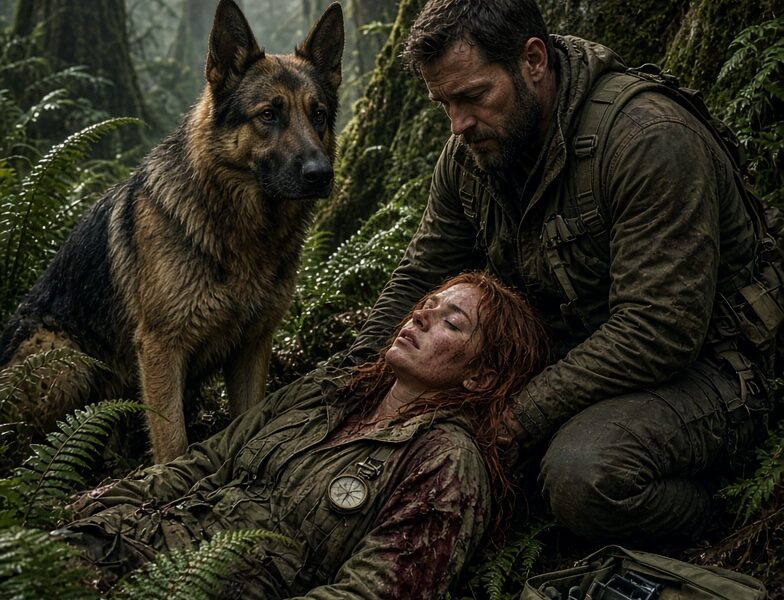
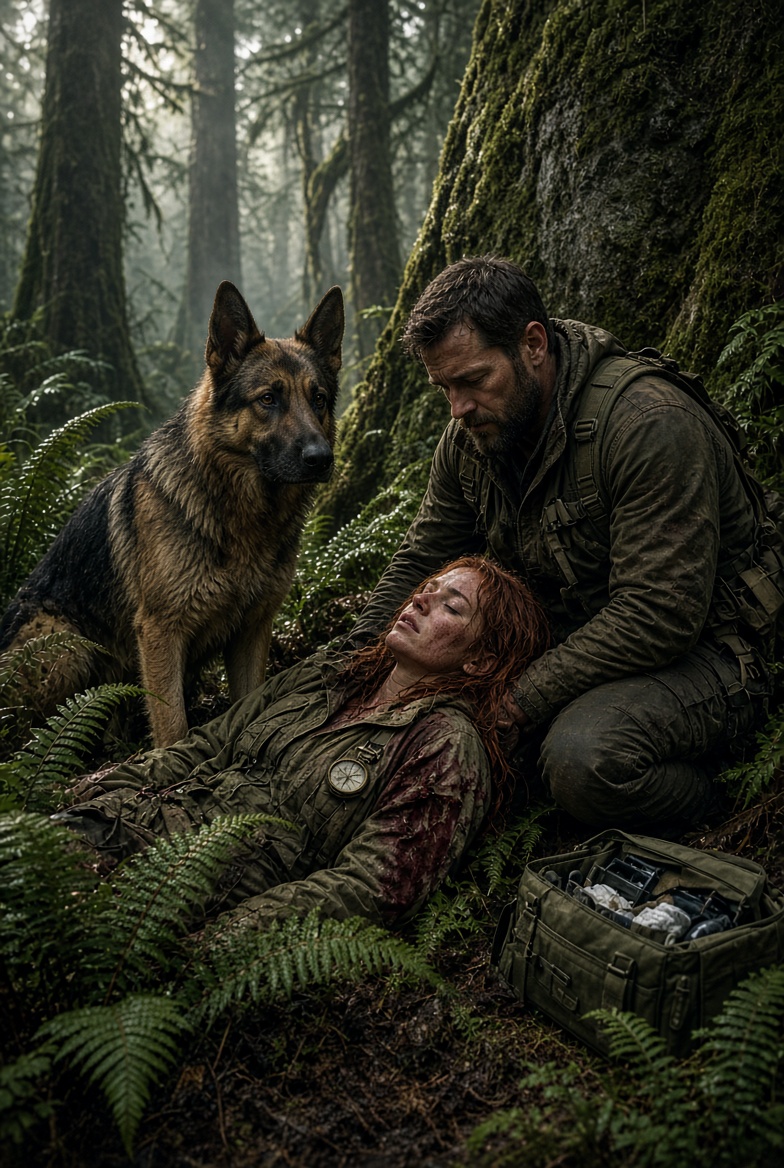
And at his feet lay a woman in a mud-covered field jacket, her red hair spread across the wet ferns, one shoulder soaked dark with blood.
Reed had come to these mountains to escape the world for a few days.
He had no idea that, before sunset, the woman beneath that boulder would tell him something that could determine whether 4,200 people made it home alive.
And he had even less idea that the small brass compass clipped to her jacket would become the one piece of evidence that could bring an entire operation crashing down.
Reed was thirty-eight years old and had spent the last eleven of those years as a Navy SEAL.
Eleven years of sand, saltwater, and nights when the darkness offered no guarantees. Eleven years of clearing rooms, reading unfamiliar terrain, and making decisions in less time than it took most people to understand that a decision needed to be made.
He had learned to recognize fear in the smallest movements.
A hand that tightened around a weapon.
A breath held too long.
Eyes that focused on an exit rather than the person speaking.
He had also learned that the most dangerous people were not always the loudest ones.
Sometimes, they were the quiet men who never needed to raise their voices.
Three weeks earlier, Reed’s commanding officer had summoned him to a plain office in Virginia Beach.
There had been no ceremony, no dramatic confrontation, and no argument that either man could win.
His commander had simply looked across the metal desk and said, “Reed, you’re taking leave.”
“I’m fine, sir.”
“I didn’t ask whether you were fine.”
Reed had held his gaze.
His commander had continued in the same measured tone. “You haven’t taken meaningful leave in over a year. You’re sleeping four hours a night, you’re volunteering for every assignment that comes across your desk, and your last medical evaluation says you’re carrying more stress than you’re willing to acknowledge.”
“That sounds like an evaluation problem.”
“It sounds like a mandatory vacation.”
Reed had almost smiled.
Almost.
His commander leaned back in his chair.
“Take the time, Chief. Get somewhere quiet. No calls unless there’s an actual emergency. No checking your work email. No finding a way to turn a vacation into another assignment.”
“And if I don’t?”
“Then I’ll personally arrange a destination you won’t enjoy.”
That had ended the discussion.
Four days ago, Reed had loaded a single duffel bag into his truck, secured Duke in the passenger seat, and headed west.
He drove until the highways narrowed, the cities disappeared behind him, and the road became a two-lane strip of blacktop winding through the foothills of the Olympic Mountains.
Eventually, the blacktop turned to gravel.
The gravel ended at a trailhead.
He parked beneath a towering Douglas fir, shouldered his pack, checked Duke’s harness, and walked into the wilderness.
For four days, he had not spoken to another human being.
He hadn’t missed it.
The old-growth forest was unlike any place he had trained or deployed. The trees rose hundreds of feet overhead, their trunks wrapped in thick green moss. Sword ferns spread across the forest floor, and the air smelled of wet bark, cedar, and earth.
Water moved somewhere beneath the vegetation, invisible but constant.
The forest seemed older than every problem Reed had ever carried into it.
At night, he slept beneath a lightweight shelter and woke without an alarm.
For the first time in years, he was getting eight hours of sleep.
He dreamed of nothing.
He had begun to wonder whether that was what peace felt like.
Then Duke found the woman.
Reed dropped beside her and checked for a pulse.
Faint.
Fast.
Shallow.
“Easy,” he murmured, though he wasn’t certain whether he was speaking to the woman or himself.
Duke stood close to her head, his dark eyes fixed on Reed’s hands.
The woman’s jacket was heavy canvas, reinforced at the elbows, with rubber boots caked in mud. A small brass compass hung from a clip near her chest pocket.
Reed registered the compass, the mud, the blood, and the angle of her body in a fraction of a second.
Then he focused on the injury.
A gunshot wound in her left shoulder.
The opening was small, but the bleeding was active, soaking through her flannel shirt and the base layer beneath it.
Reed pulled his medical kit from his pack.
The kit had traveled with him for years. He carried it the way some people carried their wallets, not because he expected trouble every day, but because he had learned what happened when trouble arrived and nobody was prepared.
He cut away the fabric surrounding the wound, packed it with hemostatic gauze, and applied firm pressure.
The woman made no sound.
That worried him more than screaming would have.
“Duke, stay.”
The dog lowered himself beside her head.
Reed secured the dressing as best he could without knowing the full extent of the injury. His movements were controlled and deliberate, but his mind was already considering the distance to the nearest access road, the limitations of their supplies, and how quickly the woman’s condition could deteriorate.
He needed a rescue team.
He needed communication.
Most importantly, he needed to know whether the person who had wounded her was still nearby.
The woman suddenly opened her eyes.
She came awake swinging.
Her good arm struck toward Reed’s face, and her fingernails caught his forearm before he could pull back.
She tried to scramble away, dragging herself across the wet ferns, her expression twisted with terror.
“Hey!” Reed caught her before she could tear the dressing loose. “Stop moving. You’re injured.”
She grabbed a fistful of his shirt.
“Get away from me!”
“Listen to me. You’re bleeding, and I need you to stay still.”
She fought harder.
Duke moved.
The German Shepherd stepped across Reed’s knee and gently laid himself over the woman’s lap. Seventy-four pounds of warm, solid muscle settled against her legs.
He didn’t bark.
He didn’t bare his teeth.
He simply looked up at her and licked her wrist.
Then his tail thumped once against the ferns.
Something changed.
The woman’s hand slowly released Reed’s shirt.
Her chest continued to rise and fall rapidly, but the frantic movement stopped. She looked down at Duke as though the dog had become the only recognizable thing in a world that had suddenly turned hostile.
Her fingers found his ear.
Duke remained still.
“His name is Duke,” Reed said quietly. “He’s not going to hurt you. Neither am I.”
She swallowed.
“My name is Petra.”
“All right, Petra. I’m Reed. I’m going to keep pressure on your shoulder, and you’re going to help me by staying as still as you can.”
Her eyes moved toward the trees.
“How long have I been out?”
“I don’t know. I just found you.”
She looked at the blood on her jacket, then at the medical supplies beside him.
“Are you military?”
“Yes.”
“What branch?”
“Navy.”
She closed her eyes.
For a moment, Reed thought she might have lost consciousness again.
Then she opened them and gripped Duke’s fur.
“You have to listen to me.”
“I’m listening.”
“No, you don’t understand.” Her voice cracked, and she forced it steady. “You have to listen to everything I tell you. Not just enough to get me out of here. Everything.”
Reed watched her face.
He had spent eleven years reading people under pressure. He knew the difference between confusion and calculation, between panic and the fear that came from understanding something terrible before anyone else did.
Petra wasn’t confused.
She was carrying information that frightened her more than the wound in her shoulder.
“Tell me what happened,” he said.
She drew a shallow breath.
“I’m a wildlife biologist with the National Park Service. I’ve been monitoring wolf corridor activity in the restricted zone above the Quinault drainage.”
Reed glanced at her equipment.
“Here?”
“Above Boundary Ridge. I went out before dawn to check camera traps on the north-facing slope. The ridge is glacially carved granite, and the upper face is unstable. The Park Service closed the area because the fracture system is unpredictable.”
She paused to gather herself.
“When I reached the upper monitoring station, I heard machinery.”
“What kind?”
“Drilling equipment. Heavy equipment.”
Reed kept pressure on her shoulder.
“How many people?”
“Six. Maybe eight.”
“What were they doing?”
“Working along the base of the cliff. They had core drills positioned at several points in the rock. They were packing the holes with something gray and waxy.”
Petra looked directly at him.
“I studied geology as a minor in college. I know what shaped explosive charges look like.”
For a few seconds, the forest seemed to close around them.
Reed had seen enough in his career to understand that people didn’t normally place explosives in the foundation of a mountain without a reason.
“Did they see you?”
“I think so.”
“You think so?”
“I made a mistake. I stepped onto a loose shelf, and a piece of stone rolled downhill. One of them turned toward me.”
Her jaw tightened.
“Then someone fired.”
Reed glanced at the bandage.
“How far away were you?”
“Close enough to know they weren’t shooting to scare me.”
He let the answer settle before asking the next question.
“Why would anyone plant explosives on Boundary Ridge?”
Petra looked past him, toward the lower valley.
Below the ridge lay the Quinault River lowlands, a broad green valley of forest, river channels, campground loops, and winding access roads. During ordinary weeks, the area could feel almost empty.
But this was Labor Day weekend.
The main campground was packed. Overflow sites were full. Families had arrived in RVs, trucks, and station wagons loaded with coolers and sleeping bags. Children were running between tents, and parents were preparing dinner beneath the trees.
Petra had spoken to a ranger the previous afternoon.
“He told me they’d turned away four hundred vehicles at the gate,” she said. “The campground is at capacity. The group sites are full. There are families down there, Reed. Thousands of people.”
Reed understood before she finished.
“If that ridge comes down…”
“It will bury the valley.”
She spoke without drama.
That made the words worse.
“The cliff face is under enormous tension. If they compromise the main load-bearing sections simultaneously, the entire shelf could release. Thousands of tons of rock would come down into the lowlands.”
“How much warning would people have?”
“Almost none.”
Reed looked toward the mountains.
“How long until they do it?”
“I don’t know.”
“Did you hear them discussing a time?”
“No.”
“Did you see a control unit?”
“At the center of the installation. There were wires running between the charges.”
Reed checked the dressing again.
Petra’s skin was pale, but her eyes remained clear.
“Can you walk?” he asked.
“Yes.”
“Can you keep your mouth shut when you need to?”
She gave him a look that might have been offended under different circumstances.
“Can you stop asking questions you already know the answers to?”
For the first time that morning, Reed almost smiled.
“Good. We’re going to get along.”
He helped her sit upright, gave her a moment to steady herself, and adjusted the compression wrap.
Duke remained pressed against her leg.
Petra reached for the brass compass clipped to her jacket, checked that it was still there, and fastened it more securely.
Reed noticed the movement.
“Important?”
“My father gave it to me.”
“Does it still work?”
“Most of the time.”
“Then keep it.”
He lifted his pack.
The woman had brought a warning out of the mountains. Reed had a choice to make.
He could try to reach the nearest ranger station, hoping that no one was watching the obvious routes. Or he could move deeper into the forest, get Petra somewhere concealed, and find a way to understand exactly what they were facing.
He looked at Duke.
The dog was already watching the timber.
“All right,” Reed said. “Let’s move.”
The first hundred yards were difficult.
Petra could walk, but the pain in her shoulder made every movement costly. She kept her injured arm close to her body and used her good hand to steady herself against tree trunks.
Reed moved behind her, taking some of her weight on the steep sections without making a show of it.
Duke ranged ahead, quartering the slope and periodically returning to check on them.
He behaved less like a pet than a silent third member of a team.
Reed chose a route away from the drainage and into thicker timber. Twice, he changed direction to make their passage harder to follow.
He listened for voices.
He listened for machinery.
Most of all, he listened for the sounds that didn’t belong.
After half a mile, he found what he was looking for: a granite overhang tucked beneath a hillside, almost completely hidden behind sword ferns and the exposed root mass of a fallen Sitka spruce.
The opening was barely large enough for two adults and a German Shepherd.
“In here,” he said.
Petra lowered herself against the cold stone.
Duke immediately settled across her feet.
She looked at Reed.
“What happens now?”
“We let them walk past us.”
“Who?”
“The men who shot you.”
Her expression tightened.
“You think they’re looking for me?”
“I think people who plant explosives beneath a crowded campground don’t leave loose ends lying around.”
He checked the entrance.
“They’ll search the obvious routes first. The trailhead, the drainage, anywhere someone would go if they were trying to reach help.”
“And after that?”
“After that, they’ll start looking where people don’t normally look.”
Petra stared toward the ridge.
“How many do you think are out there?”
“At least two. Probably more.”
She pressed her good hand against her injured shoulder.
“Can we get to the ranger station before they find us?”
“Not if they know what they’re doing.”
“Then how are we supposed to stop them?”
Reed crouched beside her.
“First, we stay alive. Then we find a way to reach that ridge before they can finish what they started.”
He didn’t tell her that their situation was worse than she understood.
They had no reliable radio signal, limited medical supplies, and an injured civilian who needed professional treatment. Reed had his field kit, a knife, a compact emergency light, a few days of supplies, and the equipment he normally carried on a backcountry trip.
His training was valuable, but it wasn’t magic.
He couldn’t make the forest smaller.
He couldn’t make the men searching for them disappear.
And he couldn’t promise that he would be able to stop an explosive installation without knowing how it was configured.
What he could do was keep moving.
For now, that would have to be enough.
Fourteen minutes passed.
Reed counted them by breathing and listening rather than checking his watch. Duke’s ears moved twice, but the dog didn’t growl.
Then came the footsteps.
Heavy boots pressed through the ferns above the drainage.
The sound was slow and deliberate, belonging to someone who knew how to move through rough terrain without wasting energy.
Reed placed one hand on Duke’s shoulder.
The dog looked up at him.
“Easy,” Reed whispered.
Duke became completely still.
A figure appeared beyond the fern curtain.
The man wore tactical pants, a plate carrier, and a rifle secured across his chest. His clothing was clean enough to suggest preparation rather than an improvised trip into the wilderness.
He stopped six feet from the entrance.
Reed could see the man’s face through a narrow gap in the foliage.
The stranger examined the hillside, then the exposed roots, then the fern curtain.
His gaze passed over the opening.
For one terrible moment, it seemed to settle directly on Reed.
Nobody moved.
The man touched the radio clipped to his vest, listened, and murmured a response.
Then he continued downhill.
The footsteps faded.
Reed waited another four minutes before allowing himself to breathe normally.
“He’s gone,” he whispered.
Petra lowered her hand from her chest.
“I thought he saw us.”
“He might have.”
“That’s not reassuring.”
“It wasn’t supposed to be.”
She gave him a tired, incredulous look.
Reed checked the time.
They had perhaps ninety minutes before the searchers began considering routes that weren’t obvious.
If the explosives were already installed, that window could be much shorter.
He took out his canteen, dampened a clean piece of fabric, and pressed it gently to Petra’s forehead.
Her dressing was holding.
“Talk to me about the ridge,” he said. “Everything you know about the fractures.”
Petra glanced at the ground.
For several seconds, she appeared to be gathering the pieces of herself that fear and pain had scattered.
Then she began drawing.
With her index finger, she traced a long line through the damp dirt.
“This is the main fracture. It runs horizontally along the lower face. The cliff above it is essentially a hanging block, supported by three primary granite pillars.”
She marked three points.
“Here, here, and here.”
Reed studied the diagram.
“Those are the points they drilled?”
“Yes. If the supports fail at nearly the same time, the shelf could release. The slope below it funnels the debris toward the lowlands.”
“How long from detonation to impact?”
“Depending on the section that breaks loose, perhaps forty seconds from the initial release to the debris reaching the valley floor.”
“Would people hear the explosion?”
“Not early enough to matter.”
She rubbed out part of the diagram and drew it again, more carefully.
“The sound would arrive almost alongside the leading edge of the rockfall. People might look up. They wouldn’t have time to get out of the way.”
Reed watched her finger move through the dirt.
“What happens if only one support fails?”
“That depends on which one. The others may hold, or the fracture could propagate unpredictably. That’s what makes the ridge so dangerous.”
“Can you identify the most important support?”
Petra nodded slowly.
“I think so. The middle pillar carries the largest share of the load. Roughly forty percent, based on the monitoring data. The left and right pillars carry about thirty percent each.”
“You think?”
“I’m a biologist, Reed. Not a structural engineer. But I’ve spent three years studying that slope, and I know the geology better than most people who work in the park.”
He accepted the qualification.
It was the kind of answer he trusted.
A person who understood the limits of their knowledge was often more useful than someone who pretended to know everything.
“If the middle support fails to detonate,” he asked, “could the other two release the entire shelf?”
“Not necessarily. They might cause localized failure, and I can’t promise the rest would remain stable. But the chances of a catastrophic collapse would be much lower.”
“That’s something.”
“It’s not enough.”
“No,” Reed said. “But it’s something.”
Petra looked toward the entrance.
“Those men aren’t just trespassing. They brought military-grade equipment into a national park, set explosives beneath an unstable ridge, and shot a federal employee who saw them.”
“Which means they believe whatever they’re doing is worth the consequences.”
“Or they believe no one will ever know.”
Reed looked at the small compass on her jacket.
Its brass casing was scratched, and the glass face reflected a sliver of gray light.
“Why were you carrying that instead of a GPS?”
“My father used to take me hiking when I was a kid. He said electronic equipment was useful, but you should never let it become the only way you know where you are.”
“Smart man.”
“He was.”
Petra’s voice softened.
“He died six years ago. I still carry it on field assignments.”
She turned the compass in her fingers.
For a moment, the woman who had described a possible mass casualty event seemed younger, almost like someone who had wandered too far from home and wanted nothing more than to hear a familiar voice.
Then the expression disappeared.
“I need to get back up there,” she said.
Reed stood.
“So do I.”
He checked their equipment and helped Petra to her feet.
The mountains had offered him silence.
Now they were asking him to make a choice.
He could leave the responsibility to someone else and try to get the wounded woman to safety. Or he could follow the only information he had, toward a ridge where armed men were preparing to destroy the lives of thousands.
Reed tightened the straps on his pack.
He had never been particularly good at walking away from a problem that was still in front of him.
“Stay close,” he said.
Duke rose beside them.
The three of them moved north.
The climb to Boundary Ridge nearly broke Petra twice.
The terrain was steep, and the damp ground made every foothold uncertain. On some sections, moving horizontally along the slope was faster than climbing directly upward.
Reed led them through switchbacks, pausing whenever Petra needed to recover.
She refused to complain.
That didn’t mean she wasn’t suffering.
Her face had become increasingly pale, and sweat gathered along her hairline despite the cool air. Once, her knees buckled when she stepped onto a loose patch of gravel.
Reed caught her before she fell.
“Stop,” he said.
“I’m fine.”
“That’s the second time you’ve said that when it wasn’t true.”
“I can keep moving.”
“I didn’t ask whether you could. I asked you to stop.”
She glared at him, but she stopped.
Reed checked her pulse and watched her breathing. The bleeding appeared controlled, but the combination of pain, exertion, and blood loss worried him.
“Give me sixty seconds,” he said.
“We don’t have sixty seconds.”
“We’ll make them.”
He helped her sit against a tree and offered her water.
Duke stood beside them, his ears alert.
Petra drank, closed her eyes, and took several slow breaths.
“I’m sorry,” she whispered.
“For what?”
“For slowing you down.”
Reed looked at her.
“You’re the reason we’re going up there. Without you, I wouldn’t know what was happening.”
“Without you, I’d be dead in a drainage ditch.”
“Then I guess we’re even.”
She opened her eyes.
“Is that how you always talk to injured people?”
“Only the argumentative ones.”
A small laugh escaped her before she could stop it.
It was the first genuinely human sound Reed had heard from her.
For a moment, he remembered why his commander had sent him away from Virginia Beach. He had become so accustomed to treating every problem as a task that he sometimes forgot the people inside those problems were allowed to be frightened, angry, exhausted, and uncertain.
He gave her another minute.
Then they continued.
Duke chose the route through the scree, placing his paws carefully and occasionally turning back to make sure they were following.
Thirty-eight minutes after leaving the overhang, they reached the ridge.
Reed looked down.
For two seconds, the view stopped him.
The Quinault lowlands spread beneath the mountains in a vast sweep of green and gray. The river curved through the valley, reflecting the last light of afternoon. Beyond it, the campground glowed with hundreds of small lights.
Cooking fires.
Lanterns.
RV awnings.
Families moving between tents.
From that height, the campground looked peaceful enough to belong in a postcard.
Reed could see a child running between two tents, a couple setting up a folding table, and a man carrying a cooler toward a picnic area.
Thousands of people were living their ordinary lives beneath a mountain that might be about to come down on them.
He forced himself to look away.
“Show me the pillars,” he said.
Petra pointed toward the lower cliff face.
“There.”
Three sections of granite stood out from the surrounding rock, their surfaces slightly different in color and texture.
At the base of each, barely visible in the fading light, were the gray deposits Petra had described.
Thin wires connected the installations.
The wires converged at a black control unit attached to the rock above the middle pillar.
Reed crouched behind a granite outcrop.
“How many men did you see here?”
“Six at first. There may have been others out of sight.”
“Did you see anyone carrying a radio?”
“All of them.”
“Any vehicles?”
“Not from where I was standing.”
He studied the surrounding terrain.
There were several routes to the installation, but the exposed rock limited their options. The men who had placed the charges had chosen a position that gave them a clear view of anyone approaching from the south.
Reed looked at Petra.
“Stay behind that outcrop. Don’t move unless I tell you.”
She nodded.
He advanced toward the control unit, keeping low.
The timer was visible through a narrow opening in its casing.
He leaned closer.
Twenty-two minutes and fourteen seconds.
For a moment, he simply stared.
Then he heard Petra’s sharp intake of breath behind him.
“They changed the timeline,” she whispered.
Reed looked at the display again.
“Someone must have given the order over the radio.”
“How do we stop it?”
He examined the unit without disturbing the wiring.
The installation was more sophisticated than he’d hoped. It had a primary timer and what appeared to be a separate receiver for a secondary activation system.
He couldn’t safely assume that disabling one would make the others harmless.
“First, we identify what we’re dealing with,” he said. “Then we figure out how to prevent the main support from failing.”
“Can you disarm it?”
“I can try.”
“That’s not the same as saying yes.”
“No,” he replied. “It isn’t.”
Petra looked toward the valley.
“Twenty-two minutes.”
Reed understood the arithmetic.
If the main support failed, the remaining charges might still cause a collapse. If they did nothing, thousands of people could die. If they made the wrong move, they could accelerate the very event they were trying to prevent.
There was no clean solution waiting for them.
Only a narrow path through a dangerous problem.
Reed took out his radio and tried the emergency channel.
Static answered him.
He adjusted the antenna and tried again.
Nothing.
The ridge was blocking the signal, or the equipment was too limited to reach anyone below.
He tried a different position.
A faint burst of interference came through, followed by silence.
“Nothing?” Petra asked.
“Nothing useful.”
“Then we’re alone.”
Reed looked down at Duke.
The dog stood beside Petra, his head turned toward the southern approach.
“No,” Reed said. “We’re not.”
The first sound was almost lost beneath the wind.
A boot scraping against stone.
Reed turned.
A man stepped from behind a granite outcrop six feet to his left.
He was large, with a shaved head, a broad jaw, and the controlled posture of someone accustomed to carrying weapons. His rifle was already raised.
He pointed it toward Petra.
“Step away from the board.”
Reed froze.
“Both of you. Hands where I can see them.”
Petra slowly raised her good hand.
The man’s eyes moved from Reed to the woman and then to the German Shepherd.
“Well,” he said, “this is inconvenient.”
Reed watched the rifle, the man’s stance, and the position of his finger near the trigger.
He didn’t need to know the stranger’s name to understand the situation.
The man wasn’t surprised to find them.
He was angry that they had reached the installation.
“You’re done,” the stranger said. “The woman, the dog, all of it. This ends here.”
Reed kept his voice level.
“If you shoot either of us, you still have a problem with that timer.”
The man smiled without warmth.
“I have a redundant trigger on me. If I decide this operation is compromised, I can finish it before you take another step.”
Petra went very still.
Reed glanced at the timer.
Eighteen minutes and thirty seconds.
The man followed his gaze.
“You’re a little late, Chief.”
Reed’s eyes returned to him.
“You know who I am?”
“I know what you look like. We received a description from the search team.”
“So you know we can talk this through.”
The man laughed once.
“No, Chief. I know you’re going to try to stop me.”
He adjusted his grip on the rifle.
“My name is Voss. Remember it, if you get the chance.”
Reed stored the name away.
Voss was watching him closely, waiting for the first sign of a movement he could interpret as a threat.
Reed kept his hands visible.
Behind Voss, Duke stood absolutely still.
The dog had moved into position beside a rock, his body angled toward the armed man. His gaze never left Voss’s hands.
Reed didn’t look at him again.
He didn’t need to.
“How many people know about this?” Reed asked.
Voss tilted his head.
“Enough.”
“Who gave the order?”
“Does it matter?”
“To the families in that valley, I’d say it matters quite a lot.”
For the first time, something changed in Voss’s expression.
Not guilt.
Not shame.
Irritation.
“You think this is about the families?”
“I think they’re the ones who will pay for it.”
“You have no idea what this is about.”
“Then explain it.”
Voss gave a short, humorless laugh.
“You really believe there’s time for a conversation?”
Reed glanced at the timer.
“There’s time for you to make a different decision.”
The man’s expression hardened.
“People like you always think there’s a decision to make. That’s what your training teaches you. Every problem has an answer, every situation has a way out.”
He raised the rifle a fraction.
“Sometimes, Chief, the decision was made long before you arrived.”
Petra’s breathing had become shallow.
Reed could hear it behind him.
He wanted to tell her to stay calm, but he knew that words would do little to help. She was wounded, exhausted, and staring at a man who had already demonstrated that he was willing to kill to protect his operation.
Reed focused on Voss.
“You still have time to walk away.”
Voss shook his head.
“Not anymore.”
He shifted his stance.
It was a small movement.
But Reed saw it.
So did Duke.
The dog launched from a dead standstill.
He crossed the three feet between them in a fraction of a second and clamped his jaws around Voss’s forearm near the wrist.
The rifle fired once, the shot cracking across the ridge and disappearing into the forest.
Voss shouted and swung his free arm.
His elbow struck Duke’s ribs hard enough to make the dog grunt, but Duke held on.
Reed moved.
He crossed the distance in two steps, forced the rifle away from Petra, and drove his shoulder into Voss’s center of balance.
The struggle lasted only seconds.
Voss stumbled against the rock, lost his grip, and went down.
Reed secured the rifle away from him and restrained his hands with the man’s own equipment.
Duke released Voss when Reed gave the command.
The dog stepped back, breathing hard, his ears still alert.
Reed dropped to one knee beside him.
“Easy, buddy.”
Duke looked up.
“Let me see.”
The dog allowed Reed to examine his side. There was no obvious serious injury, though the impact had clearly hurt him.
Reed ran a hand over the German Shepherd’s neck.
“Good work.”
Duke’s tail moved once.
Then Reed turned toward the control unit.
Fifteen minutes and forty seconds remained.
The timer was still running.
Reed had spent years learning how to make decisions under pressure, but the timer on Boundary Ridge presented a different kind of problem.
He was not dealing with an unfamiliar building or an enemy position. He was dealing with a mountain, a complex installation, and a woman whose expertise could be the difference between a controlled outcome and a catastrophe.
He couldn’t solve the problem through force alone.
He needed Petra.
“Can you come over here?” he asked.
She moved slowly toward the control unit, keeping her injured arm close to her body.
“Tell me what you need.”
“I need to know which support is most important. You said the middle pillar carries about forty percent of the load.”
“That’s right.”
“If its charge doesn’t function, can the other two release the entire shelf?”
Petra studied the cliff face.
Her eyes moved between the three pillars, following the lines of the natural fractures. She seemed to forget the pain for a moment, absorbed by the familiar language of stone.
“I can’t guarantee that the other two won’t cause a smaller collapse,” she said. “But the middle support is the critical one. If it remains intact, the probability of the entire shelf releasing drops significantly.”
“Significantly isn’t a number.”
“It’s the most honest answer I can give you.”
Reed nodded.
“Then we’ll work with it.”
He moved away from the unit long enough to make sure Voss was secured and no longer posed an immediate threat.
The man’s expression had changed.
He was no longer smiling.
“You don’t understand what you’ve interrupted,” Voss said.
Reed ignored him.
“You think arresting me solves anything?”
Reed checked the restraints.
“No.”
Voss stared at him.
“Then you really are a fool.”
“Maybe.”
Reed stood.
“But I’m the fool standing between you and 4,200 people.”
He returned to Petra.
The timer continued counting down.
She examined the installation from a safe distance, studying the visible connections and the placement of the charges.
“I’ve seen equipment like this in photographs,” she said. “Not in person. But I know the difference between the main installation and a redundant system.”
“Can you identify the primary support charge?”
“The one at the middle pillar.”
“Then we focus on preventing that charge from doing its job.”
Reed studied the installation carefully. He was not going to pretend he could safely dismantle an unfamiliar explosive system simply because he had military experience.
He had seen what happened when people confused confidence with competence.
He needed specialists.
He needed to reach them.
He tried the radio again.
This time, a faint voice emerged through the static.
“…any station… identify yourself…”
Reed moved several feet toward the ridge’s exposed edge.
“This is Chief Petty Officer Reed, United States Navy, transmitting from Boundary Ridge in the Olympic National Park backcountry corridor. I have a wounded civilian requiring immediate medical evacuation. One hostile individual is restrained at the installation. Additional armed individuals may be operating in the lower drainage.”
Static swallowed the response.
Reed adjusted the antenna.
“I repeat, I have located an explosive installation above the Quinault campground. The system appears designed to cause a major rockfall. The primary timer is active. We need law enforcement, bomb-disposal specialists, and medical response at the ridge trailhead immediately.”
A burst of static followed.
Then a voice came through.
“Chief Reed, this is Olympic National Park emergency coordination. We copy a possible explosive threat. Confirm your location.”
Reed gave the coordinates as accurately as he could.
“How long until you can get a team here?” he asked.
“We’re notifying the appropriate agencies now. Do not approach or disturb the installation. Can you withdraw to a safe location?”
Reed looked at the timer.
“Negative. We have less than fifteen minutes, and the installation is positioned above a crowded campground.”
A pause.
“Chief, did you say fifteen minutes?”
“Affirmative.”
“Stand by.”
Reed listened as the dispatcher spoke to someone off the radio, then returned.
“We’re initiating an emergency response. State the nature of the device if you can do so without touching it.”
“Multiple charges connected across three support points. A central control unit has a countdown timer. There appears to be a secondary activation system.”
“Understood. Do not attempt to disarm the system. Keep clear and maintain observation if safe.”
Reed looked at Petra.
The advice was sensible.
It was also difficult to follow when the timer was running and the people below had no idea what was happening.
He returned to the unit and examined it from a distance.
“Can you see anything that tells us how the secondary system works?” he asked Petra.
She studied the arrangement.
“Not enough to make a safe judgment. The central unit controls the countdown, but I can’t tell you how the other components respond if the primary system fails.”
“All right.”
Reed stepped back.
He wasn’t going to risk turning an uncertain situation into an immediate disaster.
He had done what he could with the radio. Now they needed to preserve the time they had and keep the site from being compromised again.
Voss began laughing.
It was quiet at first.
Then he looked up at Reed.
“You think a few minutes on a radio will save them?”
Reed said nothing.
“You think the people coming up here will arrive in time?”
Still nothing.
Voss’s smile returned.
“You don’t even know who ordered this.”
“Then you’ll have plenty of time to tell investigators.”
The smile disappeared.
For the first time, Voss looked uncertain.
Reed noticed.
He filed it away.
The man had been confident when he believed the operation was under control. Now that the countdown was running and the authorities had been alerted, he seemed less certain of the people who had sent him.
That mattered.
Reed crouched a few feet away.
“Who gave you the order?”
Voss looked toward the forest.
“No one you can reach.”
“That’s not an answer.”
“It’s the only one you’re getting.”
Reed studied him.
“You’re willing to die for them?”
Voss’s eyes snapped back to his face.
“Don’t make assumptions.”
“Then tell me what you’re willing to do.”
Voss said nothing.
The wind moved across the ridge, lifting the edge of Reed’s jacket.
Below them, a string of campground lights flickered on as evening approached.
Petra looked down at the valley.
“There’s a family near the river,” she whispered. “I can see their tent.”
Reed followed her gaze.
A small figure ran across a clearing, chased by another child.
The sight made the distance between the ridge and the valley feel impossibly small.
“How old are your kids?” Petra asked suddenly.
Reed turned toward her.
“I don’t have any.”
“Do you want them?”
The question caught him off guard.
He glanced toward Voss, then back at Petra.
“I haven’t thought about it.”
“That sounds like a yes from someone who’s afraid to answer.”
Reed almost laughed.
“You’re asking a lot of personal questions for someone who met me an hour ago.”
“You told me to talk.”
“About geology.”
“Geology is boring.”
Despite everything, Reed smiled.
It was brief, but it was real.
Then the timer display changed.
The remaining time was dropping.
Reed looked back at the unit.
The emergency team had acknowledged the threat, but no one could guarantee they would reach the ridge before the countdown ended.
He needed a way to prevent the main support from failing without creating a new danger.
Petra moved beside him.
“If the central charge is the one we prevent from functioning, the structure is much more likely to remain standing.”
“Can we be certain?”
“No.”
“Can we improve the odds?”
“Yes.”
She looked at the cliff face again.
“The middle pillar is the key. If the other charges activate, they may damage the outer supports, but the central one carries the greatest load. The rock could fracture, but the entire shelf is less likely to release.”
Reed took a breath.
He looked at the control unit, then at the restrained man, then toward the valley.
Every option carried risk.
But the worst option was to stand still and hope the timer stopped on its own.
He made his decision.
“All right,” he said. “We focus on the central support, and we keep the authorities informed.”
He picked up the radio.
“Emergency coordination, this is Reed. The central support appears structurally critical. We need the bomb-disposal team to prioritize that installation when they arrive. The outer charges may still be active.”
The response came more clearly this time.
“Copy. Specialized teams are en route. Maintain distance and do not manipulate the device.”
Reed acknowledged the instruction.
He wasn’t going to ignore professional guidance simply because he was impatient.
He also wasn’t going to pretend that the valley could wait forever.
He moved Petra behind the outcrop and checked her dressing.
“How are you feeling?”
“Like someone shot me.”
“That’s fair.”
“Are you always this calm?”
“No.”
“When aren’t you?”
“When people ask me that question.”
She gave a weak smile.
Then she looked toward the campground.
“Reed, if this goes wrong…”
“It won’t help anyone if you spend your remaining time imagining the worst.”
“What if I need to?”
“Then do it while you keep breathing.”
She stared at him for a moment.
“That’s terrible advice.”
“Probably.”
He settled beside her.
Duke lay between them, his head resting across Petra’s boots.
The dog seemed to understand that, for now, the most useful thing he could do was remain close.
Reed rested a hand on his back.
He had spent years thinking of courage as the ability to move when others froze. But sitting beside Petra, listening to the timer and the wind, he realized that courage sometimes meant accepting how little control a person truly had.
They could prepare.
They could act.
They could make the best decisions available.
But neither of them could promise the outcome.
The only thing they could do was keep trying to change it.
The countdown had fallen below ten minutes when Reed received the first clear confirmation that help was moving toward them.
“Chief Reed, emergency coordination. We have law enforcement units approaching the trailhead. Bomb-disposal personnel are being deployed. Medical evacuation is being arranged.”
“Copy. We have one restrained suspect and a wounded civilian. The suspect identified himself as Voss. We have reason to believe additional individuals were involved in placing the charges.”
“Understood. Do not attempt to move the suspect until officers arrive.”
Reed looked toward Voss.
The man was sitting against the rock, his expression unreadable.
“You hear that?” Reed asked him. “People are coming.”
Voss gave no response.
“Your friends aren’t going to get you out of this.”
“They aren’t my friends.”
The answer came too quickly.
Reed crouched.
“Then what are they?”
Voss stared at the ground.
“People who pay.”
“Who?”
Silence.
Reed waited.
The man’s jaw tightened.
“You think this is some grand conspiracy? A bunch of men sitting in a room planning to destroy a mountain?”
“Isn’t that exactly what happened?”
Voss looked up.
For a moment, his composure cracked.
“You have no idea what that valley is sitting on top of.”
Petra turned sharply.
“What does that mean?”
Voss’s eyes shifted toward her.
Then he shut his mouth.
Reed watched him.
The words had not sounded like a threat. They had sounded like something the man hadn’t intended to reveal.
“What is beneath the valley?” Reed asked.
Voss looked away.
“Ask the people who own the land.”
Petra went pale.
“The land is public.”
“Most of it.”
“What are you talking about?”
Voss didn’t answer.
Reed considered the statement.
The operation might have been intended to destroy the campground, but the men could also have had another objective. The explosives might have been part of something larger, and the campground might have been a target because of its location rather than the people themselves.
He didn’t have enough information to know.
But he now had a question worth asking.
“Who owns the land you’re talking about?” he said.
Voss smiled faintly.
“You’re too late.”
Reed rose.
He didn’t like the answer.
He liked the way Voss had delivered it even less.
Petra looked at him.
“What if this isn’t just about the campground?”
“Then the investigators will need to find out what else is involved.”
“And if they don’t?”
“They will.”
“You sound very sure.”
“I’m not sure. I’m committed.”
She studied him.
“There’s a difference?”
“There’s a big one.”
The timer continued its steady countdown.
Reed checked the radio again, giving the emergency team the information about Voss’s statement and asking them to preserve the scene for investigation.
He made sure they understood that the suspect had mentioned land ownership and an objective beyond the immediate explosive threat.
The dispatcher acknowledged the information.
Then the radio crackled again.
“Chief Reed, we need you to confirm the countdown reading.”
Reed looked at the display.
“Approximately seven minutes.”
“Copy. The bomb-disposal team is moving as quickly as conditions allow. Can you confirm whether the central support has been compromised?”
“Negative. We have not disturbed the installation.”
“Good. Maintain distance.”
Reed lowered the radio.
Petra’s face had tightened with pain.
He helped her sit more comfortably behind the outcrop, then checked her pulse and breathing.
“We need you to stay conscious,” he said.
“I wasn’t planning on taking a nap.”
“Good.”
“Do you ever say anything comforting?”
“I once told a guy that his surgery went well.”
“Were you his doctor?”
“No.”
She looked at him.
“You’re a terrible nurse.”
“I’ve been told.”
Duke shifted closer to her.
Petra rested her good hand on his head.
“He’s a good dog.”
“The best.”
“He knew I was there before you did.”
“That’s usually how it works.”
“How long have you had him?”
“Five years.”
“Was he trained for military work?”
“Some. He was trained to follow commands, work in difficult terrain, and stay calm under pressure. But a lot of what makes him good can’t be taught.”
Petra stroked his fur.
“Like knowing when someone needs help.”
Reed looked at Duke.
“Something like that.”
He thought of the first moment he’d seen the dog standing over Petra in the drainage. The way Duke had remained still, the way he’d placed himself between her and the fear that had overtaken her when she woke.
There were things Reed could explain.
And there were things he simply trusted.
The radio crackled.
“Chief Reed, we have visual confirmation of your location. Officers are approaching from the north. Do not move toward them until they identify themselves.”
“Copy.”
Reed scanned the trees.
A minute later, two figures appeared on the ridge, moving cautiously through the brush. They identified themselves and stopped at a safe distance while Reed confirmed their credentials and the location of the restrained suspect.
The first officer approached Voss.
The second moved toward Petra.
“Ma’am, we’re here to help. Medical personnel are on the way.”
Petra closed her eyes.
For the first time since Reed had found her, she looked as though she might allow herself to believe she would survive.
Then a distant helicopter became audible above the forest.
Its sound grew steadily louder, echoing between the mountains.
Reed looked toward the sky.
The helicopter circled the ridge, searching for a safe approach and a clear view of the terrain. The crew spotted the reflective signal Reed had prepared and acknowledged their position.
The aircraft couldn’t land directly beside the installation, but it could evacuate Petra once the medical team secured a suitable pickup point.
Reed helped her stand.
She swayed, and he caught her elbow.
“Easy.”
“I’m all right.”
“You don’t have to prove that anymore.”
She looked at him.
Something in her expression softened.
“Thank you.”
He nodded.
There wasn’t much else to say.
As the medical team approached, Reed gave them a concise account of her injury and the treatment he had provided. They took over the assessment, checked the dressing, and prepared her for evacuation.
Petra reached for the compass clipped to her jacket.
It was still there.
She held it briefly in her good hand, then looked at Reed.
“Don’t let them forget what happened here.”
“I won’t.”
“Not just the explosives. What Voss said about the land.”
“I’ll make sure it’s included in the report.”
She nodded.
The medical team guided her toward the helicopter pickup point.
Duke followed until Reed called him back.
The dog stopped, looking between the woman and his handler.
Petra turned.
“Duke.”
The German Shepherd’s ears lifted.
She smiled through the pain.
“You saved my life.”
Duke’s tail moved.
Then Petra was carried toward the waiting aircraft, leaving Reed on the ridge with the officers, the restrained suspect, and the countdown that had nearly changed everything.
The emergency response unfolded in stages.
Law enforcement secured the immediate area while specialized personnel assessed the explosive installation. Additional officers searched the lower drainage and the surrounding terrain for the other people Petra had seen.
Reed remained available to explain what he had observed.
He described the control unit, the placement of the charges, and the routes he believed the suspects had used. He identified the location where he’d found Petra and explained how the group had moved through the forest.
He also repeated Voss’s comments about the land.
The officer taking his statement looked up.
“Did he say who owned it?”
“No.”
“Did he explain what he meant?”
“No. He realized he’d said too much and stopped talking.”
The officer wrote something in his notebook.
“We’ll follow up.”
Reed watched the specialists working from a safe distance.
The central installation remained a serious hazard, and no one was willing to treat it as harmless simply because Voss had been restrained.
The bomb-disposal team took control of the site and began a careful assessment. They established a perimeter, examined the components, and coordinated with the incident commander before deciding how to proceed.
Reed knew enough to understand that the operation would not be quick.
He also knew that the people in the campground were still unaware of how close they had come to disaster.
As darkness settled over the mountains, additional personnel arrived at the ridge.
The investigation expanded.
The searchers found evidence that the installation involved more than one person and that the group had prepared the site in advance. Equipment, communications devices, and other materials were recovered and documented.
Voss was taken into custody.
He said very little.
When an investigator asked whether anyone else had been involved, he looked at Reed and gave a faint smile.
“You’ll find out.”
Reed didn’t respond.
He had heard enough from men like Voss to know that silence could be a tactic, a threat, or simply a way to buy time.
The important thing was that the man was no longer in control of the situation.
Late that evening, Reed was finally cleared to leave the immediate site.
He descended with Duke and the remaining officers, following the route to the trailhead.
The dog was limping slightly, and Reed had him examined as soon as they reached the medical staging area. The veterinarian on the response team found bruising along his side but no obvious serious injury.
“He’s going to be sore for a few days,” the veterinarian said. “Keep him quiet and watch his breathing.”
Reed knelt beside Duke.
“You hear that? You’re on restricted duty.”
Duke looked at him.
“Don’t give me that face.”
The dog’s tail thumped against the ground.
For the first time all day, Reed allowed himself to feel the exhaustion he’d been holding back.
He sat on the tailgate of a parked truck and watched emergency personnel move between vehicles beneath the harsh white lights of the staging area.
A ranger brought him a bottle of water.
“Chief Reed?”
“Yes.”
“I’m Ranger Collins. I wanted to thank you for what you did today.”
Reed took the water.
“We found her. That’s all.”
Collins shook his head.
“No. You could have gotten her out of the forest and called for help. You chose to go back toward the threat.”
“I had information that people were in danger.”
“And you acted on it.”
Reed looked toward the dark mountains.
“I hope the people in that valley never find out how close it was.”
Collins followed his gaze.
“They deserve to know that the threat was stopped. They don’t necessarily need every detail tonight.”
“That’s probably right.”
The ranger hesitated.
“How did you find her?”
“Duke.”
Collins glanced at the dog.
“He tracked her?”
“He found her. I followed.”
The ranger crouched and offered Duke the back of his hand.
The dog sniffed it, then settled beside Reed.
“Good boy,” Collins murmured.
Duke closed his eyes.
Reed looked down at him.
For five years, the dog had been his partner in a world where mistakes could have consequences that lasted far longer than the moment in which they were made.
Duke had never asked for recognition.
He never cared about medals, commendations, or the stories people told about the work they did.
He simply showed up.
And when something was wrong, he found it.
Reed rested his hand on the dog’s back.
“Let’s get you somewhere warm.”
The helicopter carried Petra to a hospital in Port Angeles.
By the time Reed arrived there the following day, she had undergone treatment for her shoulder wound and was recovering under medical supervision.
He had spent the night answering questions, coordinating with investigators, and making sure Duke received proper care.
He had also called his commanding officer.
The conversation had lasted less than three minutes.
“Reed,” his commander said, “I was told you had an eventful vacation.”
“That’s one way to describe it, sir.”
“Are you injured?”
“No.”
“Is Duke injured?”
“Bruised. He’ll recover.”
A pause followed.
“Do I want to know what happened?”
“Eventually.”
His commander sighed.
“You were supposed to rest.”
“I did get some hiking in.”
“Reed.”
“Yes, sir.”
“Tell me the important part.”
Reed looked out at the hospital parking lot.
“A civilian discovered an explosive installation above a crowded campground. She was wounded by the people who placed it. Duke found her, and we were able to get the information to the authorities before the installation could cause a major collapse.”
His commander was silent for several seconds.
“How many people were at the campground?”
“Approximately 4,200.”
Another pause.
“Are you certain the threat is contained?”
“The site is under control, but the investigation is ongoing.”
“Good. Stay available to the authorities. Do not attempt to run the investigation yourself.”
“Understood.”
“And Reed?”
“Sir?”
“When this is over, take another week.”
Reed almost smiled.
“Yes, sir.”
“That’s an order.”
The call ended.
Reed stood in the parking lot for a moment, watching the sunlight move across the hospital windows.
He had come to the Olympic Mountains because he wanted to be somewhere that didn’t demand anything from him.
Now he was standing outside a hospital, thinking about a woman he’d met in the forest, a dog with bruised ribs, and thousands of strangers who would never know how close they had come to losing everything.
He wasn’t sure what to do with that feeling.
So he went inside.
The hospital corridor smelled of antiseptic and weak coffee. Nurses moved between rooms, carts rattled across the floor, and a television murmured from somewhere behind a closed door.
Duke walked at Reed’s side, wearing a temporary harness that identified him as a working dog.
He was tired but alert.
When they reached Petra’s room, Reed knocked.
“Come in,” she called.
She was sitting upright in bed, her left arm secured in a proper sling. The color had returned to her face, though she still looked exhausted.
A cup of water sat on the bedside table.
The brass compass lay beside it.
Petra looked at Reed.
“You’re alive.”
“Last time I checked.”
“And Duke?”
“Bruised, offended, and convinced the hospital belongs to him.”
Duke walked to the side of the bed and lowered his head toward her hand.
Petra smiled and stroked his ears.
“Hello, hero.”
His tail thumped against the floor.
Reed set two cups of coffee on the tray table.
“I wasn’t sure how you take it.”
“Anything that doesn’t taste like hospital coffee.”
“Then I’ve brought you something better.”
She took a sip.
Her expression changed.
“That’s still terrible.”
“It’s from the vending machine.”
“Of course it is.”
For a moment, the room felt almost ordinary.
Then Petra’s smile faded.
“They got all of them,” she said.
Reed pulled a chair beside the bed.
“That’s what I heard.”
“The FBI called this morning. Eight people are in custody.”
“Eight?”
She nodded.
“Eight in total. The men who placed the charges, the people who transported the equipment, and several others who were coordinating the operation.”
Reed looked at her.
“Did they tell you what the motive was?”
“Not everything. The investigation is still active.”
She picked up the compass, running her thumb over the scratched brass casing.
“But they found enough explosive material on the ridge to bring down a substantial section of the cliff.”
Reed sat back.
“And the campground?”
“Four thousand two hundred people were registered or present in the valley during the critical period, according to the ranger who spoke to the investigators.”
She swallowed.
“Four thousand two hundred people who went home Sunday. Parents who drove back to Seattle or Portland or Spokane with exhausted kids in the back seat. Families who would spend the next week unpacking coolers, washing sleeping bags, and sorting photographs.”
Her voice faltered.
“They’ll tell their friends about the rain, the river, the campfires, and the bear that got into someone’s trash.”
She looked at Reed.
“They’ll never know how close they came.”
Reed held his coffee without drinking it.
“Maybe that’s a good thing.”
“Is it?”
“Sometimes.”
Petra considered that.
“Part of me wants to tell them. I want them to understand what happened. I want them to know that their lives were almost taken away by people who didn’t even know their names.”
“I understand.”
“But another part of me thinks they’d never feel safe camping again.”
“Some might. Others would come back next summer.”
She looked toward the window.
“That’s what I hope.”
Reed watched her for a moment.
The woman he’d found in the drainage had been pale, terrified, and barely conscious. Now she was sitting upright in a hospital bed, asking difficult questions about the people she’d helped save.
He respected that.
He also wondered what it had cost her.
“How did you get into wildlife biology?” he asked.
Petra looked surprised.
“That’s a change of subject.”
“You’ve been interrogating me since yesterday. I thought I’d return the favor.”
She laughed softly.
“My father. He took me hiking when I was little. He was a park ranger before he retired. He taught me to identify tracks, read weather patterns, and understand why animals moved through certain areas.”
“Sounds like a good man.”
“He was.”
She looked down at the compass.
“He gave me this when I was sixteen. We were hiking near Mount Rainier, and I kept relying on a handheld GPS. The batteries died, and I had no idea how to orient myself.”
“What happened?”
“He made me figure it out with a map and this compass. I was furious with him.”
Reed smiled.
“I can imagine.”
“He told me that tools were useful, but understanding the world was more important. You could lose a device. You could lose a map. But if you understood the land, you could still find your way.”
Petra turned the compass over.
“I thought it was just another lesson from a father who enjoyed making his daughter uncomfortable.”
“And now?”
“Now I think he knew more about life than I gave him credit for.”
She set the compass down.
“That morning, when I heard the machinery, I almost kept walking. I thought I might have stumbled across an unauthorized research project or a group of people doing something stupid. I considered going back to the trail and reporting it later.”
Reed listened.
“But then I saw the drills. I saw the charges. And I understood what they were doing.”
Her eyes grew distant.
“I remember thinking that if I left, I might never forgive myself.”
“You made the right decision.”
“I got shot.”
“You also got the information out.”
She looked at him.
“Would you have done the same thing?”
Reed didn’t answer immediately.
He thought about the question carefully.
“I’d like to believe I would.”
“That’s not an answer.”
“It’s the honest one.”
She studied him.
“You’re more like me than you think.”
“How do you figure?”
“You both keep moving toward the thing that scares you.”
Reed looked down at Duke.
The dog had settled on the floor beside Petra’s bed, his head resting on his paws.
“Sometimes,” Reed said, “the thing that scares you is exactly where you need to go.”
Petra smiled.
Then she reached for her coffee.
“That sounds like something a Navy SEAL would say.”
“Don’t tell anyone. I have a reputation to maintain.”
Three days after the incident, the investigation had expanded beyond the ridge.
The FBI and other federal authorities were examining the recovered equipment, communications records, and financial connections among the suspects.
The eight people taken into custody had not all played the same role. Some had been directly involved in placing the charges. Others appeared to have provided equipment, transportation, or logistical support.
Investigators were still determining how far the operation extended and who had authorized it.
The reference to land ownership had become a particular focus.
A preliminary review found that a private development group had recently been involved in a disputed proposal concerning a remote section of land near the broader Quinault region. The proposal had attracted opposition from environmental organizations and local residents.
Investigators had not established that the development group was responsible for the explosives, and authorities cautioned against drawing conclusions before the evidence was fully reviewed.
But the possibility that the operation had been intended to clear a restricted area or manipulate a land dispute was now being examined.
Petra learned about the development proposal from an investigator who visited her hospital room.
He was a quiet man with a notebook and a habit of pausing before every question.
“Dr. Holloway, we understand you were conducting wildlife monitoring near the ridge before the incident.”
“Yes.”
“Did you observe anything unusual in the weeks leading up to the attack?”
Petra thought about it.
“Unusual activity around the north-facing slope. Not enough to justify an emergency response at the time. I noticed some new vehicle tracks near an access road, but that area occasionally gets used by maintenance crews.”
“Did you record the tracks?”
“No. I photographed the area, though. The pictures are on my work camera.”
The investigator made a note.
“Have you turned the camera over to the Park Service?”
“They collected it after the incident.”
“We’ll coordinate with them to preserve the files.”
He glanced at the compass on her bedside table.
“Is that yours?”
“Yes.”
“Was it with you when you were found?”
“Yes. Why?”
“We’re documenting the items recovered from the scene. We don’t believe the compass is related to the operation, but we’d like to confirm the chain of custody for everything collected.”
Petra picked it up.
“My father gave it to me. It’s been with me on almost every field assignment.”
The investigator nodded.
“We’ll make sure it’s returned to you.”
After he left, Petra sat quietly for a long time.
She hadn’t realized how much the incident would change the way she looked at her work.
For years, she had thought of herself as a scientist. Her job was to observe wildlife, monitor habitat conditions, and collect data that could help protect the park’s ecosystems.
She had never expected to become the center of a criminal investigation.
She had never expected to lie injured beneath a boulder, wondering whether anyone would find her before the people hunting her did.
And she had certainly never expected that the knowledge she had spent years building would become the key to saving thousands of lives.
Reed visited that afternoon.
He found her looking out the window at the Olympic Mountains, their peaks visible in the distance beneath a thin layer of cloud.
“You’re thinking too hard,” he said.
She turned.
“Is that an official diagnosis?”
“Professional observation.”
“You’re a Navy SEAL, not a psychiatrist.”
“I’ve been told I’m not much of either.”
He pulled the chair beside her bed closer.
“How are you holding up?”
“Physically? Better. Emotionally? I’m not sure.”
“That’s fair.”
She looked toward the window again.
“I keep thinking about what would have happened if Duke hadn’t found me.”
Reed followed her gaze.
“I’ve thought about it too.”
“What would you have done if you’d reached the trailhead and found a ranger instead?”
“I would have reported the threat and tried to get help.”
“And if you hadn’t believed me?”
He considered the question.
“I would have looked at your wound, your condition, and the information you gave me. Then I would have acted on what I could verify.”
Petra nodded slowly.
“That’s what frightens me. I had no proof beyond what I’d seen. I couldn’t show anyone the charges. I couldn’t give them a recording of the men. I was just a wounded woman saying something terrible was about to happen.”
“You were a federal employee reporting a credible threat. That’s not nothing.”
“It could have been.”
“Maybe. But you did what you could with what you had.”
She looked at him.
“How do you live with that? Knowing you can make the right decision and still have no guarantee it will work?”
Reed rested his hands on his knees.
“You learn to separate the decision from the outcome. You control what you can control. You prepare as well as possible. You make the best choice available. Then you accept that the world doesn’t owe you a particular result.”
Petra considered that.
“That sounds exhausting.”
“It can be.”
“Is that why you came here?”
He looked at her.
“What do you mean?”
“You came to the mountains because you wanted silence. You said so when we were on the ridge.”
Reed nodded.
“I did.”
“Did you find it?”
He thought about the first four days of his trip, when he had slept beneath the trees and walked without checking his phone. He remembered the silence of the forest before Duke disappeared into the drainage.
He remembered how much he had wanted to be alone.
Then he remembered Petra’s face when she realized what the explosives could do.
“Not the kind I expected,” he said.
She smiled faintly.
“Maybe that’s the kind you needed.”
Reed looked at her for a long moment.
“You sound like my commander.”
“Then he must be a very wise man.”
“He thinks he’s hilarious.”
“So do you.”
“That’s different.”
Petra laughed, and this time the sound didn’t disappear immediately.
Duke lifted his head from the floor, looked at them, and settled back down.
For a few minutes, they talked about ordinary things.
Petra told him about her work monitoring wildlife corridors and the difficulty of collecting reliable data in areas where weather and terrain could change overnight. Reed told her about the absurdity of trying to explain military leave to someone who had never served.
They disagreed about whether coffee should be strong enough to stand a spoon in.
Petra insisted that anything weaker was hot water with ambitions.
Reed said he would remember that the next time he needed a second opinion.
The conversation was easy in a way neither of them had expected.
And for the first time since the ridge, Reed noticed that he wasn’t thinking about the next task.
He was simply sitting in a hospital room, listening to a woman talk.
It was a small thing.
But it felt important.
A week later, Petra was discharged from the hospital.
Her shoulder still needed time to heal, and her doctors had ordered her to avoid strenuous activity until they could assess her progress. She would need follow-up appointments, physical therapy, and patience.
Patience was not her strongest quality.
When Reed arrived to take her home, she was standing beside the bed, attempting to close a small travel bag with one hand.
“You’re doing that wrong,” he said.
She looked at him.
“Would you like to try?”
He took the bag, folded the loose clothing more efficiently, and zipped it closed.
Petra raised an eyebrow.
“Very impressive. Is there anything you can’t do?”
“Plenty.”
“Name three things.”
“Tax preparation. Ballroom dancing. Keeping my dog from stealing food.”
Duke looked up from the floor.
“He’s not stealing,” Petra said. “He’s conducting independent research.”
“That’s what he tells the court.”
They left the hospital shortly after noon.
The sky was clear, and the Olympic Mountains stood beyond the city, their slopes dark with evergreen forest and their upper ridges bright beneath the sun.
Petra paused beside Reed’s truck.
“I haven’t been outside without a medical professional following me in days.”
“Enjoy the freedom.”
She took a careful breath of the cool air.
“It smells different.”
“Different from the hospital?”
“Different from everything.”
Reed opened the passenger door.
“Get in before you decide to hike back to the ridge.”
She gave him a look.
“I would never.”
He waited.
“Not today,” she added.
Duke climbed into the back seat and settled against the side of the truck.
Petra adjusted the sling across her shoulder and sat down.
As Reed drove away from the hospital, she watched the streets pass by in the afternoon light.
For a while, neither of them spoke.
Then Petra asked, “Where are you staying?”
“A small cabin outside town.”
“Alone?”
“Me and Duke.”
She nodded.
“Would you mind if I stayed there for a few days?”
Reed glanced at her.
“Why?”
“My apartment is in Seattle. I don’t want to drive that far until I’m more comfortable with my shoulder, and I need somewhere quiet while I recover.”
He considered the request.
The cabin was modest, with two bedrooms, a woodstove, and a covered porch facing a stand of fir trees. It was far enough from town to feel secluded but close enough to reach a hospital if necessary.
“You can take the spare room,” he said. “But I should warn you that Duke believes he owns the furniture.”
“I’ve met Duke. I understand the power structure.”
The dog thumped his tail against the back seat.
Reed drove toward the cabin.
For the first time in years, he found himself looking forward to having another person around.
He wasn’t entirely sure what that meant.
He decided not to overthink it.
The cabin stood at the end of a gravel road, surrounded by tall trees and a small clearing where the sunlight reached the ground.
Reed had chosen it because it was quiet.
There were no neighbors close enough to hear a conversation, no traffic noise, and no television unless someone deliberately turned one on.
A narrow path led to a stream behind the property.
The first time Reed arrived, he had spent an hour sitting beside the water, listening to it move over the stones.
He had thought the sound might be enough to settle the restlessness that followed him everywhere.
Now he pulled into the clearing with Petra in the passenger seat and Duke already standing in the back, eager to inspect the property.
“Home sweet home,” Reed said.
Petra looked around.
“It’s beautiful.”
“It’s a cabin.”
“It’s a beautiful cabin.”
He helped her inside and showed her the spare bedroom, the bathroom, and the kitchen.
She settled into a chair by the window while Reed prepared lunch.
Duke lay beside her feet.
The first afternoon was quiet.
Petra slept for two hours.
Reed took Duke for a short walk, checked the property, and returned to find her awake with the brass compass in her lap.
She was studying the dial.
“Does it still work?” he asked.
“Yes.”
“Good.”
She looked up.
“I’ve been thinking about what my father told me. About understanding the land instead of relying on tools.”
“Sounds like good advice.”
“It was. I just didn’t understand why it mattered until now.”
She turned the compass over.
“When I was in the drainage, I thought I was going to die. I kept trying to remember the route I’d taken that morning. I wanted to leave some kind of record of what I’d seen, in case someone found me.”
Reed sat opposite her.
“What did you do?”
“I tried to remember the landmarks. The slope, the rock formations, the direction of the drainage. I couldn’t use my phone, and my GPS was gone.”
She gave a small, rueful smile.
“I kept thinking that if I could just get back to the trail, I could tell someone. I didn’t want the information to die with me.”
Reed understood that feeling more than he wanted to admit.
“You got it out.”
“Because you found me.”
“Because you kept talking.”
She looked down at the compass.
“Maybe both.”
Duke shifted closer to her chair.
Petra rested her hand on his head.
“I owe you a lot, you know.”
Reed shook his head.
“You don’t owe me anything.”
“That’s not how I see it.”
“Then we’ll have to disagree.”
She smiled.
“You’re very stubborn.”
“I’ve been told.”
“By your commander?”
“Among others.”
She laughed softly.
The sound filled the cabin, warm and unexpected.
Outside, the wind moved through the fir trees.
For the first time since the incident, Reed felt something close to the peace he had come looking for.
It wasn’t the empty silence he had imagined.
It was something better.
The sound of another person breathing in the next room.
A dog asleep on the floor.
Coffee cooling on the table.
The knowledge that the world was still dangerous, but that danger wasn’t the only thing worth noticing.
The investigation continued over the following weeks.
The authorities recovered additional evidence from the ridge and the surrounding area. Communications records connected several suspects to the planning and transportation of the equipment.
The development proposal near the region became a subject of intense scrutiny, although investigators remained careful not to attribute responsibility without supporting evidence.
A private company issued a statement denying any involvement in the operation.
Its executives said they had no knowledge of the explosives and would cooperate with federal investigators.
The FBI did not publicly confirm whether the company or its employees were connected to the suspects.
For Petra, the uncertainty was frustrating.
She wanted a clear explanation. She wanted to know who had ordered the operation, why the ridge had been targeted, and whether the men who shot her had been acting alone or following instructions from someone who would never have to stand in front of a courtroom.
But the investigation was moving at its own pace.
Evidence had to be examined.
Statements had to be verified.
Financial records had to be traced.
People had to be interviewed, and every claim had to be tested against what could actually be proved.
Reed understood the process.
He also understood that patience could feel unbearable when the truth mattered personally.
One evening, he found Petra sitting on the porch with the compass beside her.
The sky was darkening over the trees, and the air smelled of damp earth.
“Any news?” he asked.
She shook her head.
“Nothing substantial.”
He sat beside her.
“They’ll get there.”
“I know.”
“But you don’t like waiting.”
“I hate it.”
“That’s understandable.”
She looked at him.
“Do you ever get used to it?”
“To waiting?”
“To not knowing.”
Reed considered the question.
“No. You just get better at living while you wait.”
Petra looked toward the trees.
“I keep wondering whether the people responsible will ever understand what they almost did.”
“Some will. Some won’t.”
“That’s a depressing answer.”
“It’s an honest one.”
She smiled faintly.
“You seem very committed to honesty.”
“I’ve found it saves time.”
“Not always.”
“No. But it helps.”
They sat quietly.
A bird called from somewhere in the trees.
Duke lifted his head, listened, and then settled back down.
Petra reached for the compass.
“My father used to say that the hardest part of getting lost wasn’t finding the right direction. It was admitting that you didn’t know where you were.”
Reed looked at her.
“That’s good advice.”
“He said people wasted a lot of time pretending they knew the way. They kept walking in the wrong direction because turning around felt like admitting defeat.”
She turned the compass in her hand.
“I think that’s what happened to me after the shooting. I kept telling myself I could reach the trailhead, that I could get to help on my own. I didn’t want to accept how badly I’d been hurt.”
“But you did accept it eventually.”
“After I woke up swinging at a Navy SEAL.”
Reed smiled.
“That was an interesting introduction.”
She laughed.
Then her expression became serious.
“I don’t want to spend the rest of my life being afraid of the forest.”
“You won’t have to.”
“How do you know?”
“Because you’re already thinking about going back.”
She looked at him.
“Maybe I am.”
“Then you’ll go back when you’re ready.”
She held his gaze for a moment.
“And what about you?”
“What about me?”
“Are you going to return to your quiet vacation after all this?”
Reed looked toward the darkening trees.
He thought about the trailhead, the old-growth forest, and the silence that had seemed so important before Duke found Petra.
He thought about the ridge, the timer, and the thousands of people beneath it.
Then he thought about the woman beside him, her brass compass resting in her palm.
“Maybe,” he said. “But I think the mountains have different plans.”
Petra smiled.
“That sounds suspiciously like an excuse.”
“Could be.”
She turned toward him.
“For what it’s worth, I think you did a good thing.”
Reed looked down at Duke.
“We did.”
“No,” Petra said gently. “You chose to help when you could have walked away.”
He didn’t know what to say.
So he let the silence answer for him.
Petra’s recovery took longer than she wanted.
The wound in her shoulder healed, but rebuilding her strength required patience. She attended follow-up appointments, completed physical therapy, and gradually returned to ordinary activities.
Reed stayed in the area longer than he had planned.
He told himself it was because Duke needed time to recover from his bruised ribs.
That was partly true.
It was also true that he enjoyed the cabin more when Petra was there.
She filled the kitchen with the smell of coffee and toasted bread. She asked questions about the trees around the property and pointed out birds Reed had never noticed.
She read books beside the window and sometimes sat on the porch for hours, watching the light change across the forest.
Duke followed her everywhere.
When she walked slowly along the path behind the cabin, he stayed beside her. When she rested, he settled at her feet. When she returned from an appointment, he greeted her as though she had been gone for months.
Reed watched the two of them develop their own routine.
He found himself smiling at small things.
Petra’s habit of talking to Duke as though he understood every word.
The way she tapped the brass compass against her palm when she was thinking.
The fact that she always left the last piece of toast for someone else.
One morning, Reed found her standing beside the kitchen counter, looking at the compass.
“Something wrong?” he asked.
She shook her head.
“No. I was just thinking.”
“That sounds dangerous.”
She gave him a look.
“You really need new material.”
“I’m working on it.”
She turned the compass over.
“I’ve decided I’m going back to the park.”
Reed leaned against the doorway.
“When?”
“When my doctors clear me for fieldwork. Not before.”
“Good.”
“I don’t want to be reckless. But I also don’t want what happened to determine the rest of my life.”
He nodded.
“That makes sense.”
She looked at him.
“Will you come with me?”
The question surprised him.
“To the park?”
“Not to work. Just to walk. I want to go back to the trail where you found me.”
Reed thought about it.
The place held memories he would never forget. It was where a quiet vacation had turned into a race against time, where he had watched a woman with a gunshot wound refuse to give up, and where Duke had reminded him that the world still contained reasons to act.
“Yes,” he said.
Petra smiled.
“Good.”
She tucked the compass into her jacket pocket.
“Then it’s a plan.”
They returned to Olympic National Park several weeks later.
The weather was cool and clear, with sunlight filtering through the trees in long golden bands. The forest floor was still damp, and the air smelled of moss and cedar.
Reed parked at the same trailhead where his vacation had begun.
Petra stood beside the truck, adjusting the strap of her day pack.
Her shoulder had healed enough for a moderate walk, although she still moved carefully over uneven ground.
Duke waited between them, his tail moving slowly.
For a moment, nobody spoke.
The trail stretched ahead into the forest.
Petra looked toward it.
“I thought I’d feel afraid.”
“Do you?”
“A little.”
“That’s all right.”
She took a breath.
“I also feel angry.”
“That’s all right too.”
“And relieved.”
Reed smiled.
“You’re allowed to feel more than one thing.”
She looked at him.
“Is that another professional observation?”
“Absolutely.”
Duke started down the trail.
Petra followed.
The forest was much as Reed remembered it, ancient and green, with moss hanging from the branches and ferns spreading across the ground.
But this time, he noticed different things.
The sunlight on the tree trunks.
The sound of water moving through a shallow stream.
The faint calls of birds high in the canopy.
The ordinary details that had been present all along, even when his attention had been focused on the threat ahead.
They walked slowly, stopping when Petra wanted to rest.
At one point, she crouched beside a patch of disturbed earth and examined the tracks of a small animal.
“Deer,” she said. “Probably passed through this morning.”
Reed looked at the impressions.
“How can you tell?”
She explained the shape of the tracks, the spacing, and the direction of travel.
He listened.
She was good at this.
Not merely knowledgeable, but alive to the work. Her attention sharpened whenever she spoke about the forest, as though the world became more vivid when she was explaining it.
He understood that feeling.
He had experienced something similar when teaching a new operator how to read a room or when helping a teammate develop the confidence to make a difficult decision.
There was a particular satisfaction in watching someone become more capable because of something you had shown them.
They continued toward the drainage.
When they reached the moss-covered boulder, Petra stopped.
The ferns had grown back around the area, and the ground no longer showed obvious signs of the struggle that had taken place there.
She stood quietly for a long time.
“This is where Duke found me,” she said.
Reed nodded.
She looked at the ground.
“I remember waking up and thinking I was going to die. I remember grabbing your shirt. I remember being terrified of everything.”
Duke moved closer to her.
Petra knelt carefully and placed her hand against his chest.
“And then I saw him.”
The dog looked at her with his calm, dark eyes.
“He didn’t ask me to explain anything. He didn’t need to know who I was or what had happened. He just stayed.”
Reed watched her stroke the dog’s fur.
“That’s one of his better qualities.”
Petra laughed softly.
She reached into her pocket and pulled out the brass compass.
The scratched casing caught the sunlight.
“I almost lost this here.”
She held it for a moment, then closed her fingers around it.
“My father gave it to me so I’d always have a way to find my direction. I used to think that meant knowing where I was going.”
She looked toward the trail.
“Now I think it also means knowing when you need help finding the way.”
Reed stood beside her.
“Sounds like your father was a wise man.”
“He was.”
She looked at him.
“And I think he’d have liked you.”
Reed raised an eyebrow.
“That’s a serious endorsement.”
“He would have asked you a hundred questions about your military service, complained about your coffee, and tried to convince you that hiking boots should never be polished.”
“Sounds like we’d have gotten along.”
“He would have liked Duke most of all.”
Duke’s tail thumped against the ferns.
Petra smiled.
Then she slipped the compass back into her pocket.
They stayed beside the boulder for several minutes before continuing along the trail.
The forest was quiet.
But it no longer felt like an escape from the world.
It felt like part of it.
By the end of the year, the investigation had produced substantial evidence against the people directly involved in placing the explosives.
Prosecutors filed charges related to the conspiracy, the illegal possession and placement of explosive materials, the shooting of a federal employee, and other alleged offenses supported by the evidence.
The case remained complex, and not every question had been answered.
Investigators continued examining the financial records and communications that might reveal who had financed the operation and what the ultimate objective had been.
The public learned that a major threat had been prevented in Olympic National Park, but many details remained restricted while the legal proceedings continued.
For the people who had camped in the Quinault valley that Labor Day weekend, life returned to normal.
Families went back to school and work.
Children returned to their classrooms and told their friends about the river, the campfires, and the enormous trees.
Some of them kept photographs from the trip on their bedroom walls.
Others forgot the weekend within months, replacing it with soccer games, birthdays, and the thousand small events that filled their lives.
They would never know exactly how close they had come to losing everything.
Reed sometimes thought about that.
He imagined the parents packing their vehicles, the children falling asleep on the drive home, and the families arguing about where to stop for dinner.
He wondered whether any of them had looked up at Boundary Ridge as they drove away.
Perhaps one had noticed the scarred section of rock.
Perhaps someone had wondered why the park had temporarily restricted access to a trail.
But most had probably been thinking about ordinary things.
The weather.
The traffic.
The groceries they needed to buy.
The work waiting for them on Monday.
That was the part Reed found most difficult to explain.
The people in the valley had not been doing anything extraordinary. They had been living.
And that was exactly what made their lives worth protecting.
One evening, months after the incident, Reed received a letter from Ranger Collins.
The ranger had included a photograph taken at the campground on the day the evacuation warning was lifted. It showed families returning to their campsites, children running across the grass, and a couple sitting beside a picnic table beneath the trees.
On the back, Collins had written a short note.
You and Duke gave these people the chance to keep making ordinary memories. They may never know your names, but their lives continued because you chose to act.
Reed read the note twice.
Then he placed it on the shelf beside the cabin door.
Petra found him looking at it later that evening.
“What’s that?”
He handed her the photograph.
She studied the people in it.
“They look happy.”
“They are.”
She turned it over and read the note.
For a long moment, she said nothing.
Then she returned the photograph to him.
“That’s what I wanted,” she said. “Not recognition. Not a medal. Just the chance for them to keep living.”
Reed placed the photograph on the shelf.
Duke lay beside the woodstove, his body stretched comfortably across the floor.
Petra sat in the chair near the window.
Outside, the trees moved gently in the evening breeze.
Neither of them needed to say anything else.
Spring arrived slowly in the Olympic Mountains.
The days grew longer, the streams ran high with melting snow, and the forest floor filled with new green growth.
Petra returned to fieldwork gradually, beginning with shorter assignments and working her way back toward the more demanding routes.
Her shoulder regained most of its strength.
She still carried the compass.
She still checked her equipment carefully before every trip.
And she still remembered the morning when she had stepped onto an unstable shelf of granite and heard the first shot echo through the trees.
But the memory no longer controlled every decision she made.
She had learned that fear could remain without becoming the thing that directed her life.
Reed, meanwhile, had begun reconsidering his own plans.
His leave eventually ended, and he returned to his military responsibilities. He kept the cabin as a place to return when circumstances allowed, and he made a point of taking the time his commander had ordered him to take.
He did not become a different person overnight.
He still woke early.
He still checked exits when entering unfamiliar buildings.
He still carried the habits that eleven years in the Navy SEALs had built into him.
But he had begun to notice the difference between being prepared for danger and expecting danger to be everywhere.
He had started calling friends he hadn’t spoken to in months.
He had begun answering questions about his life instead of changing the subject.
He had even agreed to attend a family gathering he would previously have avoided.
His commander noticed the change during a routine meeting.
“You look better,” the man said.
Reed sat across from the familiar metal desk.
“Thank you, sir.”
“Are you sleeping?”
“Most nights.”
“Taking leave?”
“Yes, sir.”
“Without turning it into an assignment?”
Reed hesitated.
His commander narrowed his eyes.
“Reed.”
“I’ve been hiking.”
“That’s not what I asked.”
“I’ve also been spending time with people.”
His commander leaned back.
“People?”
“Yes, sir.”
“Voluntarily?”
Reed smiled.
“Yes, sir.”
The older man studied him for a moment, then nodded.
“Good.”
He glanced at the paperwork on his desk.
“Whatever happened out there, I’m glad you came back in one piece.”
“So am I.”
Reed left the office feeling lighter than he had when he entered.
He wasn’t cured of anything.
He hadn’t found a secret that made the difficult parts of life disappear.
He had simply begun to understand that rest wasn’t the same as isolation, and silence wasn’t always the same as peace.
Sometimes, peace came from knowing you had done what you could.
Sometimes, it came from allowing someone else to sit beside you without needing to explain why.
And sometimes, it came from a German Shepherd lying on the floor, breathing slowly, entirely convinced that the world was safe enough for a nap.
One afternoon, Petra invited Reed to join her for a walk near the river.
The weather was mild, and the forest had begun to fill with the sounds of spring.
They followed a narrow path through the trees until they reached a clearing overlooking the water.
Duke ran ahead, then returned when Reed called him.
Petra sat on a flat rock and removed the compass from her pocket.
“I’ve been thinking about something,” she said.
“That’s usually how conversations begin with you.”
She smiled.
“I’ve been thinking about the difference between being rescued and being saved.”
Reed sat beside her.
“What’s the difference?”
“When Duke found me, I needed to be rescued. I was injured, lost, and unable to get help on my own.”
She looked down at the compass.
“But when I told you what was happening on the ridge, you could have treated me as a patient and left the rest to someone else. Instead, you listened. You believed me enough to act.”
Reed shook his head.
“I didn’t know whether everything you told me was true.”
“But you understood that the risk was serious enough to investigate.”
“Yes.”
She looked toward the river.
“That made the difference. I needed someone who would take the information seriously before I had all the proof.”
Reed thought about the drainage, the overhang, and the ridge.
“I had the same problem,” he said. “I needed someone who understood the mountain better than I did.”
She smiled.
“So we saved each other.”
“Something like that.”
Petra held the compass in her palm.
“My father used to tell me that a compass couldn’t choose your destination. It could only help you understand where you were in relation to it.”
“That’s a good way to put it.”
“I think people are like that too. Sometimes we need someone to remind us where we are. Not to tell us what to do, but to help us see the choices we still have.”
Reed looked at her.
“You’re getting philosophical.”
“Occupational hazard.”
He laughed.
She leaned back against the rock.
“Do you ever wonder what would have happened if Duke hadn’t found me?”
“Yes.”
“What do you think?”
Reed looked toward the forest.
“I think I would have kept walking until something made me stop. Maybe a sound. Maybe a radio call. Maybe something I never would have understood until later.”
Petra nodded.
“And the people in the valley?”
“I think they would have been in danger until someone else discovered the installation.”
“Someone might have found it in time.”
“Maybe.”
She looked down at the compass.
“Or maybe not.”
Reed didn’t answer.
There was no value in pretending they knew what might have happened. They could imagine different outcomes, but none of them could prove which one would have occurred.
The only thing they knew for certain was what had happened.
Duke had found Petra.
Petra had told Reed what she had seen.
Reed had listened.
And thousands of people had been given the chance to return home.
Sometimes, the facts were enough.
As the afternoon faded, they started back toward the trailhead.
Duke walked ahead, his tail swinging loosely.
At the edge of the clearing, he stopped and looked into the timber.
Reed noticed immediately.
“What is it, buddy?”
Duke tilted his head.
For a moment, the dog seemed to be listening to something beyond the range of human hearing.
Then he turned and continued along the path.
Petra watched him.
“Do you ever wonder what he notices that we don’t?”
“All the time.”
“Does it bother you?”
“No.”
“Why not?”
Reed thought about it.
“Because I don’t need to understand everything he notices. I just need to pay attention when he tells me something matters.”
Petra smiled.
“That sounds like a lesson.”
“It probably is.”
She slipped the compass back into her pocket.
They continued walking.
The forest closed around them, green and ancient, filled with the small sounds of water and wind.
Reed felt no urgency to reach the trailhead.
He wasn’t looking for an exit.
He wasn’t counting the minutes.
For once, he was simply walking through the woods with a woman he cared about and a dog who had never needed a reason to stay close.
The mountains rose beyond the trees, their peaks bright against the evening sky.
The valley below was full of life.
The river moved through it, carrying the slow work of the mountains toward the sea.
And somewhere in that valley, a child was probably asking for another marshmallow, a parent was probably pretending not to hear, and a family was probably arguing about whether to pack up before breakfast or after it.
Ordinary moments.
Small moments.
The kind of moments people rarely recognize as precious until they imagine a world without them.
Reed looked at Petra.
She was watching Duke move ahead on the trail, the brass compass resting safely in her pocket.
“You know,” she said, “I think my father would have liked this place.”
Reed looked around at the trees.
“I think he would have.”
“He would have complained about your boots.”
“Probably.”
“And your coffee.”
“Definitely.”
She laughed.
Duke looked back at them, as if wondering why they were moving so slowly.
Reed called him.
The dog returned at once.
“Come on, buddy,” Reed said.
Duke fell into step beside him.
Petra walked on his other side.
The three of them followed the trail through the forest until the light began to fade and the first stars appeared above the trees.
Looking back, Reed would remember many details of that day.
The smell of wet earth.
The unnatural silence of the drainage.
The sight of Petra lying among the ferns.
The first moment he saw the timer on Boundary Ridge.
The sound of the helicopter approaching through the dark.
But the image that stayed with him longest was much smaller.
A German Shepherd lying across an injured woman’s legs, his head resting near her hand, his tail moving gently against the forest floor.
There had been no dramatic speech.
No promise that everything would be all right.
No guarantee that the men searching the woods would fail to find them.
There had only been a dog who recognized that someone was afraid and chose to stay.
Reed had spent eleven years learning to act when the consequences were serious.
He had trained to move through danger, make decisions under pressure, and keep going when the situation offered no easy answers.
Yet some of the most important lessons of his life had come from moments that no training manual could fully explain.
A wounded woman who refused to let a warning die with her.
A scientist who understood the language of stone well enough to recognize a catastrophe before anyone else could see it.
A dog who found the person everyone else had missed.
And a mountain that held.
The people who camped in the Quinault valley that Labor Day weekend would continue living their lives without ever knowing how close they had come to losing them.
They would grow older.
Their children would grow up.
Some would return to the park with families of their own, pitching tents beneath the same towering trees and telling stories about the first time they slept beneath the stars.
They would hear the river moving through the valley and watch the evening light fade across the mountains.
They would have no reason to think about the ridge above them.
And that was how it should be.
The greatest victories are not always marked by celebrations or remembered by the people who benefit from them.
Sometimes, the victory is a child waking up in a sleeping bag on a cold morning.
Sometimes, it is a family packing its car and driving home.
Sometimes, it is a woman returning to the work she loves, carrying a scratched brass compass in her pocket.
Sometimes, it is a Navy SEAL learning that rest doesn’t mean turning away from the world.
And sometimes, it is a dog sleeping beside the door, one ear lifted, ready to rise if someone needs him.
Reed had driven into the mountains looking for silence.
He found it.
But first, he found a woman who needed help, and she gave him a reason to listen.
He found a danger that thousands of people could not see, and he learned that the right decision could begin with a single act of attention.
He found a reason to return to the world instead of hiding from it.
And Duke, as always, found the thing that needed finding before anyone else knew it was lost.
Courage was never the absence of fear.
Petra had been afraid.
Reed had been afraid.
Even Duke, brave as he was, had felt the danger in the forest.
Courage was what happened when fear did not get the final word.
It was the decision to speak when silence would have been easier.
The decision to listen when disbelief would have been safer.
The decision to move when standing still would have protected no one.
And sometimes, courage was simply staying beside another living creature long enough for them to believe they were no longer alone.
The mountains had offered Reed a quiet place to disappear.
Instead, they gave him something more valuable.
A reminder that the world was still full of people worth protecting, ordinary moments worth preserving, and lives that could change because one person chose not to look away.
The valley held its green silence beneath the peaks.
The river continued its journey toward the sea.
And somewhere along a forest trail, Duke walked twenty yards ahead, his ears relaxed and his tail swinging loosely.
Then he stopped.
Reed looked up.
“What is it, buddy?”
Duke turned toward him, dark eyes alert.
For a moment, Reed watched the dog and felt the old familiar instinct to hurry forward, to search the trees, to discover what had caught his attention.
Then he smiled.
“All right,” he said softly. “Show me.”
And together, they moved into the forest.
Tighten the middle investigation arcResolve the ticking-device payoff clearly









