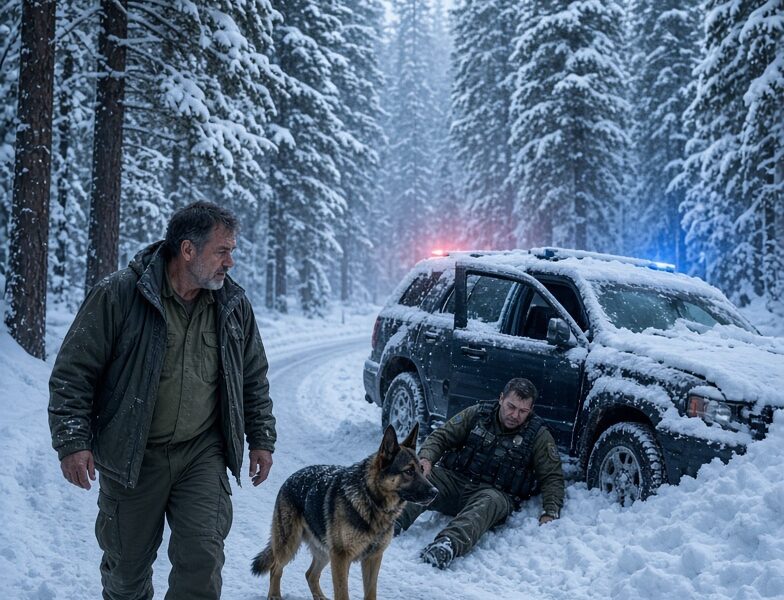
His German Shepherd Found a Crashed Cruiser in the Snow — The Name Inside Forced Him to Face the Past
When Calder Vance took his German Shepherd into the snowy Montana woods, he thought he was escaping another silent winter at home.
Then Ranger stopped at the edge of the trail and stared toward a faint red-and-blue glow beneath the pines.
A sheriff’s cruiser had gone off the road, and the injured deputy beside it carried a last name Calder had not heard spoken in years.
Inside the wreck lay an old military duffel, a worn jacket, and a piece of the past Calder had spent decades trying to keep neatly buried. But the man sitting in the snow had not come looking for a war story. He had come looking for the truth about the father Calder remembered as a hero.
What followed would force two men to confront a difficult question: Could they love the same man without agreeing on who he had been?
And could a dog recognize something worth trusting in a man who was still trying to decide who he wanted to become?
By the last week of January, the mountains above Red Lodge had become almost painfully bright.
Fresh snow covered the lower ridges in clean white folds, gathered along the shoulders of the county road and resting heavily on the dark arms of the lodgepole pines. In the afternoon sun, the whole country seemed sharpened by cold. Even the shadows looked blue.
Calder moved through it without hurry.
At fifty-two, he still carried the compact strength of a man who had spent most of his life asking his body to work efficiently rather than impressively. He stood a little over six feet tall, broad through the shoulders but lean at the waist, with a long, weathered face and a nose that bent slightly off-center from an old break.
His brown hair, longer now than anything he would once have tolerated, had gone silver at both temples. Short stubble covered his jaw, dark in some places and gray in others.
His combat shirt was olive through the torso, fitted close beneath an open charcoal-green shell. Muted camouflage ran down both sleeves, interrupted by reinforced panels around the upper arms.
The clothing came from habit more than nostalgia.
Calder had stopped dressing for anyone’s approval years ago.
Ranger walked ahead of him.
The German Shepherd was eight years old, with a broad black saddle across a honey-gold back and markings uneven enough to make his right shoulder appear darker than his left. His right ear angled slightly outward, giving him a permanent expression of skepticism. Fine silver had begun appearing beneath his black muzzle.
That morning, Ranger had been stiff for his first dozen steps outside the cabin.
Calder had noticed.
He had also remembered June Halpern telling him, very clearly, that an eight-year-old German Shepherd with early joint stiffness did not need to prove anything to a fifty-two-year-old man with questionable judgment.
So Calder had chosen the easier trail.
That was what he told himself, anyway.
He had shortened the distance, reduced the climb, packed an extra thermal pad for Ranger, and still gone into the forest.
June would have called that a compromise.
Calder suspected she would have used a different word.
Ranger stopped beside a drift and looked back.
“You’re fine,” Calder said.
The dog stared at him.
Calder adjusted the strap of his pack.
“Don’t start.”
Ranger turned away.
The cabin below Red Lodge had been especially quiet that week.
Nothing had happened there.
That was the problem.
A house could become quiet in harmless ways. Snow against the windows. A refrigerator humming. Wood settling in the stove. Ranger making noise when he wanted something and breathing loudly when he slept.
Calder’s cabin had learned another kind of quiet.
There were no arguments waiting for him. No television left on in another room. No second pair of boots beside his own at the door. Even the ordinary sounds of living seemed to disappear as soon as he stopped moving.
Calder told people he camped because he liked winter.
That was true.
It simply wasn’t the whole truth.
The trail bent downward toward an older county service road, mostly hidden beneath the snow. Ranger moved another twenty yards, then froze.
Calder nearly walked into him.
The dog didn’t growl. He didn’t bark. His ears lifted toward the trees below.
Calder followed his gaze.
At first, there was only snow, pine trunks, and fading light.
Then something flashed.
Blue.
A pause.
Red.
Then blue again, dimmed by branches.
Calder’s posture changed before he consciously decided anything.
“Stay close.”
Ranger was already moving.
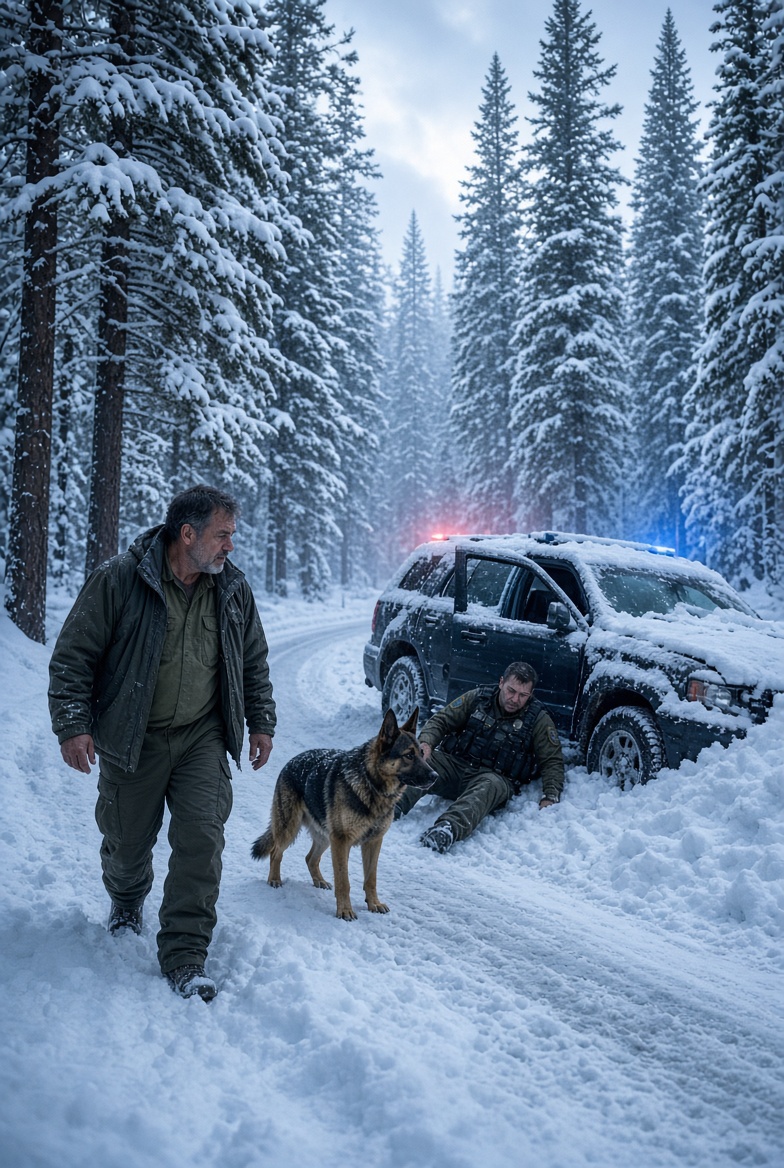
They cut carefully down the slope until the road appeared beneath them. A sheriff’s cruiser sat nose-first in a snowbank at the outside of a curve. One front wheel had disappeared into deep powder. The hood was buckled slightly on the passenger side, and the driver’s door hung open.
The emergency lights were still cycling weakly.
A man sat in the snow beside the open door, his back against the vehicle.
He lifted one hand when he saw Calder.
“Please tell me you’re not a hallucination.”
His voice was clear.
Good.
Calder approached slowly.
“Depends. Hallucinations usually carry better coffee.”
The deputy released a short breath that might have been a laugh.
He looked to be in his mid-thirties, broad-faced, with light brown hair damp against his forehead where his winter cap had come off. A short beard shadowed his jaw. His sheriff’s coat was dark and heavy, one shoulder powdered white from where he had leaned against the cruiser.
His right leg lay extended awkwardly in the snow.
Calder crouched several feet away.
“Name?”
“Evan Callaway.”
The surname landed quietly.
Calder didn’t react.
Not yet.
“How old are you?”
“Thirty-four.”
“Did you lose consciousness?”
“No.”
“Hit your head?”
“Side window. Not hard.”
“Nausea?”
“No.”
“Neck pain?”
“No.”
Calder moved closer and checked what he could without forcing the injured leg. Evan’s ankle was swelling inside his boot. The knee appeared stable, but even a small movement made the deputy’s face tighten.
“Don’t put weight on it.”
“I gathered that part. I tried once, and I developed a sudden respect for medical advice.”
Calder almost smiled.
Ranger stood several feet away, watching both men.
Evan noticed him.
“Good-looking dog.”
“He knows.”
“Of course he does.”
Calder took a folded insulating pad from his pack and slid it beneath Evan so he wouldn’t remain directly on the snow.
“What happened?”
“Road inspection. A pine came down near mile marker nine this morning. Dispatch wanted the upper stretch checked before dark.”
“You were headed back?”
Evan hesitated.
“My shift ended about thirty minutes ago.”
“That wasn’t my question.”
Evan looked toward the road ahead.
“No. I was going farther.”
“Where?”
The deputy met his eyes.
“To see Calder Vance.”
For a moment, the weak police lights seemed louder than they were.
Calder’s face remained still.
“Why?”
Before Evan could answer, Ranger moved toward the passenger side of the cruiser.
Something olive green had slid partly out from behind the seat during the impact.
A military duffel.
Ranger stopped over it.
His body changed.
Not fear. Not excitement. Something smaller and more difficult to name.
He pressed his nose close to the fabric.
A low whine escaped him.
“Ranger.”
The dog looked at Calder, then back at the bag.
Calder rose.
Evan watched him carefully now.
The duffel had already fallen mostly clear of the vehicle. Calder pulled it the rest of the way into the snow and opened the top.
Inside lay an old field jacket, several photographs, a watch in a scratched leather case, and a rectangular metal box.
Calder touched the jacket first.
The cloth had faded almost gray at the seams. Near the left cuff ran a crooked repair made with thread one shade too dark.
Calder knew that repair.
He had made it sitting beneath a fluorescent light more than twenty years earlier while Daniel Callaway complained that Calder stitched like a drunk grandmother.
His fingers stopped.
He turned the collar.
A name remained inked inside.
D. CALLAWAY.
The forest seemed to pull farther away.
Calder looked at Evan.
Years disappeared badly. They didn’t vanish cleanly. They left pieces behind, and sometimes those pieces were all a man had left to hold.
“Daniel was my father,” Evan said.
Calder didn’t answer for several seconds.
“He died four years ago,” Evan continued. “I know that probably surprises you.”
“It does.”
“You knew?”
“A Christmas card. Then a call from someone we both served with.”
Evan nodded slowly.
“My mother’s selling the house. She started going through the garage a few months ago. Dad left that bag with her. He told her to give it to me when I was ready.”
“Ready for what?”
“He apparently didn’t include instructions for that part.”
Calder looked at the metal box.
Two words had been written across the lid in black marker.
CALDER VANCE.
Evan watched him.
“I found your address three weeks ago.”
“Three weeks?”
“It didn’t take three weeks to find you.” A tired smile passed over Evan’s face. “It took three weeks to decide whether I wanted to knock.”
Before Calder could answer, Ranger lifted his head.
The Shepherd turned away from the bag and stared uphill.
A sound moved through the trees.
Low wood under strain.
Calder had heard something similar earlier and dismissed it as snow settling on branches.
This time, the sound came again, sharper.
Ranger barked once.
Calder looked up.
A large pine above the cruiser had begun leaning farther over the slope. Snow loaded one side of its crown. Near the base, a pale seam had opened in the trunk.
“Evan.”
The deputy followed his eyes.
“That bad?”
“Yes.”
Calder moved immediately, but not recklessly.
He took a length of rescue webbing from his pack, looped it beneath Evan’s arms and chest, and secured it so he could help move him without forcing the injured leg.
“We’re going downhill ten yards.”
“I can help.”
“You can keep your good leg under you and avoid becoming heavier.”
“That sounded personal.”
“It will if you argue.”
Another crack split the air.
Ranger circled toward the lower side, barking once more.
Calder pulled while Evan pushed with his uninjured heel. They slid down into a shallow depression protected by two smaller pines. The duffel came with them, dragged by its shoulder strap.
They had barely cleared the slope when the trunk broke.
The pine fell slowly at first, then all at once.
Branches struck the rear of the cruiser with a hard metallic collapse. Snow burst outward. The light bar shattered beneath the weight.
The red and blue lights vanished.
Silence returned.
Evan stared upward.
“My county is going to love this report.”
Calder took out his satellite messenger.
“Put that under ‘tree disagreed with parking location.’”
Evan laughed once, then winced.
The device acquired enough signal to send an SOS and their coordinates. A delayed response came back several minutes later. Dispatch had their location. Road conditions were worsening. A rescue team would attempt the approach, but reaching them before morning was unlikely.
Calder read the message twice.
Then he put the device away.
No panic. No speech.
Just work.
He built a low emergency shelter beneath dense pines, away from the damaged vehicle and any heavily loaded trees. He reinforced Evan’s ankle and knee, wrapped him in a thermal blanket, and melted snow for warm water on a compact stove.
Ranger settled nearby on his insulated pad.
As darkness thickened, the forest became smaller. The world ended at the edge of their headlamps.
For a long while, neither man mentioned Daniel.
Then Evan looked toward Ranger.
The Shepherd had his head on his paws, amber-brown eyes half closed.
“My father knew him.”
Calder stared into the small stove flame.
“Yes.”
“How?”
Calder rubbed a thumb across the worn nylon strap of his watch.
“Ranger’s mine. Your father was standing beside me the day I chose him.”
Evan waited.
Calder didn’t continue.
Not yet.
Perhaps Evan understood. He leaned back beneath the thermal blanket and looked toward Ranger again.
The dog shifted, stretched one foreleg toward the space between them, and went still.
Outside the shelter, snow continued falling through the pines.
Daniel Callaway had been dead for four years.
Yet for the first time, Calder understood that death hadn’t preserved one version of him. It had preserved several.
And somewhere between the injured son, the old jacket, and the dog breathing quietly beside them, those versions had finally entered the same room.
Morning arrived without drama.
That was the first mercy.
The snowfall had thinned before dawn, leaving the forest washed in pale blue light. Calder heard the rescue team before he saw them: the distant grind of a tracked utility vehicle, followed by voices carrying strangely through the trees.
Ranger was awake at once.
Evan opened his eyes more slowly.
“You always sleep that lightly?” he asked.
“Only when someone is injured twenty feet from me.”
“That sounds relaxing.”
“It isn’t.”
Evan’s face looked better than it had during the night, though exhaustion had settled beneath his eyes. His right ankle remained swollen beneath Calder’s temporary wrap, and the knee was still too painful for him to trust.
Calder checked both before the rescue team reached them.
He asked first.
That detail might have escaped anyone else. It didn’t escape Calder.
He had spent most of his adult life learning how quickly competence could turn into intrusion if a man stopped noticing where another person’s body began.
The first rescuer through the trees was a county medic. The second was a woman in a dark sheriff’s winter jacket, moving with the brisk irritation of someone who had been worried for several hours and intended to disguise it as annoyance.
She was in her early forties, compact and strong, with dark hair pulled low at the back of her neck and a few silver strands catching the morning light.
Her face was angular, alert, and entirely unimpressed by the sight of Evan wrapped in emergency foil beneath a pine tree.
“Callaway.”
Evan raised one hand.
“Morning, Mara.”
Deputy Mara Reeves stopped in front of him and looked him over from boots to forehead. Then she looked at the ruined cruiser visible uphill through the trees.
Then back at Evan.
“You were actually going to meet him after your shift?”
Calder glanced at her.
Evan closed his eyes.
“Good morning to you, too.”
Mara pointed at Calder without looking away from Evan.
“That’s Calder Vance.”
“I assumed introducing people could wait until after the hypothermia.”
“You weren’t hypothermic.”
“I was preparing emotionally.”
Mara finally offered Calder a hand.
“Mara Reeves.”
“Calder.”
“I know.”
That seemed to be the entire introduction she required.
Within twenty minutes, the medics had transferred Evan to a rescue sled. Ranger stayed nearby but didn’t interfere, watching every movement with his right ear angled outward.
The olive duffel rode beside Evan.
Calder noticed that Mara looked at it once.
Only once.
Which meant she knew exactly what it was.
The road back to town took nearly two hours because crews were still clearing snow from the lower county routes.
At the hospital in Red Lodge, X-rays showed no fracture, but Evan had a significant ankle sprain, soft-tissue damage in his knee, and a mild concussion from the impact with the cruiser’s side window.
Nothing dramatic enough to keep him overnight, but enough that the physician didn’t want him alone for the next day or two.
Evan listened to the discharge instructions with the expression of a man being personally insulted by medicine.
Mara stood beside the bed, arms folded.
“You’re not going home tonight.”
“My apartment still exists.”
“Your road doesn’t.”
“It’s temporarily closed, which is what roads say before people become county reports.”
Evan looked at Calder.
Calder had been standing near the window, uncertain when exactly he had become part of the conversation.
Mara noticed.
“So, no,” she said.
“I didn’t ask yet.”
“You were about to offer him the guest room.”
Calder paused.
“I was.”
Mara nodded.
“Fine. Better than the sheriff’s office sofa.”
Evan looked at her.
She continued, “It smells like wet wool, burnt coffee, and approximately 1997.”
Calder said nothing.
Evan stared at the ceiling for several seconds.
“Two nights.”
Calder nodded.
“Two nights.”
Mara picked up her keys.
“Good. I have twelve hours of weather calls waiting because some people apparently believe four-wheel drive grants diplomatic immunity from physics.”
She looked at Evan.
“Text me tonight.”
“Yes, Mom.”
“I’m younger than your mother.”
“Barely.”
Mara smiled without warmth and left.
Calder watched her go.
“She likes you,” he said.
Evan adjusted the brace around his ankle.
“That is one interpretation.”
By late afternoon, they were back at Calder’s cabin.
It looked different with another man inside it.
Not warmer.
Not yet.
Just less arranged.
Evan’s boots sat near the door. His crutches leaned beside the kitchen table. A hospital bag occupied one chair.
The olive duffel rested on the bench beneath the front window.
Ranger inspected all of it. He smelled the crutches first, then the brace, then Evan’s coat.
He ignored Evan himself.
“I appreciate the boundaries,” Evan said.
“He’s deciding whether your furniture is going to stay longer.”
“That feels threatening.”
Calder made soup.
Evan ate half a bowl and fell asleep in the guest room before nine.
The house settled around them.
Wind moved lightly against the windows. The fire in the stove had burned down to a deep orange.
Calder sat at the kitchen table with Daniel’s metal box in front of him.
He didn’t wait three weeks.
He didn’t put it in a drawer.
He didn’t tell himself he needed the right time.
Daniel had already lost the privilege of making him wait any longer.
Calder opened it.
The lid gave with a stiff metallic click.
Inside lay a folded letter, a battered silver lighter, a photograph, and a restaurant receipt almost yellow with age.
Calder picked up the photograph first.
Daniel was asleep in the passenger seat of an old truck, mouth open, chin tucked against his chest, one hand still holding a paper coffee cup.
Calder turned the photo over.
In Daniel’s handwriting were the words:
Tactical observation posture. Do not wake.
Calder laughed once, quietly.
The sound felt strange in the kitchen.
He set the photograph down and unfolded the receipt.
A diner in Virginia. Two coffees. Two breakfasts. Three side orders of bacon.
Across the bottom, Daniel had written:
Calder owes me $740 and an apology.
No explanation.
Calder remembered the argument immediately.
Daniel had insisted hot sauce belonged on scrambled eggs. Calder had called that a moral failure.
Apparently, the dispute had required financial documentation.
The letter was last.
Daniel’s handwriting had become less steady toward the end of his life, but it was still unmistakably his.
The first paragraph concerned the lighter. It had stopped working, and Daniel claimed this was because Calder had once borrowed it.
The next paragraph mentioned Elaine being annoyed that he was writing instead of sorting insurance papers.
Then, without ceremony, Daniel wrote about Evan.
Not as a boy.
As a man.
He said Evan had always tried to do the correct thing before deciding whether the correct thing was actually his to do.
Daniel admitted he might have helped teach him that.
Too much duty. Too much silence. Too many moments when approval had arrived only after usefulness.
Calder stopped reading.
Ranger had entered the kitchen.
The Shepherd stood several feet away, looking at the table, not at the box.
At Calder.
“I’m fine,” Calder said.
Ranger sat.
Calder looked back down.
Daniel’s next lines were less polished.
That made them harder.
He wrote that if Evan ever came looking for Calder, Calder should resist the urge to give him stories about courage.
Evan already had enough of those.
Do not tell him what I was at my best and call that the whole truth.
Do not make him compete with a dead man.
Then came the line Calder read twice.
Don’t make my boy carry the best version of me.
Below it, squeezed sideways into the margin, was another sentence.
Tell him I was wrong sometimes. More than sometimes. According to Elaine, she is standing here while I write this and says I should remove the word sometimes.
Calder closed his eyes.
For years, he had remembered Daniel in clean pieces.
A hand on his shoulder. A joke told at the wrong time. A promise kept. A man who had once stood beside Calder outside a working-dog program and said very seriously that Calder needed something alive enough to inconvenience him every morning.
That man was easy to miss.
Easy to honor.
Easy to simplify.
The man who had written this letter was more difficult.
He sounded tired, funny, aware of damage he had caused without fully knowing how to repair it.
Human.
Calder folded the letter and returned it to the box.
Ranger rose and moved closer. He rested his chin against Calder’s knee.
Calder looked down.
“You don’t have an opinion.”
Ranger’s amber eyes remained open.
“That’s why everyone likes you.”
The next morning, Evan came into the kitchen on crutches and found the box open on the table.
He stopped.
Calder had expected anger.
Instead, Evan looked at the letter, then at Calder.
“You read it?”
“Yes.”
“Good.”
Calder leaned against the counter.
“You knew what was in it?”
“No.”
Evan lowered himself carefully into a chair.
“Dad wrote me my own letter. I read that one after he died.”
Calder waited.
“What did he say?”
Evan stared toward the stove.
“Some things that mattered.”
The answer closed the door without slamming it.
Calder respected that.
After a moment, Evan looked back toward the box.
“I didn’t come because I thought he left me another message through you.”
“Then why come?”
Evan was quiet long enough that Ranger crossed the kitchen and lay down between the table and stove.
Finally, Evan said, “I wanted to know who he was when he wasn’t my father.”
Calder felt the old instinct rise immediately.
He could have told him about Daniel under pressure, about the nights he stayed awake when others slept, about loyalty, about the things men called bravery because there was no useful language for doing what had to be done while afraid.
The stories lined up almost automatically.
Calder looked at the letter.
Don’t make my boy carry the best version of me.
So he chose something else.
“Your father made terrible coffee.”
Evan blinked.
“That’s your opening?”
“It was strong enough to remove paint.”
“My mother says the same thing.”
“He once made a pot so bad I told him a nail would float in it.”
Evan smiled.
“What did he say?”
“He dropped a washer in the cup and it sank.”
For the first time since Calder had met him, Evan laughed without pain.
It was brief, not loud, but free.
Ranger lifted his head from the floor.
Evan looked at him, then at Calder.
“My mother never told me that.”
“She probably had standards.”
Evan laughed again.
Outside, morning sunlight spread over the snow beyond the windows.
The metal box remained open on the table.
Nothing inside it had solved anything.
No secret had rearranged their lives.
It had done something smaller.
It had made room.
And for now, that was enough.
Two nights became four.
The county road opened before Evan was ready to drive, and Evan was ready to drive before Calder believed he should.
Neither fact helped.
By the third morning, the cabin had developed habits around him.
There was now a second mug beside the sink. A pair of crutches leaned against the wall in a way Calder disliked because they weren’t parallel. A bottle of pain medication sat near the bread box.
Evan’s olive duffel remained beneath the front window, closed now, its importance diminished by the ordinary mess of living.
Calder cooked too much.
He didn’t mean to.
Years of living alone had taught him exactly how much oatmeal one man needed, how much stew would last three days, and how many eggs were excessive.
Then Evan arrived, and somehow Calder began making six eggs at a time.
“You planning for reinforcements?” Evan asked one morning.
Calder set a plate in front of him.
“You complain a lot for someone eating my food.”
“I’m conserving strength.”
“For what?”
“Future complaints.”
Ranger lay near the stove, chin on his paws, watching the exchange with the weary patience of an animal who had apparently been placed in charge of two men who should have known better.
Evan had stopped trying to do everything himself.
Mostly.
He still attempted to carry his coffee while using crutches. He still refused help with his jacket. He still insisted he could manage the short steps onto the porch without Calder hovering behind him.
Calder did hover.
He simply did it from farther away.
That counted as progress.
The days remained bright and cold. Snow slipped from the cabin roof in soft collapses around noon. Sunlight flashed through the windows strongly enough to warm the wood floor where Ranger liked to sleep.
Evan spent more time out of bed.
They talked because there was only so much weather two men could discuss before silence became obvious.
At first, Calder kept his promise to Daniel without naming it.
He told Evan about the parts of Daniel that would never appear in a service record.
“He sang constantly.”
“Good?”
“No.”
“How bad?”
“Your father knew three lines from every song ever written and none in the correct order.”
Evan laughed.
“That explains something.”
“What?”
“My mother refused to let him choose music on road trips.”
Calder looked at him.
“That may have saved your childhood.”
Another afternoon, Calder told him about the dentist.
Daniel had once delayed an appointment for nearly a year because he insisted the dentist had an aggressive personality.
Evan nearly spilled his coffee.
“He told us he didn’t trust dentists because they enjoyed causing pain.”
“He said the same thing to me.”
“So that was real.”
“Unfortunately.”
The stories became small bridges.
Not dramatic ones. No medals, no last stands, no speeches.
Just a man who overused hot sauce, broke cheap tools because he refused to read instructions, and once blamed an entire shelving unit for being structurally arrogant.
Evan seemed hungry for those stories.
That made Calder careful.
He had begun to understand that hunger didn’t mean a person should be fed everything available.
Sometimes it meant the opposite.
One evening, they sat near the stove while Ranger slept beside the woodbox. Snow tapped lightly against the windows.
Calder had been telling Evan about a winter years ago when Daniel had driven through a storm to help a former teammate whose furnace had failed.
“He always showed up,” Calder said. “Didn’t matter how far. If someone called, Daniel went.”
The room changed.
Not dramatically.
Evan simply stopped smiling.
Calder noticed.
“What?”
Evan looked down at his hands.
“Nothing.”
“That wasn’t nothing.”
Evan let out a slow breath.
“No, I guess it wasn’t.”
He shifted in the chair, careful with his injured leg.
“My father wasn’t always there.”
Calder felt something tighten in him.
Not anger exactly.
Reflex.
A defense older than thought.
“He had a lot going on.”
Evan nodded once.
“I know.”
“Those years after he came home—”
“I know.”
Calder stopped.
Evan looked toward the fire.
“He missed my academy graduation.”
Calder said nothing.
“He said he’d be there. My mother saved a seat. I kept looking at the back doors every time someone came in late.”
A faint smile crossed Evan’s face, but there was no humor in it.
“Eventually, I stopped looking.”
Calder searched his memory.
Daniel had never mentioned that.
Evan continued.
“He used to lock himself in the garage when things got bad. To work sometimes, and other times…” Evan shrugged. “Just to be somewhere with a door.”
That sentence landed harder than Calder expected.
He knew something about doors.
Evan went on.
“He promised to take me fishing one summer. We planned it for weeks. I packed the truck the night before.”
“What happened?”
“He forgot.”
Calder almost said Daniel wouldn’t have forgotten something like that.
The thought formed completely.
He hated himself a little for it.
Evan looked at him.
“There were almost two years when most of what we said to each other was practical.”
His voice changed slightly, imitating Daniel.
“Car running okay?”
Then his own younger voice.
“Yeah.”
“Electric bill paid?”
“Yeah.”
“You eating?”
“Yeah.”
Evan looked back at the fire.
“That was us.”
Calder leaned forward.
“He was hurting.”
Evan turned.
“I know.”
The answer was quiet.
Calder continued anyway.
“He came back carrying things he didn’t know how to put down.”
“I know.”
“He cared about you.”
“I know.”
The third answer was different.
Not louder.
Sharper.
Calder stopped.
Evan’s expression was controlled, but his eyes had hardened.
“I know why my father hurt,” Evan said slowly. “What I never understood was why knowing that was supposed to mean I wasn’t allowed to hurt because of him.”
The stove gave a soft metallic tick.
Ranger lifted his head.
Calder had no answer.
For years, he had protected Daniel in memory because the dead couldn’t defend themselves. He had never considered what that protection might do to the living.
Evan looked away first.
“I’m not saying he was a bad man. I know I loved him. I know he could be generous and funny. He could drive two hours in the middle of the night because somebody needed help.”
Evan swallowed.
“And then he could come home and disappear ten feet away from us.”
Calder sat very still.
That was the version of Daniel he had never had to live with.
The man Calder remembered arrived when someone called.
The man Evan remembered sometimes failed to arrive even when he was already home.
Both could be true.
That was the part Calder had resisted.
Not because he thought Evan was lying, but because accepting it meant losing the clean shape of a friend he had spent years preserving.
Ranger stood.
Calder expected him to come over.
Instead, the dog walked toward Evan.
He stopped a few feet away, sniffed once, then lay down.
No touch.
No performance.
Evan looked at him.
“You taking sides?”
Ranger rested his chin on the floor.
Calder said, “He charges by the hour.”
Evan gave a small laugh.
The tension loosened just enough to breathe around.
The next morning, Evan began a routine with Ranger.
It happened without discussion.
Evan woke earlier than Calder expected, moved carefully into the kitchen, and opened the porch door.
Ranger went outside.
When he returned, snow clung between his toes. Evan sat on the floor because bending from a chair was awkward with the brace. He took an old towel from the hook and wiped Ranger’s paws one at a time.
Ranger allowed it.
That was all.
The following morning, it happened again.
Then again.
Evan never called Ranger over, never tapped his leg, never tried to prove the dog liked him.
He opened the door, waited, wiped the snow away, then sat against the cabinet drinking coffee while Ranger chose where to be.
Calder watched from the table.
It bothered him how natural they looked.
That feeling surprised him.
He examined it and found something small and unpleasant beneath it.
Possessiveness.
Not of Ranger exactly, but of history.
Ranger had belonged to the life Calder built after Daniel. Now the dog was forming a relationship with Daniel’s son that Calder hadn’t arranged.
He should have liked that.
Most of him did.
The remaining part had to learn.
By the end of the week, Evan could walk short distances with one crutch. His road was open. Mara had already texted that she could pick him up Saturday morning.
On Friday night, Evan packed.
The cabin looked as though it were undoing the evidence of his presence.
Medication disappeared into a bag. Crutches moved toward the door. The second mug was washed and left upside down beside Calder’s.
Evan pulled on one glove, then checked the chair.
“Where’s the other one?”
Calder looked up from the stove.
“No idea.”
They both looked at Ranger.
The Shepherd was lying on his bed.
Under his chest was Evan’s missing glove.
Evan stared.
Calder folded his arms.
“He steals.”
“I’m a sheriff’s deputy.”
“Then you’re finally useful.”
Evan crouched as far as his injured leg allowed.
“Sir, I’m going to need you to release the property.”
Ranger didn’t move.
Calder said, “Strong case. Repeat offender.”
Evan looked at the dog.
Then, after a second, he stood.
“Keep it.”
Calder raised an eyebrow.
“You’re surrendering evidence.”
“I’ll amend the report.”
The next morning, Mara arrived before nine.
Evan put on his coat. He had another pair of gloves.
Before leaving, he looked once toward Ranger’s bed.
The old glove was still there.
He didn’t take it.
Calder noticed.
He said nothing.
Outside, tires crunched over the bright snow. Ranger stood beside Calder at the window as Mara’s vehicle disappeared down the road.
For several moments, neither moved.
Then Ranger returned to his bed.
He lowered himself carefully, turned once, and rested his muzzle over Evan’s glove.
Calder looked at him.
“That’s theft.”
Ranger closed his eyes.
Calder glanced toward the empty guest room.
The cabin was quiet again, but not quite in the same way.
Something had been left behind.
And for once, Calder didn’t feel the need to put it away.
Evan didn’t disappear after leaving Calder’s cabin.
At first, every visit came with an excuse.
The following Saturday, he returned for the charger he had forgotten beside the guest bed.
Three days later, he came back with a socket wrench Calder had loaned him.
Calder looked at the tool.
“You drove forty minutes to return a twelve-dollar wrench.”
Evan leaned against the porch rail, his ankle still wrapped but no longer requiring crutches.
“It’s a very good wrench.”
“It came in a set of twenty.”
“I respect the whole family.”
The third visit came without anything to return.
Evan brought coffee.
Calder noticed.
He didn’t mention it.
Neither did Evan.
Ranger was less subtle.
The German Shepherd met Evan at the porch instead of waiting inside. He sniffed the man’s boots, inspected the pocket where Evan had once carried dog treats, then walked back toward the cabin as though the matter had been settled months ago.
The glove Evan had left behind remained on Ranger’s bed.
Calder had washed it once.
Ranger had watched the entire process with open disapproval.
By mid-February, Evan’s limp was nearly gone.
His personal pickup was less fortunate.
It arrived at Calder’s cabin one Sunday, making a grinding sound that caused Calder to wince before Evan had even shut off the engine.
“That’s new,” Calder said.
“It has personality.”
“That transmission has a death wish.”
“I was hoping for something cheaper.”
“You usually are.”
Calder knew someone.
Frank Ellery’s garage sat near the older edge of Red Lodge, where the tourist storefronts gave way to feed stores, repair shops, and houses that had survived several generations of people saying they would repaint them next summer.
Ellery Auto and Small Engine had once been painted in red letters above the bay doors.
The sun had reduced most of them to pink.
Frank himself appeared from beneath a pickup on a rolling creeper, boots first.
He was sixty-seven, broad through the hands and slightly broader through the middle, with thinning gray-white hair and a mustache substantial enough to qualify as weather protection.
Reading glasses sat on top of his head.
He squinted at Evan’s truck.
Then at Evan.
Then at Calder.
“What did you do to it?”
Evan pointed at Calder.
“He diagnosed it from thirty feet away.”
Frank looked offended.
“That man diagnoses everything from thirty feet away. Half the time he’s wrong quietly.”
“Half?” Calder asked. “Don’t become ambitious.”
Frank opened the hood.
Within fifteen minutes, Evan had stopped behaving like a customer.
He listened to the transmission with a mechanic’s stethoscope, checked the fluid, then asked Frank for a socket extension without needing to be told where the tools were.
Frank handed it over.
“You work on cars?”
“Grew up doing it.”
“You any good?”
Evan looked underneath the truck.
“Depends who’s asking.”
“The man deciding whether you’re allowed near my torque wrench.”
That earned a smile.
Calder stood near the workbench with Ranger beside him.
He watched Evan loosen a bracket, shift his weight naturally, then reach for the exact tool Frank was already preparing to hand him.
There was none of the hesitation of someone remembering a hobby.
This was muscle memory.
Frank noticed, too.
“You learn this professionally?”
“My father.”
Calder saw the change in Evan’s face when he said it.
Small, not pain exactly.
History adjusting its coat.
“He had a garage at home,” Evan continued. “Two bays if you were generous. One and a half if my mother was measuring.”
Frank nodded.
“Good woman.”
“You haven’t met her.”
“She understands square footage.”
The transmission problem turned out to be repairable without replacement.
A worn mount and failing linkage had made the situation sound worse than it was.
Frank seemed disappointed.
“I was hoping to charge you enough to retire.”
“You’re already sixty-seven.”
“Retirement and age are unrelated concepts.”
Evan stayed another hour, helping reassemble what they had removed.
By the time they finished, Frank had stopped asking permission before handing him tools.
Calder had noticed something else, too.
Evan relaxed in the garage.
Not the way he relaxed at the cabin.
At the cabin, relaxing meant lowering his guard.
Here, it meant becoming more awake.
His hands knew where to go. Problems had edges. A bolt was seized or it wasn’t. A gasket fit or it didn’t.
Machines could be stubborn, but they rarely asked a man to interpret grief.
Frank wiped his hands on a shop rag.
“You do this and still chose patrol?”
Evan closed the hood.
“I chose patrol before I learned how much I liked having weekends.”
Frank snorted.
“You’re good with a wrench, so naturally you picked a job where people call after they’ve driven the vehicle into a ditch.”
Evan laughed.
“Excellent career planning.”
Calder expected the conversation to end there.
It didn’t.
Frank opened a cabinet and searched for something. His glasses remained on his head.
Evan watched for nearly ten seconds.
“What are you looking for?”
“My glasses.”
Evan pointed upward.
Frank touched them.
“That proves nothing.”
Then, almost casually, he said, “You still thinking about leaving patrol?”
Calder looked at Evan.
Evan didn’t look back.
Frank found the invoice pad.
“You told him no.”
Frank glanced between them.
“Well, I have improved communication in another family.”
Calder waited until they were outside.
Ranger was sniffing a drift near the building.
“You’re leaving the sheriff’s office?”
Evan pulled on his gloves.
“I didn’t say that.”
“Frank did.”
“Frank says carburetors have feelings.”
“Are you?”
Evan looked toward Main Street.
“Maybe patrol.”
“How long have you been thinking about it?”
“A year.”
That answer disturbed Calder more than he expected.
Not because Evan might leave, but because Calder had immediately begun searching for an explanation connected to Daniel.
The accident. The inheritance of expectation. The father who had served.
Evan seemed to recognize the calculation.
“It isn’t because of him.”
Calder said nothing.
“And it isn’t because of the crash, either.”
“Then what?”
Evan leaned against the truck.
“Ten years of nights, domestic calls, drunk drivers, walking into houses where everybody’s already having the worst hour of their week.”
He rubbed his thumb across the edge of one glove.
“I still like helping. I just don’t know if I like meeting people only after everything has gone wrong.”
That stayed with Calder.
A few days later, Mara Reeves confirmed it without being asked.
She stopped at Frank’s garage during her shift to get a damaged windshield-wiper motor for her cruiser.
Her stainless-steel thermos appeared before the rest of her.
Frank looked at it.
“You ever wash that thing?”
“Coffee sterilizes.”
“It absolutely does not.”
“Then I’ve survived through luck.”
Evan was under his truck again, replacing a shield Frank had declared technically optional but morally necessary.
Mara watched him work.
“He told you,” Frank said.
“Of course he did. Privacy comes to this garage to die.”
Calder looked toward Evan.
“You think he should leave?”
Mara considered the question.
“I think Evan has spent ten years doing work he’s good at.”
“That wasn’t the question.”
“No, it was a better answer.”
She took a drink from the thermos.
“He never wanted to be called a hero. He hates when people use that word.”
Evan called from beneath the truck.
“I can still hear you.”
Mara raised her voice slightly.
“Good.”
Then she looked back at Calder.
“He just can’t stand walking away from somebody having the worst day of their life.”
Calder’s response came before he could stop it.
“Daniel was the same.”
He cut himself off.
Silence.
Evan rolled out from under the truck.
He looked directly at Calder, not angry.
That was worse.
Calder heard the unfinished comparison sitting between them.
Daniel was the same.
Daniel would understand.
Daniel would approve.
Daniel.
Daniel.
Daniel.
Calder looked away first.
“Sorry.”
Evan sat up.
“I know you don’t mean it.”
“That doesn’t make it useful.”
Something passed between them.
Not forgiveness.
Recognition.
It was a small failure, but Calder finally saw its shape.
He had been using Daniel as a ruler, laying it against every decision Evan made, measuring the living man against someone who could no longer change.
He had mistaken comparison for respect.
The distinction should have been obvious.
It wasn’t.
Weeks passed.
Ranger continued improving physically after the accident, but loud metallic sounds still startled him.
June Halpern had examined him twice and found nothing physically wrong beyond his existing joint stiffness.
“Stress doesn’t always leave when the bruise does,” she had told Calder.
Calder had immediately asked what training he should use.
June had given him the look she reserved for people attempting to turn patients into equipment.
“None.”
“None?”
“Give him predictable routines. Distance from sudden noise. Let him recover.”
“He needs to get used to it.”
“He needs to learn the world is safe again. Those are not the same thing.”
Calder had disliked the distinction because he understood it.
One afternoon, Ranger accompanied him to Frank’s garage.
Evan was there replacing an old alternator. The bay door stood partly open to winter sunlight.
Outside, a county snowplow crawled along the curb.
No one paid attention to it until a loose steel side plate dropped against the pavement.
The crash filled the garage.
Ranger flinched violently.
He backed several steps, his nails scraping concrete.
Calder turned.
“Ranger.”
The command was already forming.
Come center.
Look.
Something familiar that would give the dog a task.
Ranger walked past him.
Calder stopped speaking.
The Shepherd crossed the garage toward Evan.
Evan had already put the wrench down.
He didn’t call Ranger. He didn’t reach for him.
He simply lowered himself onto a shop stool, turning his body slightly sideways.
Ranger stopped beside him.
His breathing was fast.
Evan waited.
Outside, the snowplow continued down the street.
The garage became quiet again.
After several seconds, Ranger moved closer on his own, then pressed one shoulder gently against Evan’s knee.
Evan rested his hands loosely between his legs.
Still no touch.
A minute passed before Evan finally placed one hand against the dog’s shoulder.
Ranger exhaled.
His body softened.
Frank watched from the workbench.
Calder stood ten feet away.
Something inside him wanted to name the moment.
Daniel’s son.
Daniel’s dog.
History coming around.
He rejected all of it.
Daniel hadn’t chosen this.
Calder hadn’t arranged it.
There was no old coat nearby. No military bag. No scent carrying twenty-year-old memories.
There was only Evan, and Ranger trusted him.
Calder looked down at the olive nylon strap of his watch.
The letter returned to him.
Don’t make my boy carry the best version of me.
Calder had thought Daniel was asking him to tell the truth about the past.
Now he understood there was another part.
He had to stop using Daniel as the measurement for the future.
Evan wasn’t a continuation, a debt, or a second chance to keep a friend.
Across the garage, Evan scratched lightly beneath Ranger’s neck.
The Shepherd leaned into him.
Frank broke the silence.
“Well.”
Calder glanced over.
Frank adjusted the reading glasses still sitting uselessly above his forehead.
“At least one of you knows when not to talk.”
Evan looked at Ranger.
Calder laughed quietly.
Then he walked back to the workbench.
He didn’t call the dog away.
For Calder, that was a very small action.
It also might have been the first time he let something he loved choose a direction without following behind to correct it.
Ranger began having harder mornings.
Not every morning.
That made it easier for Calder to pretend nothing had changed.
Some days, the German Shepherd rose from his bed beside the stove, stretched his front legs long across the floorboards, and followed Calder to the door with the same quiet purpose he had carried for years.
Other mornings, his hindquarters took an extra second.
Then, too, he would stand, pause, shift his weight, and only afterward move toward the kitchen.
Calder noticed every time.
He began noticing too much.
By the third week of February, Ranger had been removed from the longer forest route, the hill behind the cabin, the steeper path near Rock Creek, and eventually anything Calder considered remotely unnecessary.
Ranger objected by standing at the door whenever Calder put on his boots.
“You’re staying.”
Ranger stared.
“It’s cold.”
The dog continued staring.
“You were stiff this morning.”
One ear angled slightly outward.
Calder pointed toward the bed.
“You can be judgmental from there.”
Ranger didn’t move.
Two days later, June watched him cross the examination room at her veterinary clinic.
The clinic smelled faintly of disinfectant, wet wool, and the coffee June had forgotten on the counter long enough for it to become medicinal.
June was sixty-one, compact, with salt-and-pepper curls brushing her jaw and gray-green eyes that had spent twenty years watching owners explain what their animals had supposedly told them.
She crouched and ran careful hands along Ranger’s hips and knees.
Ranger tolerated the examination, though his expression suggested he was documenting several professional concerns.
June had him walk the hallway twice.
Then she straightened.
“Mild arthritis.”
Calder folded his arms.
“How mild?”
“Mild.”
“What changes?”
“Some.”
“Which ones?”
June looked at him.
“That depends on whether I’m answering the question you asked or the one you’ve already answered for yourself.”
Calder frowned.
“I reduced his activity.”
“I heard. He doesn’t need the longer climbs.”
“Probably not.”
“No steep ground.”
“Reasonable.”
“No winter camping until—”
“No.”
Calder stopped.
June leaned against the counter.
“You’re doing that thing again.”
“What thing?”
“The thing where one reasonable adjustment becomes six because six feels more responsible.”
Calder looked toward Ranger.
The Shepherd had walked to the door and was sniffing beneath it.
“He’s eight.”
“Yes, he’s stiff.”
“Then why would I push him?”
June’s expression softened slightly.
“I didn’t say push him.”
She let the silence sit for a moment, then asked, “Are you protecting Ranger, or are you arranging his life so you don’t have to watch him get older?”
Calder didn’t answer.
June had known him too long to rescue him from the question.
She turned back to Ranger instead.
“Shorter walks, flatter ground. Give him a few minutes to warm up before anything strenuous. Watch for limping, reluctance, changes in appetite, or difficulty standing after rest. We can manage discomfort.”
Calder nodded.
“And if he wants to keep going?”
June looked directly at him.
“You watch the dog you actually have that day. Not the dog you had five years ago, and not the dog you’re afraid he’ll become five years from now.”
Ranger came over and leaned briefly against Calder’s leg.
Calder rested one hand against the dog’s shoulder.
He disliked lessons that arrived through people he couldn’t argue with.
June was unfortunately one of them.
That afternoon, Calder took Ranger on the flat road beside the cabin.
At the first fork, Calder almost turned them back automatically.
Ranger kept going.
Not quickly. Not painfully.
Simply forward.
Calder followed.
Half a mile later, Ranger stopped beside a buried fence post, sniffed it with great seriousness, then turned toward home.
Calder stared at him.
“That’s it?”
Ranger began walking back.
For once, Calder accepted the answer.
Evan’s decision was more difficult.
The sheriff’s office had posted an internal opening in community services and emergency preparedness. It was still county work, still connected to law enforcement, but the rhythm was different.
Fewer night patrols.
More planning for severe weather.
Coordinating volunteers, visiting isolated residents before storms, organizing emergency resources, and helping older residents prepare before small problems became emergency calls.
Calder learned about the opening when Evan showed him the notice over coffee at Frank’s garage.
“You applying?”
Evan folded the paper once.
“Thinking about it.”
“You’ve been thinking about leaving patrol for a year.”
“That doesn’t make this the answer.”
“It sounds close.”
Evan looked toward the open bay.
“That might be the problem.”
Calder waited.
Evan rubbed the folded edge between his fingers.
“Patrol is real work.”
“So is this.”
“You know what I mean?”
Calder did.
He also knew the sentence forming in his own head.
Daniel would tell you—
He stopped before it reached his mouth.
Evan noticed anyway.
His eyes lifted.
Calder looked at the coffee cup.
“I almost did it again.”
“Yeah.”
“Sorry.”
Evan unfolded the paper.
“My father would have stayed on patrol.”
Calder considered that.
“Maybe.”
Evan looked surprised.
“You’re not going to tell me he would?”
“I wasn’t inside his head.”
“That hasn’t stopped you before.”
“No.”
The answer drew the faintest smile.
But Evan’s uncertainty remained.
It wasn’t about whether he could do the new job.
It was about whether wanting a different life made him smaller.
Calder recognized that kind of trap.
He had simply built his from different materials.
Elaine Callaway arrived in Red Lodge the following weekend.
Calder expected to be nervous.
Instead, he discovered that nervousness required too much energy.
Elaine entered Frank’s garage carrying a paper bag of sandwiches and immediately told Evan that he looked thin.
“I’ve gained two pounds,” Evan said.
“Then you looked worse before.”
She was sixty-three, slender, with silver-blonde hair tied loosely at the nape of her neck and a rust-red scarf wound once around a pale green sweater.
Lines gathered easily around her light blue eyes when she smiled.
She hugged Evan.
Then she turned toward Calder.
For a moment, neither spoke.
Twenty years of Daniel existed between two people who had never met.
Elaine solved it.
“You’re taller than he said.”
Calder blinked.
“What did he say?”
“That you were approximately his height.”
“Daniel was five-ten.”
“I know.”
Calder smiled.
“That sounds like him.”
Elaine offered her hand.
“It sounds like every man who ever described another man’s height.”
That made things easier.
They ate lunch around Frank’s battered worktable.
Ranger lay beneath it, close enough to Evan that one boot touched the fur along his side.
At first, the conversation stayed safe.
Weather. Road conditions. Elaine selling the old family house. Frank complaining that modern trucks required computers to diagnose problems that older trucks announced with smoke.
Then Daniel entered the room.
Not literally.
Simply through a story.
Calder mentioned how Daniel once drove through a snowstorm to help a teammate whose furnace had failed.
“He always took care of people,” Calder said.
Elaine raised one eyebrow.
“Your Daniel did.”
Calder paused.
Elaine opened her sandwich.
“Mine once stood in front of the refrigerator for ten minutes and asked where the ketchup was.”
Evan laughed.
“It was in the door.”
“It was always in the door.”
Frank nodded solemnly.
“Refrigerator doors are highly tactical environments.”
Elaine ignored him.
“Daniel could drive across three counties because somebody needed help. But replacing a hallway light bulb?”
She shook her head.
“Three weeks.”
Calder smiled.
“He hated ladders indoors.”
“No, he hated chores without witnesses.”
Evan laughed harder.
Something warm moved around the table.
Then Elaine looked at Calder, not accusing, not amused now.
“You knew him when he was very good at being needed.”
Calder lowered his coffee.
Elaine continued quietly.
“Evan sometimes knew him when he was very bad at being there.”
The room settled.
Evan looked toward his mother.
She didn’t reach for him.
She didn’t need to.
Calder heard Daniel’s defense rising again inside him, but this time it no longer felt like loyalty.
It felt like interruption.
Elaine took another breath.
“Both are true.”
Calder looked at her.
“You knew Daniel when he was at his best, Calder.”
Then she glanced at Evan.
“My son sometimes had to live with him when he was at his worst.”
Evan stared at the scratched tabletop.
Elaine’s voice remained gentle.
“You don’t have to choose which man was real.”
That sentence seemed to remove something from the room.
Not grief.
Something heavier.
The obligation to reach a verdict.
Calder looked toward Evan.
For years, he had treated memory as if love required testimony.
Daniel had been loyal.
Daniel had been brave.
Daniel had shown up.
All true.
None complete.
Across the table, Ranger shifted and rested his muzzle on Evan’s boot.
Evan glanced down.
His mother smiled.
“He likes you.”
“He stole my glove.”
“Your father stole my good screwdriver set in 1998.”
“Borrowed,” Calder said automatically.
Elaine pointed at him.
“There. That.”
Calder laughed.
“I withdraw the defense.”
“Too late. I’ve been waiting twenty-eight years for a witness.”
Frank lifted his coffee.
“I charge by the hour.”
The laughter lasted longer than Calder expected.
Later, after Elaine and Evan left, Calder took Ranger home along the flat road.
The dog walked beside him at an easy pace.
No hurry.
No need to prove anything.
Calder thought about Ranger aging, about Evan changing jobs, about Daniel being allowed to be both generous and absent, courageous and difficult, loved and disappointing.
He had spent years believing loyalty meant defending a fixed picture.
Maybe it didn’t.
Maybe loyalty could survive correction.
At the cabin, Ranger stopped before the porch steps.
Calder waited.
The dog looked toward the longer path leading behind the property, then toward the door.
He chose the door.
Calder opened it.
No persuasion.
No disappointment.
Inside, Ranger crossed to his bed and lowered himself with a long sigh.
Calder removed his coat and stood for a moment in the quiet room.
For the first time, he understood that asking what someone wanted wasn’t surrendering responsibility.
Sometimes it was the most responsible thing a person could do.
And somewhere not far away, Evan still had a decision to make.
But it would have to be Evan’s.
By March, winter had changed its manner without leaving Montana.
Snow still covered the fields outside Red Lodge, thick in the shadows and piled along the county roads, but daylight stayed longer now.
By late afternoon, the mountains no longer disappeared into darkness before anyone had properly looked at them.
Daniel Callaway’s birthday fell on a Saturday.
Calder had known the date for more than twenty years.
For the last four, he had spent it alone, not ceremonially. He never lit a candle or poured Daniel’s favorite drink. He simply made sure no one needed him that evening, cooked something uncomplicated, and let the date pass without having to explain why he was quieter than usual.
This year, his kitchen contained six chairs.
Five of them had been borrowed.
Frank Ellery had delivered two mismatched folding chairs with the solemn announcement that one had survived three Christmases and a poker argument, which apparently qualified it as structurally certified.
June Halpern brought bread.
Mara Reeves arrived with a pie from a grocery store and immediately removed the price sticker as if concealment could turn it homemade.
Elaine came carrying salad and a bottle of sparkling cider.
Evan brought nothing.
Calder had told him not to.
“You invited me to my dead father’s birthday dinner and prohibited contribution,” Evan said at the door. “That feels like entrapment.”
“You can wash dishes.”
“I withdraw my complaint.”
Ranger greeted him by pressing his nose into Evan’s coat pocket.
“No treats,” Evan said.
Ranger checked the other pocket.
“Your faith in me is touching.”
The Shepherd’s stiffness had improved with June’s adjustments.
Calder no longer took him on long winter climbs, but Ranger still walked daily and had apparently decided the shorter routes required twice as much investigation.
Tonight, he moved comfortably between the guests, accepting attention when he wanted it and retreating to his bed when Frank became too enthusiastic about scratching behind his ears.
No photographs of Daniel had been arranged around the room.
No chair was left empty for him.
That had been deliberate.
Calder wanted Daniel remembered.
He didn’t want the dead man to become the host.
Frank had brought chili in a dented slow cooker.
The first spoonful made Elaine stop chewing.
She looked into her bowl, then at Frank.
“Who put this much hot sauce in here?”
Frank pointed at Calder.
Calder shook his head.
“Daniel.”
Elaine stared.
“Daniel has been dead four years.”
“He gave Frank the recipe.”
Frank raised a finger.
“Technically, he wrote down ingredients. Calling it a recipe would imply quantities.”
Evan took another bite and immediately reached for water.
“My father ate this?”
“He considered sweating part of the flavor,” Calder said.
Elaine shook her head.
“I spent thirty-one years asking that man why food needed to hurt.”
June tore a piece of bread.
“Maybe he confused dinner with character development.”
Even Mara laughed.
The sound filled the cabin differently from the laughter of one or two people.
Calder noticed that.
He also noticed he wasn’t trying to preserve it.
For once, he let a good moment happen without immediately measuring how soon it might end.
Dinner moved without ceremony.
Frank told a story about Daniel once insisting he could repair a lawn mower with a borrowed screwdriver and basic mechanical confidence.
Elaine corrected three details.
Then four.
Evan listened with his elbow on the table, smiling in a way Calder had begun to recognize.
Not amusement alone, but relief.
After the bowls were cleared, Calder went to the hallway closet.
He returned carrying a cardboard box.
It wasn’t the metal box Daniel had left for him.
This one belonged to Calder.
He had collected things in it for years without ever calling it a collection.
Receipts, notes, photographs, a hotel key card, a folded diner menu, and an envelope containing absolutely nothing because Daniel had once mailed it to him with the words You know what you did written across the front.
Evan picked it up.
“What did you do?”
“I have no idea.”
Elaine leaned across the table.
“That means he knew exactly what he did.”
Calder began passing things around.
One photograph showed Daniel standing beside a rental car with the rear bumper partly detached.
In another, he was attempting to grill in the rain while holding an umbrella between his shoulder and cheek.
Evan stared at that one.
“He used to do that at home.”
“Badly,” Elaine added.
“Consistently,” Calder said.
There were no photographs of Daniel in uniform.
Not because Calder had none, but because tonight didn’t need them.
Near the bottom of the box was a sheet of notebook paper covered in Daniel’s handwriting.
A chili recipe.
The first instruction read, Brown meat. Do not become distracted.
The second read, Onion amount reasonable.
Frank leaned over Evan’s shoulder.
“I followed that exactly.”
Elaine pointed farther down.
“What does that say?”
Evan read aloud.
“Hot sauce until spiritually appropriate.”
The table broke into laughter.
Calder laughed with them.
Then he saw Evan’s face change, only slightly.
His thumb rested against the edge of the recipe.
“These are the kinds of things I didn’t know I wanted,” Evan said.
Nobody answered too quickly.
That was something they had all learned.
Evan looked through the photographs again.
“When people talked about Dad after he died, it was always the same things. Reliable, tough, loyal, served his country, took care of people.”
He gave a small shrug.
“All true.”
“Yes,” Elaine said. “But none of them explain why he believed measuring spoons were government interference.”
Calder smiled.
“No one fully understood that.”
The room settled into something comfortable.
Not happy exactly.
Something wider.
There was room for missing Daniel without becoming trapped beneath the weight of missing him.
Later, June left first because she had an early surgery at the clinic. Mara followed after receiving a county message about a road closure.
Frank remained, apparently because no social signal had yet been invented powerful enough to make him leave voluntarily.
The table was half-cleared when Elaine asked Evan, “When do they need your answer?”
Calder knew immediately what she meant.
Evan looked at the clock.
“Monday morning.”
Frank stopped stacking bowls.
The community position.
Evan nodded.
Nobody spoke.
Ranger had settled beneath the table, his muzzle resting across Evan’s boot.
Calder leaned against the counter.
He had spent days telling himself the decision belonged to Evan.
That didn’t mean he had stopped having opinions.
Patrol was harder, more immediate, more dangerous. Daniel had always respected work that asked something physical and visible from a man.
Calder could almost hear him.
Stay where the work matters.
Do the harder thing.
People depend on you.
The old sentence reached Calder’s mouth.
Your father would—
He stopped.
Evan looked at him.
Elaine did, too.
No one rescued Calder from the silence.
He felt the familiar temptation to finish, to soften it, to explain what Daniel probably would have said.
Instead, he let the unfinished sentence die.
He pulled out a chair and sat across from Evan.
“What do you want your Monday to look like?”
Evan blinked.
Perhaps he had prepared for advice.
“Not that.”
“What?”
“Forget five years from now. Forget what it means on paper.”
Calder nodded toward him.
“You wake up Monday morning. What do you want the day to look like?”
Evan looked down at Ranger.
His boot shifted slightly beneath the dog’s muzzle.
For a long time, he said nothing.
Then he spoke.
“I want to still matter to people.”
Calder waited.
“But I don’t want my body to feel like I’m working twelve hours after I clock out.”
Elaine’s expression didn’t change.
Evan continued.
“I want to know dinner is probably going to happen at dinner.”
Frank nodded gravely.
“Radical.”
“I want to fix things sometimes.”
Evan looked toward the garage through the dark window, though Frank’s shop was miles away.
“I miss doing work where the problem stays put long enough to understand it.”
His hands opened on the table.
“And I still want to help people.”
He hesitated.
“Just earlier.”
Calder frowned slightly.
“Earlier?”
“Before the call becomes an emergency.”
Evan leaned back.
“The older guy whose furnace fails every January because nobody checked it in October. The woman living twelve miles outside town who doesn’t know her driveway will become inaccessible after the next storm. People who don’t have emergency kits. Folks who stop driving because winter scares them and then don’t know how to get groceries.”
He exhaled.
“I think I’d rather meet some of them before the worst day of their month.”
Calder heard Mara’s words from weeks earlier.
Evan couldn’t stand leaving someone alone on the worst day of their life.
Maybe the answer had never been to stop helping.
Maybe it was to arrive sooner.
Evan rubbed the back of his neck.
“But leaving patrol still feels like…”
He searched for the word.
“Quitting,” Elaine offered.
“Maybe.”
Frank placed another bowl in the sink.
“I left volunteer fire after twenty-six years.”
Evan looked at him.
“Did it feel like quitting?”
“Absolutely.”
“What changed?”
“My knees.”
That earned a laugh.
Frank turned on the faucet.
“Then eventually my brain caught up.”
Elaine looked at her son.
She didn’t tell him what Daniel would have wanted.
Neither did Calder.
That absence became its own kind of permission.
Monday morning arrived clear and bitterly cold.
Calder didn’t go with Evan to the sheriff’s office.
Neither did Elaine.
It wasn’t their decision, so they didn’t turn it into a procession.
Evan called at 11:17.
Calder was outside brushing snow from the porch while Ranger investigated a squirrel track.
“I accepted it,” Evan said.
Calder leaned against the shovel.
“How do you feel?”
“Like I may have made a terrible mistake.”
“Good.”
A pause.
“That was not the response I expected.”
“Most real decisions feel suspicious for a while.”
Another pause.
Then Evan laughed.
Calder heard voices behind him. Elaine was apparently nearby.
Frank’s voice came through the phone.
“Tell him he can now pay me for every hour he spends pretending to work in my garage.”
Evan said, “He heard you.”
“Good.”
Calder smiled.
Later that afternoon, they met briefly outside the sheriff’s building.
Elaine hugged Evan.
No speech. No tears. Just both arms around her son for several seconds.
Calder waited until she stepped away.
Then he offered Evan his hand.
Evan looked at it.
“You’re shaking my hand.”
“You got a job, not married.”
“That’s fair.”
They shook.
Ranger stood beside Evan, his forest-green harness bright against his black-and-gold coat.
A county employee passed through the doors carrying a stack of folders. Someone started a truck across the parking lot.
Nothing in the world paused to recognize Evan’s decision.
That seemed right.
He hadn’t become a different man.
No old expectation had broken with a dramatic sound.
He simply had a different schedule starting next month.
Different responsibilities.
Different mornings.
Daniel’s son had chosen work Daniel might or might not have chosen.
Calder realized he no longer needed to know which.
For once, the living man’s answer was enough.
Nearly a year passed before winter returned to Red Lodge in earnest.
It didn’t arrive all at once.
First came frost along the shaded sides of roofs. Then thin ice over livestock troughs. Then one November morning, the mountains woke beneath a fresh blanket of snow, and by noon every pine beyond Calder Vance’s cabin carried white along its branches.
A year earlier, that sight would have made Calder start packing.
Not because he disliked home, but because winter made the silence inside it louder.
This year, he stood in the kitchen with coffee in one hand and looked around a house that had acquired evidence of other people.
A pair of gloves hung beside the back door.
They belonged to Evan.
Technically, one pair belonged to Evan.
Ranger had claimed another glove months ago and still slept with it often enough that ownership had become legally complicated.
A tool case sat beneath the mudroom bench. Frank Ellery had left it there after informing Calder that he wasn’t qualified to own good ratchets unsupervised.
In the pantry was a bag of medium-roast coffee Elaine preferred because Calder’s usual blend was, according to her, what happened when beans lost the will to live.
There was a veterinary supplement beside Ranger’s food bin.
A calendar on the refrigerator contained three appointments Calder hadn’t written himself.
The cabin was still quiet, but quiet was no longer the same thing as empty.
Ranger rose from his bed near the stove, more slowly now.
Calder watched without moving to help.
That had taken practice.
The German Shepherd stretched long through his shoulders, shifted his hind legs beneath himself, and stood.
Fine silver had spread farther beneath his black muzzle since the previous winter. His right ear still angled slightly outward, and his honey-gold coat remained dark across the back in its uneven saddle.
He looked at Calder, then at the pack near the door.
“You saw nothing.”
Ranger walked toward it.
“You’re getting predictable.”
The dog smelled the side pocket containing food.
“Very dignified.”
Calder crouched and checked the dark forest-green harness.
June had adjusted Ranger’s winter plan twice during the year.
Shorter mileage. Longer warm-ups. No steep climbs if Ranger woke stiff. No pretending enthusiasm meant infinite endurance.
Most importantly, Calder had finally stopped asking what Ranger could still prove.
He had begun asking what Ranger still enjoyed.
That had changed more than their walking routes.
Calder picked up his phone.
Evan answered on the fourth ring.
“If this is about Frank’s alternator, I already told him Thursday.”
“It’s not.”
“If it’s about your generator, turn it off before touching anything.”
“I know how generators work.”
“That confidence is why I asked.”
Calder looked at Ranger.
“We’re heading out tomorrow. Two nights, lower ridge.”
There was a brief pause.
Then Evan asked, “You inviting me?”
“That’s generally the idea.”
“No ceremonial speech?”
“No.”
“No story about how Dad used to camp there?”
Calder considered insulting him.
Instead, he said, “Are you coming or not?”
Evan laughed.
“Yeah. I’m coming.”
Calder ended the call.
Ranger stared at him.
“What?”
The dog’s tail struck the cabin floor at once.
Evan arrived the following morning shortly after sunrise.
He looked less tired than he had the previous winter.
That was the first thing Calder noticed.
The second was the steel-blue winter jacket.
The third was the county vehicle parked behind his personal pickup.
“You working?”
“Half day yesterday. Not today.”
Evan had settled into community services and emergency preparedness better than he had expected and less neatly than everyone else had hoped.
The job had turned out to involve more paperwork than patrol.
It also involved visiting older residents before storms, coordinating volunteer snow-clearing lists, checking emergency heating plans, and arguing with people who insisted their thirty-year-old generators ran fine because they had worked last time.
Mara still worked patrol and had apparently developed a ritual of sending Evan photographs of herself eating lunch at irregular hours.
Frank claimed Evan now had an office job with decorative law enforcement attached.
None of it seemed to bother him very much.
That mattered.
They loaded the truck.
Calder had chosen a lower trail west of Red Lodge, one he once considered too easy to qualify as a proper winter trip.
Now he regarded that opinion as something belonging to a younger and slightly more foolish man.
The morning was bright.
Snow covered the trail, but not deeply enough to hide the old track beneath it. Sunlight moved between the trees in long white bars.
Ranger walked ahead, but not far.
Years ago, he would have ranged twenty yards forward, returned, circled, investigated, and repeated the process.
Now he traveled with economy.
He sniffed what interested him, ignored what didn’t, and stopped when he wanted.
About a mile into the route, they reached a fork.
The right path climbed sharply along a narrow ridge.
It was shorter.
The left curved around the hillside through thicker trees, adding nearly half a mile but very little elevation.
Calder stopped.
A year earlier, he would have chosen before Ranger reached the junction.
Today, he waited.
Ranger sniffed the air, looked right, then left.
He started along the left trail.
Evan watched him.
“He knows he’s old.”
Calder followed the dog.
“Maybe he just knows which road he wants.”
Evan looked at him.
“That sounds suspiciously healthy.”
“Don’t tell June.”
“I’m calling her from camp.”
“You’ll sleep outside.”
“We are sleeping outside.”
Calder frowned.
Evan smiled.
They continued left.
That decision remained with Calder longer than it should have.
Not because Ranger had chosen the easier trail, but because Calder hadn’t experienced the choice as a loss.
There had been a time when every adjustment felt like subtraction.
Shorter trail.
Less distance.
Older dog.
Different job.
Friend gone.
Years gone.
He had measured life by what could no longer be restored.
The strange thing about the past year was that almost nothing had been restored, and yet his life had become larger.
They reached camp in midafternoon.
The site sat on a low rise overlooking the valley, sheltered by pines on three sides. Red Lodge lay far below, its streets barely visible beneath the snow, scattered windows already beginning to glow in the early winter dusk.
Evan helped pitch the shelter.
Calder arranged Ranger’s insulated mat.
The Shepherd inspected both efforts, then selected a patch of snow several feet away.
Calder pointed.
“I brought that specifically for you.”
Ranger sat in the snow.
Evan nodded.
“Strong review.”
“He’ll use it when he’s cold.”
“You sound less offended than last year.”
“I’ve matured recently.”
Calder looked at him.
Evan grinned.
They ate early.
Simple stew from a camp pot.
Coffee.
No chili.
Frank had offered to provide some.
Both men had refused.
As darkness settled, the temperature dropped quickly.
Calder lit the camp stove but left the small fire pit unlit. While they organized their gear, Evan reached into his jacket.
“I almost forgot.”
He produced a scratched silver lighter.
Calder recognized it immediately.
“Daniel’s.”
“Frank fixed it months ago.”
“Why?”
“He said broken things lying in drawers make him nervous.”
“That sounds like Frank.”
Evan flicked the wheel.
Nothing happened.
He looked at the lighter.
Calder waited a beat.
“Definitely your father’s.”
Evan laughed.
“He left instructions, apparently.”
“Try again.”
The second strike produced a small flame.
No swell of music.
No revelation.
Just fire.
Evan held it to the tinder.
The flame caught.
Within minutes, a modest fire burned against the snow-dark clearing.
Evan turned the lighter in his fingers.
“I used to think I had to decide what things of his meant.”
Calder looked over.
“The watch, the letters, this. Like keeping them meant something. Getting rid of them meant something else.”
“What does that one mean?”
Evan tossed a small piece of wood into the fire.
“It lights fires.”
Calder smiled.
“Useful quality in a lighter.”
“I’m growing.”
Ranger settled near the flames, not between them.
Calder noticed that, too.
For months, the dog had often positioned himself somewhere in the space connecting Calder and Evan, under a table between their chairs, beside the workbench, halfway between two voices.
Tonight, Ranger lay in front of them with his back toward both men, paws extended toward the warmth.
He didn’t need to watch either one.
The distance had already been crossed.
Below them, Red Lodge glowed against the white valley.
Calder could identify almost nothing individually from this far.
Not Frank’s garage.
Not June’s clinic.
Not the county office where Evan now worked.
Not his own cabin among the trees.
But he knew they were there.
That was enough.
Evan added another log.
“You still come up here to get away?”
Calder considered the question.
Wind moved softly over the ridge.
Once, he would have answered too quickly.
“I still like being here.”
“That wasn’t what I asked.”
“No.”
Calder rested his forearms on his knees.
“I used to stay longer.”
“Why?”
“You know why.”
Evan did.
Calder looked across the valley.
“The cabin got too quiet sometimes.”
“And now?”
Calder thought of Thursday dinners that had somehow become routine.
Of Elaine calling to ask whether he owned plates suitable for guests.
Of June leaving Ranger’s medication instructions on his refrigerator because she no longer trusted verbal compliance.
Of Frank appearing without warning whenever Calder mentioned a mechanical problem.
Of Evan leaving tools in places Calder would never have chosen, then somehow remembering exactly where they were.
Calder looked at Ranger.
“Now I know I’m going back.”
Evan didn’t answer.
That was one of the better things he had learned from Calder.
Not every sentence needed help afterward.
The fire settled lower.
Somewhere downhill, snow slid softly from a pine branch.
Ranger’s ear moved toward the sound, then relaxed.
Calder thought of Daniel.
Not the letter.
Not the jacket.
Daniel himself.
His terrible singing, his impossible coffee, his loyalty, his absences, the son he loved badly sometimes, and the friend he loved well in ways Calder had understood more easily.
Nothing about the past year had corrected Daniel.
That seemed important.
A dead man didn’t need to become flawless for the living to keep loving him.
And the living didn’t need to become copies of him to prove that love mattered.
Evan flicked the lighter closed and slipped it back into his pocket.
Calder looked toward him.
“You working Thursday until five?”
“Dinner at six.”
“What are you making?”
“Haven’t decided.”
“If it’s chili, I’m on patrol again.”
“You don’t work patrol.”
“I reenlist.”
Calder laughed.
Ranger raised his head, checked both men, then lowered it again.
Above them, the sky had cleared enough for stars.
Tomorrow they would walk another short loop, then descend.
No dramatic return.
No promise that nothing would ever be lost again.
Ranger would continue aging.
Evan would have difficult workdays.
Elaine would miss Daniel.
Calder would still sometimes wake to a cabin that felt larger than he liked.
Healing hadn’t erased any of those things.
It had simply changed what Calder did next.
Years ago, when silence became heavy, he had gone deeper into the mountains.
Now, sitting beside Evan while Ranger slept in the warmth of the fire, Calder understood that loyalty to the dead didn’t require keeping life exactly where they had left it.
Sometimes love survived by changing shape.
Sometimes it became a son choosing a different road than his father.
Sometimes it became an old dog choosing the gentler trail.
Sometimes it became a man who had spent years leaving home because it was too quiet finally knowing there were people waiting when he returned.
The fire shifted.
Ranger sighed.
Far below, the lights of Red Lodge remained steady against the snow.
And for the first winter in a very long time, Calder wasn’t looking at them as something he had escaped.
He was looking at them as home.
Sometimes healing doesn’t mean forgetting the people we’ve lost.
It means loving them without letting the past decide every road still ahead of us.
Calder, Evan, and Ranger learned that even old loyalties can make room for new choices.
And sometimes grace arrives quietly—in a gentler path, an open door, or someone waiting for us when we come home.









