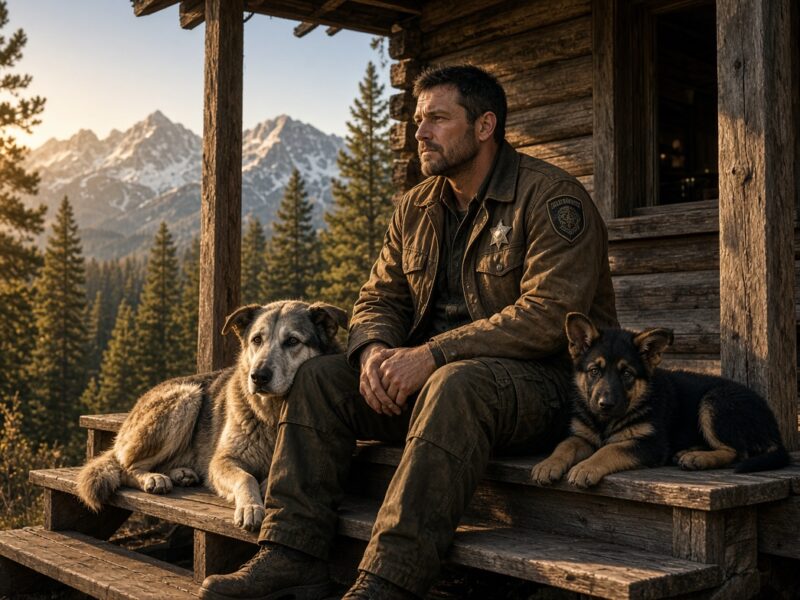
His Aging K9 Could Barely Walk — Then the Night Camera Caught the Old Dog Secretly Teaching a Lost Puppy
Deputy Graham Voss found the abandoned German Shepherd puppy curled beside a cold stove in a snowbound Wyoming cabin, too tired to bark and too weak to keep waiting.
He brought the puppy home for only a few days, never imagining what Ekko would mean to Bruno, his thirteen-year-old retired K9, whose failing legs had already ended a career built on loyalty and service.
During the day, Bruno kept his distance while Ekko quietly watched every move the old dog made.
But after midnight, Graham’s garage camera began recording something he was never meant to see.
Bruno returning to his old scent boxes, touching one with his nose, then waiting for Ekko to try.
The old K9 no longer had the strength to do the work himself.
Yet somehow he was still teaching the young dog what years of duty had taught him.
And just when Graham realized Ekko had given Bruno a reason to feel useful again, a call came from the people who had been searching for the puppy all along.
—
By the last week of January, winter had settled over western Wyoming with the kind of authority that made even familiar roads look temporary.
A blizzard had crossed the mountains during the night, burying fences, filling roadside ditches, and pushing hard-packed snow against the lower windows of houses outside Pinedale.
By dawn, the sky had cleared to a hard, pale blue, but the cold remained sharp enough to turn every breath white.
At 5:20 that morning, Deputy Graham Voss was already awake.
He did not need to be.
His shift would not begin for another two hours.
Still, his eyes opened at the same minute they had for most of the past eight years.
Graham lay still for a moment, listening.
The house was quiet except for the furnace and the faint scrape of claws somewhere beyond the bedroom.
That sound used to mean Bruno was waiting.
Ready.
Graham sat up.
At thirty-six, he had the solid build of a man who had spent years wearing body armor, a radio, and a duty belt rather than lifting weights for appearance.
His shoulders were broad, his movements economical.
Short, dark brown hair lay slightly flattened on one side from sleep, and a few days of stubble darkened a face made older by long winters and too many night shifts.
His gray-blue eyes went automatically toward the hallway.
Bruno stood there, or tried to.
The thirteen-year-old German Shepherd had once been almost ninety pounds of controlled strength, black saddle dark against warm tan legs, ears alert at the smallest change in Graham’s voice.
Now silver covered most of his muzzle, and his hindquarters had grown visibly thinner.
Bruno’s front legs came beneath him first.
His back legs took longer.
One rear paw dragged half an inch before finding purchase on the runner Graham had placed across the wooden floor.
Graham was already moving toward him.
Bruno looked up.
That look stopped him.
It was not anger.
Bruno had never needed much of that.
It was simply the old expression that meant, “Give me a second.”
Graham stayed where he was.
Bruno steadied himself and walked toward the kitchen.
“All right,” Graham murmured. “Your way.”
Six months earlier, a veterinary neurologist had given a name to what Graham had spent nearly a year pretending was ordinary age.
Degenerative myelopathy.
There was no dramatic injury.
No single morning when Bruno stopped being the dog he had been.
The change had arrived by inches.
A paw placed strangely on the pavement, a hesitation getting into the patrol vehicle, a rear leg that seemed slow after a long search.
Then came the day Bruno tried to jump into the K9 crate and could not get his hindquarters high enough.
Graham had lifted him in.
Neither of them had looked at the other afterward.
The sheriff’s office retired Bruno two weeks later.
Graham had responded the way he responded to most problems.
He changed the environment.
He installed a ramp from the porch to the yard.
He put non-slip runners across the hardwood.
He moved Bruno’s food and water closer to the living room.
He researched support harnesses, joint supplements, floor traction, sleeping positions.
He turned care into a list of tasks.
Lists were manageable.
Loss was not.
That morning, after feeding Bruno and swallowing half a cup of coffee, Graham buttoned his dark navy sheriff’s uniform.
His silver badge sat over his left chest, his VOSS nameplate over the right.
He clipped the radio microphone near his shoulder and fastened the black duty belt around his waist.
At the garage door, his hand went to the old K9 harness hanging from a wooden peg.
It happened before he thought about it.
His fingers closed around the worn strap.
For years, that had been the last thing he picked up before leaving the house.
Bruno would be waiting beside the door.
Graham would say, “Work.”
And Bruno’s entire posture would change.
This morning, the harness remained cold beneath his hand.
Graham let go through the doorway.
Bruno was already lowering himself onto the rug near the fireplace.
Graham looked away first.
There was one other thing he had not changed.
The K9 crate was still bolted into the rear of his patrol SUV.
Lieutenant Camille Ror had noticed.
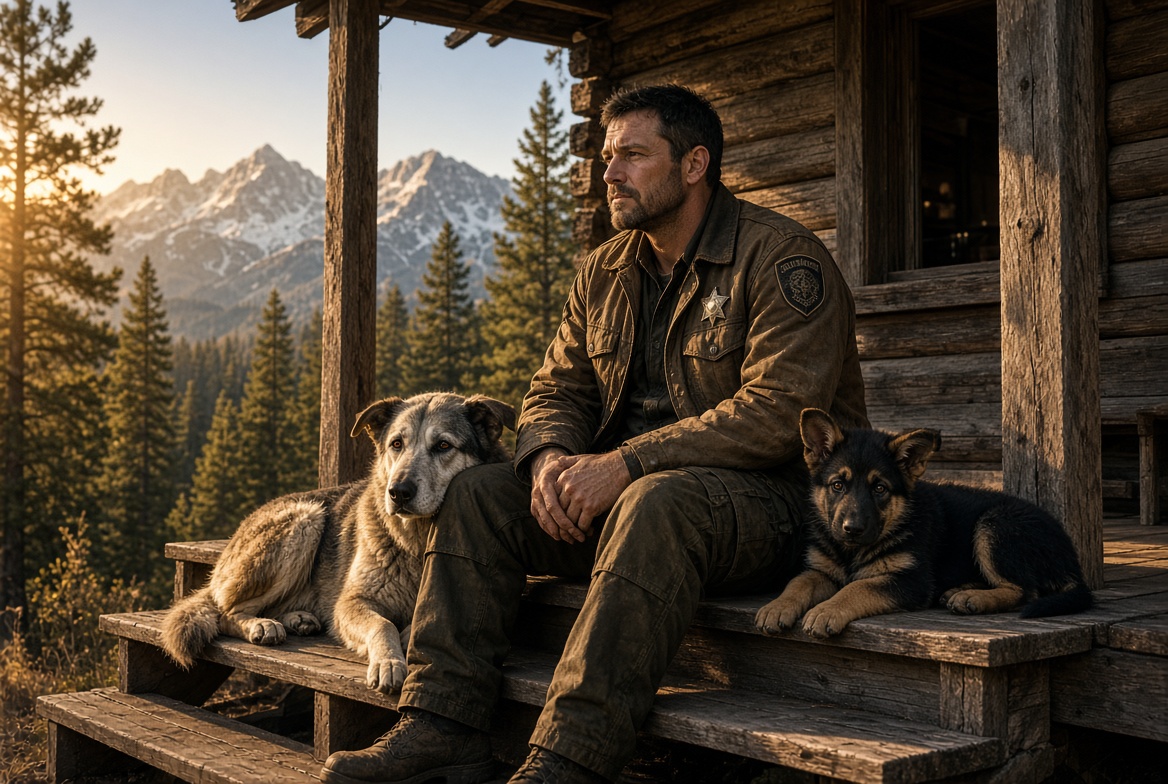
Of course, Camille noticed most things.
At forty-four, she supervised the department’s K9 program with the calm precision of someone who had handled working dogs long enough to understand that handlers were often harder to manage than the animals.
Three times since Bruno’s retirement, she had asked Graham whether he wanted to be considered for another dog.
Three times he had given her the same answer.
Not yet.
The last time, Camille had simply studied him across her office.
She had not mentioned the empty crate.
She had not mentioned that six months was a long time to leave equipment installed for a dog who would never use it again.
She had only said, “All right.”
That had somehow been worse because Graham knew she understood.
“Not yet” sounded temporary.
But temporary was easier to live with than finished.
—
Later that afternoon, Judith Bellamy appeared at Graham’s back door, carrying a covered plate in one hand and a paperback novel in the other.
She lived two hundred yards down the road in a small white house with a porch Walter Bellamy had built himself more than twenty years earlier.
Walter had been gone four years.
Judith still referred to the workshop as Walter’s shop and the chair beside her living room window as Walter’s chair.
She never said those things sadly.
She simply had no interest in pretending fifty-two years of marriage could be erased by changing vocabulary.
At seventy-nine, she was small without appearing fragile, silver-white hair cut neatly along her jaw and tortoiseshell glasses resting low on her nose.
She wore a cream cardigan beneath her winter coat and carried herself with the quiet independence of someone who disliked being fussed over.
Graham opened the door and looked at the plate.
“No.”
“You don’t even know what’s under the foil.”
“Chicken?”
Judith stepped past him.
“Then you’ve learned something from all those years in law enforcement.”
“Bruno’s on a diet.”
“Bruno is thirteen.”
“That’s not a medical exemption.”
Judith ignored him and went to the living room.
Bruno’s head lifted immediately.
That response always annoyed Graham a little.
He could open a refrigerator, call Bruno’s name, or bring home expensive veterinary food and receive mild interest.
Judith entered with contraband roast chicken and suddenly the retired K9 had purpose again.
She sat beside him instead of calling him over.
That was something she had learned quickly.
Bruno no longer liked crossing a room unless he had a reason.
Judith tore off a piece of chicken no larger than her thumbnail and held it beneath his nose.
Graham pointed at her.
“One.”
“Of course you said that last time.”
“And last time he survived.”
Bruno took the chicken with extraordinary care.
Judith scratched the fur beneath his jaw.
After a moment, Bruno shifted as though he wanted to rise.
Graham immediately stepped forward.
Judith lifted one hand.
“Give him a moment.”
Graham stopped.
Bruno pushed himself upright slowly.
His rear legs trembled, corrected, and held.
Then he walked three steps toward Judith’s chair and lowered himself beside her.
She rested her hand on his shoulder.
“There,” she said quietly.
Graham frowned.
“There? What?”
“He wanted to move.”
“I know.”
“No. You knew he might fall.”
Judith opened her book.
The words landed more gently than an accusation, which made them harder to dismiss.
Graham looked at Bruno.
He had spent months making sure the old dog never had to struggle.
Maybe he had also stopped allowing Bruno to decide when a struggle was worth making.
Judith turned a page.
“Taking care of someone isn’t the same thing as doing all their living for them.”
Graham reached for his coffee.
“You practice that speech?”
“No. Walter gave me plenty of material.”
For the first time that day, Graham almost smiled.
—
That evening, another front moved through the high country.
The worst of the blizzard had passed, but county crews were still reopening secondary roads and checking isolated structures where power had failed.
Shortly before sunset, Graham was sent north toward the Green River Lakes area to inspect several seasonal cabins and maintenance buildings that had been inaccessible since the storm.
He drove slowly.
Snowbanks rose higher than the hood in places, and the patrol SUV’s headlights swept across walls of white, broken only by lodgepole pines and the occasional reflector post.
Behind him, the empty K9 crate rattled faintly whenever the vehicle crossed frozen ruts.
Graham turned the radio louder.
It did not help.
By the time he reached the final maintenance spur, darkness had filled the valley.
The old cabin at the end of the road belonged to a seasonal trail crew.
One corner of the roof sagged beneath snow, and drifted powder had piled almost to the lower windows.
Graham parked and stepped out.
The cold hit immediately.
He zipped his dark navy winter jacket to his throat, adjusted the radio mic at his shoulder, and walked a slow perimeter with his flashlight.
No vehicle.
No fresh human tracks.
The lock on the outer storage shed was intact.
He checked the side window of the cabin.
Dark.
Empty.
He was already halfway back toward the SUV when he heard it.
A faint scrape.
Graham stopped.
Wind moved through the trees.
Nothing else.
Then it came again.
Scratch.
Pause.
Scratch.
Not from outside.
From inside the cabin.
Graham turned back.
He approached the door and knocked hard.
“Sublette County Sheriff’s Office.”
No answer.
Another faint sound came from behind the wood.
He tried the handle.
The door moved less than an inch before catching against something inside.
Graham pushed carefully.
A drift of snow spilled from the threshold.
His flashlight cut across an overturned chair, an empty shelf, a stack of firewood, and a small iron stove gone cold.
Then the beam stopped.
Two dark eyes reflected back at him.
A young German Shepherd lay curled beside the stove.
For half a second, neither moved.
The dog was perhaps eight months old, black and tan, long-legged, and still growing into his ears.
Snow had dried into pale crusts along the fur of his legs.
His body looked leaner than it should have been, but Graham saw no blood, no obvious wound, no sign that anyone had deliberately hurt him.
The dog did not bark.
He simply watched.
Graham lowered the flashlight.
“Hey.”
One ear shifted.
Graham crouched, keeping several feet between them.
“You picked a bad vacation spot.”
The young shepherd’s nose moved.
Graham removed one glove and held out his hand.
He did not advance.
After several seconds, the dog lifted his head.
Then slowly, he crawled forward.
His nose touched Graham’s fingers.
Cold. Dry.
Graham stayed still.
The dog smelled him again, then leaned forward just enough for his forehead to touch Graham’s palm.
Something tightened in Graham’s chest.
It was not affection yet, not even trust.
It was simply the recognition of an animal that had decided for one moment not to be alone.
Graham wrapped the dog in an emergency blanket from the patrol vehicle and lifted him carefully into the back.
For the first time in six months, the K9 crate was no longer empty.
—
At the sheriff’s office, animal control coordinator Mara Ellison met him near the side entrance.
Mara was forty-six, broad-shouldered, practical, with auburn hair tied low at the back of her neck and an orange rescue lead clipped to her utility belt.
She scanned the dog twice.
“No chip, no collar either.”
Mara checked his gums, then looked at Graham.
“Dehydrated, hungry, probably exhausted. Doesn’t look like he’s been out there long enough to go completely feral.”
“Someone’s missing him, probably.”
She photographed the dog, filed the found animal report, and began sending notices to area shelters, veterinary clinics, county offices, and regional lost pet groups.
Then she sighed.
“The temporary kennels are full.”
Graham knew where the conversation was going.
“No.”
Mara looked at him.
“I didn’t ask yet.”
“You were about to.”
She glanced toward the German Shepherd now sitting against Graham’s boot.
“Have you ever fostered?”
“No.”
“Congratulations, Mara. Official emergency foster. County documented. Until we find the owner or a kennel opens.”
Graham looked down.
The young shepherd looked up.
“Three days,” Graham said.
Mara smiled without warmth.
“Sure.”
—
When Graham finally reached home, Judith was sitting in the living room with Bruno.
She looked first at Graham, then at the German Shepherd beside him, then back at Graham.
“I assume there’s an explanation.”
“Temporary foster.”
“Of course.”
Bruno raised his head.
The young dog froze for several seconds.
The two German Shepherds simply watched each other.
Bruno pushed himself up slowly, carefully.
He walked toward his water bowl.
The younger shepherd watched every step, then followed.
Bruno stopped.
The young dog stopped.
Bruno turned his head toward Graham.
A beat later, the younger dog turned, too.
Judith covered a laugh with one hand.
Graham looked at her.
“What?”
“He copies him.”
“He’s nervous.”
Bruno took another step.
The young shepherd took one, too.
Judith’s expression softened like an echo.
Graham looked down at the dog.
The dog looked first at Bruno, then at him.
“Echo,” Judith said.
Outside, wind moved loose snow across the porch.
Inside, Bruno lowered himself beside the fireplace while the young German Shepherd remained a respectful few feet away.
Graham told himself the name was temporary, just like everything else.
But no one in the room corrected Judith, and by the end of the night, the dog had become Ekko.
—
Within four days, Ekko stopped looking like a dog who had survived a Wyoming blizzard.
His ribs were still easier to feel than Graham liked, but his appetite had returned with enough enthusiasm to make up for lost time.
He discovered that the refrigerator made promising sounds, that Graham’s boots carried interesting smells from places he was not allowed to visit, and that a half-open closet door existed primarily to be investigated.
The house changed around him.
Not dramatically.
Mostly through noise.
There was the quick tapping of young paws across the hallway, the metallic rattle of the temporary county tag Mara had attached to Ekko’s dark green collar, and the occasional thump of something Graham had been certain was too high for a dog to reach.
One morning, Graham walked into the kitchen and found Ekko standing with his front paws on the counter, examining a bag of coffee.
“Off.”
Ekko dropped immediately.
He sat, then looked pleased with himself.
Graham stared at him.
“That’s not how this works.”
From the living room, Bruno watched without lifting his head.
The contrast between the two dogs became impossible to miss.
Ekko moved as though every room might contain something he had not yet experienced.
Bruno moved only when he had decided the destination mattered.
Ekko crossed the same hallway twenty times in an hour.
Bruno could spend forty minutes considering whether the patch of sunlight near the porch was worth getting up for.
The younger dog learned quickly that enthusiasm did not impress the older one.
On the second evening, Ekko approached Bruno’s rug carrying a rope toy.
He stopped about two feet away and dropped it.
Bruno opened one amber eye.
Ekko nudged the rope toward him.
Bruno looked at the toy, then at Ekko.
Nothing else happened.
Ekko waited.
Bruno continued looking at him.
After perhaps five seconds, Ekko picked up the rope and backed away.
Graham, watching from the kitchen, almost laughed.
Bruno had once controlled suspects with nothing more than presence.
Apparently, the skill also worked on teenagers.
The old shepherd never growled at Ekko.
That surprised Graham.
He had expected irritation, perhaps territorial behavior, especially around food or the fireplace rug Bruno had claimed for more than a decade.
Instead, Bruno seemed to enforce boundaries with extraordinary economy.
If Ekko came too close while Bruno was resting, Bruno raised his head.
That was usually enough.
If Ekko ignored the first warning, Bruno turned his body slightly toward him.
Ekko would stop.
Within a week, he had learned to leave a narrow, invisible circle around the old dog.
It was not friendship, but it was an agreement.
Graham respected agreements.
He understood them better than affection.
—
His patrol schedule returned to normal as roads reopened after the storm.
During longer shifts, Judith came over around midday to let Ekko into the yard and check Bruno’s water.
Graham had given her a spare key years ago.
He had never formally asked her to look after the dogs.
Judith had never formally asked permission.
That arrangement suited them both.
When Graham returned one afternoon, he found her in his living room wearing her cream cardigan, tortoiseshell glasses low on her nose, reading a murder mystery with Bruno asleep beside her chair.
Ekko lay several feet away.
He was awake.
He was watching Judith turn pages.
“You know,” Graham said, removing his winter jacket, “most people would consider breaking into a deputy’s house a bad hobby.”
Judith did not look up.
“Most deputies don’t leave a key under my flower pot.”
“I gave you that key.”
“Then I suppose the case is weak.”
Ekko rose immediately when Graham entered.
Bruno lifted his head but stayed down.
Graham noticed the difference.
Once Bruno would have been standing at the door before the vehicle had fully stopped outside.
The thought came quickly.
Graham pushed it away just as quickly.
Judith closed the book.
“He had a good afternoon.”
“Bruno?”
“Both of them.”
She nodded toward Ekko.
“He finally stopped trying to smell every square inch of your kitchen. That’s progress.”
“He moved on to the laundry room.”
Graham sighed.
Judith smiled.
Ekko approached her and pressed his nose briefly against the sleeve of her cardigan.
He had already become familiar with the light floral scent she wore, the wool of her clothes, and the burgundy scarf she often left draped over the back of the chair.
Judith scratched beneath his chin.
Bruno watched.
Then Graham noticed something else.
When Judith stood to leave, Bruno pushed himself upright.
Ekko immediately stood too.
Judith reached the back door.
Bruno stopped several feet from it and looked at Graham.
Years of training had made the behavior automatic.
Doorways were thresholds.
Bruno had always waited for release rather than rushing through them.
Graham opened the door.
“Okay.”
Bruno stepped onto the porch.
Ekko took one quick step after him, then stopped.
No command, no leash correction.
He simply stopped where Bruno had stopped.
Graham looked down at him.
Ekko looked at Bruno, then back at Graham.
“Did you teach him that?” Judith asked.
“No.”
She gave Graham a sideways glance.
“Maybe someone did.”
Graham dismissed it.
“He’s copying.”
“That is generally one way of learning.”
“It doesn’t mean anything.”
Judith pulled on her gloves.
“I didn’t say it did.”
That answer stayed with him longer than it should have.
—
Over the following days, Ekko’s imitation became easier to notice.
When Bruno heard the sheriff’s radio on Graham’s kitchen counter, his ears shifted toward it without the rest of his body moving.
At first, every burst of static made Ekko jump up.
Then he began looking at Bruno before reacting.
If Bruno remained still, Ekko remained still.
When Graham gave Bruno a simple wait before setting down his food bowl, Ekko watched.
Two meals later, Ekko hesitated before his own bowl without being asked.
Not perfectly, not for long.
But he hesitated.
Graham told himself it was ordinary social learning.
A young dog adjusting to an older one.
Nothing mysterious.
Nothing worth thinking about.
The garage was another matter.
For almost eight years, part of it had belonged to Bruno.
Not officially.
There was a workbench, winter tools, two sets of tires, and shelving filled with things Graham intended to organize someday.
But along the lower wall were remnants of K9 work, a stack of training cones, an old tracking line, several ventilated scent boxes, small metal tins that had once held training odors, a reward ball with teeth marks pressed deep into the rubber.
Graham had removed most official equipment after Bruno retired.
The rest he simply stopped looking at.
Ekko found it immediately.
“Leave it.”
The young shepherd withdrew his nose from one of the boxes.
Graham moved them farther beneath the shelf.
The following morning, one sat several inches away from where he remembered placing it.
He blamed Ekko.
A day later, another box was turned sideways.
Again, Graham pushed it back.
He considered putting everything into storage.
He never did.
One Saturday afternoon, he was sorting through the lower shelf while Ekko wandered nearby.
Graham picked up one of the old scent tins.
It had been cleaned months ago, but another training tin sat inside the box beside it, holding a harmless scent sample he had once used during basic nosework drills.
The moment Graham lifted the container, Ekko stopped moving.
Graham noticed because stillness was not Ekko’s usual condition.
The young dog’s nose worked quickly.
He approached.
“Easy.”
Ekko sniffed Graham’s hand, then the box, then two adjacent containers.
He returned to the first one and touched it with his nose.
Graham froze.
Ekko pulled back, his ears tilted forward.
Graham looked at the container in his hand, then at Ekko.
Without thinking, he said the word he had said thousands of times during training.
“Good.”
Ekko’s tail struck the side of the workbench.
Graham reached into the treat pouch he had begun carrying for basic obedience and gave him a small piece.
Ekko swallowed it, then immediately returned to the boxes.
“No.”
Graham set the tin down.
“That was one time.”
Ekko stared at the shelf.
Graham stared at Ekko.
Something about the moment bothered him.
Not because it was impossible, but because the young dog had looked surprisingly deliberate.
Then Ekko sneezed, bumped a paint tray with his hip, and nearly frightened himself into the lawn mower.
Graham shook his head.
Eight months old.
That was the explanation.
Nothing more.
Still, that evening, he left one scent box on the floor instead of putting it back on the shelf.
He told himself he had simply forgotten.
—
Judith found it the next afternoon.
“What is this? Training box? For what?”
“Scent discrimination.”
Judith turned it over in her hands.
Ekko was already watching.
Graham took the box away from her.
“Don’t make this into something.”
“What am I making it into?”
“I know that look.”
“You’ve known me fifteen years and still think you know my looks.”
She removed one of her gloves.
Then, before Graham could stop her, she walked into the hallway and tucked it partly behind a low chair.
Ekko saw the entire thing.
“This isn’t scent work,” Graham said.
Judith returned.
“I didn’t claim professional standards.”
She looked at Ekko.
“Find my glove.”
Ekko trotted directly to the chair.
Judith laughed.
Graham crossed his arms.
“He watched you hide it.”
“Then he’s excellent at eyewitness testimony.”
She moved the glove again while Ekko was distracted by Graham opening a cabinet.
This time she tucked it behind a basket near the living room.
Ekko wandered for almost a minute.
He checked Judith first, then the chair, then the floor.
Eventually, his nose carried him toward the basket.
He pulled the glove free.
Judith praised him so enthusiastically that Ekko ran one victory lap around the coffee table.
Bruno remained on his rug, but his ears were forward.
That was all Graham noticed anyway.
—
A few days later, Dr. Lenora Finch came to examine Bruno at home.
Lenora had treated him for nearly nine years.
At fifty-one, she carried herself with the quiet patience of someone accustomed to animals that could not explain what hurt.
Dark blonde hair threaded with silver was tied loosely at the back of her neck, and a black stethoscope hung over her navy quilted jacket.
Bruno trusted her.
Not enough to enjoy thermometers, but enough.
Lenora watched him cross the living room.
His front legs remained strong.
The rear paws were slower, occasionally placing him perfectly before correcting.
She checked his reflexes, range of motion, muscle tone, and paws.
Then she watched Graham help Bruno turn.
“You didn’t need to do that,” she said.
“He was slipping.”
“He was adjusting.”
Graham straightened.
“I’m trying to keep him from getting hurt.”
“I know.”
There was no accusation in her voice.
That made Graham think of Judith again.
Lenora sat back on her heels.
“How much activity is he getting?”
“Out to the yard. Short walk if the ground’s good. No training.”
Graham shook his head.
“He can’t work.”
“I didn’t ask if he can work.”
Graham said nothing.
Lenora glanced toward the garage.
“Does he still like using his nose?”
“He always did.”
“Then let him.”
Graham frowned.
“Tracking?”
“No, not the way he used to. No rough terrain, no long distances, no repeated turns that force his rear end to compensate.”
She ran one hand gently along Bruno’s shoulder.
“But nosework doesn’t have to mean a mile through the woods. Put a scent tin ten feet away. Let him identify a box. Give him something mentally familiar without asking his body to do what it can’t do anymore.”
Graham looked at Bruno.
The old shepherd was watching Lenora’s medical bag, probably hoping something edible might emerge from it.
“His body is changing,” Lenora said. “His brain isn’t retired.”
The sentence landed somewhere Graham was not prepared to examine.
From the doorway came a small metallic click.
Ekko stood beside one of the scent boxes.
Graham had forgotten to move it.
The young shepherd lowered his nose to the vents, sniffed, then looked toward Bruno.
Bruno raised his head.
For several seconds, the room became strangely still.
Lenora watched the two dogs.
“So,” she said, “I see you’ve already started.”
“I haven’t.”
Ekko touched the box with his nose.
Graham almost corrected him.
Instead, he waited.
Bruno continued watching.
Ekko looked toward Graham as though expecting something.
Graham reached into his pocket.
A treat remained from the morning obedience session.
He tossed it gently.
“Good.”
Ekko caught it badly, dropped it, found it again, and ate it from the floor.
Lenora smiled.
Graham did not, but he also did not put the scent box away.
—
That night, Bruno slept beside the fireplace.
Ekko fell asleep near the hallway after exhausting himself trying to remove a tennis ball from beneath the sofa.
Graham stood in the garage before bed.
Two scent boxes sat slightly out of line beneath the shelf.
He stared at them.
For a moment, he tried to remember whether he had left them that way.
He couldn’t.
Graham straightened both boxes until their edges matched.
Then he switched off the light.
Behind him, somewhere inside the house, a collar tag made one soft metallic sound against the floor.
Graham closed the garage door.
By morning, one of the boxes would no longer be where he had left it.
—
Three weeks after Ekko came to Graham’s house, the worst of winter had loosened its grip on western Wyoming.
Not enough to trust it.
The roads between Pinedale and Jackson were open, but shaded stretches still held hard ribbons of ice, and snow remained piled along the shoulders in dirty white walls.
Graham checked the forecast twice before dawn, then checked it again while Judith climbed into his truck.
“You know, they invented weather reports so people wouldn’t have to stare at the sky themselves,” she said.
Graham closed her door.
“I don’t trust people who predict Wyoming.”
Judith adjusted the burgundy scarf at her neck.
“That sounds exhausting.”
“It is.”
She smiled and looked out the window.
Graham had traded shifts to drive her to an outpatient clinic in Jackson for a scheduled examination.
Judith had insisted she could arrange transportation herself.
Graham had responded by arriving at her house twenty minutes early.
Neither mentioned the disagreement again.
Ekko rode in the back, secured in his forest green harness.
Bruno had stayed home.
Long trips were becoming harder on him, and Judith had promised to return before dark to sit with him a while.
Ekko pressed his nose briefly against the window, fogging a small circle in the glass before settling down.
Judith reached beneath her scarf and touched the silver locket resting against her blouse.
Graham had seen it hundreds of times.
He had never asked much about it.
Judith was not secretive, but some objects seemed to come with an understanding that questions should be invited.
That morning, she volunteered the story.
“Walter gave me this on my seventy-fifth birthday.”
Graham glanced over.
The oval locket was small, no larger than a quarter, its silver edges softened by years of handling.
“Last birthday before he died.”
Judith nodded.
“He claimed he had picked it out himself.”
“You don’t believe him?”
“I was married to that man for fifty-two years. Walter couldn’t pick a Christmas card without asking three store employees.”
Graham smiled.
Judith opened the locket.
Inside was a faded photograph of Walter standing beside an old green pickup, one hand on the hood, and a ridiculous wide-brim fishing hat on his head.
“The truck broke down forty miles outside Cody two hours after that picture.”
“Good memory.”
“It was not good at the time.”
She closed the locket carefully.
“Funny how inconvenience improves with age.”
Graham understood more than he said.
Some memories became valuable precisely because there would never be another chance to be annoyed by the person inside them.
—
At the clinic, Ekko remained in the truck while Graham walked Judith inside.
The building was warm and overly bright, filled with the quiet sounds of rolling carts, low conversations, and shoes crossing polished floors.
Before one portion of the examination, a nurse asked Judith to remove her jewelry.
Judith hesitated only briefly before lifting the chain over her head.
The nurse handed her a small cream-colored cloth pouch.
“You can keep it with your coat,” she said.
Judith slipped the locket inside, folded the drawstring over once, and tucked the pouch into the deep right pocket of her navy wool coat.
Graham saw her do it.
That detail would matter later.
At the time, it meant nothing.
The appointment took longer than expected.
By the time they left Jackson, afternoon light had flattened across the snow fields.
Graham stopped once at a roadside coffee stand near the clinic district.
Judith stayed in the truck while he walked to the window.
Later, they stopped at a turnout because Ekko had become restless.
Judith stepped out with him for less than five minutes, walking slowly along a cleared section of pavement while Graham checked a message from dispatch.
Then they continued toward Pinedale.
Nothing felt unusual.
Nothing felt important.
That was how most losses began.
Not with a warning.
With an ordinary minute no one thought to remember.
When Graham pulled into Judith’s driveway, she gathered her gloves, handbag, and scarf.
Then she stopped.
Her right hand went into her coat pocket.
She checked the left, then the right again.
Graham had already opened his door when he noticed her expression.
“What?”
Judith did not answer.
She searched her handbag, then both coat pockets again.
The movements became quicker.
“The pouch.”
Graham got back into the truck.
“What pouch?”
“My locket.”
He remembered immediately.
“The one from the clinic.”
Judith nodded.
Her fingers were already shaking.
Graham searched beneath the seats.
Ekko stood in the back, watching the sudden movement.
They emptied Judith’s handbag onto the center console.
Wallet, tissues, a pair of reading glasses, two peppermints, a receipt.
No pouch.
Graham checked the truck floor, door pockets, seat rails beneath the rubber mats.
Nothing.
Judith sat very still.
“Call the clinic,” Graham said.
She did.
The front desk checked the examination room.
Nothing had been turned in.
A nurse walked the hallway where Judith had changed.
No pouch.
Security said someone could review the lobby camera in the morning, but the footage would not show inside her pockets.
Graham looked at the darkening road.
“We’ll go back tonight if we need to.”
Judith stared at him.
The drive to Jackson would put them back on icy roads after dark.
For several seconds, Graham could see the argument forming in her.
Then she closed her eyes.
“No. We can know, Graham.”
Her voice was quiet.
“We go tomorrow.”
It was one of the few times he obeyed her immediately.
—
The next morning, they returned shortly after the clinic opened.
Ekko came with them again.
Graham brought him partly because Judith had asked, partly because the young shepherd had begun to become restless when left alone too long.
Mostly, Graham did not think about the decision.
At the clinic, the staff helped willingly.
The examination room was searched again.
So was the restroom, the waiting area, the hallway, and the lost and found drawer.
A maintenance worker checked beneath benches and around the entry vestibule.
Nothing.
Security showed Graham a portion of the entrance footage.
Judith could be seen leaving at 12:46 p.m., buttoning her coat against the wind.
There was no way to tell whether the pouch was still inside the pocket.
They searched the truck again, then the parking lot, then the sidewalk between the clinic and the curb.
Graham walked every section Judith remembered.
Ekko waited beside the truck on leash while Judith stood near the entrance with her arms folded tightly against the cold.
Two hours passed, then three.
The problem was no longer where to look.
The problem was that the number of possible places had become too large.
The clinic, the parking lot, the coffee stand, the turnout, the gas station where Graham had briefly stopped on the way home, the road shoulders between them.
Judith grew quieter with every failed search.
By early afternoon, Graham found her sitting on a low concrete wall outside the clinic.
She held her gloves in her lap.
For once, she did not complain about the cold.
Graham stood beside her.
“We haven’t checked everything.”
Judith looked toward the snowbank at the edge of the lot.
“Walter is still dead.”
Graham said nothing.
“I know that sounds obvious.”
“It does.”
She gave him a tired look.
“I’m trying to make a point.”
“I know.”
Judith rubbed her thumb across the seam of one glove.
“The locket doesn’t bring him back. It doesn’t change anything important.”
Graham studied her face.
He had heard versions of that sentence from people after house fires, after burglaries, after accidents.
It was only property.
It was replaceable.
It did not matter.
People often said those things when the opposite was true.
“You don’t have to make it unimportant just because it can’t be replaced.”
Judith turned toward him.
For a moment, the humor left her face entirely.
Graham continued, “You can know Walter’s gone and still want what he gave you.”
Her eyes rimmed.
She looked away before tears could gather properly.
“That was almost emotionally intelligent.”
“Don’t tell anyone.”
A small laugh escaped her.
It did not solve anything, but it changed the air enough for Graham to think again.
Ekko was standing beside the truck, not pulling, not pacing, just watching them.
Graham remembered the garage, the scent boxes, Judith’s glove, the way Ekko had moved differently when he was using his nose with purpose.
It was a bad idea, or perhaps just an unproven one.
He walked to the truck and opened the rear door.
Judith followed.
“What are you doing?”
“Trying something with Ekko.”
“Maybe he’s not trained.”
“I know.”
Graham took Judith’s burgundy scarf from the rear seat.
She had removed it earlier when the sun came out.
He crouched beside Ekko and let him investigate the wool.
The young shepherd knew the scent well.
Judith wore the scarf often.
He sniffed it once, then looked at Graham as though waiting for the next part of a game he did not understand.
Graham clipped a long line to Ekko’s harness.
“This isn’t a search dog deployment,” he told Judith.
“I gathered that from the lack of helicopters.”
“I’m serious.”
“So am I.”
Graham pointed toward the clinic entrance.
“We keep it small. Only places you definitely walked yesterday. If he gets distracted or stressed, we stop.”
Judith nodded.
They began near the clinic doors.
At first, Ekko was terrible.
He sniffed a trash can, a patch of salt, a tire.
He tried to greet an elderly man carrying a paper bag.
Graham reset him.
Back to the scarf.
Back to the starting point.
“Easy.”
Ekko lowered his nose again.
This time he moved more slowly across the sidewalk toward the curb.
Then sideways into the parking area.
He lost whatever interested him and circled back.
Graham did not pretend the dog knew what he was doing.
He simply gave him time.
The search became less about hope and more about method.
Ten yards.
Reset.
Another section.
Reset.
Judith followed quietly.
Near the area where Graham had parked the previous day, Ekko became interested in a path leading toward the drop-off lane.
He pulled harder, then lost it.
Graham brought him back.
They repeated the section.
Ekko went farther this time, past a bench around the corner of the curb, toward a snowbank built up along a shallow drainage channel.
Then he walked straight past it.
Graham exhaled.
Ekko stopped six feet away.
Turned.
Returned to the same place.
His body changed.
Not dramatically.
His tail lowered.
His movements became tighter.
He sniffed the packed snow along the edge of the drainage grate, then moved away again.
Judith whispered, “What is he doing?”
“I don’t know.”
Ekko returned a third time.
This time, he pawed once at the snow.
Graham moved closer but did not touch him.
“Go ahead.”
Ekko scraped again.
A thin layer of gray-white snow broke apart.
Something cream-colored appeared beneath it.
Judith made a sound Graham had never heard from her before.
Not quite a gasp, not quite his name.
Ekko pushed his nose into the snow and pulled free a small cloth pouch.
For half a second, Graham simply stared.
Then he took it gently from Ekko’s mouth.
The fabric was wet and cold.
He loosened the drawstring.
Silver flashed inside.
Judith covered her mouth.
Graham placed the locket in her hand.
She opened it immediately.
Walter was still standing beside the green pickup, still wearing the ridiculous fishing hat.
Judith sank onto the curb.
Ekko stepped toward her.
She wrapped both arms around his neck.
The young shepherd stiffened in surprise, then settled.
Judith pressed her cheek against the fur behind his ear.
Her shoulders moved once, then again.
She did not make a sound.
Graham looked away long enough to give her the privacy of pretending he had not noticed.
When he looked back, Ekko was still standing completely still.
No jumping, no pulling, no demand for a reward.
Judith finally released him and wiped beneath her glasses.
“You found it,” she whispered.
Ekko licked the end of her glove.
Graham should have felt only relief.
Mostly he did.
But as he rewound the last hour in his head, something refused to settle.
Ekko had made mistakes.
Plenty of them.
But near the snowbank, he had changed.
Focused.
Returned after passing the spot.
Worked the same small area until he found the source.
Graham knew what inexperienced dogs looked like when they stumbled onto something by accident.
He also knew what trained behavior looked like.
This had been somewhere between the two.
On the drive home, Judith kept the locket closed inside both hands.
Ekko slept in the back seat, exhausted by the search.
Graham drove in silence.
He thought about the scent boxes in the garage, the ones that never seemed to stay exactly where he left them.
Ekko had never attended a tracking class.
He had never worked a formal scent trail with Graham.
And yet, when the task had finally mattered, the young shepherd had known enough to keep searching.
Graham glanced at him in the rearview mirror.
Ekko was asleep with one ear folded beneath his head.
Graham looked back at the road.
Someone or something had taught that dog more than he realized, and it hadn’t been him.
—
Graham did not sleep much that night.
Judith had gone home with the locket around her neck again, tucked beneath her coat as if she no longer trusted pockets.
Ekko had eaten, paced the hallway twice, and eventually collapsed near the end of the couch.
Bruno slept by the fireplace.
The house was quiet.
Graham was not.
Every time he closed his eyes, he saw Ekko working the edge of the snowbank.
Not the moment he found the pouch.
The moments before it.
The young shepherd had passed the spot once, lost interest, then come back.
He had narrowed his search without being told.
His nose had stayed low.
His movements had become deliberate.
None of it had been polished.
A trained tracking dog would have worked more cleanly.
But it had been organized enough to bother Graham.
At 12:47 a.m., he gave up on sleep.
He pulled on jeans, a gray thermal shirt, and the brown work jacket hanging by the kitchen door.
Ekko lifted his head.
“Stay.”
The puppy settled again.
Bruno did not move.
Graham stepped into the garage and closed the door behind him.
Cold lingered in the concrete even though the space was insulated.
The overhead light cast long shadows beneath the workbench.
The scent boxes sat where he had left them.
Almost.
One was angled slightly away from the wall.
Graham stared at it, then looked toward the small security camera mounted above the interior garage door.
He had installed it years earlier after tools were stolen from a neighbor’s shed.
It recorded whenever motion triggered the sensor and stored the clips automatically.
Most of the footage was useless.
Graham walking through, Judith borrowing a snow shovel, Ekko wandering in behind someone, Bruno crossing from the mudroom to the porch ramp.
He opened the camera application on his phone.
The timeline stretched back three weeks.
Graham began scrolling.
The first useful clip was from eleven days earlier.
1:14 a.m.
The garage appeared in grainy black-and-white infrared.
For several seconds, nothing moved.
Then Bruno entered.
Graham leaned closer to the screen.
The old German Shepherd moved differently when no one was watching.
Not better, not younger, just without Graham hovering three feet away.
Bruno crossed the rubber runner near the door, stopped, adjusted his hind legs, and continued toward the lower shelf.
There were three scent boxes on the floor.
Graham remembered leaving them there after sorting equipment.
Bruno approached the first, sniffed, moved to the second, paused, then the third.
His nose touched the ventilation holes.
Bruno stopped there.
Ekko appeared from the edge of the frame.
The younger shepherd stood behind him.
Bruno glanced back.
Ekko came closer.
He sniffed the first box, then the second.
He chose the wrong one.
Nothing happened.
Bruno did not correct him, did not bark, did not nudge him away.
He simply returned to the third box, sniffed it again, touched it with his nose.
Ekko watched, then stepped forward and did the same.
The clip ended.
Graham remained perfectly still.
He replayed it, then again.
On the third viewing, he noticed something small.
After Ekko touched the correct box, Bruno turned toward the house.
The movement was slow.
Matter of fact.
As though whatever had needed doing was finished.
Graham checked another night, then another.
Not every evening contained something useful.
Some clips showed nothing but Ekko wandering through the garage after Graham forgot to close the mudroom door completely.
One showed Bruno stopping halfway to the boxes, deciding against the effort and turning back.
Another showed Ekko knocking over a plastic container and fleeing from the sound.
Graham almost laughed.
Then he found the second real session.
Bruno moved toward four containers.
Ekko followed.
This time the puppy checked each one too quickly.
Bruno stayed at the correct box.
Ekko went past, returned, sniffed again, corrected himself.
A third video showed Bruno making no effort to stand at all.
He remained lying near the wall while Ekko moved between two boxes.
When Ekko became distracted by a dropped glove, Bruno lifted his head and looked toward one particular container.
Ekko eventually followed the direction of his attention.
Graham paused the video.
The old dog’s body had done almost nothing.
His experience had that distinction.
It sat heavily in the room.
By 2:30 a.m., Graham had found six clips spread across nearly three weeks.
Six.
Not nightly lessons, not secret training sessions organized like a human instructor, just repeated fragments of behavior, old habits, scent work that had lived so deeply in Bruno’s life that even retirement had not erased it.
Ekko had simply been there to watch.
Graham lowered the phone.
For months, he had measured Bruno against memory.
Could he still jump into the SUV?
No.
Could he cover rough terrain?
No.
Could he hold a perimeter for hours?
No.
Could he run a track through snow, rock, sagebrush, and creek beds?
No.
Each answer had felt like losing another piece of him.
But Graham had never made the opposite list.
Could Bruno still distinguish scent?
Yes.
Could he still recognize a pattern?
Yes.
Could he still wait?
Yes.
Could he still observe?
Yes.
Could he still influence another dog without chasing, commanding, or dominating him?
Apparently.
Graham sat down on an overturned bucket.
He felt ashamed, though he could not have explained exactly why.
He had spent six months trying to protect Bruno from becoming less than he had been.
In doing so, Graham had nearly reduced him to the very thing he feared.
A dog defined entirely by decline.
The garage door opened behind him.
Graham turned.
Bruno stood in the doorway.
Ekko was several feet behind him.
“You two have terrible timing.”
Ekko came forward immediately.
Bruno remained where he was.
Graham looked at the scent boxes, then at Bruno.
For once, he did not go to help him.
Bruno took one step, then another.
His rear paws placed carefully on the rubber mat.
He reached the nearest box and sniffed it.
Nothing happened.
No dramatic recognition.
No miraculous return to working form.
After a few seconds, Bruno lost interest and lowered himself onto the mat.
Ekko sat nearby.
Graham looked from one dog to the other.
“You’ve been doing this without me.”
Bruno yawned.
That response somehow helped.
—
The next morning, Graham called Lenora Finch.
He expected a lecture.
Instead, she listened.
“You’re sure he wasn’t overexerting himself?”
“No. Some clips he barely moved. And afterward, no pain that I noticed. No unusual fatigue.”
Lenora was quiet for a moment.
“Then don’t stop him just because it looks like work.”
Graham leaned against the kitchen counter.
“He’s got DM.”
“I’m aware. You told me not to push him.”
“I told you not to push his body beyond what it can do.”
Lenora’s voice softened.
“That doesn’t mean his world has to shrink to a bed, a bowl, and the backyard.”
Graham looked toward the living room.
Bruno was awake.
Ekko lay several feet away, chewing one corner of a rubber toy.
“What would you allow?”
“Short sessions, flat surface, good traction, no fast turns, no long searches. Let Bruno choose whether he participates. And if he doesn’t, then he doesn’t. Simple.”
It should have been obvious for Graham.
It was not.
He had always understood K9 work as structure, command, response, reward, repeat.
This would require something harder.
Restraint.
—
That afternoon, he changed the garage.
Not much.
He rolled out two additional non-slip mats, moved the scent boxes from beneath the shelf, cleared a path wide enough that Bruno would never need to turn sharply.
He placed three boxes several feet apart.
Ekko watched the entire process with embarrassing enthusiasm.
Bruno slept through most of it.
Graham almost woke him, then stopped himself.
That was the point.
An hour later, Bruno entered the garage on his own.
Graham was sitting on the floor beside Ekko.
He did not give a command.
Bruno sniffed the air, walked to the first box.
Nothing.
Second, nothing.
Third.
He paused.
Ekko stood.
“Easy,” Graham said softly.
The puppy waited.
Bruno touched the third box with his nose.
Graham felt an old response rise automatically.
Praise, reward, the rhythm of thousands of training repetitions.
But this was not a certification drill.
He let Bruno finish, then quietly placed a small treat on the mat near him.
Ekko checked the first box.
Wrong.
Then the second.
Wrong again.
The third.
His nose stayed there.
“Good.”
Ekko spun toward Graham so quickly his rear paws slipped.
Bruno looked offended.
Graham laughed.
It surprised him.
Not because anything was funny, because the sound had not belonged in the garage for months.
—
Judith joined them two days later.
She arrived carrying her paperback novel, a container of soup, and the burgundy scarf Graham now considered unofficial training equipment.
“I assume I’m being invited here for professional reasons.”
“You’re hiding something.”
“Ah, law enforcement finally recognizes my talents.”
Graham handed her a clean scent tin.
She walked into the garage and hid it behind a low storage bin while Ekko waited inside the house.
Bruno remained on his mat.
He showed no interest.
Ekko came in, searched, missed the tin twice, checked Judith’s boots, investigated a cardboard box, then returned to the storage bin.
He found the tin.
Judith praised him.
Bruno still did not move.
Graham noticed his first impulse was disappointment.
Then he caught himself.
Bruno had not volunteered.
That mattered more than Graham’s plan.
They reset.
On the second round, Bruno remained lying down.
Ekko searched alone.
On the third, Ekko became confused near two identical boxes and stopped.
Bruno lifted his head.
Nothing more.
Ekko looked toward him.
Bruno stood.
It took effort.
Graham kept his hands at his sides.
The old dog walked to one of the boxes and touched it.
Ekko approached, sniffed, then touched the same one.
Judith looked at Graham.
Neither spoke.
There was no need.
The moment did not feel like Bruno was training a replacement.
It felt smaller than that.
And because it was smaller, it felt more honest.
Bruno still knew something.
Ekko still wanted to learn.
And Graham finally had learned how not to stand between them.
—
The sessions remained short.
Five minutes, sometimes less.
Some days Bruno participated.
Some days he slept through them.
Some days he watched from the doorway and never crossed the threshold.
Graham stopped measuring success by whether Bruno worked.
He measured it by whether Bruno had been given the choice.
That change spread beyond the garage.
When Bruno paused before the porch ramp, Graham waited longer before helping.
When the old dog chose the sunny patch beyond the kitchen instead of his usual rug, Graham let him take the extra steps.
When Bruno tired halfway across the yard, Graham supported him without pretending the walk had been a mistake.
The difference was subtle, but Judith noticed.
“So,” she said one afternoon, “you finally stopped managing him.”
Graham glanced at her.
“I still manage him.”
“You know what I mean.”
Unfortunately, he did.
—
A week after Judith’s locket was found, Graham stood in the garage watching Ekko work through three boxes while Bruno rested near the wall.
Ekko checked one.
Wrong.
Two.
Wrong.
He stopped, looked back.
Bruno did not move.
Ekko returned to the first box, sniffed longer this time, then went to the third.
Correct.
“Good.”
Ekko hurried toward Graham for his reward.
Bruno’s tail struck the mat once.
That was all.
Graham smiled.
His phone rang.
Mara Ellison.
He answered without looking away from the dogs.
“Voss.”
Mara did not waste time.
“We matched the found dog report.”
Graham straightened.
Ekko was still waiting for his treat.
“What do you mean?”
“A couple from Boulder saw the posting. They think Ekko was theirs.”
The garage suddenly felt smaller.
Graham looked at the young shepherd, then at Bruno.
Neither dog knew anything had changed.
Mara continued, “They have photos, veterinary records, and purchase documents. I’m setting up verification.”
Graham said nothing for several seconds.
Then he looked down at the treat still in his hand.
“Okay.”
It was the only answer he had.
But for the first time since Ekko entered his house, the word temporary no longer felt harmless.
—
Two days after Mara’s call, Graham stood in the sheriff’s office parking lot with one hand resting on Ekko’s leash and wished for the first time that verification took longer.
The morning was cold but clear.
Bruno had stayed home with Judith.
Ekko seemed unaware that anything about the day was unusual.
He had spent the drive watching passing snowbanks through the rear window, occasionally turning toward Graham whenever the truck slowed.
Mara Ellison waited near the animal control entrance with a black clipboard tucked beneath one arm.
“They’re ten minutes out,” she said.
Graham nodded.
“Everything checked so far.”
Mara glanced at Ekko.
“Photos match. Age matches. Veterinary records match. They also have the breeder paperwork.”
Graham looked down at the dog.
Ekko was sniffing a patch of salted pavement.
“Okay.”
Mara studied him for a moment.
“You don’t sound surprised.”
“I’m not.”
“That’s not what I meant.”
Graham ignored her.
A silver pickup pulled into the lot several minutes later.
The man who stepped out first was in his early sixties, lean, with a short salt-and-pepper haircut and a gray beard kept close to his jaw.
He moved carefully on his left knee, but with the stubborn posture of someone who disliked having that noticed.
The woman beside him wore a navy quilted coat over a soft gray sweater.
Her blonde-gray hair fell just past her jaw, and before the passenger door had fully closed, her eyes were already searching the lot.
Ekko saw her.
Everything in him stopped.
His ears rose.
His body went still.
Beth Larkin covered her mouth with one hand.
“Oh God.”
Ekko pulled once, hard.
Graham barely had time to loosen the lead before the young shepherd launched forward.
Beth dropped to her knees.
Ekko reached her and pressed himself against her chest so completely that she nearly lost her balance.
She wrapped both arms around him.
“Hey, baby. Hey. Hey.”
Her voice broke on the second word.
“Echo.”
It was the first time Graham had heard that particular sound from him.
Not fear.
Recognition.
Howard Larkin came around the truck more slowly.
He stopped several feet away.
His face had gone pale.
“Milo.”
Ekko’s head snapped around.
For a second, Graham felt something inside him drop.
Milo.
The dog left Beth and ran to Howard.
Howard crouched as far as his knee allowed and buried both hands in the fur along Ekko’s neck.
“You idiot,” he whispered, his eyes filled immediately. “You absolute idiot.”
Ekko licked his beard.
Howard laughed and wiped his face with the back of one hand.
Graham looked away.
He had not expected doubt.
Still, some part of him had kept a small space open for it.
A paperwork error, a similar dog, a coincidental photograph, anything.
That space disappeared in less than thirty seconds.
Mara gave the reunion time before inviting everyone inside.
The records were reviewed again.
Vaccination dates.
Purchase agreement.
A photograph of Ekko, Milo, then at four months old, sleeping beneath Beth’s kitchen table.
Another at six months with Howard holding a green rubber ball.
A veterinarian near Boulder confirmed the file by phone.
There was no question.
Ekko belonged to them.
Graham sat across the table and answered only what Mara asked.
Where the dog had been found, his physical condition at intake, how long he had stayed at Graham’s home, whether he had received veterinary treatment.
He did not mention Judith’s locket.
He did not mention Bruno.
He did not mention the garage.
Those things felt irrelevant now.
When Mara stepped out to make copies, Howard rested his hands on the table.
“We owe you more than thanks.”
“You don’t owe me anything.”
“We thought he was dead.”
Graham said nothing.
Howard looked toward Ekko, who was lying against Beth’s boots.
The dog seemed divided between exhaustion and happiness.
“We were coming up from Boulder,” Howard said. “Had a cabin rented north of Pinedale. Storm came in faster than forecast.”
Beth looked at the floor.
“We should never have kept driving.”
“Road wasn’t closed yet,” Howard said gently.
“That doesn’t mean we should have been there.”
He turned back to Graham.
“We pulled into a turnout when visibility went bad. Tow operator stopped because we were starting to drift sideways.”
The memory was clearly well rehearsed, though probably not because Howard enjoyed telling it.
They were moving us into another vehicle when a compressor kicked on behind the truck.
Wind hit at the same time.
Milo panicked.
Beth’s hand tightened around Ekko’s collar.
“We had his normal leash packed with the luggage. Howard was using a backup.”
“The clasp held,” Howard said. “My hand didn’t.”
There was no excuse in his voice.
Only fact.
“By the time I got across the road, he was in the trees.”
They searched until county crews ordered everyone out.
Howard returned the next morning.
Then again, after the road reopened.
They placed reports with shelters and veterinary clinics, posted in regional groups, called animal services in surrounding counties.
But the last person who thought they saw Ekko had placed him south of the turnout.
So that was where most of the search went.
Ekko had apparently moved north through timber, across open ground, eventually reaching the abandoned maintenance cabin where Graham found him.
A volunteer comparing regional posts had finally connected Mara’s found dog notice with Beth’s older lost dog post.
“Three weeks,” Beth said.
She ran a hand down Ekko’s back.
“I woke up every morning thinking maybe that would be the day someone called.”
Graham knew the sentence was not meant for him.
Still, he felt it.
Because in three weeks, the dog lying against Beth’s boots had stopped feeling temporary inside his house.
Mara returned and set the completed verification file on the table.
“Everything is in order.”
Graham nodded once.
“Then we arrange return.”
Beth looked up.
Howard did too.
There was something in their faces Graham had not expected.
Not reluctance exactly.
Something less simple.
Howard rubbed his palm along one knee.
“There’s something we should probably tell you before we load him into the truck.”
Graham waited.
Howard looked at Beth.
She nodded.
“We were already working with a trainer before Milo got lost,” he said.
Graham’s attention sharpened.
“For obedience.”
“Started that way,” Beth exhaled. “He was too much dog for us.”
Her hand immediately moved to Ekko’s shoulder as if the sentence required an apology.
“Not bad. Never bad.”
Howard shook his head.
“Just always on. Doors, sounds outside, objects moving, games that lasted forever unless someone deliberately ended them.”
Ekko could learn a command in days and then invent six ways around it if he became bored.
The trainer had described him as a dog with unusually high working drive.
“He needed structure,” Howard said. “Real structure, not just two walks and throwing a ball.”
Graham looked at Ekko.
None of that surprised him.
Beth continued.
“We love him.”
Her voice became firmer.
“I need you to understand that.”
“I do.”
“But love doesn’t turn us into younger people.”
Howard gave a dry smile.
“I’m sixty-three with one knee held together mostly by optimism.”
Beth looked at him.
“You complain more than the knee does.”
“That too.”
For a moment, the tension eased.
Then Howard became serious again.
“We had already started asking whether we were the right home.”
Graham felt the thought forming and shut it down before it reached his face.
This was not permission.
Not yet.
He leaned back.
“What did the trainer recommend?”
“A working home. Sport home. Search program. Someone experienced with shepherds.”
“We hadn’t decided,” Beth said. “Then he disappeared. After that, every doubt had felt shameful. How could we question keeping a dog we were desperate to find?”
So they stopped discussing it until now.
Graham looked from Howard to Beth, then at Ekko.
There were several things he could have said.
He could have told them about the locket, about the scent boxes, about how Ekko adjusted his speed around Bruno, about the way the dog had learned the household in three weeks.
He could have made a case.
He did not.
“If you take him home,” Graham said, “I’ll help. However I can.”
Beth studied him.
“And if we decide we can’t give him what he needs?”
Graham held her gaze.
“That decision belongs to you.”
Howard seemed surprised.
“You’re not going to tell us what you think?”
“You found him.”
“No,” Howard said. “You found him.”
That distinction remained between them.
—
In the end, Howard and Beth did not take Ekko home that afternoon.
Not because Mara prevented them.
Not because Graham asked.
They wanted one more conversation with the trainer who had evaluated him before the storm.
Mara suggested they also take twenty-four hours to discuss whether returning immediately made sense after three weeks of disruption.
They agreed to come back the following weekend.
Six days.
Beth stood near the truck before leaving and knelt once more beside Ekko.
“We’re coming back.”
Ekko pressed his nose against her chin.
Howard handed Graham a phone number written on the back of an old receipt.
“In case something changes.”
Graham folded it once and placed it in his pocket.
“Nothing will.”
Howard looked at him.
“Things change.”
Then they drove away.
Ekko watched the truck until it disappeared.
Graham expected him to whine.
He did not.
He simply stood beside Graham for a while, then turned toward the building.
That somehow hurt more.
—
Back at the house, Bruno was asleep when they arrived.
Judith sat in her usual chair with a cup of tea balanced on the side table.
She took one look at Graham and asked, “They were real?”
“Yes.”
Ekko answered behind him.
Judith’s gaze dropped toward the dog.
“And they’re coming back Saturday.”
Graham removed Ekko’s leash.
He hung it on the hook nearest the door, then after a second moved it to a different hook.
Judith noticed.
She said nothing.
The next several days developed an uncomfortable precision.
Graham stopped calling Ekko onto the couch in the evening.
When Ekko followed him toward the garage, Graham sometimes closed the door before the dog reached it.
Training sessions became shorter.
He told himself that was sensible.
There was no point making separation harder.
Ekko responded by staying nearer.
If Graham moved into the kitchen, Ekko followed.
If Graham stood on the porch, Ekko settled near the door.
Graham began giving him fewer reasons to follow.
Judith watched the pattern for two days before finally interrupting it.
Graham was washing a coffee cup when she said, “You’re rehearsing.”
He glanced over.
“For what?”
“Losing him.”
“I’m not losing him.”
“No, he has owners.”
Judith looked toward Ekko, asleep near Bruno’s rug.
“So you’ve decided to leave before he does.”
Graham set the cup down.
“That’s not what I’m doing.”
“It is exactly what you’re doing.”
“He’s not my dog.”
Judith was quiet.
Graham wished she would argue.
Instead, she looked at Bruno.
The old shepherd was awake now.
His amber eyes followed Ekko as the younger dog stretched and moved to another patch of floor.
Judith nodded toward him.
“Was Bruno your dog when the department first assigned him to you?”
Graham frowned.
“That’s different.”
“How?”
“He was a working dog. He was property.”
Graham’s expression hardened slightly.
Judith did not retreat.
“On paper.”
She folded her hands in her lap.
“But that’s not what made him family.”
Graham looked at Bruno.
“You’re making this more complicated than it is.”
“No, you were trying very hard to make it simpler.”
Ekko got up.
He walked toward Bruno.
The younger dog stopped at the invisible boundary he had learned weeks earlier.
Bruno looked at him, then shifted one forepaw, leaving slightly more room beside the rug.
Ekko lay down there, not touching.
Close enough.
Judith watched them.
“Bruno didn’t become yours because someone stamped the right form.”
Graham said nothing.
“You and that dog chose each other every day for eight years.”
She stood and put on her coat.
At the door, she stopped.
“Sometimes family is just two lives that keep making room for each other.”
After she left, Graham remained in the kitchen.
Ekko was still beside Bruno.
Six days ago, Graham would have looked at the scene and thought about progress.
Tonight, he counted the days remaining.
Five.
Then four.
Then three.
The number sat in his mind like a clock he refused to look at.
Saturday was coming.
And for the first time since Ekko arrived, Graham understood exactly what temporary meant.
—
The night before Howard and Beth were due to return, Graham began putting things away.
He told himself it was practical.
Ekko’s training line went back on the hook beside the workbench.
The extra food bowl was washed and dried.
A canvas bag sat open on the garage floor, ready for the few things that had become echoes during his stay.
Nothing about the process was dramatic.
That was what made it difficult.
There was no emergency to manage, no road to clear, no search to organize, just a house slowly being prepared to lose a sound it had grown used to hearing.
Graham folded the forest green working harness and placed it inside the bag.
Ekko watched from the doorway.
The young shepherd did not understand what the bag meant, but he understood that objects connected to him were being moved.
He approached.
Graham closed the bag halfway.
“Not now.”
Ekko stopped.
For several seconds, he stood there with one ear tilted slightly outward.
Then he turned back toward the living room.
Graham waited until he was gone before continuing.
At the bottom of an old storage box sat equipment Graham had not touched in months.
Training leads, a faded reward ball, an old sheriff’s office patch, and beneath them Bruno’s leather K9 duty collar.
The leather had darkened with age and sweat.
A small worn canine patch remained attached near the buckle.
Its edges curled slightly from years of use.
Graham lifted it.
His thumb moved across the cracked leather.
There were memories attached to the object, though not the kind photographs captured well.
Rain, wet dog, cold coffee, mud on the rear bumper, Bruno breathing beside him after a long track, the sound of the collar buckle at three in the morning when a call came in.
Graham had kept it because throwing it away had felt wrong.
He had also kept it because putting it somewhere permanent would have meant admitting there would be no reason to use it again.
His phone rang inside the house.
Camille Ror.
Graham set the collar on top of the open box and stepped onto the porch to answer.
Camille was checking whether he wanted coverage for a part of the following morning.
“No,” Graham said.
“You sure?”
“Yes.”
A brief silence.
Camille knew about Ekko.
Not every detail.
Enough.
“If you need the time, take it.”
“I already have it.”
“All right.”
She did not say good luck.
Graham appreciated that.
When he returned inside, Bruno was no longer by the fireplace.
Graham stopped.
The old shepherd stood near the garage doorway, his rear legs trembling slightly beneath him.
The open storage box remained on the floor.
Ekko lay near the sofa with his chin between his paws.
“Bruno.”
The old dog looked at him.
Graham moved instinctively to help, then stopped.
Bruno lowered his head into the box.
For a moment, Graham thought he was simply investigating an old scent.
Then Bruno closed his mouth around the leather duty collar.
It took him longer than it once would have.
He lifted it carefully, turned.
One rear paw slipped half an inch.
Graham’s hands tightened at his sides.
Bruno corrected himself, then started across the room slowly.
No urgency, no performance, just one deliberate step after another.
Ekko raised his head.
Bruno reached him and dropped the collar on the floor.
The leather landed with a soft sound.
Ekko stood, sniffed it.
His tail moved once.
Bruno remained there.
Ekko did not pick up the collar, did not shake it, or treat it like a toy.
He simply lowered himself beside it.
Bruno stayed standing for another moment, then sank carefully onto the rug near Ekko.
Graham did not move.
He knew better than to invent thoughts for an animal.
Bruno had not chosen a successor.
He had not decided Ekko should become a police dog.
He had not performed some ceremony only people could understand.
The collar smelled like Bruno, like Graham, like the patrol vehicle, like the garage, like hundreds of hours of training.
And over the last few weeks, those were the same things Ekko had been learning to recognize.
Maybe Bruno had carried the collar because it was familiar.
Maybe because Ekko was familiar now, too.
Maybe that was enough.
Graham sat on the floor across from them.
Ekko rested one paw beside the collar.
Bruno’s eyes closed.
For the first time in six days, Graham stopped counting how many hours remained before Saturday morning.
—
The next day, Howard and Beth arrived shortly after 10:00 a.m.
Mara came separately, carrying a folder with the transfer paperwork as well as the return documents in case the Larkins chose to take Ekko home.
No one acted as though the decision had already been made.
That mattered to Graham.
Beth entered first.
Ekko rushed toward her.
She crouched and caught him around the shoulders.
“There you are.”
Howard followed more slowly and scratched beneath Ekko’s jaw.
The reunion still carried warmth, but it no longer had the desperate intensity of their first meeting.
This time, everyone knew the dog was safe.
The question was simply where his life would continue.
They sat around Graham’s kitchen table.
Mara placed the folder in the center but left it closed.
Howard asked about Ekko’s appetite.
Beth asked whether he still woke at night.
Then the conversation stopped.
Graham knew this was the moment when he could remain quiet.
If he said nothing, no one could accuse him of interfering.
Howard and Beth could make their decision without pressure.
That had been Graham’s plan.
Then Bruno entered the room.
The old dog walked as far as the edge of the kitchen and stopped.
Ekko immediately turned toward him.
Graham looked at both dogs, then at the closed folder.
“I need to tell you something before you decide.”
Howard leaned back slightly.
Beth waited.
Graham began with Judith.
Not every detail, only enough.
He told them about the lost locket and how Ekko had followed Judith’s scent through the clinic lot.
He told them he had been surprised by how methodically the young dog worked.
Then he told them about the garage camera.
Six clips.
Bruno revisiting the old scent boxes.
Ekko watching, trying, getting things wrong, trying again.
Howard listened without interrupting.
Beth’s eyes moved toward Bruno.
“So Bruno taught him.”
Graham shook his head.
“Not exactly.”
He chose his words carefully.
“Ekko watched him. Bruno repeated things he already knew. We reinforced some of it without realizing where it started.”
That distinction mattered.
Graham continued.
“Ekko changed things here.”
His voice became slower.
“But not because I need another K9.”
Howard looked at him.
Graham forced himself not to look away.
“When Bruno retired, I spent months thinking about what he couldn’t do anymore. Ekko made me see what was still there.”
He glanced toward Bruno.
“Bruno started using his nose again, started participating again. Not because Ekko replaced anything, because having Ekko around gave some of those old habits somewhere to go.”
Beth’s eyes softened.
Graham rested his forearms on the table.
“I know Ekko is yours.”
The sentence hurt less than it had six days earlier.
“I also know you said you were already wondering whether your home was the right fit for him.”
Howard nodded once.
“If that’s still a concern, I want you to consider letting me adopt him.”
No one spoke.
Graham continued before fear could make him stop.
“I’m not asking because I think I have more right to him.”
He looked at Beth.
“I don’t, Howard. And I’m not saying he has to become a police dog.”
That brought Howard’s attention fully back to him.
“What would you do with him?”
“Get him evaluated properly. Obedience, nosework, tracking foundations if he enjoys it. And if he isn’t suited to police work,” Graham answered immediately, “then he isn’t.”
Howard waited.
Graham added, “He’d still be Ekko.”
The silence afterward felt different.
Not tense.
Thoughtful.
Beth looked toward the living room.
Ekko had left the table and moved beside Bruno.
“We want some time outside with him,” she said.
“Of course.”
The four adults went into the yard.
Snow remained along the fence line, but patches of brown winter grass had begun showing through near the house.
Ekko ran immediately.
He circled the yard, nose down, tail high.
Howard threw a rubber ball once.
Ekko brought it back, then again.
On the third throw, Bruno stepped off the porch.
Graham nearly moved toward him, stopped.
Bruno chose the yard.
Ekko reached the ball near the fence.
He started back quickly, then saw Bruno.
The young dog slowed, not dramatically, no command.
He simply adjusted.
He returned to Bruno, walked beside him for several yards, then trotted ahead again.
Beth watched.
“That’s new.”
Graham nodded.
“He learned to watch Bruno’s pace.”
Howard looked at him.
“He does that with you, too.”
Howard was quiet for a while.
Then he asked the question Graham had expected since morning.
“If he stays here, are you going back to the K9 unit with him?”
“No.”
Howard looked surprised.
“No, not based on this.”
Graham nodded toward Ekko.
“He’s eight months old. Nobody knows yet what he’ll be best at.”
“So you wouldn’t train him for police work?”
“I’d train him to be stable, obedient, and useful to himself first.”
Howard smiled faintly at that.
“And then we see what kind of dog he becomes.”
Beth looked at her husband.
Something passed between them that required no explanation.
They went back inside.
The next hour was not cinematic.
That was important.
Howard called the trainer who had evaluated Ekko before the storm.
Mara explained the county’s transfer process.
Beth asked practical questions about veterinary care, exercise, visits, liability, registration, and what would happen if Graham’s work schedule became difficult.
Graham answered them.
Sometimes Mara corrected him.
Sometimes Howard disagreed.
Nobody cried.
Nobody made speeches.
By early afternoon, the decision had become less about surrendering a dog and more about building a plan.
Mara opened the folder.
Howard signed first.
He paused before handing the pen to Beth.
She stared at the line for several seconds, then signed.
Graham’s turn came last.
His hand felt strangely steady.
When everything was complete, Mara gathered the pages.
Howard stood by the window.
“One condition.”
Graham looked up.
Howard glanced toward Ekko.
“We’re not disappearing.”
Beth smiled through eyes that were beginning to shine.
“We live close enough.”
Howard continued, “Good weather, reasonable roads. We want to see him. You bring him over sometimes. We come here sometimes.”
Graham nodded.
“That’s fair.”
Howard shook his head.
“Not fair.”
Graham waited.
“Necessary.”
He looked at Ekko.
“We’re giving up ownership. Not love.”
Graham understood immediately.
“I wouldn’t ask you to.”
Beth knelt beside Ekko one more time.
This time the hug was different.
Not farewell, not reunion.
Something in between.
When they finally left, Ekko followed them to the porch.
He watched the silver pickup move down the road, then returned inside.
Bruno was lying near the fireplace.
The old duty collar still rested beside his rug.
Ekko walked over, lay down nearby.
Graham stood in the doorway looking at both dogs.
For weeks, he had thought keeping Ekko would require someone else to lose him.
It had never occurred to him that love did not have to be divided that cleanly.
Some things could be shared without becoming smaller.
Some families did not end when paperwork changed.
They simply became wider.
Graham looked down at the adoption copy Mara had left on the kitchen counter.
At the top, under the dog’s registered name, was a blank line marked preferred name.
He picked up a pen.
He wrote one word.
Ekko.
—
Spring arrived late in Pinedale.
For weeks winter seemed unwilling to surrender anything more than a few inches at a time.
Snow withdrew from the south-facing hills first, exposing flattened grass the color of old rope.
The road softened into mud during the afternoon and froze hard again overnight.
Then one morning, Graham opened the back door and smelled wet earth instead of snow.
Bruno noticed it, too.
The old German Shepherd stood at the threshold for nearly half a minute, nose lifted into the cool air.
Graham waited behind him.
Months earlier, he would have reached for the rear support harness before Bruno even tried the porch.
Now he let Bruno decide.
The old dog stepped forward, one paw, then another.
His hind legs moved imperfectly, but they moved.
He made it to the patch of sunlight beyond the porch and stopped there.
That was enough.
Graham carried a chair outside and sat beside him.
Ekko came racing around the side of the house with a pine cone in his mouth, saw Bruno resting in the grass, and slowed before reaching him.
He dropped the pine cone several feet away.
Bruno ignored it.
Ekko lay down.
The morning continued.
There was no victory hidden inside it.
Bruno had not improved.
Degenerative myelopathy did not reverse because spring had arrived.
Some mornings he could make it to the yard without help.
On others, Graham fitted the charcoal support harness beneath his hips and carried part of his weight.
Some afternoons Bruno participated in scent work for three minutes.
Some days he refused the garage entirely and slept beneath the kitchen window instead.
Graham had stopped keeping score.
That was new.
For months, a good day had meant Bruno walking farther, standing longer, eating more, looking more like the dog he had once been.
Now, a good day could mean Bruno choosing the sun, or finishing breakfast, or deciding he had no interest in training and falling asleep while Ekko worked.
Graham no longer treated those choices as evidence of decline.
They were simply Bruno’s choices.
Ekko’s life was changing, too.
A few weeks after the adoption became official, Lieutenant Camille Ror arranged an evaluation with a certified working dog trainer named Rebecca Sloan, who operated a small training facility outside Daniel.
Rebecca was in her late forties, lean and weathered, with cropped sandy hair and the unhurried manner of someone who had spent more time watching dogs than talking about them.
She did not begin by asking what Graham wanted Ekko to become.
She watched Ekko enter the training field, watched how quickly he noticed movement, how he recovered when a metal gate slammed nearby, how he responded when Graham changed direction without warning, how long he stayed interested in an odor search when no reward appeared immediately.
Only afterward did she ask, “What are you planning for him?”
Graham glanced at Ekko.
“I don’t know yet.”
Rebecca nodded.
“Good.”
Camille, standing beside the fence in her dark sheriff’s soft shell, raised an eyebrow.
Graham looked at her.
“What?”
“Six months ago, you’d have hated that answer.”
She was right.
He did not tell her.
Rebecca’s assessment was encouraging.
Ekko had strong food drive, good recovery, curiosity, and an obvious desire to use his nose.
He also had the uneven concentration of an eight-month-old dog who sometimes believed a blowing leaf was as important as the task in front of him.
He was not a finished working dog.
He was not even close.
That suited Graham.
They started with foundation work.
Short obedience sessions.
Simple odor recognition.
Tracking on easy surfaces.
Learning to disengage instead of reacting to everything interesting in the environment.
There was no K9 badge, no patrol vest, no crate in the back of Graham’s unit waiting for him.
Sometimes people at the sheriff’s office asked whether Ekko was Bruno’s replacement.
Graham stopped correcting the wording defensively.
He simply said, “He’s Ekko.”
That usually ended the conversation.
—
Judith became part of the routine without ever announcing that she had.
Every Wednesday afternoon, her car appeared near Graham’s fence.
She brought soup, bread, or something Graham claimed he did not need.
Sometimes she hid a scent tin for Ekko.
Sometimes she sat beside Bruno and read.
Sometimes she did neither.
The silver locket was no longer carried loose in her coat pocket.
Graham had given her a small zippered case for it.
Judith called this excessive.
She used it anyway.
On Walter’s birthday, she wore the locket around her neck.
Graham noticed.
He did not mention it.
Howard and Beth did not disappear either.
The first time Graham drove Ekko to their home near Boulder after the adoption, he worried about what the return trip would feel like.
Ekko spent three hours running between Beth’s kitchen and Howard’s yard.
He slept with his head on Howard’s boot.
He followed Beth when she went to make coffee.
Then, when Graham picked up the leash, Ekko walked toward him.
No hesitation, no painful choice.
Beth saw Graham notice.
“He doesn’t have to choose,” she said.
Graham looked at her.
Beth smiled.
“Neither do we.”
That sentence stayed with him.
The arrangement settled into something no paperwork had anticipated.
Some weekends, Howard and Beth visited Pinedale.
Other weekends, Graham drove Ekko down to them.
Beth always sent him home with enough food for several days.
Howard kept pretending this was because Graham did not cook properly.
Graham stopped arguing.
Ekko’s world had not become divided.
It had become larger.
—
By May, the last deep snow behind Graham’s garage had finally melted.
One Saturday afternoon, he opened the rear doors of his patrol SUV.
The K9 crate was still there.
It had been there through Bruno’s retirement, through the blizzard, through Ekko’s arrival, through every conversation Graham had refused to have with himself.
He stood looking at it.
The crate was scratched along one side where Bruno’s harness hardware had rubbed the metal over the years.
A faded strip of tape still marked the emergency release mechanism.
There were pieces of fur caught deep in a seam that no vacuum had ever fully reached.
Graham had told himself the crate stayed because removing it was inconvenient.
That had never been true.
He went into the garage and returned with a socket wrench.
Bruno was lying just inside the open door.
Ekko was outside with Judith, searching for a scent tin she had hidden near the fence.
Graham climbed into the vehicle.
The first bolt resisted.
He leaned harder.
Metal gave with a sharp crack.
Bruno lifted his head.
Graham stopped.
For a strange second, he felt as though he had done something irreversible.
Then he looked at the old dog.
Bruno was not watching the crate.
He was watching Graham.
“Yeah,” Graham said quietly. “I know.”
He returned to the bolt.
One came out, then another, then another.
No ceremony, no sudden rush of grief, just metal, tools, and work.
Halfway through, Camille pulled into the driveway.
She stepped out carrying two coffees.
“I was told there was free labor here.”
“Who told you that?”
“Judith. Traitor.”
From the yard, Judith shouted, “I heard that.”
Camille came to the rear of the SUV.
She saw the loosened crate, then looked at Graham.
For once, she did not make a joke.
“You sure?”
Six months earlier, that question might have stopped him.
Graham looked toward Bruno, then toward Ekko, who had just found Judith’s scent tin and was trotting proudly back across the yard.
“Yeah.”
Camille handed him a coffee.
They removed the crate together.
It was heavier than Graham remembered.
They carried it into the garage and set it against the far wall.
Graham stood there with both hands on his hips.
The rear of the patrol SUV looked strangely empty, but not wrong.
That surprised him.
Camille leaned against the workbench.
“You want me to put you back on the K9 candidate list?”
Graham looked at her.
The old answer rose automatically.
Not yet, he almost said it.
Instead, he looked at Ekko outside, eight months old, still learning.
Maybe suited for police work.
Maybe not.
Then at Bruno, thirteen years old, still here, still himself.
“When it’s right,” Graham said.
Camille studied him, then nodded.
“That’s a better answer.”
After she left, Graham spent another hour cleaning the space where the crate had been.
He did not install a new one.
There was no reason to.
Not yet.
Inside the garage, Bruno’s old leather duty collar still rested on a shelf.
Graham picked it up.
For years, he had treated it like equipment, waiting for a purpose.
Then, like a relic he could not touch.
Now, it felt like neither.
He drove two small screws into the wooden wall above the workbench and hung the collar there.
Ekko wandered inside.
He looked up at it, sniffed once, then walked away.
Graham smiled.
A week later, he mounted a small wooden plaque beneath the collar.
Judith stood behind him while he leveled it.
“Crooked,” she said.
“It isn’t.”
“It is.”
Graham adjusted it one millimeter.
“Better.”
“No.”
He ignored her and stepped back.
The words were simple.
Service doesn’t end when the uniform comes off.
Judith read them twice.
“That’s about Bruno.”
Graham looked at the old shepherd lying near the open garage door.
“Mostly.”
Judith turned toward him.
Graham did not explain further.
He did not need to.
Part of the sentence belonged to Bruno.
Part belonged to Graham.
Perhaps some of it belonged to Howard and Beth, who had learned that loving Ekko did not require keeping him under the same roof.
Perhaps some belonged to Judith, who had spent years discovering that life after Walter did not erase life with Walter.
Outside, Ekko worked a short scent problem Rebecca had given Graham for practice.
He overshot the target, circled back, checked the wrong place, tried again.
Eventually, he found it.
Graham marked the behavior and rewarded him.
Ekko raced toward the garage afterward.
Bruno lifted his head.
The younger dog slowed automatically.
He approached the old shepherd and stopped beside him.
Bruno’s tail struck the floor once.
Ekko lay down.
Graham watched them.
There was still uncertainty ahead.
Bruno’s illness would progress.
Ekko might become a working dog.
He might not.
Graham might return to the K9 unit someday.
He might discover that the next part of his career looked different.
For once, none of those questions demanded an immediate answer.
He had spent years believing loyalty meant remaining exactly where someone had left you, keeping the same routines, protecting the same role, holding on.
But Bruno had never asked him to freeze time.
The old dog had simply continued being Bruno with whatever remained available to him.
His nose, his patience, his habits, his presence.
Ekko had not inherited Bruno’s life.
He was building his own.
And Graham finally understood that those truths could exist together.
One dog was slowing down.
Another was learning where to place his feet.
Neither erased the other.
Graham sat on the garage step between them as evening settled over the Wyoming hills.
Bruno rested on one side.
Ekko stretched out on the other.
Behind them, the old duty collar hung beneath the fading light, not waiting to be worn again, not marking an ending, simply holding the memory of work that had mattered, and leaving room for whatever came next.
Maybe the greatest lesson Bruno left behind was not how to search, protect, or serve.
It was this.
Our worth does not disappear when we can no longer do what we once did.
Sometimes a new season of life asks us to stop measuring ourselves by strength, work, or usefulness and begin noticing what we can still give.
Patience.
Experience.
Love.
And a place beside someone who needs us.









