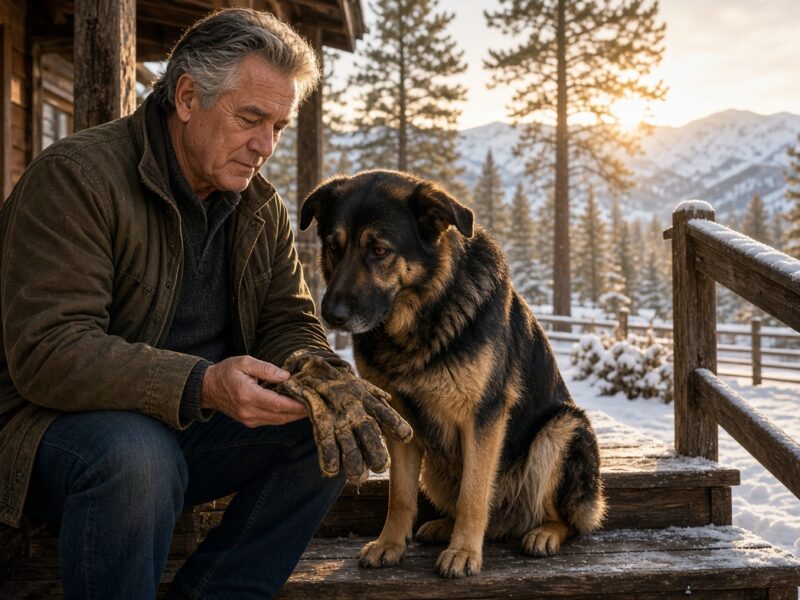
He Went to Adopt a Puppy… and Left With the Dog Who Hadn’t Eaten in Four Days After Guarding His Dead Owner
Bruno had not touched his food bowl in four days.
The six-year-old German Shepherd pressed himself against the cold concrete wall of his kennel at Gallatin Valley Humane Society, ribs barely moving, amber eyes fixed on the door at the far end of the corridor.
The one that opened dozens of times each day and never once produced the right footsteps.
He did not bark when volunteers passed. He did not growl when handlers approached.
He simply watched with the patience of a creature that had not yet accepted it was waiting for something that would never come.
A former Navy SEAL named Ross Kimble arrived that Tuesday morning in December with a reservation to adopt a yellow Labrador puppy.
He had no intention of meeting Bruno.
Seventy-two hours later, Bruno would carry something across the porch and place it in Ross’s open hand, and every person standing in that driveway would understand without a word being spoken that neither of them was leaving alone.
Snow had been falling since before dawn across Bozeman, Montana, turning the Bridger Mountains into a pale blur and coating the ranch roads east of town in a clean white silence.
Ross parked his truck in the shelter lot and sat for a moment with both hands still on the wheel and the engine ticking down.
He was a large man, broad through the shoulders, thick through the wrists, with a face that had weathered thirty years of salt air and desert sun and a particular kind of quiet that comes not from peace but from the disciplined suppression of everything that is not peace.
He was fifty-seven, with dark hair going silver at the temples and pale blue eyes that assessed a room before he stepped into it.
He had spent two decades with Naval Special Warfare and nine months of something far harder afterward — sitting in the house he and his wife Diane had built together in the Gallatin foothills, learning hour by hour that the silence she left behind was nothing like the quiet he had trained himself to carry.
Diane had died eighteen months ago. Pancreatic cancer. Four months from diagnosis to the morning at the hospital when Ross held her hand and spoke her name until she could no longer squeeze back.
He had kept talking anyway. He did not know what else to do with his hands.
Since then, the house had stayed exactly as she arranged it.
His daughter Paige, thirty-one, a schoolteacher in Billings who drove four hours whenever she felt her father needed something he would not ask for, had pushed the shelter idea through a combination of patience and strategic guilt.
She met him in the parking lot now, red-cheeked from the cold, her dark hair tucked under a wool hat.
“You look like you’re about to breach a building.”
“I’m fine.”
“You’ve been gripping the door handle for three minutes.”
He let go of it.
She linked her arm through his without asking permission, and they walked into the warmth of the lobby together.
The space smelled of antiseptic and dog and the kind of burnt coffee no one ever had time to replace.
A volunteer confirmed Ross’s paperwork. Sunny, the twelve-week-old yellow Labrador, was healthy and ready in the puppy wing.
Ross had done his research. Temperament tested. No history of trauma. No complications. A dog that would be uncomplicated.
Something alive in the house that would not require him to feel anything he wasn’t ready for.
They were almost to the puppy wing when Carmen Rios stepped into the hallway.
The shelter’s director was fifty-four, compact and direct, with bronze skin and dark eyes behind wire-rimmed glasses. She had the particular composure of someone who had spent twenty-six years watching people make hard decisions and had learned to give them exactly enough truth to make the right one.
She apologized for stopping them. She said it would only take a minute.
Then she led them down a colder hallway marked Staff Only and stopped beside a narrow window set into a gray door.
“I wouldn’t ask this if I didn’t think it mattered,” she said. “Two minutes. That’s all.”
Through the glass, Ross saw Bruno for the first time.
The German Shepherd was large, or would have been if hunger hadn’t sharpened his frame until the architecture of his ribs showed through the black-and-tan coat.
He was pressed against the far wall with his tail tucked and his head lowered, positioned so he could see both the door and the corner simultaneously.
A full water bowl sat three feet from his nose, untouched.
His eyes were the color of old brass, and they were aimed at the kennel door with the steadiness of a dog that had been aiming at doors for a long time.
“He hasn’t eaten a real meal in four days,” Carmen said. “He’ll drink a little if the staff leaves the room. Won’t accept a leash. Won’t come forward. The intake report listed him as potentially aggressive.”
Ross studied the rigid shoulders, the flattened ears, the way the dog’s body was shaped less like threat and more like something trying to be invisible without believing invisibility was possible.
“That’s not aggression,” he said.
“No,” Carmen agreed. “It isn’t.”
She told them what she knew.
Bruno’s owner had been a man named Leonard Cobb — seventy-three, retired Army combat medic, widower. He had lived alone in a small house north of town, kept to himself after his wife passed three years back, and had adopted Bruno from a rescue when the dog was just past a year old.
Neighbors described Leonard as methodical, gentle, increasingly private. They said Bruno went everywhere with him.
Leonard had died in his armchair eight days ago. Cardiac arrest. Probably while he slept.
Bruno had remained in the house with him for nearly three days before a neighbor noticed.
When deputies entered, Bruno positioned himself between them and Leonard’s chair. He didn’t bite. He didn’t charge. He stood in the way, growling only when someone reached forward.
They had to use a blanket to carry him out.
“He wasn’t being aggressive,” Paige said softly.
“He was trying to protect him,” Ross said. “Or waiting for him to wake up.”
Carmen looked at him carefully.
“Since then, he watches every door. Every time someone leaves, he repositions himself to face the entrance.”
Ross understood what that was.
He had spent eighteen months doing his own version of it. Waking before light. Listening for sounds in a house that no longer made the right ones. Spending the first few seconds of every morning reaching for something that was no longer beside him.
He had dressed it up in different clothes, called it discipline, called it routine, but the shape of it was the same.
“We came for the puppy,” he said.
“I know.” Carmen didn’t argue. “Would you be willing to help him drink?”
Just that.
He looked at Paige. She looked back at him without offering anything, which was its own kind of answer.
He went in alone.
The kennel smelled of concrete and the particular absence of warmth.
Bruno’s body tightened the moment Ross entered, muscles bunching along the dog’s back, breathing going shallow.
Ross didn’t approach. He curved wide around the space, set the water bowl a few feet from Bruno’s position, then retreated to the far wall and sat down with his back partly turned.
He talked about nothing. The drive in from the foothills. The ice on the fence posts along Route 86. A noise his truck heater had been making for two winters that he kept meaning to fix.
His voice stayed low and even — not the command voice, not the reassurance voice, just the voice. The one that didn’t need anything back.
For a long time, nothing happened.
Then Bruno’s nose moved. A small thing, almost invisible.
Ross kept talking. He described the way snow looked on the Bridger Range in the hour before full light — blue and flat and enormous — and how Diane had loved that view so much she once talked him into driving out at four in the morning just to see it properly.
He hadn’t been to that overlook since she died. He hadn’t planned to mention her at all.
The soft, careful sound of a dog’s tongue touching water came from behind him.
Carmen pressed her hand to her mouth in the doorway. Paige went completely still.
Ross stared at the wall and felt something tighten and ease inside his chest at the same time. Not comfort exactly, but the sensation of a locked room being opened from the inside.
Bruno drank only a little before retreating, but he had chosen to.
In the hallway afterward, Ross authorized the release of Sunny to the family on the backup list — a couple with two small children who had visited the puppy twice and cried both times when they were told they were second.
He signed the emergency foster paperwork for Bruno with the same deliberate attention he had once given operational orders, reading every line twice.
“Seventy-two hours,” he said. “Nothing more.”
Carmen agreed. Paige said nothing, but the look she gave him over her coffee cup carried a full conversation.
The drive to Ross’s place took forty minutes.
Bruno rode in the cargo area, pressed flat against the far side, his muzzle resting on his paws and his eyes fixed on the rear gate. He made no sound.
Ross spoke occasionally into the silence — the name of the creek that ran along the back of the property, the way the pines looked in early December when the snow caught in the branches before the wind took it.
Bruno’s near ear shifted once toward the sound.
Ross kept talking.
The house was a cedar-sided ranch set back from the road behind a row of ponderosa pines, with a covered porch that faced west and a back field that ran all the way to the tree line.
Ross had chosen the property for its sightlines. Diane had chosen it for the light.
The kitchen window caught the morning sun in a way that made the whole room glow orange for about twenty minutes each day, and she had arranged her houseplants in that window with the precision of someone who understood what twenty minutes of good light was worth.
The plants were still there. Ross watered them because she had loved them, not because he had learned to.
He carried Bruno’s crate onto the porch and opened its door. Bruno sat at the back of it and looked at the open front as though freedom might be another version of the same trap.
Ross set food and water within reach, then sat on the porch steps with his back to the crate.
Cold air moved through the pines. The creek made its winter sound somewhere down the slope, low and steady under a skim of ice.
“No one’s rushing you,” Ross said.
He sat there for forty minutes.
When he heard Bruno’s paws on the porch boards, he didn’t turn around.
Bruno did not enter the house that night. He settled just inside the threshold, positioned where he could see both the front door and the porch simultaneously, and stayed awake through most of the darkness.
When Ross came downstairs in the early hours and lowered himself to the floor a few feet away, Bruno watched him but did not retreat.
They sat like that until the sky outside the kitchen window went from black to gray to the thin blue that came just before sunrise found the mountains.
The second night brought wind.
It came down from the Bridgers fast and hard, bending the ponderosas and making the old cedar house creak along its ridgeline in a way that sounded, if you weren’t listening carefully, like something trying to get inside.
Bruno had spent most of the day within fifteen feet of wherever Ross happened to be — not following exactly, but noticing.
He ate a few bites of food when Ross moved to another room. He drank when Paige, who had extended her stay without asking whether she was wanted, sat on the couch reading with her back turned.
These were small things. Ross treated them like ordinary things, because Carmen had told him that frightened animals sometimes retreated the moment they sensed humans becoming excited about progress.
He understood the mechanism. He had seen it in people, too — the way someone healing could feel the pressure of everyone else’s hope bearing down like another kind of weight.
Paige had noticed something else, though. She mentioned it that evening while Ross stood at the kitchen counter making sandwiches.
“He watches you,” she said. “Not the door. You. He watches everything. He watches you different.”
Ross didn’t answer. He heard her anyway.
It was late when the power went out.
A utility pole somewhere up the canyon let go under the wind load. A crack like a rifle shot, then the flat boom of a transformer, then the house dropped into darkness so complete that for one second Ross was not standing in his kitchen in Montana.
He was somewhere with sand under him and a sky too bright in one direction and smoke in another. And there was a sound he had spent eleven years trying not to hear.
His canine partner Zeus going quiet too fast after the second charge detonated.
Zeus had been a Belgian Malinois, eight years old, a dog of extraordinary focus and almost embarrassing loyalty, and he had been running back toward Ross when the device triggered.
The blast threw Ross backward. When he got up, Zeus was down, and the world had a different shape than it had possessed three seconds earlier.
Ross had done everything right. Applied the kit. Applied pressure. Talked to Zeus the same way he talked to injured men — clearly and calmly, promising things he needed to believe were true.
It hadn’t mattered.
He had carried that for eleven years. He had carried it alongside Diane, who understood without needing every detail explained.
And when Diane was gone, too, there was nothing left between Ross and the thing he had learned at its most brutal — that you could do everything right and still lose what you were trying to save.
A pan slid off the stovetop. Paige, disoriented, catching herself against the counter, and it hit the floor with a ringing crash.
The sound reached Ross from eleven years away and brought him all the way back to the kitchen floor.
And he was on his knees without knowing when he’d gotten there. One hand pressed flat against the tile, the other closed around nothing, and the breath in his chest was the wrong size for the space it was trying to leave.
“Dad.” Paige’s voice, careful, close. “I’m here. You’re home.”
He couldn’t answer yet.
In the corner of the dark living room, Bruno had gone rigid at the crash. Body flat, claws scraping the hardwood as he tried to press himself into the baseboard. His breathing was audible from across the room — fast and broken, the breathing of a dog whose fear was old enough to have its own particular sound.
And then Bruno heard something else. Not the pan. Not Paige.
The low, involuntary sound that came from Ross. Not a word. Not a name. Just the sound a person makes when they have finally run out of armor.
Bruno lifted his head.
He stood up from the floor, trembling so hard his coat rippled along his spine. He looked at the fallen pan. He looked at the darkness between himself and where Ross had gone down.
Every signal his body was sending said to stay against the wall.
He came anyway.
He moved around the pan in a wide arc, stopping twice, his legs shaking beneath him. When he reached Ross, he stood beside the kneeling man for three long seconds — close enough that his breath moved against Ross’s sleeve.
And then Bruno lowered himself and placed his head across Ross’s knee.
The weight was slight, because Bruno was still too thin. But it landed with a precision that nothing else that night had managed.
Ross stopped fighting his breathing. He simply felt what was there. Warm fur. A heartbeat going fast. A frightened animal that had crossed its own fear to be in the right place.
His hand came up slowly and rested against Bruno’s chest. Not gripping. Not commanding. Just resting, the way you touch something you are afraid of breaking.
“It’s done,” Ross said. His voice didn’t sound like his own. “It’s already done.”
He said it twice more until his breathing steadied.
Bruno’s breathing steadied with it.
Paige sat on the floor nearby without speaking. She had learned in thirty-one years when her father needed language and when he needed something entirely different.
The morning was clear and cold, with ice on the fence posts catching the early sun.
Ross woke on the living room floor with his back against the couch, and Bruno was beside him. Not touching, but close. Closer than the night before.
Dr. Keisha Wynn, the shelter’s partnered veterinarian, came to the house rather than force Bruno into an unfamiliar clinic.
She was forty-four, athletic and unhurried, with warm brown skin, close-cropped natural hair, and the calm eyes of someone perpetually arriving at understanding just before she needed to speak.
She spent twenty minutes simply watching Bruno from across the room before she opened her bag.
She found the old collar — stiff leather, a registration stamp worn nearly smooth — and the number led thirty minutes later to Leonard Cobb’s granddaughter.
Stella was twenty-eight and lived in Great Falls, and had not known where Bruno had been taken until Carmen tracked her down that morning.
She had Leonard’s same careful speech, the same pause before she said anything that cost her something.
On the video call, she confirmed everything the intake report had only suggested. Leonard and Bruno had been inseparable. Morning walks at six o’clock regardless of weather. Evenings in the living room with Bruno at the foot of the recliner, Leonard’s hand resting on the dog’s back.
“He talked to him like another person,” Stella said, her voice thin at its edges. “Short sentences. My grandfather didn’t waste words on things that didn’t deserve them.”
She demonstrated the hand signals Leonard had used. Three of them. Simple gestures Ross recognized immediately.
Not identical to the ones he had used with Zeus, but close enough to explain everything.
After the call, Ross sat at the kitchen table with a mug going cold in his hands.
Bruno had moved to the edge of the kitchen doorway — not quite in the room, not quite out of it — watching Ross with his amber eyes steady and his head tilted at an angle that communicated something specific.
“He thought Leonard would come back,” Ross said.
Paige looked up from the paperwork. “Maybe he still does.”
“No.” Ross shook his head slowly. “He knows. He just hasn’t figured out what to do instead.”
She studied her father for a moment. “Sound familiar?”
Ross didn’t answer. He didn’t need to.
That afternoon, Bruno stole a piece of bread from the counter.
He had been watching Ross assemble a sandwich with the focused attention of a dog performing reconnaissance. And when Ross turned to answer Paige’s question from the hallway, Bruno completed the operation cleanly and retreated to the doorway to consume the evidence.
When Ross turned back and found the bread missing, he looked at Bruno.
Bruno studied the floor, then the wall, then a fixed point somewhere above Ross’s right shoulder.
“You refused food for four days,” Ross said, “and the first real thing you eat is my lunch.”
Something moved in Bruno’s tail. Not a full wag. More like the memory of one — a single quiet thump against the floor.
Paige laughed from the hallway. The sound surprised her coming out, and it surprised Bruno, whose ears came forward toward it.
Ross held his expression of appropriate displeasure for about four seconds before it failed completely.
The laughter was real. The house hadn’t held that kind of sound in a long time.
Carmen called that evening. The rehabilitation transport was confirmed for eight o’clock the following morning.
Ross thanked her and set the phone down.
He didn’t sleep well. He lay in the dark and thought about Leonard Cobb taking the same six o’clock walk every morning through the Montana winters, year after year, loving something faithfully and completely until the morning he didn’t wake up.
He thought about Diane arranging her houseplants in the kitchen window, choosing each position with care, understanding something about what twenty minutes of warmth was worth.
He thought about Zeus running toward him across ground that had one more second before everything changed.
He had always told himself that losing the people and things he loved was reason enough not to hold anything too hard. He had called this wisdom.
Sitting in the dark at two in the morning with a German Shepherd sleeping ten feet away, Ross began to suspect he had simply been afraid and had given his fear a more respectable name.
The transport van arrived at 5:08.
It came slowly over the frozen gravel, white with the shelter’s logo on the door. Carmen climbed out first. A transport specialist named Kevin Marsh followed — quiet-moving, mid-forties, the kind of man who let the animals set the pace.
Paige stood on the porch with her arms folded and her expression doing the thing it did when she had decided not to say what she was thinking.
Ross carried the canvas bag outside. Food. Medication schedule. The soft blanket Carmen had sent.
Each item represented the correct decision, the prepared outcome, the responsible choice.
He set the bag on the van’s rear step and turned back to the door.
Bruno was at the threshold.
The German Shepherd looked at the van. He looked at Carmen. Then he looked at Ross with his amber eyes level and his head at a slight angle.
And the look communicated something that didn’t require translation.
“It’s okay,” Ross said. “You don’t owe me anything.”
Bruno turned and went back inside the house.
“Give him a minute,” Carmen said.
No one moved. The cold was clean and absolute. Kevin stayed by the van. Paige said nothing.
Ross stood at the top of the porch steps and looked at the mountains and thought about all the times he had stood at the edge of a decision and told himself the next move was the practical one — the one that wouldn’t cost him anything he couldn’t afford to lose.
Inside the house, Bruno was moving.
They heard his paws on the hardwood. A pause. Then the soft, careful sound of something being lifted.
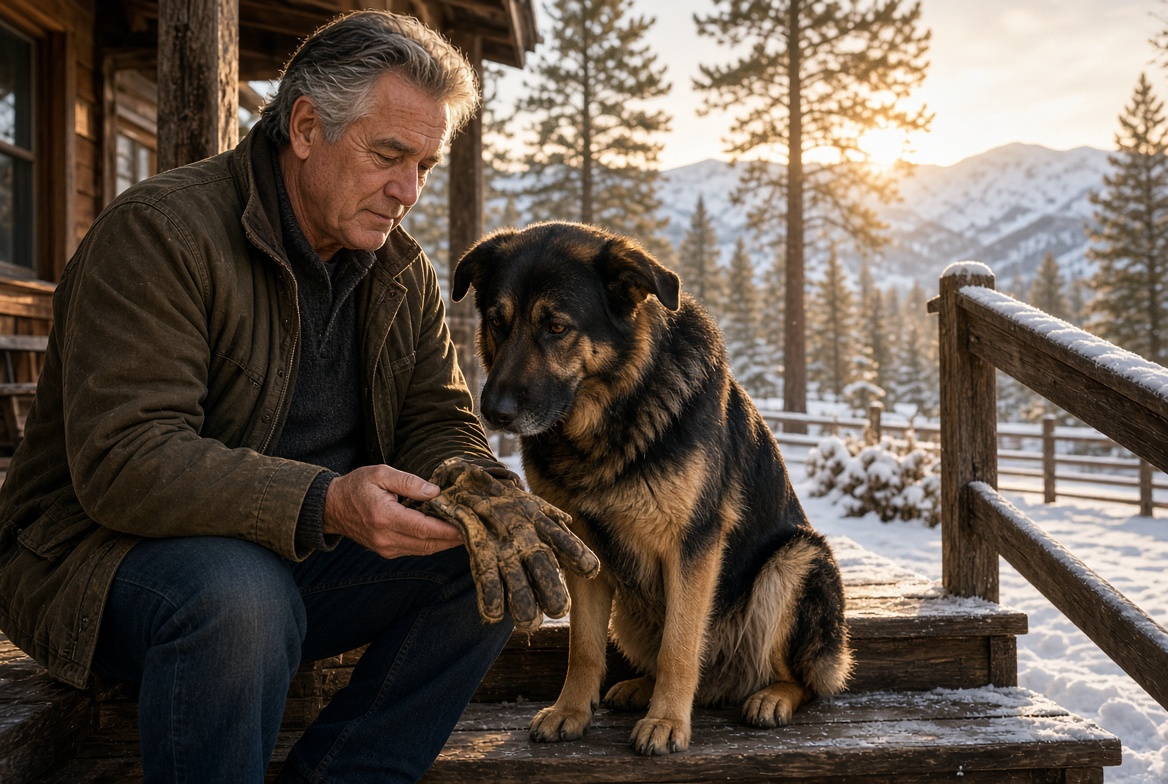
When Bruno reappeared in the doorway, he was carrying one of Diane’s gardening gloves.
It had been on the bench inside the entry hall for eighteen months. One of a pair she had left there the last autumn she was well enough to work in the yard.
Ross hadn’t moved them. He hadn’t been able to explain why, even to himself. They were simply there, at the edge of the space where the house met the world. And he walked past them every day and kept walking.
Bruno carried the glove carefully by the cuff, allowing no part of it to drag.
He crossed the porch and walked directly to Ross and sat down.
Then he lowered his head and placed it in Ross’s open hand.
He didn’t look away. He simply sat with his amber eyes on Ross’s face and waited.
Ross stared at the worn leather in his palm.
He understood what he was holding. Not just the glove. Not just the weight of the dog’s choice.
He was holding the specific, unarguable point that Paige had been trying to make for eighteen months — and that he had been refusing to hear.
That keeping the house exactly as Diane left it was not the same as honoring her. That refusing to let anything new matter was not the same as being faithful to what he’d lost. That some things were meant to be carried forward, not preserved in place.
He went to his knees on the porch.
Bruno’s ears came back, but he held his ground.
“You’re not Zeus,” Ross said. His voice was rough and real. “You don’t have to be. And you’re not Leonard’s dog anymore, which means you get to decide what comes next.”
He put his hand slowly against the side of Bruno’s neck. The dog flinched once — one small tremor — then went still beneath the touch.
“If you’re choosing this place, I’m choosing it, too. For real this time.”
Kevin quietly closed the van’s rear gate.
Carmen looked at the mountains and pressed her lips together.
Paige brought her fingers to her mouth — the gesture she had made since she was small when she was trying not to cry in front of her father.
The permanent adoption paperwork took twelve minutes.
Carmen walked Ross through it at the kitchen table while Bruno sat beside his boot. Not leaning against him. Just beside him. The way a dog begins to stake its quiet, patient claim on the person it has decided to keep.
By spring, the entry bench had been rearranged.
Diane’s gardening gloves were still there — both of them now, together. But Bruno’s leash hung on the hook beside them, and no one who came through the front door would have been able to say which items had been there longer. They simply looked like they belonged to the same life.
Bruno’s ribs had disappeared. His coat had grown thick and glossy, and when the morning light came through the kitchen window at its orange best, he positioned himself in the warmest patch of it and slept with his front paws stretched forward in a posture of complete and unhurried trust.
He still startled at sharp metal sounds. A dropped tool in the driveway would bring his head up fast, his eyes going alert. But then he would find Ross, and something in him would calculate, and he would exhale, and put his head back down.
Ross still had nights when the bedroom was somewhere else and the weight in his chest was old and specific.
On those nights, Bruno came to the side of the bed without being called and rested his chin on the mattress near Ross’s arm.
He didn’t paw or whine. He was simply there — patient in the way only a creature with genuine faith can be patient. Not demanding that the darkness end. Only refusing to let it go unwitnessed.
Ross would open his eyes. Bruno would be there. The room would be the room.
That was enough. Most mornings, it was more than enough.
He had started spending Saturday mornings at the shelter — fixing things at first, because that asked nothing emotional of him.
Then Carmen began placing him outside the kennels of dogs that wouldn’t come forward for anyone else. He brought no treats and made no promises.
He sat, and he stayed, and he waited with a specific quality of presence that belongs only to people who have learned what patience actually costs.
Other veterans eventually joined him on those mornings. They made no formal arrangement of it. They simply kept showing up, and the dogs kept noticing, and the Saturdays kept happening until something had been built.
Not a program, not yet. Just a practice. Something worth continuing.
One evening, Ross sat by the living room window with Bruno stretched at his feet and the mountains holding the last light above the tree line.
He had placed a framed photograph on the windowsill that week. Diane in the garden, hands already dirty, caught mid-laugh, squinting into the sun.
It was the first photograph of her he had displayed anywhere in the house since she died.
It did not feel like moving on. It felt like moving with — which he now understood to be an entirely different thing.
Bruno shifted at his feet and exhaled slowly, his heavy head resting against the side of Ross’s boot.
Outside, the pines caught the last of the evening wind, and the house was warm, and the mountains went blue in the falling light.
Ross sat still inside all of it. Not braced against it. Not measuring exits. Just present. Just there.
Which was the hardest thing he had ever learned to do, and also, at fifty-seven, the most important.
Sometimes healing doesn’t arrive the way we expected.
Sometimes it walks through the door on four quiet paws, carrying something we forgot we’d left behind.









