He Was Told the Military Dog Was Dead… Then He Found Him for Sale on a Snowy Street
The winter afternoon had turned downtown Bozeman into a postcard of soft gray, snow falling steadily since early morning, softening the edges of parked cars and storefront awnings along Main Street.
By four o’clock, the sidewalks had gone white, traffic had slowed to a crawl, and the Bridger Mountains beyond town had disappeared entirely behind the winter haze.
Gunnery Sergeant Ethan Walker had intended to be home before dark.
At forty, Ethan stood six-foot-two with broad shoulders and the compact strength of a man who had spent nearly two decades in the United States Marine Corps.
His dark brown hair was cut in a short regulation buzzcut, gray just beginning to appear at his temples, and a narrow scar beside his right eyebrow came from an old training accident he rarely discussed.
His face was usually composed, his blue-gray eyes steady, and younger Marines often mistook his silence for severity.
It was not severity.
Ethan had simply learned that the loudest person in a difficult situation was rarely the one thinking most clearly.
That afternoon, however, he was thinking about a ten-year-old girl and whether the wrapped astronomy kit sitting on the passenger seat of his truck was enough for her birthday.
Lily Walker was small for her age, with chestnut hair she usually wore in two loose braids and large brown eyes that made it impossible for Ethan to hide anything from her.
She was curious, stubborn, and unusually observant.
Three years after losing her mother, Lily had learned to carry sadness quietly.
She still laughed.
She still asked a thousand questions.
But she had developed one habit Ethan understood too well—she avoided becoming attached to anything she might someday lose.
When a neighbor offered her a kitten the previous spring, Lily had smiled, held it for less than a minute, then handed it back.
“I think it should go to somebody else.”
Ethan had not pushed her.
Loss had already taught his daughter lessons he wished she had never needed.
He was thinking about that when he noticed the crowd.
Maybe a dozen people stood near an iron street lamp at the edge of a small public square.
Some held shopping bags.
One man had stopped with a coffee in his hand.
Two teenagers were taking pictures from several yards away.
Ethan slowed.
At first he assumed someone had slipped on the snow.
Then he saw the sign.
A piece of brown cardboard had been tied to the lamp with white cord, and across it, painted in uneven red letters, were the words: “$500 for giant dog.”
Ethan frowned.
Then he saw the dog.
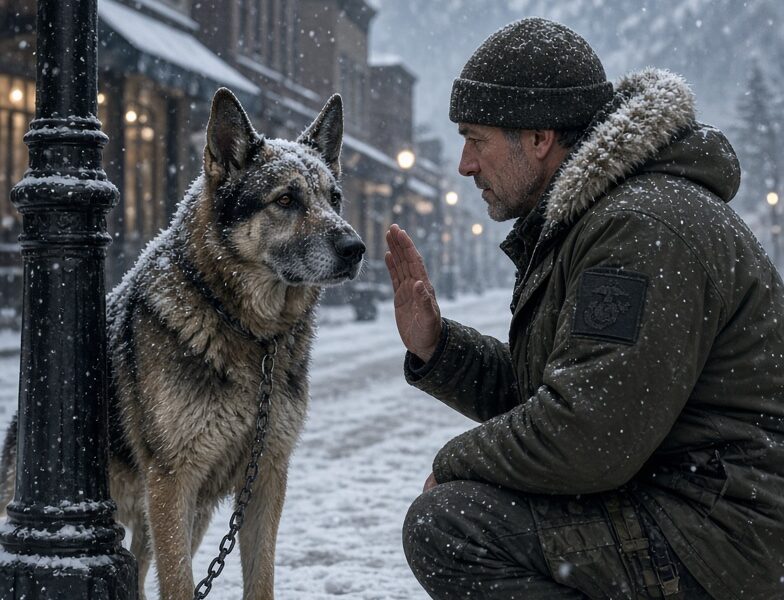
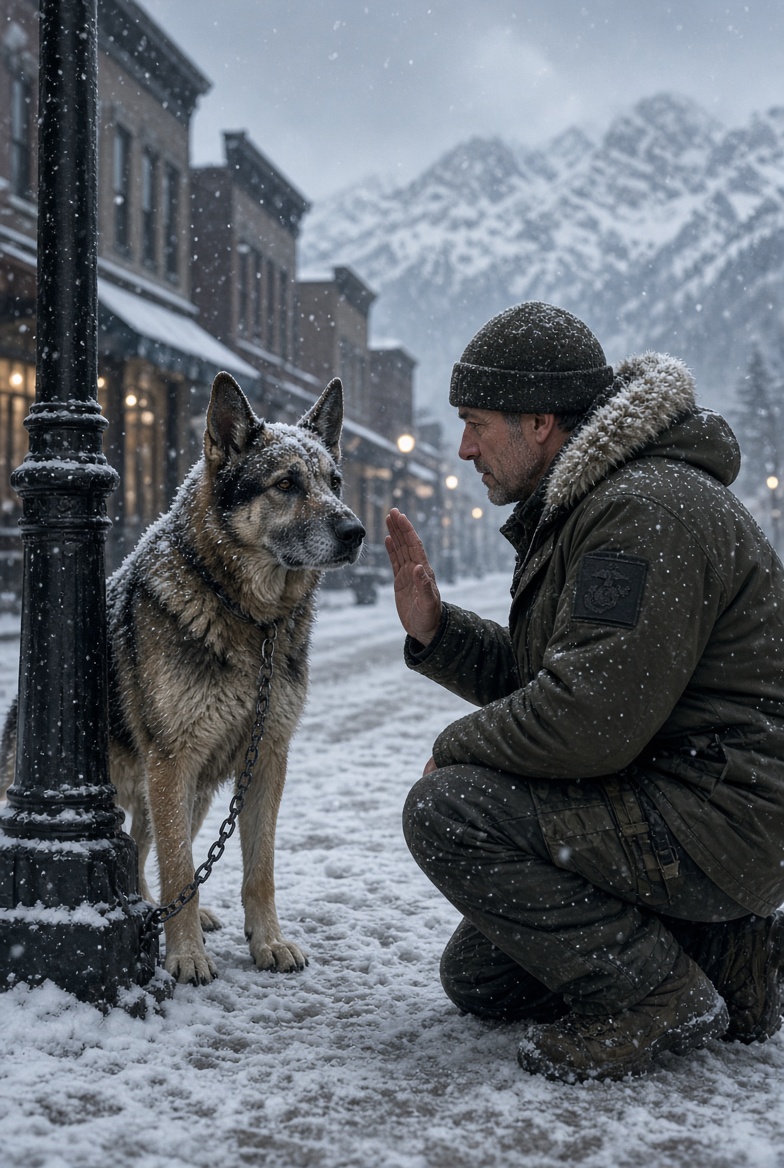
The German Shepherd stood beside the lamp with a heavy chain attached to an old leather collar.
He was enormous—larger than most shepherds Ethan had worked around—with a broad chest, long powerful legs, and a dark black saddle running across his back.
Tan fur covered his shoulders and lower legs, and gray had begun spreading around his muzzle, suggesting he was no young dog.
Snow rested across his coat, but he did not shake it off.
He simply stood there, watching the people.
There was something controlled about him.
Too controlled.
Beside the dog stood Calvin Briggs, a man in his mid-fifties with a narrow frame, weathered cheeks, and a brown work jacket zipped almost to his chin.
His thinning gray hair was flattened beneath a wool cap.
Calvin spoke quickly to anyone who showed interest, the manner of a man who wanted a transaction completed before anyone asked too many questions.
“Name’s Bear,” he told a couple standing nearby.
“Used to work private security. Good dog. Just too much dog for most people.”
The couple looked at the shepherd’s size and moved away.
Calvin shrugged.
“See what I mean?”
Ethan should have kept walking.
He had groceries to pick up.
Lily would be home from a friend’s house before six.
The weather was getting worse.
Then the shepherd turned his head.
His eyes found Ethan.
Everything changed.
The dog had dark amber-brown eyes, alert despite the gray around his muzzle.
He looked at Ethan’s face first, then lower.
Ethan followed the dog’s gaze.
A small Marine Corps insignia was stitched onto the front of Ethan’s winter jacket.
The shepherd straightened—not dramatically, not excitedly.
His posture simply changed.
His shoulders squared, his head lifted, his attention became absolute.
Ethan stopped walking.
For several seconds, the crowd seemed to disappear.
He knew that posture.
“Hey,” Calvin called. “You interested?”
Ethan did not answer.
He raised his right hand slightly, two fingers together, palm turned inward.
It was an old working dog hand signal Ethan had used hundreds of times during joint training exercises.
The shepherd sat immediately.
Ethan felt something tighten beneath his ribs.
Calvin gave a nervous laugh.
“Guess he likes you.”
Ethan looked at him.
“You said his name is Bear.”
“That’s what I was told.”
“Told by who?”
Calvin’s expression changed for only a fraction of a second.
“Guy I got him from.”
Ethan looked back at the dog.
There were hundreds of trained German Shepherds in the country.
Thousands, probably.
One response to one familiar signal proved nothing.
So Ethan tried another.
He lowered his hand.
The shepherd stayed.
Then Ethan turned his wrist and gave a second silent command.
The dog shifted into the exact position Ethan expected.
Not close.
Not similar.
Exact.
Ethan’s breathing slowed.
“No way,” he whispered.
He stepped toward the shepherd.
The dog rose.
For the first time, something broke through that rigid discipline.
His ears came forward.
His tail moved once, then again.
Ethan crouched several feet away.
The shepherd stared at him.
Ethan stared back.
Three years earlier, Sergeant Ryan Mercer had been one of Ethan’s closest friends in the Corps.
Ryan had been thirty-seven, tall and lean with sandy blond hair, an easy smile, and a habit of making jokes during the worst possible moments.
He had been patient with nervous Marines and almost endlessly patient with dogs.
Atlas had been his partner.
The German Shepherd had been five then, massive even by working dog standards, intelligent, steady, and famous among handlers for refusing to be distracted once he was given a task.
Ryan used to say Atlas did not follow orders because he had to.
He followed them because he had already decided they were reasonable.
After Ryan died during an overseas assignment, Ethan had asked what would happen to Atlas.
The answer had been simple—retirement processing, a specialized placement program.
Months later, Ethan had been told Atlas had developed a serious medical problem after transfer and had died before a permanent home could be arranged.
Ethan had believed it.
He had no reason not to.
Until now.
The shepherd stepped forward.
Then, with surprising urgency, he rose onto his hind legs and placed both front paws against Ethan’s chest.
Ethan nearly lost his balance.
“Easy.”
His hands came up instinctively, gripping the dog’s shoulders.
The shepherd leaned against him.
Ethan froze.
Up close, he could see the gray muzzle, the old wear along the collar, and then he saw it.
Behind the left ear, a small pale scar curved slightly at one end.
Ethan’s face changed.
Years earlier, Atlas had caught that ear on a damaged training barrier.
The injury had been minor, but the scar had remained.
Ryan used to rub it before every long exercise.
Ethan touched the fur beside it.
The shepherd closed his eyes.
“No.”
The word barely escaped him.
Calvin shifted uneasily behind them.
Ethan looked again.
“Atlas.”
The shepherd’s eyes opened, his ears lifted.
Ethan felt his throat close.
“Atlas!”
The dog pushed closer.
Ethan turned his face away for a moment, but it did nothing to stop the tears that had already reached his eyes.
People around them became quiet.
Ethan did not care.
Three years ago, he had mourned Ryan.
Then he had accepted that Ryan’s partner was gone too.
And now that same dog was standing in a snowy Montana street with a cardboard price hanging beside him.
Five hundred dollars.
Ethan looked at Calvin.
“Where did you get him?”
Calvin glanced toward the street.
“I already told you. Private security.”
“Which company?”
“I don’t remember.”
“You had him long?”
“Not really.”
“Paperwork?”
Calvin’s jaw tightened.
“You buying him or not?”
That answer told Ethan enough.
He stood and pulled out his wallet.
Five hundred dollars changed hands less than a minute later.
Calvin counted the bills quickly.
Too quickly.
He unclipped the chain from the street lamp, handed it to Ethan, and began walking away.
“You don’t want my information?” Ethan called.
Calvin stopped only for a second.
“You’ve got the dog.”
Then he continued through the snow.
Ethan watched him disappear around the corner.
Atlas stood beside him, still alert.
Ethan lowered one hand and wrapped it around the old chain.
“Come on, buddy.”
Atlas followed him toward the truck without hesitation.
At the passenger door, Ethan paused and opened the rear cab.
Atlas did not climb in.
Instead, the shepherd turned.
His entire body became rigid.
Across the street, partly obscured by falling snow, a white commercial truck sat beside the curb.
Dark lettering covered the side panel.
Iron Gate Canine Logistics.
Ethan looked at the truck, then at Atlas.
The shepherd’s eyes remained fixed on it—not frightened, not excited.
Watching.
Calculating.
Exactly the way Ethan remembered.
Ethan rested a hand along Atlas’s neck.
“Come on.”
After several seconds, Atlas finally climbed into the truck.
Ethan closed the door.
The German Shepherd moved to the window and continued staring at the white Iron Gate vehicle as Ethan walked around to the driver’s side.
Three years earlier, Ethan had been told Atlas was dead.
That afternoon, he had bought him for five hundred dollars on a snowy street in Bozeman, and Atlas had not forgotten the truck across the road.
By the time Ethan Walker pulled away from downtown Bozeman, the snow had begun falling harder.
Wind pushed loose powder across the road in pale sheets, and the white Iron Gate truck he had noticed near the square disappeared behind him after two turns.
Ethan checked the rearview mirror anyway.
Atlas sat upright in the back seat, filling nearly half the cab, his broad head turned toward the rear window as though he was still tracking something Ethan could no longer see.
“Easy, buddy.”
Atlas looked forward at the sound of Ethan’s voice.
For a moment, the German Shepherd seemed exactly as Ethan remembered him—alert, controlled, waiting for the next instruction.
Then the effort faded.
Atlas lowered himself carefully onto the blanket Ethan had spread across the seat.
His movements were slower than they should have been.
The dog was not dangerously weak, but exhaustion was written into every deliberate motion.
Ethan changed direction.
Home could wait.
Twenty minutes later, he pulled into the parking lot of Bridger Valley Veterinary Clinic, a low brick building on the northern edge of town.
Warm yellow light glowed through the windows against the blue-gray winter afternoon.
Dr. Natalie Pierce met them at the side entrance.
Natalie was thirty-six, medium height, and lean, with auburn hair pulled into a practical ponytail and hazel eyes that rarely missed small details.
She usually wore dark scrub pants beneath a fleece jacket, and there was something steady about the way she moved around frightened animals.
Natalie had spent several years working emergency veterinary shifts before opening her own practice.
Those years had given her an unusual combination of patience and bluntness.
She was gentle with animals, calm with worried owners, and almost completely intolerant of incomplete medical records.
Ethan had met her twice before through local veterans who brought retired working dogs to the clinic.
The moment she saw Atlas, her expression changed.
“That is a very large shepherd.”
“About a hundred and twenty pounds when he was working.”
Natalie glanced at Ethan.
“Was.”
Ethan opened the rear door.
Atlas lifted his head.
Natalie did not reach for him immediately.
She stood several feet away, allowing the dog to study her first.
“What’s his name?”
“Atlas.”
The German Shepherd’s ears shifted.
Natalie noticed.
“Definitely Atlas.”
Then Ethan gave her a tired look.
“That’s what I’m trying to figure out.”
Inside the examination room, Natalie moved slowly.
Atlas allowed her to check his eyes, mouth, paws, heart rate, and breathing without resistance.
When she touched near his shoulders, he turned his head but remained still.
“He’s tired,” Natalie said after several minutes.
“Mildly dehydrated. Probably hasn’t been eating consistently. But I’m not seeing anything right now that makes me think we’re dealing with a major immediate medical crisis.”
Ethan released a breath he had not realized he was holding.
“So he’s going to be okay.”
“I said I’m not seeing an emergency. That is not the same thing as promising you anything.”
That was Natalie—precise even when reassurance would have been easier.
She continued the examination, checking the gray around Atlas’s muzzle and the condition of his joints.
“Eight?” she asked.
“Eight,” Ethan confirmed.
Natalie nodded.
“That fits.”
She ran the scanner over Atlas’s shoulders.
A tone sounded.
Natalie looked at the screen.
Then she stopped moving.
Ethan saw it immediately.
“What?”
“Give me a second.”
She scanned again.
Same result.
A long identification number appeared.
Natalie typed it into the clinic database.
The first record loaded almost immediately.
She turned the monitor slightly.
Ethan read the line.
Atlas, military working dog.
Below it were an identification number, breed, sex, date of birth, and older service information.
Ethan stared at the screen.
“That’s him.”
Natalie looked from the record to the dog.
“Well, unless there are two hundred German Shepherds named Atlas sharing the same microchip, I’d say so.”
Ethan barely heard the joke.
For three years, Atlas had existed in his memory as part of Ryan Mercer’s life.
Now a computer was confirming what Ethan’s own eyes had already told him.
Natalie continued scrolling.
Her expression changed again.
“Ethan.”
“What?”
“There’s another entry.”
She opened it.
The screen showed a separate administrative record created almost three years earlier.
It referenced an approved K-9 retirement facility in Colorado and contained a status Ethan had to read twice before accepting the words.
Deceased.
Following medical complication.
Ethan did not speak.
Atlas lay quietly on the padded floor beside him.
Natalie leaned closer to the monitor.
“This record says he died.”
“I know what it says.”
Ethan read the date—about four months after Ryan’s death, exactly when he remembered being notified.
Natalie looked down at Atlas.
“He looks remarkably active for a dead dog.”
Ethan did not smile.
“Could the chip number have been entered wrong?”
“Possible.”
“Could somebody have reused his record?”
“Possible.”
“Could the database be wrong?”
Natalie turned toward him.
“Also possible. But those are three possibilities. None of them explain why the dog attached to this exact chip is standing in my examination room.”
Ethan ran a hand across his jaw.
“Can you tell where the record came from?”
“Not from this system. I can see the facility listed, but not every administrative document behind the status change.”
She zoomed in on another line.
“Hold on.”
Atlas’s collar was lying on the examination counter where Natalie had placed it.
She picked it up and examined the metal hardware.
The leather was old, cracked at the edges, worn smooth where years of pressure had shaped it.
Beneath one side of the buckle was a faint serial number.
Natalie compared it with the military record.
“That’s interesting.”
Ethan stepped closer.
“What?”
“This collar hardware was issued under the same military equipment series listed in his older working dog file.”
“So the man who sold him to you said this dog had been working private security.”
Ethan nodded.
Natalie tapped the collar.
“This isn’t proof of where he’s been, but it means whoever had him never completely separated him from his original equipment.”
Ethan looked at Atlas.
The German Shepherd’s eyes followed him.
That detail bothered Ethan more than he expected.
By early evening, Atlas had been given fluids, food in controlled portions, and a warm place to rest while Natalie finished her notes.
Ethan stepped into the hallway and made a call he had not expected to make that day.
The number belonged to an administrative office connected to his former working dog support unit.
After several transfers, he reached a record specialist willing to search Atlas’s old file.
Ethan kept the conversation simple.
“I’m trying to confirm the disposition of military working dog Atlas after Sergeant Ryan Mercer’s death.”
A pause, keyboard sounds, then the answer.
Atlas had indeed entered retirement processing.
His transfer had been approved through a contracted K-9 logistics provider.
Ethan asked for the name.
Iron Gate K-9 Logistics.
He looked through the examination room window.
Atlas was sleeping.
“When did they take custody?”
The record specialist gave him the date—weeks before Atlas was supposedly transferred to Colorado.
“And after that, according to the file, Iron Gate coordinated transportation to the retirement facility.”
Ethan felt the same unease he had felt when Atlas stared at the white truck downtown.
“Do you have confirmation he arrived?”
Another pause.
“There’s a receiving notation signed by—” The specialist stopped. “I can’t release all of that without a formal request.”
Ethan understood.
He thanked the specialist and ended the call.
He did not need every answer yet.
One fact was enough.
Iron Gate had handled Atlas before Atlas was declared dead.
At the clinic, Natalie handed Ethan a short care plan.
“Small meals tonight, water available, no long walks, no excitement if you can help it.”
Ethan looked toward Atlas.
“You’ve met him.”
“I said if you can help it,” she said, crouching beside the German Shepherd.
“He needs rest more than anything.”
Ethan clipped the old collar back on.
Before leaving, he looked again at the small scar behind Atlas’s left ear.
The scar that had convinced him on the street.
A memory returned—a training field years earlier.
Ryan laughing after Atlas ignored another handler and walked directly back to him.
Ethan standing beside them.
Ryan rubbing the spot behind Atlas’s ear.
He needed something more than memory.
That night, after Atlas was settled at home, Ethan opened a storage box in the hall closet.
Old deployment photographs, unit patches, letters—things he rarely looked at anymore.
He found the photograph near the bottom.
Ryan Mercer stood in the center, tall and lean, smiling toward the camera.
Ethan stood to his left, younger and less gray.
Atlas sat between them, wearing the same broad working collar.
Ethan brought the photograph close to the kitchen light.
Behind Atlas’s left ear, just visible beneath the fur, was the same pale curved scar.
No doubt remained.
Lily came home shortly afterward.
She stopped in the entryway when she saw Atlas.
Her backpack slid slowly from one shoulder.
“Dad.”
Ethan stood beside the kitchen counter.
“I was going to explain.”
Lily’s eyes stayed on the dog.
Atlas was lying near the living room wall.
“He’s huge.”
“Yeah.”
“Is he yours?”
Ethan thought about that.
“He belonged to someone I knew.”
Lily looked at him.
“Someone from the Marines.”
Ethan nodded.
She did not move closer.
Atlas watched her quietly.
Lily had always been comfortable around animals before her mother died.
Afterward, affection itself seemed to make her cautious.
She had once told Ethan she did not want another pet because pets eventually left too.
Ethan had never forgotten it.
“This is Atlas,” he said.
Lily looked at the shepherd.
Atlas’s ears moved at his name.
“Is he staying for tonight?”
That answer seemed safe enough for both of them.
Later, Ethan found Lily sitting on the floor with the old photograph in her hands.
“Is this him?”
“Yes.”
“And that’s Uncle Ryan.”
Ethan leaned against the doorway.
“Yeah.”
Lily studied the picture.
“He looks younger.”
“Atlas or Ryan?”
“Both.”
For the first time that day, Ethan smiled.
That evening, Atlas ate, drank, and then slowly explored the main floor of the house.
He smelled the couch, the kitchen doorway, Ethan’s boots, Lily’s abandoned backpack.
When Ethan checked the hallway before bed, Atlas was not on the blanket he had prepared.
He was lying directly outside Lily’s bedroom door, head on his paws, facing the stairs.
Guarding.
Ethan stopped.
For years, Atlas had slept outside Ryan’s quarters whenever circumstances allowed it.
Some habits went deeper than commands.
The next morning, Ethan found Lily already awake.
She had placed a bowl of fresh water near the hallway wall.
Then she sat several feet from Atlas with her knees pulled toward her chest.
She did not touch him.
Atlas did not approach her.
They simply watched one another.
No fear, no demand—just patience.
Ethan stayed in the kitchen and said nothing.
His laptop chimed.
New email.
No sender name he recognized.
The subject line was empty.
Ethan opened it.
There was only one sentence.
If you found Atlas, don’t give him back to Iron Gate.
Ethan stared at the screen.
Behind him, Lily remained seated beside the German Shepherd everyone had believed was dead, and Atlas was still watching her.
Morning came slowly over Bozeman, the snowstorm having passed sometime before dawn.
Pale light spread across the rooftops, and the Bridger Mountains emerged behind the town in sharp white ridges beneath a clearing sky.
Inside Ethan Walker’s house, everything felt unusually quiet.
Atlas was already awake.
The old German Shepherd lay outside Lily’s bedroom, exactly where Ethan had found him the night before.
When the door opened, Atlas lifted his head but did not stand.
Lily appeared, carrying the stainless steel food bowl Ethan had set on the kitchen counter.
She had changed into jeans and a thick gray sweater, her chestnut hair still untidy from sleep.
She stopped several feet from Atlas.
“Breakfast.”
Atlas watched her.
Lily placed the bowl down, then stepped away rather than trying to touch him.
Only when she reached the kitchen doorway did Atlas rise and approach the food.
Ethan watched from beside the coffee maker.
“You’re getting good at this.”
Lily shrugged.
“He doesn’t like people standing over him.”
Ethan looked at her.
“How do you know?”
“He waits until I move.”
That answer surprised him.
For years, Ethan had watched experienced handlers learn to notice the smallest changes in a working dog’s posture.
Lily had spent less than twenty-four hours with Atlas and had already started paying attention instead of demanding affection.
Atlas finished eating, drank some water, then followed Lily halfway down the hall before settling near her backpack.
Lily noticed.
She smiled, but only slightly.
Ethan did not comment.
Some things were better allowed to happen on their own.
His laptop was still open on the kitchen table.
The anonymous message from the previous morning remained on the screen.
If you found Atlas, don’t give him back to Iron Gate.
Ethan had replied only once.
Who are you?
For almost twelve hours, nothing came back.
Then at 8:17 that morning, a new message appeared.
Someone who tried to report this before. If you want answers, come alone. Bridger Trail Diner, 11:30, back booth.
Ethan read it twice.
By eleven, Lily was with a neighbor she had known for years.
Atlas was resting at home, and Ethan was driving west beneath a sky that had finally turned blue.
Bridger Trail Diner sat along an old highway several miles outside Bozeman, a narrow one-story building with faded red siding and a parking lot bordered by plowed snow.
Truckers stopped there for coffee.
Ranch workers came for breakfast.
Nobody looked twice at a man sitting alone in the back.
The person waiting for Ethan looked younger than he expected.
Lance Corporal Eli Parker was twenty-three, lean and slightly narrow through the shoulders, with sandy brown hair cut short and a face that still carried the openness of someone who had not yet learned how completely institutions could complicate simple questions.
He wore a dark winter coat over civilian clothes, but his posture gave him away immediately.
Back straight, eyes scanning the room, hands close to the coffee cup without really drinking from it.
Eli had always been quiet by nature.
During his first years in the Corps, supervisors had described him as careful, dependable, and almost irritatingly precise with records.
His father had worked as an accountant, and Eli had grown up believing that numbers usually told the truth if people did not interfere with them.
That belief had made him useful in administrative work.
It had also gotten him into trouble.
“You’re Walker.”
Ethan sat across from him.
“You sent the email.”
Eli nodded.
“How did you know I found Atlas?”
“I didn’t know for certain.”
“That isn’t an answer.”
Eli glanced toward the window.
“I heard someone in Montana had scanned his chip.”
Ethan’s expression hardened.
“Who told you?”
“A contact still working in the transportation system. I’m not giving you the name.”
Ethan studied him.
Eli looked nervous but not evasive.
“Start with Atlas.”
Eli wrapped both hands around the coffee.
“He isn’t the first.”
Ethan said nothing.
Eli had spent nearly two years assisting with records at a military working dog transportation center in Wyoming.
His job was not glamorous.
He matched microchip numbers with transfer forms, confirmed destinations, logged veterinary clearance paperwork, and closed files when retired dogs reached approved homes or facilities.
Most cases were ordinary.
Then he began noticing dogs whose stories did not end where their paperwork said they did.
“At first I thought they were clerical errors,” Eli said.
“One dog showed as medically retired, but his chip appeared later in a private security registry.”
“How much later?”
“Four months. Could have been adopted into security work. That’s what I thought.”
Eli looked at Ethan.
“Then there was another. And another.”
Over two years, Eli had identified at least six working dogs with questionable records.
One had supposedly been transferred to a veteran family in Idaho.
Another had been listed as medically unsuitable for placement.
Two were recorded as having died before their retirement process was completed.
Others simply disappeared after administrative transfers.
But later microchip activity showed up elsewhere—private security facilities, contract canine companies, commercial training centers.
Different states.
Different names.
Same identification numbers.
Ethan leaned back.
“Six that I found.”
“You reported it?”
Eli gave a humorless smile.
“I tried.”
He had taken the irregularities to a supervisor and asked for a formal review.
The first response had been that old databases sometimes failed to synchronize.
Eli accepted that explanation until he found newer records with the same problem.
He raised the issue again.
Two weeks later, a transfer packet involving three retired dogs disappeared from the files assigned to his section.
Eli was blamed.
“I didn’t lose them.”
“What happened?”
“They pulled me from K-9 records while they reviewed it.”
“For how long?”
“Still going.”
Ethan understood the tension.
He had noticed it the moment he entered the diner.
Eli was not merely afraid of being wrong.
He was afraid that asking the question had already changed his career.
“You’re facing discipline.”
“Possibly. For missing documents. For mishandling controlled administrative records.”
Ethan’s jaw tightened.
“Records that disappeared after you reported irregular transfers.”
Eli met his eyes.
“Yes.”
Neither spoke for several seconds.
Then Ethan asked the question that mattered.
“What does Iron Gate have to do with it?”
Eli looked toward the diner entrance before answering.
“They handled transportation on most of the cases. Most. Not all. But enough.”
Iron Gate K-9 Logistics was paid to move retiring military working dogs between installations, veterinary facilities, approved rehabilitation programs, and final homes.
On paper, it was exactly the kind of contractor needed to keep a complicated system moving.
Eli had begun to notice something else.
Once a dog was marked deceased, medically unsuitable, or permanently transferred outside the active system, follow-up became less frequent.
“The tracking didn’t completely stop,” Eli said, “but attention dropped.”
Ethan understood immediately.
“If the paperwork says the dog is gone, nobody keeps asking where it is.”
Eli nodded.
“I’m not saying I can prove what happened to Atlas—”
“Then what are you saying?”
“I’m saying Atlas fits the same pattern.”
Ethan stared through the diner window at the snowbank outside.
For the first time, the possibility became larger than a single dog and a strange street sale.
He pulled out his phone.
“I know someone.”
Special Agent Dana Brooks arrived in Bozeman that afternoon.
Dana was forty-four, tall and athletic, with dark brown skin, close-cropped black hair, and observant brown eyes that seemed to evaluate a room before she acknowledged anyone in it.
She had spent more than fifteen years with NCIS, much of that time working cases involving military contractors and procurement records.
She was calm, methodical, and famously resistant to conclusions that arrived before evidence.
Years earlier, Dana had watched a poorly handled investigation nearly destroy the career of an innocent service member.
Since then, she had developed a rule that everyone who worked with her eventually heard.
Suspicion could begin a question.
Only evidence could finish it.
She met Ethan at his house shortly before four.
Atlas watched her from the living room.
Dana did not approach him.
Ethan explained everything—the street sale, the microchip, the false death record, the Iron Gate transfer, Eli’s six suspicious cases.
Dana listened without interrupting.
When he finished, she folded her arms.
“You have a strange situation.”
“I have more than that.”
“You have inconsistencies. A dog listed as dead is standing ten feet away. Yes, Iron Gate handled him. Yes, other dogs connected to Iron Gate have questionable records, according to Parker.”
Ethan’s expression tightened.
“You don’t believe him?”
“I didn’t say that.”
“What are you saying?”
“I’m saying I need something that connects Atlas’s actual movement to something Iron Gate did after he supposedly died.”
Ethan looked at Atlas.
“So the chip scans aren’t enough?”
“They’re useful. They’re not enough by themselves.”
His phone rang.
Natalie.
Ethan answered.
She had spent part of the afternoon requesting expanded veterinary microchip history through databases available to her clinic.
“I found more activity,” she said.
“How much?”
“Three states.”
Ethan stood straighter.
“After his recorded death.”
“Yes.”
Atlas’s chip had been scanned in Colorado, Wyoming, and Montana during the years he was officially dead.
Natalie could confirm dates and device regions, though not yet the people who had physically handled the dog.
Dana listened as Ethan repeated the information.
“That helps,” she said when the call ended.
“But I still want something tying movement to Iron Gate.”
Ethan exhaled.
Lily entered from the hallway carrying Atlas’s old collar.
“I think this is coming apart.”
She handed it to Ethan.
The leather lining near the buckle had loosened.
Ethan turned it over.
Something thin was visible between the layers.
Dana stepped closer.
“Don’t pull it too fast.”
Ethan carefully opened the already separated edge.
A small rectangular identification tag slid into his palm.
Stamped into the metal was a code: IG47-219.
Dana took a photograph before examining it more closely.
“Iron Gate.”
Ethan nodded.
“Looks like their prefix.”
Dana made a call.
Twenty minutes later, she had an answer.
IG47-219 was not associated with the Colorado retirement facility listed on Atlas’s death record.
It was a transport identifier attached to an Iron Gate facility outside Livingston, Montana.
Ethan looked toward Atlas.
“So he never went where the paperwork says.”
Dana remained careful.
“It proves this tag points somewhere else. We still need to establish what happened there.”
Her phone vibrated.
Unknown caller.
She answered.
The man on the other end identified himself as Walter Hayes.
Walter was sixty-three, a retired kennel manager with a heavy build, a neatly trimmed white beard, and the rough hands of someone who had spent most of his adult life working around dogs rather than desks.
He had a reputation for remembering every working animal that passed through his facility.
Since retirement, however, he had kept mostly to himself.
His voice was quiet.
“You’re asking about Iron Gate transfers?”
Dana looked at Ethan.
“Yes.”
Walter hesitated.
“I saw records like that before I retired.”
“What kind of records?”
“Dogs disappearing one way on paper and showing up somewhere else later.”
Dana straightened.
“Why didn’t you report it?”
A long silence followed.
Then Walter answered.
“I should have.”
Atlas lifted his head from the floor.
Dana looked down at the code in her hand.
Livingston, six questionable dogs, three post-death chip scans, and now a retired kennel manager who had seen the same pattern before.
For the first time, Atlas no longer looked like an impossible mistake.
He looked like evidence of something larger.
The next morning, a hard blue sky stretched over Bozeman, bright enough to make the snow along the streets look almost silver.
The storm had moved east during the night, leaving behind deep banks against fences and parked cars.
Inside Ethan Walker’s kitchen, Atlas lay near the hallway while Lily ate breakfast at the table.
The old German Shepherd had developed a routine without anyone teaching it to him.
He waited outside Lily’s room until she woke, followed her as far as the kitchen, then settled where he could see both the front door and the hallway.
For the first time in months, Lily looked rested.
Ethan noticed because he had become used to noticing the opposite.
Since her mother’s death, winter storms had been difficult for her.
Wind against the windows could wake her in the middle of the night, and she sometimes appeared in the kitchen the next morning claiming she was fine when the dark circles beneath her eyes said otherwise.
The previous night had brought hours of blowing snow.
Lily had slept straight through it.
“What changed?” Ethan asked.
She spooned cereal into her mouth and nodded toward the hallway.
“He was there.”
Atlas opened one eye.
Lily smiled.
Ethan did not say anything else.
He understood.
Atlas had returned carrying questions Ethan could not answer.
But somehow the old dog was already answering a different question for Lily.
The girl who had spent three years avoiding anything she might become attached to had begun leaving part of her breakfast routine aside for a dog she had known less than a week.
Later that morning, Special Agent Dana Brooks called.
She had started an official review of Iron Gate’s contracting history.
That distinction mattered to Dana.
Ethan had spent most of his career trusting instinct when something felt wrong.
Dana trusted instinct enough to decide where to look, but never enough to decide what she had found.
“Do not go to Livingston,” she told him.
“I didn’t say I was going.”
“You were thinking about it.”
Ethan leaned against the kitchen counter.
“You always this suspicious professionally?”
Dana had spent most of the previous night reviewing procurement databases, transportation contracts, K-9 retirement agreements, and subcontractor payments.
The numbers were larger than Ethan expected.
Iron Gate K-9 Logistics had received millions of dollars over several years for moving working dogs between military installations, veterinary facilities, rehabilitation programs, retirement organizations, and approved veteran homes.
On paper, the company looked efficient.
Transfers were usually completed quickly.
Reports were filed.
Invoices were approved.
The problem appeared when Dana compared the destination addresses.
Some belonged to legitimate veterinary centers.
Some belonged to established veteran placement programs.
Several did not.
One address supposedly receiving retired working dogs belonged to a storage office that had closed two years before the transfers listed in the records.
Another destination was attached to a rural property whose registered owner said through county filings that the site had never operated as a canine facility.
A third address appeared repeatedly in payment documents, but Dana could not find any corresponding retirement organization attached to it.
“Paper destinations,” Ethan said.
“That is one possibility.”
“You say that a lot.”
“Because possibilities become accusations only after we prove them.”
Dana had also begun reviewing Eli Parker’s disciplinary case.
That part surprised Ethan.
“You believe him now?”
“I believe his complaint deserves to be compared with the timeline.”
That was as close to trust as Dana was willing to offer yet.
Eli’s warning about the disappearing transfer files had been made before Atlas resurfaced in Montana.
The missing records appeared after Eli began asking questions, not before.
Dana had requested the administrative history surrounding his removal from K-9 records.
It did not clear him, but it meant someone was finally looking at the sequence rather than just the accusation.
Shortly after noon, Walter Hayes arrived at a quiet county office Dana had arranged outside downtown Bozeman.
The retired kennel manager looked much as Ethan had imagined after hearing his voice on the phone.
Walter was sixty-three, heavy through the shoulders, with a neatly trimmed white beard, weathered skin, and large hands roughened by decades of kennel work.
His winter coat looked ten years old but carefully maintained.
He moved slowly—not from weakness, but from the habit of a man who preferred to think before occupying space.
Grief had shaped him in ways Ethan recognized immediately.
Walter’s wife, Margaret, had developed a serious illness during his final years at the kennel.
For nearly two years, Walter had divided his life between work and hospital appointments.
He slept badly, spoke less, and counted the months until retirement because he believed leaving would give him more time with her.
Margaret died four months after he retired.
Walter had carried one question ever since.
What had he failed to notice while simply trying to survive each day?
He placed a thick envelope on the table.
“I kept copies.”
Dana did not touch it immediately.
“Why?”
Walter looked at her.
“Because I told myself I was probably imagining a pattern. And if I was imagining it, I figured someday I’d throw them away.”
He had not.
Inside were photocopies of transfer sheets, kennel release forms, handwritten notes, and older identification lists.
Nothing by itself proved wrongdoing.
Walter understood that.
Dana understood it even better.
But the pattern was uncomfortable.
Several healthy dogs had suddenly been marked unsuitable for standard veteran placement.
One German Shepherd had been described as having an unexplained temperament concern after years of stable work.
A Belgian Malinois had been redirected to a rehabilitation program that Walter could never confirm receiving him.
Another dog disappeared from the internal kennel roster after a transportation company collected him.
Iron Gate appeared repeatedly.
“Why didn’t you raise this formally?” Ethan asked.
Walter stared at the papers.
“I asked questions.”
“What happened?”
“I got answers that sounded official.”
Walter’s voice was quiet.
“At the time, that was enough for me.”
Ethan said nothing.
Walter continued.
“My wife was sick. I was driving ninety minutes each way to see her after work. I had retirement papers sitting on my desk. Every time something looked wrong, somebody had a form explaining why it wasn’t.”
He rubbed a thumb across the edge of the envelope.
“I wanted the forms to be true.”
That was the part Ethan understood most.
Walter had not been bribed.
He had not helped anyone.
He had simply reached a point in his life where trusting the paperwork was easier than opening another problem he did not have the strength to carry.
“When I heard Atlas was alive,” Walter said, “I stopped being able to tell myself I remembered wrong.”
Dana began cataloging the documents.
“You’re telling us now?”
Walter nodded.
“It’s late.”
“Late is not the same as never.”
Walter looked at her for a long moment.
Then he pushed the entire envelope across the table.
“Take all of it.”
Two days later, Ethan brought Atlas back to Bridger Valley Veterinary Clinic for a scheduled recheck.
Dr. Natalie Pierce seemed satisfied with his progress.
Atlas had gained some hydration, his appetite had improved, and his movements were less deliberate than they had been on the first afternoon.
“He is recovering exactly the way I hoped,” Natalie said.
Atlas stood beside the examination table while she checked his joints.
“That doesn’t mean he’s ready for anything strenuous.”
Ethan looked innocent.
“I didn’t say anything.”
“You don’t have to.”
Natalie had also obtained more information about the chip scans she had found.
Colorado, Wyoming, Montana.
The dates occurred months apart, all after the official record declared Atlas dead.
Some scans appeared connected to general commercial veterinary devices, while others were harder to identify from the database Natalie could access.
“He was moving,” Ethan said.
“That’s what it looks like.”
“Across three states?”
“Yes.”
“And nobody noticed a dead military dog doing that?”
Natalie looked at him.
“That is probably a question for someone who likes paperwork more than I do.”
They left the clinic just before three.
Ethan had opened the rear door of his truck when Atlas suddenly stopped.
Not froze.
Stopped.
There was a difference.
His head lifted, his shoulders aligned, his ears came forward.
Ethan followed his gaze.
A white commercial truck was moving slowly along the road in front of the clinic.
The lettering on the door was unmistakable.
Iron Gate Canine Logistics.
Atlas did not bark.
He did not pull against the leash.
He did not retreat.
He simply watched.
The exhaustion Ethan had seen in him days earlier seemed to vanish behind years of training.
His eyes locked onto the vehicle until it turned onto the main road.
Ethan felt the leash tighten slightly.
“Atlas.”
The shepherd did not look away.
Ethan took out his phone and photographed the rear of the truck before it disappeared.
Then he called Dana.
She checked the license plate through official channels.
The answer came that evening.
The vehicle was registered to Iron Gate and had appeared repeatedly in movement records between the Livingston facility and a privately operated storage property near Paradise Valley.
“How often?” Ethan asked.
“Enough to interest me.”
Dana had also found another set of financial records.
Iron Gate had received payments from several private security companies for what invoices described only as “advanced trained German Shepherds” and “Belgian Malinois.”
No service names.
No military names.
Just identification codes and serial numbers.
Ethan stood beside his living room window while Dana read several aloud.
Atlas lay nearby.
Lily was sitting on the floor doing homework, one hand resting only inches from the shepherd’s paw.
She still had not begun hugging him or treating him like a pet.
She no longer needed several feet of distance either.
Dana stopped speaking.
“What?”
“I found a serial number.”
Ethan waited.
“It matches an older canine file.”
“Which dog?”
Dana searched again before answering.
“Military working dog Maverick. German Shepherd, seven years old at the time of his final record.”
Ethan felt his stomach tighten.
“What happened to him?”
A pause.
“According to the official file, Maverick died eighteen months ago.”
Ethan looked down at Atlas.
The old shepherd opened his eyes.
Atlas had returned from the dead on paper.
Now another dead dog had just appeared inside Iron Gate’s financial records.
And somewhere between Livingston and Paradise Valley, the questions were getting harder to explain away.
Paradise Valley looked almost untouched beneath the winter sky.
Snow covered the open fields between Livingston and the mountains, and the Yellowstone River moved dark and narrow through the white landscape.
From the highway, there was nothing about the place that suggested a major investigation was unfolding less than five miles away.
By seven that morning, Special Agent Dana Brooks had the authorization she had been waiting for.
The financial records, Atlas’s microchip history, Walter Hayes’s archived transfer documents, the Iron Gate transport code hidden inside Atlas’s collar, and the vehicle movements between Livingston and Paradise Valley had finally created enough of a documented pattern to justify an official inspection of the private Iron Gate property.
Dana called Ethan before sunrise.
“We’re going in today.”
Ethan sat upright on the edge of his bed.
“What time?”
“That wasn’t an invitation.”
“You knew I was going to ask.”
“I did.”
Ethan looked toward the hallway.
Atlas was asleep outside Lily’s door.
Dana continued.
“You are not part of the search team. You do not open doors. You do not handle records. You do not decide what looks suspicious. Understood?”
“I haven’t finished.”
Ethan almost smiled.
Dana allowed him to accompany investigators for one narrow reason.
Several items listed in Walter’s old files were specialized military canine equipment that Ethan could help identify.
More importantly, Atlas himself had become part of the documented transfer history.
Natalie had cleared the dog for a short controlled trip as long as he was not asked to work and was allowed to rest whenever necessary.
“You’re there as a witness and identifier,” Dana said.
“Nothing more.”
“I understand.”
“Say it again like you mean it.”
“I’m there as a witness and identifier.”
“Better.”
Before leaving, Ethan told Lily only that he needed to help Dana with something involving Atlas’s old records.
Lily stood in the kitchen wearing her school sweatshirt, one hand resting lightly against Atlas’s shoulder.
“Is he coming back?”
The question was not casual.
Ethan heard everything beneath it.
Atlas, her mother, anyone Lily had ever learned could disappear.
Ethan crouched until they were eye level.
“Yes. I’m bringing him home.”
Lily looked at Atlas.
“Okay.”
She did not ask for a promise.
That somehow made Ethan feel the weight of the answer even more.
The Iron Gate property sat at the end of a private road near the southern edge of Paradise Valley.
From outside, it resembled an ordinary commercial storage operation.
Two long metal warehouses, a maintenance building, several parked trucks, and chain-link fencing surrounding the property.
Snow had been cleared from the main drive, leaving tall white banks along both sides.
Military investigators and local supporting personnel had already secured the entrances when Ethan arrived.
Walter Hayes was there too.
The retired kennel manager had insisted on helping identify historical equipment if Dana believed he could be useful.
He stood near one of the vehicles in his old brown coat, looking more tired than Ethan remembered from their previous meeting.
Atlas stepped carefully from Ethan’s truck.
Walter stopped speaking.
For several seconds, he simply watched the German Shepherd.
“So that really is him?”
Ethan nodded.
“Yeah.”
Walter approached only halfway.
Atlas looked at him but showed no concern.
Walter’s expression softened.
“I signed one of his routine kennel sheets years ago. You remember that?”
“I remember dogs better than paperwork.”
Dana approached before either man could say more.
“No wandering.”
Ethan raised his hands.
“We’re standing beside my truck.”
“I’m establishing expectations.”
Walter glanced at Ethan.
“She always like this?”
“Yes.”
Dana ignored both of them.
The first warehouse contained mostly ordinary supplies—transportation crates, cleaning equipment, old kennel panels, replacement leads, and vehicle accessories.
Investigators documented everything carefully rather than assuming the unusual appearance of an object meant anything.
In the second building, the pattern changed.
A row of storage cabinets held folders associated with canine transfers.
Some were complete.
Others were not.
Dana stood beside an investigator as the files were cataloged.
Several retirement certificates contained destination information different from the electronic records she had already reviewed.
A dog listed as having been delivered to an approved veteran household had a second internal routing page showing a commercial holding site.
Another file had a retirement facility stamp but no corresponding receiving confirmation.
Then they found the collars.
Dozens of them were stored in plastic bins.
Ethan recognized the type immediately.
Military working dog hardware.
Dana looked at him.
“You’re certain?”
“The design changed over the years, but yes.”
Some collars still carried identification markings.
Others showed empty spaces where identification plates should have been.
No one speculated aloud about why.
Dana simply had each item photographed, labeled, and added to the inventory.
Walter stood several yards away.
His face had gone pale.
“I’ve seen those.”
“Where?” Dana asked.
“At the kennel. Different years, different dogs.”
He pointed toward one dark collar.
“That buckle system was used on shepherds from our program.”
Dana noted the statement.
The more paperwork investigators reviewed, the clearer the administrative pattern became.
Iron Gate had not needed elaborate methods.
The system already depended on paperwork moving through multiple organizations.
A dog nearing retirement might leave active service, enter medical review, transfer to transportation control, then move to a rehabilitation site or approved family.
At each stage, another person trusted the previous record.
If the final record said a dog had died, become unsuitable for normal placement, or been redirected for specialized care, fewer people continued asking questions afterward.
Somewhere inside that gap, certain dogs had been given new identification codes.
Not every Iron Gate transfer was improper.
In fact, most appeared completely legitimate.
That detail made the questionable ones harder to notice.
Dana found a private billing folder.
Inside were invoices sent to security companies in several western states.
The wording matched what she had discovered earlier.
Advanced trained German Shepherd.
Advanced trained Belgian Malinois.
No service names.
No handler names.
Only codes.
Several codes corresponded to retired working dogs Walter remembered.
Then an investigator called Dana from behind the second warehouse.
“There’s another structure.”
The building was smaller and partly shielded by the larger storage facility.
It appeared on a newer property plan but not on several older Iron Gate documents Dana had reviewed.
The inspection team entered first.
Ethan remained outside with Atlas.
Several minutes passed.
Then Dana returned.
Her expression was different.
“Walter.”
The older man straightened.
“I need you to come with us.”
Ethan looked at her.
“What did you find?”
Dana hesitated.
“Dogs.”
The word seemed to stop the cold air around them.
“How many?”
“Five.”
Natalie Pierce had been asked to remain available nearby in case investigators located any animals requiring veterinary evaluation.
Dana called her immediately.
When Ethan was eventually permitted into the outer section of the building, Natalie was already examining the dogs one at a time.
None appeared to be in immediate medical danger.
They were alert, responsive, and physically stable, though some seemed uncertain around unfamiliar people and would need careful evaluation, routine care, and time to adjust.
They had been housed separately with water, food, bedding, and basic kennel supplies.
The concern was not a dramatic medical emergency.
It was that according to official records, several of these dogs should not have been there at all.
Walter walked slowly along the kennels.
Then he stopped.
In the third enclosure stood a large black-and-tan German Shepherd with a square muzzle, dark intelligent eyes, and gray beginning around the chin.
At eight years old, Maverick no longer carried the effortless energy of a young working dog, but even standing quietly, he had the balanced posture of years of training.
Walter’s hand rose to his mouth.
“Maverick.”
The shepherd’s ears moved.
Walter did not approach the gate.
He simply stood where the dog could see him.
“Mav.”
The German Shepherd stared.
Walter slowly raised his right hand and gave a small signal.
Maverick sat.
Walter’s eyes filled immediately.
He gave another old kennel signal.
The dog tilted his head, then shifted into the position Walter had requested hundreds of times years earlier.
Walter lowered his hand.
“He remembers.”
His voice barely held.
Ethan stood behind him and said nothing.
Walter had spent months carrying the belief that his silence might have allowed dogs to disappear.
Now one of them was standing twenty feet away.
Dana’s team found the explanation in the adjoining records room.
Transfer forms showed that selected dogs with high levels of training had been removed from normal retirement pathways after being classified under various administrative reasons.
Their official identities were then replaced inside Iron Gate’s private commercial system with serial codes.
The dogs could later be offered to security contractors without their military history appearing on ordinary private paperwork.
Atlas had been part of that same process.
An internal note described him as “resistant to reassignment.”
Another document showed multiple unsuccessful attempts to place him with new commercial handlers.
Then Dana found a handwritten disposal note connected to his transport code.
The word did not refer to harming Atlas.
It referred to removing him from Iron Gate’s inventory before a scheduled records audit.
A low-level employee had been instructed to move him away from the facility.
A receipt recovered from a vehicle file placed the same employee in Bozeman on the day Ethan found Atlas.
Five hundred dollars.
The amount matched Calvin Briggs’s sale exactly.
Ethan stared at the document.
“So that’s how he ended up on the street.”
Dana nodded.
“It appears someone wanted him outside Iron Gate’s custody before anyone counted what was here.”
Another discovery followed.
This one concerned Eli Parker.
Dana found archived internal correspondence discussing the young Marine’s questions about missing K-9 transfer records.
One message referenced the need to “resolve the Parker issue” before a records review.
Another showed that copies of the files later blamed on Eli had been accessed through credentials connected to an Iron Gate administrative liaison after Eli’s original complaint.
The timeline was clear.
Eli had not caused the missing records.
His questions had made him inconvenient.
Dana called him personally.
Ethan stood nearby while she spoke.
“Lance Corporal Parker, this is Special Agent Brooks.”
A pause.
“We found the records.”
Another pause.
“No, listen carefully. The documents support your account. You were not responsible for those missing transfer files.”
Ethan could not hear Eli’s reply, but he saw Dana’s face soften.
“The disciplinary basis is being corrected. You’re clear on this matter.”
For several seconds, Dana listened.
Then she said quietly, “You did the right thing by speaking up.”
Outside, engines started near the main entrance.
A dark SUV had attempted to leave the property.
Its driver was Richard Vance, forty-nine, founder and chief executive of Iron Gate K-9 Logistics.
Vance was tall, broad-shouldered, and carefully groomed, with silver at his temples and the polished appearance of a man accustomed to entering contract meetings already expecting agreement.
Former employees described him as controlled, persuasive, and rarely emotional.
He had built Iron Gate by presenting himself as a problem-solver, someone who could move animals, equipment, and paperwork faster than government systems usually allowed.
That morning, his composure did not change the authority waiting at the gate.
The SUV was stopped.
Vance stepped out when instructed.
There was no struggle and no dramatic confrontation.
Investigators handled it.
Ethan saw the movement from across the property.
For one moment, old instinct pulled his attention toward the gate.
Then the leash in his hand shifted.
Atlas sat down.
The trip and cold had taken more out of him than Ethan realized.
His breathing was heavier, his head slightly lower.
Ethan immediately crouched beside him.
“Easy, buddy.”
Atlas leaned against Ethan’s knee.
Dana walked past several minutes later.
“You didn’t go after him.”
Ethan looked toward Vance, being escorted away.
“That’s your job.”
He ran one hand along Atlas’s neck.
“This is mine.”
Walter remained near Maverick while Natalie continued her evaluations.
The five dogs were alive.
Eli had been cleared.
Atlas’s disappearance finally had an explanation.
Ethan’s phone vibrated.
Video call.
Lily.
He answered.
Her face filled the screen.
She barely looked at him.
“Where’s Atlas?”
Ethan turned the phone.
Atlas lifted his head at Lily’s voice.
Her entire expression changed.
“Hi, Atlas.”
The shepherd’s ears came forward.
Lily looked back at Ethan.
“When can he come home?”
Ethan looked at the old German Shepherd sitting beside him beneath the enormous Montana sky.
“Soon, sweetheart.”
For that day, it was enough.
Six weeks later, Bozeman looked almost the same.
Snow still clung to the shaded sides of buildings.
The Bridger Mountains still rose pale and sharp beyond town.
Pickup trucks still moved slowly along icy morning streets, and the same coffee shops opened before sunrise for ranchers, construction crews, students, and anyone else who had learned that Montana winters rewarded early preparation.
But for Ethan Walker, almost nothing felt the same.
Iron Gate K-9 Logistics no longer held a single active military contract.
The investigation that began with one German Shepherd standing beneath a cardboard sign had expanded through transportation records, altered transfer forms, microchip histories, financial payments, private security agreements, and the five retired working dogs recovered from Paradise Valley.
Federal prosecutors had formally charged Richard Vance and several Iron Gate managers with offenses connected to contract fraud, falsified records, and the improper retention of working dogs that should have entered approved retirement programs.
Dana Brooks called Ethan when the charging documents became public.
She did not celebrate.
That was not her nature.
“Charges aren’t convictions,” she reminded him.
“I know. But the contracts are gone. The dogs are safe. And the records are preserved.”
Ethan stood at his kitchen window while Atlas slept near the heater.
“That’s enough for today.”
Dana was quiet for a moment.
Then she said, “For today?”
“Yes.”
The investigation had also forced a change larger than Iron Gate itself.
Military working dogs leaving service would now require independent microchip verification at more than one point in the retirement process.
The dog’s identity had to be confirmed before departure, at the receiving facility, and again when the final placement was completed.
A transfer could no longer be closed simply because one contractor submitted a form saying the animal had arrived.
Proof of final placement would be required.
Dana described the new procedure as boring.
Ethan considered that a compliment.
Boring systems were often the ones that protected people and animals best.
For Eli Parker, the changes were more personal.
The twenty-three-year-old Marine received written confirmation that the disciplinary findings connected to the missing transfer files had been removed from his record.
His kennel status was restored, and after additional review, he was invited back into the working dog program.
The first time Ethan saw him again, Eli looked almost like a different person.
His shoulders were no longer held with the constant tension Ethan had noticed at the diner.
His sandy hair was still cut short, his manner still quiet, but the uncertainty in his face had softened.
Beside him stood Maverick.
The eight-year-old German Shepherd had gained weight and strength during recovery.
His coat had regained a healthy shine, and the gray around his muzzle only made his dark eyes appear more focused.
He was still cautious with unfamiliar people, but around Eli, something had begun to settle.
The pairing had not been Ethan’s idea.
It had come from the rehabilitation staff after noticing that Maverick consistently responded well to Eli during supervised visits.
Eli had not tried to impress the dog.
He simply sat nearby.
He followed the old routines.
He waited.
That patience mattered.
After several weeks of evaluation and retraining, the program offered Eli the opportunity to complete formal handler certification with Maverick.
He accepted immediately.
When Ethan visited the training yard, Eli gave a simple hand signal.
Maverick moved into position.
Eli looked at Ethan.
“He makes me work for it.”
Ethan smiled.
“Good dogs usually do.”
Across the property, Walter Hayes was repairing a section of fence.
Retirement had once meant empty mornings and too much time alone with thoughts he could not change.
Now Walter volunteered three days a week at the working dog retirement center.
He cleaned kennels, repaired gates, walked older dogs, and helped new staff understand the habits of animals that had spent most of their lives receiving commands.
Walter still did not speak much.
He did not need to.
One afternoon, Ethan found him sitting outside beneath a bare cottonwood while an elderly Belgian Malinois slept with its head across Walter’s boot.
Walter looked down at the dog.
“Funny thing.”
“What?”
“I spent years thinking dogs needed us to give them a job.”
Ethan waited.
Walter rubbed one hand across his beard.
“Turns out sometimes they just need us to stay.”
Ethan understood exactly what he meant.
Walter could not go back and ask the questions he had avoided years earlier.
But every morning he showed up now was an answer to the silence he regretted.
Natalie Pierce’s life had changed as well.
The review triggered by Iron Gate created a regional advisory position for veterinary oversight of retired working dog transfers.
Natalie was asked to serve as an independent veterinary consultant.
She pretended she was unimpressed by the appointment.
Ethan did not believe her.
“You’re smiling.”
Natalie looked up from the letter.
“I am reading.”
“You’re smiling while reading.”
“I’m imagining the amount of paperwork.”
“That’s definitely your happy face.”
She folded the letter.
“Go bother somebody else.”
Atlas, lying near the examination room door, opened one eye.
Natalie pointed at him.
“Preferably your retired dog.”
Atlas was ready for that title.
His recovery had gone well, but Natalie remained clear about one thing.
He did not need to return to work.
At eight years old, Atlas could walk comfortably, play for short periods, climb into Ethan’s truck, and spend long afternoons following Lily around the house.
His mind was sharp.
His obedience had never disappeared.
His instincts remained.
But he had nothing left to prove.
Ethan agreed immediately.
Atlas’s official retirement placement took longer.
There were identity corrections to make, old records to reconcile, veterinary documents to update, and one unusual problem nobody had expected.
On paper, Atlas had already died.
It took several agencies to formally make him alive again.
When the final paperwork arrived, Ethan read the page twice.
Permanent placement approved.
Ethan Walker.
He sat at the kitchen table staring at it.
Atlas rested beside his chair.
Lily walked in carrying something behind her back.
“What’s that?”
“Nothing.”
“That looks like something.”
She brought out a new leather collar.
It was dark brown, simple, and much nicer than anything Ethan expected a ten-year-old to buy.
“Where did you get that?”
“I saved.”
“For how long?”
“Long enough.”
Lily had been putting aside birthday money, allowance, and small amounts her grandmother occasionally sent her.
Ethan suddenly understood why she had stopped asking for little things at the store.
She sat beside Atlas.
By then, Lily no longer kept several feet between them.
Atlas had become part of her mornings.
He waited for her outside the bedroom.
He followed her to the kitchen.
He sat near the driveway when the school bus was due, though Ethan never remembered teaching him when it arrived.
Lily had changed too.
She still understood that things could be lost, but she had slowly stopped treating love as something dangerous simply because loss existed.
Ethan removed Atlas’s old collar.
The worn leather had followed the dog through too many identities, too many transfers, and too much confusion.
Lily fastened the new one around his neck.
Atlas looked at her.
“Better,” she said.
The old collar went into a storage box.
The cardboard sign did not.
Ethan had recovered it from Calvin Briggs before the investigation closed.
The cardboard was bent, stained from snow, and still carried the ugly red letters.
“$500 for giant dog.”
Ethan framed it.
Lily stared at him when he hung it in the garage.
“That’s weird.”
“Probably.”
“Why keep it?”
Ethan looked at the sign.
The first time he saw those words, they had reduced Atlas to a price.
Five hundred dollars for a giant dog.
No history.
No service.
No Ryan.
No years of training.
No nights standing guard.
No Lily.
Just a number.
Now the sign meant something else.
“It reminds me where we found him.”
Lily looked toward Atlas, lying near the garage door.
“You mean where he found us?”
Ethan glanced at her.
“Yeah. That too.”
Months passed.
The five dogs recovered from Paradise Valley completed medical and behavioral evaluations.
Some were placed with experienced veteran families.
Others entered carefully supervised retirement arrangements suited to their age and temperament.
Nobody rushed them.
Nobody treated them like inventory.
Maverick remained with Eli.
Walter kept volunteering.
Natalie kept complaining about paperwork while accepting more responsibility than anyone else wanted.
Dana occasionally called Ethan with updates, always pretending the calls were strictly professional.
Ethan stopped asking.
Atlas learned retirement.
At first, he still reacted when Ethan put on his Marine uniform.
He stood near the front door as if expecting to leave.
Eventually, new routines replaced the old ones.
Morning walks.
Lily’s school bus.
Sleeping beneath the kitchen table.
Watching snow from the living room window.
Following sunlight across the floor during long afternoons.
One winter evening, Ethan took Lily and Atlas along a quiet snow-covered trail outside Bozeman.
The mountains were turning blue beneath the fading sky.
Lily ran ahead in a yellow winter coat, her boots throwing powder behind her.
Atlas walked beside Ethan.
He was slower now.
Gray had spread farther around his muzzle.
His steps were easier than when Ethan first found him, but there was no urgency in them.
There did not need to be.
After several minutes, Atlas stopped.
He looked toward Lily, then back at Ethan.
It was the same habit Ethan remembered from years earlier.
Checking.
Making sure everyone was still there.
Ethan rested one hand against Atlas’s shoulder.
“I’m here.”
Atlas watched him for another second.
Then he turned and continued toward Lily.
She was waiting ahead.
Ethan followed.
Atlas had spent years serving people.
He had survived being reduced to a line in a false record and later to a price written across cardboard.
But he was not a contract anymore.
He was not an inventory number.
He was not a five-hundred-dollar giant dog.
He was home.
And this time when Atlas looked back, both Ethan and Lily were still there.









