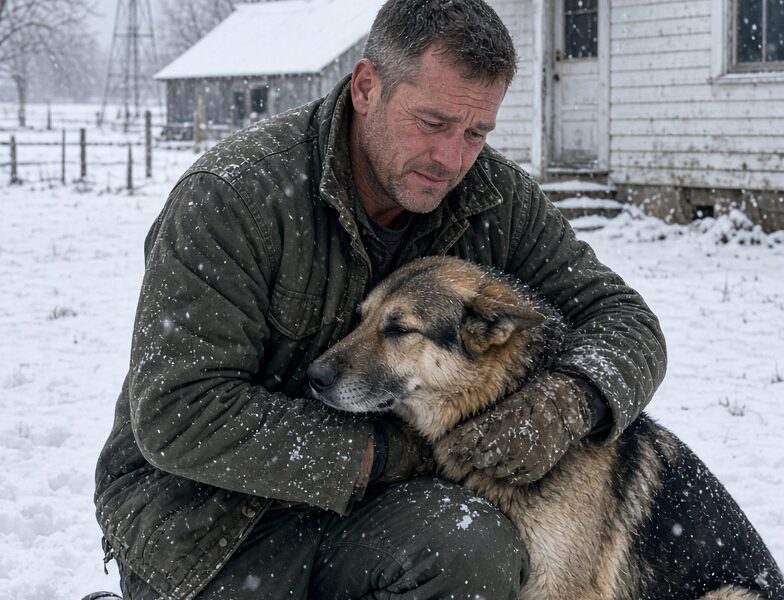
He Was Told His War Dog Died… Until He Found Him for $20 on a Snowy Porch
## Part 1
The snow had been falling since before sunrise, laying a clean white cover across the fence posts and empty fields outside Helena, Montana.
Staff Sergeant Mason Hail drove his aging red pickup west along a narrow county road, the heater working hard against the January cold.
Mason was thirty-nine, just over six feet tall, broad-shouldered from nearly two decades in the Marine Corps. His close-cropped brown hair had begun to gray near the temples, and his weathered face looked older whenever he was tired.
His blue-gray eyes tended to study a room before he entered it. His habit of speaking only when necessary had earned him a reputation for being distant. In truth, Mason had simply learned that silence was easier than explaining things people could not see.
Five years earlier, an overseas deployment had ended with an emergency evacuation, several injuries, and the loss of the one partner whose absence he had never learned to discuss.
Since then, Mason had become even more deliberate about where he went, what he kept, and which memories he allowed himself to revisit.
That morning, however, he was driving toward one of them.
His father’s old house sat another fifteen miles away, empty since Daniel Hail had died eighteen months earlier. Mason had promised himself he would spend the weekend checking the pipes, clearing snow from the porch, and finally deciding what to do with the place.
He might have reached the house without stopping if an old utility truck ahead of him had not slowed abruptly near a bend. A loose load cover had come partly undone, and the driver pulled onto the shoulder to secure it.
Mason eased his pickup behind the truck and waited. With nowhere to go, he glanced across the road toward a farmhouse he had probably passed dozens of times without noticing.
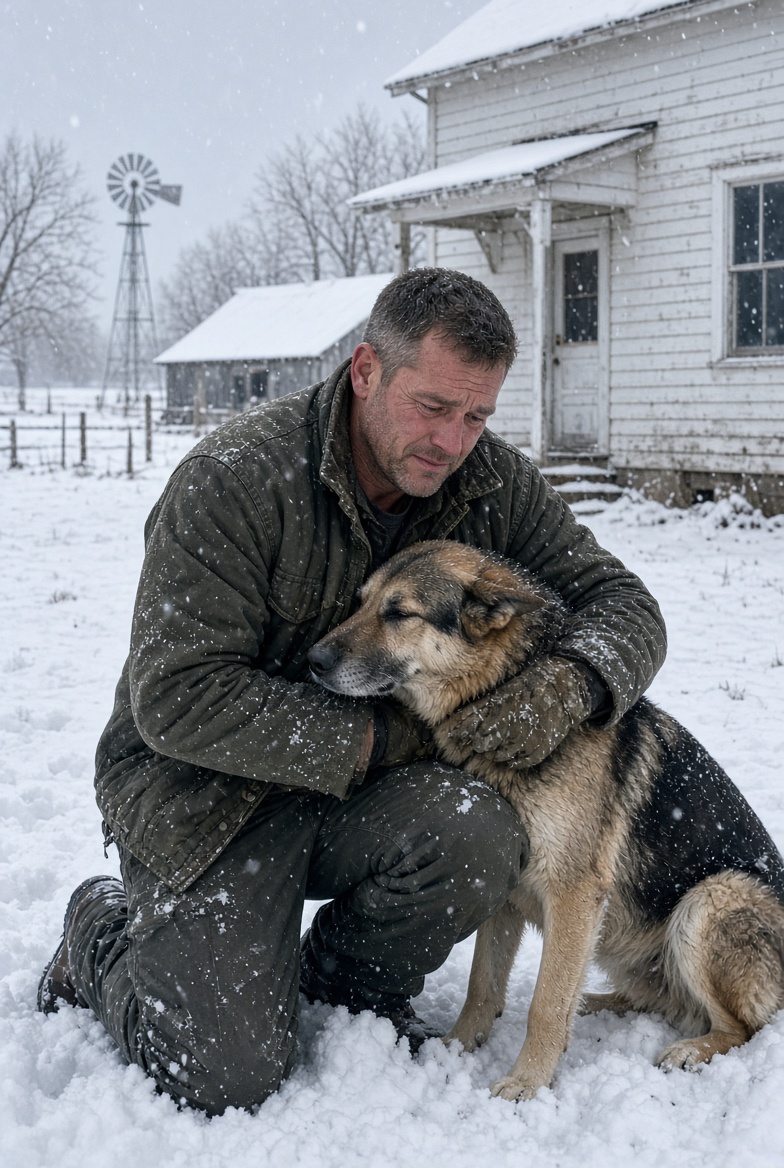
It was a modest white wooden place with peeling paint along the porch rails, a windmill standing motionless behind the barn, and several bare cottonwood trees bending slightly under the snow.
Then Mason noticed the dog.
An aging German Shepherd sat near the end of the porch, secured with a long rope that allowed him to move across the sheltered boards without reaching the road. Above him, tied to a porch post, hung a flattened cardboard sign written in thick marker: “Dog for sale. $20.”
Mason looked away almost immediately. Older dogs appeared in farm country for all kinds of ordinary reasons. Families moved, owners became ill, working animals aged. None of that was his business.
The utility truck ahead still had not moved, so Mason glanced back one more time.
The German Shepherd had lifted his head.
He was large despite his age, with a black saddle across a faded tan coat and a muzzle touched heavily with gray. Snow dusted his shoulders. His right ear stood unevenly, folding slightly near the upper edge, while his left hind leg remained positioned with careful stiffness.
The dog did not bark or strain against the rope. He simply stared across the road at Mason’s pickup with an unsettling concentration.
Mason felt something tighten behind his ribs.
He had seen that ear before. He had seen that cautious way of shifting weight away from the left rear leg. But five years could make memory unreliable, and grief could make a man recognize ghosts wherever he wanted to find them.
Mason opened the truck door anyway.
The cold struck him immediately. He crossed the road slowly, boots pressing through several inches of powder, telling himself he was only going to look closer.
Halfway across the yard, the shepherd rose. His movement was slower than Mason remembered, but the way his eyes traveled over Mason’s hands, shoulders, and face was painfully familiar.
Mason stopped ten feet from the porch.
Five years earlier, Ranger had been a powerful six-year-old German Shepherd assigned to a Marine working dog support unit. He had been alert without being nervous, serious while working, and almost ridiculous off-duty whenever he discovered an unattended tennis ball.
Ranger’s right ear had been bent during his younger years and never stood perfectly afterward. A training injury had also left his rear leg vulnerable, though it had never prevented him from doing his job.
Mason had spent hundreds of hours beside that dog—training, traveling, waiting, working, and sometimes simply sitting in silence during nights when neither of them could sleep.
Then came the evacuation.
Mason had been taken out for medical treatment while Ranger remained with the secondary support team. Days later, a report reached him stating that Ranger had not survived the later medical transport. Mason never saw the dog again.
There had been no reunion, no retirement ceremony, no final goodbye—just paperwork.
He had spent five years accepting that the last time he saw Ranger had been the last time there ever could be.
The shepherd took a slow step toward him.
Mason’s throat tightened, but he still refused to trust what he wanted to believe. There was one thing no stranger could have taught this dog by accident.
Years earlier, while working on close positioning, Mason had created a private hand signal because Ranger occasionally moved several inches too far forward when excited.
Mason lowered his left hand beside his thigh and closed two fingers together. He said nothing.
For a moment, the dog remained still. Then his posture changed.
He stepped off the porch carefully, came directly to Mason’s left side, turned his body, and settled his shoulder against Mason’s leg in the exact position he had taken hundreds of times before.
Mason forgot the cold. He forgot the snow soaking into his boots. His hand hovered above the dog’s head because touching him somehow felt more impossible than seeing him.
Ranger looked up. The same deep brown eyes met his.
Mason finally rested his palm behind the bent ear. His control broke quietly. He turned his face away, covered his mouth with one gloved hand, and tried to breathe through a grief that had suddenly changed shape.
He had mourned Ranger for five years. Now the dog was leaning against him as though five years had been an unusually long afternoon.
Ranger did not jump or whine. Age had taken some of that energy from him. Instead, he pressed closer until Mason crouched beside him and wrapped one arm carefully around his shoulders. The shepherd rested his muzzle against Mason’s chest.
For a long moment, Mason could not decide whether the feeling inside him was joy, relief, disbelief, or anger at all the lost time. In the end, it was simply too much to name.
The farmhouse door opened behind them. Ruth Caldwell stepped onto the porch carrying a heavy-knit cardigan around her shoulders.
Ruth was sixty-eight, short and sturdy with silver hair cut just below her ears, clear green eyes, and the practical expression of a woman who had spent most of her life solving problems before complaining about them. She had been widowed for nearly a decade and maintained the small property mostly by herself until worsening hip pain finally convinced her daughter that independence had limits.
Ruth disliked being fussed over, but she disliked making promises she could not keep even more. Her hip surgery was scheduled for the following week, and afterward she would be moving temporarily—perhaps permanently—to her daughter’s home near Missoula.
She stopped when she saw Mason kneeling beside the shepherd. “Well,” she said softly, studying them both. “I suppose that answers one question.”
Mason stood slowly. “How long has he been here?”
“About two years.” Ruth rested one hand on the porch railing.
She explained that Ranger had not originally belonged to her. A driver had appeared one cold evening and asked whether he could leave the dog near an unused storage building on the edge of her property for a few days. He claimed he was sorting out a housing problem and would return. Ruth had been suspicious but agreed because the dog looked tired and the weather was turning bad.
The man never came back. She moved the shepherd into the farmhouse, fed him, contacted nearby shelters and veterinary offices, and posted notices in several towns. No one claimed him. Eventually, Ranger simply became part of the property. He followed Ruth to the barn, slept near the kitchen door, and spent warm afternoons beneath the cottonwoods.
“He’s a good dog,” she said. “Always has been. But I can’t take him where I’m going, and I won’t pretend I can manage him after surgery.”
Mason looked at the cardboard sign. “Why twenty dollars?”
Ruth gave him a tired smile. “Because free attracts people who haven’t thought past the drive home. Twenty dollars isn’t much, but it makes them stop and decide whether they actually mean it.”
She added that several people had asked about Ranger, but most wanted a younger dog. One family had been kind but admitted they needed something more active for their children. Ruth had refused another person after realizing he had no plan for caring for an older large breed dog. She had been waiting for someone who looked at Ranger instead of the price.
Then she mentioned something Mason found strange. Ranger had always paid close attention to diesel engines. When large trucks passed the property, he often went to the edge of the porch and watched until they disappeared down the road. He never chased them. He simply waited.
Mason reached for his wallet and removed a twenty-dollar bill. Ruth accepted it, then immediately handed most of it back.
“Buy him decent food with that. The sign says twenty. The sign did its job.”
Mason almost argued, then recognized the expression of someone who would enjoy winning the argument more than he would. He folded the returned bills into his pocket and accepted the worn leash Ruth handed him. Ranger moved to Mason’s side without hesitation.
Before leaving, Mason removed the old collar to check whether it was too tight beneath the thick winter coat. The leather was cracked, faded, and clearly older than the time Ranger had spent with Ruth.
As Mason turned it over, his thumb caught against a small piece of metal tucked beneath the inner fold. It looked like the remains of an identification plate, scratched and dulled by years of use. Most of the engraving had worn away, but one sequence remained readable.
FCL 287.
Mason stared at it. Ruth leaned closer. “You recognize that?”
“No, but something about the neat industrial lettering bothers me.” It did not look like a pet tag. It looked like inventory.
Mason slid the metal piece carefully into his jacket pocket, replaced the collar loosely, and led Ranger toward the red pickup.
The old shepherd paused at the passenger door, looking at the high seat. Mason remembered the stiffness in his hind leg and lifted him gently rather than making him climb. Ranger settled onto the passenger side, turned once, and rested his head against the seat as though the place belonged to him.
Mason closed the door and stood in the snow for several seconds, looking through the window at the partner he had buried only in memory.
He had started the morning thinking he was driving toward his father’s empty house to decide what part of the past he was finally ready to leave behind. Instead, the past had been waiting on a farmhouse porch beneath a twenty-dollar sign.
As Mason climbed behind the wheel, Ranger opened his eyes and looked at him. Mason placed one hand on the steering wheel and the other briefly against the dog’s shoulder.
Five years of certainty had vanished in less than an hour. Ranger was alive. That should have been enough for one day.
Yet, as Mason felt the small metal plate inside his jacket pocket, one question refused to leave him. What was FCL 287? And how had Ranger traveled from a military evacuation five years earlier to a snowy porch outside Helena with his real name apparently lost somewhere along the way?
—
## Part 2
By the time Mason Hail turned his red pickup toward Big Sky Veterinary Center, the snowfall had softened into thin white streaks that swept across the road and disappeared beneath the tires.
Ranger lay on the passenger seat with his head resting near Mason’s coat, opening his eyes every few minutes as if checking that the man beside him had not vanished again.
Mason had spent the drive trying not to stare. Five years of believing Ranger was gone had built a wall inside him that one impossible morning could not immediately tear down. He kept thinking about the stiff rear leg, the gray muzzle, the worn collar, and the small metal plate now resting in his jacket pocket.
FCL 287. He did not know what the letters meant, but he knew enough about military equipment and transport systems to recognize that the marking had been made for a reason.
For now, however, answers could wait. Ranger needed a veterinarian first.
Big Sky Veterinary Center stood on the northern edge of Helena in a low stone and timber building surrounded by spruce trees heavy with snow. The clinic was modest but carefully maintained, with wide doors for large animals, heated floors near the examination rooms, and photographs of retired police dogs framed along one hallway.
Dr. Hannah Brooks met Mason near the reception desk. Hannah was thirty-six, about five foot seven, lean rather than delicate, with dark auburn hair tied loosely behind her head and gray-green eyes that seemed to notice details before people finished explaining them. She wore charcoal scrubs beneath a faded blue fleece jacket and moved with the unhurried confidence of someone accustomed to frightened animals and worried owners.
Hannah had spent several years working with municipal K-9 units and retirement programs before returning to Montana. Early in her career, she had watched an older police shepherd struggle to find a permanent home after his handler became seriously ill, and the experience had changed the way she viewed working animals. Since then, she had developed a particular patience for dogs whose careers had ended before anyone had decided what came next.
Hannah did not reach for Ranger immediately. She crouched several feet away, letting him study her. Ranger lifted his head, watched her hands, then looked back toward Mason.
“He’s still reading the room,” she said.
Mason nodded. “He always did.”
Hannah glanced at him. “Always?”
Mason hesitated before answering. “He was my working dog.”
That changed her expression, though not dramatically. She simply looked at Ranger again with greater attention. Mason added, “Five years ago, I was told he died.”
Hannah stopped for a second. She did not ask whether Mason was certain. Instead, she opened the exam room door and said, “Then we start with what we can prove today.”
The physical examination took nearly an hour because Hannah refused to rush him. Ranger’s heart and lungs sounded strong for his age. His teeth showed years of use but nothing urgent. He was underweight, though not severely, and his coat had lost some of the density Mason remembered.
Hannah carefully checked the old left hind leg problem and found chronic stiffness around the knee and hip. “Arthritis,” she said, “and probably an old ligament injury that healed with less support than I would have wanted.”
Mason looked toward Ranger. “Can it be managed?”
Hannah nodded. “Absolutely. Controlled exercise, weight gain, joint support, medication if he needs it, and no pretending he’s six years old because his brain still thinks he is.”
Ranger watched her as though mildly offended. Hannah almost smiled. “That look is familiar. Retired working dogs usually surrender the schedule before they surrender the job.”
The comment eased something in Mason. He admitted Ranger had once been almost impossible to keep still when a vehicle door opened. Hannah asked how much activity he had done recently, and Mason explained that he had only found him that morning.
She paused, realizing the entire reunion had happened only hours earlier. “Then today counts as enough excitement for both of you.”
Mason did not argue. Hannah prepared a conservative feeding plan and demonstrated several gentle mobility exercises Mason could use at home. Nothing about the dog suggested an immediate medical crisis. That should have been the best news Mason had received in years.
Yet the small metal tag in his pocket kept pulling at his attention.
When Hannah brought out a microchip scanner, Mason expected the mystery to become simpler. It did not.
She passed the scanner over Ranger’s shoulders once. Nothing. She tried again, slower. Still nothing.
“Military and police dogs are usually identifiable,” Hannah said. “Was he chipped?”
“Yes,” Mason answered without hesitation. He remembered paperwork, vaccinations, transport records—everything that had once made Ranger impossible to confuse with another dog.
Hannah ran the scanner lower along the shoulder and then toward the upper chest. A faint tone interrupted the silence. She stopped. “Wait.”
She moved back across the same area. The device responded again. The chip had migrated farther from its original placement than usual, buried deeper beneath the tissue near the shoulder. The scanner produced only a partial number on the first pass, then a longer sequence.
When Hannah adjusted the angle, Mason stood beside the table while she copied the digits onto a pad. “Can you trace it?”
“Maybe.” Hannah moved to a computer terminal. Because of her previous work with retired police dogs, she still had access to several legitimate identification networks and archival systems used by veterinary professionals. She warned Mason that older records could be incomplete, transferred between databases, or contain clerical errors. “Whatever we find, we don’t jump ahead of it.”
Mason appreciated that. He had spent too much of his life in environments where assumptions could become mistakes. “Agreed.”
The first registry returned nothing useful. The second recognized part of the number but redirected Hannah to an older working dog database. After several minutes, an archived profile appeared.
There was a younger photograph of a German Shepherd with a darker muzzle, stronger rear legs, and the same uneven right ear. Mason stepped closer before Hannah even read the screen aloud.
The record identified him as Ranger MWDR392.
For several seconds, Mason could only stare at the photograph. It was not merely proof that Ranger had once existed. It was the exact service number Mason remembered from five years earlier.
Then Hannah scrolled down.
Status: deceased.
The date matched the week of Mason’s evacuation.
The examination room seemed to become smaller. Ranger lay on a padded mat a few feet away, breathing slowly, one front paw stretched toward Mason’s boot, while a government-length archive declared that he had been dead for five years.
Mason read the line twice. “Can that be wrong?”
Hannah folded her arms lightly. “Records can be wrong. Status entries can be entered incorrectly. Systems can inherit old information. I’m not going to tell you what happened without evidence.”
Mason’s jaw tightened, but he nodded. Her refusal to speculate made the record more unsettling, not less.
Hannah searched the accessible history attached to the profile. Most of it ended near the evacuation period. Medical notes were limited. Several fields had been closed automatically when the status changed, but one transport reference remained visible beneath the final movement entry.
Hannah leaned closer. “Here.”
Mason removed the metal plate from his jacket and placed it beside the keyboard. On the screen was the same sequence: FCL 287.
Beside it appeared a contractor name: Frontier K9 Logistics.
Hannah looked from the screen to the worn tag. “That’s not random.”
Mason’s voice stayed low. “No.”
The name meant nothing to him, but seeing it connected to Ranger’s official service file transformed the piece of metal from a curiosity into the first solid link to the years he could not account for.
Hannah printed the section he was permitted to retain and advised him to preserve the tag rather than clean or alter it. She also copied the medical information needed for Ranger’s future care.
Before they left, Hannah mentioned a small retirement facility she helped support outside Helena called Last Patrol. It had originally been created for older police and military dogs whose handlers could no longer keep them or whose retirement placements had failed. The facility was struggling financially. Rising heating costs, veterinary bills, and several recent intakes meant part of the kennel area might have to close by spring.
Hannah had been trying to build a low-pressure rehabilitation program where retired working dogs could recover physically before permanent placement. She suggested Ranger might eventually benefit from supervised mobility sessions there.
Mason’s answer came quickly. “I’m not putting him in front of cameras.”
Hannah raised an eyebrow. “I didn’t say anything about cameras.”
Mason realized how defensive he sounded. “I don’t want his story turned into something people use.”
Hannah’s expression softened but did not become pitying. “Neither do I. Last Patrol is for dogs, not publicity. You can say no.”
Mason did, at least for now.
—
## Part 3
Late that afternoon, Mason finally reached his father’s house. The small cedar-sided home sat beneath tall pines several miles outside Helena, exactly as Mason had left it after his last inspection.
Daniel Hail had been a carpenter with wide hands, a dry sense of humor, and an almost stubborn affection for fixing things rather than replacing them. He had raised Mason in that house after Mason’s mother died when he was a teenager.
Daniel’s death eighteen months earlier had left the rooms painfully unchanged. Tools still organized in the garage, an old wool coat hanging by the door, coffee mugs stacked exactly where he had kept them. Mason had avoided staying there overnight because every object seemed to ask a question he did not want to answer.
Ranger changed the house before Mason could.
The moment Mason opened the front door, the old shepherd stepped inside, paused, and sniffed the air. He moved through the living room slowly, past the worn sofa and Daniel’s heavy oak chair, then stopped beside the stone fireplace.
Mason remembered bringing Ranger there during leave many years before. The dog had slept on the same patch of rug every evening, close enough to the fire to become too warm, and then refused to move.
Now Ranger circled once and lowered himself onto that exact place.
Mason remained standing in the doorway with his coat still on. “You remember?”
Ranger rested his muzzle on his paws.
For the first time since Daniel’s funeral, the house did not feel entirely occupied by things that would never return.
That night, Mason sat at his father’s old desk with Ranger sleeping near the fireplace. He typed Frontier K9 Logistics into his laptop.
The company had once provided transportation services for military, police, and other working dogs across several western states. Old archived business pages described climate-controlled vehicles, veterinary transfer coordination, and retirement relocation assistance. The company had stopped operating three years earlier. Mason found no explanation on the public pages for why it had closed.
He kept searching only through ordinary public information, resisting the temptation to decide what any of it meant.
Then an archived company page loaded. At the top was the Frontier K9 Logistics logo: a bronze wolf’s head set inside a sharp triangular outline.
Ranger’s head came up.
Mason noticed immediately. The shepherd rose from the fireplace rug despite the stiffness Hannah had warned about and stared across the room toward the laptop screen. His body was not aggressive. He did not bark or move toward the computer, but his relaxed expression disappeared, replaced by the focused stillness Mason remembered from working days.
Mason slowly turned the laptop so the image faced Ranger more clearly. The dog continued staring at the bronze wolf.
Mason looked down at the printed veterinary record beside his hand. Ranger, MWDR392, status deceased. FCL 287, Frontier K9 Logistics.
He had taken Ranger to the clinic hoping to learn whether his old partner was healthy enough to come home. He had received that answer. Ranger could recover. He could eat well again, move carefully, sleep near the fireplace, and grow old somewhere safe.
But the day had given Mason something else. The official record said Ranger had died five years ago. The transport code said Frontier K9 Logistics had been part of his final documented journey. And Ranger, who could not explain where he had been, had just reacted to the company’s symbol as though the past had entered the room.
Mason closed the laptop. He did not yet know what any of it meant. He only knew that FCL 287 was no longer just a worn number inside an old collar. It was the first real trail Ranger had brought home with him.
—
Mason Hail slept badly for the next three nights. Ranger slept better than he did.
The old German Shepherd had settled into Daniel Hail’s house with an ease that Mason almost envied, returning each evening to the rug beside the stone fireplace and waking only when the furnace changed cycles or a vehicle passed somewhere beyond the pines.
Mason, meanwhile, spent hours at his father’s desk rereading the veterinary printout from Big Sky Veterinary Center. Ranger MWDR392. Status deceased. FCL 287. Frontier K9 Logistics.
Every time he reached the same three lines, he told himself not to invent an explanation before evidence existed. That discipline became harder after midnight. He kept imagining five missing years as an empty corridor with Ranger somewhere inside it.
On the second night, Mason brought the cardboard sign from the truck and leaned it against the wall near the desk. Dog for sale. $20. He could not bring himself to throw it away. It was ugly, stained along one corner and written in Ruth Caldwell’s uneven marker, but it had become evidence of something larger than twenty dollars.
Five years earlier, Ranger had carried a military service number. Weeks ago, he had apparently been nothing more than an old dog on a porch.
Ruth called the following morning. She was still preparing for her hip surgery and spoke with the stubborn cheerfulness of someone determined not to sound worried. Mason told her Ranger had been examined, was underweight but stable, and would need controlled exercise for arthritis.
Ruth seemed relieved enough to scold him for not mentioning sooner that Ranger had once been a military dog. Mason explained that he had only confirmed it after leaving her property.
“I knew he had manners,” she said. “Nobody sits that straight for canned food by accident.”
Mason almost laughed. Ruth then asked whether Ranger had slept by the door. Mason looked toward the fireplace. “No, by the fire.”
Ruth was quiet for a moment. “Good. He always watched the road at my place. Maybe he finally figured out he doesn’t need to.”
The remark stayed with Mason long after the call ended. Ruth had expected to disappear from his life the moment Ranger left her porch. Instead, she had become the person who could tell Mason things about two years of Ranger’s missing life that nobody else could. He began returning her calls instead of letting them go to voicemail—a small habit that surprised him more than it should have.
That afternoon, Mason drove to the Lewis and Clark County Sheriff’s Office carrying copies of Ranger’s records, the veterinary scan results, photographs of the FCL 287 tag, and printouts from Frontier K9 Logistics’ archived website.
Deputy Lucas Grant met him in a plain interview room overlooking the snow-covered parking lot. Lucas was forty-one, six foot two, lean, dark-skinned, with a shaved head, careful brown eyes, and a habit of placing documents into precise square stacks before discussing them.
He had spent thirteen years in county law enforcement, including several years working financial and property investigations. Early in his career, he had helped build a case around a witness whose memory later proved unreliable, forcing the department to withdraw several claims. The experience had changed him. Lucas was courteous, but he treated certainty as something that had to be earned.
He listened to Mason without interrupting, then examined the records one page at a time.
“The dog being alive does not automatically mean somebody committed a crime,” he said. “Databases get copied. Status codes get entered incorrectly. Contractors transfer files between systems. People make mistakes.”
Mason nodded. “I know.”
Lucas looked up. “Good. Because if we find something real, I want it to stay real.”
Lucas began with records that could be lawfully checked: old business filings, public contract references, kennel licensing documents, transport registrations, and addresses associated with Frontier K9 Logistics. Frontier had operated for more than a decade before closing three years earlier. Its public materials described veterinary transfers, handler reunifications, retirement placements, and interstate movement of military and police dogs.
At first, nothing about the company looked unusual. Then Lucas started cross-referencing its final six years of transport activity against available destination records.
The numbers were not proof by themselves, but they were difficult to ignore. Forty-two working dogs had passed through records tied to Frontier during that period. Eleven were listed as deceased, either during transport or shortly afterward. Six reached a transfer stage but had no verifiable final placement recorded in the systems Lucas could access. Four retirement organizations listed as destinations did not appear to have operated at the addresses attached to them.
Ranger was among the eleven marked deceased.
Lucas printed the list and circled nothing. Mason noticed. “You’re not calling that coincidence.”
“I’m not calling it anything yet.” Lucas leaned back. “Some of these could have legitimate explanations—different legal names, bad archiving, facilities that closed. But there are enough inconsistencies that I can justify asking more questions.”
Mason looked down the page. Ranger’s service number was no longer alone.
That was the moment the mystery changed for him. Until then, the problem had been personal—one dog, one wrong record, one five-year absence. Now there were seventeen other entries carrying some form of uncertainty.
Mason felt a familiar pressure building behind his eyes.
—
## Part 4
Ranger returned to Big Sky Veterinary Center two days later for his first mobility session. Hannah Brooks used low-impact exercises, slow controlled turns, and short stretches rather than pushing the old shepherd beyond what his joints could comfortably manage.
Mason expected Ranger to resist being treated like a retiree. Instead, Ranger tolerated Hannah with growing trust, particularly when she allowed him time to decide each movement.
During the appointment, two older veterans arrived for a scheduled visit connected to Last Patrol. One was Frank Delaney, sixty-seven, a compact former Army mechanic with a white mustache, heavy winter coat, and a dry sense of humor that surfaced whenever conversation became too serious. The other was Maria Torres, sixty-two, a retired Air Force logistics specialist with short salt-and-pepper hair and a calm, observant manner.
Hannah introduced them only briefly. Ranger watched both from across the room, then slowly walked toward Frank and sat beside his chair without being called.
Frank rested one hand near Ranger’s shoulder but waited until the dog leaned closer before touching him. Mason noticed the change immediately. Ranger had spent days watching exits and listening to engines. Yet around the two veterans, his body softened.
Hannah noticed Mason watching. “That’s what I was trying to tell you about Last Patrol.”
Mason folded his arms. “You said rehabilitation.”
“That too. But some dogs relax around people who understand structure. And some people relax around dogs that don’t ask them to explain themselves.”
Mason glanced at Frank, who was quietly rubbing Ranger behind the bent ear. Hannah did not push the idea further. That restraint continued to earn Mason’s trust.
Their conversations had become easier since the first examination. They still knew little about each other beyond work, Ranger, and the shelter, but Mason no longer interpreted every suggestion as an attempt to turn his reunion into a public story. Hannah, for her part, never asked him to describe the mission where Ranger disappeared. She seemed to understand that some histories were better approached from the present.
—
Lucas called the next evening. He had found someone willing to speak: Caleb Voss, a former Frontier driver.
They met at a quiet diner on the south side of Helena, where the windows had fogged from the heat inside. Caleb was fifty-five, narrow through the shoulders with thinning gray hair, a lined face, and large hands marked by decades of mechanical work. He wore a brown canvas jacket despite the warmth and kept one hand wrapped around a coffee cup as if he needed something solid to hold.
Caleb had driven commercial trucks most of his adult life. He had joined Frontier after a back injury forced him away from freight loading and had left less than two years later. He was not unfriendly, but he was visibly uncomfortable discussing the company.
“I didn’t see crimes,” he said first.
Lucas answered calmly. “I didn’t ask you to call anything a crime. Tell us what you actually saw.”
That distinction mattered.
Caleb slowly explained that most Frontier runs had seemed ordinary. Dogs moved between clinics, agencies, retirement facilities, and handlers. The paperwork generally matched what was on the vehicle. But certain nighttime movements bothered him. Some documents used labels such as “medical transfer” or “deceased pickup.” Yet Caleb remembered passing secured transport kennels and realizing that some animals listed in closed-status paperwork were clearly still alive and responsive.
He had questioned a supervisor once and had been told that drivers were responsible for routes, not records. Caleb stopped asking. He also started saving things—not original government documents, he emphasized, but personal photographs, copied schedules he had been given, and notes about dates that did not make sense to him.
From an old envelope, Caleb removed several photographs. Most showed vans, kennel rows, loading areas, or blurred dogs behind transport barriers. Mason went through them slowly.
The fourth photograph made his hand stop.
It showed the rear interior of a transport van with several secured kennels arranged along the sides. Inside one stood a German Shepherd. The image was grainy, but the right ear bent at the top. On the left hind leg, a rectangle of shorter fur suggested recent veterinary treatment.
Mason turned the photograph over. A date had been written on the back. Nine months after Ranger had officially died.
Mason looked at Caleb. “Where was this taken?”
“Frontier yard outside Helena.”
“You sure?”
“I took it.”
Lucas studied the photograph without changing expression but immediately placed it into a protective sleeve. Mason did not need Ranger’s microchip to know what he was seeing. He had spent years recognizing that silhouette at a distance.
That was Ranger.
Caleb hesitated before gathering the remaining photographs. Then he added one last detail. Frontier K9 Logistics had closed on paper three years earlier, but he had occasionally seen vehicles resembling the company’s old transport vans near Silver Creek Industrial Yard, an aging cluster of warehouses east of Helena. He could not say who currently owned them or what they were being used for.
Lucas made him repeat that distinction. Caleb did.
Then Mason asked who had run Frontier during the years Ranger passed through it.
Caleb’s expression tightened. “Gavin Shaw.”
Mason had already seen the name on old corporate pages. Gavin Shaw was fifty-seven now, according to public business records—tall and silver-haired in archived promotional photographs, usually dressed in pressed shirts and expensive outdoor jackets rather than work clothes. Former company profiles described him as a founder with a background in private logistics and a polished talent for convincing agencies that Frontier could handle complicated transportation problems.
Caleb remembered him differently. Controlled, persuasive, and uncomfortable with employees who asked questions outside their assigned jobs.
Mason looked again at the photograph of Ranger behind the transport kennel. For the first time, the five missing years were no longer completely blank. Nine months after the day Mason had been told Ranger was dead, his partner had still been alive inside a Frontier vehicle in Montana.
And Ranger was no longer the only dog whose paperwork did not make sense.
—
The storm arrived over Helena before noon, swallowing the mountains behind a wall of white and turning the county roads into pale ribbons between dark stands of pine. By mid-afternoon, schools had begun dismissing early. Highway crews were warning drivers to stay off secondary roads, and wind pushed loose snow across the fields faster than plows could clear it.
Mason Hail was at his father’s house when Deputy Lucas Grant called. Ranger was asleep beside the fireplace after a short morning walk, his gray muzzle resting across his paws, while Mason sat at Daniel Hail’s old kitchen table studying the photograph Caleb Voss had provided two days earlier.
Nine months after Ranger had supposedly died, the German Shepherd had been standing alive inside a Frontier K9 Logistics transport van. Mason had studied the photograph so many times that he knew every blurred corner of it.
Lucas did not waste time on greetings. Caleb had contacted him less than an hour earlier. The former driver said he had found something while clearing boxes from a rented storage unit: an old transport ledger from his Frontier years.
According to Caleb, it contained handwritten service numbers, replacement identification, destination codes, and buyer references that never appeared on the official records Lucas had reviewed. Caleb was frightened enough that he refused to describe everything over the phone. He wanted to hand it over in person at an abandoned fuel station off an old service road near Silver Creek Industrial Yard.
Mason looked through the kitchen window. Snow was already reaching the lower porch step. “He picked a bad day.”
Lucas agreed. Caleb had insisted he could make the short drive before conditions worsened, and Lucas had reluctantly agreed to meet him because the ledger might matter. Mason was not officially needed, but Caleb had asked that he come.
Forty minutes later, Mason reached the old station in his pickup with Ranger secured comfortably in the rear seat rather than the higher passenger side. Lucas was already there in a county SUV, standing beneath the rusted canopy with his dark winter jacket zipped to his throat. Snow gathered along his shoulders while he checked his phone for the third time.
Caleb was twenty-five minutes late.
That alone was not alarming in a storm. An hour later, it was harder to dismiss.
Lucas called Caleb repeatedly with no answer, then contacted County Dispatch and began checking road incidents along the route Caleb would most likely have taken. Mason stayed quiet while Lucas worked. He knew better than to turn delay into disaster simply because the situation already carried too many unanswered questions.
A road crew eventually reported an unattended pickup partly off a service road east of Silver Creek. The description matched Caleb’s truck.
Lucas immediately drove toward the location with Mason following at a safe distance. The pickup had slid into a shallow snowbank rather than suffering a serious collision. The driver’s door was closed, the engine was off, and there was no sign of Caleb nearby. His phone lay on the passenger floor, apparently dropped when he left the vehicle.
Lucas checked the truck without disturbing more than necessary. A wool cap was missing from the seat, and footprints disappeared into wind-blown snow toward a line of maintenance structures farther from the road. Caleb’s work bag was not inside.
Lucas radioed the location and requested assistance, but poor visibility and worsening roads meant additional units would take time. “He could have walked for shelter,” Lucas said. “The question is which direction.”
Mason looked toward Ranger. The old German Shepherd was already awake. Mason hesitated.
Five years earlier, he would have opened the door, given Ranger a command, and expected him to work until the task was complete. That instinct still existed somewhere inside him. But Ranger was no longer a six-year-old operational dog. He was ten, arthritic, recovering from years Mason did not fully understand, and Hannah had made his limitations very clear.
Mason opened the rear door and let Ranger step carefully onto the packed snow. He allowed him to smell Caleb’s glove from the truck, then watched his posture. Ranger’s ears shifted forward, his nose worked along the air and the edge of the road.
Mason knelt beside him. “Easy, partner. We do this your way.”
Lucas noticed the difference in Mason’s tone. This was not an order issued to equipment. It was a request made to an old friend.
Ranger followed the trail slowly. Mason kept him on a long lead, giving him room without allowing him to disappear into poor visibility. Lucas walked several yards behind, marking their direction and updating dispatch.
The trail crossed a snow-covered drainage ditch, moved along an old fence, and continued toward maintenance buildings that belonged to a utility property no longer in regular use. After twenty minutes, Ranger’s pace began to shorten.
Mason immediately stopped. The shepherd looked back at him, visibly wanting to continue.
“No.” Mason crouched and rubbed the fur behind Ranger’s bent ear. “You’ve done enough.”
He gave Ranger water from a collapsible bowl and let him rest against his leg for several minutes. Lucas said nothing, but he understood what the moment meant. Years earlier, Mason had depended on Ranger’s endurance. Now he was protecting Ranger from the very instinct that made the dog refuse to quit.
When Ranger rose again on his own, Mason allowed a few more minutes. The dog turned sharply toward a low maintenance building, almost hidden behind a snow-covered equipment shed. One window had been boarded over; another was dark.
Lucas approached first and called Caleb’s name. A weak answer came from inside.
They found Caleb sitting on the concrete floor beside an old workbench, wrapped in an emergency blanket he had taken from a cabinet. He was cold, exhausted, and embarrassed, but alert. His right ankle had been injured when he lost his footing after leaving the truck, and rather than risk walking farther in worsening weather, he had taken shelter.
Nothing about his condition appeared life-threatening, and Lucas arranged for medical evaluation as soon as additional responders reached them.
Caleb’s first concern was not his ankle. “My bag. It’s under the workbench.”
Mason retrieved the battered brown canvas bag and placed it beside Caleb. The former driver immediately checked the zipper. Inside was the ledger.
Caleb looked older than he had at the diner only days earlier. His thinning gray hair was damp from melted snow, and fatigue had deepened the lines around his eyes. Fear had changed as well. At the diner, he had spoken like a man worried about what reopening the past might cost him. Now there was something closer to resignation in his face.
“I should have turned this over years ago,” he said.
Lucas did not reassure him. “Why didn’t you?”
Caleb stared at the ledger. “Because I told myself I didn’t know enough. Then I told myself somebody else would notice. Then Frontier closed and I decided it was over.” He looked at Ranger. “But it wasn’t.”
—
## Part 5
Back at the sheriff’s office that evening, after Caleb had been medically checked and told to remain off the ankle for a while, Lucas opened the ledger in a records room with Mason present as a witness.
Caleb had stored it in a plastic sleeve, preserving pages filled with dates, abbreviations, handwritten identification numbers, and old route references. It was not an official master file. Caleb explained that it had been used internally by drivers and dispatch personnel to reconcile kennel numbers during transfers. That made it valuable because it connected working dog identities before and after changes in paperwork.
Twenty-three entries stood out. Each listed an original service number, a later replacement name or code, and a buyer or destination reference. Some of the dogs matched the questionable records Lucas had already identified. Others were new.
Mason read down the page until his eyes stopped at the seventh entry.
MWDR392. Ranger.
Beside it, written in different ink, was another name: Cain. The next column read: “Private security animal.”
Mason did not speak for several seconds. He had been prepared for evidence that Ranger had been transported improperly. He had not been prepared to see his partner renamed as if everything before that moment could be erased by replacing one word with another.
Ranger had not simply disappeared from retirement records. Somewhere in the system, somebody had converted MWD Ranger 392 into Cain, a private security dog without the identity Mason knew.
Caleb watched him carefully. “Drivers sometimes used the replacement names so the kennel sheets matched the destination paperwork.”
Mason looked at him. “Did you know Ranger was Ranger?”
“Not then.” Caleb shook his head. “To me, he was a number in a crate. That’s the part I can’t stop thinking about now.” His voice became quieter. “I drove dogs because I thought I was helping get them where they belonged.”
That night, Caleb made a decision. He agreed to provide Lucas with every photograph, old schedule, note, storage box, and contact he still remembered. He did not call himself a whistleblower or a hero. In fact, he rejected both words. He said he was cooperating because silence had already lasted too long.
The ledger created another practical problem. If even some of the twenty-three dogs were still alive, they could eventually need temporary veterinary placement while identities were sorted out.
Mason called Hannah. She listened without interruption, then immediately began contacting the board responsible for Last Patrol. The shelter could not take unlimited animals, but Hannah offered to reserve several quiet kennels for older working dogs if authorities needed short-term care. It was a significant commitment for a facility already struggling financially.
Mason reminded her of that.
“I know,” Hannah said. “But if those dogs exist, they shouldn’t have to wait for our budget to become convenient.”
Unexpected help came the next morning from Ruth Caldwell. Her farm sale had finally closed, and she was preparing to leave for her daughter’s home before surgery. Mason had told her only the broadest version of what they had discovered. Ruth refused details she had no need to know, but she asked about Last Patrol.
Later that afternoon, Hannah called Mason to say Ruth had made a modest donation toward winter kennel expenses. When Mason phoned to protest, Ruth dismissed him. “I sold land I can’t take with me. Seems reasonable to help dogs that need somewhere to stay.”
That conversation led Mason to something else. While searching his father’s desk for old property papers, he found a folder of Daniel Hail’s charitable receipts. Mason had never paid much attention to them. Tucked between church donations and community repair projects were several small annual contributions to a regional senior dog rescue program.
Daniel had never mentioned them.
Mason sat at the desk holding one of the receipts while Ranger slept beside the fireplace. For eighteen months, Mason had treated the house like a museum filled with objects belonging to a man who was gone. Now he began noticing evidence that his father’s life had continued in ways Mason had never known. The house was not simply a container for memories. It could still become part of what came next.
—
By the end of the week, Lucas had finished organizing the first package of evidence: Ranger’s confirmed identity, the contradictory death status, Caleb’s photograph proving Ranger was alive nine months later, the questionable records involving multiple working dogs, and now the ledger connecting twenty-three original identities to replacement names and destination codes.
That was enough to move beyond a county-level records inquiry. Lucas called Mason into the sheriff’s office one final time before sending the material forward.
“This is no longer something I should keep inside one county,” he said.
Mason looked at the folder. Lucas continued, “I’m referring it to federal investigators familiar with contracting records and to the military side, because some of these service numbers belong to government working dogs.”
Mason nodded slowly. The storm outside had passed. Sunlight reflected off the snow beyond the station windows, almost painfully bright after days of gray.
For the first time, Mason understood the scale of what Ranger’s return might mean. The mystery was no longer how one dead dog had found his way home. It was why twenty-three working dogs had needed new names in the first place.
—
The first federal investigators arrived in Helena four days after Lucas Grant forwarded the Frontier K9 Logistics evidence. Mason Hail met them in a conference room at the sheriff’s office with Ranger resting beside his chair. The older German Shepherd had recovered well from the snowstorm search, but Mason had followed Hannah’s instructions carefully and given him several quiet days afterward.
Across the table sat Special Agent Nathan Cole, forty-six, a broad-chested man of medium height with closely cropped black hair, a neatly trimmed beard, and dark eyes that rarely revealed whether something surprised him. Nathan had spent seventeen years investigating government procurement and contractor fraud. Earlier in his career, a rushed case had collapsed when an investigator treated suspicious accounting as proof rather than evidence, and Nathan had never forgotten the lesson. He spoke slowly, asked precise questions, and seemed almost impossible to provoke.
Beside him sat Major Emily Ross, thirty-nine, an Army veterinary logistics officer with straight blonde hair tied behind her head, a tall athletic frame, and a composed manner that made even complicated records seem manageable. Emily had spent much of her career coordinating the medical transport and retirement of working dogs. To her, service numbers were not merely entries in databases. They represented animals and handlers who expected the system to bring them back together.
Emily placed Ranger’s identification records beside Caleb Voss’s ledger. “MWDR392,” she said. “Original name Ranger. Your dog.”
Mason nodded.
She then pointed to the replacement entry: “Later listed as Cain, private security animal.”
The words had not become easier to read.
Nathan explained that investigators had begun matching Caleb’s buyer codes against financial records, contract documents, archived transport permits, and corporate registrations. Caleb had cooperated fully, providing old schedules, photographs, names of dispatchers, and codes he remembered from Frontier’s final years. Several transactions crossed state lines, which expanded the inquiry far beyond Montana.
Still, Nathan reminded Mason that incomplete records did not automatically prove misconduct in every case. Some working dogs had apparently been transported properly. Others had reached legitimate retirement placements. The concern centered on a smaller group whose identities appeared to change after leaving government systems.
Then Emily opened a recovered military report. Mason recognized the date before he read the text. It came from the operation five years earlier—the same operation that had separated him from Ranger.
The document reconstructed what happened after Mason’s medical evacuation. A secondary recovery team had returned to the area and located Ranger alive. The shepherd had been exhausted and injured but stable enough to receive veterinary treatment. Over the following day, as his condition improved, once cleared for transport, Ranger was scheduled to return through an established logistics chain.
Mason stared at the page. “So he survived the entire time.”
Emily nodded. “He survived the incident. He survived recovery. He entered veterinary care alive.”
Mason swallowed. For five years, the memory that had haunted him most was leaving in the evacuation vehicle while Ranger remained behind. Rationally, he had known he had no choice. Emotionally, he had carried the belief that his partner died because Mason had gone first.
Nathan slid another document forward. Frontier K9 Logistics appeared in the transfer sequence soon afterward. Investigators had found evidence suggesting that Gavin Shaw learned highly trained dogs could command substantial prices in parts of the private security market. The emerging pattern did not show that every Frontier transfer was improper. Most appeared routine. But a subset of dogs had unusual status changes followed by private transfers that bypassed normal handler or retirement channels.
Ranger was among them.
“They didn’t just lose him,” Mason said.
Nathan did not answer for him.
Mason looked through the glass wall toward Ranger. “They changed who he was.”
—
The investigation moved quickly once the military records matched Caleb’s ledger. Buyer codes supplied by Caleb connected old Frontier transactions to businesses in several states. That evidence remained under review, but the Montana material was enough for investigators to seek legal authority to search Frontier’s former operational property at Silver Creek Industrial Yard.
The old company officially no longer operated there, yet records showed parts of the warehouse complex were still being leased through businesses with historical links to Frontier personnel.
Lucas made Mason’s role clear before the search. “You’re there because you can identify Ranger-related materials and because Emily believes Ranger may recognize spaces associated with his transport history. You are not law enforcement on this case.”
“I understand.”
“And if Gavin Shaw is there, you let us handle him.”
Mason looked down at Ranger. “I understand.”
Silver Creek Industrial Yard sat east of Helena between an old freight spur and a frozen drainage channel. The warehouse formerly used by Frontier was a long gray building with faded loading numbers above several doors. Nothing about it looked dramatic. That bothered Mason more than he expected. Five missing years should have belonged to some unmistakable place. Instead, part of Ranger’s history seemed connected to a building that looked like a hundred others across Montana.
Hannah Brooks arrived with the veterinary support team after authorities secured the property. She wore insulated work clothes beneath her clinic jacket and carried emergency veterinary supplies alongside two technicians. One of them, Dr. Marcus Bell, was fifty-two, heavy-set with a shaved head, warm brown eyes, and the patient temperament of a man who had spent twenty-five years treating animals that could not explain where they hurt.
Marcus had worked with Hannah on several retired police dog cases and volunteered with Last Patrol whenever older working dogs required more specialized evaluation. Their purpose was simple: if dogs were found, medical professionals would handle them.
Gavin Shaw was inside the warehouse.
The man Mason had seen only in archived company photographs was now fifty-seven, tall and lean, with silver hair combed neatly away from his forehead. He wore a charcoal wool coat over an expensive blue shirt, looking more like an executive arriving for a meeting than the former owner of a closed transport company.
Gavin spoke calmly with investigators and initially showed little outward concern. His strongest talent had always been presentation. Former employees described him as persuasive, intelligent, and able to make complicated decisions sound routine. Caleb had also described another side: Gavin disliked being questioned by people he considered beneath his level of responsibility.
Mason remained well back with Ranger while Nathan and the other investigators worked. Then Gavin saw the dog.
His expression changed for less than a second. “Cain.”
The name left his mouth before he seemed to realize he had said it.
Mason felt Ranger become still beside him. Nathan looked at Gavin immediately.
Mason did not move toward the man. He did not raise his voice. He simply rested his hand near Ranger’s shoulder and said, “His name is Ranger.”
Gavin recovered quickly. “There were hundreds of dogs through this company. Names get reused.”
Nathan took over the conversation. Mason stayed where he was.
Five years earlier, he might have imagined confronting the person responsible for keeping Ranger from him. Now that the moment existed, it felt smaller than he expected. Gavin could not return those years. Anger would not improve Ranger’s hips, erase the old records, or help the other dogs listed in Caleb’s ledger. The investigation belonged to people whose job was to prove what had happened. Mason’s responsibility was standing beside him on four aging legs.
—
The warehouse search continued room by room. Most spaces contained old equipment, storage racks, empty kennel frames, archived paperwork, and transport supplies. Ranger walked only short sections with Mason, never off lead. Mason watched his breathing and movement more carefully than whatever his nose might discover.
Near the rear corridor, Ranger stopped. Ahead stood a plain gray metal door. The shepherd looked beneath it, then back at Mason. He approached again and sniffed along the bottom seam. His posture sharpened.
Mason did not give a search command. Ranger scratched once at the door, then sat.
Lucas noticed. Investigators checked the room assignment against the search authorization and opened the secured door.
Behind it was a second kennel area that did not appear on the current warehouse layout provided to them. Five dogs looked back.
Two German Shepherds and three Belgian Malinois occupied separate clean transport kennels. They were older dogs, probably between seven and ten, with graying muzzles and the physical appearance of animals that had worked for much of their lives. None appeared to require emergency care. They looked tired, confused by the sudden activity, but alert and responsive.
Fresh water was present, and Hannah immediately reminded everyone to keep the room calm. Mason stayed outside while the veterinary team entered.
Every dog wore a newer collar. None carried a visible old service number.
One Belgian Malinois drew Emily’s attention. He was approximately nine, lean with a dark mask, faded tan coat, and a narrow patch of gray running beneath his muzzle. Part of an older identification tattoo remained visible where the newer documentation had failed to account for it.
Emily photographed the marking and compared it against a database from a tablet. Her face went still.
“Nathan.”
The agent approached. Emily showed him the screen. The Malinois had once been registered as MWD J184. Cobalt. His official status: deceased.
Mason looked at Ranger. One wrong death record could have been an administrative error. Now two supposedly dead working dogs were standing alive inside the same story.
—
Over the following hours, Hannah, Marcus, and the veterinary team transferred the five dogs carefully for complete evaluation. Last Patrol had prepared several isolated kennels in advance, and temporary arrangements had been approved so the dogs could remain quiet while their identities were investigated.
Only weeks earlier, Hannah had worried the facility might have to close part of its operation. Now it had become an important support site in a case involving missing retired working dogs.
The first identity confirmations came sooner than expected. In addition to Cobalt, investigators matched preliminary markings on another German Shepherd to an old law enforcement canine record from Washington State. A second possible handler connection emerged from Colorado. Both former handlers were still alive. Both had records indicating their dogs had died years earlier.
Nathan would not allow anyone to contact them until identification was conclusive. Mason understood why. False hope could be its own kind of cruelty.
Caleb’s buyer codes were now being compared against records in multiple states. He continued cooperating from home while his ankle healed, forwarding old contacts whenever investigators requested them. Each verified entry made the ledger more valuable.
By evening, Emily found Mason sitting alone in a quiet office at the sheriff’s station. Ranger lay beneath the table. She carried one document.
“The original recovery report,” she said.
Mason already knew what it contained, but knowing was different from reading. Emily placed it in front of him.
Mason followed the sequence line by line: operational separation, secondary recovery, veterinary intake, stabilization, transport authorization. Then he reached the sentence.
MWD Ranger recovered alive.
He stopped there.
Five years of guilt did not disappear dramatically. There was no sudden feeling that everything had been repaired. Instead, something inside Mason simply loosened. He had not abandoned Ranger to die. Ranger had survived. The system had brought him partway home. Then someone had redirected the journey.
Mason lowered his hand beneath the table. Ranger immediately rested his head across Mason’s boot.
For five years, Mason had carried the memory of leaving his partner behind. Now, for the first time, he understood the truth. He had left because he was ordered to survive. Ranger had survived, too. The reunion had been stolen from both of them, but it had not been lost forever.
And in the room beyond them, five other old working dogs were finally beginning the same journey back toward their real names.
—
## Part 6
Four months later, spring had finally returned to Montana. Snow still lingered in the highest folds of the mountains, but the valley outside Helena had turned green again, and yellow wildflowers appeared along the county roads where plows had piled dirty winter snow only weeks earlier.
At Daniel Hail’s old house, the change was even more noticeable. The porch had been repaired, the loose railing replaced, and the gutters Mason had ignored for more than a year finally hung straight.
Ranger spent most mornings in a patch of sunlight near the front steps. His coat had regained some of its old weight and shine. His hind leg remained stiff after long walks, and gray now covered most of his muzzle. But Hannah’s rehabilitation plan had helped him move more comfortably.
More important, something inside him had changed. During the first weeks after coming home, Ranger had slept facing the front door and lifted his head every time a diesel engine passed beyond the trees. Now he often slept with his back to the doorway. Trucks came and went along the county road. Ranger sometimes opened his eyes, but he no longer stood to watch them disappear.
The investigation into Frontier K9 Logistics had continued in the careful, unglamorous way Lucas Grant had predicted. There had been no dramatic ending in a courthouse hallway and no single document that explained every missing dog. Instead, investigators followed buyer codes, archived contracts, payment records, transport forms, and testimony collected across several states.
Gavin Shaw and several people connected to the former transport network were formally charged in relation to contract fraud, falsified records, and improper transfers.
Mason followed the case but stopped trying to learn every detail. He had once believed that knowing exactly how Ranger had disappeared would somehow return the lost years. By spring, he understood differently. The legal process mattered, but Ranger’s recovery did not have to wait for it to end.
The five working dogs found at Silver Creek all entered legitimate veterinary and retirement programs while investigators reconstructed their histories.
Cobalt, the nine-year-old Belgian Malinois whose official record had listed him as deceased, was eventually reunited with his former handler. His handler was Thomas Keen, fifty-eight, a retired Army sergeant with a broad frame, thinning blonde-gray hair, and a quiet manner that became even quieter whenever emotion threatened to show. Thomas had spent years believing Cobalt had died after a complicated medical transfer. When the identification was confirmed, he drove from Idaho to Montana without telling anyone except his wife.
Mason did not attend the reunion. Hannah later told him only that Thomas had sat on the floor for nearly an hour while Cobalt rested against him, neither of them needing much from anybody else.
A second dog, an older German Shepherd named Echo, was returned to her former law enforcement handler in Washington. One of the remaining Malinois was legally adopted by Robert “Bobby” Ellis, a sixty-four-year-old retired Montana State Trooper with a thick white mustache, heavy shoulders, and a requirement for talking to dogs more easily than people. Bobby had worked with K9 units for decades but had never owned a retired working dog himself. He chose the oldest of the available dogs because, as he told Hannah, younger animals usually had more people asking for them.
The last two dogs remained at Last Patrol in long-term retirement care while permanent arrangements were evaluated. Neither was rushed into another placement. After everything the investigation had uncovered, Hannah insisted that “somewhere” was no longer good enough. The next home had to be the right one.
Ranger’s own record was formally corrected in April. Major Emily Ross sent Mason a certified copy, though she warned him that several archived systems would take longer to update. The main line now read: “Recovered, retired, returned to former handler.”
Mason read it once at the kitchen table. Ranger was asleep beside the fireplace, his paws twitching slightly in a dream. Five months earlier, Mason might have framed the document. Instead, he folded it carefully and placed it inside Daniel Hail’s old desk. The paper mattered because it corrected the truth, but it no longer had the authority to define Ranger’s life. The dog breathing ten feet away had already done that.
—
Mason made another decision soon afterward. Rather than continue accepting assignments that could send him away for long stretches, he transferred into a training role working with younger Marines. The new position was not retirement, and he did not pretend it was. He still wore the uniform, still demanded discipline, and still arrived earlier than most of the people he trained. But his days became more predictable. For the first time in years, Mason could plan a month ahead without automatically wondering whether he would still be in Montana when it arrived.
He had once associated stability with losing purpose. Ranger taught him something different. Staying could be a decision, not a surrender.
Last Patrol changed, too. The small retirement facility that had been preparing to close part of its kennel space became one of the most visible practical outcomes of the investigation. Not because anyone turned the recovered dogs into publicity, but because people understood the need. Donations from veterans, law enforcement families, animal welfare groups, and ordinary residents allowed Hannah to keep the full facility open.
Mason helped her develop a separate area specifically for older police and military dogs. He spent weekends repairing fencing, rebuilding drainage around the kennel runs, installing heated sleeping platforms, and renovating a quiet consultation room where former handlers could meet dogs without crowds or cameras.
Hannah refused to call it a therapy center. Her idea remained simpler than that. Veterans could visit, sit, read, drink coffee, help with grooming, or simply spend time near dogs that were also learning how to live without constant instructions. There were no promises that a dog would fix anyone. No emotional performances were required. Some veterans talked; others did not. Hannah believed the absence of pressure was the point.
Mason liked that.
Their relationship developed in much the same way. There was no sudden declaration and no attempt to force years of loneliness into a neat romantic ending. Hannah began staying for dinner after late workdays. Mason started bringing coffee to the clinic without asking how she took it because he already knew. Sometimes they argued about Ranger’s portions. Sometimes Hannah made fun of Mason’s belief that canned chili counted as a complete meal. On Sundays, they worked at Last Patrol together, often speaking more about fence posts and medication schedules than anything personal.
Slowly, ordinary routines became something neither of them wanted to lose.
Ruth Caldwell returned after recovering from hip surgery. She walked with a cane at first, hated using it, and complained loudly whenever Hannah reminded her not to carry heavy feed bags. Ruth began volunteering on Saturdays, usually handling laundry, records, or anything else that allowed her to claim she was not actually working.
Ranger recognized her immediately the first time she arrived. He walked across the yard, placed his head against her coat, and stayed there until Ruth wiped her eyes and told him he was ruining her reputation.
Caleb Voss also found a place at Last Patrol. Once his ankle healed and his cooperation with investigators no longer required him to remain close to Helena, he began driving for a legitimate retired K9 transport program. Caleb never claimed that the job erased the years he had stayed silent at Frontier. He simply said that if a dog needed to travel somewhere safe, he wanted to be certain the paperwork and the destination matched this time.
Lucas continued helping authorities review questionable K9 records whenever the federal investigation produced Montana connections. His methodical personality had not changed. If anything, the case reinforced his belief that good investigations were built by refusing to exaggerate what evidence could prove.
—
By May, the new retirement wing at Last Patrol was ready. Hannah wanted Mason to help name it. He resisted every suggestion involving Ranger or his own name.
Finally, standing beneath the unfinished wooden sign, Mason looked across the quiet kennels at several old working dogs sleeping in the afternoon warmth.
“Second Watch,” he said.
Hannah turned toward him.
“Second Watch Canine Center.” Mason said, “Old warriors don’t always need another mission. Sometimes they just need somewhere to live the rest of their lives.”
The name stayed. A week later, the sign was mounted above the entrance.
—
At home, Mason made one final change. He stopped talking about selling his father’s house. Instead, he repaired the guest room, reopened the workshop, and cleared Daniel’s unused storage from the garage. Ranger received an oversized orthopedic bed beside the fireplace, though he still preferred the rug half the time.
On the garage wall, Mason hung the cardboard sign Ruth had made months earlier. Dog for sale. $20.
Hannah saw it one evening and asked why he had kept it.
Mason looked toward Ranger sleeping in the open doorway. “Not because he was worth twenty dollars. Because I never want to forget that somebody else’s price was never his value.”
—
Late one Sunday morning, Mason sat on the porch with a mug of coffee while Hannah planted small purple flowers along the repaired fence. Ruth had dropped off homemade bread earlier. Caleb was scheduled to transport an elderly retired police shepherd to Last Patrol that afternoon. Somewhere in town, Lucas was probably organizing another stack of records into perfectly square piles.
Ranger lay in the sun beside Mason’s chair, wearing a simple new collar. A metal tag hung from it. Ranger. Nothing else needed to be written there.
A diesel truck came along the county road. Ranger’s eyes opened. For a second, Mason watched him. Months earlier, the dog would have risen immediately and followed the truck with his eyes until it disappeared.
This time, Ranger remained where he was.
The vehicle passed. Ranger placed his gray muzzle across Mason’s boot, released a long, comfortable breath, and closed his eyes again.
Mason rested one hand behind the bent ear.
Ranger was no longer waiting for someone to return for him. He was no longer listening for the next transport. He was no longer Cain, inventory, a missing number, or a line marked deceased.
He was Ranger, and Ranger was home.









