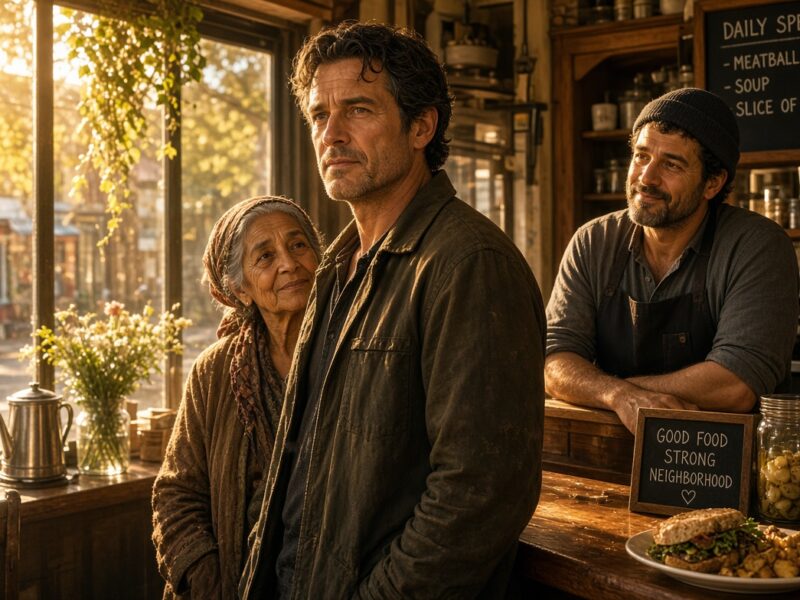
He Was Just a Quiet Shop Owner — Until He Stepped Between a Thug and an Old Man
“This is our turf. You think you can short change me, old man? You think I won’t notice?”
“Let him go.”
“Who do you think you are?”
“Just walk away. This is your only warning.”
The punch never reached its mark.
What followed lasted only seconds.
Two of Brock’s crew hit the pavement, and Brock himself was left staring up at the same man he’d just warned off.
The stranger hadn’t raised his voice or made a single threat.
He’d simply stepped in front of an old man who couldn’t defend himself and waited with the kind of stillness that doesn’t come from nerve.
It comes from years.
Brock had seen a man in a worn jacket and made every easy assumption about who he was dealing with.
What had he actually just walked into?
Dunridge, Pennsylvania, was the kind of neighborhood that looked the same at fifty as it did at twenty.
The same cracked sidewalks, the same narrow storefronts with hand-painted signs, the same smell of exhaust and fried food rolling off the street in the late morning heat.
For most people who grew up here, that sameness was either a comfort or a trap.
Dorian Reigns hadn’t decided yet which one it was for him.
He’d come back six weeks ago after his older brother Marcus passed.
No ceremony about it, just a phone call, a funeral, and then a set of keys to a small electronics repair shop on the corner of Hadley and Third.
The place still smelled like solder and black coffee.
Marcus’s handwriting was still on the whiteboard near the register.
Dorian had left it there.
He wasn’t sure he was ready to erase it, and he’d stopped asking himself when he would be.
He was forty-six years old.
He had no family left in Dunridge, no close friends still living nearby, and no particular plan beyond keeping the shop open and not letting his brother’s work disappear.
He wore plain clothes, drove an unremarkable car, and took his lunch at the counter of whatever was still open nearby.
He didn’t talk much, and nobody asked him much.
He fixed things, broken screens, dead circuit boards, radios that had been dropped once too many times.
And he did it well, and people started coming back, and that was enough for now.
What nobody in Dunridge knew, because Dorian had never said and Marcus had never been the type to brag on someone else’s behalf, was what Dorian had done for the two decades before he came back.
He hadn’t been driving a delivery truck or working a desk somewhere.
He had competed in full-contact karate at the national level, earned a black belt that took him twelve years to feel he’d truly earned, and then spent another decade training fighters who went on to win titles of their own.
In certain circles, tournament programs, regional gyms, a handful of old VHS tapes that coaches still referenced, the name Dorian Reigns meant something specific.
A man with hands so precise he could stop a combination mid-sequence and redirect it before the other person understood what had happened.
A man who had never once continued striking after his opponent went down.
A man whose students described his teaching the same way almost universally.
He never showed you how to hurt someone.
He showed you how to understand what was happening in front of you fast enough to handle it.
He had walked away from all of it when Marcus got sick.
He hadn’t announced it or explained it.
He just stopped showing up and started driving north.
Nobody in the martial arts world blamed him.
A few reached out over the years.
He answered briefly and didn’t encourage follow-up.
Every morning at 5:30, before the shop opened, Dorian went through his forms alone in the back room.
Not for anyone, just because stopping entirely would have felt like losing something else he wasn’t ready to lose.
He moved through the sequences slowly with the same attention he brought to a difficult repair.
Each step considered, each transition deliberate, nothing rushed.
By 6:15, he was showered and behind the counter.
By 6:40, he was usually on his way to Otis.
He first noticed Otis Bell the morning after he opened the shop.
The old man’s cart was parked half a block up, just close enough to catch the foot traffic from the bus stop.
He sold breakfast sandwiches, coffee from a battered thermos, and small bags of chips for a dollar.
His cart had a hand-painted sign with a sun on it, faded, but still legible.
And he worked it alone, moving slowly but efficiently, the way a person does when they’ve done something so many thousands of times that the body does it without instruction.
He knew his regulars by name.
He remembered their orders.
He gave the kids who couldn’t quite cover the cost a pass without making them ask twice.
Dorian recognized him before Otis recognized him.
When he was twelve, Otis had let Marcus run a tab all winter so they could eat hot food on the walk to school.
He’d never asked to be paid back.
Marcus had mentioned it once years later in the way people mentioned things that settled something in them when they were young.
Dorian started buying his morning coffee there.
He didn’t bring up the tab.
He could tell Otis didn’t remember him, and that was fine.
He just kept showing up.
He also noticed Lenora Finch across the street.
Her place, a small diner called Finch’s, had been there longer than most of the other businesses on the block.
She was in her late fifties, ran the front of the house herself with one part-time server, and had a habit of standing in the doorway between the breakfast and lunch rush with a cup of tea, watching the street the way someone watches a thing they’ve decided to be responsible for.
She let Otis park his cart in her rear lot overnight.
She’d been doing it for years without being asked.
What Dorian noticed in those first few weeks was the look on people’s faces when certain cars slowed down.
It wasn’t the ordinary weariness of a rough neighborhood.
It was something more specific, a practiced flatness, the way a person looks when they’ve learned that reacting is more dangerous than not reacting.
He noticed it on Otis.
He noticed it on Lenora.
He noticed it on the woman who ran the dry cleaners two doors down and on the teenage boy who worked the register at the corner market.
He noticed it on his own customers once or twice when a particular car idled too long outside.
He didn’t know the name that went with the fear yet.
He was starting to understand the shape of it.
On a Tuesday morning in early October, Dorian was unlocking the shop when he heard the cart go over.
The sound was unmistakable.
The flat crack of metal hitting concrete, the scatter of containers and loose change, a short burst of something frying hitting the sidewalk.
He stepped out and saw Brock Voss standing in the middle of the block with two men flanking him, looking down at Otis, who was on his knees, gathering bills off the ground with shaking hands.
Dorian had never seen Brock before, but he understood immediately who he was looking at.
The way the two men on either side watched the street instead of the situation.
The way pedestrians had already redirected themselves to the other side without anyone saying a word.
The way Brock stood not tense, not aggressive in any agitated sense, just certain.
Like a man who had never once been told no and believed that this was the natural order of things.
Like a man who confused fear for respect and had been making that mistake for long enough that the distinction had stopped mattering to him.
Brock grabbed Otis by the back of his collar and pulled him to his feet.
The old man’s knees buckled.
He got his feet under him, but just barely.
Dorian was already walking.
“Let him go.”
Brock turned.
He looked at Dorian, looked at the jacket, the calm face, the unhurried walk, and made a decision in less than a second.
He laughed.
“Who do you think you are?”
“Let him go,” Dorian said again, and stepped between Brock and Otis, turning his shoulder gently to move Otis behind him.
Brock pointed two fingers at Dorian’s face.
“This is our turf. You want to stay in business on this block? You walk away right now. Last warning.”
Dorian looked at him.
He didn’t step back.
Brock threw the punch.
It was a wide hook thrown with the confidence of a man who had thrown it before and watched people fold.
Dorian rolled under it without changing his expression, planted his weight, and put a straight counter into Brock’s ribs.
Short, accurate, delivered like he was pressing a button he’d pressed a thousand times.
Brock went down.
One of the flanking men charged.
Dorian sidestepped, caught the man’s momentum with one hand on his shoulder, and drove him away from Otis with a single controlled push that sent him stumbling into the cart frame.
The third man stopped.
He looked at Brock, who was getting his hands under himself on the pavement, and he didn’t move.
Dorian turned to the cart.
He gripped the frame and righted it with the same matter-of-fact effort he’d used to right a chair.
He looked at Otis.
“Are you hurt?”
Otis shook his head, though his hands were still unsteady.
Dorian looked at Brock, who was on one knee now, jaw set, watching him with an expression that had moved past surprise into something colder and more considered.
“Take your people and go,” Dorian said.
“Let him work.”
For a moment, nothing happened.
People on the sidewalk had stopped moving.
A woman near the bus stop had her hand over her mouth.
The man by the cart frame hadn’t gotten up.
Brock looked at Dorian for a long five seconds, then stood, brushed off his jacket, and walked.
Nobody cheered.
Nobody said anything.
They just watched Brock go, and then they watched Dorian start picking up scattered napkins off the ground.
And then slowly, one by one, they started moving again.
Lenora was waiting at the door of the diner when Dorian helped Otis wheel his cart into her back lot that afternoon.
“You know he’s coming back,” she said.
It wasn’t a question.
“I expect so.”
“The last man who pushed back like that had his windows put in three nights later.”
“I heard.”
“Did you hear what happened to the one before that?”
“No.”
Lenora’s expression didn’t change.
She held the door and let them through.
Otis sat down at her counter and folded his hands on the surface.
He was quiet for a while.
Then he said, “Dorian, I appreciate what you did. I mean that. But you just got here. You just got that shop open. Don’t throw it away because of me.”
“You’re not why I stepped in,” Dorian said.
“I stepped in because he was choking an old man in the street.”
“Same thing.”
“It isn’t.”
He didn’t press the point.
He understood what Otis was saying, and he understood it came from a real place, from years of watching what happened to people who made themselves targets.
But he also understood something Otis didn’t know about him yet.
That Dorian Reigns had spent twenty years learning exactly how much damage a man could absorb and keep functioning, and that he had a considerably higher threshold for both than this situation currently required.
That night, going through Marcus’s desk, he found the ledger.
His brother had kept everything, every payment, every date, every note in the margin.
The entries went back three years.
Monthly payments, always cash, always labeled the same way.
Protection/BV.
The amounts had gone up twice.
Dorian sat with the ledger for a long time.
He closed it.
He put it in the drawer under the register.
He understood now.
This wasn’t a neighborhood dispute.
This wasn’t a bully with a short temper.
Brock Voss had built a system, and Marcus had been inside it, and every other small business on this block was still inside it, paying and staying quiet because the alternative looked exactly like what had happened to the man with the broken windows.
Brock’s message came through Lenora the following morning, relayed from one of the men who’d been with him.
Dorian was to come to the diner the next day in front of everyone, apologize, and pay what Otis owed.
If he didn’t, the cart would be destroyed.
Not broken. Destroyed.
Lenora delivered it without editorializing.
She watched Dorian’s face while she said it.
“What are you going to do?” she asked.
Dorian thought about it for a moment.
“Not long. I’m going to go to the precinct with Otis today and file a report. I’ll photograph the cart, the damage, everything.”
He looked at her.
“And I’ll be there when Otis opens tomorrow morning. If they show up, I’ll deal with that when it happens.”
“That’s not an answer to what I asked.”
“I know.”
He pulled on his jacket.
“I’m not going to go looking for them. I’m not going to walk into their space and start something. But if they come back and put their hands on him again, I’ll stop them.”
He said it the same way he said everything, without performance, without heat.
Like it was already settled.
He took Otis to the precinct that afternoon.
The officer at the desk took the report, wrote down the information, and told them someone would follow up.
Neither of them believed it would amount to much on its own, but the report existed now.
The photographs existed.
The date was on record.
The following morning, Dorian was standing beside Otis’s cart at 6:45, a cup of coffee in his hand, when the first customers arrived.
He didn’t tell anyone he was there for a reason.
He just stood there in the cold morning air drinking his coffee and watching the street.
Nobody from Brock’s crew came that day.
But Dorian had been in enough situations to know that absence wasn’t the same thing as retreat.
It just meant whoever was on the other side of the problem was taking their time deciding what to do next.
He went back inside, opened the shop, and started on the first repair of the morning.
Brock didn’t reappear that week.
What appeared instead were smaller things.
A group of men Dorian didn’t recognize standing near the bus stop across from Otis’s cart, not buying anything, just watching.
A delivery truck that couldn’t seem to find a window to unload Lenora’s kitchen supplies, circling the block twice before the driver called to say he’d been told to skip the address.
A broken padlock on the back door of a framing shop two blocks down, whose owner had been in the same report-filing line at the precinct as Otis.
It wasn’t random.
It was a message delivered in pieces to as many people as possible at the same time.
Nothing dramatic, nothing that could be pointed to as a single incident.
Just enough to make everyone on the block feel the weight of Brock’s reach without him having to lift a finger himself.
Dorian saw it clearly.
He’d watched enough competition footage and trained enough fighters to recognize the difference between a man charging forward and a man controlling the space until you walked into where he wanted you.
Brock was doing the second thing.
The problem was that Dorian couldn’t cover every location.
The evening he walked Otis home, someone took the hinged sign off the front of a shoe repair shop and left it in the middle of the street.
Nobody had seen anything, or nobody was saying they had.
By the end of the second week, two of the block’s shop owners had come to Lenora’s separately, not together.
Both of them saying the same thing in different words, that maybe things had been better before Dorian stepped in.
That at least before there had been a predictable schedule to how much they paid and how often they were bothered.
He didn’t argue with them.
He understood a managed fear is easier to live with than an unpredictable one, and he had disrupted the rhythm they’d built their survival around.
That wasn’t nothing.
But he also knew that the rhythm would never stop accelerating on its own.
It only went in one direction.
He asked Lenora if she’d be willing to call a quiet meeting.
Not loud, not announced.
Just whoever felt comfortable in the back room of the diner one evening after closing.
She looked at him for a moment, then said she’d make calls.
Seven people came.
They sat at two pushed-together tables and talked quietly the way people do when they’re not sure who might be listening through the walls.
Dorian didn’t lead it.
He sat at the end and listened.
What came out over the course of an hour was a detailed picture of three years of systematic extraction.
Not just money, but time, energy, the low-grade constant stress that gets into everything and makes a person smaller year by year.
People described adjusting their hours, turning down catering jobs, declining to apply for a permit they needed because each of those things would have required more visibility, and more visibility meant more cost.
The operation hadn’t just taken money.
It had taken ambition.
It had taken the ordinary confidence that the fruits of your own work belong to you.
The man who ran the shoe repair shop said he’d started leaving the lights off in the back workroom after six, so it looked like he’d closed early.
The woman from the dry cleaners said she’d stopped entering her real revenue in the books because she didn’t want anyone who looked at them to see how much she was actually clearing.
It made her a bigger target.
A man who sold produce from the back of a truck twice a week said he’d changed his route three times in two years.
Always trying to find a block where he wouldn’t be noticed.
He’d ended up back on Hadley anyway.
There was nowhere to go that Brock didn’t eventually find.
Otis didn’t say much.
He sat with his hands folded and listened to the others and nodded occasionally.
At one point, someone mentioned his name and he looked up and said simply, “I’ve been here twenty-two years.”
Then he looked back down at his hands.
Nobody needed to ask what he meant.
Dorian asked a simple question at the end.
Would people be willing to document, save messages, write down dates and amounts, request their security footage before it was overwritten?
Not to hand it to anyone immediately, just to have it.
Most of them nodded.
Not all, but most.
On the walk home, Dorian thought about the math of it.
Brock’s operation ran on two things: fear and invisibility.
Fear made people comply.
Invisibility meant there was no record of what they were complying with.
Documents didn’t eliminate fear, but they eliminated invisibility.
And without that, the operation started to look like what it actually was.
Brock, meanwhile, had come to his own conclusion.
Word filtered back through channels Dorian couldn’t have traced, a comment made at a bar, repeated by someone who repeated it to someone else.
That Brock had decided the situation needed to be resolved publicly.
Not in a back alley, not in private.
In front of the people on the block who were currently watching to see which way this went.
He brought Wade Mercer into it.
Dorian had heard the name by then.
In passing, someone had mentioned Wade as the person Brock put in front of situations that required more than presence.
Wade had competed locally, not at a high level, but he was real enough.
And more importantly, he was a symbol.
Bringing him meant Brock was done with the preliminary stages.
He was closing the argument.
They came in on a Wednesday at 12:15, when Finch’s was at its busiest.
Brock walked through the front door with Wade behind him and two others filling the entrance.
He didn’t rush.
He moved through the room like he owned it, which was the point, and pulled a chair out from a two-top near the window and sat down without being invited.
Lenora came out of the kitchen.
She stopped when she saw who it was.
Brock reached into his jacket and set a plain envelope on the table.
He looked across the room at Dorian, who was eating alone at the counter.
“You’re going to pick that up,” Brock said, loud enough for the room to hear.
“Fill it with what Otis owes, plus your apology fee, and walk it out the front door right now in front of everybody.”
Dorian set down his fork.
He looked at the envelope.
Then he looked at Brock.
“Leave,” he said.
Brock’s expression didn’t shift.
He nodded at Wade, who moved around the end of the counter toward Otis.
The old man was sitting near the kitchen pass where he usually ate his lunch when Lenora let him come inside.
Wade grabbed the back of the chair Otis was sitting in and yanked it sideways.
Otis went down, catching the edge of the counter with one elbow, landing hard on his side.
Lenora moved toward him.
One of Brock’s men stepped in front of her and shoved her back against the edge of the service counter.
She hit it with her hip and grabbed the counter to stay upright.
Dorian was already off his stool.
He didn’t run.
He crossed the room in four steps, put himself between Wade and Otis, and turned to face the room.
His back was to the wall beside the kitchen door.
Lenora was to his left.
Otis was on the floor to his right.
He stood with his weight distributed and his hands loose.
“Get up,” Wade said, looking down at Otis.
“He stays down,” Dorian said.
Wade came at him.
He was big and he’d done this before.
His first move was a right hand intended to establish range.
Dorian slipped it, stepped inside, and hit him twice in the body, short punches that Wade didn’t see the full weight of until the second one connected.
Wade stepped back.
His face registered something not pain yet, but the recognition that the math wasn’t what he’d expected.
He tried again, this time with more commitment, a combination that would have worked on most people in that room.
Dorian covered the first shot, deflected the second, and countered with a single straight hand to the chin that snapped Wade’s head back.
Wade’s legs went loose.
He grabbed the edge of a table to keep from going all the way down and stood there, head low, trying to find the floor.
Dorian turned.
One of Brock’s men was already moving.
He let the man come, sidestepped, and redirected him into the door frame with a controlled push that dropped him.
The fourth man had his back against the entrance now.
He didn’t come forward.
Brock had stood up.
He didn’t move toward Dorian directly.
He moved toward Otis, who was still on the ground, and crouched down, gripping the old man’s arm.
Dorian was there before Brock’s hand fully closed.
He caught Brock’s wrist, stepped across, and applied just enough leverage to break the grip and put Brock back onto his heels.
Brock stumbled but caught himself.
A cough came from near the kitchen pass.
An older man, one of the regulars, had half risen from his chair.
He was staring at Dorian with an expression that didn’t belong in the middle of a fight.
It was too still, too certain.
The face of someone arriving at a recognition they hadn’t expected.
“Dorian Reigns,” he said.
It wasn’t a question.
His voice was slow with it.
“That’s Dorian Reigns from the circuit.”
Nobody in the room moved.
The name didn’t mean anything to most of them yet, but the way the old man said it, the way he sat back down slowly like something had just been confirmed that he’d been hoping to rule out, made the room quieter than it already was.
Dorian helped Otis to his feet.
He didn’t look at the old man who’d said his name.
He checked Otis for injuries, elbow, shoulder, knees, then looked at Lenora, who nodded that she was all right.
Then he turned back to Brock.
“Take them,” he said, “and don’t come back.”
Brock left.
He didn’t say anything, and that was more telling than anything he could have said.
He picked up the envelope from the floor where it had fallen, put it back in his jacket, and walked out.
His men followed.
Wade went last, still moving carefully, not making eye contact with anyone.
The room stayed quiet for a long moment after the door closed.
Then someone helped straighten a table.
Someone else picked up a chair.
The noise came back in small pieces.
By that evening, a video someone had taken on their phone, a shaky shot from across the room, but clear enough, had made its way to a regional martial arts forum.
And from there to the contact list of a man named Gary Presfield, who ran the oldest functioning karate gym in the county and who had judged three of Dorian’s national bouts in the early 2000s.
Presfield posted two words under the video.
“That’s him.”
He followed it with a tournament program from 2003, scanned and uploaded, with Dorian’s name and record printed in the results column.
Then a photograph from a regional championship in 2006.
Dorian mid-form, not posing, just caught in the middle of a movement.
But even in a still image, the precision was visible to anyone who knew what they were looking at.
Wade Mercer saw the post from a parking lot that same evening, sitting in his car, ice wrapped in a towel pressed against his ribs.
He scrolled through the images slowly.
He’d grown up watching tournament footage.
He knew what the names at the top of those result sheets meant.
He put his phone down and looked at the windshield for a long while, and the thing that moved through him wasn’t simply the embarrassment of having lost.
It was something colder and more specific.
The recognition that he had been standing on the wrong side of something and that he had been given plenty of chances to notice before now.
He thought about the old man on the floor of the diner.
He thought about the woman shoved into the counter.
He thought about how many times he’d stood in a room while Brock did those things to people and told himself it wasn’t his problem.
He didn’t call Brock.
He went home.
The next morning, Wade drove to the repair shop on Hadley and Third and knocked on the frame of the open door.
Dorian looked up from the workbench.
Wade stood in the doorway.
He wasn’t holding anything.
He kept his hands where Dorian could see them.
“I’m not here to start something,” he said.
Dorian set down what he was working on and waited.
“He’s going after the woman,” Wade said.
“The one who runs the diner. She’s got documentation he wants gone, and he’s going to move on her directly, probably after closing when the block is empty.”
He stopped.
“I don’t want to see her get hurt.”
Dorian looked at him for a long moment.
Wade held it.
“That’s all I came to say,” Wade said.
Then he turned and walked back out to the street.
Dorian watched him go.
He stood at the workbench for a moment, then picked up his phone and called Lenora.
He told her to make sure everything she’d collected was backed up somewhere outside the building.
She said she’d already done it three weeks ago, right after the first meeting in the back room.
She’d arranged for the camera system to upload continuously to a cloud account registered to her sister’s address in Ohio.
She’d photographed every page of her payment records and emailed them the same night.
He told her he’d be across the street every evening until further notice, later than usual.
She was quiet for a moment.
“You think it’ll be soon?” she said.
“I think it’ll be soon,” he said.
He was right.
Brock, meanwhile, had stopped thinking about Dorian’s hands and started thinking about Lenora’s camera system.
He’d seen it every time he’d been inside, a small unit mounted in the corner above the door, the kind that recorded continuously to a hard drive under the register.
He didn’t know exactly what it might have captured from the confrontation at the diner, but he knew that if she had usable footage and was willing to take it somewhere, that was a problem he needed to resolve before it became something he couldn’t manage.
He also knew something else.
The business owners on the block were starting to coordinate.
He could feel it in the way conversation stopped when his crew walked past.
He could see it in the small, unremarkable ways people were now walking home in pairs instead of alone, propping doors for each other, making eye contact across the street.
None of it was dramatic.
It didn’t have to be.
Small acts of mutual awareness were enough to tell him that the isolation he’d cultivated was eroding.
And Lenora was at the center of it.
She had the space.
She had the credibility.
And from what he could tell, she had the nerve.
Take her out of the equation.
Not permanently.
Just shake her badly enough that she stepped back, and the rest would follow.
He also knew that after Wednesday, Dorian would be watching for something frontal.
So he wouldn’t do that.
He’d come quiet, late, when the block was empty.
He started planning.
The attack came on a Thursday night, forty minutes after Lenora flipped the sign on the front door.
Three men, Brock led them in through the service entrance in the back, which they’d forced during the day.
They locked the front from the inside.
Lenora was in the kitchen finishing the close-down.
Otis was at the counter with the last of his coffee, waiting for her so they could walk to the lot together.
Brock moved straight to Lenora and told her to hand over the camera hard drive and her phone.
He said it once, flat, without raising his voice.
Lenora said no.
Brock nodded at the man to his left, who put his hand on her arm.
Across the street, Dorian was still in the shop, intentionally.
Through the front window, he saw the movement inside the diner.
The shifted light, the wrong kind of stillness from where Lenora should have been moving around in the closing routine he’d watched enough times to know by heart.
He called 911.
He gave the address, said there were people inside who shouldn’t be.
Then he hung up and went through the side door at a run.
He came through the side door into the back hallway and heard it before he saw it.
A crash from the front of the house.
Something ceramic.
Then Otis’s voice saying, “Wait, wait,” in the tone of someone who knows it won’t help but says it anyway.
Dorian moved through the kitchen and pushed the swing door open.
One of Brock’s men had Lenora by the arm, pulling her toward the camera mounted in the corner.
She was braced against his grip, heels dug in, one hand on the counter.
Otis had stood up from his stool, and one of the other men had stepped in front of him, not touching him yet, just blocking.
Brock was standing in the center of the room with his arms at his sides, watching.
Dorian didn’t announce himself.
He crossed the distance to the man holding Lenora in three steps, got both hands on the man’s arm, and broke the grip with a short rotation that put the man off balance and away from her.
He stepped in front of Lenora.
“Go,” he said to her, low and direct.
“Take Otis. Side door.”
The man he’d pulled off her recovered faster than expected and came back immediately.
Dorian blocked the first swing, answered with two quick shots to the body, and pushed him into the row of stools along the counter.
The man went down across two of them and didn’t get up cleanly.
Brock’s third man moved to cut off the path to the side door.
Dorian moved to intercept, and that put him between Brock and both exits, which was exactly where Brock needed him.
Lenora pulled Otis toward the side door.
Otis moved, but his right knee had been bothering him for weeks, and he couldn’t move fast.
He stumbled near the kitchen threshold, grabbing the door frame to catch himself.
He didn’t go down, but he stopped, bent, trying to get his breath and his balance back at the same time.
Dorian turned back to help him.
He never heard the second man get up.
The blow came from behind and to the left.
Something solid swung hard and low, catching him across the ribs on the same side that had taken a hit the day before at the diner.
The pain was immediate and total.
A whiteout that went from his side up through his shoulder and knocked the air out of him completely.
He went down on one knee, then both hands, the floor cold against his palms.
He tried to stand.
His body gave him about six inches before the pain closed back in and his arms folded.
Brock walked over to him slowly.
He crouched down, not touching, just looking at Dorian’s face.
Then he stood up straight and said it like it cost him nothing.
Flat, casual, almost bored.
“Where’s your legend now?”
He turned, kicked the phone out of Lenora’s hand where it had fallen near the door, and pulled her back toward him.
The floor was hard and cold, and Dorian could feel every crack in it against his palms.
His vision was clear.
His mind was clear.
That was the thing nobody told you.
When you’d trained long enough, the pain didn’t confuse you.
It just occupied a room inside you that you had to decide whether to lock or leave open.
He’d been knocked down before.
He’d been knocked down in front of crowds of two thousand people, under lights, with judges watching and a clock running.
He knew the specific weight of that moment, the body’s argument that staying down was reasonable, that the math didn’t add up, that whatever came next would hurt more than this.
On the circuit, getting back up after a knockdown was a matter of will and conditioning and the knowledge that the rules would protect you if you couldn’t fully protect yourself.
Referees existed.
Corners existed.
There was a structure around the violence designed to keep it from going past a certain point.
There was no structure here.
And that wasn’t a reason to stay down.
It was the opposite of that.
He heard Lenora’s voice.
Not what she said, just the pitch of it, the involuntary sound of someone being handled against their will.
He heard Otis call his name from the doorway, not loud, just once.
The way you call someone when you’re not sure they can hear you anymore.
He had not come back to Dunridge for a fight.
He hadn’t come looking for Brock Voss or for any version of this situation.
He’d come back for a shop and a set of keys and whatever remained of his brother’s life that he could keep intact.
That was all he’d wanted.
But somewhere in the last six weeks, without ceremony or announcement, he’d made a different choice.
He’d stepped between Otis and the man holding his collar.
He’d stood outside a cart in the cold with a cup of coffee.
He’d sat in the back room of a diner and asked seven frightened people if they’d be willing to write things down.
He’d made the choice in pieces, the way most real choices get made.
And the sum of those pieces was this.
He’d put himself on this side of the line, and that didn’t change because he was currently on the floor.
He wasn’t surprised the pain was still there when he started to move.
He’d known it would be.
He put one hand flat on the floor, then the other, then got his right knee under him and pushed.
It cost him something he couldn’t name yet.
He found the edge of the counter and used it.
He stood up.
It wasn’t fast.
It wasn’t clean, but he was standing.
Brock saw him.
The satisfaction on his face shifted, re-calibrated, moved into a territory past annoyance and toward something that looked at its edges like unease.
A man you’d put on the floor was supposed to stay there.
A man who got up anyway was no longer operating inside the rules Brock had written for this situation.
Dorian looked at Brock.
He didn’t raise his voice.
“You want me?” he said.
“I’m right here.”
He said it because it was true and because saying it out loud would do the one thing he needed done right now.
Pull Brock’s attention back to him and away from the two people near the door.
It worked.
Brock let go of Lenora’s arm and came toward him.
The distance between him and the side door opened.
Lenora didn’t need to be told twice.
She got her arm under Otis’s and moved them both through the doorway.
Dorian heard the door open.
Heard the outside air come in.
Heard the door close again.
They were out.
Now there were three people in the room.
Dorian and Brock and the man who’d gotten back up from the stools.
The one who had hit him from behind was somewhere to his right.
He registered all of it.
Positions, distances, angles, the way you register traffic when you’ve been driving long enough that the calculation is automatic.
Brock came in fast and hard because he decided the time for theater was over.
He threw a combination, jab, cross, hook, and if any of those had landed cleanly, they might have ended it.
None of them did.
Dorian slipped the jab, caught the cross on his forearm, and let the hook miss by a margin that was narrower than he would have liked, because his lateral movement was compromised, and he knew it.
He answered with a counter that was not designed to knock Brock down.
It was designed to make Brock understand that the distance between them was not safe for him.
It landed on the cheek, sharp and precise, and Brock’s next step was backward instead of forward.
The man from the stools came around to Dorian’s right.
Dorian turned into him instead of away, closing the distance before the swing was fully loaded, and put a short elbow into the man’s sternum that knocked the air out of him and sent him down to one knee.
He stayed there.
The third man made a decision.
He went left toward the side door, not toward Dorian.
He was going after Lenora and Otis.
Dorian cut him off.
He was already moving before the decision was fully apparent.
Three steps that put him between the man and the door.
The man tried to go around him.
Dorian stopped him with a push kick to the midsection.
Not a strike, just enough force to reset the man’s position and his intentions simultaneously.
The man hit the service counter, looked at Dorian, and didn’t try again.
Brock came back.
He was angrier now, which made him more committed and less precise.
A combination that was familiar to anyone who had ever watched a losing fighter in the fourth round decide that intensity could substitute for technique.
It couldn’t.
Dorian covered the first punch, rolled the second, and stepped inside the third.
He hit Brock twice, body, then chin, and Brock sat down against the base of the counter with the abruptness of a man whose legs had received news that his brain hadn’t processed yet.
He sat there, eyes open, jaw working.
Brock looked up at him with the expression of a man who had been telling himself a specific story about the world for a very long time and was watching in real time as it stopped being true.
“This is still my block,” Dorian said.
He wasn’t breathing easily.
His side was a single sustained note of pain.
“No one here belongs to you.”
Brock didn’t answer.
From outside, through the side door, came the sound of voices, neighbors, several of them, and then the low pulse of a siren two blocks away and closing.
Someone had called more than one person, given how fast the sound was coming.
Dorian stepped back from Brock.
He moved to the center of the room, put both hands visible at his sides, and waited.
When the first officer pushed through the front door thirty seconds later, Dorian was standing still in the middle of the room, hands open and away from his body.
He told the officer his name, told him he was the one who had called, and did exactly what he was instructed to do.
He lowered himself to the floor when asked, let them secure the room, answered the first questions calmly and completely.
He felt his side every time he breathed.
He didn’t mention it until someone asked.
Outside, Lenora had gotten Otis to the neighbor’s house three doors down.
Her hip was bruised where she’d hit the service counter, but she could move.
Otis had a gash on his elbow from the fall.
Both of them were sitting on the neighbor’s front steps when the second squad car arrived.
The block had come out.
Not all of it, but more than Dorian would have expected.
People standing in doorways and on stoops, watching the lights.
Nobody had gone back inside when the siren started.
They stayed.
A woman who lived above the dry cleaners had her phone in her hand.
She’d been watching from her window when the men went in through the back, and she’d recorded what she could from the second floor.
The forced entry, the locked front door, the scramble when Lenora and Otis came out the side.
She gave the footage to the officer who came to take her statement without being asked.
Two other people on the block had called 911 before Dorian had.
The camera system in the diner had been running the entire time.
When Brock’s man pulled the hard drive out of the wall mount during the arrest processing that night, he pulled out a shell.
Everything it had recorded was already in Ohio, on a server Lenora paid for with a card registered to her sister’s address.
The footage covered the full encounter, the forced entry, the confrontation, the blow from behind, all of it.
The documentation the block’s business owners had been quietly accumulating also survived intact.
Photographs, saved messages, printed records of cash payments with dates, a handwritten log Otis had kept in a small notebook inside his cart.
Every entry dated, going back fourteen months.
Lenora’s folder of the diner’s payment history, photographed page by page and emailed to Ohio the night of the first backroom meeting.
Brock’s plan to destroy the evidence had required the evidence to be in one place.
It wasn’t.
The responding officers had enough to hold Brock and the two men who hadn’t managed to leave before the squad cars arrived.
In the days that followed, a detective from the organized crime unit came to speak with Lenora, with Otis, and with Dorian, and then with several of the other business owners, who had, now that Brock was in custody, found that the weight of silence they’d been carrying had become easier to set down.
More people came forward than Lenora had expected.
They brought what they’d been holding, the messages, the records, the dates.
The shoe repair man brought three years of handwritten payment logs he’d kept hidden inside a toolbox under his workbench.
The produce vendor produced a phone full of voice memos he’d made to himself after each collection visit, recording the amounts and the names while they were still fresh.
Even two people who had declined to participate in the backroom meeting showed up at the precinct separately in the days after Brock’s arrest and asked to speak with someone.
The picture that assembled itself was detailed and consistent in a way that made it very difficult to argue pieces of it away.
Cross-referencing the accounts, the dates aligned.
The amounts escalated in the same pattern across multiple unconnected sources.
The detective described it in one of his conversations with Dorian as cleaner documentation than he usually saw in cases like this.
People had been keeping records even when they thought no one would ever ask.
The charges that emerged covered extortion, conspiracy, assault, criminal mischief, and filing violations going back two years.
The case was transferred to a unit that handled organized criminal activity, which meant the investigation extended beyond what any single incident could have supported.
Dorian gave his statement.
He described what had happened in what order, without editorial.
He identified the men he recognized.
He was asked several times whether he had been the one to initiate the physical confrontations, and each time he said no, and the footage confirmed it.
He was treated at an urgent care clinic for two cracked ribs and a deep contusion on his left side.
He was told to rest and not to lift anything heavier than five pounds for three weeks.
He went back to the shop the following morning and opened at the usual time.
Six weeks later, Otis Bell’s cart was back at its spot near the bus stop on Hadley, polished to a degree it had probably never been before.
Several people from the block had gotten together one Saturday, and the cart had ended up as the accidental centerpiece of what turned into a half day of work and food and a lot of standing around talking.
The way communities sometimes mark the end of something without quite naming it out loud.
The broken padlock on the framing shop had been replaced.
The cracked window at the dry cleaners had been repaired.
The hand-painted sign that had ended up in the middle of the street was back above its door, rehung and resealed.
And in Dorian’s opinion, more level than it had been before.
Lenora had kept every payment record she’d given to the detective.
She’d also kept a second copy in Ohio.
She said she would keep it there for as long as the case was active, and probably after that, too.
She’d spent three years paying for protection she didn’t need from people she hadn’t invited into her life.
And she believed in keeping records.
A martial arts club two neighborhoods over reached out to Dorian about running a self-defense course.
Basic stuff.
No competition, no rankings, just practical fundamentals for people who wanted to know how to use their bodies if they had to.
Dorian thought about it for a few days.
Then he said yes.
The first class was held on a Tuesday evening in the club’s back room.
Twelve people came, most of them from the Hadley Street block.
Lenora was there.
The woman from above the dry cleaners was there.
The teenager from the corner market sat in the back and watched without participating, which Dorian counted as more than nothing.
About twenty minutes in, one of the women near the front, who ran a small accounting practice out of the building next to the framing shop, asked why he hadn’t told anyone who he was when all of this started.
She asked it sincerely, without accusation, the way a person asks a question they’ve been turning over for a while.
Dorian thought about it.
“Otis didn’t need me to be a champion,” he said.
“He needed somebody to step in front of him. Those aren’t the same thing.”
The woman nodded.
She didn’t push further.
He spent the rest of the class on basics.
Stance, distance, how to fall without getting hurt, how to make noise and create space, things that don’t require years of practice to use.
He showed them how a person’s weight shifts before they commit to a direction, and how that half second of reading the shift is the difference between being in the wrong place and the right one.
He showed them how loudness alone changes what an attacker calculates.
He showed them that the goal in almost every situation is not to win a fight.
It’s to not be where the danger is anymore and to buy the time to make that happen.
He watched the room get quieter as people started to understand that what he was teaching wasn’t complicated.
That the body, given even a small amount of instruction, is more capable than most people have been allowed to believe.
The teenager from the corner market, who had been sitting with his arms crossed in the back row since the start, uncrossed them sometime in the second hour.
He didn’t participate, but he was watching carefully, and Dorian noticed.
On a Friday afternoon, three weeks after that, Dorian locked up the shop at his usual time and walked half a block to where Otis was starting to break down his cart for the day.
The lunch rush was long over, and the bus stop was quiet.
Otis saw him coming and reached into the warming tray without being asked.
He put together a sandwich, the same kind Dorian had been buying most mornings since September, wrapped it in paper, and held it out.
Dorian took it.
He leaned against the side of the cart and ate it slowly, watching the street.
A woman walked past with two small kids who were arguing about something urgent and incomprehensible.
A man in coveralls came out of the auto parts store and lit a cigarette in the doorway.
Somewhere down the block, music came through an open window, low and unhurried.
Otis folded up his awning with the ease of someone who had done it ten thousand times.
He latched the cart, checked the wheels, and stood for a moment with his hands on the handles.
The tin for the tip jar sat right there on the shelf in plain sight.
No reason to hide it.
No one left to hide it from.
“Same time Monday,” he said.
“Same time Monday,” Dorian said.
Otis nodded and started rolling the cart toward the lot behind Lenora’s.
Dorian stayed where he was, finishing his sandwich, watching the afternoon settle over the block.
The slow return of the ordinary.
The sound of a street that had remembered how to just be a street.
He wadded up the wrapper, put it in his pocket, and walked back to the shop.
There was still an hour of work left on the bench.
He sat down and started on it.
Real strength isn’t measured by how hard you can hit.
It’s measured by who you choose to stand in front of and whether you stay there when it gets hard.
Dorian Reigns didn’t walk back into that neighborhood looking for a fight.
He walked back to keep a light on in his brother’s shop.
But when he saw an old man being choked in the street over a few dollars, he made a choice, a quiet one.
He stepped forward.
That’s the part that gets lost in stories like this.
The moment before the legend shows itself isn’t dramatic.
It’s just a person deciding that what’s happening in front of them matters enough to do something about it.
The skill came later.
The character was already there.









