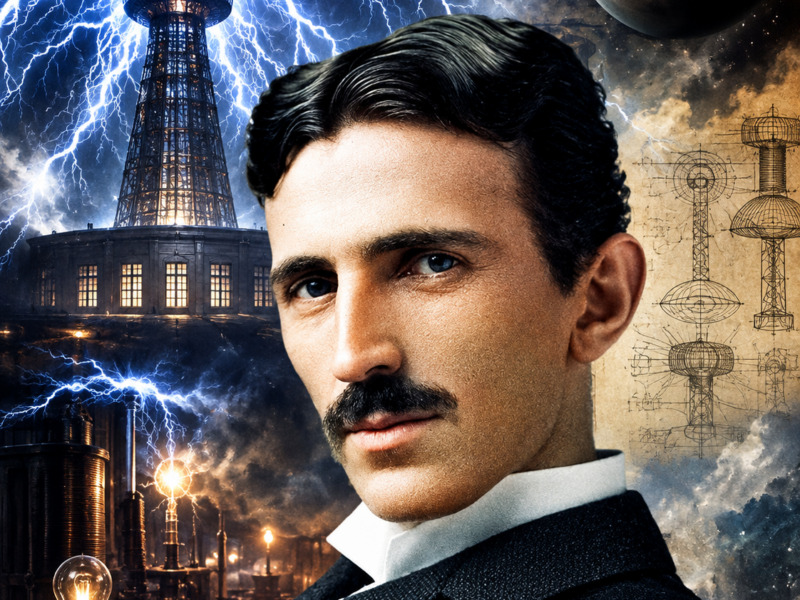
He Was Found Dead in Room 3327 and His Secret Notebook Vanished: The Lost Inventions That Could Have Ended War and Free Energy Forever
The maid ignored the Do Not Disturb sign.
It was January 8, 1943, on the thirty-third floor of a New York hotel, and Nora Brennan had a long list of rooms to clean. She knocked once, got no answer, and pushed open the door of Room 3327.
The air inside was stale. Papers and birdseed lay scattered across every surface, and the carpet was crusted with droppings.
A few feet in, she stopped.
An old man was slumped in a chair, hunched forward and stripped naked except for a pair of socks dangling from his feet. His skin was gray. He had been dead for some time.
He was eighty-six years old, and a few decades earlier he had been one of the most famous men in America.
His name was Anton Veles.
By the next morning, his nephew had arrived to settle his affairs and found something that made his blood run cold. The body was gone. Someone had been through the room.
Folders of technical papers had been emptied. Schematics were missing. And a small black notebook, the one the old man never let out of his sight, had vanished.
Within a day, federal agents sealed the room.
What they were afraid of, and what had happened in that room, is a mystery that has never been solved.
A Mad Genius
Anton Veles has been called many things.
Inventor. Visionary. Madman. A man who gave the modern world its electrical grid, and who spent his last years feeding pigeons in a rented hotel room.
He claimed to have found a three-digit code that unlocked the universe. He may have received a message from another planet. He borrowed from ancient Hindu metaphysics to explain the force that powered his machines. And in his final decades, he fell in love with a white pigeon.
But the strangest part of his story is not his eccentricity.
It is what he said he had built at the end.
He announced two inventions, a generator that could pull limitless free energy out of the universe itself, and a weapon he believed would end war forever. Both, he said, were nearly complete.
Both vanished with him.
So the question hangs over everything he did.
Was Anton Veles a man destroyed by his own mind? Or was he the target of a far larger conspiracy, one designed to silence the most revolutionary inventions the world had ever seen?
The Boy From the Village
He was born in 1857, in a small village in the Balkans called Dolina.
His father, Milan, was an Eastern Orthodox priest. But the boy took more after his mother, Yelena, a remarkable woman who had never received a day of formal education.
She designed and built her own tools and household machines. She memorized entire epic poems after reading them only a few times.
Anton would later credit her for his photographic memory and his inventive streak. She was clearly a prodigy, but she was denied the chance to use her gifts because of her sex, and her legacy passed to her son.
In high school, he discovered electricity.
His physics teacher showed the class a simple demonstration, and the boy was transfixed. He called it a mysterious phenomenon and a wonderful force. From that moment, it became the passion and obsession of his life.
He felt a strange kinship with it, as if he had always known it. His teachers sometimes accused him of cheating on tests because he arrived at answers so quickly. They never proved a thing.
But Anton knew he was different.
The Flashes
Since childhood, he had suffered from blinding flashes of light that struck without warning. Each was accompanied by vivid visions of words, ideas, and memories he could not control.
Over time, the episodes grew into something stranger. He began to feel that he was being carried out of his body and set down in other places.
“New places, cities, and countries,” he later wrote, “as dear to me as those in actual life, and not a bit less intense in their manifestations.”
As a teenager, he learned to tame the visions.
By the time he was a grown man, he could summon an image of almost anything he wished, in astonishing detail. He called the technique picture thinking.
He would assemble a machine in his mind, down to every dimension, every gear, every bolt. Then he would build it in the real world, almost entirely from memory.
Shortly after finishing high school, he nearly died.
Drinking contaminated water, he contracted cholera. For more than nine months he lay bedridden, close to death several times. He was seventeen years old.
His father, who had always intended him for the priesthood, made a promise at his bedside. If the boy survived, he could study engineering.
He survived.
But the illness left him with a lifelong terror of germs. And some have speculated that it may have changed his brain, leaving him forever balanced on the knife-edge between brilliance and madness.
The Strange Habits
There was a darker side to his gifts.
As an adult in America, Anton began to obsess over odd things. He wrote about them in his journals with a startling candor.
“I would get a fever by looking at a peach,” he wrote. “I had a violent aversion to the earrings of women. The sight of a pearl would almost give me a fit, but I was fascinated by the glitter of crystals or objects with sharp edges. When I drop little squares of paper into a dish filled with liquid, I always sense a peculiar and awful taste in my mouth. I would not touch the hair of other people, except perhaps at the point of a revolver.”
Most modern psychiatrists who have read those passages believe they describe obsessive-compulsive disorder, and a severe case.
He swam exactly thirty-three laps each morning, and if he lost count, he started over from zero. Before entering a building, he walked around the block three times. He used exactly eighteen napkins to wash his dishes after dinner.
He would only stay in hotel rooms whose numbers were divisible by three.
Then, in his sixties, he formed the strangest attachment of his life.
The White Pigeon
Anton spent hours every day in the park, feeding pigeons.
He took injured birds back to his hotel room and nursed them to health by hand. He kept his windows open so they could come and go. He had the hotel kitchen prepare special blends of birdseed for his guests.
He never married. He never courted anyone. He believed that chastity sharpened his mind.
But he confessed to falling in love once.
Among the thousands of pigeons that visited him, one stood out, a white female with light gray tips on her wings. He believed that she communicated with him through some kind of thought, that he only had to wish for her and she would come.
“I loved that pigeon as a man loves a woman,” he wrote, “and she loved me. As long as I had her, there was a purpose in my life.”
One night, in 1922, she flew through his window and perched near him. He understood that she had come to say goodbye.
She died in his hands within minutes.
As the life went out of her, he saw a white light in her eyes, brighter than any electrical current he had ever produced.
Something in him broke that night, and it never fully healed.
Manic Highs, Dark Lows
His emotions swung as wildly as his obsessions.
In his highs, he barely slept, claiming that two hours a night was plenty. He worked in a blaze of invention, producing ideas faster than anyone could write them down.
In his lows, insecurity ate him alive. He locked himself in his room and shut out the world, sometimes for weeks.
A biographer summed up the pattern in a single line. There were moments, he wrote, when Veles was the toast of the town, and moments when he seemed to want nothing more than to sit alone in a dark hotel room.
That solitary man is the one who died in Room 3327.
But he left behind a legacy that is difficult to overstate.
He is recognized today as the inventor of the alternating current power system, hydroelectric power generation, the radio, remote-controlled vehicles, induction motors, and wireless energy transfer. If you have ever plugged anything into a wall, you have used his work.
And yet, in the days after his death, a striking number of his most valuable and confidential papers disappeared.
They have never been found.
The Invention That Could Destroy an Industry
Veles was famous for his secrecy.
He guarded his work obsessively, and many believe that his notebooks contained inventions the world never saw. Some may have been lost. Others, according to a persistent theory, were deliberately suppressed.
And there is good reason to think that he invented something that could have demolished the largest, most profitable economic sector on Earth.
Energy generation.
In November 1933, a New York newspaper carried an announcement that must have startled its readers.
The foremost living inventor in the scientific world, it said, had declared that a new source of power would soon be available everywhere. It would replace coal, oil, gas, and every other established fuel. It was the result of thirty years of experimentation with a mysterious force that, for want of a better term, he called cosmic energy.
“This new power for the driving of the world’s machinery,” Veles said, “will be derived from the energy which operates the universe. The cosmic energy, which is everywhere present in unlimited quantities.”
Think about what that means.
No more electric bills. No more fluctuating gas prices. No more stopping at a gas station, ever again. A substance with the power to remake the world.
And yet, to this day, no one is quite sure what he was talking about.
A Quick Detour Into Physics
Before we go further, we need to talk about why this sounds impossible, because the objections are serious.
Genuine free energy would have to be both zero cost and pollution-free. And according to the known laws of physics, it cannot exist.
The first problem is conservation. Energy cannot be created from nothing. Neither mass nor energy can be created or destroyed, though one can be converted into the other. The calories in your dinner, for instance, are a measure of energy. Your body burns the food and releases the energy as heat. An atomic bomb works the same way, converting a little mass into a great deal of energy.
But in every case, nothing is made from nothing.
The second problem is efficiency. Energy changes form constantly. A water wheel turns the motion of falling water into electricity. A heater turns the electricity into warmth. The energy is never destroyed, but with every conversion, a little of it is wasted.
A scientist might ask, why not simply convert energy in a loop?
Because the second law of thermodynamics forbids it. Some inefficiency always creeps in. A light bulb, for instance, exists to make light, but much of the energy it consumes escapes as heat. No machine can ever be perfect.
So, by the known rules, no pool of energy can be infinite.
Which means that either the science is fundamentally flawed, or the entire world’s physicists and engineers are in on a gigantic conspiracy.
Free, But Not Quite
There is a more modest way to look at it.
Suppose free energy is not truly free, but an extremely efficient conversion of power from a massive, existing reservoir. If the supply is large enough and the conversion efficient enough, the energy is effectively free.
The sun is a perfect example. It will keep burning for another five billion years.
So why not power the world with solar energy?
Because our technology is not very good at capturing it. We can gather small amounts, but nowhere near enough for modern demands. Fossil fuels, by contrast, beat every renewable source we know of by a staggering margin.
That is exactly why the oil industry is so enormously profitable.
It cannot be challenged, at least until the oil runs out, or the Earth buckles under the damage.
But what if someone did manage to harness a renewable source with incredible efficiency?
It would destroy the business model of the oil giants in a single stroke. And that gives them a motive, a clear and powerful one, to make sure it never happens.
The economic powers that be are ruthless. Any threat to their dominance would be attacked with full force.
Veles understood that better than anyone.
He once wrote in his journal that no free energy device would ever be allowed to reach the market.
He learned that lesson the hard way.
The Tower
In 1901, Veles began building the most ambitious project of his career.
It was a wireless transmission station on the coast of Long Island, a tall wooden tower topped by a giant metal dome, known as the Ardmore Cliff Tower. It was meant to send messages across the Atlantic.
But soon, he changed its purpose.
He decided to use it to generate and transmit cosmic energy.
It was the chance to turn into reality a dream he had held for ten years. In 1891, he had given a speech to a gathering of electrical engineers in which he first revealed his belief that the universe held an enormous reservoir of energy that could be tapped from any point on Earth.
“Ere many generations pass,” he told them, “our machinery will be driven by a power obtainable at any point in the universe. It is a mere question of time when men will succeed in attaching their machinery to the very wheelwork of nature.”
In that speech, he referred to the Greek myth of Antaeus.
Antaeus was a giant, the son of the earth goddess and the sea god, and he drew enormous strength from the ground as long as his feet touched it. But the hero Hercules defeated him by lifting him into the air, away from his source of power, and crushing him.
It was a fitting story, and an eerie premonition.
Because soon after Veles announced that the tower would be used for cosmic energy, his primary backer pulled out.
The Banker
That backer was the financier Josiah Pell.
Pell was one of the most powerful bankers in America, and a central figure in a company called Consolidated Electric, today a business worth a hundred billion dollars and one of the largest corporations in the world.
When Pell withdrew, other investors followed. Veles tried to find replacements. He could not.
Much of the tower had already been built.
In 1906, he abandoned it without ever making it operational. In 1917, the tower was demolished and sold for scrap to pay off his debts.
The loss destroyed him financially. It crushed his self-esteem. And it haunted him for the rest of his life.
Looking back, it seems strange that so many respected financiers pulled their money at the same moment, long before he announced any free energy generator.
But the tower’s potential may have been enough.
Veles was an inventor of enormously expensive experimental devices. He relied entirely on the backing of the powerful. And many of those backers had deep ties to the very industry he threatened.
A Pattern of Suppression
The idea that free energy has been suppressed is an old one. It dates back at least to the 1920s.
That was when an American inventor named Thaddeus Marlow claimed to have discovered a form of energy floating in the atmosphere and built a machine to harness it. The machine converted this energy into a cold form of electricity with remarkable efficiency.
In the early 1930s, dozens of people saw it working.
They reported that it ran without any external power.
Then his troubles began. Marlow said he received threats, warning him to stop his public demonstrations. His machine began to break down, and he discovered that an assistant had tampered with it. The man was fired.
After that, the harassment targeted his wife and children.
Marlow was reportedly shot at in public. He bulletproofed the family car. Finally, his laboratory was broken into and robbed. The stolen equipment would be worth millions of dollars today.
He could never rebuild. He abandoned energy research altogether.
His story may be one of the first, but it is far from the last.
Over the decades, many inventors have claimed to have built devices of the same kind. Generators based on odd principles. Cold fusion machines. Antigravity propulsion systems. Reverse-engineered technology of unknown origin.
According to the theory, certain tactics are used to keep such inventions off the market.
Corporations donate millions to governments to ensure the law favors them. They fund research institutions to steer the direction of alternative energy research. They buy up patents. They sue inventors into bankruptcy.
And in the most extreme cases, say believers, they turn to murder.
Several inventors have been named as possible victims. One was killed in 2004 by three men, with no confirmed motive.
And on that list, according to many, is Anton Veles.
What He Would Not Say
Veles was always mysterious about his work, and perhaps with good reason.
Many of his ideas had been stolen. Early in his career, while working for a major electrical company and directly under a famous rival inventor, he saw his breakthroughs claimed by others. His redesign of a major generator was among them.
By the time he approached free energy, he was extremely careful.
When he finally spoke about it, he gave away almost nothing.
“I shall not announce the scientific principles of the discovery and describe the mechanical means I have devised for carrying it out,” he said. “It is sufficient at this time to say that I have performed experiments and obtained results from which I am able to calculate what the mechanism may be expected to perform. Much, of course, remains to be accomplished, but it is work not necessarily of a creative kind. It can be done by many, and hence development to the point of actual operation may be enormously speeded up.”
In other words, the core idea was complete.
All that remained was engineering.
That makes it all the stranger that, to this day, we know almost nothing about what the device actually was.
In 1934, when he announced it, he lost his last backers. By the end of his life, he was dying of poverty.
It was the final result of a vicious pattern that seemed to follow him whenever he announced progress on technology that threatened the energy status quo.
And in his case, with a brilliant mind and a poor head for money, all it took was to cut off the funding.
The rest was history.
What Was Cosmic Energy?
The more important mystery is the substance itself.
Veles described cosmic energy in several interviews, and his statements have never matched anything in known science.
In 1932, he said he had harnessed cosmic rays and made them operate a motive device. The appeal of cosmic rays, he explained, was their constancy. They shower down on us for the entire twenty-four hours of the day. They would not require storage, as wind, tide, or sunlight would. And they move with a velocity exceeding that of light.
He added other details in other places.
Cosmic energy is made of particles so small they can hardly be observed. They pass through almost any substance without any visible effect. They arrive from all directions at all times. They come from the stars, including our own sun. And he hinted, more than once, that they were somehow linked to radioactivity.
It sounds a bit like solar power. But it was not.
“Night will not interrupt the flow of the new power supply,” he insisted. “The disappearance of the sun below the horizon will not shut it off.”
So what was it?
To answer, we need to understand how Veles himself saw the world, and that requires going back to the death of a child.
The Horse
When Anton was six, his older brother Daro, a boy of twelve, was riding a horse near their home.
Anton, playing nearby, accidentally startled the animal.
The horse bolted and bucked, and threw Daro to the ground. Then it trampled him. He died on the spot.
Anton had caused it. And he had seen all of it.
After that day, something changed.
He began to see things that other people could not. Energies, frequencies, and vibrations of every color and form, floating in the air around him, like what he described as tongues of living flame. He thought he could touch them, because they looked so real.
For years, they tormented him.
But as he grew older, he learned to master them. And with that mastery came a profound shift in how he understood the relationship between mind, body, and universe.
“To me, the universe is simply a great machine which never came into being and never will end,” he wrote. “The human being is no exception to the natural order. Man, like the universe, is a machine.”
He concluded that his visions were the result of a reflex action of the brain and the retina. And if the eye could produce an image, he reasoned, it should be possible to project on a screen the picture of any object one conceives.
His point was larger than machines.
Everything, he came to believe, is made of frequency and vibration. Today, that is accepted science. All matter, including you and me, is in constant wave-like motion, vibrating, oscillating, resonating.
But Veles was one of the first to say it.
“If you want to find the secrets of the universe,” he is said to have declared, “think in terms of energy, frequency, and vibration.”
The Cosmic Pain
He went further.
He believed that those vibrations were shared among all living beings, and even among objects, planets, and stars. And they affected one another, sometimes with enormous consequences.
He called it the cosmic pain.
In an interview in 1899, he tried to explain it.
“Whenever one of my near and dear ones was hurt, I felt physical pain. That is because our bodies are made of a similar material, and our souls are connected by unbreakable wires. The incomprehensible sadness that sometimes overwhelmed us means that somewhere on the other side of this planet, a child or a generous man has died. In some periods, the entire universe is tired of itself and of us. The disappearance of a star and the appearance of comets affect us more than we can imagine.”
It was a strange thing for a leading engineer to say.
He wrote privately, too, in a passage that is almost a prayer.
“These ties cannot be seen, but we can feel them. I cut my finger, and it pains me. This finger is a part of me. I see a friend hurt, and it hurts me too. My friend and I are one. Does this not prove that each of us is only part of a whole? For ages, this idea has been proclaimed in the wise teachings of religion. The Buddhist expresses it in one way, the Christian in another, but both say the same. We are all one. Science, too, recognizes this connectedness.”
It may come as a surprise that one of the greatest minds in science was also deeply spiritual.
But he was raised in a religious house. His father and grandfather were both Orthodox priests. Asked in interview after interview whether he believed in God, he gave the same answer.
“In my heart I am deeply religious, though not in the orthodox sense. What one man calls God, another calls the laws of physics.”
The Core of the Universe
His God was not a moral figure.
It was neither good nor bad. It was simply the reason why everything is the way it is, an unknowable and all-knowing source of infinite energy and potential.
And he believed that he could receive messages from it.
“My brain is only a receiver,” he said. “In the universe there is a core from which we obtain knowledge, strength, and inspiration. I have not penetrated into the secrets of this core, but I know that it exists.”
Students of esoteric traditions have noticed that this sounds a lot like the Akashic records, an ethereal archive that holds every event, thought, word, emotion, and intention that has ever occurred, or ever will, across the whole universe.
Veles never used the term. But he came close.
“I am part of a light, and it is the music. The light fills my six senses. I see it, hear it, feel it, smell it, touch it, and think it. I saw the past, present, and future all at the same time.”
How did he gain access?
He gave one famous answer.
“If you only knew the magnificence of the three, the six, and the nine, then you would have the key to the universe.”
Three, Six, Nine
His obsession with those numbers is well documented.
It began around 1917, when his compulsive behavior was at its height, and it started with three. He swam thirty-three laps. He circled each building three times before he entered it.
His schedule was built on them. He worked from nine in the morning until six in the evening, and after dinner and a long break, he worked again until three.
He walked thirteen or sixteen kilometers a day. He used eighteen napkins to clean his dishes, and eighteen is divisible by three, six, and nine. And he would only stay in a hotel room whose number could be divided by three.
The room where he died was 3327.
No one knows exactly what he meant. He never explained. Some think the three numbers stand for the other triad he cared about, energy, frequency, and vibration.
But mathematics may offer a clue, and what follows is the kind of thing that can keep you up at night.
The Pattern in the Numbers
Start with the powers of two. Begin at one and double each time.
One, two, four, eight, sixteen, thirty-two, sixty-four, and so on.
Now reduce each number to its digital root. You do that by adding up its digits until only one digit is left. Sixteen becomes one plus six, which is seven. Thirty-two becomes three plus two, which is five. Two hundred fifty-six becomes thirteen, and then four.
Do this for the whole sequence, and a pattern emerges.
One, two, four, eight, seven, five. Then it repeats. One, two, four, eight, seven, five. Forever.
Notice what is missing.
Three, six, and nine do not appear anywhere in the cycle.
Some researchers see this as one of the deepest structures in the universe. This approach is called vortex mathematics, because when it is drawn in a circle, the repeating sequence forms a kind of vortex. The sequence is also found in the doubling of cells in living things, which is why some people call it the blueprint of God.
Followers of the idea believe that the three missing numbers may be the key to something much bigger. A fundamental pattern that, if properly used, might allow the laws of physics to be bent, and perhaps even free energy to be generated.
Nobody has proven it. The research continues, and there are few definite answers.
The Number of Gods
But it is interesting that three shows up everywhere in religion.
In Christianity, there is the Trinity, three distinct persons in one essence of God. In Hinduism, there are three principal deities, the creator, the preserver, and the destroyer, forming a single supreme divinity.
In ancient Mesopotamian religion, a nineteenth-century scholar noted, there was a composite god with three heads, representing three persons in one. The three were a king, his wife, and her son, who was announced as the king reborn, and the three began to be worshiped as one.
Hinduism has no connection to Mesopotamia, and yet the idea is almost identical. Other ancient cultures show the same fixation on a trinity of gods, including the Greeks, the Egyptians, the Phoenicians, and the Celts. An early church father claimed that all the ancient nations believed in a trinity.
Nature seems to agree.
An atom is made of three basic particles, protons, neutrons, and electrons. And life on Earth seems to depend on three bodies in the sky. The Earth itself, a third land and two-thirds water. The sun, which gives us heat and light. And the moon, which steadies the Earth, keeps the climate stable, and governs the tides.
Veles had his own trinity of energy, frequency, and vibration.
Whatever the numbers meant, it is a profound sequence.
A Message From Another World
Veles was convinced that he could use the cosmic pain to talk to other beings.
He was a firm believer in intelligent extraterrestrial life. Some planets are not inhabited, he said, but others are, and among them there must be life in every condition and phase of development.
If those civilizations had discovered the same secret, that everything is energy, frequency, and vibration, then a universal language could exist. And perhaps Earth could be introduced to the wider cosmic community.
In 1899, he built a field laboratory in the mountains of Colorado, equipped to record signals from other planets.
In July of that year, while tracking a lightning storm, he picked up a series of rhythmic beeps.
He ruled out every explanation he could think of. And he made an announcement.
“Brethren, we have a message from another world, unknown and remote. It reads, one, two, three. According to my investigations, it could not have originated from the sun, the moon, or Venus. Further study has satisfied me that they must have come from Mars. The feeling is constantly growing on me that I had been the first to hear the greeting of one planet to another.”
Some believe that the signal, if it was not a natural phenomenon, proved his mastery of the cosmic pain. He had sent out a vibration, and something had answered.
It is an odd story in an already odd life.
The Swami
Veles’s dream of free energy also owed a great deal to a friend, a Hindu teacher who had come to America to introduce his tradition’s wisdom.
In 1896, both men happened to attend a play about the life of the Buddha. Afterward they ran into each other, and a passionate conversation began.
The swami, whose name was Prakashananda, was fascinated by Veles’s theories on energy, frequency, and vibration. At that point, the inventor was only beginning to understand them himself, and he lacked the words.
The swami supplied them.
He related Veles’s ideas to the ancient scriptures. He told him that all living things are connected to a divine center, a teaching of his own master. It sounded very much like the inventor’s core of the universe.
The conversation changed Veles.
He met the swami many times afterward and began to study the Vedas, the oldest Hindu scriptures. For the rest of his career, especially his research on cosmic energy, he used Sanskrit terms to describe the source and structure of matter.
“All perceptible matter comes from a primary substance, of a tenuity beyond conception, filling all space, the Akasha, or luminiferous ether, which is acted upon by the life-giving Prana, or creative force, calling into existence, in never-ending cycles, all things and phenomena.”
Akasha, in Vedantic thought, is the most basic essence of everything in the material world. It was the first element created, and it is part of all that exists. The word means the upper sky, or outer space, and it is the root of the term Akashic records.
Prana is life force, vital breath. It is present in everything, even inanimate objects. And according to the tradition, it comes from the sun and other stars.
Which is exactly where Veles said cosmic energy originates.
Could Akasha and Prana be the cosmic energy?
If so, then the essence of creation and the force of life may have powered the most dangerous invention of his career.
The Black Notebook
Return to Room 3327.
The morning after the maid’s discovery, the inventor’s nephew, Savo Kovac, arrived and noticed three things immediately.
His uncle’s body had already been removed. Someone had gone through all of his belongings. And there were large gaps in the folders of papers, where technical documents and schematics should have been.
Missing, too, was the black notebook.
His uncle had told him that it was vital. It held confidential notes on work done for the American government, along with the most secret details of his most secret inventions.
The next day, federal agents arrived and sealed off the room, suspecting foul play. A government office that handled property seized all of the inventor’s remaining possessions.
A physicist named Dr. Walter Hayes was assigned to analyze them for dangerous information. He later reported that he had found nothing of interest.
The papers were nonetheless classified as top secret.
They would not be seen again for more than seven decades.
According to later reports, the government had acted so fast for one reason. They believed the old man had built a weapon, and they wanted to secure every scrap of information before a foreign power did.
The weapon was known as the death ray.
A Weapon for Peace
It seems shocking that the man who dreamed of free energy would also design the ultimate weapon.
But his intention was pure.
He believed in the universal truth shared by religion and science, that all living creatures are connected. And as strange as it sounds, he thought his weapon could bring lasting peace.
Veles hated war with a deep and personal passion.
His father, Milan, had been the son of a soldier who fought in the Napoleonic wars. Milan himself, a priest, mentored many soldiers, and in a letter written during the revolutions that swept Europe, he vowed that wherever he was, he would be ready to lay down his life for the church and the people.
Anton’s own birthplace was later flattened by tanks. He had never fought in a war, but he understood it, and for his entire working life he tried to invent something that would end it forever.
In a 1937 interview, he explained his logic.
“Progress will be impossible while nations persist in the savage practice of killing each other. I inherited from my father, an erudite man who labored hard for peace, an intense hatred of war. Like other inventors, I believed at one time that war could be stopped by making it more destructive. But I found that I was mistaken. I underestimated man’s combative instinct. We cannot abolish war by outlawing it. We cannot end it by disarming the strong. War can be stopped not by making the strong weak, but by making every nation, weak or strong, able to defend itself. Hitherto, all devices that could be used for defense could also be used for aggression. But I was fortunate enough to evolve a new idea, and to perfect means that can be used chiefly for defense. If it is adopted, it will make any country, large or small, impregnable against armies, airplanes, and other means of attack. If no country can be attacked successfully, there can be no purpose in war.”
The Teleforce
He called it the teleforce.
The newspapers called it the peace ray. But those names did not last, and soon it was known by the title that has stuck ever since.
The death ray.
In theory, a death ray is a directed energy weapon, one that destroys its target using highly focused energy, such as lasers, charged particles, or sound. In Veles’s case, he said the power came from the same source as his free energy generator, the cosmic reservoir that surrounds the Earth.
He was not the first to make such a claim.
In the 1920s, several inventors in Britain and America said they had built working death rays that could bring down planes and vaporize birds. None ever produced proof. During the Second World War, other powers tried to develop their own, and the most promising prototype was reportedly destroyed in a bombing raid.
Today, militaries do operate energy weapons, including naval laser systems.
None come close to what Veles said his device could do.
“Many thousands of horsepower are transmitted by a stream thinner than a hair,” he told reporters. “The nozzle would send concentrated beams of particles through the free air, of such tremendous energy that they will bring down a fleet of ten thousand enemy airplanes at a distance of two hundred miles from a defending nation’s border, and will cause armies to drop dead in their tracks.”
He described it as a wall of power, an invisible Great Wall that would offer an insuperable obstacle to any aggressor.
A 1915 newspaper headline had called an earlier version a thing like the bolts of Thor. But that was not accurate. He did not intend to harness lightning. He claimed his device, charged with a hundred billion watts, would fire a beam of metal particles at 270,000 miles an hour.
How it worked, exactly, remains unknown.
The First Break-In
By 1937, it was obvious that a great war was about to begin.
Veles sent urgent requests for funding to several countries, including the United States, Canada, France, Britain, the Soviet Union, and his homeland.
While he was away negotiating, an unknown person broke into his hotel room and went through all of his documents.
It was the first sign that his pursuit of the weapon had made him a player in a very dangerous game.
But he was calm. The thieves, he was sure, had taken nothing of value.
The blueprint of the death ray did not exist on paper. It existed in the safest place he could imagine.
The photographic memory of Anton Veles.
The Verdict
When the inventor’s body was examined, the medical examiner announced the cause of death.
Coronary thrombosis. A blood clot in the heart.
It was a perfectly believable finding. For the last decade of his life, his health had collapsed. Photographs show a skeletal, fragile old man. He fainted often, but refused to see a doctor, a habit he kept his whole life.
He was also desperately poor. He drifted from hotel to hotel, leaving unpaid bills behind him, and sometimes being evicted for keeping pigeons. His rooms were piled with birdseed and coated in droppings.
At eighty-six, a heart attack hardly requires an explanation.
But there is the matter of the missing papers.
There is the earlier break-in. There is the fact that federal agents investigated for foul play. And in recent years, intelligence documents have been declassified describing weapons that fire an undetectable projectile laced with poison, designed to cause a sudden heart attack.
Could the old man have been killed that way?
It cannot be proven or disproven, because he died alone.
But three suspects are worth considering.
Suspect One: The Nephew
The first is his own nephew.
Savo Kovac was the legal heir to the estate. He was also an ambassador from the inventor’s homeland, and he was the first to report the missing papers.
Documents declassified decades later show that federal agents suspected him of secret ties to the communist party in his own country, and feared that if he gained control of the papers, he might make them available to the enemy. At one point, they considered arresting him to prevent him from receiving the estate.
It is odd that he arrived a full day before the agents. Odder still that he was the one to describe the missing notebook.
And his political influence had been rising. That gave him a motive, and as a family member, easy private access to the old man.
But Kovac had suspicions of his own.
He thought it was disturbing that, although his uncle was an American citizen, everything in the hotel had been seized by federal agents. He took the matter to court, and in 1952 a ruling confirmed that he was the rightful heir.
The files were shipped abroad.
Agents had originally recorded eighty trunks of the inventor’s belongings. Only sixty arrived.
The government said it had simply packed everything into fewer trunks.
It is possible that twenty trunks remain in American hands, with whatever was inside them.
Suspect Two: His Own Government
The second suspect is the government that seized his papers.
In his final years, the inventor had grown more philosophical and eccentric, and he was making little practical progress. His usefulness to officials was fading. But they were deeply worried about his work falling into the wrong hands.
That could have been a motive. Eliminate the man, secure the possessions, prevent a leak.
Is there any evidence?
The poison weapons I mentioned are American technologies. Declassified papers show that the vice president at the time discussed the inventor’s effects with his advisers, specifically his work on wireless transmission of energy and the death ray. And there are hints that the president himself tried to meet with Veles shortly before his death.
Then there is Dr. Hayes’s report, which said that nothing noteworthy was found.
It was followed, in time, by an active military program to develop directed energy weapons. Decades later, a famous defense program imagined hundreds of satellites in orbit, armed with particle beams.
It is entirely possible that the basis for those ideas came from the missing papers.
Some of the classified material has been released, a few hundred pages in 2016, and more since. Many files remain sealed.
We have no idea what they contain.
Suspect Three: The Enemy
The third suspect is the enemy.
Some years before his death, federal investigators learned that foreign spies had obtained a large amount of his research, and uncovered a plot to weaponize some of his inventions. It was treated as a national threat, especially as war had just begun.
It is no surprise that the hostile regime targeted him. It was obsessed with advanced weapons.
By the time the war began, the fame of the death ray had spread so widely that many people in his homeland begged him to come home and build it, to protect them from the invading armies.
But did the enemy actually kill him?
The evidence is thin. There is an alleged deathbed confession by a notorious former officer, which claims that he and a spymaster visited Veles that day, posing as government agents, questioned him about his advanced technologies, stole the blueprints, and strangled him.
The same confession makes an absurd array of other claims, including that a certain dictator survived the war and lived in America for decades, and that a future president was secretly a spy. It is deep conspiracy territory.
Make of it what you will.
What Is Left
The truth is that Veles said both inventions were nearly finished.
He said the death ray was complete.
“It is not an experiment,” he told reporters. “I have built, demonstrated, and used it. Only a little time will pass before I can give it to the world.”
If that were true, where is the prototype?
It has never been found.
Because he died before demonstrating it, we have to ask whether it ever existed. But it is hard to call him a liar or a charlatan. His inventions truly changed the world, and he was every bit as brilliant as the stories say.
He kept his secrets because he feared theft, a fear that history had justified many times over.
One of his sayings captures the whole man.
“I don’t care that they stole my idea. I care that they don’t have any of their own.”
He never gave the world free energy, and he never ended war.
But hundreds of his innovations still run our everyday lives, and others are still being developed and debated. For a man who spent his days unraveling the mysteries of life, of religion and of science, the hints he left behind deserve our attention.
Maybe someday, someone will do what he claimed he could.
Reach the core of the universe, through three, six, and nine.









