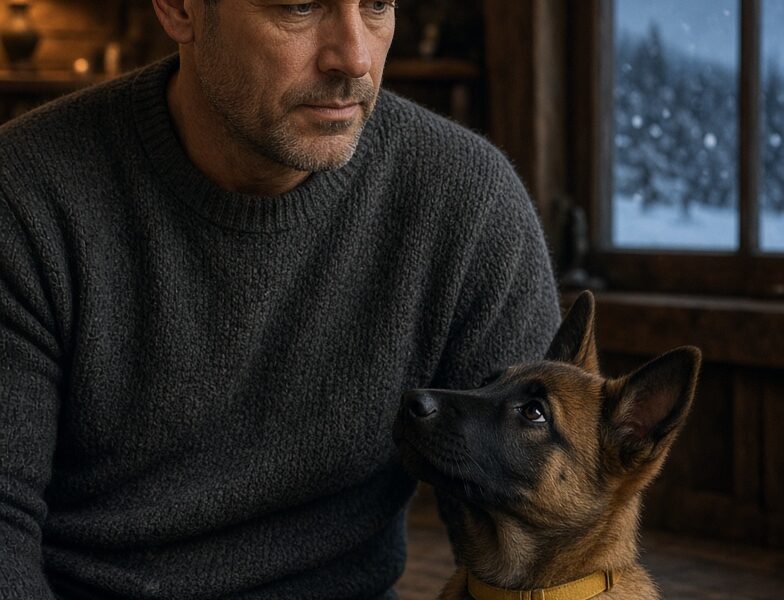
He Took In a Stray Puppy for 3 Days… Then a Storm Forced Him to Face What He’d Been Running From
The silence was the first thing Nolan Harwood noticed that January morning—not the peaceful quiet of a sleeping house, but the heavy, suffocating stillness that comes when snow has swallowed every familiar sound. Outside his cabin on Alder Street, the small Michigan town of Marrow Bay was disappearing beneath another brutal winter storm. Snow clung to the pine branches, buried the fences, and drifted across roads leading toward Lake Superior. At 51, Nolan had survived enough difficult winters to respect what the cold could do.
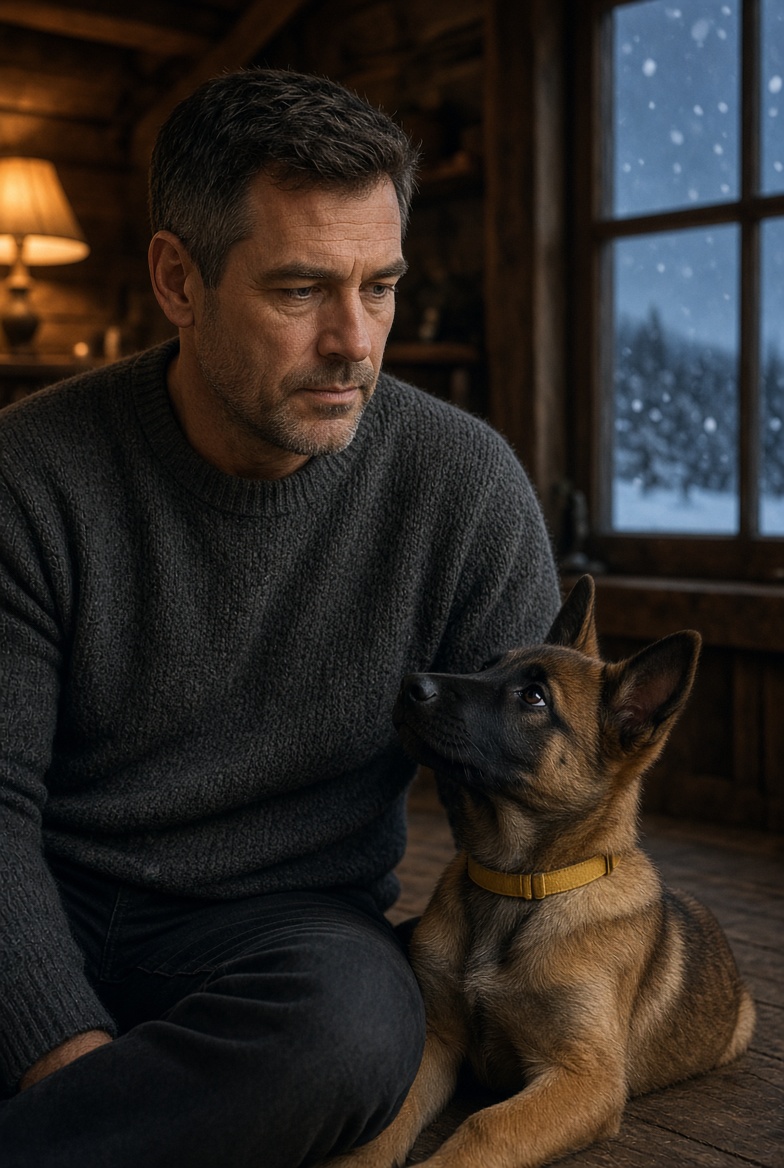
A retired Navy SEAL and former senior chief petty officer, he stood six feet tall with broad shoulders, a solid athletic build, and the weathered face of a man who had spent much of his life outdoors. His short dark brown hair was turning silver at the temples, and his square jaw carried a trace of closely trimmed stubble. Gray-blue eyes studied the world with an alertness he had never completely lost. His left ear, damaged during his years of military service, no longer caught every sound—a fact that bothered him more than he admitted.
He had once been responsible for men who trusted him to notice danger before it reached them. Now he repaired radios, emergency lanterns, and small electrical equipment for people around town. It was honest work, but Nolan sometimes felt as though the most meaningful part of his life had already ended. On the kitchen table lay a job offer from a company several hours away. He had not accepted it yet, though he had already begun imagining the relief of leaving without saying goodbye to anyone.
That morning, Nolan pulled on his charcoal gray sweater, dark winter trousers, and navy blue parka before loading six repaired emergency lanterns into his truck. His destination was the Marigold, a former movie theater converted into a community warming center. Twenty-seven residents were registered to stay there overnight while power outages and dangerous temperatures continued across Marrow Bay. The building still carried traces of its former life—faded red carpet, brass door handles, framed movie posters, and an old projection room above the main hall.
Cora Lynwood, the 39-year-old manager, greeted Nolan before he finished brushing snow from his boots. She was a slender woman of average height with auburn-brown hair tied in a low ponytail, hazel eyes, and a teal winter jacket that seemed almost permanently attached to her. Cora had a practical kindness about her—the kind that remembered medications, extra blankets, and who needed help standing up. “You’re early again,” she said. “And you’re leaving before coffee again, aren’t you?”
Nolan placed the lanterns on a folding table. “Depends. Is the coffee any better?”
“Absolutely not.”
He almost smiled. Across the room, Mabel Kershaw was arranging chairs beside the breakfast tables. At 72, she was petite, slightly stooped, and silver-haired with a neat low bun, pale blue eyes, and a soft face lined by decades of laughter and worry. A purple knitted scarf lay across her beige coat. She had operated the Marigold’s projectors for more than forty years and now helped the shelter maintain a handwritten contact book for isolated residents. One day, Mabel told Nolan, “You’re going to sit in one of these chairs instead of standing guard over everyone.”
Nolan glanced toward the doorway. “Someone ought to make sure it stays open.”
Mabel smiled, but her eyes held a quiet concern. He pretended not to notice. Before Nolan could leave, Cora introduced Lydia Voss, a 43-year-old animal rescue coordinator, standing near a designated side room. Lydia had shoulder-length, softly curling dark brown hair, warm brown eyes, and an olive green winter coat. Her gentle voice contrasted with the efficiency with which she managed vaccination records, feeding instructions, and temporary placements.
Inside a small puppy pen beside her sat a Belgian Malinois named Wick. He was a male puppy, only three months old, with a compact, youthful body, short, warm fawn-colored fur, a sharply defined black mask across his face and muzzle, and deep brown eyes that seemed curious about everything. His right ear stood upright, while his left remained adorably folded halfway over. A simple mustard-yellow fabric collar circled his small neck. Wick had been displaced when his temporary foster family’s heating system failed, and Lydia needed a safe home for the next few days.
Nolan understood what Cora was about to ask before she spoke. “No,” he said.
“You haven’t heard the question.”
“I know the question.”
Lydia smiled patiently and explained that the puppy had received age-appropriate veterinary care, although he still needed a controlled environment and careful supervision. Nolan shook his head. “I don’t know the first thing about raising a puppy.”
As though responding to that admission, Wick padded toward the edge of the pen, sat, and looked directly at him. Then something happened that made Cora stop smiling. When Nolan turned toward the exit, Wick abandoned the toy he had been carrying, hurried to the pen’s edge, and released a small, pleading whine. Lydia opened the pen to lift him into his carrier, but the puppy stepped toward Nolan instead, pressed one tiny paw against his snow-covered boot, and looked up.
Nolan froze. There was nothing extraordinary about a puppy seeking attention. Yet the simple trust in those dark eyes unsettled him. For years, he had arranged his life so nobody would be waiting when he returned home. Now, a creature that had known him for barely five minutes appeared unwilling to watch him leave.
“Well,” Mabel murmured, “perhaps someone finally found a reason for you to stay a little longer.”
Nolan stared down at Wick. “Three days,” he said at last. “And if he eats my furniture, I’m sending you the bill.”
Lydia laughed but took the arrangement seriously. She reviewed Nolan’s home conditions, completed the temporary foster paperwork, and explained Wick’s feeding schedule, bathroom routine, sleeping needs, and the importance of gentle, reward-based training. By late afternoon, Nolan was driving home with a secure puppy carrier fastened in the rear seat and a bag of supplies beside it. His orderly cabin changed almost immediately. Wick tipped his water bowl, dragged a sock beneath the coffee table, and tried to carry a chew toy larger than his head.
Nolan discovered that military discipline was remarkably ineffective against a puppy who had decided the corner of a rug was fascinating. He cleaned the floor, moved electrical cords out of reach, and placed a soft bed near the living room heater. After dinner, Wick fell asleep so suddenly that Nolan thought something was wrong. Lydia reassured him by phone that young puppies needed plenty of rest. Nolan sat beside the sleeping dog, listening to the faint ticking of his old military watch.
He had spent years believing that being needed meant being useful in a crisis. Wick needed nothing dramatic. He needed food, warmth, patience, and someone willing to remain nearby. Strangely, that felt harder than anything Nolan had expected. The following afternoon, Cora called to ask whether Nolan could deliver several additional emergency lanterns before the storm grew worse. The visit would be brief, and Nolan arranged to bring Wick in his carrier rather than leave him alone longer than he was ready for.
At the Marigold, the puppy settled in the quiet, approved pet room away from the crowded communal area. Nolan worked nearby, checking charging cables while snow scratched softly against the windows. The old building creaked whenever the wind pressed against its walls. Somewhere beyond the corridor, the heating system hummed steadily. Wick had been nosing a rubber toy when he suddenly stopped. His right ear rose sharply while the left tilted forward. His small body stiffened. He turned toward the wall adjoining the service corridor and gave a faint, uncertain whine.
Nolan glanced over. “What is it, buddy?”
Wick stepped backward, then looked toward the wall again. Nolan checked the room, found nothing visibly wrong, and crouched beside him. Still, the puppy would not return to his toy. When Nolan stood near the wall, he felt a faint, uneven vibration beneath his palm. A thin metallic squeal came and went behind the steady sound of ventilation. He could not tell whether it was serious, and he had no intention of guessing. He moved Wick farther from the noise, secured him comfortably in his carrier, and reached for his phone.
Nolan found the number for Darius Meechum, the building’s on-call maintenance technician, and pressed call. Outside, the winter wind rattled the theater windows. Inside, the puppy watched him with wide brown eyes, one ear standing and the other folded, as though still trying to understand the unfamiliar sound. Nolan had trusted his own judgment through many difficult situations. Yet this time it was a three-month-old dog that had made him pay attention. He looked once more toward the service corridor. He didn’t know what was happening behind that wall. He only knew something was different—and differences deserve to be checked.
When the call connected, Nolan spoke quietly. “Darius, it’s Harwood. Could you come take a look at the heating system?” He paused, listening to the question on the other end, then glanced at Wick. “I’m not sure yet,” he answered. “But something doesn’t sound right.”
Darius Meechum arrived at the Marigold twenty minutes after Nolan Harwood’s call, carrying a weathered tool bag and wearing the expression of a man who had already decided the evening was going to be longer than expected. At 58, Darius was broad through the chest, slightly heavy around the waist, with short salt-and-pepper hair, a neatly trimmed gray beard, and rectangular glasses that constantly slipped down his nose. His brown insulated work jacket showed years of practical use, and his thick hands bore the roughness of a lifetime spent repairing machinery. Darius had maintained heating systems around Marrow Bay for nearly three decades. He spoke plainly, disliked unnecessary risks, and had learned from experience that an old machine could appear perfectly reliable until the moment it wasn’t.
“So,” he said, setting his bag beside the service corridor. “I’m here because your puppy heard something.”
Nolan folded his arms. “I’m here because I felt something. He noticed it first.”
Darius raised an eyebrow but did not laugh. “Fair enough. Let’s see what we’ve got.”
The Marigold was unusually busy that evening. Snow pressed against the tall windows while twenty-seven residents gathered in the former theater’s warm communal hall. Some played cards beneath the faded movie posters. Others sat beneath blankets, listening to the wind. Cora Lynwood moved between tables, checking whether anyone needed medication, food, or help contacting relatives. Nolan remained near the service corridor as Darius examined the heating equipment. Wick, the three-month-old Belgian Malinois puppy, rested safely in the adjacent designated pet room. His warm fawn-colored coat contrasted with the black mask across his little face, and his right ear stood upright while his left remained slightly folded.
When the ventilation system produced another thin metallic squeal, the puppy lifted his head and looked toward the wall. Darius noticed the reaction through the open interior doorway. “That may be a sound we aren’t hearing very well,” he admitted. He continued his inspection, and after several minutes, his expression grew serious. The exhaust fan was operating unevenly, and snow had accumulated around the exterior vent area. Darius determined that the system required further attention before it could safely continue operating. “I’m shutting it down until we can inspect and repair it properly,” he said.
Nolan looked toward the crowded hall. “How long?”
Darius shook his head. “Longer than I’d be comfortable leaving these people without dependable heat.”
Cora joined them as Darius explained what he had found. She listened carefully, her hazel eyes moving toward the elderly residents sitting only a few yards away. “Are they in danger?” she asked.
“We haven’t established an immediate exposure,” Darius answered. “But we can’t keep relying on this equipment.” He recommended contacting the fire department for an independent safety assessment. Cora made the call without hesitation.
Less than half an hour later, Captain Tamson Oaks arrived with a small fire crew. Tamson was 44, athletic and straight-backed, with dark brown hair secured beneath a navy winter cap and deep brown eyes that rarely missed a detail. Her charcoal-colored winter rescue jacket carried reflective markings across the shoulders. She had worked through enough Michigan winters to know that the first task in an emergency was preventing fear from becoming another problem. Her team checked the occupied areas with appropriate monitoring equipment and found no dangerous carbon monoxide readings at that time. Still, the heating system remained out of service. The indoor temperature would eventually fall, and the approaching storm threatened the power supply.
After consulting the local emergency management team, Tamson made her decision. The residents would be moved to the school athletic center, an approved backup warming location with reliable emergency power and heating. For a moment, Cora looked overwhelmed. Twenty-seven people depended on this building, and several could not move quickly without assistance. Nolan immediately began listing what needed to be done—lanterns, blankets, medications, transportation, and a clear route to the exits. His voice became sharp and efficient, the voice of a man accustomed to giving instructions when time mattered.
But when an elderly resident asked whether he could bring the framed photograph of his late wife, Nolan answered too quickly. “Only essentials, sir.”
The old man lowered his eyes. Cora quietly touched Nolan’s sleeve. “That picture may be essential to him.”
Nolan looked at the photograph, then at the man’s trembling hands. He had spent years measuring urgency in seconds and distance. He had forgotten that sometimes safety meant protecting the small things that help people feel human. He softened his voice. “Of course. I’ll make sure it travels with you.”
The old man’s shoulders relaxed. Nolan helped wrap the frame in a clean towel before returning to the preparations. When Lydia Voss arrived to take Wick to a temporary heated foster room, Nolan expected the handover to be simple. Instead, the puppy recognized his voice, scrambled to his feet, and pressed his tiny front paws against the carrier door. Nolan crouched beside him. The little Malinois tilted his head, one ear upright and the other folded, his dark eyes fixed on Nolan’s face.
“Hey, buddy,” Nolan whispered. “You’re going somewhere warm. I’ll come back for you.”
The words escaped before he considered them. For years, Nolan had carefully avoided making promises that required him to return. There had been too many departures in his life, too many people he could no longer see, and too many memories he preferred to carry alone. Yet here he was, reassuring a puppy he had known for barely two days. Lydia watched him secure the carrier and smiled. “He’ll be fine, Nolan.”
Nolan nodded. But as Lydia carried Wick toward her waiting vehicle, he felt an unfamiliar emptiness. It surprised him how quickly a small creature could become someone he worried about leaving behind. Back inside the Marigold, the evacuation preparations continued. Tamson confirmed that the route to the school remained accessible, and the local emergency team arranged vehicles to transport the residents in supervised groups. Nolan placed his repaired emergency lanterns along the designated gathering area, supplementing the building’s emergency lighting. Cora distributed instructions while volunteers helped residents collect medications and winter coats.
Near the breakfast tables, Mabel Kershaw was checking names in her handwritten notebook. Her purple scarf rested loosely around her neck, and her silver hair was pinned in its familiar neat bun. She had helped maintain the center’s contact records for years, particularly the telephone numbers of elderly neighbors who lived alone. Suddenly, she remembered that the larger brown contact book was still upstairs in the old projection room. She had taken it there earlier to update several addresses in peace. With the building about to close temporarily, she worried the information might be inaccessible when someone needed it. Before the formal evacuation announcement reached the hall, Mabel quietly made her way toward the familiar staircase. The slow ache in her knees made each step deliberate, but she knew the old theater so well that she believed retrieving the book would take only a few minutes.
Meanwhile, Nolan helped a volunteer carry blankets to the assembly area. Outside, the wind had strengthened enough to shake the glass doors. Snow streamed through the streetlights, reducing the familiar road to a pale corridor between dark buildings. Tamson kept the movement orderly, allowing residents who needed extra assistance to board first. Nolan had just returned to the lobby when the overhead lights flickered once, then again. A low murmur passed through the hall. Moments later, the building’s main electrical supply failed. The ceiling lights went dark, leaving battery-powered exit signs and emergency fixtures glowing along the corridors.
Nolan immediately switched on two of the lanterns he had repaired and positioned them where the firefighters directed. Their warm light spread across the floor, illuminating the gathered residents without creating confusion. “Everyone stays with their assigned group,” Tamson announced calmly. “We have lighting, transportation, and a safe destination. No one needs to rush.”
Nolan watched the residents respond to her measured voice. He recognized something he had nearly forgotten. Real leadership did not always mean being the loudest person in the room. Cora moved carefully between the waiting vehicles and the illuminated gathering area, confirming each resident’s name against the official registration sheet. The first groups were already seated inside the transport vehicles while the remaining residents waited with volunteers near the entrance. Nolan helped an older woman adjust her scarf before looking toward the former theater hall. For the first time that evening, he noticed how strangely empty the room had become. The tables were still there. A half-finished card game lay abandoned beneath one of the lanterns. A forgotten paper cup stood beside a chair. Everything looked ordinary, yet the absence of familiar voices made the building feel unfamiliar.
Cora returned from checking the vehicles, her face tightening as she studied the list. She counted the confirmed residents once, then checked again. Twenty-six. Nolan noticed her expression immediately. “What’s wrong?”
Cora asked two volunteers whether anyone had seen Mabel board a vehicle. Both shook their heads. She checked with the transport coordinator, then searched the names a third time. Tamson approached, already reading the concern on Cora’s face. Outside, snow continued to thicken around the waiting vehicles. Cora lifted her eyes from the paper, and her voice dropped to something barely above a whisper. “We’re missing Mabel.”
For one terrible moment, nobody answered Cora Lynwood. The words “We’re missing Mabel” seemed to hang in the cold air of the Marigold’s entrance hall, heavier than the snow gathering against its windows. Nolan Harwood turned toward the dim corridor, his gray-blue eyes narrowing. Captain Tamson Oaks immediately lifted her radio. “One resident unaccounted for. Seventy-two-year-old female, limited mobility, hearing impairment. Continue the interior sweep. Do not clear the building.” Her voice remained steady, but Nolan recognized the urgency beneath it. Twenty-six residents had been accounted for, either aboard the waiting vehicles or in the supervised gathering area. One was still somewhere inside.
Cora checked the registration sheet again, her fingers tightening around the clipboard. “She was helping me with the contact records earlier. I thought she’d join the others.”
Nolan remembered Mabel’s purple scarf, her gentle smile, and the way she had talked about keeping important telephone numbers safe. Then another memory surfaced. “The projection room,” he said. “She mentioned leaving her contact book upstairs.”
Cora looked up sharply. “She knows that room better than anyone.”
Tamson repeated the information over her radio and directed two firefighters toward the old staircase. Nolan instinctively stepped after them. Tamson stopped him with a raised hand. “I need you here, Harwood. You know the layout. Tell me anything else you remember.”
Nolan nodded despite the frustration rising inside him. He was used to moving toward uncertainty, not watching others disappear into it. Above the main hall, Mabel Kershaw sat beside the silent projection equipment, holding a brown leather-bound notebook against her chest. The room was almost unchanged from her working years. A scratched wooden desk stood beneath a narrow window. An old projector faced the auditorium, and metal shelves held empty film containers that nobody had bothered to remove. She remembered when the room had been filled with the steady mechanical rhythm of movie reels and the smell of warm dust. Back then, she could move up and down the stairs without thinking. Now her knees protested whenever she stood, and her hearing aids struggled with the muffled noise of wind pressing against the old building.
She had retrieved the notebook shortly before the power failed, but the sudden darkness had frightened her. The battery-powered exit lighting still worked along the stairwell, yet the shadows between the steps looked deeper than she remembered. She had no wish to fall and make matters worse. So she had sat down, switched on her small flashlight, and waited. Mabel knew she should have told Cora where she was going. That realization weighed more heavily than the book in her lap. Downstairs, somewhere beyond the heavy door, she could occasionally feel the vibration of footsteps. She called out twice, but her voice seemed terribly small inside the empty room.
Nolan stood near the designated gathering area, staring toward the staircase entrance. His bad left ear caught only fragments of radio traffic, forcing him to turn his head whenever someone spoke. Years earlier, he would have considered that limitation unacceptable in himself. He had built his identity around preparation, awareness, and the ability to act before others needed to ask. But the firefighters were trained for precisely this situation. And he knew that following them without authorization would create another problem.
Cora approached, her auburn hair escaping its ponytail beneath her teal hood. “You gave them the right place to look,” she said quietly.
Nolan shook his head. “Maybe. I should have noticed she wasn’t downstairs.”
“There were twenty-seven people moving in different directions. That’s why we have a count.” He looked toward her clipboard. The numbers were simple, but the responsibility behind them was not.
At that moment, his radio crackled. A firefighter reported reaching the upper landing. There was a short pause, then another transmission. “Projection room occupied. We’ve located Mrs. Kershaw. She’s conscious and communicating.”
Cora closed her eyes. Nolan released a breath he had not realized he was holding. Minutes later, Tamson appeared at the bottom of the staircase with Mabel and another firefighter. The elderly woman walked slowly, supported on either side, her beige coat buttoned unevenly and her purple scarf tucked beneath one arm. Her pale blue eyes were moist, but she managed a faint smile when she saw Cora waiting.
“I suppose I’ve made quite a nuisance of myself,” she said.
“You gave us a fright,” Cora answered, embracing her gently. “That’s different.”
A responder helped Mabel into a chair, checked that she was warm and alert, and offered her a blanket. She was tired and shaken but had no apparent serious injury. Nolan crouched beside her. “I’m sorry,” Mabel whispered. “I thought I could collect the book and get back before anyone noticed.”
Nolan looked at the old notebook resting on her knees. “You don’t owe anybody an apology for needing help.”
She gave a weak little laugh. “I do owe Cora an apology for not telling her where I went.”
“That,” Nolan admitted, “you probably do.”
For the first time that evening, Mabel smiled without looking frightened. As Nolan helped Mabel place the notebook inside her bag, a loose sheet slipped from between its pages. He caught it before it touched the wet floor. The paper contained several handwritten names and addresses beneath the heading “Winter Check-In List.” Nolan was about to return it without reading when one name caught his attention. His own.
“Nolan Harwood, Alder Street. Lives alone. Rarely asks for help. Check on him during major storms.”
He stared at the words, unable to understand why they were there. “Mabel,” he asked quietly. “Why is my name on this list?”
The elderly woman looked at the page, then up at his face. Her expression softened. “Because you live alone, dear.”
Nolan swallowed. “I’m not one of your shelter residents.”
“I know,” she touched his wrist. “But you’ve been coming here for months, fixing things and helping everyone else. Every time somebody asks how you’re doing, you say you’re fine and walk away.” Her eyes glistened. “I thought someone ought to make sure you really are.”
For several seconds, Nolan could hear nothing but the quiet hum of the emergency lantern beside them. He had faced storms, isolation, and difficult decisions before. But this simple piece of paper reached a place in him that years of silence had protected. Mabel had noticed him. Not because he was a retired Navy SEAL, not because he could repair equipment, and not because she expected him to rescue anyone. She had written his name down because she cared whether he made it through the winter.
“You didn’t have to do that,” he murmured.
“Neither did you,” Mabel replied, glancing toward the lanterns illuminating the hall. “Yet here you are.” She adjusted the blanket around her shoulders. “You spend so much time making sure everyone else gets home. Someone ought to make sure you do, too.”
Nolan looked away, blinking against an unexpected sting in his eyes. In the Navy, being needed had meant responsibility. At the Marigold, it had meant bringing working lanterns and staying useful. But Mabel was offering something different. Concern that asked for nothing in return. He carefully folded the sheet and placed it back inside her notebook.
With Mabel accounted for, the evacuation continued. Tamson confirmed the completed room checks, and the remaining residents were transported to the heated school athletic center. Cora rode with Mabel, promising to help reorganize the contact records once everyone had settled. Before leaving, Mabel reached through the vehicle doorway and squeezed Nolan’s gloved hand. “Don’t disappear on us,” she said.
Nolan managed a small smile. “I’ll try not to.”
He watched the vehicle pull away through the falling snow, then helped the remaining volunteers secure the portable equipment. The Marigold stood quiet behind him, its old movie posters dimly illuminated by the last lantern being packed away. He had arrived that afternoon expecting to deliver a few repairs and return to an empty house. Instead, he was leaving with the uncomfortable knowledge that people had been paying attention to him all along. For once, he did not know what to do with that feeling.
When his responsibilities were finished, Nolan drove to the heated temporary foster location where Lydia Voss was caring for Wick. The moment the little Belgian Malinois heard his voice, his dark brown eyes brightened. He scrambled forward inside the puppy enclosure, his right ear standing proudly while the left folded against his small head. His mustard-yellow collar sat slightly crooked above his warm fawn-colored coat. Nolan knelt, offered his hand, and laughed softly as Wick greeted him with an enthusiastic wagging tail and an impatient attempt to climb into his lap.
“Yeah, buddy,” he whispered. “I came back.”
Lydia watched from the doorway, smiling as Nolan carefully settled the puppy into his carrier. During the drive home, Nolan glanced toward the secure carrier in the rear seat more often than necessary. Someone was coming home with him—someone who would need dinner, a warm bed, and a gentle voice when the night grew quiet. The thought no longer frightened him quite as much.
Back at the cabin, Nolan removed his navy parka and placed Wick on the living room rug. The puppy explored briefly, drank some water, and finally curled into his soft bed beside the heater. Nolan sat at the kitchen table where his old military watch lay beside the unanswered job offer. Beyond the window, snow drifted over Alder Street, slowly covering the tracks his truck had left in the driveway. He looked toward Wick, whose small paws twitched as he slept. Then he remembered Mabel’s handwritten note and the way she had spoken as though his life mattered without needing to explain why.
Nolan had spent years believing that leaving was easier than belonging. Tonight, for the first time, he wasn’t so certain. He picked up the job offer, studied it for a moment, and set it back down. The house remained quiet, but it no longer felt empty. Somewhere between an elderly woman’s concern and a puppy’s uncomplicated trust, something inside him had begun to change.
Four days after the evacuation of the Marigold, the snow began to loosen its grip on Marrow Bay. Snowplows had cleared the main streets, though white banks still rose above the sidewalks, and Lake Superior remained hidden beyond a curtain of pale winter mist. Nolan Harwood stood at his kitchen window, holding a cup of coffee that had gone cold. At 51, the retired Navy SEAL had learned to recognize the moment after a crisis when urgency disappeared and ordinary life demanded attention again. In the military, there had always been another assignment, another responsibility, another reason to keep moving. Here, in his quiet cabin on Alder Street, there was only the ticking of his old watch and the soft breathing of a puppy asleep beside the heater.
Wick, the three-month-old Belgian Malinois, lay curled on his blanket, his warm fawn-colored fur rising and falling with every breath. The black mask around his muzzle made his dark brown eyes appear almost impossibly expressive when they opened. His right ear stood upright while his left remained slightly folded. Nolan had never imagined that something so small could make a house feel different. Yet the cabin no longer seemed quite so empty. Even the misplaced toys and the little mustard-yellow collar hanging beside the door had begun to feel like things that belonged there.
The Marigold remained closed while Darius Meechum and the maintenance contractors worked to restore its heating system. The school athletic center continued providing temporary shelter for residents who could not yet return home. Cora Lynwood had organized volunteers to distribute warm meals, check emergency supplies, and contact vulnerable neighbors. Nolan found himself returning almost every afternoon. He repaired two portable radios, replaced worn charging cables, and helped organize the emergency lanterns into clearly labeled storage containers. More importantly, he began showing the volunteers how to inspect the equipment themselves.
One afternoon, a nervous volunteer struggled to replace a radio battery. Nolan started to reach across the table, ready to complete the task in seconds, but stopped himself. “Try turning it the other way,” he suggested. The volunteer succeeded and smiled with obvious relief. Nolan felt an unfamiliar satisfaction. He had not solved the problem for someone. He had helped another person become capable of solving it.
Cora noticed, standing nearby in her teal jacket, auburn hair tied loosely behind her head. She gave him an approving look. “Careful, Nolan. People might start thinking you’re friendly.”
He raised an eyebrow. “Let’s not spread dangerous rumors.”
Cora laughed. And this time, Nolan laughed with her.
At home, Wick was teaching him an entirely different kind of patience. The puppy seemed to approach every ordinary object as though it were a discovery worth investigating. A fallen pine cone, a squeaking floorboard, or the loose end of a blanket could occupy him for several minutes. Nolan followed Lydia Voss’s instructions carefully, keeping training sessions short and rewarding simple behaviors rather than demanding perfection. Wick was learning to recognize his name, sit briefly, and come when called in the quiet living room. Some sessions went well; others ended with the puppy becoming fascinated by a dust particle floating through the afternoon sunlight. Once Nolan called him three times before realizing Wick had fallen asleep with his chin resting on a toy. Nolan shook his head and smiled. “Some soldier you’d make.”
The puppy opened one eye, yawned, and closed it again. Nolan began to appreciate the difference between training an animal and controlling one. Wick did not need to become an obedient machine. He needed security, consistency, proper rest, and a person willing to understand him.
That afternoon, Lydia arrived for a scheduled foster check. Her shoulder-length dark brown curls peeked from beneath an olive green wool hat, and she carried a folder containing Wick’s veterinary records and placement information. She inspected the puppy’s sleeping area, asked about feeding and bathroom routines, and watched Nolan gently reward Wick for approaching his carrier. Everything appeared well organized. Then Lydia explained that the temporary foster arrangement would soon need a final decision. Another screened household had expressed interest in adopting Wick. Nolan could also apply, but it would require a long-term commitment. “Belgian Malinois puppies grow into energetic dogs,” she reminded him. “He’s adorable now, but he’ll need years of exercise, mental stimulation, veterinary care, and consistent training. Loving him means preparing for the dog he’ll become, not just the puppy he is today.”
Nolan nodded. He understood responsibility. That was what frightened him. His job offer in another city still lay unanswered on the kitchen table. Taking it would mean relocating, adjusting his working hours, and making entirely new arrangements for Wick. Lydia watched his expression. “You don’t have to decide this minute,” she said gently. “But whatever you choose, make sure it’s a life you can truly give him.”
After she left, Nolan remained beside the door long after her vehicle disappeared down the snowy street. The following evening, the company called again. The position was still available, but they needed an answer before the end of the week. Nolan thanked the recruiter and promised a decision. Then he opened the hall closet and pulled out the dark travel bag he had used for years. Its familiar weight brought back memories of early departures, unfamiliar rooms, and a life where leaving had always felt easier than staying. He placed the bag beside his bedroom door and began sorting the few possessions he considered important.
From the hallway came the faint click of small claws against the floor. Wick appeared carrying one of Nolan’s old wool socks. The puppy stopped beside the open travel bag, tilted his head, and studied it with the solemn curiosity of a creature encountering something new. Then he dropped the sock, stepped onto Nolan’s boot, and settled against his ankle. Nolan looked down. “That’s not your bed, buddy.”
Wick made no effort to move. Instead, he rested his small chin on the boot and closed his eyes, perfectly content. Nolan suddenly remembered the promise he had made at the Marigold. I’ll come back for you. He had kept that promise once. But what about tomorrow and the years after that? Wick had no understanding of job offers, distance, or the reasons people leave. He only knew Nolan’s voice, his footsteps, and the safety of the place they shared. For the first time, the travel bag looked less like freedom and more like something Nolan had been using to avoid the possibility of belonging.
The next morning, Nolan visited Mabel Kershaw at the heated home of a longtime friend, where she was staying until her own house could be checked and safely reopened. Mabel welcomed him into a modest sitting room filled with knitted cushions, framed family photographs, and the scent of cinnamon tea. Her silver hair was secured in its familiar low bun, and her purple scarf rested over the back of a chair. At 72, she moved carefully, favoring one knee, but her pale blue eyes remained bright with the gentle curiosity Nolan had come to recognize.
“You look like a man carrying a suitcase nobody can see,” she observed.
Nolan gave a reluctant smile. “There’s an actual suitcase at home.”
Over tea, he told her about the job offer, Lydia’s visit, and the possibility of adopting Wick. He admitted that the thought of depending on another living creature unsettled him more than he expected. “I spent most of my life being the person people counted on,” he said. “After I left the service, I started wondering what was left when I couldn’t be that man anymore.” His fingers tightened around the warm cup. “I don’t want to promise that puppy a home and then discover I’m not enough.”
Mabel listened without interrupting. Then she looked toward an old photograph of the Marigold hanging beside the window. “When that theater stopped showing movies, I thought my life had ended,” she said. “Forty years operating those projectors. I knew every sound those machines made. Then one day, nobody needed me to run them anymore.” She smiled sadly. “I spent months thinking I had become useless. But eventually, I found other things worth doing—remembering people’s birthdays, calling neighbors during storms, keeping a little book of names.”
Nolan lowered his eyes, remembering his own name on her handwritten list. “You don’t have to be the strongest man in the room to deserve a place in it,” she continued. “And you don’t have to rescue that puppy every day for him to love you.”
Nolan stared at his coffee. He had spent years measuring his worth by what he could accomplish. Mabel was asking him to consider something he had never learned to measure—the value of simply being present.
When Nolan returned home, Wick greeted him with an enthusiastic wagging tail and a brief, clumsy attempt to carry two toys at once. Nolan sat on the floor beside him, laughing as the puppy abandoned one toy to investigate his shoelaces. He thought about the practical questions Lydia had raised. Could he provide the time Wick needed as he grew? Could he afford veterinary care and training? Could he arrange responsible supervision during longer work days?
Nolan spent that evening making a plan rather than relying on emotion. His current local repair business provided a manageable schedule, and he could adjust appointments to avoid leaving Wick alone for excessive periods. He identified a qualified positive-reinforcement trainer, reviewed nearby veterinary services, and discussed backup care with Lydia. For once, planning did not feel like preparing for another mission. It felt like building a future.
The following morning, Nolan called the company and politely declined the position. He thanked them for the opportunity but explained that he had decided to remain in Marrow Bay. The decision surprised him by how peaceful it felt. He then contacted Lydia and formally applied to adopt Wick. Over the next several days, she completed the required assessment, reviewed his home arrangements, and confirmed that he understood the responsibilities involved. Nolan answered every question carefully. He made no promises about turning Wick into a working dog or expecting extraordinary achievements from him. He wanted to give the puppy a stable home, proper care, and the freedom to grow into whatever kind of dog he would become.
When Lydia finally approved the adoption, Nolan signed the paperwork with hands that were steadier than he expected. She smiled as she returned the completed documents. “Congratulations, Nolan. He’s officially yours.”
Nolan looked toward Wick, who was busy investigating a harmless rubber toy. “I think he made that decision before I did.”
That evening, Nolan carried his travel bag back to the hall closet and placed it on the highest shelf. He returned to the living room, wearing his charcoal gray sweater, the sleeves pushed above his wrists. Wick lay on his blanket beside the heater, his mustard-yellow collar bright against his fawn coat, his right ear standing while the left folded softly over. Nolan lowered himself onto the rug. The puppy immediately shuffled closer and rested against his leg. Outside, snow drifted through the last light of the winter afternoon. Inside, the cabin held the quiet sounds of a life no longer lived entirely alone.
Nolan thought of Cora, Mabel, the volunteers, and the small community he had nearly abandoned without ever allowing himself to become part of it. He looked down at Wick and gently scratched beneath his collar. “Looks like we’re staying, little buddy,” he whispered.
Wick answered with one sleepy thump of his tail. Nolan smiled, unaware that in just a few days, the people of Marrow Bay would show him how much that decision meant.
Two weeks after the winter storm that forced the Marigold to close, Marrow Bay was beginning to breathe again. Snow still covered the rooftops and gathered beneath the tall pine trees, but the main roads had reopened, and warm lights glowed behind windows that had stood dark for days. Nolan Harwood drove slowly toward the school community center, his gray-blue eyes following the familiar streets with an unfamiliar sense of belonging. At 51, the retired Navy SEAL still had the broad shoulders, square jaw, and disciplined posture of a man who had spent much of his life preparing for danger. Silver threaded through his short, dark brown hair, and a trace of stubble shadowed his weathered face. His navy winter parka rested over a charcoal gray sweater.
In the back seat, secured inside a comfortable carrier, Wick watched the passing scenery with wide, curious eyes. The three-month-old Belgian Malinois had a warm fawn-colored coat, a distinct black facial mask, dark brown eyes, and a mustard-yellow fabric collar. His right ear stood upright, while his left remained adorably folded. Nolan had officially adopted him only days earlier. Yet the little dog already seemed to belong to every corner of his life.
That morning, they were attending a gathering for the twenty-seven residents who had sheltered at the Marigold during the storm. Inside the school community center, folding tables stood beneath warm ceiling lights, and the smell of fresh coffee drifted through the room. Cora Lynwood was directing volunteers near the entrance, her auburn-brown hair tied loosely behind her head and her teal jacket unzipped over a cream sweater. She greeted Nolan with a smile.
“You’re early.”
“Someone has to make sure your lanterns work.”
“They work perfectly,” she replied. “You checked them yesterday.”
Nolan almost argued, then laughed. Cora handed him a small box of name cards and asked him to help arrange the seating. Along one side of the room stood twenty-seven chairs, each bearing the name of a resident who had been evacuated from the Marigold. Other chairs and tables were reserved for volunteers and guests. Nolan helped straighten the rows, checking that the walkways remained clear for people using canes or walkers. He noticed that every chair in the residents’ section had a name except a small space at the end of the last row. He assumed another chair had simply been moved.
Mabel Kershaw appeared behind him, her silver hair gathered into a neat bun, her familiar purple scarf resting over a beige wool coat. At 72, she moved slowly but carried herself with quiet purpose. “Don’t worry about that space,” she said. “I’ve got plans for it.”
Nolan raised an eyebrow. Mabel smiled and walked away without explaining.
Lydia Voss had arranged for Wick to remain in a quiet, pet-permitted side room during the gathering. The puppy had his own soft mat, fresh water, and a familiar chew toy. Nolan checked on him between helping the volunteers, making sure the little Malinois was comfortable and not overwhelmed by unfamiliar sounds. When Nolan entered, Wick greeted him with a sleepy wag of his tail before returning to his toy.
Lydia, wearing her olive green winter jacket, watched with satisfaction. “He’s settling in beautifully,” she said.
Nolan crouched beside the puppy. “He’s getting better at training me, too.”
Lydia laughed. “That part usually happens first.”
Nolan gently scratched Wick’s chest, careful not to interrupt his rest for too long. He had once imagined that owning a dog meant teaching it obedience and discipline. Now he understood that the greater responsibility was learning what the animal needed. Wick did not have to become a working dog or perform extraordinary tasks. He was a puppy who deserved patience, safety, and affection. Watching him settle comfortably on his mat, Nolan felt proud of something far simpler than any achievement from his military years.
By noon, the twenty-seven former shelter residents had gathered in the main room. Darius Meechum stood near a display of emergency equipment, his gray beard neatly trimmed beneath rectangular glasses. Captain Tamson Oaks spoke with volunteers about improving winter safety procedures, her dark rescue uniform contrasting with the bright room. Cora welcomed everyone and thanked the community for working together during the storm.
Darius explained that the unusual sound from the Marigold’s ventilation system had prompted an inspection, but the decision to close the building had been based on proper technical and safety assessments. He smiled toward Nolan. “And yes, a very small puppy helped get our attention.”
Gentle laughter moved through the room. Nolan smiled but shook his head. He did not want Wick turned into some legendary rescue dog. Tamson reminded everyone that good preparation, accurate headcounts, and cooperation had kept the evacuation orderly. Nolan appreciated that real safety depended on people doing their jobs, not on pretending any single person had saved the day.
When Cora finished speaking, Nolan stepped toward the back of the room, intending to return to Wick. But Mabel called his name. “Nolan, would you come here a moment?”
She stood beside the twenty-seven chairs, holding another folding chair that a volunteer had brought from storage. Nolan approached, puzzled. Mabel placed it at the end of the row and carefully straightened a small white card attached to its back. Nolan looked down. Printed across the card were two words: Nolan Harwood.
For several seconds, he said nothing. “Mabel, I wasn’t one of the shelter residents.”
“I know, dear.” She rested one hand against the chair. “We counted twenty-seven people that night. We made sure they were warm, safe, and accounted for.” Her voice softened. “But we never counted the man who kept making sure everyone else was safe.”
Nolan stared at the empty seat. Mabel stepped closer. “You spend your life standing near the door, ready to leave whenever someone needs help. I thought perhaps just once somebody should save you a place.” Then she smiled through gathering tears. “This one’s yours.”
The room grew quiet. Nolan looked at the chair, then at the faces around him. He remembered how often he had entered the Marigold, carrying repaired equipment, refusing coffee, avoiding conversation, and leaving before anyone could ask how he was feeling. He remembered the years after leaving the Navy when silence had seemed easier than admitting how much he missed belonging somewhere. Now, an elderly woman was offering him a chair as though it were the most natural thing in the world.
Nolan swallowed hard. “I don’t know what to say.”
Mabel touched his arm. “Then don’t say anything. Just sit down.”
Slowly, Nolan lowered himself into the twenty-eighth chair. Cora smiled from across the room. Darius gave him a quiet nod, and Tamson looked away for a moment, allowing him the privacy of his emotions. Nolan had spent years believing that his worth depended on what he could do for others. Yet nobody in that room was asking him to repair something, organize a rescue, or prove his strength. They simply wanted him there—and for the first time in years, he allowed himself to stay.
The gathering continued with stories, laughter, and plans for the coming winter. Mabel introduced a voluntary neighborhood check-in program inspired by her old contact book. Residents who wished to participate could provide updated contact information and identify trusted neighbors who could call during severe weather. Cora explained that the information would be shared only with permission. Nolan volunteered to maintain emergency radios and teach basic equipment checks. He no longer felt compelled to manage everything himself. When one elderly resident thanked him for the lantern that had helped him find his medication during the blackout, Nolan accepted the gratitude without brushing it aside.
Later, after the room became quieter, Lydia brought Wick out for a short, supervised visit. The little Malinois walked beside Nolan on his leash, pausing to investigate the unfamiliar chairs. Nolan guided him toward his mat beside the twenty-eighth seat. Wick circled twice, settled near Nolan’s boots, and released a contented sigh. Mabel watched them with a smile. “Looks like he approves.”
Nolan glanced down at the puppy. “He’s been making decisions for both of us since the day we met.”
By late afternoon, the gathering began to end. Nolan helped carry supplies to the storage room and thanked Cora for inviting him. Before he left, Mabel removed the name card from the twenty-eighth chair and placed it in his hand. “Take it home,” she said. “In case you ever forget.”
Nolan looked at the simple piece of paper. “Forget what?”
Mabel smiled. “That there’s a place for you here.”
He folded the card carefully and slipped it into his coat pocket. Outside, the sky had turned a soft blue-gray, and thin flakes drifted between the buildings. Nolan secured Wick in his carrier before driving home through the quiet streets. He passed the Marigold, still closed for repairs, its faded sign standing above the snow-covered entrance. Once Nolan had viewed the building as another place where something needed fixing. Now he saw the people who had gathered beneath its roof, the friendships that had begun there, and the life he might have missed if he had simply driven away.
That evening, the cabin on Alder Street glowed with warm lamplight. Nolan hung his navy parka beside the door and placed Wick’s leash on its wooden hook. The puppy drank from his water bowl before settling onto the soft bed near the heater. Nolan took the name card from his pocket and set it beside his old military watch. For years, that watch had reminded him of the man he used to be—disciplined, dependable, always prepared to carry someone else’s burden. The little white card reminded him of something entirely different. He no longer needed a mission to justify his place in the world.
Outside, snow continued falling gently across the silent street. Nolan sat on the rug beside Wick, watching the puppy’s dark eyes grow heavy with sleep. He remembered the tiny paw against his boot on the day they met, the strange sound that had brought them together, and the twenty-eighth chair waiting for him in a room full of people who cared. He gently stroked Wick’s half-folded ear and whispered, “I thought I was giving you a home, little buddy. Turns out you gave me one first.”
Wick rested his small muzzle against Nolan’s knee, his tail tapping the rug once before he fell asleep. And in the quiet warmth of that winter evening, the former Navy SEAL finally understood. Home was not merely a place where the storm could not reach you. It was a place where someone noticed when you were missing, someone waited for you to return, and someone always remembered to leave you a chair.









