He Told the Tiny Puppy to Get Out of His Truck — Then the Blue Cloth Changed Everything Forever
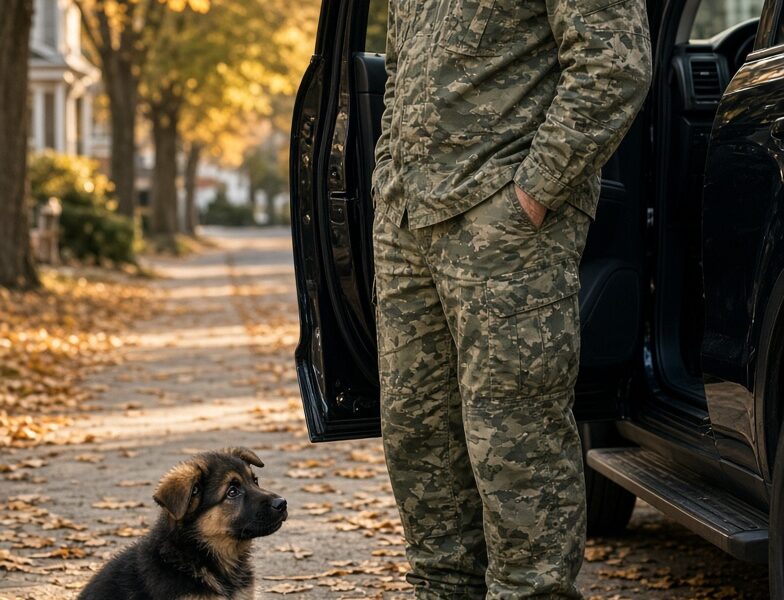
A tiny German Shepherd puppy sat on the back seat of a black SUV, staring at the Navy Seal standing outside. 45-year-old David Harris pointed toward the open door.
“Get out, little buddy.”
“This isn’t your truck.”
The puppy slowly lowered his head.
Then, instead of running away, he picked up a worn blue cloth, climbed down, and placed it beside the soldier’s boots.
David stopped smiling.
Why did this tiny puppy carry that old cloth everywhere he went?
And why did he refuse to leave the Navy Seal’s side?
Some creatures understand the difference between being told to move and being told they no longer belong.
Others are too young to know the difference, and that uncertainty can follow them long after the words have faded.
David Harris had never given much thought to such things.
At 45, he believed a clear instruction was usually an act of kindness.
People deserved to know what was expected of them.
Life was difficult enough without unnecessary confusion.
But on a pleasant autumn morning in Chesapeake, Virginia, a 9-week-old German Shepherd puppy would challenge that belief without saying a single word.
The morning was bright with gentle sunshine warming the sidewalks and a cool breeze stirring the leaves along a quiet neighborhood street.
David had just finished attending a community program for military veterans and was making one final stop before returning to his duties.
He stood 6 feet 2 inches tall with broad shoulders, an athletic build, and the steady posture of a man accustomed to responsibility.
Short dark brown hair, lightly silvered at the temples, framed a handsome, angular face.
A neatly trimmed beard emphasized his square jaw, while blue-gray eyes gave him an expression that often seemed sterner than he intended.
He wore an authentic Navy working uniform type 3 in soft green, gray-brown camouflage without body armor or tactical equipment and polished black boots.
David was a Navy Seal who had spent much of his adult life learning to remain calm when circumstances became unpredictable.
Yet, patience with ordinary inconveniences was not among his strongest qualities.
He respected honesty, disliked excuses, and believed problems should be addressed before they grew complicated.
Years earlier, an unexpected assignment had forced him to miss a retirement celebration he had promised to attend for a close military colleague.
The man had forgiven him without complaint, but David had remembered the disappointment.
Since then, he had become careful about making promises, particularly ones involving his time.
That morning, however, his greatest concern was a stubborn zipper.
His olive khaki military duffel bag had been repaired at Thompson’s alterations, a small neighborhood shop with faded blue shutters, a brick entrance, and a handwritten sign promising repairs done properly rather than quickly.
David parked his black SUV outside.
The vehicle’s dark paint reflected the autumn sunlight while its beige leather interior remained pleasantly cool.
Inside the shop, Carol Thompson handed him the repaired bag.
Carol was 71, petite and straightbacked with fair skin, neatly curled silver hair, and observant pale blue eyes.
She had spent nearly four decades repairing clothing and possessed the quiet confidence of someone who could identify a poorly sewn seam from across a room.
Her kindness was genuine, although her opinions tended to arrive without an invitation.
“The zipper should last another 10 years,” she announced.
“That’s optimistic.
I repaired it myself, Commander.
Optimism has nothing to do with it.”
David smiled.
Carol had apparently decided that every uniformed customer deserved a military title, whether appropriate or not.
He carried the bag outside, opened the SUV’s rear passenger door, and placed it on the cream-colored seat.
Remembering that he had not paid for the replacement zipper, he left the door open and returned to the shop.
He was gone only a few minutes.
When David came back, something was sitting beside his bag.
At first, he thought Carol had placed a stuffed animal inside the vehicle as a joke.
Then, the stuffed animal blinked.
A tiny German Shepherd puppy sat upright on the rear seat.
Four oversized paws planted carefully against the leather.
Thick black and tan fur covered his little body with warm golden markings across his chest, eyebrows, and short legs.
One triangular ear stood almost straight while the other leaned sideways as though still considering the effort.
His round brown eyes followed David with extraordinary concentration.
For several seconds, neither moved.
David looked toward the shop, then back at the puppy.
“Well, that’s a new one.”
The puppy tilted his head.
David pointed toward the open door.
“Hey, little guy, get out.”
“This isn’t your truck.”
He expected the little animal to retreat immediately.
Instead, the puppy lowered his head.
The change was small, but strangely noticeable.
His ears softened, his shoulders dipped, and the confident little posture disappeared.
He shifted toward the edge of the seat, hesitated, then carefully climbed down onto the running board.
David stepped aside, suddenly conscious of how small the animal really was.
But the puppy stopped before reaching the ground.
He turned, reached beneath the edge of the rear seat, and began tugging at something with his tiny teeth.
A piece of faded blue cloth slowly emerged.
The puppy pulled it free, gathered the worn fabric into his mouth, and carefully carried it down the remaining step.
Then he walked straight toward David.
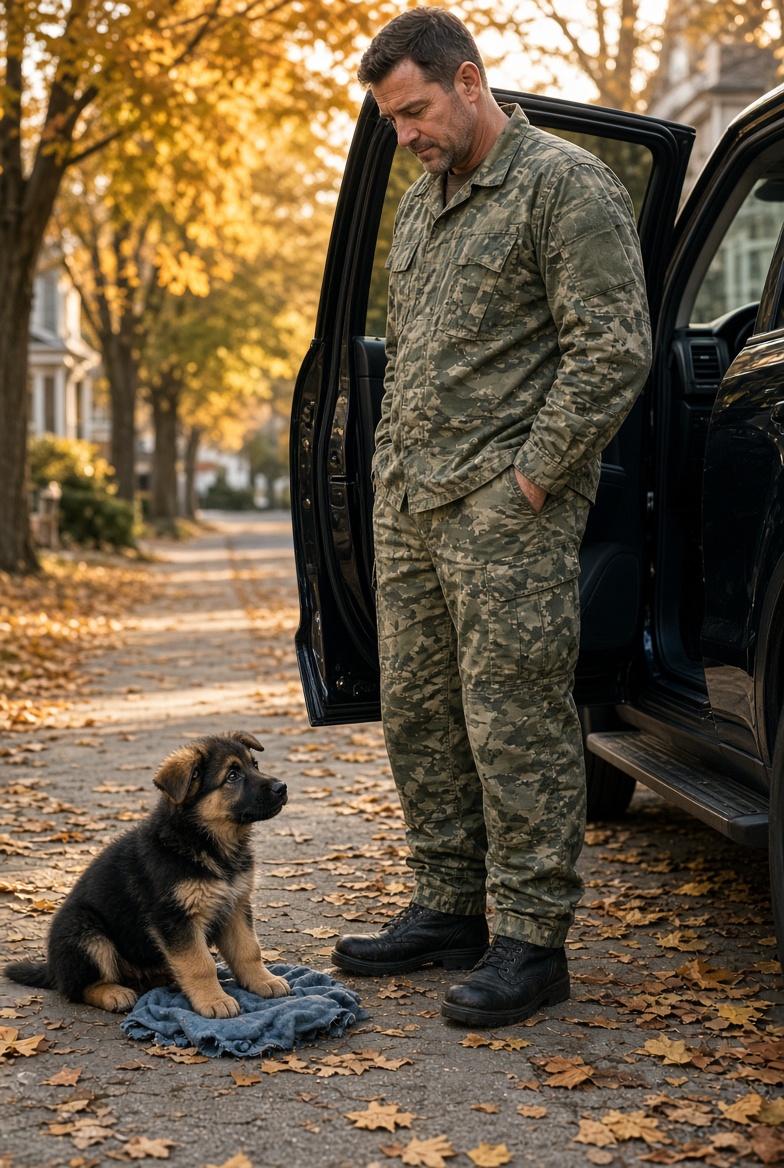
He placed the blue cloth beside the soldier’s black boots, settled both front paws on top of it, and sat down.
His little face lifted.
David stared.
“”What’s that supposed to mean?”” The puppy offered no explanation.
He merely shifted closer to the vehicle’s rear wheel, keeping one paw firmly on the cloth.
There was nothing dramatic about the gesture.
No barking, no frantic movement, no desperate attempt to climb back inside.
Just a very small animal sitting quietly beside an old piece of fabric.
Yet something about the scene made David uncomfortable.
He was accustomed to animals responding to confidence and consistent direction.
This puppy appeared to have interpreted his command as something entirely different.
Before he could consider it further, a woman’s voice came from the shop.
Toby.
Oh, thank goodness.
Carol hurried outside, followed by a younger woman carrying an empty fabric box.
The younger woman was Megan Collins, 32, with chestnut brown hair tied into a practical ponytail, warm olive skin, and an energetic manner.
She had worked alongside Carol for six years and was known for her patience with customers, though she occasionally struggled with her employer’s determination to supervise everything.
Carol stopped when she saw the puppy.
There you are, you little rascal.
David folded his arms.
Does this rascal belong to you?
Temporarily, I’m fostering him for the local rescue program.
Apparently, he’s also inspecting vehicles.
Megan pressed her lips together, trying not to laugh.
Carol explained that Toby had arrived only two days earlier and was still adjusting to the unfamiliar surroundings.
That morning, Megan had been carrying fabric boxes through the rear gate.
During one of those trips, Toby had slipped unnoticed out of the enclosed yard.
“I thought he was asleep in his pen,” Carol admitted.
“That’s a rather important assumption,” David replied.
Carol straightened.
And I suppose you’ve never overlooked anything in 45 years.
Not anything that climbed into somebody else’s truck.
Well, congratulations.
You’ve met someone less predictable than yourself.
Megan finally laughed.
David might have answered, but Toby chose that moment to stand, drag his blue cloth closer to the SUV, and plant both front paws on the running board.
The tiny puppy looked over his shoulder at the adults.
For the first time that morning, David nearly laughed aloud.
Carol gently lifted Toby into her arms.
The puppy wriggled once, then settled against her cardigan, holding the cloth between his paws.
Carol’s expression changed.
Well, would you look at that.
She recognized the fabric immediately.
It was the same blue cloth she had placed in Toby’s sleeping pen every night since his arrival.
She had wondered why he always rearranged it before resting.
David noticed the careful way the puppy kept the material close.
Why does he carry that old thing everywhere?
Carol ran a hand gently over Toby’s uneven ears.
“For once, the talkative seamstress did not answer immediately.
“He’s had quite a few changes lately,” she said at last.
“Different places, different people.”
“More than a little fellow like this ought to have to get used to so quickly.”
David looked at the puppy.
Toby’s brown eyes were no longer fixed on the SUV.
He was nestled against Carol’s arm.
his tiny paws resting protectively over the faded cloth.
David had meant nothing unkind when he told the puppy to get out.
It was an ordinary instruction spoken in an ordinary voice on an otherwise ordinary morning.
But perhaps Toby had heard something David never intended to say.
And standing there beside his open truck, David wondered how many times that little puppy had watched a familiar place disappear before he had learned to carry the only familiar thing he possessed.
Sometimes the things we hold most tightly are not valuable to anyone else.
A faded photograph, a familiar sweater, a handwritten recipe tucked inside an old cookbook.
Ordinary objects can become the last remaining evidence that something once felt safe.
David Harris understood this in theory.
Yet, standing outside Thompson’s alterations, watching a tiny German Shepherd puppy clutch a worn blue cloth, he began to suspect that understanding something and truly feeling it were entirely different matters.
Carol carried Toby toward the shop’s rear entrance while David prepared to leave.
The morning had grown warmer, and sunlight stretched across the brick walkway, catching the edges of fallen leaves gathered beside the wooden fence.
Toby, however, had other plans.
Before Carol reached the doorway, the puppy twisted in her arms, turning his nose toward the black SUV.
His little paws pressed against her cardigan, and a soft, questioning whimper escaped him.
Oh, now don’t start, Carol murmured.
You’ve already inspected the gentleman’s automobile.
David glanced back.
Toby was still watching the vehicle.
Carol set him inside the enclosed rear yard, intending to return him to his sleeping pen.
Instead, the puppy hurried toward the fence, dragging his blue cloth behind him.
When he reached the closed gate, he stood on his hind legs and looked through the wooden slats toward David’s truck.
There was nothing particularly remarkable about a curious puppy wanting to explore.
David knew that, but the persistence seemed unusual, especially for an animal that had only just met him.
“Does he do that with every car?”
David asked.
“Not that I’ve noticed.
Maybe he likes leather seats.”
Carol gave him a dry look.
or perhaps he’s discovered that some people leave their doors open.
David accepted the criticism with a reluctant smile.
He should have left then.
The bag had been repaired, the bill paid, and the puppy was safely back with his temporary caregiver.
Nothing required his continued presence.
Yet, he found himself following Carol into the yard.
Toby immediately abandoned the gate and trotted toward him.
the blue cloth trailing across the clean paving stones.
He stopped near David’s boots and placed one paw on the fabric, almost as though checking that it had followed him.
David crouched.
All right, little fellow.
What’s so special about that thing?
Toby responded by sitting down.
Carol leaned against the fence, studying the small animal with an expression David could not quite read.
There’s something you ought to know about him, she said.
Nearly 3 weeks earlier, Toby had been found inside a pet carrier near the sheltered entrance of a warehouse complex on the outskirts of Chesapeake.
A delivery employee had noticed the carrier and contacted a local animal rescue organization.
The puppy, estimated to be 6 weeks old at the time, had been taken to a veterinary clinic for an examination.
The veterinarian found him small and understandably unsettled by the unfamiliar surroundings, but otherwise in a condition that allowed him to begin receiving ordinary puppy care.
There was no reliable information about how he had arrived at the warehouse.
Carol was careful about that distinction.
People enjoy inventing explanations, she told David, but wondering isn’t the same as knowing.
What the rescue volunteers did know was that Toby had experienced several changes in a short period.
After the veterinary examination, he stayed with an experienced temporary caregiver who helped him establish a feeding and sleeping routine.
A sudden family obligation made continued care impossible.
So, the organization arranged another placement.
That volunteer then encountered an unexpected scheduling conflict, requiring another move.
Neither home had been unsuitable.
The caregivers had simply faced circumstances they could not control.
two days earlier, Toby had arrived at Carol’s shop.
For a puppy still learning which sounds, smells, and routines belong to ordinary life, those changes were considerable.
David watched Toby push his nose beneath the folded cloth.
He had always believed adaptability was a strength.
His military training had taught him to function in unfamiliar locations, accept changing assignments, and remain effective without familiar comforts.
But David was a grown man with experience, language, and the ability to understand why circumstances changed.
Toby had none of those advantages.
Every unfamiliar doorway might bring another arrangement of voices and smells.
Every new sleeping place required another adjustment.
Even an ordinary car journey could end somewhere the puppy had never seen before.
David wondered whether the little animal had learned to associate enclosed spaces with temporary shelter.
Perhaps the SUV’s quiet interior had simply looked inviting.
Perhaps the soft seat and David’s canvas bag resembled the protected corners where Toby had previously rested.
There was no way to know for certain, and that uncertainty mattered.
David had initially interpreted Toby’s behavior as a deliberate attempt to stay with him.
Now he wondered whether he had been assigning human meaning to something much simpler, a small animal searching for somewhere comfortable.
Carol gently lifted the blue fabric.
This was inside the carrier when they found him.
The cloth had once been part of a small blanket.
Its edges were uneven, and one corner had been repaired with a few careless stitches.
Carol had tried replacing it with a softer piece of fleece after Toby arrived.
The new bedding was warmer, cleaner looking, and considerably more attractive.
Toby had ignored it.
Instead, he searched his sleeping area until he found the original cloth tucked beside the pen.
I thought he’d prefer something new, Carol admitted.
Turns out he has stronger opinions about interior decorating than I do.
David laughed quietly.
The humor faded as he watched Toby gather the material beneath his paws again.
The cloth might carry familiar smells from his earliest surroundings.
Its texture might simply have become associated with rest.
Whatever the reason, it offered continuity in a world that had changed repeatedly.
David reached toward the puppy, then hesitated.
For once, he resisted the impulse to decide what should happen next.
He waited until Toby leaned forward to investigate his fingers before gently scratching beneath the little dog’s chin.
Inside the shop, an old-fashioned service bell rang.
Megan appeared at the back doorway holding a clipboard.
Carol, the school uniform alterations are ready, but the afternoon pickup schedule needs checking.
Put them on my desk.
I’ll handle it.
You said that yesterday, and I handled yesterday.
Megan glanced at David before continuing more carefully.
She suggested taking responsibility for customer pickups and routine alterations, allowing Carol more time to manage the fostering arrangements.
With the autumn school term underway, the shop was busier than usual.
Several families had requested uniform repairs, and a local community group had ordered costume adjustments for an upcoming performance.
Carol had been arriving early and leaving late, insisting that every finished garment pass through her hands.
Megan respected that dedication.
What troubled her was the unspoken assumption that nobody else could be trusted to maintain the same standards.
I’ve worked here six years, Megan said.
I think I can manage a pickup list.
Customers expect me to check their orders.
They expect their clothes to fit.
That isn’t quite the same thing.
Carol’s expression tightened.
To Megan, the discussion was about professional trust.
She wanted the opportunity to prove she could help run the business, not simply follow instructions.
To Carol, the request touched something more personal.
The shop had been the center of her adult life.
Every repaired sleeve and shortened hem carried some small evidence of usefulness.
She had watched customers grow older, children become parents, and familiar faces disappear from the neighborhood.
surrendering even one responsibility felt uncomfortably close to admitting that the place might continue perfectly well without her.
“I appreciate the offer,” Carol said, her voice cool.
“But I’ll decide when I need help.”
Megan lowered the clipboard.
“Of course you will.”
She returned inside, leaving the doorway quietly swinging behind her.
David recognized that silence.
He had heard similar silences during difficult conversations with colleagues, usually when someone had decided that arguing further would accomplish nothing.
Carol brushed imaginary dust from her sleeve.
Young people think experience is something you can download.
David considered the closed door.
Sometimes experienced people make it difficult for anyone else to gain some.
Carol looked at him sharply.
Are you offering business advice now?
No, ma’am.
Just recognizing a familiar habit.
He did not elaborate.
The uncomfortable truth was that he understood her resistance.
He too preferred handling problems personally.
Depending on another person meant accepting uncertainty, and uncertainty could become disappointment.
Yet Toby was sitting between them, calmly rearranging his ridiculous little piece of blue cloth, apparently unconcerned with the adult world’s arguments about competence.
Eventually, David stood.
He needed to return to work.
Carol guided Toby back into his sleeping area and secured the pen.
David placed the faded cloth beside the puppy’s bedding, smoothing one folded corner before withdrawing his hand.
Toby sniffed it, circled twice, and sat down.
David gave his head one last gentle scratch.
“Take care of yourself, little guy.”
For a moment, Toby leaned into the touch.
Then, David stepped away.
This time, the puppy did not attempt to follow him.
He remained behind the fence, watching quietly as the soldier walked toward the SUV.
David opened the driver’s door, glanced back once, and found Toby still sitting in the same place.
The sight stayed with him longer than he expected.
He drove away beneath the autumn trees, telling himself that Carol knew how to care for the puppy and that the rescue organization would eventually find him an appropriate home.
Nothing more needed to be done.
That evening, after finishing his paperwork and preparing a simple dinner, David received a message from Carol.
It contained a photograph.
Toby was curled into a small circle in his sleeping pen, one ear folded against his head, the worn blue cloth tucked beneath his chin.
He looked peaceful, surrounded by the ordinary comforts Carol had carefully provided.
Beneath the photograph, Carol had written, “Thought you’d like to see your smallest admirer.
Apparently, you’ve made quite an impression.”
David smiled.
He enlarged the photograph, studying the little paws resting on the familiar cloth.
For reasons he could not explain, he looked at the picture longer than he intended.
Then, he set the phone face down beside his dinner plate.
It was only a puppy, he reminded himself.
A curious little German Shepherd who had accidentally climbed into the wrong truck.
Nothing more.
At least that was what David Harris intended to believe. 3 days had passed since David Harris first discovered a German Shepherd puppy sitting in the back of his SUV.
Yet, the memory continued to interrupt him at inconvenient moments.
It appeared while he reviewed training schedules, waited for coffee, or reached into his military bag for a document.
He remembered the puppy’s serious expression, the little paws resting on a faded blue cloth, and the absurd determination with which such a small creature had claimed a place in his vehicle.
David found the whole incident mildly embarrassing.
At 45, with years of military experience behind him, he considered himself reasonably capable of concentrating on important matters.
Remembering a puppy during a briefing hardly qualified as professional discipline.
By late morning, a perfectly legitimate reason to return to Thompson’s alterations had presented itself.
A seam near the cuff of one of his uniform shirts had begun to loosen.
The damage was minor, but David preferred having things repaired before they became inconvenient.
He placed the shirt inside a paper bag, drove through the familiar Chesapeake neighborhood, and parked his black SUV outside Carol Thompson’s shop.
He told himself he was there for the shirt, nothing more.
The shop’s front entrance stood open to the autumn breeze, and the faint sound of a sewing machine drifted through the doorway.
David stepped inside where Megan Collins was sorting finished garments according to their collection dates.
She looked up from her paperwork.
Well, look who’s back.
Another zipper emergency.
Loose stitching.
Naturally, can’t have the military falling apart one seam at a time.
David smiled despite himself.
Megan had developed a habit of treating his military seriousness as an invitation for jokes.
a habit he suspected Carol had encouraged.
Carol was working behind the counter, carefully examining a jacket that required a new lining.
She greeted David warmly, accepted the shirt, and promised to have it ready the following afternoon.
David should have left.
Instead, his attention wandered toward the rear hallway.
“How’s the puppy?”
Carol’s mouth curved into a knowing smile.
Oh, Toby.
He’s doing wonderfully, apart from attempting to reorganize my entire backyard.
David glanced toward the rear door.
Carol noticed.
Go on then.
He’s outside.
David hesitated just long enough to maintain the appearance of indifference before following her toward the enclosed yard.
The moment he stepped through the gate and closed it behind him, something small came racing across the paving stones.
Toby had been entertaining himself with a rubber ball near the garden bench.
At the sight of David, he abandoned the toy, hurried forward, lost his footing briefly on the smooth bricks, and slid the final few inches directly into the soldier’s boots.
The puppy sat down, apparently surprised by his own arrival.
David looked down.
“”Well, that’s quite an entrance.”” Toby sprang up and began investigating the familiar footwear with enthusiastic little sniffs.
Carol laughed from the doorway.
He doesn’t greet everyone like that.
Most visitors have to earn his approval.
David felt an unexpected warmth at the remark, although he immediately questioned whether the puppy simply recognized the smell of his boots.
Dogs remembered familiar scents.
That was hardly remarkable.
Still, when Toby lifted his head and wagged his tail, David found himself smiling in a way that had little to do with scientific explanations.
He crouched to greet the puppy.
Toby responded by grabbing one of his loose shoelaces.
“Absolutely not.”
The puppy pulled backward.
David gently freed the lace, but Toby promptly seized the other one.
Carol watched with obvious amusement.
He certainly found your weakness.
My weakness is apparently poor footwear security.
For a few moments, the yard filled with the ridiculous spectacle of a highly trained Navy Seal negotiating with a creature that weighed little more than a grocery bag.
Toby eventually released the shoelace only to discover that David’s fingers were far more interesting.
David offered him a soft rubber toy instead.
The puppy accepted the exchange with surprising enthusiasm.
There was something disarming about Toby’s complete lack of concern for David’s accomplishments.
Military experience, rank, discipline, and professional reputation meant nothing to him.
The puppy cared about interesting smells, comfortable places, and whether the rubber toy could be carried across the yard without falling from his mouth.
David had spent years being valued for reliability.
People approached him because they expected answers, decisions, or assistance.
Toby appeared to expect none of those things.
For the moment, a few minutes of attention were enough.
Carol returned indoors to help a waiting customer, leaving David seated on a low garden bench while Toby explored the space around his boots.
The puppy occasionally looked back, checking his surroundings before investigating another corner.
David noticed that Toby’s confidence seemed strongest when the yard remained quiet and familiar.
A passing delivery vehicle made him pause, but he soon returned to his toy.
There was progress in those small moments.
Although David was beginning to understand that progress with a puppy could not be measured in the same way as completing an assigned task.
After several minutes, David stood.
Toby immediately abandoned the toy.
He hurried toward the gate, stopped beside it, and looked through the wooden slats toward the black SUV parked outside.
David felt a familiar temptation to open the gate and let the puppy investigate the vehicle again.
It would have been easy to pick him up, settle him on the comfortable rear seat, and enjoy another few minutes of companionship.
But he remembered Carol’s explanation about Toby’s recent changes of home.
Another brief journey without a clear purpose might only complicate the puppy’s developing routine.
David sat back down.
Toby turned toward him, uncertain what was happening.
“It’s all right, buddy.
We’re not going anywhere.”
He waited.
The puppy investigated the bottom of the gate, sniffed a fallen leaf, and eventually returned to David’s side.
When Carol appeared with a small braided rope toy, David gently rolled it across the paving stones.
Toby followed.
A few moments later, he was occupied with the toy again.
David felt quietly pleased, not because he had persuaded the puppy to obey, but because he had managed to resist imposing his own preferred solution.
Inside the shop, however, another disagreement was developing.
Megan had spent the previous evening preparing a proposal for a community sewing program.
Several retired residents in Chesapeake had mentioned difficulty finding affordable clothing alterations, particularly for everyday garments that were too valuable to discard, but not expensive enough to justify professional repair prices.
Megan believed the shop could offer scheduled low-cost appointments, allowing younger apprentices to handle straightforward work under supervision, while Carol concentrated on specialized tailoring.
the arrangement might bring new customers into the business and preserve practical sewing skills that were gradually becoming less common.
Carol was unconvinced.
For her, the reputation of Thompson’s alterations rested on consistency.
A poorly finished hem or carelessly repaired jacket could disappoint someone who had trusted the shop for years.
She had built that trust one garment at a time, often working long after closing to ensure everything met her standards.
The prospect of inexperienced hands representing the business frightened her more than she wished to admit.
When David returned indoors, Megan was explaining the proposed appointment schedule.
“We could begin with two afternoons a month,” she suggested.
Nothing complicated.
Basic repairs supervised properly.
And when someone brings in an expensive garment, we explain what the program covers.
And if somebody makes a mistake, then we correct it.
Carol, that’s part of learning.
David listened from beside the counter.
The disagreement reminded him of arguments he had heard throughout his career when experienced personnel resisted new methods because established procedures felt safer.
Without considering how little he knew about running a tailoring business, he offered his opinion.
Maybe the easiest solution is to let Megan manage the program and evaluate the results after a month.
Carol looked at him.
Wonderful.
And how many sewing shops have you managed, David?
None.
Then perhaps we should begin by establishing that.
Megan pressed a hand against her mouth.
David recognized the mistake immediately.
He had reduced a problem involving professional pride, financial uncertainty, and decades of customer relationships to a simple management exercise.
He disliked admitting error, particularly in front of an audience.
But he disliked becoming the sort of person who offered confident advice without understanding the consequences even more.
“You’re right,” he said.
I stepped into something I don’t fully understand.
Megan laughed.
That’s the first time I’ve heard a Navy Seal surrender to a sewing machine.
David raised an eyebrow.
Don’t underestimate sewing machines.
Apparently, they’re formidable opponents.
Even Carol smiled, although she folded Megan’s proposal and placed it beside the register without agreeing to anything.
David noticed that Megan watched the paper carefully.
The younger woman was not asking for praise.
She wanted an opportunity to prove that the skills Carol had taught her were worth trusting.
And Carol, beneath her stubbornness, seemed afraid that allowing someone else to succeed might make her own contribution less necessary.
It was a problem David understood better than he cared to admit.
Later that afternoon, Linda Parker arrived at the shop.
Linda was 58, of medium height, and sturdy build with fair skin, shoulder-length dark blonde hair threaded with silver and rectangular glasses resting low on her nose.
She served as the local rescue program’s adoption coordinator.
Calm, methodical, and careful with promises, Linda believed that finding an appropriate home mattered more than completing an adoption quickly.
She had stopped by to review Toby’s progress and discuss a new application.
A family had expressed serious interest in meeting him.
Their preliminary information appeared promising, and Linda hoped to arrange an introductory visit.
After completing the usual checks, Carol listened with a mixture of relief and affection.
David stood near the doorway, suddenly aware of the quiet yard beyond it.
That’s good news, he said.
Linda nodded.
It could be.
We’ll see whether they’re the right match.
David knew she was correct.
Toby needed a stable home, responsible caregivers, and a future shaped around his needs rather than somebody else’s passing emotions.
That was what everyone wanted.
At least it was what David believed he wanted.
Before leaving, he looked into the rear yard one final time.
Toby had settled in his sleeping area, curled comfortably around the familiar blue cloth.
One little paw rested across the fabric, while the other lay beneath his chin.
The afternoon light fell softly across the floor, and the puppy slept without any apparent concern for the important decisions being made nearby.
David watched him for a moment.
He should have felt nothing but relief.
Instead, a quiet sadness settled somewhere beneath his ribs.
If the family proved suitable, Toby might soon leave Carol’s shop forever.
David would no longer have an excuse to stop by, exchange jokes about shoelaces, or spend a few peaceful minutes beside a puppy who expected so little from him.
He turned away before anyone noticed his expression.
Outside, the black SUV waited beside the curb.
David climbed into the driver’s seat and glanced at the empty beige leather seat behind him.
For the first time, he wondered why the possibility of never seeing that little German Shepherd again felt so much like losing something he had never actually owned.
Hope was a peculiar thing.
It could make ordinary people believe that a stranger’s arrival meant the beginning of a happy ending.
And sometimes, without anyone intending harm, that same hope could turn a thoughtful decision into a painful disappointment.
David Harris had spent years learning to judge situations by facts rather than expectations.
Yet, when he returned to Thompson’s alterations two afternoons later, he discovered that his own expectations had quietly begun to involve a little German Shepherd puppy named Toby.
The autumn afternoon in Chesapeake was pleasantly warm, with sunlight filtering through the trees along the neighborhood street.
David had come to collect his repaired uniform shirt, which Carol had finished the previous day.
He noticed an unfamiliar silver sedan parked outside the shop and two visitors speaking with Linda Parker near the entrance.
Carol greeted him from behind the counter.
But instead of immediately handing over his shirt, she lowered her voice and explained that the prospective adoptive family had arrived to meet Toby.
The couple introduced themselves as Paul and Susan Miller.
Paul was 49, tall and slightly lean, with broad hands, short graying brown hair, and a neatly maintained salt-and-pepper beard.
His friendly expression contrasted with the tiredness around his eyes, the result of long hours supervising operations at a regional distribution company.
He was practical, dependable, and accustomed to solving problems before anyone noticed them.
Susan, 47, was a medium-height woman with softly waved blonde hair beginning to silver, fair skin, lightly scattered with freckles, and gentle green eyes.
She worked as an elementary school librarian, and possessed the patient manner of someone who had spent years helping children discover that books could be more interesting than arguments.
The Millers had previously shared their home with an elderly Labrador named Cooper, who had passed away peacefully the previous spring after a long, comfortable life.
They missed the ordinary routines of having a dog, the sound of paws approaching the kitchen, the morning walks, and the familiar presence beside the sofa.
Susan had noticed Toby’s photograph on the rescue organization’s website and felt an immediate affection for him.
Paul had been more cautious, although he had agreed that meeting the puppy would help them understand whether their household was ready.
David politely introduced himself and stepped aside.
He had no official role in the visit, and Linda had already explained that Toby needed an opportunity to interact with the couple without unnecessary distractions.
From the shop’s rear doorway, David watched the meeting unfold in the enclosed yard.
Toby approached Susan with his usual mixture of curiosity and caution.
He sniffed her shoes, retreated a step, and then returned when she offered a small rubber ball.
Susan rolled it gently across the paving stones.
Toby followed, pounced clumsily, and succeeded in pushing the ball beneath the garden bench.
Paul laughed.
“Well, there’s our first problem.
He’s going to need someone with longer arms.”
Susan smiled.
I believe you’ve just volunteered.
The puppy soon grew comfortable enough to accept gentle attention, and after another short game, he settled beside Susan’s shoes.
She remained still, allowing him to rest without demanding more interaction.
David noticed how naturally she respected the puppy’s pace.
There was no exaggerated excitement, no attempt to force affection, and no expectation that Toby should immediately behave like a trained family companion.
For a few minutes, everything seemed encouraging.
Carol watched through the doorway with quiet satisfaction.
She had grown fond of Toby, but affection had never changed the temporary nature of her responsibility.
The puppy needed a permanent home with people who could provide years of stability, patience, and consistent care.
Susan and Paul appeared capable of offering exactly that.
Yet, appearances David was beginning to learn rarely revealed an entire life.
While Linda discussed the adoption process with the couple, David returned to the counter.
Several freshly completed garments hung behind Carol and a large stack of unfinished orders occupied the workroom.
The shop had become noticeably busier since his previous visit.
School uniform repairs, household alterations, and costumes for a community performance had arrived within the same week.
Carol moved from one task to another with determined efficiency, but David noticed her paws to rest her hands before lifting a heavy box of fabric.
Megan approached with a written list of outstanding orders.
We’re going to need another pair of hands, she said.
Even part-time would help.
Carol barely glanced at the paper.
And where exactly would the money come from?
The additional orders would cover some of it.
We could start with an apprentice.
An apprentice would need supervision.
Yes, that’s what apprentices usually need.
David recognized the tension immediately.
Megan was trying to offer a practical solution while Carol heard another suggestion that she could no longer manage the business she had built.
Before their discussion could continue, Carol examined a navy blue skirt Megan had completed earlier that morning.
Without consulting her, she removed the garment from the finished rack and began adjusting the hem.
Megan stopped.
“Carol, Mrs. Henderson approved that length.
The stitching could be neater.
I followed the measurements exactly, and I’m improving the finish.”
The words were spoken quietly, but their effect was immediate.
For Megan, the altered hem represented more than a few additional stitches.
Carol had corrected her work without asking, despite the fact that the customer had already approved it.
After six years of training and responsibility, Megan still felt treated like a beginner whose judgment could never be trusted.
For Carol, the decision came from a lifetime of believing that her name on a garment meant personal accountability for every detail.
She was not deliberately trying to humiliate Megan.
She simply could not stop herself from checking and improving anything that passed through the shop.
That distinction did little to soften the younger woman’s disappointment.
You know, Megan said, “Sometimes I think you’d rather work yourself into exhaustion than let me do something differently.”
Carol looked up.
And sometimes I think you forget whose reputation keeps this place open.
The silence that followed was heavier than either woman expected.
Megan set down her clipboard and returned to the workroom.
Soon, the steady mechanical sound of a sewing machine filled the shop.
Although the two women did not speak again, David remained beside the counter, uncomfortable with how easily he understood both sides.
He had seen experienced colleagues struggle to delegate authority, fearing that someone else’s mistake would become their responsibility.
He had also watched capable younger people lose confidence after having every decision questioned.
He understood Carol’s pride, but he recognized Megan’s hurt.
What troubled him most was that he could imagine himself making exactly the same mistake.
Outside, Linda was discussing Toby’s daily needs with the Millers.
Their enthusiasm had remained genuine, but the conversation was becoming more serious.
A 9-week-old German Shepherd required frequent supervision, consistent routines, appropriate socialization, and patient training.
As Toby grew, his need for mental stimulation, exercise, and guidance would increase considerably.
Susan listened carefully, occasionally glancing toward the puppy resting near Paul’s feet.
Their household had suited Cooper during his later years.
He had been content with gentle walks, familiar routines, and long afternoons sleeping beside the window.
A growing German Shepherd puppy would require something very different.
Paul’s working hours frequently changed with the distribution cent’s delivery schedule.
Susan’s school responsibilities included occasional evening events and early morning meetings.
Although they had comfortable finances and a suitable home, neither could guarantee the consistent availability a young puppy needed during the coming months.
Linda did not pressure them.
She simply helped them examine what ordinary days would actually look like after the excitement of adoption had passed.
The distinction mattered.
Loving the idea of a dog was not the same as being prepared for the daily responsibilities of raising one.
Eventually, Susan looked down at Toby and gave a small, regretful smile.
“He’s wonderful,” she said.
“But I don’t think we’re ready for a puppy this young.”
Paul nodded reluctantly.
“I think we’ve been remembering life with Cooper at 12 years old.
Not at 1two weeks.”
Their disappointment was genuine.
Susan had imagined Toby growing into a beloved companion, while Paul had already pictured quiet weekend walks through their neighborhood.
Neither wanted to abandon that possibility, but both understood that Toby needed more than affection and good intentions.
After thanking Linda and Carol, they decided not to continue their application.
Carol accepted the news politely, although David noticed the disappointment in her expression.
He felt something sharper.
For an instant he wanted to ask why the millers had come if they were not prepared to adopt.
Had they not considered their schedules beforehand?
Had they not understood that a puppy would require attention?
But Linda seemed to recognize his frustration before he spoke.
Better to make an honest decision now, she said quietly, to discover later that the arrangement isn’t right.
David said nothing.
He knew she was correct.
More importantly, he recognized the uncomfortable similarity between the miller’s situation and his own.
His military obligations were hardly predictable, and he had not seriously considered how he would manage a young dog’s needs during extended assignments.
It was easy to admire responsibility when someone else was being asked to demonstrate it, much harder when the question turned toward oneself.
The millers gathered their belongings and made their way toward the front entrance.
Toby, noticing the movement, rose from his resting place and trotted after them across the enclosed yard.
He stopped at the threshold beside the open shop door, where Carol gently prevented him from going farther.
Susan turned and gave him one final affectionate smile.
Goodbye, sweetheart.
Paul raised a hand in farewell.
Then they stepped outside, entered the silver sedan, and drove away.
Toby remained beside the doorway, watching the vehicle disappear beyond the neighboring houses.
Nobody could know what the puppy understood about the departure.
Perhaps he was merely interested in the movement.
Perhaps the brief visit had left him curious about the strangers who had played with him.
David refused to pretend otherwise.
Yet the sight brought back an uncomfortable memory of Toby sitting beside his SUV, guarding a faded blue cloth with his little paws.
He stepped into the yard and crouched beside the puppy.
For several moments, neither moved.
David gently rubbed the soft fur between Toby’s uneven ears, feeling the little animal relax beneath his hand.
He had spent much of his life believing that every problem had a solution if someone was willing to work hard enough.
But this was not a damaged zipper, an unfinished assignment, or a complicated training exercise.
Toby needed a home.
and David, for all his confidence, did not know whether he could become the person capable of providing one.
“I wish I knew what to do with you, buddy.”
Toby turned toward the familiar voice, placed his front paws against David’s knee, and climbed awkwardly onto his lap.
The movement was so unexpected that David laughed.
Then the puppy settled against him with complete satisfaction, as though the matter had been decided long ago.
David rested one hand along Toby’s back.
The laughter faded, leaving an unfamiliar tightness in his throat.
He did not make a promise.
He did not announce a decision.
He simply remained where he was, holding a little German shepherd who had no idea how complicated he had made one man’s otherwise orderly life.
And for the first time, David was not entirely certain he wanted that complication to disappear.
The promises David Harris feared most were not the ones made in dangerous circumstances.
They were the quiet promises of ordinary life, the kind spoken over a kitchen table or beside a front door when someone believed he would always be there.
At 45, David had learned that good intentions could become disappointments when circumstances changed.
It was one reason he rarely committed himself to anything beyond his professional responsibilities.
But lately, an inconvenient little German Shepherd named Toby had begun making that carefully organized philosophy difficult to maintain.
Several days after the Millers decided not to adopt Toby, David began stopping at Thompson’s alterations more regularly.
Sometimes he brought coffee for Carol.
Occasionally, he delivered supplies the rescue program had requested.
More often, he simply found himself driving through the neighborhood when his schedule allowed.
Carol noticed the pattern, but wisely avoided commenting.
The autumn weather remained mild, allowing Toby to enjoy short, supervised walks along the quiet sidewalks near the shop.
David sometimes accompanied Carol, keeping the outings brief and letting the puppy investigate unfamiliar surroundings at a comfortable pace.
Toby approached the world with an enthusiasm that was both delightful and exhausting.
Fallen leaves required careful investigation.
Mailboxes apparently possessed fascinating secrets.
A passing bicycle might interrupt an entire expedition, while a particularly interesting patch of grass could occupy several minutes.
David discovered that walking a puppy was considerably different from walking toward a destination.
His first mistake was expecting progress to follow a straight line.
One morning, Toby managed several comfortable steps beside him.
The following afternoon, he sat down after reaching the garden gate and refused to continue until Carol distracted him with a toy.
David initially interpreted such behavior as stubbornness.
Carol reminded him that Toby was still learning and the world contained an astonishing number of unfamiliar experiences.
The soldier began adjusting his expectations.
Instead of measuring success by distance, he learned to notice smaller achievements.
Toby remaining relaxed when a familiar vehicle passed, responding to his name, or returning to his sleeping area when tired.
Not every day brought improvement.
Some days the puppy seemed to forget everything he had learned.
David found those days particularly educational.
Toby also possessed an extraordinary talent for locating objects nobody intended him to have.
Shoelaces remained his favorite targets, but he soon expanded his interests to include a soft slipper, a folded washcloth, and the corner of Carol’s gardening apron.
The missing rubber ball eventually appeared beneath the garden bench alongside a collection of leaves and one of Megan’s measuring tapes.
Carol accused Toby of operating a criminal organization.
David suggested the puppy needed better management.
Megan replied that the same accusation could be made about everyone in the building.
For the first time since their disagreement, Carol laughed at one of Megan’s jokes.
The moment was brief, but David noticed.
The faded blue cloth remained Toby’s most treasured possession.
Whenever Carol washed it with a gentle detergent and returned it to the sleeping area, the puppy promptly dragged it onto the floor, rearranged it with his paws, and settled on top.
Carol eventually stopped insisting that the fabric remain neatly folded.
David found that decision surprisingly significant.
She had not abandoned her standards of cleanliness or care.
She had merely accepted that comfort did not always resemble order.
One afternoon, while Toby slept after a short play session, Linda Parker visited to review his progress.
The rescue coordinator was pleased with the puppy’s gradual adjustment, and Carol’s careful recordkeeping.
David listened as Linda discussed feeding routines, veterinary appointments, socialization, and the importance of consistent supervision.
He had read about these responsibilities before, but hearing them described in relation to Toby made them feel different.
The puppy was no longer an interesting animal whose photograph occasionally appeared on his phone.
He was a living responsibility who would continue growing long after the novelty of tiny paws and crooked ears disappeared.
When Carol returned indoors to answer the shop telephone, David remained beside Linda near the garden bench.
For several moments, he said nothing.
Then he admitted something he had been reluctant to acknowledge.
I’ve been thinking about adopting him.
Linda did not smile triumphantly or offer congratulations.
Instead, she waited.
David explained that his military schedule was not entirely predictable.
Although his current assignment kept him in Virginia, training obligations could require him to travel, sometimes with limited advance notice.
He could provide food, veterinary care, and a comfortable home.
Those matters did not concern him.
What troubled him was everything money could not guarantee.
Who would care for Toby during unexpected assignments?
How would a growing German Shepherd receive appropriate training and companionship?
What would happen if David’s responsibilities changed?
Linda considered his questions carefully.
Those are the things you need to answer before you adopt him, she said.
Not afterward.
David looked toward the sleeping puppy.
I don’t want to promise him something I can’t deliver.
then don’t make the promise until you’ve made a plan.
Linda’s response offered neither encouragement nor rejection.
She explained that responsible ownership required arrangements for everyday care, exercise, training, veterinary expenses, and reliable backup assistance during absences.
The rescue organization would evaluate those arrangements before approving any application.
David appreciated her directness, although he had secretly hoped someone might assure him that affection would somehow make the practical difficulties disappear.
It would have been comforting.
It would also have been dishonest.
Neither noticed Carol standing near the open doorway until she spoke.
“So, you’re thinking about taking him home, but you aren’t sure you’ll be around?”
Her tone immediately changed the conversation.
David turned toward her.
That’s why I’m asking questions.
And when your work takes you somewhere else, what happens to Toby then?
The accusation irritated him more than he expected.
He had deliberately avoided rushing into adoption because he understood the consequences of making an unreliable commitment.
Being criticized for that caution felt profoundly unfair.
Carol, I’m trying to do this properly and I’m trying to make sure he doesn’t spend his life wondering where he’s going next.
The words settled between them.
Carol looked away first.
Her protectiveness was genuine, but David sensed something beneath it that had little to do with Toby.
During the past week, she had been working longer hours while refusing Megan’s repeated offers to reorganize the shop’s workload.
She seemed increasingly exhausted.
Yet, every suggestion of assistance made her more defensive.
David began to understand that Toby represented another responsibility Carol feared losing control over.
She could not protect him from every future disappointment, just as she could not personally oversee every garment that passed through her shop.
Knowing that did not make surrendering responsibility easier.
I haven’t applied to adopt him, David said more gently.
And I won’t unless I can give him what he needs.
Carol studied him for a moment.
Then she lowered herself onto the bench.
I know you’re trying, she admitted.
I just keep thinking about how many changes that little dog has already had.
Her voice softened.
Some days I wonder whether I’m doing enough for anybody anymore.
David was surprised by the confession.
Carol had always presented herself as someone who knew exactly what needed doing.
Hearing uncertainty from her felt almost as unexpected as discovering Toby quietly leaving a toy untouched.
Before David could respond, Megan appeared in the doorway.
She had heard enough of the conversation to understand its direction, although she had not intended to interrupt.
Carol, nobody is trying to take your place.
Carol gave a weary sigh.
That’s easy for you to say.
Megan stepped into the yard.
I don’t want your shop because I think you’re finished.
I want to help keep it open because I believe in what you’ve built.
The younger woman paused, choosing her next words carefully.
She explained that her proposed changes were meant to preserve the business, not replace its founder.
Without additional help, unfinished orders would continue increasing.
Customers might become dissatisfied, and Carol would have less time for the skilled work she genuinely enjoyed.
Megan’s frustration was not about ambition alone.
She cared about the shop.
She also cared about Carol, even when the older woman’s stubbornness made that affection difficult to express.
Carol listened without interrupting.
For once, she offered no immediate objection.
The silence that followed was not reconciliation.
Too many disagreements remained unresolved, and neither woman was ready to surrender her concerns.
But David noticed that Carol did not dismiss Megan’s words.
Perhaps listening was the first responsibility people had to accept before trusting someone else.
That evening, David returned to his house and placed his keys beside the kitchen counter.
The rooms were quiet, orderly, and exactly as he had left them.
He prepared dinner, reviewed a few work documents, and eventually sat on the sofa.
The empty space beside him caught his attention.
He imagined Toby attempting to climb onto the cushions, dragging his blue cloth behind him, or proudly delivering a stolen slipper as though presenting a military decoration.
David smiled.
Then he opened his laptop.
For the next hour, he researched the needs of an adult German Shepherd.
structured training, daily physical activity, mental enrichment, preventive veterinary care, and the importance of companionship.
He examined realistic expenses and considered how regular walks would fit around his working hours.
He also thought about the practical consequences of military travel.
A dependable arrangement could not consist of asking Carol for favors whenever his schedule changed.
He would need reliable help, clear responsibilities, and contingency plans that did not depend on another person’s goodwill alone.
As he continued reading, a photograph of a fully grown German Shepherd appeared on the screen.
The powerful animal stood confidently beside its owner, alert and composed.
David imagined Toby becoming that size.
He remembered the tiny puppy struggling to drag a shoelace across Carol’s courtyard and laughed softly, but his smile gradually faded.
A grown German Shepherd would not remain a charming visitor who occupied a few spare minutes between assignments.
He would become part of every ordinary day.
David looked around the carefully arranged living room.
For years, he had organized his home around independence.
He came and went according to his responsibilities, changed plans without explanation, and rarely needed to consider anyone waiting for him.
Bringing Toby into that life would mean changing it.
Not temporarily, not merely until the puppy stopped chewing shoelaces.
For years, David closed the laptop halfway, then opened it again.
The photograph of the adult German Shepherd remained on the screen.
He had always believed responsibility meant keeping the promises he made.
Now he was beginning to understand that some promises demanded an entirely different way of living before they could honestly be spoken.
And for the first time, he was no longer certain that protecting his comfortable independence was more important than discovering whether he could make room for Toby.
Leaving was not always the opposite of love.
Sometimes it was simply the price of refusing to make a promise that could not yet be kept.
David Harris understood that distinction better than most people.
He had spent years accepting assignments that carried him away from familiar places, and he had learned to leave without making departures unnecessarily dramatic.
But on a cool autumn morning in Chesapeake, Virginia, the thought of saying goodbye to a little German Shepherd puppy, troubled him more than he cared to admit.
The decision had been forming for several days.
David had reviewed his professional calendar, examined potential arrangements for Toby, and considered the responsibilities Linda Parker had explained.
His upcoming assignment involved two weeks of military training away from Virginia.
Although the schedule was confirmed, he had not yet established a dependable arrangement for caring for a young dog during such absences.
It would have been easy to tell himself that everything could be worked out later.
He had solved complicated problems under far greater pressure.
But this was different.
Toby could not understand an explanation about military obligations or unexpected changes of schedule.
The puppy would simply depend on whatever arrangements David made.
If those arrangements failed, Toby would be the one experiencing another disruption.
That realization made David uncomfortable because it challenged something he had always valued about himself, his ability to handle responsibility.
He was accustomed to being the person others depended upon.
Admitting that he could not yet offer a suitable home felt remarkably close to admitting failure.
That morning, David called Linda.
He explained that he wanted to remain informed about Toby’s progress, but would not submit an adoption application until he had resolved the practical questions surrounding his military schedule.
Linda listened without interrupting.
I think you know what matters here, she said.
Toby needs a stable home, not a hopeful guess.
David looked at the calendar on his desk.
I know.
I just wish the answer were simpler.
Most worthwhile responsibilities aren’t particularly simple.
After the call, David remained seated for several minutes.
There was no dramatic loss, no official rejection, and no argument he could challenge.
He had made a reasonable decision.
Unfortunately, reasonable decisions did not always feel good.
Later that afternoon, he drove to Thompson’s alterations to tell Carol in person and visit Toby before leaving for his assignment.
The shop was unusually quiet when he arrived.
Several finished garments hung near the counter, while a handwritten notice reminded customers that certain alterations might require additional time.
Carol was sorting invoices.
She looked up when David entered and seemed to understand immediately that he had something serious to say.
He explained the situation plainly.
He would be leaving Chesapeake for two weeks, and until he had arranged reliable backup care, he could not responsibly pursue Toby’s adoption.
Carol listened with her hands resting on the counter.
When he finished, she merely nodded.
At least you’re being clear about it.
Her words were polite, but the disappointment behind them was unmistakable.
David felt an immediate urge to defend himself.
He wanted to explain how carefully he had considered the decision, how much time he had spent researching German Shepherd care, and how strongly he wanted to give Toby a permanent home.
But none of those explanations would change the practical problem.
He remained silent.
Carol returned to her invoices, although she no longer seemed interested in the figures.
David wondered whether she believed he was another visitor who had grown attached to Toby and then stepped away when the responsibility became inconvenient.
That possibility hurt more than he expected.
He was not certain whether it hurt because Carol might misunderstand him or because he feared some part of her judgment could eventually prove correct.
Before either could continue, Megan emerged from the workroom carrying a folder.
She had been unusually quiet that week, and David noticed that Carol watched her with a guarded expression.
“Megan placed the folder on the counter.
I received an offer from another business,” she said.
The announcement interrupted the uncomfortable silence.
A larger alterations company in Norfolk had contacted Megan after seeing examples of her work.
The position offered a higher salary, predictable hours, and opportunities to supervise younger employees.
Megan had not actively planned to leave Thompson’s alterations.
Yet, after months of feeling that her judgment was constantly questioned, the offer had forced her to consider whether loyalty had become an excuse for remaining professionally stuck.
Carol opened the folder and studied the printed details.
For years, she had assumed Megan would eventually take on more responsibility at the shop.
She had imagined the transition happening gradually at some comfortable future time when she herself felt ready.
Now that imagined future had arrived without waiting for her permission.
“Are you going to take it?”
Carol asked.
“I haven’t decided.”
Carol glanced toward the workroom.
The room contained decades of familiar objects.
Measuring tapes hanging from hooks, boxes of buttons arranged by color, and an old sewing machine that had survived several moves and countless repairs.
She had spent much of her life believing that careful supervision protected the business.
But perhaps her determination to supervise everything had begun threatening the very future she wanted to preserve.
David recognized the irony.
That morning, he had stepped away from a responsibility because he was not prepared to fulfill it.
Carol was facing the possibility of losing someone because she refused to share responsibilities she could no longer manage alone.
Neither situation offered an easy answer.
After a long pause, Carol asked Megan to sit with her after closing.
She suggested a different arrangement.
Megan could oversee scheduling, customer communication, and routine alterations, while Carol concentrated on complicated tailoring and the specialized work she enjoyed most.
They could also explore hiring an apprentice for a limited trial period.
The proposal surprised Megan.
For six years, she had waited to hear Carol offer something resembling professional trust.
Yet she was no longer willing to accept promises based entirely on a moment of panic.
I appreciate that, Megan replied, but I need to know things will actually change.
Carol lowered her eyes to the folder.
For once, she did not argue.
David quietly excused himself and went to the rear yard.
The autumn sunlight had softened, leaving the paving stones pleasantly warm.
Toby was playing with a rubber toy near his sleeping area, but his attention shifted the instant David entered through the secured gate.
The puppy hurried toward him, his little paws tapping across the bricks.
David crouched just in time to receive an enthusiastic greeting.
Toby investigated his boots, sniffed his hands, and immediately decided that one shoelace deserved further attention.
“Some things never change,” David murmured.
The puppy responded by grabbing the lace.
David gently exchanged it for a soft toy.
For the next several minutes, they played without any particular objective.
Toby chased the toy, occasionally losing track of where it had gone, then returned to David as though expecting congratulations for the effort.
David found himself laughing more freely than he had all day.
There was comfort in the puppy’s uncomplicated enjoyment.
Toby did not know about military schedules, employment decisions, or the difficulties adults created when trying to do the responsible thing.
He knew the familiar smell of David’s boots, the pleasure of a toy sliding across the ground, and the comfortable little yard where Carol had established his daily routine.
Eventually, Toby wandered toward his sleeping area and emerged carrying his faded blue cloth.
He brought it across the yard and dropped it near David’s knee.
David remembered the first morning they met when the puppy had climbed out of the SUV with the same piece of fabric.
At the time, David had assumed the gesture meant the little animal wanted to remain beside him.
Now, he understood that Toby’s attachment to the cloth might have more to do with familiarity than any particular person.
That did not make the moment less meaningful.
It made David more conscious of the responsibility involved in interpreting what an animal needed.
He sat on the bench while Toby settled near his boots, occasionally chewing his toy and rearranging the cloth beneath his paws.
The afternoon passed quietly.
Inside the shop, the distant sound of a sewing machine began and stopped.
Somewhere along the street, a delivery vehicle pulled away.
Leaves moved against the fence in a gentle breeze.
David looked at the puppy and considered how quickly ordinary moments could become important.
He had not promised Toby anything.
Yet he had allowed himself to imagine the little dog sleeping beside his sofa, following him through the kitchen, and riding in the back of his SUV on weekend outings.
Those imagined moments had become surprisingly difficult to surrender.
When it was time to leave, David stood slowly.
Toby immediately rose.
The puppy picked up one corner of his blue cloth and followed David toward the yard’s inner doorway.
David paused.
He had deliberately avoided taking Toby near the SUV that afternoon.
He did not want to encourage another association between the vehicle and a journey to an unfamiliar place.
Instead, he crouched inside the secure yard.
Toby approached with the cloth hanging from his mouth.
Then, as he attempted to step closer, the fabric slipped free and landed beside David’s boot.
David picked it up.
For a moment, he held the worn material between his fingers, thinking about all the places it had accompanied this little dog.
Then, he gently placed it back beneath Toby’s paws.
Not yet, little buddy.
The words came quietly.
David scratched beneath Toby’s chin, waited until the puppy settled beside Carol and rose.
Carol stood near the doorway, watching without speaking.
There was still disappointment in her expression, but David could see something else now, a reluctant understanding that affection alone could not guarantee the future Toby deserved.
He thanked her for looking after the puppy.
Then he walked through the gate and closed it carefully behind him.
Toby remained beside Carol, watching the familiar figure disappear from view.
There was no dramatic farewell.
The puppy simply stood for a moment, then lowered his nose toward the blue cloth.
David did not look back again.
He knew that if he did, he might start offering promises before he was ready to keep them.
As he drove toward his unit, the afternoon traffic moved steadily beneath the trees lining the road.
David tried concentrating on the training schedule ahead, but his thoughts repeatedly returned to the little yard behind Carol’s shop.
He wondered whether Megan would accept the proposed changes.
He wondered whether Carol could learn to share the responsibility she had carried alone for so long.
And despite his efforts to remain practical, he wondered what Toby would be doing when he returned to Chesapeake.
His phone rang through the vehicle’s hands-free system.
The screen displayed Linda’s name.
David pulled into a convenient parking area, stopped the SUV, and answered.
Linda explained that another prospective adopter had contacted the rescue organization asking about Toby.
No meeting had been arranged yet, and the person’s suitability had not been evaluated.
Nevertheless, the inquiry represented another possible opportunity for the puppy to find a permanent home.
David listened quietly.
He knew exactly what he ought to say.
If they’re a good match, Linda, please keep the process moving.
She thanked him for understanding.
When the call ended, David remained parked.
The SUV was silent.
He turned slightly and looked toward the beige leather rear seat.
The place where Toby had once sat so confidently was empty, just as it had been every day since their first encounter.
David remembered pointing toward the open door and telling the puppy to get out.
Back then he had believed the little dog was occupying a place where he did not belong.
Now staring at the same empty seat, David found himself wishing that an impossibly small German shepherd might somehow be sitting there again.
And the realization troubled him because for the first time it was not Toby who seemed unwilling to let go.
It was David.
A home was not simply a place where someone was welcomed.
It was a place prepared for the days when welcoming someone became inconvenient.
David Harris had begun to understand that difference during two weeks away from Chesapeake, Virginia.
He had spent most of his adult life believing that responsibility meant being strong enough to handle whatever happened.
Now, for the first time, he was considering whether true responsibility might also mean admitting that he could not handle everything alone.
The military training assignment had taken him away from the familiar streets surrounding Thompson’s alterations.
His days followed a demanding schedule of instruction, coordination, and physical training.
By evening, he was usually tired enough to appreciate the quiet of his temporary quarters.
Yet that quiet had begun to feel different.
In earlier years he had welcomed the absence of obligations after work.
Now he occasionally found himself wondering whether Toby had learned to walk calmly beside Carol, whether the little German Shepherd still hid toys beneath the garden bench, and whether the faded blue cloth remained his favorite sleeping companion.
Carol sent occasional updates, careful not to make them sound like invitations to reconsider his decision.
One photograph showed Toby proudly standing beside a small pile of leaves.
Another captured the puppy asleep after an afternoon of play, apparently exhausted by the enormous responsibilities of being young.
David smiled at the photographs, but he did not mistake affection for readiness.
He had learned enough about Toby to understand that the little dog needed more than someone who enjoyed his company.
During the second week, David requested a meeting with the officer responsible for coordinating his upcoming training assignments.
He discovered that his present position was expected to keep him working primarily in Virginia for more than another year.
Occasional travel remained part of the job, and no military schedule could be guaranteed permanently, but the information gave him a clearer understanding of his immediate responsibilities.
For years, David had preferred uncertainty to dependence.
When plans changed, he adjusted them himself.
He rarely asked anyone to rearrange a schedule for his convenience, and he disliked the thought of placing obligations on friends.
A puppy, however, would not care about his pride.
David began making calls.
One went to his longtime friend, Benjamin Foster, a 50-year-old retired Navy chief who lived outside Chesapeake.
Benjamin was a tall, solidly built man with a broad, angular face, short dark hair, streaked with silver, a closely trimmed beard, and thoughtful brown eyes.
His easygoing manner concealed the careful judgment of someone who had spent decades managing difficult responsibilities.
After retiring, he had devoted much of his time to volunteering with community organizations and caring for his family’s dogs.
Benjamin had known David long enough to recognize when a casual question concealed something important.
So he said when David explained the situation, “The fellow who never wanted anything interrupting his schedule is considering a German shepherd.”
David accepted the teasing.
Benjamin listened as his friend described the practical concerns surrounding adoption.
He explained that caring for a dog required dependable routines, but did not demand that one person be physically present every minute of every day.
What mattered was arranging trustworthy help before it became necessary.
He offered to serve as an emergency contact when available, provided he could meet Toby first and understand the puppy’s routine.
David appreciated the offer, particularly because Benjamin did not make it sound like a heroic sacrifice.
It was simply something one friend could reasonably do for another.
David also contacted a professional pet care service near his neighborhood.
After checking references and available services, he arranged to meet Rachel Moore, a 43-year-old caregiver with a slender build, dark curly hair, usually secured in a practical bun, warm brown skin, and a calm, observant manner.
Rachel had spent 11 years providing inhome pet care, and was trained in pet first aid.
She believed reliable care depended on preparation, clear instructions, and understanding each animal’s individual needs.
Rachel explained that a young puppy would require more frequent supervision than an adult dog.
She could offer scheduled visits and discuss extended care when needed, but arrangements would have to be confirmed in advance.
David found her honesty reassuring.
He did not ask for guarantees she could not reasonably provide.
Instead, he began creating a written plan covering feeding, veterinary appointments, training, supervision, emergency contacts, and arrangements for future absences.
For the first time, his desire to bring Toby home was becoming something more substantial than an emotion.
When David finally returned to Chesapeake, the familiar neighborhood seemed unchanged.
The leaves had deepened in color.
The afternoon sunlight fell across the same brick sidewalks, and the old sign above Thompson’s alterations still hung slightly crooked.
Yet inside the shop, something had shifted.
Megan was standing behind the counter reviewing customer appointments while Carol worked quietly at a sewing machine near the window.
Neither appeared to be watching the others every movement.
The arrangement was still new, but the atmosphere felt noticeably lighter.
During David’s absence, Carol and Megan had held several difficult conversations about the future of the business.
Megan had explained which responsibilities she needed to manage independently, while Carol had outlined the standards she wanted the shop to preserve.
They had eventually agreed on a revised arrangement.
Megan would oversee customer scheduling, routine alterations, and the process of hiring an apprentice.
Carol would concentrate on specialized tailoring, complicated repairs, and the work she most enjoyed.
Her schedule would become more flexible, giving her time to continue helping the animal rescue organization without exhausting herself.
The agreement had not emerged easily.
Carol had struggled with the thought of someone else making decisions under the name she had spent decades building.
Megan, meanwhile, had needed reassurance that her new responsibilities would be genuine rather than temporary privileges that could disappear whenever Carol became nervous.
But both women had finally accepted that preserving something valuable sometimes required changing the way it was managed.
Carol also decided to limit her future fostering commitments to what her available time and resources could comfortably support.
David listened as Megan explained the arrangement, and he noticed the quiet satisfaction beneath her professional tone.
For once, he resisted the temptation to offer advice.
Carol seemed to appreciate that restraint.
Later, when David told her he had been preparing a formal adoption plan for Toby, she studied him carefully.
“I thought you might change your mind and forget about all this,” she admitted.
David shook his head.
“I thought I might, too.”
Carol looked toward the rear yard.
She confessed that watching Toby adjust to different surroundings had made her unusually protective.
She had begun assuming that anyone who hesitated would eventually disappear.
David understood.
He had spent much of his life treating uncertainty as a warning rather than an ordinary part of making difficult choices.
Neither needed to apologize for caring.
What mattered was recognizing when concern began interfering with another person’s opportunity to make a responsible decision.
That afternoon, David met Linda Parker and formally requested an adoption evaluation.
Linda confirmed that Toby had not yet been matched with another family.
The rescue organization had continued reviewing inquiries, but no placement had been approved.
She examined David’s proposed schedule, his arrangements for backup care, and his understanding of what raising a German Shepherd would involve.
She was pleased by his preparation, but she made no promises.
Before Toby could begin a supervised trial placement, Linda needed to inspect David’s home, review his care arrangements, and ensure that the puppy’s needs could be met consistently.
David agreed without argument.
A younger version of himself might have considered the process unnecessarily complicated.
The man standing before Linda now understood that patience was not the opposite of determination.
Sometimes patience was how determination proved itself.
The home visit took place several days later.
David had prepared a quiet sleeping area, secured household items that might tempt a curious puppy, arranged appropriate feeding supplies, and designated a safe space for supervised play.
He had also discussed suitable transportation restraints and veterinary care with Linda.
The house remained recognizably his, although it was no longer arranged entirely around his personal convenience.
Linda inspected the living areas, reviewed his emergency contacts, and asked how he intended to manage unexpected changes in his work schedule.
David answered carefully, distinguishing confirmed arrangements from those still requiring advanced coordination.
By the end of the visit, Linda was satisfied that a supervised trial could begin.
It was not a final adoption.
Toby would need time to adjust, and David would need to demonstrate that his plans worked in ordinary daily life.
But it was a beginning.
On the afternoon arranged for Toby’s departure, Carol prepared a small bag containing the puppy’s food, familiar toys, and care instructions.
She had washed his blue cloth and carefully repaired one fraying corner with yellow thread.
The bright stitches stood out against the faded fabric.
Carol examined her work with professional satisfaction.
Some repairs, she thought, were not meant to hide the places where something had worn thin.
They were meant to help it last.
David arrived in his black SUV and parked outside the shop.
For a moment, he remained beside the vehicle, remembering the morning when a tiny German Shepherd had appeared on the cream-colored rear seat without invitation.
Back then, he had believed the simplest answer was to tell the puppy to leave.
Now, he had spent weeks preparing for the possibility of asking him to stay.
Carol brought Toby outside carrying the little bag and the repaired blue cloth.
The puppy approached the vehicle with familiar curiosity, pausing near the open rear door.
He looked up toward the seat, then turned his attention to David.
The soldier did not point toward the ground.
He did not issue a sharp command.
Instead, David crouched beside the open door, extended his arms, and allowed the moment to unfold without hurry.
For once, he was not trying to control what happened next.
He was simply ready to welcome someone.
“Come on, Toby.”
A home does not become a home the moment someone walks through its door.
Sometimes it takes a hundred ordinary moments.
a familiar sound in the kitchen, a favorite place to sleep, or the quiet certainty that tomorrow will look enough like today to feel safe.
David Harris had spent weeks preparing for Toby’s arrival.
But as he watched the little German Shepherd settle into a secured travel carrier in the back of his SUV, he wondered whether he had truly understood what he was inviting into his life.
The autumn afternoon was bright and mild as David drove through Chesapeake toward his house.
Toby traveled quietly with the familiar blue cloth tucked inside the carrier.
Occasionally, a curious nose appeared near the ventilation opening, accompanied by a soft sound that made David glance toward the rear view mirror.
“Almost there, buddy.
We’ve got a whole house to inspect.”
David had imagined their arrival dozens of times.
In those pleasant versions, Toby explored the living room, accepted his new bed, and settled peacefully beside the sofa.
Reality proved less cooperative.
The moment Toby entered the house, he stopped.
Everything was unfamiliar.
The scent of polished wooden floors, the gentle hum of the refrigerator, and the unfamiliar arrangement of furniture.
He investigated the entryway cautiously before discovering a small rug that apparently deserved several minutes of serious attention.
David allowed him to explore a prepared area at his own pace.
The puppy soon found his water bowl.
Then he stepped directly into it.
Water spread across the floor.
David stared at the puddle, then at the little creature standing in the middle of his first domestic achievement.
Well, that’s one way to make yourself comfortable.
Toby wagged his tail.
David fetched a towel.
It was the first of many adjustments.
During the following days, David discovered that caring for Toby required a kind of patience his military training had never quite prepared him for.
The puppy needed regular meals, supervised play, gentle training, and frequent opportunities to go outside.
He also possessed an astonishing ability to locate whatever David had forgotten to put away.
One afternoon, Toby carried a slipper across the living room with the proud determination of a soldier delivering important documents.
David exchanged it for a suitable chew toy, only to discover later that the puppy had hidden another toy beneath the sofa.
The greatest surprise came during the early morning hours when David awoke to the sound of Toby moving restlessly in his sleeping area.
He checked whether the puppy needed to go outside and took him for a brief, quiet bathroom break.
Once indoors, however, Toby decided that 4:00 was an excellent time to parade around with his favorite toy.
David sat on the floor exhausted.
Your sense of timing needs serious improvement.
Toby dropped the toy against his knee.
David laughed despite himself.
For years, his home had been a place where everything remained exactly as he left it.
Now, the living room contained a puppy bed, neatly stored toys, and a small basket holding supplies he once would never have imagined purchasing.
The changes irritated him occasionally.
What surprised him was how little he wanted to undo them.
Gradually, Toby began learning the rhythms of his new home.
He recognized the sound of his food container, found his bed when tired, and grew more comfortable with ordinary household noises.
He still had uncertain moments, particularly when David moved between rooms.
But his confidence increased through predictable routines and gentle reassurance.
The blue cloth remained near his sleeping area.
At first, Toby carried it from place to place.
Later, he began leaving it behind while exploring, apparently comfortable enough to move through the house without bringing it everywhere.
David noticed the change without celebrating too quickly.
He had learned that progress rarely announced itself with fanfare.
Sometimes it simply looked like a puppy falling asleep peacefully while someone washed the dishes.
Throughout the supervised trial, Linda Parker checked regularly on Toby’s adjustment.
David kept records of feeding, training, veterinary appointments, and the arrangements he had made with Benjamin and Rachel for future absences.
He no longer regarded asking for assistance as evidence of personal failure.
It was part of caring responsibly for someone who depended on him.
After several weeks, Linda completed the final assessment.
Toby was settling into his environment.
David had followed the agreed care plan and suitable support arrangements were in place.
The adoption could be finalized.
When Linda handed David the paperwork, he looked at the documents longer than necessary.
“You understand this isn’t a temporary assignment?”
she asked with a smile.
David nodded.
“For once, I’m hoping it lasts a very long time.”
Linda smiled back.
Toby, entirely unaware that his legal circumstances had changed, was occupied with investigating a rubber toy beneath the table.
David signed his name.
And just like that, the little German Shepherd officially had a family.
The following weekend, David prepared to take Toby to a nearby park.
When he opened the rear passenger door of the black SUV, Toby hurried forward, climbed onto the low running board with David supporting him, and settled on the familiar cream-colored seat.
He looked remarkably pleased with himself.
David stood beside the open door.
For a moment, the intervening weeks seemed to disappear.
He remembered finding an unexpected passenger inside his vehicle, pointing toward the ground and telling a little dog that the seat did not belong to him.
Now Toby sat in almost the same position.
Only one thing had changed.
David smiled and shook his head.
“”You know what, buddy?
This seat is yours now.”” He gently secured Toby in his approved travel restraint, closed the door, and drove toward the park.
There were no cheering crowds, no grand declarations, and no miraculous transformation.
Just a man taking his dog for a ride.
For David, it was more than enough.
A few days later, Carol Thompson and Megan Collins organized a small gathering at Thompson’s alterations.
The occasion celebrated both Toby’s adoption and the shop’s new working arrangement.
Megan had begun managing customer schedules independently, while Carol devoted more time to specialized tailoring.
Their partnership was not completely free of disagreement, but they had learned to discuss differences without treating every suggestion as a challenge to their worth.
Coffee, homemade muffins, and a modest plate of cookies covered the front counter.
Several longtime customers stopped by, pleased to see Carol enjoying herself rather than hurrying between unfinished orders.
David brought Toby, who quickly decided the gathering had been organized for his personal entertainment.
He investigated the table legs, attempted to retrieve a fallen crumb, and finally discovered David’s shoelaces.
The room erupted in laughter as the puppy began tugging.
Carol shook her head.
That dog has been trying to undress your feet since the day you met.
David freed the lace.
And I haven’t won a single argument.
Megan grinned.
That’s because Toby doesn’t care about your rank.
Near the end of the gathering, Carol noticed the blue cloth inside Toby’s travel bag.
The small yellow stitches she had added were still holding.
She touched the repaired corner gently.
For weeks, she had worried about what would happen when Toby left her care.
Now she understood that helping him find a permanent home did not erase the kindness she had already given him.
It allowed that kindness to become part of something lasting.
Several months passed.
Toby grew taller, stronger, and increasingly confident.
His ears now stood upright, and his legs seemed to lengthen faster than the rest of him.
He still enjoyed riding in David’s SUV, especially when their destination involved a walk, an interesting smell, or a visit to Carol’s shop.
One peaceful weekend afternoon, David stopped by Thompson’s alterations after a visit to the park.
Carol greeted Toby warmly, and the puppy responded with enthusiastic tail movements before investigating the familiar shop.
When it was time to leave, David settled Toby into the rear seat and prepared his travel restraint.
Carol stood beside the open door.
“Do you think he remembers the day you told him to get out of that truck?”
David laughed softly.
“I know I never will.”
Toby sat comfortably on the cream-colored leather, one front paw resting upon the faded blue cloth with its small yellow stitches.
David looked at the puppy and remembered how certain he had been that everything in his life already belonged exactly where it should.
He had been wrong.
He leaned closer, gently rubbed Toby’s head, and spoke in a quiet voice.
I told you to get out because I thought you didn’t belong here.
Turns out I was wrong.
Toby looked up, wagged his tail, and settled comfortably against the seat.
David secured the restraint, closed the door gently, and walked around to the driver’s side.
The late afternoon sunshine fell across the quiet street as the black SUV pulled away from the curb.
This time, there was no temporary home waiting at the end of the journey, no uncertain arrangement, and no question about where Toby would sleep that night.
There would still be difficult days, unexpected assignments, muddy paws, and occasions when David wondered whether he had enough patience for one remarkably determined German Shepherd.
But there would also be familiar mornings, ordinary walks, and a comfortable place waiting whenever they returned.
Toby had a family.
He had a seat of his own.
And he had a man who had learned that love was not always about knowing exactly what to do.
Sometimes it was about making room for someone and choosing day after day to keep that room open.
Sometimes God’s miracles don’t arrive with thunder or extraordinary signs.
Sometimes they come quietly on four little paws and sit in a place where nobody expected them.
David thought he was simply telling a puppy to get out of his truck.
He never imagined that those few words would lead him to question the walls he had built around his own heart.
I believe there’s a lesson here for all of us.
We spend so much of our lives protecting our routines, guarding our independence, and convincing ourselves there’s no room for anything more.
But perhaps God sometimes places unexpected blessings in our path.
Not to make life easier, but to teach us how to love more deeply.
Toby didn’t need a perfect man.
He needed someone willing to make room and keep showing up.
And isn’t that what love asks of us everyday?









