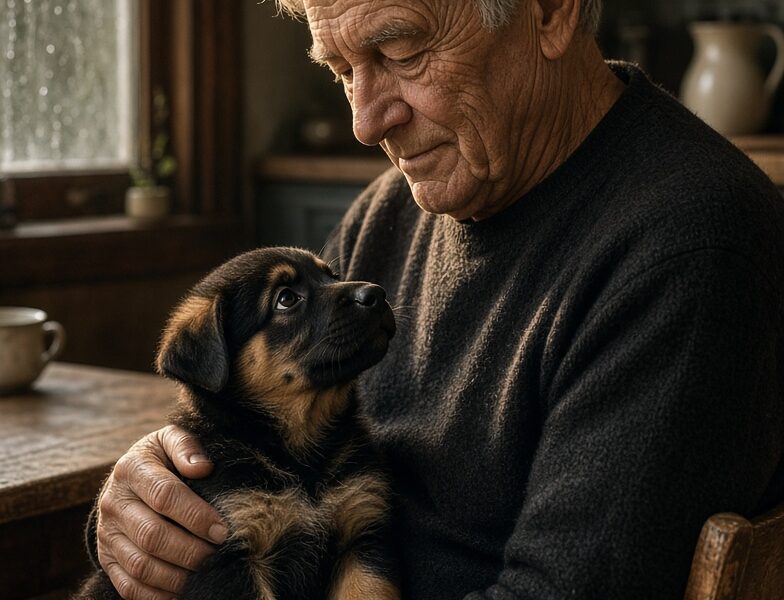
He Thought His Heart Had Closed Forever… Until a Tiny German Shepherd Puppy Arrived on His Doorstep
At seventy-five, former Navy SEAL Harlan Beckett had grown accustomed to mornings when no one called his name.
He lived behind locked doors, surrounded by military memories he had never spoken of, and a family silence that had lasted far too long.
Then, one cold morning, the doorbell rang.
On the porch sat a six-week-old black and tan German Shepherd puppy inside a cardboard box beside a handwritten note.
“People say you never turn away a dog that needed shelter.”
Harlan intended to keep him for one night.
He had no idea the puppy had been brought to his door for a reason, and before winter reached the town, that little dog would begin opening something that war, grief, and pride had kept closed for years.
Before the story begins, let us know where you’re watching from today.
It’s always beautiful to see how many places a single story can reach.
Early October brought the first real cold to Enterprise, Oregon.
A thin rain drifted across the low roofs before daylight, gathering on porch rails and darkening the trunks of the maples along the street.
Wind pushed fallen leaves into damp piles beside the curbs, while the Wallowa Mountains appeared only in brief gray openings between the clouds.
Harlan Beckett woke at 5:40, three minutes before the alarm beside his bed.
He sat on the edge of the mattress until the stiffness eased from his right knee, then crossed the hall in wool socks and checked the back door.
His hand tested the deadbolt, moved to the window latch, and pulled the curtain aside just far enough to see the garden gate and the old Ford parked beside the fence.
Thirty years had passed since he left Naval Special Warfare, yet his body still completed certain tasks before the rest of him had fully awakened.
The house gave him plenty of room to hear himself move.
He crossed the living room, adjusted the front curtain, and entered the kitchen.
A small pot of coffee went on to the burner.
Beside it, he placed the blood pressure monitor and pulled a narrow wooden cart away from the wall.
A dark red canvas pouch rested on the second shelf.
Inside were his morning blood pressure tablets, a medical information card, and a small bottle of medication his doctor had prescribed for chest pain.
Harlan checked each label before taking anything, although the bottles had occupied the same places for months.
Precision had once kept other men alive.
These days, it kept his mornings from coming apart.
He wrapped the cuff around his arm, waited for the machine to finish, and wrote the numbers in a pocket notebook.
The top of the page already held the date in block letters.
Beneath it, every line was straight enough to look measured.
The coffee began to hiss behind him.
Harlan poured one cup and carried it to the small table by the window.
Only the chair facing the garden showed signs of use.
The other three remained pushed in, their seats covered by a faint film of dust that returned no matter how often he wiped them.
The rest of the house was equally orderly.
A folded newspaper sat beside the recliner.
The television remote lay square with the edge of the side table.
Two framed photographs rested on the mantel—one from his service years, and another turned slightly away from the room.
Near the front door, an old leather collar still hung from a brass hook.
The tag read KODIAK.
Three years earlier, Harlan had carried the German Shepherd to the base of the apple tree at the far end of the garden.
Kodiak had lived eleven years.
Long enough to know the sound of Harlan’s nights, the difference between a delivery truck and an unfamiliar engine, and the exact moment an old man needed company without being touched.
Harlan had dug the grave himself.
His hands had shaken hard enough that the shovel struck the stones twice.
By the time he finished, darkness had settled across the yard, and rain had filled the prints left by his boots.
The next morning, he washed Kodiak’s metal bowls, dried them, and put them behind a stack of cooking pots.
He stopped walking the neighborhood after that.
At 6:20, the doorbell rang twice.
The sound traveled through the house with a sharpness that made Harlan set down his cup.
No one from town visited that early.
The few people who knew him well enough to ignore his preferences had disappeared from his life in one way or another.
The bell stayed silent.
Harlan moved into the hallway without hurrying.
He positioned himself to the side of the door, looked through the narrow pane of glass, and waited long enough to hear the rain ticking against the porch roof.
No shadow crossed the steps.
He released the deadbolt and opened the door halfway.
A cardboard box sat close to the threshold, its bottom raised from the wet concrete by a sheet of folded plastic.
The upper flaps had been tucked inward, leaving enough space for air to pass through.
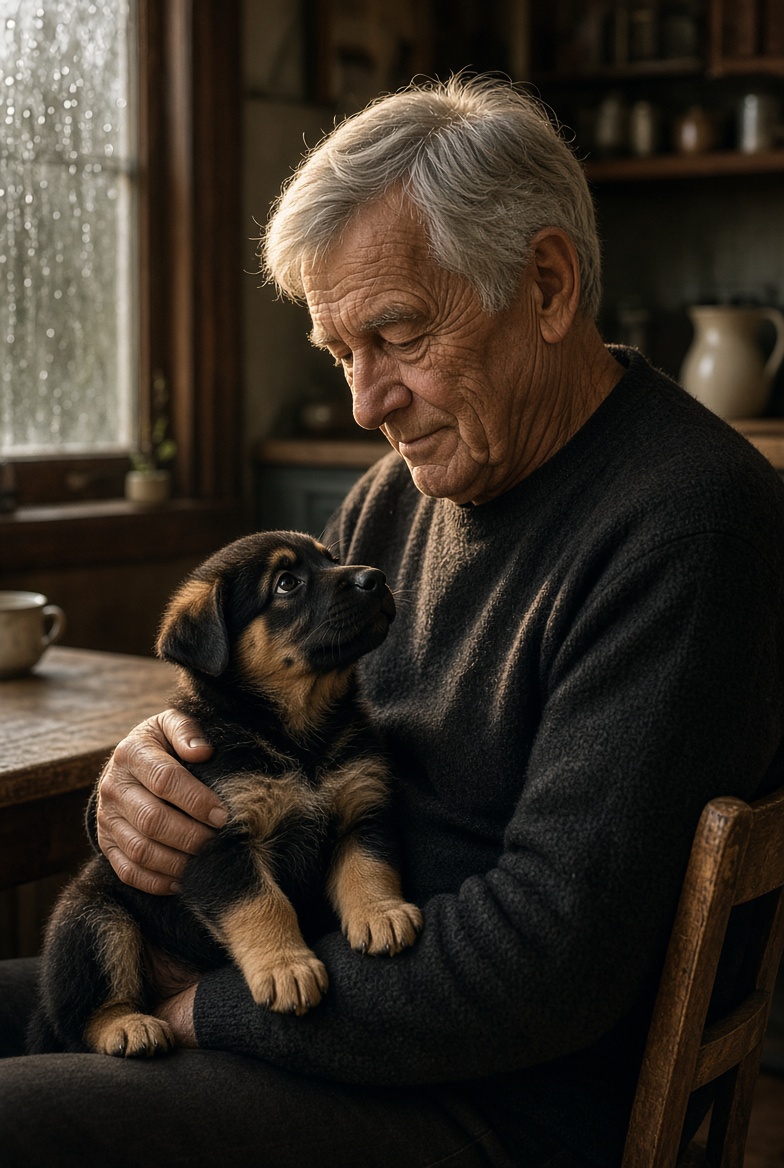
Inside, a black and tan German Shepherd puppy lay curled in a faded flannel blanket.
The pup looked barely six weeks old.
His ears folded in different directions, his paws seemed borrowed from a much larger dog, and the damp fur along his back rose in uneven ridges.
His chest moved quickly beneath the blanket.
He made no sound.
The puppy lifted his head and held Harlan’s gaze.
Harlan looked beyond the box toward the sidewalk.
The road was empty except for a newspaper carrier turning at the far corner.
A pale set of tire tracks curved away from the curb, already softening beneath the rain.
“Who left you here?” he asked.
The puppy blinked once.
Harlan crouched with care, keeping one hand against the doorframe.
Beneath the edge of the blanket, he found a folded sheet of paper.
The writing leaned slightly to the right, pressed hard enough to leave marks on the back.
“Mr. Beckett, people say you never left a dog outside when it needed a door. I’m asking you to prove them right one more time. I can’t keep him. Please forgive me.”
Harlan read it twice.
The choice of words bothered him more than the missing name.
Whoever wrote the note knew his address, knew his history with dogs, and knew enough about him to expect the front door would open.
He stepped onto the porch and walked as far as the gate.
Rain gathered along the shoulders of his sweater.
He studied both ends of the street, then examined the tire marks near the curb, searching for anything the weather had not yet erased.
There was no one to question.
A gust moved through the maples and sent several wet leaves skittering across the pavement.
Somewhere beyond the row of houses, an engine turned over, idled briefly, and faded into the morning traffic.
When Harlan returned to the porch, the puppy had managed to push one front leg over the side of the box.
He strained for a second, lost his balance, and disappeared backward into the blanket.
Harlan closed his eyes.
“One night,” he said. “Then we find the person responsible for this.”
The puppy sneezed.
Harlan lifted the box and carried it into the kitchen.
The little body inside weighed less than he expected, though the animal shifted toward the sound of his voice each time Harlan spoke.
He placed the box near the stove, turned the heat up two degrees, and found an old towel for the damp fur.
The puppy watched his hands.
Harlan opened cupboards until he found the metal bowl behind the pots.
Kodiak’s name was scratched into the underside, hidden unless the bowl was turned over.
Harlan held it at the sink for a while before running the water.
He washed it twice.
There was no puppy food in the house, so he softened plain cooked chicken and rice with warm water, using what his neighbor had left during a recent weekend trip.
He tested the temperature with the inside of his wrist, placed the bowl beside the box, and waited.
The puppy climbed out with considerable effort.
His front paws reached the floor first, followed by his chest, while his hind legs remained caught on the cardboard edge.
Harlan steadied him with two fingers until all four feet landed on the linoleum.
The pup ate too quickly.
Every few mouthfuls, he stopped and looked up, checking Harlan’s position before lowering his head again.
Harlan pulled a chair closer.
By evening, the rain had weakened to a fine mist.
The puppy had overturned the water bowl, dragged three sheets of newspaper across the kitchen, and fallen asleep with his nose inside one of Harlan’s slippers.
Each time Harlan moved into another room, the small claws followed, tapping over the floor in an uneven rhythm.
He prepared a sleeping place in the hallway using the flannel blanket and an old bath towel.
The puppy circled twice, dropped onto his side, and closed his eyes.
“That is where you sleep,” Harlan told him.
The puppy’s ear twitched.
Near midnight, Harlan woke in the recliner with the television glowing silently across the room.
Something warm pressed against the side of his boot.
The puppy had left the hallway and curled beneath the chair.
One front leg rested across Harlan’s shoelace, while the soft muzzle lay against the worn leather.
Harlan reached down, stopped before touching him, then placed his hand lightly over the narrow ribs.
The puppy breathed against his palm and settled deeper into sleep.
Across the room, Kodiak’s collar hung motionless beside the door.
Morning arrived under a lighter sky.
Harlan folded the flannel blanket, returned it to the box, and put on his coat.
He intended to drive the puppy to the local animal shelter, explain what had happened, and leave the problem with people equipped to handle it.
The puppy trotted into the hallway and sat directly on the lower edge of Harlan’s coat.
Harlan looked down.
The pup looked back, calm and entirely certain of his place there.
By then, Harlan believed the remaining mystery concerned only a shelter record and the careless person who had abandoned a dog on his porch.
The answer was already closer than he realized.
The previous morning, more than a block away, a young woman had been sitting inside a parked car beneath a row of thinning trees.
The heater remained on.
An empty pet carrier waited across the back seat, and her eyes stayed fixed on Harlan’s house through the rearview mirror.
The puppy had been alone on the porch for less than a minute.
Had Harlan left the door closed, she would have gone back for him.
Before we see where this little puppy leads Harlan next, please like the video and subscribe to the channel.
Thank you.
The drive to Wallowa Valley Animal Haven took less than fifteen minutes, though Harlan stretched it longer by avoiding Main Street and taking the quieter road past the fairgrounds.
The puppy rode in the cardboard box on the passenger side floor, wrapped in the same flannel blanket from the porch.
Every few minutes, a pair of oversized paws appeared above the rim before slipping back out of sight.
Harlan kept one hand on the wheel and the other near the box.
“Don’t get ideas,” he said. “This is transportation, not a partnership.”
The puppy answered by chewing the corner of the cardboard.
The shelter stood near the edge of town in a low building that had once stored farm equipment.
Volunteers had painted the siding a pale green, though weather and wind had worn the color thin along the southern wall.
Behind it, several fenced runs stretched toward a line of cottonwood trees, their yellow leaves gathering against patched roofs built by local hands.
The barking began before Harlan reached the entrance.
The puppy stiffened inside the box.
His head rose, ears folding back as several dogs answered one another from the concrete hallway beyond the front desk.
When Harlan set him down, the little dog pressed against his boot and stayed there.
Harlan clipped on the temporary leash he had found in Kodiak’s old drawer.
He kept it short enough to prevent tangling, yet left enough slack for the puppy to step away if he chose.
Then he stood quietly and let him take in the room.
The pup looked toward the noise, then up at Harlan.
“Take your time,” Harlan said.
A young woman emerged from a side room carrying a folded towel and a stainless steel bowl.
Her name tag read ELISE ROWE.
She looked about twenty-two, with brown hair pulled into a low tie and the tired, steady expression of someone who had already cleaned three kennels before most people finished breakfast.
When she saw Harlan, she stopped.
The pause lasted less than a second.
She shifted the towel to her other arm and continued toward them, though something in her face had changed enough for Harlan to notice.
“Morning,” she said. “Can I help you?”
“You can tell me who left this dog on my porch.”
The puppy heard her voice and moved forward before Harlan could answer anything else.
His nose worked quickly along the air, and his tail gave two uncertain taps against Harlan’s leg.
Elise crouched.
“Well, hello again,” she murmured.
Harlan’s gaze settled on her.
Elise seemed to catch the mistake as soon as the words left her.
She ran her fingers along the puppy’s neck, checking the skin beneath his collar, then looked toward the front desk.
“We’ve had several young shepherds come through recently,” she said. “Some of them remember every person who fed them once.”
The puppy pushed his head into her palm.
“He remembers you better than once.”
Elise gave a small smile and stood.
“Let me check the intake records.”
She disappeared behind the desk and returned with a thin folder.
A moment later another woman joined her—broad-shouldered and gray-haired, wearing work boots and a navy fleece with the shelter logo stitched over one pocket.
“I’m Dana Whitcomb,” she said. “I manage the place.”
“Harlan Beckett.”
Dana looked down at the puppy, then at the box and folded note Harlan had brought with him.
Her expression tightened while she read.
“This wasn’t an approved placement,” she said.
“That much I worked out.”
Elise busied herself with the folder, but the puppy continued watching her.
Dana turned several pages.
The dog had come from a county animal control facility south of Enterprise with four littermates.
Their mother had developed complications after giving birth and was receiving treatment with a veterinary foster.
The puppies had been separated among temporary homes until they were old enough for regular adoption.
“This one was the smallest,” Elise said. “He ate slower than the others and didn’t settle well by himself. Once he trusted someone, he followed them from room to room.”
Harlan glanced down.
The puppy had planted one paw across the toe of his boot.
“That part seems accurate.”
Dana examined the handwritten note again.
“Do you have any idea who brought him to your house?”
“I was hoping you did.”
“We’ll look into it.”
She closed the folder.
“For today, we have another problem.”
A volunteer passed behind them carrying a bag of laundry.
From farther down the hall came the scrape of kennel doors and a sudden burst of barking.
The puppy lowered himself against Harlan’s leg.
Dana watched the movement.
“We’re full.”
Harlan lifted the leash slightly. “Then call whoever was fostering him.”
“We will.”
“It may take a day or two.”
“He can stay here until then.”
Dana looked toward the hallway, where every run was already occupied.
“We don’t have a safe kennel open for a puppy this young.”
Harlan let out a slow breath.
“I’m seventy-five. I walk with a cane. I did not come here to turn my living room into a training yard.”
The puppy chose that moment to lower his head and begin pulling at Harlan’s shoelace.
Elise looked down.
“It appears the first training session started without your approval.”
Harlan followed her gaze.
The puppy had loosened the knot and was working with quiet determination on the second loop.
A reluctant sound escaped Harlan—somewhere between a sigh and a laugh.
Elise heard it.
Her smile widened briefly, and for an instant it carried a familiarity Harlan could not place.
Dana leaned against the desk.
“We can make this a temporary foster arrangement. We’ll provide food, schedule the veterinary check, and give you anything you need for basic care. You bring him back if it becomes too much.”
“I already said one night.”
“You also brought him here in his own blanket and carried the note.”
“That proves I can organize evidence.”
Elise looked away to hide another smile.
Dana studied him for a moment.
“Have you raised a German Shepherd before?”
Harlan’s eyes moved toward the leash drawer in his memory, toward the brass hook beside his front door, toward the patch of dark earth beneath the apple tree.
“One,” he said. “Kodiak. Eleven years.”
Dana’s voice softened. “Long time.”
“Long enough.”
He kept the rest to himself.
Kodiak had learned how to wake him before the nightmares reached their worst point.
He had waited outside the clinic during June’s final months, head resting between his paws, each time Harlan came through the doors.
After the funeral, when the phone stopped ringing and Mary Ann’s bedroom remained closed, Kodiak had been the only living thing in the house that still expected Harlan to return by supper.
The puppy tugged once more at his lace.
Dana gathered several forms.
“Temporary foster. You can decide later.”
Harlan stared at the paperwork while rain tapped against the front windows.
The practical answer was to refuse, leave the dog with trained staff, and return to the quiet order of his kitchen.
The shelter no longer had room for practical answers.
He signed only the first page.
Dana gave him a bag of puppy food, a feeding chart, and a date for the veterinary examination.
Elise found a smaller collar and knelt to adjust it, working two fingers beneath the nylon to check the fit.
The puppy stood quietly for her.
“You’ve handled him before,” Harlan said.
Elise kept her attention on the buckle.
“I helped with the litter when they came in.”
“How often?”
“Enough to know he hates closed doors and sleeps better near someone.”
The answer was smooth, though her hands paused at the final hole in the strap.
By the time Dana finished explaining the foster rules, Harlan had begun to believe the morning’s mystery would end with a misplaced record and an irresponsible volunteer.
The hallway near the exit held something harder to dismiss.
A wooden donor board hung beside the door, filled with brass plates of different ages.
Harlan would have walked past it if the puppy had not stopped to sniff the baseboard.
His eyes moved across the names without interest until one line brought him still.
“June Beckett Memorial Recovery Room, given by Mary Ann Rowan Family.”
The leash shifted in his hand.
June’s name carried the quiet of hospital rooms, cold coffee, and a wedding ring he still kept in the top drawer beside his bed.
Mary Ann’s name brought back another kind of silence, born in a kitchen after the funeral and carried forward by two people too wounded to make the first call.
Harlan read the brass plate again.
Behind him, Elise had stopped walking.
The puppy sat between them, one ear folded forward while rainwater slid in narrow lines down the glass door.
Harlan’s fingers tightened around the head of his cane.
Elise lowered her eyes to the floor.
Harlan left the shelter with the foster papers folded inside his coat and the puppy asleep in the cardboard box on the passenger side floor.
The brass plate stayed with him all the way home, each word returning whenever the tires passed over a seam in the road.
“June Beckett Memorial Recovery Room, given by Mary Ann Rowan Family.”
He had known Mary Ann might have changed her name someday.
The possibility had remained abstract, belonging to a life that continued somewhere beyond his view.
Seeing it engraved in brass gave that unseen life weight, and the word family sat beneath her name with a meaning he could not measure.
The puppy lifted his head when Harlan turned onto their street.
“Our street for now,” Harlan corrected.
At home, he cleared a section of the kitchen wall and taped up the feeding chart Dana had given him.
The shelter bag contained puppy food, a soft collar, a short training lead, chew toys, cleaning pads, and more written instructions than Harlan remembered receiving before some deployments.
He read every page.
The next morning began at 5:40.
Harlan checked the doors and windows, started the coffee, and found the puppy sitting inside the towel basket with only his head visible above the rim.
The new sleeping mat lay untouched three feet away.
“You missed the designated area.”
The puppy yawned.
Harlan began building a routine around him.
Meals came at regular hours.
Trips outside followed sleep and play, and the kitchen became the center of a small training ground.
He used pieces of kibble to teach sit, then wait, come, and place, repeating each command in the same calm tone.
The puppy learned quickly when he wished to.
At other times, a drifting leaf beyond the window, a shoelace, or the faint reflection of his own ears in the oven door became more important than anything Harlan had to say.
Harlan never raised his voice.
Years earlier, he had watched frightened young men follow commands because rank left them no choice.
The ones who trusted the person giving those commands kept thinking when plans collapsed and noise swallowed every instruction.
Fear produced obedience for a moment.
Trust held when the leash was gone.
The puppy tested that trust daily.
He slept in the towel basket, carried Harlan’s socks into the living room, and bit the end of the pencil whenever Harlan tried to record feeding times.
During place, he settled beside the training mat with one paw barely touching the fabric, as though compliance could be negotiated by inches.
“You know exactly what you’re doing,” Harlan told him.
The puppy rolled onto his back.
Each morning, after setting down the food bowl, Harlan pulled the wooden cart away from the kitchen wall.
He tapped the dark red canvas pouch on the second shelf and said, “Med kit.”
The first few times, the puppy tried to reach the food while Harlan wrapped the blood pressure cuff around his arm.
Harlan blocked him gently with one hand, repeated, “Wait,” and finished the routine before offering a piece of kibble.
The sequence became familiar.
Food bowl.
Red pouch.
Blood pressure cuff.
Pill bottle.
Reward.
By the third morning, the puppy sat beside the cart without being asked.
When Harlan said, “Med kit,” the little dog’s eyes went directly to the red canvas pouch before returning to Harlan’s hand.
“Smart enough to be dangerous,” Harlan murmured.
Names proved more difficult.
He tried Murphy while the puppy pulled stuffing from a toy.
There was no response.
Finn earned a brief glance, though only because a spoon had fallen into the sink.
Scout failed entirely when a moth appeared near the ceiling light.
Most of the time, Harlan used “kid,” “pup,” “recruit,” or “trouble.”
Trouble seemed the most accurate.
On the fourth afternoon, a hard wind came down from the mountains and pushed dry leaves against the back steps.
The puppy had worn himself out chasing them across the yard, and Harlan expected an hour of quiet while he sorted a drawer in the dining room.
At the bottom lay June’s old chess set.
The wooden box had darkened around the hinges, and one corner still bore the shallow scratch Mary Ann had made with a house key when she was nine.
Harlan carried it to the kitchen table and opened the lid.
The pieces were wrapped in yellowed tissue paper.
June had favored the white pieces and always moved too quickly when she believed she had him cornered.
Mary Ann used to kneel on a chair between them, offering advice to whichever parent appeared closest to losing.
Harlan unwrapped a black knight.
The puppy’s nose appeared beside his elbow.
“No.”
The nose moved closer.
Harlan reached for the rook just as a small mouth closed around it.
The puppy snatched the piece from the box and shot beneath the table, back legs sliding on the rug before finding traction.
“Drop it.”
The puppy ran into the hallway.
Harlan followed with his cane, careful where he placed each step.
The thief circled the dining table, nearly collided with a chair, then scrambled toward the kitchen with the black rook still held between his teeth.
Harlan stopped beside the counter.
“All right, Rook. You win.”
The puppy froze.
He turned his head, ears lifting as far as they could manage, then gave one slow sweep of his tail.
Harlan repeated the word. “Rook.”
The puppy came toward him and dropped the chess piece beside his boot.
That settled it.
Rook became part of the household in ways the foster papers could not record.
He waited beside the door each morning, pressed his shoulder against Harlan’s calf while the leash was clipped on, and watched the street as though their short walks carried serious purpose.
Harlan began opening the curtains earlier.
He stepped beyond the gate every day—first to the corner and back, then around the block when his knee allowed.
Rook moved in bursts.
Three quick steps, a sudden stop to inspect a leaf, then a hurried return when he realized Harlan had continued without him.
Neighbors started noticing.
Mrs. Bell from across the street brought over a rubber chew toy shaped like a tire.
Earl Pritchard leaned over his fence and asked whether Harlan had finally hired security small enough to fit under the couch.
At the feed store, two people Harlan had avoided for years stopped to ask the puppy’s name.
He answered them.
The change arrived in ordinary pieces.
A second bowl drying by the sink, muddy paw prints beside the back door, a half-finished cup of coffee cooling while Rook investigated the yard.
Harlan still checked every lock.
The silence between those checks had begun filling itself.
For several days, the new routine kept his attention in the present.
Then Rook opened a door Harlan had left closed for much longer.
The puppy disappeared into the hall closet one afternoon while Harlan was changing the furnace filter.
There was a scrape followed by a muffled sneeze, and Rook backed into the hallway dragging something blue between his teeth.
Harlan recognized the yarn before the object reached the light.
It was a child’s mitten, small enough to fit inside his palm.
One side was wider than the other, and a crooked letter H had been stitched near the wrist with white thread.
Mary Ann had made it when she was ten.
She had spent an entire winter insisting he wear it on patrol around the yard, though it barely covered three of his fingers.
Harlan had kept it in his coat pocket for years after that, long after she stopped asking whether he carried it.
Rook placed the mitten on the bottom stair and sat beside it.
Harlan lowered himself carefully.
The wool had thinned near the thumb, and one loose thread curled around his finger when he picked it up.
The kitchen after June’s funeral had become the final picture he allowed himself of Mary Ann—her face pale from sleeplessness, his own voice hard enough to turn grief into something sharp, a door closing before either of them knew how long it would remain that way.
Other memories waited behind it.
Mary Ann asleep in the recliner, determined to hear his truck return.
Mary Ann riding on Kodiak’s back when the dog was still young enough to tolerate it.
Mary Ann standing on a kitchen chair, accusing both parents of cheating at chess.
Rook rested his chin on Harlan’s knee.
That night, Harlan opened the drawer beneath the telephone.
A folded piece of paper lay beneath old batteries and a book of stamps.
The number written there was twenty-five years old, the ink faded at the creases.
He lifted the receiver.
The dial tone filled the kitchen.
Harlan pressed each number slowly, pausing after every one.
When only the final digit remained, his thumb hovered above the button.
Rook crossed the floor carrying the blue mitten.
He placed it on Harlan’s knee and sat down.
The dial tone continued.
Harlan returned the receiver to its cradle, then ran one hand along the puppy’s back.
“Not today,” he said quietly. “But I’m running out of reasons.”
Harlan never completed the call, though he no longer returned Mary Ann’s number to the bottom of the drawer.
The folded paper remained beside the telephone, held flat beneath the blue mitten Rook had carried from the hall closet.
Each morning, Harlan saw both objects before taking the puppy outside.
By the final days of November, the weather around Enterprise had turned rougher.
Two nights of heavy rain softened the garden paths, cold wind moved down from the Wallowas, and mud collected beneath the back steps in thick brown ridges.
The wooden gate at the far end of the yard had begun striking its post whenever the wind shifted.
Harlan listened to it through breakfast.
Clack.
A pause.
Clack.
Rook sat beside the table watching a piece of egg cool on Harlan’s plate.
“Don’t start,” Harlan said.
Rook lowered his head, though his eyes remained fixed on the plate.
Harlan had eaten only half his breakfast when the gate struck the post again.
Snow was expected within a day or two, and a sagging hinge would only become harder to repair once the wood froze.
He placed his coffee in the sink, pulled on his work coat, and carried a metal toolbox into the yard.
Rook followed with a short length of rope he had found near the back door.
The puppy had grown since arriving, though his paws still seemed too large for the rest of him.
One ear stood upright when he was alert, the other folded sideways as if unwilling to commit.
He dropped the rope near Harlan’s boot and waited for a game.
Harlan knelt beside the post and removed the lower screw.
The wood had swollen around the metal, forcing him to lean his weight into the wrench.
He adjusted the hinge, tested the gate, then bent again when it dragged across the ground.
The wind carried away the sound of his breathing.
He stayed crouched too long.
When he finally stood, the fence tilted across his vision and the apple tree seemed to move several feet to the left.
Harlan caught the top rail with one hand and waited for the dizziness to pass.
It did not.
Pressure gathered beneath his breastbone, heavy and deep.
His heartbeat stumbled, raced, then seemed to pause before striking again.
He drew in a breath that stopped halfway.
Rook dropped the rope.
Harlan tried to reach the porch.
One step carried him away from the fence, while the second ended with his right knee folding beneath him.
He landed beside the remains of the summer garden, one shoulder striking the damp earth.
The cold reached through his coat immediately.
Rook circled him, whining once before pressing his nose beneath Harlan’s wrist.
Harlan lifted his hand, but the fingers felt slow and distant.
His vision had narrowed to the muddy path, the puppy’s black muzzle, and the pale rectangle of the open kitchen door.
He gathered enough breath for two words.
“Rook. Med kit.”
The puppy stared at him.
Harlan tapped the ground once and pointed toward the house.
“Med kit.”
Rook turned and ran.
He crossed the back steps too quickly, struck the screen door with one shoulder, and squeezed through the opening.
Muddy paws slid across the kitchen floor, sending him sideways into the leg of a chair.
The chair scraped loudly, and Rook scrambled upright.
The red canvas pouch rested on the second shelf of the wooden cart.
Rook had watched Harlan touch it every morning.
He knew the words, the color, the smell of medicine and canvas, and the piece of kibble that followed.
Reaching it had never been part of the routine.
He rose onto his hind legs and snapped at the dangling strap.
His teeth caught the dish towel instead.
The towel fell across his head and shoulders.
Rook backed into the table, shaking until the cloth slid free, then returned to the cart and jumped again.
A wooden spoon clattered onto the floor.
Rook sprang away from the noise.
His nails scrabbled against the linoleum, and for a moment he stood near the doorway, ears flattened, looking toward the yard.
Harlan coughed outside, then the garden went quiet.
Rook rushed back to the cart.
On the third attempt, his teeth closed around the pouch strap.
He pulled with his full weight.
The bag shifted from the shelf, tipped over the edge, and dropped into the towel basket below.
Rook shoved his head into the basket.
His front half disappeared beneath folded cloths, while his hind legs remained outside, kicking against the cabinet.
A towel wrapped around one paw.
He twisted free, buried his nose deeper, and found the canvas strap.
The pouch came out beneath him.
Rook backed across the kitchen, dragging it between his legs until the strap caught around the table leg.
He pulled harder, growling through the canvas, but the bag stayed in place.
Harlan had spent days teaching him to stop fighting a trapped toy from the same angle.
A short command.
A hand signal.
Then another approach.
Rook released the strap.
He circled the table, seized it from the opposite side, and pulled.
The pouch snapped free.
It bumped across the kitchen floor, caught on the threshold, then followed him onto the porch.
Halfway down the steps, the strap looped around his front leg.
Rook tumbled onto the wet grass and rolled once, the red bag landing beside him.
He stood immediately.
Mud streaked one side of his face.
He grabbed the strap again and ran toward the garden.
Harlan saw the red canvas moving through the blur before he saw Rook.
The puppy reached him breathing hard, dropped the pouch against his chest, then pushed it closer with his nose.
“Good boy,” Harlan whispered.
His fingers struggled with the zipper.
Rook pawed at the bag, nearly turning it over until Harlan steadied it against the ground.
He found the small bottle prescribed for chest pain, placed a tablet beneath his tongue, and pulled the medical card from the side pocket.
The pressure eased slightly after several moments.
His heartbeat remained uneven, and his legs offered no support when he tried to move.
Rook waited beside his shoulder.
“Earl,” Harlan said, pointing toward the neighboring fence. “Go.”
The puppy ran halfway across the garden, stopped, and looked back.
“Go get Earl.”
Rook reached the fence and began barking.
The sound came in sharp bursts, followed by a return to Harlan, then another rush toward the property line.
Inside the neighboring house, Earl Pritchard heard the barking over the radio in his workshop.
He opened the back door and saw Rook jumping against the fence, muddy from chest to tail.
“What did you get into?”
Rook ran toward Harlan and barked again.
Earl followed the movement through the slats.
The question left his face.
He called 911 before crossing the side gate.
Harlan was pale, damp with cold, and struggling to keep his eyes open.
Earl covered him with an old wool blanket from the workshop, placed the medical card beside the phone, and read the information to the dispatcher.
Rook pressed against Harlan’s arm until the sirens reached the street.
The paramedics moved quickly through the yard.
One checked Harlan’s heart rhythm while another took his blood pressure, asked about the chest medication, and fitted an oxygen line beneath his nose.
The numbers on the monitor drew a glance between them that Harlan understood without explanation.
The tablet had reduced some of the pressure.
It had not ended the emergency.
Earl held Rook near the porch while the stretcher crossed the muddy path.
The puppy pulled toward Harlan, whining for the first time since the paramedics arrived.
Harlan turned his head as they lifted him through the gate.
“Earl, I’ve got him. Don’t let them send him back for good.”
The ambulance doors closed before Earl could answer.
The ambulance carried Harlan to Grande Ronde Hospital in La Grande, where the first night passed beneath white lights and the steady pulse of a heart monitor.
Nurses drew blood, adjusted the leads on his chest, and asked the same questions in different ways until his answers became shorter.
By morning, the cardiologist had a clearer picture.
Harlan’s blood pressure had climbed dangerously high during an episode of irregular rhythm and chest pain.
The medication from the red pouch had eased the pressure long enough for help to arrive, though it had never removed the need for emergency care.
“You were fortunate your neighbor found you quickly,” the doctor said.
Harlan looked toward the window.
“The dog found him.”
The doctor lowered the chart.
He was close to sixty, with silver hair and a voice that carried concern without softness for its own sake.
“That puppy will grow into a seventy-pound shepherd. He’ll need long walks, training, and someone strong enough to control him when he gets excited. One hard pull could put you back in here with a broken hip.”
“He brought me my medication.”
“I read the report.”
“Then you know he listens.”
“I know he’s young, and you’ve just had a cardiac event.”
Harlan held the doctor’s gaze.
The argument was reasonable, which made it harder to dismiss.
He could picture Rook at full size, shoulders level with his knee, eager feet finding ice before Harlan saw it.
He could also picture the brass hook beside his front door standing empty again.
The doctor continued speaking about medication changes, supervised activity, and fall risks.
Harlan heard most of it.
Beneath the clinical language ran an older message, one he had encountered since his hair turned gray and the cane became permanent.
Other people were beginning to measure what he should still be allowed to keep.
By late afternoon, Harlan had learned to tolerate the monitor, the food tray, and the hallway lights.
Then came the sound he had been listening for without admitting it.
Small claws moved across the tile outside his room.
They came too quickly, stopped, then started again with a scrape against the doorframe.
Elise appeared carrying Rook against her chest, one arm beneath his hindquarters while the other held his leash.
Rook saw the bed.
He twisted free before Elise could lower him properly, landed in an awkward crouch, and hurried across the room.
His front paws struck the side rail, slid down, and tried again.
“Easy,” Harlan said.
The puppy stretched upward until his nose reached Harlan’s open hand.
Warm breath touched his palm.
Rook licked one finger, pressed his muzzle harder into the hand, then made a low sound deep in his throat.
Harlan had answered every nurse with the same controlled voice.
His hand began to shake against the puppy’s face.
Elise pulled a chair closer and lifted Rook onto it.
He placed both front paws on the mattress, leaning his chest against the edge while Harlan rubbed the fur between his ears.
“He refused breakfast,” Elise said. “I told him he could visit after he ate.”
Harlan glanced at her. “So he ate half the bowl.”
“He’s training you faster than you’re training him.”
“That has become obvious.”
Rook settled with his chin across Harlan’s wrist.
Mud still marked the pale fur between his toes despite someone’s attempt to clean him.
The visit could have ended with that quiet arrangement.
Elise remained near the foot of the bed, winding the leash once around her hand and then unwinding it.
“There’s something I should tell you,” she said.
Harlan waited.
“I rang your doorbell that morning.”
His hand stopped on Rook’s neck.
Elise looked toward the window.
“I brought him to your porch.”
For several seconds, the monitor supplied the only sound in the room.
“You left a six-week-old shepherd outside my house in the cold for forty-seven seconds.”
“You counted?”
“I was sitting in a car down the street. The heater was running, and his carrier was on the backseat. If you hadn’t opened the door, I would have taken him back.”
Harlan studied her face.
“That is a very organized description of a bad decision.”
“Yes, sir.”
“Why my house?”
Elise drew a breath.
“We were full. Rook had already chewed through two foster applications, kept three volunteers awake, and screamed every time someone closed a door between him and the next room.”
“That explains the puppy.”
Her fingers tightened around the leash.
“It doesn’t explain me.”
Elise looked down at Rook.
“I heard about a man who never left a dog outside when it needed help. I also thought Rook might do better with someone who understood what it feels like to wake up and check whether anyone is still there.”
Harlan heard the missing pieces in her answer.
She had offered enough truth to sound honest and held back enough to keep the question alive.
“Who told you about me?”
“A person who remembered you differently than you remember yourself.”
Before he could press further, Rook shifted his weight and nearly slid off the chair.
Harlan caught him beneath the chest while Elise steadied his back legs.
The puppy looked between them as though the interruption had been deliberate.
That evening, Elise stood in the hospital stairwell and called Mary Ann.
Mary Ann answered before the second ring.
“How bad is it?”
“He’s stable. They’re adjusting his medication.”
“Was he conscious when they brought him in?”
“Yes.”
“Is he alone?”
Elise looked through the narrow window in the stairwell door.
Harlan’s room lay beyond the turn in the corridor.
“Rook is with him.”
A breath moved across the line.
“Does he still hate lying flat?”
“He raised the bed before the nurse finished showing him the controls and asked them to turn off the hallway light twice.”
Mary Ann gave a sound that might have been a laugh on another day.
“He always said hospital lights were designed by people who never had to sleep under them.”
Elise leaned against the wall. “You remember everything.”
“I remember the things I tried hardest to forget.”
“Come see him.”
The silence lasted long enough for footsteps to pass on the floor below.
“I’ve driven to Enterprise three times,” Mary Ann said.
“Once I made it as far as the grocery store. I sat in the parking lot for forty minutes and drove home.”
“You could make it farther next time.”
“He may close the door.”
Back in Enterprise, an old telephone number remained beneath a blue mitten in Harlan’s kitchen.
Mary Ann had no way to know that.
Harlan had no way to know how often her car had reached the edge of town.
Both had treated fear as evidence.
Elise closed her eyes.
“He stopped beneath your name on the donor wall. He read it twice.”
Mary Ann said nothing.
“Come before another twenty-five years finds a reason to pass.”
Harlan returned home two days later with a paper bag of new medication, a list of restrictions, and Earl driving his truck.
Rook remained at the shelter while Dana reviewed the foster arrangement and Harlan regained enough strength to manage safely.
The house greeted him with still air.
There were muddy prints near the back door, a rope toy beneath the table, and one small tooth mark on the leg of the kitchen cart.
Harlan left every trace where it was.
Home should have settled the matter.
The following afternoon made clear that the decision belonged to more than one person.
Dana arrived with Elise shortly after three.
She declined coffee, accepted a chair, and placed a folder on the table.
“You cared for Rook well,” she said. “His vet records are current, his weight is improving, and he’s strongly bonded to you.”
Harlan rested both hands on the head of his cane. “Then bring him home.”
“We need a backup caregiver listed before the adoption can move forward.”
His expression hardened.
Dana continued.
“Someone who can take him if you’re hospitalized, recovering, or temporarily unable to handle him. Rook will need that person for his entire life.”
“I managed Kodiak for eleven years.”
“You were younger when Kodiak came to you.”
“I’m aware of my age.”
“I believe you are. Rook’s future still requires a plan beyond your good days.”
The words landed cleanly because Dana had not spoken them with cruelty.
She was protecting a young dog from an emergency that had already happened once.
Harlan looked toward the empty bowl beside the wall.
“I don’t have anyone.”
Elise shifted in her chair.
“Give me until tomorrow.”
Harlan almost asked what one night could change after twenty-five years.
He saw the strain around her eyes and kept the question to himself.
Dana left the folder on the table.
That evening, Harlan washed Rook’s bowl and set it back in its usual place.
He turned off the television early, checked the locks, and lowered himself into the recliner.
The hallway remained empty.
At 5:40 the next morning, nothing scratched at his bedroom door.
Harlan woke to an empty hallway.
He took his new medication, wrote the numbers from the blood pressure monitor in his notebook, and left Rook’s bowl beside the wall.
The house seemed to have preserved every trace of the puppy except the sound of him.
At 8:15, the doorbell rang twice.
Harlan stopped with one hand on the kitchen counter.
The same two notes had opened this story weeks earlier, and his body answered them in the same old way.
He moved to the side of the frame, looked through the narrow pane, and released the lock.
Elise stood on the porch holding Rook against her coat.
A folder rested beneath one arm, its lower corner bent and marked by several small teeth.
Behind her stood a woman close to fifty.
Brown hair touched with silver framed a face Harlan recognized before his mind caught up with the years.
Mary Ann held both hands together near her waist.
She had June’s eyes and Harlan’s habit of standing as though leaving remained an available option.
For several seconds, the three adults stayed where they were.
Mary Ann looked above the door.
“You still leave the porch light on after sunrise.”
“The timer’s broken.”
Her eyes moved toward the switch visible through the window.
The house had never had a timer.
Rook twisted in Elise’s arms until she lowered him.
He hurried to Harlan, pressed his chest against the old man’s shin, then turned and ran back to Mary Ann.
After tugging once at the hem of her coat, he returned to the doorway and looked over his shoulder.
“He’s subtle,” Elise said.
“He’s eating your paperwork,” Harlan replied.
Rook had already caught the folder’s corner between his teeth.
Mary Ann tightened her grip on it.
“These are the backup caregiver forms.”
Harlan looked at her. “You came to sign for the dog?”
“I came for several reasons.”
Her voice wavered once, then steadied.
“That seemed like the one you might let through the door.”
He stepped aside.
“Come in before he finishes the signature page.”
The kitchen gave them practical things to discuss.
Mary Ann asked about the new medication, the cardiologist, and the damaged gate.
Harlan asked how far she had driven and whether the roads near Pendleton had iced over.
Elise poured coffee while Rook moved between all three chairs, carrying a dish towel that no one remembered giving him.
They spoke around the missing years.
Mary Ann examined the red medical pouch on the cart.
Harlan noticed her noticing it and explained the new dosage.
She told him Earl had already arranged to repair the gate.
He said Earl interfered too much.
She answered that Harlan had always chosen friends who ignored instructions when necessary.
For a moment, the corner of his mouth moved.
Rook disappeared into the hallway.
The conversation had reached the safe limit of weather, medicine, and dog food.
What returned in the puppy’s mouth pulled it somewhere else.
He emerged carrying the small blue mitten.
Mary Ann stopped breathing for a moment.
Rook placed it between their chairs and pushed it forward with his nose.
“You kept that?” she asked.
Harlan picked up the worn wool.
“You made it. It wouldn’t fit two of your fingers. You told me size was less important than effort.”
“I was ten.”
“You were confident.”
Mary Ann looked down at the crooked white H stitched near the wrist.
The faint smile left her face.
“Dad, I said terrible things after Mom died.”
Harlan set the mitten on the table.
The kitchen grew quieter than the hospital room had ever been.
Mary Ann spoke slowly.
She remembered accusing him of turning June’s final months into another operation.
Medication charts.
Appointment times.
Backup plans.
Instructions taped to the refrigerator.
He had monitored everything that could be measured while June lay awake at night, frightened of what neither of them could control.
“You knew how to bring men home from places I couldn’t find on a map,” Mary Ann said. “I told you that you had no idea how to sit beside your own wife when she was afraid.”
The words had been sharpened by grief, exhaustion, and years of waiting for a father who often returned from service with part of himself still elsewhere.
They had also touched a truth Harlan had spent twenty-five years trying to outlive.
He had raised a hand against his own daughter.
The memory stayed in the room without decoration.
One reckless movement.
One sharp sound in the kitchen.
One daughter stepping backward.
Harlan looked at his fingers.
“What you said hurt me,” he said. “My hand was still mine.”
Mary Ann’s eyes lifted.
“I blamed the funeral. I blamed exhaustion. I blamed every year before it.”
His voice lowered.
“You deserved an apology before you reached the front steps that day.”
“I wanted you to call. I picked up the phone more times than I can count.”
“So did I.”
Harlan glanced toward the old telephone.
The faded number remained beneath the blue mitten, exactly where Rook had left it.
Mary Ann rubbed her thumb along the folder’s edge.
“After a while, I thought the silence was your answer.”
“I thought it was yours.”
Twenty-five years had grown around the same mistake.
The paperwork on the table offered a solution for Rook.
A surname beside the signature line uncovered the final piece of the morning.
Harlan read the printed name again.
Mary Ann Rowe.
His eyes moved to Elise’s badge clipped to her jacket.
Elise Rowe.
He looked from one woman to the other.
Elise sat very still.
“I’m your granddaughter.”
Harlan’s hand tightened around the mitten.
Mary Ann told him Elise had grown up hearing stories about the father she had lost without a funeral.
She had taken her daughter to volunteer at the shelter, funded the recovery room in June’s name, and asked people in Enterprise for news she lacked the courage to request directly.
Elise leaned forward.
“Mom told me about the time you stopped during a snowstorm for a shepherd running beside the highway. She said you followed it almost six miles until it led you to an overturned truck.”
Harlan remembered the storm.
He remembered the driver more clearly than the dog.
“I thought you might close the door if I came as family,” Elise continued. “So I brought someone you would open the door for.”
Harlan studied her.
“Leaving a six-week-old puppy on a porch is standard shelter outreach now?”
“No.”
“Approved foster procedure?”
“Definitely no.”
“The worst plan you ever had.”
Elise glanced at Rook.
“The worst one that worked.”
Rook crawled beneath the table, placed one paw across Harlan’s shoe and the other against Mary Ann’s, then lowered his head between them.
Within minutes, a soft snore rose from under the chairs.
Mary Ann laughed before the tears reached her face.
Harlan covered his eyes with one hand.
Their apologies continued without speeches.
Mary Ann admitted she had used anger to hide how badly she wanted her father to come after her.
Harlan told her pride had become easier to carry than the possibility of rejection.
Neither asked the other to erase what had happened.
When Mary Ann stood, Harlan rose more slowly.
The embrace was awkward at first.
His cane pressed between the chairs.
Her shoulder caught beneath his chin.
Both seemed uncertain where to place their hands.
Then Mary Ann held him with the same fierce grip she had used as a child whenever his deployments ended.
Rook woke and barked once.
The following afternoon, Mary Ann signed the backup caregiver agreement.
Dana reviewed the emergency plan.
Elise added the shelter contact number.
Harlan agreed to supervise training, shared walking duties, and temporary care whenever his health required it.
Rook’s adoption became official.
A card appeared on Harlan’s refrigerator.
Primary caregiver: Harlan Beckett.
Backup caregiver: Mary Ann Rowe.
Shelter contact: Elise Rowe.
Mary Ann began visiting each week, sometimes bringing her adult children.
Elise helped with puppy classes.
Harlan learned to hand someone else the leash on difficult days without treating the gesture as surrender.
As Rook grew, he accompanied Harlan to a weekly coffee gathering for older veterans.
He slept beneath the chair of a widow named Frances, rested his head on the knee of a man who rarely spoke, and collected gloves beneath the refreshment table until everyone began checking his hiding place before going home.
Laughter returned in modest amounts.
In early December, the first snow settled across the porch.
Mary Ann carried an apple pie into the kitchen.
Elise sat on the floor trying to recover a glove from Rook.
Harlan stood by the window facing the tree where Kodiak rested.
The old collar remained in its place.
Beside it now hung Rook’s leash and a new house key cut for Mary Ann.
The door had stayed the same.
The people crossing its threshold had learned how to return.
There are lives that look perfectly organized from the street.
The porch is swept.
The medicine is taken.
The lights come on at the same hour.
And no one notices how quiet the kitchen has become.
Harlan’s loneliness lived in those ordinary details long before Rook arrived.
What moved me most was the way healing entered without asking permission.
It came through muddy paw prints, a worn mitten, an untouched food bowl, and a telephone number that had survived twenty-five years in a drawer.
Rook never understood the history between Harlan and Mary Ann.
He simply kept carrying things from one person to another until silence became harder to protect.
We created these characters, but the distance between parents and children, the fear of being too late, and the comfort of being needed belong to real homes.
Many families carry love quietly for years because neither side knows how to cross the room first.
May God give grace to anyone waiting for a call, courage to anyone afraid to make one, and companionship to those whose days have grown too still.
I’d love to read your memories, prayers, or thoughts below.
A like and subscription help us continue sharing grounded stories about ordinary people finding their way back.
The image I keep is simple.
An old collar.
A new leash.
And a house key resting on the same hook.
The mitten had started as a child’s Christmas project, crooked stitches and all.
It had become a memory in a drawer, a gift carried by a puppy, and a bridge across twenty-five years of silence.
And now it sat on the kitchen table between a father and a daughter, a reminder that some things are never too lost to be found.
The end.
If this story touched you, hit that like button and share it with someone who needs to hear it.
Subscribe for more stories about family, forgiveness, and the quiet heroes who find their way home.
See you in the next one.









