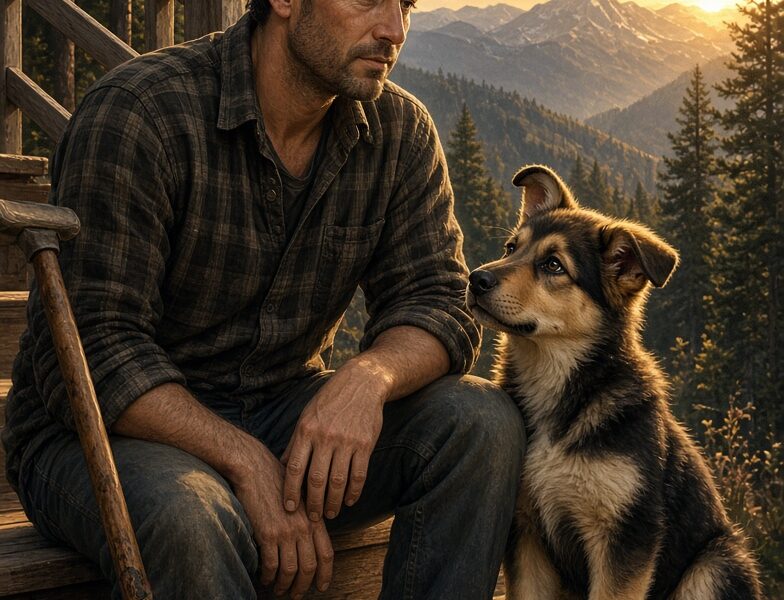
He Thought He Had Nothing Left to Give… Then a Puppy Followed Him Home
A faint cry came from behind the abandoned gas station just as Ethan Walker was telling himself he no longer had anything left to give.
He stopped beneath the faded sign on the outskirts of Cedar Ridge, Colorado, one hand gripping his crutch, the other holding a paper bag containing soup, bread, and a few pieces of chicken.
For three months, the wounded former Navy SEAL had avoided anything that might require him to care about the future.
Then he heard the cry again.
Inside a broken wooden crate, a German Shepherd puppy watched him with frightened eyes, one ear standing upright and the other folded sideways.
Ethan offered the little dog a piece of chicken, expecting it to eat and disappear.
Instead, the puppy followed him home, led him toward a forgotten rescue property, and uncovered a connection that would force an entire town to confront what it had abandoned.
But the most important thing Ethan would build was not a shelter, a clinic, or even a place for wounded veterans.
It was a home for people and animals who had begun to believe they no longer belonged anywhere.
And it all started with a blue collar that nobody expected to matter.
Cedar Ridge rested beneath a clear autumn sky, its pine-covered hills glowing in the afternoon sunlight.
From the highway, it looked like the kind of Colorado town where nothing terrible ever happened and everyone knew their neighbors by name.
Yet behind the familiar storefronts and quiet residential streets, people were struggling with losses they rarely discussed.
Ethan understood that better than most.
At thirty-eight, he was tall and lean, with short dark hair, steady gray eyes, and the guarded expression of a man who had spent years learning to hide whatever he felt.
His right leg had been badly injured during an overseas mission when he tried to help a teammate reach safety.
The injury had ended his career as a Navy SEAL and forced him to relearn movements he had once performed without thinking.
Walking across an uneven parking lot required concentration.
Climbing a staircase meant planning every step.
Even standing for too long could leave his leg aching until he could barely focus on anything else.
His doctors called it rehabilitation.
Ethan called it the daily reminder that the man he had been was gone.
Three months earlier, he had returned to the small wooden house his late father had left him.
The house stood beyond a line of pines, overlooking a valley of golden grass and distant mountains.
It had a narrow porch, a weathered front door, and a kitchen window through which the morning sunlight fell across an old wooden table.
Ethan had once imagined filling that house with friends, family, and the ordinary noise of a life that continued after service.
Instead, he had filled it with silence.
He declined invitations from former teammates.
He let calls go unanswered.
He attended physical therapy at Cedar Ridge Rehabilitation Center, completed his exercises, and returned home before anyone could ask how he was doing.
When people asked, he always gave the same answer.
“I’m fine.”
They usually accepted it because his expression suggested that asking another question would be unwelcome.
Ethan preferred it that way.
Fine required no explanation.
Fine did not force him to admit that he sometimes woke before sunrise and stared at the ceiling, wondering what a man was supposed to do when the work that had defined him was no longer possible.
Fine did not require him to explain why he avoided looking at photographs from his service.
And fine certainly did not require him to acknowledge that surviving had begun to feel like a responsibility he no longer understood.
That afternoon, he left rehabilitation with a small paper bag in his hand and his crutch tucked beneath his arm.
The shortest route home passed a local café where two former service members sometimes gathered.
Ethan took the longer road.
He had no desire to explain his limp, listen to well-meaning advice, or endure another conversation about how strong he was.
Near the outskirts of town stood an abandoned gas station that had been closed for years.
Its faded sign leaned above an empty lot, and weeds grew through the cracks in the pavement.
Several broken wooden crates had been pushed against the rear wall.
Ethan would have walked past without looking if he had not heard the sound.
A faint, uneven cry came from behind the building.
He stopped.
A truck passed on the highway, its tires humming against the asphalt.
Somewhere nearby, a loose metal sign tapped against its frame.
Then the cry came again.
Ethan looked toward the dark space between the crates.
“Come on,” he muttered to himself. “Somebody else can handle this.”
He continued walking.
Three steps later, he stopped again.
The sound had been too small to ignore and too familiar to forget.
He turned around.
Moving carefully across the uneven ground, he reached the back of the building and found a wooden crate lying on its side.
Inside, a German Shepherd puppy had curled itself against the broken boards.
The animal appeared to be about five months old.
Its dusty sable-and-cream coat was thin, its oversized paws were dirty, and one ear stood upright while the other leaned uncertainly to the side.
There was no collar.
No food.
No sign that anyone had intended to return.
The puppy watched Ethan with dark, alert eyes.
It did not bark or approach him.
It simply waited, as though experience had taught it that hoping for kindness could be more disappointing than expecting nothing.
Ethan lowered himself slowly, keeping several feet between them.
“I’m not going to touch you,” he said.
His voice sounded rough from disuse.
“You can stay right there.”
The puppy’s gaze shifted toward the paper bag.
Ethan opened it and removed a small piece of chicken.
He placed it on the ground, then leaned back against the wall.
For nearly a minute, neither moved.
Finally, the puppy stretched its neck forward.
It stopped, looked at Ethan, and moved one paw across the dust.
Ethan kept his hands still.
Another paw followed.
The puppy approached the food, grabbed the chicken, and retreated into the crate before chewing.
“That’s all right,” Ethan murmured. “You don’t have to trust me.”
The words surprised him.
For months, people had told him to trust his doctors, trust the rehabilitation process, trust his body, and trust that things would eventually improve.
Nobody had told him that he was allowed to be afraid while learning how to live again.
He placed another piece of chicken closer to the crate.
The puppy ate it, then looked at him.
Ethan poured some water into a shallow plastic lid he found nearby and placed it within reach.
“You need somebody who knows what they’re doing,” he said. “I’m barely qualified to take care of myself.”
The puppy lowered its head to drink.
Ethan watched it for a moment longer, then pushed himself upright.
His leg protested immediately.
He adjusted his grip on the crutch and turned toward the road.
He had provided food and water.
That was enough.
At least, that was what he told himself.
He had taken no more than ten steps when he heard small paws tapping against the pavement.
Ethan stopped.
The puppy stood several yards behind him.
He pointed toward the crate.
“Go on. That’s where you were.”
The puppy remained still.
Ethan resumed walking.
The tapping began again.
Every time he turned around, the puppy stopped.
Every time he faced forward, it followed.
“You don’t know me,” Ethan said over his shoulder. “I could be the worst decision you’ve made today.”
The puppy kept coming.
And for the first time in months, someone was following Ethan not because they needed him to be strong, but because they had decided he was worth trusting.
He continued down the road, moving slowly because of his leg.
The puppy maintained a careful distance, stopping whenever Ethan stopped to rest.
When a delivery truck passed an intersection, the animal startled backward into a patch of weeds.
Ethan turned away rather than approaching it.
“It’s all right,” he said. “Wait until it passes.”
The truck disappeared around the corner.
The puppy remained still until Ethan started walking again.
Then it followed.
That small decision unsettled him more than he wanted to admit.
The animal was not simply wandering behind the nearest person.
It was choosing him.
By the time Ethan reached the road leading toward his house, the distance between them had shortened to about ten feet.
He considered calling county animal services.
He also considered the crowded shelter, the coming cold nights, and the fact that the puppy had already been left in a broken crate without anyone knowing how long it had been there.
He looked down at the dog.
“One night,” he said. “You get water, food, and somewhere warm. Tomorrow, we figure this out.”
The puppy’s tail moved once.
Ethan pretended not to notice.
His wooden house appeared beyond the pines, its porch illuminated by the late afternoon sun.
He climbed the steps one at a time and unlocked the door.
When he turned around, the puppy had reached the bottom step.
Ethan opened the door wider.
“I’m not promising anything.”
The puppy lifted one paw onto the porch, withdrew it, and looked toward the road.
Then it stepped inside.
It did not explore the rooms.
It crossed the entryway, stopped beside the wall, and lowered itself near the front door.
Ethan set down a bowl of water and divided the remaining chicken into small pieces.
The puppy waited until he turned away before eating.
He found an old blanket and placed it inside a shallow cardboard box near the fireplace.
The puppy ignored it and remained beside the door.
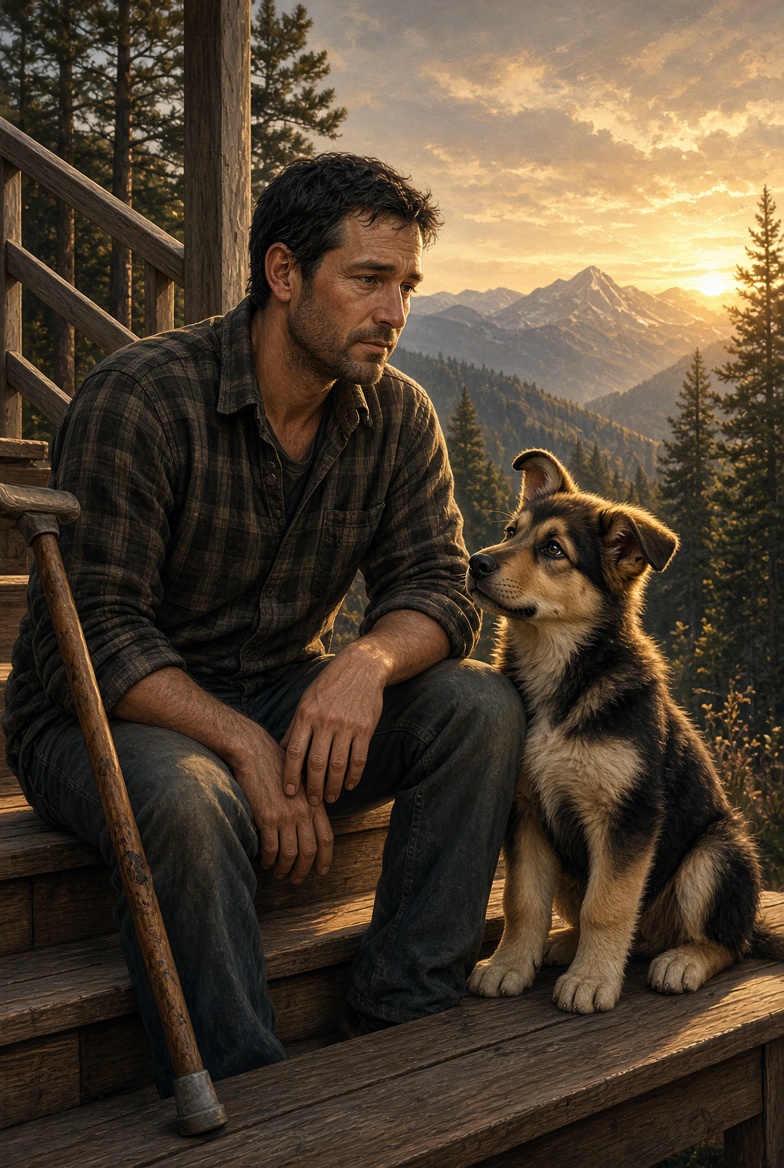
Ethan did not insist.
He understood that a safe place could still feel unfamiliar when a person had spent too long expecting to be turned away.
That evening, he heated his soup, took his medication, and tried to read a report from the rehabilitation center.
He read the same paragraph four times.
His attention kept returning to the entryway.
Finally, he turned off the kitchen light.
“You can sleep,” he said. “Nobody’s coming in.”
The puppy lowered its head.
Ethan went to bed without deciding what would happen the next morning.
He told himself that Olivia Bennett, the veterinarian at Cedar Ridge Animal Care, would know what to do.
He would take the puppy to her clinic, complete the necessary paperwork, and return to his ordinary life.
Yet when he lay awake in the darkness, he found himself listening for the faint movement of paws in the next room.
He had spent three months trying to make his house feel empty enough that nothing could hurt him.
Now he was afraid that the puppy might leave.
The next morning, Ethan discovered that the food bowl was empty.
The puppy had moved only a few inches from the wall.
Its water bowl had been disturbed, but not overturned.
Ethan stood in the doorway, studying the little animal.
“All right,” he said. “Let’s find out who you belong to.”
He lined a cardboard box with a clean towel and carried it to his truck.
The puppy hesitated when he opened the passenger door.
It looked at the seat, then at the house.
Ethan sat behind the wheel and waited without reaching for it.
After nearly a minute, the puppy climbed inside and curled up on the towel.
The drive to Cedar Ridge Animal Care took less than fifteen minutes.
The clinic occupied a modest building on Main Street, with a small treatment room, a reception desk, and a fenced rescue yard behind it.
A hand-painted sign near the entrance read, “Every Life Deserves a Second Chance.”
Ethan had passed it dozens of times without stopping.
Inside, Olivia Bennett was sorting invoices while the afternoon’s first appointments waited to be processed.
In her early forties, Olivia had brown hair usually tied back, warm eyes, and the practical patience of someone who understood that frightened animals needed time before they could accept help.
Her father had founded the clinic years earlier.
After his death, Olivia had kept it running because she believed that animals without owners deserved the same careful treatment as those whose families could afford anything.
Unfortunately, compassion did not pay every bill.
The roof needed repairs.
Medicine costs had increased.
The clinic’s aging equipment required replacement.
And the bank had recently given Olivia ninety days to settle its outstanding loan.
A veterinary company called Northline Veterinary Group had offered to purchase the property.
The offer would eliminate her debts and provide financial security for her and her thirteen-year-old daughter, Lily.
It would also end the clinic’s independent rescue program.
Olivia folded the latest invoice and placed it beneath the counter.
She had not told Lily how close the clinic was to losing everything.
Her daughter had enough worries of her own.
A traffic accident the previous year had left Lily nervous around sudden noises and unfamiliar situations.
She had gradually regained confidence, but crowded rooms and unexpected movements could still overwhelm her.
Animals were different.
They never demanded that she explain why she needed a little more time.
When Ethan entered with the puppy, Olivia looked up.
“You came back.”
“It followed me.”
“That’s not quite the same thing.”
“Tell the dog that.”
Olivia smiled faintly and crouched several feet from the cardboard box.
“Hello, sweetheart. Let’s see what we can do for you.”
Lily emerged from the back room carrying a stack of clean towels.
She stopped when she saw the puppy.
Olivia glanced toward her daughter.
“Would you bring us a small plate of food?”
Lily nodded and returned with the plate.
She placed it on the floor and stepped back.
The puppy did not approach.
Lily waited, then moved another step away.
Only then did the animal leave the box.
It walked toward the food, stopped to look at Ethan, and continued eating.
Lily’s expression softened.
She did not reach out.
The puppy did not retreat.
For several quiet seconds, they shared the same room without either demanding anything from the other.
Olivia examined the puppy’s paws, ears, breathing, and general condition.
She found signs of poor nutrition and an old scar near its shoulder, but nothing that required emergency treatment.
There was no collar and no microchip.
She recorded the animal’s details, photographed it for a found-pet notice, and promised to contact the county network.
“If someone is looking for him, we should give them a chance to find him,” she explained. “Otherwise, we’ll follow the proper process and see about adoption.”
“I’m not adopting him,” Ethan said.
Olivia looked at the puppy, who had settled near his boot.
“Of course not.”
“It’s temporary.”
“Temporary can still be meaningful.”
Ethan ignored the remark.
When Olivia asked what name to put on the initial record, he looked down at the puppy.
It was no longer watching the door.
It was watching him.
“Ranger,” he said.
Lily repeated the name softly.
“Ranger.”
The puppy lifted its head.
Ethan looked away before either woman could notice how much that small response affected him.
Before leaving, he agreed to keep Ranger safely while the clinic searched for an owner.
He also bought a dark blue collar from the small display beside the reception desk.
The collar had a simple metal clasp and a blank identification tag.
He placed it on the passenger seat beside the puppy.
“It doesn’t mean anything,” he told Ranger.
Ranger rested his chin on the towel.
Ethan started the truck.
For the first time since returning to Cedar Ridge, he did not drive home alone.
During the first week, Ranger learned the sound of Ethan’s crutch against the wooden floor.
He recognized the opening of the kitchen cabinet, the squeak of the back door, and the rhythm of Ethan’s slow movements between rooms.
Still, the puppy remained cautious.
He ate only after Ethan turned away, slept near the front door, and left a small distance between himself and anything that might move unexpectedly.
Ethan did not try to change those habits.
Some mornings, he placed Ranger’s bowl in the kitchen and sat several feet away with his back turned.
He pretended to read while listening to the faint sound of the puppy eating.
When the bowl scraped across the floor, he knew Ranger had finished.
He never praised the animal loudly or made the moment feel important.
He had the feeling that too much attention might make Ranger retreat again.
In a strange way, caring for the puppy was teaching Ethan how to respect his own boundaries.
His physical therapist had asked him to practice walking across the living room without placing all his weight on the crutch.
The exercise looked simple on paper.
In reality, every step required concentration.
Ethan placed three strips of blue tape across the floor, each marking a short distance.
He stood beside the sofa, breathed slowly, and moved toward the first strip.
Ranger watched from the edge of the room.
On the first morning, the puppy remained near the door.
On the second, he moved closer.
By the third, he followed Ethan several steps behind, stopping whenever Ethan stopped.
Ranger never pulled at his clothes or crossed into his path.
He simply kept pace, as though he had decided that Ethan’s slow movements were the natural speed of the world.
One evening, Ethan woke from an uncomfortable dream and sat on the edge of his bed, waiting for the ache in his leg to settle.
Ranger lifted his head in the hallway.
“I’m all right,” Ethan said automatically.
The puppy remained still.
Ethan looked at him and almost laughed.
“Apparently, neither of us believes that anymore.”
He reached for the glass of water on his bedside table.
The old blue collar lay on the dresser, still waiting to be adjusted properly.
For reasons he could not explain, Ethan had begun to associate it with something beyond identification.
It reminded him that Ranger had been abandoned without a name anyone knew.
It also reminded him that he had returned home feeling much the same way.
The collar was not a promise.
But it was evidence that someone had started preparing for tomorrow.
On the fourth morning, a familiar knock sounded at the front door.
Marcus Reed entered carrying a paper bag of coffee and a folder tucked beneath his arm.
Marcus had served beside Ethan for years.
In his early forties, he was broad-shouldered, direct, and remarkably skilled at recognizing when someone was avoiding a conversation.
Ranger rose and moved beside Ethan’s injured leg.
Marcus noticed the puppy but kept his movements slow.
“I brought coffee.”
“You brought paperwork.”
“The paperwork is hiding beneath the coffee.”
Marcus placed the bag on the counter.
“There’s a veteran support program starting next month. Small group, no speeches, no uniforms. Just people learning how to live after service.”
“I’m not interested.”
“You didn’t ask what it is.”
“I know what it is.”
Marcus rested one hand on the folder.
“Then you know it isn’t a place for weak people.”
Ethan’s jaw tightened.
Marcus had not meant the words as an insult.
That somehow made them more difficult to dismiss.
“You don’t have to tell them anything,” Marcus continued. “You can sit there, drink bad coffee, and leave.”
“I can do that here.”
“You already are.”
Ranger glanced between the men and lowered his head.
Ethan disliked how much Marcus could understand without asking questions.
“I’m fine,” he said.
Marcus nodded.
“Keep saying it. Maybe one day you’ll convince yourself.”
He left the folder on the counter and walked toward the door.
Before stepping outside, he glanced at Ranger.
“That dog seems to have better judgment than you.”
“He follows strangers.”
“Then he’s still learning.”
After Marcus left, Ethan stared at the folder for several minutes.
Ranger settled near his feet.
Ethan reached down, stopped halfway, and allowed the puppy to decide whether to move closer.
Ranger remained where he was.
For once, Ethan did not mistake that distance for rejection.
Across town, Olivia received the letter she had been dreading.
The bank had given Cedar Ridge Animal Care ninety days to resolve its outstanding balance or begin the process of transferring the property.
Attached was Northline Veterinary Group’s formal proposal.
The company was offering enough money to settle the debt, replace the clinic’s outdated equipment, and provide Olivia with financial stability.
It would also convert the building into a modern veterinary practice with a smaller rescue program and stricter limits on long-term animal care.
The old kennels would likely be removed.
The storage shed behind the clinic, where Olivia’s father had kept photographs and records of animals he had helped, would be cleared.
Olivia read the proposal twice.
Then she folded it and placed it inside a drawer.
Lily found her mother sitting alone in the treatment room that evening.
“If we sell the clinic, where will the dogs go?”
Olivia looked up.
“We’ll find good places for them.”
“But they won’t be here.”
Olivia stopped moving.
That was the question beneath every financial calculation.
Her daughter was not asking whether the clinic could survive.
She was asking whether a place that had helped frightened animals feel safe could simply disappear without changing anything.
“I won’t make a decision without thinking about them,” Olivia promised.
She did not promise that she could save the building.
That night, Ethan returned to his walking exercises.
He placed one hand on the arm of the sofa and left his crutch within reach.
Ranger stood near the blue tape.
“Three steps,” Ethan said. “That’s all.”
He shifted his weight forward.
The first step was controlled.
The second required more effort.
On the third, his foot caught slightly against the edge of the rug.
He reached for the sofa, missed the armrest, and went down onto the floor.
The impact was not severe, but the sudden sound filled the room.
Ranger jumped backward and ran to the front door.
Ethan remained still for a moment, checking his leg and breathing through the familiar discomfort.
Then he heard the puppy sit near the entrance.
Ranger’s head was lowered.
His body had become small, and his eyes remained fixed on the floor.
Ethan recognized the expression.
The puppy believed something had gone wrong.
He probably expected the next part to involve being sent away.
“Hey,” Ethan said.
Ranger did not move.
Ethan pushed himself up against the sofa.
“It was an accident.”
The puppy remained near the door.
Ethan looked toward the kitchen counter.
The blue collar lay beside the unopened identification tag.
He had bought it days earlier and still had not put it on Ranger because he did not want the puppy to feel trapped.
Now, staring at the frightened animal, Ethan understood that he had been avoiding a different kind of commitment.
He wanted Ranger to trust him.
But he was still afraid to show the dog that he intended to stay.
Ethan took a slow breath.
“You didn’t do anything wrong,” he said. “I fell. That’s my mistake.”
Ranger’s ears shifted.
Ethan waited.
After several minutes, the puppy stood and walked toward the kitchen.
He disappeared behind the counter, then returned carrying the blue collar in his mouth.
The loose end dragged across the floor.
Ranger stopped several feet away and placed the collar on the ground.
Ethan stared at it.
For a long moment, neither moved.
Then Ethan lowered himself onto the floor and tapped the space beside him.
“You can stay.”
Ranger looked toward the door, then at the collar.
Finally, he took one cautious step forward.
Ethan did not reach for him.
Another step followed.
The puppy stopped beside the blue tape, close enough for Ethan to hear his breathing.
Nothing had been repaired that evening.
Ethan’s leg still hurt.
Marcus’s folder still waited on the counter.
Olivia’s clinic was still in danger.
But Ranger had returned after the sound of a fall, and Ethan had not turned away from him.
For the first time, both began to understand that trust was not built by avoiding every mistake.
Sometimes it began when two frightened souls stayed in the same room after something went wrong.
The following week, Ethan returned to the old rescue property behind Cedar Ridge Animal Care.
He had noticed the land before, although he had never paid much attention to it.
The wooden kennels stood behind a line of pine trees, partly hidden by weeds and weathered fencing.
Several structures needed repairs.
A narrow storage building contained old tools, donated blankets, and boxes of records that had survived years of neglect.
Olivia had told him the property once belonged to Daniel Brooks, a local veteran who had created a small animal rescue called Second Chance.
Daniel had helped abandoned dogs and wounded service members long before anyone in Cedar Ridge considered those two responsibilities connected.
Then, years earlier, he had disappeared from town.
Some residents said he had moved away.
Others believed he had become overwhelmed by the work.
Nobody seemed to know the whole truth.
What remained was a wooden sign with faded letters and a collection of photographs in a metal box.
Ethan found the box while helping Olivia clear a storage shelf.
Inside were photographs of dogs resting beside veterans, children brushing the fur of rescued animals, and volunteers repairing the old kennels.
In one picture, a younger Daniel stood beside a German Shepherd puppy with oversized paws and one ear folded sideways.
The photograph had been taken years earlier.
Ethan stared at it for a long time.
The puppy in the photograph looked remarkably like Ranger.
He turned the picture over.
Someone had written a date and a short note on the back.
“First day home. He followed me all the way from the old station.”
Ethan read the sentence twice.
“Olivia.”
She looked up from a stack of records.
“What is it?”
He showed her the photograph.
Olivia took it carefully.
“That’s Daniel. And that must have been one of his rescue dogs.”
“Do you know what happened to him?”
She shook her head.
“My father used to talk about Daniel. He said the rescue saved dozens of animals, but the work became difficult after Daniel lost several people close to him. He stopped accepting help. Eventually, he left.”
“Did he sell the property?”
“Not that I know of. The records are incomplete.”
Ethan examined the photograph again.
The puppy was wearing a dark blue collar.
His chest tightened.
It could have been a coincidence.
German Shepherd puppies were common enough, and blue collars were not unusual.
But the note, the abandoned station, and the unmistakable shape of the puppy’s ears made it difficult to dismiss.
He looked toward Ranger, who was lying beside the doorway.
The dog raised his head.
Ethan held out the photograph.
Ranger approached, sniffed the paper, and settled beside Ethan’s boot.
Olivia watched them.
“What are you thinking?”
Ethan looked at the old wooden kennels beyond the window.
“I’m thinking that this place didn’t disappear because it stopped mattering.”
Olivia folded her arms.
“And I’m thinking that you have a habit of becoming responsible for things you don’t know how to fix.”
“That’s a fair assessment.”
“Then don’t make promises you can’t keep.”
Ethan returned the photograph to the metal box.
“I’m not making promises.”
But that evening, he began drawing plans.
He measured the old kennels, noted the damaged fencing, and marked spaces for a recovery room, a supply area, and a quiet yard where frightened animals could rest without being forced to interact.
He imagined a small center where veterans recovering from physical or emotional injuries could care for rescued animals while rebuilding their own routines.
The dogs would receive food, veterinary attention, and time.
The people would receive structure, companionship, and the opportunity to contribute without pretending they were unchanged.
He wanted a place where nobody would be expected to prove their worth before receiving help.
He wanted a place where asking for assistance would be considered ordinary rather than shameful.
Most of all, he wanted to build something that could continue without depending on one person carrying everything.
That last requirement would prove harder than the rest.
Ethan began researching veteran support organizations and nonprofit requirements.
Marcus introduced him to a group in Colorado Springs that advised former service members on community projects, accessible facilities, liability insurance, and programs that paired veterans with rescue animals.
Ethan listened carefully.
He took notes.
He asked questions about costs, staffing, and long-term funding.
For the first time since leaving the service, he felt the familiar satisfaction of working toward a clear objective.
But this time, he was not preparing for a mission that would end when the immediate danger passed.
He was trying to build something that would still matter years later.
The work was slow.
His leg tired easily, and some days he could not complete more than a few hours of measuring or paperwork.
At first, he concealed those limitations from the volunteers.
He tried to lift materials he should have asked someone else to carry.
He stayed on his feet longer than his therapist recommended.
He treated every delay as a personal failure.
Then one afternoon, Marcus found him sitting beside a stack of timber, visibly frustrated because he could not finish repairing a fence section alone.
“Need a hand?”
“No.”
Marcus looked at the unfinished fence.
“Interesting. I thought you were building a community center.”
“I’m working on it.”
“Looks like you’re working against it.”
Ethan glared at him.
Marcus pulled over a chair.
“You know what your problem is?”
“I suspect you’re about to tell me.”
“You still think accepting help means losing control.”
Ethan looked away.
Marcus continued more quietly.
“On our old team, we trusted each other because none of us could do everything alone. You understood that then. Why is it so difficult to understand now?”
“Because I used to be able to do my part.”
“You still can.”
“Not the same way.”
“No. Not the same way.”
Marcus let the words settle.
“That doesn’t mean your part no longer matters.”
Ethan stared at the fence.
He had spent months measuring his life against the person he had been before the injury.
Every difference felt like evidence of failure.
Marcus was asking him to consider a different measure.
Not what he could do alone.
What he could help make possible.
Ethan finally nodded toward the timber.
“All right. Take that end.”
Marcus smiled.
“Was that an actual request for help?”
“Don’t make me regret it.”
They worked until the fence section was secure.
Ranger watched from the shade, occasionally carrying a loose glove from one volunteer to another.
When the work was finished, Ethan looked at the completed section and realized that he had not done less by sharing the task.
He had simply allowed it to get done.
That evening, he called the realtor handling his small condominium.
He had purchased the property before his final deployment and kept it despite never returning to live there.
Selling it would mean releasing another piece of the life he had expected to resume.
The decision frightened him.
It also felt right.
Within several weeks, the sale was finalized.
Ethan placed the proceeds in a separate account and used part of the money to secure the Second Chance property before Northline Veterinary Group could complete a purchase agreement involving the land.
He worked with a local attorney to ensure that the transfer was properly recorded and that the proposed project could operate under the necessary legal arrangements.
He did not announce the purchase.
He wanted the foundation to be solid before he asked anyone else to believe in it.
Unfortunately, there was one person who deserved to know what he had done.
And she discovered it in the worst possible way.
Olivia arrived at Ethan’s house one afternoon carrying a folder from the bank.
She expected to discuss the latest fundraising figures.
Instead, she found Ethan at the kitchen table surrounded by property documents, repair estimates, and a hand-drawn plan for the proposed center.
Ranger lay beneath the table.
The blue collar rested beside the paperwork.
Olivia picked up the deed and read it twice.
“You bought the Second Chance property.”
Ethan set down his pen.
“The transfer went through yesterday.”
“With what money?”
“My savings.”
“Ethan.”
He recognized the warning in her voice.
She looked at the documents again.
“You sold your condominium?”
“Yes.”
“And you never told me?”
“I wanted to make sure the purchase was final.”
Olivia placed the deed on the table.
“You used almost everything you had to buy land that needs repairs, fencing, insurance, staff, and a dozen other things you haven’t even listed.”
“I’ve listed most of them.”
“That is not the point.”
She walked toward the window.
Beyond the glass, the autumn grass moved gently in the wind.
“You are turning your pain into another mission,” she said. “You were injured because you believed you had to be the person who carried everyone out. Now you’re doing the same thing with this place.”
Ethan’s expression tightened.
“This is different.”
“Is it?”
She turned toward him.
“You have barely learned how to ask for help, and now you want to build a center for people who need it.”
Ethan looked down at his hands.
For several seconds, the room held only the quiet sound of Ranger shifting beneath the table.
“I don’t know if it will work,” he admitted.
Olivia’s expression changed slightly.
“I know the money may not be enough. I know the property could take years to repair. I know that I can’t build everything myself.”
“Then why do it?”
Ethan looked toward Ranger.
“Because for the first time since I came home, I’m doing something because I believe it matters. Not because I’m trying to prove that I’m still the man I was.”
Olivia was quiet.
He continued.
“When I found Ranger, I thought I was helping a stray dog. Then I realized how much of myself I recognized in him. He had been left somewhere nobody expected him to survive, and he had no reason to believe anyone would come back.”
Ethan touched the blue collar.
“I knew what it felt like to believe that your useful life was over.”
Olivia looked at the collar, then at the property plans.
“What are you going to call the place?”
“I don’t know yet.”
“Then don’t decide everything alone.”
Ethan looked up.
Olivia pulled out a chair and sat beside him.
“If this place is meant to help people and animals, it cannot be built around one person refusing to let anyone in.”
He studied her face.
She was still worried.
She was still angry that he had made such a consequential decision without consulting anyone.
But she had not walked away.
Ethan slid the property plan toward her.
It was a small movement.
It was also the first time he had invited someone else into a decision that mattered to him since returning home.
Olivia examined the drawing.
“The treatment room needs to be closer to the main entrance,” she said. “And if you expect veterans with mobility issues to use this place, the paths need to be accessible.”
Ethan reached for his notebook.
“Show me.”
For the next hour, they worked through the design.
They disagreed about the location of the storage building, the number of kennels, and whether the recovery cabin needed a separate entrance.
But the argument gradually became something else.
A plan.
Not Ethan’s plan.
Theirs.
Meanwhile, Lily and Ben began restoring the old kennels.
Ben was the grandson of one of Daniel Brooks’s former volunteers.
He had spent much of his childhood hearing stories about the rescue, although the details had become less clear as the years passed.
He remembered Daniel as someone who spoke softly to animals and never hurried a frightened dog.
He also remembered the old wooden sign that had once stood above the entrance.
When Olivia told him the property might be sold, Ben began spending more time in the storage room, sorting through the old photographs and notebooks.
He wanted to preserve whatever remained.
Lily helped him clean the records and organize the pictures.
Together, they found lists of animals Daniel had rescued, letters from former volunteers, and handwritten notes about veterans who had helped repair the kennels.
One photograph showed Daniel sitting on the porch beside three German Shepherd puppies.
Another showed a group of service members carrying bags of food through a snow-covered yard.
On the back of the final picture, Daniel had written a sentence that made Ben stop.
“A second chance only works when someone is willing to stay long enough to give it.”
Ben copied the words into his notebook.
Then he began cleaning the old sign.
He refused to repaint Daniel’s name.
Instead, he removed the dirt carefully and placed the sign beneath a covered section of the shed so it would not be damaged.
Lily painted a narrow blue line along the fence.
When Ben asked why she had chosen that color, she glanced toward Ranger.
“It reminds me of his collar.”
Ben looked at the puppy, who was sleeping beside Ethan’s boots.
“Do you think a dog can remember a place it has never seen?”
Lily considered the question.
“Maybe not the place.”
She watched Ranger lift his head as Ethan moved across the yard.
“But maybe it can recognize what the place is supposed to feel like.”
Neither child knew that Ethan was planning to make the property a center for veterans as well as animals.
When he finally explained the idea, Ben listened without interrupting.
Then he asked, “Can people be frightened in the same way dogs are?”
Ethan considered his answer.
“Sometimes.”
“Even when they’re adults?”
“Especially when everyone expects them to know how to handle everything.”
Lily nodded.
“Then maybe both need a place where nobody demands that they be brave immediately.”
Ethan looked at the two children.
He thought about the old photograph, the wooden sign, and the puppy that had followed him home.
For the first time, he understood that the future of Second Chance did not depend on restoring everything exactly as it had been.
It depended on preserving the reason it had existed in the first place.
The next challenge arrived unexpectedly.
One morning, Olivia called Ethan to the clinic and told him that Ben was missing.
Lily had discovered his empty chair in the storage room.
His notebook lay open on the floor, and his familiar blue scarf was missing from the hook beside the back door.
Olivia had called Ben’s grandmother, checked the surrounding streets, and contacted the sheriff’s office.
Nobody knew where he had gone.
Ethan arrived with Ranger before the first search vehicle left town.
“What did he take?” he asked.
Lily held out the notebook.
“He was looking at the old rescue photographs. He kept saying he wanted to see where the original sign had stood.”
Olivia looked toward the hills beyond the property.
“The old trail?”
Lily nodded.
Ethan glanced at Ranger.
The puppy lowered his nose toward the scarf Olivia had retrieved from the back room.
He remained still for several seconds, then moved toward the door.
Ethan followed.
Before leaving the paved road, he contacted the sheriff’s office and provided his location.
He agreed to remain in contact with the search team and avoid any unstable terrain.
He had no intention of turning the search into a mission.
But as Ranger moved farther along the trail, old instincts began to awaken.
Ethan remembered scanning unfamiliar ground, measuring distances, and calculating how quickly he could reach someone who needed help.
His body had once responded before his mind finished making a decision.
Now his right leg reminded him that those days were over.
Ranger moved about twenty feet ahead and stopped to look back.
Ethan continued at his slower pace.
The distance between them widened and closed repeatedly, as though the dog understood that Ethan could not move quickly but refused to leave him behind.
The trail narrowed between pale rocks and dry grass.
Nothing about the landscape looked dramatic.
It was simply a quiet stretch of uneven ground where the hillside rose before dropping toward a shallow canyon.
Ranger stopped near a flat stone and lifted his head.
Ethan heard nothing at first.
Then a small voice came from below.
“Ethan?”
He moved closer but remained several feet from the edge.
“Ben, can you hear me clearly?”
“Yes.”
“Are you hurt?”
“I don’t think so.”
Ben’s voice trembled.
He had slipped onto a lower shelf while searching for the old rescue sign and could not find a safe way back up.
Ethan looked at the ground.
His first impulse was to lower himself and reach for the boy.
The thought came so quickly that he almost moved before considering the consequences.
Then he looked at his leg, his crutch, and the unstable ground between them.
If he rushed down, he might make the situation worse.
He stepped back and called the sheriff’s office.
“I have visual contact,” he said. “The boy is conscious and answering questions. I’m staying above the lower shelf until the rescue team arrives.”
The decision felt like failure.
Ethan had spent years believing that whoever arrived first had to be the person who acted first.
Now he had to accept that the safest thing he could do was wait.
Ranger remained beside the edge without going farther.
Ethan placed one hand on the dog’s harness and kept his voice calm.
“Ben, I need you to stay where you are. Don’t try to climb yet. Help is coming.”
“Are you going to leave?”
“No. I’m right here.”
“What if nobody finds us?”
“They know where we are.”
Ethan described their location to the dispatcher and identified visible landmarks.
Then he focused on Ben.
“Tell me five things you can see.”
The boy hesitated.
“Rocks. A branch. The sky. Your dog. And the shadow of the hill.”
“Good. What can you hear?”
“The wind. Cars, maybe. Your voice.”
“All right. Keep talking to me.”
Ben’s breathing gradually steadied.
They spoke about the old photographs, the rescue property, and the wooden sign.
Ben admitted that he had wanted to see the place before it changed forever.
“Daniel told my grandmother that a place can remember people even after they’re gone,” he said.
Ethan looked toward the hills.
“You were right to care about that place.”
“Then why did he leave?”
Ethan considered the question.
“I don’t know all the reasons. But sometimes people leave because they don’t know how to ask for help.”
“Does that mean they don’t care anymore?”
“No.”
Ethan glanced toward Ranger.
“It means they might need someone to remind them that they still have a place to come back to.”
Ranger sat beside him, his shoulder close to Ethan’s injured leg.
The dog did not whine or pace.
He simply remained there, watching the lower shelf as if he understood that Ben needed someone to stay.
Several long minutes passed.
Then the sound of approaching vehicles reached them from the road.
The county rescue team arrived with Olivia, Lily, and Ben’s grandmother.
The team leader asked Ethan to describe the terrain and the boy’s position.
Ethan answered clearly, then stepped away from the edge to give the rescuers room.
He wanted to help physically.
He wanted to prove that he could still do something more than stand and wait.
But he understood that the safest assistance he could provide was accurate information.
The rescuers moved carefully along a more stable route and reached Ben without rushing him.
When the boy finally appeared beside the trail, Olivia hurried forward.
Lily reached him first.
She wrapped both arms around her friend, and Ben held on tightly.
Ethan stood a short distance away with Ranger beside him.
Ben looked toward the rocks, then at Ethan.
“I found the sign,” he said.
Ethan nodded.
“Then you don’t have to carry it with you.”
Ben looked confused.
“Why not?”
“Because what Daniel built isn’t only in the wood.”
Ethan glanced toward the clinic, the people gathered around Ben, and the puppy leaning against his leg.
“People don’t disappear just because the place they helped create changes.”
Ben wiped his eyes and nodded.
The rescue had taken less than an hour.
Its effect on Cedar Ridge would last much longer.
That evening, residents gathered in the community hall to discuss Northline Veterinary Group’s offer.
Some believed Olivia should accept it.
The amount would erase the clinic’s debts, provide modern equipment, and protect her family from financial uncertainty.
Others argued that Cedar Ridge would lose more than a building if the property became a private development.
Marcus attended quietly.
He spent most of the meeting speaking with former service members outside the main room.
By the end of the evening, he had gathered commitments from several veterans willing to organize a fundraiser, repair fences, transport animals, and volunteer at the clinic.
No one called it a solution yet.
But it was the beginning of a plan.
Lily had not intended to speak.
She sat beside Olivia with her hands folded in her lap, listening as adults debated figures, contracts, and deadlines.
Then the meeting chair asked whether anyone wanted to say something about the clinic.
Lily looked at Ranger, who was lying near Ethan’s chair.
Slowly, she stood.
Her voice was quiet at first.
She explained that the clinic was where frightened animals were given time instead of being pushed away.
She told the room that Ranger had helped her feel calmer when she was afraid.
Not by doing anything extraordinary.
By sitting nearby and waiting.
“Some places matter because they give people and animals a chance to feel safe,” she said. “If we sell this place, we should be certain we aren’t selling that chance, too.”
The room became silent.
Olivia reached for Lily’s hand.
Marcus lowered his head.
Several residents began discussing donations before the meeting had even ended.
Ethan looked at Ranger and understood that the dog had changed more than his own quiet house.
He had brought people together without knowing how.
For the first time since returning to Cedar Ridge, Ethan did not feel like a man standing outside everyone else’s life.
He felt like someone who had helped keep a door open.
But the money still had to be raised.
The clinic still faced a deadline.
And buying the land had only solved one part of the problem.
The town had ninety days to prove that compassion could become a sustainable plan rather than a collection of good intentions.
Ethan decided that they would not spend those ninety days trying to save everything exactly as it had been.
They would build something that could survive.
Marcus helped Ethan organize the first volunteer meeting at the old rescue property.
They divided the work into practical tasks.
Some volunteers would repair the kennels.
Others would manage donations, transport animals, and coordinate with local veterinarians.
A retired carpenter offered to inspect the buildings and estimate repair costs.
Two former service members volunteered to handle transportation for veterans who lacked reliable vehicles.
A local accountant agreed to help establish a transparent budget.
Olivia would oversee animal care.
Marcus would coordinate veteran services.
Ethan would develop the recovery program.
Nobody was expected to do everything.
That rule became the first principle of the new project.
The second was that every person and animal would be treated as an individual rather than a problem to be solved.
The third was written on a sheet of paper Lily taped beside the entrance.
“Nobody has to earn the right to feel safe.”
Ethan read the sentence several times.
He did not change a word.
Meanwhile, the clinic continued operating under the same pressure.
Invoices arrived.
Supplies ran low.
The roof repair estimate was higher than Olivia had expected.
Some residents who had promised donations never followed through.
Others contributed small amounts that seemed insignificant until the total began to grow.
A retired teacher donated fifty dollars.
A local mechanic provided several hours of labor.
A family brought blankets, food, and an old washing machine that still worked perfectly.
One veteran who could not afford a monetary contribution offered to drive animals to appointments.
Another began repairing the kennel gates every Saturday.
The work moved forward unevenly.
Some days, Ethan felt encouraged.
Other days, he looked at the property and wondered whether he had made an expensive mistake.
On one such afternoon, he found Olivia sitting on the porch with a stack of bills.
“I’ve calculated what we need,” she said.
“And?”
“We’re short.”
“How short?”
Olivia handed him a sheet of paper.
The immediate repairs, medical supplies, insurance, and essential operating costs would require approximately $47,500 beyond the money already committed.
Ethan studied the figure.
It was more than he had hoped.
Less than he had feared.
Still, it was a number that could not be solved by optimism alone.
“We need another plan,” he said.
“We need several.”
Olivia gathered the bills.
“And we need to stop treating every setback as proof that the entire idea is failing.”
Ethan looked at her.
“Was that directed at me?”
“Entirely.”
He almost smiled.
She did, too.
For several minutes, they sat quietly.
Then Ethan asked what she thought they should do first.
Olivia looked surprised.
It was a simple question.
But it was the first time he had asked her to lead a major part of the project without immediately offering his own solution.
“First, we separate the urgent costs from the improvements that can wait,” she said. “Second, we establish a proper fundraising target. Third, we tell the town exactly what the money will pay for.”
Ethan opened his notebook.
“All right.”
Olivia studied him.
“You’re actually listening.”
“Don’t ruin it.”
She laughed.
The sound carried across the yard.
Ranger lifted his head, looked at them, and returned to sleep.
For Ethan, the moment was more valuable than any donation.
He was beginning to understand that building a future did not require him to become the person with every answer.
It required him to make room for people who knew things he did not.
Three weeks later, the first fundraising event took place in the Cedar Ridge community hall.
There were no expensive decorations, no professional speakers, and no promises that every problem could be solved overnight.
Lily arranged photographs of the rescued animals on a long table.
Ben displayed copies of Daniel’s old rescue records.
Marcus organized volunteers at the entrance.
Olivia prepared a short presentation explaining the clinic’s financial situation and the proposed center’s purpose.
Ethan had agreed to speak, although the thought of standing in front of a crowd made him more uncomfortable than he expected.
He had spent years speaking when necessary and remaining silent when it was safer.
Now he needed to explain something personal without turning it into a performance.
When his turn came, he walked to the front with his crutch.
He chose a chair rather than standing throughout the presentation.
For a moment, he looked at the audience and considered giving them the simple version.
A veteran had been injured.
A puppy had needed help.
A rescue property needed repairs.
The town could save a clinic.
All of it was true.
None of it explained why the project mattered.
“I came home believing my useful life was over,” he began.
The room grew quiet.
“I didn’t say that to anyone. I told people I was fine, and I made sure they didn’t ask questions that would require a different answer.”
He looked down at his hands.
“I thought that if I couldn’t do the things I’d done before, then whatever came next would always be less important.”
Ranger lay beside the chair.
Ethan rested one hand on the dog’s back.
“Then I found a puppy behind an abandoned gas station. He was frightened, hungry, and alone. I gave him some food, and he followed me home.”
A few people smiled.
“I thought I was giving him a second chance. What I didn’t understand was that he was giving me one, too.”
Ethan explained the proposed program.
Veterans would be able to participate in animal care, maintenance, transportation, and training activities suited to their abilities.
Rescued animals would receive veterinary treatment and structured opportunities to find suitable homes.
The center would coordinate with established veteran services rather than attempt to replace professional medical care.
The clinic would remain the medical foundation of the operation.
The old property would provide room for recovery, practical work, and community support.
“We can’t promise that every dog will recover quickly,” Ethan said. “We can’t promise that every veteran will have an easy road ahead. We can’t promise that a building will make every problem disappear.”
He paused.
“But we can promise that nobody will be treated as disposable simply because their life has changed.”
He looked across the room.
“That’s what we’re trying to build.”
The applause began slowly.
Then more people joined.
Ethan felt his face grow warm and looked toward Ranger, grateful for the excuse to lower his eyes.
Afterward, residents approached with donations and offers of assistance.
The total raised that evening was $12,400.
It was not enough to cover the entire shortfall.
But it was enough to fund several urgent repairs and demonstrate that Cedar Ridge was willing to invest in the project.
For the first time, the future seemed less like a wall and more like a road with a difficult first mile.
The fundraising event also brought an unexpected visitor.
An older man named Thomas Hale approached Ethan while volunteers were packing away the chairs.
Thomas had served in the military decades earlier and had spent much of his retirement avoiding other veterans.
He lived alone on the edge of town.
His wife had died several years earlier, and his adult children lived in other states.
He had heard about the center through a neighbor but had almost stayed home.
“I don’t know what I could do here,” Thomas admitted.
Ethan glanced toward the repair tools stacked beside the wall.
“What did you do before retirement?”
“Carpentry.”
“Can you still work with your hands?”
“Some days.”
“Then we can probably find something.”
Thomas looked uncertain.
“I don’t want anyone treating me like I’m helpless.”
“Neither do I.”
The answer surprised the older man.
Ethan continued.
“We’ll find work that makes sense for you. If you need a break, take one. If you can help someone else, do that. Nobody’s keeping score.”
Thomas looked toward Ranger.
“Does the dog have a job?”
“Officially, no.”
“Unofficially?”
“He supervises.”
Thomas laughed.
The next morning, he arrived at the property with his own toolbox.
Within a week, he had repaired two kennel doors and designed a simple ramp for the recovery cabin.
He also began talking with another veteran who had been reluctant to attend the program.
They did not discuss their service in detail.
They talked about tools, weather, and the best way to repair a warped wooden frame.
Sometimes that was enough to begin.
Ranger greeted Thomas every morning by resting near his boots.
The older man eventually began carrying small pieces of dried chicken in his pocket.
He claimed it was because the dog deserved a reward for good supervision.
Nobody challenged him.
The center’s first animal arrived before the repairs were complete.
A county shelter contacted Olivia about a German Shepherd mix that had been waiting for placement.
The dog was healthy enough to leave the shelter but remained fearful around unfamiliar people.
Its name was Juniper.
She had a dark coat, amber eyes, and a habit of retreating whenever someone approached too quickly.
Olivia agreed to evaluate whether the property could provide a suitable temporary placement.
Ethan watched as the staff prepared a quiet kennel.
They placed fresh bedding inside, secured the gate, and set out food and water.
Juniper entered cautiously.
She sniffed the floor, inspected the corners, and settled near the back wall.
Ranger stood several feet away.
He did not rush toward her.
He did not bark.
He simply sat beside Ethan and waited.
Juniper lifted her head.
For several seconds, the dogs watched each other.
Then Ranger turned away and lay down.
Juniper’s posture relaxed slightly.
Olivia noticed.
“He’s learning how to make room for someone else.”
Ethan looked at the puppy.
“He didn’t get that from me.”
“Maybe you both learned it together.”
Over the following days, Juniper gradually became more comfortable.
She accepted food from the staff, explored the yard, and began approaching Ranger when he rested beneath a tree.
The dogs were never forced to interact.
They were given space, supervision, and time.
That approach became part of the center’s developing routine.
Every animal would receive an individualized assessment.
Every veteran would be invited to participate according to their needs and abilities.
No one would be expected to produce a dramatic transformation to justify their place.
The progress was sometimes almost invisible.
A dog that ate while someone remained in the room.
A veteran who stayed through an entire meeting.
A volunteer who asked another person to carry a heavy box.
A teenager who introduced herself to a group without retreating to the doorway.
These were not the kinds of moments that attracted attention online.
But they were the moments that made the center worth building.
As the weeks passed, the old rescue property began to change.
The damaged fences were repaired.
The kennels were cleaned and repainted.
A treatment room was established in the renovated clinic.
The storage building was reorganized, and the old photographs were placed in protective sleeves.
Ben helped Daniel’s former volunteers identify people in the pictures.
Some had moved away.
Some had died.
Others still lived nearby and arrived to help when they learned that the property was being restored.
Each person brought a different memory of Daniel Brooks.
One remembered how he had taken in a dog during a winter storm.
Another remembered that he never allowed volunteers to leave without eating something.
A third recalled that Daniel had offered temporary work to veterans who struggled to return to civilian employment.
Piece by piece, the town began recovering a history it had nearly forgotten.
But the most important discovery came from a folder hidden beneath the bottom shelf of the storage cabinet.
Ben found it while looking for additional photographs.
Inside were several letters, a list of former volunteers, and a handwritten account of the rescue’s earliest days.
The final pages described a puppy Daniel had taken in after finding it behind the abandoned gas station.
The puppy had been frightened and underfed.
It had followed Daniel home.
Daniel had named it Scout.
Ethan read the account slowly.
The dates matched the photograph.
The description matched Ranger.
But there was one important difference.
Scout had not simply been a rescued animal.
Daniel had trained him to help frightened veterans feel comfortable around dogs.
The letters described how Scout would sit near a person without approaching, wait until the person initiated contact, and remain beside them during quiet activities.
Daniel had developed the routine after noticing that some veterans became uneasy when people asked too many questions.
Scout offered companionship without demanding conversation.
A letter from a former volunteer explained that the program had helped dozens of people reconnect with the community.
Another described how the rescue had provided temporary housing and practical work for veterans who were rebuilding their lives.
Ethan looked up from the papers.
“This wasn’t just an animal shelter.”
Olivia shook her head.
“No. It was a support program before anyone called it one.”
Ben held the photograph of Daniel and the puppy.
“Then Ranger is part of the same story.”
Ethan looked toward the yard.
Ranger was resting near Juniper’s kennel.
The puppy that had followed him home was now helping another frightened animal learn that not every approach ended in disappointment.
The blue collar, the old photograph, and the abandoned station were no longer unrelated details.
They were pieces of a history that had survived because someone had cared enough to record it.
Ethan placed the letters back inside the folder.
“We need to find Daniel.”
Finding Daniel Brooks proved more difficult than Ethan expected.
The records contained an old address in New Mexico and the name of a veterans’ treatment center.
Marcus contacted several organizations and eventually located a program that had received mail for Daniel.
The staff confirmed that he had lived there for a period but had moved to a smaller residential program.
They could not disclose private information without his permission.
Ethan respected that.
He wrote a letter instead.
He included a copy of the photograph showing Daniel beside Scout, along with a recent picture of Ranger resting in the restored yard.
He explained that the Second Chance property was safe for now.
The clinic was still operating.
The town had begun restoring the kennels.
And there was a place for Daniel if he ever wanted to return.
Ethan did not promise that the past could be repaired.
He did not suggest that Daniel owed anyone an explanation.
At the end of the letter, he wrote one final sentence.
“You don’t have to come back as the man you were. You only have to come back as yourself.”
He sealed the envelope and sent it.
Then he waited.
For several days, nothing happened.
Ethan continued the work.
He attended rehabilitation, completed his exercises, and participated in the planning meetings.
He learned to delegate tasks rather than trying to complete them himself.
He also began attending Marcus’s veteran support group.
The first meeting was uncomfortable.
Ethan sat near the exit and spoke very little.
Nobody pressured him.
The second meeting was easier.
At the third, he offered advice about organizing the center’s maintenance schedule.
At the fourth, he admitted that he had been sleeping poorly.
No one treated the confession as a victory.
They listened, asked what support would help, and continued the conversation.
That ordinary response meant more to Ethan than he could explain.
He had expected to be judged.
Instead, he was allowed to be honest.
Meanwhile, Olivia’s clinic continued to stabilize.
The fundraiser covered several urgent costs.
Local businesses offered discounted supplies.
A regional veterinary organization agreed to provide limited assistance with essential equipment.
The bank granted a short extension after receiving a detailed financial plan and evidence of community support.
The ninety-day deadline had nearly arrived, but the clinic was no longer standing alone.
The town had begun to understand that saving the property required more than affection for the idea.
It required budgets, schedules, legal agreements, and people willing to show up after the first wave of excitement had passed.
Ethan found that work less glamorous than he had expected.
He also found it deeply satisfying.
Every completed repair made the project more stable.
Every volunteer who returned the following week made the future more believable.
And every time Ranger settled beside a frightened dog, Ethan remembered why the work had begun.
Daniel’s reply arrived on a rainy Thursday morning.
Ethan was sitting at the kitchen table when he noticed the envelope among the day’s mail.
The handwriting was careful and slightly uneven.
He recognized the name immediately.
For several seconds, he did not open it.
Ranger lay beneath the table with his head resting against Ethan’s boot.
Finally, Ethan broke the seal.
Daniel thanked him for the photographs.
He wrote that he had spent years believing Second Chance had ended when he left Cedar Ridge.
He had assumed the volunteers moved on, the dogs found other homes, and the property eventually became just another abandoned building.
He explained that he had left after several painful losses and a long period of exhaustion.
He had struggled to accept help from others.
When the work became too much, he had convinced himself that disappearing was easier than admitting he could no longer carry everything.
He did not describe every detail.
He did not need to.
Ethan recognized the pattern.
Daniel had not stopped caring about the rescue.
He had simply become convinced that the people who depended on him would be better off without him.
The letter ended with a question.
“Would there still be room for someone who doesn’t know how to begin again?”
Ethan read the sentence twice.
Then he reached for a clean sheet of paper.
“Yes,” he wrote. “There will be room.”
He added a few practical details about transportation and the property.
He told Daniel that he could arrive whenever he felt ready and that nobody expected him to take over the entire project.
Then he placed the letter in an envelope.
Ranger lifted his head as Ethan stood.
“We’ve got work to do,” Ethan said.
The puppy followed him to the door.
This time, Ethan did not tell him it was temporary.
By the beginning of autumn, the old Second Chance property no longer looked forgotten.
The repaired kennels stood beneath golden trees.
The fences were stronger, the paths were clearer, and the treatment room had new equipment donated by local supporters.
A small cabin near the back of the property had been prepared for veterans who needed a quiet place to stay while participating in the program.
The main building contained donated furniture, mismatched chairs, and a kitchen that had required more repairs than anyone wanted to count.
It was not perfect.
But it was warm, clean, and alive.
A new wooden sign stood above the entrance.
HOMEWARD BOUND RANCH.
Beneath the name, in smaller letters, someone had added the original motto.
EVERY LIFE DESERVES A SECOND CHANCE.
Ethan had insisted that the old sign remain protected inside the main building.
Daniel’s name was still visible on the weathered wood.
Ben had helped clean it, and Lily had placed a framed photograph beside it showing the original volunteers standing outside the rescue yard.
The past had not been erased.
It had been given a place in the future.
On the first official morning, volunteers arrived with boxes of food, blankets, medical supplies, and tools.
Lily carried a notebook filled with information about the animals.
Ben checked the water bowls and reviewed the feeding schedule with Olivia.
Marcus organized the volunteer assignments.
Ethan moved through the property with his crutch, answering questions and sitting whenever his leg became tired.
He no longer tried to hide the moments when his body required him to slow down.
That change had not happened overnight.
There were still days when he became frustrated.
There were still mornings when the pain reminded him of everything he could no longer do.
But he had stopped treating those moments as evidence that he did not belong.
Ranger stayed close.
Not because he was afraid of being left behind.
He walked through the open yard with his head raised, greeted familiar volunteers, and occasionally disappeared behind the kennels before returning with a glove or piece of rope.
He had become the first welcome many visitors received.
When a former service member arrived with an uncertain expression, Ranger did not rush toward him.
He approached slowly, stopped several feet away, and sat down.
The man looked at Ethan.
“What do I do?”
“Nothing you don’t want to do,” Ethan replied. “He’ll wait.”
The man sat on the porch.
Ranger remained nearby.
After several minutes, the visitor reached out and allowed the dog to sniff his hand.
Nothing dramatic happened.
But when the man looked up again, his shoulders seemed less tense.
Ethan watched from a short distance.
Ranger was offering people the same patience he had once needed himself.
Daniel arrived just before noon.
His journey from New Mexico had taken several days.
He had nearly turned back twice before reaching Cedar Ridge.
When his car finally stopped beside the entrance, he remained seated for several seconds, staring through the windshield.
He had silver hair, a tired face, and the careful manner of someone who had spent years avoiding unfinished memories.
A small suitcase rested on the passenger seat.
Daniel placed one hand on the door handle, then stopped.
He had no idea whether he still had the right to return.
The property looked different from the place he remembered.
The kennels had been repaired.
The yard was full of people.
The old sign had been preserved.
And the new sign above the entrance carried a name he had never seen before.
Homeward Bound Ranch.
Daniel finally stepped out of the car.
Ethan stood near the gate with Ranger beside him.
He did not hurry toward the older man.
He simply waited.
For several seconds, Daniel looked at the sign, then at the kennels, and finally at the dog.
Ranger had been resting beneath a tree.
The moment he noticed Daniel, he lifted his head.
He stood slowly and crossed the yard.
Daniel lowered himself to one knee, leaving enough space for the dog to decide what came next.
Ranger stopped in front of him.
He studied Daniel’s face.
Then he leaned forward.
Daniel placed both hands around the dog’s neck and held him gently.
His shoulders trembled.
No one interrupted the moment.
“I thought I had lost you,” he whispered.
Ranger remained against him, calm and steady.
Daniel closed his eyes.
For years, he had believed that the rescue’s story had ended when he left town.
He had imagined the dogs moving on, the volunteers forgetting him, and the work becoming irrelevant.
Now he was standing in the same yard, holding a dog whose existence connected the past to the future.
Ethan waited until Daniel was ready to stand.
“Welcome home,” he said.
Daniel looked at him.
“I don’t know if I still know how to do this.”
“You don’t have to know everything today.”
Daniel glanced toward the kennels.
“What if I can’t be the person I used to be?”
Ethan thought about his own reflection in the bathroom mirror during the first weeks after returning home.
He remembered the anger, the shame, and the exhausting effort required to pretend that nothing had changed.
“You don’t have to be that person,” he said. “You only have to be here.”
Daniel looked toward the old sign inside the main building.
For the first time in years, he allowed himself to imagine that returning did not mean undoing the past.
It meant accepting that the past had not taken away every possibility.
The ranch’s first month brought challenges nobody had anticipated.
One dog required more medical attention than expected.
A donated vehicle needed repairs.
A volunteer moved away.
The cost of heating the recovery cabin threatened to exceed the original estimate.
Ethan responded by organizing another planning meeting.
This time, he did not arrive with a complete solution.
He brought the figures, explained the problem, and asked the team what they thought.
Olivia proposed adjusting the intake schedule until the budget stabilized.
Marcus arranged transportation through the veteran support network.
Daniel identified several local volunteers who could help with animal care.
Thomas offered to repair the cabin’s older windows to reduce heat loss.
Lily reorganized the donation records.
Ben created a list of supplies so the team could identify which items were most urgently needed.
The solution emerged through several conversations.
It was not as quick as Ethan would once have preferred.
It was also stronger than anything he could have produced alone.
The ranch began using a simple principle for every major decision.
No one person would be responsible for the entire outcome.
If a task required skills someone lacked, the team would find someone qualified.
If a volunteer needed rest, another person would take over.
If the budget could not support a new program, they would postpone it rather than make promises they could not keep.
Ethan placed the principle on the wall beside Lily’s sentence about safety.
For years, he had believed that responsibility meant carrying as much as possible.
Now he was learning that responsibility also meant knowing what should not be carried alone.
Olivia officially became the director of Homeward Bound Ranch several weeks after Daniel returned.
Ethan handed her the office keys during a meeting with Marcus and the volunteer team.
She stared at him.
“You bought this place.”
“That doesn’t mean I should run it.”
“You could have told me you were planning this.”
“I could have.”
Olivia raised an eyebrow.
Ethan smiled faintly.
“I’m learning.”
She accepted the keys.
“You’d better keep learning.”
Daniel agreed to lead the rescue and animal care program.
Marcus became responsible for coordinating veteran support, transportation, and volunteer training.
Ethan took responsibility for developing the recovery program and working with partner organizations.
The arrangement was deliberate.
The ranch would not become an extension of Ethan’s personal struggle.
It would be a community institution capable of surviving his difficult days, his medical setbacks, and eventually his absence.
That was the real test of what he had built.
Could it continue without him standing at the center of every decision?
The answer began to emerge in ordinary moments.
Olivia managed a difficult medical appointment while Ethan attended rehabilitation.
Marcus organized a volunteer schedule without waiting for Ethan’s approval.
Daniel helped a frightened dog settle into a new kennel.
Lily introduced a family to an animal that might suit their home.
Ben completed the records without asking anyone to check every line.
The ranch was becoming more than an idea.
It was becoming a place where other people could lead.
And Ethan was discovering that letting go of control did not mean losing something.
Sometimes it meant giving the work a chance to outlive its founder.
Lily organized the first adoption day in late autumn.
She prepared information cards for each dog and practiced introducing them in front of an empty row of chairs.
When families began arriving, she stood near the entrance and spoke clearly about the animals’ habits, routines, and needs.
Her voice still became unsteady sometimes.
But she no longer stepped away from the crowd.
Ranger sat beside her during the opening remarks.
Whenever Lily needed a moment to collect herself, she rested one hand on his back.
The dog remained calm.
After the introductions, a family approached Juniper’s kennel.
They had two older children, a fenced yard, and experience caring for rescue animals.
Olivia explained Juniper’s history and made sure the family understood that the dog would need time to settle into a new environment.
The parents listened carefully.
Their younger child sat on the ground several feet from the kennel and waited.
Juniper approached the gate.
She sniffed the child’s hand, withdrew, and returned a moment later.
Lily watched with a quiet smile.
She knew that an adoption was not simply a happy ending.
It was the beginning of another responsibility.
The family completed the necessary paperwork and agreed to follow-up visits.
When Juniper left the ranch, Daniel stood beside the gate with Ranger.
He watched the vehicle disappear down the road.
“Do you ever get used to that?” he asked.
Ethan shook his head.
“I don’t think you’re supposed to.”
Daniel considered the answer.
“Maybe that’s why the work matters.”
Across the yard, Ben was recording Juniper’s adoption in his journal.
He had begun writing about each animal that arrived, describing where it came from, what helped it feel safe, and where it went afterward.
He also included notes about the volunteers who cared for it.
At first, he had written because he was afraid Daniel’s history would disappear.
Now he understood that recording the present was another way to protect the future.
The old rescue sign remained in its place inside the main building.
Its faded lettering reminded visitors that Homeward Bound Ranch had not appeared from nowhere.
It had grown from work that other people had started, carried forward, and eventually passed to someone else.
Ben was no longer trying to preserve a place exactly as it had been.
He was helping it become something that could continue.
As winter approached, Ethan began to notice changes in himself that had nothing to do with his leg.
He was sleeping more regularly.
He had stopped avoiding every invitation.
He attended Marcus’s support group without sitting beside the exit.
He had learned to tell his physical therapist when an exercise caused too much discomfort rather than forcing himself through it.
Most importantly, he had begun making plans that extended beyond the next appointment or the next repair.
One evening, he sat on the porch with Olivia while the last sunlight settled across the valley.
Ranger lay beside his boots.
The ranch lights glowed beyond the trees.
Olivia held two mugs of coffee.
“You know,” she said, “when you first brought Ranger to the clinic, I thought you’d return him to the shelter as soon as we found a suitable placement.”
“I considered it.”
“You looked terrified of him.”
“I was terrified of responsibility.”
Olivia smiled.
“And now?”
Ethan watched Ranger lift his head as a volunteer crossed the distant yard.
“Now I’m terrified of running out of coffee.”
She laughed.
Then her expression softened.
“You’ve changed.”
Ethan looked toward the mountains.
“I don’t think I’ve become stronger in the way people mean when they say that.”
“What do you mean?”
“I still have bad days. My leg still hurts. I still get frustrated when I can’t do something I used to do without thinking.”
Olivia waited.
“But I don’t think those things mean my life has stopped.”
She rested her mug on the porch rail.
“That’s a good place to begin.”
They sat together without rushing to define what had developed between them.
Their closeness had grown through practical decisions, difficult conversations, and the willingness to remain present when neither had an easy answer.
Neither expected the other to erase the past.
Neither needed a promise that the future would be simple.
They were learning how to make room for something new without pretending that everything old had disappeared.
Ranger shifted closer to Ethan’s injured leg.
Ethan rested one hand on the dog’s shoulder.
For the first time in a long while, he could imagine tomorrow without feeling that it was an obligation.
It was simply another day in a life that still had something to offer.
The following spring, Homeward Bound Ranch held its first community gathering.
There were no expensive decorations or elaborate speeches.
Volunteers brought food.
Families visited the animals.
Former service members demonstrated basic care activities.
Children painted small wooden signs for the garden.
Daniel displayed the original photographs, including the one showing him beside Scout, the puppy who had followed him home years earlier.
Beside it, Ethan placed a newer photograph.
It showed Ranger resting beside the restored wooden sign, with Ethan sitting on the porch behind him.
The resemblance between the two dogs was striking.
Both had oversized paws.
Both had one ear that refused to stand properly.
Both had followed someone home when they could have been left behind.
But the photographs represented more than a resemblance.
They showed how one act of care could continue beyond the people who began it.
During the gathering, Daniel stood beside the old sign and spoke briefly about the rescue’s history.
He did not pretend that the years away had been easy.
He did not promise that he would never struggle again.
Instead, he thanked the volunteers who had restored the property and the people who had welcomed him back.
“I used to believe that leaving meant I had failed,” he said. “I thought I had to return only when I could prove I was ready to do everything again.”
He looked toward Ethan.
“I was wrong.”
The crowd remained quiet.
“I came back because someone reminded me that there was still a place for me. I hope this ranch can offer that same reminder to anyone who needs it.”
Afterward, several veterans approached Daniel.
Some had never met him before.
Others remembered the old rescue.
They spoke about practical things, asked questions, and offered help.
Daniel listened.
He did not have to become the man in the old photographs.
He only had to participate in the work that existed now.
That afternoon, Ben presented him with a journal containing copies of the original photographs and records of the animals that had passed through the restored ranch.
Daniel held the book carefully.
“You kept all of this?”
Ben nodded.
“I wanted people to remember.”
Daniel looked at the pages.
“Then keep writing.”
Ben smiled.
“I will.”
Nearby, Lily was introducing a family to a shy dog that had recently arrived.
She explained its needs patiently, allowing the children to ask questions without rushing them.
Olivia watched from the clinic entrance.
Marcus stood beside Ethan, holding a clipboard covered in volunteer assignments.
The work continued around them.
There were animals to feed, records to update, repairs to complete, and new applications to review.
The gathering was not the end of the story.
It was proof that the story could continue without a single person carrying it.
Months later, Ethan sat on the porch of his wooden house at the end of another long day.
His right leg still ached.
He still used the crutch when the distance was too great.
Some mornings, he still woke with the familiar frustration of remembering how much had changed.
Nothing had returned him to the man he had been before the injury.
He no longer needed that restoration.
Ranger lay beside him with his head resting against Ethan’s injured leg.
The dog was no longer the frightened puppy who had watched him from a broken wooden crate.
His coat was healthier, his movements more confident, and his eyes relaxed whenever he settled into a familiar room.
The dark blue collar rested around his neck.
The metal identification tag carried his name and the ranch’s contact information.
Ethan had kept the original collar from the first week in a small wooden box beside the photograph of Daniel and Scout.
He could not explain why the object mattered so much.
Perhaps it reminded him of the first commitment he had made without knowing where it would lead.
Perhaps it reminded him that the future did not always begin with certainty.
Sometimes it began with a simple decision to return the next morning.
The front door stood open.
Ranger never looked toward it.
The road, the town, and the ranch beyond the pines were all part of their lives now.
Ethan lowered his hand and stroked the dog’s neck.
He thought about the puppy in the broken crate.
He remembered the man who had walked away because he was afraid of responsibility, the animal who had followed him anyway, and the old photograph that had connected two generations of rescue work.
He thought about Olivia, who had helped turn an impulsive purchase into a sustainable plan.
He thought about Marcus, who had reminded him that accepting help was not the same as surrendering.
He thought about Daniel, who had discovered that returning did not require erasing the years he had spent away.
He thought about Lily, who had found her voice.
And he thought about Ben, who had learned that remembering the past did not mean being trapped inside it.
Each of them had arrived at Homeward Bound Ranch carrying something unfinished.
None had been required to become a different person before being welcomed.
Ethan looked toward the distant lights of the ranch.
Olivia was closing the clinic.
Lily was finishing the adoption records.
Ben was checking the evening schedule.
Marcus was answering messages from veterans who wanted to volunteer.
Daniel was sitting beside the dogs he had once believed he had lost forever.
The future remained difficult.
The ranch would need money, maintenance, patience, and people willing to return after the excitement of its opening had faded.
There would be setbacks.
There would be days when Ethan’s leg hurt too much for him to work.
There would be animals that needed more help than the team could provide and people whose recovery followed a slower path than anyone hoped.
But the work no longer depended on pretending those difficulties did not exist.
The people at Homeward Bound Ranch had learned to face them together.
Ethan rested his hand on Ranger’s shoulder.
“We made it home,” he whispered.
Ranger closed his eyes.
For the first time, the silence around Ethan felt peaceful rather than lonely.
He had not returned to the man he used to be.
He had become someone new.
A man willing to open the door, accept help, share responsibility, and allow other people to stand beside him.
And Ranger, the puppy who had once been left alone in the shadows, had become the quiet heart of a place where every lost soul could be given another chance.
The blue collar had begun as a practical purchase, something Ethan told himself did not mean anything.
Then it became a reminder that a frightened animal could choose to trust again.
Finally, it became a symbol of the promise that had shaped Homeward Bound Ranch from the beginning.
Nobody had to be perfect to belong.
Nobody had to return to an earlier version of themselves to have a future.
And nobody had to carry the entire world alone.
Years earlier, Daniel had written a sentence on the back of a photograph.
“A second chance only works when someone is willing to stay long enough to give it.”
Ethan had once believed that staying meant standing strong, never slowing down, and refusing to let anyone see him struggle.
Now he understood that staying could mean something quieter.
It could mean asking for help.
It could mean sitting beside a frightened dog until the dog decided to approach.
It could mean allowing a child to speak at her own pace, giving an older veteran useful work, or welcoming someone home without demanding an explanation for the years they had been gone.
Sometimes it meant repairing a fence.
Sometimes it meant keeping a clinic open.
And sometimes it meant opening a door when every instinct told you to remain alone.
Ethan looked toward the valley, where the last light of evening rested on the distant mountains.
Ranger breathed slowly beside him.
Tomorrow, there would be more work.
There would be appointments, volunteer schedules, veterinary bills, and difficult decisions.
But tomorrow was no longer an empty space he feared.
It was a place where something meaningful could happen.
Ethan leaned back in his chair and let the evening settle around him.
The wounded Navy SEAL had thought his life ended when his old purpose disappeared.
The lost puppy had thought every open door might close behind him.
Together, they had discovered that healing was not about returning to the life that existed before the pain.
It was about building a life in which the pain no longer made anyone disposable.
And the thing Ethan built changed everything, not because it made him a hero, but because it gave other people the chance to discover that they still mattered.
If this story touched your heart, remember that kindness does not always arrive as a grand gesture.
Sometimes it is a piece of chicken placed beside a broken crate.
Sometimes it is a quiet voice saying, “You can stay.”
Sometimes it is a person who chooses to return, even when the future remains uncertain.
And sometimes it is a wounded man and a frightened puppy who find each other on an ordinary afternoon in Colorado and begin building something neither could have created alone.
A second chance is not a guarantee that life will become easy.
It is an invitation to believe that life can still become meaningful.
May we learn to offer that invitation to the people and animals who need it most.
May we have the patience to let trust grow slowly, the courage to ask for help when we need it, and the wisdom to understand that a person’s worth does not disappear when their circumstances change.
And may every lost soul find a place where the door remains open, where kindness is offered without conditions, and where nobody is forgotten simply because their road home has taken longer than expected.









