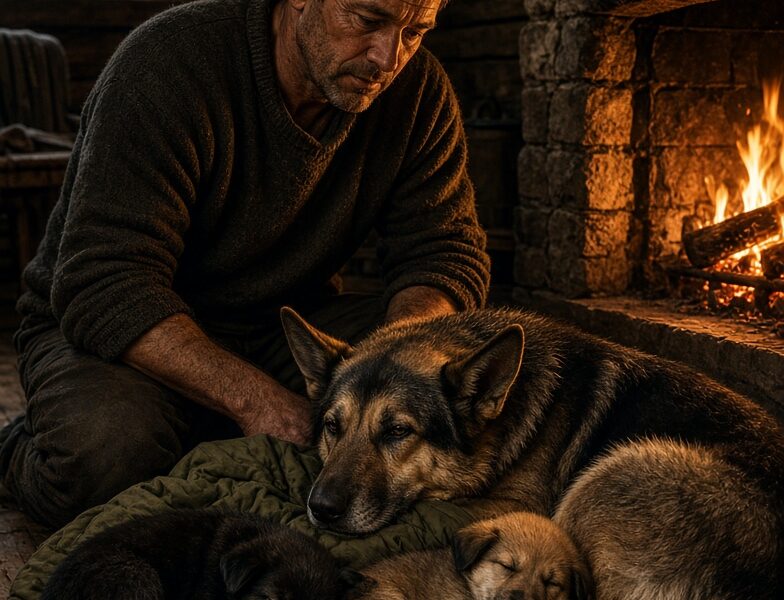
He Stopped for Three Stray Dogs in the Rain… And Found the Reason to Keep Living
The rain had been falling for three hours when Beck Sawyer finally admitted he had no idea where he was going.
His old green pickup climbed another bend in the Smoky Mountains, its windshield wipers struggling against the October storm. Bare hardwood branches clawed at the gray sky, and water streamed across the asphalt in silver ribbons. Somewhere below the road, a creek roared through the darkness.
Then his headlights caught something beside a broken guardrail.
At first, Beck thought it was a discarded tarp.
He slowed, passed it, and looked into the rearview mirror.
Two small shapes moved beneath a limestone ledge, while a larger one remained curled around them in the mud.
Beck’s hands tightened around the steering wheel.
For two years, he had driven these mountain roads to avoid going home to an empty cabin. He had spent every October trying to outrun the memory of the woman he loved.
Tonight, the road had finally given him a reason to stop.
And before morning came, a starving German Shepherd, two freezing puppies, and one faded green hiking jacket would begin changing everything he thought he knew about loss.
Beck pulled onto the gravel shoulder and killed the engine.
For several seconds, he remained behind the wheel, listening to the rain hammer the roof.
He was forty-six years old, broad-shouldered and lean, with dark hair cut short and silver beginning to show at his temples. Twenty-two years in the Navy had taught him to recognize danger before it became obvious, to keep his breathing steady when other people panicked, and to move when hesitation could cost a life.
Those lessons had served him well overseas.
They had been less useful since his wife died.
Two Octobers earlier, Dana Sawyer had been driving along Route 9 when a logging truck crossed the center line. The accident happened so quickly that by the time the authorities called Beck, there was nothing left for him to do except answer questions about a woman whose laugh he could still hear whenever the house became quiet.
He had buried her, sold the family home, and eventually moved into their small mountain cabin.
He had also stopped making plans.
The only thing he had never been able to put away was Dana’s old hiking jacket.
It lay folded on the passenger seat, its faded green canvas worn soft at the elbows and its left pocket still torn where she had once caught it on a fence.
She had promised to repair it.
There had always been something else to do first.
Beck kept the jacket where he could see it, not because he believed it would bring her back, but because putting it away felt too much like agreeing that their ordinary life had become something that existed only in the past.
He reached for his flashlight.
“All right, Dana,” he murmured, glancing at the jacket. “Let’s see what we’ve got.”
He stepped into the storm.
The cold struck through his clothes almost immediately. Rain ran down the back of his collar as he moved along the guardrail, sweeping his flashlight over the embankment.
The beam found a patch of exposed earth, a tangle of roots, and a limestone shelf where the ground dipped toward the swollen creek.
Then the light settled on the dog.
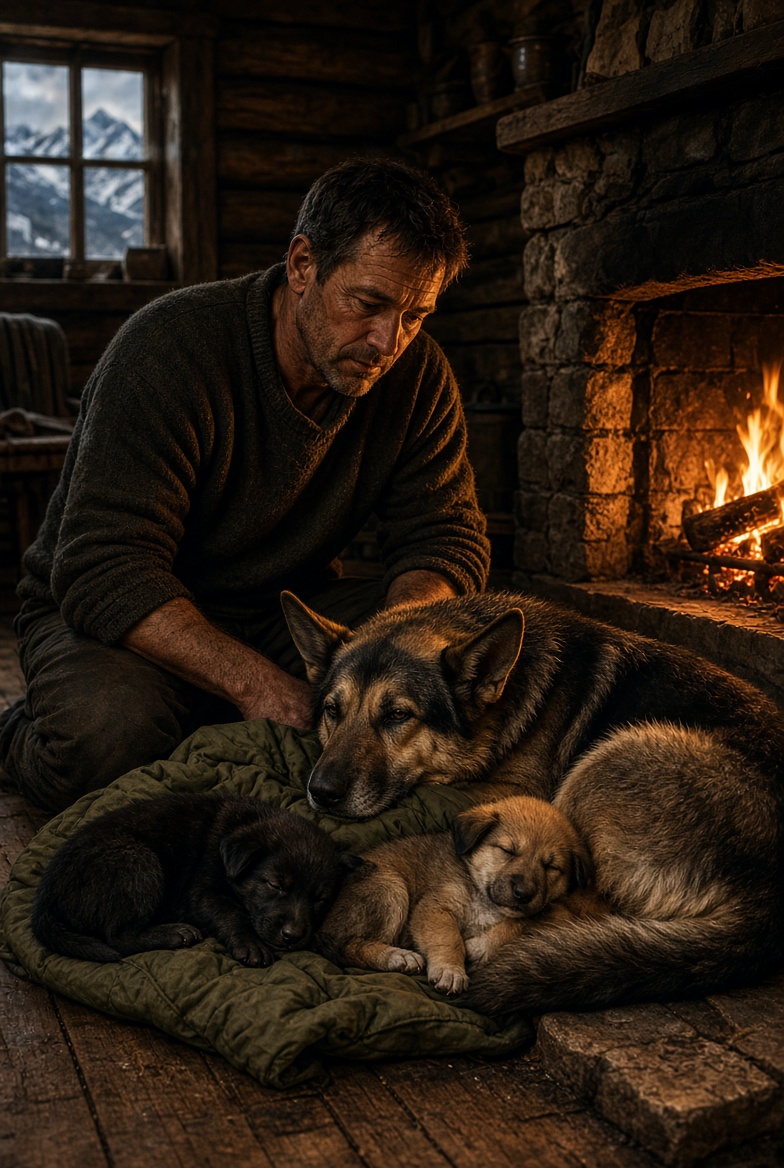
She was a German Shepherd, large-framed but painfully thin, her black-and-tan coat plastered against her ribs. Her muzzle had begun to gray, and one amber eye was half closed against the rain.
The other followed Beck with unnerving concentration.
Two puppies were pressed against her belly.
One was nearly black, with a small patch of tan on his chest. The other had a sandy coat and a narrow white mark beneath his chin.
They looked no more than six weeks old.
The smaller puppy shivered so violently that its entire body seemed to tremble with every breath.
Beck crouched near the edge of the ledge.
“Hey, girl.”
The Shepherd did not bark.
She did not bare her teeth.
She simply watched him, her body curved protectively around the puppies, as though she had already spent everything she possessed keeping them alive.
Beck recognized that expression.
He had seen it in the eyes of men who had run out of options and were waiting for someone else to decide what happened next.
He had never expected to recognize it in a dog.
“You’re in a bad spot,” he said softly. “But I’m not going to hurt you.”
He reached into his jacket pocket and found Dana’s old wool driving gloves.
They were slightly too small for his hands, and the stitching at one thumb had begun to loosen. Dana had kept them in the truck for years, insisting that the mountain weather could turn without warning.
Beck pulled them on one at a time.
Then he lowered himself another few inches and held out one gloved hand.
“Take your time.”
The rain struck his shoulders.
Water ran off the brim of his cap and dripped from his chin.
For nearly a minute, neither of them moved.
Then the sandy puppy made a thin, exhausted sound.
The mother lifted her head.
She looked at the puppy, then at Beck’s hand.
Slowly, carefully, she extended her muzzle and touched his fingers.
It was the smallest gesture imaginable.
It nearly brought him to his knees.
Something inside Beck shifted, not enough to erase the two years of grief he carried, but enough to remind him that he was still capable of feeling something other than its weight.
“Okay,” he whispered. “I’ll take care of them.”
He did not know whether the dog understood him.
He made the promise anyway.
He lifted the dark puppy first, supporting its belly and keeping it close beneath his jacket. The little animal was so cold that Beck felt the chill through his shirt.
He placed it on Dana’s hiking jacket in the passenger seat.
The puppy turned twice, nosed the canvas, and immediately curled into a ball.
For one impossible second, Beck imagined Dana laughing at the sight.
Then he carried the sandy puppy to the truck.
This one barely protested.
Beck tucked it beside its sibling, pulled the jacket around them as carefully as he could, and returned to the embankment.
The mother had begun to rise.
Her front legs shook beneath her weight. She paused, gathered herself, and climbed toward the road with the determined patience of a creature that had decided it would try one more time.
Beck reached for her but stopped when she stiffened.
“Your call,” he said, stepping aside. “I’m not going to force you.”
She reached the shoulder, stood beside the open passenger door, and looked into the truck.
Then she looked back at Beck.
He moved away from the doorway.
The dog climbed inside and folded herself into the rear footwell.
Beck shut the door against the storm.
For a moment, he stood in the rain with one hand resting on the truck’s roof.
He had stopped to help a family of dogs.
He had also, without quite realizing it, made his first promise to someone in two years.
And promises, Beck knew, had a way of demanding more than a man expected to give.
The drive to the cabin took twelve miles.
He drove slowly, checking the rearview mirror every thirty seconds.
The puppies lay on the old hiking jacket, their tiny bodies pressed together. The mother remained in the footwell, her head raised whenever the truck crossed a rough patch of road.
At one bend, the pickup slid slightly on wet gravel.
The dog immediately shifted toward the puppies.
Beck corrected the steering and eased off the accelerator.
“Easy,” he told her. “I’ve got you.”
The words came out naturally.
That was what surprised him.
For two years, he had avoided speaking to an empty passenger seat. Now he was reassuring a dog who had every reason to distrust him.
The cabin stood at the end of a gravel track surrounded by tulip poplars and white oaks.
Beck had bought it with Dana after his retirement from the Navy. They had planned to repair the sagging back porch, plant a vegetable garden, and adopt a dog once they had settled in.
They had made lists.
Dana had even circled a particular Saturday on the calendar for building a small fenced yard.
They had never reached that Saturday.
After the accident, Beck moved into the cabin full-time because the house in Knoxville had become unbearable. Her reading chair remained beside the living room window. Her favorite mug sat in the kitchen cabinet. Even the morning light seemed to arrive in exactly the same place where she had once stood making coffee.
The cabin was different.
It was smaller, quieter, and surrounded by enough forest that he could spend entire days without seeing another person.
For a while, that had seemed like freedom.
Eventually, it became a way to disappear.
Beck carried the puppies inside and placed them in a wooden crate lined with towels and an old flannel shirt.
The dark puppy lifted its head long enough to inspect the room before settling again.
The sandy one remained pressed against its sibling.
“You’re Stone,” Beck told the darker puppy.
He looked at the other.
“And you’re Birch.”
The names arrived before he had time to question them.
He had not named anything since Dana died.
Outside, the mother had climbed out of the truck.
Beck found her standing in the rain beside the passenger door.
She had followed him.
He walked toward her, crouching several feet away.
“I know you don’t know me,” he said. “Truth is, I’m not sure I know myself these days.”
The dog watched him.
“But those two are inside where it’s dry. There’s a fire coming, too, if I remember how to build one.”
He opened the cabin door wider.
“I’d like you to come in.”
The Shepherd approached slowly, crossed the threshold, and stopped just inside the room.
Her eyes moved from the fireplace to the crate, then back to Beck.
She did not relax.
She simply walked to the braided rug beside the hearth and lowered herself to the floor.
Beck closed the door against the rain.
For the first time in two years, he was no longer alone in his cabin.
He had no idea how much that would matter.
He started the fire with dry pine kindling and two split pieces of red oak. The first match failed, the second caught, and soon the flames began to push warmth into the cold room.
He heated water, found a clean cloth, and knelt beside the dog.
“Let’s get some of this mud off you.”
He worked slowly, wiping her paws and the dirt along her flank.
When he moved too close to the crate, her lip lifted.
Beck stopped immediately.
“Fair enough.”
He lowered his eyes and pulled back.
“I’m a stranger. You don’t owe me trust.”
The dog watched him for several seconds before resting her chin between her paws.
Beck continued cleaning her coat.
He found no obvious wound, but her ribs were prominent, and her breathing sounded heavier than it should have. Her coat was tangled around the neck, where a faded nylon cord disappeared beneath the fur.
He did not tug at it.
Not yet.
Instead, he placed a bowl of water within reach and sat several feet away while she drank.
The dark puppy stretched one paw over its sibling in its sleep.
Beck watched them for a long time.
Then he realized he had been sitting beside the fire for nearly twenty minutes without once looking at the clock.
He could not remember the last evening that had happened.
He decided to call the mother Cleo.
He could not explain why.
The name simply felt right.
By midnight, the rain had not stopped.
Cleo had eaten only a few small portions of softened food, and the sandy puppy still trembled whenever the wind rattled the windows.
Beck carried a warmed towel to the crate and tucked it around the puppies.
“You’re going to have to help me out here,” he told Cleo. “I’m a little out of practice.”
Her ears moved toward his voice.
He took that as an answer.
He had just settled onto the couch when Cleo lifted her head and stared at the front door.
Beck sat upright.
“What is it?”
A branch scraped against the porch railing.
He listened.
Nothing followed.
Cleo remained alert for another moment before lowering her head.
Beck watched her settle beside the crate.
He had spent years around working dogs and understood that some reactions were instinct, others memory, and many were impossible to distinguish without knowing the animal’s history.
This dog had history.
He could see it in the way she positioned herself between the puppies and every entrance.
He could see it in the way she watched his hands before his face.
He could see it in the brief moments when she seemed ready to sleep, only to raise her head at the smallest sound.
Someone had taught her to be alert.
Someone had also left her in a ditch with two puppies.
Beck looked toward the faded green jacket lying inside the crate.
The puppies had found warmth in it before they had found it anywhere else.
He wondered what had happened to their mother.
He wondered who had left them.
And for the first time that night, he understood that bringing them home was only the beginning.
At seven the next morning, someone knocked on his door.
Beck opened it to find Nadine O’Reilly standing on the porch with a paper bag in one hand and the expression of a woman who had already decided that whatever happened next would be handled properly.
Nadine was sixty-eight, small and wiry, with short silver hair and pale green eyes. She had lived in the Smoky Mountains all her life and had buried both her husband and her son.
Her son, Danny, had been twenty-three when his Army vehicle struck an explosive device outside Kandahar.
She rarely discussed the details.
She did, however, remember everything about the young man he had been before he left.
Danny had brought home stray cats, repaired broken appliances for neighbors, and once spent an entire weekend building a shelter for a litter of abandoned puppies behind the local grocery store.
Nadine had been a veterinary technician for twelve years before leaving the profession to care for her husband.
She and Beck had been neighbors for two years.
They had exchanged greetings, discussed weather conditions, and occasionally helped each other with practical problems.
They had never become friends.
Beck had not been interested in friendship.
Nadine, apparently, had decided that was no longer relevant.
“I saw your truck coming up the road last night,” she said. “Then I noticed the lights were still on at four in the morning.”
Beck glanced toward the bag.
“What’s in there?”
“Supplies. Now move aside.”
He stepped back.
Nadine entered the cabin and stopped when she saw Cleo.
The Shepherd immediately rose and positioned herself beside the crate.
Nadine did not approach.
She set down the bag, crouched at a respectful distance, and studied the dog’s breathing.
“How long has she been like this?”
“Since I found her.”
“Where?”
“Below the guardrail on the ridge road. About twelve miles from here.”
Nadine’s expression changed.
“With the puppies?”
“Yes.”
“Good Lord.”
She removed a thermometer and a small examination light from her bag.
“She’s running a fever.”
“How bad?”
“Not critical yet, but she’s exhausted and probably dehydrated. These puppies need attention, too.”
“I don’t have antibiotics.”
“I do.”
She took out a brown bottle and checked the label.
“Let’s get her stable, then we’ll call a veterinarian.”
Beck watched her work.
There was no drama in Nadine’s movements, no unnecessary reassurance, no attempt to make him feel better about the situation.
She simply examined Cleo, checked the puppies, and explained what she needed.
He found the directness comforting.
For the next several hours, they moved around the cabin in quiet coordination.
Nadine prepared small portions of food and water. Beck kept the fire going and warmed towels near the hearth. They checked the puppies regularly and made sure Cleo could rest without being disturbed.
When Nadine finished examining the sandy puppy, she sat back on her heels.
“This little one is weaker than his brother.”
“Birch,” Beck said.
She glanced at him.
“You’ve named them already?”
“Apparently.”
“And the mother?”
“Cleo.”
Nadine looked at the Shepherd.
“That suits her.”
Beck did not tell her how the name had come to him.
There were some things he still kept to himself.
Around noon, Birch discovered his tail.
He turned in three complete circles trying to catch it, stumbled sideways into Stone, and sat down with an expression of profound confusion.
Beck watched the performance from across the room.
A sound escaped him.
It was brief, rough, and almost unfamiliar.
He was laughing.
The realization startled him so badly that he stopped.
Cleo’s ears turned toward him.
Nadine continued stirring broth at the stove.
“There it is,” she said.
Beck frowned.
“There what is?”
“Nothing.”
“You’re smiling.”
“I’m stirring.”
“You’re smiling while stirring.”
Nadine looked over her shoulder.
“Don’t make me regret coming over here.”
For the first time in months, the cabin felt less like a place where Beck went to hide and more like a place where something could happen.
The rain continued for three days.
During those three days, the fire rarely went out.
The cabin smelled of wood smoke, broth, damp fur, and clean towels. The puppies began to eat more reliably, and Cleo gradually allowed Beck to sit closer to the crate.
On the second night, her fever finally broke.
Beck had fallen asleep against the couch with one hand resting near her head when he felt something warm touch his wrist.
He opened his eyes.
Cleo had lifted her muzzle and placed it across his hand.
Her breathing was steadier now.
She was watching him with half-closed amber eyes.
Beck did not move.
He sat in the darkness, listening to the rain and the fire and the three quiet rhythms of the dogs’ breathing.
Something had changed.
It was not the disappearance of grief.
Grief did not work that way.
It was more like a river flowing around a stone. The stone remained exactly where it had always been, but the water found a different path.
In the morning, Nadine returned with eggs from her chickens.
She found Beck sitting on the floor beside the crate, watching Stone and Birch sleep.
“How did you do?” she asked.
“Nobody got worse.”
“That sounds like a good start.”
“It does.”
She put the eggs on the counter.
Then she glanced at the hiking jacket.
“That yours?”
“My wife’s.”
Nadine waited.
Beck looked down at his hands.
“Dana. She died two years ago.”
He had not planned to tell her.
The words simply emerged.
Nadine nodded once.
“I’m sorry.”
He expected her to say more.
She did not.
Instead, she looked toward the puppies.
“These two are going to need a lot of attention.”
Beck breathed out slowly.
“Yeah.”
“Good thing they found somebody with time on his hands.”
He almost corrected her.
He had plenty of time.
It was the reason he had stopped knowing what to do with himself.
But he let the comment pass.
Over the next several mornings, Nadine returned with supplies, checked Cleo’s condition, and stayed long enough to help with whatever needed doing.
Gradually, their conversations moved beyond the dogs.
Nadine told him about Danny.
Not the circumstances of his death, but the ordinary things that had made him Danny.
The way he had once driven forty miles to return a wallet he found in a parking lot.
The way he repaired things nobody else considered worth saving.
The way he called home after difficult days and spent ten minutes discussing his neighbor’s broken lawn mower because he did not want his mother to worry.
“He thought he could fix everything,” Nadine said one afternoon.
She was sitting beside the fire while Stone and Birch wrestled over a knotted rope.
“He used to tell me that if something was broken, somebody just hadn’t figured out the right way to put it back together.”
Beck watched the puppies tumble into a cushion.
“Sounds like a good kid.”
“He was.”
She paused.
“Still is, in my mind.”
Beck understood that kind of sentence.
Some people remained present even when the world insisted they were gone.
“Dana was like that,” he said.
The name settled into the room.
It was the first time he had spoken it aloud to another person in months.
Nadine did not look away or rush to comfort him.
She allowed the silence to hold the name.
“What was she like?” she asked.
Beck stared into the fire.
“She made plans.”
Nadine waited.
“Big ones, small ones. Didn’t matter. She’d wake up on a Saturday and decide we needed to build a garden, repaint a room, drive to North Carolina for pie, or adopt a dog.”
He glanced at Cleo.
“We never got around to that last one.”
“Maybe she knew you’d get there eventually.”
Beck gave a quiet, humorless laugh.
“I don’t think she planned on dying first.”
“No,” Nadine said. “I doubt she did.”
The honesty of the answer surprised him.
Nadine folded her hands.
“Listen, Beck. I lost my husband, and I lost Danny. I’m not going to tell you that everything happens for a reason, because sometimes things happen for no good reason at all.”
She looked toward the puppies.
“But what we do afterward is still ours to decide.”
Beck said nothing.
“Your wife was the building kind. You know what that kind of person is worth.”
He swallowed.
“And you know that worth doesn’t disappear just because the person isn’t here to see what happens next.”
Outside, rainwater ran through the creek.
Inside, Cleo shifted on the rug and rested her chin on her paws.
Beck looked at the three dogs.
“I don’t know what I’m building,” he admitted.
Nadine followed his gaze.
“I think you’re further along than you realize.”
For the first time, Beck did not immediately dismiss the possibility.
He still did not know what the future would look like.
But he had begun to wonder whether he might be allowed to have one.
On the fourth morning, Beck was shaving at the kitchen window when a county vehicle turned into the gravel drive.
Cleo heard it before he did.
She rose from the rug and placed herself between the front door and the crate.
Her body stiffened.
A low sound vibrated in her throat.
Beck set down the razor.
“Easy, girl.”
Cleo did not move.
Someone knocked.
Beck opened the door to find a lean, weathered man wearing the tan uniform of the county animal welfare office.
His name tag read CORD MABRY.
“Mr. Sawyer?”
“That’s me.”
“Cord Mabry, County Animal Welfare. We received a report about an unregistered German Shepherd and two puppies on this property.”
Beck looked at him for a moment.
“I pulled them out of a ditch during a rainstorm. They didn’t come with paperwork.”
“I understand that. But I still need to establish their status, check for ownership records, and make sure they’re receiving appropriate care.”
“She’s getting veterinary attention.”
“Do you have documentation?”
“Some. We’re working on the rest.”
Mabry glanced past him.
Cleo remained motionless beside the crate, her amber eyes fixed on the visitor.
The officer’s expression changed.
“That dog has a working carriage.”
Beck said nothing.
“Someone trained her,” Mabry continued. “I need to know whether she belongs to anyone.”
“I found a tag. The phone number was disconnected.”
“Any identification chip?”
“Not yet.”
Mabry opened a small notebook.
“I’ll give you seventy-two hours to get her scanned and bring me the medical records. If we can’t establish her ownership and legal status, I’ll have to arrange an assessment at the county facility.”
Beck felt his shoulders tighten.
“What happens to the puppies?”
“They’ll be assessed separately if necessary.”
“Separately?”
“That’s the procedure.”
Cleo made another low sound.
Beck moved his hand to the back of her neck.
Beneath his palm, she was trembling.
He remembered the limestone ledge, the rain, the two tiny bodies pressed against her belly.
He remembered the way she had touched his glove before allowing him to carry her puppies.
He had promised to take care of them.
Now someone was telling him that the family might be separated because he lacked a piece of documentation.
“I’ll get what you need,” Beck said.
Mabry studied him.
“You served?”
“Twenty-two years in the Navy.”
The officer nodded slowly.
“Army. Two tours.”
For a moment, neither man spoke.
They recognized something in each other that required no explanation.
Mabry looked back at Cleo.
“Get the chip scanned first. If she worked as a K9, the record may establish her history.”
“And if it does?”
“Bring the information to my office. I’ll see what I can do.”
He closed his notebook.
“I have a job to do, Mr. Sawyer. But I’m not looking to make this harder than it needs to be.”
Beck held his gaze.
“Neither am I.”
Mabry walked back to his vehicle.
Beck closed the door and leaned against it.
For several seconds, he listened to the quiet inside the cabin.
Then Cleo turned away from the door and returned to the crate.
She settled beside the puppies, her body touching theirs.
She was not asking Beck to fight for her.
She was simply trusting him to try.
That was somehow harder.
The veterinary clinic in the nearest town opened at eight.
Beck arrived before the doors unlocked, carrying Cleo on a short lead and keeping the puppies warm in a padded carrier.
The clinic smelled of disinfectant and wet coats.
A receptionist helped him complete the paperwork while a veterinary technician brought the dogs into an examination room.
Dr. Evelyn Park arrived a few minutes later.
She was a quiet woman with dark hair, rectangular glasses, and the calm efficiency of someone who had learned not to be surprised by what people did to animals.
She examined Cleo first.
“She’s underweight, but she’s stronger than she was a few days ago. Keep the meals small and regular. No sudden changes in diet.”
She checked the puppies, then looked at Beck.
“You’re doing the right things. They still need close monitoring, especially the smaller one.”
“He’s eating better.”
“Good. We’ll keep watching his weight.”
After the examinations, Dr. Park brought out a handheld scanner.
“Let’s see if we can find a chip.”
Beck stood beside the examination table while she moved the scanner slowly across Cleo’s shoulders.
The device gave a short beep.
Dr. Park looked at the display.
“There we are.”
Beck leaned forward.
“What does it say?”
She entered the identification number into the clinic computer.
For several seconds, the room was silent except for the keyboard.
Then her expression changed.
“Interesting.”
Beck felt his stomach tighten.
“What?”
“She’s registered to a private K9 security contractor based in Raleigh, North Carolina.”
“How long ago?”
Dr. Park read through the record.
“Five years of service listed. The company dissolved eighteen months ago. There’s a forwarding address, but the file says the last contact information was updated before the closure.”
She looked up.
“The phone number on the record is the same one printed on her old tag.”
“The disconnected number.”
“Yes.”
Beck stared at the screen.
Five years.
Cleo had spent five years working for someone who had documented her training, recorded her identification, and maintained a file on her.
Then the company had disappeared.
Somewhere along the way, the dog had been passed from one person to another until she ended up beneath a limestone ledge with two puppies and almost nothing left to protect them.
“Can you tell who had her last?” he asked.
“I’m afraid not from this record alone.”
Dr. Park printed the information.
“But this establishes that she was a working dog. Keep this copy. It should help with the county.”
Beck folded the paper carefully.
“Thank you.”
Dr. Park watched him for a moment.
“Mr. Sawyer, I don’t know what happened to her. But whoever left her in those conditions failed her.”
Beck looked through the examination room window at Cleo.
She was standing quietly beside the technician, allowing her ears to be examined.
“No argument there.”
He called Mabry from the parking lot.
The officer answered on the second ring.
“Got something?”
“Her chip confirms five years with a private K9 security contractor out of Raleigh. The company dissolved eighteen months ago. I’ve got the veterinary printout.”
There was a pause.
“Bring it to the office by tomorrow noon,” Mabry said. “I’ll review the file personally.”
Another pause followed.
“She was a working K9?”
“That’s what the record says.”
Mabry exhaled.
“Then she deserves better than a county kennel.”
Beck looked at the gray sky above the parking lot.
“Thank you.”
“Don’t thank me yet. Get the paperwork squared away.”
The call ended.
Beck stood beside his truck, the printed record folded in his pocket.
For the first time since the rainstorm, he felt something resembling certainty.
Cleo had a history.
She had been trained, registered, and cared for once.
She was not simply a stray dog who had appeared from nowhere.
She was a working animal who had lost everything that had once given her life structure.
Beck understood that more than he wanted to admit.
He had also spent years being part of an institution that gave him a purpose, a schedule, and people who depended on him.
When that life ended, he had struggled to understand what remained.
He looked at the truck.
Dana’s green jacket was still on the passenger seat.
It had carried the puppies through the storm.
Now, folded in the same pocket where he kept his wife’s old gloves, was a record that might give Cleo another chance.
Beck opened the driver’s door.
“Let’s go home,” he told her.
This time, the words did not feel like a promise he was afraid he could not keep.
They felt like the beginning of a plan.
Mabry reviewed the paperwork the following morning.
He called Beck later that afternoon and confirmed that the identification record, veterinary assessment, and evidence of the company’s closure gave them a workable path forward.
There would be additional forms, vaccinations, and follow-up checks.
But Cleo and the puppies would not be sent to the county facility while the matter was being resolved.
Beck listened without interrupting.
When Mabry finished, he said, “I appreciate it.”
“You’ve done the important part,” Mabry replied. “You got them checked out. You followed the process. Keep the records up to date.”
“I will.”
“And Sawyer?”
“Yes?”
“That dog trusts you. Don’t take that lightly.”
Beck looked across the room.
Cleo was lying beside the fireplace, her head resting on her paws while Stone and Birch slept against her belly.
“I won’t,” he said.
By the time the first real snow arrived three weeks later, the cabin had changed in ways Beck could not have predicted.
The rain had finally passed.
A light dusting of snow covered the gravel track, the woodpile, and the bare branches of the oaks. Morning sunlight spilled across the porch.
Beck stood outside with a mug of coffee when Stone stepped into the snow for the first time.
The puppy lifted one paw.
He placed it down.
Then he lifted the other and stared at Beck as though the ground had personally betrayed him.
Birch took a mouthful of snow and sneezed repeatedly.
Cleo watched from the doorway with the patient expression of a mother who had accepted that her children would always make questionable decisions.
Beck laughed.
This time, he did not stop himself.
The sound carried across the yard.
Nadine, who had arrived with a carton of fresh eggs, looked up from the porch steps.
“Well, that’s an improvement.”
“What’s that?”
“Your sense of humor.”
“I’ve always had one.”
“Then you should consider using it more often.”
She placed the eggs on the kitchen counter and glanced toward the old shed behind the cabin.
“Have you ever thought about fixing that building?”
Beck followed her gaze.
The shed had once been used to store tools and camping equipment. It was weathered, drafty, and crowded with things he had not touched since moving into the cabin.
“Why?”
“I spoke to a friend in Asheville. His name is Percy Vance. He runs a nonprofit that helps place retired military working dogs with veterans who are struggling to adjust to civilian life.”
Beck took another sip of coffee.
“All right.”
“He’s been looking for a rural property where he could run a small residency program. Somewhere quiet, with room for dogs, and with somebody who understands what these veterans are carrying.”
Nadine let the words settle.
“I told him about you.”
Beck turned toward her.
“You what?”
“I told him about the cabin, the land, and the fact that you’ve managed to turn a frightened German Shepherd into a dog who can sleep through a night without checking every window.”
“She still checks the windows.”
“Yes, but now she does it and goes back to sleep.”
He could not argue with that.
Cleo had changed.
She still noticed every movement near the door. She still positioned herself between the puppies and unfamiliar visitors. But the constant tension in her body had eased.
In the evenings, when the fire burned low and the puppies slept in a heap, she sometimes stretched out on the braided rug and closed her eyes completely.
Beck had begun to recognize those moments as victories.
Nadine nodded toward the shed again.
“You’ve got twelve acres here. The shed could become a kennel with some work. You’ve already got a warm cabin and space for people to stay.”
“I don’t know anything about running a program.”
“You know how to follow a plan. You know how to train a dog. And you know what it feels like when a life you understood disappears overnight.”
Beck looked away.
“That’s not the same as knowing how to help somebody else.”
“No,” Nadine said. “But it’s a start.”
He watched Stone chase a dead leaf across the porch.
Cleo followed him with her eyes, prepared to intervene if the leaf became dangerous.
“What exactly would this program do?”
“Give veterans a place to stay while they work with retired military dogs. Not a hospital, not a military unit, and not a place where anyone has to explain themselves before they’re ready.”
She paused.
“A place to rebuild routines. Learn to care for something. Get outside. Sleep through a night. Maybe remember that being useful doesn’t have to mean being deployed somewhere.”
Beck stared at the shed.
He knew what it was like to wake up before dawn because sleep had become unreliable.
He knew what it was like to avoid people because explaining himself took more energy than he had.
He knew how easily days could disappear when there was nothing that required him to get up.
He also knew what had happened when three hungry dogs entered his life.
For the first time in two years, he had a reason to rise before sunrise.
He had to check the puppies’ food, keep the firewood dry, and make sure Cleo received her medication.
He had to answer Nadine’s questions.
He had to call the veterinarian.
He had to be present.
And somewhere inside those small responsibilities, the days had begun to feel different.
“Let me think about it,” he said.
Nadine gave him a look.
“Beck, you’ve been thinking since the day I met you.”
He raised an eyebrow.
“At some point, thinking becomes another word for waiting.”
She picked up her bag.
“Call Percy.”
That afternoon, Beck stood beside the kitchen window for nearly twenty minutes before dialing the number Nadine had left on the counter.
Percy Vance answered with a voice that sounded both energetic and tired.
Nadine had already explained the basic situation.
They spoke about the property, the shed, the available space, and the kind of veterans Percy hoped to serve.
Beck asked questions about insurance, veterinary expenses, training, and the legal requirements for housing working dogs.
Percy answered what he could and promised to send documents covering the rest.
“I don’t want this to become a place where people are told to be grateful for a roof and a dog,” Beck said. “They need privacy. They need choices. They need to be treated like adults.”
“I agree,” Percy replied.
“And nobody comes here because somebody else decided they need fixing.”
“That’s not our approach.”
Beck looked out at the snow-covered yard.
“What is your approach?”
“Give them room to find out what they’re capable of doing next. We provide support, structure, and a place to start. They decide what comes after.”
The answer stayed with Beck after the call ended.
That evening, he sat beside the fire with Dana’s old jacket folded over the back of a chair.
He thought about the plans they had made for the cabin.
The porch they had intended to repair.
The garden they had never planted.
The dog they had talked about adopting.
He could almost hear Dana insisting that he stop staring at the shed and start measuring the walls.
She had always been good at recognizing the moment when a possibility needed to become a task.
Beck looked at Cleo.
She had placed her chin across his boot.
“All right,” he whispered.
He did not know whether he was speaking to her, to Dana, or to the part of himself that had spent two years refusing to move forward.
But the decision had been made.
The next morning, he started clearing the shed.
The work was harder than he expected.
The building needed new boards, better insulation, repaired drainage, and a roof that did not leak every time the weather turned.
He spent the first week removing broken shelves, hauling out old equipment, and measuring the interior.
Stone and Birch followed him everywhere, occasionally stealing a glove or attempting to drag a piece of rope twice their size.
Cleo supervised from the doorway.
When the puppies wandered too close to a stack of lumber, she herded them back with a low sound.
Beck began to wonder whether she would ever stop believing that every room needed a guard.
Then he would catch her sleeping beside the fireplace, one paw resting on Stone’s back, and remember that healing did not require a creature to forget everything that had happened.
Sometimes it only required a safer place to remember it.
Mabry appeared on the second Saturday.
He arrived in his county vehicle, stepped out carrying a post driver, and looked at the shed.
Beck straightened from the boards he had been measuring.
“You’re a long way from your office.”
“Free weekend.”
Mabry set the tool down.
“Where do you want the first post?”
Beck stared at him.
“You’re volunteering?”
“Don’t make it complicated.”
They worked until noon.
Mabry was practical, experienced, and willing to do the kind of work that left a person’s hands sore at the end of the day.
He did not ask Beck why he was building the kennels.
He did not discuss the paperwork unless a question needed answering.
He simply helped.
Nadine arrived shortly afterward with sandwiches, a thermos of coffee, and a list of supplies that seemed to have been assembled with military precision.
By the end of the weekend, the first section of the shed had been cleared and the framework for the kennels was taking shape.
The project had become real.
That was when the doubts began.
Beck understood construction, logistics, and routine.
He understood dogs.
But running a residency program involved more than building kennels.
There would be insurance, veterinary costs, food, utilities, transportation, emergency plans, and people whose needs might be harder to anticipate than those of any animal.
Some veterans would arrive ready to work.
Others might need several days before they felt comfortable leaving their rooms.
Some would talk.
Others might not speak much at all.
Beck knew enough about loss to understand that there was no universal schedule for getting through it.
He also knew that he was not a counselor, a doctor, or an expert in every problem a person might bring through the door.
When he told Percy this during their next call, Percy did not dismiss his concerns.
“Then don’t pretend to be any of those things,” Percy said. “We’ll establish the professional support and referral network. You’ll be responsible for the program’s daily structure and the working relationship between the veterans and the dogs.”
“And if someone needs more help than we can provide?”
“We connect them with the right people. We don’t make promises we can’t keep.”
Beck leaned against the kitchen counter.
“How many residents are you thinking?”
“Let’s start small. Two or three. We can expand when the property and the support system are ready.”
Beck looked at the shed through the window.
“Three.”
“Does that sound manageable?”
“It sounds like a number I can plan for.”
“Good. That’s where we start.”
The first draft of the plan arrived by email two days later.
Beck read it at the kitchen table after the puppies had settled for the night.
He checked every expense, marked questions in the margins, and called Percy the following morning to clarify the details.
The program would begin with four kennels, although only two would be occupied initially.
Residents would stay for several weeks at a time, with flexible arrangements depending on their needs and the availability of professional support.
There would be no requirement for anyone to tell their story to a group.
No public photographs without explicit permission.
No pressure to describe difficult experiences.
The work would begin with ordinary things: feeding schedules, walking routines, basic training, meals, maintenance, and shared responsibilities.
Beck understood the value of ordinary things.
He had learned that the small tasks were often the ones that made the next day possible.
By December, the first kennels were finished.
The shed had a repaired roof, clean flooring, proper drainage, and separate spaces for feeding and storing supplies.
Nadine organized medical equipment, bedding, food, and cleaning supplies.
Mabry returned with additional materials.
Percy arranged the administrative details and began identifying potential residents.
Beck worked on the property every day.
Sometimes, he found himself looking at the empty kennels and imagining the people who might eventually occupy them.
He wondered whether they would feel comfortable here.
He wondered whether they would understand that nobody expected them to become different people overnight.
He wondered whether he was building something useful or simply giving himself another project to avoid the questions he still could not answer.
One evening, Nadine found him standing in the shed long after the day’s work had ended.
The lights were on.
The kennels were empty.
Cleo stood beside him, her shoulder touching his leg.
“You look like you’re waiting for an inspection,” Nadine said.
“Maybe I am.”
“From whom?”
He looked around.
“I don’t know.”
Nadine studied him.
“Would Dana approve of this?”
The question caught him off guard.
He had thought about Dana every day since the storm, but he had not allowed himself to ask what she would have thought about the project.
He looked at the kennels.
“She’d tell me the storage shelves are too low.”
Nadine smiled.
“Then raise them.”
“She’d say the yard needs a proper fence.”
“It does.”
“And she’d have a list of things we forgot.”
“She sounds useful.”
Beck laughed softly.
“She was.”
Nadine placed a hand on his shoulder.
“You don’t have to make this perfect for her.”
He looked at her.
“You only have to make it useful for the people who come here.”
The words stayed with him.
That night, Beck returned to the cabin and took a small notebook from a drawer.
It had belonged to Dana.
The first pages contained grocery lists, reminders, and sketches for the garden they had intended to plant.
He turned to a blank page.
At the top, he wrote three words.
Things Worth Building.
Below them, he wrote the names of the dogs.
Cleo.
Stone.
Birch.
Then he added the first two kennels, the repaired shed, and the names of the people helping him.
For the first time in two years, he wrote down something that belonged to the future.
The first veteran arrived in January.
His name was Marcus Reed.
He was forty-one, a former Army mechanic, and had spent several months moving between temporary arrangements after leaving the service.
He arrived with a retired Belgian Malinois named Duke and a duffel bag that looked as though it had accompanied him through several moves.
Marcus stepped out of the vehicle, looked at the cabin, and then looked at the shed.
“That’s the place?”
“That’s the place,” Beck said.
Marcus nodded.
He did not ask about the program’s history or how long he was expected to stay.
He simply carried his bag inside and followed Beck to the room that had been prepared for him.
The room contained a bed, a desk, a chair, a lamp, and a window overlooking the woods.
There was no television.
Beck had asked Marcus beforehand whether he wanted one.
Marcus had declined.
“There’s coffee in the kitchen,” Beck said. “Food is in the refrigerator. Nobody expects you to join us for meals if you don’t feel like it.”
Marcus looked around the room.
“What am I supposed to do?”
Beck considered the question.
“For today? Get settled. Meet Duke’s kennel area. We’ll go over the routine tomorrow.”
“That’s it?”
“That’s it.”
Marcus nodded again.
He set his duffel on the bed and began unpacking.
Beck left him alone.
That afternoon, Marcus sat on the porch with Duke beside him for three hours.
He watched Beck work with Cleo in the yard.
He watched Stone and Birch chase each other through the grass.
He watched Nadine carry a basket of towels into the shed.
He did not say much.
Beck did not ask him to.
On the second evening, Beck heard Marcus talking to Nadine in the kitchen.
“I haven’t sat outside for more than ten minutes in two years,” Marcus said.
Nadine was drying a plate.
“How was it?”
Marcus considered the question.
“Quiet.”
“Good quiet or bad quiet?”
He looked through the window at Duke.
“I don’t know yet.”
Nadine nodded.
“That’s an honest answer.”
Beck stood in the hallway, listening.
He did not enter the kitchen.
He had learned from Cleo that trust could not be demanded, and progress did not always announce itself.
Sometimes the best thing a person could do was continue showing up.
Over the next week, Marcus began helping with the dogs.
He checked their water bowls, cleaned the kennel areas, and assisted Beck with basic training exercises.
Duke was an intelligent, high-energy dog who responded well to routine but became restless when the schedule changed.
Marcus understood him.
He could recognize the moment Duke needed another activity, a quieter space, or a break from the noise of the other dogs.
Beck watched them work together.
Their movements became more coordinated each day.
One afternoon, Marcus managed to teach Duke a new recall cue.
The dog crossed the yard at a run, stopped directly in front of him, and sat.
Marcus stared down at him.
Then he smiled.
It was not a large smile.
It was not the kind of expression people put in photographs.
But it was real.
Beck recognized it because he had recently begun to experience the same thing.
By February, a second resident arrived.
Her name was Elena Brooks, a former Navy corpsman who had spent years working in demanding medical environments before leaving the service.
She arrived with a retired German Shepherd named Ranger.
Elena was direct, organized, and skeptical of the idea that a rural residency program could make much difference in anyone’s life.
“I don’t need a motivational speech,” she told Beck during their first conversation.
“Good,” he replied. “I don’t give them.”
“What do you expect me to do?”
“Help take care of the dogs if you want to. Follow the house rules. Tell us if something isn’t working.”
“And if I don’t want to talk about anything?”
“Then we talk about the weather.”
She studied him for a moment.
“That’s it?”
“That’s it.”
Elena glanced toward Ranger.
“All right.”
She stayed.
For the first several days, she kept to herself.
She joined the others for meals but rarely spoke beyond practical questions.
She spent much of her time walking Ranger along the property boundary, checking the fencing, and organizing the medical supplies Nadine had arranged.
Beck recognized the behavior.
He had done much the same thing when he first moved into the cabin.
Work gave the hands something to do while the mind tried to decide whether it was safe to settle.
One afternoon, Elena found him repairing a gate.
“Your latch is installed backward,” she said.
Beck looked up.
“Is it?”
“Yes.”
She showed him how the mechanism should sit.
He handed her the screwdriver.
“Want to fix it?”
Elena raised an eyebrow.
“You asking me to do your job?”
“I’m asking you to show me the right way.”
She took the screwdriver.
They repaired the gate together.
Afterward, she stayed to help with another section of fencing.
By the end of the week, the two of them had improved the entire eastern boundary.
Elena did not talk about her past.
She did, however, begin asking questions about the dogs.
Why Cleo preferred to approach new people from the side.
Why Duke became restless when several people spoke at once.
Why Ranger sometimes refused to enter the shed after a loud noise.
Beck answered what he could and admitted when he did not know.
Together, they adjusted the dogs’ routines.
The program began to develop its own rhythm.
Mornings started with feeding and basic care.
Residents could join training sessions, help with maintenance, or take quiet walks through the woods.
Afternoons were flexible.
Evenings were usually spent in the cabin, where people could talk, read, play cards, or simply sit near the fire.
Nobody was required to be cheerful.
Nobody was expected to be grateful.
The point was not to create a perfect place.
It was to create a dependable one.
Cleo became an unofficial guide.
She showed the new dogs where the water bowls were kept, which corner of the yard received the afternoon sun, and where she preferred to rest when the cabin became busy.
She still watched unfamiliar visitors carefully.
But she no longer spent every moment anticipating trouble.
Stone and Birch grew into energetic young dogs who seemed determined to investigate everything on the property.
Stone was cautious, thoughtful, and quick to observe a new situation before acting.
Birch was impulsive, curious, and almost always convinced that whatever he had discovered was the most important thing in the world.
Their personalities were so different that Beck began using them in training exercises for different reasons.
Stone needed confidence.
Birch needed patience.
Cleo needed to learn that she did not have to supervise every decision they made.
The last lesson proved the most difficult.
When the puppies were old enough to explore the yard independently, Cleo followed them from one end to the other.
If Stone paused to sniff a tree, she watched him.
If Birch ran toward the shed, she stood immediately.
If either puppy disappeared behind the porch steps, Cleo rose to investigate.
Beck watched her one afternoon as she interrupted Birch’s attempt to carry a pinecone larger than his head.
“You can’t protect them from every bad decision,” he told her.
Cleo looked at him.
Birch dropped the pinecone and immediately tried to eat a leaf.
Beck sighed.
“Some decisions, apparently, are going to happen anyway.”
Marcus laughed from the porch.
It was the first time Beck had heard him laugh without immediately looking surprised by the sound.
By early spring, the residency program was no longer an idea on paper.
Two veterans were staying on the property.
Four kennels stood ready.
The veterinary records were organized.
The supply room was stocked.
The nonprofit had established a system for referrals and additional support.
Beck had begun discussing a third resident with Percy.
But the most important change was not visible in the buildings or the paperwork.
It was in the way the people moved through the property.
Marcus had started sitting outside with Duke before breakfast.
Elena had taken over the weekly inventory and was helping Nadine prepare a schedule for the coming months.
Both residents had begun making plans beyond their expected stays.
Marcus was considering a maintenance position with a local contractor.
Elena had begun exploring volunteer work with an animal rescue organization.
Neither had suddenly become carefree.
They still had difficult days.
They still needed privacy, patience, and support.
But the days were no longer all the same.
One evening, Marcus stood beside Beck near the kennel entrance.
“Can I ask you something?”
“Sure.”
“Why did you do this?”
Beck looked across the yard.
Stone and Birch were wrestling in the grass while Cleo watched them from the porch.
“What do you mean?”
“The program. You could have fixed the shed, sold the property, and spent the rest of your time fishing or something.”
“I don’t fish.”
“You know what I mean.”
Beck leaned against the fence.
For a moment, he considered giving the easy answer.
Then he decided against it.
“I was lonely,” he said.
Marcus glanced at him.
“That’s the whole reason?”
“No. But it’s the part I understood first.”
He watched Cleo stand and stretch.
“After my wife died, I thought if I kept my life small enough, I wouldn’t have to lose anything else.”
Marcus said nothing.
“I stopped making plans. Stopped seeing people. I drove around the mountains at night because I couldn’t stand being in the cabin once it got dark.”
He paused.
“Then I found Cleo and the puppies.”
“And that fixed it?”
“No.”
Beck shook his head.
“It gave me something I couldn’t ignore. They needed food. They needed warmth. They needed somebody to make decisions. I couldn’t tell them I wasn’t ready.”
Marcus looked down at Duke, who had settled beside his boot.
“Funny how that works.”
“Sometimes.”
Beck turned toward him.
“I don’t think taking care of a dog fixes everything. And I don’t think this place is going to fix everything for anybody. But it can give people a reason to get up tomorrow and something useful to do when they do.”
Marcus considered that.
Then he nodded.
“That’s more honest than most things I’ve heard.”
Beck smiled faintly.
“I’m trying to keep it that way.”
The third resident arrived in March.
His name was Thomas Hale, a former Army medic who had spent several years caring for other people and was struggling to decide what he wanted his own life to look like afterward.
He arrived without a dog.
Percy had explained that Thomas would be paired with a suitable retired working dog once they had assessed his preferences and experience.
Thomas looked at the kennels and then at the cabin.
“Which dog is mine?”
“Nobody’s assigning you a dog today,” Beck replied.
Thomas frowned.
“I thought that’s why I’m here.”
“You’re here to see whether this place works for you. The dog comes later, if the match makes sense.”
“What if I don’t connect with any of them?”
“Then we don’t force it.”
Thomas looked skeptical.
Beck understood.
People often expected an answer to arrive with the problem.
Sometimes the most responsible answer was to admit that the decision needed more time.
Thomas settled into the third room.
For several days, he spent most of his time reading, walking the property, and helping Nadine with supply organization.
He was comfortable around dogs but reluctant to take responsibility for one.
Beck did not push him.
Instead, he invited Thomas to observe the training sessions.
Stone, now much more confident, became particularly interested in him.
The puppy would approach, sit nearby, and wait.
Thomas would acknowledge him briefly before returning to his book.
Stone would leave.
A few minutes later, he would come back.
The routine continued for several days.
Eventually, Thomas began bringing a small training pouch to the yard.
He started with simple commands.
Stone responded well.
By the end of the week, Thomas was laughing at the dog’s tendency to sit before being asked.
“He’s trying to negotiate the whole process,” Thomas said.
“That’s Stone,” Beck replied.
“Does he always do that?”
“Only when he thinks he knows what comes next.”
Thomas looked down at the dog.
“I know a few people like that.”
Beck smiled.
“Me too.”
Stone was not formally assigned to Thomas, and nobody rushed the decision.
But the two began spending more time together.
Thomas helped with feeding, training, and grooming.
Stone learned to wait at the gate.
Thomas learned that the dog needed a moment to observe unfamiliar situations before approaching.
They adjusted to each other without anyone insisting that they should.
One afternoon, Thomas found Beck repairing a section of porch railing.
“Can I ask you something?”
“That’s becoming a habit around here.”
Thomas ignored the remark.
“How did you know you were ready to take care of Cleo?”
Beck set down his hammer.
“I didn’t.”
Thomas looked at him.
“I was driving through the rain. I saw three animals who needed help. I had a truck, a warm cabin, and enough sense to get them to safety. That was the decision in front of me.”
“But you took on a lot more than that.”
“Later.”
Beck leaned against the railing.
“The first night, I wasn’t deciding whether to build a residency program. I was deciding whether to leave a mother and two puppies in the cold. Those were different decisions.”
Thomas looked toward Stone, who was investigating a patch of grass near the steps.
“So you just kept making the next decision?”
“Pretty much.”
Thomas nodded slowly.
“That sounds manageable.”
“It is, some days.”
“And the others?”
Beck picked up his hammer.
“On the others, you ask for help.”
Thomas stood quietly for a moment.
Then he joined Beck at the railing.
They worked until sunset.
Spring arrived slowly in the Smoky Mountains.
The bare branches filled with new leaves.
Redbuds appeared along the creek, and the mornings became warm enough that Beck could drink his coffee on the porch without pulling on a jacket.
The property looked different.
The repaired shed stood solidly behind the cabin.
The kennel yard had a proper fence.
The gravel track had been graded to make it easier for visitors to arrive in bad weather.
There were fresh flowers near the porch steps because Nadine had decided the place needed them.
Beck had argued that flowers would require maintenance.
Nadine had informed him that he was already maintaining three dogs, several buildings, and a small nonprofit.
Flowers were not going to defeat him.
He stopped arguing.
One morning, he walked to the tree line behind the cabin.
A few feet from the creek stood an old oak where the ground rose slightly above the water.
Beck had buried a small tin box there after Dana’s death.
Inside was a folded piece of paper in her handwriting.
It was her last grocery list.
Milk.
Coffee.
Apples.
Bread.
A note reminding him to buy screws for the porch.
He had kept it because the ordinary details felt more precious than anything he could have chosen deliberately.
The list reminded him of a life in which there had always been something to do tomorrow.
He sat beneath the tree and took the paper from the box.
For a long time, he simply looked at it.
He thought about the garden Dana had planned.
He thought about the cabin they had purchased together.
He thought about the dog they had never adopted.
He thought about how much of his life had been spent believing that moving forward meant leaving her behind.
The creek ran below him.
A kingfisher called from the opposite bank.
Then Cleo appeared between the trees.
She walked toward him without hurry and sat beside his knee.
Her shoulder pressed against his leg.
Beck rested a hand on her back.
“Hey, girl.”
Cleo leaned against him.
Behind them, Stone and Birch were arguing over a stick.
Stone had one end.
Birch had the other.
Neither appeared willing to surrender.
They pulled in opposite directions until the stick slipped free and both puppies tumbled backward.
A moment later, they were chasing each other again.
Beck laughed.
He looked down at Dana’s grocery list.
For the first time, he did not feel that keeping it meant he had to remain in the place where she had left him.
The paper could be a memory without becoming a boundary.
He folded it carefully and returned it to the tin box.
Then he placed the lid back on top and sat beside Cleo for another few minutes.
He was not finished grieving.
He did not expect to be.
But he had begun to understand that the future did not have to be a betrayal of the past.
Sometimes it was the place where the past continued to matter.
That evening, Beck returned to the cabin and opened the kitchen drawer he had avoided for two years.
Inside lay Dana’s old harmonica.
She had bought it at a roadside shop during one of their mountain trips and learned a simple tune that she played whenever she was happy.
Beck had never been particularly good at music.
Dana had never cared.
She used to tell him that a song did not have to be perfect to be worth playing.
He carried the harmonica to the porch.
The sun had dropped behind the trees, and the air smelled of damp earth and new leaves.
Cleo settled at his feet.
Stone leaned against his left boot.
Birch rested his chin on Stone’s back and fell asleep before Beck had even raised the instrument.
The other residents were inside preparing dinner.
For once, Beck did not feel the need to fill the quiet with a television or a radio.
He placed the harmonica to his lips and played the tune Dana used to hum.
The first notes came out unevenly.
He stopped, adjusted his grip, and tried again.
The melody moved slowly into the evening air.
Three verses.
Nothing complicated.
The kind of tune that seemed to belong outdoors, among the trees and the running creek.
Cleo closed her eyes.
Stone shifted against his boot.
Birch slept on.
Beck played all the way to the end without stopping.
When the final note faded, he lowered the harmonica and looked across the yard.
The shed stood in the twilight.
The kennel lights glowed softly.
Inside the cabin, someone laughed at something Marcus had said.
Nadine was probably correcting Elena’s method of storing the supplies.
Thomas was likely explaining to Stone why the dog could not follow him into the kitchen every time he moved.
Life was happening.
Not the life Beck and Dana had planned, but something that had grown from the pieces they had left behind.
He had once believed that grief meant carrying the past alone.
Now he understood that the people we lose can remain part of the world through what we choose to do with the time they gave us.
Dana had loved building things.
She had loved the mountains.
She had loved the ordinary work of caring for a home, making plans, fixing broken objects, and imagining what tomorrow might hold.
Beck could not give her the years they had lost.
But he could continue some of what she had started.
He could repair the porch.
He could plant the garden.
He could keep the cabin warm for people who needed somewhere to begin again.
He could make sure Cleo never had to wonder whether someone would return for her.
He could watch Stone grow into a confident dog and Birch discover a thousand new ways to make trouble.
He could help veterans find routines that belonged to them, not because somebody had promised that every problem would disappear, but because every person deserved the chance to build a life beyond the hardest chapter of it.
The harmonica rested in his hands.
Cleo opened her eyes and looked up at him.
Beck reached down and scratched gently behind her ears.
“You did good, girl.”
Her tail moved once against the porch boards.
He smiled.
The rainstorm had happened months earlier.
He could still remember the cold, the mud, the broken guardrail, and the way Cleo had watched his gloved hand before deciding whether to trust it.
He could still picture the puppies curled on Dana’s jacket.
That faded green canvas had carried more than two frightened animals through a storm.
It had become the first warm place they could reach.
Later, it had reminded Beck that a memory did not have to remain untouched to be meaningful.
He could let life gather around it.
He could let it become part of something new.
Inside, someone called his name.
Beck turned toward the door.
“Coming.”
He slipped the harmonica into his pocket and rose from the porch.
Stone woke and followed him.
Birch lifted his head, considered the situation, and hurried after his brother.
Cleo stood last, stretching before joining them.
Beck held the door open.
For two years, he had treated the cabin as a place to retreat from the world.
Now he stood in the doorway, watching the people and animals he loved move toward the warmth inside.
He understood something he had not understood on that rainy October night.
Sometimes the rescue begins with the person who opens the door.
Sometimes it begins with the frightened creature who decides to trust the hand reaching toward it.
And sometimes, when a man stops long enough to help a family stranded in the rain, he discovers that the road has brought him to the place where his own life can begin again.
Beck stepped inside.
Behind him, the mountain evening settled quietly over the cabin.
The creek kept running.
The trees moved in the breeze.
And somewhere between the memory of the woman he had loved and the life he was still learning to live, there was room for both grief and hope.
He had not known that night where the road was taking him.
He had only known that three lives needed help.
But some roads understand what the people traveling them cannot yet see.
Sometimes the most important turn is the one that makes you stop.
Sometimes the smallest promise becomes the beginning of something much larger.
And sometimes the door you open for someone else is the very door you needed to walk through yourself.









