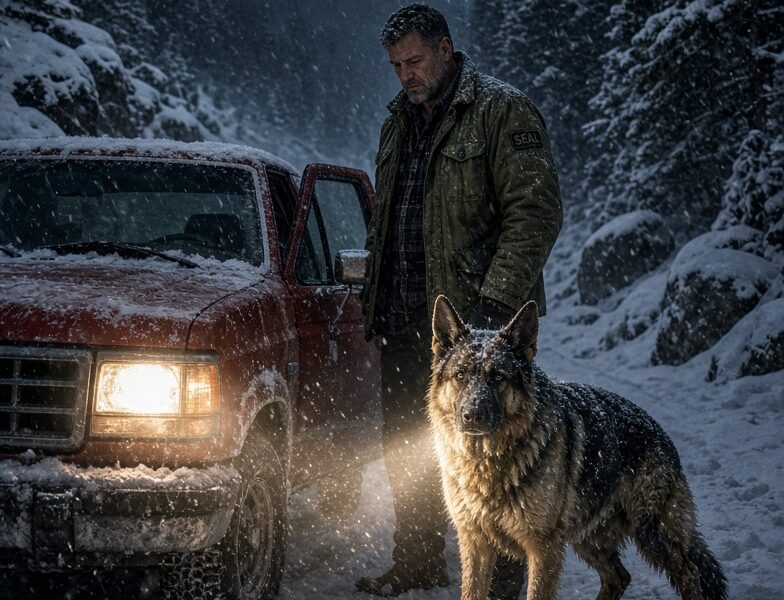
He Stopped for a “Dead” Military Dog in a Blizzard — What He Found Will Haunt You
Snow had swallowed the White Mountains before darkness fully arrived.
By six o’clock that evening, White Mountain Road was little more than two fading tire tracks running through a world of white pine, black rock, and blowing snow.
The forest on either side seemed to disappear whenever the wind rose, then returned seconds later beneath the sweep of headlights.
Ryan Callahan kept both hands on the steering wheel of his old red Ford pickup and drove slower than the speed limit allowed.
At forty-eight, Ryan still carried the build of the Navy SEAL he had once been.
He was six-foot-two, broad through the shoulders, with strong hands marked by years of hard work and a face that looked older when he was tired.
His dark hair had begun turning gray above the temples, and short stubble covered a square jaw that rarely softened around strangers.
His eyes were gray-blue, watchful, and habitually moved from mirror to road to tree line, as though some part of him had never received the message that the war was over.
He wore a faded dark green field jacket over a red and black flannel shirt.
The jacket was old enough that the fabric had gone pale around the seams.
A worn SEAL patch remained on the sleeve.
Ryan had considered removing it more than once.
He never had.
For nearly three years, he had lived alone in a timber cabin north of North Conway, far enough into the mountains that nobody arrived there by accident.
He told people he preferred privacy.
That was true.
It just was not the whole truth.
The cabin had once had two wooden chairs on the porch.
Now there was one.
Ryan had moved the second into the shed nearly two years earlier and had never brought it back out.
Inside the cabin, an old military field radio sat on a shelf beside the fireplace.
It still worked.
Ryan knew that because once every few months he checked the battery, turned the dial until static filled the room, and then switched it off before any voice could come through.
Some habits survived because they were useful.
Others survived because a man did not know how to let them die.
Ryan had driven into North Conway that afternoon for kerosene, canned food, roofing nails, and a sheet of weatherproof flashing.
The forecast had warned that the mountain road might close overnight, and one corner of his cabin roof had started leaking during the previous storm.
He wanted to be home before the worst of it arrived.
The supplies rattled quietly behind the truck seat.
The heater struggled against the cold.
Snow struck the windshield in thick waves.
Ryan leaned forward slightly.
Visibility had dropped to less than forty yards.
Then something moved inside the headlights.
Ryan’s foot hit the brake.
The Ford slid sideways for half a second before the tires caught.
A dark shape stood in the road.
Ryan stared through the windshield.
A German Shepherd.
The dog was large, though hunger and exhaustion had narrowed his frame.
He looked to be eight or nine years old, maybe older, with the sable and black coloring of a working shepherd and a heavy head that once must have carried itself proudly.
Snow covered his back.
Ice clung lightly to the long fur around his legs.
One ear stood straight while the other tilted outward near the tip, giving his face an uneven, almost questioning expression.
His right hind leg barely touched the ground, but he did not collapse.
He did not run.
He stood directly inside the headlights and looked at Ryan.
Ryan’s first thought was that someone had lost him.
His second was that no ordinary lost dog would stand like that.
The shepherd was tired, certainly frightened, maybe, but his eyes were clear, alert, focused.
Ryan shut off the high beams.
The dog blinked once.
Then he turned toward the forest.
He walked five steps into the blowing snow, stopped, and looked back.
Ryan frowned.
The shepherd waited.
“Come on,” Ryan muttered.
The dog turned toward the trees again.
Ryan watched him disappear almost completely into the storm.
Then the shepherd returned.
This time, he came closer to the truck, not begging, not wandering.
Insisting.
Ryan had seen that kind of behavior before, years ago.
A dog working a problem that the human had not understood yet.
He killed the engine and opened the door.
Wind hit him immediately, cold enough to cut through the flannel beneath his jacket.
The shepherd backed several feet away but did not leave.
Ryan stepped into the snow.
“Easy.”
No reaction.
He held one gloved hand low.
“Come.”
The shepherd stared at him.
Nothing.
Ryan studied his posture.
There was discipline underneath the exhaustion.
The dog watched Ryan’s shoulders rather than his hand.
His body remained angled forward, prepared to move the instant something made sense.
Ryan felt a small shift inside his chest.
He tried another command, one he had not spoken to a dog in years.
“With me.”
The reaction was immediate.
The shepherd moved despite the weakness in his hind leg.
He crossed the snow and stopped against Ryan’s left side.
Perfect position.
Shoulder near knee, head forward.
Ryan did not breathe for a moment.
The dog had been trained.
Not backyard obedience.
Not somebody teaching a pet to sit for treats.
Working dog training.
Ryan looked down at him.
The shepherd looked up once, then turned toward the woods again.
“All right,” Ryan said quietly.
The dog started walking.
Ryan followed.
They left the road twenty yards behind them.
The forest changed the moment the headlights disappeared.
Pine branches bent under heavy snow.
Wind moved through their tops while the ground below remained strangely still.
Ryan used the flashlight on his phone, keeping it angled toward the shepherd rather than directly into his eyes.
The dog moved with purpose, slowly, painfully, but never uncertainly.
Ryan noticed the collar after they had gone perhaps fifty yards.
It was old brown leather, wide and weathered, partly hidden beneath thick neck fur.
One section looked darkened from heat or age.
Most of whatever identification had once been attached to it was gone.
Ryan crouched when the shepherd paused.
The dog allowed him close.
That alone told Ryan something.
He brushed snow away from the collar.
A small metal plate remained.
Three characters were visible beneath scratches and corrosion.
V17.
Ryan ran his thumb over them.
“What’s that supposed to mean?”
The shepherd immediately looked toward the trees.
Ryan followed his gaze.
At first, he saw nothing.
Then he noticed a break in the snow, a narrow trail descending between two pines.
The shepherd went down it.
Ryan followed.
The ground became steeper.
Branches scraped against his jacket.
Snow reached above his boots in places.
Somewhere below, hidden by the storm, Ryan caught the faint outline of something metallic.
He stopped.
The shepherd kept going.
Ryan moved faster.
Twenty yards farther down the slope, the forest opened into a shallow ravine.
There was a vehicle below.
A dark gray SUV had left the road somewhere farther uphill and come to rest between two trees.
Snow had already built against one side, softening its shape until it looked almost like another piece of the landscape.
Ryan’s heartbeat changed.
Not faster.
Sharper.
The part of him that had spent years responding when other people froze took control without asking permission.
He descended carefully.
The shepherd reached the SUV first.
He went straight to the passenger side and pressed his nose against the window.
Then he looked at Ryan once.
That was enough.
Ryan cleared snow from the glass with his sleeve.
Someone was inside.
A girl.
She was young, thirteen, perhaps fourteen.
She had a narrow face, light freckles across her cheeks, and long chestnut brown hair that had fallen loose from a winter hat.
She wore a blue parka over a gray sweatshirt.
Even unconscious, she looked like a child accustomed to holding herself carefully, the kind who watched adults before deciding whether they were safe.
Ryan tested the door.
It opened.
“Hey.”
No response.
He leaned closer without moving her unnecessarily.
“Can you hear me?”
The girl’s eyelids moved.
Ryan exhaled.
Alive.
The shepherd stood beside him, shaking now that he had apparently reached the end of whatever task had kept him moving.
Ryan looked at the dog, then at the road high above them, then back at the girl.
He understood.
The shepherd had left this place, climbed the ravine, reached the road, waited in a blizzard, and when the first vehicle came, he had not asked to be rescued.
He had brought help back.
Ryan took off one glove and gently checked the girl’s hand.
Cold but responsive.
“Stay with me,” he said.
Her eyes opened slightly.
They were hazel, unfocused at first.
Then she saw Ryan.
Fear crossed her face.
Not fear of him.
Fear of something she remembered.
The shepherd pushed his muzzle close to the open doorway.
The girl’s eyes found him.
Relief appeared so suddenly that Ryan noticed it immediately.
Her fingers moved weakly toward the dog’s fur.
“He’s here,” Ryan said.
“He’s okay.”
The girl swallowed.
She tried to speak.
Ryan leaned closer.
“What is it?”
Her eyes shifted toward the dark forest above the ravine, then back to the shepherd.
Her voice was barely more than breath.
“Don’t let them take him back.”
Ryan went still.
The girl closed her eyes again.
Outside the SUV, snow continued falling across the shepherd’s back.
Ryan looked down at the damaged leather collar.
V17.
Then he looked toward the forest.
A few minutes earlier, he had believed he had stopped for a lost dog.
Now he was no longer certain who had been lost and who had been trying to escape.
By the time the ambulance reached Memorial Valley Hospital, the storm had turned North Conway into a maze of white streets and blurred headlights.
Snowplows moved slowly through the center of town, pushing heavy banks against sidewalks, while emergency vehicles came and went beneath the yellow glow of the hospital entrance.
Ryan Callahan stood beneath the awning for only a few seconds after the paramedics carried Emily Parker inside.
He watched the doors close behind the thirteen-year-old girl, then looked toward his truck.
The German Shepherd was still there, sitting upright in the passenger seat despite the weakness in his hind leg, watching the hospital entrance as though his responsibility had not ended simply because Emily was now surrounded by doctors.
Ryan understood that kind of loyalty.
It was the kind that did not know when to clock out.
He opened the passenger door.
The shepherd tried to climb down without assistance, but his rear leg gave a small tremor beneath him.
Ryan caught him beneath the chest before he could lose balance.
“Enough,” Ryan murmured.
“You got her here. Let somebody take care of you now.”
The dog did not resist being helped, but he did not relax either.
His attention remained fixed on the hospital until Ryan placed him carefully inside the truck again.
That was when Ryan noticed the old collar more clearly beneath the melting snow.
Brown leather darkened with age.
One section visibly damaged.
And the scratched metal plate he had already seen in the forest.
The 17.
Nothing else.
No phone number.
No address.
No ordinary pet tag.
Twenty minutes later, Ryan pulled into a small veterinary clinic on the east side of town.
Foster Veterinary Care occupied a converted white farmhouse with green shutters and a wide porch where two wooden benches disappeared beneath fresh snow.
A lamp burned over the entrance despite the late hour.
Dr. Megan Foster opened the door before Ryan could knock twice.
Megan was thirty-five, tall and lean, with auburn hair tied loosely behind her head and intelligent green eyes that had always seemed capable of noticing what people were trying not to say.
She wore navy scrubs beneath a gray cardigan, and there were faint lines around her eyes that had not been there when Ryan knew her in high school.
She had been quick to laugh then, the kind of girl who remembered birthdays and brought injured birds to biology class in shoe boxes.
Life had quieted her without making her cold.
Four years earlier, Megan’s husband had died in a climbing accident in the Presidential Range.
Afterward, she had returned to North Conway and taken over the veterinary practice from an aging doctor who wanted to retire.
People in town trusted her because she never rushed frightened animals and rarely offered empty comfort to frightened owners.
She stared at Ryan for one second longer than politeness required.
“Callahan.”
“Foster.”
Her eyes moved to the shepherd in his arms.
Whatever question she had about Ryan disappeared.
“Bring him in.”
The examination room was warm and bright with pale walls, steel cabinets, and a folded blanket already spread across the table.
Ryan placed the shepherd down carefully.
The dog immediately tried to stand.
Megan put one hand near his shoulder without touching him.
“Easy, big guy. Nobody’s keeping score.”
The shepherd watched her hand, then her face.
He was wary, but not aggressive.
Even exhausted, he seemed to evaluate people before deciding what they were allowed to do.
Megan noticed it, too.
“He’s used to being handled.”
“More than that,” Ryan said.
Megan looked at him.
“I gave him a working command in the woods. He knew exactly where to position.”
She glanced at the collar.
“V17. That’s all I have.”
Megan began the examination slowly.
The dog had been through more than a single night in the cold.
His right hind leg carried evidence of an old fracture that had healed poorly, leaving him stiff and protective of the joint.
There were several older scars beneath the coat and signs that a restraint had rubbed repeatedly against the fur around his neck.
Megan found a small area near one shoulder where an earlier procedure had left a distinct surgical mark.
Then she stopped over the place where a standard identification microchip would usually be checked.
She ran the scanner again.
Nothing.
Megan frowned.
“Most dogs with this level of training would have some kind of identification.”
Ryan watched her expression.
“Would I’d expect it.”
She examined the area more closely, careful and clinical rather than dramatic.
After a moment, she straightened.
“There are indications he had a chip at some point. Now I can’t find one.”
Ryan looked at the shepherd.
The dog looked back.
Megan continued the examination and found another small irregularity near the shoulder beneath the fur.
Evidence of an older procedure that did not match routine care.
She did not speculate beyond what she could support.
“Whatever his history is,” she said, “it wasn’t simple.”
She stepped away and reached into a cabinet for supplies.
A soft rubber ball sat on the counter.
Megan rolled it toward the shepherd almost absent-mindedly.
The ball crossed the floor.
He ignored it completely.
She tried a biscuit.
He sniffed once and looked past it.
Ryan almost smiled.
“Not impressed.”
“Apparently I have terrible taste.”
Megan turned back toward the cabinet.
As she did, a small metal sample pouch slipped from the edge of the counter and landed on the floor.
The shepherd changed instantly.
His head lifted.
His ears moved forward.
Despite his stiff leg, he rose and approached the pouch with precise concentration.
He did not bite it or paw at it.
He checked it methodically, nose working along the seams, then sat beside it and looked toward Ryan.
Ryan’s expression hardened with recognition.
Megan saw it.
“What? That wasn’t curiosity. You’ve seen it before?”
Ryan nodded slowly.
“Detection response.”
For a moment, neither of them spoke.
The shepherd remained beside the pouch, waiting.
Ryan looked at the scratched plate on the collar again.
V17 had just become considerably more important.
Megan finished treating what could safely be addressed that night and prepared a padded area beside the examination table.
“He needs rest, warmth, food in small amounts, and proper imaging when the roads are better.”
Ryan nodded.
“You can leave him here overnight.”
The shepherd immediately looked toward Ryan.
Ryan looked back.
Megan folded her arms.
“Or apparently you can’t.”
For the first time that evening, the corner of Ryan’s mouth moved.
“You always this bossy?”
“You always disappear for twenty-eight years and come back carrying mysterious German Shepherds during blizzards?”
“Twenty-seven.”
“That makes it completely normal.”
The humor faded gently rather than abruptly.
Megan glanced toward the dog.
“I heard you moved up on the ridge. People talk.”
“They always did.”
“And you came back.”
Her face changed almost invisibly.
“My husband loved these mountains,” she said.
“After he died, leaving felt like losing him twice.”
Ryan understood the sentence too well to answer quickly.
Megan looked at him.
“So I stayed.”
Ryan nodded once.
Neither of them asked the other to explain further.
Some grief recognized itself without introduction.
Across town, Sheriff Daniel Cooper stood beside Emily’s SUV beneath portable work lights while deputies documented the scene.
Daniel was fifty-two, a solidly built man with graying brown hair, a neatly trimmed mustache, and the patient expression of someone who had spent twenty-five years learning that the loudest person in a room was rarely the most useful.
He had served as sheriff for six years and was known for being cautious almost to the point of irritation.
He disliked rumors, shortcuts, and conclusions that arrived before evidence.
That temperament made him slow to accuse and difficult to fool.
The vehicle’s position initially suggested an accident caused by the storm.
The closer examination did not.
Daniel crouched near the front of the SUV while one of his deputies finished taking photographs.
Something in the braking system had been deliberately tampered with.
Daniel stood slowly.
The storm might have caused the vehicle to leave the road.
It had not caused that.
At Memorial Valley Hospital, Sarah Parker sat beside her daughter’s bed with both hands wrapped around a paper cup she had forgotten to drink from.
Sarah was thirty-eight, tall and slender, with straight dark blonde hair pulled hastily into a ponytail and tired blue eyes that revealed how little sleep she allowed herself.
She worked as a registered nurse at the same hospital, though tonight she looked nothing like the calm professional patients normally saw.
Since Emily’s father had left the family five years earlier, Sarah had built her life around schedules, bills, school pickups, extra shifts, and the determined belief that if she controlled enough details, nothing else important would disappear.
It had made her dependable.
It had also made her strict.
Emily had inherited her mother’s stubbornness without her mother’s caution.
When Ryan arrived at the hospital later that night, Sarah stood immediately.
“You found her.”
“The dog found her.”
Sarah’s eyes filled, but she controlled herself.
“Then you followed.”
Ryan nodded.
“That counts.”
Sheriff Cooper was already there.
He stood near the window with his hat in one hand.
“Emily shouldn’t have been on White Mountain Road,” Sarah said quietly.
“We argued before she left.”
“About what?” Daniel asked.
“Nothing worth this.”
Sarah looked toward her daughter.
“Her grades. Staying out after dark. Keeping secrets. I told her she couldn’t go out again this week. She told me I never listened. Then she left.”
Emily opened her eyes.
Sarah immediately went to her.
“Hey, sweetheart.”
Emily looked around the room, saw Ryan near the doorway, and ignored every question waiting in the adults’ faces.
“Is Valor safe?”
Ryan frowned.
“Valor? The dog.”
So that was his name.
Ryan pulled a chair closer but did not sit.
“He’s at Megan Foster’s clinic. He’s warm. He’s safe.”
Emily visibly relaxed.
Sarah touched her daughter’s hair.
“Honey, where did you find him?”
Emily hesitated.
Three adults waited.
The girl turned toward Ryan.
“I found Valor three weeks ago near the old service warehouse by Mill Creek.”
Sarah looked startled.
“You’ve been going out there?”
“I brought him food,” Emily explained slowly.
“Valor usually appeared near evening. During the day, he disappeared somewhere beyond the warehouse.”
She had never been able to follow him far.
He was cautious around everyone except her.
And even with Emily, he always watched the road.
Then one night, she had seen a white cargo van near the building.
Several men were there.
They had taken Valor toward it.
Emily had hidden until they left.
She remembered the logo because the letters were large on the side.
White Ridge Freight.
Ryan’s face did not change much.
Daniel Cooper noticed anyway.
“You know the company?”
Ryan stared through the hospital window at the snow moving beneath the parking lot lights.
“I know the name from town.”
Ryan took a moment before answering.
“No.”
That was what bothered him.
He had heard White Ridge Freight somewhere else years ago, long before North Conway.
And whatever memory was trying to surface, Ryan Callahan already knew he was not going to like where it came from.
Morning came to North Conway beneath a sky the color of old steel.
The storm had weakened before dawn, leaving deep snow packed against porches, road signs, and the low stone walls that bordered the mountain neighborhoods.
From the window of Foster Veterinary Care, Ryan Callahan watched a plow move slowly along the road while Valor slept on a thick blanket near the radiator.
The German Shepherd had eaten a little during the night and accepted water, but even asleep, he never looked completely at rest.
One ear remained angled toward the room, his breathing changing whenever footsteps passed outside the examination area.
Ryan had slept even less.
On the counter beside him lay three photographs Megan had taken of Valor.
One full-body image, one of the damaged brown collar, and one close enough to clearly show the scratched metal plate.
The 17.
Ryan had spent much of the night trying to remember where he had heard the words White Ridge Freight before.
Nothing came cleanly.
Memory rarely returned when ordered.
It came in fragments.
Cargo manifests beneath fluorescent lights.
Pallets waiting beside military aircraft.
Contractors carrying clipboards.
Men whose names meant little until years later.
By seven-thirty, Ryan stopped trusting memory and started looking for someone who would know the dog.
There was only one man he could think of.
Mason Reed lived outside Stowe, Vermont, in a small farmhouse surrounded by maple trees and open fields.
At fifty-five, Mason was thick through the shoulders with close-cut silver hair, a weathered face, and a neatly trimmed gray beard.
Years earlier, he had served as a senior military canine handler and later supervised training programs for detection dogs.
He was the kind of man who rarely wasted words and trusted dogs more quickly than people, mostly because, as he once told Ryan overseas, dogs had fewer reasons to lie.
After retiring, Mason had withdrawn from most military circles and spent his time helping police departments evaluate aging working dogs before retirement.
Ryan had not spoken to him in almost six years.
He sent the photographs without explanation.
The phone rang less than two minutes later.
Ryan answered.
“Where did you get that dog?”
No greeting.
No small talk.
That was Mason.
“New Hampshire.”
There was silence.
“Ryan, I found him last night.”
Another pause, longer this time.
“Alive.”
Ryan looked across the room at Valor.
“Very.”
Mason exhaled.
“Turn the camera on.”
Ryan switched to video and walked closer.
Valor opened his eyes.
As soon as Ryan approached, his head rose.
Mason said nothing for several seconds.
“Show me the left side.”
Ryan moved the phone.
“The ear.”
Ryan adjusted the angle.
“The collar.”
Ryan crouched and held the scratched plate where Mason could see it.
Mason’s face changed.
Not dramatically, but Ryan knew men like him well enough to recognize the moment certainty became concern.
“The 17 isn’t a kennel number,” Mason said.
“What is it?”
Mason rubbed one hand across his beard.
“It’s an operational designation.”
Ryan went still.
“For what?”
Mason looked directly into the camera.
“Valor. Military working dog 17.”
Ryan glanced down.
The shepherd’s eyes remained fixed on him.
For the first time, the name Emily had given him carried weight.
Valor.
Not a name a child had invented.
His real name.
Mason disappeared briefly from the screen and returned carrying an old laptop.
“Give me a minute.”
Ryan waited while the older man searched through archived records he still had access to from his consulting work.
Megan entered from the back room carrying coffee.
Ryan lifted one finger, asking for silence.
She saw his expression and placed the cup beside him without speaking.
Mason finally stopped typing.
“I have him.”
Ryan leaned closer.
Valor’s record was thin, but what remained told enough of the story to make the room feel smaller.
He had entered military service young, had been trained for specialized detection work, and had spent years moving between deployment support programs and stateside assignments.
His evaluations described him as unusually focused, steady under pressure, and strongly handler-oriented.
He was not aggressive by nature.
His value had been his memory, discipline, and ability to ignore distractions once he understood a task.
Then the record changed.
Retired.
Transferred to private contractor.
And beneath that, deceased.
Ryan stared at the screen.
“When?”
“Almost three years ago.”
Ryan looked down at the dog lying ten feet away.
“Apparently someone forgot to tell him.”
Mason did not smile.
Ryan heard the seriousness before the next question even left his mouth.
“Who got him after retirement?”
Mason scrolled, then stopped.
“North Atlantic Security Logistics.”
The name struck Ryan before he understood why.
A warehouse overseas.
A temporary operations yard.
A man standing beside stacked cargo with a radio in one hand.
The memory returned all at once.
North Atlantic Security Logistics had been one of several private contractors supporting Ryan’s unit during his final years in service.
They moved equipment, coordinated temporary storage, and handled freight that crossed between military facilities and civilian contractors.
Ryan remembered one man more clearly than the rest.
Owen Mercer.
Owen had been in his early forties then and would be around fifty now.
Tall and carefully maintained, with dark hair beginning to gray and a calm, polished manner that made him seem more like a corporate attorney than a logistics manager.
He spoke softly, dressed cleanly even in dusty environments, and had the unnerving habit of remembering everyone’s name after hearing it once.
Ryan had never liked or disliked him enough to matter.
Owen had simply been part of the machinery behind operations.
One of those men who always seemed to be near the paperwork but never near the danger.
“Who ran North Atlantic’s logistics division?” Ryan asked, though he already knew.
Mason looked at the record.
“Owen Mercer.”
Ryan closed his eyes briefly.
Megan noticed.
“You know him?”
“I knew of him.”
Mason continued.
“North Atlantic dissolved most of its government work several years ago. Mercer left before that.”
Ryan pulled up a business search on his phone.
The result appeared almost immediately.
White Ridge Freight LLC.
Owner: Owen Mercer.
Ryan stared at the screen.
Yesterday, Emily had told him she saw men putting Valor near a White Ridge Freight van.
Three years earlier, records said Valor had died after being transferred to a contractor connected to the same man who now owned White Ridge.
That was no coincidence Ryan was willing to ignore.
Across town, Sarah Parker had brought Emily home under strict instructions to rest.
The girl was sore, exhausted, and irritated by the amount of attention adults were suddenly giving her, which Sarah privately considered encouraging.
Irritation sounded more like her daughter than silence.
Around eleven that morning, someone knocked on the Parker house door.
Sarah opened it to find Tyler Bennett standing on the porch.
Tyler was fifteen, tall for his age but painfully thin, with messy sandy brown hair falling across his forehead and dark-framed glasses that constantly slid down his nose.
He wore an oversized black winter coat and carried a backpack with one broken zipper held together by a keyring.
Tyler was clever, curious, and famous among teachers for taking apart electronics that had not asked to be repaired.
Around adults, he could seem awkward and evasive, but around Emily, he had always been steadier.
His parents worked long hours at a local hotel, leaving him independent enough to become confident in solving problems himself and inexperienced enough to sometimes believe he should.
“Is Emily okay?”
“She will be.”
Tyler nodded but did not leave.
Sarah recognized guilt almost immediately.
“What did you two do?”
His face fell.
“Mrs. Parker—”
“What did you two do?”
Ten minutes later, Tyler sat at the kitchen table with both hands wrapped around a mug of cocoa he had not touched.
Emily sat beneath a blanket on the couch.
She refused to look at him.
Tyler began carefully.
For several weeks, he and Emily had noticed White Ridge Freight vans passing through their neighborhood between two and three in the morning.
That was strange because the company’s public sign near the highway advertised daytime commercial delivery hours.
At first, the two teenagers had made jokes about it.
Then curiosity became a project.
They wrote down times, counted vehicles, tried to identify routes.
They assumed White Ridge might be illegally dumping waste somewhere outside town.
Nothing more dramatic than that.
Sarah stared at both of them.
“So instead of telling an adult, you investigated it yourselves.”
“We didn’t think it was dangerous,” Tyler said.
“That sentence usually comes immediately before something dangerous.”
Emily looked down.
Tyler continued.
One night, Emily had recorded a White Ridge van with her phone.
The video showed the vehicle arriving near the Old Mill Creek warehouse well after midnight.
“How much did she record?” Sarah asked.
“Maybe forty seconds,” Emily finally spoke.
“Enough to see the logo.”
Sarah turned toward her daughter.
“Where’s the phone?”
Silence.
Emily looked at the side table where her belongings recovered from the SUV had been placed.
Her wallet was there.
Her winter hat.
One glove.
A charging cable.
No phone.
“It was in my pocket,” she said.
Sarah called Sheriff Cooper immediately.
Back at the clinic, Ryan ended his call with Mason and stood beside Valor.
Megan had heard enough to understand the situation had changed.
Ryan tested the name quietly.
“Owen Mercer.”
Valor’s reaction was immediate.
The shepherd’s head snapped upward, his body tightened, and a low warning sound formed in his chest.
He struggled to his feet despite the stiffness in his hind leg and stared toward the clinic door.
Ryan crouched.
“Easy.”
Valor remained tense.
Ryan repeated nothing.
He did not need to.
Dogs did not explain fear with words, but they remembered.
Ryan looked at the old collar, then at the official record on his phone declaring the animal in front of him dead.
Valor had not wandered into North Conway.
He had survived something that paperwork insisted he had not.
He had stayed near an abandoned warehouse.
He had trusted Emily, and when circumstances changed, he had run.
Ryan placed a hand gently along the shepherd’s neck.
Three weeks earlier, Emily Parker had believed she had found a lost dog.
Now Ryan understood something much more troubling.
Valor had not been lost.
He had escaped.
And Emily had accidentally found the place he had escaped from.
For two days after Valor’s military record surfaced, North Conway seemed determined to behave as though nothing had changed.
Tourists returned to the sidewalks beneath clear winter sunlight.
Shop owners shoveled the last heavy snow from their entrances, and delivery trucks moved normally along Route 16.
White Ridge Freight continued operating as if its name had never appeared in the story of a military dog officially declared dead three years earlier.
Sheriff Daniel Cooper did not mistake suspicion for evidence.
Ryan respected him for that, even when it made progress feel painfully slow.
They met late that morning inside Cooper’s office at the county sheriff’s department.
Photographs of Valor, copies of the military transfer record, Emily’s statement, and the missing phone report were arranged across the desk.
Cooper stood over them with his reading glasses low on his nose.
“I believe something is wrong,” he said.
“That is not the same thing as having lawful grounds to walk through Owen Mercer’s property.”
Ryan leaned against the wall, arms folded.
“I’m not asking you to.”
Cooper looked up.
“Good. I’ve spent enough years watching bad investigations collapse because somebody got impatient.”
That earned a small nod.
White Ridge Freight owned several pieces of property around the county.
A legitimate warehouse near the highway.
A maintenance yard farther south.
Smaller leased storage spaces scattered between commercial buildings.
None of that was unusual for a freight company.
The connection to Valor was troubling, but an old transfer record and the memory of a thirteen-year-old girl were not enough by themselves.
Ryan decided on something simpler.
He watched only from public roads, only what anyone else could legally see.
That evening, he parked his old red Ford at a twenty-four-hour diner across from an industrial access road and drank coffee he did not want.
White Ridge trucks came and went before sunset.
After nine o’clock, the property became quiet.
At midnight, nothing moved.
At one-thirty, still nothing.
Then, shortly after two in the morning, a white cargo van rolled out without the large roof lights used by most commercial vehicles.
It turned south.
Ryan wrote down the time.
He did not follow closely.
He did not trespass.
He only noted where the van disappeared and returned home before dawn.
The next night, another vehicle left within the same hour.
Then another.
The pattern existed.
What it meant was still unknown.
On the third afternoon, Ryan was replacing a loose board on the cabin porch when an old blue Chevrolet pickup came slowly up the private lane.
Valor was lying near the open doorway behind him.
The German Shepherd lifted his head before Ryan heard the truck.
Ryan set the hammer down.
The Chevrolet stopped twenty feet from the porch.
The man who climbed out was Frank Doyle.
Sixty-three years old, short but heavy through the chest and forearms, with a thick gray mustache, thinning white hair, and hands permanently darkened by decades of machine grease that no soap had ever completely removed.
Frank owned Doyle’s Auto and Diesel on the southern edge of North Conway.
He had spent nearly forty years repairing plow trucks, farm equipment, delivery vans, and vehicles that sensible mechanics would have told their owners to abandon.
He was blunt, suspicious of polished businessmen, and deeply loyal once he decided someone deserved it.
His wife had died from cancer eight years earlier, and since then, Frank had become quieter, spending more time in his garage than at home.
He looked first at Ryan, then at Valor.
“So that’s the dog.”
Ryan’s expression tightened.
“Who told you?”
“Small town.”
“That isn’t an answer.”
Frank sighed.
“Sheriff Cooper asked me a general question about White Ridge maintenance records. Didn’t tell me about the dog. Then I heard about Emily Parker. Put two and two together.”
Ryan stepped down from the porch.
“You know White Ridge?”
Frank glanced toward the shepherd again.
Valor watched him calmly.
“About eighteen months. They brought their vans to me whenever their own mechanic couldn’t handle something. Owen Mercer always paid on time. Cash sometimes, company account other times. Never argued over a bill.”
“That sounds like the perfect customer.”
“That’s why I remember when it stopped feeling perfect.”
Frank explained that White Ridge’s vans were not ordinary freight vehicles.
Some had cargo spaces modified in ways that seemed unusual for local commercial delivery.
Their interior panels were heavily insulated.
Several had reinforced flooring.
Strong anchor points had been installed along the walls, along with heavy-duty restraints of a type Frank associated more with specialized transport than furniture delivery.
“What were they carrying?” Ryan asked.
“Never told me. You ask. Once.”
Frank’s mouth tightened.
“After that question, White Ridge stopped bringing vehicles to him.”
There had been other things.
Once, while replacing interior trim, Frank had found coarse dog hair caught near the rear floor.
Another time, he noticed a locking arrangement that could be operated from outside the cargo compartment.
He had assumed the company transported trained animals occasionally, but there was no White Ridge advertising for animal transport.
No kennels at the registered business address.
Nothing that made the modifications make sense.
Ryan looked toward Valor.
Frank followed his gaze.
“I should have thought harder about it.”
“You didn’t know.”
Frank gave a humorless smile.
“That’s what people always say after they realize they were standing beside something important.”
Ryan understood that sentence.
Frank left copies of old invoices and work orders with him.
They were ordinary documents on the surface.
Brakes, suspension, electrical work, cargo panel repairs.
But they established which White Ridge vehicles had been modified and approximately when.
By evening, Ryan was back at the sheriff’s office.
Cooper had already started digging into public business records.
What they found was stranger than Ryan expected.
White Ridge Freight itself had not directly purchased military dogs.
Instead, several small companies had.
Some existed only briefly.
One operated from an office suite that housed dozens of unrelated businesses.
Another had dissolved less than a year after formation.
Through those companies, records showed transfers involving retired working dogs from military and government contractor programs.
Ryan counted the names.
Seven.
“Seven that I can verify,” Cooper said.
“Possibly more.”
“What happened after the transfers?”
That was the problem.
There were no ordinary adoption records, no registered kennel operation connected to White Ridge, no consistent veterinary records, no clear retirement placement.
The paper trail simply thinned out until the dogs seemed to disappear.
Cooper sat back.
“I don’t like missing paperwork.”
Ryan looked at him.
“That’s the most sheriff thing you’ve said since I met you.”
“I’ve arrested people because they thought paperwork was boring.”
Despite himself, Ryan almost smiled.
Across town, Emily Parker finally told her mother the part she had hidden.
Sarah sat beside her on the living room couch while Tyler occupied a chair near the window, unusually quiet.
Emily had spent much of the day insisting the accident was only the result of a bad decision.
It had not been.
The message arrived the afternoon before she was found.
Unknown number.
One sentence.
If you want your phone back, come alone.
Sarah’s face went pale.
“You went?”
Emily looked ashamed.
“I thought Tyler sent it.”
Tyler sat upright.
“Why would I steal your phone?”
“You once hid my backpack in a snowbank.”
“That was seventh grade.”
Sarah raised one hand.
“Not helping.”
Emily continued.
She had driven toward the location in the message, expecting Tyler, or at worst, another student playing a stupid joke.
Instead, she saw a White Ridge van near the mountain road.
Nobody approached her directly, but she recognized the vehicle.
She became frightened and left.
Not long afterward, something went wrong with the SUV’s brakes.
Sarah closed her eyes for a moment.
She had spent days blaming herself for the argument that sent Emily out of the house.
Now that guilt changed shape.
“You should have told me about the message.”
“I know.”
“You should have told me about the vans.”
“I know.”
Sarah’s voice softened.
“Emily, being afraid doesn’t mean you have to solve things alone.”
Emily stared at her hands.
“That sounds different when you say it now.”
Sarah understood immediately.
Her daughter had accused her of never listening.
Perhaps the girl had been wrong about some things.
Not all of them.
Sarah reached over and held Emily’s hand.
“Then I’ll do better.”
That evening, Ryan brought Valor home from Megan’s clinic.
Megan had cleared the shepherd to recover at the cabin as long as Ryan kept him quiet and returned for follow-up care.
Valor climbed into the pickup without hesitation, then sat in the passenger seat as though he had occupied it for years.
At the cabin, Ryan built a fire and placed a fresh blanket near the hearth.
Valor ignored it.
He chose the floor beside Ryan’s chair.
“You’re difficult,” Ryan told him.
Valor closed his eyes.
Outside, snow began falling lightly again.
Near eleven, Ryan finally allowed himself to relax.
Valor did not.
The shepherd’s eyes opened.
His head rose.
He stared at the front door.
Ryan noticed immediately.
“What is it?”
Valor stood, not hurriedly, not panicked.
Alert.
He moved to the door and remained there, nose angled toward the outside.
Ryan switched off the lamp.
Through the front window, several hundred yards down the snow-covered lane, something dark sat near the tree line.
A vehicle.
No headlights.
No reason to be there.
Ryan put on his jacket and stepped outside.
The moment he appeared on the porch, the vehicle moved.
Its lights came on.
It turned away.
Within seconds, it disappeared beyond the trees.
Ryan did not chase it.
He stood in the falling snow and watched the empty lane until silence returned.
Valor remained inside the doorway behind him.
Ryan walked toward the place where the vehicle had been parked.
The snow held fresh tire impressions.
Near one of them was something small.
Ryan crouched.
A narrow veterinary-style dart lay partly buried in the powder.
He did not touch it with his bare hands.
He had seen enough equipment around working animals to recognize its general purpose.
A tranquilizer dart.
Ryan slowly looked back toward the cabin.
Valor stood framed in the yellow light.
The pieces were changing again.
Three years ago, paperwork said Valor had died.
Three weeks ago, he appeared near an abandoned warehouse.
Now someone had driven through a winter night to Ryan’s isolated cabin carrying equipment meant to quietly capture an animal.
Ryan no longer wondered whether somebody wanted Valor back.
He wondered what the dog knew that made them willing to come looking for him.
By eight the next morning, the tranquilizer dart from Ryan Callahan’s driveway was sealed inside an evidence bag on Sheriff Daniel Cooper’s desk.
Snow light filled the sheriff’s office through half-closed blinds, pale and cold against the photographs spread across the table.
Frank Doyle’s repair invoices.
The midnight vehicle logs Ryan had written by hand.
Transfer records for retired working dogs.
Emily Parker’s statement.
The photographs of Valor’s damaged collar.
And now the small dart found less than three hundred yards from Ryan’s cabin.
None of those pieces told the whole story alone.
Together, they finally gave Cooper enough to ask a judge for something he had refused to request on suspicion alone.
A search warrant.
Cooper received approval shortly before noon.
White Ridge Freight’s main warehouse sat near the southern industrial edge of North Conway, a long steel building behind a chain-link fence with snow piled against loading ramps.
Company trucks were lined neatly beside the structure, each one clean enough to look recently washed.
Nothing about the property suggested panic.
Nothing suggested people had spent years hiding military working dogs.
That bothered Ryan more than disorder would have.
Sheriff Cooper arrived with several deputies.
Ryan remained outside the search perimeter at first, Valor beside him on a leash.
The shepherd was stronger than he had been three days earlier, but his right hind leg still moved carefully.
His sable and black coat had been brushed clean by Megan, revealing the proud frame beneath the weight he had lost.
He watched the warehouse without pulling toward it.
Ryan noticed.
“You don’t know this one,” he murmured.
Valor looked up at him briefly.
The front office door opened.
Owen Mercer walked outside.
Ryan had not seen him face to face in more than a decade, but recognition came immediately.
Owen was fifty now, tall and narrow-waisted with silver beginning to spread through carefully trimmed dark hair.
His winter coat was charcoal wool, expensive without being flashy, and his face had retained the smooth composure Ryan remembered from overseas.
Owen had always carried himself like a man who believed raising his voice was unnecessary because someone else would eventually do what he wanted.
He smiled easily, listened carefully, and had the unnerving habit of making control look like courtesy.
His eyes found Ryan, then Valor.
The smile remained.
That was the strange part.
“Ryan Callahan,” Owen said.
“That’s a name I haven’t heard in years.”
Ryan did not answer the greeting.
Cooper stepped between the conversation and the search.
“Mr. Mercer, my deputies will explain the scope of the warrant.”
Owen nodded calmly.
“Of course.”
He looked at Valor again.
“I assume this is about the dog.”
Ryan watched his face.
“You know him?”
“Certainly.”
Owen said it as though discussing a company van.
“White Ridge acquired that animal legally.”
Valor stood very still.
Owen continued.
“He disappeared from one of our contracted holding locations several weeks ago. I was preparing to notify the appropriate parties when all of this happened.”
Ryan felt something cold move through his chest.
“You lost a retired military dog and didn’t report it.”
“Our records show he was private property.”
Cooper interrupted before Ryan could respond.
“You can provide those records.”
“I already have.”
Owen’s calm never cracked.
And that was exactly what made him dangerous to underestimate.
The warehouse search lasted nearly three hours.
They found ordinary freight, packing equipment, commercial inventory, empty pallets, office records, cleaning supplies, a small break room.
Nothing resembling an animal kennel.
No obvious military equipment.
No trace of the other retired working dogs that Cooper had found in transfer records.
The place was almost too clean.
When Cooper stepped outside again, frustration showed only in the way he pulled his gloves tighter.
“Either we were wrong,” he said quietly, “or somebody expected us.”
Ryan looked across the loading yard.
“Owen expected us.”
Cooper did not disagree.
Owen provided copies of Valor’s ownership documents before the deputies left.
According to the paperwork, Valor had been legally transferred through a private contractor after retirement, later reassigned to a White Ridge affiliate for specialized detection work.
On paper, everything looked proper.
Ryan photographed the documents and sent them to Mason Reed.
The call came forty minutes later.
Mason did not bother with a greeting.
“It’s false.”
Ryan was sitting inside the sheriff’s SUV with Cooper beside him.
“What part?”
“The handler authorization.”
Mason turned his camera toward an enlarged digital copy of the signature.
The name belonged to Chief Warrant Officer Aaron Bell, a former military canine handler who had supervised Valor late in the dog’s service career.
Mason remembered him well.
Bell had been a broad, soft-spoken man from Kentucky who treated working dogs with an almost fatherly patience and had spent his final years arguing that aging canines deserved quieter retirements instead of being passed endlessly between contractors.
“He couldn’t have signed this,” Mason said.
“Why?”
“Because Aaron Bell died six months before the date on that form.”
Cooper leaned closer to the phone.
“You’re certain?”
“I attended his memorial.”
Silence filled the SUV.
Owen Mercer’s perfect documentation had just developed a hole large enough to see daylight through.
Across town, Tyler Bennett was doing something adults repeatedly told teenagers not to do.
He was thinking about the problem after being told to stop thinking about the problem.
Sarah Parker had forbidden both Tyler and Emily from going anywhere near White Ridge property.
Tyler had obeyed physically.
Mentally, he had spent the entire morning reconstructing everything he and Emily had seen during the previous month.
At the Parker dining table, old county maps were spread beside Emily’s laptop.
Tyler pushed his glasses back up his nose.
“You said there was concrete.”
Emily sat opposite him, one ankle tucked beneath the other leg.
“At the warehouse in the video.”
“The video’s gone.”
“I remember it.”
Tyler had watched Emily’s recording twice before her phone disappeared.
Most of it had been dark and useless.
A van, snow, a distant light.
But he remembered something else.
A constant mechanical hum.
Not an engine.
Ventilation.
Emily remembered a concrete wall behind the van, though the Mill Creek warehouse itself was mostly timber and corrugated metal.
Tyler pulled an older county recreation map closer.
Before White Ridge Freight existed, part of the land south of Mill Creek had belonged to Granite Hollow Ski Resort, a small mountain operation that closed almost twenty years earlier after repeated financial problems.
Most of the surface buildings had been demolished.
One feature remained on the old map.
A maintenance tunnel.
It ran beneath the lower service slope and connected an equipment room near the base of the mountain to a buried utility corridor.
Tyler stared at it, then called Sheriff Cooper.
An hour later, Cooper stood in Sarah Parker’s kitchen looking at the map.
Sarah’s expression made clear she was deciding whether to be relieved or furious.
“You two were supposed to stop investigating.”
“We did,” Tyler said.
“You are holding a twenty-year-old property map.”
“We investigated from the dining room.”
“That is not the defense you think it is.”
Ryan almost smiled despite the tension.
Cooper studied the map.
White Ridge had acquired that parcel through a subsidiary five years earlier.
That mattered.
By late afternoon, Cooper had legal authorization to inspect the identified property connected to the existing warrant and supporting records.
Ryan brought Valor.
The old ski access road had nearly disappeared beneath winter growth and deep snow.
Several deputies moved ahead while Cooper checked the property boundaries against the map.
The mountainside looked abandoned.
Pine saplings.
Broken fencing.
Half-buried concrete foundations.
Valor stepped from Ryan’s truck.
Everything changed.
The shepherd’s head rose sharply.
His nose moved toward the slope.
Then he pulled.
Not wildly.
Purposefully.
Ryan followed.
Valor led them past a collapsed shed foundation and toward what appeared to be nothing more than a bank of plowed snow against the mountain.
He stopped there.
Scratched once at the packed surface, then looked at Ryan.
“Here,” Ryan said.
The deputies cleared snow carefully.
Metal appeared beneath it.
A steel door.
The tunnel beyond was dry, electrically powered, and very much in use.
Cooper entered first with his team.
Ryan followed only after permission was given, Valor close beside his left leg.
The corridor descended beneath the old resort through concrete walls washed in fluorescent light.
Then they reached the kennels.
There were six dogs.
All were older working breeds, mostly German Shepherds and Belgian Malinois, housed individually in small but functional enclosures.
They had water, basic bedding, and enough care to remain physically capable.
The situation was not presented as one of graphic cruelty.
What disturbed Ryan was something quieter.
Every dog had an identification board.
Former agency number.
Specialty.
Age.
Capability.
They were being cataloged like equipment.
One was listed for explosives detection.
Another for electronics.
Another for tracking specific military materials.
Valor’s enclosure stood empty.
On the board above it: V17 Primary.
Ryan stopped.
Cooper began examining binders found in an adjoining office.
The records explained enough.
The dogs had been used to identify military cargo, locate old equipment caches, verify stolen material, and support a network moving restricted equipment through layers of private freight contracts.
Valor had been their most reliable detection dog.
Three weeks earlier, his entry changed.
Missing.
Ryan understood the timeline immediately.
Valor escaped.
Emily found him.
And without meaning to, a thirteen-year-old girl had stepped into the edge of something much larger than a lost dog.
Ryan walked deeper into the kennel office.
Metal lockers lined one wall.
Most were labeled with equipment codes.
One was different.
A white strip of tape had been placed across its door.
One word had been written in black marker.
Callahan.
Ryan stopped breathing normally.
Cooper came beside him.
“You want me to open it?”
Ryan shook his head.
“I will.”
The locker contained only a thin folder and one photograph.
Ryan took the photograph out.
His younger self stood in desert sunlight, wearing tactical gear, face leaner, eyes harder.
Beside him stood Jason Moore.
Jason had been thirty-six then, a powerful man with dark brown skin, a shaved head, and an easy smile that seemed almost impossible in photographs taken during deployment.
He had been Ryan’s closest teammate, the one person capable of making a room laugh five minutes before a mission.
Jason was disciplined under pressure, fiercely protective of younger operators, and stubborn about doing the right thing, even when doing it created problems for people above him.
He had been reported killed during Ryan’s final overseas operation.
Ryan had spent years carrying the weight of surviving that day.
But Jason was not the only familiar face in the photograph.
Several feet behind them, half turned toward a stack of cargo cases, stood Owen Mercer.
Ryan stared at him.
The photograph had been taken during their final deployment.
Long before White Ridge Freight, long before Valor disappeared, long before Emily Parker found a German Shepherd hiding near a New Hampshire warehouse.
Ryan turned the picture over.
Nothing was written on the back.
Nothing needed to be.
The locker carrying Ryan’s name had been hidden beneath a mountain owned by Owen Mercer.
Valor had been held there.
Jason’s photograph had been kept there.
And Owen had been part of Ryan’s story years before Ryan even knew there was a story to investigate.
For the first time since Valor stepped into his headlights, Ryan understood the scale of what he was looking at.
This had never been only about a dog.
And Owen Mercer had known Ryan Callahan long before Ryan came looking for him.
By late afternoon, North Conway had begun disappearing beneath another storm.
The first snow arrived in thin gray sheets over the highway, then thickened until the White Mountains seemed to close around the town.
Stores lowered their signs early.
Plow crews were called back onto the roads.
Sheriff Daniel Cooper had barely returned from the hidden kennel beneath the abandoned ski property when the call came through that Owen Mercer was gone.
White Ridge Freight’s owner had not returned to his house.
His primary vehicle was missing.
His phone had been switched off, and two deputies sent to the company’s office found only locked doors and employees who claimed they did not know where he had gone.
Cooper stood inside the sheriff’s operations room with both hands on the edge of a table covered in maps.
He looked tired now, not physically weak, but sharpened by the knowledge that a suspect who had spent years planning logistics had suddenly been given exactly what men like Owen Mercer used best.
Distance.
Ryan Callahan stood beside him with the photograph from the Callahan locker sealed inside an evidence sleeve.
Jason Moore’s face looked back at him from another life.
Ryan had spent years believing that photograph belonged to a closed chapter.
Now it felt like a map.
“We know the warehouse is gone,” Cooper said.
“He knew we’d find the tunnel eventually.”
Ryan looked at the county map.
“He didn’t run because we found the dogs.”
Cooper glanced at him.
“He ran because we found the connection to the old operation.”
Neither man had time to say more.
Cooper’s desk phone rang.
The deputy who answered listened for less than ten seconds before turning toward the sheriff.
“Sarah Parker.”
Something in his voice changed the room.
Ryan felt it before the words came.
“Tyler Bennett is missing.”
Twenty minutes later, Ryan and Cooper were at the Parker house.
Sarah stood in the kitchen, still wearing the hospital scrubs she had changed into for an evening shift she would no longer be attending.
Her face had lost color, but she was forcing herself to remain controlled for Emily, who sat at the table wrapped in a sweater with both hands clenched around her phone.
“Tyler’s mother called me,” Sarah said.
“He never made it home.”
Emily looked at Ryan.
“He was here earlier.”
“When?” Cooper asked.
“After school. Maybe forty minutes.”
“What was he doing?”
Emily hesitated.
“Making a copy.”
Sarah closed her eyes.
“Of course he was.”
Ryan stepped closer.
“Copy of what?”
“The video.”
The room went quiet.
Tyler had not possessed Emily’s original phone, but weeks earlier, she had sent him a short compressed version of the White Ridge recording through a shared school account.
Tyler had recovered the file from an old tablet after the search of the kennel because he thought the sheriff might need another copy.
“He said he was putting it on a drive,” Emily continued.
“In case somebody deleted the account.”
Cooper’s expression hardened.
“Where is that drive?”
“I don’t know. Tyler had it.”
That changed everything.
A deputy arrived from outside carrying a tablet.
A security camera from a house two streets away had captured part of the road near Tyler’s route home.
The footage was distant and partially obscured by snowfall, but the outline of the vehicle was clear enough.
A white Ridge pickup.
Tyler appeared on the sidewalk.
The truck stopped.
What followed was mostly hidden behind a snowbank and parked vehicles, but Tyler did not continue walking home.
Minutes later, the pickup drove away.
Sarah covered her mouth.
Emily went still.
Ryan saw guilt begin forming in the girl’s face and stopped it before it could settle.
“Emily.”
She looked at him.
“You did not cause this.”
She swallowed hard.
“He only copied it because of me.”
“He copied it because he thought he was helping.”
Ryan looked toward Cooper.
“Now we help him.”
Cooper’s deputies began pulling every available traffic camera and road sensor in the northern county.
The storm worked against them.
Visibility was getting worse by the minute.
Then one of Tyler’s devices answered.
His phone had been shut down shortly after he disappeared, but a location-sharing feature briefly reconnected when the device powered back on.
The signal lasted less than a minute.
It was enough.
Crawford Pass.
Near an abandoned weather station high above the old service road.
Ryan recognized the name only as a mountain location.
Valor recognized something else.
The German Shepherd had been resting beneath the kitchen table while the adults spoke.
At the words Crawford Pass weather station, his head lifted sharply.
Ryan looked at him.
“Valor.”
The dog stood, his entire posture changed.
Not fear.
Confidence.
A deep, confident growl.
Recognition.
Ryan called Mason Reed immediately.
Mason appeared on the video screen from his Vermont farmhouse, gray beard untrimmed and reading glasses hanging low on his nose.
“Crawford Pass,” he repeated.
“Valor knows the name.”
Mason’s expression tightened.
“North Atlantic Security Logistics leased part of that site years ago.”
Cooper leaned closer.
“For what? Temporary storage? Cold-weather equipment?”
“Supposedly. The program was shut down before I retired.”
Ryan looked down at Valor.
The dog had begun pacing toward the door.
“He has been there.”
Mason nodded slowly.
“I’d bet on it.”
Cooper did not like Ryan joining the search.
He made that clear twice.
“This is a law enforcement operation.”
Ryan stood beside his pickup while snow gathered on his shoulders.
“Then treat me as the man holding the dog who knows the mountain.”
“You are also personally connected to Mercer.”
“Which is exactly why I know what he’s capable of.”
Cooper stared at him for several seconds, then pointed toward Valor.
“The dog stays under control.”
“He will.”
“And you do what I say.”
Ryan nodded.
That was enough.
Three sheriff’s vehicles followed Ryan’s Ford north through worsening snow.
By the time they reached the lower Crawford Pass Road, plowed pavement had disappeared beneath drifts.
Wind pushed across the mountain so hard that even the deputies’ lights became blurred blue reflections against the trees.
They made it less than another mile before the road narrowed beneath fallen branches and deep snow.
The vehicles could go no farther.
Valor could.
The German Shepherd stepped down from Ryan’s truck and immediately turned toward an old service lane, almost invisible beneath the storm.
Ryan stared at it.
No sign marked the entrance.
No modern map showed it.
Valor did not hesitate.
“He remembers,” Ryan said.
Cooper looked toward the dark slope.
“Then we follow carefully.”
The group moved on foot.
Valor led them through pine forest, across a narrow clearing, and onto what had once been a maintenance road.
He moved more slowly than he would have years earlier, but every decision was precise.
Left at a buried drainage marker.
Right beside an old concrete post.
Straight toward the mountain.
Ryan understood after several minutes this was not a scent trail.
Valor was navigating memory.
Someone had moved him along this road before.
The thought made Ryan’s chest tighten, but he kept moving.
The weather station appeared through the snow like an abandoned ship.
A low concrete building sat beneath a metal observation tower, its windows dark, roof heavy with ice.
One side had partially collapsed years earlier, but a newer padlock hung from a secondary utility entrance.
Cooper’s deputies secured the perimeter.
A light flickered inside.
Valor pulled toward a side corridor the moment they entered.
The interior smelled of old dust, cold concrete, and neglected machinery.
Storage rooms lined both sides of a narrow hall.
Then came a sound.
A chair scraping.
Ryan stopped.
“Tyler.”
Silence.
Then: “Mr. Callahan.”
Tyler’s voice.
Alive.
Ryan followed it to a locked storage room.
Cooper opened the door once the area was secured.
Tyler stood inside wearing the same oversized winter coat from the Parker house.
His glasses were crooked, his sandy hair flattened beneath a knit cap, and fear had drained the usual restless humor from his face.
But he was standing.
Ryan felt something inside him release.
“You okay?”
Tyler nodded too quickly.
“I think so.”
“Where’s Mercer?”
Tyler looked past him.
“He was here.”
A voice answered from the far end of the corridor.
“I’m still here.”
Owen Mercer stepped into the weak emergency light.
Even after running, he somehow looked composed.
Snow melted along the shoulders of his dark coat.
His silvered hair had come loose from its careful shape, but his voice remained controlled.
“You always did have a talent for arriving where you weren’t invited, Callahan.”
Ryan moved slightly in front of Tyler.
Valor stepped with him.
Owen’s eyes dropped to the dog.
For the first time, the calm expression cracked.
“V17.”
Valor froze.
Ryan noticed immediately.
Not obedience.
Memory.
Owen took another step.
“Down.”
The dog remained where he was.
Ryan said nothing yet.
Cooper was moving somewhere beyond the adjoining corridor.
Ryan could hear almost nothing, but he knew the sheriff had understood the situation.
Owen looked at Tyler.
“The boy has something that belongs to me.”
Tyler’s voice trembled.
“It’s a video.”
“A copy?”
Ryan kept Owen’s attention.
“Then you’ve lost already.”
Owen smiled faintly.
“You still think evidence is what decides history?”
“No.”
Ryan looked at Jason’s memory instead of Owen’s face.
“People do.”
Owen’s composure thinned.
He reached toward Tyler.
Valor stepped between them.
Not attacking.
Not lunging.
Simply blocking the space.
Owen stared at him.
“V17. Down.”
Valor stood perfectly still.
Ryan finally spoke, not loudly.
“Valor.”
The shepherd’s ear turned toward him.
Ryan looked into the dog’s tired, dark eyes.
“Home.”
For one long second, nothing moved.
Then Valor turned away from Owen Mercer.
He crossed the corridor and walked to Ryan’s left side.
Owen’s face emptied.
That was the moment Cooper appeared behind him.
The arrest happened quickly and without spectacle.
Deputies moved in, separated Owen from Tyler, and secured him safely.
Owen did not fight once he realized every exit had closed.
Tyler was brought outside and wrapped in an emergency blanket.
Valor remained beside Ryan.
Later, inside a heated sheriff’s vehicle while the storm moved over Crawford Pass, Owen finally began talking.
Not because Ryan asked.
Because Cooper had the files, the dogs, the false transfer documents, the hidden kennel, the photograph, and now a missing teenager recovered from a property connected to North Atlantic Security Logistics.
Owen understood silence was no longer protecting him.
The network had started years earlier with military equipment diverted through logistics contracts.
Old communication systems.
Specialized components.
Restricted gear.
Anything that could disappear behind paperwork and private freight.
Jason Moore noticed irregularities.
That was why his name mattered.
Jason had quietly collected records before his final mission.
Ryan stared at Owen through the open vehicle door.
“What records?”
“Enough to destroy the operation. Jason had hidden a cache of evidence before he died. Owen’s people never found it.”
Valor had been involved in detection work connected to those storage routes.
They believed the dog could locate materials associated with Jason’s cache.
They kept using him.
Valor never led them there.
Whether from training, memory, confusion, or loyalty, Owen could not say.
But he had refused.
So instead of receiving the retirement his records claimed he had received, Valor remained inside the network until three weeks ago.
Until he escaped.
Until Emily found him.
Ryan looked down at the German Shepherd sitting beside his boot.
All this time, Owen Mercer had treated Valor like a tool that had failed him.
Ryan saw something else.
A working dog who had made one final decision of his own.
He had refused to give away Jason Moore’s last secret.
Then he had run toward the first person willing to help.
Outside, snow swept over Crawford Pass.
Inside the sheriff’s vehicle, Tyler was safe.
Owen Mercer was in custody.
And for the first time in years, Ryan knew Jason Moore had not died without leaving something behind.
Valor had remembered.
And this time, he had chosen home.
By the time winter began loosening its grip on North Conway, the story of White Ridge Freight had grown far beyond one missing teenager, one abandoned tunnel, or one German Shepherd standing in the headlights of Ryan Callahan’s truck.
Federal investigators joined Sheriff Daniel Cooper’s department within days of Owen Mercer’s arrest.
White Ridge Freight was closed while its vehicles, financial records, storage properties, and contractor accounts were examined.
The company signs eventually came down from the warehouse outside town.
Employees who had worked legitimate routes were interviewed and released.
Others were connected to shell companies that had moved retired working dogs and military equipment through layers of paperwork designed to make everything appear ordinary.
Owen Mercer was charged alongside several people investigators identified through those records.
The process would take months, perhaps years.
Ryan did not follow every hearing.
He had spent enough of his life waiting for official reports to explain things he already knew in his bones.
What mattered first were the dogs.
The six retired working dogs recovered beneath the old ski property were evaluated individually.
Some were healthy enough to move into experienced homes.
Others required quieter placements with organizations familiar with aging military and police canines.
Mason Reed traveled from Vermont to help with the assessments, treating every dog as an animal with a history rather than another line in an evidence inventory.
Valor stayed with Ryan.
There was never much debate about that.
Megan Foster completed the medical paperwork herself.
Valor was officially identified as military working dog Valor, V17, and federal records were corrected to show that the earlier report of his death had been false.
His service history was restored.
So was his retirement status.
For the first time in nearly three years, Valor existed honestly on paper.
Ryan found that strangely moving.
A government record was only ink and data, but someone had tried to erase the dog with paperwork.
Now the same system had been forced to write his name back in.
Jason Moore’s name returned, too.
Investigators recovered enough material from Owen’s records to confirm what he had admitted at Crawford Pass.
Jason had discovered irregularities in the logistics network during his final deployment.
He had begun collecting manifests, contractor records, and shipping discrepancies with the intention of reporting them outside the compromised chain.
He never got the chance.
The new investigation did not change the fact that Jason was gone.
It changed what his death meant.
He had not been careless.
He had not missed something obvious.
He had seen exactly what was happening and tried to stop it.
Ryan carried a copy of that finding for three weeks before finally making the drive south.
Jason’s mother lived outside Concord in a small yellow house with white shutters and a maple tree standing bare beside the driveway.
Margaret Moore was sixty-eight, a compact Black woman with silver hair cut into soft curls and warm brown eyes that seemed to study a person without making them feel examined.
She had worked as an elementary school librarian for more than thirty years before retiring.
Jason had inherited her patience, but also her stubborn moral certainty.
Margaret had lost her husband to illness before Jason joined the service, then lost her only son years later.
Grief had made her quieter, not bitter.
She answered sorrow the same way she had once answered frightened children in the library.
With time, tea, and the belief that people spoke when they were ready.
Ryan stood on her porch longer than he should have before knocking.
Margaret opened the door.
For several seconds, neither of them spoke.
Then she looked past him.
Valor stood beside the red pickup.
Margaret’s hand rose to her mouth.
“That’s him.”
Ryan nodded.
“Valor.”
She walked down the steps slowly.
Valor watched her approach, then moved forward and lowered his head beneath her hand.
Margaret closed her eyes.
Jason had known Valor, not as closely as Ryan had known his own working dogs overseas, but enough to have photographed him, trained near him, and joked about the animal’s refusal to waste energy impressing anyone.
Margaret stroked the bent ear.
“My boy liked stubborn creatures.”
Ryan gave a faint smile.
“That explains why he liked me.”
Inside, Ryan gave her copies of the documents confirming Jason had tried to report the logistics operation.
Margaret read them slowly.
Ryan waited for the question he had feared for years.
Why did Jason die and you come home?
It never came.
Margaret folded the papers carefully and looked at him.
“You’ve been carrying him a long time.”
Ryan stared at his hands.
“Should have known something was wrong.”
“Jason was a grown man who made his own choices.”
“I survived.”
“So did Valor.”
Ryan looked toward the window where the shepherd was sleeping in a patch of winter sunlight.
Margaret reached across the table and rested one hand over Ryan’s.
“Jason would be glad you finally came home, too.”
Ryan did not answer for several seconds.
He did not need to.
Back in North Conway, life repaired itself in smaller ways.
Sheriff Cooper refused every suggestion that Emily Parker and Tyler Bennett should become local celebrities.
He publicly thanked them for helping the investigation, then spent most of his speech explaining why children should never feel responsible for investigating dangerous situations themselves.
From that lesson came the Young Witness Safety Program, a county initiative that gave students a private way to report suspicious behavior through schools without having to confront anyone or gather evidence themselves.
Sarah Parker volunteered as one of the medical advisers.
She had changed, too.
She was still organized, still protective, still capable of turning a simple request to clean a bedroom into something that sounded like hospital protocol.
But she listened more.
Emily noticed.
Their arguments did not disappear.
They simply stopped ending with closed doors quite so often.
Emily used part of the money she had saved from birthdays to buy a secondhand camera.
Photography gave her a way to observe without chasing danger.
She photographed snow melting from rooftops, sunlight crossing the Saco River, Tyler unsuccessfully trying to repair a radio he had already repaired twice, and Valor sleeping beneath Megan’s clinic window.
Her favorite photograph was simpler.
Ryan stood beside his old red Ford with one hand resting on the open passenger door.
Valor sat beside him, sable coat bright beneath the late winter sun, bent ear lifted toward Ryan.
Emily printed the picture.
Ryan pretended he did not know where to put it.
Megan put it on his refrigerator.
Ryan had also begun spending two days each week at Foster Veterinary Care.
Officially, Megan needed help repairing fences and reorganizing the outdoor recovery yard.
Unofficially, she had discovered Ryan was very bad at refusing requests when a retired working dog was involved.
He repaired kennel gates, carried food, cleared snow from the exercise path, and walked dogs that were learning what retirement meant.
Megan never pushed him to talk.
That was probably why he sometimes did.
Their relationship developed in small things.
Coffee left on the clinic counter.
Ryan repairing a loose cabinet hinge without being asked.
Megan sending him home with more soup than one person could reasonably eat.
One evening she drove to the cabin carrying a covered pot.
Ryan opened the door.
Valor greeted her before he did.
“Traitor,” Ryan told him.
Megan walked inside.
“He has good judgment.”
Ryan noticed something through the open doorway.
The porch.
For almost three years, there had been one chair.
Now there were two.
He had brought the second chair out of the shed earlier that week.
He had not consciously decided why.
Near the fireplace sat something else.
A new orthopedic dog bed.
Ryan had spent nearly an hour choosing it.
Valor had inspected it once, then walked around it and fallen asleep against Ryan’s boots.
Megan looked at the untouched bed.
“How much?”
“I don’t want to discuss it.”
She laughed.
Valor opened one eye, decided nothing important was happening, and went back to sleep.
By the final weeks of winter, the snowbanks along White Mountain Road had collapsed into gray ridges.
Water ran beneath them in narrow streams.
Patches of brown earth appeared between the pines.
One afternoon, Ryan drove his red Ford toward North Conway with Valor in the passenger seat.
They reached the stretch of road where everything had begun.
Ryan slowed, then stopped.
Months earlier, Valor had stepped into those headlights, exhausted, cold, and unwilling to leave because a thirteen-year-old girl was still trapped somewhere below the road.
Ryan had followed because the dog asked him to.
He had not known then that he was following Valor toward Jason, toward Owen, toward Megan, toward Emily and Tyler, toward a life Ryan had spent almost three years convincing himself he no longer needed.
Valor looked through the windshield.
He did not shake.
He did not stare toward the forest.
He did not search for anyone coming after him.
He simply looked ahead.
Ryan rested one hand on the steering wheel.
Six months earlier, both of them had been living like things the past had forgotten.
One man did not know how to return to the living.
One dog no longer knew whether there was a place that could still be called home.
Then on a road buried beneath snow, they had found each other.
Ryan started the engine.
The old red Ford rolled toward North Conway.
Valor remained beside him.
For once, the German Shepherd was not following a scent, an order, or another mission.
He was going home.
Most people might have seen an old German Shepherd step into the headlights during a blizzard and assumed he was lost.
Some might have slowed down, felt sorry for him, and kept driving toward the warmth of home.
But Ryan Callahan stopped because Valor was not asking to be rescued.
He was asking someone to follow.
Somewhere below that frozen road, Emily Parker was still alive.
Somewhere behind White Ridge Freight, six forgotten working dogs were still waiting for freedom.
And somewhere inside Ryan himself, the memory of Jason Moore was still waiting for the truth to come home.
That kind of loyalty does not need words.
Sometimes it limps through the snow, remembers the road everyone else has forgotten, and keeps going until one person finally chooses to trust it.
Tonight, I pray God blesses your home, protects the people you love, heals the wounds you carry quietly, and gives you the courage to recognize hope when it appears in a form you never expected.
If Ryan and Valor’s story touched your heart, write amen in the comments.
And if you believe in loyalty, faith, courage, and second chances, subscribe and stay with us.
But Valor was not the last working dog to carry a forgotten truth back into the light.
Wait until I tell you about the retired Marine who found an aging police canine waiting beside an abandoned cruiser on a frozen mountain road after midnight.
The dog’s former handler had vanished months earlier.
An evidence case had disappeared from county storage, and that German Shepherd refused to leave the vehicle no matter how hard the storm came down.
And when the Marine finally discovered what the old canine had been protecting all that time, even the sheriff realized the missing officer’s story had never been what the town was told.
Subscribe now, because this next story is one you definitely do not want to miss.









