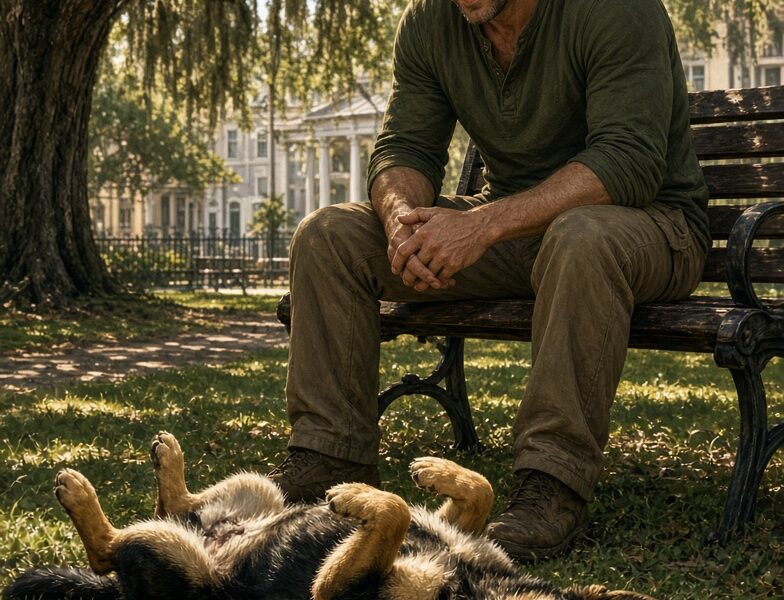
He Stole a Sandwich and Played Dead… Then a $2 Million Scam Unraveled
Beneath the moss-covered oak trees of Savannah, a skinny German Shepherd puppy snatched half a sandwich from a lonely Navy SEAL.
“Hey!” Rowan Petraus shouted.
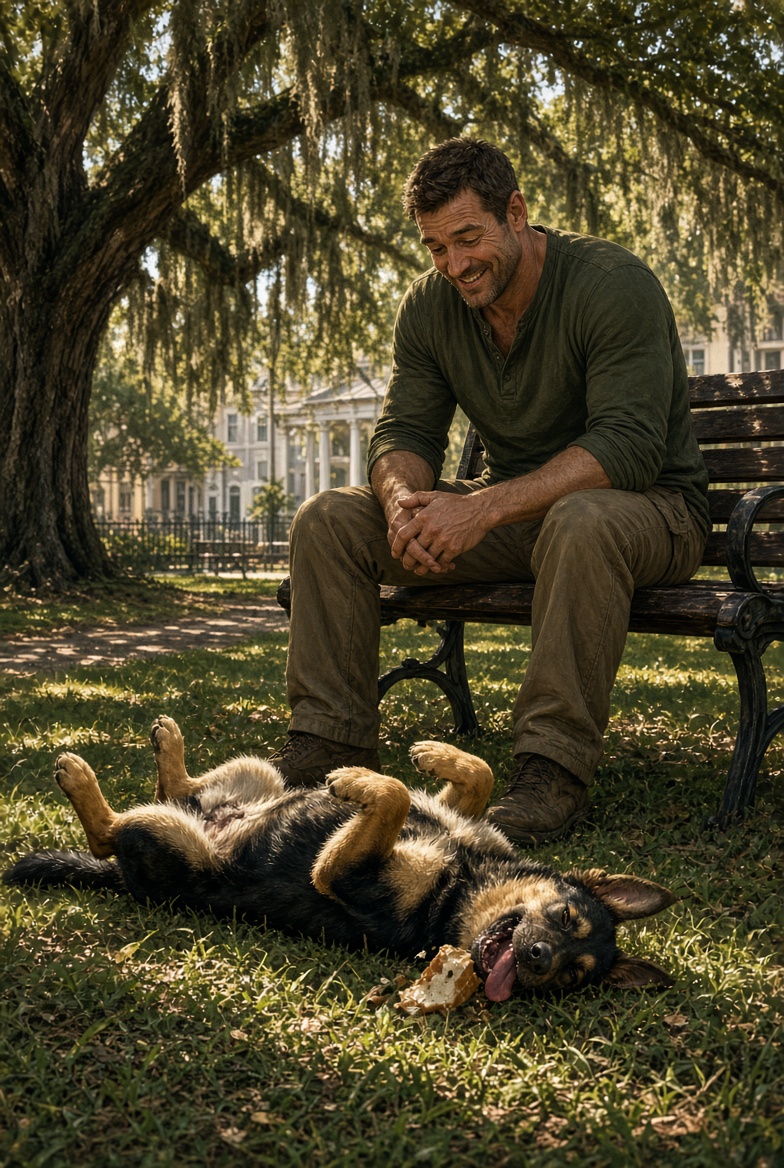
The puppy instantly collapsed onto the grass, four paws pointing skyward, tongue hanging out, pretending to be dead.
Tourists burst into laughter.
For the first time in months, Rowan laughed, too.
But then he noticed something strange: a red mark on the puppy’s leg, a shaved patch of fur, and a mysterious man demanding the dog back.
What Rowan discovered next was almost impossible to believe.
The adorable puppy had been used in staged rescue videos to collect donations from kind-hearted strangers.
Behind those videos lay a suspected $2 million deception.
And when the puppy suddenly vanished, Rowan faced a choice that would change his life forever.
Because saving this little dog meant confronting the past he had spent seven years running from.
In Savannah, Georgia, even the oldest houses seemed to remember the people who had once loved them.
Spanish moss hung from ancient live oaks like silver curtains.
Horse-drawn carriages rolled past weathered brick sidewalks, and church bells drifted through the warm late-summer air.
It was a city that seemed to believe everything deserved a second life.
Everything, perhaps, except Rowan Petraus.
At forty-five, Rowan had the broad shoulders and disciplined posture of a man who had spent years serving as a Navy SEAL.
He stood six foot four with deep amber-brown eyes, a short black beard, and dark hair touched by a narrow streak of silver above his right ear.
His face was strong, almost stern, but it was the tiredness behind his eyes that made strangers think twice before starting a conversation.
He lived behind an old mansion in a converted carriage house belonging to Mabel Whitaker, a seventy-four-year-old retired music teacher.
Mabel had once told him the little building was perfect for someone who enjoyed peace and quiet.
She had not realized just how much quiet Rowan intended to keep.
His days followed a familiar pattern: coffee before sunrise, work until his shoulders ached, a simple dinner, then silence.
He restored antique iron railings, decorative gates, and the delicate metalwork that gave Savannah’s historic homes their character.
He could spend six hours straightening a single twisted piece of wrought iron.
People trusted him with things too valuable to replace.
Yet he had long ago decided that people themselves were better off without him.
Seven years earlier, Rowan had left the Navy carrying memories he rarely discussed.
His final assignment had ended with losses that no amount of hindsight could change.
His teammates had never blamed him.
That had somehow made things worse.
Then came his mother’s final illness.
Dana, his older sister, had called repeatedly asking him to come home to Atlanta.
He had made the drive once.
He had even reached the hospital.
But he had stood outside his mother’s room, listening to voices on the other side of the door, unable to make himself enter.
His mother passed away not long afterward.
Rowan never forgot that unopened door.
Now beneath his bed, a wooden box held letters from Dana, birthday cards, reunion invitations, and a photograph of his mother smiling beside a kitchen table.
He had never thrown them away.
He had never found the courage to read most of them either.
That morning, Mabel caught him carrying a repaired section of decorative railing across the courtyard.
“You’re working too hard again,” she called from her back porch.
Her silver-white hair curled gently around her cheeks, and her pale blue eyes watched him over gold-rimmed glasses.
“Good morning to you, too,” Rowan replied.
“I’ve already had a good morning. You’re the one who looks like he wrestled a chimney.”
“It’s a railing.”
“Then I hope the railing lost.”
Rowan almost smiled.
Mabel noticed.
She always noticed.
“Get yourself a proper lunch,” she said. “And try speaking to somebody who doesn’t have hinges.”
“I speak to you.”
“Only when I corner you.”
He shook his head and continued toward his workshop.
But by noon, he took her advice—at least part of it.
He bought a thick sandwich from a neighborhood deli, wrapped the remaining half in paper, and walked toward Monterey Square.
The square was peaceful beneath the enormous oak trees.
Sunlight filtered through Spanish moss, making shifting patterns on the grass.
A few tourists admired the surrounding houses.
Somewhere nearby, a carriage horse snorted impatiently while its driver described the city’s history.
Rowan chose a shaded bench away from the busiest walkway.
He sat, unfolded the paper, and prepared to enjoy his lunch alone.
That was when something small and furry shot out from behind a low hedge.
A black-and-tan German Shepherd puppy grabbed the sandwich straight from Rowan’s hand.
For a moment, Rowan simply stared.
The puppy bounded across the grass on oversized paws, carrying a piece of bread almost as wide as its head.
“Hey!” Rowan rose from the bench, pointing one large finger toward the little thief.
What happened next was so unexpected that he forgot to move.
The puppy dropped the sandwich.
Then, with astonishing theatrical commitment, it flopped onto its back.
All four paws went straight into the air.
Its tongue slid dramatically from the left side of its mouth.
Its body became completely limp.
There it lay, looking like the most tragically defeated sandwich thief in the history of Savannah.
A nearby tourist gasped.
Another started laughing.
Within seconds, several people had stopped to watch.
An elderly woman wearing a wide-brimmed straw hat placed one hand over her heart.
“Good heavens,” she declared. “I’ve never seen anybody meet such a terrible fate over half a sandwich.”
Her husband chuckled so hard he had to steady his camera.
Someone applauded.
Then another person joined in.
Rowan stood in the middle of the grass, wondering whether he had somehow wandered into a street performance.
“Are you serious?” he asked the puppy.
No response.
Not even a twitch.
Then Rowan noticed something.
The puppy’s right eye opened the tiniest bit.
It glanced toward him.
When their eyes met, the little dog quickly closed it again—and something inside Rowan gave way.
A laugh escaped his throat.
Not a polite chuckle, not the brief breath of amusement he sometimes offered Mabel—a genuine, helpless laugh.
It surprised him so much that he laughed again.
The tourists laughed with him, but Rowan barely noticed.
For those few precious seconds, he was not a former soldier carrying seven years of regret.
He was simply a man standing under an oak tree watching a ridiculous puppy pretend to be dead because it had stolen his lunch.
“All right,” Rowan said, crouching down. “You win.”
The puppy opened both eyes.
Its tail tapped the grass.
Rowan glanced at its long, awkward legs and oversized paws.
“Look at you. You’re built like a noodle.”
The puppy rolled sideways, sprang upright, and immediately tried to retrieve the sandwich.
“Oh no. We’ve already established you’re a criminal.”
A little girl in the tourist group giggled. “What’s his name, mister?”
Rowan studied the puppy.
“Noodle,” he said.
The girl repeated it delightedly. “Noodle.”
At the sound, the puppy tilted its head.
Rowan felt a strange warmth settle in his chest.
He had not intended to name a dog.
He certainly had not intended to feel responsible for one—but now that the excitement had faded, he noticed things the laughter had hidden.
The puppy was thin, not dangerously so, but enough that its ribs were faintly visible when it turned.
Its coat was mostly black along the back with honey-brown fur on the legs and cheeks.
A tiny cream-colored mark beneath its chin resembled a grain of rice.
Its right ear stood proudly upright, while the tip of the left leaned outward.
There was also a reddish streak across one front leg.
Rowan’s smile faded.
“What’s that, little buddy?”
He reached out slowly.
Noodle hesitated, then allowed him to examine the leg.
The red coloring clung to the fur.
Rowan couldn’t see any obvious injury beneath it, but he knew better than to assume everything was fine.
A small patch of fur on the puppy’s side had also been shaved.
“Somebody’s been doing something with you,” he murmured.
Noodle looked up, wagged once, and tried to chew Rowan’s bootlace.
It was such an ordinary puppy thing that Rowan felt an unexpected pang.
He fetched a little bottled water from his bag and poured some into the clean plastic lid of his lunch container.
Noodle drank eagerly.
Then, just as Rowan lifted his hand to adjust the container, the puppy suddenly lowered itself, rolled over, and froze.
Rowan stopped.
He had not raised his voice.
He had not looked angry.
He had merely moved his hand.
A passing breeze stirred the moss overhead.
The laughter from the tourists was already fading into the distance, leaving Rowan alone with a question he couldn’t answer.
Was Noodle performing because it wanted to—or because it believed it had to?
Rowan lowered his hand. “Easy,” he said softly. “Nobody’s mad at you.”
For several seconds, Noodle remained on its back.
Then the puppy slowly turned over and crept toward him.
A small, warm nose pressed against Rowan’s fingers.
He stayed very still.
For a man who had spent years avoiding every kind of attachment, that simple touch felt unexpectedly important.
Rowan took out his phone and searched for Chatham County Animal Services.
He intended to report the puppy and arrange a veterinary examination.
Whatever the red mark meant, whatever had happened before Noodle reached the square, someone needed to make sure the little dog was safe.
A few streets away, another man was discovering that the puppy had vanished.
Trent Weller, thirty-two, stood beside a white transport van, staring at an open animal carrier.
A camera strap hung from his shoulder.
His light-brown hair was untidy, and his expression suggested he had just realized he’d made an expensive mistake.
He checked the carrier latch.
It had not clicked shut properly.
“Oh, come on,” he whispered.
Trent worked as a cameraman for Hope Rescue Network, a charitable organization that produced emotional animal rescue videos.
That afternoon, he was supposed to deliver a German Shepherd puppy to another filming location.
Instead, the carrier was empty.
He called his production manager, Kyle Brandon.
“The puppy got out.”
There was a pause. “What do you mean, got out?”
“The latch didn’t catch. I’ve checked the street. Somebody said they saw a little shepherd heading toward the square.”
Kyle’s voice sharpened. “Find him now.”
Trent swallowed. “I’m trying.”
Within minutes, Kyle arrived.
At thirty-seven, he was lean, neatly groomed, and dressed in a royal-blue Hope Rescue polo shirt.
His chestnut hair was carefully combed, and a steel ring flashed on his right hand as he gestured.
A passerby told them about a German Shepherd puppy entertaining tourists near an oak tree.
Kyle’s face tightened.
“Bring the camera,” he told Trent.
“Why?”
“Because if somebody’s got our dog, I want a record of it.”
Back at Monterey Square, Rowan was sitting on the grass beside Noodle.
The puppy had discovered that Rowan’s bootlaces were apparently more interesting than food.
“You know,” Rowan told him, “most dogs start with fetch.”
Noodle tugged harder.
“Apparently, you skip that chapter.”
For another brief moment, Rowan felt almost content.
Then a white van stopped along the street.
Two men approached.
The first wore a blue polo shirt with a rescue organization’s logo.
The second carried a camera.
“That’s our dog,” the man in blue announced.
Noodle stopped chewing.
Rowan rose slowly. “Your dog?”
“Kyle Brandon, Hope Rescue Network. That animal is under our medical care.”
Kyle extended his hand toward Noodle. “Come here, Oscar.”
The puppy stayed close to Rowan’s boot.
Kyle’s expression hardened. “We’ve been searching everywhere. You need to hand him over.”
Rowan glanced at the camera pointed in his direction. “Do you have identification? Ownership records? Veterinary paperwork?”
“We’re a rescue organization.”
“That’s not what I asked.”
Kyle looked toward Trent. “Are you getting this?”
Trent hesitated, then kept recording.
Kyle turned back to Rowan, his voice growing louder. “This man is refusing to return a sick rescue puppy.”
A few pedestrians glanced over.
Rowan kept his voice even. “I found him wandering loose. There’s a mark on his leg, and I don’t know what caused it. I’m reporting him to animal services and having a veterinarian examine him.”
“We already have veterinarians.”
“Then their record should help settle this.”
Kyle took a step closer. “You don’t understand. This dog needs treatment.”
Rowan looked at Noodle, who was now enthusiastically investigating a fallen leaf. “He needs someone to check him. That much we agree on.”
Kyle reached toward the puppy, but Rowan gently guided Noodle behind his leg.
“Please don’t,” Rowan said. “Let’s handle this properly.”
He did not raise his voice.
That seemed to irritate Kyle even more.
For a moment, nobody spoke.
Then Kyle pointed sharply toward the puppy. “Oscar.”
Noodle reacted instantly.
The little German Shepherd flopped onto its back.
Four paws in the air, tongue hanging left, body perfectly still.
The same performance, the same extraordinary precision.
Trent lowered the camera slightly.
Kyle stopped talking.
And Rowan felt the last traces of his amusement disappear.
Earlier, he had believed the puppy’s dramatic collapse was a silly trick.
Now he had watched it happen after two different men used nearly identical gestures.
He remembered the strange red mark, the shaved patch of fur, and how Noodle had rolled over when he merely moved his hand.
Nothing had been proven, but something was wrong.
Kyle seemed to realize he had revealed more than he intended.
He straightened his polo shirt and glanced toward Trent. “We’ll deal with this through the proper channels,” he said tightly.
“Good,” Rowan answered.
Kyle turned toward the van.
Then he stopped.
Without looking back, he spoke in a voice low enough that only Rowan could clearly hear.
“You have no idea what that dog is worth.”
The words settled between them.
Rowan looked down.
Noodle had rolled upright and moved close to his boot, one oversized paw resting against the leather—a tiny creature with crooked ears, a cream-colored chin, and absolutely no understanding of the trouble surrounding him.
Rowan had spent seven years convincing himself that caring about someone only gave the world another way to hurt him.
Yet standing beneath the old Savannah oaks, he found himself unwilling to step away.
He gently rested his hand on Noodle’s head, and as the white van disappeared down the street, one question remained.
Why was a little puppy worth so much to a man who seemed far more worried about losing him than about whether he was safe?
The first thing Rowan Petraus discovered about having a puppy was that silence had apparently become optional.
By seven the following morning, something had already scraped across his kitchen floor, knocked against a chair leg, and attempted to chew the corner of his work boot.
“Noodle.”
Two oversized ears appeared from behind the kitchen table.
One stood straight.
The other leaned sideways as though it had not quite made up its mind about growing up.
Rowan folded his arms. “That’s a seventy-dollar boot.”
Noodle blinked.
“Not that you’re concerned.”
The puppy wagged his tail, dropped the bootlace, and proudly presented Rowan with a dust-covered wooden spoon.
Rowan stared at it. “Well, at least you’re diversifying.”
For the first time in years, the little carriage house behind Mabel Whitaker’s Savannah mansion sounded like somewhere a person actually lived.
But Rowan had barely slept.
After the confrontation at Monterey Square, he had contacted the local animal services office and followed the instructions for reporting a found dog.
With the office visit and veterinary appointment arranged for the following morning, he had kept Noodle safely inside overnight.
The little German Shepherd had slept near the kitchen doorway, waking occasionally to check whether Rowan was still there.
Each time Rowan had heard the soft movement of paws against the floor, and each time something in his chest had tightened.
He could still hear Kyle Brandon’s parting words.
You have no idea what that dog is worth.
Rowan looked at the puppy now investigating his coffee mug. “Whatever he meant,” Rowan murmured, “we’re going to find out.”
Noodle sneezed.
It was not exactly an answer, but it was company.
By eight-thirty, Rowan had secured a properly fitted temporary collar and was guiding Noodle into his truck.
The puppy hesitated at the passenger-side door.
Rowan lifted him gently into a secured travel carrier on the rear seat and placed an old towel beneath him.
“First rule,” he said, “no eating the upholstery.”
Noodle promptly began chewing the towel.
“Excellent start.”
The veterinary clinic sat on a quiet Savannah street shaded by magnolias and marked by a modest blue sign.
Inside, the air smelled faintly of disinfectant and clean laundry.
Dr. Meredith Sloan greeted Rowan in the examination room.
At fifty-two, Meredith had the composed manner of someone who had spent decades dealing with frightened animals and worried owners.
Chestnut hair threaded with silver was tied back neatly, and burgundy reading glasses rested in the pocket of her white coat.
She looked at Noodle, then at Rowan. “Which one of you has been causing trouble?”
Rowan pointed at the puppy.
Noodle sat down with an expression of profound innocence.
Meredith smiled. “I see a repeat offender.”
Her manner changed when she examined the reddish streak on Noodle’s front leg.
She parted the fur carefully, inspected the skin, and cleaned a small area with a damp cloth.
The red coloring transferred almost immediately.
Rowan frowned. “That’s not blood?”
“No. It appears to be water-soluble food coloring. I’ll document what I’m seeing, but there’s no wound underneath.”
She examined the shaved patch on his side.
The skin was slightly irritated, though otherwise intact.
“He’s a little underweight,” Meredith continued. “And he shows some signs of stress, but his breathing is normal. His heart sounds good, and I don’t see evidence of the emergency medical condition you described from that man’s claims.”
Rowan leaned against the examination table. “So why make him look injured?”
Meredith did not answer immediately. “A veterinarian can tell you what an examination shows,” she said. “Why somebody created that appearance is a different question.”
Noodle had meanwhile discovered the edge of her sleeve.
He gave it a hopeful lick.
“Yes, sweetheart,” Meredith said. “You’re very persuasive.”
She offered a small puppy-safe treat.
Rowan pointed toward a container beside the table. “Should I put his paperwork over there?”
Before Meredith could answer, Noodle collapsed dramatically onto his back.
Four paws in the air, tongue hanging left.
Meredith went still.
Rowan lowered his hand. “There. That’s what I was telling you.”
Noodle remained motionless.
Meredith crouched, spoke gently, and waited.
After a moment, the puppy opened his right eye.
She smiled faintly. “Well, he’s certainly committed to the role.”
“Is that normal?”
“Teaching a dog to play dead isn’t unusual. Plenty of families do it for fun. But he’s responding very quickly to particular movements and sounds. Someone has probably practiced this with him.”
Rowan watched the puppy slowly rise and search for another treat.
Something about that small movement troubled him.
Noodle seemed to understand how to win applause.
Yet when Rowan reached down simply to stroke his head, the puppy hesitated, uncertain what was expected.
Rowan knelt.
He rested one hand on the edge of the table, offering the other without making any commanding gesture.
Noodle approached slowly.
A damp nose touched his fingers.
Rowan did not ask for anything.
He simply waited—and that somehow seemed harder for the little dog to understand than any trick.
Meredith watched them quietly. “Give him time,” she said. “He’s young. He can learn that attention doesn’t always come with a performance.”
Rowan scratched gently beneath the puppy’s chin. “Sounds fair,” he whispered.
Meredith scanned Noodle for a microchip.
The handheld reader beeped.
“Here we are.”
She recorded the identification number and contacted the appropriate registry through her clinic’s normal procedures.
The record linked the puppy to the name Oscar and identified an organization involved in an earlier transfer of animals to Hope Rescue Network.
It did not, however, establish the whole chain of ownership.
Meredith printed the available information.
“This gives animal services something to verify,” she explained. “A microchip helps identify an animal. It doesn’t settle every ownership dispute by itself.”
Rowan nodded.
He had not forgotten Kyle’s demand, nor had he forgotten the camera.
By late morning, Rowan was sitting across from Officer Lena Whitam at Chatham County Animal Services.
Lena was thirty-eight, with ash-blonde hair pulled into a low bun and the steady, unhurried expression of someone accustomed to hearing conflicting stories.
She examined Rowan’s report, Meredith’s findings, and the microchip information.
“Mr. Brandon’s organization has contacted us as well,” she said.
Rowan straightened. “Then he can explain the paperwork.”
“That’s what we’re trying to establish.”
Lena explained that Hope Rescue Network had supplied documents claiming responsibility for the puppy, but the available records named different entities at different stages of transfer.
Some information still required confirmation.
The official found-animal procedures would continue, including the applicable holding requirements and efforts to verify ownership.
Rowan’s jaw tightened. “Am I going to have to hand him over to that man?”
“I’m not going to promise you an outcome before the records are checked,” Lena replied. “My responsibility is to make sure the process is followed and the dog remains appropriately cared for.”
Rowan respected the answer, even though he disliked the uncertainty.
After reviewing the circumstances, Lena arranged a temporary care placement with Rowan under the conditions authorized by the agency.
There would be follow-up contact, restrictions on transferring the puppy, and an understanding that Rowan was not yet his legal owner.
Rowan signed the documents.
Then he looked down.
Noodle was asleep beside his chair, one oversized paw resting on Rowan’s boot.
Lena followed his gaze. “He’s made himself comfortable.”
“He’s got expensive taste.”
“He seems to have chosen the boots.”
Rowan almost smiled.
That afternoon, Rowan returned to the carriage house with a bag of puppy food, a water bowl, a soft chew toy, and a set of instructions from Meredith.
He placed a folded army blanket inside a washable dog bed near the kitchen.
Noodle investigated it, sniffed it, turned around twice, then grabbed the edge of the blanket in his mouth and began dragging it down the hallway.
Rowan watched with growing disbelief. “Where exactly are we going?”
Noodle continued pulling until the blanket rested outside Rowan’s bedroom.
Then he lay down on it, his chin settled between his paws.
Rowan stood in the doorway, looking at the little animal who had somehow rearranged the geography of his home in less than a day.
“All right,” he said softly. “I suppose that’s your room now.”
For years, Rowan had kept the bedroom door almost closed.
He had preferred the feeling of being separated from the rest of the house.
That evening, he left it open.
Not wide. Just enough.
Over the next several days, life developed a rhythm Rowan had not anticipated.
Noodle learned when breakfast was served.
He learned which door led to the courtyard.
He discovered that leather gloves were apparently irresistible and that a bootlace could occupy an entire morning.
He also began learning something much more important.
Whenever he stole an object and looked ready to collapse into his dramatic pose, Rowan remained calm.
He offered an appropriate toy instead.
When Noodle sat naturally, Rowan praised him.
When Noodle waited patiently, he received a treat.
There were no harsh commands, no sudden demands for a performance.
One afternoon, Noodle sat beside Rowan’s workbench without being asked.
Rowan noticed him waiting quietly.
“Well, look at that.”
He set aside his tools, washed his hands, and gave the puppy a gentle scratch behind the ears.
No tricks required.
Noodle leaned against his leg.
Rowan remained there a little longer than necessary.
Mabel noticed the changes almost immediately.
She arrived one afternoon wearing a dusty-blue floral dress and carrying a small shopping bag.
“I’ve brought a gift,” she announced.
Rowan looked suspicious. “For me?”
“Don’t flatter yourself.”
From the bag, she produced a rubber puppy toy.
Noodle greeted it with tremendous enthusiasm.
Within seconds, he was trotting across the floor with the toy in his mouth, tail swinging from side to side.
Mabel watched him affectionately. “I see you finally found someone patient enough to listen to you talk about iron railings.”
“He mostly chews while I talk.”
“Then you found a remarkably honest audience.”
Rowan laughed quietly.
Mabel’s eyes softened.
She remembered months when this house had remained so silent that even the courtyard birds sounded unusually loud.
Now she could hear Rowan speaking through the open workshop door.
Not to another person—to a puppy.
And sometimes, for reasons known only to the two of them, laughing.
Later, while Rowan prepared coffee, Mabel sat at his kitchen table scrolling through photographs of rescue organizations on her phone.
She had been curious about Hope Rescue Network ever since he mentioned Kyle.
“Oh, Rowan,” she said suddenly.
Something in her voice made him turn.
She held out her phone.
On the screen was a video thumbnail showing a young German Shepherd lying on a white blanket.
Large letters read: “Help save Lucky before it’s too late.”
Mabel enlarged the image. “Look under his chin.”
Rowan leaned closer.
A small, cream-colored mark almost shaped like a grain of rice.
He looked toward Noodle, who was currently trying to push his rubber toy beneath the sofa.
The same mark. The same broad puppy paws. The same right ear standing proudly while the left tipped outward.
Rowan took the phone. “How old is this video?”
“Not quite three weeks.”
He played it.
A sorrowful voice described Lucky as a desperately ill puppy requiring immediate treatment.
The camera lingered on a shaved patch along the dog’s side.
Rowan felt his stomach tighten.
It was the same location Meredith had examined.
The narrator pleaded for donations before time ran out, and underneath the video, hundreds of people had written messages wishing the puppy well.
Some said they had donated. Others said they were praying.
Rowan looked at Noodle.
The little dog had finally retrieved his toy and was now wrestling triumphantly with it.
No one watching the video would have expected to see such a lively puppy.
Mabel’s expression grew troubled. “Perhaps there’s an explanation.”
“Maybe,” Rowan said—but he saved the link.
That evening, Meredith recommended an independent video editor who had experience reviewing online advertising material.
Her name was Iris Bellweather.
At twenty-nine, Iris worked from a small upstairs studio filled with monitors, external drives, and more coffee mugs than she cared to admit.
Her copper-brown bob framed a face sprinkled with freckles, and transparent-framed glasses kept sliding down her nose whenever she leaned toward the screen.
When Rowan explained the situation, Iris listened without interrupting.
Then she examined the video.
“One matching feature might be coincidence,” she said. “Several matching features captured close together in time are more interesting.”
She began reviewing publicly available posts from Hope Rescue Network.
The work took hours.
Rowan brought Noodle’s veterinary notes, screenshots, and the available microchip information.
Iris compared the markings, ear positions, coat patterns, filming backgrounds, and upload dates.
By late evening, fourteen suspicious rescue videos lay organized across her screen.
They had been posted over more than a year.
Different names. Different claimed emergencies. Different desperate appeals.
Some showed German Shepherds. Others featured dogs with similar coats or body shapes.
Several appeared to reuse the same animals.
Iris was careful not to draw conclusions where the images were unclear.
But four recent videos, all published within roughly six weeks, contained a puppy whose distinctive markings strongly matched Noodle.
Oscar. Lucky. Benny. Angel.
Four names for what appeared to be the same little dog.
The remaining ten videos involved other animals, with several additional patterns suggesting repeated appearances.
Each appealed to viewers’ compassion.
Each emphasized urgency.
And each provided a convenient way to donate.
Rowan stared at the screen. “How many people believed these stories?”
Iris scrolled through the comments. “Hundreds beneath one video. Thousands of reactions beneath another. I don’t know yet,” she answered. “And we haven’t established what happened to the money, but these are serious inconsistencies.”
Rowan said nothing.
He kept thinking of the elderly woman at Monterey Square laughing beneath her straw hat, of Mabel carefully choosing a puppy toy, of all the people who would give what little they could to help an animal they believed was suffering.
Their kindness was real.
That was what made the possibility of deception so difficult to bear.
Later that night, Rowan returned home with copies of the images Iris had prepared.
The carriage house was quiet.
Noodle slept beside his chair, a little black-and-tan bundle curled around the rubber toy Mabel had given him.
Rowan opened the video labeled Angel.
A solemn narrator spoke about a helpless puppy needing immediate assistance.
Then, faintly beneath the narration, came a familiar command from someone beyond the camera.
“Oscar, down.”
At Rowan’s feet, Noodle stirred.
His ears twitched, and before Rowan could pause the recording, the little German Shepherd rolled onto his back.
Four paws pointed toward the ceiling. Tongue slipped sideways. Right eye barely open.
Rowan stared.
Then he closed the laptop.
The room returned to silence.
He knelt beside Noodle, who slowly rolled upright and pressed his nose against Rowan’s hand.
“You weren’t sick, were you, buddy?” Rowan whispered. “They just wanted people to think you were.”
Noodle leaned closer.
Rowan stroked the little cream-colored mark beneath his chin.
A moment later, his phone vibrated.
Iris had sent one final comparison image showing Noodle’s markings across four different rescue videos.
Beneath it was a single question: “If they lied about this puppy, where did all those donations go?”
By the third week of September, Rowan Petraus had learned that a four-month-old German Shepherd could rearrange a man’s entire life without ever asking permission.
His mornings no longer began with silence.
They began with the soft jingle of a collar, the impatient tapping of oversized paws, and a small black-and-tan face appearing beside his bed precisely six minutes before the alarm.
Noodle had never learned to read a clock.
He simply believed breakfast was a matter of personal urgency.
“You’re early,” Rowan murmured one morning.
Noodle wagged his tail.
“Six minutes.”
The tail wagged faster.
“You know, the Navy was less demanding.”
Noodle answered by dropping a stolen work glove onto Rowan’s chest.
Outside, Savannah was still waking beneath its ancient oak trees.
September sunlight spread across the brick courtyard, and a warm breeze moved through the Spanish moss.
For seven years, Rowan had measured each day by the work waiting in his restoration shop.
Now he measured it by smaller things.
Whether Noodle had eaten. Whether the puppy’s weight was improving. Whether the little left ear would finally stand straight. And whether Rowan could finish a cup of coffee before his new roommate discovered another household object worth stealing.
The arrangement remained temporary.
Officer Lena Whitam from Chatham County Animal Services had explained that ownership records were still being examined.
Rowan followed the agency’s conditions carefully, kept the veterinary appointments, and answered every follow-up call.
He knew Noodle was not legally his dog yet.
But explaining that distinction to his heart was becoming increasingly difficult.
Across town, Iris Bellweather was discovering a different kind of difficulty.
The more she studied Hope Rescue Network, the less its stories made sense.
Fourteen suspicious videos were only the beginning.
Their fundraising pages followed remarkably similar patterns.
A frightened dog. An urgent medical claim. A countdown clock. A plea for money before it was too late.
Then, sometimes only days afterward, an announcement that the animal had made a miraculous recovery.
The happy endings should have been comforting.
Instead, they raised questions.
Where were the veterinary reports?
Why did some dogs disappear from the organization’s adoption listings?
Why did the fundraising pages describe medical expenses without providing meaningful accounting of how donations were spent?
Iris worked carefully, comparing publicly available records with video timestamps and archived posts.
She discovered that several supposedly different rescues had been filmed in rooms with identical floor seams and window reflections.
One video used pale-blue curtains. Another used a white medical backdrop.
But beneath both, a peculiar scratch in the floor appeared in precisely the same place.
Lighting had changed. Camera angles had changed. The story had changed.
The room had not.
Iris also found an old email exchange from a short project she had completed for Hope Rescue Network the previous year.
An employee had requested that she make a dog’s condition appear more serious by using slower footage and adding increasingly urgent captions.
At the time, Iris had questioned the instruction.
She had not accepted the proposed changes.
Now, the message felt considerably more troubling.
She called Rowan.
“I found something worth preserving,” she said. “Another dog. An editing instruction. It doesn’t prove the whole organization is dishonest, but it shows someone wanted to exaggerate what viewers were seeing.”
Rowan stood beside his workshop window watching Noodle investigate a fallen magnolia leaf. “Then we show people.”
“Not yet,” Iris answered. “We document it first.”
Rowan disliked that answer, but he understood it.
He had spent enough years making decisions under pressure to know that certainty and suspicion were not the same thing.
Dr. Meredith Sloan agreed.
When Rowan brought Noodle in for a routine weight check, she reviewed the new information with him.
“Your concerns are reasonable,” Meredith said. “But a misleading video doesn’t establish every allegation we’re discussing.”
Rowan looked toward Noodle, who was attempting to charm a veterinary assistant into surrendering another treat.
“What would?”
“Independent records. Consistent evidence. People who can explain what actually happened.” She paused. “And remember, Rowan, protecting this puppy doesn’t require you to solve the entire case yourself.”
He looked away.
That last sentence sounded uncomfortably familiar.
Over the following days, Rowan and Iris organized the information they already had.
They preserved links, screenshots, dates, and copies of relevant correspondence.
They distinguished confirmed facts from questions that still needed answers.
They submitted their concerns through the appropriate reporting channels rather than making public accusations.
It was slow work, and slow work gave Rowan far too much time to think.
One afternoon, Iris forwarded him a message from a private online group of people who had donated to Hope Rescue Network.
A woman named Eleanor Vale had agreed to speak with him.
She lived in Charleston, South Carolina.
She was sixty-eight years old, and according to her brief message, she had given money to the organization because she knew what it felt like to lose a dog.
Rowan called her that evening.
A gentle voice answered after the third ring.
“Hello.”
“Mrs. Vale? My name is Rowan Petraus. Iris Bellweather said you might be willing to speak with me.”
“Oh, yes—the gentleman with the little shepherd.”
“That’s me.”
“Is he all right?”
The question came so quickly that Rowan paused. “He’s doing well. Gaining weight. Causing trouble.”
Eleanor laughed softly. “That sounds encouraging.”
Her voice carried the warmth of someone who had spent much of her life making other people comfortable.
She described living alone in a small Charleston house after losing her husband several years earlier.
Her old dog, Walter, had been her companion through the quietest months.
Walter had liked sleeping beneath the kitchen table and stealing socks from the laundry basket.
When the little dog eventually passed away from old age, the silence in Eleanor’s house had become almost unbearable.
“I kept putting out his water bowl,” she admitted. “For nearly a week. Silly, isn’t it?”
“No, ma’am,” Rowan said.
He glanced at Noodle’s bowl beside the kitchen wall. “Not silly at all.”
Eleanor had discovered Hope Rescue Network one evening while scrolling through videos.
A small dog needed urgent treatment. Then another. And another.
She began donating modest amounts, usually on the dates when she missed her husband or Walter most deeply.
It gave her comfort to believe she could help another animal remain with a family that loved it.
Rowan listened.
He had expected anger.
Instead, he heard something that troubled him far more.
Hope.
Eleanor was quiet for a moment before speaking again.
“I don’t mind that I gave money, Mr. Petraus. Even if some of it was wasted, that isn’t what hurts.”
“What does?”
“The thought that somebody might have used an animal’s suffering to make people like me feel useful.”
She drew a slow breath. “I didn’t give because I wanted to watch a miracle. I gave because I believed somebody needed me.”
Rowan looked through the kitchen doorway.
Noodle was asleep beside his work boots, one paw stretched across the leather.
For seven years, Rowan had convinced himself that nobody needed him.
He had treated that belief almost like a kindness.
Stay away. Ask for nothing. Become nobody’s burden.
But now there was a water bowl beside his kitchen wall, a rubber toy under his sofa, and a puppy who waited for him at the bedroom door every morning.
Someone needed him to get out of bed.
Someone needed him to come home.
The realization was almost painfully simple.
“Mrs. Vale,” he said quietly, “thank you for telling me.”
“Will you promise me something?”
“If I can.”
“Don’t let what these people may have done convince you that kindness was the mistake.”
Rowan closed his eyes briefly. “I’ll remember that.”
After the call, he remained at the table for a long while.
Then Noodle woke, stretched his little legs, and walked over to rest his chin on Rowan’s knee.
There was no dramatic trick, no request for applause—just a puppy wanting to be near him.
Rowan lowered his hand. “I’m beginning to think you’re teaching me something, little troublemaker.”
Noodle sneezed against his trousers.
“Something expensive, probably.”
That weekend, Rowan decided the puppy needed a proper place for his leash.
He selected a narrow piece of wrought iron from his workshop and heated it carefully until it was ready to shape.
The work required steady hands and patience.
Those were things Rowan understood.
He bent the metal into a curling shape resembling a loose strand of spaghetti.
Or at least that had been the intention.
When he finished, the hook leaned slightly to one side.
Rowan examined it with disappointment. “Oh, that’s embarrassing.”
From a safe spot beyond the workshop doorway, Noodle sat watching him.
The puppy’s tail thumped against the floor.
“Don’t encourage me. It’s crooked.”
Rowan reached for his tools to straighten the piece.
“What’s crooked?”
Mabel Whitaker stood in the courtyard carrying a small basket of freshly baked biscuits.
Rowan held up the hook. “Supposed to look like a noodle.”
Mabel studied it. Then she smiled.
“It does. It leans.”
“So do half the beautiful oak trees in Savannah.”
“It’s not symmetrical.”
“Neither is your dog.”
As though summoned by the insult, Noodle tilted his uneven ears and gave a cheerful bark.
Mabel laughed.
Then she looked at Rowan with unexpected tenderness. “Not everything beautiful has to be perfect.”
The words remained between them.
Rowan looked at the hook again.
He remembered the elaborate iron gates he had repaired over the years, each one marked by weather and age.
Some had survived hurricanes. Some had been bent by fallen branches. Others simply carried the evidence of a hundred seasons.
He had never considered their scars reasons to throw them away.
Yet he had spent seven years treating his own imperfections as proof that he belonged alone.
Slowly, Rowan put down his tools.
He mounted the hook beside the carriage house door exactly as it was.
Noodle immediately attempted to steal the leash hanging from it.
“Wonderful,” Rowan said. “My first customer is also a thief.”
Mabel laughed all the way back across the courtyard.
Meanwhile, Hope Rescue Network continued publishing its polished appeals.
At the center of those campaigns stood Vivien Harrow.
Forty-three years old, with carefully styled champagne-blonde hair and cool blue eyes, Vivien presented herself as a devoted advocate for vulnerable animals.
Her public appearances were immaculate—ivory blazers, pearl earrings, a warm, measured voice.
She had once worked in digital marketing, where she learned how images, timing, and carefully chosen words could move an audience.
Now she spoke about compassion as though it were the guiding principle of every decision she made.
In one promotional interview, she smiled into the camera and said that no animal should ever be forgotten.
The statement was accompanied by footage of grateful dogs, cheerful volunteers, and emotional adoption stories.
Viewers praised her generosity.
Few knew how much of the organization’s online material was coordinated by Kyle Brandon, its production manager.
Kyle handled filming schedules, edited campaign releases, and responded aggressively whenever viewers questioned inconsistencies.
Vivien controlled the larger fundraising strategy.
Kyle controlled much of what the public saw.
Iris watched the interview twice—not because Vivien sounded suspicious, because she sounded so completely believable.
That, Iris realized, was what made careful verification important.
A beautiful message did not make every claim behind it true.
Back at the carriage house, Rowan’s days had settled into an unfamiliar kind of peace.
Noodle had learned to sit without theatrics.
He had learned that a quiet wait could earn praise, and he had developed a particular fondness for carrying Rowan’s work gloves into the courtyard, where he arranged them in a pile like treasures.
On sunny afternoons he slept in a rectangle of warmth near the workshop wall.
Sometimes Rowan caught himself talking aloud about the history of the railings he was restoring.
“That gate’s older than both of us put together,” he told Noodle one afternoon.
The puppy yawned.
“Show some respect.”
Then came a night when the peace proved less reliable.
A distant thunderstorm rolled across Savannah.
The rain tapped against the windows, and the low rumble stirred memories Rowan had spent years trying to bury.
He lay awake, staring at the ceiling.
His thoughts returned to his final military assignment, then to the hospital corridor in Atlanta, to the door he had never opened.
He turned onto his side and closed his eyes, but sleep would not come.
A soft dragging sound interrupted the darkness.
Rowan lifted his head.
Noodle was pulling his old army blanket down the hallway.
It took the puppy several determined attempts to maneuver the bulky fabric around the door frame.
At last he reached Rowan’s room.
He arranged the blanket beside the bed, turned in a circle, and lay down.
No performance. No fuss.
Just the sound of a small animal settling near someone he trusted.
Rowan watched him. “You didn’t have to move in here.”
Noodle sighed contentedly.
Outside, the thunder moved farther away.
Rowan lowered one hand over the edge of the mattress.
Noodle shifted closer until his warm head rested beneath Rowan’s fingers.
For once, Rowan did not try to force the memories away.
He allowed them to pass, and somewhere between the fading rain and the steady breathing of a sleeping puppy, he finally drifted into sleep.
When morning arrived, sunlight lay across the floor.
Rowan woke to birdsong.
He had slept through the rest of the night.
The room did not feel empty.
Later that day, Iris received an unexpected message through a private contact address she used for professional inquiries.
The sender did not provide a name.
The message warned her that Hope Rescue Network had been producing staged rescue material at a facility near the industrial district along the Savannah River.
According to the sender, the organization had more animals involved than the publicly identified cases suggested.
Iris read the message several times.
It offered no documents, no photographs, no verifiable identity.
She could not yet determine whether the claim was credible.
Still, its details matched some of the inconsistencies she had documented.
She called Rowan.
“Somebody contacted me about a warehouse,” she said.
“What warehouse?”
“Near the river. They claim Hope Rescue is filming staged material there.”
Rowan glanced toward his truck keys. “Send me the location.”
“Rowan, I can take a look.”
“That’s exactly what you shouldn’t do.”
He exhaled slowly. “I’m not planning to cause trouble.”
“That doesn’t mean trouble won’t find you.”
A few minutes later, Meredith joined the conversation by phone after Iris asked for her advice.
“Rowan,” the veterinarian said, “you have a puppy in temporary care and an unresolved ownership dispute. Going to an unknown facility based on an anonymous message could complicate everything.”
He leaned against the kitchen counter. “I hate doing nothing.”
“Then don’t do nothing. Preserve what you found. Pass the information to the proper people. Let it be investigated.”
Noodle approached and rested one paw on Rowan’s boot.
Rowan looked down.
He thought about the hospital corridor, about the years he had spent alone, believing every difficult situation demanded either complete control or complete withdrawal.
Perhaps there was another way.
“All right,” he said at last. “We do this properly.”
That evening, Iris was organizing her evidence files when a second message arrived.
This one appeared to come from someone claiming to have worked inside Hope Rescue Network.
It contained only seven words: “Those dogs weren’t dying. They were working.”
Iris sat motionless before the screen.
Then she reached for her phone.
The first sign that something was wrong came on a Tuesday morning when Rowan Petraus received a phone call from a woman who had trusted him with her family’s ironwork for nearly six years.
“Rowan, I’m sorry,” she said. “We’re going to have to postpone the restoration.”
He stood inside his workshop holding a small brass hinge between two fingers. “Is something wrong with the measurements?”
“No—your work has always been wonderful.” There was a hesitation. “My daughter saw something online about a dog.”
Rowan looked toward the open courtyard door.
Noodle was asleep in a patch of sunlight, his black-and-tan body stretched across the bricks, one ear standing straight while the other leaned sideways.
“What did she see?”
The woman lowered her voice. “I really don’t know what’s true anymore.”
After the call ended, Rowan remained beside his workbench for several seconds.
Then he opened his phone.
A video was spreading through local social media groups.
The title read: “Former Navy SEAL refuses to return sick rescue puppy.”
Rowan pressed play.
There he was, standing beneath the oak trees at Monterey Square.
His olive combat shirt was unmistakable.
His arm was extended, one finger pointed toward a small German Shepherd.
The footage cut abruptly.
Noodle appeared lying on his back, four paws in the air.
Then came Kyle Brandon’s voice: “This man has refused to return a puppy receiving medical care through Hope Rescue Network.”
Another caption appeared: “Help us bring Oscar home.”
Rowan watched it a second time.
The laughter was gone.
The elderly woman in the straw hat was gone.
The stolen sandwich was gone.
So was the moment when Noodle had opened one eye, looking for applause.
All that remained was an imposing former soldier apparently intimidating a helpless puppy.
Someone had taken a moment of innocent laughter and reshaped it into something ugly.
And thousands of strangers were beginning to believe it.
Across Savannah, Vivien Harrow sat behind a polished desk in Hope Rescue Network’s administrative office.
Her ivory blazer was immaculate.
Champagne-blonde hair fell neatly over her shoulders, and pearl earrings caught the light from a nearby window.
On her computer screen was a summary of the concerns that had been submitted about her organization.
Questions about repeated rescue footage. Questions about medical claims. Questions about donations.
Vivien closed the document.
Kyle Brandon stood opposite her, tapping his phone against his palm.
“People are asking why the same puppy appears in different campaigns,” he said.
“People ask questions every day.”
“This is different. Someone’s organizing the information.”
Vivien regarded him calmly. “Then give the audience a simpler story.”
Kyle raised an eyebrow.
She turned her monitor toward him.
A photograph of Rowan at Monterey Square filled the screen.
“People understand a stolen dog,” Vivien said, “especially when they believe the dog is sick.”
Kyle glanced at the image.
“And the ownership paperwork?”
“Let the proper people handle the paperwork. Your responsibility is public confidence.” Her voice remained smooth. “We need people looking at the man who took the puppy, not at our organization.”
By lunchtime, Kyle’s edited video had spread far beyond Hope Rescue Network’s original followers.
The comments multiplied.
Some viewers questioned why Rowan had been allowed to keep the puppy.
Others demanded that authorities intervene.
A few asked for the complete recording, but their questions disappeared beneath a growing tide of anger.
By afternoon, Rowan’s business telephone had rung eleven times.
Seven callers hung up when he answered.
Three demanded that he return Noodle.
The last told him he ought to be ashamed.
Rowan placed the telephone face down on his workbench.
He had repaired iron gates damaged by storms, years of neglect, and careless renovations.
He knew how to identify a broken hinge.
He knew how to strengthen a weakened joint.
But he had no idea how to repair a reputation being pulled apart by strangers.
From the doorway came a soft scraping sound.
Noodle appeared carrying one of Rowan’s leather work gloves.
The puppy approached proudly and dropped it at his feet.
Rowan looked down. “Not now, buddy.”
Noodle’s tail slowed.
The little dog sat waiting.
Rowan immediately regretted the sharpness in his voice.
He crouched and rubbed the soft fur beneath Noodle’s chin. “Sorry. You’ve done nothing wrong.”
Noodle rested one oversized paw against Rowan’s knee.
For a moment, that simple gesture was enough.
Then another notification sounded, and Rowan felt the walls of his carefully ordered life beginning to close around him.
The following afternoon, three strangers appeared outside Mabel Whitaker’s wrought-iron gate.
Two were recording with their phones.
A woman wearing sunglasses called toward the carriage house. “We know the dog is in there.”
Rowan heard her from his workshop.
He started toward the courtyard, but Mabel was already crossing her porch.
At seventy-four, Mabel was not particularly tall.
Her white curls moved in the breeze, and her dusty-blue dress brushed against her knees, but she carried herself with the unmistakable authority of a retired music teacher who had once managed forty restless children armed with recorders.
“May I help you?” she asked.
“We’re here about the rescue dog,” the woman replied.
“Then you may contact animal services.”
“That man is keeping a sick puppy.”
Mabel folded her hands. “The puppy has received veterinary care. The matter is being handled through the proper channels.”
One of the visitors raised his phone. “Are you defending him?”
“I’m asking you to respect private property.”
“We have a right to know what’s happening.”
“And you have every opportunity to ask the appropriate authorities.” Mabel smiled politely. “Now, unless one of you has an appointment to discuss nineteenth-century iron railings, this conversation is finished.”
The visitors looked at one another.
They eventually walked away, still speaking into their phones.
Mabel remained at the gate until they were gone.
Then she called the local police non-emergency number to report the disturbance and ask for assistance if more visitors arrived.
Rowan stepped into the courtyard. “You shouldn’t have had to do that.”
Mabel turned. “And you shouldn’t have to defend yourself against a story somebody deliberately cut in half.”
“They could come back.”
“Then we’ll call again.”
He looked at the street beyond the gate. “I can find somewhere else to work for a while.”
Mabel’s expression changed. “Rowan, don’t you dare start packing because somebody with a camera has forgotten how to behave.”
He said nothing, but Mabel saw the familiar withdrawal settling over his face—the expression she had watched for years whenever someone tried to get too close.
And she knew that this time the danger was not only outside her gate.
It was in Rowan’s growing determination to disappear again.
That evening, Rowan sat alone at his kitchen table.
Noodle slept near the bedroom doorway.
The carriage house was quiet except for the ceiling fan and an occasional vehicle passing on the distant street.
Rowan’s phone lay beside a pile of unopened mail.
He had silenced the notifications.
Still, his mind supplied the accusations without needing to read them.
Thief. Cruel. Dishonest.
He had spent seven years avoiding attention.
Now people who had never met him were discussing his character, his military service, even the place where he lived.
He closed his eyes, and an older memory returned.
Not Savannah. Not Monterey Square.
A distant assignment near the end of his Navy career—a difficult moment when the men under his responsibility had depended on a decision only he could make.
There had been no perfect option.
Rowan had followed the information available, made the choice he believed would protect his team, and brought his men through an extraordinarily difficult situation.
But not everyone involved had returned to the life they had known before.
His teammates understood the circumstances.
They had told him so repeatedly.
Rowan had never accepted their forgiveness because he could not offer himself any.
After leaving the Navy, he had believed distance would make him easier to forget.
Then his mother became ill.
Dana had called from Atlanta.
At first, Rowan answered. Then less often.
Eventually, he stopped.
One afternoon, he drove the long road from Savannah to the hospital where his mother was receiving care.
He remembered the smell of floor cleaner, the low voices at the nurses’ station, the folded paper in his hand bearing her room number.
He had reached her door.
His fingers had touched the handle.
Then he heard his mother’s tired voice inside, speaking with Dana.
Something inside him faltered.
He could face uncertainty in places where everything depended on staying calm.
But he could not bear the thought of walking into that room and seeing his mother look at him with love he felt he no longer deserved.
He turned away.
He told himself he would come back the next day.
He never did.
His mother passed away shortly afterward.
Dana had carried the weight of those final days largely alone.
And Rowan had lived with the knowledge that the door had never truly been locked.
He had simply been afraid to open it.
A gentle knock brought him back to the present.
Mabel stood outside holding two mugs of chamomile tea. “I thought you could use one.”
Rowan stepped aside.
She entered without comment, placed the mugs on the table, and settled into the chair opposite him.
For a while, neither spoke.
Noodle wandered over, sniffed Mabel’s slippers, and decided they were less interesting than Rowan’s boots.
Finally, Mabel said, “My husband used to do something very much like you’re doing.”
Rowan looked up.
“He hid whenever life became difficult. He called it protecting me.” She wrapped both hands around her mug. “When his health started failing, he wouldn’t let me help with ordinary things. He wouldn’t tell me when he was tired. Sometimes he wouldn’t even let me sit beside him because he thought I had better things to do.”
Her smile was small. “I loved that stubborn man for forty-three years. I knew exactly how much trouble he was.”
Rowan looked down. “What happened?”
“He eventually understood that I wasn’t staying because he was strong. I was staying because he was mine.” Her voice grew quieter. “But we lost a lot of time before he understood.”
Rowan stared at the tea.
Mabel reached across the table and rested her hand briefly over his. “Sometimes people don’t need you to be strong. They just need you to stay.”
The words settled somewhere deeper than she could have known.
After Mabel left, Rowan went to the bedroom.
He pulled the wooden box from beneath his bed.
Dust had gathered along the lid.
Inside were years of unopened letters, cards from former teammates, photographs, envelopes bearing Dana’s handwriting.
He selected one dated three years earlier.
For a long time, he simply held it.
Then he opened it.
Inside was a photograph taken in their mother’s kitchen many years before.
Dana stood beside him, laughing.
Their mother sat between them, smiling over a birthday cake that had clearly leaned to one side.
Rowan remembered the cake.
Dana had baked it.
The frosting had slipped.
Their mother had declared it the most beautiful disaster she had ever seen.
On the back of the photograph, Dana had written: “You still have a place at our table.”
Rowan sat on the edge of his bed.
For seven years, he had imagined his family continuing without him.
He had told himself that was better.
But Dana had saved a place.
Not because he deserved it.
Not because he had earned his way home.
Because he was her brother.
Something brushed his ankle.
Noodle had arrived carrying Rowan’s other work glove.
The little shepherd dropped it beside the bed and looked up expectantly.
Rowan tried to smile. “You’re supposed to bring the matching pair, you know.”
Noodle tilted his head.
Rowan reached down and gathered the puppy gently against his chest.
He did not know how to repair seven years of silence.
He did not know whether Dana would answer if he called.
But for the first time, he considered that perhaps leaving was not the only way to keep someone safe.
The next morning began under a pale, cloudless sky.
Rowan had arranged to deliver a restored section of balcony railing to a nearby property.
Before leaving, he checked Noodle’s water, secured the courtyard’s inner gate, and made sure the shaded side of the carriage house was accessible through the open pet door.
Mabel was attending an appointment across town.
Rowan had been cautious since the online accusations began, but the courtyard seemed quiet, and he expected to be gone only a short while.
Noodle stood beside the door, his teal collar catching the sunlight.
“No glove stealing,” Rowan told him.
Noodle wagged.
“No digging.”
Another wag.
“And absolutely no eating the furniture.”
The puppy looked deeply offended by the suggestion.
Rowan bent and stroked his head. “See you soon, little troublemaker.”
He left without knowing it would be the last ordinary moment of the day.
Not long afterward, a service van turned into the narrow lane behind the old mansion.
The driver was Gavin Rusk, thirty-six, a broad-shouldered transport worker employed by Hope Rescue Network.
Gavin wore a dark gray shirt, a graphite baseball cap, and work trousers with a large keyring clipped at the waist.
He had been sent to retrieve the puppy.
The organization had previously obtained access information through a legitimate service arrangement connected to the property.
That authorization no longer applied, but Kyle had retained an old entry code in his records.
Gavin used it to enter the rear service area.
The security camera mounted above the carriage house door captured only part of what followed.
A man entered through the gate.
The view shifted toward the parked service van.
A short time later, the man returned toward the vehicle.
Then the van drove away.
There was no clear view of Noodle being taken—only the record of an unauthorized visitor.
When Rowan returned, the first thing he noticed was the silence.
No paws tapping against the floor. No little nose appearing around the door frame. No enthusiastic attempt to steal his shoelaces.
“Noodle.”
He set down his keys.
The puppy’s water bowl was still nearly full.
The blanket lay beside the bedroom door.
Mabel’s rubber toy rested beneath a chair.
Rowan checked the kitchen, the courtyard, the small patch of grass beyond the workshop.
“Noodle.”
His voice grew louder.
He searched every corner of the carriage house, then went outside and called again.
Nothing.
He looked at the rear gate.
It was closed, but something about the latch seemed wrong.
Rowan returned to the workshop and opened the security camera recordings.
He watched the service van arrive, watched the unfamiliar man enter, watched the vehicle leave.
He played the recording again.
Then he contacted the police and animal services, reporting the suspected unlawful removal of the puppy and providing the footage, vehicle details, and Noodle’s identification information.
Officer Lena Whitam confirmed that Rowan should preserve the original recording and remain available for follow-up questions.
Iris called after hearing what had happened.
“Rowan, I’m so sorry.”
He stood beside the empty dog bed. “I should have stayed.”
“You couldn’t have known.”
“I knew people were looking for him.”
“You followed the care arrangements. Someone else chose to enter without permission.”
Rowan looked toward the courtyard.
He knew she was trying to help, but guilt had never needed much encouragement.
By evening, Mabel had returned.
She offered to stay with him, but Rowan thanked her and said he needed a little time.
She did not argue.
Instead, she left a covered plate of food at his door.
Inside the carriage house, the quiet felt different now.
Before Noodle, silence had been something Rowan deliberately created.
Now it was the sound of an absence.
He walked past the little iron hook he had made.
Noodle’s leash hung from it, unused.
He picked up the rubber toy from beneath the chair.
Its surface still bore tiny marks from puppy teeth.
Rowan sat on the floor beside the empty bed.
He remembered Noodle dragging the old blanket toward his bedroom, the warm weight of a small head resting against his hand, the absurd sight of four paws pointing toward the ceiling.
He had spent years believing that caring for someone meant eventually losing something he could not bear to lose.
Now that fear had found him again.
For several minutes he considered doing what he had always done.
Shut the door. Stop answering calls. Let the world go on without him.
But then he looked toward the bedroom.
The wooden box remained beneath the bed.
Inside it was Dana’s photograph, and on the back were the words he had read only the night before.
You still have a place at our table.
Rowan reached for his phone.
He found the contact he had avoided for seven years.
Dana Petraus.
His thumb hovered over the screen.
He remembered the hospital corridor. His mother’s door. Dana waiting for him to come home.
He could not change those years.
He could not undo the silence—but perhaps he could refuse to let it continue.
He pressed the call button.
One ring. Two. Three.
Then a woman’s voice answered.
“Rowan.”
Hearing his sister say his name nearly undid him.
He tried to speak.
Nothing came.
“Rowan, is that you?”
He closed his eyes.
For the first time in seven years, he stopped trying to sound strong.
“Dana.” His voice trembled. “I need my sister.”
Dana Petraus had kept her brother’s telephone number for seven years.
She had kept his birthday on the kitchen calendar, too.
Every October she bought a card.
Sometimes she mailed it.
Sometimes she placed it in a drawer beside the others, unable to decide whether another unanswered message would hurt more than sending nothing at all.
She had never imagined that when Rowan finally called, the first thing she would hear was his voice breaking.
“Dana. I need my sister.”
For a moment, the forty-nine-year-old forensic accountant sat perfectly still in her Atlanta kitchen.
Then she reached for a pen.
“All right,” she said gently. “First, tell me where you are.”
“Home. Savannah.”
“Have you eaten?”
There was a pause.
“Dana—”
“Rowan, have you eaten?”
“Not really.”
“Then you’re going to eat something while we talk. Have you called the police?”
“Yes. Animal services, too.”
“Good. Now tell me everything.”
She listened as her brother explained the stolen sandwich, the ridiculous puppy, the suspicious rescue organization, and the empty dog bed beside his bedroom door.
He stumbled over the details.
Dana did not interrupt.
When Rowan finally stopped speaking, she asked one question.
“Do you want me to come?”
He looked across the little carriage house.
The handmade iron hook still held Noodle’s leash.
“Yes,” he whispered.
Dana closed her eyes.
Seven years of silence had ended with one small word.
“I’ll leave in the morning.”
The following day, Rowan heard a car stop outside Mabel Whitaker’s mansion shortly after nine.
He stepped into the courtyard wearing his olive combat shirt, charcoal-brown trousers, and old coyote-colored boots.
Dana stood beside a dark blue sedan holding a canvas grocery bag and a laptop case.
Her chocolate-brown hair was gathered into a low bun, with a few silver strands near the part.
She wore a terracotta sweater beneath a beige jacket, and the small gold pendant that had belonged to their mother rested against her collar.
For several seconds, neither moved.
Rowan remembered a girl who used to steal the marshmallows from his hot chocolate.
Dana remembered a little brother who once followed her everywhere, certain she knew the answer to every question in the world.
Now he stood before her as a broad-shouldered man with silver in his hair and sorrow behind his amber eyes.
“You got taller,” she said.
Rowan blinked. “I’ve been this height for twenty years.”
“Then I’ve been annoyed about it for twenty years.”
He gave a small, uncertain smile.
Dana set down the grocery bag.
They embraced awkwardly at first.
Then Rowan held on.
Neither mentioned how long it had been.
Inside, Dana immediately noticed the signs of another life—a rubber toy beneath a chair, a small food bowl, an old army blanket folded beside the bedroom doorway.
She knelt beside Noodle’s empty bed and touched its edge. “So this is where he slept.”
“He moved it there himself.”
“Bossy little thing.”
“You have no idea.”
Dana looked up.
There was a tenderness in Rowan’s voice she had not heard in years.
She understood then why he had called.
Noodle had become more than a dog Rowan was temporarily caring for.
He had become someone Rowan expected to find waiting when he came home.
Dana rose and carried the groceries into the kitchen.
She had brought bread, eggs, coffee, vegetables, and enough food to suggest she did not trust her brother to survive an ordinary Tuesday.
Rowan watched her unpack. “You didn’t have to bring the entire supermarket.”
“I remembered your cooking.”
“My cooking’s fine.”
“Rowan, you once burned instant oatmeal.”
“The instructions were misleading.”
Dana almost laughed.
For a few minutes, the kitchen felt like the one they had grown up in.
Then the silence returned.
Dana placed two mugs on the table. “We need to talk about Mom.”
Rowan’s expression changed. “I know.”
“Do you?”
He sat opposite her.
Dana looked toward the window, gathering herself.
“I was angry with you,” she said. “For a very long time.”
“I know that, too.”
“No, Rowan. I don’t think you do.” Her voice remained steady, but her fingers tightened around the mug. “When Mom was sick, I didn’t need you to have answers. I didn’t need you to fix anything. I needed my brother to sit beside me when I was tired.”
Rowan lowered his head. “I drove to the hospital.”
Dana looked up sharply. “What?”
“That last week. I came.” He swallowed. “I reached her room. I could hear you talking inside.”
Dana stared at him. “I didn’t know.”
“I stood there with my hand on the door. I kept thinking she’d look at me and see everything I’d become—everything I couldn’t make right.” His voice grew quieter. “So I left.”
Dana looked down at her hands.
For seven years, she had imagined Rowan sitting somewhere far away, deliberately refusing to come.
Now she learned he had been only a few feet from their mother.
The truth did not erase the pain.
In some ways, it made the loss more heartbreaking.
“She wanted to see you,” Dana said.
Rowan closed his eyes. “I know.”
“I wanted you there.”
“I know.”
A tear slipped down Dana’s cheek.
She wiped it away impatiently.
“I can’t tell you that everything is all right, because it isn’t. I wouldn’t ask you to. But I can tell you something else.”
Rowan raised his eyes.
“I’m here.” She pushed one of the mugs toward him. “We have a lot to work through. We can start with breakfast. Then we’re going to find your dog.”
Rowan wrapped his hands around the warm ceramic.
For once, he did not argue with someone trying to help.
By noon, the carriage house had become a place of unusual activity.
Dana was organizing copies of the security footage and the documents Rowan had preserved.
Mabel arrived with fresh biscuits and immediately appointed herself responsible for keeping everyone fed.
Iris Bellweather called with updates about the suspicious rescue videos.
Officer Lena Whitam confirmed that the report concerning Noodle’s disappearance remained active and that animal services was coordinating the animal-related information with the appropriate authorities.
Rowan listened to the conversations taking place around his kitchen table.
He was accustomed to making decisions alone.
Now people were asking questions, comparing information, and offering help without waiting for him to prove he deserved it.
It was uncomfortable.
It was also strangely reassuring.
That afternoon, he made two more calls.
The first was answered almost immediately.
“Thorne. Micah. It’s Rowan.”
Silence.
Then a voice Rowan remembered as clearly as his own.
“Well, would you look at that? My phone still works.”
Rowan exhaled. “I need some help.”
The humor disappeared from Micah Thorne’s voice. “Where are you?”
“Savannah.”
“I’m coming.”
The second call was quieter.
Ellis Fenwick answered from the office of a veteran support organization.
“Rowan?”
“Yeah.”
A brief pause followed.
“It’s good to hear you.”
Rowan explained as much as he could.
When he finished, Ellis said, “I’ll be there.”
No questions about the missing years.
No demand for apologies.
Just two words.
“I’ll be there.”
The next morning, a broad-shouldered man with sandy-blonde hair, a short beard, and a dented navy-blue coffee flask appeared in the courtyard.
Micah Thorne was forty-seven, solidly built, and possessed the kind of cheerful confidence that made even a difficult room feel less intimidating.
He looked Rowan up and down.
“Seven years, brother. You could have at least called to complain about the weather.”
Rowan shook his head. “You still talk too much.”
“And you still dress like you’re expecting the furniture to salute.”
Behind Micah stood Ellis Fenwick—forty-six, lean and composed, with close-cropped black hair, warm dark-brown eyes, and the calm presence Rowan remembered from their years together.
Ellis stepped forward and embraced him.
For a moment, Rowan could not speak.
Ellis simply rested a hand on his shoulder.
“You’re not the only one who remembers those years,” he said quietly.
Later, over coffee, Rowan tried to apologize for disappearing.
Micah set down his flask. “We were angry you stopped answering. But we never thought you were a bad man.”
Ellis nodded. “Nobody on that team blamed you for what happened.”
Rowan stared at the table. “I blamed myself.”
“We know,” Ellis said. “That’s why we kept inviting you.”
The words stayed with Rowan long after the conversation moved on.
While the three men talked, Dana began reviewing the financial information Iris had collected.
She was careful about what the material could and could not establish.
Public fundraising pages showed repeated emergency appeals.
Eleanor Vale and several other donors had voluntarily supplied receipts and payment confirmations.
Some campaign pages named Hope Rescue Network, while others directed donors through related fundraising and marketing entities.
Dana created a chart identifying which organization had solicited each payment, what account or payment service appeared on the receipt, and which relationships remained unverified.
The publicly advertised campaign totals and available production summaries suggested that the fundraising activity exceeded $2 million—but Dana refused to call that a confirmed amount received.
“We don’t have their complete bank records,” she explained. “We know what they advertised and what some donors paid. That’s not the same as proving where every dollar went.”
Rowan stood beside her. “Can you find out?”
“We can establish the inconsistencies. Investigators with the proper authority can obtain and verify the financial records.”
Iris arrived later with someone Rowan had never met.
Felicity Crane was thirty-four—slender, with dark blonde hair loosely tied behind her head and hazel eyes that rarely settled in one place for long.
She carried a charcoal messenger bag close against her side.
“I used to coordinate post-production for Hope Rescue Network,” she explained.
Rowan offered her a chair.
She hesitated before sitting. “I should have spoken sooner.”
Dana closed her laptop halfway. “Start wherever you’re comfortable.”
Felicity opened her bag and removed a folder.
Inside were copies of production schedules, email exchanges, and project summaries she had retained from work she had performed.
She explained that she had originally believed the organization was recreating past rescue situations for educational fundraising videos.
Then she began noticing that supposed medical emergencies appeared in several campaigns with different names and slightly altered narratives.
“The dogs weren’t always the ones described in the scripts,” she said.
Rowan felt his chest tighten. “Noodle.”
Felicity nodded slowly. “I remember him. We called him Oscar in the production files.”
She described the little German Shepherd’s crooked left ear and the cream-colored mark beneath his chin.
“He used to run toward anyone carrying treats.”
Rowan looked toward the empty dog bed. “That sounds like him.”
Felicity’s expression softened. “He was a sweet puppy.”
The room became very quiet.
Then Felicity turned to another document.
“I brought something else.”
It was a production summary showing payments for filming, digital advertising, and fundraising services.
Several vendors appeared repeatedly.
Dana studied the names and addresses.
Some shared contact details or had documented business relationships with individuals associated with Hope Rescue Network.
Other connections remained uncertain.
Dana began writing notes. “This doesn’t establish a crime by itself, but it tells us where the investigators should look.”
Felicity nodded. “I understand.”
For the first time since entering the carriage house, she seemed less afraid.
She was no longer carrying the information alone.
Then she pointed to a location listed on several production schedules.
A warehouse in an industrial area near the Savannah River.
“That’s where a lot of the videos were filmed,” she explained.
Rowan leaned closer. “Are the dogs there?”
“I can’t tell you where every dog is now, but when I worked there, they rotated animals through different productions.”
“How many?”
“At least twelve were listed in the active rotation during the period I remember.”
Rowan felt a surge of urgency.
Twelve animals. Not twelve stories. Twelve living creatures.
He reached for his truck keys. “I’m going there.”
Ellis stood. “No.”
Rowan looked at him.
“We have a location,” Ellis corrected. “We have information about a location. That’s not permission to walk into a facility and take animals.”
“They have Noodle.”
“We believe they may have Noodle.”
Rowan’s voice sharpened. “And we’re supposed to sit here?”
Ellis did not raise his. “We’re supposed to make sure the people investigating this can do their jobs without somebody putting himself or the animals at risk.”
Rowan turned away.
His old instincts urged him to move, to act, to solve the problem by sheer determination.
But those instincts had never taught him how to accept uncertainty.
And now uncertainty had a name: Noodle.
That afternoon, investigator Naomi Calder arrived to speak with the witnesses.
At forty-one, Naomi had straight black hair secured in a low ponytail, steady dark eyes, and the precise manner of someone who preferred facts to assumptions.
She had been assigned to coordinate elements of the suspected fundraising fraud investigation with the relevant authorities.
Naomi reviewed the source of each document and explained which materials could be submitted directly and which claims still required independent verification.
She also made one point especially clear to Rowan.
“Do not go to that warehouse on your own.”
He folded his arms. “You’re asking me to trust strangers with a dog I was responsible for.”
“I’m asking you to let people with the proper authority determine what can be done lawfully and safely.”
Rowan looked toward the window.
Outside, Noodle’s leash hung from the crooked iron hook.
Naomi followed his gaze.
“I understand that waiting is difficult,” she said. “But acting without enough information could make this harder for everyone—including the dogs.”
After she left, Rowan returned to his workshop.
Ellis found him there, standing beside an unfinished section of iron railing.
For a while, neither spoke.
Then Rowan said, “I spent most of my life believing that when someone needed help, I was supposed to be the one who moved.”
Ellis rested a hand on the workbench. “Sometimes helping means knowing when to let somebody else do the part they’re trained and authorized to do.”
Rowan stared at the cold iron. “I hate that.”
“I know.” A faint smile touched Ellis’s face. “You always did.”
That evening, the carriage house was crowded around Dana’s laptop.
Micah stood behind the chairs, eating the last of Mabel’s biscuits.
Iris was organizing the new material Felicity had brought.
Dana checked the campaign records again, marking unanswered questions in red.
Rowan sat slightly apart, listening.
He had spent years convinced that people only complicated his life.
Now, without being asked, four people were giving their time to help him protect a puppy—and not one of them had suggested that he owed them anything.
Near sunset, Felicity received an alert from an old production scheduling account she still had authorized access to.
She frowned. “There’s a new campaign.”
Iris leaned toward the screen. “What kind?”
“A live stream Friday evening. They’re advertising it as their biggest emergency fundraising event of the season.”
Felicity opened the public promotional page.
A photograph appeared.
A young German Shepherd lay on a white blanket beneath carefully arranged studio lighting.
The text introduced him as Angel, a puppy supposedly requiring urgent medical assistance after a serious health crisis.
Rowan leaned forward.
The little black-and-tan face filled the screen.
The right ear stood straight. The left tilted outward.
And beneath the chin was a tiny cream-colored mark shaped like a grain of rice.
Nobody in the room spoke.
Rowan knew those markings.
He knew the way that puppy tilted his head.
He knew the little animal who stole gloves, dragged blankets through hallways, and waited beside his bedroom door.
The photograph belonged to Noodle.
Below it, in large white letters, was a message: “Only hours left to save Angel.”
Rowan slowly stood.
He walked toward the little dog bed beside the doorway.
The blanket had not been moved since the morning Noodle disappeared.
He placed one hand on its folded edge.
For seven years, Rowan had answered uncertainty by disappearing.
This time, his sister was beside him.
His friends were there, and people who barely knew him were helping because they believed the truth mattered.
He looked back at the photograph.
Then he lowered his eyes to the empty bed.
“Not this time,” he whispered.
The warehouse stood less than a mile from the Savannah River, where old brick buildings watched over roads once crowded with cotton wagons and cargo trucks.
From the outside, there was nothing remarkable about it—a faded gray loading door, two security lights, a small sign identifying the property as a media production facility.
But inside, twelve dogs were helping to tell stories that had never happened.
And somewhere among them was a little German Shepherd who no longer understood why the man with the rough hands and gentle voice had stopped coming home.
Noodle lay on a folded towel inside a clean enclosure near the rear of the building.
His food bowl had been filled that morning.
Fresh water stood beside it, and the small cream-colored mark beneath his chin was as unmistakable as ever.
Physically, he appeared well enough.
But something about him had changed.
Whenever footsteps approached, his right ear lifted first.
The left followed, tipping outward in that awkward way Rowan Petraus had found so endearing.
Noodle would stand, look toward the doorway, and wait.
Then a stranger would appear, and the puppy would settle down again.
Trent Weller had noticed.
At thirty-two, Trent had spent much of his adult life looking through camera lenses.
He understood how to recognize an expression, anticipate a movement, and capture a moment that other people might overlook.
Lately, he had begun noticing things he wished he had seen much sooner.
The warehouse contained several carefully arranged filming spaces.
One resembled a veterinary examination room, complete with a white table and a medical-looking backdrop.
Another was dressed to suggest a temporary rescue shelter.
A third had soft blankets, warm lighting, and a painted window that made an interior corner resemble a quiet farmhouse.
The room itself could become almost anything.
That was the problem.
The stories changed.
The animals changed names—but the same equipment, carefully arranged props, and familiar voices appeared again and again.
Trent stood beside his camera cart, watching a young mixed-breed dog happily carry a rubber ball across the floor.
A production assistant was preparing a script describing the animal as too weak to play.
Trent looked from the cheerful dog to the printed words.
For the first time, he could not convince himself there was an innocent explanation.
He remembered the job interview two years earlier.
Hope Rescue Network had sounded like an answer to his prayers.
Before joining the organization, Trent had filmed weddings, anniversaries, retirement parties, and family reunions around coastal Georgia.
He loved those assignments.
He loved watching an elderly couple hold hands during a golden anniversary.
He loved catching the moment a father saw his daughter in her wedding dress.
He had believed a camera was most valuable when it preserved something real.
Then bookings slowed.
Equipment payments continued.
His small production business failed, leaving him with bills and a painful sense that he had disappointed everyone who believed in him.
Hope Rescue offered steady work.
Vivien Harrow had spoken passionately about helping animals find loving homes.
Trent wanted to believe he could use his skills for something meaningful.
At first, he did—or thought he did.
When a rescue scene required a second take, the staff explained they were recreating an event that had already occurred.
When a script exaggerated a dog’s condition, they called it emotional storytelling.
When donations increased, Vivien praised the production team’s ability to inspire generosity.
Trent had accepted each explanation separately.
It was only when he began considering them together that the truth became harder to ignore.
A dog’s name could change between Tuesday and Friday.
A claimed medical crisis could disappear without any corresponding veterinary records.
A supposedly miraculous recovery might have been filmed before the appeal, asking viewers to pay for treatment.
And Trent had been there adjusting lights and framing those pictures.
He turned toward Noodle’s enclosure.
“Hey, little guy.”
The puppy lifted his head.
Trent crouched outside the door. “Remember me?”
Noodle approached, sniffed his fingers, and gave a cautious wag.
There had been a time when the puppy would immediately begin performing for him—a pointed finger, a familiar command, four paws in the air.
Everyone laughed, and Noodle received a small treat.
Now the little dog seemed more interested in the hallway.
Trent opened the enclosure and sat quietly beside him.
Noodle sniffed his shoe, then returned to his folded towel.
“You’re waiting for somebody, aren’t you?”
The puppy looked toward the doorway.
Trent remembered Monterey Square.
He remembered the tall man in the olive combat shirt standing beneath the oaks with a mixture of bewilderment and concern.
Rowan Petraus had asked for veterinary records.
He had wanted to know whether the puppy was safe.
He had refused to turn the disagreement into a spectacle, even when Kyle deliberately raised his voice.
At the time, Trent had considered Rowan difficult.
Now he wondered whether Rowan had simply been the only person asking the right questions.
Noodle lowered his chin onto the towel.
Trent sat beside him for several minutes.
Then he reached into his equipment bag and removed a small rubber toy he had picked up for the puppy.
It was soft, round, and easy for young teeth to grip.
Noodle sniffed it.
For the first time that morning, his tail began moving with genuine enthusiasm.
Trent rolled it gently across the enclosure floor.
The puppy followed.
A few ordinary seconds of play.
No camera. No script. No reason to pretend.
And Trent felt ashamed of how unfamiliar that simplicity had become.
Across Savannah, Rowan was learning a different kind of patience.
It was not going particularly well.
He stood inside his carriage house workshop, staring at an antique balcony railing that needed three replacement scrolls.
Normally, intricate ironwork steadied his thoughts.
Each curve required concentration. Each repair demanded attention.
But that afternoon, his tools remained untouched.
Every time a vehicle passed outside, Rowan looked toward the courtyard.
He knew Noodle was missing.
He knew the proper authorities were investigating.
And he knew he had promised not to approach the warehouse.
Knowing those things did not make waiting easier.
Ellis Fenwick found him beside the workbench. “You’re going to wear a hole through that floor.”
Rowan glanced down. “I haven’t moved.”
“Then you’ve been glaring at the same railing for twenty minutes.”
Ellis leaned against the doorway, his dark eyes taking in the unfinished work.
He had known Rowan long enough to recognize the difference between anger and fear.
“You’ve done what you can for now,” Ellis said.
“That’s the problem.”
“Which part?”
“The part where it isn’t enough.”
Ellis stepped inside. “Are we talking about Noodle?”
Rowan was silent.
“Or are we talking about something older?”
Outside, a warm breeze stirred the Spanish moss.
Rowan looked at the iron railing.
“When we were overseas, I believed there was always one more decision I could make. One more thing I could do to keep everybody safe.”
“You made the decisions you could with what you knew.”
“Didn’t feel like enough.”
“It rarely does.”
Afterward, Rowan lowered himself onto a stool.
Ellis waited.
Eventually, Rowan spoke again.
“After I left, I thought if I stopped getting close to people, I’d stop watching them suffer.” He rubbed a hand over his beard. “Nobody would have to worry about me. Nobody would have to carry whatever I couldn’t.”
Ellis considered him carefully. “Did staying away ever make Dana hurt less?”
Rowan looked toward the floor.
He thought about his sister driving alone to hospital appointments, about birthdays she had spent without a phone call, about the photograph she had sent him three years earlier.
He did not answer.
There was nothing useful to say.
Ellis pulled another stool closer.
They sat together without speaking.
For once, the silence did not mean someone was leaving.
Back at the warehouse, Trent received a message on his personal phone.
It came from Felicity Crane.
They had worked together before she left Hope Rescue Network.
She was one of the few people who had ever questioned the stories openly.
Her message was brief: “I know you’ve seen things that don’t make sense. I have spoken with investigators. You can tell the truth without facing this alone.”
Trent read it three times.
He typed a reply. Deleted it. Typed another.
Then he set the phone down.
Across the room, Kyle Brandon was reviewing a list of scenes for Friday’s live stream.
“We need Angel ready for the rehearsal,” Kyle announced.
Trent looked toward Noodle. “He’s been restless.”
“Then give him some time to settle.”
Kyle glanced at the filming schedule. “This campaign has to work. Vivien wants everything clean and convincing.”
Trent felt a chill at the word convincing.
Not accurate. Not truthful. Convincing.
Kyle continued discussing camera angles, scripted appeals, and the order in which donation information would appear.
Trent barely heard him.
He was remembering a wedding he had filmed years earlier.
An elderly groom had become emotional during his vows and forgotten what he intended to say.
Trent had lowered the camera briefly, thinking the man might want privacy—but the bride had taken her husband’s hand and said, “It’s all right. You don’t have to say it perfectly.”
Later, the couple had asked Trent to leave that moment in the finished film.
It was their favorite part.
He had built his career around moments like that—and somehow he had ended up helping people manufacture emotions that others paid to believe.
When his shift ended, Trent sat inside his parked car for nearly half an hour.
Then he called Felicity.
“I don’t know what happens if I speak,” he admitted.
Felicity’s voice was steady. “I can’t promise there won’t be consequences.”
“I helped make those videos.”
“Then tell them exactly what you did.”
He looked through the windshield at the warehouse. “What about the dogs?”
“That’s one reason the truth matters.”
Trent swallowed. “I want to help.”
Through Felicity, he arranged to speak with investigator Naomi Calder and the appropriate authorities.
He provided original footage, production schedules, and information he was lawfully entitled to access.
He did not attempt to enter restricted accounts or remove records outside his authorization.
He also gave a complete account of his own participation.
Some questions were difficult.
Had he recognized the misleading claims? When? Why had he continued filming?
Trent answered as honestly as he could.
He did not ask to be treated as a hero.
He only hoped the truth could finally do something useful.
The original recordings revealed significant differences between the actual filming and the stories presented to donors.
Several dogs appeared healthy and active during production despite scripts describing urgent medical conditions.
The same filming locations were used to create the appearance of different rescue environments, and footage that viewers believed documented spontaneous rescues had often been prepared in advance.
These records strengthened the existing concerns, although investigators still needed to verify individual claims and financial transactions independently.
At the carriage house, Dana Petraus continued organizing donor receipts and public campaign information.
She sat at Rowan’s kitchen table with her laptop, a notebook, and a cup of coffee that had gone cold.
Micah Thorne was nearby, unsuccessfully attempting to repair the lid of his enormous travel flask.
“I’ve identified three related advertising vendors,” Dana said.
Micah looked up. “Is that good?”
“It means we have more precise questions.”
“So—accountant good.”
“Exactly.”
Rowan entered from the workshop. “Anything about Noodle?”
Dana shook her head gently. “Nothing confirmed yet.”
He nodded, trying not to show his disappointment.
She studied him. “Rowan, you don’t have to ask every time you walk into the room. If we hear something reliable, I’ll tell you.”
He gave a tired smile. “You’re starting to sound like Mom.”
Dana’s expression softened. “Someone has to.”
That evening, Vivien Harrow called an emergency production meeting.
She stood before a monitor displaying engagement statistics from Hope Rescue Network’s recent campaigns.
Public comments had become increasingly skeptical.
Several donors were asking about veterinary records.
Others wanted clarification about the same animals appearing under different names.
Vivien remained composed.
“We’re losing control of the conversation,” Kyle said.
“No,” she replied. “We’re letting other people define it.”
She displayed a promotional image of Noodle.
The puppy lay on a white blanket beneath soft lighting.
The caption described him as Angel, an animal recently returned to Hope Rescue’s care after being improperly kept by an outsider.
“This will be our largest live stream of the season,” Vivien announced.
Kyle studied the campaign materials. “We can address the controversy directly.”
“We will address what the audience needs to hear,” Vivien said.
Her tone remained perfectly measured.
“The message is simple. We brought Angel home. Now he needs our help.”
Trent stood near the back of the room.
He said nothing.
Vivien looked toward him. “Can you manage the main camera?”
“Yes.”
“I want the original recordings kept as part of the normal production archive.”
“Understood.”
She gave him a satisfied nod.
Trent lowered his eyes.
Vivien did not know he had already spoken with investigators.
She did not know the questions outside her organization were becoming more precise—and she did not know that the records she considered ordinary production material had begun to tell a very different story.
Late that night, Rowan remained in his workshop after everyone else had gone inside.
Dana found him seated beneath the hanging work lamp.
In front of him was the crooked iron hook he had made for Noodle’s leash.
He had removed it from the wall.
A small file rested beside his hand.
“You’re fixing it?” Dana asked.
Rowan nodded. “It’s crooked.”
“I thought you liked it that way.”
“Noodle kept pulling the leash sideways.”
Dana sat across from him.
“You know, I used to think I could make Mom comfortable if I just did everything correctly.” Rowan stopped filing. “I made lists. Medication times. Meals. Appointments. Things to ask the doctors.” She smiled sadly. “Some days I spent so much time trying to get everything right that I forgot to sit down and hold her hand.”
Rowan listened.
“One evening, she told me to stop checking the clock.” Dana looked toward the open door. “She said she’d rather have ten ordinary minutes with me than a whole perfect schedule.”
Rowan set the file down.
“I’m afraid,” he admitted.
Dana looked back at him. “Of what?”
“That Noodle won’t come home.” He paused. “And if he doesn’t—maybe opening that door again was a mistake.”
Dana considered the little iron hook between them.
“Love isn’t a bargain, Rowan.”
He said nothing.
“You don’t give your heart to someone because the world promises to keep them safe. You do it because being together matters while you have the chance.”
Rowan looked down. “I don’t know if I can do this again.”
“You already are.”
Dana reached across the workbench and placed her hand over his.
“You called me.” He looked at her. “You let Micah and Ellis come. You let people see that you’re frightened. You haven’t disappeared.”
For a long moment, Rowan remained still.
Then he set the file aside.
The hook was still crooked.
He did not straighten it.
Instead, he picked up Noodle’s teal leash and carefully hung it back where it belonged.
Dana watched without speaking.
A small gesture. An unfinished piece of iron. And a man learning that not every uncertain thing needed to be repaired before it could be loved.
Across the city, the warehouse lights remained on.
Friday’s live stream was approaching.
Trent adjusted the main camera, checked the sound equipment, and prepared the recording system.
Then he went to Noodle’s enclosure.
The little shepherd was lying beside the small rubber toy Trent had given him.
His right ear lifted at the sound of footsteps.
Trent crouched. “Hey, Noodle.”
The puppy looked at him.
Trent smiled faintly. “Yeah, I know that’s not what they call you here.”
He reached through the open doorway and let Noodle sniff his hand.
The puppy gave a small wag.
Trent remembered Rowan at Monterey Square—a man who had refused to believe that a dog should be treated as something valuable only because money was attached to him.
Trent gently rolled the rubber toy toward Noodle.
The puppy caught it between his paws.
“Somebody’s coming for you, little guy,” Trent whispered. “And this time it’s real.”
In the control room, Vivien Harrow studied the projected live-stream audience.
The numbers were promising.
Thousands of viewers were expected.
Donation links had been prepared. Promotional messages were scheduled.
She looked toward the monitor displaying Angel’s photograph and smiled.
Vivien believed Friday evening would restore the public’s trust in Hope Rescue Network.
She believed another carefully presented story would silence the growing doubts.
But beyond the polished camera frames and bright studio lights, the truth was finally finding people willing to tell it.
And this time, no one could be certain the story would end the way Vivien had written it.
On Friday evening, the lights of Savannah glowed beneath the ancient oak trees, turning the historic streets into ribbons of gold.
Along the river, the city carried on with its ordinary life.
Couples walked toward restaurants.
A horse-drawn carriage passed beneath the Spanish moss.
Somewhere, a church bell marked the hour.
But inside an aging warehouse near the Savannah River, an entirely different kind of evening was beginning.
Three cameras stood beneath bright studio lights.
A white blanket covered a low platform.
Artificial flowers decorated a small table, and a large monitor displayed the words: “Help us save Angel.”
Vivien Harrow stood in the control room reviewing the evening’s fundraising script.
Her champagne-blonde hair was perfectly arranged, and her cobalt-blue blazer looked immaculate beneath the fluorescent lights.
She studied the donation links, the scheduled messages, and the projected audience figures.
Everything had been prepared to create one simple impression: a helpless puppy needed saving, and Hope Rescue Network was the only organization that could save him.
“How many viewers are expected?” she asked.
A production assistant checked the dashboard. “Several thousand at the start. Possibly more if the promotion continues spreading.”
Vivien smiled. “Good. Tonight we remind people who we are.”
Across the room, Kyle Brandon adjusted the collar of his navy Hope Rescue jacket.
He had rehearsed the opening speech three times.
His tone was warm, his expression was solemn, and every sentence had been designed to make viewers feel that failing to donate would mean abandoning an innocent animal.
Behind the main camera stood Trent Weller.
He wore his familiar charcoal utility vest, but his hands were unusually still as he checked the equipment.
For years, Trent had believed that good filming meant knowing exactly what an audience should feel.
Tonight, he intended to let people see what actually happened.
He had already provided original recordings and production information to investigators.
His instructions were clear: maintain the ordinary recording process, preserve the relevant material, and do nothing that might interfere with the authorities’ work.
He checked the camera once more.
Then he looked toward the small German Shepherd waiting with a handler near the edge of the set.
Noodle.
The puppy stood on four oversized paws, his black-and-tan coat brushed neatly for the broadcast.
His right ear stood proudly upright. The left leaned outward.
Beneath his chin was the tiny cream-colored marking that had helped Rowan recognize him in the rescue videos.
Noodle looked around the room.
The lights fascinated him.
So did a dangling microphone cable—although the handler gently redirected his attention.
Trent almost smiled.
Even now, the little troublemaker seemed more interested in exploring than in following the carefully written story surrounding him.
“Hang in there, buddy,” Trent whispered.
Several miles away, Rowan Petraus was discovering that waiting could be more exhausting than any physical labor.
He sat in a quiet conference room at an authorized meeting location, accompanied by his sister Dana and his former Navy teammates Micah Thorne and Ellis Fenwick.
The room was plain—a rectangular table, a coffee machine, a clock whose second hand sounded much louder than it should have.
Rowan wore his olive drab combat shirt with camouflage sleeves, dark tactical trousers, and worn brown boots.
His broad shoulders were rigid.
Every few minutes he checked his watch.
Dana watched him do it for the sixth time. “Rowan.”
“What?”
“The minute hasn’t changed its mind.”
Micah glanced up from his coffee flask. “I’ve been watching him. He’s trying to intimidate the clock.”
Ordinarily, Rowan might have answered with something sarcastic.
Tonight, he barely managed to smile.
Ellis sat beside him. “Naomi knows where we are. If there’s reliable information, we’ll hear it.”
Rowan nodded.
Investigator Naomi Calder was coordinating with the authorities responsible for the financial investigation and the animal welfare concerns.
The information provided by Felicity Crane, Trent’s original recordings, donor receipts, and veterinary findings had helped investigators establish a stronger foundation for their inquiries.
Necessary authorizations were being handled by the appropriate agencies.
Nobody had promised Rowan exactly when he would see Noodle again.
That uncertainty frightened him more than he wanted to admit.
Dana reached across the table and took his hand.
“You promised me something yesterday.”
“I know.”
“No rushing off. No trying to handle everything alone.”
Rowan looked toward the closed door. “He’s so little, Dana.”
“I know.”
“He probably thinks I forgot him.”
Her grip tightened. “You haven’t.”
Rowan swallowed.
For a moment, he remembered Noodle dragging his army blanket down the hallway, determined to sleep near the bedroom.
He remembered the puppy stealing work gloves and turning every shoelace into an opportunity.
And he remembered the strange, trusting weight of that small head resting in his palm.
“I just wanted to know I’m still here,” he whispered.
Dana did not try to answer with a promise she could not guarantee.
She simply remained beside him.
At the warehouse, the live stream began.
A soft piano melody played beneath a montage of rescue images.
Kyle stepped into view, his expression carefully serious.
“Good evening, friends of Hope Rescue Network.”
He paused.
“Tonight, we have a very special little soul who needs your kindness.”
The monitor changed.
Noodle’s photograph appeared beside the name Angel.
Kyle described a young German Shepherd supposedly recovering from a serious medical crisis.
He also repeated the claim that the puppy had been kept away from professional care by an outsider.
In the control room, Vivien watched the viewer count rise.
Comments appeared across the monitor.
“Praying for Angel.”
“Such a beautiful puppy.”
“Where can we donate?”
Then another message appeared: “Is this the same dog from the Monterey Square video?”
Vivien frowned.
Kyle continued speaking. “We’re grateful that Angel is finally back where he belongs.”
More comments appeared.
“Where are his veterinary records?”
“Why was this puppy called Lucky last month?”
“Can you explain the different names?”
Vivien leaned toward the production assistant. “Keep the focus on the rescue.”
The assistant nodded nervously.
Kyle gestured toward the side of the set. “And now, we’d like you to meet Angel.”
The handler guided Noodle onto the soft white mat.
For a moment, the puppy stood quietly, blinking beneath the lights.
Then his nose twitched.
Somewhere beside Trent’s camera, a small bag of puppy treats had been placed on a low equipment shelf.
Noodle spotted it.
His tail began wagging.
Kyle lowered his voice. “He’s still very weak, as you can see.”
Noodle chose that moment to trot enthusiastically toward the camera.
Trent remained behind the equipment, keeping the puppy safely within the filming area.
Kyle hesitated. “Angel, sweetheart, stay here.”
Noodle looked at him, then looked at the treats.
He took two more cheerful steps.
The comments began changing.
“He looks pretty energetic.”
“Wait, wasn’t he supposed to be unable to stand?”
“Why is he running around?”
Kyle forced a smile. “Animals sometimes experience brief bursts of energy, even during difficult recoveries.”
Noodle sat beside the camera tripod and wagged his tail at Trent.
The little puppy seemed entirely delighted with the evening’s unexpected entertainment.
Kyle approached. His confidence was beginning to slip.
“Angel, come here.”
Noodle tilted his head.
Kyle wanted him lying quietly on the white blanket.
The image would match the script. It would restore the appearance of a helpless patient.
He raised one hand and used a familiar directing gesture.
Noodle hesitated.
The studio was silent except for Kyle’s voice and the hum of equipment.
Then Kyle pointed more firmly.
“Oscar, down.”
Immediately, Noodle flopped backward.
His four paws rose into the air.
His tongue slid dramatically to the left.
His small body went completely limp.
For a heartbeat, nobody spoke.
The performance was perfect.
Almost too perfect.
Trent stared through the viewfinder.
He remembered the first afternoon at Monterey Square, when the same trick had made tourists laugh beneath the old oak trees.
He remembered Rowan Petraus standing there bewildered before suddenly bursting into genuine laughter.
Now that very same trick was happening under studio lights, surrounded by donation messages and claims of desperate illness—and thousands of people were watching.
The comment feed erupted.
“Wait, did he just play dead?”
“That’s a trick.”
“I saw him do that in another video.”
“He responded to a command.”
A few viewers laughed, delighted by the puppy’s theatrical performance.
Others began asking increasingly pointed questions.
Then Noodle opened his right eye just a little.
He looked toward Trent.
Noticing the bag of treats, he rolled upright, shook himself, and trotted happily across the mat.
His tail swung from side to side.
There was no sign that he understood the extraordinary moment unfolding around him.
He simply wanted a treat.
But on the screens of thousands of viewers, the difference between the script and the puppy standing before them had become impossible to ignore.
At the meeting location, Dana’s phone vibrated.
Iris had sent a brief update confirming that the public broadcast was drawing questions about Noodle’s condition and identity.
Dana showed Rowan the message.
He read it carefully.
For the first time that evening, he stopped looking at the clock.
“He’s standing?” he asked.
“Yes.”
“And walking?”
“Apparently. Very enthusiastically.”
Micah exhaled. “That sounds like the little rascal.”
Rowan leaned back, his eyes closed for one brief second.
Noodle was alive.
Noodle was moving.
He held on to those two facts.
Nothing more was certain yet.
Back inside the warehouse, Kyle attempted to regain control.
“As you can see,” he said quickly, “Angel has moments when his spirits lift.”
A comment appeared asking for the name of the veterinarian who had diagnosed the puppy.
Another requested an explanation for the shaved patch and earlier fundraising claims.
Others posted links to archived campaign screenshots.
Vivien watched the message stream accelerate.
She looked at the production assistant. “End the comments.”
The assistant hesitated.
The questions were already spreading beyond the broadcast.
Kyle tried to continue the script, but his words sounded increasingly disconnected from the lively puppy behind him.
Noodle had now discovered that sitting politely near Trent could earn a small treat.
He sat, waited, received his reward—exactly as Rowan had patiently taught him.
Trent felt his throat tighten.
He remembered Rowan’s voice from the square: “Let’s handle this properly.”
Perhaps, Trent thought, that had been the bravest thing anyone had said throughout this entire affair.
Not a threat. Not a dramatic speech.
Just a refusal to let confusion replace the truth.
Vivien finally gave the signal to end the live stream.
Kyle delivered a hurried closing message.
The screen faded to the Hope Rescue Network logo—but the broadcast had already been seen.
Its claims had been recorded, and the original footage, together with existing evidence, would be available for appropriate examination.
The live stream alone did not establish the full extent of the suspected fraud.
Yet it had publicly exposed serious contradictions that the organization could no longer explain away with a carefully written appeal.
Meanwhile, the authorities continued the actions already underway.
Investigators and animal welfare personnel, acting within their respective legal authority, proceeded with the authorized examination of the facility and preservation of relevant records.
There was no dramatic confrontation, no shouting match, no chaotic chase through the warehouse.
The staff were instructed to cooperate with officials.
Production materials were documented, and the animals were assessed by qualified personnel.
Twelve dogs were identified at the facility.
Each required individual attention.
Their health, identification records, and legal status needed to be evaluated before appropriate placements could be arranged.
Noodle was among them.
Officer Lena Whitam was present as part of the animal services response, helping coordinate the puppy’s care and the information connected to his earlier found-animal report.
Noodle received a calm examination.
The little German Shepherd appeared alert, responsive, and eager to investigate his surroundings.
Lena recognized the cream-colored marking beneath his chin.
“Well, hello there,” she said softly.
Noodle looked up.
“You’re quite the celebrity tonight, aren’t you?”
The puppy attempted to chew the edge of her shoelace.
Lena smiled. “Apparently fame hasn’t improved your manners.”
Arrangements were made for the other dogs to receive appropriate care at authorized facilities as their circumstances were reviewed.
Noodle’s existing temporary care placement with Rowan was also examined in light of the new information.
Once the responsible personnel determined that the puppy could be returned to that placement under the continuing conditions, Lena arranged a supervised handover at a safe location.
Rowan received the call shortly afterward.
Dana answered first.
She listened carefully, then looked at her brother.
“Rowan?”
He stood so suddenly his chair scraped against the floor. “What?”
“He’s safe.”
Rowan stared at her. “Are you sure?”
“Yes. And they’ve approved a supervised return to your temporary care.”
For a moment, he seemed unable to understand the words.
Micah rose.
Ellis reached for Rowan’s jacket.
Dana stepped closer. “Come on,” she said gently. “Let’s go see your boy.”
The waiting area was quiet when Rowan arrived.
A few chairs stood against the wall, and a soft blanket had been spread on the floor near a water bowl.
Lena stood beside an animal care worker—and next to them sat Noodle.
The puppy was looking toward a doorway, his head slightly tilted.
Rowan stopped.
He had imagined this moment so many times that the reality felt almost unreal.
He wanted to run forward, to gather Noodle up, to promise that nothing frightening would ever happen again.
But he knew better than to make promises the world could not guarantee.
Instead, he waited for Lena’s signal.
“Go ahead, Mr. Petraus,” she said softly.
Rowan took one step. Then another.
“Noodle.”
The little German Shepherd’s ears shot upright.
His head turned.
For one long second, he simply stared.
Then his entire body began to wiggle.
His tail swept from side to side, and his paws hurried across the floor as the care worker released him.
Rowan knelt. “Noodle. Come here, buddy.”
The puppy ran straight into his arms.
A small bundle of black-and-tan fur pressed against his chest.
A warm tongue found his chin.
Noodle wriggled, whined softly, and pushed closer, as though trying to fit every lost day into one embrace.
Rowan held him carefully.
His shoulders began to shake.
For seven years, Rowan had hidden his grief behind silence, discipline, and an unwavering determination to handle everything alone.
Now, with his sister and friends watching, he made no effort to conceal his tears.
“Hey, little troublemaker,” he whispered.
Noodle licked his cheek.
“You gave me quite a scare.”
The puppy answered with an enthusiastic wag.
Rowan laughed through his tears.
Then he slowly raised one hand to stroke Noodle’s head.
The puppy watched him.
There was no dramatic collapse. No four paws lifted toward the ceiling.
Instead, Noodle stepped closer and placed his chin gently into Rowan’s open palm.
Rowan became very still.
He remembered the first time they met—the stolen sandwich, the performance beneath the oaks, the way Noodle had seemed to believe every human gesture required some carefully rehearsed response.
But now there was nothing to perform.
No camera. No audience demanding tears.
Just a man and a puppy who had found each other again.
Rowan rested his forehead against Noodle’s soft fur.
“You don’t have to perform for me, buddy,” he whispered. “You never did.”
Behind him, Dana wiped her eyes.
Micah turned toward the wall and became strangely interested in adjusting his watch.
Ellis placed a steady hand on Rowan’s shoulder.
Nobody hurried the moment.
Nobody tried to explain it.
Some reunions were too important for words.
Later, when the necessary paperwork had been completed, Noodle was settled safely into a travel carrier lined with his old army blanket.
Rowan sat beside Dana as they prepared to return to the carriage house.
Micah and Ellis followed in another vehicle.
Outside, Savannah’s evening lights reflected softly against the windows.
Noodle curled into the familiar blanket, gave one enormous puppy sigh, and fell asleep.
Rowan watched him for a long time.
Then he looked toward Dana. “Thank you.”
She kept her eyes on the road. “For what?”
“For answering the phone.”
Dana smiled. “You called after seven years.”
“Yes.” He looked down at his hands. “I’m sorry.”
“I know.”
She reached across the console and squeezed his fingers.
“We’ll keep talking.”
Rowan nodded.
He did not expect every wound between them to disappear overnight.
He did not expect his old memories to stop hurting.
But as the car carried them through the familiar streets of Savannah, something fundamental had changed.
For seven years, the carriage house had been a place where Rowan could shut out the world.
Tonight, he was not thinking about closing the door.
He was thinking about the people who would walk through it with him—and about the little German Shepherd sleeping peacefully behind them, finally safe enough to rest without pretending to be anything at all.
By the time autumn settled over Savannah, the little carriage house behind Mabel Whitaker’s mansion had acquired three things it had not possessed when summer began: a larger dog bed, a collection of half-chewed rubber toys, and a man who no longer hurried to close the door whenever someone came knocking.
Rowan Petraus still woke before sunrise.
He still preferred strong black coffee and the quiet satisfaction of working with his hands.
But now, before he could reach the kitchen, a young German Shepherd usually appeared in the hallway carrying something he had absolutely no business carrying.
That morning, it was a dish towel.
“Noodle.”
The puppy stopped.
His right ear stood tall, while the tip of his left leaned outward.
“Where did you get that?”
Noodle considered the question.
Then he dropped the towel and sat with the solemn expression of a dog who had just performed a valuable public service.
Rowan shook his head. “You’re fortunate you’re handsome.”
Noodle wagged his tail.
Outside, the first golden leaves drifted across the brick courtyard.
The world had changed—but not all at once.
In the weeks following the Hope Rescue Network live stream, investigators continued examining the organization’s fundraising activities.
Original production recordings, financial documents, veterinary findings, and witness statements revealed a pattern of misleading rescue appeals.
More than $2 million had been associated with campaigns claiming to help animals facing urgent medical emergencies.
The true amounts received, the movement of funds, and the responsibility of individual participants required careful verification.
Vivien Harrow, Kyle Brandon, and others connected with the operation faced continued investigation and possible legal consequences.
The process did not end with one dramatic announcement.
Accounts were reviewed under the appropriate procedures.
Payment records were examined.
Donors received information about submitting claims when grounds for reimbursement could be established.
Some funds might eventually be recovered.
Other losses would take longer to resolve, and some questions would remain unanswered until investigators completed their work.
Rowan had once believed that justice should arrive swiftly and decisively.
Now he understood that doing something properly sometimes meant accepting a slower road.
The important thing was that the truth could no longer be hidden behind a carefully edited video.
And eleven other dogs had been given an opportunity to live beyond the roles assigned to them.
Those animals were receiving appropriate veterinary examinations and care through authorized rescue organizations.
Each dog had its own temperament, its own history, its own preferences.
One older shepherd mix preferred sleeping beneath a chair.
A small terrier carried soft toys everywhere.
A shy hound loved following the sound of familiar voices through the shelter.
For the first time, their individual personalities mattered more than the stories someone wanted to sell about them.
Felicity Crane helped organize the available identification records, correcting names and matching legitimate documentation to each animal.
Trent Weller volunteered to photograph the dogs when the rescue organizations were ready to prepare adoption profiles.
He approached the work differently now.
No exaggerated lighting. No invented medical emergencies. No captions designed to make strangers feel guilty.
Just honest photographs.
A dog sitting in the morning sun.
Another investigating a tennis ball.
One looking directly into the camera with an expression of magnificent disapproval.
Trent discovered that ordinary moments could be more moving than anything he had once been paid to manufacture.
One afternoon, Eleanor Vale traveled from Charleston to visit a participating rescue center.
She arrived wearing a pale lavender blouse and her familiar silver brooch shaped like a paw print.
In her handbag was a small velvet box.
Inside lay the old collar of Walter, the dog who had kept her company through the quiet years after her husband’s passing.
Eleanor presented it to a family adopting a gentle dog whose neck was nearly the same size.
“I thought perhaps someone else could make a few good memories with it,” she said.
The family thanked her.
Later, she telephoned Rowan.
“I think I’ll keep helping animals,” Eleanor told him.
Rowan sat on his porch watching Noodle chase a fallen leaf. “I’m glad.”
“I’ll be asking more questions first.”
“That’s probably wise.”
Eleanor chuckled. “Kindness and common sense ought to get along, don’t you think?”
Rowan watched Noodle lose his argument with the leaf when the wind carried it beneath a bench. “I think they’re a good team.”
After the call ended, he sat quietly for a while.
What had happened to Eleanor and the other donors was wrong.
Their compassion had been taken advantage of.
But the answer was not to become suspicious of everyone.
It was to protect the truth, so compassion had somewhere honest to go.
That understanding meant more to Rowan than he would have admitted a few months earlier.
There was still one matter he could not stop thinking about: Noodle’s permanent home.
Although the puppy had returned to Rowan’s temporary care after the warehouse intervention, the legal ownership questions had not disappeared.
Officer Lena Whitam continued coordinating the required checks.
Records obtained from the original animal care facility showed that Noodle had been a healthy, energetic puppy before entering Hope Rescue Network’s program.
His first caregivers remembered his unusual ears and his habit of chasing dry leaves across the yard.
They also remembered finding shoelaces in places where shoelaces had no business being.
Rowan smiled when he heard that. “Some things are apparently inherited.”
The facility had transferred the puppy through a legitimate arrangement.
What happened afterward, however, did not match the rescue stories later published online.
The medical emergencies attributed to Noodle were not supported by the available veterinary evidence.
With ownership and custody matters reviewed and legally resolved, the responsible parties approved his adoption through the proper process.
On a bright October morning, Rowan returned to the animal services office to complete the final paperwork.
Lena placed the documents in front of him. “Ready?”
Rowan looked at the little shepherd sitting beside his chair.
Noodle was trying to reach the corner of Lena’s mustard-yellow notebook.
“Depends,” Rowan said. “Does he come with a return policy?”
Lena laughed. “Not the kind you’re thinking of.”
“Figures.”
He signed.
His hand was steady.
The microchip information would be updated to reflect the new ownership.
Noodle would have a permanent home—not a temporary placement, not a filming location, a home.
Lena handed Rowan the completed adoption information. “Congratulations, Mr. Petraus.”
Rowan looked down at Noodle.
The puppy raised his head, and his tail tapped against the floor.
“Well, buddy,” Rowan whispered. “I guess we’re officially stuck with each other.”
Noodle responded by licking the back of his hand.
And for once, Rowan did not feel the need to hide how much that simple gesture meant.
Mabel Whitaker insisted the occasion required a proper celebration.
By Saturday evening, the courtyard behind her historic Savannah mansion had become a modest gathering place.
A small table stood beneath the oak trees.
Soft lights hung between the porch columns.
Mabel had prepared enough food for twice the number of guests.
Dana arrived from Atlanta carrying a gift bag.
Inside was a new teal collar with a polished silver identification tag.
Micah brought a rubber toy that made an extraordinarily silly squeaking sound.
Ellis arrived with a dog bed large enough for a growing German Shepherd.
He set it near the porch. “He’s not going to fit in that little basket forever,” Ellis explained.
Noodle inspected the gift.
Then, apparently satisfied, he climbed into the new bed and dragged Micah’s squeaking toy in after him.
Micah pressed a hand to his chest. “Finally, someone appreciates my taste.”
The toy squeaked loudly.
Noodle looked delighted.
Mabel shook her head. “That thing is not coming inside my house.”
Micah grinned. “I’ll put it in Rowan’s.”
“That’s exactly what I was afraid of,” Rowan replied.
The courtyard filled with laughter.
It was not a grand celebration.
There were no speeches, no cameras, no appeals for donations.
Just a handful of people sitting together beneath the trees, sharing food and enjoying the presence of a dog who had somehow brought them all closer.
At one point, Rowan stepped away to carry empty plates into the kitchen.
Dana followed.
She found him standing near the sink, looking through the window toward the courtyard.
“You’re quiet,” she said.
“I’m usually quiet.”
“Not like this.”
Rowan set down a plate.
Outside, Noodle had managed to persuade Ellis to throw his favorite toy.
The puppy chased it across the grass, then returned proudly without any intention of giving it back.
Rowan watched for a moment. “I keep thinking about Mom.”
Dana leaned against the counter. “Me, too.”
He turned toward her. “I’ve said I’m sorry before, but I don’t think I’ve ever said it properly.”
Dana remained still.
“I’m sorry you had to be there alone,” Rowan continued. “I’m sorry I left you with all those decisions. And I’m sorry I made you wonder whether I cared.” His voice grew quieter. “I did care. I was just afraid.”
Dana looked down.
For a long time, she said nothing.
Then she spoke. “It mattered, Rowan.”
“I know.”
“There were nights I wanted to call you just to tell you I was tired, and I knew you probably wouldn’t answer.”
He lowered his eyes. “I can’t give those years back.”
“No.”
She reached for a dish towel and began drying a plate.
“But we have years ahead of us—if we’re willing to use them.”
Rowan looked at his sister.
She was not offering to erase the past.
She was offering something harder and more meaningful: a chance to build something new.
He picked up another plate.
They finished the dishes together.
It was a small thing—but it was the first time in years that Rowan had stood beside Dana doing something ordinary without wishing he could escape the conversation.
The weeks that followed were not perfect.
Rowan still had difficult nights.
Sometimes a memory returned without warning, and he would lie awake listening to the old house settle around him.
Sometimes he felt the familiar urge to stop answering the telephone.
But now, when Dana called, he tried to answer.
When Micah invited him to lunch, he sometimes said yes.
When Ellis asked how he was doing, Rowan no longer automatically replied that everything was fine.
And on the nights when sleep remained difficult, Noodle often shifted his bed closer to Rowan’s open bedroom door.
The puppy did not understand old regrets.
He could not change the past.
He simply rested nearby, occasionally lifting his head when Rowan moved.
Somehow that was enough to make the room feel less lonely.
The workshop changed, too.
A clean water bowl stood beside the entrance, safely away from the working equipment.
Noodle had his own resting place where he could watch Rowan without being near hot metal or sharp tools.
And beside the door hung the crooked iron hook shaped like a noodle.
Rowan never straightened it.
He had once believed every imperfect thing needed repairing.
Now he understood that some things were beautiful because of the history they carried.
His business gradually recovered.
Longtime customers returned.
New restoration requests arrived.
One afternoon, a young man from the neighborhood asked whether Rowan would consider teaching him some basic metalworking skills.
Months earlier, Rowan would have refused.
He would have said he worked better alone.
Instead, he considered the request.
Then he nodded. “Come by Monday. Wear proper boots.”
The young man smiled. “Thank you, sir.”
“And don’t expect me to do your work for you.”
“No, sir.”
Noodle barked from his resting mat.
Rowan glanced down. “That goes for you, too.”
The puppy wagged, as though he had just received an excellent job offer.
By late October, Savannah’s afternoons had become gentler.
The heavy summer heat had faded.
Golden light touched the old brick buildings, and fallen leaves collected beneath the live oaks.
One morning, Rowan found an envelope in his mailbox.
It carried the familiar emblem of his former unit’s Veterans Association.
Another reunion invitation.
For seven years, such letters had gone unopened into the wooden box beneath his bed.
This time, Rowan carried the envelope into the kitchen.
Noodle sat beside him, watching with great interest.
Rowan opened it.
The gathering would take place the following weekend.
He read the details twice.
Then he reached for his phone.
Micah answered almost immediately. “Thorne, it’s Rowan.”
“Well, well. Calling without a missing puppy. Should I be worried?”
Rowan smiled. “I got the invitation.”
There was a brief silence.
Then Micah’s voice softened. “You thinking about coming?”
“Yeah.”
“Good.” Another pause. “We saved you a chair.”
Rowan looked down at Noodle.
The puppy was chewing an approved toy with the intensity of someone studying for an important examination.
“Make it two spots,” Rowan said.
Micah laughed. “He’s coming?”
“Apparently he goes everywhere I go now.”
“Then we’d better guard the buffet.”
On the afternoon of the reunion, Rowan stood outside the community hall longer than he intended.
He wore a dark olive field jacket over a stone-colored henley, brown trousers, and polished boots.
Noodle waited beside him on his teal leash.
The puppy had grown stronger and a little taller, though his paws still seemed determined to arrive everywhere before the rest of him.
From inside came voices, laughter, the clink of coffee cups—familiar sounds from a life Rowan had left behind.
He rested one hand on the door handle.
For a moment, an old memory crossed his mind.
Another door. Another time when fear had persuaded him to turn away.
Noodle nudged his hand with a damp nose.
Rowan looked down.
The puppy tilted his head.
Nothing dramatic—just a quiet invitation to keep moving.
Rowan opened the door.
Micah spotted him first. “Look who finally remembered where we live.”
Several men turned.
A few rose from their chairs.
Ellis approached and embraced Rowan warmly.
Others greeted him with handshakes, gentle jokes, and the easy familiarity of friendships that had survived longer than anyone expected.
Nobody demanded an explanation for his absence.
Nobody asked him to account for every lost year.
At the table, a chair had been left empty.
Beside it stood a cup of hot coffee.
Rowan stared at it. “You really saved me a seat.”
Micah shrugged. “We were getting tired of dusting it.”
The room filled with laughter.
Rowan sat down.
At first, he listened more than he spoke.
But gradually, familiar stories began returning.
A disastrous camping trip.
A memorable Thanksgiving dinner.
The time Micah had tried to cook pancakes for an entire group and somehow produced something resembling roofing material.
Rowan laughed until his eyes watered.
Noodle rested beside his chair, taking in the many interesting smells.
Then the puppy noticed something on a nearby buffet table: bread.
Not an entire sandwich this time—just a small piece lying near the edge.
Before Rowan could intervene, Noodle snatched it and trotted toward the middle of the room.
He stopped, turned, and looked directly at Rowan.
Micah pointed. “Oh, that’s not good.”
Rowan rose slowly. “Noodle?”
The puppy wagged.
Rowan folded his arms. “Seriously?”
Noodle tilted his head.
Several men stopped talking.
They had heard the story about the stolen sandwich.
Now they waited to see what happened.
Rowan raised one finger. “Hey.”
Noodle stood perfectly still.
His right ear pointed upward. His left tilted sideways.
For a moment he appeared to consider the situation.
Then, with all the dignity a young German Shepherd could possibly summon, he slowly rolled onto his back.
Four paws pointed toward the ceiling. His tongue slipped dramatically to the left. One little brown eye opened just enough to see whether the audience appreciated his performance.
The room erupted in laughter.
Micah nearly spilled his coffee.
Someone clapped.
Ellis shook his head, smiling.
And Rowan laughed so hard he had to wipe his eyes.
He walked over and knelt beside Noodle.
The puppy’s tail swept happily across the floor.
Rowan scratched his belly. “Good boy,” he whispered. “But you don’t have to pretend anymore.”
Noodle rolled upright.
He placed his front paws against Rowan’s knee and pressed his warm muzzle into the man’s open hand.
Rowan held it there.
Then he looked around the room—at Micah, at Ellis, at the men who had continued sending invitations long after he stopped answering.
His phone vibrated.
A message from Dana appeared: “How are my two favorite troublemakers? Don’t forget Sunday dinner.”
Rowan smiled.
He typed a reply: “We’re doing good. We’ll be there.”
Then he put the phone away.
For years, Rowan had believed he needed to become a better man before he could return to the people who loved him—stronger, wiser, someone without regrets.
But the men around that table had never demanded perfection.
Dana had not demanded it.
Mabel had not demanded it.
And Noodle certainly had not.
The little dog had loved Rowan when he was tired, impatient, uncertain, and still learning how to open his heart.
Perhaps that was what love had always been meant to do.
Not erase every regret. Not guarantee that tomorrow would be easy.
But give someone a reason to stay when life became difficult.
As late-afternoon sunlight spilled through the community hall windows, Rowan settled into his chair.
Noodle curled up beside his boots.
The conversation continued around them.
Old friends laughed. Coffee was poured.
Outside, Savannah’s autumn leaves drifted quietly along the sidewalks.
And Rowan Petraus, who had once mistaken loneliness for safety, finally understood something simple.
There were people who created false stories of rescue to profit from the goodness of strangers.
But real rescue did not need a stage.
It did not need a perfect speech.
Sometimes it began with half a stolen sandwich.
Sometimes it sounded like laughter returning after years of silence.
And sometimes it looked like a small German Shepherd sleeping peacefully at a man’s feet, knowing that he was loved without having to pretend to be anything at all.
Sometimes the greatest act of love is simply choosing not to walk away.
Rowan spent seven years believing that keeping his distance would protect the people he loved.
But a little German Shepherd named Noodle taught him something no amount of strength ever could.
Love doesn’t ask us to be perfect.
It only asks us to be present.
And perhaps that’s the quiet miracle in this story.
A puppy who once had to pretend to be helpless finally found someone who loved him just as he was.
And a lonely man discovered that the people he had left behind had never stopped saving a place for him.









