He Slapped Me at the Investor Dinner—Then I Poured the Soup
The room went quiet before the sound finished traveling.
I felt it first—a sharp, hot sting across my left cheek. Then I heard it, a flat crack that cut through the murmur of forty dinner guests and the string quartet playing Vivaldi in the next room.
The musicians kept playing. They couldn’t see what had happened.
Everyone else had seen it perfectly.
We were in the private dining room of the Belvedere on Charles Street in Baltimore, under a chandelier I had personally asked the venue to dim by twenty percent. The candles were pale gold. The napkins were pale gold. I had matched them myself.
And my husband had just slapped me across the face in front of eleven investors.
Bram laughed.
He pulled his hand back and reached for his wine glass like a man who had just swatted a fly.
“Come on,” he said, loud enough for the whole table to hear. “You’re so sensitive. It was a joke.”
He said it with that particular smile.
I knew that smile. He saved it for rooms full of people who needed to find him charming—wide, self-deprecating, the smile of a man who expected the world to agree with whatever he declared next.
I tasted copper where my teeth had caught the inside of my cheek.
I looked down at the place setting in front of me. White china. Silverware I had chosen myself for this dinner. A folded napkin in pale gold to match the candles.
There was a single bright red drop on it now.
I stared at that drop longer than I stared at anything else that night.
I had spent three weeks planning this evening. I had coordinated with the caterer, adjusted the seating chart twice, and rebuilt the dietary restrictions list after discovering that Bram had forgotten to mention one guest’s shellfish allergy.
That same afternoon, I had driven back to the venue to drop off the projector Bram left at home. He was in the hotel bar at the time, drinking bourbon with his investors and telling stories about his vision.
His vision.
It was always his vision.
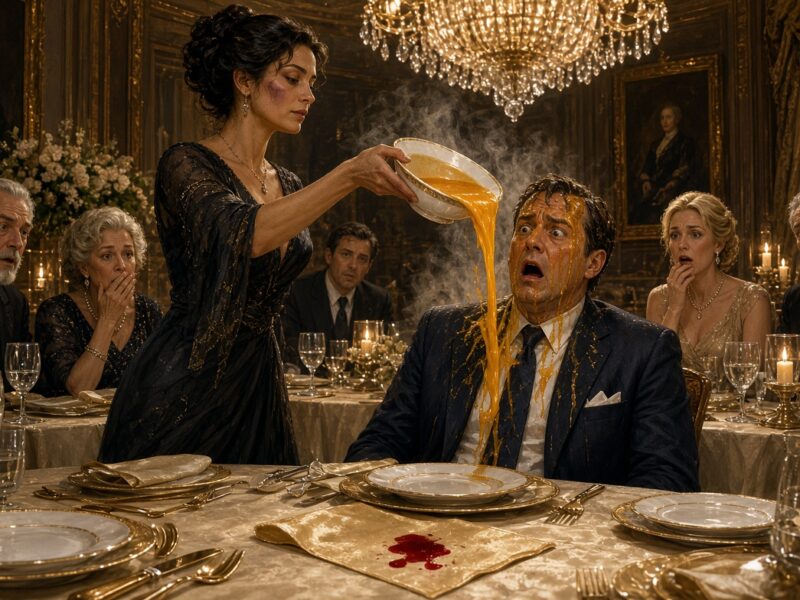
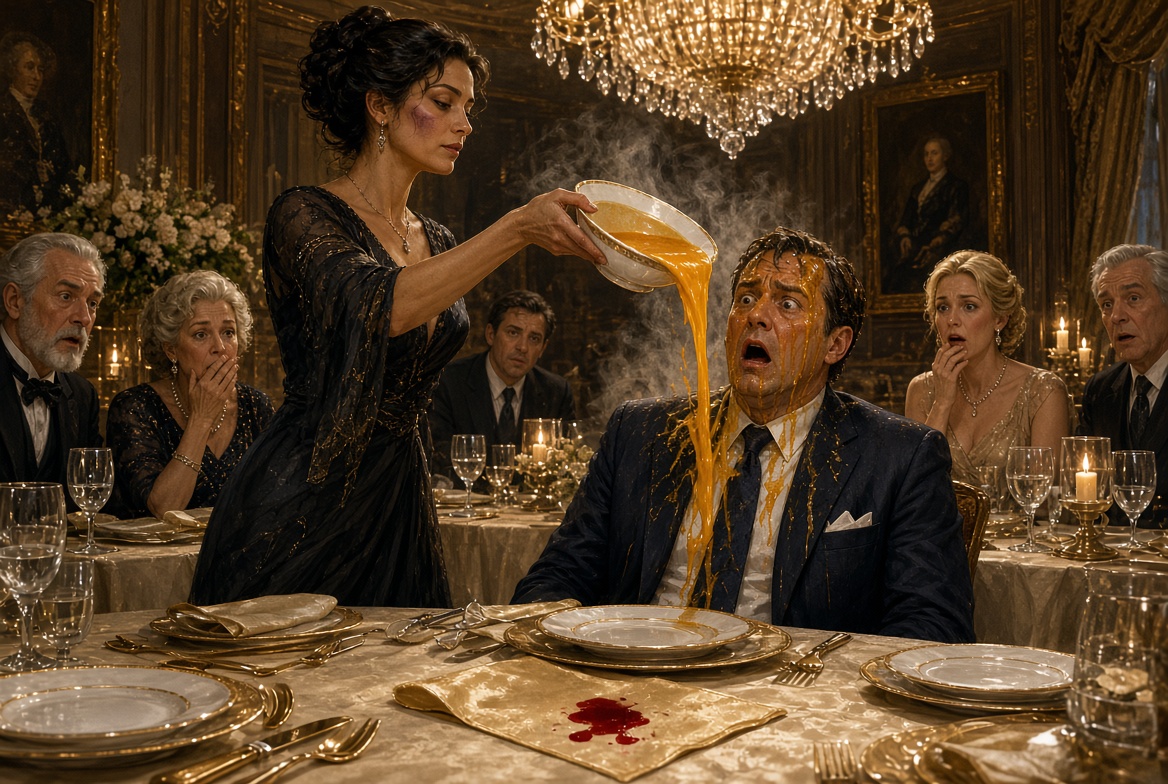
The bowl of butternut squash soup sat to my left. The server had just set it down. Steam still curled off the surface, smelling of nutmeg and brown butter.
I looked at the bowl.
Then I looked at Bram, who had already turned to the man beside him with some easy remark. Something to smooth it over. Something that would let everyone exhale and pretend the last four seconds had been a small thing.
“Anyway, Gary,” he was saying, “where were we on the waterfront numbers?”
I could see the investors recalibrating their faces. That polite neutrality men wear when they’ve witnessed something ugly and decided it isn’t their concern.
One of them, a silver-haired man from a Richmond development group, studied his bread plate like it held the secrets of the universe.
Nobody said a word to me.
Not one person asked if I was okay.
I picked up the bowl with both hands.
It was heavier than I expected. Warm against my palms.
And I poured it slowly over my husband’s head.
Bram made a sound I had never heard come out of him in eleven years of knowing him. Something between a yelp and a roar.
He shoved back from the table so hard his chair went over behind him and clattered across the hardwood.
The soup ran in dark amber streams through his hair, down his forehead, down the front of his white dress shirt. It soaked into the collar of the navy jacket he’d had tailored six weeks earlier for exactly this night.
“Inez!” he screamed. “What is wrong with you? INEZ!”
In the next room, the string quartet finally stopped.
I set the empty bowl back on the table, right in its little circle on the charger plate.
My hands were steady.
That surprised me more than anything.
Because the truth is, I had been steadying my hands for four years.
Here is what the forty people in that room did not know.
Hartfield Hospitality had started as Bram’s idea. That part was true. He had the concept, the name, and the charisma to walk into a room and make investors believe he understood something the rest of the industry had missed.
What he didn’t have was systems.
He didn’t have vendor relationships. He didn’t have operational models. He didn’t have the patience to sit down and figure out why a promising venue kept bleeding money in its second year.
That was me.
That had always been me.
I have a master’s degree in food systems management from the University of Maryland. I finished it three years before we got married. I have what my old boss once called “a specific, unglamorous talent” for seeing how the pieces of a hospitality operation fit together.
I’d worked for two regional restaurant chains before Bram asked me to help him launch his first property.
I said yes because I believed in the idea. Because I loved him. And because I thought being married meant I already had a stake in what we built—no contract required.
I was wrong about that.
In four years of building Hartfield Hospitality, I had never once been asked to sign a single document as a partner.
Not one.
The dinner that night was a pitch event for Bram’s expansion into a second market. For months, he’d been courting a group of development investors with promises of a flagship hospitality concept that would anchor a revitalized waterfront district down near Fells Point.
The numbers he was presenting were, in large part, numbers I had built.
The operational model was mine. The projected margins, the staffing ratios, the vendor strategy—mine.
I had spent the better part of three months writing that forty-two-page document at our kitchen table, usually after midnight.
Bram was planning to present all of it as his own vision.
He had told me that afternoon, adjusting his cufflinks in the hotel mirror, that it would be “cleaner” if I didn’t speak during the presentation.
“Investors like a single point of contact, babe,” he’d said. “You understand.”
I had understood.
I just hadn’t understood how much.
Dena Marsh sat three seats down from me at that table.
Dena was Hartfield’s director of partnerships. She wore a wine-colored dress that night, and over the past year she had traveled with Bram constantly—Nashville, Charlotte, Austin—always for legitimate reasons, always with a clean business rationale.
I had never examined those trips closely enough.
I saw it now, in the way Dena looked at Bram while he stood there dripping and screaming my name.
It wasn’t shock on her face.
It was something closer to calculation.
The venue manager, a quiet man named Terrence Boyd, handled the aftermath with more competence than I would have expected from anyone that night.
He cleared the room methodically, guest by guest, with a calm voice and an open palm. He sent a server for the first aid kit. Then he came straight to me and crouched down so we were eye level.
“Ma’am,” he said quietly. “Do you need medical attention?”
My cheek had already started to swell. I could feel my left eye tightening.
“Yes,” I said. “I think I probably do.”
He nodded once.
Then he walked me through a swinging door into a service corridor that smelled like dish soap and rosemary. He unfolded a metal chair, sat me down, handed me a cold pack wrapped in a bar towel, and called 911 himself.
Then he stood there beside me. He didn’t leave until the paramedics came through the loading dock.
“I saw what he did,” Terrence said.
He said it simply. No drama. The tone of a man making a factual statement for the record.
“I’ll say so to whoever needs to hear it.”
I pressed the cold pack against my face and realized I had something balled up in my left fist.
The pale gold napkin. The one with the single red drop.
I didn’t remember picking it up.
I didn’t put it down.
The ER at Mercy Medical Center was bright and loud and smelled like hand sanitizer. A young resident with tired eyes pressed gently along my cheekbone and sent me for a CT scan.
When she came back, she was holding a tablet and wearing the careful face doctors wear when the answer is worse than you hoped.
“You have a hairline fracture,” she said. “Orbital floor, lower left side. It should heal on its own. No surgery.”
She paused.
“But I’m documenting everything. Every measurement. You understand why?”
“I understand,” I said.
Two Baltimore police officers took my statement in a curtained bay off the main hallway. One was older, heavyset, with reading glasses pushed up on his head. The other was young enough to be my nephew.
I described the slap.
I did not call it an accident.
I described the angle, the force, the silence afterward. And the laughter.
I was careful with my language. I had spent four years being careful.
“Do you want to press charges, Mrs. Hartfield?” the older officer asked.
“I need to speak with an attorney first.”
He glanced at his partner and nodded slowly, like that was exactly the right answer.
“Smart,” he said. “Real smart.”
When they left, I unfolded the napkin on my lap and smoothed it flat with my fingertips.
I don’t know why I kept it. Maybe because it was the only thing in that whole beautiful room that told the truth.
I folded it into a neat square and slid it into the inside pocket of my clutch.
Bram thought the joke was on me.
He had no idea I’d just started keeping receipts.
I left the hospital before Bram’s attorney arrived.
I knew he’d call one. Bram called his lawyer the way other people called their mothers—reflexively, whenever something didn’t go his way.
I took an Uber to my cousin Tilda’s place in Hampden. She lived in a third-floor walk-up above a dry cleaner on 36th Street, a narrow apartment with slanted floors and a radiator that knocked like someone trying to get in.
Tilda opened the door in pajama pants and a Ravens hoodie. She took one look at my face and didn’t say a word.
She just stepped aside.
Then she went into her tiny kitchen and heated up a can of tomato soup.
She set the bowl in front of me at her little two-person table. We both looked down at it at the same time.
Then we looked at each other.
“Too soon?” Tilda asked.
And I laughed so hard my fractured cheek screamed at me, and then I was crying, and Tilda came around the table and held my head against her shoulder until both stopped.
She made up the pullout couch with flannel sheets. She didn’t ask questions I couldn’t answer yet.
That was the kindest thing anyone did for me that whole year.
Before I turned off my phone, I sent Bram one message.
Three sentences. I read it twice before I hit send.
“I am not coming back to the apartment tonight. Contact me in writing going forward. Do not come to Tilda’s.”
His reply came in forty seconds.
I didn’t read it. I turned the phone face down, then powered it off completely, and lay in the dark listening to the radiator knock.
When I turned it back on at 7:00 a.m., there were twenty-nine missed calls.
Twenty-nine.
The texts ran in a long gray column down the screen, and I could track the whole arc of his night in them.
“Are you insane?”
“Do you know what you just cost me?”
“Gary walked out. GARY WALKED OUT, Inez.”
“Call me.”
“Babe. Come on. Let’s talk like adults.”
“I said I was sorry. What more do you want?”
He hadn’t said he was sorry. Not once. Not in any of them.
The last one had come in at 4:52 a.m.
“You know you can’t do any of this without me.”
I read that one three times.
Then I took a screenshot of every single message, emailed them to myself, and saved them in a folder I named “Weather.”
Because that’s what Bram was. Not a man anymore. A weather system I needed to document.
There is a moment, after you stop being afraid of someone, when you start being curious about them instead.
And curiosity, it turns out, is much more dangerous.
The attorney Tilda found for me was named Ada Foss.
Tilda’s friend from nursing school had used her for a custody case and said only one thing about her: “She doesn’t blink.”
Ada’s office was above a CVS in Towson. You climbed a narrow staircase that smelled faintly of cough drops and printer toner. The frosted glass door just said FOSS LAW in black stencil.
Ada herself was about sixty, small and silver-haired, with tortoiseshell glasses and a cardigan the color of oatmeal. She shook my hand once, firmly, and gestured to a chair.
She reminded me of a good editor. She cut everything down to what mattered.
She wasn’t warm.
She was precise.
And I found that I trusted precision a lot more than I had ever trusted warmth.
“Let’s start with the injury,” she said, uncapping a pen. “Then the marriage. Then the money.”
I told her about the slap. The laughter. The soup.
Ada didn’t react to the soup. Not even a flicker. She just wrote it down.
“Witnesses?”
“Forty people. But the only one who’ll say anything is the venue manager. Terrence Boyd.”
“One honest witness is worth forty polite ones,” Ada said. “Medical records?”
“Mercy. Hairline orbital fracture.”
She wrote that down too. Then she looked up.
“Anything physical from the scene?”
I hesitated.
Then I opened my purse, took out the folded pale gold napkin, and laid it on her desk.
I unfolded it. The red drop had dried to a dark rust-brown, small and round as a coin.
Ada looked at it for a long moment.
Then she opened her desk drawer, took out a clear plastic evidence sleeve, and slid the napkin inside with the tip of her pen. She wrote the date and the venue name on the label in small, neat block letters.
“Exhibit A,” she said. “Good instinct.”
It was the first time in four years anyone had told me my instincts were good.
On our second meeting, two days later, Ada’s first question wasn’t about the slap at all.
It was about the company.
“Walk me through what you actually built,” she said. “Not what the documents say you built. What you actually built.”
So I talked.
I talked for two hours.
I told her about the first property, a struggling farm-to-table place in Hampden that Bram had bought at a fire-sale price. How it had been losing about $11,000 a month when we took over. How I’d renegotiated every vendor contract, rebuilt the menu around local suppliers who’d give us thirty-day terms, and cut food waste by almost a third.
How it turned a profit in month seven.
I told her about the second venue, the event space in Canton, and the staffing model I’d designed that let us run it with four fewer full-time employees without burning anyone out.
I told her about the spreadsheets. Hundreds of them. Built at our kitchen table after Bram went to bed, because he “thought better in the morning” and I apparently didn’t need to sleep.
I told her about the investor decks that had my numbers and his name.
Ada wrote everything in a narrow spiral notebook. Every so often she stopped me with a question that was specific and occasionally uncomfortable.
“Did he ever pay you a salary?”
“No. We had joint accounts. He said it was simpler.”
“Simpler for whom?”
I didn’t answer that. I didn’t have to.
“Did you ever sign anything? An operating agreement, an employment contract, anything?”
“I signed vendor contracts. On behalf of the company.”
Ada’s pen stopped.
“Under what title?”
I thought about it.
“‘Operations,'” I said. “Just ‘Operations.’ Bram said titles were for corporate people.”
Ada made a small sound that might have been a laugh if she were the kind of woman who laughed.
“How convenient for him.”
By the end of that meeting, she had drawn three lines in her notebook and labeled each one.
The first was my documented labor—every contract I’d signed, every email, every file with my name in its metadata.
The second was the business expense records. Some of them, it turned out, had been filed under my name and my Social Security number, which I hadn’t known.
The third line just said “D. Marsh — expense reports” with a question mark beside it.
“That one,” Ada said, tapping it with her pen, “I want an outside accountant to look at. Somebody who doesn’t know Bram and doesn’t want to.”
“Why Dena’s reports?”
Ada looked at me over her glasses.
“Because you hesitated when you said her name,” she said. “Twice.”
I hadn’t noticed.
Ada had.
That was the difference between us at the time, and it was the whole reason I needed her.
She closed the notebook.
“Here’s what I need from you, Inez,” she said. “Every financial document you can access legally. Nothing you shouldn’t have. And I need you to do something very difficult.”
“What?”
“Nothing.”
I blinked.
“He’s going to make noise,” Ada said. “Men like Bram always make noise. He’ll want you to answer it. Don’t. Let him talk. Let him put things in writing. Every word he says in public is a word he’ll have to stand behind later.”
Bram’s first public statement appeared three days later.
Tilda showed it to me on her phone while I was eating cereal on the pullout couch.
It was an Instagram post. A photo of his shoulder, slightly pink where the soup had splashed. Notably, not a photo of his face. And not a photo of mine.
The caption was long and earnest and full of words like “journey” and “healing.”
He wrote that domestic conflict was complicated, that he had “made mistakes in the heat of the moment,” and that he hoped his wife would “get the support she needs to work through her struggles.”
Her struggles.
It had 2,400 likes by lunch.
People I’d hosted at my own dinner table had commented with heart emojis. One of his college friends had written, “Stay strong, brother.”
Tilda was furious. She paced the length of her tiny living room, which took about four steps each way.
“Let me post the ER photos,” she said. “Just one. Just the CT report. Let people see what ‘heat of the moment’ looks like.”
“No.”
“Inez—”
“No,” I said again. “Ada said do nothing. So I’m doing nothing.”
Tilda stopped pacing and looked at me.
“How are you so calm?”
I thought about it honestly.
“Because he just wrote down that he ‘made mistakes in the heat of the moment,'” I said. “On the internet. With a timestamp.”
Tilda stared at me.
Then a slow grin spread across her face.
“Oh,” she said. “Oh, you’re scary.”
I wasn’t scary.
I was just finally paying attention.
I forwarded the screenshot to Ada with no comment. She replied in six minutes with two words.
“Thank you.”
That afternoon, I gathered every document I had legal access to—joint bank statements, the shared company drive I still had credentials for, tax returns, the vendor contracts with my signature—and drove them to Towson in two banker’s boxes on the passenger seat of my old Subaru.
Ada’s accountant was a man named Paul Whitaker. He was retired from a Big Four firm, wore suspenders without irony, and had a reputation for being the most boring man in Baltimore County.
“Boring is exactly what you want in a forensic accountant,” Ada told me. “Exciting people get bored and skip things. Paul never skips anything.”
Paul shook my hand, looked at the boxes, and sighed like a man settling into a warm bath.
“Give me two weeks,” he said.
He only needed eleven days.
Paul flagged the first irregularity on day eleven.
It took another week for the full picture.
Ada called me into her office on a gray Thursday afternoon. Paul was already there, sitting in the corner chair with a laptop balanced on his knees and three color-coded binders stacked at his feet.
He didn’t make small talk. I liked him immediately for that.
“Mrs. Hartfield,” he said, “are you familiar with a company called Blue Heron Advisory LLC?”
“No.”
“Neither was I. Neither is anyone in the hospitality consulting industry I’ve spoken to.” He turned the laptop toward me. “But over the last eighteen months, Hartfield Hospitality has paid them two hundred fourteen thousand, six hundred dollars.”
I stared at the number on the screen.
$214,600.
“For what?”
“The ledger says ‘operational consulting,'” Paul said. “Which is interesting. Because as far as I can tell, you are the operational consulting.”
Ada slid a sheet of paper across the desk.
It was a lease agreement.
A one-bedroom luxury apartment in Harbor East, on the fourteenth floor of a glass tower with a rooftop pool and a doorman. Rent: $7,400 a month. Furnished through a high-end design firm at a cost of $38,000, also billed to Hartfield Hospitality as “site staging.”
The lessee was Blue Heron Advisory LLC.
And the registered agent for Blue Heron Advisory LLC was a woman named Patricia Marsh.
“Dena’s mother,” Ada said quietly. “Lives in Delaware. Seventy-one years old. I doubt she’s done much operational consulting lately.”
I sat very still.
I waited to feel something huge. Rage. Heartbreak. The floor dropping out.
What I actually felt was annoyed.
Annoyed at myself.
Because I had seen those Blue Heron payments. I’d seen them come through the books every month for a year and a half. And every single time, I’d assumed Bram had brought in some outside advisor without telling me, which he did constantly, and I’d been too busy fixing the actual operations to ask.
I had been so busy holding the building up that I never once looked at who was living in it.
“The building has a key fob log,” Paul added, almost apologetically. “The doorman was quite cooperative once Ms. Foss sent a preservation letter. Your husband’s fob was used at that address two hundred and six times in eighteen months.”
“Mostly Tuesday and Thursday nights,” Ada said.
Tuesday and Thursday nights.
The nights Bram told me he had “investor dinners.”
The nights I stayed home and built his investor decks.
I started laughing.
I couldn’t help it. It came up out of me like a hiccup, and Paul looked alarmed, and Ada just waited.
“I’m sorry,” I said, wiping my eyes. “It’s just—I was literally making the slides he was pretending to present while he was there.”
Ada nodded slowly.
“That,” she said, “is going to be very useful.”
I was staying at Tilda’s when the call came that changed everything else.
It was a Monday morning. I was sitting on the fire escape with a mug of coffee, wearing two sweaters, watching the dry cleaner’s delivery van back into the alley.
The number was a 410 area code I didn’t recognize.
“Is this Inez Hartfield?” a man’s voice asked. Calm, low, slightly formal. “My name is Niles Bower. I’m with the Baltimore Development Corporation.”
I almost hung up. I assumed it was about Bram.
But he kept going.
Niles explained that he was coordinating a public-private project on the east side of the city. A neighborhood food market in a former railyard near Highlandtown, designed to bring independent vendors into a permanent shared space with subsidized rent.
The project had stalled. Badly.
“The operational model attached to the original proposal came from Hartfield Hospitality,” he said. “Your company submitted it two years ago in an early bid. The bid didn’t go through. But the model stayed in our files.”
I remembered that bid. I’d written the entire thing in nine days while Bram was in Austin. With Dena.
“Your name is all over the document log,” Niles said. “Every revision. Every file. Not your husband’s. Yours.”
He paused.
“So I need to ask you directly. Did you write the vendor support model?”
“Yes,” I said. “Every word.”
“Would you be willing to present it to the project team as an independent consultant? We need to know if the model holds up without a firm’s resources behind it.”
I watched the van finish backing into the alley.
“Let me think about it,” I said.
I thought about it for exactly half an hour.
Then I called him back.
The railyard was called the Meridian site.
Within the first ten minutes of walking it, I understood why the project had stalled.
The bones were extraordinary. Original heavy timber framing from the 1910s. Iron columns. Clerestory windows running the full length of the roof. A ceiling height that would make the space feel generous even if you packed it wall to wall with vendor stalls.
But the proposed layout treated it like a suburban shopping mall instead of a market.
The flow was wrong. Everyone would enter, walk one long straight aisle, and leave.
The utility placement was wrong. The drains were on the wrong side for the food vendors who’d actually need them.
The vendor mix assumptions were wrong too. They’d projected six coffee shops and one butcher.
I stood in the middle of that enormous empty space with dust floating in the light, and for the first time in weeks, my mind went completely quiet.
Not numb.
Quiet. The way it used to get when I was working on something I understood all the way down.
“Well?” Niles asked. He’d been standing a few feet away, letting me look without commentary. He was tall and lean, mid-forties, with gray at his temples and a canvas work jacket over his dress shirt.
“It’s beautiful,” I said. “And the plan is going to kill it.”
He didn’t flinch. He actually smiled.
“That’s what I was afraid of,” he said. “How long to fix it?”
“A week.”
“Take two.”
“I’ll take one.”
I spent seven days rewriting the operational framework on Tilda’s kitchen table, my laptop surrounded by printed floor plans and highlighters and a bag of clementines.
Tilda came home from her nursing shifts at Hopkins and found me in the same chair she’d left me in.
“Have you eaten?” she’d ask.
“Clementines.”
“That’s not food, Inez. That’s a garnish.”
But she always smiled when she said it. Because she could see what I could feel.
I was coming back.
The first formal meeting was in a conference room at the BDC offices downtown, all gray carpet and a whiteboard nobody had fully erased.
Niles ran it efficiently. He introduced me without excessive qualification. He said my name and my role and moved on, which I appreciated more than he could have known.
The team included two city staffers, a structural engineer named Harpreet Sandhu, and two representatives from the funding coalition—a bank foundation and a regional nonprofit.
They had questions.
I answered them.
Nobody talked over me. Nobody re-explained what I’d just said, slower and louder, to the men in the room.
When one of the funders asked whether the September opening was realistic, I didn’t soften it.
“September is too aggressive,” I said. “Given Harpreet’s structural assessment, you’ll be pouring concrete in the drain trenches in August, and it won’t cure. But November is achievable—if the utility work starts within the next three weeks.”
Harpreet looked up from her notes.
“That matches my numbers,” she said. “I’ll put that in the plan.”
“Good,” Niles said. And he wrote it down.
That was it.
No performance of authority. No positioning. Decisions got made. The meeting ended on time.
Afterward, I walked to the Metro station alone and stood on the platform, and it hit me all at once.
I had just spent two hours being the most effective person in a room without having to manage anyone’s ego about it.
Two hours. Not one apology for being right.
It was not a small thing.
It was everything.
The meeting with Dena happened at Ada’s insistence.
“I want to know what she knows,” Ada said. “And I want her to know that we know.”
Dena arrived at the Towson office looking like she hadn’t slept in a week. No wine-colored dress this time. Jeans, a gray sweatshirt, her hair pulled back in a hasty knot.
She sat across from me. She didn’t wait for anyone to speak.
“He told me the marriage was over,” she said. “Two years ago. He said it was functionally over and you were just staying for the company.”
I said nothing.
“I didn’t know about the apartment billing,” she went on. “Not at first. He said it was a corporate housing perk. By the time I figured out how it actually worked, it was already established practice.”
“Did you ask?” I said.
Dena looked at Ada, as if Ada might answer for me.
“She’s asking you a question,” Ada said evenly.
Dena looked down at her hands.
“Not hard enough,” she said.
It was the most honest thing she said in the entire meeting.
What she said next was harder to sit with.
“He told me you didn’t want kids,” Dena said. “He said it more than once. He said it was a fundamental incompatibility. That it was one of the reasons you two drifted apart.”
The room got very quiet.
Here is what Dena didn’t know.
I had deferred fertility treatment twice.
The first time was two and a half years earlier, when the Canton venue had a plumbing failure that cost us $46,000 in a single weekend. The second was last spring, when Bram’s waterfront pitch needed cash for architectural renderings.
Each IVF cycle we’d budgeted for was $19,500.
Both times, I’d sat across the kitchen table from Bram and said, “The company needs it more right now. We’ll do it next year.”
Both times, Bram had been in the room.
Both times, he had reached across the table, squeezed my hand, and said, “Thank you, babe. I mean it. I won’t forget this.”
Thirty-nine thousand dollars. Two cycles. Two years I would never get back.
And he had turned my sacrifice into a story about my indifference, the moment it was convenient for him.
I didn’t tell Dena any of that.
I didn’t owe her the truth of it.
I just sat with the weight of it for a moment, feeling it settle somewhere behind my ribs, heavy and permanent.
Then I set it down.
“You were used,” I said. “So was I. Those are separate problems.”
Dena opened her mouth. Closed it again.
Then she stood up, picked up her bag, and left without another word.
Ada watched the door close behind her.
“That was well done,” she said.
“It didn’t feel well done.”
“It rarely does,” Ada said. “That’s how you know.”
The divorce moved forward on a parallel track, slow and grinding, like a freight train you can hear long before you see it.
Bram rejected the first settlement offer within forty-eight hours.
His attorney, a slick man named Curtis Vane with a downtown office and a voice like a late-night car commercial, sent back a two-page letter. It called my contributions to Hartfield Hospitality “supportive in nature, consistent with ordinary household involvement.”
Ordinary household involvement.
I read that line out loud in Tilda’s living room.
Tilda put down her coffee.
“Ordinary household involvement,” she repeated slowly. “Inez. You rebuilt a restaurant’s entire supply chain.”
“Apparently that’s like folding laundry.”
“I’m going to key his car.”
“You are not going to key his car.”
“I’m going to think about keying his car. Very loudly. In his direction.”
Ada’s response to Curtis Vane was one page long.
It included a summary of Paul Whitaker’s findings, a copy of the Harbor East lease, the key fob log, and a single sentence at the bottom.
“We look forward to discussing which parts of the $214,600 in Blue Heron payments your client considers ordinary household involvement.”
After that, Bram stopped rejecting things quite so loudly.
But the consequences didn’t stay inside the lawyers’ offices.
That’s the part nobody tells you about. The truth doesn’t just sit in a file. It leaks.
The Richmond investor group—Gary’s group, the ones who had studied their bread plates while my cheek swelled—quietly requested Hartfield’s full financial disclosures before committing to the waterfront deal.
Then they requested an independent audit.
Then they withdrew.
Two more investors followed within a month. The waterfront flagship, the project Bram had been bragging about at every cocktail party in Baltimore for a year, died without a single public announcement.
Bram’s Instagram post about my “struggles” disappeared one morning without explanation.
The Baltimore Business Journal ran a short item about Hartfield Hospitality “reassessing expansion plans amid internal restructuring.” It didn’t mention me. It didn’t need to.
Dena resigned. Her LinkedIn simply said “Exploring new opportunities.”
And one Friday, Terrence Boyd sat in a conference room with Ada and a court reporter and gave a sworn deposition. It took fifty minutes.
Ada told me afterward that he hadn’t embellished a single detail.
“He described the laugh,” she said. “Curtis Vane asked him three different ways whether it could have been playful. Terrence said, ‘Sir, I’ve worked events for nineteen years. I know what a joke sounds like. That wasn’t one.'”
I had to step out into the hallway for a minute after she told me that.
Not because I was sad.
Because a stranger had told the truth about me when the people who knew me best wouldn’t.
The mediation was in March, in a beige conference room downtown with a water pitcher nobody touched.
It was the first time I’d been in the same room as Bram since the dinner.
He looked smaller. That was my first thought. Not physically—he was the same height, same shoulders, same expensive haircut. But something had gone out of him. The certainty, maybe. The smile was still there, but it flickered on and off like a bulb about to die.
He tried it on me anyway.
“Inez,” he said warmly, as if we’d run into each other at a farmers market. “You look good. Really good.”
“Please direct your comments to counsel,” Ada said, without looking up from her notes.
Bram’s jaw tightened.
For two hours, the mediator shuttled between our room and theirs. Numbers went back and forth on folded sheets of paper. Curtis Vane argued that the operational models were “company property, developed with company resources.”
Ada pointed out that the company had never paid me a salary, never given me a title, never offered me equity, and that the metadata on every single file listed one author.
Me.
Near the end of the afternoon, Bram asked to speak to me directly. Ada glanced at me. I nodded.
He leaned forward across the table, his voice dropping low and intimate, the voice he’d used for eleven years whenever he needed something.
“Babe,” he said. “We built something special. You know we did. Why are you trying to burn it all down?”
I looked at him for a long moment.
“I’m not burning anything down, Bram,” I said. “I’m just taking my matches back.”
He sat back like I’d slapped him.
I hadn’t.
I never would.
That was the whole difference between us.
The final settlement came together in April.
Bram kept Hartfield Hospitality—what was left of it. In exchange, he paid out my share of the marital interest in the company: $412,000, structured over eighteen months.
The Blue Heron payments were treated as dissipation of marital assets, which meant half of that $214,600 came back to me on top of the buyout.
And I kept full, documented authorship of every operational model I had ever written. Including the vendor support framework sitting in the Meridian project files.
Ada made Curtis Vane put that last part in its own paragraph, in bold.
“Things that aren’t in writing,” she told me, “have a way of becoming his idea later.”
I incorporated my own firm three weeks before the divorce was finalized.
I called it Calder Operations Group. Calder was my maiden name. I had given up Hartfield the moment Ada filed the paperwork, and I was not about to build anything new on a foundation with his name carved into it.
I rented a desk in a shared workspace in an old brick cannery building three blocks from the Meridian site. It came with a locker, unlimited coffee, and a view of a parking lot where a man fed pigeons every morning at exactly 8:15.
I signed a three-month contract with the Meridian project team. I billed $85 an hour.
By any honest measure, it was lower than my labor was worth. I knew that. Niles knew that. He tried to push me higher during the negotiation, which was not something I’d ever had anyone do before.
“The coalition budgeted for a hundred and twenty,” he said.
“Then they’ll be pleasantly surprised,” I said. “I need this one to be clean.”
He studied me for a second. Then he nodded.
“Next contract, you charge what you’re worth,” he said.
“Next contract,” I agreed.
I printed my first invoice eleven days later.
$1,860.
I held the paper in both hands at my little rented desk and read it top to bottom three times. My name at the top. My company. My hours. My rate.
Then I took a roll of Scotch tape out of the drawer and taped that invoice to the inside cover of my spiral notebook.
Not because the amount mattered especially.
But because no one, in this version of my life, could ever call it ordinary household involvement.
Ada called on a Tuesday morning at 9:14.
I was at my desk surrounded by vendor intake forms, a highlighter cap between my teeth.
“It’s done,” she said. “The decree is recorded. You’re divorced, Inez.”
I took the cap out of my mouth.
I waited to feel something dramatic. Fireworks. Tears. A soundtrack swelling.
Instead, I felt like I’d finished a very long calculation that had finally balanced.
“Thank you, Ada,” I said. “For everything.”
“Don’t thank me,” she said. “Send me a fruit basket. A good one. No melon.”
And for the first time in our entire relationship, I heard Ada Foss laugh.
That evening, I bought a bundle of sunflowers from a corner market on Eastern Avenue and carried them home to my own apartment.
I had rented it six weeks earlier, a sunny second-floor unit in a Highlandtown rowhouse with a clawfoot tub and a kitchen window that looked out on a tiny backyard fig tree.
The lease was in my name. Only my name.
I put the sunflowers in a mason jar on the windowsill. I ordered Thai food. I watched two episodes of a baking show and did nothing useful at all.
It was the best night I’d had in four years.
Niles asked me to dinner a few weeks later.
It was the evening after I’d spent forty-five minutes explaining to him, at length and with annotated spreadsheets, why the Meridian vendor fee structure needed to be rebuilt from scratch.
He’d listened to every word. He’d asked good questions. He’d agreed with me on four points out of five and argued with me on the fifth until I conceded he was right.
Then, as I was packing up my laptop, he cleared his throat.
“Would you have dinner with me?” he asked. “And to be clear—it would not be a dinner of the business variety.”
I zipped my bag slowly.
“Let me think about it,” I said.
He smiled like he’d expected nothing less.
I said yes on Friday.
I chose the restaurant. A small Haitian place run by a family in the neighborhood next to Meridian, with mismatched chairs and hand-painted signs, where the griot and pikliz came in big shared platters. Nobody there would recognize either of us.
We talked about the project for twenty minutes.
Then we talked about everything else for two hours.
Niles told me his mother had run a restaurant renovation business in West Baltimore for thirty years. He’d spent most of his twenties working for her, ripping out old kitchens and rebuilding them, before moving into public development.
“She used to say a kitchen tells you everything about the people who run it,” he said. “Where they put the knives. Where they put the trash. Whether there’s anywhere to sit down.”
“What did your mother’s kitchen say?”
“That she never sat down.” He smiled. “Kind of like you.”
I told him about the graduate research I’d abandoned. A longitudinal study of vendor attrition in shared market spaces—why some independent vendors thrived in markets and others failed in their second year.
I’d stopped working on it the year Bram launched Hartfield, because there weren’t enough hours in the day.
Niles put down his fork.
“That’s essentially the methodology under your Meridian model,” he said.
“Essentially.”
“You never published it?”
“I never finished it.”
He looked at me then with an expression I didn’t have a name for right away.
It wasn’t pity. I’d had enough pity that year to recognize it from a mile off.
It was something closer to recognition.
“You have time now,” he said.
I thought about it honestly. Whether it was true. Whether I believed it.
“I do,” I said.
At the end of the night, he walked me to my car. Under the streetlight, he asked if I’d like to go on a second date.
I smiled.
“Ask me on Friday.”
“Why Friday?”
“Because I want to know what it feels like to wait for something I’m already sure about.”
He laughed softly and shook his head. And he didn’t press me once all week. No texts. No hints at the office. Just ordinary, respectful professionalism in every meeting.
He called Thursday evening.
I picked up on the second ring.
“Yes,” I said, before he could say a word. “Seven o’clock Saturday. Bring an appetite.”
The summer at Meridian was the hardest work I had ever done.
It was also the first work in years that felt like mine.
I argued for the flow pattern in four separate meetings before it was approved. Instead of one long aisle, I wanted a loose figure eight, with the food vendors clustered around a central seating area so people would linger, circle back, and buy a second thing.
One of the city staffers called it “unconventional.”
Harpreet called it “structurally fine.”
Niles called for a vote.
It passed four to one.
The hardest vendor to win over was the neighborhood bakery. Alvarez Panadería had been on Eastern Avenue for twenty-six years, and its owner, Rosa Alvarez, was a broad-shouldered woman in her sixties with flour permanently ground into her knuckles and absolutely no patience for consultants.
She made me justify myself in three separate meetings.
In the first one, she refused outright.
“I’ve seen markets like this,” she said, arms crossed. “Pretty for one year. Then the rent goes up, the city forgets, and the little people go under. No, thank you.”
In the second meeting, I brought data. My old unfinished research. Attrition rates for independent bakeries in shared markets in Philadelphia, Cleveland, and Pittsburgh.
She read every page. Then she handed it back.
“Numbers are nice,” she said. “But numbers don’t bake at four in the morning.”
In the third meeting, I didn’t bring anything.
I just asked her what would make it work for her.
She looked surprised. Then suspicious. Then she told me.
She couldn’t afford to staff a stall seven days a week. She needed a shared-hours arrangement, a smaller footprint on weekdays, and a rent cap locked in for five years—not three.
I went back to my desk and rebuilt that section of the vendor model around her situation. It took me two days. It ended up helping eleven other small vendors too.
Rosa signed on a Wednesday.
She didn’t thank me. She just pushed a white paper bag across the table.
Inside was a rosemary roll, still warm.
“Don’t make me regret it,” she said.
The week after the divorce decree, Ada had mailed me a small padded envelope.
Inside was the clear evidence sleeve with the pale gold napkin, and a sticky note in her neat block letters.
“Case closed. Yours to keep or not. —A.F.”
I’d slipped it into the back pocket of my spiral notebook, right behind the taped-up invoice for $1,860.
I carried that notebook to every single Meridian meeting all summer long.
I never took the napkin out.
But I always knew it was there.
The Meridian Market opened on a cold, bright morning in the first week of November.
The big warehouse doors rolled up at exactly 9:00 a.m. Light poured in through the clerestory windows and fell across twenty-six vendor stalls, arranged in the figure eight I’d fought for.
The first smell was bread.
Rosa’s bread, from the stall closest to the entrance, where I had specifically placed her so the smell would pull people inside from the sidewalk.
I’m not a sentimental person. But I noticed it.
I was standing near the eastern annex in a rust-colored blazer and flat shoes, clipboard in hand, when Bram walked in.
He came alone.
He was wearing an evening suit to a morning market. A black dinner jacket and a loosened bow tie, at 10:20 in the morning, which told me everything I needed to know about the current state of his judgment.
His face was thinner than I remembered. There were gray circles under his eyes.
He pulled out his phone, held it up horizontally, and started filming.
“Tell everyone who you stole this from, Inez!” he shouted, loud enough to project across the whole hall. “This was developed under Hartfield Hospitality. My company. When you were my wife!”
The room did not go silent the way it had at the dinner party.
That was the first thing I noticed.
People looked up from their coffee and their empanadas and their pickled vegetables. And then, one by one, they looked at me.
Not at him.
At me.
Waiting to see what I would do.
This time, I didn’t reach for a bowl.
I walked to the small event platform near the central seating area, where a microphone stood ready for the ribbon-cutting speeches scheduled at noon.
I switched it on. I didn’t rush.
“The operational model for the Meridian Market was developed independently,” I said clearly. My voice carried across the timber ceiling. “I can direct anyone to the timestamp logs, the original file signatures, and the vendor intake records. The project team has the full documentation. So do the funders.”
I paused.
“I also want to say directly that the version of this model that appeared in Hartfield Hospitality’s investor materials was presented without my authorization and without attribution. The record exists. It’s part of a public court filing. Anyone who wants to review it is welcome to.”
I set the microphone back in its stand.
Bram said something from the floor. His voice had gone thin and high. The words weren’t clean. Something about lawyers. Something about “my vision.”
Always his vision.
Then a voice cut across his.
It was Keisha Monroe, who ran the fermented foods stall on the west wall—kimchi, sauerkraut, hot sauce in little hand-labeled bottles. She’d sat through two of my vendor orientation sessions and asked more questions than anyone.
“I’ve seen the documents,” Keisha called out, loud and flat. “He didn’t build this.”
A second voice came from a stall near the north entrance. The Ethiopian coffee roaster.
“Same.”
Then a third. The cheesemonger.
“Same here.”
Bram’s face went red, then blotchy.
He looked at the crowd. At his phone. At me.
And then, slowly, he lowered the phone.
The market’s security team was already moving toward him, quietly, the way Terrence had once moved through a dining room. Bram turned and walked out through the big rolled-up doors before they reached him.
That was its own kind of answer.
I watched him go until his black jacket disappeared into the bright November street.
I didn’t feel triumph.
I felt something lighter than that. Like a window I’d forgotten was open had finally been shut against the cold.
I looked across the hall at the bakery stall.
“Mrs. Alvarez!” I called out. “Are those rosemary rolls ready?”
Rosa Alvarez—the woman who had made me justify myself in three separate meetings—held up a big wicker basket heaped with golden rolls.
“Ready for the last twenty minutes, mija,” she called back. “Some of us have been working.”
The whole crowd laughed.
Somewhere in the central corridor, a fiddle player started up. Then a guitar. Somebody whooped.
The market opened.
Niles found me about an hour later near the spice vendor’s stall. He waited politely until I’d finished talking to a supplier about saffron pricing, and then he stepped up beside me.
“You gave a speech,” he said.
“Three sentences,” I said. “The crowd filled in the rest.”
The week before, I had asked him for one thing. If anything happened on opening day—anything at all—I didn’t want him to step in.
He’d looked at me for a long moment. Then he’d said, “Okay.”
And he’d meant it.
When Bram started shouting, Niles had stayed exactly where he was on the far side of the platform. He hadn’t moved toward Bram. He hadn’t stepped forward to manage the moment on my behalf.
He had trusted me to handle it.
I hadn’t known, until that morning, how much I’d needed someone to do that.
I took his hand right there in front of the vendor stalls. I held it for a few seconds, warm and solid.
Then I let go, because there was still work to do.
That evening, after the vendors had tallied their first-day numbers and the doors had rolled back down, the results came in on Harpreet’s tablet.
We had projected 3,500 visitors for opening day.
We got 5,180.
Rosa had sold out of rosemary rolls by 1:30 and baked a second batch. Keisha had sold every bottle of hot sauce she’d brought. The funding coalition’s quarterly report was going to look very, very good.
The others went home. Harpreet hugged me at the door. Tilda, who’d come for the ribbon-cutting and stayed all day, kissed my sore cheek—the left one, the one that had healed long ago—and whispered, “I’m so proud of you, you scary woman.”
Then it was just Niles and me in the empty hall.
Someone had left a bottle of red wine on the central table as an opening gift, with a card that just said “Congratulations, Meridian.” We found two paper cups at the coffee stall.
The stalls were dark. The big timber ceiling caught the last of the sunset coming through the high west windows, turning everything amber and gold.
I took my spiral notebook out of my bag and set it on the table between us.
The invoice was still taped inside the cover. $1,860.
I reached into the back pocket and slid out the plastic sleeve. Then I took the pale gold napkin out of it for the first time in nearly a year.
The little rust-brown stain was still there. Small and round as a coin.
Niles didn’t ask. He just watched.
“This was on my plate that night,” I said. “I kept it because it was the only thing in the room that told the truth.”
I smoothed it flat with my fingertips, the same way I had in the curtained ER bay.
Then I folded it once, twice, into a small neat square.
And I dropped it into the compost bin beside the coffee stall.
“I don’t need receipts anymore,” I said.
Niles poured the wine.
We sat for a while without talking. The light kept moving across the floor.
“Regrets?” he asked finally.
I thought about it honestly. I had made a habit of that.
“Not about any of the big decisions,” I said. “I just regret that it took me so long to count what I was actually worth.”
He looked at me in a way that made me think he’d been waiting a long time to hear me say that out loud.
“You knew before the soup,” he said.
I smiled into my paper cup.
“I knew during the soup,” I said. “That’s close enough.”
He laughed, low and warm, and the sound filled up the empty hall.
I leaned against his shoulder and watched the last of the light slide across the floor of the market I had built.
Not the market I had helped build.
Not the market I had supported.
The market I had built.
I stayed there until the light was gone.
And for the first time in a very long time, that felt like exactly enough.









