He Saved a Dying Hell’s Angel With Duct Tape. Then 150 Bikers Came Back for Him.
Blood washes away fast in a downpour, but it leaves a stain on concrete you can’t scrub out. A twelve-year-old kid with nothing to his name watched a giant of a man bleeding out in the mud. He had two choices. Walk away or risk everything. He didn’t walk.
Leo’s shoes were taped together at the toes. Silver duct tape frayed at the edges, caked in gray mud. He sat on a damp milk crate under the overpass of Interstate 84. Above him, the steady, rhythmic thump of tires over expansion joints played the only lullaby he knew. It was November, the kind of cold that doesn’t just sit on your skin, but burrows into your joints and makes your teeth ache. The rain started as a mist and quickly escalated into a punishing downpour.
Leo pulled his oversized olive green jacket tighter around his narrow shoulders. He was twelve, maybe thirteen. He didn’t keep track of birthdays anymore. Birthdays were for kids with zip codes and hot water. Then the rhythm above broke. A screech of tires, the sickening metallic crunch of heavy machinery hitting concrete at seventy miles an hour.
It wasn’t a dull thud like a blown tire. It was violent. Sparks showered down over the edge of the concrete barrier, hissing as they hit the wet weeds below. Then came the sound of something massive scraping along the asphalt, followed by an abrupt, suffocating silence.
Leo froze. Down here, you minded your own business. If someone dumped a stolen car or a body, you kept your eyes on your shoelaces. But the silence stretched heavy and wrong. He stood up, his knees popping, and scrambled up the muddy embankment. He kept low, peering over the rusted guardrail.
A customized Harley-Davidson lay on its side, the front fork twisted into a grotesque angle. Oil and gasoline were already bleeding into the puddles, swirling in rainbow slicks under the amber glow of the highway lights. A black SUV was speeding away in the distance, its taillights bleeding into the rain. A hit and run.
About thirty feet from the bike, a man lay motionless on the shoulder. Leo hesitated. His instincts screamed at him to slide back down the mud, to crawl into his sleeping bag and forget he saw anything. But he watched the man’s chest. It wasn’t moving. Or maybe it was just barely.
Leo hopped the guardrail. The wind up here was brutal, whipping rain into his eyes. He approached the body. The man was massive, broad shoulders wrapped in thick scuffed leather. He was face down, one arm pinned under him, the other thrown out. Blood was pooling fast around his right leg, thick and dark, washing away in the deluge.
Leo noticed the back of the leather vest, a winged death’s head. Above it, in arched letters, Hell’s Angels. Below it, California. Leo swallowed hard. Even the street kids knew the patch. You didn’t look at them. You didn’t talk to them. You definitely didn’t touch them. But the man groaned, a low, wet sound.
He shifted, trying to push himself up, but his right arm gave out and he collapsed, his face smacking the wet asphalt. “Hey,” Leo said, his voice cracking. The man didn’t respond. The bleeding from his leg was bad. The denim was torn, and the flesh beneath was a mess of lacerations. A piece of jagged metal from the bike’s fairing had sliced right through the calf. If he stayed here, he’d bleed out in twenty minutes. If the cold didn’t stop his heart first.
Leo looked around. The highway was dead. No headlights, no sirens. He grabbed the man by the collar of his leather vest. “Come on,” Leo grunted. The biker had to weigh two hundred and fifty pounds. Leo weighed eighty, soaking wet. It was impossible. But Leo was desperate. He didn’t want to watch another person die. He’d seen enough of that when his mother gave out in a shelter three years ago.
He grabbed the man’s left arm, dragged it over his own shoulder, and pulled upward with every ounce of leverage his scrawny frame possessed. The biker groaned, a spark of consciousness returning. “Get off,” the man slurred. “Shut up and push,” Leo snapped back, surprising himself. The harsh tone worked. The biker’s survival instinct kicked in. He planted his good leg and shoved off the asphalt.
Together, they stumbled toward the guardrail. “We got to go down,” Leo gasped. They essentially slid down the embankment. The mud acted as a chute. They crashed into the tall weeds at the bottom, the biker crying out in agony as his torn leg caught on an exposed root. Leo didn’t let him rest. He grabbed the heavy leather again and hauled him under the bridge, into the deep dry recess where the concrete sloped up to meet the steel girders.
It was Leo’s camp. A piece of heavy tarp blocked the wind. Inside, a pallet made of shipping crates held a meager, damp sleeping bag. Leo dropped the man onto the pallet. The biker went limp again, unconscious. The smell of copper filled the small space, cutting through the damp mildew of the underpass.
Leo knelt beside the giant. His name was Garrett. Leo didn’t know that yet, but he saw the name embroidered on the front of the cut. Garrett. It sounded like the scrape of a brick. Fitting. Garrett was pale. His lips were taking on a bluish tint. Shock. Leo knew what shock looked like. He scrambled to his stash box, a plastic cooler he’d found by a dumpster.
Inside were his treasures: a half-empty bottle of rubbing alcohol, a roll of duct tape, some cleanish t-shirts he’d stolen from a laundromat, and a heavy wool blanket. He took his best pocket knife, a dull Buck knife he used for opening cans, and sawed through the denim of Garrett’s pant leg. The wound was deep, pumping sluggishly.
Leo folded one of the stolen t-shirts into a thick pad. He pressed it directly into the gash. Garrett violently flinched, even in his unconscious state. His massive hand shot out, grabbing Leo’s wrist with a grip like a bench vise. Leo bit his lip to keep from screaming. The man’s eyes fluttered open. They were dark, unfocused, and entirely feral. “Who the hell?” Garrett rasped, coughing.
“Let go of my arm,” Leo said. His voice shook, but he held his ground. “You’re bleeding out. I’m trying to stop it.” Garrett blinked, the pain bringing the gritty reality of the underpass into focus. He looked at the dirty concrete above him. He looked at the scrawny kid whose wrist he was crushing. He let go.
“Hit and run,” Garrett muttered, his head falling back against the wooden pallet. “Bastard clipped my back tire.” “Press down on this,” Leo ordered, ignoring the explanation. He guided Garrett’s hand to the makeshift bandage. “Hold it hard.” Garrett obeyed. He gritted his teeth as Leo grabbed the roll of duct tape. Leo wrapped the silver tape around Garrett’s thick calf over the t-shirt, wrapping it tight enough to act as a pressure dressing. It wasn’t pretty. It wasn’t sterile. But the bright red seepage slowed.
Garrett watched the kid work. He saw the taped shoes, the dirt embedded in the knuckles, the hypervigilant way the boy’s eyes darted around the shadows. “What’s your name, kid?” Garrett asked, his voice a low, gravel drag. “Leo.” “You drag me down here, Leo?” “Nobody else was going to.” Garrett let out a short, breathy laugh that turned into a grimace.
He reached into his leather vest. Leo flinched back, expecting a gun. Instead, Garrett pulled out a smashed smartphone. The screen was a spiderweb of shattered glass. Dead. “Damn it,” Garrett whispered. He let the phone drop. He looked shivering and cold. Leo grabbed the heavy wool blanket from his cooler and threw it over the biker. “Keep it. You’re going into shock.” “I’m fine,” Garrett lied.
He was a Hell’s Angel. You didn’t show weakness. Not to rivals, not to cops, and definitely not to kids living in storm drains. But his teeth were chattering and he couldn’t stop them. Leo sat on his overturned milk crate, pulling his knees to his chest. He watched Garrett. For hours the storm raged outside. The water level in the nearby drainage ditch rose, a rushing torrent of brown sludge. Inside the hideout, it was quiet, save for Garrett’s heavy, labored breathing.
“Why didn’t you just take my wallet, Leo?” Garrett asked suddenly, his eyes closed. “Don’t need it.” “Everybody needs money, especially down here.” “Money means going into stores,” Leo said flatly. “Store owners see me, they call the cops. Cops see me, they put me in the system. The system puts me in a group home. Group homes are worse than this.” He gestured to the concrete walls.
Garrett opened his eyes and studied the boy. He understood that logic. It was the logic of an outlaw. The world had rules that didn’t serve them, so they built their own. Garrett lived by the rules of his club. Leo lived by the rules of the concrete. “You got any water?” Garrett asked. Leo reached under a piece of cardboard and tossed Garrett a plastic bottle half full of tepid tap water. Garrett drank it in three gulps. “Thanks.”
Garrett shifted, wincing as fire shot up his leg. “My brothers will be looking for me soon as the sun comes up and I miss check.” “Good for you,” Leo said, resting his chin on his knees. “You don’t talk much, do you?” “Nothing to say.” Morning broke with the harsh flat gray light of a dying storm. The rain had stopped, leaving behind an oppressive, cold dampness.
Garrett was in bad shape. The makeshift bandage had held, but the leg was swollen and radiating heat. Infection was setting in. He needed a hospital. From up on the highway, the deep guttural rumble of a V-twin engine echoed through the cold air. Then another, and another. It wasn’t the high-pitched whine of traffic. It was a low synchronized thunder. Garrett’s head snapped up. “That’s them.”
He forced himself into a sitting position. He was dizzy, nauseous. He grabbed the edge of the pallet to steady himself. “Help me up, kid.” Leo stood and offered a shoulder. Together, they limped out of the enclave and into the pale morning light. Up on the highway, three Harleys were parked near the wreckage of Garrett’s bike. Large men in leather cuts were pacing the shoulder, looking over the edge. “Down here!” Garrett roared.
It took everything he had. One of the men spotted him. Within minutes, two massive guys scrambled down the muddy embankment. They didn’t even look at Leo. They grabbed Garrett, supporting his weight effortlessly. “Christ, Garrett, we thought you were dead.” One of them, a man with a thick red beard, grunted. “Takes more than a cage driver to put me in the dirt,” Garrett forced a grin. They started hauling him up the hill.
Leo stood at the bottom, watching them go. It was exactly how he expected it to end. People took what they needed and then they left. That was the rule of the concrete. Garrett stopped halfway up the hill. He turned, leaning heavily on his brother. He looked down at the boy in the taped-up shoes. “I won’t forget this, Leo,” Garrett called out. His voice cut through the damp air, heavy with something Leo didn’t recognize.
Leo just turned around and walked back into the shadows of the underpass. He didn’t believe him. Adults always promised things when they were scared. Once the fear was gone, so were they. He crawled back onto his wooden pallet, pulled his damp sleeping bag over his shoulders, and waited for the cold to set back in.
The blood on the concrete dried to the color of rusted iron. Leo stared at it the next morning. It was the only proof that the giant had ever been there. He kicked dirt over the stain. He didn’t want the reminder. Reminders bred hope, and hope was the most dangerous thing you could carry on the streets. It weighed more than wet blankets. It made you sloppy. It made you look for things that weren’t coming.
By noon, the hunger started. It wasn’t the sharp, stabbing pain of an empty stomach. He was used to that. It was the deep, hollow ache that made his hands shake and his vision blur at the edges. His stash box was empty. The storm had washed away his usual scavenging spots. Leo climbed the embankment, his taped shoes slipping in the fresh mud. The interstate above was a river of indifferent steel and glass. Nobody looked down. They never did.
He walked two miles to a strip mall behind a heavy industrial park. There was a diner there, Ruby’s, where the cooks sometimes left mistakes in a clean white bag resting on the lip of the dumpster. It was a silent charity. Today, the bag was torn open. Crows had gotten to it first, scattering hardened French fries and a half-eaten burger across the greasy asphalt. Leo dropped to his knees. He brushed the grit off the remaining half of the burger. It was cold, the buns stiff, but he ate it in three savage bites.
“That’s my spot, kid.” Leo froze, the dry bread sitting heavy in his throat. He turned. A man stood at the edge of the alley. Deacon. He was a permanent fixture behind the strip mall. Deacon’s face was a map of hard miles, weathered deep and scarred. He held a length of heavy rebar, tapping it rhythmically against his leg. “I didn’t know,” Leo said, keeping his voice flat, neutral. He slowly backed away from the dumpster.
“You know now,” Deacon rasped. He took a step forward. He wasn’t entirely tethered to reality anymore. The streets had eaten away at his mind, leaving only territorial aggression. “You got anything in those pockets?” “Nothing,” Leo said. He kept his eyes locked on the rebar. Deacon lunged. It was a clumsy, drunken swipe, but the heavy iron clipped Leo’s shoulder. Pain flared, hot and sudden. Leo didn’t wait for a second swing. He turned and bolted, his taped soles slapping hard against the wet pavement.
He ran until the air burned in his lungs and his legs felt like lead. He didn’t stop until he was back under the overpass, sliding down the muddy embankment into the freezing shadows. He collapsed onto his wooden pallet. His shoulder throbbed. He pulled the wool blanket—Garrett’s blanket—tight around his neck. It smelled like old leather, motor oil, and dried sweat. A ghost of a promise. I won’t forget this, Leo. Leo closed his eyes. “Yeah, right,” he whispered to the empty concrete. Words were cheap. Action cost money.
Day two brought the frost. The temperature plummeted overnight, turning the puddles in the drainage ditch into panes of milky ice. Leo woke up shivering violently. His teeth clicked together in a rapid, uncontrollable rhythm. He tried to stand, but his legs wouldn’t cooperate. A deep, heavy rattle had settled in his chest. Every breath felt like he was inhaling broken glass. He coughed, a wet, hacking sound that echoed off the steel girders above. The dampness of the storm had finally breached his defenses.
Pneumonia or bronchitis. Out here, the medical distinction didn’t matter. The result was the same. He spent the entire day on the pallet. He didn’t have the strength to scavenge for water. He lay there watching the shadows stretch and shrink as the sun crawled across the sky, hidden behind a thick ceiling of gray clouds. He thought about his mother. He remembered the smell of vanilla cheap perfume she used to wear. He remembered the harsh fluorescent lights of the shelter the night she stopped breathing. He wondered if anyone would find him down here, or if he would just become another collection of bones for the rats to drag into the dark.
By day three, Leo was drifting in and out of a fever dream. The roar of the highway above sounded muted, like he was underwater. He was so hot, burning from the inside out, yet he couldn’t stop pulling the wool blanket tighter. He closed his eyes. He stopped fighting the heavy weight pulling him down. The rule of the concrete was absolute. The weak disappeared.
Then the concrete began to vibrate. It didn’t start as a sound. It started as a tremor in the earth. Dust shook loose from the steel I-beams above, drifting down like gray snow. The empty plastic bottle on Leo’s crate rattled off the edge, hitting the dirt with a hollow plastic tink. Leo forced his eyes open. His head pounded. The tremor grew, climbing up his spine.
Then came the noise. It was a low, guttural roar, deep and synchronized. It wasn’t the high-pitched whine of eighteen-wheelers. It was the concussive, heavy bar of massive V-twin engines. Dozens of them, then hundreds. The sound compounded, bouncing off the concrete retaining walls, amplifying into a physical force that pressed against Leo’s chest. He dragged himself into a sitting position, panic cutting through the fever haze. Cops. A raid. The city was finally clearing out the underpass. He needed to hide.
He tried to stand, but his knees buckled. He collapsed hard against the dirt. Above him, the thunder suddenly rolled to a stop. Tires crunched gravel. Heavy boots hit the pavement. It sounded like an army had just deployed on the shoulder of Interstate 84. “Down there,” a voice boomed over the idling engines. Leo shrank back into the deepest corner of his concrete enclave.
Beams of intense white light sliced through the gloomy twilight under the bridge. Heavy flashlights swept the mud, the tall weeds, and finally the sloped concrete under the girders. The beam hit Leo, blinding him. He threw a hand over his face. “Got him!” someone shouted. Mud squelched under heavy boots. They were coming down the hill in numbers.
Leo pressed his back flat against the freezing wall. He reached blindly for the Buck knife he kept under his crate, his fingers fumbling, weak. “Easy, kid. Drop the steel.” The voice was a low gravel drag. Familiar. The flashlight beams dipped, pointing at the dirt instead of Leo’s eyes. As his vision adjusted, the silhouettes took shape.
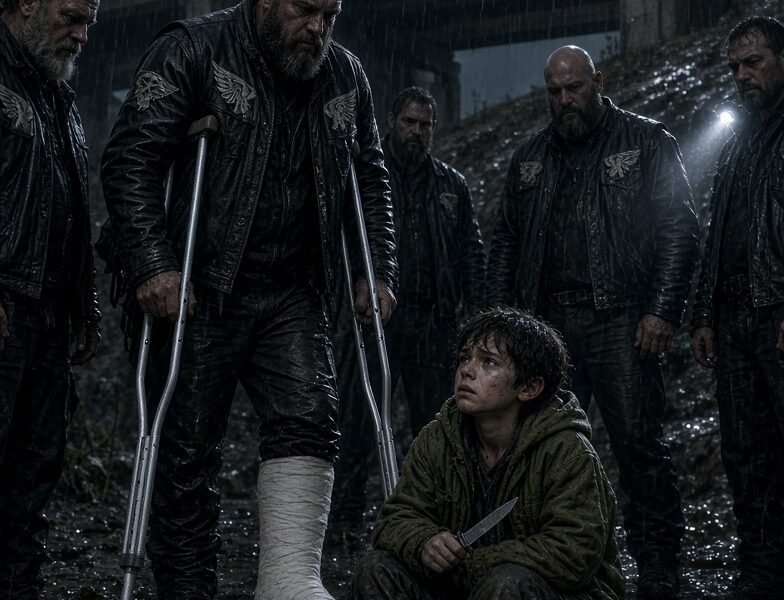
There were at least twenty men crowded into the narrow space beneath the bridge. More stood on the embankment, lining the hill all the way up to the guardrail. They were all massive, wearing heavy leather cuts. The winged death’s head stared at Leo from a dozen chests. At the front of the pack stood Garrett. He wasn’t walking under his own power. He was leaning heavily on a pair of aluminum crutches. His right leg was encased in a thick white cast from his ankle to his upper thigh, resting awkwardly on the dirt. He looked pale, but his eyes were sharp.
Beside Garrett stood an older man. He had a thick mane of silver hair pulled back into a tight ponytail and a gray beard that reached his collarbone. He radiated a quiet, dangerous authority. The patch on his chest read “President.” Garrett swung forward on the crutches. He looked at the squalor. He looked at the taped shoes. He looked at the blood stain Leo had tried to bury. Finally, he looked at Leo—shivering violently, clutching a dull pocketknife. “Told you I wouldn’t forget,” Garrett said softly.
“You,” Leo’s voice cracked. He coughed, a brutal wet spasm that bent him double. When he looked up, the older man, the president, was kneeling in the dirt right in front of him. The man ignored the grime. He reached out and put a massive calloused hand on Leo’s forehead. “He’s burning up, Garrett,” the president said. His voice was shockingly gentle. “Kid’s got a fever of at least a hundred and three.” “I’m fine,” Leo croaked, his cynical instinct kicking in. “Don’t need nothing.”
“Yeah, you do,” the president said. He turned his head slightly. “Clay, bring the bag.” A mountain of a man with a scarred jaw stepped forward, dropping a heavy black duffel bag onto the dirt. He unzipped it. The president reached in and pulled out a heavy insulated Carhartt jacket. It was brand new, stiff, and smelling of clean cotton. Next came a pair of thick wool socks, and finally a pair of dark brown Red Wing boots. Real boots, not taped-together canvas. “Put these on,” the president commanded.
It wasn’t a request. Leo just stared at them. “Why?” “Because a man who saves a brother’s life doesn’t freeze in a ditch. Not in our town,” the president said. He looked Leo dead in the eye. “My name is Duke. Garrett here is my sergeant-at-arms. He tells me a ninety-pound ghost dragged him out of the kill zone and patched an artery, saved him from bleeding out on the asphalt.” Duke gestured to the men behind him and the hundreds of idling bikes rumbling up on the highway. “Garrett’s blood is our blood. You saved him. You bought a debt. We pay our debts.”
Leo looked at Garrett. The giant gave a slow, solemn nod. “I don’t do group homes,” Leo muttered, his teeth chattering. “I don’t go to the system.” “Group homes?” Duke scoffed. A few of the bikers chuckled, a low, menacing sound. “Kid, we don’t do the system either. The system is broken. We handle our own.” Duke stood up to his full height. He loomed over the small camp.
“Here’s the deal,” Duke said. All business now. “We own a custom shop down in the valley. Four bays, lots of chrome to polish, lots of floors to sweep. There’s a heated room in the back. Got a real bed, a shower with hot water, a fridge that gets stocked every Monday.” Duke paused, letting the weight of the words settle. “You want a handout? We can leave you a stack of cash right here in the dirt and ride off. You can buy yourself some time until someone bigger takes it from you. But you look too smart for that.”
Duke pointed a heavy finger at Leo. “You come with us. You work. You sweep the bays. You wipe down the tools. You earn your keep. But you don’t sleep in the mud anymore. You don’t starve. And nobody—nobody—touches you.” Leo looked at the brand new boots. He looked at the heavy winter coat. He felt the fire burning in his lungs, the brutal reality that if he stayed here one more night, he wouldn’t wake up.
He looked at Garrett. “You mop the floors, too?” Garrett barked a laugh, wincing as it jarred his broken leg. “I build the engines, kid. You’re mopping my floors.” Leo looked back at Duke. He didn’t see pity in the older man’s eyes. He saw a transaction. Respect. It was the only currency Leo understood. It wasn’t a fairy tale. It was a job. It was survival.
Leo slowly let go of the pocketknife. It fell into the dirt. He reached out with shaking hands and pulled the heavy Carhartt jacket over his shoulders. The warmth was immediate, trapping his body heat against the thick flannel lining. Clay stepped forward and helped Leo pull off his taped, ruined shoes. He slid the thick wool socks onto Leo’s freezing feet, then laced up the heavy Red Wings. The leather was stiff, protective armor.
“Can you walk?” Duke asked. Leo tried to stand. His legs betrayed him again, buckling instantly. Before he could hit the ground, Clay caught him. The massive biker effortlessly hoisted Leo up, throwing the boy over his broad shoulder like he weighed nothing at all. “I got him, boss,” Clay grunted. They marched out of the underpass.
As they climbed the muddy embankment, the true scale of the rescue hit Leo. Up on the interstate, both northbound lanes were completely blocked. Traffic was stopped for half a mile. Red and blue police lights flashed in the distance, but the squad cars were boxed out by a literal wall of heavy iron and chrome. One hundred and fifty Harley-Davidsons sat idling, a sea of leather and denim blocking the world from getting to their brothers. The rumble was deafening. It rattled Leo’s teeth. It vibrated in his chest, chasing away the cold.
Clay carried him toward a massive blacked-out pickup truck, idling near the front of the pack. He opened the back door and set Leo gently onto the plush leather seat. The heater was blasting. It felt like stepping into an oven. Garrett hobbled over to the open door on his crutches. He leaned in, the harsh highway lights reflecting in his dark eyes. “You did good, kid,” Garrett said softly. “You’re done surviving now. We’re going home.”
Garrett slammed the heavy door shut. The loud rumble of the bikes was instantly muffled, leaving Leo in a warm, quiet cocoon. Through the tinted glass, Leo watched the bikers mount up. Duke kicked his heavy bagger into gear, leading the pack. One by one, the massive machines peeled away from the shoulder, forming a tight, unbreakable column of steel.
The black truck pulled out, flanked on all sides by roaring Harleys. They rode in formation—a mobile fortress. Leo leaned his head back against the warm leather headrest. He pulled the thick collar of his new coat up around his neck. The violent coughing fit returned, racking his small frame. But this time he didn’t care. He wasn’t alone in the dark anymore. He looked down at the heavy boots on his feet. The mud of the underpass was already drying on the soles, flaking off, leaving the dirt exactly where it belonged.
The truck merged onto the highway, and Leo watched the city slide past through half-lidded eyes. He had never seen it from this angle before—from inside, from safety. The rain had stopped completely now, leaving the streets slick and gleaming under the streetlights. They drove for twenty minutes, the Harley escort rumbling around them like a metal cocoon.
The shop was in an industrial district, tucked between a welding supply company and a tire warehouse. It was a long, low building with four roll-up doors and a neon sign that read “Devil’s Due Customs” in red and orange. The truck pulled into the lot, and the Harleys peeled off one by one, parking in a neat row along the fence. Clay opened the back door and helped Leo out.
His legs were still weak, but the boots gave him stability he hadn’t felt in months. Duke led them through a side door into the back room. It was small but clean—a twin bed with actual sheets, a dresser, a mini-fridge, and a door that led to a tiny bathroom. Leo stood in the doorway, swaying slightly. He hadn’t slept in a real bed since his mother died. He wasn’t sure he remembered how.
“Shower’s in there,” Duke said, pointing. “Hot water takes a minute to kick in. There’s clean clothes in the dresser—some of the guys’ old stuff, should fit you well enough. We’ll get you proper gear tomorrow.” Leo nodded, not trusting his voice. Duke studied him for a moment, then reached into his pocket and pulled out a small plastic bag. Inside was a bottle of antibiotics.
“Doc said take two now, then one every eight hours. You got pneumonia, kid. Bad. If you’d stayed out there another night, we’d be planning a funeral instead of a homecoming.” Leo took the bag with shaking hands. “Why?” he asked again. It was the only question that mattered. Duke didn’t answer right away. He looked around the small room, at the bed, the fridge, the clean sheets.
“Because I was you once,” Duke said finally. “Different underpass, different city. But I was you. Someone gave me a chance, and I took it. Best decision I ever made.” He turned to leave, then paused at the door. “Get some sleep. We’ll talk about work tomorrow.” The door clicked shut behind him.
Leo stood there for a long moment, the silence pressing in around him. Then he walked to the bathroom, turned on the shower, and watched the steam rise. He stripped off his filthy clothes—the jacket, the torn jeans, the socks that had been wet for days—and stepped under the hot water. The sensation was almost painful at first, his frozen skin screaming in protest. But then it became something else entirely. Something he had almost forgotten. Comfort.
He stood there for twenty minutes, letting the water wash away three days of mud and blood and fear. When he finally stepped out, wrapped in a clean towel, he caught his reflection in the mirror. He looked different. Thinner, maybe. Older. But there was something else in his eyes. Something he hadn’t seen in a long time. Hope.
He dressed in the clean clothes—a pair of jeans that were slightly too big, a black t-shirt with a faded logo, a thick flannel shirt. He took the antibiotics, then crawled into the bed. The mattress was soft. The pillow smelled like laundry detergent. He pulled the blanket up to his chin and closed his eyes. For the first time in three years, Leo slept without dreaming of the cold.
—
He woke to the sound of engines. Not the thunderous roar of the highway, but the low, rhythmic rumble of a single bike idling in the shop below. Leo lay still for a moment, disoriented by the softness of the bed, the warmth of the room. Then the memories came flooding back—the blood, the storm, the boots. He sat up slowly, his chest still tight, but the rattling cough was gone.
He found a pair of work boots by the door—not the Red Wings, but a scuffed pair of steel-toes that fit well enough. He laced them up and stepped out into the shop. The place was massive. Four bays, each one holding a bike in various stages of assembly. Tools lined the walls in neat, organized rows. The smell of motor oil and metal polish hung in the air like incense.
Garrett was in the first bay, hobbling around on his crutches as he worked on a cherry-red Sportster. His leg was still in the cast, but he moved with the practiced efficiency of a man who had learned to adapt. He looked up when Leo appeared in the doorway. “Look who’s alive,” Garrett said, a hint of a grin on his weathered face. “Thought that fever might’ve cooked your brain.”
“Still here,” Leo said. His voice was hoarse but steady. Garrett gestured to a broom leaning against the wall. “Duke said you’re on floors. Don’t expect me to go easy on you just because you saved my life.” Leo grabbed the broom. “Wouldn’t dream of it.” He started sweeping, the rhythmic scrape of bristles on concrete a comforting sound.
The morning passed in a blur of small tasks. Sweeping, wiping down tools, organizing the parts shelves. The other bikers filtered in throughout the day—Clay with his scarred jaw, a wiry man named Tuck who talked nonstop, an older guy named Preacher who didn’t talk at all. None of them asked Leo questions. None of them treated him like a charity case. They treated him like he belonged there. Like he was part of the crew.
Around noon, Duke appeared with a bag of burgers from a place down the street. They ate together at a long wooden table in the corner of the shop, the conversation easy and rough. Leo sat quietly, eating his burger in small bites, listening to the banter. No one made him talk. No one demanded anything from him. It was the strangest feeling in the world.
That night, Garrett found him in the back room, sitting on the bed with his boots off. The big man leaned against the doorframe, his crutches tucked under his arms. “You did good today,” Garrett said. “Floors never looked better.” Leo shrugged. “It’s just sweeping.” “It’s not just sweeping,” Garrett said. “It’s showing up. It’s doing the work. That’s more than most people ever do.”
He reached into his pocket and pulled out something small and shiny. A key. “Duke wanted me to give you this. It’s for the shop. Front door, back door, your room. You’re not a guest here, kid. You’re family.” He tossed the key to Leo, who caught it one-handed. It was warm from Garrett’s pocket. Heavy. Real.
Leo looked at the key in his palm, then back at Garrett. “I don’t know how to be family,” he said quietly. “I don’t remember how.” Garrett nodded slowly. “Neither did I. Still don’t, some days. But you figure it out. You show up. You do the work. You let people in.” He pushed off the doorframe. “Get some sleep. Tomorrow we start teaching you how to rebuild a carburetor.”
—
The weeks passed. The cast came off Garrett’s leg, and he started physical therapy, cursing through every session. Leo learned the shop, learned the bikes, learned the names and stories of every man who walked through those doors. He learned that Clay had a daughter in college, that Tuck had been a Marine, that Preacher had lost his wife to cancer and found his faith in the rumble of an engine.
He learned that family wasn’t about blood. It was about showing up. It was about the key in his pocket and the bed in the back room and the way Duke always saved him the last burger. It was about the way Garrett taught him to wrench, patient and gruff, never talking down to him. It was about the night he woke up coughing and found Preacher sitting in the dark outside his door, a silent sentinel keeping watch.
By spring, Leo had grown three inches and gained fifteen pounds. He could rebuild a carburetor from scratch. He could ride on the back of Garrett’s bike without flinching. He could look people in the eye when he talked to them. He had a library card. He had a bank account with three hundred dollars in it. He had a future.
One night, Duke called him into the office. Leo sat across from the old man, nervous for reasons he couldn’t explain. Duke leaned back in his chair, studying him. “You’ve been here six months,” Duke said. “You’ve done good work. You’ve earned your keep.” Leo nodded. “Thank you.” “I’m not finished,” Duke said. He reached into his desk drawer and pulled out a small box.
Leo opened it. Inside was a patch—a smaller version of the winged death’s head, not the full colors, but something close. A prospect patch. “You’re not old enough to prospect yet,” Duke said. “But when you are, if you want it, there’s a place for you.” Leo stared at the patch, his throat tight. “I don’t know what to say.”
“You don’t have to say anything,” Duke said. “Just keep showing up. That’s all any of us can do.” He stood and walked to the window, looking out at the row of bikes parked along the fence. “You know what the Hell’s Angels are, kid? We’re not just a club. We’re a family. And families take care of each other. You saved Garrett. You saved one of ours. That means something. It means everything.”
Leo closed the box and put it in his pocket, next to the key. He stood up and walked to the door, then paused. “Duke?” “Yeah?” “Thank you. For seeing me.” Duke didn’t turn around. “I didn’t see you, kid. You saw yourself. I just gave you a place to stand.”
—
The first anniversary of the storm came and went. Leo didn’t mark it. He didn’t need to. The blood on the concrete was long gone, washed away by a year of rain and time. But the stain remained—not on the concrete, but on him. It was the stain of survival. The stain of hope. The stain of a twelve-year-old kid who refused to walk away.
He still had the wool blanket. It was folded neatly at the foot of his bed, a reminder of the night everything changed. He still had the taped shoes, too, tucked away in the bottom of his dresser. He didn’t wear them anymore. But he kept them. He kept them to remember where he came from. He kept them to remember that survival wasn’t the end of the story. It was just the beginning.
Sometimes, late at night, he would sit on the back step of the shop and listen to the highway. The steady, rhythmic thump of tires over expansion joints. The only lullaby he knew. And he would think about the giant bleeding in the mud, and the choice he made, and the army that came for him.
He would think about the key in his pocket, heavy and warm. The patch in his dresser, waiting for the day he was old enough to earn it. The family that found him when he wasn’t even looking. And he would smile. Because the rule of the concrete was absolute. The weak disappeared. But the strong—the strong survived. And sometimes, if they were lucky, they found something worth surviving for.









