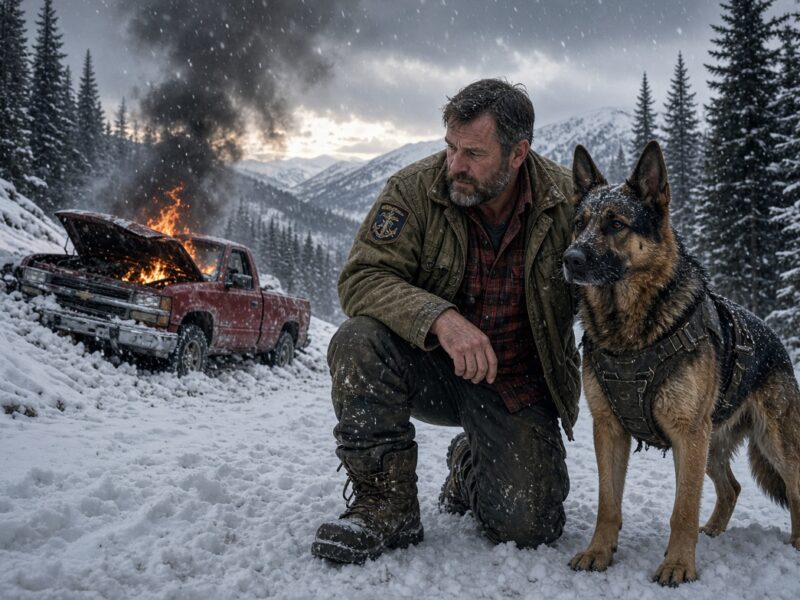
He Saved a “Dead” German Shepherd in a Blizzard — Then the Dog Saved Him
Deep in New Hampshire’s snowbound White Mountains, retired Navy SEAL Mason Hail found a German Shepherd beside a shattered kennel on a logging road.
The dog wore a faded tag marked Northstar K9 Ranger 17.
Minutes after Mason took him into his truck, the brakes failed, the pickup crashed, and flames swallowed the engine.
Injured in the snow, Mason ordered Ranger to run, but the dog refused to leave him.
Mason had no idea that saving Ranger would reconnect him with his estranged daughter, Lily, or reveal why the canine had been declared dead three years earlier.
Weeks later, Mason would become trapped inside an abandoned mountain station during another storm.
This time, Ranger would have to leave him and race for help.
By late afternoon, the White Mountains of northern New Hampshire had begun disappearing behind a slow wall of snow.
West of Conway, an old logging road wound through dark spruce and pine, climbing between frozen slopes before dropping toward a series of remote valleys.
Fresh snow moved across the road in thin white sheets, filling tire tracks almost as quickly as vehicles made them.
The February light was fading, and the temperature had begun falling with it.
Mason Hail kept his old red Chevrolet pickup moving carefully downhill.
At 49, Mason still carried the unmistakable physical presence of a man who had spent most of his adult life preparing for situations other people hoped never happened.
He stood a little over six-one with broad shoulders, powerful forearms, and the solid build left behind by more than twenty years of military conditioning.
His dark brown hair was cut short and had begun turning silver around both temples.
A rough beard covered his jaw, darker near the chin and gray along the sides.
His face was weathered rather than old, marked by cold climates, long hours outdoors, and years of keeping thoughts to himself.
Mason wore a faded olive field jacket over a red and black flannel shirt, dark work pants, and heavy winter boots.
A worn Navy SEAL patch remained stitched onto the left shoulder of the jacket.
He had stopped explaining it years ago.
Mason had served as a Navy SEAL before eventually leaving active service and returning to New England.
For several years afterward, he had helped with wilderness rescue training and occasionally assisted local search teams when weather or terrain became difficult.
He was calm under pressure, observant almost to a fault, and far better at understanding a landscape than understanding why people expected him to talk about himself.
That had not always been true.
Years earlier, Mason had been louder, easier to reach, and quicker to laugh.
But a difficult transition home, followed by the collapse of his marriage, had gradually turned silence from a habit into a shelter.
Now he lived alone in a cedar cabin far enough into the mountains that visitors rarely arrived by accident.
That afternoon, he had driven into town for groceries, propane fittings, and several boards he intended to use repairing a storage shed behind the cabin.
He expected to be home before dark.
Then something appeared beside the road.
Mason eased off the accelerator.
At first, he thought it was a young deer standing near the tree line.
Then the shape moved.
German Shepherd.
Mason slowed the truck until the tires rolled almost silently across packed snow.
The dog stood beside a damaged transport kennel, partly buried near the shoulder.
Mason stopped twenty yards away.
The German Shepherd did not run.
He was an adult male, perhaps four years old, with a large working dog frame, straight back, deep chest, and long black and tan coat dusted with snow.
His ears stood sharply above an intelligent face, and his dark brown eyes remained fixed on the truck.
He looked tired, not weak.
There was an important difference.
Even standing alone beside an unfamiliar road in worsening weather, the shepherd carried himself with the disciplined stillness of a dog accustomed to waiting for instructions.
A torn black harness remained around his chest, one strap hanging loose.
Mason watched him for several seconds.
The dog watched back.
“All right,” Mason said quietly.
He pulled the truck farther onto the shoulder and stepped outside.
Cold wind immediately moved beneath his jacket collar.
The shepherd took two steps backward.
Mason stopped.
“I’m not coming any closer.”
The dog could not understand the sentence, but Mason knew tone mattered.
He turned slightly sideways instead of facing the shepherd directly.
The dog’s ears moved.
Mason noticed the kennel.
It was a hard-sided transport crate, old enough for the corners to show years of wear.
One side had split open, possibly sometime before Mason arrived.
Snow had already gathered inside it.
There was no vehicle nearby, no person, no fresh set of human footprints that Mason could identify through the increasingly covered road.
The shepherd glanced toward the forest, then returned his attention to Mason.
Mason lowered himself slightly.
“Stay.”
The reaction was immediate.
The dog became still.
Mason’s eyes narrowed.
He waited several seconds.
“Down.”
The shepherd hesitated.
Then he lowered himself into the snow.
Mason looked at him differently.
“Now heel.”
The shepherd stood and moved several controlled steps closer before stopping again.
That was enough.
“You’ve done this before.”
Mason approached slowly.
The dog remained cautious, but he no longer retreated.
Only when Mason was close enough did he notice the small metal plate attached to the damaged harness.
He brushed snow away with two fingers.
Four lines had been stamped into the metal.
Northstar K9 Ranger 17.
Mason looked at the dog.
“Ranger.”
One ear shifted.
The shepherd’s eyes changed almost imperceptibly.
Recognition.
“That’s you.”
Ranger remained still.
Mason inspected the harness without removing it.
There was no phone number and no current owner information.
The snow was getting heavier.
Whatever story had brought Ranger to this road could wait until both of them were somewhere warmer.
Mason opened the rear door of the pickup.
“Up.”
Ranger looked inside, then at Mason.
“Your choice.”
Several seconds passed.
Ranger climbed into the truck.
Mason closed the door gently.
For the first few miles, Ranger sat upright in the rear seat, watching the road behind them.
Mason occasionally checked him in the mirror.
“You always this suspicious?”
Ranger stared back.
Mason almost smiled.
Ten minutes later, the road began descending more sharply toward the southern side of the ridge.
Snow had covered much of the packed surface.
Mason reduced his speed.
A bend appeared ahead.
He pressed the brake.
Something felt wrong.
The pedal traveled farther than expected.
Mason’s expression changed instantly.
He pressed again.
The truck slowed, but not enough.
Years of training narrowed his attention rather than widening his fear.
Road, slope, snowbank, trees, Ranger.
Mason kept both hands steady on the wheel and guided the Chevrolet toward the softer shoulder rather than allowing it to continue down the hill.
The pickup slid sideways.
Snow rose across the windshield.
The truck struck the deep bank and came to rest at an angle.
For several seconds, everything was quiet.
Mason remained behind the wheel.
He checked himself quickly.
Then he looked back.
“Ranger.”
The shepherd was standing in the rear footwell, alert but responsive.
“Stay.”
Ranger froze.
Mason smelled something he did not like.
He looked toward the front of the truck.
Smoke had begun appearing near the hood.
“Not staying anymore.”
Mason opened his door, then reached back and released Ranger.
“Out.”
Ranger jumped into the snow.
Mason followed more slowly.
The fall against the bank had left him shaken and struggling to put full weight on one leg, but he remained conscious and focused.
They moved away from the truck.
A moment later, orange light appeared beneath the front of the Chevrolet.
Mason did not go back.
Whatever was inside the vehicle could be replaced.
The road behind them could not.
He continued several yards through the snow before his injured leg refused another step.
Mason lowered himself onto the ground rather than allowing himself to fall uncontrolled.
Ranger immediately moved toward him.
Behind them, flames spread across the front section of the old red pickup.
Black smoke climbed between the white trees.
The contrast made the scene look almost unreal.
Red truck, orange fire, white mountain, and one German Shepherd standing beside a man he had met less than an hour earlier.
Mason reached into his jacket for his phone.
Nothing.
He checked the other pocket.
Then he looked back toward the truck.
Through the snow, he could see a dark shape lying near the driver’s side.
His phone.
Too close to the vehicle now.
Of course.
Ranger stared at him.
Mason shifted slightly and felt fabric pull at his shoulder.
He looked down.
One corner of the old SEAL patch had torn loose during the crash and now hung partly away from the jacket.
Mason touched it once, then looked toward the road.
No headlights, no houses, no immediate help.
Ranger moved closer.
“Go.”
The shepherd remained still.
Mason pointed down the road.
“Go.”
Ranger looked in that direction, then back at Mason.
“That’s not a suggestion.”
Nothing.
The dog stepped between Mason and the burning truck.
Mason stared at him.
For all the obedience Ranger had shown earlier, apparently there were limits.
The shepherd had decided where he belonged.
Miles away, another vehicle was moving north from Concord.
Lily Hail drove with both hands on the wheel as the weather worsened.
At nineteen, Lily was tall and slender with long dark blonde hair tied loosely behind her head and gray-blue eyes inherited from her father.
Her face was softer than Mason’s, but the way she watched the road carried the same concentrated stillness.
Lily was studying emergency medical care in Concord.
She was patient with strangers, stubborn with people she loved, and much more willing than Mason to admit when something frightened her.
The years following her parents’ divorce had changed that patience.
As a child, Lily had always expected her father to show up.
As she grew older, she learned not to build plans around that expectation.
She and Mason still spoke, but often through short texts, and sometimes days passed between them.
That morning, she had sent him three messages.
No answer.
So Lily had made a decision without telling him.
She was driving to the cabin.
Back on the mountain road, Mason’s breathing had slowed.
Snow gathered on his sleeves.
Ranger remained beside him.
Mason removed the gray wool scarf from around his neck.
He held it toward the shepherd.
Ranger leaned forward.
Mason placed one end gently between the dog’s teeth.
“Take it.”
Ranger held the scarf.
“Good.”
Mason pointed toward the road again.
“Go.”
Ranger did not move.
Instead, he stepped closer until one shoulder nearly touched Mason’s arm.
Mason looked at him for a long moment.
Behind them, the old Chevrolet burned against the snowy forest.
Ahead, the road disappeared into falling white.
Mason had spent years believing that when trouble came, the safest person to depend on was himself.
Tonight, that option was becoming smaller by the minute.
And Ranger, a dog whose past Mason knew nothing about, had already made one decision.
He was not leaving.
Night came quickly over the White Mountains.
For nearly forty minutes, Ranger remained beside Mason Hail on the snow-covered logging road, while the burning Chevrolet slowly became less important than the cold gathering around them.
The fire behind the old pickup still threw orange light across the trees, but farther down the mountain, the road had already disappeared into darkness.
Snow collected along Mason’s sleeves, boots, and shoulders.
Ranger repeatedly shifted between watching the road and checking the man beside him.
Mason had tried twice to push himself upright.
Both attempts ended the same way.
His body was responding, but not well enough for him to travel several miles through worsening weather.
Years of military experience told him something his pride did not want to accept.
Waiting beside the road was no longer a plan.
He looked at Ranger.
The German Shepherd still held the gray wool scarf Mason had placed between his teeth earlier.
He had not dropped it.
His ears moved whenever Mason spoke, as though the dog were waiting for a command that made sense.
Mason lifted one hand and pointed east toward the general direction of his cabin.
“Home.”
Ranger stared at him.
Mason repeated it.
“Home.”
The word meant something to the dog.
Not necessarily Mason’s cabin.
Ranger had never been there.
But the shepherd’s posture changed.
He looked toward the trees, then back at Mason.
His training seemed to be working through the problem in its own way.
Mason pointed again.
“Go find someone.”
Ranger remained motionless.
Mason’s expression hardened, not with anger but urgency.
“You staying here doesn’t help me.”
The dog could not understand the full sentence, but he understood tone.
Mason reached toward the loose corner of the Navy SEAL patch hanging from his shoulder.
The fabric had torn during the crash and now barely held to the jacket.
Ranger stepped closer as Mason touched it.
The weakened stitching finally gave way, and the patch slipped into the snow beside the shepherd’s front paws.
Ranger lowered his head.
He smelled it once.
Then he picked it up briefly before shifting the scarf more securely in his mouth.
Mason pointed away from himself one final time.
“Go.”
This time, Ranger moved.
He ran twenty yards, stopped, and looked back.
Mason raised his hand.
“Go.”
Ranger disappeared between the snow-covered trees.
Mason watched until the black and tan shape was gone.
For the first time since he had found the shepherd beside the damaged kennel, the road felt completely empty.
Several miles away, Lily Hail turned her silver Subaru onto the narrow access road leading toward her father’s cabin.
The storm had delayed her far longer than expected.
At nineteen, Lily was tall and slender with long dark blonde hair tied behind her head and gray-blue eyes that became sharper whenever she was worried.
She had inherited Mason’s habit of studying a problem before reacting to it.
But unlike her father, Lily disliked pretending that concern did not exist.
Training in emergency medical care had made her practical under pressure.
Yet the years following her parents’ divorce had made her cautious about expecting too much from Mason.
She had once called him Dad without thinking.
More recently, during their worst arguments, she sometimes called him Mason.
It was easier than admitting how disappointed she was.
That afternoon she had sent three messages.
You home tonight?
Then: Weather looks bad up there.
And finally: Call me when you see this.
No answer.
Lily had told herself she was only checking on him because of the weather.
That explanation had lasted until she packed an overnight bag.
The cabin appeared through the snow shortly after seven.
Lily immediately noticed what was missing.
The red Chevrolet was not beside the porch.
She parked and hurried to the front door.
“Mason!”
Nothing.
She unlocked the cabin using the key he had given her years earlier.
The interior was dark and cool, but not abandoned.
A few pieces of firewood remained beside the stove.
His coffee mug from that morning was still near the sink.
A grocery list had been left on the counter.
He had expected to return.
Lily checked her phone.
No new messages.
She called.
The line rang several times before going to voicemail.
Lily stared at the screen.
“Come on.”
She tried again.
Nothing.
Outside, wind pushed loose snow against the porch.
Lily moved toward the window and looked into the darkness.
That was when something struck the wooden steps.
Not hard, just enough to make her turn.
Another sound followed.
Lily opened the door.
A German Shepherd stood beneath the porch light.
For several seconds, neither moved.
The dog was covered in snow from his ears to his legs.
His chest rose quickly from exertion, and his black and tan coat was wet along the underside.
A damaged harness crossed his shoulders.
In his mouth was a gray wool scarf.
Lily knew it immediately.
Her father had worn the same scarf for years.
Mason’s.
Ranger stepped forward.
Something dark dropped from beside his paws.
Lily looked down.
A worn black and gold Navy SEAL patch rested in the snow.
Her expression changed.
She knew that patch, too.
Mason had worn it on the same olive jacket for as long as she could remember.
Lily crouched carefully.
“Where is he?”
Ranger looked toward the tree line.
Then he ran across the clearing.
Twenty yards away, he stopped.
He turned around.
Lily took one step after him.
Ranger ran farther, then stopped again.
She understood.
“You want me to follow you?”
She grabbed her coat and started down the porch.
Then common sense fought through panic.
She could not follow an unfamiliar dog alone into mountain forest during a snowstorm.
Lily pulled out her phone.
There was one man Mason had told her to call if anything ever happened in the mountains.
Ethan Brooks answered on the second ring.
“Lily.”
“My dad’s missing.”
The response on the other end changed instantly.
Ethan Brooks was forty-seven, compact and athletic with close-cropped brown hair turning gray near the ears and a weathered face shaped by years outdoors.
He had coordinated search and rescue operations throughout northern New Hampshire for more than fifteen years.
Ethan was deliberate, patient, and difficult to panic.
Early in his career, he had learned that rushing into bad terrain often created more people who needed rescue.
Since then, he insisted on preparation, even when emotions demanded speed.
“What do you know?”
Lily explained quickly.
“No truck, no phone answer. Then the dog. The dog brought his scarf and his SEAL patch.”
Ethan was silent for half a second.
“Stay at the cabin. I’m coming.”
“He’s trying to take me somewhere.”
“I believe you.”
“I can follow him.”
“No.”
Lily looked toward Ranger.
“He might lose the trail.”
“And if you get lost, too, I have two people to find.”
That stopped her.
Ethan continued.
“Keep the dog there if you can. Don’t force him inside. I’ll be there as fast as conditions allow.”
Ranger paced near the tree line while Lily waited.
Every few minutes he returned to the porch, looked at her, then moved toward the forest again.
“I know,” Lily whispered.
“We’re coming.”
Ethan arrived twenty-five minutes later in a four-wheel-drive search and rescue vehicle.
Another truck followed, carrying three members of his team.
They were experienced local rescuers dressed for winter travel.
People accustomed to moving carefully through terrain where weather could change faster than plans.
Ethan stepped into the clearing carrying a field pack.
His eyes went immediately to Ranger.
“That him?”
Lily nodded.
Ranger approached Ethan cautiously.
Ethan did not reach toward him.
Instead, he watched the shepherd move.
The dog looked toward the woods, then back at the group.
“He’s not wandering,” Ethan said.
“What does that mean?”
“It means he knows exactly why he came back.”
Lily was already pulling on her gloves.
“I’m going.”
Ethan looked at her.
“I assumed you’d say that.”
He opened the rear compartment of his vehicle and handed her snowshoes, an insulated outer layer, and a small emergency pack.
Lily frowned.
“We’re wasting time.”
“No, we’re making sure I don’t have to carry you back, too.”
She almost argued.
Then she remembered his earlier point.
Lily put on the equipment.
Only when Ethan had checked everyone’s gear did he nod toward Ranger.
“All right, buddy.”
The shepherd immediately ran into the forest.
The team followed.
Ranger established a pattern within the first few minutes.
He moved quickly ahead, sometimes forty or fifty yards, then stopped and looked back until he saw the rescuers.
Then he continued.
Ethan noticed it immediately.
“That dog’s trained.”
Lily looked up.
“How can you tell?”
“He’s not just following scent. He’s managing distance.”
Ranger disappeared around a stand of spruce.
Seconds later, he returned far enough to see the group.
Then he turned again.
Ethan shook his head slightly.
“Somebody taught him how to bring people with him.”
The route eventually reached the logging road.
Snow was already filling the tire marks.
Ranger accelerated.
Then Ethan saw a faint orange glow between the trees.
“Light ahead.”
Lily’s breathing changed.
They rounded the bend.
The remains of Mason’s pickup stood against the snowbank.
The fire now smaller but still visible through the front section.
Farther from the truck, a dark figure rested beside the road.
“Dad.”
Lily started forward.
Ethan caught her arm long enough to slow her.
“Careful.”
Ranger did not wait.
He raced past everyone.
Mason heard movement before he understood what it was.
His eyes opened.
Something cold touched his hand.
Ranger.
The German Shepherd pressed his nose against Mason’s fingers, then leaned his shoulder against him.
Mason looked at the dog.
“You came back.”
Then he saw lights moving through the snow.
Ethan, rescue team.
And behind them, Lily.
She reached Mason and dropped to one knee beside him.
For a second, neither spoke.
Then Lily said the word she had avoided during too many arguments.
“Dad.”
Mason looked at her.
“Hey.”
Her expression tightened.
“You’re impossible.”
“I’ve been told.”
Ethan crouched nearby and began the calm assessment he had performed on dozens of mountain rescues.
“You stay still. We’ve got you.”
Mason nodded.
Lily kept one gloved hand around his.
Ranger remained pressed against his other side.
The team worked without rushing, keeping Mason warm and preparing him for transport.
Nobody treated the moment like a spectacle.
The danger had passed.
What mattered now was getting everyone off the mountain safely.
When they finally helped Mason into the rescue vehicle, he looked around the interior, then toward the open door.
His first question was not about the truck, not about his phone, not even about himself.
“Where’s the dog?”
Ranger appeared beside Lily.
Mason’s shoulders relaxed.
Only then did he allow Ethan to close the door.
By the time Mason Hail left the small regional hospital outside Conway, the storm that had nearly buried the logging road had moved east toward Maine.
Morning sunlight reflected across plowed snowbanks so brightly that Mason had to narrow his eyes when Lily helped him into the passenger seat of her Subaru.
He disliked needing help almost as much as he disliked hospitals, but the doctor had been clear.
Mason had avoided the worst outcome.
Yet the cold exposure, bruising, and strain from the crash meant several quiet weeks instead of immediately returning to normal life.
At forty-nine, Mason had always treated recovery like an inconvenience rather than a process.
That attitude had worked when he was younger.
It worked less well now.
Lily closed his door and walked around the vehicle.
“You’re not driving.”
“I didn’t ask.”
“You looked at the keys.”
“I was looking in their general direction.”
Lily started the engine.
“That’s how this is going to be.”
Mason leaned back carefully.
“Probably.”
It was the longest conversation they had managed since the rescue.
Ranger was waiting at a veterinary clinic on the north side of Conway.
The building belonged to Dr. Hannah Pierce, a forty-one-year-old veterinarian who had spent nearly sixteen years working with family pets, retired police dogs, and search and rescue animals from across northern New Hampshire.
Hannah was tall and lean with auburn hair usually tied into a loose knot and calm green eyes that seemed to notice nervous behavior before anyone else in the room did.
Years earlier, early in her career, Hannah had treated a badly frightened working dog whose trust had been damaged by too many unfamiliar hands and too much forced handling.
The experience changed the way she practiced.
She became known for patience, quiet movement, and giving frightened animals enough space to make their own decisions whenever possible.
Animals rarely needed her to sound reassuring.
They needed her to actually be safe.
When Mason and Lily entered the clinic, Ranger was lying beside the examination room door.
The German Shepherd stood immediately.
His attention went first to Mason, then to Lily, then back to Mason.
“You look disappointed,” Mason said.
Ranger crossed the room and pressed his nose against Mason’s hand.
Hannah stood near the counter in navy scrubs beneath a gray cardigan.
“I think that’s relief.”
“He has low standards.”
“Considering where he found you, maybe not.”
Lily smiled.
Mason noticed.
He also noticed that Ranger remained close enough for his shoulder to brush Mason’s leg.
Hannah had already given the shepherd a basic examination.
Aside from fatigue, mild dehydration, and the effects of exposure to winter weather, Ranger appeared physically strong.
“He’s in remarkably good shape,” Hannah said.
“Working weight, good muscle tone, healthy coat beneath all that road grime. Somebody cared for him recently.”
“Recently?”
“He hasn’t been surviving alone in the mountains for months.”
Mason looked at the damaged black harness still resting on the table.
The metal plate remained attached.
Northstar K9 Ranger 17.
“That’s what bothers me.”
Hannah nodded.
“It bothers me too.”
She reached for a handheld microchip scanner.
“Let’s see if somebody bothered registering him.”
Ranger watched the device but did not pull away when Hannah passed it carefully along his shoulders.
The scanner sounded.
Hannah looked at the display.
“There you are.”
Mason folded his arms.
“Owner?”
“Give me a minute.”
She entered the identification number into a registry database.
At first, her expression did not change.
Then she leaned closer to the monitor.
Lily noticed.
“What?”
Hannah read the screen once, then again.
She looked toward Ranger.
“That can’t be right.”
Mason straightened slightly.
“What does it say?”
Hannah did not answer immediately.
She picked up the scanner again.
Ranger remained patient while she repeated the process.
Same number.
Hannah typed it manually.
Same result.
Then she turned the monitor toward Mason and Lily.
The registration page was old but still readable.
Name: Ranger.
Breed: German Shepherd.
Classification: Working Canine.
Registered organization: Northstar Working Canine Services.
Below that was a status line.
Hannah pointed at it.
“Deceased. Three years ago.”
Nobody spoke for several seconds.
Ranger sat beside Mason’s chair, alive, alert, watching all three of them as though the confusion belonged entirely to the humans.
Lily finally said, “Could someone have entered the wrong dog?”
“Possible,” Hannah said, “but the chip number is specific.”
“Could the record just be wrong?”
“That’s also possible.”
Mason stared at the screen.
“But somebody had to change the status.”
Hannah nodded.
“Yes.”
Mason looked down at Ranger.
The shepherd looked back.
“Congratulations.”
Lily glanced at him.
“For what?”
Mason scratched lightly beneath Ranger’s chin.
“Apparently, he’s doing very well for a dead dog.”
Hannah almost smiled.
Then she returned to the computer.
Northstar Working K9 Services had once operated out of northern New England, coordinating transport and placement of trained German Shepherds, Belgian Malinois, and other working breeds.
Its clients had included private security companies, volunteer search organizations, specialized training groups, and several agencies that occasionally contracted transportation rather than handling it themselves.
The company had closed three years earlier after financial problems.
Hannah found old public business records first, then archived canine transfer notices, then fragments of shelter correspondence.
The pattern became less clear the longer she looked.
Some Northstar dogs had been officially transferred to new organizations.
Others appeared in adoption records.
Several had been sent to shelters when contracts ended, but eleven dogs had a different notation.
No destination, no shelter, no new handler.
Only: deceased during transport.
Ranger’s identification number appeared among them.
Lily leaned closer.
“Eleven.”
Hannah nodded.
“All within a relatively short period before the company closed.”
Mason’s face became still in the way Lily remembered from childhood.
The expression he wore when something stopped being strange and started becoming a problem.
“Any explanation?”
“Not in what I can access.”
“Accident reports?”
“Not here.”
“Veterinary confirmation?”
“Nothing linked to these records.”
Hannah looked at him.
“That doesn’t mean those documents never existed. It means we don’t have them.”
“Yes.”
Ranger shifted beside Mason.
As he moved, one corner of the harness lifted away from his side.
Lily noticed a narrow stitched flap hidden beneath one of the straps.
“What’s that?”
Hannah brought the harness closer after Mason removed it from Ranger.
The flap looked like a small equipment pocket built into the interior lining.
Hannah opened it carefully.
Something metallic slid into her palm.
A steel key, small, old, stamped with three numbers.
214.
Lily looked at Mason.
“Does that mean anything to you?”
“No.”
Hannah turned the key over.
There was no name, logo, or address, only 214.
Mason placed it beside Ranger’s metal identification plate.
Northstar 17.
Key 214.
A dog listed as dead.
None of it formed a complete answer, but it was beginning to look like a question with structure.
Later that afternoon, Mason received a call from the county investigator assigned to review the vehicle incident.
His name was Daniel Cross, fifty-four, a broad-shouldered man with close gray hair and the unhurried voice of someone who had spent most of his career separating facts from assumptions.
Cross had worked accident investigations for more than twenty years.
He was methodical, almost stubbornly so, partly because an early case had taught him how quickly people could build dramatic conclusions around incomplete evidence.
“The fire appears to have started after the truck left the road,” Cross told Mason.
“Nothing about that part surprises us.”
Mason waited.
“But the brake components were already in poor condition before the crash.”
Mason frowned.
“How poor?”
“More wear than I’d expect from what you described about the truck’s maintenance.”
Mason looked toward the cabin window.
Lily was outside with Ranger.
“You saying somebody touched them?”
“I’m saying I’m not saying that.”
Cross’s tone remained steady.
“Could be age, could be maintenance history, could be something else. I need more before I use stronger words.”
Mason respected that answer.
“Fair.”
“We’ll document it.”
“Do that.”
When the call ended, Mason did not tell Lily immediately, not because he wanted to hide it, but because he did not yet know what it meant.
By evening, they were back at the cabin.
Lily carried groceries inside while Mason moved more slowly than he liked.
She had decided to stay for several days.
Mason had responded with, “You have classes.”
Lily had answered, “Most of them are online this week.”
That ended the argument.
Neither admitted it.
Both were relieved.
Ranger entered the cabin as though he had already inspected and approved it.
He explored the living room, kitchen, mudroom, then returned to Mason.
Lily placed two bowls near the stove.
“You’re feeding him.”
“He needs food.”
“That wasn’t my point.”
Mason opened the refrigerator.
“I know.”
Dinner was quiet.
Not uncomfortable exactly, just unfinished.
Mason sat at one end of the table.
Lily sat at the other.
Ranger eventually lowered himself between them.
Every time the silence lasted too long, one of them looked down at the dog.
Finally, Lily said, “You know he’s becoming a communication device.”
Mason glanced at Ranger.
“Poor career choice.”
Lily smiled.
It was small but real.
Later, Mason placed three objects on the kitchen table.
The Northstar K9 Ranger 17 tag, the steel key stamped 214, and a printed copy of the registry page Hannah had given him.
Deceased three years ago.
Ranger lay near the stove with his head on his paws.
Mason looked from the records to the living animal.
Someone somewhere had once decided that Ranger’s story ended three years earlier.
The dog beside his fire suggested otherwise, and now there were ten other names on a list that might deserve the same question.
Mason picked up the Northstar tag.
For the moment, he had no answers, so he did what he had always done when answers were unavailable.
He kept the evidence, and he remembered the details.
Three days after Dr. Hannah Pierce discovered that Ranger had been officially listed as dead, she called Mason just after nine in the morning.
Mason was standing at the kitchen counter with one hand wrapped around a mug of coffee while Ranger lay near the wood stove.
Lily sat across the room with her laptop open, working through an online emergency care lecture she had postponed twice since the accident.
The cabin had become quieter in a different way over the past few days.
Mason still spoke less than Lily wanted, but the silence no longer felt as if both of them were trying to escape each other.
Ranger usually positioned himself somewhere between them, occasionally lifting his head whenever either voice changed.
Mason answered the phone.
“Hail.”
Hannah did not waste time.
“I found someone.”
Mason straightened.
“Northstar?”
“Older than that. Someone connected directly to Ranger.”
Lily looked up.
Hannah continued, “His name is Aaron Webb. He used to handle Ranger with a private search and rescue team in Vermont. I spoke with him this morning.”
Mason glanced toward the shepherd.
Ranger’s ears had shifted at the sound of his own name.
“What did he say?”
“Mostly that he wants to see the dog before he believes anything I told him.”
That afternoon, after Hannah confirmed the arrangements, Mason and Lily drove west with Ranger toward a small town in Vermont’s Green Mountains.
The trip took several hours, and Mason complained about Lily’s driving only twice, which she considered progress.
Aaron Webb lived outside Rochester in an aging two-story farmhouse bordered by maple trees and open winter fields.
Snow lay heavily across the property, though the sky had finally cleared enough to reveal the dark mountain ridge beyond the roofline.
A dark green pickup sat beside a detached garage.
Aaron was already outside when they arrived.
At fifty-two, Aaron had the compact, durable build of a man who had spent more time walking steep ground than sitting behind a desk.
He stood about five-ten with close-cropped sandy hair turning almost entirely gray at the sides, a short beard, and pale blue eyes that carried a tired attentiveness.
His left knee bothered him in cold weather, leaving the slightest stiffness in his walk, but otherwise he moved like someone accustomed to working outdoors.
Aaron had spent nearly twenty years around search dogs.
He was patient, observant, and unusually gentle for a man whose voice could easily fill a training field.
He had learned that patience after losing his first working dog during an illness years earlier.
Since then, he rarely rushed animals or assumed that loyalty gave a handler ownership over every decision a dog made.
When Mason opened the rear door, Ranger stepped down into the snow.
Aaron stopped moving.
Ranger stopped, too.
The distance between them was perhaps thirty feet.
Lily watched the dog.
Ranger’s posture had changed.
His head was slightly higher.
His ears stood completely forward.
He did not bark or pull toward the stranger.
He simply stared.
Aaron’s expression tightened.
For a moment, he looked like a man trying not to trust his own memory.
Then he said one word.
“Ranger.”
The German Shepherd froze.
His ears moved sharply.
Aaron said it again, quieter this time.
“Ranger.”
The reaction was immediate.
Ranger crossed the yard at a run.
Aaron dropped to one knee before the dog reached him.
Ranger pressed his head against Aaron’s chest so hard that the man had to put one hand against the snow for balance.
Aaron wrapped both arms loosely around the shepherd’s shoulders.
He did not say anything for several seconds.
Neither did Mason.
Lily looked away once, then back.
Aaron finally rested one hand behind Ranger’s ear.
“You’re here.”
Ranger leaned closer.
Aaron closed his eyes.
“I thought you were gone.”
Mason stood beside the truck, giving them space.
Whatever questions had brought them there could wait another minute.
When Aaron eventually stood, Ranger remained against his leg.
Aaron looked toward Mason.
“You found him on a logging road in New Hampshire?”
Aaron’s brow tightened.
“Alone beside a damaged transport kennel.”
Aaron looked back at Ranger.
“That doesn’t make any sense.”
“That phrase is becoming common.”
Lily gave Mason a look.
Aaron noticed the worn Northstar tag Mason had brought with him.
His face changed again.
“You still have that?”
“Found it on his harness.”
Aaron held out his hand but waited until Mason placed the tag into it.
He read the engraving.
Northstar K9 Ranger 17.
Aaron exhaled slowly.
“I haven’t seen one of these in three years.”
They went into the farmhouse.
The interior was warm and simple with wooden floors, old-framed mountain photographs, and several faded search and rescue certificates arranged along one hallway.
Ranger explored only briefly before returning to Aaron.
Aaron watched him.
“Same habit.”
“What?”
“He never stayed far from whoever he thought he was working with.”
Mason looked down at the dog.
“That part hasn’t changed.”
Aaron brought them into the kitchen.
He poured coffee, but his own cup remained untouched.
Three years earlier, Aaron explained, Ranger had been part of a small private SAR program that assisted volunteer rescue groups in Vermont and neighboring states.
Ranger had shown unusual promise early.
He was steady around crowds, strong in winter terrain, and capable of switching between independence and obedience without becoming confused.
“He wasn’t the fastest dog we had,” Aaron said, “but he thought.”
Mason looked toward Ranger.
“That I believe.”
Aaron smiled faintly.
“He’d stop if the trail stopped making sense. Some dogs just push harder. Ranger would actually reassess.”
Lily leaned forward.
“What happened to the team?”
“Funding contracts. Too many organizations using too many different systems.”
Aaron looked toward the window.
“Eventually, Northstar offered to place several of our dogs into larger programs. Ranger was one of them.”
“You agreed?”
“I did.”
There was no defensiveness in his voice, only regret.
“I thought he’d get more work than I could give him.”
The transfer had been scheduled during early winter.
Five dogs were loaded through Northstar’s transport system.
Ranger was one of them.
Two days later, Aaron received a phone call.
The transport had reportedly been involved in a serious incident during bad weather.
All five dogs were listed as dead.
Lily’s expression changed.
“All five?”
Aaron nodded.
“I asked for records.”
“Did you get them?”
“Enough paperwork to make me stop asking.”
Mason watched him carefully.
“What does that mean?”
Aaron looked at him.
“It means there were forms, internal reports, statements, numbers. Everything looked official enough that a person who wanted to believe the explanation could believe it.”
“And you believed it.”
Aaron looked back at Ranger.
“Yes.”
His voice lowered.
“I never saw his body.”
The room became quiet.
Aaron continued.
“I asked. They told me the remains had already been handled because of the circumstances of the transport. I hated it. But I didn’t have a reason then to think anyone was lying.”
Lily glanced toward Mason.
Now they had one.
Aaron stood.
“There’s something I want to show you.”
He led them through the mudroom and into the detached garage.
The garage smelled faintly of pine boards, machine oil, and old winter gear.
Snowshoes hung from one wall.
Several retired tracking harnesses occupied another.
Aaron opened a narrow wooden cabinet.
Inside was a red search and rescue leash.
It had been carefully coiled.
The leather near the handle was darker from years of use.
Aaron held it without speaking.
Ranger saw it.
The shepherd stopped.
Then he approached slowly.
His nose touched the leash.
Aaron lowered it.
Ranger took the worn leather gently into his mouth.
Lily covered a small smile with one hand.
Aaron laughed once, though his eyes had become wet.
“You stole that every chance you got.”
Ranger held the leash and looked up at him.
Aaron shook his head.
“Three years.”
Mason understood something then.
The dog had not merely recognized a person.
He had recognized a life.
Aaron crouched beside him again.
“I kept it because throwing it away felt wrong.”
Lily looked toward the shelves where other old equipment sat.
“You kept his gear all this time.”
“Some of it.”
Aaron looked at her.
“I didn’t plan to. First month I told myself I’d donate everything. Then I kept delaying it.”
He touched the leash.
“Eventually it stopped being equipment.”
On the drive there, Mason had wondered whether finding Aaron would create a different problem.
If Aaron asked for Ranger back, what then?
The shepherd had known Mason for only a short time compared with the years Aaron had spent with him.
Mason had no legal claim.
He understood no history.
Only a snowy road, a burning truck, and the fact that Ranger had gone for help when Mason needed him.
Aaron seemed to read something in his expression.
“I’m not taking him from you.”
Mason looked up.
“I didn’t say you were.”
“You didn’t have to.”
Aaron watched Ranger move back toward Mason.
The dog stopped beside Mason’s left leg.
Aaron noticed immediately.
“He chose where to stand.”
Mason rested his hand lightly against Ranger’s neck.
Aaron nodded.
“If he wants to visit, I’m not going anywhere. But whatever happened after Northstar, he found you.”
Lily glanced between both men.
For two people who were not particularly comfortable discussing emotion, they were doing a surprisingly complicated job of it.
Before they left, Aaron finally gave Mason the name that mattered most.
“There was one man handling transport logistics for Northstar. When Ranger was moved.”
Mason’s attention sharpened.
“Who?”
“Derek Voss.”
Aaron leaned against the workbench.
“Mid-fifties now, if I remember correctly. Tall, heavy shoulders, dark hair going gray even back then. Quiet man, never rude, but always seemed like he was measuring how much information a conversation required before giving one word more.”
“What was his job?”
“Logistics director. Vehicles, transfer schedules, storage, contractor paperwork. If dogs moved through Northstar, Derek usually knew where and when.”
“Did he call you after the accident?”
Aaron thought for a moment.
“No. Someone from administration did. But Derek signed part of the transfer chain.”
Mason did not ask for more.
Not yet.
They had come to understand Ranger’s past, not invent a conclusion before the evidence reached it.
As they prepared to leave, Lily remained in the garage with Aaron for another few minutes, asking questions about working dogs.
How were search dogs taught to manage distance?
How did handlers recognize exhaustion?
What happened medically after long deployments in cold weather?
Aaron answered carefully.
“You interested in handling emergency medicine for people for now.”
On the drive back, Lily called Hannah through the car’s hands-free system.
“Hannah, can I ask you something?”
“Usually.”
“What kind of training do you need to work in veterinary emergency care?”
Mason looked toward her from the passenger seat.
Lily noticed.
“What?”
“Nothing.”
“That was definitely something.”
Mason looked out the window.
“You stayed calm on the mountain.”
Lily became quiet.
He continued.
“You always have.”
She waited, expecting him to stop there.
He did not.
“You’re better at the part after the emergency than I ever was.”
“What part? Talking to people?”
Lily smiled slightly.
“That might be the nicest insult you’ve ever given me.”
“It wasn’t an insult.”
“I know.”
In the rear seat, Ranger lay with his head near the center console.
Aaron’s old red leash rested beside him.
Three years earlier, one document had ended his story.
Now that story had reopened.
It had a former handler, a transfer record, five dogs declared dead, and one name tied to the movement between them.
Derek Voss.
Mason looked at Ranger through the mirror.
For now, that was enough.
The steel key sat on Mason Hail’s kitchen table for four days before anyone learned what it had opened.
By then the snow around the cabin had settled into hard white banks beneath the trees, and Mason had begun moving without the stiffness that had followed the crash.
He still avoided putting unnecessary strain on his recovering leg, though Lily had discovered that telling him to rest only made him invent quieter forms of work.
That morning, he stood near the mudroom door with Ranger in front of him and a red training leash loosely folded in one hand.
“Stay.”
Ranger remained where he was.
Mason walked ten steps across the room.
“Come.”
The German Shepherd crossed directly to him.
“Good.”
Lily watched from the kitchen table.
“You realize normal people recovering from an accident watch television.”
“Sounds exhausting.”
Ranger sat beside Mason’s left leg.
The dog had begun responding to old search and rescue commands almost as though someone had opened a door in his memory.
He knew directional hand signals, could hold position while Mason moved out of sight, and understood that a command given quietly mattered just as much as one spoken loudly.
Mason had started with simple exercises because they gave Ranger something familiar.
Then, almost accidentally, he tried another.
Lily walked into the hallway.
Mason waited several seconds.
He touched Ranger’s shoulder.
“Find Lily.”
Ranger’s ears lifted.
He moved immediately.
Five seconds later, Lily laughed from the other room.
“He found me.”
Mason looked toward the hallway.
“That one stays in.”
Lily returned with Ranger beside her.
“Why? Useful command. For what?”
Mason picked up his coffee.
“You wander.”
“I’m nineteen.”
“Exactly.”
His phone rang before Lily could answer.
Ethan Brooks.
The search and rescue coordinator had remained involved since the night Ranger brought Lily back to the mountain.
Ethan was not an investigator, and he was careful not to pretend otherwise.
But years of working beside county agencies meant he knew who to call when unusual evidence crossed from curiosity into something that required official attention.
“I think we found your key,” he said.
Mason looked toward the small steel object lying near the Northstar tag.
“Where?”
“Berlin.”
Northern New Hampshire contained dozens of old industrial properties left behind by logging, manufacturing, and businesses that had moved or disappeared.
Ethan had passed the number 214 to a county contact who compared it against archived commercial records connected with Northstar.
One match stood out.
A row of storage units on the outskirts of Berlin had once rented several spaces to a Northstar subcontractor.
One of them was unit 214.
“Do not drive up there and start opening doors,” Ethan said.
Mason looked toward Lily.
“I wasn’t planning to.”
“You say that like I haven’t met you.”
“What do you want me to do?”
“Bring the key. Let people with warrants and paperwork do the rest.”
Mason looked at Ranger.
“Fine.”
Ethan paused.
“That sounded painful.”
“It was.”
They reached Berlin shortly after noon.
The storage property sat behind an aging commercial building near an old service road surrounded by snow banks and chain-link fencing.
The units themselves were simple metal structures arranged in two long rows.
Some doors had fresh locks.
Others showed years of weather.
Ethan was already waiting.
He wore his usual dark rescue jacket, though today there was no emergency equipment in his hands.
He nodded toward Lily, then Ranger.
“You brought the entire committee.”
“Ranger’s evidence,” Lily said.
Ethan glanced at Mason.
“I like her better.”
“You’re not alone.”
The unit had already been secured for an authorized inspection after records established its former connection to Northstar.
Mason handed over the steel key rather than approaching the door himself.
It fit.
When unit 214 opened, nobody found anything dramatic.
That almost made it more unsettling.
The interior looked like a place time had forgotten.
Old transport kennels had been stacked against one wall.
Several working dog harnesses hung from hooks, their straps dusty but intact.
Plastic storage bins were labeled with faded numbers.
A microchip scanner sat inside an open equipment case beside charging cables that belonged to technology several generations old.
Mason remained near the entrance.
Ranger stood beside him.
The shepherd did not pull toward the room, but he watched it closely.
One kennel near the back caught Lily’s attention.
Its metal door carried several shallow marks along the lower edge, the kind left by repeated contact over time.
Lily looked at them, then at Ranger.
“How long were dogs kept here?”
No one answered.
Ethan’s expression tightened.
“Don’t assume anything yet.”
Mason nodded.
But he had noticed the same thing.
Investigators began cataloging the contents while Mason, Lily, and Ethan remained where they were allowed to stand.
The most important discovery was not the old equipment.
It was paper.
Three archive boxes contained transfer records dating to Northstar’s final two years of operation.
Some were routine medical clearances, transport schedules, contract numbers, kennel assignments.
Then Lily noticed something.
She was standing beside one of the investigators when a ledger was opened across a folding table.
“Wait.”
Mason looked over.
Lily pointed without touching the page.
“That number.”
A line contained one of the K9 IDs Hannah had found under the eleven dogs listed as deceased.
But here the same dog had another destination code beside it.
Not deceased.
Transferred.
The next page contained another.
Then another.
The pattern became clear slowly.
Dogs officially listed in one record as lost during transport had continued appearing in private transfer ledgers under replacement codes.
Mason said nothing for several seconds.
Ethan leaned closer.
“So Ranger wasn’t an error?”
“No,” Mason said.
Lily began photographing every page she was permitted to document before the boxes were removed for formal processing.
The ledger suggested Northstar’s collapse had created confusion across contracts, ownership paperwork, and asset transfers.
Somewhere inside that confusion, valuable working dogs had been redirected to private facilities, while official records showed they no longer existed.
One name appeared repeatedly beside those transfers.
Derek Voss.
Mason recognized it immediately.
Aaron Webb had given them that name in Vermont.
Northstar logistics director, the man who had known where dogs were supposed to go.
The records did not describe every transaction in plain language, but together they established enough of a pattern for investigators to take the files seriously.
Payments had been attached to several private placements, and Derek’s authorization appeared repeatedly within the transfer chain.
Lily stared at one page.
“He sold them.”
Ethan answered carefully.
“It looks like working dogs were redirected and money changed hands. Let the investigation establish the exact responsibility.”
Mason appreciated the distinction, but Ranger’s existence no longer looked accidental.
Late that afternoon, Aaron Webb arrived after Mason called him.
Aaron entered unit 214 more slowly than everyone else had.
He knew what some of the old harness designs meant before anyone explained them.
He recognized inventory markings and two kennel styles Northstar had used during its final year.
Then he saw a name.
He stopped.
Mason noticed.
“You know that dog?”
Aaron nodded.
The ledger listed an older canine named Bishop.
Aaron’s hand rested against the edge of the table.
“Friend of mine handled him.”
His voice changed.
“The handler died two years ago.”
Lily looked at the record.
Bishop had also been listed among dogs that supposedly never completed their Northstar transfer, but the ledger showed a later private destination.
Aaron stared at the line for several seconds.
“My friend spent years thinking Bishop died before he ever reached his new program.”
Mason watched him.
Aaron’s grief did not turn into anger.
It became purpose.
“I’m helping.”
“You already are,” Mason said.
“No.”
Aaron looked toward the archive boxes.
“I mean with whatever comes next. Records, old handlers, people who knew the contracts. If those dogs went somewhere, somebody may remember them.”
Mason nodded once.
That was enough.
Then Lily found the page that changed the room.
It was newer than most of the other material.
A short inventory sheet contained only a handful of canine codes.
Several had lines drawn through them.
Three did not.
Beside each was a status notation suggesting active placement.
No names, only codes.
Lily counted them twice.
“Three.”
Mason stepped closer.
Ethan looked over her shoulder.
Ranger sat a few feet away.
Three working dogs might still be alive somewhere under identities different from the records that had officially ended their stories.
Ranger might not be the last one.
Mason looked toward Aaron.
Aaron understood immediately.
“We find out who they are.”
Ethan raised one hand.
“The police find out where the records lead.”
Aaron exhaled.
“Fine.”
Mason almost smiled.
“You’re learning from a terrible example.”
By evening, unit 214 had been sealed again while evidence was transferred for formal review.
Lily had saved the permitted photographs.
Aaron left with a list of former handlers he intended to contact through official channels.
Ethan remained behind speaking with investigators.
Mason and Lily drove back toward the cabin with Ranger resting in the rear seat.
Halfway home, Lily looked at him.
“Three dogs, maybe. You think they’re alive?”
Mason watched the road.
“I think Ranger is.”
That answer was enough to keep hope from becoming certainty.
Back at the cabin, Mason placed the Northstar tag beside the photocopy of Ranger’s registry entry.
Then he added one more piece of paper.
Three codes, no names.
Ranger approached.
Mason pointed down the hallway.
Lily had just carried her bag toward the spare bedroom.
“Find Lily.”
The shepherd immediately disappeared around the corner.
Seconds later, Lily’s voice came from the hallway.
“Found.”
Mason looked toward the three codes again.
Ranger had remembered more than anyone expected.
Perhaps the records would too.
Far from the cabin, Derek Voss received a phone call.
At fifty-five, Derek remained a large man, nearly six-two, with heavy shoulders, dark hair now mostly gray at the temples, and a broad face that rarely revealed what he was thinking.
Years in logistics had made him methodical and economical with words.
Northstar’s collapse had made him even more guarded.
He had spent three years believing that whatever remained from the company had become irrelevant.
The voice on the phone told him otherwise.
Unit 214 had been opened.
Records had been removed.
Derek stood quietly beside the window of his small office.
“How much?”
The person on the other end did not know.
Derek looked toward a locked filing cabinet across the room.
For several seconds, he said nothing.
Then he gave one simple instruction.
“Find out what records are still left.”
He ended the call.
The storage unit had been found.
And for the first time in three years, Derek Voss understood that the past was no longer staying where he had left it.
Four days after unit 214 was sealed, one of the recovered Northstar ledgers produced a location no one had expected to matter.
It was not a kennel facility, veterinary clinic, or private training yard.
It was an old logging station deep in the White Mountains, built decades earlier along a service road that no longer appeared on most current maps.
The entry beside it contained several transfer codes, two storage references, and a handwritten note that matched one of the three canine codes still marked active.
That was enough for investigators to want the place identified before weather erased what remained of the old route.
Ethan Brooks called Mason early that morning.
“We need terrain, not heroics.”
Mason stood near the cabin window while Ranger waited beside the door.
“You always start conversations badly.”
“I start them accurately.”
The plan was limited.
Mason knew several abandoned forestry roads from his old rescue years.
Ethan knew the current trail system.
A small advance group would help confirm which approach matched the Northstar records.
Then law enforcement would take over once the site was located and secured.
Lily objected before Mason finished explaining.
“You’re still recovering.”
“I’m walking.”
“That is not the same thing.”
Mason pulled on his olive field jacket.
“It’s a route check.”
Lily folded her arms.
“With you.”
“That phrase has a terrible history.”
Ranger looked from one of them to the other.
Mason pointed toward him.
“He’s coming.”
“That somehow makes me less comfortable.”
The weather forecast called for light afternoon snow.
By noon, the forecast was already wrong.
Mason, Ethan, Ranger, and two members of the search team had reached the lower section of the abandoned service road when clouds dropped over the ridge much faster than expected.
The White Mountains disappeared behind a curtain of gray, and fine snow began moving through the trees.
Ethan stopped beside a weathered trail marker.
“We identify the station and turn around.”
Mason looked uphill.
“That was already the plan.”
Ethan gave him a long look.
“I wanted witnesses.”
Ranger moved several yards ahead, nose working through the snow.
Over the past week, Mason had continued rebuilding the shepherd’s old search habits.
Ranger responded to hand signals with increasing confidence, remembered distance control, and showed the same thoughtful pattern Aaron had described.
He did not simply run until something stopped him.
He checked, reconsidered, and returned when the trail no longer made sense.
Today, Ranger kept moving uphill.
The old road narrowed between dense spruce before opening into a shallow clearing.
At the far end stood a building.
The logging station was smaller than Mason expected, a weathered wooden structure with a corrugated roof and one side partially reinforced with newer boards.
A narrow equipment shed leaned against the rear wall.
Snow covered most of the steps.
Ethan raised one hand.
“That’s far enough.”
Nobody entered immediately.
Ethan radioed the location to the officers approaching from the lower access road.
The storm had slowed them, but they were still on their way.
Ranger stared toward the station, his ears lifted.
Mason noticed.
“What?”
The shepherd took three slow steps forward, then stopped.
A vehicle engine sounded somewhere beyond the trees.
Ethan turned toward the road.
A dark utility truck emerged from the snow and stopped near the far edge of the clearing.
The driver’s door opened.
Derek Voss stepped out.
Mason recognized him from the photographs investigators had shown after unit 214.
At fifty-five, Derek was a large man with heavy shoulders and a broad frame that made his winter coat look almost undersized.
His dark hair had gone mostly gray at the temples, and his face carried the controlled, unreadable expression Aaron had described.
He did not move like someone looking for confrontation.
He moved like someone who had spent years solving logistical problems by reducing them to the fewest necessary steps.
His eyes went first to Mason, then Ethan, then Ranger.
For the first time, his expression changed.
Not much, but enough.
“You found him.”
Mason looked at Ranger.
“That seems to surprise you.”
Derek did not answer.
Ethan stepped forward.
“This site is part of an active investigation. Officers are on the way.”
Derek glanced toward the station.
“I have property inside.”
“Then you can explain that to them.”
Snow thickened across the clearing.
Derek stood still for several seconds.
Then he said, “You don’t understand what Northstar looked like when it collapsed.”
Mason’s voice remained calm.
“Then explain it.”
“Contracts disappeared. Owners stopped paying. Facilities closed overnight. Dogs were being moved everywhere, and nobody wanted responsibility for the bills.”
“That doesn’t explain Ranger.”
Derek’s jaw tightened.
“No, it doesn’t.”
A radio message came through Ethan’s shoulder unit.
The main team had been delayed by a blocked section of road but was continuing from below.
Derek heard enough to understand.
His attention shifted toward the station again.
Mason saw it.
“You came here for something.”
Derek said nothing.
Then he started toward the building.
Ethan blocked the path.
“You wait.”
Derek stopped.
For a moment, the clearing held only falling snow and Ranger’s steady breathing.
Then Derek turned sharply toward the side entrance of the station.
Mason moved to keep distance between him and the doorway.
What followed lasted only seconds.
There was no prolonged fight and no exchange meant to injure anyone.
Derek tried to move past.
Mason attempted to stop him long enough for officers to arrive.
Ethan reached toward both men.
The old wooden floor beneath the side entrance gave way.
Mason felt the surface shift before he could step back.
Then the floor disappeared beneath him.
He dropped into a shallow maintenance space below the station.
The fall was short but disorienting.
Dust and loose snow drifted through the opening overhead.
“Mason!”
Ethan’s voice came from above.
“I’m here.”
Mason tested his arms and legs carefully.
Nothing immediately suggested a serious injury, but the maintenance chamber was narrow and partly blocked by collapsed boards.
An old metal access door remained on one side, but when Mason pushed against it, it moved only a few inches.
Above him, Ranger barked once.
“Stay!”
The shepherd appeared at the edge of the opening.
Mason looked up.
“Stay!”
Ethan tried to reach him from the safer section of floor, but another shift in the boards forced him back.
“We need equipment,” Ethan called.
“Don’t move around.”
“I wasn’t planning a tour.”
Then Ethan looked toward the clearing.
Derek was gone.
So was the utility truck.
A storage case that had been sitting near the station’s rear doorway was gone with him.
Ethan grabbed his radio and reported the vehicle description.
Officers on the lower route immediately moved to intercept.
Mason heard only fragments through the floor.
Then Ranger appeared beside the narrow gap near the maintenance door.
Somehow the dog had moved around the exterior and found an opening barely wide enough for him to pass through.
He squeezed inside.
“Ranger.”
The shepherd crossed directly to Mason.
His nose touched Mason’s shoulder.
“You’re supposed to be upstairs.”
Ranger settled beside him.
Mason almost laughed.
“Of course.”
Ethan’s voice came through the opening.
“The rescue team is coming from the lower road. Storm’s slowing everything.”
Mason looked at Ranger.
The dog looked back.
Cold air moved through the broken floor.
The situation was not immediately life-threatening, but waiting in the unheated maintenance space while snow intensified was not improving anything.
Mason pointed toward the narrow opening Ranger had used.
“Out.”
Ranger did not move.
Mason pointed again.
“Go.”
Nothing.
For a moment, Mason saw the burning Chevrolet again.
The same dog, the same refusal.
Back then, Ranger had stayed because he did not yet understand that leaving might save Mason.
Now, Mason needed him to understand.
He touched Ranger lightly behind one ear.
“Find Lily.”
The shepherd’s ears lifted.
That command he knew.
Ranger stood.
He moved toward the opening, then stopped.
He looked back.
Mason nodded.
“Find Lily.”
Ranger returned to him.
Mason closed his eyes for half a second.
“You stubborn animal.”
Ranger pressed his nose against Mason’s hand.
Mason looked directly into the shepherd’s dark brown eyes.
His voice became firmer.
“Go.”
Something changed.
Ranger turned.
He moved through the narrow opening and disappeared.
This time he did not come back.
At the lower staging point, Lily stood beside Hannah Pierce beneath the open rear hatch of Ethan’s rescue vehicle.
Hannah had come because Ranger was part of the search route and she wanted veterinary supplies available if the worsening weather became a problem for him.
She remained calm as always, but Lily noticed Hannah checking the mountain every few minutes.
Lily had been doing the same thing.
“They’re late.”
Hannah looked at her.
“They’re delayed.”
“Those are different words for the same thing.”
“No.”
Hannah tightened the strap on her medical bag.
“One is a fact. The other is fear filling in the blank.”
Lily exhaled.
Then something moved through the snow.
A German Shepherd appeared on the old service road.
Alone.
“Ranger.”
Lily ran several steps forward.
Ranger reached her and touched his nose directly against her hand.
She looked behind him.
No Mason.
No Ethan.
Her face changed.
“Where is he?”
Ranger turned toward the mountain.
Lily understood immediately.
She had seen this once before.
The night Ranger arrived at the cabin carrying Mason’s scarf.
But this time, she knew the language.
Lily pointed uphill.
“Show me.”
Ranger ran.
The rescue team moved with him.
By the time they reached the logging station, county officers had already intercepted Derek’s truck farther down the old route.
The remaining Northstar files were found with the vehicle and secured as evidence.
None of that mattered to Lily yet.
Ranger led her around the side of the station.
Ethan was waiting beside the damaged floor.
“Your father’s okay.”
Lily looked down through the opening.
“Mason.”
A familiar voice answered.
“Still here.”
The rescue team stabilized the area and opened a safe route into the maintenance space.
When Mason finally emerged, tired and cold but standing, Lily reached him first.
Ranger reached him half a second later.
The shepherd pressed against Mason’s leg.
Mason rested one hand on Ranger’s neck.
For several seconds, he said nothing.
Then he looked down.
“Good boy.”
Ranger leaned closer.
Mason’s voice softened.
“You came back.”
By the middle of April, the last heavy snow had begun retreating from the lower valleys of northern New Hampshire.
The investigation into Northstar Working Canine Services moved more quietly than the storm that had exposed it.
There was no final chase through the mountains and no dramatic confrontation after Derek Voss was stopped on the lower service road.
Instead, investigators spent weeks comparing transport ledgers, payment records, canine identification numbers, private facility contracts, and the remaining documents recovered from the old logging station.
The picture that emerged was simpler than the mystery had first appeared.
During Northstar’s collapse, Derek had used the confusion surrounding contracts and ownership transfers to redirect valuable working dogs into private placements, while official records listed some of those animals as deceased.
Payments were routed through different accounts, and replacement codes were used often enough that the dogs became difficult to follow once the company disappeared.
Ranger had been one of them.
He had simply survived long enough for the paperwork meant to erase him to fail.
The three active canine codes found in unit 214 mattered most to Mason.
All three dogs were eventually located.
The first was an eight-year-old German Shepherd male with a dark sable coat and a calm, deliberate temperament.
He had been living at a rural private security property under a different identification number.
Age had softened him, but he still responded instinctively to old working commands.
The second was a six-year-old black and tan female, smaller than Ranger and unusually attentive to people’s hands.
She had been placed with a family after passing through two organizations that never knew her original Northstar history.
She was healthy, deeply attached to the people caring for her, and remained with them after the records were corrected.
The third was a seven-year-old long-coated male with one ear that leaned slightly outward.
He had spent the previous year with a retired handler who believed the dog had come from a legitimate transfer.
Once the truth was established, the original records were restored, and everyone involved agreed that moving him again would serve no purpose.
Mason never saw those dogs as evidence.
He saw them as lives that had continued even after someone’s paperwork claimed otherwise.
Aaron Webb came to the cabin the weekend after the last dog was identified.
Spring had softened the snow around the property into dark patches of earth and wet grass.
Ranger was lying on the porch when Aaron stepped from his truck.
The shepherd stood.
Aaron smiled.
“Still remember me?”
Ranger crossed the yard and leaned briefly against his leg.
Then he turned.
Mason was standing near the workshop.
Ranger walked back to him and sat beside his left boot.
Aaron watched the movement.
For months, some part of Mason had avoided the question neither man had wanted to ask.
Who did Ranger belong with now?
Aaron had known him first.
He had trained him.
He had kept the old red leash for three years because throwing it away felt like admitting Ranger had disappeared completely.
Mason had known Ranger for only a few months.
But those months contained a burning truck, a snow-covered road, a cabin that had stopped feeling empty, and a mountain where the dog had learned to leave the man he wanted to protect so he could bring help back.
Aaron looked at Ranger, then at Mason.
“Looks like he already chose.”
Mason rested one hand on Ranger’s neck.
“You sure?”
Aaron nodded.
“I lost him once because I trusted a piece of paper more than my instincts.”
He smiled slightly.
“I’m not making decisions for him twice.”
The adoption paperwork was completed through Hannah Pierce’s clinic the following week.
Hannah placed the final form on the examination table and looked over the top of it.
“Owner’s name.”
Mason picked up the pen.
“Apparently mine.”
Lily sat nearby.
“Apparently.”
Mason signed.
Ranger rested beneath the table with his head across Mason’s boot.
Hannah smiled.
“I think the legal system has finally caught up with the dog.”
Life at the Hail cabin changed gradually after that.
Lily returned to Concord to continue her EMT program, but she also began volunteering several weekends each month at Hannah’s clinic.
At first, she helped with simple tasks: cleaning equipment, organizing supplies, preparing recovery spaces, sitting with anxious dogs while Hannah worked nearby.
Then Hannah began teaching her more.
How to recognize when a working dog was becoming overstimulated.
How cold weather affected older animals differently.
How to keep an injured or frightened dog calm without forcing contact.
Lily absorbed everything.
Mason noticed the same trait he had first seen on the mountain.
Under pressure, his daughter became quieter rather than louder.
But unlike Mason, she did not shut people out afterward.
She stayed.
She talked.
She asked whether they were all right.
That difference mattered.
Mason began making changes of his own, small ones first.
He answered calls.
He returned messages.
When Lily mentioned a training evaluation in Concord, Mason appeared.
When she had a weekend event connected with the EMT program, Mason drove down rather than saying the roads were too long.
And when Lily completed the course later that spring, Mason sat in the front row.
He arrived early.
Lily saw him before the ceremony started.
She looked across the room and smiled.
Mason raised one hand.
This time, there was no empty chair waiting for someone who might not come.
The workshop behind the cabin changed, too.
For years, it had been little more than a storage building filled with lumber, old equipment, and projects Mason kept promising himself he would finish.
Now he and Lily cleared it out together.
Hannah helped plan several quiet recovery spaces for retired working dogs or animals temporarily needing a calm environment away from crowded kennels.
Low platforms replaced high beds.
Water stations were raised for older dogs.
The floor was resurfaced to make footing easier.
Aaron became a regular visitor.
He helped rebuild training equipment and occasionally worked with dogs that still responded better to familiar search routines than ordinary play.
Ethan Brooks came by one afternoon and found Mason setting short scent trails for Ranger.
“You’re volunteering again.”
Mason did not look up.
“I’m standing in my yard with a search dog. My search dog.”
Ethan folded his arms.
“That’s how it starts.”
Mason ignored him.
Ranger loved the work.
Ethan occasionally invited them to controlled search and rescue training exercises.
Never full deployment, just enough to keep the dog’s skills sharp.
The command Ranger responded to fastest remained the same.
Find Lily.
No matter where Lily hid around the property, Ranger treated the task like the most important assignment he had ever received.
By June, the workshop needed a name.
Lily stood outside with a small wooden board in her hands.
“Second Watch.”
Mason looked at her.
“Why?”
“Because working dogs get retired, transferred, forgotten, or written off.”
She looked toward Ranger.
“Doesn’t mean their useful life is over.”
Mason considered it.
Then he nodded.
A week later, the finished sign hung above the doors.
Second Watch K9 Recovery.
Inside, Mason mounted two objects on the first wall.
The original metal tag: Northstar K9 Ranger 17.
Beside it went the torn Navy SEAL patch from the day his pickup burned.
Lily watched him attach it.
“You could replace that.”
“I could.”
“But you won’t.”
“No.”
Mason looked at the worn patch.
For years, the symbol had reminded him of the time in his life when strength meant preparation, endurance, and being able to carry his own weight through almost anything.
Now the torn version meant something different.
Sometimes strength was knowing when your own hands were not enough.
Below both objects, Lily mounted a small wooden plaque.
She had written the words herself.
Sometimes the one you rescue becomes the one who brings you home.
Mason read it.
“Little dramatic.”
“You literally survived a burning truck and got rescued by a German Shepherd.”
“Fair.”
By early summer, Ranger had developed one permanent habit.
At night, he slept beside Mason’s bedroom door.
But whenever Lily’s Subaru appeared on the driveway, he abandoned that loyalty immediately and ran outside before the vehicle had completely stopped.
Mason pretended to be offended every time.
Ranger never cared.
One clear June morning, another red pickup stood in front of the cabin.
It was not the Chevrolet Mason had lost in winter.
This one was newer, quieter, and free of smoke.
Mason stepped onto the porch.
Lily was already waiting beside the passenger door.
Ranger ran past both of them and jumped into the rear seat.
“You didn’t ask where we’re going,” Mason said.
Lily opened the door.
“Does Ranger know?”
“No.”
“Then apparently nobody does.”
Mason climbed behind the wheel.
The truck rolled down the gravel driveway.
He looked into the rearview mirror.
Ranger sat behind him, ears upright, watching the world pass outside.
Months earlier, Mason had found that same German Shepherd alone beside a broken kennel on a frozen logging road.
Then Mason had saved Ranger.
Ranger had saved Mason.
And somehow between those two moments, Lily had come back into his life.
Mason looked toward his daughter in the passenger seat, then back at Ranger.
The dog once recorded as dead now had a home.
And Mason Hail, who had spent years believing solitude was the same thing as peace, finally understood that he had one, too.
Most people might have seen a German Shepherd alone beside a broken kennel on a frozen mountain road and kept driving.
Some might have slowed down, wondered where he came from, and decided the storm was too dangerous to get involved.
But Mason stopped because Ranger was still waiting for someone to notice him.
And months later, when Mason became the one who could not make it home alone, Ranger remembered exactly what loyalty required.
Sometimes it meant staying beside him.
Sometimes it meant running through the snow to find Lily and bring help back.
That kind of loyalty does not need words.
It simply refuses to let someone disappear when there is still a way home.









