
He said it to a quiet 16-year-old girl at his own charity gala… he had no idea her father held the only key to his $2.4 billion deal.
Don’t touch me.
You think money doesn’t talk here?
It does, and it’s not yours.
Celeste looked up at him, quiet, calm.
She hadn’t even touched anything.
I’m sorry.
I didn’t mean to bother you.
He didn’t back off.
He stepped closer.
His cologne was sharp, heavy.
He looked her up and down slowly, deliberately.
Girls like you don’t belong in rooms like this.
You understand me?
The champagne kept clinking around them.
The music played on.
A thousand people in that room.
Not one of them turned around.
Not one of them even noticed.
She stood there alone, surrounded by golden light and expensive silence.
Just a girl.
Just a moment.
Nobody saw anything.
Have you ever watched someone get treated like they’re nothing right in front of everyone?
Sunday morning in Atlanta.
The kind of morning where nothing is supposed to happen.
The kitchen was small, clean, well-kept.
Not fancy, just taken care of.
Celeste Ingram sat cross-legged on a counter, eating cereal straight from the bowl.
A tablet rested on her knee.
She was scrolling, half reading, half watching the room.
Sixteen years old.
Sharp.
A little quiet.
The kind of kid who notices everything but says nothing about it.
Her mother, Diane, moved behind her, packing lunches, wrapping sandwiches in plastic wrap.
The kitchen smelled like coffee and toast.
Sunlight came through the window in thin, warm strips.
It was easy.
It was calm.
The kind of morning that feels normal because it is.
Diane glanced at the clock on the wall.
Tonight.
Don’t forget we’re going to that charity thing downtown.
Celeste didn’t look up from her tablet.
Do I have to dress up?
You have to dress up.
Celeste groaned, but it was small, almost a smile.
A few minutes later, the back door opened.
Terrence Ingram walked in from the garage.
Jeans.
A plain button-down shirt.
Sleeves rolled up to his elbows.
He was tall, calm in a way that filled a room without trying.
He moved through the kitchen like someone who had done this a thousand mornings in a row.
Kissed Diane on the forehead.
Ruffled Celeste’s hair.
Grabbed a mug of coffee off the counter without breaking stride.
Then his phone buzzed on the table.
He glanced at the screen, stepped outside.
The door clicked shut.
Through the kitchen window, Celeste could see him on the back porch, phone to his ear.
His voice was too low to hear, but small pieces carried through the glass.
Tell them the timeline holds.
A pause.
He shifted his weight.
Right.
I’ll confirm Monday.
He hung up.
Phone went back in his pocket.
He walked back inside without a word, grabbed his coffee again, sat down at the table like nothing had happened.
Because to him, it hadn’t.
This was just another call.
Another piece of a life that looked ordinary from the outside.
Nobody asked.
Nobody needed to.
Now shift across the city, all the way across Atlanta.
A glass tower in Midtown.
Forty stories of chrome and polished white.
No warmth here.
No coffee smell.
The air inside was recycled and flat.
Cold.
Everything was built to look expensive, and it did.
On the thirty-eighth floor, Gregory Harwell sat alone in a long conference room.
One hand held a phone.
The other tapped the oak table.
He was talking fast, impatient.
The kind of man who moved the world by snapping his fingers.
And it moved.
Everyone in this building knew that.
Stuart Beal stood near the door, tablet in hand, nodding at everything Harwell said.
Not because he agreed.
Because that was his job.
Behind them, a screen on the wall showed one line of text.
Clean.
White.
Bold.
Harwell Holdings.
Two point four billion dollars.
Joint venture.
Final approvals pending.
Harwell glanced at it.
Half a second.
Then he looked away.
He wasn’t worried about that number.
He assumed the deal was already done.
Already his.
He had never once thought to ask who the other name on that contract was.
Never looked it up.
Never needed to.
Why would he?
Back in the Ingram kitchen, the TV was still on.
Quiet.
A local news segment played in the background.
A reporter stood in front of a construction site somewhere in Georgia.
A major infrastructure project worth two point four billion dollars is moving forward across the state.
The number flashed on screen.
Bold.
Clear.
Terrence walked past the TV.
His eyes caught the number for one second.
Just one.
He didn’t stop.
He didn’t say anything.
He picked up his coffee and walked out of the room.
And that was that.
A quiet Sunday.
A normal family.
A man who looked like he had nowhere important to be.
But Atlanta has always had two faces.
One face is the glass towers and the charity galas and the men who run them.
The other face is quieter.
It is the people who actually build things, who hold things together without ever asking for credit.
Terrence Ingram had lived on that quiet face for a very long time.
He just didn’t let many people see it.
That evening, the city changed.
Diane and Celeste stepped out of a taxi in front of the Atlanta Marriott Marquis.
The entrance was lit up like a stage.
Gold light poured through the glass doors.
Men in black suits moved in and out, phones in hand, talking to no one and everyone at once.
Women in long dresses walked past without looking.
This was not a place that welcomed strangers.
But tonight, they had invitations.
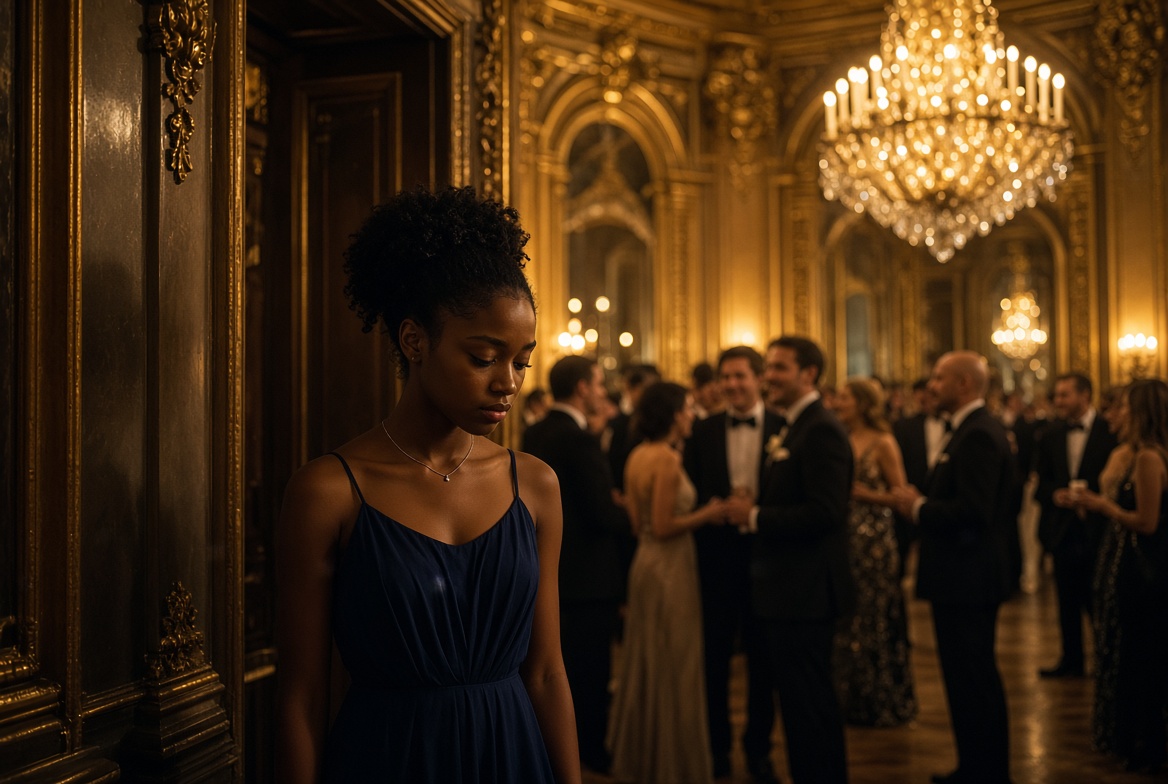
Celeste wore a dark blue dress.
Simple.
No jewelry except a thin silver chain around her neck.
The one her mother had given her last birthday.
She tugged at the hem as they walked in.
Not nervous.
Just aware.
Aware that everything in this room cost more than their car.
Diane squeezed her hand.
Just stay close.
It’s one night.
Celeste nodded.
One night.
Inside, the ballroom opened up like something out of a movie.
Crystal chandeliers hung from the ceiling.
Light scattered in every direction.
The air was thick with the smell of roasted meat and fresh bread.
Something sweet underneath it all.
A live band played softly in the corner.
Hundreds of people filled the room.
All dressed like money.
All talking like money meant nothing.
This was the Harwell Foundation annual gala, and the man at the center was exactly where you would expect.
Gregory Harwell stood near the front of the room, surrounded by a loose circle of donors and politicians.
He held a glass of scotch in one hand.
The other hand rested in his pocket.
Easy.
Relaxed.
He laughed at something someone said.
The laugh was loud, confident.
It was the laugh of a man who knew everyone in the room was listening to him.
Catherine Harwell stood beside him.
She smiled at the right moments.
She touched people’s arms when she spoke.
She looked perfect.
That was her job.
Stuart Beal hovered just behind them.
Always behind.
Tablet tucked under one arm.
Watching the room with careful eyes.
Keeping track of everything.
That was his job, too.
Diane and Celeste moved through the crowd together.
Diane nodded at a few familiar faces, made small talk, smiled when she needed to.
Celeste stayed quiet beside her, watching.
The room was loud, but somehow heavy at the same time.
Like the air itself had weight.
Like the golden light pressing down from above was not just light.
It was a statement.
You are here, but you are not one of us.
Celeste felt it.
She didn’t say it out loud, but she felt it in every glance that passed over her and kept moving.
Every laugh that stopped for half a second when she walked by.
Every pair of eyes that looked through her like she was made of glass.
At some point, she drifted.
Not far.
Just a few steps away from Diane.
Enough to be alone for a second.
She needed air.
She needed to stop being in the middle of all those voices, all that noise, all that perfume and laughter and clinking glass.
She moved toward a refreshment table near a side corridor.
Small plates of food.
Tiny sandwiches cut into squares.
Glasses of sparkling water.
Normal things.
Safe things.
She reached for a plate.
That was when Gregory Harwell walked past.
He was moving fast.
Phone in one hand.
Scotch in the other.
Coming from the main room, heading down the corridor.
He didn’t see her at first.
And then he did.
He stopped.
A short stop.
Half a second.
But it was enough.
His eyes moved across her face, across her dress, across the thin silver chain at her neck.
Something shifted in his expression.
Not surprise.
Not curiosity.
Contempt.
Pure and simple.
He stepped closer.
Not aggressive.
Controlled.
The way a man steps toward something he considers beneath him.
His cologne was sharp, expensive, heavy in the air between them.
He looked down at her.
A sixteen-year-old girl.
A dark blue dress.
A plate she hadn’t even touched.
Don’t touch me, he said.
Low.
Quiet.
Calm.
You think money doesn’t talk here?
It does, and it’s not yours.
Celeste didn’t move.
Didn’t breathe.
He tilted his head, looked her up and down slowly, deliberately, like she was something he was deciding whether to bother with.
His eyes lingered, making sure she felt it, making sure she understood exactly what he thought of her.
Girls like you don’t belong in rooms like this.
You understand me?
He held her eyes.
One second.
Two.
Three.
Then he turned, walked back into the corridor, disappeared around the corner like nothing had happened.
Like she wasn’t even there.
The music kept playing.
The champagne kept flowing.
Behind her, people laughed and clinked glasses and talked about deals and summer houses.
Not one person in that entire ballroom had seen a thing.
And Celeste just stood there.
She didn’t cry.
She didn’t yell.
She didn’t move.
She went completely still.
The way a person goes still when something hits them so hard that the body doesn’t know what to do.
Her jaw tightened slowly.
Her fingers, still holding the edge of the plate, went white against the porcelain.
She set the plate down carefully, like being neat about it was the only thing left she could control.
Then she turned and walked back toward her mother.
Diane saw it before Celeste said a word.
That is how mothers work.
You don’t have to explain.
You don’t have to cry.
You just walk back to them with a certain look on your face, and they already know something is wrong.
Something bad just happened to your child.
Diane’s eyes searched Celeste’s face.
Celeste told her quietly, calmly.
The exact words Harwell said.
Where he said them.
The way he looked at her.
The way he looked her up and down.
Diane listened.
She didn’t interrupt.
Not once.
When Celeste finished, there was a pause.
A short, heavy one.
And then Diane’s face changed.
Not to tears.
Not to shock.
To something colder.
Harder.
The kind of anger that doesn’t raise its voice.
The kind that goes very, very quiet inside.
She pulled out her phone, dialed Terrence.
He picked up on the second ring.
We’re leaving, Diane said.
Steady.
Flat.
I’ll explain in the car.
Come home.
She hung up before he could ask why.
Across the city, in the quiet study of a house on a simple street, Terrence set his phone down slowly.
The room was dark except for the lamp on his desk.
A stack of papers to his left.
His coffee, gone cold, sat to his right.
The clock on the wall ticked.
Nothing else made a sound.
He didn’t move right away.
He sat there, hands flat on the desk, thinking.
The clock kept ticking.
The lamp hummed.
Then he picked up the phone again.
Called Diane back.
She answered.
He listened.
He did not interrupt.
Not once.
He let her tell him everything.
The words.
The tone.
The way Harwell had looked at their daughter.
All of it.
Every word.
When she finished, the line went quiet.
A long silence.
The kind that has weight.
Then quietly, Drive safe.
I’ll be here.
He hung up.
He sat there for another minute, hands flat on the desk, face completely still.
The clock ticked.
The lamp hummed.
Then he picked up the phone one more time, dialed a number.
We don’t hear the conversation.
We don’t hear who answered.
The camera stays on his face.
Calm.
Controlled.
Unreadable.
As he speaks in a low, even voice.
Something had shifted behind his eyes.
Not rage.
Something quieter than rage.
Something colder.
Something that had teeth.
It was close to midnight when headlights swept across the driveway.
Terrence was at the door.
He didn’t say anything when they walked in.
He didn’t need to.
He looked at Diane first.
She looked back.
One nod.
That was all it took.
Then he turned to Celeste.
She was standing in the hallway, still in the dark blue dress, still wearing the thin chain at her neck.
She looked tired.
Not broken.
Just tired.
The way you look when something takes something out of you that you didn’t even know was there.
Terrence walked toward her, put his arms around her, held her.
Not quick.
Not casual.
Long.
Firm.
The kind of hug that says more than words ever could.
Celeste leaned into him, her face pressed against his shoulder.
The house was quiet.
Warm.
Safe.
They stood like that for a while.
Nobody talked about what was going to happen next, but it was already in motion.
Harwell didn’t lose sleep over it.
The next morning, he was in his office by eight.
Coffee on his desk.
Phone already buzzing.
The sun came through the floor-to-ceiling windows and lit the room in clean, sharp lines.
Everything in this office was built to make a man feel untouchable.
Gregory Harwell felt exactly that.
Nathan Kols knocked on the door, walked in with his tablet and a look on his face that said he didn’t want to be here.
He was Harwell’s PR director.
His job was to make problems disappear.
Right now, he had a small one.
There’s some noise online, Kols said, about the gala last night.
Someone posted about an incident.
It’s vague.
Probably nothing.
Harwell didn’t look up from his phone.
Incident?
Someone says you said something to a young woman in a corridor.
Harwell glanced at him.
Then he laughed.
Short.
Dismissive.
The kind of laugh that says, this doesn’t even deserve my attention.
It’s a nobody, he said.
Handle it.
Kols nodded.
Left, wrote a statement within the hour.
Two sentences.
No such incident occurred at the Harwell Foundation gala.
The foundation remains committed to inclusivity.
Posted it.
Done.
Or so he thought.
That afternoon, the three of them sat in a private room.
Harwell.
Catherine.
Stuart Beal.
The door was closed.
No assistants.
Just the three of them and a bottle of wine.
Harwell was not worried.
He was irritated.
Someone is making noise, he said.
He swirled his glass, didn’t drink.
I don’t like noise.
Catherine sat across from him perfectly still.
Her silence was its own kind of agreement.
Beal leaned forward.
What do you want me to do?
Harwell set his glass down.
Find out who that girl is.
I want to know who her parents are, what they do, where they live.
Everything.
Beal nodded.
He pulled out his phone before he even left the room.
What happened next was not loud.
It was careful.
The kind of thing that happens in phone calls that don’t get recorded, in favors that don’t get written down.
Beal made calls, pulled strings, asked questions through people who owed him things.
And slowly, over the next two days, the pressure started to land on the Ingram family.
It started small.
Monday evening, Diane pulled onto her street after work.
The drive home was the same as always, but something was different.
A black SUV was parked three houses down.
Engine off.
Windows tinted dark.
She had never seen it before.
She slowed down, looked at it for a second, then kept driving.
It was there the next morning, too.
Same spot.
Same angle.
Same dark windows staring back at her like a held breath.
And the morning after that.
On Tuesday, someone called Diane’s office.
A man she didn’t recognize.
Polite.
Professional.
Said he was doing background checks for a community organization.
Asked about her schedule.
Her hours.
When she usually got home.
Diane answered his questions calmly.
When she hung up, she sat there for a long time, staring at the phone in her hand.
Something about the call felt wrong.
She couldn’t name it, but it sat in her chest like a stone.
That same week, one of Terrence’s company permits got flagged.
A small renewal.
Routine.
Delayed with no reason given.
It had never been delayed before.
Not once in six years.
These were not accidents, and Terrence knew it.
He didn’t mention the permit to Diane.
Didn’t say a word about the SUV to Celeste.
He kept it close.
But at night, after everyone was asleep, he sat in his office with the lamp on and made phone calls.
His voice was low, calm, like he was running a normal meeting.
But it wasn’t normal.
Not anymore.
Then it got personal.
Wednesday night, Celeste was on her bed, phone in hand, scrolling the way sixteen-year-olds do.
And she stopped.
An account she had never seen.
No profile picture.
No name.
Just a string of numbers.
And the posts were about her.
Her school.
The name of it, spelled out clearly.
A photo of her from a track meet last spring.
A public event.
Anyone could have taken it.
Her after-school schedule.
The exact time she walked home.
Alone.
No threats.
Nothing that said I’m going to hurt you.
It didn’t need to.
The message was already there, written between every line.
We know where you are.
We know who you are.
And we want you to know that we know.
Celeste stared at the screen.
Her stomach dropped.
The phone felt heavy in her hand.
But she didn’t panic.
She didn’t put it down.
She scrolled through every single post, read them all, one by one.
Then she picked up her phone and walked downstairs.
Terrence was in the kitchen.
She showed him the screen without a word.
He looked at it, read every post.
His face didn’t change.
He handed the phone back.
Screenshot every single one, he said.
Save them all.
Don’t respond.
Don’t comment.
Don’t delete anything.
Celeste nodded.
Why?
Because every one of those posts is evidence, he said.
And right now they are giving us exactly what we need.
He called Adrienne Foster that night.
Foster was a civil rights attorney.
Sharp.
Direct.
The kind of lawyer who had seen this pattern before.
Not once, but dozens of times.
She listened to everything.
The posts.
The SUV.
The phone call to Diane’s office.
The permit delay.
When he finished, she was quiet for a moment.
Don’t respond publicly, she said.
Don’t confront Harwell.
Don’t do anything that gives him a reason to say you started it.
Let them keep pushing.
Every move they make right now is a move against themselves.
Terrence understood.
Two days later, Diane was at a community luncheon.
A small event.
Casual.
Folding tables and coffee and quiet conversation.
She needed an hour away from the weight of the last few days.
Catherine Harwell walked in.
She spotted Diane across the room, walked over, smiled, sat down beside her like they were old friends.
Diane, she said, warm, easy.
How have you been?
Fine, thank you.
They talked for a few minutes about nothing.
The weather.
The event.
Catherine was good at this.
She could fill silence with pleasantry the way a magician fills a hand with cards.
Nothing real underneath.
Just the performance.
Then Catherine leaned in, her voice dropped, still warm, still smiling.
I do hope your family isn’t getting too caught up in things that are above your station, she said.
Gregory can be so particular.
She smiled again, took a sip of coffee like she had said nothing at all.
Diane held her gaze.
Didn’t blink.
Didn’t flinch.
She let the silence sit.
Two beats.
Then she smiled back.
Of course, Diane said.
Thank you for your concern.
What Catherine didn’t know, what she couldn’t have known, was that Diane’s phone was already recording.
Had been since Catherine sat down.
Diane had placed it on the table face down, angled just right.
A quiet habit she had developed over the last few days.
Catherine stood up, waved, walked away like nothing had happened.
Diane picked up her phone, checked the recording.
Clear.
Every word.
She put it in her pocket and finished her coffee.
Meanwhile, across the city, Gregory Harwell was having a very good night.
He was at a private dinner.
A long dark wood table.
Candles flickering in the center.
Expensive food.
Expensive wine.
The kind of room where men in suits talked about money like it was the only thing worth talking about.
Harwell was relaxed, leaning back, glass of red wine in hand.
He was telling a story, and the story was about the gala.
Some kid, he said, waving his hand.
Just some kid who wandered into the wrong corridor.
He laughed.
The men around him laughed, too.
Some because it was funny.
Some because laughing when Harwell laughed was what you did if you wanted to stay in the room.
The deal with Ingram is almost locked in, he added.
He took a sip, glanced around the table.
Everything is moving.
Nothing to worry about.
He believed it.
Every word.
He had no idea.
That same night, Terrence sat alone in his office.
The lamp was on.
The rest of the house was dark and quiet.
Papers spread across his desk.
Contracts.
Permits.
Emails.
Timelines.
He had been going through them for hours, carefully, methodically.
He picked up his phone, dialed a number, spoke quietly.
We don’t hear the words.
We just see his face.
Calm.
Still.
Focused.
Lit by the warm glow of the lamp.
Gregory Harwell thought he was dealing with a quiet family that could be scared into silence.
He had never once stopped to ask a single question about the man on the other end of his biggest deal.
The man whose signature held the key to two point four billion dollars.
He was about to find out.
The next morning, Terrence was in his office before the sun came up.
The room was small.
Simple.
A wooden desk.
A lamp.
A stack of folders.
The light was soft and warm, the only brightness in the dark house.
Everyone else was still asleep.
He sat there, quiet, still, and behind him on the wall there was a photograph.
Not a big photo.
Not framed in gold.
Just a simple frame.
But the image inside it was anything but simple.
It showed Terrence Ingram standing next to the United States Secretary of Transportation.
Both men were shaking hands.
They were inside the White House.
The American flag hung in the background.
The audience sees it.
Terrence doesn’t mention it.
It just sits there on the wall, waiting.
Now the story starts to change.
Terrence Ingram is not a man Gregory Harwell had ever bothered to look up.
That was his first mistake.
Behind the quiet house and the plain truck in the driveway, there was something enormous.
Something that had been there the whole time.
Terrence Ingram is the principal of Ingram Infrastructure Group, one of the largest privately held construction companies in the American South.
His company has built highways, bridges, metro rail segments that millions of people ride every day.
He doesn’t advertise.
He doesn’t put his name on billboards.
The concrete speaks for him.
Two years ago, a reporter stood in front of one of those projects.
A massive transit station gleaming in the Georgia sun.
She spoke into her microphone.
A Georgia-based firm has just completed one of the most ambitious infrastructure projects in the region.
She never said the name Ingram.
The people who mattered already knew.
Now, the piece that connects everything.
The two point four billion dollar joint venture.
The one on Harwell’s screen.
The one Harwell had glanced at with boredom.
That deal does not belong to Harwell.
Not really.
Harwell is the name on the outside.
The brand.
The face in the press releases.
But the land?
Terrence’s.
The construction permits?
Terrence’s.
The federal contracts?
Every single one.
Terrence’s signature.
Without Terrence Ingram’s name on that contract, the deal does not exist.
Gregory Harwell didn’t just insult a girl at his own party.
He insulted the daughter of the man holding the only key to two point four billion dollars.
And he had no idea.
Thursday morning.
The house was quiet.
Coffee brewing in the kitchen.
Terrence sat at his desk.
He picked up his phone, dialed one number.
Vivian Brooks answered.
She was his chief of operations.
Calm.
Efficient.
Terrence spoke slowly, clearly.
Cancel the Harwell joint venture.
All of it.
Effective today.
No further discussion.
A short pause.
Done.
That was it.
No confrontation.
No press conference.
No angry speech.
Just a man at a desk in a quiet room making a phone call.
And in thirty seconds, two point four billion dollars disappeared.
Across the city, on the thirty-eighth floor, Gregory Harwell was having breakfast.
Eggs.
Toast.
Coffee on a silver tray.
The morning light came through the windows in long, clean beams.
His phone sat beside his plate, silent.
Everything was fine.
Everything was moving.
Then Beal walked in.
He didn’t knock.
He never forgot to knock.
But today, he forgot.
His face was the color of old paper.
His hands weren’t steady.
He held his phone out in front of him like it had burned him.
Mr. Harwell.
Harwell looked up, chewing, calm.
What?
Beal swallowed.
The Ingram deal has been cancelled.
Terrence Ingram pulled out.
Effective today.
Harwell set his fork down slowly.
He didn’t move for a moment.
The fork just sat there in his hand.
Then he put it down on the plate carefully, like the whole room was watching.
What did you just say?
The joint venture.
The two point four billion dollar project.
It’s gone.
Ingram’s lawyer sent the paperwork twenty minutes ago.
The room went quiet.
The kind of quiet that has weight.
The light kept coming through the windows.
The coffee kept steaming on the tray.
But something in the air had shifted.
Something had broken.
And everyone in that room felt it.
Harwell stared at Beal for a long time.
Neither of them moved.
Then he said one word.
Who?
Beal turned his phone around, pulled up a name, a photo.
Terrence Ingram.
The quiet man.
The man in jeans and a rolled-up shirt who grabbed coffee off the counter without breaking stride.
Then Beal pulled up something else.
The social media posts from the gala.
The ones about the incident.
The ones about the girl in the corridor.
He didn’t have to explain.
Harwell could see it all.
Every piece assembling itself in front of him like a picture coming into focus.
The girl in the dark blue dress.
The thin chain around her neck.
The corridor.
The words he had said to her.
That girl, that girl was Terrence Ingram’s daughter.
Harwell sat there, breakfast going cold in front of him, the light still coming through the windows, and two point four billion dollars gone because of one phone call he never saw coming.
He couldn’t undo it.
He couldn’t fix it.
He couldn’t make it disappear.
For the first time in a very long time, Gregory Harwell had no move.
Harwell moved fast.
He had to.
By noon, his legal team had a statement ready.
Stuart Beal drafted it himself.
Careful.
Polished.
Every word chosen to sound important while saying almost nothing.
The cancellation of the Ingram joint venture reflects a routine disagreement regarding project timelines.
Harwell Holdings remains confident in its broader portfolio.
No mention of Celeste.
No mention of the gala.
No apology.
Not one sentence that admitted anything real had happened.
Adrienne Foster read it within the hour.
She forwarded it to Terrence with one line.
He’s not going to make this easy.
Terrence read it, typed back, he’s not supposed to.
That same afternoon, Harwell tried another angle.
He didn’t call Terrence.
He had never spoken to the man in his life.
So, he did the only thing he knew how to do.
He sent a message through Beal, through lawyers, through layers of people who weren’t him.
The message read, Mr. Harwell regrets any misunderstanding at the foundation event and hopes the matter can be resolved privately.
Terrence’s phone buzzed at three fourteen.
He read the message, read it again.
Then he opened his conversation with Foster and forwarded it with one word.
Screenshotted.
No reply went back.
Not a word.
Not a thank you.
Nothing at all.
The door was closed.
And Harwell knew it.
But the worst part came the next morning.
The board of Harwell Holdings met at nine.
Long table.
Dark wood.
Twelve faces.
The fluorescent light hummed overhead.
The air was tight.
Nobody spoke until Harwell sat down.
He looked like himself.
Same suit.
Same posture.
But the confidence was thinner now.
It didn’t fill the room the way it used to.
The two point four billion dollar joint venture was gone.
The single biggest deal in company history, cancelled overnight.
No negotiation.
No chance to fight it.
Richard Oats broke the silence.
Gregory, what happened?
Harwell told them.
Not clearly.
Not all of it.
But enough.
The gala.
The corridor.
The girl.
Who her father turned out to be.
Enough for every person at that table to understand what had actually gone wrong.
It wasn’t a business mistake.
It was personal.
The silence that followed was heavy.
Not shock.
Something worse.
Twelve people in a room, all recalculating at the same time, all figuring out exactly how badly this man had failed them.
At the far end of the table, Margaret Sutton sat perfectly still.
Older than the others.
Sharper.
The kind of person who listened more than she spoke.
And when she did, people paid attention.
She looked at Harwell, held his eyes, did not look away.
You said what, exactly? she asked.
To whom?
The question hung in the air.
Harwell opened his mouth.
Nothing useful came out.
He looked at Beal.
Beal looked at the table.
The room waited.
Sutton wrote something on the pad in front of her.
Didn’t look up.
Didn’t say another word.
She didn’t need to.
The damage was already visible on every face in that room.
By evening, the industry press had the story.
Not the full version.
Just the numbers.
Harwell Holdings loses two point four billion dollar joint venture.
No explanation given.
Analysts were confused.
A deal that size didn’t just vanish.
Something had happened behind closed doors, but no one could say what.
The stock price told its own story.
Harwell Holdings dropped eighteen percent by the closing bell.
Eighteen percent in one single day.
A number that made phones ring.
A number that made people sit up and stare at their screens.
Nathan Kols watched it fall in his office, door shut.
He had spent his entire career cleaning up messes for Gregory Harwell.
Writing statements.
Making noise disappear.
This noise was not disappearing.
He picked up his phone, held it, then dialed.
He did not call Harwell.
He called a reporter.
Far from all of it, in a quiet bedroom in a quiet house, Celeste Ingram sat at her desk doing homework.
The lamp glowed warm and yellow beside her.
Pencil in hand.
The house smelled like dinner cooking downstairs.
Something normal.
Something good.
Diane came in quietly, sat on the edge of the bed, watched her daughter for a moment, then simply, Your dad handled it, sweetheart.
Celeste looked up.
She didn’t ask how.
She didn’t need details.
She already understood more than most people in this story ever would.
She nodded.
Good, she said, and went back to her homework.
The story broke on a Tuesday.
Laura Prescott was an investigative journalist, twelve years in the business.
She knew how to find things, how to put things together, and she knew exactly what she had when Nathan Kols dropped the first piece in her lap.
She spent three days verifying, checking, making calls, pulling records.
She didn’t rush it.
She wanted every fact to be airtight.
When she was done, she had everything.
The screenshots of the anonymous account targeting Celeste.
The recording of Catherine Harwell’s comment to Diane at the luncheon.
Harwell’s own non-apology statement.
The timeline of the harassment.
All of it.
Clean.
Documented.
Undeniable.
She published it at six in the morning.
The headline was simple.
Harwell Foundation gala.
Billionaire accused of racially charged confrontation with minor.
By noon, it was everywhere.
Shared thousands of times.
Comments pouring in from across the country.
People who had never heard of Gregory Harwell suddenly knew his name.
And they knew exactly what he had done to a girl at his own charity event.
The story didn’t stop there.
Once Prescott’s article was live, people started looking.
Really looking.
And what they found made the original insult look small by comparison.
The anonymous social media account, the one that had posted Celeste’s school, her schedule, her photo, got traced.
It took less than forty-eight hours.
The account was linked to a PR suppression firm, a company that specialized in making inconvenient people disappear quietly.
And that company had been hired directly by Stuart Beal.
This was no longer just one man saying cruel words in a corridor.
This was a pattern.
A coordinated campaign.
Adults working together, targeting a sixteen-year-old girl, stalking her online, surveilling her family, trying to scare them into silence.
The FBI took notice.
Agent Sandra Wade was assigned to the case.
She was the kind of agent who didn’t waste words, didn’t ask unnecessary questions.
She called Adrienne Foster on a Wednesday morning, introduced herself, asked for a meeting.
Foster said yes before Wade finished the sentence.
Wade spent the next two weeks going through everything the Ingram family had collected.
Every screenshot Celeste had saved.
Every recording Diane had made.
Every piece of evidence they had quietly, carefully gathered while Harwell’s people assumed they were dealing with a quiet family that wouldn’t fight back.
The SUV that had parked on their street for three days straight.
The phone call to Diane’s workplace asking about her schedule.
The permit delay on Terrence’s company, the one that had never been delayed before in six years.
Catherine’s recorded statement at the luncheon.
The anonymous account.
Beal’s firm.
All of it documented.
All of it traceable.
A clear, unbroken chain from Gregory Harwell all the way down.
And then, six weeks after the story broke, a Senate subcommittee announced a hearing.
The hearing room was long.
Marble floors.
High ceilings.
Cameras everywhere.
The kind of room built to make people feel small.
The fluorescent lights buzzed overhead.
The air was recycled and cold.
Laura Prescott testified first.
She sat behind a microphone and walked the committee through the entire story.
The timeline.
The insult.
The harassment campaign.
The cover-up attempt.
The stock drop.
She spoke clearly, methodically.
She laid out the facts one after another, like stones being placed.
And then Gregory Harwell took his seat.
He sat at a long wooden table alone except for his lawyer.
No scotch.
No entourage.
No Stuart Beal hovering nearby.
No Catherine smiling at the right moments.
No one laughing at his jokes.
Just a man in a suit under very bright, very public lights.
The cameras pointed at him from every angle.
He couldn’t look away from any of them.
His hands were on the table, flat, still, but his fingers tightened against the wood, just slightly, enough to see if you knew where to look.
He looked different.
Smaller.
The confidence that used to fill every room he walked into was gone.
What was left looked a lot like fear.
A senator leaned into her microphone.
The room went silent.
Mr. Harwell, did you or did you not make the remarks described in these reports to a sixteen-year-old girl?
The question hung in the air.
Every camera held steady.
Harwell’s lawyer leaned over, whispered something.
Harwell listened, nodded once, then he spoke.
I’d prefer not to answer that question today.
The room shifted.
Not loudly, but everyone in it felt it.
The senators looked at each other.
The cameras kept rolling.
And the silence that followed was its own kind of answer.
Miles away from Washington, in a living room in Atlanta, the TV was on.
Celeste sat on the couch.
Diane beside her, one hand resting on Celeste’s shoulder.
Terrence sat in the armchair behind them, leaning forward, elbows on his knees, eyes on the screen.
The room was quiet.
The only sound was the low hum of the television.
The house smelled like coffee.
Like an ordinary evening.
Like a family just sitting together.
But it wasn’t ordinary, and all three of them knew it.
Nobody spoke.
Celeste watched Harwell’s face on the television.
The way he looked down at the table.
The way his jaw tightened.
The way he said the words that everyone in the country now understood meant he couldn’t defend himself.
She didn’t smile.
She didn’t cheer.
She just watched quietly.
The way she had done everything since the night it started.
Diane kept her hand on Celeste’s shoulder, left it there.
Terrence said nothing, but something in his face, something small, something only someone who knew him well would catch, relaxed.
Just a fraction.
Justice was happening.
But it wasn’t loud in this house.
It was quiet.
It was calm.
Two weeks after the hearing, Agent Wade called Foster again.
The investigation was complete.
The evidence was solid.
The DOJ had been briefed.
A criminal referral had been filed.
Foster listened, took notes, said very little.
When she hung up, she sat for a moment with the phone still in her hand.
Then she called Terrence.
It’s done, she said.
Terrence listened, thanked her, hung up.
He sat in his office for a while after that.
The lamp was on.
The house was quiet.
The same desk.
The same room where he had made the one phone call that changed everything.
Gregory Harwell was going to face criminal charges.
For the first time in his life, the word prison was not hypothetical.
It was real.
Gregory Harwell pleaded guilty.
There was no trial, no dramatic courtroom performance.
No last-minute defense.
Just a man in a suit sitting in a federal courtroom reading a short statement from a piece of paper.
His voice was flat.
Rehearsed.
The words sounded like they had been written by someone else.
Because they had.
The judge listened, didn’t react, didn’t ask questions.
When Harwell finished reading, the judge spoke simply, clearly, the way judges do when the case is already decided.
Twenty-two months, federal prison.
A fine of one hundred and eighty million dollars.
That was it.
No applause.
No gasp.
Just numbers, clean and final.
Stuart Beal faced separate charges.
He cooperated.
His sentence was suspended, but his name was on the record now, and it would stay there.
Catherine Harwell settled a civil suit quietly.
The terms were not made public, but the suit existed, and that too was on the record.
The Harwell name, once synonymous with money and influence in Atlanta, now meant something else entirely.
Adrienne Foster took on two more civil rights cases in the months that followed.
The kind of cases that don’t make headlines until they’re won.
Laura Prescott received a National Journalism Award for the story.
She accepted it with a short speech, then went back to work on her next story.
Nathan Kols left Harwell Holdings the same week the charges were filed.
He moved into nonprofit communications.
Smaller work.
Quieter work.
The kind of work where you help people instead of protecting corporations.
And the Ingram family.
Terrence kept running Ingram Infrastructure Group.
No press tour.
No interviews.
He just kept building highways.
Bridges.
The concrete that holds a city together.
The work nobody sees but everyone needs.
Diane went back to teaching.
Back to her classroom, her students, her mornings.
The kind of life that holds everything else up.
Celeste finished her junior year.
She still ran track.
Still sharp.
Still quiet.
She never gave an interview about what happened.
Not once.
Some things don’t need to be told out loud to matter.
This story is not about revenge.
It never was.
It’s about what happens when a family decides not to stay quiet.
Not loudly.
Not dramatically.
But deliberately.
Carefully.
The way you build something that lasts.
Celeste didn’t fight with anger.
She fought by doing exactly what her father told her to do.
Screenshot everything.
Don’t respond.
Don’t delete.
Every post is evidence.
She was sixteen years old and she understood something that most adults never learn.
That the quietest moves are sometimes the sharpest ones.
Terrence didn’t fight with noise.
He fought by doing what he had always done.
He built something real.
Something essential.
Something no one could replace.
And when the time came, he simply removed it.
Thirty seconds.
One phone call.
Two point four billion dollars gone.
The system worked slowly, imperfectly.
It stumbled in places.
But it worked.
The FBI investigated.
The press reported.
The courts held hearings.
The law moved forward.
Not every story ends that way.
But this one did.
If this story hit you, if it made you angry or proud or made you think, don’t let it sit.
Share it.
Talk about it.
Comment below.
Have you ever watched someone underestimate a person and watched it come back to them?
I want to hear your story.
And if you’re not subscribed yet, hit that button.
There are more stories like this one, and they deserve to be heard.
And now it is Sunday morning again.
The Ingram kitchen.
Light coming through the window.
Warm and slow.
The smell of coffee in the air.
Toast browning on the counter.
The quiet sound of a morning with nowhere to be and nothing left to prove.
Celeste is at the table.
A book open in front of her.
Diane beside her, hands wrapped around a mug.
Terrence across from them reading something.
A paper.
A document.
It doesn’t matter what.
The three of them are in the same room.
The same light.
The same easy silence they have always shared.
Nothing about it looks like a story.
That’s the point.
If you had been in that corridor, if you had seen what Gregory Harwell did, what would you have done?
Some people fight with noise.
The Ingrams fought with patience.
And in the end, patience won.









