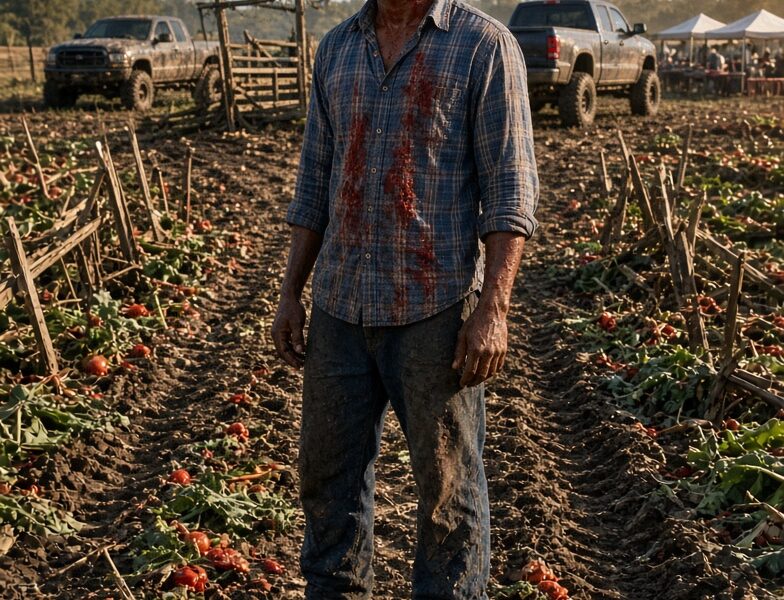
He Quietly Farmed Tomatoes for Veterans — Until Four Rich Kids Destroyed His Field and Found Out Who He Really Was
The morning sun hung over Highway 41 like a hot nickel, and the Sweetgum Market was just stretching awake.
Vendors dragged coolers across the grass, a radio at the bread tent played old gospel low and scratchy, and somewhere near the flower stand somebody laughed at nothing at all.
A dog barked twice at a pigeon, then gave up and sat down in the shade like it had already done a full day’s work.
It was 9:00 on a Saturday morning in a small Georgia town where everybody knew everybody’s business before breakfast.
At the far end of the crooked line of white canopies, one stand had no canopy at all.
It was just a folding table in front of a farm gate, and behind that gate lay twenty long rows of vegetables that looked like they had been grown by somebody who cared.
Tomatoes hung heavy and red on their stakes, peppers glowed green and orange like Christmas lights, and collard greens spread wide and dark, still wet from the morning hose.
A hand-painted sign leaned against the table.
It read: Foxworth Farm — Grown Right Here.
Cedric Foxworth set out his crates at exactly 9:00, same as he did every Saturday.
He was thirty-three, tall and lean, with a clean blue plaid shirt, dark jeans, and work boots he had scrubbed before sunrise.
A plain ball cap shaded a young, calm face that did not give away much.
He did not talk much, and when he did, his voice was low and polite.
Every crate went down square to the table edge, and every price card sat straight.
Twice that morning, he walked back to the gate and tested the chain with one hard tug.
The land had belonged to his grandfather, Ezra Foxworth, who had farmed those twenty rows for fifty years.
Three years ago, the old man died in his sleep in the chair on his porch with seed catalogs on his lap.
Cedric came home for the funeral and never left again.
Nobody in Sweetgum asked where he had been before that, and he never offered to tell them.
He was simply Ezra’s quiet grandson who grew good tomatoes.
“Morning, baby. You look like you slept in that field again.”
Viola Pettis set a paper cup of coffee on his table.
She ran the honey stand next door, was fifty-two, round-cheeked, and loud in the kindest way.
Jars of gold honey lined her shelf like little lanterns.
“Morning, Miss Viola. Thank you.”
“You picking the big order today?”
“Today. Their van comes at 11:30. The kitchen crew helps me pick, and we load it all.”
Viola lowered her voice.
“Harmon Ridge still that bad off?”
Cedric nodded once.
Harmon Ridge Veterans Home sat forty miles north and housed three hundred old soldiers, sailors, and Marines.
That spring, the state had cut its food budget in half.
Fresh vegetables were the first thing to go.
The kitchen had been serving canned beans and powdered potatoes for months.
Cedric had heard about it from a delivery driver and called the home the same afternoon.
He offered his whole harvest at cost.
Every tomato, every pepper, every leaf of greens in those twenty rows.
It would feed all three hundred men a real Sunday lunch tomorrow.
For some of them, it would be the first fresh meal since winter.
By the fence at the end of the field, thirty empty wooden crates waited in the shade.
Cedric had built them himself over three evenings.
He had stenciled every one in neat black paint: Harmon Ridge Veterans Home.
Some of them already held the first tomatoes he had picked at dawn.
Taped to the corner of his table was a card that had come in the mail on Thursday.
The handwriting shook across the page.
“Son, I have not tasted a garden tomato in two years. I am 91. I will be waiting at that table on Sunday. Thank you. — Virgil, Navy, retired.”
Viola read it over his shoulder, and her eyes went soft.
“You’re a good man, Cedric Foxworth.”
He did not answer.
He only straightened the card with one finger so it sat level with the table edge.
The morning rolled on.
Customers came and went.
A young mother bought peppers.
An old deacon bought a sack of greens and told a long story about his knees.
Cedric listened to the whole thing.
At 10:50, a low rumble rolled down Highway 41.
It grew louder.
Heads turned all along the market line.
Two lifted pickup trucks swung off the road, chrome flashing in the sun, mud flaps slapping, music thumping from open windows.
They did not head for the parking area.
They came straight across the grass, scattering a family with a stroller, and stopped with their front bumpers two feet from Cedric’s farm gate.
The music cut off.
Truck doors swung open.
Four men climbed down.
They were all in their late twenties or early thirties, wearing spotless boots and dark sunglasses.
Their grins were loose and lazy.
One of them crushed an empty can and dropped it on the grass.
The driver of the first truck came around the hood last.
Knox Vanderver was thirty, broad in the shoulders and soft in the middle, with sun-bleached hair and a gold chain resting on a pressed white polo.
The door of his truck carried a glossy logo: Vanderver Motors — Biggest Lot in the County.
Everybody in Sweetgum knew that logo.
His father owned six dealerships across three counties.
The family name was on the high school scoreboard and the new wing of the church.
Behind Knox came Boon Riggsby, twenty-eight, lanky and red-faced with a can of beer already sweating in his fist.
Two more friends trailed after him, laughing at nothing.
Knox did not look at the vegetables.
He did not look at Viola or the customers.
He looked at the chain on the gate.
Then he looked at Cedric.
He walked a slow half-circle around the gate, dragging one finger along the chain.
He flicked the padlock with his nail.
It clinked.
He looked at the hand-painted sign and snorted.
“‘Grown right here,'” he read aloud in a mocking drawl. “Isn’t that sweet? Hey, you. Open this up.”
Cedric sat down the crate he was holding.
“Morning. Can I help you with something?”
“Yeah, you can open the gate.”
Knox jerked his thumb toward the field.
“We’re heading down to the sandbar. Got a party on the river at noon. This is the only road down there a truck can take.”
It was true.
The dirt lane ran straight through the middle of the Foxworth rows, down a gentle slope to a wide sandbar on the Oakmi River.
When Ezra was alive, the old man had let local boys drive it in winter when the field lay bare.
But it was not winter.
Every foot of that lane was now lined with ripe crops.
“I’m sorry,” Cedric said. “The lane’s closed this season. Those rows are full, and we’re harvesting today.”
Knox blinked.
For a second, he looked genuinely confused, as if the words had come out in another language.
“Say that again.”
“The lane’s closed. I can’t let trucks through. They’d crush everything.”
Behind Knox, one of the friends let out a low whistle.
Another one laughed.
Knox’s jaw shifted.
A pink flush climbed his neck.
“Old man Ezra used to let us through in the winter,” Cedric said evenly. “When nothing was planted. I remember.”
“Well, I’m here now, and I’m telling you to open it.”
“And I’m telling you no, sir. Politely.”
The word hung in the bright air.
The market had started to notice.
The young mother with the stroller stopped at the edge of the grass.
The old deacon lowered his sack of greens.
At the next stand, Viola set her honey jar down very slowly.
Knox glanced back at his friends.
Boon was grinning at him, eyebrows high, as if waiting to see what Knox would do.
Two young women had climbed out of the second truck and were watching, too, arms folded.
Knox’s smile came back.
It was thinner now.
“You know who I am.”
“I know the name on your truck.”
“Then you know this is a small town.”
Knox stepped closer.
“And my family owns most of it.”
“Not this field,” Cedric said. “My grandfather paid it off in 1981. It’s mine. Those rows are going to a veterans’ home.”
Viola called out from her stand.
“Three hundred old soldiers, Knox. Leave the man alone.”
Knox did not even turn his head toward her.
His eyes stayed on Cedric, the only Black man standing at that end of the market.
They moved slowly over the plaid shirt, the scrubbed boots, the dirt under his fingernails.
His lip curled as if he had stepped in something.
He had been told no in front of his friends.
He had been told no in front of the girls.
He had been told no in front of half the town.
And he had been told no by this man.
“Boon,” Knox said without looking away. “You believe this?”
“Nope,” Boon said, and took a long pull from his beer.
Knox laughed.
It was not a friendly sound.
Then he leaned in until his face was inches from Cedric’s.
Cedric could smell the beer on his breath and the cologne on his collar.
“Let me explain how this works, farm boy,” he said softly. “And I’m only going to explain it once.”
Knox straightened up and turned to face the market.
He raised his voice so every stand could hear.
“Folks, look at this. Look real close.”
He swept an arm toward Cedric like a game show host.
“This is what happens when you let people like him own land around here. Fifty years this field fed the whole town. Now look at it. Some dirt-poor Black farmer playing landowner, telling a Vanderver where he can drive.”
A few people at the nearby stands shifted their feet.
Nobody spoke.
“I asked you nice,” Knox went on, turning back. “Now I’m asking you the other way. Open the damn gate, you filthy farmer. I’m driving my truck straight through your field.”
Boon whooped.
The two friends laughed and slapped each other’s shoulders.
Cedric did not move.
He stood with his feet a little apart and his hands loose at his sides.
The chain gleamed behind him.
His face showed nothing at all.
Knox’s nostrils flared as he stared at that blank, patient face.
“No, sir,” Cedric said. “Everything in there is ready for harvest.”
“Harvest?”
Knox tasted the word and spat it into the grass.
“It’s weeds, boy. Black man’s weeds. You grow weeds and sell them to people who feel sorry for you.”
“Those tomatoes are going to three hundred veterans tomorrow.”
“Veterans.”
Knox barked a laugh.
“You hear that, Boon? He’s a charity now.”
“Real hero,” Boon said. “Somebody get him a medal.”
The friends laughed harder.
Viola’s hands were shaking.
She pressed them flat against her table.
“Knox Vanderver, your mama would be ashamed of you. That man has done nothing but work.”
“Stay out of it, honey lady,” Knox said, still not looking at her. “Go sell your little jars.”
The young mother pulled her stroller back toward her car.
The deacon muttered a prayer under his breath.
A teenager at the kettle corn stand stopped scooping mid-motion, the metal scoop hanging in the air.
“Look at this shirt, boys.”
Knox plucked the air an inch from Cedric’s collar without touching it.
“Where’d you get this? Goodwill church box? Bet somebody felt real sorry for you.”
“That it came with the boots,” one of the friends called.
“And the table,” said the other.
“And the dirt.”
They laughed like it was the funniest thing they had heard all year.
Cedric let them laugh.
He did not look at the friends.
He did not look at the crowd.
He kept his eyes on Knox, steady and patient, the way a man watches weather coming across a field.
Knox stepped close again.
He looked Cedric up and down, slow and deliberate, the way a man looks at a stain on a carpet.
“You know what I see?” he said. “I see a guy who’s got nothing. No money, no friends, no family left. Just a dead man’s dirt and a folding table. You think a chain makes you somebody?”
Cedric’s eyes did not leave his.
“I think the chain makes it clear the lane is closed.”
A few people near the kettle corn stand let out nervous little laughs.
They swallowed them fast.
Knox’s face went red.
“Oh, you’re funny. You’re a funny one.”
He turned to his friends.
“He’s funny, boys.”
Nobody laughed this time.
The friends were watching Knox now, waiting.
Knox tried again, louder.
“Let me tell you what your granddaddy would have done. He’d have opened that gate and said, ‘Yes, Mr. Vanderver,’ because he knew his place.”
For the first time, something moved in Cedric’s face.
It was small, a tightening at the corner of the jaw.
Then it was gone.
“My grandfather,” he said quietly, “never said yes to anyone who talked to him like that. And neither will I.”
He took his phone from his shirt pocket and held it up, screen out.
“This is private land. If anybody drives through that gate, I’m calling the sheriff. That’s the last time I’ll say it.”
The whole market heard it.
A murmur ran down the line of stands.
Somebody near the bread tent said, “Good for him.”
Knox heard that, too.
He had come for a joy ride and a river party.
Now a Black farmer with dirt on his boots had told him no three times.
He had done it in front of his friends, two girls, and forty people who would tell the story all over Sweetgum by supper time.
His hands curled at his sides.
His smile vanished completely.
He glared at Cedric, eyes blazing, nostrils flared.
“You dare say no to me?”
Cedric held the phone steady.
“I do, sir.”
“I don’t give a damn.”
Knox roared.
He spun toward his friends.
“Boon, drive through.”
Boon tossed his beer can into the grass and ran for the second truck.
Cedric started dialing.
He never finished.
Boon backed the truck up to the gate, jumped out, and looped the chain around his tow hook.
He climbed back in and stomped the gas.
The old cedar post groaned.
Then it tore out of the ground with a sound like a tree limb breaking.
Chain, post, and gate went flying sideways into the ditch.
“Road’s open,” Boon hollered out the window.
Knox was already in his own truck.
The engine roared.
Black smoke coughed from the tailpipe.
“No!” Cedric shouted. “Stop!”
Both trucks lunged forward.
The first tires hit the tomato rows with a wet, crunching burst.
Stakes snapped like matchsticks.
Vines whipped under the chassis and tore loose.
Red fruit exploded against the wheel wells and sprayed across the dirt.
The second truck swerved left, straight into the pepper rows.
Green and orange peppers popped and split under two tons of steel.
The whole market froze in horror.
The sunlight was so bright that every detail showed.
Every shredded leaf, every burst tomato, every deep, ugly tire track.
“Stop! You’re destroying my crops!”
Cedric ran into the field after them.
His boots sank in the soft soil.
The trucks were faster.
Knox leaned out his window, laughing so hard his face was red.
“Look at that panicked face,” he yelled back to Boon. “Hilarious. Crush this whole stinking field.”
Boon yanked his wheel.
His truck spun in a wide circle through the collard greens.
Mud and leaves flew in a dark spray.
The two friends in the back bed hooted, grabbed tomatoes off the vines, and hurled them at each other like it was a carnival game.
One of the girls near the gate had stopped laughing.
She put her hand over her mouth.
At the honey stand, Viola had her phone to her ear, her voice cracking.
“911, this is Viola Pettis at the Sweetgum Market. They’re tearing up the Foxworth Farm. Please send somebody. Please hurry.”
Near the broken gate, one of Boon’s friends jumped down from the truck bed.
He spotted Cedric’s table and the little card taped to its corner.
He ripped it free.
“Hey, listen to this.”
He held it up and read it in a thin, quavering old man voice.
“‘Son, I have not tasted a garden tomato in two years. I am 91.'”
The two women by the gate did not laugh.
The friend laughed alone.
He crumpled the card into a ball and flicked it into the mud.
Then he stepped on it.
Cedric saw it from the middle of the field.
He stopped running for one full second.
Knox swung his truck toward the end of the field.
That was where Cedric had stacked the first crates that morning.
Thirty wooden boxes of hand-picked tomatoes lined up in the shade by the fence.
Each box was stenciled in black paint: Harmon Ridge Veterans Home.
Knox saw the words.
He grinned.
He drove straight over them.
The crates collapsed with a crack like splitting firewood.
Wood splintered.
Tomatoes burst out in a red flood.
Knox backed up and rolled over them a second time just to be sure.
Then he spun the wheel and aimed his bumper at the row where the last tomato still stood.
Cedric got there first.
He planted himself in the middle of the lane, directly in front of the truck.
Mud streaked his jeans.
His chest rose and fell.
He did not raise his hands.
He did not step aside.
The truck skidded to a stop three feet from his knees.
“Get off my land.”
For a long moment, nothing moved but the engine idling.
Then Knox shoved his door open and leaped down.
He was grinning, smug and disgusted all at once.
He looked like a man who had found something dirty on the bottom of his boot.
“Or what?” he said.
He walked right up to Cedric.
“You think you can stop me? Look around. Nobody here is going to help you. Nobody here is going to say a word.”
He jabbed a finger toward the market.
“My daddy’s the richest man in this county. Cross me and you’re finished.”
“Those crates,” Cedric said, his voice low and rough, “were for men who fought for this country. Men in their eighties and nineties. Some of them can’t even feed themselves anymore.”
“Then they can eat canned beans like everybody else.”
Knox bent down.
He scooped a split rotten tomato out of the mud, one that had been crushed and baked in the sun.
He smashed it into Cedric’s face.
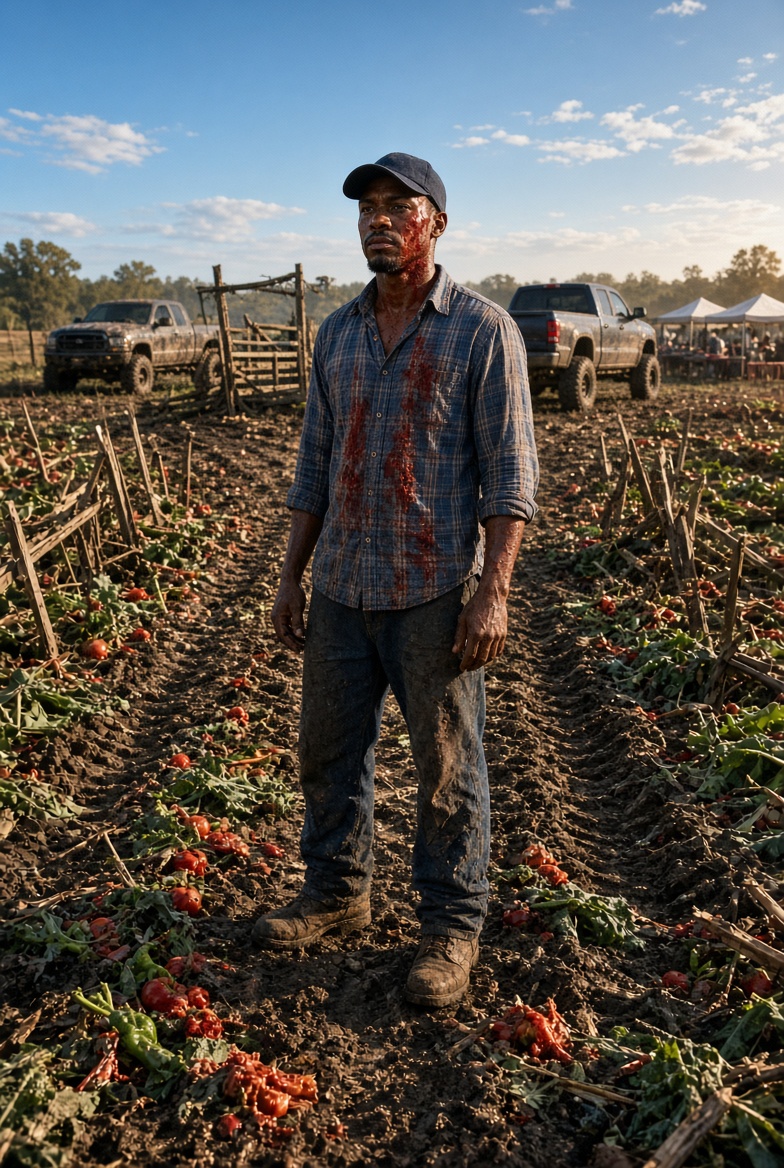
The pulp burst across his cheek and nose.
Seeds and red juice ran into his eyes, down his chin, onto the collar of his clean blue shirt.
A gasp rolled across the market.
“Smile, you filthy monkey,” Knox shouted. “Come on, smile.”
Boon had climbed onto the hood of his truck.
He was doubled over, pointing.
“Look at him, boys. So funny. He’s bleeding ketchup.”
The two friends howled.
One of them grabbed another tomato and lobbed it.
It hit Cedric’s shoulder and slid down his arm.
Cedric did not wipe his face.
He turned his head very slowly and looked past Knox, past the trucks, past the torn rows.
He looked at the pile of broken crates by the fence.
One board had landed face up in the mud.
The black letters were still readable under the red juice: Harmon Ridge Veterans Home.
Cedric stood humiliated, furious, fists trembling.
Then something in his face went completely calm.
Knox saw the calm and mistook it for surrender.
“That’s right,” he sneered, leaning in. “Now get on your knees and pick up your little tomatoes.”
He never saw Cedric move.
One moment Cedric was standing still with red juice dripping off his chin.
The next he had stepped in close, low and fast, and driven one short punch into the middle of Knox’s stomach.
It was not a wild swing.
It traveled maybe eight inches.
The air left Knox’s body with a sound like a flat tire.
His eyes bulged.
His knees folded.
He sat down hard in the mud, clutching his belly, mouth opening and closing without making a sound.
The laughter stopped as if someone had pulled a plug.
On the hood of his truck, Boon froze with one arm still pointing.
The two friends in the truck bed stared, a tomato still cocked in one man’s hand.
At the honey stand, Viola’s phone slipped from her fingers.
A jar of honey tipped off her shelf and rolled across the grass.
“Oh my lord,” she whispered.
Knox wheezed.
He dragged in half a breath and pointed a shaking finger at Cedric.
“Get him!” he gasped. “Get him!”
Boon slid off the hood.
The two friends vaulted out of the truck bed.
They came at Cedric from three sides, yelling, arms swinging wide, boots slipping in the crushed tomatoes.
Boon reached him first.
He was tall and loose-limbed, and he charged with both arms spread wide, meaning to wrap Cedric up and drag him to the ground.
Cedric simply stepped aside.
It was one easy step, like a man moving out of the way of a door.
Boon’s arms closed on empty air.
His own speed carried him past.
His boot caught a broken tomato stake, and he went face first into the soft dirt with a heavy, wet thud.
Boon lifted his face out of the soil.
Dirt clung to his eyelashes and his open mouth.
He blinked up at the sky as if he had no idea how he had gotten there.
Somebody in the market laughed out loud, then clapped a hand over their mouth.
The other two came together, one from the left and one from the right.
The man on the left swung first.
It was a big, looping punch aimed at Cedric’s head.
Cedric did not block it.
He leaned back just enough for the fist to pass in front of his nose.
Then he put one hand flat on the man’s shoulder and gave a small, gentle push, adding to the swing instead of stopping it.
The man spun half around, off balance, and stumbled straight into his friend.
Their heads knocked together with a hollow clunk.
Both men went down in a tangle of arms and legs, groaning, rolling in the crushed greens.
Cedric had not moved his feet more than a step.
His hands were already back at his sides.
The whole thing had taken maybe six seconds.
A sound went up from the market.
It was not quite a cheer yet.
It was a gasp that turned into something else halfway through.
A man near the bread tent shouted, “Did you see that?”
A woman at the flower stand grabbed her husband’s arm.
At the bread tent, the baker let a whole tray of rolls slide to the ground and did not even look down.
The old deacon took off his hat and held it against his chest.
The two young women by the gate had backed away from the trucks.
Neither one was laughing.
One of them said very quietly, “He didn’t even try.”
Viola had not picked up her phone.
She stood with both hands pressed to her chest, staring at the young man she had brought coffee to every Saturday for three years.
“Cedric,” she said.
Her voice sounded small and far away.
He did not answer her.
He had not even turned around.
He stood in the middle of the torn lane with his hands open at his sides.
His breathing was slow and even, as if he had just carried a crate from the truck to the table.
Tomato juice was drying on his face.
His eyes were fixed on one place.
Knox.
Boon was trying to get up.
He made it to his hands and knees, spitting dirt, and looked up at Cedric with an expression of pure confusion.
“What the hell was that?” he croaked.
Nobody answered him.
Behind Boon, Knox Vanderver was rising out of the mud.
His white polo was brown now.
His gold chain had swung around to his back.
His face was purple with rage and pain and humiliation, all of it at once.
He had been knocked on his backside in front of the entire town by the man he had just called a monkey.
He wiped his mouth with the back of his hand.
His eyes had gone wild.
“You’re dead,” he said.
His voice shook.
“You hear me? You’re a dead man.”
He balled up both fists and started forward.
Knox came in swinging.
He threw everything he had into one huge right hand.
His teeth were bared.
His elbow cocked back past his ear.
Every pound of his body leaned into that swing.
Cedric tilted his head two inches to the left.
The fist went past his ear and hit nothing.
Before Knox could pull it back, Cedric’s hand closed around his wrist.
It was not a wild grab.
It was quick and exact, like a man catching a set of keys tossed across a room.
Cedric turned the wrist over.
That was all.
One smooth twist.
Knox’s whole body followed his arm.
His knees buckled.
His shoulder dipped.
His feet went out from under him, and he folded down under his chest in the middle of the crushed tomato row.
Cedric went down with him, one knee resting in the dirt beside Knox’s ribs.
He held the twisted arm up behind Knox’s back with one hand.
Just one.
His other hand stayed open and loose on his own knee.
Knox tried to push up.
The arm locked.
A sharp cry burst out of him.
“Ow! Ow! Stop!”
He tried to kick.
Cedric shifted his weight an inch.
Knox’s cheek pressed deeper into the red pulp of the tomatoes he had crushed.
“Let go. Let go of me.”
“Stop fighting,” Cedric said quietly. “And it stops hurting.”
Knox stopped fighting.
He lay there, face in the mud, breathing hard, pinned in place by one hand from a man he had called filthy only minutes before.
His gold chain hung in the juice.
His sunglasses lay broken a foot away.
“Please,” he gasped. “Please let me up.”
“Please,” Viola said from across the grass, her voice trembling. “Now he says please.”
The market was dead silent.
Forty people stood frozen along the grass.
Nobody moved.
Nobody spoke.
Even the kettle corn machine had stopped popping.
Then somewhere near the bread tent, one person started clapping.
It was the old deacon.
He clapped slowly, his big hands coming together like thunder in the quiet.
Another person joined him.
Then another.
The woman at the flower stand.
The teenager at the kettle corn machine.
The young mother who had come back across the grass without her stroller.
In a few seconds, the whole line of stands was clapping.
Somebody whistled.
A man yelled, “That’s what you get, Vanderver.”
Viola sat down hard on her cooler.
She was shaking her head over and over, laughing and almost crying at the same time.
“Lord have mercy,” she kept saying. “Lord have mercy, that boy.”
“Did you all see that?” the deacon called out to nobody in particular. “One hand. He held that boy down with one hand.”
“He never even got mad,” the flower lady said, amazed. “Not once. Look at his face.”
Boon was still on his hands and knees in the dirt, his mouth hanging open.
The two other friends had crawled backward against the tire of the truck.
One of them held the side of his head.
Neither made any move to help Knox.
The two young women by the gate had stepped back from the trucks.
One of them looked at Knox in the mud, then at Cedric, and slowly shook her head.
The whole thing, start to finish, had taken less than a minute.
Nobody was bleeding.
Nobody was badly hurt.
Cedric had thrown exactly one punch.
He looked down at Knox for a long moment.
Then he let go and stood up.
He stepped back two paces and waited, hands open, face calm.
Knox rolled over.
He sat up, cradling his wrist against his chest.
Mud and tomato seeds were caked across one side of his face.
His eyes darted around the market at the clapping, at the people who had stopped being afraid of him.
For a second, he looked like a little boy who had lost his mother at the fair.
Then, down the highway, a siren wailed.
Everyone turned.
A white sheriff’s cruiser was coming fast, lights flashing blue and red against the bright noon sky.
Behind it came a long gray van and a black sedan.
Knox heard the siren, too, and as he heard it, something changed in his face.
The fear drained out.
The old smile crept back, crooked and ugly.
He scrambled to his feet and pointed at Cedric with his good hand.
“You’re done,” he said, his voice climbing. “You hear that? That’s for you. You attacked me. Everybody saw it. You hit me first.”
He laughed a high, shaky laugh.
“My daddy’s going to make sure you rot in prison.”
The cruiser slid to a stop on the grass beside the broken gate.
The gray van pulled in behind it.
Its side door read Harmon Ridge Veterans Home in faded blue letters.
The black sedan parked last, a little apart from the others.
The deputy climbed out first.
He was a thick-necked man in his forties with a tan uniform and mirrored sunglasses.
He took one look at the torn field, the trucks, the crowd, and the men in the mud, and his hand went to his belt.
“All right,” he called out. “Who’s in charge of this mess?”
Knox was already running toward him, holding up his wrist like a trophy.
“Deputy, deputy, thank God. That man assaulted me.”
He jabbed his finger back at Cedric.
“He punched me in the stomach. He attacked my friends. He tried to break my arm. Look at it. Look.”
The deputy looked at the wrist.
Then he looked at the name on the truck.
Vanderver Motors.
The deputy’s jaw tightened.
He glanced back at the logo twice.
“That true?” he called to Cedric.
“I hit him once,” Cedric said. “After he—”
“He admits it,” Knox shouted. “He just admitted it. Everybody heard him.”
“He destroyed my field,” Cedric said. “He drove over the veterans’ crates.”
“Turn around,” the deputy said. “Hands behind your back.”
A roar of protest rose from the market.
“He’s lying,” Viola screamed, running across the grass. “They tore that field up for fun. Ask anybody. Ask all of us.”
“Ma’am, step back.”
The deputy pulled a pair of handcuffs from his belt.
“We’ll sort out statements later. Right now, this man is being detained for assault.”
He walked toward Cedric.
Cedric did not resist.
He turned slowly.
He put his hands behind his back.
Tomato juice still streaked his face and collar.
His shoulders were straight.
Knox stood behind the deputy, grinning so wide it looked like it hurt.
“Told you,” he said. “Told you, farm boy. You’re finished.”
The cuffs came up.
That was when the door of the black sedan opened.
An older man stepped out.
He was sixty-one, tall and silver-haired in a navy blazer and pressed gray trousers.
A small gold pin gleamed on his lapel.
He had a folder of invoices in one hand.
He had come to sign for three hundred Sunday lunches.
He looked at the field first, at the tire tracks, at the shattered crates stenciled with the name of his veterans’ home.
Then he looked at the man with his hands behind his back.
The color drained out of his face.
The folder slipped from his fingers.
Invoices scattered across the grass and blew under the van.
He did not pick them up.
He ran.
He ran straight through the mud, through the crushed tomato rows, his polished shoes sinking with every step.
He grabbed the deputy’s arm with a grip so hard the deputy flinched.
“Stop! Stop! Take your hands off him!”
“Sir, this is a police matter. Do you know who this is?”
The old man’s voice cracked across the whole market.
“Do you have any idea?”
He turned to face the crowd.
His hand was shaking.
His eyes were wet.
“My name is Lawson Tremble. I am a retired Rear Admiral of the United States Navy. And this man is Senior Chief Petty Officer Cedric Foxworth, twelve years a Navy SEAL. He trained every man in his unit how to fight with his bare hands.”
Nobody breathed.
“In 2020, our ship capsized in a storm off the coast of Bahrain. Six sailors were trapped below deck in the dark. He swam into that ship six times and brought out every one of them. The Navy gave him the Navy and Marine Corps Medal for it.”
He swallowed hard.
“I was the sixth man he pulled out of that water.”
The deputy’s handcuffs dropped out of his hand and landed in the mud with a soft splat.
At the honey stand, Viola sank down onto her cooler with both hands over her mouth.
Then she stood right back up, marched across the grass, and planted herself in front of Cedric like a wall.
Boon sat down in the dirt where he stood.
His face had gone the color of paper.
The two friends pressed themselves against the truck tire, eyes wide.
The market was so quiet that the hum of the idling cruiser was the loudest sound on the grass.
Cedric said nothing.
He only lowered his hands from behind his back and let them rest at his sides.
Knox’s grin had frozen on his face.
Slowly, it slid off.
His keys fell out of his hand.
“That’s— That’s not—”
He looked from the admiral to the deputy to Cedric.
“That’s not possible. He’s a farmer. He’s just a farmer.”
The deputy bent down.
He picked up his handcuffs out of the mud.
Then he turned around and looked at Knox.
“Mr. Vanderver,” the deputy said. “Turn around.”
Knox stumbled back a step.
“What? No. No, you don’t understand. He hit me.”
“I understand plenty.”
The deputy’s voice had gone flat and cold.
“I’ve got a torn-out gate, a destroyed field, thirty smashed crates, and forty witnesses. Turn around.”
“Call my father.”
Knox’s voice cracked.
“You know who my father is.”
“Everybody knows who your father is, son. That’s the problem.”
The cuffs clicked shut around Knox’s wrists, right over the one Cedric had twisted.
Knox yelped.
Across the grass, people started coming forward on their own.
The old deacon was first.
“I saw it all,” he said. “The boy said no. They tore his gate out and drove over his crops. Then that one threw a rotten tomato in his face and called him a monkey. He said his daddy was the richest man in the county.”
The young mother added, “He said if anybody crossed him, they were finished.”
“I heard him too,” said the kettle corn teenager. “Word for word.”
One of the two young women by the gate stepped forward too.
She had ridden down in the second truck.
“It’s true,” she said quietly. “All of it. They did it for fun.”
Knox stared at her.
“What are you doing?”
She did not look at him.
Within ten minutes, the deputy had a notebook full of names.
A second cruiser arrived.
Boon and the other two friends were cuffed beside their truck, one after another.
Boon was crying.
He kept saying he had only been driving.
Knox was allowed one phone call from the back of the cruiser.
He put it on speaker, as if the whole market needed to hear his father save him.
“Dad. Dad, they arrested me. Some farmer attacked me. You need to call the sheriff right now.”
There was a long pause on the line.
“Who is standing there with you?” the deep, tired voice asked.
Admiral Tremble leaned toward the open window.
“Mr. Vanderver, this is Lawson Tremble. We met last spring. Your dealership is supplying the new vans for every veterans’ home in this state. Your son just drove over three hundred lunches meant for those veterans. Then he assaulted the man who saved my life.”
The silence on the line lasted a long time.
“Knox,” the father finally said.
His voice was very quiet.
“You’re on your own.”
The line went dead.
Knox stared at the phone as if it had bitten him.
The admiral straightened up.
He was still pale.
He turned to the deputy and spoke loudly enough that the crowd could hear every word.
“Deputy, you should know one more thing. The state veterans board will want a full report on this by tonight. So will the Navy. When I tell them what happened to this man, your sheriff will get phone calls. They will come from people nobody wants calling.”
The deputy nodded quickly.
“Yes, sir. Full report tonight.”
“Chief Foxworth trained men who now train other men,” the admiral went on, turning to the market. “There are officers across this country who learned from him how to stay alive. If he had wanted to hurt those four boys, they would not be sitting in a police car. They would be in a hospital.”
A ripple went through the crowd.
Several people looked at Cedric with something close to awe.
Boon, sitting cuffed against his truck, went even whiter.
The admiral’s phone buzzed in his blazer pocket.
He glanced at the screen and answered it right there in the field.
“Yes, Admiral. Yes, I found him. He is standing right in front of me.”
He listened for a moment.
“No, sir. He is not hurt. The other four are.”
He hung up.
The deputy was staring at him.
“He held back,” the admiral said. “That is who he is.”
Two tow trucks arrived before noon.
The lifted pickups were hauled away as evidence.
Both were registered to Vanderver Motors.
Both sat in the county impound lot for months.
The state canceled its van contract with the Vanderver family the following Monday.
In court a month later, the forty statements and Knox’s own words were read out for the judge.
“My daddy’s the richest man in this county. Cross me and you’re finished.”
Knox’s lawyer asked for leniency.
The judge did not give much.
He ordered Knox to pay for every row, every crate, and every lunch he had destroyed in full.
The total came to $47,300.
He added two hundred hours of community service, and he chose the location himself: Foxworth Farm.
Replanting the same rows Knox had torn apart.
Boon and the other two friends got one hundred hours each on the same field.
Back in the field that Saturday, the cruiser door slammed shut on Knox.
The admiral turned back to Cedric, and Cedric was walking slowly toward the ruined crates by the fence.
One small, shaking figure had just climbed out of the Harmon Ridge van.
He was a tiny old man in a pressed navy ball cap, gripping an aluminum cane with both hands.
A young kitchen aide held his elbow.
He was ninety-one years old, and he had insisted on riding along.
His name was Virgil.
He had written the card taped to Cedric’s table.
He stood at the edge of the field and looked at it for a long time.
At the flattened stakes, at the tire ruts, at the red mush that had been his Sunday lunch.
His chin began to tremble.
“I came to see the garden,” he said softly. “I wanted to see where it grew.”
Cedric knelt down in front of him in the mud so their eyes were level.
Tomato juice was still dried on his face.
“I’m sorry, sir,” he said. “I couldn’t stop them in time.”
Virgil looked at him.
Then he reached out one spotted, shaking hand and touched Cedric’s cheek where the rotten tomato had hit.
“Son,” he said. “I heard what that admiral said. You pulled six sailors out of the sea. Don’t you ever apologize to me.”
Viola turned away and wiped her eyes with her apron.
The admiral came over and stood beside them.
He cleared his throat twice before he could speak.
“Chief,” he said. “You disappeared on us. Three years. No forwarding address. I’ve had people looking for you.”
“My grandfather died, sir. Somebody had to take care of the land.”
“I know that now.”
The admiral looked at the ruined rows.
Then he looked back at Cedric.
“So let me say this plainly, and in front of all these people.”
He raised his voice.
“The state is starting a new program this fall. Hand-to-hand self-defense training for veterans, police officers, and first responders across Georgia. We’ve been searching for a head instructor for six months. Every name we found was good. None of them was you.”
He held out his hand.
“The job is yours if you want it. Weekdays only. The farm stays yours. The salary is five times what this field could ever pay you.”
A murmur ran through the crowd.
Cedric looked at the torn rows for a long moment.
He looked at the broken crates.
He looked at Virgil, holding on to his cane.
“What about Sunday lunch?” he asked.
The admiral almost laughed.
“That’s your first question?”
“Yes, sir.”
Before the admiral could answer, Viola raised her voice.
“Y’all heard the man,” she called down the line of stands. “Three hundred veterans need lunch tomorrow. What have we got?”
For a second, nobody moved.
Then the flower lady walked over with two buckets of zinnias for the tables.
The bread tent brought forty loaves.
A farmer from the far end hauled over six crates of sweet corn.
The deacon’s wife promised peach cobbler for three hundred.
Somebody started a list on the back of a paper bag.
Within an hour, Sunday lunch at Harmon Ridge was fully covered.
Cedric stood in the middle of it all and did not know what to say.
Viola patted his cheek and handed him a wet towel for his face.
He shook the admiral’s hand.
“I’ll take the job, sir,” he said. “On one condition. I teach the first class for free. For the men at Harmon Ridge who still want to learn.”
“Done,” said the admiral, his voice breaking on the word.
That afternoon, before the sun had even started to drop, a van from Harmon Ridge came back.
It was full of old men in veterans’ caps.
They brought their own gloves.
They could not bend very far, but they could hold the seedlings while Viola and the market people dug the holes.
Virgil planted the first tomato himself, with Cedric holding the cane.
Two weeks later, the Veterans Foundation signed a contract to buy every harvest from Foxworth Farm for three veterans’ homes at a price above market.
They paid for a new greenhouse and a drip irrigation system.
A carpenter from church built a new gate out of heavy oak.
On the new gate, a brass plate went up: Ezra Foxworth Field.
Two months later, on a hot Saturday morning, a pickup with no chrome and no music pulled up at the oak gate.
Knox Vanderver climbed out in a plain gray T-shirt, holding a paper from the court.
Cedric handed him a hoe.
“Row one,” he said. “Start at the fence.”
Knox took it.
He did not say anything.
He walked into the field and began to work.
Cedric watched him for a moment.
Then he turned back to his table, straightened the price cards, and poured Viola a coffee.
The oak gate stood wide open in the morning sun.
Down the rows, new green vines were already climbing their stakes, heavy with small, hard tomatoes that would be red by fall.
And on the table, taped level with the edge, was a new card in the same shaking handwriting.
“Son, I tasted that tomato. It was the best I ever had. See you next Sunday. — Virgil.”
Cedric straightened it with one finger, same as always.
Then he went back to work.









