He Planned Her Future Without Asking… Until She Forced Him to Stop Deciding for Her
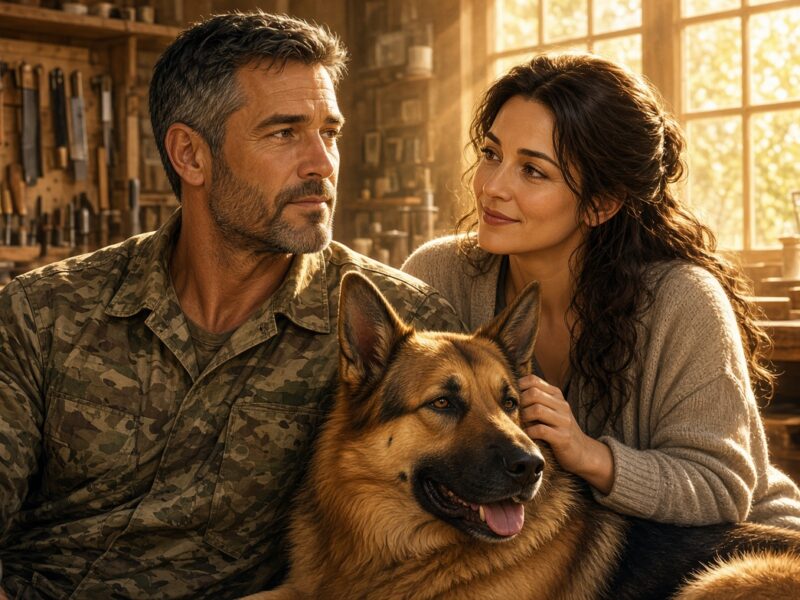
Mirabel never called the old canine over, never reached for him, and never tried to earn his trust.
But little by little, Bishop began choosing the place beside her on his own.
Caleb Rowan noticed, and for a man who had spent years controlling risk, that quiet choice unsettled him more than he expected.
Because soon, Caleb would make the mistake of planning Mirabel’s future without asking what she wanted.
And the hardest lesson of his life would not be how to protect someone, but how to stop deciding for them.
By the last week of January, winter had stopped making Red Haven beautiful.
The first snow of the season had been clean enough to soften the roofs and erase the ruts beside the roads.
What remained now had been pushed, salted, thawed, and frozen again until gray ridges lined Main Street like old concrete.
Pickup trucks carried white crust along their wheel wells.
The bitter foothills beyond town disappeared behind a low ceiling of cloud.
Inside the Red Haven Community Workshop, however, it was warm enough for Caleb Rowan to regret the thermal layer beneath his combat shirt.
He stood beside a folding table near the center of the room, sleeves patterned in muted camouflage, the olive drab body of the shirt fitted close across his shoulders.
At 49, Caleb still carried the compact strength of a man who had spent most of his adult life expecting his body to remain useful.
He was tall without seeming imposing until he stood close, broad through the back rather than the chest, with dark hair cropped short and the first silver showing farther behind his ears than at his temples.
A pale scar interrupted his left eyebrow.
People usually noticed that before they noticed the old field watch on his wrist.
Caleb preferred it that way.
“Two days,” he said, holding up a compact battery bank.
“That’s the scenario. Roads are passable eventually, but you lose power tonight and don’t get it back until the second evening. What matters?”
A man near the front raised a hand.
“Generator, if you have one. Firewood, if your heating system allows it. Food.”
Caleb nodded.
He had already laid the correct items across the table in the order he intended to discuss them.
Water.
Lighting.
Communication.
Heat.
Medication.
Food.
Backup power.
Everything had a place.
Every object was visible.
Every answer led neatly to the next one.
Within 12 minutes, he had shown 31 people how to organize a basic winter emergency kit.
Within another eight, he had demonstrated three low-tech signaling methods.
Then he brought Bishop forward.
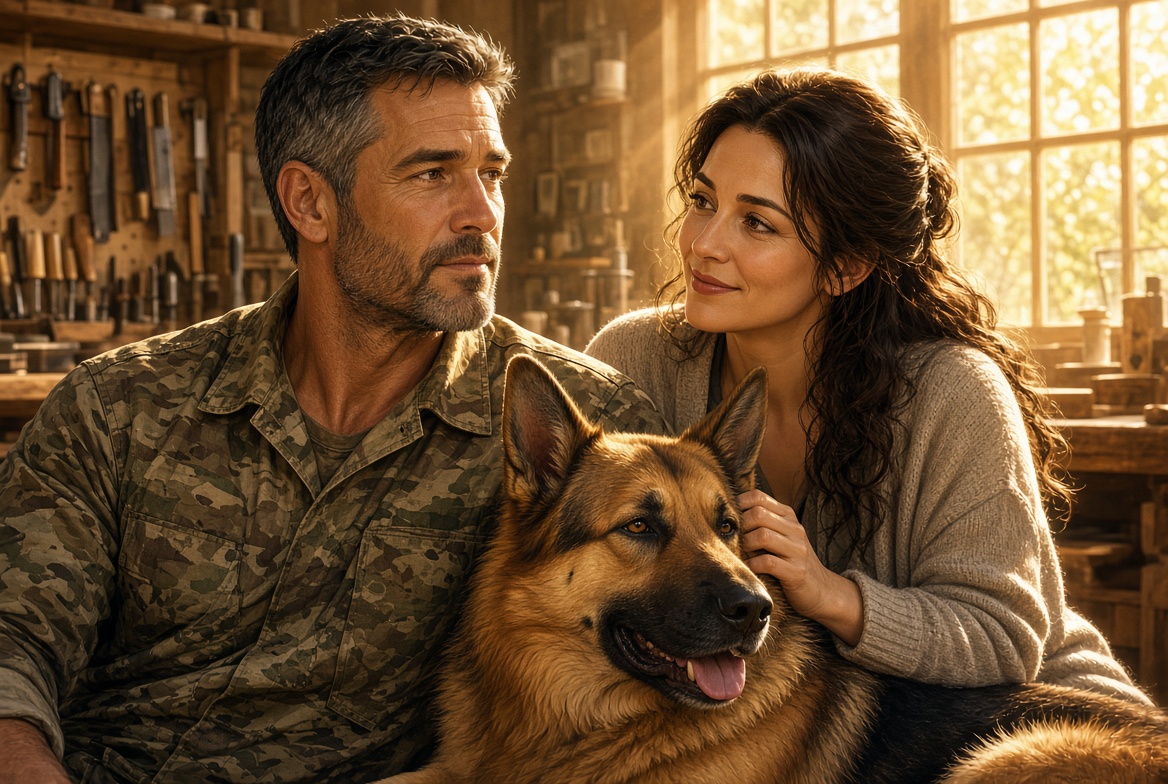
The German Shepherd had spent the first part of the session lying beside the wall in a ranger-green working harness, his long body still except for the occasional movement of his copper-amber eyes.
Nine years had silvered the hair beneath his jaw, but little else about him suggested age.
His honey-gold coat darkened into a narrow black saddle along his back, and the outer edge of his right ear carried a small V-shaped notch.
Caleb touched two fingers briefly against the harness.
Bishop rose.
The room changed.
Conversations disappeared without anyone asking for silence.
Caleb had seen that happen hundreds of times.
A working dog could command attention that a uniform could not.
A volunteer handed over a wool glove.
Another hid its matching pair among three prepared storage crates while Bishop remained outside the search area.
Caleb gave the cue.
Bishop moved.
No wasted excitement.
No dramatic circling.
His nose worked in measured sweeps while his body followed the information it gathered.
He checked one crate, passed it, paused at the second, then shifted toward the third and settled into the indication Caleb had trained into him.
“Good.”
A reward appeared.
Bishop accepted it, returned to Caleb, and resumed position.
The whole demonstration took less than a minute.
People applauded anyway.
Caleb disliked applause for working dogs, though he had long ago stopped correcting it unless it interfered with the animal.
Bishop did not care.
The dog looked up once, waiting for the next instruction.
“Questions?”
Several came.
Caleb answered each one.
What should someone do if they saw a search dog without a handler?
Call local authorities and avoid distracting the dog if it appeared to be working.
Could a family pet be trained to do the same thing?
Some could learn elements of scent work, but operational search work required more than enthusiasm and a good nose.
How far could Bishop track someone?
That depends.
Caleb explained why.
Terrain, wind, moisture, contamination, time.
He answered carefully enough to be accurate and quickly enough that nobody had to wait.
At the back of the room, a woman in a rust-colored cardigan lowered her pencil.
Caleb had noticed her earlier because she was one of the few people who never asked a question.
She was not disengaged.
That was different.
She watched.
Her dark mahogany hair brushed her collarbone, one side tucked behind her right ear.
A small notebook rested against one knee, though Caleb had seen her write in it only twice.
She had been the one unlocking storage cabinets before the session and finding extension cords for the projector, so he assumed she worked there.
When the final questions ended, people began pulling on coats.
Caleb released Bishop from the demonstration but kept him in work mode while he packed equipment.
The dog returned to his place near the wall.
A man thanked Caleb twice.
An elderly woman asked where she could buy the flashlight he had shown.
Someone else wanted the name of the battery bank.
By the time the room had mostly cleared, Caleb had every object back inside the correct bin.
He latched the lid.
“You showed them what you can do.”
The woman’s voice came from behind him.
Caleb turned.
She was carrying four laminated weather cards in one hand and that navy mechanical pencil in the other.
He took the remark as a compliment.
“That’s the idea.”
She glanced toward the table.
“No.”
There was no challenge in the word.
That bothered him more than challenge would have.
She set the weather cards into a plastic tray.
“You showed them what you can do.”
Caleb waited.
The woman looked at him.
“You didn’t give them much chance to find out what they can do.”
He studied her for a second.
Up close, she seemed younger than he had first thought.
Early 40s, perhaps.
Hazel would have been too light a word for her eyes.
They were a deep brown, steady without being severe.
A faint cluster of freckles crossed the bridge of her nose.
“Everybody followed the material.”
“I know.”
“They asked questions.”
“I know.”
“Then I’m missing the problem.”
She gave a small nod, as if that was at least an accurate place to begin.
“My name’s Mirabel Bell.”
“Caleb Rowan.”
“I know.”
Of course she did.
His name had been on the program sheet.
Mirabel rested one hip against the edge of a workbench.
“You asked what should go into a winter kit. Then you had the correct kit laid out in front of them.”
“So?”
“So half the room was reading the answer from your table.”
Caleb looked toward the equipment.
That had been intentional.
Visibility helped people remember.
Mirabel seemed to read the defense before he offered it.
“I’m not saying the information was bad.”
“That’s reassuring.”
That earned him the faintest curve at one corner of her mouth.
“I’m saying you solved the problem before anyone had time to struggle with it.”
Caleb folded his arms.
“I don’t normally measure the success of emergency preparedness by how much people struggle.”
“You might want to.”
For the first time, irritation touched him.
Not anger, something smaller.
The discomfort of hearing a criticism that could not be dismissed as uninformed.
Before Caleb answered, Mirabel picked up a box of laminated cards and carried it toward a long table near the windows.
Bishop watched her cross the room.
Caleb noticed because Bishop noticed.
Mirabel sat down several yards away from the dog.
She did not look at him.
That was unusual.
Most people who liked dogs announced it immediately.
They crouched, smiled, whispered the dog’s name after hearing it once.
Some slapped their thighs as though every animal had spent its life waiting to be summoned by strangers.
Mirabel did none of those things.
She opened the box, sorted cards into piles.
Bishop looked at her.
Mirabel continued working.
The dog’s right ear, the one with the small notch, shifted toward the soft click of laminated cards against the tabletop.
Still, Mirabel did not call him.
She did not offer her fingers for him to smell.
She did not even ask Caleb whether she could pet him.
For reasons Caleb could not immediately explain, that drew more of his attention than her criticism had.
Bishop watched her for another two seconds.
Then he lowered his head again.
Mirabel kept sorting.
There was restraint in the exchange, but not distance.
Caleb had spent years learning how much information could exist inside what did not happen.
He looked down at his field watch.
The woven olive strap was frayed along one edge.
Nathan had worn it first, years before it became Caleb’s.
His thumb found the metal keeper and moved it once along the strap.
An old habit, one he usually noticed only after he had done it.
“You know working dogs,” he said.
Mirabel glanced up.
“A little. That usually means no.”
“My father taught wilderness first aid for years. Search teams came through sometimes.”
Caleb nodded toward Bishop.
“You were right not to call him.”
“I figured if he wants something from me, he’ll tell me eventually.”
Something about the sentence remained with Caleb longer than it should have.
Not because it was profound, because she seemed to mean it literally.
No performance, no attempt to impress the handler through the dog, just a willingness to let the animal decide whether contact was necessary.
Caleb returned to packing.
Mirabel returned to the cards.
For several minutes, they worked without speaking.
He found the silence easier than the conversation.
That surprised him, too.
Outside, a county plow passed along the road, its blade grinding against old ice.
The windows trembled faintly.
Caleb zipped the equipment bag and checked the floor around the table.
Nothing left behind.
He unclipped one portion of Bishop’s harness, signaling the work period was nearly finished but not releasing him yet.
Mirabel stood and carried the organized cards toward a cabinet.
“Are you coming back?”
Caleb looked at her.
“For the program.”
She closed the cabinet.
“I assume you’re not planning to spend February repairing our folding tables.”
Caleb glanced at one table with a strip of duct tape wrapped around a leg.
“No promises.”
Mirabel smiled.
There it was again.
Small enough that he almost missed it.
“We have one more scheduled session,” Caleb said.
“Next Thursday.”
“Good.”
She returned the pencil to the spine of her notebook.
“Next Thursday. Try letting them be wrong for a minute.”
Caleb lifted an eyebrow.
“You always talk to people like you’re assigning homework?”
“Only the ones who look like they need it.”
He should have had a reply.
Usually he did.
Instead, something escaped him before he could stop it.
A quiet laugh, barely more than air through his nose, but unmistakable.
Mirabel looked pleased without making a point of being pleased.
Caleb hated that he appreciated that, too.
He gave Bishop the release cue.
The shepherd’s posture changed almost invisibly.
The rigid attention softened from his shoulders.
He stood, stretched his front legs, then looked first at Caleb and afterward across the room toward Mirabel.
She was already stacking chairs.
She still did not call him.
Bishop watched her for a moment, then followed Caleb toward the door.
Outside, the afternoon had already begun turning blue.
Caleb clipped the leash to Bishop’s collar and stepped onto the salted walkway.
Snow cracked beneath his boots.
Behind them, someone inside the workshop dragged a chair across the floor.
He had conducted more training sessions than he could easily count.
Most disappeared from memory as soon as the equipment was packed.
Walking toward the truck, Caleb found himself replaying this one.
Not the questions, not Bishop’s search, not even the part where a room full of people had applauded.
He kept hearing a woman tell him that being correct too quickly could keep somebody else from learning.
Caleb opened the rear door for Bishop.
The dog jumped in and settled into the secured space.
Before closing the door, Caleb looked back once at the workshop windows.
Mirabel crossed behind the glass carrying another stack of chairs.
She did not see him.
That was probably better.
Caleb shut the door.
For the first time in months, he was still smiling when he walked around to the driver’s side.
Sheriff Karen Vale arrived 16 minutes after Cormac called.
Cormac knew because he had checked his watch twice and then deliberately stopped checking it.
Her county SUV came down the ferry road without hurry, tires finding the old ruts beneath the snow instead of fighting them.
She parked beside Laurel’s pickup, killed the lights, and sat for one extra second before stepping out.
That was Karen.
She never entered a problem at the same speed everyone else had created it.
She was 48, compact and steady, with short black hair silvering around the temples and a rectangular face that seemed made for listening without giving much away.
Her winter duty jacket was charcoal over dark khaki, and an orange pen sat clipped high on the chest pocket.
She took in Cormac, then Laurel, then Owen, then Briar sitting directly in front of Storage 4.
“Tell me nobody opened it.”
Cormac answered first.
“Nobody opened it.”
Karen looked at the bent county notice flapping against the metal door.
“Good.”
Owen shoved his hands deeper into his coat.
“We heard something inside. Something alive. Sounded like knocking.”
Karen looked at Cormac.
Cormac shook his head once.
“Could be structural.”
“And the dog?”
Cormac glanced at Briar.
“He’s interested.”
“That’s not an answer.”
“It’s the one I’ve got.”
Karen accepted that with a small movement of her chin.
Laurel stepped forward and offered the folded paper she had brought from the truck.
“Peter rented the unit.”
Karen took them.
She read more carefully than Laurel expected.
The cold gathered around them while the sheriff checked the original lease number, the renewal date, the name of Red Fern Ferry Company, and the signature at the bottom.
Peter Wynn.
The agreement had remained active through the date of his death.
Karen looked up.
“Legally, you have a claim to the contents.”
Laurel’s shoulders loosened slightly.
“But.”
“But the building is posted unsafe.”
Laurel looked toward the door.
“I’m not asking to spend the night in it.”
“No, you’re asking me to let four people and a retired working dog enter a structure with a compromised north support.”
Owen glanced at Cormac.
“Five. If we’re counting his personality.”
Cormac ignored him.
Karen did not.
The corner of her mouth almost moved.
Almost.
She handed the papers back.
“We open the exterior door enough to inspect. Nobody goes in until he tells me the roof isn’t about to come down.”
She nodded toward Cormac.
Laurel looked surprised.
“He’s qualified for that.”
“No,” Cormac said at the same time Karen said, “More than you are.”
Karen continued.
“He maintains half the old ferry property and knows where everything has been failing for the last decade.”
“Seven years,” Cormac said.
Karen looked at him.
“Would you like less responsibility?”
“Yes.”
“Denied.”
Owen laughed once.
It disappeared quickly in the cold.
Cormac went to the workshop and came back with a pry bar, a portable brace, and two short lengths of timber.
Karen noticed the gear.
“You’ve done this before.”
Cormac fitted the bar beneath the lock housing.
“I’ve opened stuck doors before.”
That was all he gave her.
The lock itself came free easier than expected.
The door did not.
Cormac pulled.
Metal groaned.
The lower track moved six inches, then ten, then stopped with a violent scrape.
Briar lowered his head.
Cormac froze.
Not because of the dog, because he felt it through the steel.
Pressure.
Something in the frame had shifted.
“Stop.”
Karen’s hand came up immediately.
Nobody moved.
Cormac crouched beside the track, shone a flashlight along the edge, then studied the beam above.
“Snow load on the north side. Old deformation in the upper rail. Not immediate collapse. Not safe either. We open it another foot. No more.”
Laurel nodded too quickly.
Cormac looked at her.
“If I say out, you don’t ask why.”
She met his eyes.
“Fine.”
He worked the pry bar again.
The door lifted to roughly 30 centimeters.
Darkness opened beneath it.
Cold air breathed out from inside.
Briar dropped almost flat.
His nose went to the gap.
Owen leaned sideways trying to see anything.
Cormac shone his light.
Only floor dust.
The broken edge of a pallet.
Then something tapped above them.
Knock.
Laurel stiffened again.
Knock.
Knock.
Owen exhaled sharply.
Cormac followed the sound upward.
A loose section of conduit hung from a bent bracket near the interior beam.
The wind entered through a broken side vent and moved it just enough to strike the steel.
Owen stared at it, then laughed.
Not because it was funny, because human beings sometimes laughed when fear turned out to have terrible timing.
“A pipe.”
Karen looked at him.
“Conduit.”
“Even better.”
He rubbed a hand over his face.
“So that’s it.”
Laurel looked toward Briar.
“No.”
Cormac heard the word leave her before she seemed to realize she had said it.
Everyone looked down.
Briar had not relaxed.
The dog moved his nose slowly along the gap beneath the door.
Once, twice, then stopped near the left corner.
He inhaled deeply.
His ears changed position.
Cormac knew that look.
Not alarm, processing.
The sort of focus Briar used to hold when a scent crossed several others and he had to decide which one mattered.
Cormac crouched.
“What do you have?”
Briar looked at him.
No theatrics, no pawing, just that long, fixed stare.
Cormac felt something old shift behind his ribs.
There had been a time when that look meant somebody was waiting under concrete.
He pushed the thought away before it formed completely.
Karen saw the change in his face.
“What?”
Cormac slid his hand beneath the door and touched the floor.
Dust.
Dry grit.
No recent footprints.
He drew his fingers back.
“Briar’s picking up something deeper inside.”
“Person?”
“No.”
“Animal?”
Cormac shook his head.
“Probably not.”
Owen folded his arms.
“What does that leave?”
Cormac looked into the darkness.
“Things people handled.”
He could smell some of it himself now.
Old cloth, grease, metal, the stale enclosed scent of cardboard and wood.
Not enough to explain Briar, but enough to make him stop dismissing it.
Karen looked at the roofline again.
“We brace the door, then one person goes in first.”
“Cormac,” Laurel said.
He looked at her.
“I should know. It’s my husband’s storage unit, and if the ceiling comes down, it’ll still be his storage unit.”
Laurel’s expression hardened.
Cormac continued before she could answer.
“I go in first. You follow if I say it’s stable enough.”
Something flickered across her face.
Not gratitude.
Relief she did not want him to see.
That made it easier.
Cormac set the timber braces and widened the opening enough to duck beneath.
Inside, the air was colder than outside.
Still, he swept the light across the ceiling.
Corrosion.
Old water staining.
A long split near the north support, but the central frame held for now.
“Come in one at a time.”
Karen entered next, then Laurel.
Owen followed, slower because of his leg.
Briar came last.
The interior was almost empty.
Three rotted pallets, a folding table against one wall, two heavy plastic bins with cracked lids.
Nothing that justified six hours of driving.
Nothing that justified eight months of silence.
Laurel’s disappointment entered the room before she spoke.
“This is it.”
Owen kicked lightly at a scrap of wood.
“Maybe Peter liked expensive storage.”
Laurel ignored him.
Cormac moved the flashlight toward the back wall.
The beam passed over rust, concrete, a drain channel, then stopped.
A steel filing cabinet stood in the far corner, waist high, gray, older than everything else.
Laurel did not move.
Cormac saw why.
Across the top drawer, written in black permanent marker, were five words.
“Laurel, only if I can’t come back.”
Owen swore under his breath.
Not casually this time.
Laurel stood so still that even her coat seemed to stop moving.
Eight months.
Cormac thought of that number without wanting to.
Eight months of sorting bank statements.
Eight months of deciding which shirts to keep.
Eight months of hearing people say Peter’s name in the past tense.
And here in a condemned storage building by a dead ferry landing, her husband had written directly to her in a hand that assumed there might come a day when he could not speak for himself.
Laurel took one step, then stopped.
Her breathing changed.
Cormac turned his flashlight away from her face.
There were moments when privacy was not distance.
It was simply refusing to watch.
He moved toward the side wall and pretended to inspect the ceiling.
Behind him, metal scraped.
The first drawer opened.
No one spoke for several seconds.
Then Owen said quietly, “What’s in it?”
Laurel answered after a pause.
“Not much.”
Cormac looked back.
That was not true.
There was no money, no jewelry, no legal envelope marked will.
Instead, there were photo packets, dozens of them, technical notebooks, a portable hard drive sealed inside an anti-static bag, and one white envelope on top.
Laurel’s name was written across it.
Not typed.
Written.
She picked it up with both hands.
The envelope had already been sealed.
Cormac found that detail unexpectedly cruel.
Peter had prepared for this, whatever this was.
Laurel opened it.
The paper inside contained less than a page.
Her eyes moved quickly at first, then more slowly.
Owen watched her face.
“What?”
She kept reading.
“Laurel.”
She looked up at him.
For a moment, she seemed unable to place where she was.
Then she looked back down.
“He says he’s sorry.”
Owen’s jaw shifted.
“For what?”
“For not telling me about—”
“What?”
Laurel read again.
Her voice came out thin at the edges.
“He found something while reviewing old structures around Red Fern.”
Cormac turned fully now.
Laurel swallowed.
“He says there were inconsistencies in the Harbor 9 records.”
Owen’s expression changed before Cormac had time to understand why.
“Harbor 9.”
Cormac knew the name.
Everyone around Red Fern did.
Two years earlier, an old warehouse scheduled for demolition had partially collapsed during dismantling.
Eleven workers injured, one dead.
North Basin Recovery had been running the job.
The investigation had blamed a combination of structural deterioration and errors during the removal sequence.
It had made the regional news for less than a week.
Then the world moved on.
Laurel did not.
She kept reading.
Peter doesn’t say North Basin caused the collapse.
Karen stepped closer.
“Good.”
Laurel looked at her.
Karen’s face remained neutral.
“Specific language matters.”
Laurel nodded.
“He says he doesn’t know that.”
She returned to the page.
“He says he only knows the final reports don’t match the copies he reviewed.”
Owen’s voice sharpened.
“Meaning?”
Laurel looked at him.
“Some of them were changed.”
Silence filled the warehouse.
Not dramatic silence.
Worse, the administrative kind.
The kind that came from realizing something terrible might have been hidden inside paperwork ordinary enough for nobody to read twice.
Karen held out a hand.
“Don’t give me the letter yet.”
Laurel stared at her.
“Why?”
“Because if this becomes evidence, I want to document exactly where everything was found before we start passing it around.”
Laurel looked down at the page as though letting go of it had become impossible.
Karen softened her voice.
“You can keep holding it.”
Laurel nodded.
Cormac watched that.
Karen had understood the difference between preserving evidence and taking a dead man’s last words out of his wife’s hands.
Laurel turned to the final lines.
Her lips moved before her voice came.
“He says—”
She stopped.
Owen waited.
Cormac did not.
He looked away again.
Laurel tried once more.
“If you’re reading this, don’t try to prove I’m right.”
Her voice steadied.
“Just find someone who can prove I’m not lying.”
No one spoke.
A small sound came from the back of the room.
Briar settling down.
The shepherd lay beside the filing cabinet, his scarred right paw crossed over the left as though the search had ended.
Laurel sat on the dusty folding chair.
The letter remained open in her hands.
Owen stared at the cabinet.
“Why didn’t he tell us?”
There was anger in the question, but not only anger.
Laurel looked at the handwriting.
“Maybe he thought he was protecting us.”
Cormac stood near the door.
Cold light cut across one side of his face.
He should have said nothing.
This was not his marriage, not his dead husband, not his secret.
But silence could pretend to be protection for a very long time.
He knew that much.
“People do that,” he said.
Laurel looked at him.
Cormac’s gaze remained on the open doorway.
“They think if they carry the dangerous part alone, everyone else stays safe.”
His thumb turned the bezel of his watch once.
“Sometimes all they do is leave everyone else without the map.”
Laurel said nothing.
Neither did Owen.
And for the first time since arriving at Red Fern, the locked building was no longer the most important thing in the room.
Karen did not let anyone leave Storage 4 with the documents that afternoon.
She photographed everything first.
The steel cabinet, the position of the folders, the envelopes, the hard drive, even the black marker line Peter had written across the drawer.
Cormac stood near the door while the sheriff worked, her orange pen moving steadily across a legal pad.
Laurel waited without complaint.
Owen did not.
“So we drove six hours to find the stuff,” he said.
“And now we leave it here.”
Karen looked up.
“For tonight. That building is condemned.”
“Which is why I’m documenting it before anything moves.”
Owen gestured toward the roof.
“And if the roof comes down—”
“Then I’ll have photographs proving where everything was before the roof came down.”
Cormac glanced at him.
“You asked.”
Owen gave him a look.
“I’m beginning to understand why you live alone.”
Cormac almost told him that understanding was overrated.
Instead, he held the door while they left.
He thought that would be the end of it.
It wasn’t.
The next morning, Laurel returned.
Cormac was halfway beneath an old boat trailer replacing a seized bearing when he heard the workshop door open.
Briar raised his head from the stove.
Laurel stepped inside carrying two paper cups.
“You’re open.”
“No.”
She looked at the half-raised overhead door.
“This feels open.”
“It’s ventilation.”
She walked to the bench and set one cup beside the parts tray.
“Coffee.”
Cormac rolled out from under the trailer.
“I have coffee.”
Laurel looked at the dark liquid in the mug near the drill press.
“That stopped being coffee sometime before sunrise.”
Cormac sat up.
Briar rose and walked over to the new cup and sniffed it.
Cormac pointed at the dog.
“No.”
Briar sat.
Laurel smiled faintly.
She left 10 minutes later.
Cormac did not drink the coffee.
He also did not throw it away.
The second morning, she brought two pieces of apple cake wrapped in wax paper.
Cormac did not touch those either.
Briar did.
Cormac turned to reach for a wrench, heard paper crinkle behind him, and looked back just in time to see the German Shepherd swallow the evidence.
Laurel said nothing.
Cormac looked at Briar.
“Traitor.”
Briar licked one corner of the paper.
On the third morning, Laurel came in empty-handed.
Cormac noticed immediately.
He disliked that he noticed.
She took off her gloves and warmed her hands near the stove.
“Nothing today.”
Laurel looked at him.
“I thought you didn’t want anything.”
“I don’t.”
“Then this is going very well.”
Cormac tightened his jaw.
Briar lay between them, eyes half closed.
Laurel looked down at him.
“Your dog disagrees.”
Cormac exhaled.
“Don’t bring food anymore.”
“Because you don’t like it?”
“Because the dog is starting to think you live here.”
For a second, Laurel simply stared at him.
Then she laughed.
It was not loud, not dramatic.
It was just a brief, surprised sound that seemed to escape before grief remembered to stop it.
Cormac looked down at the socket wrench in his hand.
He had not meant to make her laugh.
That made it worse somehow.
By noon, Karen called.
She had spent most of three days checking Peter’s material against copies held by the county.
Not conclusions, not accusations.
Differences.
That was the word she kept using.
Differences.
She came to the workshop with a banker’s box under one arm and Dr. Celeste Warren beside her.
Celeste was 56, small-framed and silver-haired, with the economical movements of someone who had spent years entering rooms where other people were panicking.
A dark moss sweater showed beneath her winter coat, and a strip of old scar tissue crossed the inside of her left wrist.
Cormac knew her.
Not well enough to call her a friend, well enough that she had once stitched his hand without asking why the cut had waited 12 hours.
She nodded to him.
“You still avoiding the clinic?”
“I’m standing upright.”
“That wasn’t my question.”
Laurel glanced between them.
Cormac changed the subject.
“What did you find?”
Karen set the box on the workbench.
“Peter kept copies of structural inspection reports for Harbor 9.”
Owen, who had arrived with Laurel that morning, stopped leaning against the wall.
Karen opened the box.
“Several files match the versions in the county archive.”
She removed one packet.
“Several do not.”
Laurel stepped closer.
“What changed?”
Karen placed two printed reports side by side.
“Three warnings appear in Peter’s copy and disappear in the final submission.”
Cormac looked down.
The missing paragraphs were highlighted.
Load-bearing member deformation.
Visible corrosion at connection points.
Further load testing recommended prior to dismantling.
Laurel read them twice.
Karen pointed to the dates.
“And there’s this. Peter’s version carried one schedule. The final version carried another. The demolition start date had moved forward by 13 days.”
Laurel looked at Karen.
“Why?”
“I don’t know.”
“Who changed it?”
“I don’t know.”
“Was Peter’s signature still on it?”
“Electronically, yes.”
That stopped her.
Owen spoke from behind them.
“So either he signed off on changes he didn’t agree with, or somebody used his signature.”
Karen looked at him.
“Those are possibilities. Neither is established.”
Owen nodded once.
He sounded calm.
Too calm.
Celeste opened the folder she had brought.
“I pulled the emergency treatment records from Harbor 9.”
Laurel turned.
“Why would you have those?”
“I was part of the county medical response.”
Celeste placed a single-page summary on the bench.
“There were 11 injured workers transported or treated on site.”
She paused.
“One death.”
Laurel lowered her eyes.
Celeste tapped the final line.
“Samuel Kerr, 53.”
The name sat there without explanation.
No photograph, no biography, just a name and an age and the kind of short medical notation that reduced the last day of a life to objective language.
Cormac watched Laurel read the page.
Her finger moved to the first name, then the second, then the third.
She did not rush.
Cormac waited.
Finally, he asked, “You know them?”
“No.”
“Then why—”
“Peter did.”
She kept her eyes on the page.
“He remembered people.”
Cormac said nothing.
Laurel gave a small, sad smile.
“He remembered birthdays. Children’s names. Who took sugar and coffee. Who hated driving in snow.”
She traced another name.
“If he met someone twice, he remembered them the third time.”
Her smile disappeared.
“That was one of the reasons I married him.”
Cormac looked at the 11 names.
He did not know what to do with a man described that way.
The dead were usually easier when reduced to facts.
Rank.
Date.
Cause.
Laurel had just made Peter inconveniently alive.
Briar came over and sat beside her.
She rested one hand on the dog’s head without looking down.
“He knew.”
Cormac looked at her.
“Maybe he had the reports. Maybe he knew there was a risk.”
Laurel’s fingers tightened slightly in Briar’s fur.
“The warnings were there before the collapse.”
“We don’t know when he saw them.”
“He saved them.”
“We still don’t know what he did with them.”
Laurel turned toward him.
“So what are you saying?”
“I’m saying we don’t build the middle of the story because we already know the ending.”
Her face hardened.
Before she could answer, Owen spoke.
“Or maybe there isn’t a middle worth building.”
Everyone looked at him.
He was standing in the workshop doorway, one shoulder against the frame, his bad leg slightly forward.
Laurel frowned.
“What does that mean?”
Owen looked at the papers, then at Peter’s name.
“Maybe he didn’t stop anything because he didn’t do anything.”
Laurel went pale.
“That’s not fair.”
“Why?”
“You don’t know what he was doing.”
“Neither do you. You’re turning him into some kind of hero because he’s dead.”
The words landed harder than a shout would have.
Cormac watched Laurel absorb them.
The sadness went first, then anger, then something underneath both.
Fear.
“Don’t,” she said.
Owen shook his head.
“No, you keep talking about how he remembered everybody, how kind he was, how careful he was. He was careful, was he?”
Laurel stared at him.
Owen’s jaw tightened.
Then he turned and walked out.
The workshop door slammed behind him.
Briar stood.
Cormac did not call the dog.
He was already moving.
Laurel said, “Leave him.”
Cormac stopped.
She was still looking at the door.
“He doesn’t want help.”
Cormac knew the sentence.
He also knew how often it was wrong.
“I’m not helping.”
He pulled on his jacket.
“I’m asking a question.”
Outside, Owen was halfway down the old dock.
He walked faster when he was angry, which made the limp more visible.
Cormac followed without hurrying.
The lake wind came hard across the ice.
Owen stopped near the end where an old ferry bollard leaned toward the water.
He heard Cormac behind him.
“Seriously?”
Cormac stopped several feet away.
“Who are you angry at?”
Owen laughed, bitter.
“You people really love that question.”
“I don’t—”
“Could have fooled me.”
Cormac waited.
That was another thing he had learned long ago.
Silence bothered people more when you did not use it as punishment.
Owen looked out across the frozen lake.
Finally, he said, “Peter.”
Cormac did not react.
“Why?”
Owen rubbed his left thigh.
The motion looked unconscious.
“He knew I worked at Harbor 9.”
Cormac’s attention sharpened.
“You were there?”
Owen gave him a flat look, then slapped the outside of his left leg.
“Where do you think this came from?”
Cormac looked at the stiff knee.
Something rearranged itself.
Not the facts, the meaning of them.
“You were injured in the collapse.”
“Crushed under a steel brace for 40 minutes.”
Owen looked back toward the workshop.
“Two surgeries. Nine months of rehab. Still hurts when the weather changes.”
Cormac said nothing.
Owen continued.
“Peter knew I’d taken the job. At North Basin, temporary demolition crew, and he knew the building. He’d inspected it.”
Owen’s voice dropped.
“That’s the part nobody seems to care about.”
Cormac watched him.
“You think Peter knew it was dangerous before you went in?”
“I think he knew something.”
“Do you know that?”
“No.”
The answer came immediately, honest enough to hurt.
Owen looked down at the ice beneath the dock.
“But I know he never warned me.”
Cormac let that sit.
He knew where I was working.
He knew what building.
And now we find reports he hid in a storage unit saying the place had structural problems.
His mouth twisted.
You tell me what I’m supposed to do with that.
Cormac had no answer.
Owen’s eyes were bright now, but he did not cry.
I spent two years trying not to blame anybody.
He swallowed.
Then Peter dies and suddenly everybody talks about him like he was the best man who ever lived.
The wind pulled at his jacket.
Owen looked back toward shore.
“I loved him.”
That was the first sentence that broke.
Not much.
Enough.
He was my brother before he was my brother-in-law.
Cormac understood.
Then the anger was not the opposite of grief.
It was grief with nowhere respectable to stand.
Owen dragged a hand across his face.
If he knew that building was unsafe and let me walk in there anyway—
He did not finish.
Cormac did not finish it for him.
After a while, he said, “You haven’t forgiven him.”
Owen looked at him.
“For what?”
Cormac met his eyes.
“That’s the problem.”
Owen’s mouth tightened.
Cormac continued.
“You don’t know yet.”
For once, Owen had no sarcastic answer.
They stood at the edge of the abandoned dock with the frozen lake stretching ahead of them.
Behind them, in the workshop, 11 names waited on a sheet of paper.
One belonged to a dead man.
Ten belonged to people who had survived.
And now Cormac knew there had always been a 12th person carrying Harbor 9 long after the building fell.
Owen Wynn.
By the end of February, the snowbanks along Red Haven’s main road had sunk low enough to reveal dirty gravel and the tops of buried parking curbs.
The town still looked like winter, but not the clean version of it.
Rooflines dripped in the afternoon.
Ice formed again after dark.
Every sidewalk seemed to spend half the day becoming water and the other half becoming dangerous.
The community workshop had reached the point where the remaining repairs were smaller than the damage that had caused them.
That changed the evenings.
There was less hauling, less noise, more time to notice who stayed after everyone else left.
One Thursday, Mirabel was closing a storage cabinet when Caleb said, “Dinner.”
She looked over.
He was standing beside the long worktable with his gloves tucked beneath one arm.
Mirabel waited.
Caleb realized he had said only the noun.
“With me,” he added.
“That does make it more specific.”
He nodded once.
“Tonight.”
She looked toward the clock.
“You plan these things far in advance?”
“No.”
“I gathered that.”
For a moment, he thought she might say no.
Instead, she picked up her coat.
“There’s a place off Highway 12.”
Caleb looked at her.
“That a yes?”
“It’s the closest thing you’re getting.”
The diner sat beyond the edge of town where the highway widened near a truck stop and then narrowed again toward the foothills.
Inside, the tables were scratched wood laminate, the booths dark red vinyl, and a pie case stood near the register beneath a handwritten sign that said “Huckleberry, if it lasts.”
Nothing about the place asked anyone to behave differently than they had all day.
Caleb liked that immediately.
Mirabel slid into the booth across from him.
“You look relieved.”
“I am.”
“Why?”
“No candles.”
She laughed.
“That was your concern?”
“Among others.”
The conversation began with ordinary things.
The workshop.
Owen’s habit of labeling storage bins with handwriting no one could read except Owen.
Ruth sending food in containers she expected returned.
Jonah pretending the physical therapist’s instructions were suggestions.
Mirabel ordered coffee after dinner.
Caleb declined.
“You don’t drink coffee at night?”
“I prefer sleeping.”
“A disciplined man.”
“That’s one word.”
She stirred cream into her cup.
“What are the other words?”
Caleb looked out the window.
Wet pavement reflected the lights from the gas station across the highway.
“Depends who you ask.”
Mirabel did not fill the silence.
By now, he had started to recognize that as one of the things she did deliberately, not withholding, waiting.
It made people choose whether they wanted to continue.
Caleb did.
“My brother used to call me unbearable.”
Mirabel looked up.
“You had a brother.”
“Nathan.”
He had not meant to say the name that early.
Once it was there, however, he did not take it back.
“Younger. Four years.”
“What was he like?”
Caleb leaned back.
The question should have been simple.
Instead, it opened a room he normally entered alone.
“Nathan was louder than I was. Less patient. Better with strangers. He could turn a missed highway exit into a story and a broken camping stove into an excuse to eat cold food and laugh about it.”
“He climbed,” Caleb said.
Professionally?
No, he worked construction. Climbed because he liked it.
Mirabel nodded.
Caleb looked down at the edge of the table.
“He died eight years ago.”
She did not react dramatically.
No sharp inhale.
No instant apology for asking.
“Fall.”
That was enough for several seconds.
Then Caleb added, “Weather changed faster than expected.”
Mirabel’s hand remained around the coffee mug.
“Were you with him?”
“No.”
The word came harder than the others.
Caleb rubbed his thumb along the keeper of the old field watch.
Mirabel noticed the movement but did not ask about it.
“He went out with two friends,” Caleb continued.
“Route wasn’t supposed to be difficult. Forecast shifted. One section iced over. He fell before they turned back.”
He stopped.
The diner had not changed.
Someone near the counter laughed.
A server carried two plates past their booth.
Outside, a truck pulled onto the highway.
Caleb hated that the world could stay ordinary while certain sentences were being said.
“I spent a long time afterward thinking about what he missed.”
Mirabel listened.
“Wrong weather window. Wrong equipment for the conditions. One earlier decision could have changed the rest.”
“Maybe.”
Caleb looked at her.
“You don’t agree.”
“I didn’t say that.”
“You almost did.”
Mirabel traced one finger along the rim of her cup.
“I think you’re talking about his death like it was a problem someone should have solved before it happened.”
“It was preventable.”
“That’s not the same thing.”
Caleb felt something inside him harden.
Not anger, defense.
“If they’d turned around sooner—”
“I know.”
“If someone had checked—”
“I know.”
He stopped.
Mirabel’s voice remained quiet.
“Nathan sounds like he made choices.”
“He did.”
“And he knew mountains could go bad.”
“Yes.”
“And you still think part of your job was somehow to be one step ahead of a trip you weren’t on?”
Caleb looked away.
The question reached farther than he wanted it to.
Mirabel let another moment pass.
Then she asked, “Would Nathan have liked the way you live now?”
Caleb looked back at her.
“What does that mean?”
“Would he have liked you treating every ordinary day like it might become a rescue if you failed to notice something soon enough?”
The diner seemed quieter.
It was not.
Caleb simply heard less of it.
He had expected sympathy.
He had been prepared to reject sympathy.
He had not expected that.
Mirabel did not soften the question.
She also did not press for an answer.
Caleb looked down at the watch on his wrist.
Nathan had worn it for years.
The strap had been replaced twice since then, but the scratched case was still the same.
“I don’t know,” he said.
Mirabel nodded.
“That sounds more honest.”
They did not return to the subject.
That mattered, too.
She told him instead about her first year teaching vocational science in Spokane, and the afternoon a student accidentally glued a wooden vise handle to a bench.
Caleb laughed before he could decide whether the story was funny enough to deserve it.
By the time they left, the temperature had dropped below freezing.
The parking lot had begun shining.
Caleb walked Mirabel to her car.
Neither of them called the evening a date.
Neither of them needed to.
For three days, the memory of Nathan’s question followed Caleb more closely than the dinner itself.
Then the first deadline arrived.
Evelyn called Mirabel into the library office late Monday afternoon.
Caleb learned about it that evening when he stopped by the workshop.
Mirabel was sitting at the edge of a worktable reading a printed document.
“You all right?”
She looked up.
“My contract ends in six weeks.”
Caleb knew the position had been temporary.
Knowing was different from hearing the number.
“Can they extend it?”
“Maybe.”
“That means no.”
“It means they don’t know.”
Mirabel folded the paper.
“The council has to approve next quarter’s community budget. The workshop survived the repairs. That doesn’t mean the position did.”
Caleb’s mind moved before she finished.
Budget line, grant options, library partnership, teaching credentials, nearby districts, possible temporary programs.
He stopped himself from saying any of it.
“What do you want?”
Mirabel seemed surprised, then pleased.
“I don’t know yet.”
Caleb nodded.
That should have been enough.
Two mornings later, the second deadline appeared.
Lieutenant Commander Pike gathered the remaining K9 personnel in the temporary operations room.
The delayed winter work was nearly complete.
Weather windows had improved.
Equipment recovery was ahead of schedule.
Unless conditions changed again, the team would leave Montana during the first week of April.
Caleb wrote the date down.
Washington state, training cycles, operational blocks, travel, schedules that moved because they could.
He had known all of that before meeting Mirabel.
It had not felt like a problem then.
Now it arranged itself into one.
Mirabel might lose her position.
He would leave around the same time.
Neither of them knew what came next.
By that afternoon, Caleb was calculating.
Not deliberately at first.
His mind simply did what it had always done.
Identify instability.
Reduce exposure.
Build alternatives.
The mistake started small enough to sound reasonable.
He asked Evelyn whether the town had another position Mirabel could move into if the workshop contract ended.
Evelyn looked at him over the top of her glasses.
“Did Mirabel ask you to ask me?”
“No.”
“That’s what I thought.”
Caleb ignored the warning.
Evelyn told him there might be part-time program work depending on funding, but nothing permanent.
The next day, Caleb called a former training contact in Spokane who worked with a technical education center.
He described Mirabel’s background, teaching, program management, community work, and asked whether they expected openings.
The man said maybe.
Send a resume if she was interested.
Caleb thanked him, then did not tell Mirabel he had made the call.
He told himself he was not deciding anything for her.
He was only gathering options.
That distinction made him feel better.
It should not have.
Over the next week, he began creating distance with the same quiet efficiency he brought to everything else.
He stopped inventing reasons to drive through Red Haven.
When Mirabel sent a message, he answered.
When she did not, he rarely began one.
Coffee became less frequent.
Walks after closing disappeared.
The workshop still saw him, but only when he had a reason to be there.
Mirabel noticed.
She did not chase him.
That somehow made the distance easier to maintain and harder to justify.
One evening, Caleb drove back from training with Bishop secured behind him.
The road approached the junction where he had turned toward Red Haven so many times that his hands seemed to know it before he did.
The signal clicked, then stopped.
Caleb stayed on the main road.
Behind him, Bishop lifted his head.
The dog looked toward the familiar turn, his right ear angled forward.
For several seconds, he remained alert to a road they were no longer taking.
Then Red Haven disappeared behind the trees.
Bishop lowered his head again.
No whining, no protest, only recognition that a routine had changed.
Caleb tightened one hand around the steering wheel.
The old field watch sat beneath his sleeve.
Nathan’s watch.
Mirabel’s contract.
April.
Washington.
Spokane.
Everything in Caleb’s mind had begun turning into routes, exits, backup plans.
He told himself that was responsibility.
He did not yet understand that fear could wear the same uniform.
Mirabel learned about Evelyn first.
It happened on a Wednesday afternoon that had no reason to matter.
The workshop smelled faintly of sawdust and drying paint.
Someone had left a window cracked near the office, and cold air moved along the floor in a narrow stream while sunlight pressed weakly against the glass.
Mirabel was reviewing the final six weeks of her contract with Evelyn Price.
There was nothing emotional about the paperwork.
Dates, budget codes, program hours, a list of tasks that needed to be completed before the end of March.
Evelyn sat across from her with reading glasses low on her nose, turning pages slowly.
“We’re still waiting on the council,” she said.
Mirabel nodded.
“I figured.”
“I wish I had something firmer.”
“You don’t?”
“No.”
Mirabel appreciated that.
People often thought uncertainty became kinder if they wrapped it in optimism.
Evelyn did not.
She checked another page.
“There might be part-time work through the library side if the program budget changes.”
“Maybe.”
“Maybe.”
Evelyn hesitated.
It was small, but Mirabel knew her well enough to notice.
“What?”
Evelyn removed her glasses.
“Caleb asked me about that.”
Mirabel’s hand stopped on the edge of the document.
“About what?”
“Whether the town had another position for you.”
The room changed by less than an inch.
Nothing moved.
Nothing broke.
But suddenly the silence felt arranged.
“When?”
“Last week.”
Mirabel looked down at the contract.
Last week.
Around the same time Caleb stopped finding reasons to drive through Red Haven.
Around the same time his messages shortened.
Around the same time the coffee after repair nights disappeared.
Evelyn watched her face.
“He wasn’t pushing. He just asked.”
“I know.”
“I assumed you knew.”
Mirabel looked up.
“I didn’t.”
Evelyn sat back.
“I’m sorry. You didn’t do anything wrong.”
That was true.
Mirabel finished the meeting.
She asked the remaining questions, confirmed the next council date, signed the form Evelyn needed.
Then she carried the folder back to the workshop.
For 20 minutes, she did exactly what she had planned to do before the conversation.
Checked supply inventory.
Answered an email.
Moved three boxes from one shelf to another.
The ordinary work helped.
Then Lena Marsh called.
Lena had been Mirabel’s friend long before she became Jonah’s rehabilitation specialist.
At 38, she had the fast, deliberate voice of someone accustomed to measuring recovery in small increments rather than dramatic breakthroughs.
She wore her black hair in a low braid during work and had a habit of removing her glasses whenever a conversation became personal, as if clarity required fewer objects between her and the person in front of her.
“I need to ask you something,” Lena said.
Mirabel closed the office door.
“That sounds dangerous.”
“Did you tell someone to contact Spokane Technical Skill Center?”
Mirabel went still.
“No.”
A pause.
“Okay.”
“Why?”
“One of their program coordinators called me this morning. My name is still listed as a professional reference from your last application.”
Mirabel stood beside the desk.
“What did they want?”
“They wanted to know whether I thought you’d be interested if a teaching position opened later this spring.”
Mirabel did not speak.
Lena waited.
Finally, Mirabel asked, “Did they say who called them?”
“Not exactly. Just someone asking generally about your background. Former military, apparently.”
The answer did not need finishing.
Mirabel leaned against the desk.
Two conversations.
Two different institutions.
Two plans forming outside her knowledge.
Lena’s voice softened.
“Do you want me to ask more?”
“No.”
“You sure?”
“Yes.”
That answer came quickly.
Too quickly.
Mirabel looked through the small office window toward the workshop floor.
A repaired shelf stood near the far wall.
The portable heater Caleb had refused to touch was gone now, taken away by a licensed electrician the day before.
For a moment, she almost laughed.
He had learned not to fix the heater.
Apparently, people were harder.
“Is this about Caleb?” Lena asked.
Mirabel closed her eyes briefly.
“Yes.”
“You want to talk?”
“Not yet.”
“All right.”
Lena did not push.
That helped.
After the call, Mirabel remained in the office for several minutes.
Not angry.
Not yet.
Anger would have been easier.
What she felt first was recognition.
Caleb had not lost interest.
He had not grown bored.
He had not changed his mind about her.
He had done something more familiar to him than any of those.
He had made a plan.
And because he believed plans reduced harm, he had started arranging hers.
That understanding hurt more than the possibility that he had simply walked away.
By evening, Mirabel knew what she wanted to say.
She did not rehearse it.
That would have made it sound cleaner than it felt.
Caleb was due at the workshop after training to collect a set of tools and confirm one final volunteer schedule.
Mirabel stayed.
The building emptied slowly.
Theo left first.
Then Evelyn.
A retired volunteer called good night from the hallway.
By 6:30, the workshop was quiet.
Mirabel stood beside the long table near the center of the room.
No coffee, no paperwork, no reason to pretend she was doing anything else.
At 6:42, the front door opened.
Caleb entered alone.
Bishop was not with him.
That somehow made the room feel larger.
Caleb removed his gloves as he walked in.
He saw Mirabel and stopped.
Something in her posture told him before she spoke.
“You asked Evelyn.”
Caleb did not pretend not to understand.
“Yes.”
“You asked whether the town could find me another job.”
“I asked what options existed.”
Mirabel nodded once.
“And Spokane?”
His eyes changed very slightly.
That was enough.
“You called them?”
“Yes.”
“About me?”
“Yes.”
Mirabel let the words settle.
Caleb took two steps farther into the room.
“I didn’t send anything. I didn’t give them your resume.”
“That isn’t the point.”
“I know.”
“Do you?”
He went still.
Mirabel folded her arms, not to close herself off, but because she needed somewhere to put her hands.
“You asked Evelyn.”
Caleb nodded.
“You called Spokane.”
Another nod.
“You asked Owen whether your schedule after Montana had any flexibility.”
This time, Caleb said nothing.
Mirabel had guessed that part.
His silence confirmed it.
She looked at him.
“You asked everyone.”
Caleb’s jaw shifted.
Mirabel continued.
“Except me.”
The room held the sentence between them.
Caleb looked toward the floor, then back at her.
“I was trying to understand the options.”
“My options?”
“Yes.”
“That you never asked if I wanted.”
“I wasn’t making decisions for you.”
Mirabel almost smiled.
Not because anything was funny.
“Caleb, you were building an exit plan. For you. That is exactly the problem.”
He exhaled.
“You’re losing the workshop position.”
“I know.”
“I’m leaving.”
“I know that, too.”
“My schedule after this won’t be predictable.”
“I know what your work is.”
“You know part of it.”
“Then tell me the rest.”
Caleb looked away.
Mirabel waited.
He hated being cornered by emotion because emotion refused to behave like logistics.
She could see that now.
Not weakness, training, habit, fear made efficient.
“There will be times I can’t call,” he said.
“Trips I can’t explain. Holidays I miss. Plans that change after we make them.”
Mirabel listened.
“I could be gone when something goes wrong here.”
“That’s possible.”
“You could build around this and find out later that I can’t give you what you thought.”
“What do you think I thought?”
Caleb hesitated.
That was the first crack.
Mirabel stepped closer, though not enough to soften the distance.
“Tell me.”
“I don’t know exactly.”
He looked at her.
She felt the anger arrive then.
Not loud, not hot, something cleaner.
“You don’t know what I expect because you never asked.”
Caleb said nothing.
“You don’t know what I would tolerate.”
Silence.
“You don’t know what I would choose.”
Still silence.
Mirabel took a breath.
“And somehow you decided that not knowing gave you permission to decide for me.”
That’s not what I was doing.
It is.
His voice hardened slightly.
“I was trying to keep you from losing more than you already are.”
There it was.
Mirabel looked at him for a long moment.
“You still think I’m something that needs managing?”
“That’s not fair.”
“Then what is it?”
Caleb opened his mouth, closed it.
Mirabel did not rescue him.
“If I said I was willing to try,” she said, “what would you say?”
He answered too quickly.
“You don’t know how hard that could be.”
The moment the sentence left him, both of them heard it.
Mirabel’s face changed.
Not dramatically, just enough.
“Then let me find out.”
Caleb looked at her.
“You’re talking about months apart.”
“Yes.”
“Uncertain schedules.”
“Yes.”
“You could end up somewhere else for work.”
“Yes.”
“I could miss birthdays. Christmas. Days you need me.”
Mirabel’s eyes did not leave his.
“I never asked you to promise me things you can’t control.”
That’s easy to say now.
No.
Her voice stayed low.
“What’s easy is deciding I won’t be able to handle it before I get the chance.”
Caleb’s hand moved toward his watch, then stopped before touching it.
Mirabel noticed.
For once, he noticed her noticing.
“I’m trying to protect you from something you might regret.”
Mirabel’s expression softened.
That made the next words hurt more.
“I don’t need you to protect me from every possible heartbreak.”
Caleb stood completely still.
Mirabel continued.
“I need you to respect me enough to let me choose which heartbreaks are worth risking.”
Something in Caleb’s face emptied.
The argument left him.
Not because he agreed immediately.
Because the sentence had reached somewhere logic could not defend.
He looked past Mirabel toward the repaired north wall.
For several seconds, neither of them spoke.
Then Jonah’s voice returned to him.
A hallway.
A loose handrail.
A question asked without ceremony.
What do you do when you don’t know how to fix something?
Caleb had answered without hesitation.
Find another way.
He had believed it was wisdom.
Now he heard the arrogance hiding inside it.
Find another way.
Who finds it?
Who decides?
Who gets to say what counts as fixed?
Mirabel was not a broken railing, not a damaged building, not Nathan on a mountain he could rewrite afterward.
She was standing in front of him, alive, capable, angry, asking to be included in her own future.
Caleb looked at her.
“I thought I was making it easier.”
“For who?”
He did not answer.
That was answer enough.
Mirabel’s arms fell to her sides.
The anger had not disappeared, but underneath it was something worse.
Disappointment.
Caleb could handle anger.
Disappointment asked him to look at himself.
“I was afraid,” he said.
Mirabel waited.
Not encouraging, not forgiving, just listening.
“I knew I was leaving,” Caleb continued.
“Then your contract changed and suddenly everything about this had an expiration date.”
“Everything has one.”
He looked at her.
“That doesn’t make it easier.”
“No.”
“I thought if I could give you options before I left—”
“You mean before you left me.”
The correction stopped him.
Mirabel swallowed.
The first visible sign that the conversation was costing her.
Caleb noticed.
She noticed him noticing and looked away.
“I wasn’t trying to leave you.”
“You already started.”
The sentence was quiet.
It landed harder than anything else.
Caleb thought of the unanswered roads, the shorter messages, the evenings he had stayed away because distance seemed responsible.
He had imagined he was reducing future pain.
He had only begun causing it early.
“I was wrong,” he said.
Mirabel looked back at him.
No defense followed.
No explanation.
Caleb repeated it.
“I was wrong.”
She held his gaze.
“Yes.”
That was all.
She did not step closer, did not absolve him, did not tell him understanding the mistake was the same as repairing it.
Caleb nodded once.
He picked up the tool case he had come for.
For a moment, Mirabel looked as if she expected him to say something else.
He did, too.
Nothing honest arrived, so he did not manufacture it.
At the door, Caleb stopped.
“Mirabel.”
She looked at him.
“I’m sorry.”
Her face softened by almost nothing.
“I know.”
Not forgiveness.
Recognition.
For now, that was all she had.
Caleb opened the door and stepped into the cold.
Behind him, the workshop remained lit.
He did not look back.
Not because he did not want to, because for the first time he understood that wanting to turn around did not automatically give him the right to return before she was ready.
For the first two days after the argument, Caleb did exactly what he would once have considered useless.
Nothing.
He did not call Evelyn.
He did not contact Spokane.
He did not ask Owen whether a different departure date was possible.
He did not send Mirabel a long explanation designed to make his mistake easier to understand.
That last part was the hardest.
Caleb had spent most of his life believing that if people had enough information, they could make sense of almost anything.
Procedures worked that way.
Training worked that way.
Failure could usually be traced backward until a decision, a missed signal, or a flawed assumption appeared.
People were not procedures.
Mirabel had made that clear.
So Caleb kept his explanation to himself.
The first message came from her on Friday afternoon.
“Council meeting got moved to Monday.”
Caleb stared at the words for several seconds.
His mind immediately produced three possible consequences and twice as many questions.
He typed, “Do you know why?”
Then deleted it.
He tried again.
“Want me to look into anything?”
Deleted that, too.
Finally, “I hope they give you a clear answer.”
Mirabel replied several minutes later.
“So do I.”
That was all.
It felt insufficient.
Caleb let it be insufficient.
When Monday came, the council still did not resolve the funding issue.
Mirabel told him that evening while they stood outside the workshop after a volunteer shift.
“They want another budget review.”
Caleb nodded.
“When?”
“End of the week.”
He could think of four questions that might have helped.
He asked none.
Mirabel watched him.
“That’s it.”
“What?”
“No plan?”
Caleb put his gloves into his coat pocket.
“It’s your job.”
“It is.”
“If you want my opinion, I’ll give it.”
She looked at him for a moment.
“And if I don’t?”
“I’ll listen.”
Mirabel’s mouth moved as though she almost smiled.
Almost.
“I’m still angry with you.”
“I know.”
“You keep saying that.”
“Because you keep being angry.”
This time, a small breath of laughter escaped her before she could stop it.
It disappeared quickly, but Caleb heard it.
He did not treat it as forgiveness that mattered.
Three days later, Mirabel called him at 11:26 in the morning.
Caleb was at the winter training site with Bishop, checking equipment after a short scent exercise.
He saw her name and answered immediately.
“Mirabel.”
There was hospital noise behind her.
Not loud, a cart rolling, a voice over an intercom, the kind of background sound that told him where she was before she said it.
“My dad fell.”
Everything in Caleb tightened.
“Where are you?”
“Red Haven Medical.”
“Is he conscious?”
“Yes.”
“Did he hit his—”
Caleb stopped himself.
Mirabel breathed shakily at the other end.
“They’re checking him now.”
“I’m coming.”
He ended the call and looked across the room.
Owen had already read the situation on his face.
“Go.”
Caleb glanced at Bishop.
“I’ll take care of him,” Owen said.
“You’re not bringing a working dog into a hospital waiting room because you forgot how civilians function.”
Under different circumstances, Caleb might have answered.
Instead, he handed over the lead.
“Thanks.”
The drive to Red Haven took 31 minutes.
Caleb knew because he checked once.
Only once.
He did not call the hospital, did not call Lena, did not call Mirabel again.
He hated every mile of that restraint.
When he entered the emergency department, Mirabel was sitting in a row of molded plastic chairs beneath a television with the sound turned off.
Her coat was still zipped.
She had not taken off her gloves.
That told him more than tears would have.
He sat beside her.
“What happened?”
“Lena was working with him at home. He stood too fast after one of the exercises. His right leg didn’t catch up.”
“Head?”
“They don’t think he hit it good. His shoulder hurts.”
Caleb nodded.
Then he stopped talking.
Mirabel looked toward the treatment doors.
“They’re doing imaging.”
He stayed beside her.
Ten minutes passed.
Then 20.
Ruth arrived with Lena.
Ruth looked angry in the particular way fear sometimes appeared on people who had spent careers in medicine.
“Of all the ridiculous ways to get another hospital bill,” she muttered.
Lena touched her shoulder.
“He did what we asked. His balance went before I could get him.”
Ruth nodded.
“I know.”
Lena was still blaming herself.
Caleb recognized it immediately.
Once he would have told her why she was wrong.
Instead, he let Ruth answer.
“You were there,” Ruth said. “That’s what mattered.”
Lena looked down.
Caleb said nothing.
They waited.
Time moved differently in hospitals.
It did not pass.
It accumulated.
At one hour, Mirabel finally removed her gloves.
At two, Ruth went to find coffee.
Lena left briefly to speak with a staff member.
Caleb remained beside Mirabel.
He checked neither his phone nor the clock often enough to make her notice.
At some point, Mirabel leaned forward with her elbows on her knees.
“I hate this.”
“I know.”
“My mother knows more about this than I do. Lena knows more than I do. The doctors know more than I do.”
Caleb waited.
“And I’m sitting here doing nothing.”
There was something painfully familiar in the sentence.
He looked at her.
“Yes.”
Mirabel turned.
“You’re not going to tell me that’s normal?”
“It probably is.”
“You’re not going to ask the nurse what’s taking so long?”
“You already asked.”
“You’re not going to call Lena’s supervisor or find a better hospital or make a list?”
Caleb’s expression shifted.
“No.”
Mirabel looked almost irritated.
“Why not?”
He rested his forearms against his thighs.
“Because you don’t need me to take over.”
Her eyes stayed on him.
The room around them seemed to recede slightly.
“What are you doing then?”
Caleb looked toward the treatment doors.
“Being here.”
Mirabel said nothing.
He could feel the difference between this silence and the one in the workshop days earlier.
That silence had been a boundary.
This one was recognition.
Caleb had spent years believing presence was the least useful thing a person could offer when something was wrong.
No solution, no measurable result, no guarantee, just a chair beside someone who was afraid.
Yet Mirabel’s shoulders lowered for the first time since he arrived.
Not much.
Enough.
She leaned back, their arms touched along the plastic divider between the chairs.
Neither moved away.
Jonah was released three hours later.
No fracture, no head injury, a badly bruised shoulder, a strained hip, and strict instructions to take the next phase of rehabilitation more slowly.
Jonah appeared in a wheelchair pushed by an orderly and looked offended by the entire concept.
“I can walk.”
Ruth met him halfway.
“That attitude is why you’re in the chair.”
“I fell once today.”
Jonah looked at Caleb.
“You see what I live with?”
Caleb stood.
“Seems appropriate.”
Jonah pointed at him.
“Traitor.”
Mirabel laughed.
The sound came out tired and uneven.
Caleb thought it was the best thing he had heard all day.
He helped with practical things only when asked.
Held a door, moved the passenger seat back so Jonah had more room, carried a bag Ruth handed him.
He did not lift Jonah without instruction.
Did not reorganize the medication sheet.
Did not take over the discharge papers from Mirabel.
At the Bell house, Jonah moved slowly down the hallway with his cane while Ruth hovered close enough to catch him and far enough away to preserve his dignity.
Caleb waited near the door.
Mirabel had gone to put the paperwork on the kitchen counter.
Jonah reached his chair and lowered himself into it.
Then he looked toward Caleb.
“Rowan.”
Caleb stepped closer.
Jonah tapped the other chair with his cane.
Caleb sat.
For a moment, Jonah studied him.
Then he said, “Find another way yet?”
Caleb knew exactly what he meant.
The loose handrail.
The first evening in the Bell house.
What do you do when you don’t know how to fix something?
Find another way.
Caleb looked down at his hands.
“Maybe that was the wrong answer.”
Jonah’s eyebrows lifted.
“Dangerous thing to admit.”
Caleb ignored that.
“Sometimes there isn’t another way to find.”
Jonah waited.
Caleb had learned that from him, too.
The value of leaving room after a question.
“Sometimes,” Caleb said, “the other person gets to decide what happens next.”
Jonah’s expression changed slowly.
Not surprise, satisfaction perhaps.
“Now,” he said, “you’re starting to understand my daughter.”
Caleb looked toward the kitchen.
Mirabel stood just beyond the doorway.
She had heard him.
Neither of them said anything about that.
Three days before Caleb’s departure, the community workshop held its final volunteer evening before the repaired sections returned to normal use.
There was very little left to do.
A shelving unit needed one final brace.
Two bins had to be labeled.
One drawer needed adjustment.
Bishop came with Caleb after the last training requirement of the day.
When Caleb removed the ranger-green harness and gave the release cue, the shepherd stretched slowly.
Age showed more in that movement than it did when he worked.
Then Bishop crossed the room, not toward Caleb, toward Mirabel.
She was sitting at the long table organizing program folders.
Bishop circled once beside her chair and lowered himself to the floor.
His black-tipped tail rested across one boot.
Mirabel looked down.
“You’ve become very confident.”
Bishop closed his eyes.
Caleb carried a shelf bracket to the wall.
“He likes predictable people.”
“That sounds like criticism.”
“It wasn’t from you.”
“I’m not sure.”
Caleb smiled.
He finished the shelf, tested it once, then stepped back.
Near the staff room door, one cabinet hinge sat slightly crooked.
Caleb noticed immediately.
Of course he did.
He reached toward the multi-tool at his pocket.
“Leave it.”
Mirabel’s voice came from behind him.
Caleb looked at the hinge.
It would take less than a minute, maybe 30 seconds.
He looked at Mirabel.
She was watching him.
Not challenging.
Waiting.
Caleb removed his hand from the multi-tool.
“All right.”
Something in Mirabel’s face softened.
A tiny decision, a ridiculous decision.
One crooked hinge left for someone else.
Yet neither of them mistook what it meant.
Caleb leaned against the worktable.
“I leave Friday.”
“I know.”
“I don’t know where I’ll be six months from now.”
“I know.”
“I don’t know what the schedule looks like once we’re back in Washington.”
“I know.”
“There will be calls I miss.”
“Yes.”
“Plans I break.”
“Probably.”
Caleb looked toward Bishop.
The dog slept beside her chair.
“I can’t tell you this will be easy.”
Mirabel followed his gaze.
“It definitely won’t be.”
That almost made him laugh.
Almost.
He looked back at her.
“There is something I can promise.”
Mirabel waited.
“The next time something belongs to both of us, I won’t decide your half.”
Her expression did not change immediately.
Caleb was grateful for that.
He did not want an easy absolution.
Finally, she said, “That’s a promise I can believe.”
Caleb nodded.
His heart was beating harder than it had during the argument.
There was no tactical reason for that.
No physical danger, nothing to solve.
Only a sentence he had been carrying for weeks without recognizing it.
“I love you.”
Mirabel lowered the folder in her hands.
Caleb did not add anything.
No explanation of when it began, no promise about the future, no demand for an answer.
Mirabel stood.
She crossed the small distance between them and placed her hand over his on the table.
“I’m still angry with you.”
Caleb nodded.
“I know.”
“I may be angry for a while.”
“That’s fair.”
“And I still think calling Spokane was incredibly arrogant.”
“It was.”
Mirabel studied him, then her fingers closed gently around his.
“And I love you.”
Caleb let out a breath.
Nothing in the room changed.
The council had not solved Mirabel’s employment.
Caleb’s departure date remained Friday.
Washington was still far away.
His work would still interrupt things they had not even planned yet.
Forgiveness did not erase any of that.
It simply meant they would stop making those uncertainties alone.
At their feet, Bishop shifted in his sleep.
The crooked hinge remained crooked.
Caleb saw it and left it that way.
Caleb left Montana on a Friday morning.
There was no dramatic farewell at the workshop.
No crowd, no last-minute run across a parking lot.
He and Mirabel had already said what mattered the night before.
By 7, the equipment was loaded.
Owen checked the final inventory twice.
Bishop settled into the secured space behind Caleb’s seat and turned once before lying down.
The mountains were pale under a clear sky.
As they pulled away, Red Haven disappeared behind them slowly.
First the workshop, then the library, then the road toward Mirabel’s neighborhood.
At the junction where Caleb had once driven straight instead of turning toward town, Bishop lifted his head.
Caleb noticed.
This time he did not pretend not to know why.
“We’re leaving,” he said quietly.
Bishop looked through the side window, then settled again.
Caleb drove west.
Three weeks later, Mirabel learned that the council would not fund her full-time management position.
The decision hurt.
It did not surprise her.
For two days, she allowed herself to hate it.
On the third, she met Evelyn at the library.
They sat at a narrow table between the local history shelves and the children’s section while Evelyn moved numbers across a yellow legal pad.
“We can’t afford a full-time program manager,” Evelyn said.
“I heard that part.”
“We can afford Saturday use.”
Mirabel looked up.
Evelyn continued.
“Library has the room. Workshop has the tools. You know the families.”
Mirabel leaned back.
“What exactly are you proposing?”
“Nothing.”
That made her smile.
Evelyn tapped the pencil.
“I’m asking what you would propose.”
The distinction mattered.
By the following month, Red Haven Repair and Learn opened on Saturday mornings.
It started badly.
The first week, Mirabel brought too much.
The second week, not enough.
One family arrived expecting appliance repair.
Another brought a broken lamp no one wanted to touch because of the wiring.
Three teenagers came because Theo Lang had promised to teach them how to square a frame.
Ruth volunteered to teach basic first aid once a month.
Sheriff Mara Quinn, compact and direct in a









