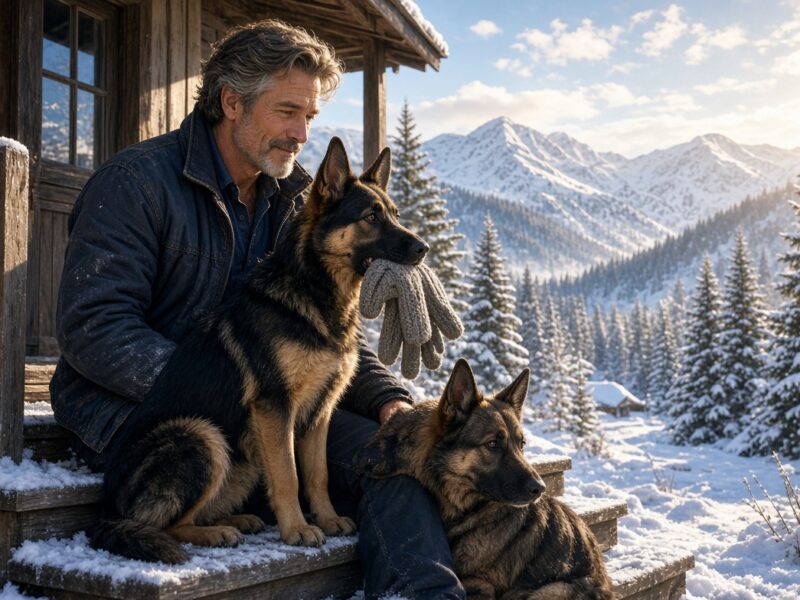
He Packed His Bags to Leave Forever… Until Two Abandoned Dogs Chose Him Instead
Snow buried the Aderondex in white, turning Northwind Lodge into a warm island of light beneath a brutal winter sky.
Inside the five-star lobby, Declan Ror stood in a faded NWU Type III jacket, a ring of steel keys resting against his hip, watching a soaked woman arrive with two young German shepherds.
The manager saw muddy footprints and immediately ordered the dogs away from the guest area.
Bramble shrank at the metallic rattle of a luggage cart while Moxy suddenly stole Declan’s wool glove and vanished beneath the brass trolley, drawing startled laughter from the guests.
Declan did not argue.
He simply opened the staff corridor and said, “Bring them inside.”
It seemed like one small act of kindness.
But before that storm was over, the most frightened dog in the building would make a choice that would change Declan’s life forever.
By 3:00 in the afternoon, the Aderondex looked too beautiful to trust.
The storm that had crossed northern New York during the night had left the mountains buried beneath fresh white, smoothing the roofs, fences, and frozen shoreline into clean, luminous shapes.
Sunlight flashed across Northwind Lake hard enough to make the ice seem polished.
Beyond it, ranks of spruce and white pine stood motionless under their burden of snow.
Northwind Lodge rose above the trees in timber, stone, and tall panes of glass, glowing amber against all that winter blue.
Inside, perfection was being measured in inches.
A banquet table had to be shifted six inches away from a window.
Three champagne towers were rejected because their spacing was uneven.
White linen disappeared beneath silver place settings, evergreen centerpieces, and handwritten cards for donors.
Arriving that evening for the lodge’s annual winter fundraising gala, Declan Ror watched two banquet employees move the same table for the third time.
“Two inches back,” he said.
Both men stopped, one glanced at the other.
Declan looked at the floor mark, then at the table.
“Actually, you’re good.”
The men stared at him.
Declan’s mouth almost moved.
“Enjoy the victory.”
They did.
At 47, Declan had the kind of build that suggested discipline had become habit long after anyone stopped requiring it.
He was tall, broad through the shoulders, solid without looking sculpted for display.
His ash-brown hair, threaded with gray, was longer than the regulation cuts of his Navy years, and swept naturally to one side.
A short silvering chevron mustache softened a face otherwise made severe by a slightly crooked nose and deep-set hazel eyes.
The faded NWU Type III jacket he wore had no rank, name tape, or insignia left on it.
Only the digital woodland pattern remained beneath years of washing.
A steel carabiner at his right hip carried half the operational life of Northwind Lodge in keys.
People heard him coming before they saw him, not because of his boots, because of the keys.
Declan checked the service elevator, verified the loading entrance had been cleared, signed off on the backup linen inventory, and corrected a delivery schedule nobody else had noticed was thirty minutes wrong.
He had once coordinated supplies where mistakes traveled much farther than a dining room.
After more than two decades in Navy expeditionary logistics, civilian hospitality should have felt easy.
Instead, sometimes it felt strangely harder.
Nobody gave you orders to care about a place.
Nobody told you how long you were supposed to stay.
Through the glass doors, his pickup sat in the employee lot with six inches of new snow melting from its hood.
Behind the passenger seat was a dark canvas duffel packed.
It had been packed for eleven months.
Two shirts, socks, toiletries, a spare pair of jeans, documents, and a waterproof envelope.
Enough to leave without going home first.
Declan called it practical.
No one had ever asked why practicality required keeping his life ready for departure.
After winter, he had decided.
Once the seasonal rush ended, he would head west.
Maybe Vermont first, maybe Maine.
Somewhere with maintenance work, seasonal lodging, and no reason to stay longer than necessary.
He was checking a thermostat near the lobby when the revolving door stopped halfway around.
A blast of cold air rushed through the opening, then came barking, not loud barking.
One sharp, startled sound followed by the scrape of claws on polished stone.
Declan turned.
A woman stood awkwardly inside the entrance, one hand gripping two leashes and the other holding the front of a rust-orange parka closed against the cold.
Wet auburn hair had escaped a low ponytail and curled against her cheeks.
Snowmelt darkened the shoulders of her coat.
The lower half of her outdoor pants was streaked with roadside slush.
Beside her were two young German shepherds who looked as though winter had personally thrown them out of a moving vehicle.
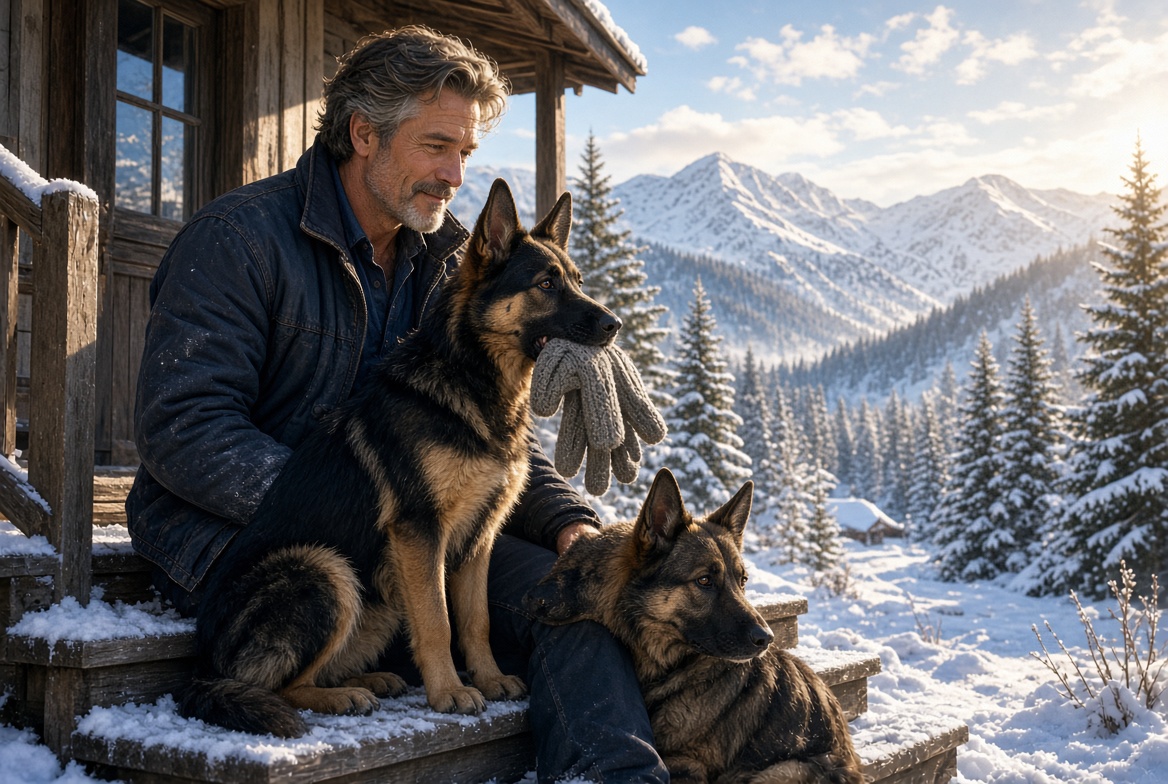
One was black and tan, long-legged and bright-eyed, with an expression of outrageous interest in everything Northwind Lodge had ever purchased.
The other was slightly larger, darker across the back with sable-black shading and deep amber eyes.
He stood pressed against the woman’s leg.
A county snowplow driver appeared behind them.
“Cars in a drift down past Miller Bend,” he explained.
“Road service is backed up. Couldn’t leave her out there with these two.”
The black-and-tan puppy immediately stretched toward a brass luggage cart.
The darker dog retreated from it.
Its wheels gave a brief metallic rattle.
The puppy’s entire body tightened.
Declan noticed.
So did Dorian Beckett.
Northwind’s general manager appeared from the ballroom corridor with the impossible timing of a man who seemed to sense disorder before being informed of it.
At 50, Dorian was lean, immaculate, and controlled down to the angle of his burgundy tie.
Silver touched the black hair combed smoothly away from his forehead.
He carried a slim brown leather clipboard against one palm.
His pale eyes moved from the woman’s muddy boots to the dogs, then to the wet marks gathering on the stone floor.
“I’m sorry,” he said in the tone of a man who was not.
“Animals can’t remain in the guest lobby.”
The woman blinked.
“I understand. My car went off the road about a mile and a half down. The driver said I could wait here while I reach roadside assistance.”
Dorian looked toward the entrance.
“And the dogs come with me.”
“That’s the problem.”
The black-and-tan shepherd chose that moment to sniff a decorative arrangement of winter branches priced at considerably more than she understood.
The woman shortened the leash.
“Moxy. No.”
Moxy looked back with absolutely no remorse.
Declan lowered his eyes before anyone caught the beginning of a smile.
Dorian did not.
“We have a major event tonight,” he said.
“Health regulations, guest safety, liability.”
“I’m not asking for a suite.”
That made the woman go still.
Just for a second.
Declan knew Dorian well enough to know the sentence had come out harsher than intended.
Dorian knew it too, judging by the way his thumb began rubbing the edge of the clipboard, but he did not retract it.
The luggage cart shifted behind a bell attendant.
Metal clicked against metal.
The darker shepherd flinched, not dramatically.
That was what caught Declan’s attention.
The dog simply lowered himself, pressed shoulder-first against the woman’s shin, and turned his head away from the sound as though trying to become smaller than his own body.
“What’s that one?” Declan asked.
The woman looked at him.
“Bramble?”
Declan crouched a few feet away, not reaching.
Bramble watched him.
His ears were upright, but one had rotated backward.
His paws looked almost too large for the rest of him.
“Seven months,” Declan guessed.
“Just about.”
Dorian exhaled.
“Declan. Staff lounge in the service wing.”
Dorian’s gaze hardened slightly.
Declan stood.
“No food preparation in there. Separate entrance. No guest traffic. They can wait there until roadside service gets through.”
“That isn’t what the room is for.”
“No.”
Declan glanced at Bramble.
“But it has heat.”
For several seconds, only the muted piano from the lobby speakers filled the space.
Dorian looked toward the ballroom where employees were hanging the final lights for the gala, then at his clipboard.
“Temporary,” he said.
“Temporary,” Declan agreed.
The woman let out a breath.
“Thank you.”
Declan took one of the leashes she offered.
Moxy immediately chose him.
Bramble did not.
“Apparently, I’ve been assigned the difficult one,” Declan said.
“You’ve been assigned the one who thinks everyone is her best friend.”
“That’s worse.”
The woman’s first real smile appeared.
“Hannah Greer.”
“Declan Ror.”
Moxy pulled toward the service corridor.
Declan looked down at her.
“You and I are going to establish a chain of command.”
Moxy sneezed.
Hannah laughed quietly.
“Good luck.”
Ten minutes later, Declan discovered that chain of command had collapsed completely.
Marabel Santos was crossing the employee service area carrying a tray when one small piece of cold, unseasoned sausage rolled from the edge and landed on the floor.
Marabel froze.
Moxy froze.
Declan saw the exact instant both understood what had happened.
“No,” Marabel said.
Moxy moved.
She snatched the sausage and vanished around a cart.
“Moxy!”
Hannah lunged for the leash and caught nothing but air.
Declan followed.
Marabel, Northwind’s executive chef, stood with one hand on her hip, charcoal chef coat immaculate despite the chaos around her.
Her dark hair was secured in a low bun, and a striped towel hung over one shoulder like a badge of office.
“If that dog enters my kitchen,” she called, “I am billing somebody.”
“Put it on Dorian’s gala account,” Declan replied.
Marabel stared after him.
“Who are you and what have you done with Ror?”
Moxy had not entered the kitchen.
She had discovered the luggage staging area instead.
Declan rounded the corner and found a long black-and-tan tail sticking out from beneath a brass cart.
He stopped.
Hannah arrived behind him, breathing hard.
Bramble followed cautiously, leash loose in her hand.
Moxy chewed and triumphed beneath the cart.
“You know,” Declan said, bending forward with his hands on his knees, “I’ve managed cargo operations involving helicopters that were easier than you.”
The tail wagged faster.
Hannah covered her mouth.
Declan reached under.
Moxy backed away.
He moved left.
She moved right.
He tried the other side.
Moxy popped out behind him, tongue out, eyes shining, sausage gone.
For one stunned second, Declan simply looked at her.
Then a sound escaped him.
A laugh.
Not the polite breath he sometimes used when other people made jokes.
A full, startled laugh that caught him by surprise halfway out.
Hannah looked at him from the doorway.
Marabel looked at him too.
Declan straightened slowly.
“What?”
Marabel narrowed her eyes.
“Nothing.”
Her expression said the opposite.
Bramble stood several feet away.
He wasn’t looking at Moxy.
He was looking at Declan.
Something about that bothered Declan more than it should have.
Back in the staff lounge, Hannah dried both dogs with towels while Declan brought water bowls from the maintenance supply closet.
Moxy recovered from her criminal career immediately.
Bramble stayed near Hannah’s chair.
“They’re rescue dogs?” Declan asked.
“Sort of. They came through a nonprofit that evaluates shepherd litters for working placements. Detection programs, assistance work, things like that. Some of their litter mates moved into training.”
He nodded toward the dogs.
“These two didn’t make the cut.”
“Moxy likes people more than assignments.”
Moxy was currently trying to persuade Marabel’s abandoned towel to become a toy.
Declan nodded solemnly.
“Clearly unemployable.”
Hannah smiled.
“And Bramble, sensitive to sudden noise. Metal carts, alarms, doors slamming. Nobody wanted to push him into work that would keep him stressed.”
Bramble lifted his head when Declan shifted his keys.
Declan caught the carabiner in his palm before it could jingle again.
The dog’s ears relaxed.
“They’re heading to a foster home,” Hannah continued.
“After that, adoption placement. Hopefully together.”
Declan leaned against the counter.
“So, two recruits who washed out.”
Hannah stopped rubbing Moxy’s ears.
Her eyes moved to his faded navy jacket.
Maybe she understood the joke differently than he intended.
“Or,” she said, “they weren’t suited to the job somebody else picked for them.”
Declan said nothing.
Hannah looked down at Bramble.
“That’s not the same thing as being useless.”
Outside the narrow staff window, sunlight disappeared behind a bank of gray cloud rolling over the mountains.
Declan’s hand was still wrapped around his keys.
For reasons he didn’t care to examine, he thought of the packed duffel behind the seat of his truck.
Before he could answer, the phone clipped at his belt vibrated.
Operations line.
He picked up.
“Ror.”
A woman’s voice came through clipped and steady.
“Declan, Kendra Low, County Emergency Coordination. I need Northwind on standby.”
His posture changed instantly.
“What’s happening?”
“The next snowband strengthened faster than forecast. We’re also dealing with a heating system problem at the community center.”
Declan turned toward the window.
The first flakes had begun to fall again.
Large ones.
Slow at first, then more.
“How bad?”
“A powder keg. Too early to say, but I wouldn’t make plans for a quiet evening.”
Declan looked across the room.
Moxy had finally fallen asleep upside down beside a chair.
Bramble rested with his chin between his paws, amber eyes still watching him.
Two wet dogs had seemed like the day’s disruption.
Declan was beginning to suspect they had only arrived before the real one.
Morning made Northwind Lodge look innocent again.
The storm clouds had broken sometime before dawn, leaving a sky so clear and blue that the cold seemed almost decorative.
Snow lay thick along the lodge roof and balanced in soft ridges on the stone walls.
Beyond the tall lobby windows, sunlight spilled through the pines and flashed across the frozen lake.
Guests came downstairs carrying coffee and phones, photographing a winter that had spent the night quietly closing roads around them.
Declan Ror knew better than to trust a beautiful morning after bad weather.
At 6:45, he was standing behind the operations desk with a county road map open on one screen and a mug of coffee cooling beside his hand.
Three routes showed yellow, two showed red.
Miller Bend, where Hannah Greer’s vehicle had gone into the drift, remained marked limited access.
Declan picked up the phone.
“Northwind Lodge operations.”
The tow company dispatcher sounded exhausted before Declan finished explaining.
“Best estimate afternoon. Maybe later if County Route 9 stays restricted.”
Declan looked through the glass toward the mountains.
“Understood.”
He hung up.
A wet nose appeared beneath his elbow.
Declan looked down.
Moxy sat beside him with the patient dignity of a dog who had never once been patient in her life.
“You work here now?”
Her tail struck the cabinet once, twice, then faster when he looked at her.
Across the lobby, Hannah was filling out temporary guest information at the concierge desk.
Her rust-orange parka hung open over a gray fleece, still faintly marked with yesterday’s melted road slush.
Bramble sat beside her boots.
A bell attendant rolled an empty luggage cart toward the elevators.
Its wheels rattled over a seam in the stone floor.
Bramble’s head snapped toward the sound, his shoulders tightened.
Yesterday, he would have pressed himself against Hannah.
This time, he stepped backward once, scanned the lobby, and walked directly behind Declan.
Declan felt the dog’s shoulder touch the back of his leg.
He did not look down.
He simply shifted half a step so his body stood between Bramble and the cart.
The wheels passed.
A few seconds later, the pressure against his leg disappeared.
Hannah had noticed.
She said nothing.
That irritated Declan more than if she had.
“The tow truck isn’t getting here before noon,” he told her.
“I figured the road may close again.”
“I also figured that you do a lot of figuring.”
Hannah signed the form and handed the pen back.
“I spend a lot of time transporting animals through places that have weather.”
Moxy rose and attempted to follow a housekeeper carrying folded towels.
Hannah caught the leash before the puppy succeeded.
“And occasionally,” she added, “I transport weather systems disguised as German shepherds.”
Declan glanced at Moxy.
“That one has extremely low atmospheric pressure.”
Bramble remained near Declan, not touching him now, just there.
Declan pretended not to notice that either.
By 8, Hannah had reached the nonprofit by phone.
She put the call on speaker in a small office off the service corridor so Declan could help coordinate the transport delay.
A calm woman from the organization confirmed that the foster home expecting the dogs had already been notified.
“No emergency,” the woman said.
“Keep them warm and together. We can move the placement by a day.”
Declan leaned against the filing cabinet.
“Together matters.”
“It does with these two.”
Hannah looked toward Bramble.
Moxy was busy inspecting the bottom of a chair.
Bramble watched Moxy inspect it.
The woman on the phone continued.
“They were part of the same litter evaluation. Several pups moved into working programs. Moxy and Bramble didn’t.”
Declan’s gaze returned to the dogs.
“What kind of working programs?”
“Different placements. Detection prospects, assistance work, structured training partnerships. Nothing was guaranteed. It was just an evaluation path.”
“And these two failed.”
Hannah looked at him.
The woman on the phone laughed softly.
“We don’t use that word.”
Declan lifted an eyebrow.
“Moxy scored high for social engagement,” she said.
“Too high, depending on the assignment. She’d rather meet the human than finish the task.”
Moxy, as if recognizing her name, immediately crossed the room and placed her chin on Declan’s thigh.
He looked down.
“Case in point.”
Hannah smiled.
“And Bramble?” he asked.
The voice on the speaker changed slightly.
“Good focus, smart, strong attachment, but sudden metallic sounds and alarm tones create too much stress for the environments he would have been asked to work in. We decided early not to pressure him through it.”
Declan watched Bramble from across the room.
The young shepherd was lying with his front paws crossed, ears tracking every sound beyond the door.
Somewhere down the corridor, a service door shut.
Not violently, just firmly.
Bramble rose at once.
Declan’s keys shifted against the steel carabiner at his hip.
He caught them in his hand before they could jingle.
Bramble looked at him.
A strange understanding passed through Declan, not dramatic enough to name, but uncomfortable enough to stay.
He had spent much of his adult life inside systems built to decide where people fit.
Useful here, needed there, qualified, unqualified, ready, not ready.
The categories had always seemed clean when they were printed on paper.
Real lives rarely behave that way.
After the call, Hannah clipped both leashes to her belt while she organized their food.
Declan poured fresh water into two stainless bowls.
“So,” he said, “one likes people too much and the other doesn’t like loud carts. That’s the simplified version.”
“Sounds like performance reviews.”
Hannah glanced up.
“Still calling them washouts.”
He considered it.
“No.”
Moxy chose that moment to stick her head into an empty cardboard produce box.
Declan watched the box begin walking across the floor.
“Though I’m withholding final judgment on her.”
Hannah left.
The rest of the morning moved in small disturbances.
Moxy learned that the kitchen service door opened automatically if a person approached from the correct side.
Marabel learned that Moxy had learned this.
Their relationship deteriorated accordingly.
“No.”
Marabel pointed at the puppy from six feet away.
Moxy sat.
“No.”
Moxy tilted her head.
“That face has never worked on me.”
Luis Navarro passed behind Marabel carrying a voltage meter and a coil of cable.
“It worked on you yesterday.”
“It did not.”
“You gave her turkey.”
“It fell into her mouth.”
Marabel narrowed her eyes.
Luis kept walking.
At 52, Luis had the compact, heavy-shouldered build of a man who had spent years moving equipment that should have required two people.
His short salt-and-pepper hair was flattened on one side from a knit cap he had just removed.
A small flashlight was clipped across the chest pocket of his dark forest-green work jacket, and a yellow pencil sat behind his right ear.
He stopped beside Declan.
“Got a minute?”
That tone erased the humor.
Declan followed him into the service hall.
Luis opened a maintenance tablet showing the lodge’s electrical and heating systems.
“Grid voltage dipped twice before 7. Generator tested. Fuel is good. Automatic transfer is good.”
“So, what’s bothering you?”
Luis enlarged a schematic.
“East conference wing.”
Declan recognized the section immediately.
Older construction.
Renovated cosmetically twice.
Infrastructure upgraded only where budgets had forced it.
“The heating loop?” Declan asked.
“Working, but it’s older than the rest of the property, and that wing pulls more auxiliary load when temperatures drop.”
Declan studied the screen.
“Problem?”
“Not yet.”
Luis tapped the display.
“I prefer telling you before ‘not yet’ changes its mind.”
Declan appreciated that about him.
Twenty years at Northwind had taught Luis every place where the lodge looked newer than it really was.
“Keep it monitored,” Declan said.
“If we lose the grid, we prioritize guest rooms, kitchen, refrigeration, emergency lighting, communications.”
Luis nodded.
“And conference space?”
Declan looked at him.
“Why?”
Luis removed the pencil from behind his ear.
“Because county emergency management called engineering ten minutes ago asking what square footage we could heat independently.”
Declan’s eyes narrowed.
“Kendra didn’t give a name.”
Declan was already reaching for his phone.
Before he could dial, Dorian Beckett appeared at the far end of the corridor.
He was carrying the same leather clipboard from yesterday.
Only now there were more pages in it.
“Operations meeting. Five minutes.”
The morning sunlight outside remained brilliant.
Inside, the day’s mood changed.
The meeting took place in a small conference room overlooking the frozen lake.
Dorian stood at the head of the table.
Declan sat on one side.
Luis remained standing near the door.
Marabel arrived last, sat down a coffee, and announced, “If this meeting cancels my gala menu after I’ve been reducing stock since 4 in the morning, somebody else is telling the pastry team.”
Nobody volunteered.
Dorian looked at his notes.
“The county community center has a heating failure.”
Declan said nothing.
“Kendra Low estimates repairs may take most of the day. They have a contingency facility south of town.”
“So, we’re clear,” Marabel asked.
“For now,” Dorian’s thumb moved slowly along the edge of the clipboard.
Declan noticed.
Dorian continued.
“However, the county asked whether Northwind could be listed as secondary contingency.”
Luis folded his arms.
“Which means?”
“It means they asked, and I declined.”
Marabel stopped drinking.
Declan looked toward Dorian.
“Reason?”
Dorian met his eyes.
“We are a hotel, not an emergency shelter.”
There was no cruelty in his voice.
That almost made the answer more complicated.
“We have paying guests,” Dorian continued.
“A full event team, food service commitments, insurance limitations, fire code capacity, security requirements, animals already in a non-standard area.”
At the word animals, Moxy barked once from somewhere beyond the wall.
Luis looked at the ceiling.
Marabel whispered, “Excellent timing.”
Dorian ignored it.
“The county has a designated backup facility. Let them use it.”
Declan leaned back.
Under ordinary circumstances, almost everything Dorian had said made sense.
That was the trouble.
Rules usually became dangerous only when reality changed faster than they did.
His phone vibrated.
“Kendra,” Declan answered.
“Low.”
Her voice was less relaxed than yesterday.
“We’re moving people out of the community center to the south facility.”
“That’s the plan.”
“About 30 adults, maybe fewer once families make private arrangements.”
Dorian watched Declan closely.
“Road status?” Declan asked.
“Passable for now.”
He looked toward the brilliant windows.
“For now. That’s the phrase everyone keeps using today.”
The call ended.
Dorian closed his clipboard.
“There. The county has a plan.”
Declan did not argue.
Not yet.
By lunchtime, the mountains had disappeared.
Clouds came down first, swallowing the distant ridgelines.
Then snow began.
Small grains at first.
By 1:30, they were thick enough to soften the edges of the trees.
By two, guests stopped taking photographs.
Declan moved through Northwind, checking entrances, staffing assignments, food deliveries, road alerts.
Bramble followed whenever Hannah happened to be nearby.
The dog’s behavior was beginning to change in ways so small most people would have missed them.
A cart rattled.
Bramble flinched, then looked for Declan.
A service door closed.
Bramble’s ears flattened.
Then he moved toward Declan instead of away from the noise.
Once, Declan stepped aside without thinking before a banquet worker rolled a rack through the corridor.
He realized afterward that he had placed himself between Bramble and the metal wheels.
Hannah stood twenty feet away.
She saw it again.
She said nothing.
Declan was beginning to suspect silence was her most irritating talent.
At 2:23, Luis radioed him.
“Declan, check county traffic.”
Declan opened the road dashboard.
County Route 11 had changed color.
Red.
A message appeared underneath.
Commercial vehicle incident. Roadblocked. Expect extended closure.
Declan stared at the screen.
That was the road leading to the county’s designated backup warming facility.
His phone rang less than ten seconds later.
Kendra.
He answered immediately.
“Tell me the truck isn’t where I think it is.”
“It is.”
“Alternative route?”
“Too slow and conditions are getting worse.”
Declan looked through the nearest window.
Snow crossed the glass sideways now.
“What are you doing with the community center group?”
A silence of barely half a second.
Long enough.
“Kendra.”
“The bus already left.”
Declan straightened.
“Going where?”
“North.”
He looked toward the front drive.
Dorian appeared from the ballroom corridor at the same moment, phone in hand.
His expression said he had just received the same information.
“No,” Dorian said.
Kendra’s voice came through Declan’s phone.
“We need them indoors while we reassess.”
Dorian stopped several feet away.
“This property has not agreed to that.”
Declan kept his eyes on him.
“How far out?” he asked Kendra.
“Less than fifteen minutes.”
The lodge seemed suddenly very quiet.
Not because it was.
Carts still moved.
Phones still rang.
Somewhere in the ballroom, someone tested the gala microphone, but Declan heard only fifteen minutes.
Dorian stepped closer.
“Tell her the bus needs to turn around.”
Declan looked outside.
Fresh snow was already filling the tracks left by the last vehicle through the drive.
Behind him, Bramble approached without being called and stood beside his leg.
Declan rested one hand on the edge of the operations desk.
For most of his life, decisions had arrived with an authority attached to them.
A rank, a procedure, a line on a page telling him where responsibility began and ended.
This one had none of those things.
Just a bus coming through the snow, thirty adults who needed somewhere warm long enough for the county to solve the next problem, and a hotel full of rules written for a day that no longer existed.
Declan looked at the falling snow.
Then at Dorian.
He had less than fifteen minutes to decide which kind of mistake he was willing to make.
The first sign of the bus was not its engine.
It was light.
Two pale beams appeared between the pines below Northwind Lodge, vanished behind a curtain of snow, then surfaced again farther up the switchback road.
Declan Ror stood just inside the glass entrance with one hand resting against the operations desk.
“Twelve minutes,” Luis Navarro said behind him.
Declan glanced at the wall clock.
Kendra had said fifteen.
The county driver had made better time than anyone should have on that road.
Outside, snow moved almost horizontally beneath the portico lights.
What had been a postcard morning was gone.
The frozen lake had disappeared behind white haze, and the lodge’s carefully cleared front drive was already collecting another thin layer.
Dorian Beckett stepped beside Declan.
“We have not authorized occupancy.”
“No,” Declan said.
“I need you to understand that.”
“I do.”
Dorian looked at him.
That was probably the part he disliked most.
Declan did understand.
There were fire code limits, insurance language, security requirements, staffing ratios, food service obligations, accessibility issues.
A hundred small responsibilities that became large liabilities when thirty unexpected people crossed a threshold.
None of them disappeared simply because the weather was bad.
The bus turned into the drive.
Declan could see silhouettes behind fogged windows.
His phone rang.
Kendra Low.
He answered immediately.
“Tell me you’ve got something official.”
“We do. County Emergency Coordination is designating Northwind as temporary warming accommodation while we reassess transport.”
“Temporary.”
“Declan. We’re not asking you to become a long-term shelter.”
“How many?”
“Twenty-eight adults on the bus. Two county volunteers. EMS has their intake information. We’ll maintain responsibility for relocation once the route clears.”
Declan looked at Dorian.
“Put her on speaker.”
Kendra repeated the information.
Dorian listened without interrupting.
“Fire capacity?” he asked.
“We need whatever area you can legally allocate without affecting required exits.”
“Medical responsibility.”
“County EMS remains on coordination. If anyone needs care beyond basic warming and observation, we handle that.”
“Security.”
“We have names from the community center.”
“And if the road stays closed?”
A pause.
“We’ll solve that when we know it.”
Dorian’s jaw tightened slightly.
“I don’t operate buildings on ‘we’ll solve that.'”
“No,” Kendra said.
“Tonight, you’re operating one during a storm.”
The bus stopped outside.
Its door folded open.
Nobody moved for several seconds.
Then the first person stepped down.
An older woman in a plum-colored coat held the railing with both hands as she negotiated the snowy step.
Behind her came a gray-haired man carrying a canvas grocery tote.
Then two men in work jackets, a woman with an overnight bag, another man in reflective work pants.
No crowd, no chaos.
Just tired people emerging one at a time into weather that had already taken away their first plan and their second.
Dorian watched through the glass.
Declan did too.
A man near the middle of the line stopped beside the bus.
He was perhaps in his late sixties, thin under a brown winter coat, his shoulders pulled high against the cold.
He fumbled with one glove while waiting for the person ahead of him to move.
The wind caught his coat.
He shivered once.
Then again.
Declan reached for the door.
Dorian’s voice came behind him.
“Declan.”
He stopped.
“We don’t have the east room cleared.”
“Then they wait in the lobby.”
“That’s guest space.”
“It’s heated guest space.”
“We are still establishing—”
“Kendra confirmed county responsibility.”
“That doesn’t erase our procedures.”
“No.”
Declan turned.
“But procedures take five minutes. Cold doesn’t.”
For a moment, neither man moved.
This was not mutiny.
There was no dramatic challenge in Declan’s voice.
That almost made the decision larger.
He simply opened the door.
Cold air rushed through the lobby.
“Bring the first group inside,” he told the county volunteer.
“Nearest the bus. Keep the entrance clear. We’ll register everyone before they move farther into the building.”
Dorian closed his eyes for half a second.
Then he looked toward the front desk.
“Get me current occupancy numbers and maximum assembly capacity for East Conference.”
Declan heard the concession buried inside the order.
He did not smile.
“Already printing.”
Dorian looked at him sharply.
Declan opened the second door.
Within minutes, Northwind’s lobby began to look unlike itself.
Wet boots gathered near the stone entrance.
Coats released the smell of cold air and melting snow.
The low murmur of arriving voices replaced the carefully selected piano music.
Declan established an intake table beside the unused concierge desk.
One of Kendra’s volunteers checked names against the county list while a Northwind employee handed out dry towels.
Dorian stayed close enough to oversee everything.
He did not welcome anyone.
He also did not ask anyone to leave.
That counted for something.
“We use East Conference only,” he told Declan.
“No guest floors unless circumstances change.”
“Agreed.”
“Main corridor stays open.”
“Agreed.”
“No unregistered movement into service areas.”
“Already blocked.”
Dorian stared at him.
“You enjoy being prepared for arguments.”
“I enjoy short arguments.”
The corner of Dorian’s mouth nearly changed shape.
Nearly.
Luis arrived carrying a floor plan.
“East Conference exits are clear. Capacity is fine for thirty plus staff. I’m checking heat now.”
“Animal separation?” Dorian asked.
Declan looked toward the service corridor.
Hannah stood there with Moxy and Bramble.
Moxy was fascinated by thirty new people.
Bramble looked as if thirty new people were an administrative error.
“Hannah keeps them in the designated side area,” Declan said.
“No food service access. No loose movement.”
Hannah gave him a small salute.
Moxy attempted to imitate the motion by standing on her hind legs.
It was not successful.
Dorian looked away before anyone could determine whether he found that amusing.
The first half hour was mostly chairs.
Chairs from the ballroom.
Chairs from conference storage.
Chairs moved against walls, arranged in small clusters, then moved again when someone pointed out an exit route.
Declan found that emergencies often looked less like heroism and more like furniture management.
The ballroom staff discovered this quickly.
A young banquet captain stood in East Conference staring at rows of elegant dining chairs as though they had personally betrayed him.
“What do you want us to do with the gala setup?” he asked.
Before Declan could answer, Marabel Santos entered through the side doors.
She carried a printed menu in one hand.
The expression on her face suggested the menu had committed a serious offense.
“Forget plated service,” she said.
The banquet captain blinked.
“But chef—”
“The tenderloin becomes tomorrow’s problem. The bisque soup—”
“It was already soup.”
“Now it becomes useful soup.”
Declan folded his arms.
Marabel pointed at three banquet employees.
“You, bread station. You, coffee and tea. You, find every thermal dispenser we own.”
One employee hesitated.
“What about the donor reception?”
Marabel looked around the room at wet coats, tired faces, county volunteers, and chairs being assembled beneath chandeliers intended for a gala.
“Do you see a donor reception?”
“No.”
“Excellent. We have achieved situational awareness.”
Declan heard Luis laugh from the hallway.
Northwind began improvising, not gracefully, but effectively.
Some guests objected.
One man in a cashmere quarter-zip approached the front desk and asked how long this arrangement would continue.
Dorian answered him personally.
“Until the county reopens a safe route.”
“I booked this weekend six months ago.”
“I understand.”
“My wife and I were told tonight’s event would be private.”
“It was intended to be.”
The guest looked toward the conference corridor.
“This isn’t what we’re paying for.”
Dorian’s expression did not change.
“No, sir.”
The answer offered no apology and no argument.
The man returned to the elevators.
Another guest behaved differently.
A woman in an expensive cream coat came downstairs, noticed an older couple struggling with two bags, picked up one of them without asking, and carried it toward East Conference.
Neither action transformed anyone.
Declan preferred it that way.
Real people rarely became better in synchronized groups.
They changed unevenly, sometimes by inches.
A little after 5, a woman approached the intake table.
She was 61, slender, straight-backed, silver-white hair cut into a precise bob beneath a camel cardigan.
Dark red reading glasses hung from a fine cord around her neck.
“I heard you asking whether anyone had medical training.”
Declan looked up.
“I asked staff.”
“I’m not staff.”
“I noticed.”
“Evelyn Shaw. Emergency medicine. Retired.”
Declan paused.
“You understand this is basic observation, not a clinic.”
“That’s why I volunteered instead of billing you.”
He almost smiled.
“Do you have identification?”
She produced it before he finished asking.
Declan checked the name.
Dr. Evelyn Shaw.
“All right. County volunteer is over there. Coordinate through her.”
Evelyn took back her identification.
“You’re military.”
Declan looked at his faded jacket.
“Was.”
She nodded toward the room.
“You still point at things like they owe you obedience.”
Then she walked away.
Declan watched her go.
Hannah had heard the exchange.
“She’s going to be fun.”
“You’re enjoying this too much.”
“I’m stranded in a luxury hotel with two dogs and a man being criticized by a retired doctor. I take entertainment where I can get it.”
Moxy chose that moment to create some.
A banquet employee had draped a stack of folded white napkins over the edge of a service table.
One corner hung down.
Moxy saw it.
Hannah saw Moxy see it.
“Moxy.”
The puppy froze.
Everyone nearby froze with her.
“Moxy, leave it.”
For one glorious second, obedience seemed possible.
Then Moxy took the corner gently between her teeth and backed up.
The entire stack slid.
Napkins cascaded from the table like white birds losing an argument with gravity.
Moxy jumped backward in astonishment.
A construction worker laughed.
Then the older woman beside him laughed.
Then Marabel appeared from the kitchen doors and stopped.
She looked at the floor.
She looked at Moxy.
Moxy sat immediately.
Marabel pointed two fingers at her own eyes, then at the dog.
“I’m watching you.”
Moxy’s tail swept the floor.
The room laughed again.
Even Declan did not stop it.
Across the conference room, Bramble had chosen another kind of work.
The older man Declan had noticed outside sat alone near a window.
His name, according to the intake sheet, was Howard Pritchard, 68, lived by himself in one of the small apartment buildings heated through the community center’s shared system.
He had spent most of the afternoon checking his phone.
No messages seemed to arrive.
Bramble wandered toward him, stopped several feet away, then sat.
Howard glanced down.
“You’re not very cheerful.”
Bramble remained still.
Howard looked at the dog’s navy collar.
“My wife liked shepherds.”
No one answered.
That seemed to suit him.
After a while, Bramble lowered himself onto the carpet.
Howard did not reach for him.
The dog did not ask to be touched.
They simply occupied the same patch of quiet while the room moved around them.
Declan noticed from the doorway.
He had spent years thinking comfort required solutions.
Food delivered, routes cleared, inventory counted, problems named and assigned.
He was good at that kind of care.
Maybe too good.
It had never occurred to him that sometimes what a person needed most could be something that did absolutely nothing except remain.
He looked at Bramble.
The dog rested his chin on his paws.
Howard checked his phone again.
Then, instead of putting it immediately back into his pocket, he placed it on the empty chair beside him.
As if waiting might be easier with company.
Declan felt something inside him shift.
Not enough to understand.
Enough to notice.
At 6:12, the County Road alert came through.
Luis read it first.
“Damn.”
Dorian turned from the registration table.
“What?”
Luis held up his phone.
“Northbound route is closed.”
Declan crossed the room.
“Temporary?”
Luis shook his head.
“Through morning, minimum.”
Almost simultaneously, Declan’s phone rang.
“Kendra,” he answered.
“I saw it.”
“The plow crews can’t safely reopen the main grade tonight,” she said.
“We’re keeping everyone where they are until daylight and a new road assessment.”
Declan looked across East Conference.
Twenty-eight county residents, two volunteers, hotel staff, guests drifting in and out, steam rising from paper cups, wet coats now hanging over chairbacks.
Moxy asleep beside Hannah’s boots after exhausting herself with crime.
Bramble still beside Howard.
“Understood,” Declan said.
Kendra’s voice softened slightly.
“Sorry. I know this was supposed to be temporary.”
Declan looked toward the windows.
Outside, Northwind Lodge had vanished from the rest of the world.
Snow had erased the drive.
The lake was invisible.
Even the nearest pines appeared and disappeared in white.
He ended the call.
Dorian was already watching him.
“Morning?” he asked.
“Earliest.”
A long silence passed between them.
Around the room, people gradually realized what the call had meant.
Someone asked whether the road was closed.
Someone else answered before Declan could.
The words moved quietly from chair to chair.
No panic.
Just adjustment.
Plans being rewritten again.
Declan looked at a room that had been designed for speeches, crystal glasses, and donors who expected their names printed correctly on cards.
Tonight, none of that mattered.
Northwind had opened its doors for a few hours.
Now the mountain had made the decision for them.
Nobody was leaving.
Not until morning.
At 7:03 p.m., the gala disappeared from the schedule.
There was no announcement, no dramatic meeting.
Dorian Beckett simply stood behind the front desk, drew one clean line through Winter Benefit Gala on the operations sheet, and wrote canceled beside it in black ink.
For several seconds, his pen remained on the paper.
Then he set it down.
Outside, the storm had swallowed everything beyond the first row of pines.
Snow moved beneath the exterior lights in dense silver ribbons, sometimes sideways, sometimes upward when the wind curled around the stone walls.
The frozen lake was gone behind white.
So was the road.
From the lobby windows, Northwind Lodge appeared less like a resort in the mountains and more like the last illuminated building at the edge of the world.
Inside, the chandeliers still glowed.
That was almost the only thing that felt normal.
Declan Ror stood beside the operations board with a radio in one hand and three sheets of paper spread across the desk.
One showed occupancy, one showed staffing.
The third had started as the gala logistics plan.
He had turned it over and written on the blank side.
Heat, food, power, medical, sleeping space, communication.
Not departments.
Needs.
That distinction mattered now.
“Kendra says county crews won’t reassess the north grade before 5 in the morning,” he said.
Dorian glanced toward the snow.
“So, everyone stays.”
“Everyone stays.”
The lights dimmed only slightly, enough for every conversation in the lobby to stop.
A second later, full brightness returned.
Luis Navarro’s voice came through Declan’s radio.
“Grid fluctuation. Generator remains on standby. I’m checking east.”
Declan pressed the transmit button.
“Copy.”
Across the lobby, Moxy lifted her head from beside Hannah’s chair.
Bramble did not.
He had learned that lights changing did not make noise.
That seemed to make the problem acceptable.
For now.
Declan looked back at his list.
In the Navy, logistics had always begun with the same principle.
Count what is real, not what you wished you had.
Northwind had 87 registered hotel guests, 28 displaced residents from the community center, two county volunteers, 31 staff still on property, a kitchen designed to serve far more people than that but not indefinitely, backup power, limited blankets, one older conference wing whose heating system had already earned Luis’s suspicion, and one general manager who still believed the best solution to uncertainty was containment.
Dorian tapped East Conference on the floor plan.
“They remain there overnight.”
Declan looked up.
“If the heat holds.”
“It has so far.”
“That’s not what Luis said.”
“He said the system is functioning. He also said he doesn’t trust it.”
Dorian’s expression tightened.
“Declan, if we start moving county evacuees into guest areas—”
“We lose any meaningful operational separation.”
“What?”
Dorian looked at him.
“Registered guests and emergency occupants.”
Declan let the silence sit for a second.
“I know what you meant.”
The answer irritated Dorian.
Good.
Sometimes irritation meant a thought had nowhere comfortable to hide.
Declan did not press.
He had learned long ago that people became harder to move when they believed they were being pushed.
Instead, he picked up the radio.
“Marabel, status.”
Her answer arrived under a clatter of kitchen equipment.
“I have soup for sixty, bread for everyone, pasta after that, coffee until civilization returns, and one pastry chef mourning a chocolate centerpiece.”
“Can the centerpiece be eaten?”
A pause.
“Not after what he did to it.”
“Copy.”
Luis broke into the channel.
“Declan, I need you in East Conference.”
The tone changed everything.
Declan was moving before the radio returned to his belt.
East Conference had stopped resembling a ballroom.
Round tables had been pushed against the walls.
Chairs formed loose islands around the room.
Wet coats hung from portable racks.
Paper cups gathered along window ledges.
The stage where a string quartet had been scheduled to perform now held folded blankets, bottled water, extension-safe emergency lamps, and two boxes marked County Supplies.
The room felt warmer than outside, but not warm enough.
Declan noticed it before Luis said anything.
People had begun putting their coats back on.
Luis stood beneath a ceiling vent, one hand raised.
“Supply temperatures dropping.”
“Boiler?”
“Main boiler is fine. East loop is the issue. Old circulation control isn’t keeping up.”
Dorian arrived behind Declan.
“How long to repair?”
Luis gave him a look.
“If I knew what had failed before I opened it, I’d charge more.”
Dorian ignored the remark.
“Can you stabilize it?”
“Maybe. But I don’t want thirty people sitting here while I find out.”
Declan looked across the room.
Evelyn Shaw was speaking quietly with the older couple who had arrived together.
Howard Pritchard sat nearby, hands around a cup of coffee.
Hannah had positioned Moxy and Bramble in a quieter corner behind a portable divider.
Nobody looked frightened.
Not yet.
They were simply getting colder.
Declan turned to Dorian.
“We move them.”
“Where?”
“North Ballroom.”
Dorian’s eyes sharpened.
“The ballroom is part of the primary guest zone.”
“It’s also on the newer heating circuit. It contains hotel equipment, audiovisual systems, furniture. All replaceable.”
Dorian went still.
Declan realized the words had come out harder than intended, so he lowered his voice.
“I’m not asking you to choose between the hotel and these people. I’m asking you to use the hotel for what it’s capable of doing tonight.”
Dorian looked around East Conference.
Luis rubbed his hands together.
Temperatures lost another degree.
That settled more than argument could.
Dorian exhaled through his nose.
“Move them.”
Declan nodded once.
Dorian wasn’t finished.
“Open the blanket reserve.”
Declan looked at him.
“The full reserve.”
“Yes.”
“The banquet team.”
Dorian glanced toward the rows of people.
“Reassign them.”
No apology.
No speech.
He simply closed the leather clipboard he had carried all evening and placed it on a table.
Then he took off his suit jacket, folded it over the back of a chair, and began helping Luis move portable signage out of the path.
Declan watched for half a second.
Then there was work to do.
Northwind reorganized itself again.
The transition was awkward at first.
Banquet staff who had spent all afternoon preparing place settings now carried blankets instead of wine glasses.
The reception podium became an intake station.
A table intended for donor gifts held phone chargers separated by connector type.
Crystal candle holders were removed and replaced with thermal drink dispensers.
Marabel emerged from the kitchen pushing a cart loaded with soup.
She stopped in the ballroom doorway.
“This room cost somebody an unreasonable amount of money.”
“Probably,” Declan said.
“And now I’m serving lentil soup in it.”
“Also probably.”
Marabel looked over the gathered residents.
“Good.”
Then she wheeled the cart inside.
One of the hotel guests approached and asked whether he could help distribute bowls.
Marabel handed him a ladle without ceremony.
“If you spill on the carpet, you work here until spring.”
The man nodded gravely.
“Understood.”
For the first time that evening, Declan stopped thinking in terms of two groups.
The distinction had become impractical.
A guest carried blankets.
A displaced resident helped stack chairs.
A banquet server plugged phones into a charging station while one of the county volunteers recorded names beside them so nothing disappeared.
Evelyn established a quiet corner near the fireplace for anyone who needed rest or basic health observation.
Hannah discovered that Moxy could distract almost anyone from worrying for thirty seconds at a time.
It was not a trained skill.
Moxy simply possessed no respect for private melancholy.
She approached a tired mechanic, rested her chin directly on his knee, and stared at him until he smiled.
Then she moved on as if the assignment had been completed.
Bramble remained less ambitious.
He stayed where the noise was lower.
Declan began moving between stations.
Food, heating, front desk, county communications, generator status, blankets, staff rotation.
He gave fewer orders than he would have expected.
Mostly he asked questions.
What do you need?
Who hasn’t eaten?
Who has the current count?
Can that wait until morning?
Who knows how to fix this?
The answers came from different people.
That was the strange part.
For years, Declan had associated coordination with hierarchy.
Somebody knew the plan.
Somebody issued the plan.
Everyone else executed it.
Tonight, the system worked because no single person had enough information.
Luis knew the building.
Marabel knew the food.
Evelyn knew bodies.
Kendra knew the county.
Hannah knew the dogs and had an instinct for people who needed quiet before they needed conversation.
Dorian knew the hotel’s limits.
Declan knew how to keep those pieces from colliding, not because anyone had assigned him that role, because there was an empty space between all of them, and he happened to know how to stand there.
At 8:40, Kendra called.
“How are you holding?”
“We moved everyone out of East Conference.”
“Why?”
“Heat loop is unstable. Luis is working it.”
“Power?”
“Still on grid. Generator ready.”
“Any medical transports?”
“Not known.”
“Food?”
Declan looked toward Marabel, who was arguing with Moxy over the legal ownership of a napkin.
“We have food.”
Kendra laughed softly.
“That sounded personal.”
“It is.”
“Road crews say conditions may worsen before they improve. I’ll call again at 10:00.”
Declan ended the call.
For the first time in hours, nobody immediately asked him another question.
He found Hannah near a side window where the ballroom lights reflected against the glass, turning the storm outside into pale moving shadows.
Moxy was asleep on her side.
Bramble sat upright beside her, struggling against sleep as if he had appointed himself responsible for the room.
Declan handed Hannah a paper cup.
“Coffee?”
She looked inside.
“This is black.”
“Yes.”
“I didn’t ask for black.”
“You didn’t ask for coffee.”
She took it anyway.
“Fair.”
They stood without speaking for a while.
Across the ballroom, Howard was teaching one of the banquet employees a card game using a deck somebody had found at the front desk.
A guest in a cashmere sweater was folding blankets badly.
Dorian noticed, walked over, and showed him how to fold one properly.
Neither man seemed pleased by the interaction.
Declan almost smiled.
Hannah followed his gaze.
“You expected this?”
“No.”
“You usually expect everything.”
“I usually try.”
“That sounds exhausting.”
“It saves time.”
“It looks like it creates paperwork.”
He glanced at her.
“You’re very comfortable insulting the person keeping you housed.”
“I brought two German shepherds into your workplace. I lost the right to subtlety yesterday.”
Moxy’s paw twitched in her sleep.
Declan looked down at the dogs.
“Nobody’s lined up for them yet.”
“Not officially.”
“I thought the foster placement was part of adoption.”
“It’s part of getting them ready for it.”
Hannah rubbed one hand around the warm cup.
“There have been inquiries, but the rescue wants them together if possible because of Bramble.”
“Partly.”
Declan watched the darker shepherd.
“Moxy doesn’t look like she needs anybody.”
“That’s because Moxy believes everybody already belongs to her.”
Declan gave a quiet laugh.
Hannah continued.
“Bramble uses her confidence. New room, new person, strange sound. He checks what she does. If Moxy decides the world hasn’t ended, he usually believes her.”
“Usually.”
“Usually.”
Declan’s expression shifted.
“So, somebody spent time evaluating them, moving them, paying for food, foster care, vet checks, knowing they weren’t going to do the job they were originally considered for.”
Hannah turned slightly toward him.
“Yes.”
“Why?”
The question came out more seriously than he intended.
Hannah studied him.
Then she said, “Why does a living thing have to perform something exceptional to be worth keeping?”
Declan looked away.
Snow ran sideways across the window.
The question found a place in him he had spent years keeping orderly.
He had been useful almost his entire adult life.
Useful in schedules, useful in supply chains, useful when plans broke, useful when people needed something moved from one place to another before a deadline.
Then his Navy career ended.
Nobody had been cruel about it.
There had been handshakes, paperwork, a final day, then silence.
He had discovered that usefulness, when it became identity, left very little behind when the assignment ended.
“I moved a lot,” he said.
Hannah waited.
“Twenty-plus years. Bases, temporary assignments, new crews, new rooms, new routines.”
He rolled the paper cup slowly between his palms.
“When I got out, I kept doing it. Seasonal jobs.”
He nodded.
“Six months here, eight months there. Maintenance, operations, lodges, resorts.”
“Because you liked traveling.”
“That’s what I told people.”
“And what did you tell yourself?”
Declan looked through the glass.
“Freedom.”
Hannah considered that.
Then she glanced toward his pickup somewhere beyond the snow-covered lot.
“The bag in your truck.”
His eyes moved to her.
“You saw it yesterday?”
“Back seat.”
He said nothing.
“Packed?”
“Yes.”
“For how long?”
“Eleven months.”
Hannah’s eyebrows lifted.
“That’s not freedom.”
“No.”
“No.”
She took a sip of coffee and made a face at its bitterness.
“That’s a very efficient way to make sure nobody has time to miss you after you leave.”
The words landed quietly.
Declan could have made a joke.
He almost did.
Instead, he looked across the ballroom.
Luis was speaking with Dorian near the maintenance door.
Marabel was redistributing leftover bread.
Evelyn had removed her red-framed reading glasses and was listening to an older woman tell a story.
Howard dealt another round of cards.
None of those people needed Declan specifically.
That should have been comforting.
For years, he had built his life around that exact condition.
And yet tonight, it felt different.
Something warm settled against his boots.
Declan looked down.
Bramble had finally surrendered to sleep.
The young German shepherd lay across the floor with his chin resting over the toe of Declan’s right boot, one oversized paw touching the other.
Moxy remained asleep a few feet away.
Bramble could have chosen her.
Instead, he had chosen Declan.
Hannah noticed this time.
She still said nothing.
The ballroom lights flickered once.
Declan glanced toward the ceiling.
The storm continued outside.
Snow fell over Northwind Lodge, covering tire tracks, stairs, signs, and every visible path leading away.
Declan remained where he was.
For once, he did not think about where he would go next.
At 11:47 p.m., Northwind Lodge went dark.
Not dim.
Dark.
The chandeliers vanished.
The ballroom disappeared around the people inside it.
For one suspended second, the only light came from phone screens and the blue-white storm beyond the windows.
Someone drew a sharp breath.
Someone else dropped a paper cup.
Then the generator caught.
A low mechanical thrum rose from somewhere beneath the building.
Emergency lights blinked awake along the walls, followed by selected ceiling fixtures and the glow of the front desk terminals.
The ballroom returned in pieces.
Declan Ror was already standing.
“Stay where you are,” he called, not loudly, but with enough weight to stop several people from moving at once.
“Backup power is on. Give us a minute.”
His radio crackled.
“Luis Navarro. Grid is gone. Generator transfer completed. Stable. A pause. Mostly.”
Declan did not like that word.
“What’s not stable?”
“Service wing C. I’m seeing abnormal heat at an older distribution panel.”
Declan looked toward Dorian.
The general manager had abandoned his leather clipboard hours ago.
His sleeves were rolled to the forearms now, burgundy tie loosened, the polished outline of the man who had begun the evening preparing for donors replaced by someone who had spent five hours carrying blankets, moving chairs, and answering questions nobody had planned to ask.
Dorian read Declan’s face.
“Problem?”
“Potential one.”
Luis returned over the radio.
“I need that corridor cleared while I isolate the section.”
“Fire?”
“Not at this point. Some equipment is running hotter than it should. I want the area empty before I touch anything.”
“Understood.”
Declan clipped the radio back onto his belt.
He did not explain more than necessary.
“East service corridor needs to be cleared temporarily,” he told Dorian.
“Luis is handling the electrical side.”
Dorian nodded.
“I’ll take the count.”
That answer would have surprised Declan six hours earlier.
Now it simply saved time.
They divided the work.
Declan went toward the service corridor.
Dorian moved through the ballroom with one of the county volunteers, verifying names and making sure nobody had wandered into the adjoining spaces.
Evelyn Shaw opened the small medical kit the county had provided and moved it closer to the ballroom entrance.
“If anybody comes back coughing or light-headed, send them to me,” she said.
“No heroics,” Declan replied.
Evelyn gave him a level look over her red-framed glasses.
“I was about to say the same thing.”
He ignored that.
Kendra Low answered on the second ring.
“Power outage?”
“Grid is down. Generator is carrying us.”
“Any evacuation needed?”
“Not from the property. We’re clearing one internal service wing while engineering checks a panel. EMS can stage at the lower junction if the county road crew can keep that section open.”
“Do that, Declan.”
He paused.
“Don’t improvise past your people.”
His gaze moved toward Luis, who was already disappearing through the maintenance door with his equipment case.
“I know.”
He ended the call.
For once, he meant it.
Luis knew electricity.
Evelyn knew medicine.
Kendra knew emergency coordination.
Declan’s job was simpler.
People, doors, routes, numbers.
He moved through the corridor, checking one room after another.
Laundry clear.
A staff member raised a hand.
“Clear.”
Storage clear.
Service pantry clear.
The old wing had a different sound under generator power.
Without the normal hum of every system running, small noises became distinct.
The click of a closing latch, the distant vibration of ventilation, the soft mechanical buzz of emergency lights.
Then came a faint odor.
Hot insulation.
Not strong, just wrong.
Luis appeared at the far end of the corridor.
“That’s enough. Everyone out past the fire door.”
Declan didn’t question him.
He directed the last two employees through.
Dorian stood beyond the marked boundary with the count sheet.
“All staff accounted for?”
Declan checked his own list.
Laundry pantry.
Maintenance assistant.
Banquet runner.
Housekeeping.
He traced the lines once, then again.
“Blanket storage.”
Dorian frowned.
“What about it?”
“Inventory says two emergency kits were never logged out.”
“They’re blankets. Maybe—”
Dorian understood immediately.
If the kits were still there, fine.
If they were missing, someone might have gone back for them without being counted.
“I’ll check the staff list again,” Dorian said.
Declan looked through the fire door toward the short stretch of corridor leading to the storage room.
It was less than thirty yards.
The air remained clear enough to see the far wall.
Luis was working from the opposite side of the restricted section.
Declan keyed his radio.
“Luis, I’m verifying blanket storage and coming straight back.”
“Make it quick. I want this section empty.”
“Copy.”
Declan went through.
He did not rush.
Rushing created mistakes.
The storage room door stood partly open.
Inside, shelves rose nearly to the ceiling, stacked with linens, bottled water, banquet supplies, and emergency kits in blue canvas cases.
Two remained on the lower shelf.
Declan exhaled.
Nobody had taken them.
Nobody was missing.
He turned.
A sharp electronic tone sounded overhead.
Then another.
The alarm system activated.
The fire door at the end of the corridor released automatically.
Declan started toward it.
The heavy door swung shut.
His radio struck the frame as he reached it.
The clip tore free.
The radio bounced once and slid across the floor onto the other side just before the door sealed.
Declan stared through the narrow reinforced window.
Perfect.
The alarm continued, not deafening, but sharp enough to make thought difficult.
A thin gray haze began creeping along the ceiling farther down the service corridor.
Technical smoke, no flames, no sudden inferno, but the message was clear enough.
This part of the building was no longer somewhere he wanted to remain.
He tested the fire door.
It held in its protective position while the affected zone remained isolated.
Through the glass, his radio lay three feet away, completely useless.
Declan turned toward the rear service exit.
The door opened inward several inches, then stopped.
He pushed harder.
Something outside resisted.
Snow.
Hours of wind had piled it against the exterior side of the service landing.
The door shifted another inch and no more.
Declan stopped pushing.
No point wasting energy against a wall of winter.
He stepped away.
This was a problem, not a catastrophe.
He repeated that distinction to himself.
Luis knew the wing.
Dorian had the count.
Someone would notice.
He moved toward the clearest section of corridor, away from the light haze above the old electrical area.
Then he waited.
Back in the ballroom, the alarm transformed Bramble.
The young German shepherd had been lying beside Hannah’s chair when the first tone sounded.
His head snapped upward.
His ears flattened.
His entire body tightened as if the sound had passed through him rather than around him.
Hannah was beside him immediately.
“It’s okay, Bramble. Here.”
Moxy stood too, alert but less frightened.
Bramble turned in a tight circle.
He pulled toward the far side of the ballroom.
Hannah shortened the leash.
“No, stay with me.”
Bramble stopped.
Trembling moved visibly through his legs.
The sound was exactly the kind his early evaluation had warned about.
Repetitive, metallic, impossible to predict or escape.
Hannah crouched beside him.
“You’re safe.”
Bramble looked toward the service doors, then back at her, then toward the doors again.
Moxy stepped closer and touched her nose briefly to his shoulder.
Bramble moved forward.
Hannah let him take three steps.
He headed straight toward the corridor Declan had used minutes earlier.
“Bramble.”
He pulled again.
Not wildly, purposefully.
Hannah frowned.
“You saw him go that way.”
At the word him, Bramble looked at her, then pulled once more.
The alarm sounded again.
Bramble recoiled.
For a moment, Hannah expected him to retreat beneath the nearest table.
Instead, he lowered his head, shook once from nose to tail, and moved toward the sound.
Moxy followed.
Hannah’s expression changed.
She went with them.
Luis emerged from the maintenance access at the same moment.
He had isolated the affected electrical section and the haze was already beginning to thin.
“Bramble!”
“No!” Hannah said as the dog reached the fire door.
The shepherd planted his paws.
He barked once.
Twice.
Luis stopped.
“What is he doing?”
“He watched Declan come through here.”
Luis looked toward the sealed door, then at the floor.
Declan’s radio lay on the other side of the glass.
Luis’s face changed.
“Dorian.”
The general manager crossed the corridor at once.
“What?”
“Where’s Declan on your count?”
Dorian looked at the sheet.
“I thought he was with you.”
“He isn’t.”
Bramble barked again.
Luis stepped closer to the fire door.
The alarm tone stopped abruptly in that section as the system shifted after isolation.
For the first time, the corridor became quiet enough to hear something else.
Three dull knocks.
Everyone froze.
Then three more from behind the door.
“Declan,” Luis called.
A muffled answer came back.
Not clear enough to understand.
Clear enough.
Dorian reached for the door.
Luis caught his arm.
“Not that way. The zone is still isolated.”
“What do we do?”
Luis nodded toward access.
“I might find another route.”
Luis turned and moved fast toward the adjoining service passage.
This time Dorian followed without argument.
Hannah stayed back with the dogs.
Bramble tried to follow.
“No,” she resisted.
“Bramble.”
Moxy stood beside him.
The darker shepherd’s body was still trembling, but he did not turn away.
Hannah knelt and held both collars gently.
“They know where he is now.”
Bramble stared down the corridor.
His breathing remained fast.
He stayed.
Several minutes later, a maintenance door farther along the hall opened.
Luis appeared first, then Dorian, then Declan.
He walked under his own power.
His face was pale beneath the emergency lights, and a rough cough interrupted his first attempt at speaking.
Dorian reached for his arm.
Declan waved him off.
“I can walk.”
“Wonderful,” Dorian said.
“Do it toward Dr. Shaw.”
That earned him another cough that might have been a laugh.
Evelyn met them before they reached the ballroom.
She took one look at Declan.
“Sit.”
“I’m fine.”
“Excellent. Sit while being fine.”
Declan sat.
She checked him carefully, listened to his breathing, asked several questions, and kept him under observation while fresh air from the newer ventilation zone circulated around them.
“No heroics,” she reminded him.
Declan leaned back in the chair.
“I remember somebody saying that.”
“Apparently, memory isn’t the problem.”
Across the room, the alarm had finally stopped.
The silence afterward seemed enormous.
People spoke quietly again.
Luis reported that the affected circuit had been isolated and the rest of the backup system was holding.
Kendra confirmed that EMS remained available if Declan’s symptoms changed.
Dorian finished recounting everyone for the third time.
The crisis contracted from something unknown into something manageable.
Declan closed his eyes for a moment.
He felt exhausted, not injured, not frightened anymore, just emptied out.
Then something pressed against his boot.
He opened his eyes.
Bramble stood there.
The young shepherd was still trembling, not as badly as before, but enough for Declan to see it.
Hannah had left the leash loose.
Moxy stayed several feet behind her.
Bramble had walked the last distance alone.
Declan lowered one hand.
Bramble stepped beneath it.
His fur was warm.
Declan rested his palm gently between the dog’s ears.
“You hate alarms,” he murmured.
Bramble leaned against his shin.
Declan swallowed.
It would have been easy to tell himself the dog had saved him.
That was cleaner, more dramatic.
It was also not true.
Luis had known the building.
Dorian had helped find the access route.
Hannah had understood Bramble’s behavior.
Evelyn was making sure Declan was all right.
Kendra had coordinated support.
Bramble had done one thing, one small thing.
He had been afraid, and instead of running away from the sound that frightened him most, he had gone back toward the last place he had seen Declan.
The realization reached somewhere deeper than gratitude.
Declan looked down at the dog pressed against his leg.
For years he had arranged his life so leaving first would always be easy.
Bramble had been given every reason to move away and had chosen the opposite.
Declan’s fingers moved slowly through the fur behind the dog’s ears.
Around them, Northwind began breathing normally again.
Bramble stayed.
By 4:18 a.m., Northwind Lodge had stopped sounding like an emergency.
The alarms were silent.
The generator settled into a steady mechanical hum somewhere beneath the building, no longer surging as load shifted from one circuit to another.
Luis Navarro had isolated the overheated section of the old service wing and confirmed that the remaining distribution system was stable.
Outside, the storm had begun to lose its grip.
Snow still moved past the windows, but the wind no longer hurled it sideways.
Through occasional breaks in the white, Declan could see the dark shapes of the nearest pines again.
The world was slowly returning.
Inside the ballroom, nearly everyone was asleep.
Blankets covered shoulders and knees.
Chairs had been pulled together into makeshift resting places.
A few people lay on padded banquet mats the staff had found in storage.
Paper cups sat abandoned beside shoes.
The expensive room looked exhausted.
So did Declan.
He sat near the fireplace with both hands wrapped around a cup of water Evelyn Shaw had ordered him to drink.
Not suggested.
Ordered.
His breathing felt normal again.
The roughness in his throat had eased.
Evelyn had checked him twice and finally allowed herself to stop watching him every thirty seconds.
“Any dizziness?”
“No.”
“Headache?”
“No.”
“Shortness of breath?”
“No.”
“You understand that answering quickly doesn’t make me leave faster.”
Declan looked at her.
“Was worth testing.”
Evelyn adjusted the red-framed glasses hanging against her cardigan.
“You’re annoyingly functional.”
“I’ve been called worse.”
“I’m sure.”
She moved on to check an older guest sleeping near the far wall.
Declan leaned back.
A dark shape lay against his boots.
Bramble.
The dog had fallen asleep there sometime after the corridor incident and had resisted every attempt Hannah made to move him somewhere more comfortable.
Moxy was sprawled beside Hannah’s chair several feet away, asleep on her back, paws bent at ridiculous angles, as if she had personally completed the electrical repairs and found the effort exhausting.
Declan looked down at Bramble.
The shepherd’s breathing was deep and even now, no trembling, no flattened ears, just sleep.
Declan touched the dog’s shoulder lightly with the side of his boot.
Bramble did not wake.
“That’s new.”
Luis lowered himself into the chair across from Declan.
He smelled faintly of machine rooms, cold air, and coffee that had been reheated too many times.
“What’s new?”
“I’ve worked in this building almost twenty years.”
Declan waited.
Luis pointed toward Bramble.
“Never seen a German shepherd conduct a personnel accountability check.”
Declan stared at him.
Luis kept a perfectly straight face.
“Very thorough animal. Might hire him.”
“He’d hate your maintenance carts.”
“Everyone hates my maintenance carts.”
Declan looked down at Bramble again.
“He didn’t find me.”
“I know.”
Luis leaned back and stretched one shoulder.
“But he noticed something the rest of us missed.”
Declan’s expression changed.
Luis saw it.
“That’s not criticism.”
“I didn’t think it was.”
“You looked like it was.”
Declan took a drink of water.
Luis studied him for a moment.
“You know what bothered me?”
Declan sighed.
“I suspect you’re going to tell me.”
“When we saw your radio behind that door, I realized I hadn’t asked where you were.”
Declan looked at him.
Luis continued before he could answer.
“I assumed you were handling something because you’re always handling something.”
“That’s my job.”
“Sure.”
Luis nodded toward the sleeping ballroom.
“But it might be worth considering that the rest of us also have jobs.”
Declan said nothing.
Luis stood.
“Try not to get offended. I’m too tired to make it sound nicer.”
“You’ve never let fatigue stop you before.”
“There’s the Declan I know.”
Luis walked back toward the service hall.
The remark remained behind.
The rest of us also have jobs.
Declan had spent most of his adult life ensuring no one had to wonder whether he would do his.
Reliable had always felt like the safest thing a person could be.
Reliable people did not create problems.
Reliable people did not require rescue.
Reliable people knew their role.
But somewhere along the way, he had begun treating dependence as a kind of failure.
His own dependence especially.
A plate appeared in front of him.
Declan looked up.
Marabel Santos stood there holding another one for herself.
Eggs, bread, roasted potatoes.
Nothing elegant, everything hot.
“You eat,” she said.
“I’m not hungry.”
“That wasn’t a question.”
He accepted the plate.
Marabel turned toward Moxy.
The dog opened one eye.
“Don’t even think about it.”
Moxy’s tail tapped the floor.
“Every sausage in this building is under armed guard.”
Declan raised an eyebrow.
Marabel looked at him.
“Metaphorically. Good clarification.”
Moxy rolled onto her side and stared at the plate with profound personal disappointment.
Marabel pointed her fork at the dog.
“You stole once. That was character development. Twice becomes a pattern.”
Hannah, half awake in the neighboring chair, laughed into her sleep.
For a few minutes, the ballroom felt strangely ordinary.
People waking before sunrise.
Someone searching for fresh coffee.
A county volunteer trying not to wake anyone while replacing trash bags.
Howard Pritchard sitting beside the dark window with his phone in both hands.
Then Howard’s screen lit.
He read something.
His shoulders dropped, not collapsed, relaxed.
He typed a reply.
Bramble did not notice.
For once, that seemed appropriate.
Not everything needed the dog.
At 4:42, Dorian came into the ballroom carrying his phone rather than his clipboard.
That alone made Declan look up.
Dorian approached the county volunteer.
“Can you connect me with Kendra Low?”
“I can call her.”
“I’ll do it.”
He stepped toward the quieter end of the ballroom and dialed.
Declan did not intend to listen.
The room made privacy difficult.
“Kendra, Beckett. A pause. Yes, power is stable. Engineering has isolated the affected section.”
Another pause.
Dorian looked across the room.
His gaze rested briefly on the people sleeping beneath Northwind’s blankets.
“I also want something added to the incident record.”
Declan stopped eating.
“My initial decision regarding the community center group underestimated the conditions on the mountain and overestimated the usefulness of our normal operating restrictions.”
Silence on the other end.
Dorian continued.
“No, I’m not asking you to remove anything.”
His jaw tightened slightly.
“I’m saying the decision was mine.”
Another pause.
“Yes, send whatever documentation the county requires. I’ll also request a full operational review from corporate once communications normalize.”
He ended the call.
Declan looked at him.
Dorian noticed.
“If you have something to say, Ror, I’d prefer you say it.”
Declan considered several answers.
Instead, he said nothing.
Dorian frowned.
“That may be the most irritating possible response.”
“I know.”
Dorian glanced toward the ballroom doors.
“I was wrong about one thing.”
Declan waited, possibly too carefully.
“Don’t make this sentimental.”
“No danger.”
Dorian looked toward the storm-dark windows.
“A procedure isn’t useful merely because it exists.”
Declan said nothing.
Dorian slipped his phone into his pocket.
“But we’re still reviewing why the blanket inventory was inaccurate.”
There he was.
Declan almost smiled.
“Wouldn’t want you changing too quickly.”
Dorian gave him a flat look and walked away.
The storm weakened another degree before 5.
Kendra’s next call came with the first genuinely good news in hours.
“Road crews are staged below the north grade,” she told Declan.
“If visibility keeps improving, they’ll start clearing after first light.”
“How soon before traffic?”
“No promises. Best case, later this morning.”
Declan looked toward Hannah.
She was brushing snow-dried mud from the sleeve of her parka.
“Kendra, what about the tow companies?”
“Same thing. Nobody moves until county gives them the route.”
“Understood.”
He ended the call.
Hannah was already watching him.
“Good news, possibly.”
“That’s not your good news face.”
“I have a good news face.”
“No.”
He handed her the phone update.
“If the road opens, your rescue can send another transport later today.”
Hannah glanced toward the dogs.
“Probably.”
Declan nodded.
“Good.”
One word.
Perfectly normal.
Luis was passing with a tool bag.
He slowed, looked at Declan, looked at Hannah, then continued walking.
Declan frowned after him.
“What?” Hannah asked.
“Nothing.”
“You’re doing that thing.”
“What thing?”
“The thing where you answer before anyone asks the question you don’t want them to ask.”
Declan took another bite of breakfast.
“I have no idea what you’re talking about.”
“You’re very convincing.”
The room gradually quieted again.
Some people slept.
Others watched the windows for morning.
Declan eventually moved to a small seating alcove beyond the ballroom entrance where the light was lower and the hum of conversation softened into background noise.
Hannah joined him.
Moxy stayed near her.
Bramble followed Declan.
Of course he did.
Declan sat in an armchair.
Bramble lowered himself across the toe of his right boot again.
Hannah looked down.
“I think your footwear has been adopted.”
“He has poor judgment.”
“He has selective judgment.”
For a while they listened to the building.
Pipes.
Generator.
Wind.
A spoon touching the side of a cup somewhere down the hall.
No alarms.
Declan stared at the window.
“You were right.”
Hannah did not ask about what.
Maybe she knew there were too many possibilities.
He continued.
“The bag isn’t about being ready.”
“The one in your truck.”
He nodded.
They had spoken about it before, but only around its edges.
He had told her where he went, not why he always kept leaving.
“When a place started feeling familiar,” he said, “I’d start looking at job boards.”
Hannah rested her hands around her coffee.
“How familiar?”
“People knowing how I took my coffee.”
“Terrifying.”
“The mechanic knowing my truck.”
“Worse.”
“Getting invited somewhere I didn’t have to attend.”
Hannah glanced at him.
“There it is.”
Declan looked down at Bramble.
“I used to think I was avoiding obligation.”
“And now?”
He took his time.
“I think I was avoiding the part after obligation.”
She waited.
“The part where you care.”
The generator hummed steadily beneath the floor.
Declan continued.
“In the service, leaving was built in. Orders changed. Tours ended. People transferred. You knew everything was temporary, so nobody had to pretend otherwise.”
He rubbed one thumb across the edge of his empty cup.
“Afterward, I kept choosing places where temporary was normal. Seasonal hotels, maintenance contracts, operations work. Anywhere leaving didn’t require an explanation.”
Hannah looked toward him.
“Because leaving hurts less if you’re the one who schedules it.”
Declan gave a small nod.
There was no revelation in her voice.
No triumph.
Only recognition.
“If I went first,” he said, “nothing could leave me.”
Hannah let that sit between them.
Then she looked down.
Bramble’s chin was resting across the front of Declan’s boot.
“Someone forgot to brief him on your disappearance policy.”
Declan laughed.
A quiet sound at first, then another.
His chest tightened unexpectedly.
He stopped.
Hannah did not move.
Declan looked away toward the window.
The laugh had opened something he had not meant to open.
His eyes burned.
He blinked hard.
Once, then again.
It did not help.
“Well,” he said roughly, “that’s inconvenient.”
Hannah’s voice stayed gentle.
“Very poor operational timing.”
That made it worse.
Declan laughed once more through the tightness in his throat.
A tear slipped down his cheek.
He turned his face away by instinct.
The same instinct that had made him pack bags early.
Leave quietly.
Keep every ending orderly.
Hannah did not pretend she hadn’t seen.
She also did not reach for him.
She simply stayed in the chair beside him.
Bramble stayed across his boot.
Moxy came over after a moment, sniffed Declan’s knee, apparently determined that nothing required intervention, and lay beside Bramble.
Declan wiped his face with the heel of one hand.
“Nobody say anything.”
Hannah looked toward the dogs.
“I can’t guarantee Moxy.”
He laughed again, softer this time.
Beyond the windows, the darkness had begun to thin.
Gray entered the sky behind the pines.
The storm clouds were breaking apart above the ridge, revealing narrow strips of pale winter morning.
Soon the plows would move.
Roads would reopen.
People would return to apartments, jobs, cars, schedules.
Hannah would leave.
The dogs would leave.
Northwind would begin turning itself back into a hotel.
Declan knew all of that.
For once, knowing something would end did not make him want to leave before it could.
He looked down.
Two German shepherds slept against his boots.
Across the room, people he had known as co-workers, guests, strangers, and problems only hours earlier were waking beneath the same roof.
Declan had spent years believing home was a place you remained long enough to claim.
He understood now that he had it backward.
Maybe home began the moment someone noticed you had not come back.
Outside, morning reached Northwind Lodge.
Declan stayed in his chair and let it find him.
Morning came to the Aderondex in blue and gold.
The storm had spent itself sometime after sunrise, leaving behind a sky so deep and clear it seemed newly made.
Snow clung to every pine branch in bright white shelves along Northwind Lake.
Sunlight scattered across the frozen surface in thousands of hard glittering points.
For the first time in nearly two days, mountains existed beyond the windows again.
Declan Ror stood just outside the front entrance and listened.
No wind striking stone.
No alarm, no generator straining beneath the floor.
Instead, somewhere down the grade came the slow scrape and growl of county plows working uphill, a road returning to the world.
Behind him, Northwind Lodge looked as though it had survived an extremely polite invasion.
Blankets were folded over chairs that had once been positioned for donors.
Paper cups crowded side tables beneath expensive paintings.
The north ballroom still contained the long communal arrangement created during the storm, where gala place settings had given way to soup bowls, charging cables, county paperwork, and handwritten medication reminders.
Nothing matched.
For once, nobody seemed bothered.
The first group from the community center prepared to leave shortly after 9.
Howard Pritchard stood near the entrance, buttoning his brown coat.
He had finally reached the relative he had been waiting to hear from, and the anxiety that had hollowed his expression the night before had eased.
Bramble approached him.
Howard looked down.
“So, you’re abandoning me now?”
Bramble sat.
Howard glanced toward Declan.
“He’s got terrible loyalty standards.”
“Apparently.”
Howard crouched carefully and rested one hand against the dog’s shoulder.
It was the first time Declan had seen him deliberately touch Bramble.
“Good dog,” Howard said.
Bramble accepted this information with grave seriousness.
Then Moxy appeared and attempted to inspect Howard’s tote bag.
Howard straightened.
“There’s the criminal.”
Marabel’s voice traveled from the dining room.
“I heard that.”
Moxy retreated immediately.
Laughter followed her.
Not everyone leaving Northwind exchanged emotional goodbyes.
Some people simply thanked the staff.
Some shook hands.
A few slipped quietly onto county vehicles as if embarrassed to have needed anyone at all.
One of the hotel guests, who had complained the previous evening, approached a pair of men from the community center before they left.
He said something Declan could not hear, then held out his hand.
One man took it.
The other did not.
Declan found that reassuring in its own way.
A difficult night had not magically made everyone friends.
It had merely given them the chance to see one another more clearly.
Near the front desk, Dorian Beckett was speaking with Kendra Low over video call.
His tie was straight again.
The rest of him was not.
He looked as though sleep had been mentioned to him as a theoretical concept.
“County operations review next Thursday,” Kendra said through the tablet speaker.
“I’ll coordinate with corporate.”
“I’ve already requested their facilities and risk teams.”
Kendra raised an eyebrow.
“Voluntarily?”
Dorian’s expression barely changed.
“Don’t become accustomed to it.”
Declan walked past.
Kendra noticed him on the screen.
“Ror.”
He stopped.
“Road North Grade is open to controlled traffic. Tow trucks and authorized transports first. General travel probably later.”
Declan nodded.
“Thanks.”
“And Declan?”
“Yeah?”
“You did good work.”
He shifted slightly.
Dorian looked at him.
Declan said, “Everybody did.”
Kendra smiled.
“That answer tells me you’re feeling better.”
The call ended.
Dorian picked up his leather clipboard from the counter.
Declan noticed it had returned.
“Comforting,” he said.
Dorian looked down at it.
“Some institutions deserve to survive.”
“Apparently.”
Dorian hesitated.
“The county wants to discuss a formal emergency use agreement with the lodge.”
Declan’s eyes moved to him.
“You’re considering it?”
“I’m considering how to prevent sixty improvised decisions from becoming necessary next time.”
That was the most Dorian way imaginable to describe helping people.
Declan nodded.
“Fair.”
“I’ll need operations involved.”
“Of course.”
Dorian studied him for a moment.
“I thought you were leaving after winter.”
Declan went still.
Then Luis called from the service hall.
“Beckett, your beautiful building is complaining again.”
Dorian closed his eyes.
“What now?”
“Nothing expensive yet.”
“That sentence has never improved my day.”
He walked away.
Declan remained by the front desk.
I thought you were leaving after winter.
He had thought so too.
At 10:17, Hannah received the message.
The rescue transport was forty minutes away.
She read it once.
Then again.
Declan was standing beside the luggage staging area when she told him.
“Roads good enough for them,” she said.
“Good.”
His answer came too quickly.
Hannah noticed.
Of course she did.
Moxy sat between them, chewing nothing, but somehow looking guilty.
Bramble stood at Declan’s left side.
Luis happened to be passing with a maintenance case.
He heard the conversation, slowed, looked at Declan, then kept walking.
Declan frowned after him.
“I am surrounded by extremely judgmental people.”
Hannah clipped the leashes to her belt.
“One of them isn’t even a person.”
“Two. Moxy doesn’t judge.”
Moxy sneezed.
Declan pointed.
“Hostile witness.”
The next forty minutes disappeared into work.
That helped.
Declan checked a delivery entrance, signed an incident form, spoke with a county driver, verified room temperatures, found three extension cords that belonged to engineering, and returned them to Luis.
Every task had an edge.
A clear beginning, a clear end.
None of them asked what he was going to do when the rescue van arrived.
At 11:00, tires crunched over packed snow outside.
Declan heard them from the lobby.
He kept writing.
The engine stopped.
A door opened.
Hannah came toward him wearing her rust-orange parka.
“That’s them.”
Declan put down the pen.
“Right.”
He walked outside with her.
The cold had changed.
It no longer bit.
Sunlight warmed the stone even though the air remained well below freezing.
Plowed snow stood in clean walls along the driveway.
A white rescue van waited near the entrance.
The driver opened the side door.
Moxy saw the open vehicle and bounded toward it as if she had personally booked transportation.
“Of course,” Hannah said.
Moxy jumped inside.
Bramble remained beside Declan.
The driver secured Moxy’s leash to the interior safety point.
Declan shoved his hands into his jacket pockets.
“Good trip,” he said to Hannah.
“You too.”
“I’m not going anywhere.”
The words escaped before he could examine them.
Hannah looked at him.
Declan looked away.
“Figure of speech.”
“Sure.”
Moxy suddenly launched herself out of the van.
“Moxy.”
She landed in the snow.
Something gray was hanging from her mouth.
Declan recognized it immediately.
His wool glove.
It had been sticking halfway out of his jacket pocket.
Moxy bolted around the rear of the van.
The rescue driver laughed.
Hannah groaned.
Declan stared after the dog.
“She’s been waiting two days for that.”
Moxy circled the van once with the glove held like a trophy.
Luis appeared in the lodge doorway.
Marabel stepped out behind him.
“Don’t chase her,” Marabel called.
“I’m aware.”
“She enjoys it.”
“I’m aware.”
“Just checking.”
Declan crouched.
“Moxy.”
The puppy stopped.
He held out his hand.
“Trade.”
Moxy considered.
Then Bramble moved.
Not toward Moxy.
Toward Declan.
He walked slowly across the packed snow, stopped directly in front of him, and sat.
Declan lowered his hand.
Bramble looked into his face, then rose onto his hind legs and placed both front paws against Declan’s knees.
Declan froze.
The world seemed to become incredibly quiet.
No hustle, no rescue van, no people watching, just amber eyes, oversized paws.
A dog who had once measured every unfamiliar sound before deciding whether the world was safe.
Declan went down onto one knee.
Bramble leaned into him immediately.
Declan put both arms around the young shepherd.
The dog’s body was warm beneath his hands.
“You were supposed to get in the van,” Declan whispered.
Moxy abandoned the stolen glove.
She came running back, pushed her head under Declan’s arm, and forced herself into the embrace.
His laugh broke, not like the night before.
That had been private, fragile, something discovered unexpectedly in the dark.
This was different.
This hurt because nothing was wrong.
The road was open.
The dogs were safe.
Hannah was leaving exactly as she was supposed to.
And Declan realized he did not want to protect himself from missing them.
That was the part that undid him.
His eyes filled.
He did not turn away this time.
A tear ran down one cheek.
Then another.
Luis studied the parking lot with sudden professional interest.
Marabel looked at him.
“Don’t.”
“I didn’t say anything.”
“You were thinking loudly.”
Declan laughed through the tears.
Moxy licked his mustache.
“Absolutely not.”
She tried again.
“Boundaries.”
Hannah stepped closer.
“They don’t have an adoptive home.”
Declan looked up.
He had to clear his throat before speaking.
“I thought they were going to foster.”
“They are. For how long?”
“Until the rescue approves the next placement.”
He looked at Bramble.
Then Moxy.
“Together.”
“That’s the goal.”
Declan was silent.
Hannah understood before he said it.
“You can’t just take them today.”
“I know.”
“There is an application.”
“I assumed.”
“Home check.”
“Fine.”
“References.”
“I have references.”
“Trial foster period.”
Declan narrowed his eyes.
“You’re enjoying this a little.”
He looked back at the dogs.
“So, I have to prove I’m qualified.”
Hannah smiled.
“Looks like all three of you do.”
Seven weeks later, Northwind Lodge had recovered its symmetry.
The ballroom carpets had been cleaned.
The donor decorations were gone.
The service wing had a new electrical distribution panel scheduled for replacement during the next maintenance shutdown, but some changes remained.
A county map now hung permanently inside operations.
Highlighted routes showed emergency access.
A draft memorandum between Northwind County Emergency Management and local responders filled half of Dorian’s clipboard.
The lodge was being evaluated as a formal temporary warming location during future winter road closures.
Declan sat at the conference table during the planning meeting.
Kendra spoke from one end.
Luis had building schematics open.
Marabel had insisted any future plan include realistic food reserves.
Dorian had written realistic twice.
When the discussion reached logistics coordination, Kendra looked at Declan.
“We’d like you to lead the property side.”
Declan waited for the old instinct, the one that would calculate the duration, the commitment, the easiest exit.
It did not come.
“All right,” he said, not because someone had ordered him, because he wanted to be there when winter came again.
The foster approval had taken three weeks.
The adoption took longer.
References were checked.
The house was inspected.
The rescue wanted evidence that Declan’s work schedule could support two young shepherds.
Hannah refused to influence the process.
“You’re cruel,” Declan told her over the phone.
“Professional ethics.”
“You volunteer.”
“Volunteer ethics.”
Eventually, the message arrived.
Approved.
Both dogs together.
By late March, snow still covered patches of the Aderondex, though afternoon sun had begun hollowing dark circles around tree trunks.
Declan sat on the steps outside his small house above the town.
Moxy ran through the yard, carrying the same gray wool glove she had stolen at Northwind.
He had stopped trying to recover it weeks ago.
Bramble lay across the porch beside him, larger now, his dark back warmed by the late winter sun.
A delivery truck passed on the road below.
Its metal bed rattled.
Bramble lifted his head.
His ears shifted.
Then he looked at Declan.
Declan rested one hand against the dog’s shoulder.
“You’re all right.”
Bramble exhaled and put his head back down.
Through the open front door, a closet was visible.
On the upper shelf sat a dark canvas duffel, empty, not waiting behind the truck seat.
Not packed for the next departure.
Just a bag.
Moxy raced back toward the porch.
She dropped the glove at Declan’s feet.
He reached for it.
She snatched it away again.
“That’s theft.”
Moxy’s tail flew.
Bramble opened one eye.
Declan leaned back against the porch post and looked beyond the trees.
From here he could see the lights of town beginning to appear in the blue evening.
Northwind was somewhere beyond the ridge.
People he knew were there.
People who would notice if he did not show up tomorrow.
Once that thought would have felt like a chain.
Now it felt remarkably close to peace.
Declan looked down at the two German shepherds who had once been judged unsuitable for the work imagined for them.
Moxy had never learned to stop being distracted by people.
Bramble still disliked sudden metallic sounds.
Neither flaw had disappeared.
They had simply stopped being definitions.
Declan understood that better now.
For years, he had believed strength meant being able to leave anything behind.
A town, a job, a room, a person, a life.
Keep moving and nothing could hold you.
The dogs had taught him something simpler.
Sometimes courage was not another road.
Sometimes it was staying long enough to unpack.
Moxy dropped the glove beside him again.
Declan picked it up.
She allowed him exactly two seconds of ownership before stealing it back.
He laughed.
Bramble shifted closer until his shoulder rested against Declan’s boot.
Light snow began to fall.
Declan stayed where he was.
Sometimes healing does not arrive as a great victory.
Sometimes it looks like a warm room after a storm, a hand that stays near, or a frightened dog choosing not to walk away.
Declan spent years believing that leaving first could protect him from loss.
Moxy and Bramble taught him something quieter.
A life becomes meaningful not because we never need anyone, but because we finally allow ourselves to belong.
Perhaps there is someone somewhere who has been waiting for you to stay a little longer.
A friend, a family member, a place you stopped calling home, or even an animal whose trust reminds you that your presence matters more than you realize.
If this story touched something in your heart, share in the comments what home means to you.
And if you enjoy stories about loyalty, healing, and the small moments that restore our faith in life, please subscribe and join us for the next one.
May you find peace in the places that welcome you and courage to stay when your heart finally knows it has found home.









