He Ordered Her to Remove the SEAL Trident… Then Her Kill Count Destroyed Him
The dust hadn’t even settled on the tarmac when the four-star general stopped dead in his tracks.
His eyes locked onto the gold trident pinned to a female operator’s uniform.
His face flushed with absolute rage.
In his world, women weren’t Navy SEALs.
But he was about to learn a terrifying truth.
Forward Operating Base Viper sat on the jagged edge of the Syrian desert, a miserable expanse of dirt, Hesco barriers, and relentless heat.
It was a place where careers were either forged in blood or buried in the sand.
General Kevin Albright, a man whose chest was heavy with enough ribbons to armor a small tank, stepped out of the Black Hawk.
Albright was a relic of the old military.
A hard-charging, cigar-chewing commander who believed wars were won by sheer grit and the traditional brotherhood of the infantry.
He was here on a surprise inspection, looking for weakness in the ranks of the Joint Special Operations Command task force stationed there.
As his entourage moved through the bustling camp, soldiers snapping to attention and officers sweating through their uniforms, Albright’s hawkish gaze swept the perimeter.
That was when he saw her.
Chief Petty Officer Olivia Jenkins was walking back from the armory.
She looked like hell.
Her face was smeared with camouflage paint and dirt, her eyes sunken from a grueling 72-hour overwatch mission in the mountains.
Over her shoulder, she carried the massive, unmistakable weight of a McMillan TAC-338 sniper rifle.
But it wasn’t the weapon that caught General Albright’s eye.
It was the small gold insignia pinned to the tactical patch on her chest rig.
The Special Warfare insignia.
The SEAL trident.
Albright stopped.
The entire entourage behind him came to a jarring halt.
The ambient noise of the base, humming generators, distant diesel engines, the chatter of soldiers, seemed to instantly evaporate.
“You there,” Albright barked, his voice cracking like a whip across the dusty compound.
“Halt.”
Olivia stopped, turning slowly to face the general.
Despite her exhaustion, her posture snapped into perfect military bearing.
“Sir.”
Albright marched up to her, invading her personal space.
He loomed over her, his eyes burning with an indignation that had been simmering since the Pentagon changed the combat exclusion rules years prior.
He pointed a trembling, calloused finger directly at her chest.
“What in the hell do you think you’re doing, sailor?” Albright demanded, his voice echoing loudly enough to draw the attention of every operator within fifty yards.
“Returning to my quarters to clean my weapon, sir,” Olivia replied, her voice eerily calm, devoid of the intimidation Albright was used to instilling.
“Don’t play games with me,” Albright snarled, stepping closer.
“I am talking about that piece of metal on your chest. The trident. Who authorized you to wear that badge?”
“The Department of the Navy, sir,” Olivia answered smoothly, her blue eyes locking unblinkingly with his.
“Upon my graduation from BUD/S Class 342 and subsequent completion of SQT.”
A murmur rippled through the gathering crowd of soldiers.
Albright’s face turned a dangerous shade of crimson.
He had heard the rumors, of course.
The whispers out of Coronado about a female candidate who had quietly slipped through the cracks, passing the grueling selection process under a veil of extreme classification.
But Albright didn’t believe it.
He believed it was a political stunt, a paperwork exercise pushed by politicians in Washington who didn’t understand the brutal reality of close-quarters combat.
Albright spat, completely abandoning military decorum.
“You can’t wear that badge. No woman has earned the right to wear the trident in real combat. I know how Washington works. I know they lowered the standards to get a PR win. But out here, in my theater of operations, we don’t play dress-up.”
He jabbed his finger toward the pin.
“That pin represents men who bled and died in the mud, men who broke their bodies to achieve perfection. It is not a participation trophy.”
The silence that followed was deafening.
Even Albright’s aides looked uncomfortable.
Screaming at an operator in the middle of a FOB was highly irregular.
But accusing them of stolen valor or an unearned trident was borderline unprecedented.
Olivia didn’t flinch.
She didn’t look away.
Her hand remained casually resting on the sling of her sniper rifle.
“With all due respect, General, my standards were not lowered. I carried the same boats, lifted the same logs, and survived the same surf torture as every man in my class.”
She paused.
“Actually, sir, I finished top of my class in marksmanship.”
“I don’t care about your paper qualifications,” Albright roared, the veins in his neck bulging.
“Take it off. I will not have a political experiment making a mockery of Naval Special Warfare in my camp. Take that badge off right now, or I will have you stripped of your rank and court-martialed for insubordination.”
Olivia’s jaw tightened.
For a fraction of a second, the stoic mask slipped, revealing a flash of absolute, ice-cold lethality.
But before she could respond, a voice cut through the tension.
“General Albright. Step away from my chief.”
Captain David Miller, the commanding officer of SEAL Team 6’s Alpha Squadron at the FOB, pushed his way through the crowd.
Miller was a battle-hardened veteran, his face scarred from a lifetime of war.
He did not look happy.
Albright wheeled on Miller.
“Captain, you’re enabling this circus. Tell your sailor to remove that before I have you both brought up on charges.”
Miller stepped between Albright and Olivia.
“General, respectfully, you are out of line. Chief Jenkins is an active, fully integrated operator in my squadron. She earned that trident. Furthermore, she just returned from a high-risk classified overwatch operation.”
“I don’t give a damn about your coddling, Miller,” Albright shouted.
“I want to see her file now. I want to see every AAR, every deployment record, every single piece of paper that supposedly justifies a female sniper wearing the Navy’s most sacred badge. We’re going to the TOC now.”
Miller sighed, glancing back at Olivia.
“Go clean your weapon, Chief. Get some sleep.”
Olivia offered a crisp salute.
“Aye, Captain.”
She turned and walked away, completely unfazed, the heavy rifle swaying rhythmically against her back.
Albright glared at her retreating figure.
“This is a joke. I’m going to expose this fraud. Miller, let’s go.”
The inside of the Tactical Operations Center was a stark contrast to the blinding desert sun outside.
It was dimly lit, cooled by heavy AC units, and lined with glowing monitors displaying satellite feeds and drone telemetry.
Albright stormed in, his boots hammering the plywood floor.
Miller followed calmly, gesturing for the intelligence officers to clear the room.
“Pull it up,” Albright demanded, crossing his arms.
“I want to see the so-called combat record of your star pupil. Let me guess. She’s been sitting in a crow’s nest on a friendly base, taking potshots at stray dogs and logging it as combat experience.”
Miller didn’t smile.
He walked over to the secure terminal, inserted his CAC card, and typed in a long sequence of passwords.
A heavily redacted file appeared on the massive central screen.
The header read: “Classified. Top Secret. SCI. Eyes Only.”
“Chief Olivia Jenkins,” Miller began, his voice low and measured.
“Grew up in Montana. Hunted elk from the time she could walk. Enlisted in the Navy at eighteen. When the combat roles opened up, she didn’t just apply. She demanded it. She bypassed the standard pipelines and got a congressional sponsor just to secure a spot at BUD/S.”
“Politics,” Albright scoffed.
“Exactly what I said.”
“No, sir,” Miller corrected gently.
“Determination. During Hell Week, Class 342 got hit with a freak winter storm in Coronado. Water temperatures dropped to dangerous levels. We lost sixty percent of the class to hypothermia and drops in two days. Jenkins didn’t ring the bell. In fact, her boat crew won the grueling crucible run. She carried a torn shoulder for the last three weeks of third phase and never reported it until after graduation.”
Albright waved a dismissive hand.
“Training is training. I’ve seen plenty of physical studs freeze up the first time a bullet snaps past their head. What has she done in the sandbox? Why is she carrying a TAC-338? That’s a dedicated sniper platform. You don’t hand that to a rookie.”
Miller clicked a button, bringing up her deployment history.
“She’s not a rookie, General. This is her third deployment. She was fast-tracked to sniper school because her spatial awareness and ballistic mathematics were off the charts. Instructors said she possessed an unnatural stillness. But her first real test wasn’t supposed to happen.”
Miller brought up a map of the Helmand Province, Afghanistan.
The date was three years prior.
“Operation Viper’s Nest,” Miller stated.
“A joint task force raid on a Taliban stronghold. Jenkins was attached as a secondary spotter. Her lead sniper was Chief Petty Officer William Cole. They were set up on a ridgeline providing overwatch for a Marine infantry squad pushing through the valley.”
Albright leaned closer to the screen, his tactical mind overriding his prejudice for a moment.
“I remember that op. It went south. Ambush. A massive one.”
Miller nodded grimly.
“Intelligence underestimated enemy strength by a factor of three. The Marines got pinned down in a kill zone. To make matters worse, Cole and Jenkins were flanked by an enemy patrol. Cole took a round to the neck in the first three minutes. He bled out instantly.”
Albright frowned.
“So she was alone. A junior spotter without her lead.”
“Alone, compromised, and watching thirty Marines about to be overrun in the valley below,” Miller said.
“Standard operating procedure would dictate she destroy her equipment, break contact, and evade to the extraction point. That’s what command ordered her to do over the radio.”
“She disobeyed a direct order,” Albright asked, his eyes narrowing.
“She muted her comms,” Miller corrected.
“She took Cole’s rifle, an older MK-13 Mod 7 at the time. She repositioned two hundred yards to a higher, more exposed vantage point to get an angle on the enemy heavy machine gun nests that were pinning the Marines.”
Miller clicked the screen again, bringing up an after-action report signed by the Marine platoon commander, a captain named John Carter.
“For the next fourteen hours,” Miller read, “Chief Jenkins provided continuous, devastating precision fire. She neutralized three PKM machine gunners. When the Taliban realized where she was, they started walking mortar fire onto her ridgeline. She didn’t retreat. She mapped the mortar tube flashes, calculated the distance over twelve hundred meters, and took out the mortar crews in the dark while taking shrapnel.”
Albright was silent.
The loud, blustering general from the courtyard was slowly being replaced by a man processing hard data.
He looked at the casualty report on the screen.
“How many?” Albright asked quietly.
“In that single engagement, thirty-two confirmed enemy KIA,” Miller said.
“She completely broke the enemy’s momentum, allowing Captain Carter and his Marines to extract with zero fatalities. Carter recommended her for the Navy Cross. It was quietly downgraded to a Silver Star to keep her identity out of the press.”
Albright swallowed hard, but his stubborn pride wouldn’t let him yield entirely.
“One good day. Survival instinct kicks in. People get lucky. A sniper is judged by consistency, Miller. You don’t earn legend status off one desperate firefight.”
“You’re right, General,” Miller agreed softly.
He typed another command into the keyboard.
“Which is why I want to show you her file from last month. Operation Sand Viper. Right here in Syria.”
The screen flashed, replacing the dusty map of Afghanistan with a high-resolution drone feed of a bombed-out urban landscape.
It was Raqqa.
“We were tracking a high-value target,” Miller explained.
“Tariq Al-Hassan. One of the top bomb makers in the region. He never left his compound. It was heavily fortified, surrounded by civilian shields, and guarded by his personal fanatical militia. A raid would have been a bloodbath. An airstrike would have killed dozens of innocents.”
“So you sent in a sniper element,” Albright deduced.
“We sent Jenkins,” Miller said.
“And her spotter, Sergeant First Class Liam Hayes. They infiltrated the city on foot, moving exclusively at night through the rubble. It took them four days to crawl two miles into a firing position overlooking the compound. They set up in the remains of a water tower.”
Albright leaned on the table, his eyes fixed on the screen.
“Distance: two thousand one hundred fifty yards,” Miller said.
“Over a mile. Crosswinds were unpredictable, whipping through the urban canyons. Temperature shifts were extreme. It was a mathematically impossible shot for most Tier 1 snipers.”
“Did she take the shot?”
Miller shook his head.
“Tariq never showed himself. They waited for six days. Their water rations ran out on day five. Hayes wanted to abort. Jenkins refused. On the morning of the seventh day, a convoy of technicals rolled into the compound.”
“It was a trap,” Albright looked up.
“What do you mean?”
“Tariq knew they were being hunted. He intentionally leaked his location. The convoy wasn’t his escort. It was an execution squad. They started sweeping the buildings looking for our overwatch. They surrounded the water tower. Fifty heavily armed fighters against Jenkins and Hayes.”
Miller paused, letting the weight of the situation hang in the chilled air of the TOC.
He looked General Albright dead in the eye.
“General, you asked earlier why she was walking around looking like hell today. You asked why she had the audacity to wear that trident.”
Miller tapped the screen, pulling up her official classified career kill count.
Albright’s eyes drifted to the number at the bottom of the screen.
He blinked.
He leaned closer, wiping a hand across his face as if to clear his vision.
The number sat there, glaring in bright white font against the dark screen.
It wasn’t a typo.
It was a statistical impossibility.
“That can’t be right,” Albright whispered, all the bluster completely drained from his voice.
“That number. That surpasses Kyle. That surpasses Hathcock.”
“It does,” Miller said coldly.
“And what she did in that water tower to get out alive is something that will be studied in sniper schools for the next fifty years.”
Albright stared at the screen, the realization washing over him that the woman he had just publicly humiliated wasn’t a political pawn.
She was perhaps the deadliest weapon the United States military had ever produced.
“Show me the drone footage from that day,” Albright said, his voice trembling slightly.
“Show me how she got out.”
Miller clicked the video file.
“Sit down, General. You’re going to want to see this.”
The screen flickered, casting a pale, ghostly light across General Albright’s weathered face.
The drone feed was in high-contrast thermal imaging.
Below, the ruined cityscape of Raqqa looked like a graveyard of broken teeth.
In the center, the skeletal remains of an industrial water tower loomed over a crumbling courtyard.
“The feed has no audio,” Captain Miller said, his voice dropping to a low rumble.
“But the telemetry data tells the whole story.”
On the screen, dozens of bright white thermal signatures.
Enemy fighters were swarming the base of the tower.
They were moving tactically, utilizing the rubble for cover, setting up heavy DShK machine guns in the beds of pickup trucks to lay down suppressive fire.
“They had them dead to rights,” Albright murmured, leaning so close to the monitor his breath fogged the glass.
“That’s a textbook L-shaped ambush. How the hell did they not get torn to shreds?”
“Because Chief Jenkins didn’t wait to be a victim,” Miller replied, tapping the keyboard.
The camera zoomed in on the top of the tower.
Two small thermal blobs were huddled behind a rusted steel plate.
Suddenly, one of the blobs shifted.
A bright, elongated muzzle flash erupted from the tower.
A fraction of a second later, the thermal signature of the lead enemy gunner on the DShK simply vanished in a spray of heat.
“The .338 Lapua Magnum round,” Miller explained clinically, “travels at over three thousand feet per second. At that range, the enemy didn’t even hear the gunshot before their gunner was gone.”
On the screen, chaos erupted.
The militia fighters opened fire.
Hundreds of glowing tracer rounds created a river of light directed at the water tower.
The steel plating around Jenkins and Hayes sparked violently.
But Jenkins didn’t duck.
She fired again.
And again.
And again.
“She wasn’t shooting randomly,” Miller pointed out.
“Look at the pattern. She’s taking out their squad leaders. Anyone holding a radio. Anyone barking orders. Anyone coordinating the heavy weapons.”
“She’s blinding them,” Albright whispered, his tactical mind recognizing the sheer brilliance of the defense.
“She’s cutting the head off the snake.”
“Exactly. But then disaster struck.”
Miller pointed to the second thermal blob in the tower.
It slumped over.
An RPG detonated against the support strut below them.
Shrapnel came up through the floor.
Sergeant Hayes took a jagged piece of steel to the femoral artery.
He was bleeding out fast.
Albright’s stomach tightened.
In his decades of service, he knew what a severed femoral meant.
“You had less than three minutes before hypovolemic shock and death. Shortly after, Jenkins had a choice,” Miller continued.
“Provide cover fire and let her spotter die, or drop her rifle to apply a tourniquet and let the enemy rush the stairs.”
“What did she do?” Albright asked, his eyes glued to the silent, deadly ballet on the screen.
“She did both.”
The drone footage showed Jenkins moving with terrifying efficiency.
She pinned her massive sniper rifle against the barricade with her knee, keeping the optic aligned.
With her free hands, she ripped the trauma kit from her rig, wrapped the tourniquet high and tight on Hayes’s leg, and cranked the windlass until the bleeding stopped.
All while looking through the scope and pulling the trigger with her opposite hand to keep the enemy pinned down.
“She fired three rounds left-handed while applying a femoral tourniquet,” Miller said, shaking his head.
“Three confirmed hits through concrete barriers. She was calculating windage, bullet drop, and barrier penetration in her head while saving Liam’s life.”
The enemy assault stalled.
The sheer volume and pinpoint accuracy of the returning fire convinced the militia they were facing a full squad of elite operators, not a single woman holding a rifle and a dying man.
“Then came the twist that would cement her legend,” Miller said.
“The enemy fell back to regroup. But Jenkins noticed something. The militia wasn’t just retreating. They were looking back toward a building complex a mile and a half to the east. They were waiting for new orders.”
Miller fast-forwarded the drone footage.
The camera panned sharply to the east, zooming in on a distant fortified balcony.
There, standing slightly back in the shadows, was a lone figure flanked by two bodyguards.
“Tariq Al-Hassan,” Albright breathed.
“He couldn’t resist.”
Miller nodded.
“He wanted to watch the Americans die. He thought he was completely untouchable. He was two thousand yards away. That is one point four miles, General. To make a shot like that, you have to account for the curvature of the earth. You have to account for the spin of the bullet, the barometric pressure, the humidity, and the crosswinds whipping through the urban canyons. It is a mathematical impossibility in a sterile environment, let alone in the middle of a firefight, dehydrated, covered in your partner’s blood.”
“She didn’t have her spotter,” Albright said, his voice hollow.
“Hayes was down. Who called the wind?”
“No one,” Miller said quietly.
“She did the math in her head.”
On the screen, the drone panned back to the water tower.
The muzzle of the TAC-338 protruded through a small rusted hole.
For two agonizingly long minutes, it didn’t move.
It was so still it looked like it was welded to the steel.
“She was waiting for the wind to drop,” Albright realized, his heart pounding in his chest as if he were in the tower with her.
“No,” Miller corrected.
“She was waiting for the wind to stabilize. She had one armor-piercing tracer round left. One.”
On the screen, a brilliant flash erupted from the tower.
The drone camera instantly snapped back to the balcony one point four miles away.
For three seconds, nothing happened.
The bullet was still in the air.
Then the thermal silhouette of Tariq Al-Hassan violently jerked backward, his head snapping back as the heavy round impacted dead center.
He collapsed, instantly devoid of heat, while his bodyguards scrambled in pure, unadulterated terror.
The command center was dead silent.
The only sound was the hum of the servers and General Albright’s ragged breathing.
The militia, having just watched their untouchable warlord drop dead from an invisible strike from the heavens, broke and ran.
They abandoned their vehicles.
They abandoned their weapons.
They fled in sheer panic.
Ten minutes later, the drone feed showed a pair of AH-64 Apache helicopters swooping in to secure the airspace, followed by a medevac bird picking up Jenkins and Hayes.
Miller reached out and paused the footage.
The screen froze on the empty, smoking water tower.
“She carried Hayes down four flights of rusted stairs over her shoulder,” Miller said, turning to face the general.
“He lived. He’s in physical therapy at Walter Reed right now. And Tariq’s terror cell collapsed within a week without his leadership.”
General Albright stood frozen.
The arrogance, the rigid traditionalism, the decades of ingrained prejudice, all of it shattered completely against the diamond-hard reality of what he had just witnessed.
He looked at the staggering kill count still displayed on the adjacent monitor.
It wasn’t a number padded by bureaucracy.
It was a testament to a solitary, lethal guardian angel who had saved countless American lives.
Albright slowly uncrossed his arms.
He looked at Captain Miller, his expression completely transformed.
The redness in his face was gone, replaced by the pale solemnity of a man who realized he had just committed the greatest error of his career.
“Where is she?” Albright asked, his voice barely a whisper.
“I ordered her to the armory, sir,” Miller replied.
Albright turned and walked out of the TOC without another word.
The blinding Syrian sun hit him like a physical blow as he stepped back into the dust of FOB Viper.
He ignored his aides.
He bypassed his security detail.
He walked purposefully across the compound, his boots kicking up small clouds of dirt until he reached the corrugated metal doors of the armory.
He stepped inside.
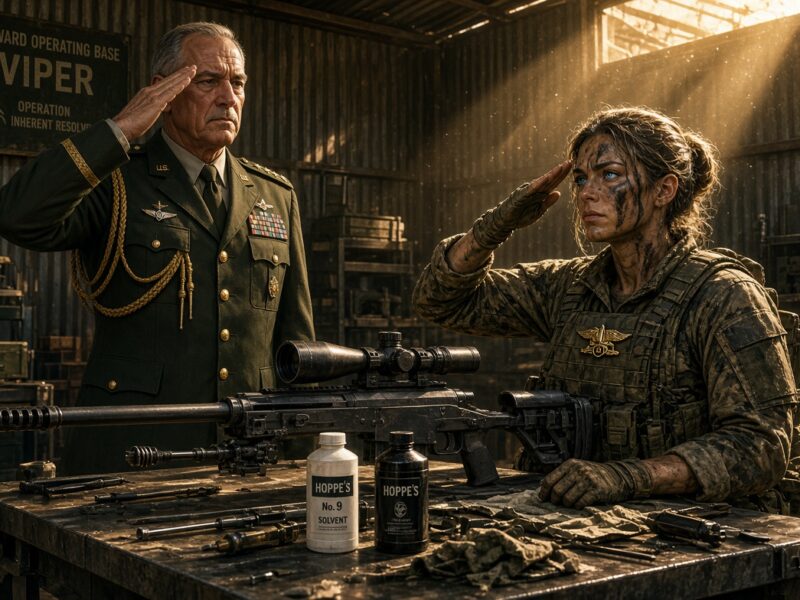
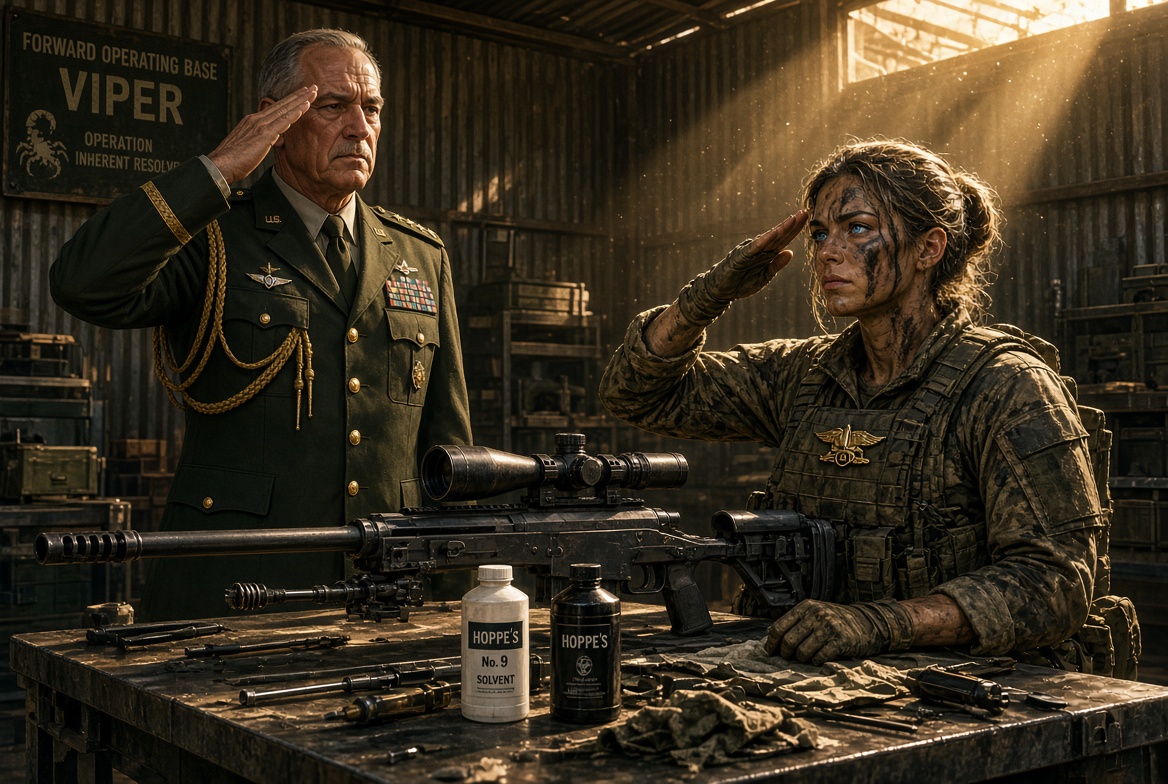
The air was thick with the smell of Hoppe’s No. 9 solvent and gun oil.
Sitting alone at a metal workbench in the back corner was Chief Petty Officer Olivia Jenkins.
She had stripped off her heavy body armor and was methodically breaking down the massive bolt-action receiver of her McMillan sniper rifle.
Her hands, covered in grease and calluses, moved with the gentle precision of a surgeon.
She hadn’t bothered to wipe the camouflage paint from her exhausted face.
Hearing the heavy footsteps, she looked up.
Seeing the general, she immediately began to push her chair back to stand at attention.
“As you were, Chief,” Albright said sharply, his voice carrying a strange, unfamiliar tremor.
Olivia froze halfway up, then slowly lowered herself back onto the stool.
She didn’t speak.
She just watched him with those cold, analyzing blue eyes, the same eyes that had calculated a two-thousand-yard shot in the middle of hell.
Albright walked slowly to the workbench.
He looked at the disassembled rifle.
He looked at the gold trident, still pinned to the patch of her discarded chest rig resting on the table.
For a long, agonizing minute, the four-star general stood in silence.
Then he reached into his breast pocket.
He pulled out a heavy, solid bronze challenge coin.
It wasn’t a standard command coin.
It bore the crest of the Joint Chiefs, awarded only by his personal hand, usually for monumental acts of valor.
He didn’t hand it to her.
He set it gently on the workbench, right next to the bolt of her rifle.
Albright took a half step back, squared his shoulders, and snapped his boots together.
The sound echoed sharply in the quiet armory.
Slowly, deliberately, the general raised his right hand to the brim of his cap in a crisp, flawless salute.
It wasn’t a salute of protocol.
It was a salute of absolute, unquestionable reverence.
Olivia stared at him for a moment, her expression unreadable.
Then she wiped a grease-stained hand on her trousers, sat up perfectly straight, and returned the salute.
“I was wrong, Chief Jenkins,” Albright said, his voice thick with emotion he fought to suppress.
“I am deeply, profoundly sorry. You wear that pin. You wear it with pride, because God help the enemy who tries to take it from you.”
Albright held the salute for three more seconds, lowered his arm, and executed a perfect about-face.
He walked out of the armory, leaving the deadliest sniper in American military history alone in the quiet company of her weapon.
What an absolute masterclass in resilience and tactical brilliance.
Chief Jenkins proved that true warriors are defined by their actions on the battlefield, not by outdated expectations.









