He Opened the Door on the Coldest Night of the Year… and Found Six Pregnant German Shepherds Waiting in the Snow
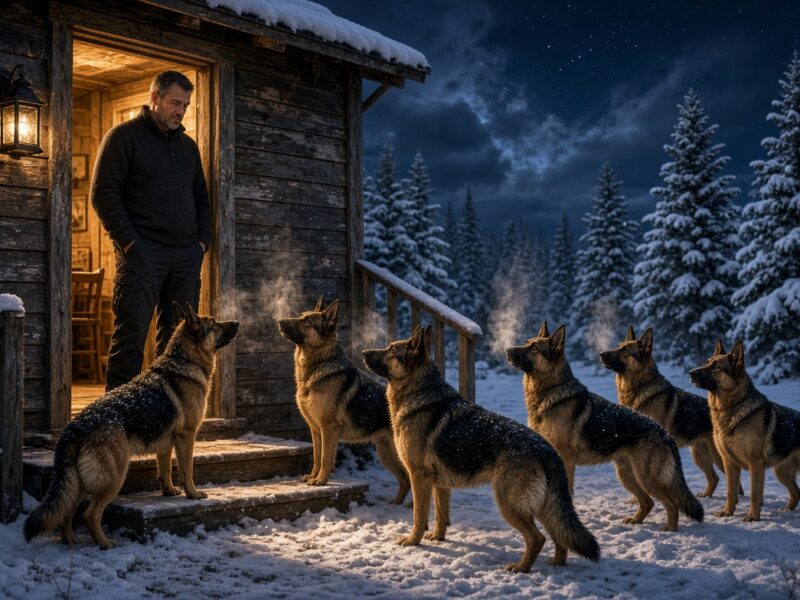
The thermometer nailed to Ethan Cole’s porch read four degrees below zero when he heard the scratching.
It was 1:12 a.m. on the coldest night of the year in Cape Rowan, Maine. The plows had quit Route 1 hours ago, and the only light for half a mile was the orange glow of his woodstove.
He opened the door expecting a branch.
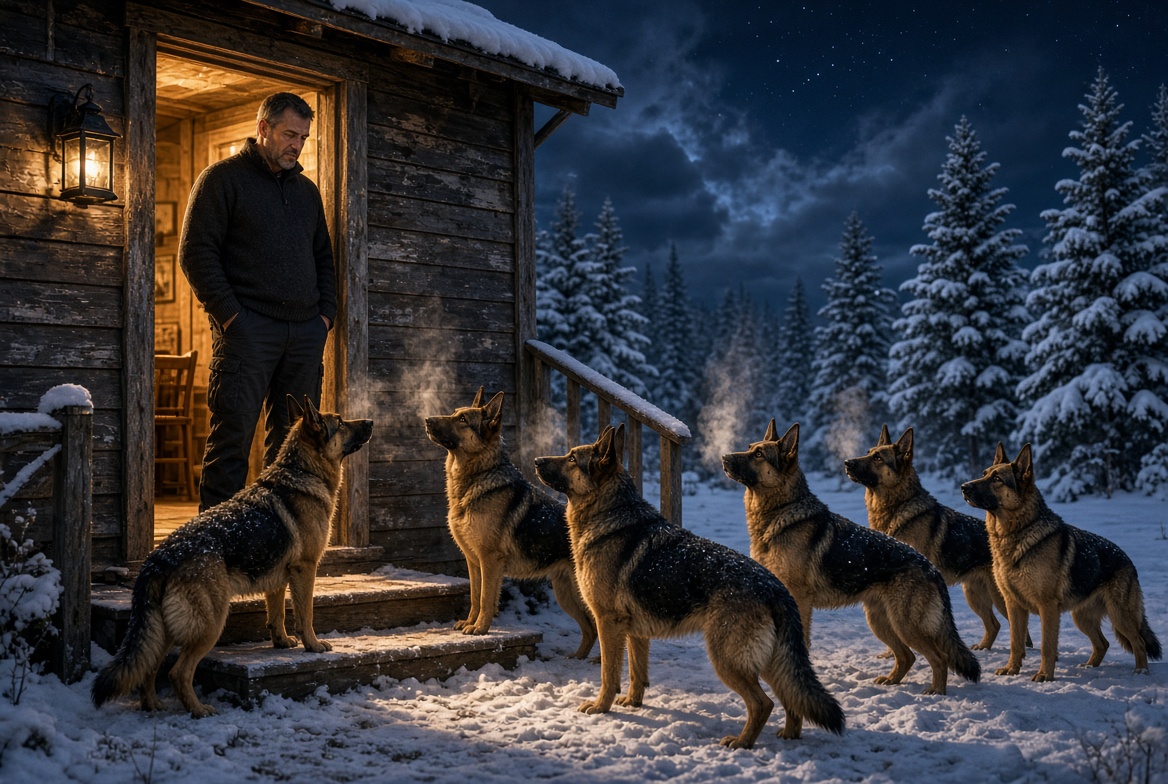
Instead, six German Shepherds stood in the snow, arranged in a silent half circle, their bellies heavy, their breath rising like smoke from six small chimneys.
Not one of them barked.
They just looked at him, the way soldiers look at the last open door on a burning street.
Ethan had been a Navy SEAL for eleven years. He had walked into places most men only see in nightmares.
But nothing had ever stopped his heart quite like those twelve patient eyes.
He didn’t know yet that someone had left them out there on purpose.
He didn’t know that a man in a $900 coat would come knocking within the week to take them back.
And he had no idea that the small brass compass locked in a metal box in his kitchen drawer was about to point him somewhere he had stopped believing existed.
Three days earlier, Ethan had stepped off a Concord Coach bus at the Rockland depot with one duffel bag, one worn Navy peacoat, and nobody waiting.
By late December, Cape Rowan had gone almost entirely white.
Snow buried the narrow streets, crusted the harbor ropes, and sat heavy on the roofs of the weathered fishing houses. The wind came off the Atlantic sharp with salt, and most folks stayed close to their fireplaces, waiting out the next storm.
Ethan was thirty-four.
He was tall and broad through the shoulders, with dark hair cut short, tired gray eyes, and a quiet face that made him look older than he was.
The Navy had taught him to move carefully, speak only when necessary, and keep whatever he felt locked behind discipline.
An injury had ended his career. A torn shoulder, a bad knee, a medical board that thanked him for his service in a single paragraph.
So he had come back to the only place that had ever felt like home.
He just wasn’t sure the word meant anything anymore.
The small wooden house at the edge of town still stood where it always had, leaning slightly toward the sea as if it were listening for something past the horizon.
The paint had faded. One shutter hung loose. The chimney gave off more smoke than heat.
But it was his.
Inside, he set the duffel beside the narrow bed and opened the drawer under the kitchen table.
Unpaid bills. A few folded letters from the VA. And a small metal box, dented at one corner, holding the last photographs of his parents.
When he lifted it, something inside slid and knocked against the tin.
He knew exactly what it was. His father’s brass compass.
He put the box back without opening it.
He hadn’t opened it in twenty-six years.
His parents had disappeared when he was eight, on a fishing trip that began on an ordinary October morning and ended with an empty boat drifting back toward the harbor on the evening tide.
The Coast Guard searched for nine days.
No one ever found them.
No one could tell Ethan exactly what had happened, and that uncertainty followed him into adulthood like a shadow that never fell far behind.
For a long time, he blamed the sea.
Later, he blamed himself for surviving the years they hadn’t.
The Navy had given him structure, purpose, and a way to keep moving forward without asking too many questions.
Now there was nothing left to tell him where to go next.
Some men survive the war only to find out the quiet is harder.
Ethan picked up what work he could.
He rebuilt outboard motors, replaced rotted dock boards, and helped the lobstermen haul gear across the frozen wharf.
He was good with his hands, patient with stubborn machinery, and willing to work in the cold when others weren’t.
Still, the jobs came and went, and every month seemed to bring another bill he couldn’t pay in full.
His old Ford pickup needed a new starter. The roof leaked over the back room.
And the savings he’d carried home from the military had dwindled to $2,340 faster than he wanted to admit.
He didn’t talk about any of it.
In Cape Rowan, people noticed everything, especially what a man tried to hide.
The first person to visit him was Mara Bennett, the town’s only veterinarian.
She was in her early thirties, auburn hair usually tied back at the neck, steady green eyes, and a practical way about her that made her seem calm even when everything around her was coming apart.
They had grown up on the same street, sat in the same classrooms at Cape Rowan Consolidated, and once swore they’d never leave.
Life had pulled them in different directions.
But she had never completely stopped looking out for him.
Her clinic sat behind the old post office, a small white building with a blue door and a hand-painted sign. Ethan had rebuilt its back steps years ago, and Mara still sent work his way whenever she could.
That afternoon, she showed up with two paper cups of coffee and found him splitting firewood behind the house.
“You came back,” she said.
He leaned the axe against the chopping block and took a cup.
“Looks that way.”
She glanced at the house, the sagging fence, the empty woodrack.
She didn’t ask how long he planned to stay.
She already knew he had nowhere else to go.
“How’s the clinic?” he asked, mostly to change the subject.
“Still standing.”
“That’s not an answer.”
Mara blew across her coffee. “The bank says I’m $19,500 behind. They sent a letter with the word foreclosure in bold, which I thought was a little dramatic.”
“Mara.”
“I know.”
“You’re still treating strays for free.”
“Somebody has to.”
She said it simply, the way other people said the sky was gray.
Then she nodded toward town. “My exam table’s broken. Hydraulic lift won’t hold.”
“I’ll fix it tomorrow.”
“You always say tomorrow.”
“Tomorrow usually comes.”
A small smile touched her mouth, but Ethan looked away toward the shoreline.
She understood that he wasn’t being rude.
He just didn’t know how to accept concern without feeling like he owed someone an explanation.
Before she left, she set a folded envelope on the porch rail.
“There’s a Hannaford gift card in there. Groceries. You don’t have to pay me back.”
His jaw tightened. “I can manage.”
“I know you can,” Mara said gently. “That doesn’t mean you have to manage everything alone.”
He didn’t answer.
She didn’t push.
She only nodded once and walked back toward town, her boots leaving a neat line of prints in the snow.
A few minutes later, another figure appeared at the fence.
Theo Miller was sixteen, tall and skinny, freckles across his nose, brown hair that never stayed combed, and the restless energy of a kid who hadn’t yet decided what kind of man he wanted to be.
He lived with his grandmother in a small house near the harbor and had been watching Ethan from a distance since the day he got off the bus.
Theo knew Ethan had been a SEAL.
In his head, he had built a whole private legend: secret missions, impossible rescues, courage that never cracked.
The truth was quieter.
Ethan didn’t think of himself as a hero. He was just a man who had learned to endure hard things without letting anyone see how much they hurt.
Theo stopped at the fence and pretended to inspect a loose section of wire.
“Your truck still won’t start?”
“It starts when it feels like it.”
“My grandma says old machines are like old people. They need patience.”
Ethan glanced over. “Your grandma’s probably right.”
Theo grinned, encouraged.
He wanted to ask about the Navy. About the scars that disappeared under Ethan’s sleeves. About why a man who had survived places no one in Cape Rowan could imagine would choose to live alone next to a freezing ocean.
Instead he asked, “Are you staying?”
Ethan looked past him at the harbor.
The water was black under a thin skin of ice, and the boats rested against the docks as if they were exhausted.
“For now.”
Theo nodded, though the answer seemed to disappoint him.
“If you ever need help,” the boy said, “with the truck or whatever, I’m around. Like, a lot.”
“Don’t you have school?”
“Winter break. And even when I don’t, I’m still around.”
Ethan almost smiled. “I’ll keep that in mind.”
After the boy left, Ethan went inside and set Mara’s envelope on the kitchen counter without opening it.
He stood a long time at the window, watching snow drift across the empty road.
Cape Rowan had given him a house, a few odd jobs, and the memories he’d spent sixteen years trying to outrun.
It had not yet given him a reason to believe that coming back was the same as coming home.
That evening, he lit the stove, checked the lock on the front door twice, and sat alone in the quiet house while the winter settled over town.
At one point, he found himself staring at the kitchen drawer.
The metal box. The compass inside it.
When he was seven, his father had pressed that compass into his small hand on the deck of the Margaret Ann and said, “No matter how dark it gets out there, this little needle always knows the way home.”
The next year, the boat came home and his father didn’t.
So much for the needle.
Ethan turned off the lamp.
He had survived the ocean, the military, and every year that followed.
But he still felt like a man standing at the edge of something enormous, not sure whether he was supposed to keep moving or finally stop.
He did not know that, before the night was over, the choice would come scratching at his door.
The night grew colder after midnight.
Snow pressed against the windows in pale waves, and the wind moved through the pines with a low, restless voice.
Ethan had just banked the stove when he heard it. A faint scratching near the front door.
At first he figured a loose branch had blown against the siding.
Then it came again. Slower. Followed by a soft shifting on the porch boards.
He stood still and listened.
The scratching was uneven and weak, as if whatever was outside had almost no strength left.
He took the old kerosene lantern from beside the stove, pulled on his coat, and crossed the room.
When he opened the door, the cold rushed in before the light could get out.
Six German Shepherd females stood just past the porch steps, arranged in a quiet half circle under the falling snow.
They were big dogs, but the winter had made them look smaller.
Their coats were thick and beautiful under the frost, though several had gone dull with cold and exhaustion.
Their sides were visibly heavy with pregnancy.
And each of them stood with a careful stillness, saving whatever energy they had left.
The one in front had a dark sable coat and watchful eyes. She lifted her head when Ethan appeared, but she didn’t bark or come closer.
Behind her stood a black-and-tan female with a white blaze on her chest.
A golden-coated dog whose ears stayed low.
A narrow-faced Shepherd with a wary look.
A strong, dark female who kept close to the rest.
And at the back, a pale-coated dog whose legs trembled more than the others’.
Ethan counted them twice, because the snow made their shapes blur together.
Six.
All female.
All pregnant.
The pale one lowered her head, and the others shifted in around her.
That small movement told Ethan more than any sound could have.
They weren’t six strays wandering separately.
They had stayed together.
He had seen people abandon gear, boats, entire houses.
But he had never understood how anyone could leave living creatures to face a Maine winter night alone.
“Come on,” he said quietly. “You can come inside.”
None of them moved.
So Ethan stepped back from the doorway and left it wide open.
He knew frightened animals needed room to decide. Forcing them would only make it worse.
He set the lantern on the floor, went to the kitchen, and came back with a shallow bowl of water.
The sable dog watched every move.
After a long moment, she took one careful step forward.
The others followed, one by one.
The pale dog stayed behind until the strongest female turned around and waited for her.
“That’s it,” Ethan murmured, holding the door wider. “Nobody’s in a hurry.”
Slowly, without panic, the dogs came in.
They moved through the narrow kitchen toward the old storage shed attached to the back of the house, where Ethan kept tools, rope, and a busted fishing cart.
The shed wasn’t built for animals, let alone six pregnant ones.
But it had four walls, a roof, and a little cast-iron stove that still worked if you fed it enough wood.
Ethan cleared the floor as fast as he could.
He hauled out a toolbox, two buckets, and an armload of scrap lumber.
He shoved the heavy stuff against the far wall, swept up the sawdust, and spread his old military blankets across the cold boards.
The dogs stayed bunched near the doorway, uncertain but quiet.
He filled two bowls with water, then searched the kitchen for anything safe to give them.
There wasn’t much. Some dried beef, a little rice, half a loaf of bread.
He hesitated.
None of it would be enough for six dogs, especially six mothers carrying puppies.
He divided it anyway.
The sable dog came forward first, but she didn’t eat right away.
She looked back at the others. Then she lowered her head.
The rest followed, except the pale one, who stood with her nose near the floor.
Ethan crouched a few feet away.
“You don’t have to be afraid,” he said. “Not tonight.”
He had no idea whether she understood.
But she raised her eyes to him, and something in that tired look reminded him of every person he’d ever seen waiting for help that might not come.
That was the moment the door stopped being something he could close.
He went back inside, added a log to the stove, and stared at the phone on the wall.
Calling Mara meant admitting he couldn’t handle this alone.
He had spent years training himself to stay useful under pressure. Asking for help still felt like failing a test.
But six pregnant dogs weren’t a problem you solved with discipline.
Before he could reach for the phone, a shadow crossed the window.
Theo stood at the edge of the yard, squinting through the snow at the light in the shed.
A few minutes later, there was a soft knock at the back door.
The boy had a knit Patriots hat pulled low over his ears and a canvas tote clutched against his chest.
“My grandma keeps food for strays,” he said. “She said I could bring some.”
Ethan looked at the bag, then at the kid. “You shouldn’t be out here. It’s almost two in the morning.”
“You’re out here.”
“I’m older.”
“That doesn’t make the weather warmer.”
Ethan almost smiled.
Theo opened the tote. Several cans of dog food, a folded towel, a small thermos.
“The cans are sealed,” he added quickly. “Grandma said it’s better than giving them whatever’s in your fridge.”
“Smart woman. Thank her for me.”
“She said you’d say that and then still try to pay her back.”
“Your grandmother knows me too well.”
Theo leaned to look past him toward the shed. “Are they really all pregnant?”
“Yes.”
“Do you know who they belong to?”
Ethan shook his head. “Not yet.”
Theo was quiet a moment. “What are you gonna do?”
Ethan looked through the open doorway.
The six dogs had settled closer to the blankets, though the pale one still stood apart.
“Keep them warm. Keep them calm. Call Mara.”
“That sounds like a plan.”
“It’s the beginning of one.”
Theo nodded as if that answer mattered more than anything anyone had told him all year.
Ethan carried the cans into the shed and split them among the bowls.
This time the dogs ate steadily.
He watched them for several minutes, noticing how different each one was.
The sable dog never took her eyes off him. He called her Luna.
The black-and-tan moved with a quiet, patient rhythm. Willow.
The golden Shepherd became Hazel.
The narrow-faced one, Ruby.
The strongest female, who never drifted far from the group, was Faith.
The pale dog stayed silent until Ethan set a bowl right beside her paws.
“You can be June,” he whispered. “You look like you’ve been waiting a long time for summer.”
Theo repeated the names under his breath, memorizing them.
“Luna, Willow, Hazel, Ruby, Faith, June.” He looked up. “They already seem different.”
“They were different before they got here,” Ethan said. “Somebody just stopped noticing.”
He finally picked up the phone.
Mara answered on the second ring, her voice thick with sleep and instantly alert.
“Ethan? What’s wrong?”
“Six dogs showed up at my door. German Shepherds. All pregnant. All half-frozen. One of them’s worse off than the rest.”
There was a pause just long enough for him to hear her sit up.
“Six?”
“Six.”
“I’m coming. Keep them warm, don’t force food, and don’t let anybody crowd them.”
She didn’t ask why he’d waited before calling.
She just hung up and came.
While they waited, Ethan fed the little stove, checked the walls for drafts, and wedged a board across the gap under the door to keep the wind out.
He moved slowly around the dogs and never reached toward one without letting her see his hands first.
Luna watched every movement.
But she didn’t retreat.
Mara arrived through the snow with a headlamp, a lantern, and a canvas medical bag over one shoulder.
She stepped into the shed, took in the scene, and her face went serious.
“You were right to call me.”
“Can you help them?”
“I can examine them and tell you what they need tonight. Beyond that, we take it one step at a time.”
She moved from dog to dog, speaking low, checking each one’s condition without alarming her.
She confirmed what Ethan already knew: all six were pregnant.
Then she told him what he didn’t know.
“Some of them are a lot closer than you’d think. Two, maybe three weeks for most. Less for a couple.”
She stopped beside the sable dog and frowned.
“This one. What did you call her?”
“Luna.”
“Luna’s the weakest of the group, even if she’s acting like the leader. She’s underweight and she’s carrying a lot. She’s the one I’m worried about.”
Ethan glanced at June, still trembling at the edge. “I thought it would be the pale one.”
“June’s scared. Luna’s tired. Scared you can fix with warmth and time. Tired goes deeper.”
She straightened up and wiped her hands.
“They need heat, clean water, rest, and real food. Puppy-formula food, not table scraps. And they need eyes on them, around the clock. We can’t assume they’ll all recover at the same pace.”
Ethan looked at the blankets, the little stove, the four cans Theo had brought.
“I don’t have enough.”
Mara met his eyes.
“Then we start with what you have, and we figure out what comes next in the morning.”
He waited for her to mention the cost.
She didn’t.
She just rested a hand on the door frame and looked at the six dogs gathered in the dim light.
“This isn’t going to be simple, Ethan.”
“I know.”
“It’s going to take more than one person.”
He looked over at Luna, who had laid her head on the blanket, and at June, who had finally edged close enough to the others to feel their warmth.
“I know that too,” he said.
Accepting it was harder than saying it.
Mara helped him arrange the dogs so no one was isolated. Theo held the lantern while Ethan dragged another blanket in from his own bed.
Before she left, Mara gave clear instructions.
“Keep the shed above fifty degrees. Watch for heavy panting, pacing, or anyone refusing water. Any of that, you call me. Don’t wait for morning to be polite.”
“Understood.”
“And Ethan?”
“Yeah.”
“Eat something yourself.”
She didn’t promise him everything would be fine.
He respected her for that.
After Mara and Theo left, the shed went quiet again.
Six dogs rested under the blankets, their breathing slow and uneven, but steady enough to give him courage.
Ethan sat by the door with his back against the wall, listening to the wind roll over the roof.
He had come back to Cape Rowan believing his life had shrunk to a crooked house, a stack of overdue bills, and memories he couldn’t change.
Now six frightened animals had crossed the snow to stand at his door.
And he had opened it without any idea what would happen next.
For the first time since he got off that bus, Ethan didn’t feel completely alone.
Luna lifted her head and looked at him through the dim light.
“We’ll get through tonight,” he told her.
He wasn’t sure whether he was talking to her or to himself.
He stayed beside them until the coldest hours had passed.
Somewhere out in the dark, the person who had left them there was sleeping just fine.
Morning came quietly over Cape Rowan, bringing a pale sky and a thin skin of frost across every window.
The snow had stopped, but the cold stayed sharp enough to seep into the walls of the shed.
The six Shepherds lay close together under the blankets while Ethan moved between them with a spiral notebook in one hand and a mug of lukewarm coffee in the other.
He had slept less than an hour, sitting against the wall with his coat still on.
He didn’t feel tired, not in the ordinary way. His mind had narrowed to the dogs, and there was no room left for anything else.
Mara came back just after sunrise and examined each of them again.
Willow, Hazel, Ruby, Faith, and June were all heading into the last stage of pregnancy.
Luna was still the biggest worry. She had eaten only a little overnight and couldn’t seem to find a comfortable way to lie.
Mara didn’t use alarming words, but Ethan heard the weight underneath her calm voice.
“She needs warmth, water, quiet, and constant observation,” Mara said. “They all do. Luna just has less to spare.”
Ethan flipped the notebook open. “Tell me what to write down.”
Mara studied him for a beat, then gave him a schedule.
He logged the time of every meal. How much water each dog drank. How often they stood or rested. Any change in breathing or behavior.
He divided the shed into small spaces with old boards, giving each dog room to lie down without cutting her off from the others.
He scrubbed the bowls, checked the stove, and arranged the blankets so Luna wouldn’t get pushed away from the warmth.
It felt like a military routine.
Except there was no commanding officer, no clear mission, and no guarantee that following every instruction would end in success.
There were only six living creatures depending on him to pay attention.
Theo showed up before noon with another container from his grandmother’s kitchen.
This time he’d also brought a clean towel, a pencil, and a sheet of paper folded into a grid.
“I made a chart,” he said.
Ethan looked at it.
Theo had written the dogs’ names across the top and left boxes under each one for food, water, rest, and notes.
“You don’t have to do this.”
“I know.”
“What about school?”
“Still winter break. I told you.” Theo set the chart on a wooden crate. “Besides, I can help more here.”
Ethan wanted to tell him this wasn’t a kid’s responsibility.
But Theo was already studying Luna from the doorway with a look so serious it stopped the words in Ethan’s throat.
He didn’t look like a boy chasing adventure.
He looked like someone who had finally found something that mattered.
“Okay,” Ethan said. “You write down the times. You don’t go in the shed unless Mara or I am with you. Deal?”
“Deal.”
Ethan showed him how to watch without disturbing anyone. How to notice when a dog had shifted, whether she’d taken water, whether her body looked restless or too still.
Theo asked a hundred questions.
But he listened to every single answer.
By early afternoon, the news had started moving through Cape Rowan.
Ethan didn’t know who had mentioned the dogs first, and he wasn’t happy that people were talking about his business.
But this town had always carried news faster than the harbor carried boats.
The first visitor was Grace Holloway.
She was a short woman in her sixties in a blue wool coat, who spoke with the bluntness of someone who had raised children, livestock, and difficult neighbors.
She stopped at the shed door with two forty-pound bags of dog food.
“These were in my pantry,” she announced. “Don’t ask how long.”
“Mrs. Holloway, I’ll pay you back when I can.”
She gave him a look that had probably silenced school board meetings.
“You can thank me by using them, Ethan Cole.”
She set the bags against the wall and was gone before he could argue.
Half an hour later, the Branson family rolled up in an old Chevy pickup.
A father, two teenage sons, and a quiet mother who stayed in the passenger seat while the boys unloaded several bales of clean straw.
“Got more at the farm if you need it,” the father said.
He didn’t step inside or ask to see the dogs.
He just helped spread the straw under the blankets, shook Ethan’s hand once, and drove off.
Ethan stood in the doorway watching the truck disappear behind the snowbanks.
He had spent most of his life believing that accepting help meant taking on a debt you could never repay.
Yet the people of Cape Rowan kept offering without asking for anything back.
Later that afternoon, an old boatbuilder named Walter Crane showed up with a portable space heater.
Walter had worked on boats for more than forty years. He had stiff hands, careful movements, and the air of a man who trusted tools more than conversation.
“Still works,” he said. “Don’t run it too close to the blankets.”
Ethan checked the cord and tested the switch. “If it acts up, I can fix it.”
Walter gave a short nod. “That’s why I brought it to you.”
It was the closest thing to praise Ethan had heard from the man in twenty years.
It stayed with him long after Walter’s truck was gone.
Help, it turned out, didn’t arrive like a rescue team. It arrived one bag of straw at a time.
Mara came back before evening and found Ethan on his knees beside Luna.
The dog had shifted twice in the last hour and refused the food in front of her.
Ethan had pulled the bowl closer and was offering water in tiny amounts, waiting patiently between each try.
Mara watched a moment before stepping in.
“You haven’t eaten.”
“I had coffee.”
“Coffee is not food.”
“It was warm.”
Mara sighed, but there was no anger in it.
She pulled a wrapped turkey sandwich from her bag and set it on the crate beside him.
“You can’t take care of six dogs if you collapse next to them.”
Ethan kept his eyes on Luna. “She’s worse than the others.”
“That doesn’t mean you have to get worse with her.”
He didn’t answer.
Mara sat on the far side of the shed, leaving enough space to keep the dogs calm.
For a while, neither of them said anything.
The heater hummed. Theo’s pencil scratched across the chart. The dogs breathed under the blankets.
“You’re treating this like a mission,” Mara said finally.
“Missions have objectives.”
“And this one?”
“Keep them alive.”
Mara studied him. “That’s not the only reason you’re doing this.”
Ethan’s shoulders went still.
He had never told her about the years after his parents vanished. The nights he lay awake imagining the Margaret Ann coming back into the harbor with two figures waving from the deck.
The guilt of being the one left behind.
He had never explained why the sea still made his stomach tighten after a decade in the Navy, or why he sometimes woke before dawn certain he’d heard a boat engine outside.
“I opened the door,” he said. “They came in. That’s what happened.”
“It’s enough,” Mara said softly.
She didn’t push.
She knew Ethan would talk when he was ready, if he ever was.
Theo looked up from his chart. “Luna drank twice since noon.”
Ethan glanced at him. “Good. Write that down.”
Theo did, carefully, without missing a word.
For the first time in a long while, the boy felt that his attention mattered to someone other than himself.
He wasn’t watching Ethan from behind a fence anymore.
He had a place inside the work, however small.
As evening fell, lights came on in the windows up and down the road.
The town didn’t show up in a crowd. Nobody made it dramatic.
People just started leaving what they could at Ethan’s door. A bag of kibble. A bundle of straw. A spare towel. A Mason jar of chicken broth. A sticky note with a phone number and the words call if you need anything.
Ethan lined everything up in a neat row inside the shed.
It still made him uncomfortable.
But he had stopped refusing it.
Before Theo left, Ethan handed him the notebook.
“Keep this tonight. Bring it back tomorrow.”
Theo held it like it might break. “You trust me?”
Ethan considered the question honestly. “I trust that you’ll do the work.”
Theo grinned.
For the first time since Ethan had known him, the boy looked completely sure of himself.
Over the next several days, the shed turned from an emergency shelter into a place of careful routine.
The donated food was measured and stored. The straw was swapped out whenever it got damp. Theo’s chart filled with tiny notes about appetite, rest, and movement.
Luna was still weaker than the others, but she no longer turned away from every bowl.
The Branson boys patched a section of the roof. Someone left a casserole on the porch with Ethan’s name taped to the foil.
By the fifth day, Ethan had done the math in the back of the notebook.
Even with all the donations, he had spent $1,180 of his last $2,340 on puppy-formula food, firewood, propane, and supplies from the Tractor Supply in Rockland.
He didn’t regret a dollar of it.
On the fifth morning, he was carrying a bucket of clean water toward the shed when he heard an engine coming up the road.
A black Range Rover stopped by the fence.
A tall man stepped out wearing a charcoal wool overcoat, polished boots, and leather gloves that looked too expensive for the weather.
Gordon Pike was in his early fifties, silver at the temples, square-jawed, with the controlled expression of a man used to being obeyed.
He carried himself with calm confidence. Not because he was calm, but because he had spent years learning how to make other people doubt themselves first.
A younger man followed him out of the passenger side.
Daniel Reed was thin and neatly dressed, with a slim leather briefcase and a careful voice that sounded rehearsed in offices where every sentence was chosen for effect.
Ethan set the bucket down and stepped between them and the shed.
Pike looked at him briefly, then at the building behind him.
“You have my dogs.”
Ethan didn’t move. “They’re being cared for.”
“That wasn’t my question.”
“They’re inside.”
Pike took a few steps toward the shed.
Ethan shifted into his path. “Not without permission.”
Pike’s eyes settled on him, and the confidence in them sharpened into something colder.
“I don’t need permission to see my own property.”
Ethan felt the old pressure gather under his ribs.
He had faced men who shouted, men who threatened, men who thought their rank made them untouchable.
Pike was a different kind.
He never raised his voice. He simply assumed the world would step aside for him.
“They’re not property the way you’re using the word,” Ethan said. “They’re living animals. And they were left outside in a Maine winter.”
Pike’s mouth thinned. “They were released. Temporarily.”
“You released six pregnant dogs into a snowstorm and didn’t come looking until they were safe.”
“You don’t know what happened.”
“I know what shape they were in when they got here.”
Pike glanced at the shed again. “Are they all still pregnant?”
The question came so fast, and with so little concern, that something inside Ethan went cold.
“That’s what you want to know?”
“It’s relevant.”
“Not to me.”
Pike ignored that. “Which one is the sable? Number four in my records.”
Ethan’s hand tightened on the edge of his coat. “Her name is Luna.”
“Her name is a registration number, Mr. Cole. Which one is she?”
“If you have records on all six, you should know.”
For the first time, irritation cracked Pike’s face.
“Mr. Cole, I’m here to take my dogs home. I’m prepared to overlook whatever expenses you claim to have incurred if you hand them over today. Call it five hundred dollars for your trouble.”
Ethan let out a quiet breath that wasn’t quite a laugh.
“Overlook?”
“You provided temporary boarding. I’m offering to settle this without unpleasantness.”
“You didn’t come to ask how they’re doing.”
Pike’s eyes flicked to the shed door. “I came because I was informed they were here.”
“And if they hadn’t made it?”
Pike didn’t answer.
The silence said everything.
A man who doesn’t ask whether something is alive has already told you what it’s worth to him.
Daniel Reed opened his briefcase and slid out a folder.
“Mr. Cole, my client has documented ownership of all six animals. They’re registered under Pike Ridge Kennels, and there has been no transfer of ownership.”
Ethan looked at the folder but didn’t take it. “Is there anything in there about them being abandoned?”
Reed paused. Less than a second.
Ethan noticed.
“They were never abandoned in any legal sense.”
“They were left without food, shelter, or supervision.”
“That’s an interpretation.”
Tires crunched on the snow. Mara’s Subaru pulled in behind the Range Rover.
She crossed the yard with her medical bag and stopped when she saw the two men.
“Those dogs shouldn’t be moved,” she said.
Pike turned. “And you are?”
“Dr. Mara Bennett. I’ve been treating them since the night they arrived.”
Reed glanced at her bag. “Then you can confirm they’re stable enough to travel.”
Mara’s expression didn’t change. “No. I can confirm they need warmth, rest, regular food, and close observation. I have not cleared them for transport.”
Pike gave a short laugh. “You have no authority over my animals.”
“Maybe not,” Mara said. “But I have a professional obligation not to sign off on moving late-term animals whose condition could crash under stress. And I’ll put that in writing for anyone who asks. Including the county.”
Ethan watched Pike’s attention move between them.
He had come expecting one broke man standing alone.
He hadn’t expected the vet, the patched roof, the stacked bags of food, or the sound of six dogs shifting behind the door.
“I’ll be back with the proper paperwork,” Pike said.
“Do that,” Ethan answered. “Until then, they stay.”
Pike stepped closer. His voice dropped.
“You’re making a mistake. A man in your situation can’t afford a legal fight.”
“That may be true.” Ethan’s voice stayed level. “But I can afford to keep the door closed.”
Reed touched Pike lightly on the arm. Not to hold him back. Just to signal the conversation had run out of use.
Pike looked at Ethan one more moment, then turned toward the SUV.
“You’ll be hearing from us.”
“I expect I will.”
The Range Rover backed out and disappeared over the hill.
Ethan didn’t move until the engine noise was completely gone.
Mara looked at him. “You handled that well.”
“I wanted to say a lot more.”
“You said enough.”
That afternoon, Theo found Mara at Ethan’s kitchen table, surrounded by paper.
The pages came from her clinic’s old files.
Pike Ridge Kennels had brought animals to her clinic years ago, before switching to a vet two towns over.
Mara had pulled vaccination records, missed appointments, and her own notes from back then.
“Look at this,” she said, tapping a page. “This is Willow. Three years ago. Booster scheduled, never brought back. Faith, same thing. Ruby had an ear infection that was flagged twice and never followed up.”
Theo leaned closer, careful not to touch anything. “So he just stopped bringing them?”
“Whenever it got inconvenient. Or expensive.” She stacked the pages. “None of this tells the whole story. But it shows a pattern.”
“Is it enough?”
“Not by itself.”
“What else do we need?”
Mara glanced toward the shed, where Ethan was feeding the stove.
“Facts. Dates. Witnesses. Anything that shows what happened before they reached this house.”
Theo looked down at the chart in his hands.
“I might know somebody.”
He explained that a man named Colin Reeves sometimes helped his grandmother with repairs around the house.
Colin had worked at Pike Ridge until a few months ago and almost never talked about it.
But once, fixing her water heater, he had muttered that Pike kept a beat-up phone for training videos and inventory, and that some of what was on it “would make your stomach turn.”
“Theo,” Mara said, “do not go poking around on your own. I mean it.”
“I won’t. I’ll just ask Grandma to call him.”
He kept his word.
Before dark, Colin knocked on the clinic’s blue door with an old Android phone and a tired face.
He was a quiet man in his forties, his work jacket faded at the shoulders, with the guarded manner of someone who’d learned to be careful around powerful bosses.
“I don’t want my name in the paper,” he said.
“Understood,” Mara said.
“I took this before I quit. Didn’t know why. Just felt like somebody should have it.”
The video was dark and shaky, the audio uneven.
But Gordon Pike’s voice came through clearly.
“Six of them, all bred late. You know what it costs to winter six dogs? Seven grand, minimum, and the litters won’t move till spring. They’re not worth it. Figure something out. I don’t want to see them here after the fifteenth.”
There was no shouting. No dramatic scene.
Just a few cold sentences that revealed far more than Pike had ever intended.
Theo stared at the screen. “The fifteenth. That’s… that’s the week before they showed up at Ethan’s.”
Mara copied the file to her laptop and to a flash drive, which she locked in the clinic safe.
“Thank you, Colin.”
He nodded once and left without another word.
Theo stood beside her, realizing for the first time that small pieces of truth could become heavy when you put them side by side.
Seven thousand dollars. That was the price Gordon Pike had put on six lives.
That night, Ethan jolted awake in the chair beside the shed door.
For a few seconds, he didn’t know where he was.
The room felt too narrow, the air too cold, and the wind hitting the roof sounded exactly like waves slapping the hull of a boat.
He tried to steady his breathing.
His hands wouldn’t stop shaking.
Mara had stayed late at the kitchen table reviewing the records. She came to the shed without a word and sat down a few feet away.
She didn’t touch him.
She didn’t tell him to calm down.
She just stayed.
After a while, Ethan looked over.
“It passes.”
“I know.”
“You don’t have to sit here.”
“I know that too.”
Her voice was gentle, and that made it easier for him to stay where he was.
Behind them, Luna shifted under her blanket.
Ethan turned toward her and listened until her breathing evened out again.
The dogs didn’t know about registration papers or lawyers or threats.
They only knew the shed was warm, the bowls were full, and the people who came in didn’t leave them alone.
Gordon Pike had come back when everything looked safe, believing he could reclaim what he had thrown away.
But the dogs weren’t standing outside a stranger’s door anymore.
They were inside, surrounded by people who had learned their names.
Ethan didn’t know what would happen next.
But he knew one thing for certain.
He would not hand them over just because someone had suddenly decided they were valuable again.
The days after Pike’s visit settled into the quiet rhythm of the shed.
Ethan, Mara, and Theo split the hours between them. Checking the dogs. Changing the straw. Warming water. Writing down every change.
Nobody mentioned sleep unless it was absolutely necessary.
The dogs were calmer now, but their behavior had shifted.
Willow paced slowly along the wall. Hazel rested more. Ruby got restless whenever the shed went quiet. Faith refused to lie down for long.
June stayed close to the others, studying every person who came in as if she were still deciding whether this strange new place was really safe.
Luna remained the most fragile.
She drank in small sips and ate only when Ethan set the bowl right under her nose. She tired easily and spent most of her time beneath the blanket.
“She’s holding on,” Mara told him one evening. “That matters. But we take it an hour at a time.”
Ethan wrote the words in the notebook even though he’d already memorized them.
A certified letter arrived on the third day.
It was from Daniel Reed’s firm in Portland.
Pike had filed a complaint with the Cape Rowan Town Council and the Knox County Animal Welfare Office, demanding the immediate return of “six registered breeding females and all resulting offspring.”
The letter put their value at $42,000.
It described Ethan’s care as “unauthorized boarding” and hinted, without quite saying it, that he planned to sell the puppies himself.
A hearing was set for the second week of February.
Ethan read the letter twice, folded it into quarters, and put it in the drawer beside the metal box.
He didn’t open the box.
But he rested his hand on it for a moment before closing the drawer.
Forty-two thousand dollars. The same dogs Pike wouldn’t spend seven thousand to keep warm.
On the fourth morning after Pike’s visit, Willow started acting differently.
She moved away from the others, circled the straw, and returned to the same corner again and again.
Theo noticed first. “She keeps changing spots.”
Mara looked up from the supplies she was sorting. “That could mean she’s starting labor.”
Ethan shut the notebook and went to Willow.
The dog watched him, alert but calm, while Mara cleared a clean section of the shed.
Nobody rushed.
Theo brought fresh towels, checked the water, and stayed in the doorway so he wouldn’t crowd her.
“What do I do?” he whispered.
“Mostly nothing,” Mara whispered back. “Which is the hardest job there is.”
The hours crawled. The winter light faded.
Then, right as the sky went dark, the first puppy arrived.
There was no drama. Just a brief, breathless moment of uncertainty, and then a small, unmistakable cry.
Ethan leaned in, caught himself, and let Willow have her space.
Mara checked the newborn from a respectful distance and nodded.
“Breathing well. Strong.”
Ethan let out a breath he hadn’t known he was holding.
Willow turned toward the tiny bundle, and the whole shed seemed to go quiet around them.
Theo smiled so wide that Mara had to remind him to keep his voice down.
“One,” he whispered. “We have one.”
Ethan looked at him. “We have one healthy puppy.”
Theo wrote the time in the chart, his pencil shaking slightly. 6:47 p.m.
That first puppy changed everything.
Until then, the dogs had been waiting for something uncertain.
Now there was new life lying against Willow’s belly, warm and completely dependent on her.
Ethan caught himself drifting back to that corner over and over.
Not because there was anything to do.
Just to make sure the puppy was still there.
Mara caught him at it once.
She didn’t say a word. She just smiled into her coffee.
Hazel went into labor the next day, just after sunrise.
She was calmer than Willow, but it still took patience.
Ethan sat by her head and talked to her in the low voice he used whenever the dogs got uneasy.
Theo had the supplies ready before anyone asked. Mara walked him through each step without ever making him feel hurried.
When Hazel’s first puppy arrived, it was a sturdy little female with a dark muzzle and very determined movements.
Theo laughed under his breath when she tried to lift her head.
“She’s already trying to get somewhere.”
“That’s what healthy puppies do,” Mara said. “They start searching before they understand the world.”
“Kind of like you,” Ethan said.
Theo turned red to his ears, but he didn’t stop grinning.
Hazel rested afterward, and Ethan slid a clean blanket in beside her.
He was learning that caring for the mothers meant respecting their space as much as helping them.
The dogs had stopped watching every movement with suspicion.
They knew Ethan’s footsteps now. Mara’s voice. Theo’s careful way of slipping through the door.
Ruby delivered next. Then Faith.
Each birth brought its own quiet tension and its own wave of relief.
Ruby’s puppies were small and dark. Faith’s were wildly restless the moment they could move.
By then, the shed had filled with soft sounds. Mothers shifting in the straw. Theo turning pages. Mara’s medical bag clicking open. And the faint, high cries of newborns searching for warmth.
Ethan stopped counting time by the clock.
He measured it by how many mothers had delivered safely and how many small bodies were breathing beside them.
June went into labor in the early evening.
Snow pressed against the windows. Walter’s heater hummed along the wall.
June stayed close to Ethan the whole time, resting her head against his knee whenever she got uncertain.
He kept his hand near her shoulder but never forced contact.
“You know what to do,” he told her. “We’re right here.”
Mara worked calmly. Theo shuttled between the kitchen and the shed with warm water and towels.
June’s last puppy took longer than the others to respond.
Mara stayed focused, rubbing the tiny body gently with a towel, murmuring under her breath.
One second. Five. Ten.
Theo stopped breathing.
Then the puppy stirred and let out a thin squeak.
Theo pressed a hand over his mouth, eyes shining.
“That’s five mothers,” he said through his fingers.
Ethan looked around the shed.
Willow, Hazel, Ruby, Faith, and June lay curled around their puppies.
And Luna lay alone in the far corner.
The relief from the other births couldn’t quite reach her.
She’d been quieter all day, and Mara had checked on her again and again.
Now Mara knelt beside her with one hand resting lightly at her neck.
“She may start soon,” Mara said.
Ethan crouched down. “Is she ready?”
“Ready isn’t the word I’d use.” Mara’s voice stayed steady, but she didn’t look up. “She’s exhausted. And I’m not sure the puppy is positioned right.”
“What does that mean?”
“It means if this goes wrong, we may need the emergency animal hospital in Portland. That’s ninety minutes on a good night.”
Ethan looked out the window at the snow piling against the glass.
“And tonight’s not a good night.”
“No,” Mara said quietly. “It’s not.”
Every rescue eventually reaches the hour where wanting it badly isn’t enough.
The night that followed was different from all the others.
Luna shifted, went still, then shifted again.
She seemed to be pulling every last bit of strength inward, preparing for a job she couldn’t explain.
Ethan stayed beside her. Theo kept the notebook open on his knees. Mara laid out everything she might need on a clean towel, then laid it out again.
Outside, the wind kept moving across the roof.
Inside, everyone spoke in whispers.
Ethan kept one hand near Luna’s shoulder and watched her eyes.
“You came to my door,” he whispered. “You walked through all that snow to get here. You don’t have to do this by yourself.”
Luna looked at him.
For a moment, her breathing slowed and evened out.
Mara gave Ethan short, simple instructions, and he followed every one without question.
There was no room for fear to take over.
He could feel it waiting at the edge of his thoughts, the same cold weight he’d felt in helicopters and on night raids.
But he had learned long ago to focus on the next small thing.
Luna’s breathing. Mara’s voice. The clean blanket. The warmth of the stove.
Around three in the morning, Theo’s eyes kept sliding shut, but he wouldn’t leave.
He sat by the door with the notebook in his lap, jerking awake every few minutes to check on Luna.
On one of those checks, he saw something the adults had missed.
Luna had gone very still. Too still.
And the small shape beside her wasn’t moving.
“Mara,” he said softly. “Look.”
Mara was there in two steps.
“Theo, the warm towel. Now. Ethan, keep her calm. Keep talking to her.”
Ethan stayed at Luna’s head and kept his voice in a steady rhythm.
He told her she had already traveled farther than anyone knew.
That she had found a place to rest.
That she was not alone.
And somewhere in the middle of it, the words stopped being only for Luna.
They were for a woman and a man who’d sailed out of this harbor twenty-six years ago and never come back.
They were for an eight-year-old boy who had stood on the town dock every evening for a month, waiting.
They were for the part of his own life he had believed ended a long time ago.
“You’re not alone,” he said again. “Nobody here is leaving you. Nobody.”
Mara worked with steady, patient hands.
Theo held the towel exactly where she told him to.
The silence stretched on so long that Ethan could hear the snow ticking against the glass.
Then a small sound rose into the shed.
Weaker than the cries of the other puppies.
But real.
Ethan looked at Mara.
She let out a shaky breath and nodded.
“He’s alive.”
Luna turned her head toward the sound.
Ethan lowered himself beside her, his chest so tight he couldn’t speak for a moment.
Theo wiped his eyes with the back of his sleeve and wrote the time in the notebook, even though the numbers blurred.
3:41 a.m.
The puppy was smaller than all the others and would need close watching.
But he had made it into the world.
Ethan looked at the tiny body, then at Luna.
“Anchor,” he said quietly. “That’s his name.”
Mara glanced at him. “Why Anchor?”
“Because he held everything here together tonight.” Ethan swallowed. “Because he gave us something to hold on to.”
For the first time, Mara reached out and rested her hand on Ethan’s shoulder.
It was simple. Brief and careful.
Ethan didn’t pull away.
They stayed like that for a long moment while Theo sat by the door, listening to Anchor’s faint breathing.
Neither Ethan nor Mara said anything about what had changed between them.
They didn’t need to.
It had grown through long nights, shared work, and the quiet understanding that neither of them had to carry every burden alone.
As the sky turned gray, Mara made Theo lie down on the old couch in Ethan’s living room.
The boy was asleep before she got the blanket over him, the notebook still clutched to his chest.
Ethan went into the kitchen to start coffee.
He stood at the counter, waiting for the water to boil, and his eyes went to the drawer under the table.
The certified letter was in there. So was the metal box.
He didn’t decide to open it.
His hands just did.
The lid stuck, then gave with a soft scrape of rust.
Inside were six photographs, curled at the edges. His mother laughing on the deck of the Margaret Ann. His father holding up a lobster the size of a dog. The three of them on the dock, Ethan maybe six, missing a front tooth.
And underneath, wrapped in a faded red bandana, the brass compass.
It was smaller than he remembered.
The glass was scratched. The needle still swung, then settled, pointing north toward the harbor.
He turned it over in his palm.
And for the first time in twenty-six years, he noticed the inside of the lid.
There was writing there. Engraved in small, careful letters, worn soft by a fisherman’s thumb.
For E. — When you can’t see the shore, keep a light on for someone else. That’s how you find your way home. — Dad
Ethan read it three times.
Then he sat down hard on the kitchen chair, the compass in both hands, and cried for the first time since he was eight years old.
He didn’t hear Mara come in.
She stood in the doorway a moment, then crossed the kitchen and sat beside him.
She didn’t ask.
He held out the compass so she could read the lid.
She read it. Then she looked toward the shed, where six mothers and their puppies were sleeping in the warmth of a light he had kept burning for eleven straight nights.
“He knew you,” she said softly.
Ethan wiped his face with the heel of his hand.
“I left this in a drawer for twenty-six years. I thought it was broken. I thought it lied.”
“Maybe it was just waiting for you to open the door.”
He let out something between a laugh and a sob.
Outside, the snow had stopped.
The first light of morning lay pink across the harbor.
“You should sleep,” Mara said.
“Soon.”
“You say that like it’s easy.”
“It’s not easy. It’s necessary.” He gave her a tired smile. “Somebody told me that once.”
“Smart woman.”
“You’ll be here?”
“Yes.”
That one word settled something deep inside him.
He slipped the compass into his shirt pocket, right over his heart, and went back out to the shed.
He sat against the wall and closed his eyes, listening to the soft sounds all around him.
Six mothers had crossed the snow together.
Now six families rested under the same roof.
For the first time since he’d come home, Ethan felt that the future wasn’t a closed door.
It was small. Fragile. Breathing quietly beside him.
But it was there.
And in thirteen days, a man in a charcoal coat would try to take all of it away.
The hearing was held in the old Cape Rowan Town Hall, a narrow brick building beside the public library.
It was the room where the council usually argued about mooring permits, property lines, and which roads got plowed first.
That morning, the front steps were glazed with frost, and the tall windows reflected a pale sky over the harbor.
Ethan arrived with Mara, Theo, and a handful of neighbors who had decided, without being asked, to walk in beside him.
He wore the cleanest shirt he owned and a dark sport coat borrowed from Walter Crane. The sleeves were an inch too short.
The brass compass sat in his shirt pocket.
He had walked into firefights with less dread than he felt walking into that warm, wood-paneled room where strangers would decide the future of six mothers and their puppies.
At the front sat Evelyn Hart, chair of the town council, a silver-haired woman with a composed face and a reputation for listening longer than she talked.
Beside her were two council members, the town clerk, and a representative from the Knox County Animal Welfare Office.
Gordon Pike sat at the opposite table with Daniel Reed, who arranged his papers in perfectly squared stacks and never looked toward Ethan for more than a second.
The room filled slowly.
Grace Holloway came first, then the Bransons, Walter Crane, Colin Reeves, and dozens of others who had dropped off a bag of food or a bundle of straw over the past six weeks.
Nobody carried a sign. Nobody made a speech.
They just took their seats, row after row, until every folding chair was full and people were standing along the back wall.
Ethan turned around once and counted.
Sixty-three people.
He understood then that the town hadn’t come to make a scene.
It had come to make sure he didn’t stand alone.
A man can face a lot by himself. But it changes something when he doesn’t have to.
Chair Hart opened by reading Pike’s complaint into the record.
It claimed Ethan had unlawfully kept six registered German Shepherds and their offspring for personal gain.
It called the dogs “temporarily displaced property” and suggested Ethan had exploited the situation for attention, donations, and future income from selling the puppies.
Then Reed stood.
He was smooth and unhurried.
“Mr. Cole has no legal authority to retain these animals,” he said. “No veterinary training. No written agreement with my client. No standing whatsoever to make decisions on Mr. Pike’s behalf.”
He paused, letting it land.
“We don’t doubt Mr. Cole’s feelings. He is a veteran in difficult financial circumstances, living alone, who became emotionally attached. But sympathy is not ownership. And attachment is not a legal claim.”
Ethan listened with his hands folded on the table.
Every sentence had been chosen to make him sound selfish without ever directly calling him a thief.
Reed lifted a thin binder. “We’re also submitting Pike Ridge Kennels’ care logs, which document consistent feeding, housing, and supervision for all six animals.”
The clerk took the binder. Copies went to the council and to Ethan’s table.
When Reed sat down, Chair Hart turned to Mara.
Mara carried a folder to the front.
She explained that she had examined all six dogs the night they arrived and monitored them every day after.
Her report recorded their condition without exaggeration. Underweight. Exhausted. Dehydrated. In need of warmth and consistent care.
“Several were within days of delivering,” she said. “Moving them in that state would have put real strain on the mothers and the unborn puppies. One of them, the dog we call Luna, came very close to not surviving her delivery.”
Reed rose for questions. “Dr. Bennett, can you prove my client intentionally abandoned these dogs?”
“I can speak to their condition,” Mara answered. “I can speak to where they were found and what care they needed. I can’t speak for every decision Mr. Pike made before that night.”
Her calm honesty quieted the room.
She didn’t perform. She just told them what she had seen and what she had done.
“Did Mr. Cole receive donations from the community?”
“People brought food, straw, blankets, a heater. Yes.”
“Has he sold any of the puppies?”
“No.”
“Advertised them?”
“No.”
“Asked the town for money?”
“Not once.”
Reed tilted his head. “But he accepted help.”
“He accepted supplies that went straight into that shed,” Mara said. “That’s not the same as profiting.”
Grace Holloway testified next.
“I left dog food at his house,” she said, “and that boy tried to pay me for it with money he didn’t have. If that’s a con, it’s the worst one I’ve ever seen.”
A ripple of quiet laughter went through the room.
The Bransons confirmed their straw had gone into the shed. Walter Crane said his heater had never left it.
Each statement was simple. Together, they painted a clear picture of a man trying to keep animals alive with whatever he had.
Pike shifted in his chair.
He had expected the town to stay neutral, maybe even a little embarrassed by Ethan.
Instead, his neighbors spoke with quiet certainty.
Then Colin Reeves was called.
He didn’t look at Pike as he walked to the front.
He explained that he had worked at Pike Ridge for four years and left because he no longer agreed with how decisions were being made.
He didn’t describe anything graphic.
He said only that Pike had talked about the cost of keeping the six dogs through the winter and called them animals that “no longer justified the expense.”
His signed statement was entered into the file.
Then Mara asked permission to play the recording.
Pike’s voice filled the room, scratchy and unmistakable.
“You know what it costs to winter six dogs? Seven grand, minimum… They’re not worth it. Figure something out. I don’t want to see them here after the fifteenth.”
When it ended, nobody moved for several seconds.
Reed was on his feet immediately. “Objection. We don’t know when this was recorded, or whether the full conversation was preserved. It’s an out-of-context fragment.”
Chair Hart considered it.
“The council will accept the recording as supporting evidence,” she said evenly. “Not as sole proof. Noted, Mr. Reed.”
Reed sat.
But Ethan saw something he hadn’t seen before. Reed’s pen tapping, twice, against the edge of his binder.
Theo was called next.
He walked to the front holding his notebook flat against his chest like a shield.
He had practiced with Mara for three nights straight. Standing in front of the council, every prepared word vanished.
He looked across the room at Ethan.
Ethan gave him the smallest nod.
Theo took a breath and started over.
He described carrying canned food through the snow on the first night. The schedule Ethan made. How every feeding, every sip of water, every hour of rest had been written down.
He held up the chart. Forty-one days of entries in neat, careful pencil.
“Why did you keep helping?” Chair Hart asked.
Theo glanced at Ethan.
“Because they needed somebody to pay attention,” he said. “And Mr. Cole did.”
Reed stood. “Theo, do you understand the difference between caring for an animal and owning one?”
“Yes, sir.”
“And has Mr. Cole ever told you those dogs belong to him?”
“No, sir. He never said they were his.” Theo’s voice steadied. “He said they were safe while they were with him.”
Several people in the room lowered their eyes.
Reed began to sit down.
Then Theo said, “Can I say one more thing? About your binder?”
Reed froze halfway into his chair.
Chair Hart’s eyebrows rose. “Go ahead, young man.”
Theo opened the copy of the Pike Ridge care logs that had been placed on Ethan’s table.
His hands shook a little. But his voice didn’t.
“I’ve kept a care chart every day for forty-one days. So I know what one’s supposed to look like.” He turned the binder toward the council. “Every page in this log has entries. Feeding times, water, initials. Until December third.”
He flipped a page. Then another. Then another.
“After December third, there’s nothing for any of the six. No feedings. No initials. Just blank lines.”
The room went absolutely silent.
“And Mr. Pike came to Mr. Cole’s house the morning of January first. That’s twenty-nine days.” Theo swallowed. “Twenty-nine days with nobody writing down whether they ate.”
The county representative leaned forward and began paging through her own copy.
Chair Hart turned to her. “Ms. Alvarez, did your office receive a missing-animal report from Pike Ridge Kennels during that period?”
The representative checked a tablet in front of her.
“No, ma’am. No report to our office. And the Knox County Sheriff’s Office confirms no call either. Not for one dog. Not for six.”
Every head in the room turned toward Gordon Pike.
For the first time, he had nothing ready.
Reed bent toward him and whispered something urgent. Pike shook his head once, sharply, and stared at the table.
Twenty-nine days of blank lines. Pike’s own lawyer had handed them the proof.
Finally, Ethan was asked to testify.
He stood slowly and faced the council.
He described hearing the scratching, opening the door, bringing them into the shed.
He said he hadn’t known who owned them, hadn’t tried to make a dime, and only wanted to keep them alive through the cold.
Chair Hart asked, “Why didn’t you call the county first, Mr. Cole?”
Ethan thought about his parents. About an empty boat drifting home on the evening tide. About twenty-six years of wondering whether somebody, somewhere, could have done more.
“Because they were at my door,” he said. “They were scared, worn out, and carrying puppies. I couldn’t close that door and pretend I hadn’t seen them.”
Reed stood one last time, though some of the polish had gone out of him.
“Do you have medical training, Mr. Cole?”
“Combat first aid. Not veterinary.”
“Do you understand animal ownership law?”
“No.”
“Is it possible your personal history influenced your judgment?”
Ethan considered the question honestly.
“Probably,” he said. “I’m not a veterinarian. I’m not a lawyer. I’m a person who opened a door when six animals needed shelter.”
“Do you expect to profit from the puppies?”
Ethan looked directly at him.
“I came home with twenty-three hundred dollars. I’ve spent nearly all of it on food and heat. If I wanted money, Mr. Reed, I picked the worst possible way to get it.”
“You became emotionally attached.”
Ethan’s face softened.
“Anybody who listened to them breathe every night would understand that.”
Reed had no answer.
During the recess, Mara found Ethan standing alone at the hallway window, looking at the harbor.
“You did well,” she said.
“I just told the truth.”
“That’s why it worked.”
He touched the compass in his pocket. “Theo did better.”
Mara smiled. “Theo did better than all of us.”
When the council reconvened, Chair Hart read the decision.
“The evidence shows that Mr. Pike failed to provide adequate care, made no reasonable effort to recover the animals during a twenty-nine-day period, filed no report with county authorities, and returned only once the animals were safe and, by his own filing, valued at forty-two thousand dollars.”
She set the page down and looked over her glasses.
“This council does not view Mr. Cole as a thief or a profiteer. We recognize him as an emergency rescuer who acted to protect animals in immediate danger.”
“Mr. Pike’s petition is denied. The animals will not be removed. Legal custody of all six adults and their offspring is granted to Mr. Cole. The matter of Pike Ridge Kennels’ broader practices is referred to the Knox County Animal Welfare Office for review.”
The room held still for one heartbeat.
Then Grace Holloway pressed a hand over her mouth. Theo let out a breath so loud that half the room laughed through their tears. Mara closed her eyes.
Pike sat rigid while Reed gathered the papers.
He didn’t apologize.
But as he walked out, he no longer looked like a man who believed every room belonged to him.
In the lobby, a woman in a navy fleece approached Mara.
She introduced herself as the director of the Harbor Paws Animal Foundation out of Portland. They had been following the case since the first local news story.
“We’d like to help your clinic keep its doors open, Dr. Bennett,” she said. “We can cover the $19,500 you owe the bank, plus new equipment.”
Mara opened her mouth. Nothing came out.
It was the first time Ethan had ever seen her speechless.
Another Harbor Paws staffer spoke quietly with Theo about a paid training program in animal care and service-dog handling, starting that summer.
Theo looked stunned.
Ethan put a hand on his shoulder.
“You earned it.”
“I just wrote stuff down.”
“You noticed what everybody else missed. That’s not small, Theo. That’s the whole job.”
Outside, the air was cold and bright.
Ethan looked toward the harbor, then back up the road toward his house.
Six mothers and their puppies were still waiting in the shed, unaware of the papers signed inside that brick building.
Their future wasn’t perfect.
But it was safe.
After the hearing, Cape Rowan expected Ethan to do the practical thing.
Sell the puppies once they were old enough. Fix the leaking roof. Pay his bills. Maybe buy a boat and go back to the work he knew.
Nobody expected him to sell the only boat he owned.
The Margaret Ann had sat on blocks behind Walter’s boatyard for twenty-six years. It was the boat that had drifted home empty.
Ethan had always told himself he’d restore her someday.
After the hearing, he stood beside her hull for a long time.
He finally understood that she represented the life he had lost, not the life he wanted to build.
A collector from Camden paid $18,000 for her.
It didn’t make Ethan rich.
But combined with the community’s donations, the support from Harbor Paws, and a small reimbursement the county ordered from Pike Ridge for the dogs’ care, it was enough.
Ethan bought the abandoned Coast Guard rescue station at the end of the harbor road.
It had been empty for years. Dusty windows. Faded walls. Rooms full of broken equipment.
But it had a solid foundation, a big storage bay, and a view of the sea all the way to the horizon.
It was also the building where his parents had prepped their gear the morning they sailed out for the last time.
The first time Ethan walked through it, the old ache rose up in his chest.
But for once, it didn’t tell him to leave.
Mara found him standing in the empty main room with sunlight falling through the dirty glass.
“What are you going to do with it?” she asked.
Ethan took the compass out of his pocket and opened the lid so the engraving caught the light.
“Keep a light on,” he said. “Keep the door open.”
That was the beginning of the Six Anchors Haven.
He named it for Luna’s smallest puppy, who had survived the hardest night.
But the name meant something else too.
An anchor doesn’t stop the sea. It doesn’t erase the storm.
It just gives something a chance to hold steady while everything around it moves.
Some people spend their whole lives looking for the shore. Ethan decided to build one.
The renovation took eleven weeks.
Walter Crane rehung the doors and rebuilt the front steps. The Bransons cleared the storage bays. Grace Holloway organized every donated blanket and bag of food with military precision.
Other neighbors brought paint, tools, shelving, and coffee.
Nobody waited to be asked.
They just showed up and worked until the old station felt less like a ruin and more like a home.
Ethan laid out the space carefully.
One room became a quiet recovery area for animals that needed rest.
Another became a clean nursery for puppies and small animals.
The largest section went to retired service dogs, a place where they could live out their years in comfort after working alongside soldiers, police officers, and search-and-rescue teams.
And Ethan set aside one more room for veterans who needed somewhere calm to sit, talk, or just be around animals without anyone asking questions.
He didn’t call it therapy.
He called it a place to breathe.
Mara became the Haven’s veterinary director, though she insisted her clinic behind the post office would stay open.
With Harbor Paws covering her debt, she replaced her old equipment and kept treating animals whose owners couldn’t afford care.
She split her days between the clinic and the Haven, setting up health records and teaching volunteers how to spot when an animal needed a professional.
Ethan trusted her judgment completely.
And she trusted him to build a place where her work could reach beyond the walls of one small clinic.
What grew between them didn’t happen all at once.
There were no grand speeches. No big promises.
They just started eating dinner together after long days, walking the harbor when the weather was clear, and leaving the doors between their lives open.
Theo took charge of the puppy room with such seriousness that Ethan finally gave him his own key.
He kept meticulous records, ran the feeding schedule, and learned to handle each puppy with patience.
The notebook from the first night sat on a shelf in his office, its cover soft and bent. Forty-one days of pencil.
The puppies were never treated like products.
They were raised with gentle routines and careful socialization, with attention paid to each one’s temperament.
Some showed the calm focus needed for assistance work. Others were curious, energetic, or especially tuned in to people.
Ethan and Mara agreed their futures would be decided slowly, based on what each dog was suited for and comfortable doing.
A few might become service dogs for people living with disabilities. Some might enter carefully supervised search-and-rescue programs. Others would simply become loyal family dogs.
Their worth would never again be measured only in dollars.
The six mothers stayed together in a warm enclosure at the heart of the Haven.
Luna kept Anchor close, watching him with quiet attention as he grew from the runt into a sturdy, clumsy, endlessly curious pup.
Willow, Hazel, Ruby, Faith, and June settled in as if they finally understood they didn’t have to keep moving.
Every morning, before anything else, Ethan visited them.
He checked their food, opened the gate to the exercise yard, and sat with them when the day felt heavy.
He had expected the Haven to make him feel responsible for more lives.
It did.
But it also gave him a reason to get up every single morning.
Near the entrance, Ethan hung a simple wooden plaque.
The Cole Harbor Room — Dedicated to Thomas and Margaret Cole.
There were no photographs. No long explanations. No attempt to tell visitors how much his parents’ disappearance had shaped him.
The room held a wooden bench, a framed chart of the Maine coastline, and a small glass case on the windowsill.
Inside the case sat the brass compass, its lid open so anyone could read the words inside.
When you can’t see the shore, keep a light on for someone else. That’s how you find your way home.
The needle pointed north, across the harbor, toward the open sea.
Ethan kept that room’s door open to anyone who needed a quiet place to remember someone.
Or to begin again.
The Haven opened on the first warm Saturday in April.
The whole town gathered outside under a clear spring sky.
The snow had pulled back from the roads, uncovering dark earth and the first patches of green. The harbor was still cold, but the air no longer felt trapped in winter.
Grace brought a huge pot of clam chowder. The Bransons carried in fresh bread. Walter stood by the entrance leaning on his cane.
Theo raced from room to room, double-checking everything for the fourth time.
Mara stood beside Ethan as Walter and Grace pulled the canvas off the sign above the door.
SIX ANCHORS HAVEN.
The six mothers were led into the fenced yard, followed by their tumbling, growing puppies.
They moved carefully at first, then began exploring the clean grass while people watched from a respectful distance.
Anchor stuck close to Luna, turning back every few steps as if to make sure she was still there.
She always was.
Ethan looked at the animals, the restored building, the people who had worked beside him, and the sea beyond the harbor.
For years, he had believed survival meant carrying loss quietly until it became part of your body.
Now he understood that survival could also mean making room for something new.
He hadn’t rescued six dogs because he knew how to save them.
He had opened a door because they needed one.
Everything else had come from patience, trust, and the courage of a lot of people who chose to help.
Mara reached for his hand.
This time, Ethan held on without hesitating.
“You okay?” she asked.
“Yeah.” He looked out at the water. “For the first time in a long time, I think I actually am.”
“Are you staying?”
He laughed, because it was the same question Theo had asked him over a broken fence on a gray afternoon in December.
This time, he didn’t look at the harbor before he answered.
He looked at her.
“Yeah,” he said. “I’m staying.”
Across the yard, Theo waved them over to where the puppies were piling around a wooden bowl.
Ethan smiled and walked with Mara into the sunlight.
The man who once believed he had nowhere to come back to had built a place where abandoned animals, retired service dogs, and lonely veterans could find warmth without ever having to prove they deserved it.
The six mothers had arrived as forgotten burdens, left out in the snow because someone decided they cost too much.
They had become the beginning of a home.
And on the day the Six Anchors Haven opened its doors, Ethan finally understood that the life he lost at sea was not the only life meant for him.
Another one had been waiting on shore all along. Surrounded by people, by animals, and by a door he had chosen to keep open.
Sometimes the biggest changes in a life begin with one small act of kindness.
Ethan opened one door on the coldest night of the year.
And in return, he found a family, a community, and a reason to hope again.
No good deed is ever truly wasted.
Even the smallest kindness can become a light in someone else’s darkest night.
And sometimes, if you keep that light on long enough, it leads you home.









