He Opened a Hidden Door in the Woods… and Found the Dog He Watched Die Three Years Ago
The first thing Senior Chief Jack Harrison noticed about the abandoned barn buried beneath the Missouri Ozarks was that someone had gone to extraordinary lengths to keep it hidden.
The second was the breathing.
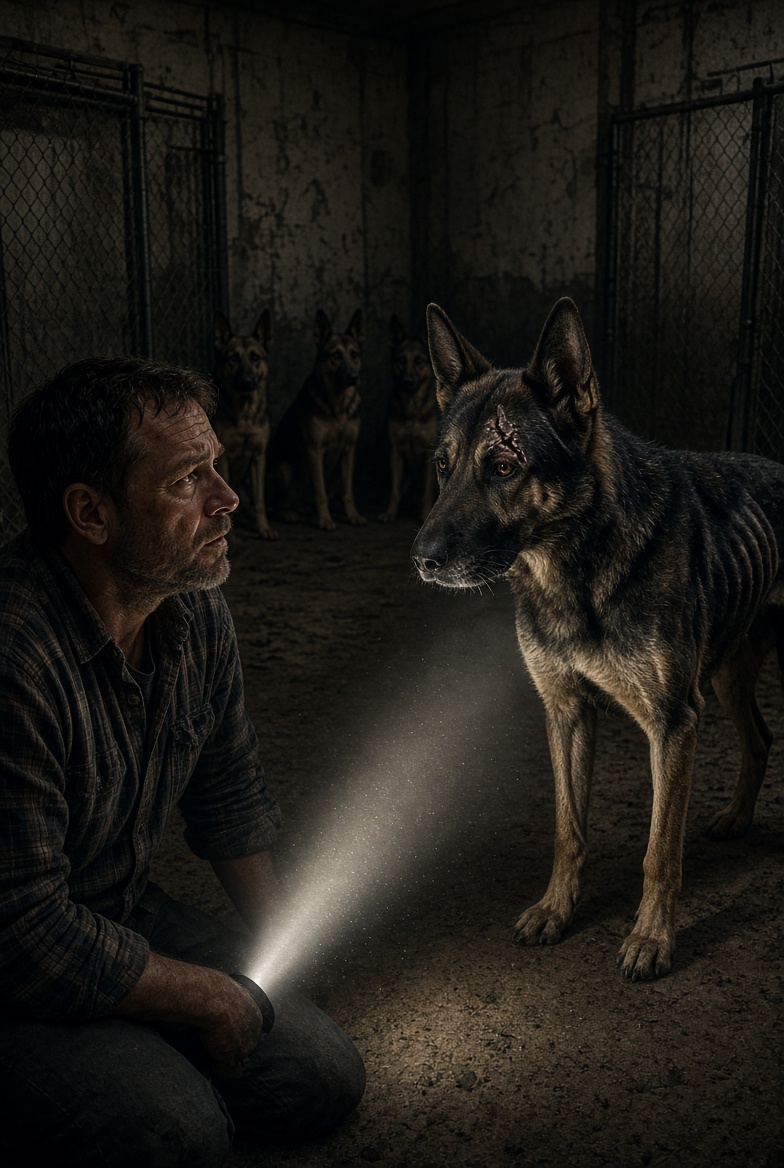
It came from behind a rusted steel door concealed beneath decades of moss, tangled blackberry vines, and rotting camouflage netting. When Jack finally broke the enormous padlock and stepped inside with his flashlight raised, five German Shepherds rose from their concrete kennels in perfect military formation.
They were starving, barely able to stand, yet not one of them barked.
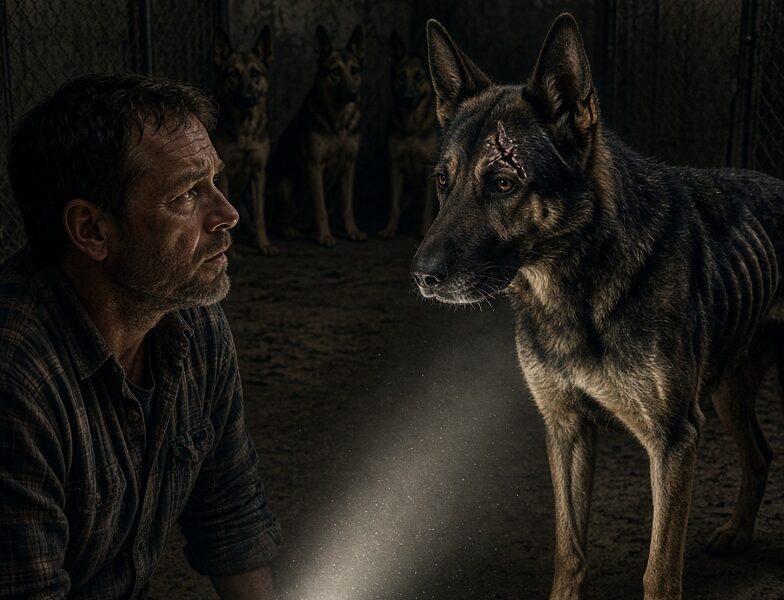
Then the largest dog stepped into the light, revealing a jagged scar above his left eye.
Jack stopped breathing.
Three years earlier, he had personally stitched that wound shut inside a Black Hawk helicopter over the Gulf of Aden. Hours later, the dog and his handler had supposedly died in a classified operation in Yemen.
The military had declared the dog killed in action.
Jack had attended the funeral.
Now the animal stood before him, trembling from starvation, waiting for a command only one man had ever taught him.
“Odin?” Jack whispered.
The German Shepherd lifted his head.
And in that instant, the quiet life Jack had fought so desperately to build disappeared before it had even begun.
Jack Harrison had not moved to the Missouri Ozarks to become a hero.
He had moved there to disappear.
After fifteen years as a Navy SEAL, fifteen years of classified deployments, sleepless nights, and missions whose details he would never be allowed to discuss, his medical discharge had felt less like retirement and more like exile.
His knees were damaged beyond repair.
The hearing in his right ear was permanently compromised, leaving him with a high-pitched ringing that became unbearable whenever the world grew too quiet.
Sleep was worse.
Whenever he closed his eyes, he found himself back inside places he had spent years trying to forget: narrow corridors, dust-filled rooms, aircraft vibrating beneath his boots, and the faces of men who had trusted him to bring them home.
Some had made it.
Others had not.
And there were nights when Jack could no longer remember which losses he had accepted and which ones he was still trying to bargain with.
So he bought forty acres of forgotten Missouri farmland at a county tax auction, sight unseen, and promised himself that he would never again answer a radio call.
The property had once belonged to a reclusive man named Hayden Pendleton, who had supposedly died of a heart attack two years earlier.
There were no surviving relatives willing to claim the land, no neighbors who knew much about him, and no obvious reason for anyone to care what happened to the place.
The county records showed an abandoned farmhouse, several acres of neglected pasture, and a few deteriorating outbuildings.
What they did not show was a hidden structure beneath the northern ridge.
That omission would eventually become the most dangerous detail in Jack’s life.
For the first three weeks, he lived out of a refurbished Airstream trailer parked beside the farmhouse.
He repaired what he could, cleared brush with a machete, hauled rotting timber away from the main cabin, and worked until exhaustion turned his thoughts into something resembling silence.
Fourteen hours of labor often bought him four hours of sleep.
It was not much, but he had learned to appreciate small victories.
He liked the property because nobody came looking for him.
The nearest neighbor was far enough away that Jack could run a chainsaw for half a day without attracting attention.
The county road was barely more than a pair of muddy tracks winding between oak trees and limestone outcroppings.
There was no reliable cell service, no traffic, and no reason to explain himself to anyone.
For a man who had spent much of his adult life being told where to go, what to do, and how much time he had to do it, the isolation felt almost luxurious.
Every morning, he brewed black coffee over a portable stove and drank it on the Airstream’s narrow steps.
Every evening, he checked the locks, listened to the wind move through the trees, and reminded himself that he was finished with the past.
He even began leaving his satellite phone powered off.
Then came the twenty-fourth morning.
Jack was clearing a northern ridge when he noticed that the terrain did not match the county survey.
The hillside rose too sharply in one section, and the drainage channels followed patterns that looked less natural than engineered.
He stopped swinging his machete.
For several seconds, he stood motionless, studying the slope.
Old instincts stirred beneath the layers of exhaustion and denial.
He had learned long ago that the most dangerous thing in an unfamiliar environment was the assumption that everything was exactly what it appeared to be.
He pushed through a wall of blackberry brambles.
His machete struck something solid.
The sound was a dull, hollow metallic knock.
Jack crouched and began pulling away vines with his gloved hands.
Beneath the moss and dead leaves lay a sheet of camouflage netting that had gradually become part of the forest floor.
Underneath it was a steel door.
The door had been built directly into the hillside, framed by reinforced concrete and protected by a commercial-grade deadbolt.
It was not a storm shelter.
The steel was too thick, the hinges too heavy, and the locking mechanism too elaborate for an ordinary underground cellar.
There were no power lines leading to it.
No visible ventilation pipes.
No tire tracks nearby.
Nothing suggested that anyone had visited the place recently.
Jack brushed the dirt from the door and found an industrial padlock nearly as large as his fist.
He studied it for a moment before leaning closer.
At first, all he heard was the familiar ringing inside his damaged ear.
Then came something else.
A faint, uneven rasp.
Breathing.
Jack straightened so quickly that his knee nearly gave out.
He stood perfectly still, waiting for another sound.
There it was again.
Someone—or something—was alive behind that door.
He ran back to his Airstream, collected a pair of thirty-six-inch bolt cutters and a crowbar, and returned with his sidearm secured in its holster.
The padlock resisted his first attempt.
Rust had fused parts of the mechanism together, and the thick metal handles bit into his palms as he applied pressure.
He adjusted his grip and tried again.
The shackle snapped with an explosive crack that sent birds scattering from the canopy.
Jack paused, listening.
Nothing moved inside.
He released the latch and pulled.
The door opened with a long, grinding groan.
The smell struck him first.
Ammonia, damp concrete, stale food, and the unmistakable odor of animals confined for far too long.
Jack covered his nose with his flannel collar and switched on his tactical flashlight.
Its beam cut through suspended dust and illuminated a chamber that extended much farther into the hillside than he had expected.
The underground structure measured roughly three thousand square feet.
Concrete flooring covered the entire room.
Cinder-block walls rose to a low ceiling supported by heavy steel beams, while a row of chain-link kennels occupied the far side.
Jack’s flashlight stopped moving.
Five German Shepherds stared back at him.
They were painfully thin.
Their ribs showed beneath dull, matted coats, and their hind legs trembled as they struggled to stand.
The water bowls were empty, coated in dust and cobwebs.
An automated food hopper hung above each kennel, but several mechanisms had jammed, and the remaining kibble was scattered across the floor.
Whatever had kept the dogs alive had stopped working weeks ago, perhaps longer.
Jack had seen neglected animals before.
He had never seen anything like this.
The dogs should have been barking, retreating, or lunging against their cages.
Instead, as his flashlight passed over them, each animal rose slowly and moved toward the front of its kennel.
They sat.
One after another, five exhausted German Shepherds arranged themselves in precise heel positions, their eyes following Jack with extraordinary concentration.
The silence was almost unbearable.
“Jesus,” Jack whispered.
He lowered his flashlight slightly.
The largest dog occupied the center kennel.
He was a black-and-tan male with a broad head, a powerful frame that starvation had reduced to sharp angles, and eyes that remained alert despite his obvious weakness.
The dog tried to stand a little straighter when Jack approached.
His back legs shook.
He refused to sit crookedly.
Jack recognized that stubbornness.
He had seen it in men who continued working after injuries that should have put them on the ground.
He had seen it in dogs trained to obey even when every instinct told them to conserve their remaining strength.
Most of all, he recognized the way the animal watched his hands.
Not his face.
His hands.
The dog was waiting for instructions.
Jack had no intention of approaching a starving animal carelessly, so he hurried outside and returned with a five-gallon jug of purified water and an old plastic bucket.
He poured a small amount into the bucket and carried it toward the largest kennel.
The dog followed every movement.
Jack opened the gate.
Nothing happened.
The Shepherd did not rush past him or attempt to escape.
He looked at the water, then at Jack.
A strange tightness formed in Jack’s throat.
He knew that look.
“Easy, buddy,” he murmured. “You’re safe for now.”
He placed the bucket on the concrete.
The dog did not move.
Jack took a breath.
“MPC break.”
The response was immediate.
The Shepherd lowered his head and began drinking, taking small, desperate gulps.
Jack watched carefully, allowing only a little water at a time.
After a short pause, he offered another small portion.
The dog drank, then looked up again.
Jack moved down the row.
Each kennel opened with a metallic rattle, and each dog waited for the same release command before approaching the water.
They were not merely obedient.
They had been trained to function under conditions in which a single uncontrolled movement could compromise an entire team.
Jack knew the training because he had spent years working alongside men and animals who had received it.
This was not a forgotten breeding kennel.
It was a holding facility for military-grade working dogs.
But who had brought them here?
And why had someone gone to such lengths to conceal them?
Jack spent the next three hours moving the animals from the underground structure to the main cabin.
He carried the weakest dogs whenever their legs gave out, stopping frequently to let them rest.
The largest Shepherd resisted being carried until Jack placed a steady hand against his shoulder and spoke in a low, familiar voice.
Only then did the animal allow himself to be lifted.
By the time Jack reached the cabin for the final trip, his damaged knee was throbbing and sweat had soaked through his shirt despite the cool morning air.
He laid heavy wool blankets near the wood stove, keeping the room warm without overheating the dehydrated animals.
Then he made the first call he had placed to anyone in nearly a week.
Dr. Dakota Jenkins operated a veterinary clinic about fifty miles away.
Her practice handled everything from injured livestock to emergency cases involving farm animals, and her advertisement promised weekend assistance for urgent situations.
Jack gave her the shortest explanation he could manage.
“I’ve got five German Shepherds in critical condition. Severe neglect, dehydration, possible malnutrition. I need you here as soon as you can get here.”
“Are they aggressive?” Dakota asked.
“Not with me.”
There was a brief silence.
“That’s not the same as saying they’re safe.”
“No,” Jack admitted. “It isn’t.”
“Keep them separated if you can. Don’t force food or water, and don’t let them exert themselves. I’ll bring what I need.”
Dakota arrived less than an hour later in a mud-splattered veterinary truck.
She stepped through the cabin door carrying a medical bag, took one look at the dogs, and stopped.
Her professional expression tightened.
“Oh, my God.”
She moved immediately.
The female Shepherd nearest the stove was severely dehydrated, and Dakota began assessing her condition while preparing fluids and checking the other animals for injuries.
She worked methodically, examining gums, monitoring breathing, and checking each dog’s temperature.
Jack remained close enough to help but far enough away to let her do her job.
After several minutes, Dakota straightened and looked at him.
“These animals need careful refeeding, fluids, and monitoring. Their bodies have been under tremendous strain. If we push them too quickly, we could make things worse.”
“Tell me what you need.”
“More blankets. A clean area for each dog. And if you have a vehicle with enough room, we may need to transport the most unstable ones to a hospital.”
Jack nodded.
He had spent years following medical instructions from combat medics who knew how to keep people alive when everything else had gone wrong.
He was not about to improvise with five animals who had already endured more than they should have.
Dakota returned to the largest Shepherd.
The dog had finished a small portion of boiled chicken and rice and was resting his head against Jack’s thigh.
His eyes were half-closed, but they opened whenever Dakota moved near him.
“He’s watching every person in the room,” she observed.
“He’s watching you because you’re moving around him.”
“Most frightened dogs watch the person they think might hurt them.”
“This one is watching to make sure you’re doing what you came here to do.”
Dakota studied Jack’s face.
“You know a lot about working dogs.”
“Enough.”
“Military?”
Jack did not answer immediately.
He glanced at the animal beside him.
Then he gently slid his leg out from beneath the dog’s head and stood.
The Shepherd immediately struggled to his feet.
Jack said nothing.
He simply raised his right hand, closed his fist, and tapped his chest twice.
The dog dragged himself forward, pressed his right flank against Jack’s left leg, and sat motionless.
His eyes began scanning the room.
Dakota stopped checking her medical supplies.
“What did you just do?”
“Silent rally command.”
“You didn’t say anything.”
“Didn’t need to.”
“Who taught him that?”
Jack looked down at the Shepherd.
“The United States Navy.”
Dakota stared at the dog again.
Then she looked at the scar above his left eye.
“Jack, what happened to him?”
Jack lowered himself onto one knee.
For a moment, he could not answer.
He reached toward the dog slowly, giving him time to pull away.
The Shepherd leaned forward instead.
Jack placed one hand against his cheek and traced the rough scar with the tip of his thumb.
He remembered the helicopter.
He remembered the smoke, the noise, and the smell of hot metal as the aircraft shuddered through the night sky.
He remembered a younger man named Wyatt Cole holding the dog steady while Jack stitched the wound shut.
And he remembered the last radio transmission from the operation that had supposedly taken both of them away forever.
“No,” Jack whispered.
Dakota crouched beside him.
“What is it?”
Jack gently lifted the dog’s right ear and turned it to expose the pale skin near its base.
He fetched his tactical flashlight.
There, faded but unmistakable, was a small blue identification tattoo.
MPC-884.
ODIN.
Jack’s flashlight slipped from his hand and struck the hardwood floor.
The sound made the other dogs lift their heads.
Dakota looked from the tattoo to Jack.
“Who is Odin?”
Jack swallowed.
“My teammate’s dog.”
He stared at the Shepherd, whose brown eyes remained fixed on his face.
“Three years ago, Odin and his handler were declared killed in action during a classified operation in Yemen. I saw the compound collapse. I was told there were no survivors.”
He paused.
Then he looked at Dakota.
“I attended Wyatt’s funeral.”
The room seemed to grow colder.
Dakota slowly lowered herself onto the edge of a chair.
“You’re saying this dog was officially dead?”
“I’m saying I watched him get buried in a report that was supposed to end the story.”
Jack reached for his satellite phone.
Because if Odin had survived, then somebody had lied about what happened in Yemen.
And if somebody had hidden a highly trained military dog beneath an abandoned farm in Missouri, Jack needed to know why.
He also needed to know who else might be aware that the dog was still alive.
He had spent three years trying to escape the past.
Now the past was lying on his cabin floor, breathing against his boots.
And Jack was about to discover that it had never stopped looking for him.
The satellite phone connected on the fourth attempt.
“Jack?” a familiar voice answered. “You know what time it is?”
“Late enough that I wouldn’t be calling if this could wait.”
Commander David “Sully” Sullivan had been Jack’s point of contact during his final years in the service. He was one of the few people Jack trusted to distinguish between a genuine emergency and a veteran struggling with memories he could no longer organize.
“What happened?”
“I found five military working dogs on my property.”
Sully exhaled.
“Jack, if this is about adopting animals, I can give you the number for—”
“One of them is Odin.”
Silence.
Jack looked at the dog lying beside the stove.
“He has the scar I stitched over his left eye. The tattoo matches his military identification. He’s alive, Sully.”
Three thousand miles away, in a fluorescent-lit office in Arlington, Virginia, Sully sat upright.
“That isn’t possible.”
“I thought the same thing.”
“The Yemen operation, Iron Resolve, was three years ago. The compound was struck after the extraction team reported a catastrophic compromise. Wyatt Cole was inside. Odin was inside. The intelligence report said the target was destroyed.”
“I know what the report said.”
“DNA identified Wyatt.”
“Human DNA identified Wyatt,” Jack corrected. “Nobody ever confirmed Odin’s remains. You told me yourself that the identification of the dog was an assumption.”
Sully said nothing.
Jack took a photograph of the faded tattoo and sent it through their old encrypted messaging system.
“Check your secure inbox.”
A few seconds passed.
Then Jack heard Sully inhale sharply.
“Where did you say you found him?”
“An underground barn. Reinforced concrete, hidden steel entrance, five chain-link kennels. The food dispensers were empty. The dogs have been there for months, possibly longer.”
“Who owns the property?”
“That’s what I need you to find out. The previous owner was Hayden Pendleton. He died two years ago, supposedly of a heart attack.”
Sully began typing.
Jack could hear the keys clicking through the satellite connection.
Then the sound stopped.
“Jack, Hayden Pendleton didn’t exist before 2018.”
Jack stood slowly.
“What?”
“His identity first appeared in government-linked records six years ago. The Social Security information, property records, tax documents—all of it looks legitimate at first glance, but the underlying history doesn’t hold up.”
“Who was he?”
“The man’s real name was Thomas Kesler. Former logistics director for Blackwood Executive Solutions.”
Jack recognized the name immediately.
Blackwood was a private military contractor known for providing transportation, security, and logistical support to clients who preferred not to ask too many questions about the details.
Over the years, Jack had heard rumors about its more questionable operations.
Equipment that disappeared between contracts.
Personnel who appeared on one roster and vanished from another.
Shipping manifests that never quite matched the cargo.
Nothing he had seen had connected Blackwood directly to the disappearance of a military working dog.
Until now.
“Why would a contractor steal military dogs?” Jack asked.
“Money. Access. Influence. Take your pick. A fully trained multipurpose canine represents years of specialized work and can cost tens of thousands of dollars to develop. To someone willing to sell that training to the wrong buyer, the value could be much higher.”
Jack glanced at the other four Shepherds.
“They were trained together.”
“Then they may have been part of a larger operation.”
“There’s more, Sully. Four others. Same discipline. Same training. Different markings.”
“Photograph every identification mark you can find. Don’t touch anything else in that bunker until we know what we’re dealing with.”
Jack looked at Odin.
The dog had raised his head, following the conversation as though the words themselves meant nothing but the tone meant everything.
“Somebody left them down there to die.”
“Jack, listen to me carefully. If Blackwood was involved, you may be dealing with a classified theft operation. Don’t investigate this yourself.”
“Who has been feeding them?”
“That’s what we’re going to establish.”
“Kesler died two years ago. The dispensers only recently ran dry. Somebody has been maintaining that place.”
“Then someone may already know the dogs are missing.”
Jack walked toward the window.
Outside, the Missouri woods were darkening beneath a cold, heavy sky.
“Sully, if they discover that the bunker has been opened, how long before they come back?”
“I can’t give you a reliable estimate.”
“Give me your best one.”
A pause.
“Assume they already know.”
Jack stared into the timberline.
That was all he needed to hear.
“Sully, get federal investigators involved. Preserve whatever records you can. But don’t send anyone here who doesn’t understand the situation.”
“I’ll contact the appropriate command channels. A federal tactical team can be assembled from Fort Leonard Wood if the threat is confirmed. Two hours, possibly less, depending on authorization.”
“Two hours,” Jack repeated.
“Stay inside. Secure the property. Don’t engage anyone. You hear me?”
Jack looked down at his hands.
For three years, he had believed that the worst thing that could happen to a soldier was surviving a mission that had taken his friends away.
Now he was beginning to understand that there were worse possibilities.
What if the people he had buried had never been given the chance to come home?
“I hear you,” he said.
It was not a promise.
Sully seemed to understand that.
“Jack, whatever you do, don’t go back into that bunker alone. And don’t let this turn into another mission.”
Jack ended the call without answering.
He placed the satellite phone on the counter and stood beside the stove.
Dakota was still awake, examining Odin’s paws and checking the bandage she had placed around one of his front legs.
“Well?” she asked.
“His identification is real.”
“And the people who put him there?”
“Possibly connected to a private military contractor.”
Dakota looked up.
“Should I call the police?”
“If you believe someone may be in immediate danger, yes. But we need to be careful about what we tell them until federal investigators arrive.”
She frowned.
“Jack, five dogs were abandoned in a bunker. Whatever else is happening, that’s a crime.”
“You’re right.”
He meant it.
He also knew that the situation might involve people who had the resources to make evidence disappear and the connections to turn an ordinary investigation into a complicated jurisdictional fight.
He was not going to pretend that he could solve all of it by himself.
For the first time since opening the hidden door, Jack allowed himself to consider the possibility that he might need help.
He began documenting everything.
Photographs of the bunker entrance.
Images of the kennels.
The damaged feeding systems.
The military identification tattoos.
The lock, the door, and the camouflage netting.
He recorded the approximate location and made a list of everything he remembered seeing.
Then he backed up the photographs through an encrypted connection and sent copies to Sully.
He was halfway through the inventory when Odin lifted his head.
The dog’s ears moved toward the front of the cabin.
Jack stopped typing.
“What is it, buddy?”
Odin rose slowly.
His legs trembled, but he remained standing.
He stared toward the front door.
A low rumble began deep in his chest.
Jack moved to the window and lifted the curtain by less than an inch.
Nothing.
Only trees, fog, and the narrow driveway descending toward the county road.
Then he noticed a faint reflection between two distant trunks.
A small glimmer of light.
It vanished almost immediately.
Jack released the curtain.
“Dakota.”
She looked up.
“Take the other four dogs into the bathroom. Bring your medical bag and your phone. Stay away from the windows.”
Her expression changed.
“Why?”
“Because someone may be on the property.”
She didn’t ask another question.
Jack moved toward the kitchen and checked the exterior cameras he had installed during his first week on the farm.
The driveway camera showed nothing but fog.
The camera overlooking the equipment shed had stopped transmitting.
He checked the time stamp.
The feed had gone dark less than three minutes earlier.
Then a sharp metallic crack echoed through the valley.
Jack froze.
He recognized the sound immediately.
A warning device he had placed across the lower driveway had been triggered.
Someone had crossed the perimeter.
He reached for his phone and called 911.
“My name is Jack Harrison. I’m at an isolated property in the Missouri Ozarks. I have reason to believe armed individuals may be approaching my residence. There are five injured animals inside, and a civilian veterinarian is with me. I need law enforcement assistance.”
The dispatcher began collecting his location and details.
Jack answered clearly, providing the road name, the nearest intersection, and the description of the vehicles he had glimpsed through the fog.
He did not exaggerate.
He did not speculate beyond what he could support.
Then he moved away from the windows and waited.
The first headlights appeared several minutes later.
Two black Chevrolet Tahoes climbed the muddy road, their tires slipping on the steep grade.
They stopped roughly fifty yards from the cabin.
Four men emerged from the first vehicle.
Four more followed from the second.
Their equipment was dark and unmarked.
They carried themselves with the coordinated movements of trained professionals, spreading out around the vehicles rather than clustering together.
Jack watched through the narrow gap in the curtain.
He knew that movement.
He knew the way the men checked their surroundings, the way they used the vehicles for cover, and the way their attention shifted between the cabin and the tree line.
These were not lost hunters.
They had come looking for something.
One man, broad-shouldered with a jagged scar across his jaw, raised a hand.
“Clear the cabin,” he ordered. “Secure the assets. If the new owner is inside, don’t let him interfere.”
Jack felt the last traces of warmth leave his body.
The word assets told him everything he needed to know.
They were not there to recover stolen property.
They were there to recover the dogs.
He moved away from the window, picked up his rifle, and checked his surroundings.
He could hear Dakota moving the other dogs into the bathroom.
Odin remained in the living room.
The Shepherd stood rigidly beside the kitchen island, staring at the door.
“Come here,” Jack whispered.
Odin turned his head but did not move.
Jack looked into those exhausted brown eyes.
“You’ve done enough.”
The dog gave a single, low whine.
For one brief moment, Jack remembered a different night, three years earlier, when Wyatt Cole had knelt beside Odin after a difficult extraction.
The dog had been injured and exhausted.
Wyatt had placed a hand on his head and told him to rest.
Odin had refused.
He had remained beside his handler until the last member of the team had reached the aircraft.
Jack understood the refusal now.
He could not ask the dog to abandon his post when Jack himself had spent years doing exactly the same thing.
Outside, a vehicle door slammed.
Boots crunched across gravel.
Jack moved toward the side entrance, keeping away from the exposed windows.
The next few minutes would determine whether the farm became a crime scene or the place where a buried secret finally came to light.
And somewhere beyond the fog, eight men believed they were about to retrieve five helpless animals.
They had no idea who had opened the door.
They had even less idea who was waiting inside.
The first shots shattered the morning silence.
Jack heard the sharp reports, the splintering of wood, and the crash of something heavy striking the porch.
He moved away from the cabin’s exposed side and toward the rear passage, trying to maintain awareness of the attackers’ positions without losing sight of the building.
The men outside were advancing from multiple directions.
He could not defend every entrance.
He could, however, keep them from reaching the animals without making themselves known.
A voice shouted from the porch.
“Police! Open the door!”
Jack recognized the deception immediately.
The men had not announced themselves as law enforcement when they first arrived, and the command came with none of the identification or procedure he would expect from legitimate officers.
He kept his voice low.
“Nobody move toward the hallway.”
The instruction was directed at Dakota, who had opened the bathroom door just enough to look out.
“Jack, I heard gunfire.”
“I know. Stay where you are.”
“Are you hurt?”
“No.”
“Then get away from the windows.”
She closed the door.
A heavy impact shook the front entrance.
The oak frame groaned.
Then the door gave way.
Two men entered the cabin, rifles raised, their boots scattering splinters across the floor.
“Clear!”
The first man moved toward the kitchen.
The second followed, checking the hall.
Neither noticed the Shepherd standing in the shadows beside the island until the dog moved.
Odin launched forward.
Despite his starvation, he struck the first intruder with enough force to knock him off balance.
The man’s rifle discharged into the ceiling.
Odin clamped onto his forearm and held on as the intruder struggled to regain his footing.
The second man turned toward the commotion.
Jack appeared behind him.
“Drop it!”
The contractor swung his rifle toward the sound.
Jack struck the weapon aside and forced the man away from the hallway, using the opening to separate him from the other attacker.
The man stumbled against the broken door frame and fell.
Jack kicked the rifle out of reach.
“Odin! Out!”
He used the German release command they had practiced years earlier.
Odin’s jaws opened.
For an instant, the dog stood motionless, breathing hard, his eyes fixed on the man beneath him.
Then his legs buckled.
He collapsed onto the hardwood floor.
Jack dropped beside him.
“Odin!”
The dog’s chest rose and fell rapidly.
His gums were pale, and his breathing had become shallow.
Dakota appeared at the bathroom doorway with her medical bag.
She saw the broken door, the injured men, and Jack kneeling beside Odin.
She did not waste time asking questions.
“Move back. Give me room.”
She dropped to her knees and began checking the dog.
Jack rose slowly, his face drained of color.
“Tell me what you need.”
“Warm blankets. Clean towels. And keep everyone away from him.”
Jack turned toward the two contractors.
The first man was clutching his injured arm.
The second was trying to sit up, visibly dazed.
Jack collected their weapons and moved them beyond reach.
“Who sent you?” he demanded.
Neither man answered.
Jack crouched in front of the one who appeared more alert.
“You’re going to tell me why you came here.”
The man shook his head.
“We were told the property was empty.”
“Who told you?”
“Blackwood.”
The name landed like a stone.
Jack glanced toward the open doorway.
Outside, engines were starting.
The remaining men had realized that their entry team was no longer responding as expected.
They were withdrawing.
Jack did not chase them.
He had five injured dogs, a veterinarian, two restrained intruders, and an emergency call already in progress.
He had no intention of turning an uncertain situation into a wider confrontation.
He returned his attention to the man on the floor.
“What is Blackwood trying to recover?”
The contractor swallowed.
“The dogs.”
“Why?”
“I don’t know all the details.”
“Then tell me the details you do know.”
The man hesitated.
Jack waited.
Finally, the contractor spoke.
“They call it the Lazarus Protocol.”
Jack’s expression did not change.
“Explain.”
“It’s an off-the-books program. Dogs declared dead during operations were recovered and transferred to private facilities. Some were intended for resale. Others were being evaluated for breeding and specialized training.”
“Who authorized it?”
“Blackwood command. I don’t know who signed the original contracts.”
“Who was Hayden Pendleton?”
The contractor looked up sharply.
“Kesler?”
“His real name was Thomas Kesler.”
The man’s face tightened.
“He was one of the logistics directors. He managed transportation and storage.”
“Why was he keeping the dogs in my bunker?”
“I don’t know why he chose that location. I only know he maintained the site until he died.”
Jack looked toward Odin.
Dakota had wrapped the dog in a thermal blanket and was carefully monitoring his breathing.
“Why did you come back now?”
“The site went dark. We were supposed to retrieve the remaining animals and transfer them to another facility.”
“Because they were starving?”
The contractor looked away.
“Because the equipment failed.”
Jack stared at him.
The answer was so casual that it frightened him more than an outright denial would have.
“How many animals?”
The man hesitated again.
“At the main facility? I don’t know the exact number.”
“Give me your best estimate.”
“More than eighty.”
Jack’s eyes narrowed.
“Where?”
The contractor shook his head.
“I don’t have the coordinates. I handle transportation, not facility security.”
“Who does?”
“Director Sterling.”
“Where is he?”
“I don’t know his exact location.”
Jack leaned closer.
“You came here with eight armed men. You broke into my house. You tried to take five starving animals. You can do better than that.”
The contractor looked at the floor.
“West Virginia. Near a town called Marlinton. Old coal-mining property in the Appalachian foothills. That’s where the dogs were being moved.”
Jack went very still.
“Who else is being held there?”
The man hesitated long enough to answer the question without speaking.
Jack felt the room tilt.
“There’s a handler,” he said.
The contractor’s eyes widened.
Jack caught the reaction.
“Wyatt Cole.”
The man’s face changed.
He looked genuinely frightened now.
“How do you know that name?”
Jack grabbed the front of his tactical vest.
“Because I buried him.”
The contractor swallowed hard.
“He isn’t dead.”
Jack released him.
For several seconds, he could hear nothing but the ringing in his damaged ear and the sound of Dakota speaking quietly to Odin.
“Tell me exactly what happened in Yemen.”
The contractor shook his head.
“I wasn’t there.”
“Then tell me what you were told.”
“They recovered the dog and the handler before the compound was destroyed. The operation was supposed to look like a complete loss. The handler was transferred to the breeding facility because the dogs wouldn’t work properly with anyone else.”
Jack felt the blood drain from his face.
“You’re telling me Wyatt has been alive for three years?”
“Yes.”
“Where is he?”
“Marlinton. I swear that’s all I know.”
Jack released the man’s vest and stepped backward.
He had spent three years waking from dreams in which Wyatt was still trapped beneath the collapsed building.
He had spent three years wondering whether he could have done something differently.
He had carried the guilt because guilt had been easier than accepting that some losses could never be explained.
Now he was being told that the man he had mourned might still be alive.
Not merely alive.
Held somewhere in the mountains by the same people who had hidden Odin beneath a forgotten Missouri farm.
Jack looked toward the stove.
Odin had closed his eyes.
Dakota was still beside him, checking his breathing and adjusting the blanket.
“How long would it take to get there?” Jack asked.
“From here? Eleven hours, maybe twelve.”
Jack looked down at the contractor.
“You’re going to stay here until law enforcement arrives. You will not touch the animals. You will not attempt to contact anyone. Do you understand?”
The man nodded.
Jack turned toward the kitchen counter.
His satellite phone had begun to vibrate.
Sully was calling back.
Jack answered.
“Tell me you’re safe,” Sully said.
“I’m alive.”
“That isn’t what I asked.”
Jack looked at the shattered front door.
“Eight men came to the property. Two are injured and in custody until local law enforcement arrives. The others withdrew. I called 911.”
“Good. Keep it that way. Federal teams are being assembled, and state authorities have been notified. Don’t leave the property.”
Jack looked at Odin.
“There’s another problem.”
“What?”
“Wyatt is alive.”
The silence on the other end lasted so long that Jack checked the connection.
Then Sully spoke.
“Who told you that?”
“One of the men who came for the dogs. He says Blackwood recovered Wyatt before the strike in Yemen. They’ve held him at a facility near Marlinton, West Virginia.”
Sully’s voice became very quiet.
“Jack, do not make any decisions until we can verify that information.”
“I intend to verify it.”
“Not by going there yourself.”
Jack closed his eyes.
He could already hear the rest of the conversation.
The warnings.
The instructions to wait.
The reminders that a classified operation could not be handled by one retired operator with a damaged knee and a personal connection to the case.
Sully would be right about all of it.
That did not make the information any easier to accept.
“Send me what you can,” Jack said. “Names, property records, anything connected to Blackwood.”
“Jack—”
“I’ll remain available.”
He ended the call.
For several minutes, he stood alone in the kitchen, staring at the broken door.
Then he returned to Odin.
The dog opened his eyes when Jack knelt beside him.
“I’m sorry, buddy,” Jack whispered.
Odin’s tail moved once beneath the blanket.
Jack rested a hand against the dog’s head.
“I thought I had lost you both.”
The Shepherd looked at him without moving.
Jack could not know what Odin understood.
But he knew the dog recognized his voice.
And that recognition was enough to break something open inside him.
For the first time in three years, Jack allowed himself to imagine Wyatt walking through a doorway.
Not in a photograph.
Not in a memory.
Alive.
The possibility was terrifying because it demanded something Jack had not wanted to give anyone since his discharge.
Hope.
Outside, the Missouri wind swept across the pasture, carrying away the last traces of gun smoke.
Inside, five dogs slept beneath wool blankets while a veterinarian worked to stabilize the weakest among them.
And Jack Harrison made a decision that would take him far beyond the quiet life he had bought for himself.
He would not abandon Wyatt Cole to another day in captivity.
But he would not make the mistake of believing that courage alone could solve what had happened.
He needed evidence.
He needed the truth.
And he needed to bring his friend home without sacrificing the lives of the animals who had already suffered enough.
By midnight, the first law enforcement vehicles were climbing the driveway.
Jack stepped onto the porch and raised his hands where the approaching officers could see them.
He identified himself, explained the situation, and directed them toward the injured men.
He told them where the weapons had been secured.
He showed them the photographs of the hidden bunker and provided the location of the steel entrance.
He made no attempt to conceal his involvement.
When a deputy asked why the attackers had come, Jack answered plainly.
“They were trying to recover stolen military working dogs.”
The deputy looked toward the cabin.
“All five?”
“All five.”
“And you believe there are more?”
“At least eighty, according to one of the men. Possibly more.”
The deputy exchanged a glance with his partner.
“You’re going to need to tell federal investigators everything you know.”
“I intend to.”
An ambulance arrived for the injured men, and Dakota accompanied the weakest Shepherds to her clinic after determining they could be transported safely.
Before leaving, she crouched beside Odin and checked his breathing one final time.
“He’s not out of danger,” she told Jack. “He needs continued monitoring and specialist care. But he’s responding.”
Jack nodded.
“Thank you.”
Dakota rested a hand against Odin’s neck.
“You did your job, big guy. Now let us do ours.”
Odin’s ears moved at the sound of her voice.
Jack watched the veterinary truck disappear down the driveway.
Then he turned toward the officers waiting beside the porch.
The farm was no longer a place where nobody knew his name.
It was now the starting point of a federal investigation, a suspected trafficking operation, and a mystery that reached back to one of the worst nights of his military career.
Yet none of that changed the promise he had made to himself.
He would bring Wyatt home.
And when the time came to face the people who had stolen three years from his friend, he would make sure the truth survived long enough for the world to see it.
The road to West Virginia would be long.
The people waiting there would be dangerous.
But Jack Harrison had spent fifteen years learning that the hardest missions were rarely the ones that began with a gun in your hand.
Sometimes, the hardest mission was deciding that someone else’s life was still worth fighting for when every part of you wanted to stop.









