He Only Planned to Keep the Puppy for a Few Days… Then a Silent Girl Started Laughing Again
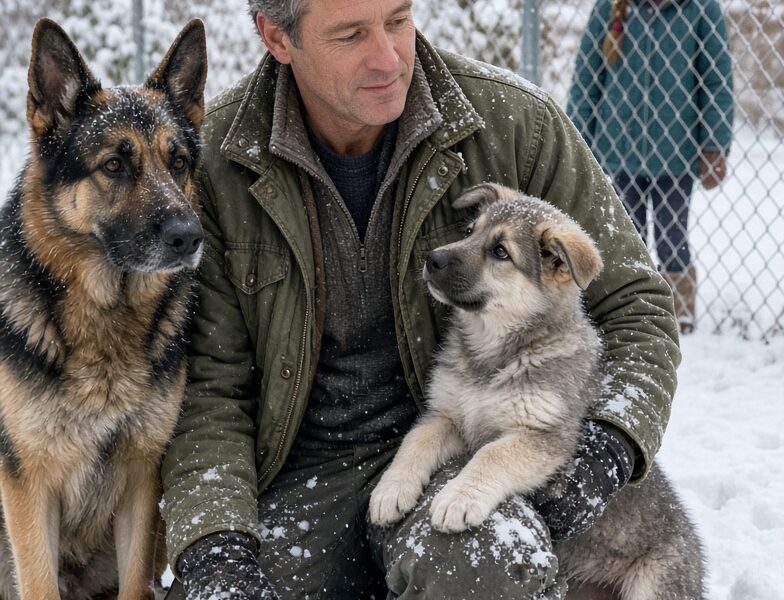
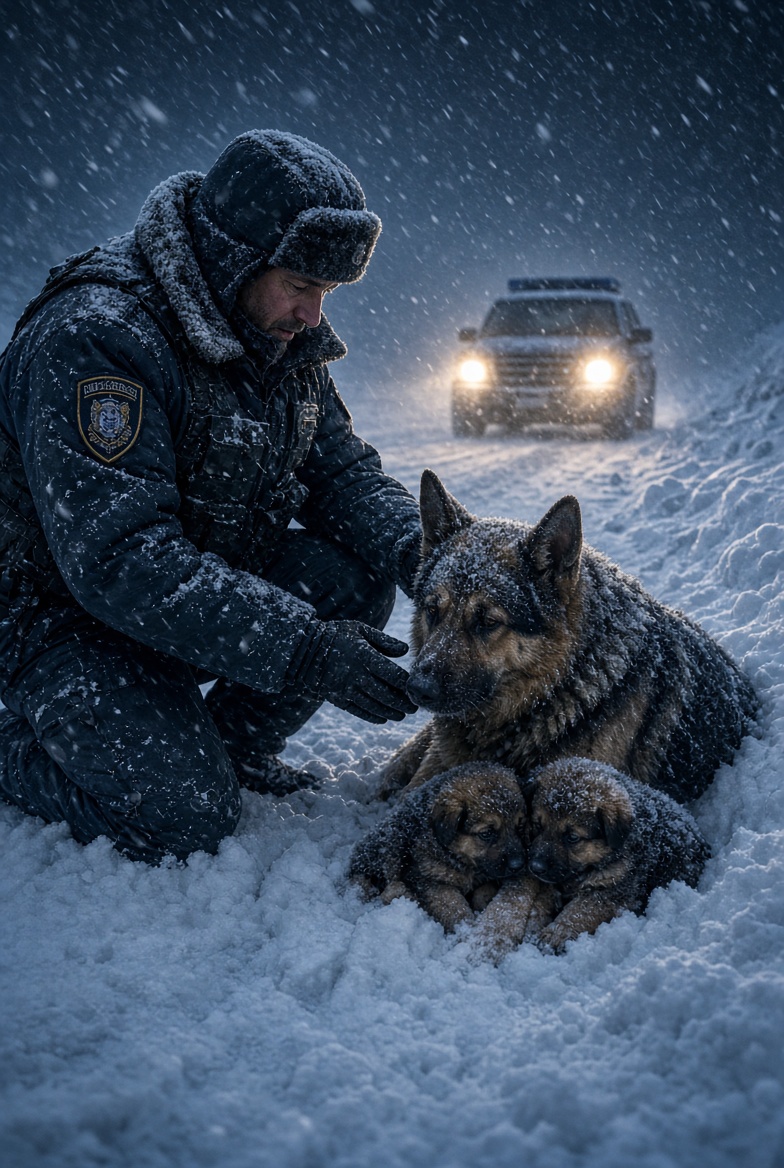
Beneath a snow-crusted delivery trailer in Pine Glass, Minnesota, a shivering German Shepherd puppy barked at the only man willing to crawl close enough to help him: Mason Rourke, a guarded former Army medic.
Mason planned to keep the loud little dog for only a few days.
Instead, Nico invaded his home, stole his gloves, challenged his calm older Shepherd, Atlas, and even protested every time Atlas received the larger dinner portion.
But the puppy’s greatest disruption came next.
Across the fence lived ten-year-old Layla, a girl who had stopped trusting winter after a frightening road accident.
As Nico failed, barked, tried again, and refused to be ashamed of mistakes, Layla slowly began doing the same.
Mason thought he was rescuing a homeless puppy.
He never imagined that Nico would quietly teach an entire household how to live again.
By the last week of January, Pine Glass had been buried so thoroughly beneath snow that the little Minnesota town seemed less built than carved out of winter.
The lake beyond Main Street had frozen into a broad sheet of pale blue, and the morning sun caught every ridge of windblown snow until the whole shoreline glittered.
Roofs wore thick white caps.
Chimneys breathed slow columns of smoke into a sky so clear it looked brittle.
Even the tire tracks along County Road 12 had frozen into neat gray grooves.
At 6:45 every morning, Mason Rourke cleared his front steps.
Not 6:40, not 7:00.
6:45.
Atlas usually watched from the doorway.
The seven-year-old German Shepherd had the kind of stillness that made strangers lower their voices around him without knowing why.
He was large, black and rich tan, broad through the chest with a small V-shaped notch along the outside edge of his left ear, and the first few silver hairs beginning beneath his chin.
He could stand motionless for so long that snow sometimes settled across his back before he bothered shaking it off.
Mason had once told a customer Atlas was patient.
The customer had looked at the dog, then at Mason, and said, “No, that dog looks retired.”
Mason had almost smiled.
Almost.
At forty-four, Mason still carried the physical economy of the Army years he rarely discussed.
He was tall, broad-shouldered without looking bulky, his body built more from repetition and endurance than from mirrors and gym equipment.
His chestnut hair had begun silvering slightly at the temples, and a natural wave prevented it from ever lying as neatly as the rest of his life.
His face was clean-shaven, long and angular, with hazel eyes that could look green in winter light and brown beside a fire.
He wore the same faded OCP field jacket most days, stripped of name tape and insignia years ago, over a charcoal thermal shirt and old combat trousers.
On his left wrist sat an analog watch with a worn olive canvas strap.
Everything Mason kept had a purpose.
The garage behind the house proved it.
Wrenches hung by size.
Sockets sat in labeled drawers.
Replacement belts for snowblowers occupied one wall.
Generator parts, another.
A whiteboard beside his workbench showed customer names, equipment models, promised dates, and parts on order in lettering so precise it looked typeset.
Nothing was where it should not be.
Nothing surprised him.
That was intentional.
After the Army, Mason had learned there were people who missed noise, movement, urgency, the strange clarity of being needed every minute.
Mason did not.
Or at least that was what he told himself.
What he missed was certainty.
In the field, questions had demanded answers.
A person was stable or not.
A route was open or closed.
Supplies were available or they were not.
Decisions could be terrible, but they had shape.
Civilian life had turned out to contain far too many questions whose answers were “maybe” — maybe this repair would hold another season, maybe somebody meant what they said, maybe you could care about someone and still fail them.
Mason had developed his own solution.
Do what you knew how to do.
Do it well.
And whenever possible, never become the person someone could not manage without.
Atlas had been exempt from that rule.
Dogs were simpler.
At least Mason had believed so.
That Thursday morning, the snowfall thickened just after nine.
Mason needed a carburetor gasket for an elderly snowblower belonging to Mr. Haney on Birch Street.
And since Mr. Haney had called twice before breakfast to remind Mason that weather does not wait for machinery, Mason pulled on his gloves and drove into town.
Pine Glass Hardware and Supply sat at the corner of Main and Second in a low brick building with a red awning half buried under snow.
A delivery trailer stood behind it, backed toward the loading doors.
Snow had drifted beneath the trailer in soft white ridges.
Mason had just stepped out of his truck when he heard a bark.
He stopped.
It came again.
Too sharp for Atlas.
Too loud for anything that small.
Mason walked around the rear of the trailer and crouched.
Two dark eyes stared back from beneath the axle.
The puppy was wedged between a tire and a bank of snow.
Not trapped, exactly, but clearly unconvinced that emerging was a good idea.
He was perhaps four months old.
German Shepherd.
Dark silver sable fur dusted with snow.
Front paws ridiculously large.
One ear stood upright with serious determination.
The other made it about two-thirds of the way and then tipped outward as if it had reconsidered the commitment.
The puppy barked again.
Mason leaned back slightly.
“You are loud.”
The puppy barked a third time.
“Yes, I heard you.”
A metal door opened behind Mason.
“Been doing that twenty minutes,” called Glenn Porter, the hardware manager.
“I put water out. He yelled at the bowl.”
Mason looked over his shoulder.
“Where’d he come from?”
“Wish I knew. Delivery guy noticed him when he backed in.”
Glenn zipped his coat higher.
“Called animal rescue. Roads north of town are bad, and their volunteers are stuck waiting on a plow.”
The puppy growled softly.
Not threatening.
More like commentary.
Mason removed one glove and held out his hand, palm low.
The puppy sniffed the air.
“You planning to come out?”
No movement.
“All right.”
Mason remained where he was.
Thirty seconds passed, then a minute.
Snow ticked softly against his jacket.
Eventually, the puppy stretched his neck forward, sniffed Mason’s fingers, retreated, reconsidered, then crawled out with a solemn expression of someone convinced the decision had been entirely his own.
He stood beside Mason’s boot.
His head barely reached Mason’s knee.
Then he barked at him.
Glenn laughed.
“Oh, he likes you.”
“That is not what this looks like.”
Ten minutes later, Mason was sitting in his truck with a German Shepherd puppy in the passenger footwell.
The puppy had refused the cardboard box Glenn offered.
He had also attempted to chew Mason’s glove.
Mason retrieved it.
“No.”
The puppy stared at him.
Then chewed the edge of the floor mat.
“No.”
The puppy moved to Mason’s boot lace.
Mason closed his eyes for one second.
“This arrangement is temporary.”
The puppy sneezed.
Dr. Tessa Wren’s clinic occupied a renovated house two blocks from the elementary school.
By the time Mason carried the puppy through the front door, he had accumulated snow on both shoulders and a strand of silver-gray fur across his field jacket.
Tessa looked up from behind the counter.
Her dark curls framed her face in a compact bob, and forest-green scrubs showed beneath a charcoal quilted jacket.
A stethoscope hung around her neck with a tiny paw-print tag clipped near the tubing.
She looked at Mason, then at the puppy, then back at Mason.
“No.”
Mason frowned.
“I haven’t asked anything.”
“You have the face you make before pretending something is not your problem.”
“This actually isn’t my problem.”
The puppy barked.
Tessa nodded.
“Compelling counterargument.”
She scanned for a microchip.
Nothing.
She checked his paws, ears, eyes, and teeth, listening to his chest while the puppy attempted to investigate the stethoscope with his mouth.
“No obvious concerns,” she said.
“Cold, hungry, probably exhausted. No tag, no chip.”
“So the rescue can take him?”
“Eventually.”
Mason’s eyes narrowed.
Tessa continued before he could object.
“We’ll post him through the county system, local pages, shelters, veterinary offices. There’s a required hold period before anybody can claim him permanently.”
“Good.”
“But our foster homes are full this week.”
Silence.
Tessa looked at him.
Mason looked at Tessa.
The puppy sat between them and began chewing his own leash.
“No.”
“You have space.”
“I have Atlas.”
“Atlas likes dogs.”
“Atlas tolerates dogs.”
“Same thing at seven.”
“I work.”
“You work behind your house.”
“He’ll destroy things.”
Tessa glanced at Mason’s field jacket.
“Then perhaps you’ll finally learn whether anything you own can survive being slightly out of place.”
Mason stared at her.
Tessa smiled.
Twenty-five minutes later, Mason walked out of the clinic carrying a bag of puppy food, a packet of instructions, and the growing conviction that he had been manipulated.
The small dog bed was his own fault.
So were the new gloves.
He had purchased those at the feed store next door after discovering the puppy had somehow pulled one of his old gloves beneath the passenger seat and chewed the thumb into a wet, useless shape.
Mason loaded everything into the truck.
The puppy sat in the passenger seat wearing a temporary collar.
“You’re staying until they find your people.”
The puppy tilted his head.
“That’s all.”
The puppy placed one oversized paw on the center console.
Mason removed it.
“Boundaries.”
The paw returned.
Mason looked through the windshield at the falling snow.
“This is already going badly.”
Atlas met them at the back door.
For several seconds, neither dog moved.
Atlas stood inside.
The puppy stood outside.
Atlas lowered his head slightly.
The puppy’s crooked left ear twitched.
Mason loosened the leash and let them observe each other.
Atlas sniffed.
The puppy sniffed back.
Then, without warning, the puppy barked directly into Atlas’s face.
Atlas blinked.
Mason waited.
Atlas looked at Mason.
It was not an aggressive look.
It was worse.
It was the exhausted expression of someone who had trusted management and now regretted it.
“Don’t start,” Mason said.
The puppy barked again.
Atlas turned and walked away.
That should have been the first warning.
Within forty minutes, the puppy had stolen one sock from Mason’s laundry basket, dragged a kitchen towel into the hallway, and climbed halfway onto Atlas’s bed before losing his balance and rolling onto the floor.
Atlas watched everything.
When the puppy discovered the box of clean shop rags in the mudroom, he climbed directly inside, turned three circles, and fell asleep.
Mason found him there ten minutes later.
“You have a bed.”
One honey-brown eye opened.
Mason pointed toward the dog bed in the kitchen.
“That cost thirty-eight dollars.”
The eye closed.
“Fine.”
By late afternoon, Mason had begun calling him Nico.
He told himself it was simply more efficient than saying “puppy” every seven minutes.
Atlas did not seem convinced.
At dinner, Mason prepared both dogs’ food.
Atlas received his usual portion plus several pieces of cooked beef left from Mason’s own dinner.
Nico received puppy food and one small piece of beef cut into appropriate bites.
Mason placed the bowls on opposite sides of the kitchen.
Atlas sat calmly.
Nico vibrated.
“Wait.”
Atlas waited.
Nico sat for nearly half a second, stood, sat again, shuffled both front feet, and produced a small impatient sound.
Mason lowered the bowls.
“Okay.”
Atlas moved to his meal.
Nico attacked his own as though somebody might repossess it.
Then halfway through, he stopped.
Slowly, his head lifted.
His eyes moved to Atlas’s bowl, then back to his own, then again to Atlas.
Mason leaned against the counter.
Nico studied the larger pieces of beef with the stunned expression of a citizen discovering government corruption.
The puppy turned fully toward Atlas and barked.
Atlas kept eating.
Nico barked again.
Atlas paused.
He raised his head.
The two dogs stared at one another.
Nico looked toward Atlas’s bowl, then toward his own, then back at Atlas.
Bark.
Atlas looked at Mason.
Mason pressed his lips together.
“No.”
Nico barked louder.
Atlas returned to dinner.
The puppy marched two steps closer and launched into an indignant series of complaints, every bark seemingly designed to explain in detail how profoundly unfair the distribution system had become.
Atlas stopped chewing.
His expression remained calm, but something about his eyes suggested he had reached a philosophical limit.
Mason felt it first in his chest.
A small pressure.
Then a breath escaped through his nose.
He tried to stop it.
Nico barked once more.
Atlas slowly looked at Mason again, and Mason laughed.
Not the quiet exhale he sometimes offered customers when they made a decent joke.
Not the polite sound used to end a conversation.
A real laugh.
It surprised him so completely that he had to set one hand against the counter.
Nico stopped barking.
Atlas stared.
Mason laughed harder.
For several seconds, the kitchen filled with it.
Then the sound faded, and Mason became aware of the room.
The clock above the stove ticking.
The refrigerator humming.
Snow whispering against the dark window.
Atlas standing beside his bowl.
Nico sitting upright with one ear straight and the other tilted absurdly sideways.
Mason’s smile remained, but something beneath it tightened.
He could not remember the last time laughter had sounded like that in this house.
Not through a television.
Not from somebody on the phone.
From him.
Nico gave one softer bark, apparently unwilling to let the original dispute disappear entirely.
Mason looked down.
“Your portion is correct.”
Nico stared at him.
“Appeal denied.”
Atlas resumed eating.
That night, the temperature dropped below zero.
Mason checked the locks, turned down the thermostat, and made one final walk through the kitchen before bed.
The new dog bed was empty.
So was the box of shop rags.
He found Nico in the living room.
Atlas lay near the wood stove, stretched on one side.
The puppy had curled himself against Atlas’s front legs, nose tucked beneath one enormous paw.
Atlas was awake.
His amber eyes followed Mason into the room.
Mason folded his arms.
“Don’t get attached.”
Atlas blinked.
“He’s staying a few days.”
Atlas lowered his head again.
Mason waited.
The old dog could easily have moved to his usual place near the hallway.
He did not.
Nico shifted in his sleep and pressed closer.
Atlas remained exactly where he was.
Outside, snow continued falling over Pine Glass, smoothing the roads, the fences, and every sharp edge beneath a clean white silence.
Inside, for the first time in years, Mason Rourke’s house was no longer completely quiet.
By the fourth morning, Nico had developed a working theory of Mason Rourke’s garage.
Anything below knee height belonged to Nico.
Anything above knee height had simply not fallen down yet.
Mason discovered this philosophy at 7:12 on Monday morning when he came through the connecting door carrying coffee and found the German Shepherd puppy standing with both front paws inside an open tool drawer.
“Nico.”
The puppy froze.
A shop rag hung from his mouth.
Across the garage, Atlas lay beneath the wall-mounted heater with his head between his paws.
The older German Shepherd opened one amber eye, confirmed that the situation did not require him, and closed it again.
Mason set down his coffee.
“Drop it.”
Nico tightened his grip.
“That’s not how that word works.”
Nico backed away.
Mason took one step forward.
Nico ran.
The puppy shot between a snowblower and a workbench, silver-sable body bending around corners with an agility his oversized paws had not yet earned.
The shop rag streamed behind him like a victory flag.
Mason stopped chasing after three steps.
He had already learned that lesson.
Nico appeared on the other side of the workbench and stared at him.
Mason stared back.
“You’re going to make me regret naming you.”
Nico shook the rag.
Atlas sighed.
The sound was so deeply weary that Mason looked over.
“You’re not helping.”
Atlas did not move.
Four days earlier, the garage had contained only the sounds Mason expected.
Ratchets clicking, engines turning over, the low furnace hum, an occasional radio station drifting beneath it all.
Now there were puppy nails on concrete, barks at cardboard boxes, the mysterious collapse of objects Mason had been certain were stable, and every few hours a message from Dr. Tessa Wren.
The rescue group had posted Nico’s photograph across county shelter pages, veterinary offices, and local community boards.
Mason had received a copy of the listing because Tessa apparently believed he needed proof that somebody was trying to remove the animal from his life.
“Found. Male German Shepherd puppy. Pine Glass area. Proof of ownership required.”
No calls had led anywhere.
One person insisted Nico resembled a dog lost two years earlier.
Another wanted to know whether Mason was giving him away if nobody claimed him.
Tessa handled those conversations.
Mason preferred carburetors.
On Tuesday afternoon, he drove Nico back to the clinic for the vaccinations appropriate for his age and another checkup.
Tessa examined the puppy while Nico attempted to climb into her lap and investigate every pocket of her charcoal veterinary jacket.
“He’s gained a little weight,” she said.
“He eats like he’s preparing for winter.”
“He is in winter.”
“You know what I mean.”
Tessa glanced toward Mason.
“Still no confirmed owner.”
“Good.”
She paused.
Mason immediately corrected himself.
“I mean good that nobody has shown up with a legitimate claim after neglecting to identify him.”
“Of course.”
“That was clearly what I meant.”
“Obviously.”
Nico put one paw against Tessa’s shoulder.
She scratched under his chin.
“The hold period still has to run its course. Until then, you’re fostering him, not adopting him.”
“I know.”
“No permanent decisions.”
“I know.”
“No assuming he’s yours.”
Mason looked at her.
“Tessa.”
She smiled.
“Just checking.”
On the drive home, Nico slept with his head against the passenger seat, entirely unconcerned by the legal uncertainty surrounding his future.
Mason envied him that.
Back at the house, Atlas sniffed Nico from nose to tail before allowing him through the kitchen.
“Apparently, you have been missed,” Mason said.
Atlas walked away.
Nico followed.
Within minutes, both dogs disappeared into the garage.
The new routine settled around them without Mason’s permission.
He worked.
Atlas rested beneath the heater.
Nico investigated civilization.
A red plastic funnel occupied him for seventeen minutes.
A cardboard shipping tube lasted nine.
A rolling stool became an enemy after it moved when he put both paws on it.
But the place Nico loved most was the far side of the yard.
A chain-link fence separated Mason’s property from the neighboring house.
A pale blue two-story place with white trim and a narrow back deck.
Snow had piled nearly halfway up the bottom section of the fence, leaving drifts soft enough for Nico to plow through with his chest.
The first time Mason noticed him there, the puppy was standing perfectly still.
That alone was suspicious.
Mason looked up from the generator carburetor spread across his workbench.
Nico faced the fence.
His tail moved slowly.
Beyond it, behind the neighboring kitchen window, stood a girl.
Mason had seen her before, though only in fragments.
A backpack disappearing through the side door on school mornings.
A burgundy knit hat above the passenger window of a dark crossover.
A slim figure beside the mailbox.
She was perhaps ten, with auburn hair usually braided over one shoulder and a face pale enough in winter that the freckles across her nose stood out clearly.
Now she watched Nico through the glass.
Nico lowered his front half toward the snow.
His rear stayed high, tail wagging.
The girl did nothing.
Nico jumped sideways.
Nothing.
He dug both front paws into the drift and sent powder over his own face.
Still nothing.
Then he sneezed.
The girl remained motionless.
Mason returned to the carburetor.
He had spent enough years around people to recognize the difference between someone who wanted company and someone who wanted to observe it from a safe distance.
Nico possessed no such restraint.
The next afternoon he went back.
This time the girl was outside.
She wore a dark teal parka, camel-colored snow boots, and a burgundy beanie.
A cream mitten rested on the top rail of the fence while she stood several feet away.
Nico saw her.
His entire body changed.
He galloped toward the fence, reached a mound of snow, attempted to leap over it, and stopped halfway.
His front legs landed on one side, his back legs remained on the other.
His belly rested across the top of the drift.
For two solemn seconds Nico appeared to consider pretending this was intentional.
Then his rear paws kicked uselessly.
A sound came from beyond the fence.
Small, brief, almost lost beneath the whine of Mason’s garage heater.
A laugh.
Mason was crossing the yard with a metal toolbox in both hands.
He stopped.
The girl covered her mouth immediately, as if the sound had escaped without permission.
Nico continued paddling.
Another laugh came out, longer this time.
Mason looked toward the blue house.
A woman stood inside the back door.
She was watching, too.
Her expression changed when she heard her daughter.
Not dramatically.
There was no gasp, no hand pressed to the heart, just a softening around the eyes followed almost immediately by something more cautious.
Hope, Mason thought, could make people careful.
It gave them something else to lose.
He set down the toolbox and walked toward Nico.
Before he could help, the puppy finally wriggled free, tumbled down the near side of the drift, and vanished briefly into powder.
His head popped up, one ear straight, the other tilted, snow covering his muzzle.
The girl laughed again.
Nico barked.
She stopped.
The puppy wagged.
Mason pointed toward him.
“That was working until you started talking.”
The girl’s mouth twitched.
From then on, Nico began checking the fence every afternoon.
Sometimes the girl was there.
Sometimes she wasn’t.
Atlas eventually followed him, though Atlas approached the situation the way Atlas approached nearly everything, with the assumption that unnecessary enthusiasm was a character flaw.
The older German Shepherd did not press against the fence.
He sat six feet back, still, quiet, watching.
The girl noticed.
Mason could see it in the way her attention shifted between the two dogs.
Nico demanded to be seen.
Atlas made room to be approached.
Several days later, the woman from the neighboring house came around to Mason’s driveway.
She was thirty-something, perhaps a little younger than Mason, with honey-dark blond hair brushing her collar and a camel-colored winter coat over a charcoal turtleneck.
She held a pair of cream gloves in one hand.
“Mason Rourke?”
He set down the snowblower belt he had been examining.
“Yes.”
“Jenna Monroe. Next door.”
They had exchanged waves before, nothing more.
Mason wiped his hand on a rag before shaking hers.
“Your puppy has apparently started a diplomatic relationship with my daughter.”
“He’s not technically my puppy.”
Jenna glanced through the open garage door.
Nico was sleeping upside down in the new bed Mason had insisted he did not need.
“Of course. Temporary foster. I see.”
Mason disliked that Tessa and Jenna had somehow developed the same tone despite never meeting.
Nico woke, spotted Jenna, and ran toward her before Mason could stop him.
Jenna waited rather than reaching down.
Nico sniffed her boot, then her hand.
Only after he nudged her fingers did she scratch lightly beneath his chin.
“You’re learning,” Mason said.
“My daughter used to correct me.”
The words carried something beneath them.
Mason did not ask.
Jenna looked toward the fence.
“Layla took a dog handling class last spring. Just a short junior program through the library and rescue group. She loved it.”
“Past tense?”
Jenna was quiet for a moment.
A snowplow moved somewhere on the next street, blade making a distant scraping sound against packed snow.
“Six months ago, we slid on black ice coming back from Duluth,” she said.
“The car hit the guardrail.”
Mason’s attention sharpened, though his expression did not.
“We were both okay. Sore for a while. Shaken up.”
Jenna folded her gloves together.
“Nobody else was involved.”
She seemed to need that last sentence understood.
Mason nodded.
“But she remembers the sound. The engine revving when I tried to correct the car. Metal against the rail. Everything moving when it wasn’t supposed to.”
Mason understood that part better than he wanted to.
Jenna continued.
“She still goes to school. She’s doing fine academically. She talks to me. This isn’t—”
She stopped and searched for the right words.
“She hasn’t disappeared. Her world has just gotten smaller.”
Mason looked toward the pale blue house.
“She stopped skating, stopped asking to go to winter events. If something is crowded, I usually tell her she doesn’t have to come.”
“Does that help?”
Jenna gave him a tired smile.
“I thought it did.”
Mason heard the uncertainty there and deliberately left it alone.
He had no advice to offer.
More importantly, none had been requested.
Across the yard, Atlas approached the fence and sat.
A few moments later, Layla appeared on the other side.
She did not reach toward him.
Atlas did not move closer.
They simply looked at one another through the wire.
Jenna followed Mason’s gaze.
“She likes the big one.”
“Atlas.”
“He’s very calm.”
“He believes excitement is beneath him.”
As if to contradict that statement, Nico charged past them carrying a length of blue shop towel.
Atlas did not even turn his head.
Jenna smiled.
“Maybe he’s right.”
Two afternoons later, Mason learned that Layla had also been studying him.
He was outside replacing a cracked extension cord on a portable work light.
His gloves rested on the hood of a snowblower.
That was his mistake.
Nico passed, saw the gloves, stopped.
Mason looked up just in time to see the puppy grab one by its wrist strap.
“Nico!”
The puppy ran.
Mason followed.
Nico rounded the workbench, crossed the open garage, and burst into the yard.
“Drop it!”
Nico accelerated.
Mason changed direction to cut him off.
The puppy changed direction, too.
Atlas watched from beside the heater.
Mason was beginning to suspect the dog enjoyed these situations privately.
Nico made another circle through the snow.
Mason followed.
Then a voice came from the fence.
“You’re making him run.”
Mason stopped.
Layla stood on the other side in her teal parka, one mitten holding the wire.
It was the first time she had spoken directly to him.
Mason glanced at Nico.
The puppy had also stopped, glove hanging from his mouth.
“He stole my glove.”
“I know.”
“I’d like it back.”
“If you chase him, he thinks that’s the game.”
Mason looked at her.
“So, what’s the instructor’s recommendation?”
Layla hesitated.
Then she pointed toward the garage.
“Trade.”
“For what?”
“Food.”
Mason considered maintaining his dignity.
He decided the glove mattered more.
He retrieved two pieces of puppy kibble from the container near the door and crouched.
“Nico.”
The puppy stared at him.
Mason opened his palm.
Nico’s eyes locked on the food.
He walked over immediately.
Mason held out one hand.
“Drop.”
The glove fell into his palm.
Nico ate the kibble.
Mason remained crouched for a second.
Then he looked toward Layla.
She was smiling.
Not because Nico had done something ridiculous this time.
Because she had been right.
Mason stood and inspected the wet glove.
“It appears I’ve just been professionally embarrassed by a ten-year-old and a dog who ate part of a cardboard tube this morning.”
Layla laughed, a clear, unguarded sound.
From the back door next door, Jenna watched.
Mason saw her, but did not look away from Layla.
“You still remember the class?”
“Pretty well.”
Layla shrugged.
“Some of it.”
“Nico remembers none of it. He hasn’t taken the class.”
“That explains everything.”
Another smile.
Nico barked at the fence.
Layla crouched slightly, but did not put her fingers through.
“Can I teach him?”
The question caught Mason off guard.
Before he could answer, Jenna crossed the neighboring yard.
“Layla.”
“I mean with you there.”
Jenna stopped near the fence.
Layla looked at her mother now.
“And Mr. Rourke.”
“Mason,” he said automatically.
Layla considered that.
“Mason.”
Jenna studied her daughter.
Not the dogs.
Not Mason.
Her daughter.
For a few seconds, Mason saw the instinct arrive in her face, the urge to list complications before anything could go wrong.
Cold weather, a garage full of tools, a puppy, a man she barely knew.
Then Jenna looked toward Atlas sitting quietly near Mason’s boots.
She looked at Nico, who was currently trying to bury his nose in Mason’s pocket because he remembered where the kibble had come from.
Finally, she said, “One afternoon to start.”
Layla straightened.
“I’ll stay close,” Jenna added.
“And you listen if Mason tells you something isn’t safe.”
“I will.”
Mason lifted an eyebrow.
Nobody had asked him yet.
Jenna noticed.
“Is that all right?”
He looked at Layla.
The girl was not looking at him like someone asking to be rescued.
There was no plea in her expression.
No expectation that he fix anything.
She was studying Nico with the focused irritation of a person who had identified a badly behaved student.
Mason looked down.
Nico had managed to hook one oversized paw around the edge of his food pocket.
He removed it.
“All right,” Mason said.
Layla’s face brightened.
“One afternoon. That’s what my mother said.”
Mason glanced at Jenna.
Jenna laughed under her breath.
Nico barked as though the matter had been settled primarily through his efforts.
Atlas remained beside the garage, silent as ever.
Beyond them, late afternoon sunlight spread across the snow, turning the whole yard pale gold.
For the first time in months, Layla Monroe had somewhere she wanted to be tomorrow.
Not because anyone had promised to make her less afraid.
She had simply found a puppy who desperately needed better manners.
Mason cleared a corner of the garage the next morning.
He told himself it was because Nico needed structure.
That explanation survived for almost four minutes.
Then he caught himself moving a part shelf six inches to the left because it blocked the cleanest path between the heated wall and the open floor, and he had to admit the truth.
He was preparing for Layla.
Not dramatically.
Mason did not do dramatic.
He rolled up one rubber mat, swept away a trail of salt and snow grit, moved a crate of generator belts onto a higher shelf, and marked off a square of open floor beside the heater.
He found an old folding chair for Jenna and set it near the wall.
Then he removed it.
Too close.
He moved it back.
Atlas watched the entire operation from beneath the heater.
Mason looked at him.
“Say nothing.”
Atlas blinked.
Nico, meanwhile, had discovered the roll of blue painter’s tape.
By the time Mason noticed, nearly three feet of it had been pulled loose and was stuck to one oversized front paw.
Nico backed away from the tape.
The tape followed.
He barked at it.
Mason closed his eyes.
“This is exactly why you need school.”
At 3:35 that afternoon, Layla crossed the snow-covered yard alone.
Jenna stood on her back porch, visible through the falling flakes, but she did not walk her daughter to the fence.
That mattered.
Mason noticed.
Layla wore the same dark teal parka and burgundy beanie, her auburn braid hanging over one shoulder.
A small mustard-colored treat pouch rested at her waist.
She came through Mason’s side gate, closed it carefully behind her, and stepped into the garage.
Nico exploded toward her.
“Wait.”
Layla raised one hand.
Nico kept coming.
She turned her body sideways.
The puppy skidded on the concrete, surprised by the absence of an enthusiastic greeting.
Layla waited.
Nico bounced once, then twice, then, through some combination of confusion and hope, he sat.
Layla immediately gave him a treat.
Mason leaned against the workbench.
“That was fast,” he offered.
“You didn’t tell him to sit?”
“I didn’t need to.”
Mason folded his arms.
Layla glanced up.
“What?”
“Nothing.”
“You’re making the face.”
“What face?”
“The face grown-ups make when they think a kid got lucky.”
Mason looked toward Atlas.
Atlas, as usual, declined involvement.
“I was going to say you timed the reward well.”
Layla studied him suspiciously.
“Okay.”
Mason almost smiled.
The first lesson lasted twenty-three minutes.
Layla did not try to teach Nico everything.
That impressed Mason more than he expected.
She worked on one thing at a time.
Sit.
Touch.
Come two steps.
Look at her.
She kept the repetitions short, and whenever Nico became distracted by a sound, a smell, Atlas breathing, a snowflake melting near the door, or some mysterious spiritual calling from beneath the workbench, she stopped and reset.
Mason watched from a distance for the first seven minutes.
Then he moved closer.
“Your reward hand is too high.”
Layla did not turn around.
“You’re distracting him.”
“I’m not touching him.”
“You’re talking.”
“I was explaining.”
“Do you want to leave the class?”
Mason stopped.
Across the room, Atlas turned his head away.
It was subtle.
It was also absolutely deliberate.
Mason pointed at him.
“Coward.”
Layla laughed.
Nico barked.
She gave him a look.
“No reward for commentary.”
Mason leaned back against the workbench.
“Finally, someone addresses the real problem.”
By the end of the week, the training corner had acquired a small basket for toys, a rubber mat for place, and three plastic cones Tessa brought from the rescue.
Layla was trying to teach Nico to remain on the mat for longer than four seconds when Tessa stepped inside, shook snow from her boots, and watched silently.
Layla placed Nico on the mat.
“Stay.”
Nico stayed.
Three seconds, four, five.
Then Nico lowered himself into a down.
Layla frowned.
“I told him stay.”
“He is staying,” Tessa said.
“But I didn’t tell him down.”
Tessa crouched beside them.
“Then ask yourself what you care about more. The exact posture or the idea.”
Layla looked at Nico.
“The idea.”
“Good.”
Tessa tapped the edge of the mat.
“Training isn’t about making a dog obey every thought in your head. It’s about making the communication clear enough that both sides know what succeeds.”
Mason, listening from his bench, glanced over.
Tessa noticed.
“That includes humans.”
“I assumed that was coming.”
“It usually does with you.”
Layla grinned.
Nico broke the stay and trotted directly toward Atlas.
Atlas was chewing a small training reward Mason had given him for tolerating the demonstration.
Nico stopped.
His head tilted.
He looked back at Layla.
Then at Atlas’s treat, then at his own.
Mason already knew the sequence.
“No.”
Nico marched toward Atlas.
Bark.
Atlas continued chewing.
Bark.
Atlas turned his head slowly.
Layla put both hands on her hips.
“Nico.”
The puppy looked at her.
“You already got one.”
Nico looked back at Atlas.
Bark.
Tessa laughed.
“He has a strong sense of comparative economics.”
“He has a strong sense of theft,” Mason said.
Nico tried to inspect Atlas’s mouth.
Atlas stood up and walked away.
The puppy followed.
Layla exhaled.
“He listens better when Atlas isn’t here.”
Mason nodded solemnly.
“Atlas has spent seven years developing bad influences.”
Atlas stopped beside the heater and stared at him.
The lessons became part of the week.
Monday, Wednesday, sometimes Friday if homework was done.
At first Jenna crossed the yard with Layla and sat in the folding chair Mason had finally returned to its original location.
Then she began staying only ten minutes.
After that she would stand at the garage door and talk with Mason while Layla worked.
Eventually Layla simply arrived.
Mason would hear the side gate click, then the stomp of snow from boots, and Layla’s voice.
“Don’t let him jump on me.”
Nico would already be jumping.
“Excellent timing,” Mason would say.
She talked more while she trained.
Not about the accident.
Not at first.
She talked about a boy in her class who could make a pencil disappear inside his sleeve.
A teacher who said “interesting” when she clearly meant “wrong.”
A science project involving bean plants that had somehow become competitive.
She told Mason she liked mystery books where the clues seemed stupid until the end.
She told him she hated raisins in cookies because they were a betrayal.
Mason told her that was excessive.
Layla said he had no standards.
One afternoon while Nico practiced touching his nose to Layla’s palm, she said, “My skates are still in my closet.”
Mason looked up.
She kept her eyes on Nico.
“Used to skate at the lake.”
“Before?”
She nodded.
The word hung there.
“Before.”
Mason did not ask when she planned to use them again.
He only said, “Probably still fit?”
“Maybe.”
Nico touched her palm.
Layla gave him a treat.
“Good.”
The subject ended there, but Mason remembered it.
A week later, the garage reminded everyone that progress did not move in a straight line.
Mason was lifting a metal tray from beneath a small engine when the edge slipped from his glove.
The tray struck the concrete.
The sound cracked through the garage, sharp, metallic, immediate.
Layla froze.
Mason saw it before Jenna did.
Her shoulders rose.
Her hands stopped.
The color seemed to drain from her face all at once.
Nico looked up.
Atlas stood.
For one old reflexive second, Mason almost crossed the room.
His body knew how to move toward distress, had known for years.
Assess.
Approach.
Stabilize.
But he stopped.
Layla was breathing.
Fast, but breathing.
She was not in physical danger.
This was not a field problem to solve.
Mason set the tray down carefully.
“Sorry,” he said.
Nothing else.
Jenna had been standing near the garage entrance with a paper cup of coffee.
She took one step forward, then stopped, too.
Her lips parted.
Mason knew the question waiting there.
“Are you okay?”
Jenna seemed to hear it herself.
She did not ask.
Layla stared at the floor.
Nico moved toward her, not dramatically.
He sniffed the toe of her boot.
Layla did not react.
Atlas remained several feet away.
Still, the heater hummed.
Outside, snow slid from the garage roof in a soft rush.
A minute passed, maybe two.
Then Layla lifted one hand and placed it on Nico’s head.
Her breathing slowed.
She looked at the fallen tray, then at Mason.
“I hate that sound.”
“I figured.”
“I know it was just the tray.”
Mason nodded.
“Knowing doesn’t always fix the first second.”
Layla looked at him.
He did not say anything more.
She crouched and adjusted Nico’s treat pouch.
“Okay.”
Mason waited.
Layla pointed toward the mat.
“Place.”
Nico went halfway there, then stopped.
Layla took a breath.
“Try again.”
Mason turned back to his workbench, not because the moment was unimportant, because Layla had decided it was over.
That evening, Jenna stayed behind after Layla went home.
Snow floated beneath the yard light, slow and dry.
“She’s seeing Marion tomorrow,” Jenna said.
Mason knew the name.
Marion Cole, the school counselor.
He had seen her at town meetings before.
Plum cardigan, tortoiseshell glasses, calm eyes that made rushed people suddenly aware of how fast they were speaking.
“Good,” Mason said.
Jenna wrapped both hands around her coffee.
“Marion keeps telling me not to build Layla’s whole life around avoiding the things that might make her uncomfortable.”
“That sounds difficult.”
“It is.”
Jenna smiled faintly.
“She says small experiences, predictable ones, things Layla chooses herself.”
Mason glanced through the open garage.
Layla had forgotten one of the plastic cones.
Nico was carrying it by the point.
“That qualify?”
“I think so.”
Nico dropped the cone, stepped on it, and startled himself when it flipped upright.
Jenna laughed.
“Probably.”
The next time Marion came to pick up donated books from the community center, Jenna brought her by the garage for five minutes.
Mason expected questions.
Marion asked almost none.
She simply watched Layla show Nico how to touch a target stick.
Afterward, she said to Jenna, “Keep letting her choose the size of the step.”
That was all.
No grand speech, no promise that dogs would solve anything.
Mason liked her immediately.
Meanwhile, Nico had begun working on Atlas.
At first, Atlas tolerated the puppy the way an old porch tolerates weather.
Nico climbed over him.
Atlas moved.
Nico stole toys.
Atlas let him.
Nico barked in his face.
Atlas stared through him.
Then one Thursday afternoon, something changed.
Mason was tightening a starter motor when Nico found a red rubber ball beneath the bench.
The puppy carried it to Atlas, dropped it, barked.
Atlas looked at the ball, then at Nico, then away.
Nico picked it up, moved six inches closer, dropped it again, barked.
Atlas closed his eyes.
Nico nudged the ball against his paw.
Atlas opened one eye.
Mason stopped working.
Layla stopped, too.
They watched.
Nico waited.
Atlas stood.
For a second, Mason assumed he was simply leaving.
Then Atlas picked up the ball.
Nico froze.
Atlas walked toward the open garage door.
Nico followed.
Outside, Atlas dropped the ball into the snow.
Nico launched after it before it had even stopped moving.
Atlas ran, not fast at first, then faster.
The two German Shepherds crossed the yard in sweeping arcs, Atlas’s dark saddle cutting through the white, Nico bouncing after him with his crooked ear and oversized paws.
Snow flew beneath them.
Nico barked.
Atlas spun away.
Nico chased.
Mason stood in the doorway.
Something about the sight unsettled him.
Atlas had always walked, waited, watched, stayed close.
Mason had praised those things so often that he had stopped noticing what was missing.
He could not remember the last time he had seen Atlas simply run because running felt good.
Layla came to stand beside him.
“He likes Nico.”
Mason watched Atlas shoulder gently through a drift while Nico attacked the resulting cloud of snow.
“He’d deny it.”
“He’s a dog. He has pride.”
Layla smiled.
Mason did not.
Not immediately.
He was thinking about quiet houses, perfect routines, good dogs, men who had spent so long making sure nothing went wrong that they had forgotten nothing happening was not the same thing as living.
Maybe Nico had not only disturbed Mason’s house.
Maybe he had disturbed Atlas, too.
And maybe that was not entirely bad.
Two days later, Tessa pulled into the driveway just before sunset.
She found Mason in the garage with Layla, Atlas, and Nico.
Nico was failing a stay.
Layla was refusing to lower her standards.
Tessa leaned against the doorframe.
“The hold period is done.”
Mason looked up.
Layla stopped.
“What does that mean?” she asked.
“No verified owner came forward,” Tessa said.
“The rescue completed the required checks. If Mason wants to adopt him, he can.”
The garage went strangely quiet.
Nico wandered over and sat on Mason’s boot.
Mason looked down.
The puppy looked up.
One ear straight, one ear tilted, no idea that anyone had just discussed where he belonged.
Mason rested one hand against the workbench.
For weeks, he had kept the same sentence ready.
Temporary.
Foster.
A few days.
Not mine.
Each word had been useful because each kept the future slightly outside the door.
Layla waited.
Tessa waited.
Atlas did not.
Atlas walked over, lay beside Nico, and rested his chin on his paws.
Mason exhaled.
“Looks like I’ve officially run out of reasons to say he’s temporary.”
Layla gave him a look.
“You ran out of reasons the first week.”
Mason looked at her.
Tessa laughed.
Nico barked once.
And Atlas, apparently satisfied that the matter had finally been settled, closed his eyes.
By the first week of February, Pine Glass had begun dressing itself for Winter Lantern Weekend.
Paper lanterns appeared in the windows along Main Street.
Volunteers wrapped strings of warm white lights around the bare maples near the lake.
Wooden booths were hauled from storage and lined up beside the community hall, their roofs capped with fresh snow.
Children painted signs in the library basement, and every business in town seemed to have acquired either a basket of pine branches or a chalkboard promising hot chocolate.
The festival had existed longer than Mason had lived in Pine Glass.
He knew this because everyone kept reminding him.
“You should come this year.”
“You always say that.”
“Atlas would like it.”
Mason had never understood why people assumed Atlas cared about seasonal programming.
The dog preferred snow banks, quiet walks, and exactly the same place near the wood stove every night.
Nico, on the other hand, would probably consider a winter festival proof that civilization had finally been organized correctly.
The puppy had entered the garage that morning wearing a red strip of tissue paper stuck to one hind leg.
Mason had no idea where it came from.
He had decided not to ask.
Layla arrived after school with snow clinging to the shoulders of her teal parka and a folded flyer in one mittened hand.
“Tessa gave me this.”
Mason glanced up from a starter motor.
“What did she volunteer me for?”
“Nothing.”
“That sounds suspicious.”
Layla unfolded the flyer on the workbench.
Across the top, printed in blue letters, were the words “Winter Lantern Weekend Family Dog Demonstration.”
Below it were pictures of dogs sitting beside children, a list of short demonstrations, and a note about responsible pet handling.
Mason read it once, then again.
“No.”
Layla blinked.
“I didn’t ask yet.”
“You were going to.”
“How do you know?”
“You have the flyer.”
“That’s not evidence.”
“It is excellent evidence.”
From the heated corner, Nico barked.
Layla looked at him.
“You’re not helping.”
Nico barked again.
Atlas lifted his head from the mat, and then lowered it again.
The side door opened before Mason could continue.
Tessa stepped inside, cheeks pink from the cold, forest-green scrub top visible beneath her charcoal quilted jacket.
“Good. You showed him.”
Mason turned.
“You planned this.”
“I suggested it.”
“To a ten-year-old?”
“To a ten-year-old who has become better at handling your puppy than you are.”
“That is an exaggeration.”
Layla and Tessa both looked at him.
Mason exhaled.
“Fine. A limited exaggeration.”
Tessa took the flyer and tapped the middle section.
“The rescue group runs this every year. Nothing fancy. Basic handling, simple cues, how to approach a dog safely, why you don’t grab a dog’s face, that kind of thing.”
“And?”
“And Layla could do a short segment with Nico.”
Mason’s answer came before he had fully thought it through.
“No.”
This time, Layla did not blink.
She just looked at him.
Mason continued.
“There’ll be too many people.”
Tessa started to speak.
“Children running everywhere, doors opening and closing, PA system, unknown dogs, slippery pavement, noise.”
Jenna arrived through the open garage door halfway through the list.
“What noise?”
“The festival. Layla turned toward her mother. Tessa asked if I want to do the dog demonstration.”
Jenna stopped.
For one moment, pride crossed her face.
Then concern arrived behind it.
“How long would it be?”
“Ten minutes,” Tessa said.
“Maybe less.”
“How crowded?”
“Depends on the weather.”
“Inside or outside?”
“Mostly inside the community hall.”
“Mostly?”
Mason pointed at Jenna.
“Exactly.”
Tessa folded her arms.
“That is not the victory you think it is.”
Jenna ignored her.
“There are going to be speakers, right?”
“Yes.”
“And the parking lot gets icy.”
“It’s Minnesota in February, Mason said. Everything gets icy.”
Jenna glanced at him.
“You’re not helping.”
“I’m agreeing with you.”
“That’s why you’re not helping.”
Layla had sat down on the low bench beside the training mat.
Nico immediately came over and leaned his front paws against her knee.
She scratched his chest without looking at anyone.
The adults kept talking.
They discussed entrance routes, crowd size, where the dogs would wait, whether the community hall’s side corridor stayed quieter, whether the rescue group could schedule the demonstration earlier in the day before the biggest crowd arrived.
Mason suggested the parking lot might be a problem if temperatures rose and froze again.
Jenna reminded everyone that Layla had not gone to the Christmas market because of the noise.
Tessa pointed out that Layla had not been asked to perform at the Christmas market.
The conversation became increasingly organized, which was another way of saying they were making decisions faster than the person most affected by them.
Layla finally said, “Stop.”
Nobody heard her.
She said it again, “Stop.”
This time Mason did.
So did Jenna.
Tessa stepped back against the workbench.
Layla looked first at her mother, then at Mason.
Her voice was quiet, not angry.
That made it harder to dismiss.
“I didn’t ask if I’d be scared.”
Silence settled across the garage.
Nico sat between her boots.
Layla’s hand rested on his back.
“I know I’ll be scared.”
Jenna’s face changed.
“Layla, I know.”
The girl looked down for half a second, then raised her eyes again.
“I’m not asking if it’s scary. I’m asking if I can try.”
Mason felt the sentence land somewhere inconvenient.
He had spent most of his life treating risk like a mathematical problem.
Identify it, reduce it, remove it if possible.
He knew there were situations where that instinct mattered.
Roads, machinery, medication, ice.
But standing in the garage looking at Layla, he could see what happened when you applied that thinking to everything.
Eventually, you remove the uncertainty, then the noise, then the crowds, then the possibility of being embarrassed, then the chance of failing.
And if you were thorough enough, you could make life very safe.
Very small.
Jenna sat beside her daughter.
“I just don’t want you overwhelmed.”
“I know.”
“You don’t have to prove anything.”
“I’m not.”
Layla looked at Nico.
“I want to do it because I want to.”
Jenna’s shoulders lowered.
Mason understood that motion.
It was the body giving up a defense the mind still wanted.
Tessa waited.
She was good at that.
Mason was not.
He rubbed one hand across the back of his neck.
“What if we make it controlled?”
Layla looked up.
Jenna did, too.
Mason continued.
“One short rehearsal. Not the festival. You walk through the room. We find the exits. You meet the volunteers. You hear the speaker once. If you want to leave, we leave.”
“No argument?” Layla asked.
Mason glanced at Jenna.
Jenna answered first.
“No argument.”
“And nobody says I have to stay longer because I already came?”
“No,” Mason said.
Tessa nodded.
“And I handle the dog side.”
Mason pointed at her.
“You were handling the dog side regardless.”
“That sounded almost like trust.”
“Don’t make this unpleasant.”
Two days later, the four of them stood outside the Pine Glass Community Hall.
The building sat near the frozen lake.
A broad cedar-sided structure with a long porch and windows glowing gold against the late afternoon snow.
Inside, volunteers were assembling tables.
A ladder scraped softly across the floor.
Someone tested a microphone.
“Check, one, two.”
Layla stopped on the sidewalk.
Mason noticed.
He did not speak.
Jenna noticed, too.
Her hand twitched slightly at her side as though wanting to reach for her daughter.
She did not.
Tessa opened the door.
Warm air spilled out.
Nico stepped inside first.
Atlas followed with the expression of a dog who had attended far too many human events without consenting to any of them.
Layla came last.
The first rehearsal was deliberately short.
Tessa showed her the demonstration area.
A rectangle of open floor, three plastic cones, two low platforms, a table for informational handouts.
The side corridor led to a quieter reading room if Layla needed space.
Another exit opened toward the lakeside porch.
“Nothing is locked,” Tessa said.
“You leave whenever you want.”
Layla nodded.
Mason watched her eyes move around the room.
Doors, speaker, people, paths.
He recognized the scan.
Not because it was military, because uncertainty made people map the room.
Jenna stayed near the back wall.
Close, but not beside her.
The first ten minutes went well.
Nico touched Layla’s palm, sat, waited approximately four seconds, ignored one cone, barked at another.
Tessa laughed.
“Excellent. He remains deeply committed to creative interpretation.”
Layla smiled.
Then Nico saw the ribbon.
A volunteer had hung a line of blue and silver paper pennants along the end of a table.
One triangle dangled lower than the rest.
Nico stared.
Mason saw the exact second responsibility left his mind.
“No!”
Nico lunged.
His teeth caught the ribbon.
The entire line came loose.
“Nico!”
The puppy ran.
Paper flags snapped behind him.
He tore between two rows of folding chairs, dragging the ribbon like a parade he had organized for himself.
A volunteer jumped back laughing.
Atlas stood perfectly still as Nico flew past him.
Layla ran after the puppy.
“Nico!”
The puppy looked over his shoulder.
Huge mistake.
He clipped a chair leg, corrected himself, and kept going.
Layla laughed.
Not nervously, not politely.
She laughed because the dog looked ridiculous.
Nico shot through the open double doors to the covered sidewalk.
Layla followed.
Mason started after them.
Tessa caught his sleeve.
“Wait.”
He stopped.
Outside, Layla finally cornered Nico beside a snow bank.
She did not grab the ribbon.
She pulled a treat from her pouch.
“Trade.”
Nico froze.
The puppy’s eyes dropped to her hand.
The ribbon fell.
Layla picked it up.
“You are terrible.”
Nico sat.
“You think that fixes everything?”
Nico lifted one paw.
Layla laughed harder.
Mason stepped outside.
Jenna came behind him.
For one second, everything was easy.
Then Layla looked down.
The laughter stopped.
A thin layer of clear ice covered part of the stone walkway.
Not enough to be dangerous at the moment, but visible, shining.
The kind of surface that looked solid until light moved across it.
Layla’s shoulders tightened.
Her breathing changed.
Nico was still sitting in front of her.
Mason saw the memory arrive without anyone naming it.
Jenna took half a step forward.
Stopped.
Mason looked at her.
She looked back.
Neither moved.
Layla stared at the ice.
The puppy shifted.
Mason walked closer, but not onto the slick patch.
He held out Nico’s leash.
“Want to keep going?”
That was all.
No congratulations.
No “look what you just did.”
No attempt to turn the previous thirty seconds into a breakthrough.
Layla looked at the leash, then at the ice, then back toward the open community hall doors.
Her hand trembled slightly when she reached out.
She took the leash.
For another moment, she did not move.
Nico looked up at her.
Atlas stood near Mason’s leg.
The frozen lake stretched behind the building, blue-white beneath the descending sun.
“I do,” Layla said.
Mason nodded.
They went back inside.
The rehearsal continued for twelve more minutes.
Nico failed two stays, barked at the microphone when someone tested it, attempted to sit on one of the cones.
Layla corrected nothing with urgency.
She simply reset him.
Again.
Again.
Again.
At the end, she walked out through the same side doors.
This time she paused before the icy patch, looked at it, then stepped around the edge where the stone was dry.
Mason said nothing.
Jenna said nothing.
Tessa said nothing.
There were moments that became smaller when adults rushed to explain them.
Layla crossed the walkway with Nico beside her.
Still afraid.
Still careful.
Still moving.
And for the first time since the winter road had taught her how quickly the world could slip out from under her, fear was no longer deciding everything.
Two days before Winter Lantern Weekend, the backup heater at the Pine Glass Community Hall stopped cooperating by itself.
That would not have been enough to alarm anyone.
Machines failed.
Pine Glass was a Minnesota town in February.
If residents panicked every time a motor complained in cold weather, nobody would finish breakfast.
The problem was that the auxiliary heating unit and the emergency generator shared space in the same service room.
And when the building manager tested the generator that morning, it hesitated, coughed twice, then refused to turn over cleanly.
At 9:15, Mason’s phone rang.
He was in the garage with half a snowblower spread across his workbench.
Atlas slept beneath the heater.
Nico was trying to pull a cardboard tube out from under a shelf that Mason was fairly certain had not contained anything useful in several years.
Mason answered, “Rourke.”
“Morning,” said Ed Barlow, the community hall manager.
“I’ve got something here making a sound I don’t like.”
“That describes most machines before coffee.”
“This one is attached to the building.”
Mason straightened.
“What kind of sound?”
“Starter catches, drops, catches again.”
“And the auxiliary heater shut itself down overnight.”
Mason looked toward the snow-covered yard.
“I’ll be there in twenty.”
Nico barked.
Ed paused.
“You running a kennel now?”
“No.”
Nico barked again.
“Sounds convincing.”
Mason hung up.
Twenty-three minutes later, he stood in the service room behind the community hall wearing his old OCP field jacket, sleeves pushed halfway up his forearms despite the cold.
The room smelled of dust, warm metal, and the faint oily scent common to machinery that spent most of its life waiting for something to go wrong.
The generator sat along the far wall.
Mason removed the housing panel, checked the connections he was qualified to inspect, and tested the mechanical starter assembly.
There it was.
Wear in the starter mechanism.
Not catastrophic.
Not mysterious.
Something he understood.
That part relaxed him.
He could replace it.
He could test it.
He could put it back together.
He began laying tools across an old work table.
Then he noticed the discoloration near one of the electrical components inside the control section.
Mason leaned closer.
He did not touch it.
For several seconds, he stared.
There were times when knowing enough became dangerous, because it made a person believe he knew the rest.
Mason knew engines.
He knew small generators.
He knew mechanical systems well enough to hear a problem before most people could name it.
But this belonged to someone else.
He reached for his phone, then stopped.
The old reflex arrived quietly.
You can figure it out.
Trace the circuit.
Check the panel.
Don’t bother somebody else unless you have to.
Mason stood very still.
For years, that voice had sounded like responsibility.
Lately, he had begun to hear the arrogance hidden inside it.
He called Owen Pike.
Owen answered on the fifth ring.
“If this is about that portable heater you tried to rewire last winter, I’m still saying no.”
“It’s not.”
“Then I’m disappointed.”
“I’m at the community hall.”
That changed Owen’s tone.
“What’s wrong?”
“Mechanical issue in the generator starter. I’ve got that part. There’s something in the electrical control side I don’t like.”
“Did you touch it?”
“No.”
“Good. Maybe you’re teachable.”
Mason stared at the wall.
“You coming?”
“Ten minutes.”
Owen arrived in twelve, wearing his tobacco-brown canvas coat, charcoal work pants, and the thick salt-and-pepper mustache that made every sentence sound slightly more skeptical than it probably was.
He entered the service room carrying a tool case.
Mason pointed.
“I think the starter assembly is worn. I can handle that. I don’t trust what I’m seeing in the control section.”
Owen crouched, looked once, then twice.
He stood.
“Your part is the machine.”
Mason nodded.
“My part is the electricity.”
Another nod.
Owen looked at him.
“You want to say anything difficult before we begin?”
Mason frowned.
“What?”
“Usually when I tell you where your part ends, you look like somebody insulted your ancestors.”
“I’m working on personal growth.”
Owen grunted.
“Dangerous age to start.”
Mason picked up a socket wrench.
“Electrical is yours. Mechanical is mine. Fine.”
For Owen, that was the end of the matter.
For Mason, it was not.
He turned toward the generator and felt something inside him resist the simplicity of it.
There was no shame in the sentence.
No one had laughed.
No one had thought less of him.
He had identified what he knew.
Identified what he did not.
And called the person qualified to handle it.
That should have felt ordinary.
Instead, it felt strangely exposed.
By late morning, both men had the service room open enough that the building manager wisely stopped asking how long it would take.
“You’ll know when we know,” Owen told him.
Ed looked toward Mason for a more reassuring answer.
Mason almost gave him one.
Then didn’t.
“We’ll update you after testing.”
Ed nodded and left.
Owen looked over his shoulder.
Mason ignored him.
“Don’t.”
“I didn’t say anything.”
“You were about to.”
“I was about to compliment you.”
“That would be more suspicious.”
They worked until the sound of voices drifted through the wall from the main hall.
A few volunteers had arrived to set up for the festival rehearsal.
Mason recognized Tessa first.
Then Layla.
Then Nico.
The puppy barked once, followed by Layla’s voice.
“No. That is not yours.”
Owen paused with a meter in one hand.
“Puppy?”
“Unfortunately.”
“Yours?”
Mason tightened a bolt.
“Unfortunately.”
Owen smiled.
“That sounded affectionate.”
“It wasn’t.”
They both knew it was.
Half an hour later, Mason stepped into the main hall carrying a rag.
Layla was practicing with Nico between two plastic cones while Tessa watched.
Jenna sat in the second row of folding chairs, one ankle crossed over the other, a paper cup of coffee between both hands.
Atlas lay near the edge of the demonstration area, calm as a carved statue.
Nico, by contrast, appeared convinced the cones were optional suggestions.
“Place,” Layla said.
Nico stepped onto the mat.
Then immediately stepped off.
Layla reset him.
Mason watched.
“What happened?” she asked.
“The generator?”
She nodded.
“We found a mechanical problem and an electrical one.”
“Are you fixing it?”
“The mechanical part.”
“And the electrical?”
“Owen.”
Layla glanced toward the service hallway.
“So, it’ll definitely work by Saturday?”
The answer rose in Mason’s throat.
“Yes, of course. We’ll get it done.”
Adults said those things all the time.
Sometimes because they believed them, sometimes because children looked better when reassured.
Mason looked at the girl.
“I don’t know.”
Layla blinked.
Mason rubbed the rag between his fingers.
“I think so. We’re making progress, but I don’t know yet.”
She studied him with open curiosity.
“Don’t you hate saying that?”
“Very much.”
“Then why say it?”
Mason looked toward the service room door.
“Because it’s true.”
Layla considered that, then nodded as though filing it away somewhere.
Nico chose that moment to sit on the edge of the mat instead of the center.
Layla sighed.
“You don’t know where the middle is, either.”
Nico wagged his tail.
Mason returned to work before anyone could make a lesson out of him.
By early afternoon, the generator starter had been replaced.
Owen had isolated the electrical fault to a relay and a damaged connection in the control system.
Nothing dramatic.
Nothing irreversible.
But the replacement relay would not arrive until the following morning.
That meant one more thing Mason could not control.
He disliked it immediately.
Outside, the sky had turned pale and heavy.
Snow began falling in soft, sparse flakes.
Jenna found Mason near the back entrance, where he stood with a paper cup he had forgotten to drink from.
“You look angry at the weather.”
“I’m thinking.”
“That usually looks similar.”
He glanced at her.
Jenna leaned against the cedar wall beside him.
For several seconds, they watched snow settle across the parking lot.
Then she said, “Layla told me you said you didn’t know.”
Mason groaned softly.
“This town needs fewer witnesses.”
“That seems unhealthy.”
Jenna smiled.
Then her expression softened.
“She notices when adults pretend.”
“Most kids do.”
“Yes, we just count on them being polite enough not to say it.”
Mason looked down at his coffee.
The cup had gone lukewarm.
Jenna waited.
She had learned that about him.
If she filled silence too quickly, Mason used the new words as cover.
If she left it alone, sometimes he stepped into it himself.
After a while, he said, “Near the end of my Army years, we had a field exercise.”
Jenna turned slightly toward him, but did not interrupt.
“One of the guys had a training injury. Nothing life-threatening, nothing permanent.”
Mason kept his eyes on the snow.
“We had two options for where to send him. One was faster. One had more support if the situation turned out to be worse than it looked.”
“You chose the second.”
He nodded.
“I was being careful.”
“Was it the wrong choice?”
“Not exactly.”
Mason took a breath.
“It took longer. Delayed some things.”
“His recovery took more time than expected, but he recovered.”
“Completely.”
“Did anyone blame you?”
“No.”
“Did he?”
“No.”
Jenna frowned slightly.
“Then who did?”
Mason gave a humorless smile.
“You know the answer.”
Jenna looked back toward the parking lot.
Snow collected along the shoulders of her camel coat.
Mason continued, “I started treating it like proof.”
“Proof of what?”
“That if someone trusted me to make the call, I wasn’t allowed to guess wrong.”
Jenna was quiet.
“That sounds exhausting.”
“It is.”
“No one can live like that.”
“I know.”
He finally looked at her.
“I just took a long time to believe it.”
The door behind them opened.
Atlas stepped out, followed by Nico.
Layla remained inside with Tessa.
Atlas came to Mason’s side.
Nico immediately shoved his nose into the snow bank beside the wall.
Jenna watched him dig, then said, “I’ve been lying too.”
Mason raised an eyebrow.
“To Layla?”
“To myself.”
She wrapped her hands around her coffee.
“After the accident, I started avoiding driving whenever snow was expected.”
Mason said nothing.
“I told Layla I was being careful, planning ahead. That roads were unpredictable.”
“They are.”
“I know.”
Jenna looked at him.
“But that wasn’t the whole reason.”
She exhaled.
“I’m scared.”
Mason’s face did not change.
She seemed grateful for that.
“Sometimes I take the long way to avoid a hill. Sometimes I cancel errands. Last month I told Layla the grocery store was too crowded. It wasn’t. It was Tuesday morning.”
Mason almost smiled.
Jenna looked embarrassed.
“The thing is, I kept telling myself I was making her world safer. But I was also building the same world for me.”
Snow slid from the roof behind them with a soft rush.
“What are you going to do?” Mason asked.
Jenna straightened slightly.
“There’s a winter driving safety class at the county training lot on Sunday.”
“That sounds terrible.”
“It does.”
“You signed up?”
“This morning.”
Mason nodded.
“That sounds worse.”
She laughed.
“Thanks for the encouragement.”
“I’m trying honesty.”
“Maybe moderate it.”
From the doorway, Layla called, “Mom?”
Jenna turned.
“I’m here.”
Layla appeared.
“Can we stay ten more minutes?”
Jenna hesitated.
Once she might have answered based on the road, the weather, the temperature, the possibility of snow increasing.
Instead she looked outside, considered it, and said, “Ten minutes.”
Layla disappeared again.
Jenna looked at Mason.
“Small steps, apparently.”
The next morning, Owen returned with the replacement relay.
They worked until shortly before noon, when the generator finally started cleanly, the engine settling into a steady mechanical hum.
No hesitation, no ugly chatter.
Owen stood with his hands on his hips.
“Good.”
Mason listened.
“Good.”
“That almost sounded like relief.”
“It’s a machine. Machines are predictable.”
Owen snorted.
“Keep telling yourself that.”
The auxiliary heating system was tested next.
Stable.
Ed Barlow looked close to celebrating.
Mason stopped him.
“We’ll test it again tomorrow.”
Ed’s shoulders dropped.
“You couldn’t let me have ten seconds, could you?”
“I gave you six.”
By late afternoon, the sky had cleared.
Mason returned home with Atlas and Nico.
The snow in the yard glowed pale blue beneath the sinking sun.
He opened the garage door.
Atlas stepped outside.
Nico followed.
Mason went to the workbench to put away his tools.
A red rubber ball rolled slowly across the concrete.
He looked down.
Atlas stood beside it.
For a second, Mason thought Nico had dropped it.
Then Atlas lowered his head, picked up the ball, and carried it across the garage.
Nico stopped.
His ears lifted.
Atlas walked directly to him, dropped the ball.
No bark, no demand, no puppy insistence.
Nico startled, then pounced.
Atlas turned and ran.
Nico shot after him.
They burst into the yard, two dark shapes crossing white snow.
Atlas cut left.
Nico followed too late and vanished chest-first into a drift.
He resurfaced immediately and chased again.
Mason stood in the garage doorway.
The old dog had not waited to be invited.
He had not been coaxed.
He had not been ordered.
He had simply wanted to play.
Mason leaned one shoulder against the frame.
Behind him, every tool hung exactly where it belonged.
In front of him, Nico missed the ball completely and rolled sideways through the snow while Atlas circled back for him.
Mason smiled.
Change, he was beginning to understand, rarely announced itself.
Sometimes it was only a man admitting he did not know, a mother signing up for a class she dreaded, a girl asking for ten more minutes, and an old dog carrying a ball to a puppy before anyone had to bark.
Winter Lantern Weekend began beneath a sky so clear that Pine Glass seemed newly made.
By nine in the morning, sunlight had turned the snow banks along the lake into walls of crushed glass.
Strings of paper lanterns swayed above the pedestrian paths, their colors bright against all that white—red, amber, blue, green.
Volunteers in wool hats carried trays of waffles from one booth to another.
Steam rose from vats of hot chocolate.
Children dragged sleds behind them and packed snow into lopsided forts while parents stood nearby holding paper cups and pretending not to be cold.
For once, even Mason had difficulty finding something to criticize.
He stood near the community hall entrance with Atlas beside his left leg and Nico at the end of a short leash.
Nico was vibrating with information.
There were people, dogs, food, flags, children, a man in a moose hat.
Every direction contained something that apparently required immediate investigation.
“No,” Mason said as Nico leaned toward a dropped napkin.
Nico looked up.
“No.”
The puppy sat for one miraculous second.
Then a waffle cart rattled past.
Nico stood again.
Mason looked down at Atlas.
“You were never this much work.”
Atlas stared across the lake.
Mason narrowed his eyes.
“That was not a compliment.”
Several yards away, Layla was standing beside Jenna.
She wore her teal parka, burgundy beanie, and the mustard treat pouch she used during training.
Her auburn braid lay over one shoulder.
From a distance, she looked like any other ten-year-old attending a winter festival.
Up close, Mason could see the difference.
Her eyes moved constantly.
Entrances, speaker, crowd, dogs, door, parking lot, then back to Nico.
She had a plan.
That mattered.
Tessa had written it with her the afternoon before, though most of it had been Layla’s idea.
Short practice.
Break before the demonstration.
No obligation to perform.
Quiet room if she wanted it.
Jenna nearby, but not hovering.
Mason available, but not deciding.
Tessa handling the dogs.
And one rule Layla had added herself.
“Nobody gets to tell me I’m fine if I say I’m not.”
Mason had read that line twice, then nodded.
Now Tessa approached carrying two paper cups.
She handed one to Mason.
“Coffee?”
He took it suspiciously.
“What do you want?”
“Nothing.”
“You only bring me coffee when you’re about to ask something.”
“I also bring you coffee when I feel sorry for you.”
“Worse.”
Tessa looked at Nico.
The puppy had discovered a pile of decorative straw near a booth and was attempting to determine whether it belonged in his mouth.
“That dog has been here twelve minutes.”
“I’m aware.”
“You look tired.”
“I was tired before he arrived.”
“That’s the spirit.”
Layla came over.
Nico immediately forgot the straw.
His ears lifted.
She crouched, waited for all four paws to stay on the ground, then rewarded him.
“Good.”
Mason watched her.
“You ready?”
Layla took a breath.
“Ready enough.”
It was not the answer he would have given months earlier.
Months earlier, he would have wanted yes.
Clear, certain, useful.
Now, “ready enough” sounded like something a person could actually live with.
The morning went better than anyone expected.
Layla practiced in ten-minute blocks.
She guided Nico through a few cues behind the community hall, away from the biggest crowd.
He sat.
He touched her palm.
He completed a short stay with only one protest bark.
Atlas remained nearby as an example of what adulthood might someday look like.
Nico showed no interest in adulthood.
When a child carrying whipped cream passed too close, he forgot three weeks of training in less than a second.
Layla recovered him, reset, tried again.
No frustration, no panics, just repetition.
Mason found himself watching her more than the dogs.
At noon, the festival spread farther across the lakefront.
Someone started music near the pavilion.
Children built a snowman with pine branches for eyebrows.
The smell of cinnamon, wood smoke, and hot sugar drifted through the cold air.
Layla even ate half a waffle while standing near the outdoor railing.
Jenna noticed.
Mason saw Jenna notice.
Neither said anything.
That restraint had become its own kind of skill.
By early afternoon, the sky changed.
It happened slowly at first.
The blue above the lake turned pale.
The distant tree line disappeared beneath a gauze of gray.
Then the wind arrived.
Lanterns began pulling sideways on their strings.
A volunteer chased paper cups across the walkway.
Snow thickened within twenty minutes.
No longer soft flakes, but fast, slanting grains that erased footprints almost as soon as they formed.
Ed Barlow stepped onto the community hall porch and clapped his gloved hands.
“All right, folks. We’re bringing the next activities inside.”
There was no panic.
Pine Glass knew winter.
Outdoor booths secured their awnings.
Volunteers directed families toward the hall.
The children’s craft tables moved into the reading room.
A portable sign announced that the snow sculpture judging had been postponed until morning.
Inside, the building was warm.
The emergency lights had been tested.
Owen had checked the generator again that morning.
The elementary school, two blocks away, remained the designated backup location if conditions ever required relocation.
Everything was organized.
Everything was reasonable.
That should have helped.
Mason knew better now than to assume it would.
The main hall grew crowded but orderly.
Wet boots squeaked against the floor.
Coats rustled.
People laughed louder than usual because everyone had been pushed indoors together.
Layla sat on a folding chair near the demonstration area with Nico between her boots.
Atlas rested beside Mason.
Jenna stood several feet away talking quietly with Marion Cole, who had volunteered at the children’s reading table that afternoon.
Marion wore her familiar plum cardigan beneath an open winter coat, tortoiseshell glasses catching reflections from the overhead lights.
Layla looked toward the speaker.
Then the exits.
Then Nico.
Mason crouched several feet away.
“You still good?”
Layla thought.
“Mostly.”
He nodded.
“Mostly counts.”
A gust struck the side of the building.
The windows rattled.
Several children looked over.
Layla’s shoulders rose slightly.
Nico lifted his head.
Then everything settled.
Conversation returned.
Mason stood.
He had taken only three steps.
Once.
Twice.
The main hall dropped into darkness.
Someone gasped.
Then the emergency lights came on in dim amber strips along the walls.
It lasted only a few seconds.
But in that narrow space between dark and light, the generator started.
The sound came from behind the service corridor.
A hard mechanical catch, a sudden heavy ignition, then a metallic vibration as the system took load.
To most people, it was only machinery.
To Layla, it was somewhere else.
Her entire body went still.
Nico stood.
Mason turned immediately.
He saw the change before Jenna did.
Layla’s hands had closed around the edge of the folding chair.
Her face had gone pale.
The hall was no longer around her.
Not completely.
The sound had reached backward.
A revving engine, a sudden shift beneath tires.
The terrible feeling of a vehicle moving where it should not.
Metal meeting rail.
A world refusing to stay under control.
Jenna saw her daughter.
“Layla.”
She stepped forward.
Mason moved at the same time.
Marion’s voice came quietly from beside them.
“Give her a choice.”
They both stopped.
It was harder than it sounded.
Every instinct in Jenna’s face said go to her.
Every old instinct in Mason’s body said assess, intervene, fix.
But Layla was breathing.
Too fast.
Too shallow.
Yet breathing.
She was here.
Nico approached first.
Not with the bouncing enthusiasm he brought to everything else.
He moved slowly, sniffed her mitten.
Layla did not respond.
Nico looked up at her face, then turned toward Atlas.
Two short barks.
Atlas raised his head.
Nico barked again, looking from the older dog to Layla.
For weeks, Nico had done versions of this whenever something interested, confused, or concerned him.
Food, toys, strange sounds, things he believed Atlas should investigate immediately.
Atlas had learned the language.
He stood, crossed the few feet between them, and lowered himself beside Layla’s right leg.
No command, no performance.
Just wait.
Warmth, presence.
Nico pushed into the space on her left.
The puppy sat against her boot.
For several seconds, nothing happened.
Mason remained where he was.
Every part of him wanted to move closer.
Instead, he lowered his voice.
“Layla.”
Her eyes shifted toward him.
Not fully, but enough.
“What do you want us to do?”
No answer.
Jenna covered one hand with the other.
Mason waited.
Around them, the festival continued in a quieter form.
Volunteers guided people away from the service corridor.
Tessa kept another dog and several children on the far side of the hall.
The emergency lighting held steady.
No one gathered around.
No one stared openly.
Owen appeared briefly in the corridor and looked toward Mason.
Mason saw the question.
“Generator?”
Owen pointed toward the service room, then toward himself.
He had it.
Mason did not move.
That decision might once have been impossible.
A machine had a problem.
Mason knew machines.
He would have gone.
He would have told himself he was needed.
Instead, he trusted Owen.
He stayed.
Layla’s fingers loosened from the chair.
One hand moved slowly to Atlas’s back.
Her palm settled into the thick fur behind his shoulders.
The other reached down and closed around Nico’s coat.
The puppy remained unusually still.
Mason asked again, softer, “What do you want us to do?”
This time, Layla swallowed.
Her voice was so quiet he almost missed it.
“Don’t take me anywhere.”
Jenna’s face tightened.
She had been ready to move Layla to the quiet room, outside, home, anywhere that might remove the trigger.
Months earlier, she probably would have done it before asking.
Mason lowered himself to the floor several feet away, not beside Layla, not touching her, just down at her level.
“Okay.”
Layla looked at him.
“We’re staying here.”
Nobody told her she was safe.
Nobody told her the sound meant nothing.
It had meant something.
Her body remembered.
Arguing with that memory would not erase it.
So, they stayed.
The generator’s hum steadied behind the wall.
Atlas breathed slowly.
Nico leaned harder against Layla’s boot until one oversized paw rested on it.
Her grip on his fur softened.
Jenna knelt several feet away.
Marion remained standing near the wall, present but unobtrusive.
Minutes passed strangely.
Time in distress did that.
Sometimes ten seconds became enormous.
Sometimes five minutes disappeared.
Layla’s breathing gradually lengthened.
Not smooth, not perfect, but slower.
She looked around the hall.
The lanterns hanging from the ceiling, the table with paper snowflakes, Tessa speaking with a volunteer, the amber emergency light, Mason, her mother, the dogs.
Her eyes settled again.
From the service corridor came Owen’s voice.
“Power’s stable.”
A moment later, the main lights returned.
They did not snap on all at once.
Rows came alive in sequence, filling the hall again with warm white light.
A few people applauded automatically.
Owen appeared in the doorway and immediately waved both hands.
“Please don’t clap for electricity doing what electricity is supposed to do.”
A few people laughed.
The normal sound of the room returned slowly.
Layla still trembled.
Mason could see it in her hands.
But she had stayed.
That was the only fact that mattered.
Not whether she had been calm.
Not whether she had looked brave.
She had been frightened, and she had remained exactly where she chose to remain.
After another minute, Layla placed both hands on the edges of the chair.
She leaned forward.
Mason almost rose to help.
He caught himself.
Layla stood.
Her knees looked uncertain for one second.
Atlas stood with her.
Nico bounced to his feet.
Layla inhaled, then exhaled.
Jenna’s eyes shone.
She moved slightly closer.
Stopped.
“Mama?”
Layla looked at her.
“Can I hug you?”
The question seemed to break something open in Jenna’s face.
Not painfully.
Gently.
Layla nodded.
Jenna crossed the space between them and wrapped her arms around her daughter.
Layla pressed her face against the front of the camel coat.
Nico tried to join from below.
Atlas remained beside them.
Mason turned his head toward the windows.
Outside, snow streamed across the lakefront beneath the festival lights.
Behind him, Jenna laughed once through a breath that was dangerously close to tears.
“You’re squashing Nico.”
“I know,” Layla murmured.
The puppy barked from somewhere between their legs.
That made Layla laugh.
Small.
Shaky.
Real.
Mason looked back.
There had been no rescue.
No dramatic act.
Nothing anyone could point to and call heroic.
Owen had done his job.
The emergency systems had done theirs.
Jenna had asked instead of deciding.
Mason had stayed instead of fixing.
Atlas had simply lain down.
Nico had simply noticed.
And Layla had done the hardest part herself.
She had been afraid.
She had not pretended otherwise.
And when the fear told her to disappear from the moment, she had chosen to remain.
By morning, Pine Glass looked as if the storm had never happened.
The sky had cleared to a hard, brilliant blue.
Sunlight flashed across the frozen lake and turned every snowbank into something almost luminous.
The wind had dropped.
Roofs sagged beneath fresh white weight, and volunteers were already outside the community hall with shovels, brooms, thermoses, and the practical optimism of people accustomed to winter changing its mind overnight.
Winter Lantern Weekend would continue.
Smaller.
Later.
But it would continue.
Inside Mason’s kitchen, Nico was chewing the end of his bootlace.
Mason looked down.
“Nico.”
The puppy froze.
His honey-brown eyes lifted.
The lace remained between his teeth.
“Release the hostage.”
Nico tightened his grip.
Atlas lay beside the wood stove watching the negotiation with the detached dignity of a dog who had survived enough of Nico’s decisions to stop being surprised by them.
Across the table, Layla sat with both hands wrapped around a mug of warm cider.
She looked tired.
Not fragile.
Not defeated.
Just tired in the honest way people looked after a difficult night.
Jenna sat beside her with coffee.
She had asked Layla twice that morning whether she wanted to stay home.
Both times, Layla had said she did not know.
Nobody had pushed for a better answer.
Tessa arrived shortly after nine and stood in the doorway shaking snow from her boots.
“The demonstration is optional,” she said before taking off her coat.
Mason glanced at her.
“You drove here specifically to say that?”
“Yes.”
“I already told her.”
“I assumed you did.”
Jenna nodded toward her daughter.
“So did I.
Layla stared into her cider.
Tessa leaned against the kitchen counter.
“No one loses anything if you skip it.”
“I know.”
“You don’t owe the rescue group a performance.”
“I know.”
“You don’t owe the festival one.”
“I know.”
Jenna touched one finger against the rim of her own cup.
“You don’t have to prove anything, sweetheart.”
Layla did not answer.
Nico chose that moment to abandon Mason’s bootlace and attack the loose end of the canvas strap on his old field jacket.
Mason caught the puppy gently beneath the chest and moved him back.
Nico returned.
Mason moved him again.
Nico came back a third time.
Layla watched.
A tiny smile appeared.
Mason pointed at the dog.
“This is your student.”
“That’s why I’m thinking.”
Nico grabbed the lace again.
Layla finally looked at her mother.
“I still want to do it.”
Jenna studied her carefully.
“You’re sure?”
“No.”
That answer stopped everyone.
Layla looked at Tessa.
“But I want to try.”
Tessa nodded once.
“Then we try.”
No celebration.
No congratulatory speech.
Just a decision.
By late morning, the community hall had filled again.
Not like the day before.
Some families had stayed home after the storm.
Several outdoor activities remained canceled.
The main room felt calmer with more empty space between chairs and fewer voices pressing against the walls.
For Layla, that helped.
For Nico, fewer people simply meant each available person deserved more concentrated attention.
He attempted to greet a toddler, a volunteer, and a decorative wooden snowman within the first five minutes.
Layla redirected him each time.
“Work.”
Nico looked up.
She gave him a treat.
“Good.”
Mason stood near the edge of the demonstration area with Atlas.
He had been assigned no official role.
This made him uncomfortable.
Tessa had told him so directly.
“You stand there.”
“And?”
“That’s it.”
“What if something needs moving?”
“Someone else can move it.”
“What if—”
“Mason.”
He had stopped.
Now he stood.
Atlas sat beside him.
It occurred to Mason that the dog had been training him in exactly this skill for years.
Across the room, Jenna stayed near the second row of chairs.
Close enough for Layla to see her, far enough not to become the center of Layla’s attention.
Marion sat several seats away talking quietly to another parent.
She had greeted Layla when she arrived but had not asked how she felt.
That seemed deliberate, too.
At 11:20, Tessa stepped into the demonstration area.
“Good morning.”
The small crowd quieted.
“This is our family dog demonstration. The goal is not perfect obedience. It’s learning how to communicate clearly, reward good choices, and make working together enjoyable for both dog and person.”
Mason glanced down at Nico.
The puppy had one hind foot on Layla’s boot.
Tessa continued, “Our youngest handler today is Layla Monroe, and her partner is Nico, who is very talented at proving my first sentence.”
A few people laughed.
Layla smiled nervously.
Then Tessa stepped aside.
Layla took one breath.
“Nico.”
The puppy looked up.
“Touch.”
She offered her palm.
Nico pressed his nose against it.
“Good. Treat.”
Simple.
Clean.
The second exercise was place.
Layla pointed toward the rubber mat.
“Place.”
Nico stepped onto it.
All four paws.
He looked at her.
She rewarded him.
Two successes.
Mason felt himself begin to relax.
That was his mistake.
The third exercise was stand.
Layla held a treat forward.
“Stand.”
Nico sat.
Someone in the audience chuckled.
Layla blinked.
Nico stared up at her proudly.
She tried again.
“Stand.”
Nico sat harder, as if improved sitting might solve the misunderstanding.
The laughter grew slightly.
Layla’s face flushed.
Mason felt his body lean forward.
Atlas shifted beside him.
Mason stopped himself.
Across the room, Jenna remained still.
Layla looked down at Nico.
Then she exhaled.
“Okay.”
She reset him, moved one step, waited, tried again.
This time, Nico stood.
The audience gave a small round of applause.
Layla rewarded him.
No visible relief beyond a tiny lift at the corner of her mouth.
The next exercise involved walking around two cones.
Nico started correctly, then spotted Atlas.
He changed direction halfway through and circled the wrong side.
Layla turned.
“Nico.”
The puppy completed an entirely unnecessary loop around Atlas.
Atlas looked down at him with slow disappointment.
More laughter.
Nico returned to Layla.
She stood there with a leash loose in her hand.
Mason watched the old danger appear.
Not panic.
Something smaller.
The instinct to decide that one mistake meant the whole attempt was going wrong.
He knew that instinct very well.
Layla looked toward him.
Mason did not nod, did not gesture, did not tell her she was fine.
He simply waited.
Layla looked back at Nico.
“Again.”
She walked to the starting point.
Nico followed.
This time, they completed the cones correctly.
It was not impressive.
That was what made it important.
The demonstration continued.
Sit.
Touch.
Place.
Short recall.
One stay that lasted five seconds before Nico sneezed and broke it.
Layla laughed at that.
So did the audience.
By the end, the nervous stiffness had left her shoulders.
Tessa brought Atlas into the center.
“This is Atlas. Atlas has one important job today.”
Mason frowned.
Nobody had told him Atlas had a job.
Tessa produced two small pieces of cooked beef from a container.
Atlas sat.
Nico immediately noticed.
His ears went forward.
Tessa handed Atlas the larger piece.
Then Nico the smaller.
Mason knew.
Layla knew.
Jenna knew.
Even Atlas seemed to know.
Nico stared at his piece, then at Atlas, then back at his own.
Slowly the puppy turned.
His crooked ear lifted.
Bark.
The audience laughed.
Atlas chewed.
Nico stepped closer.
Bark.
Atlas stopped.
He looked down at Nico.
Nico looked at the remaining beef.
Bark.
Atlas turned his head toward Mason.
That expression.
The same expression from the first night.
The exhausted patience of someone who had filed this complaint repeatedly and found management ineffective.
Mason covered his mouth.
Layla was laughing now.
Not cautiously.
Not because someone else laughed first.
Her whole face had changed.
Nico barked again.
Tessa raised both hands.
“I should clarify that our program does not currently include lessons in equal meat distribution.”
The room broke into louder laughter.
Atlas finished his reward.
Nico checked the floor beneath his muzzle for evidence of hidden assets.
There were none.
The demonstration was over.
Tessa thanked everyone.
Then the volunteer holding the microphone turned toward Layla.
“Would you like to say anything about working with Nico?”
Mason’s attention sharpened.
Layla’s smile disappeared.
Not from fear exactly.
From thought.
She looked toward Jenna, then Mason, then down at Nico.
The puppy was still sniffing the mat where Atlas had eaten.
Layla accepted the microphone.
For several seconds she said nothing.
No one rushed her.
Finally she looked at Nico.
“He gets things wrong a lot.”
A ripple of laughter moved through the crowd.
Nico glanced up at the sound.
Layla continued.
“He sits when I want him to stand.”
More laughter.
“He forgets what we’re doing.”
Tessa smiled.
“And sometimes he thinks everything belongs to him.”
Nico barked.
That earned the biggest laugh yet.
Layla looked down at him.
Her voice became quieter.
“But he keeps trying again.”
The room settled.
Layla rubbed her thumb against the microphone handle.
Then she added, “I think I can, too.”
That was all.
She handed the microphone back.
No music began.
Nobody stood up.
There was applause, but it was warm rather than thunderous.
Mason turned his head.
He looked toward the tall windows where sunlight lay across the snow outside.
His vision had blurred.
He blinked once, then again.
Beside him, Jenna said nothing.
He knew she had seen.
That somehow made it easier.
When he looked back, Layla was crouched beside Nico.
The puppy was licking something from the floor.
Not a heroic animal.
Not a miracle.
Just Nico.
And Mason understood why that mattered.
Three weeks later, Pine Glass Community Hall hosted its first Saturday Dog Club.
The idea had come from the rescue group.
Tessa had agreed to oversee it.
The community hall provided the room.
Mason had somehow become responsible for setting up barriers, rubber mats, and folding tables despite repeatedly insisting he was only helping with equipment.
Layla wore her treat pouch.
A six-year-old boy stood in front of her holding a biscuit too tightly in one fist.
A small mixed-breed dog sat nearby.
“Open your hand,” Layla told him.
“What if she takes my fingers?”
“She won’t.”
“How do you know?”
Layla considered this.
“Okay. Probably not.”
Mason, carrying two plastic cones behind them, almost laughed.
The boy opened his hand.
The dog took the treat.
His face lit up.
“I did it.”
Layla nodded.
“Good. Now again.”
Nearby, Nico had become distracted by a dropped mitten.
Atlas lay beneath a table.
Tessa was explaining dog body language to three parents.
The room buzzed with voices, paws, chair legs, and occasional barking.
Once, Mason would have found it exhausting.
He still did, technically.
But he no longer wanted to leave.
Layla became the youngest regular helper.
When one child became frustrated because a dog refused to sit, Layla crouched beside him.
“Don’t get mad.”
“He’s doing it wrong.”
“So?”
The boy frowned.
Layla smiled.
“Let him try again.”
Jenna heard from across the room.
She turned toward Mason.
Neither spoke.
They did not need to.
Jenna had changed, too.
She drove herself to the club that morning.
Snow had fallen overnight.
Not much.
Enough.
She had taken the longer route because the main hill still made her nervous.
When she told Mason, she looked almost apologetic.
He had shrugged.
“You drove.”
“Slowly.”
“Still counts.”
“I pulled over once.”
“Still counts.”
She had smiled.
Progress was becoming less impressive and more ordinary.
That might have been the best sign.
Layla still disliked sudden metallic sounds.
Mason still had days when he reorganized a shelf someone else had already organized.
Jenna still checked weather reports too often.
Atlas still preferred routines.
Nico still believed portion size was a moral issue.
No one reached a finish line, but winter moved on.
Days lengthened.
Snow softened along the south-facing roofs, and life continued becoming larger in small increments.
One evening near the end of February, Jenna and Layla stayed for dinner.
Nothing formal.
Soup, bread, hot cocoa for Layla.
Mason stood at the kitchen counter preparing the dogs’ bowls.
Atlas waited beside the cabinet.
Nico sat three feet away, already suspicious.
Mason added the portions.
Atlas’s was larger.
It had to be.
Atlas weighed nearly three times as much.
Nico did not care about mathematics.
Mason placed both bowls on the floor.
“Okay.”
Atlas lowered his head.
Nico looked at his bowl, then Atlas.
Mason paused.
From the table behind him, Layla noticed, too.
Nico looked again.
Atlas continued eating.
Nico turned.
Bark.
Layla burst out laughing.
Jenna nearly spilled her cocoa.
Mason pointed at Nico.
“We have discussed this.”
Bark.
“Body weight.”
Bark.
“Calories.”
Bark.
Atlas stopped eating.
He looked at Mason.
Mason knew exactly what the dog was thinking.
Your problem.
Atlas returned to his bowl.
Nico issued another formal complaint.
The kitchen filled with laughter.
Chair legs scraped.
A spoon tapped against a mug.
Snow whispered against the dark windows.
The wood stove ticked softly as it warmed.
Mason stood in the middle of it.
Months earlier, he could have heard the kitchen clock from anywhere in the house.
Now Layla was telling Nico he had already eaten.
Jenna was laughing into her cup.
Atlas was pretending nothing in the room concerned him.
Nico was arguing with reality.
Nothing was where Mason would once have put it.
The moment was noisy, unplanned, imperfect, and he felt his eyes sting.
Not because the dogs had performed some impossible act.
They had not.
They had done smaller things.
Nico had shown a frightened child that getting something wrong was not the end of the attempt.
Atlas had shown her that quiet presence could be enough.
Together, without knowing it, they had helped Jenna understand that protecting someone did not mean deciding every step for them—and they had forced Mason to discover something he had resisted for years.
Being trusted did not require perfection.
Being loved did not require usefulness.
Sometimes all a person had to do was stay, try again, make room.
Nico barked once more.
Mason laughed and wiped quickly beneath one eye.
Layla saw him.
She smiled but mercifully said nothing.
Outside, snow kept falling.
Inside, the house that had once been quiet enough to hear time passing had become too full of life for anyone to notice the clock.
Sometimes the bravest thing we can do is not to become fearless, but to keep going while fear is still beside us.
Layla did not heal in one perfect moment.
Mason did not suddenly learn to let go of every uncertainty.
Even Nico kept getting things wrong.
What changed was simpler.
Each of them learned to try again without demanding perfection first.
Maybe there is something in your own life you have been waiting to feel completely ready for.
You may not need to be ready.
You may only need enough courage for the next small step.









