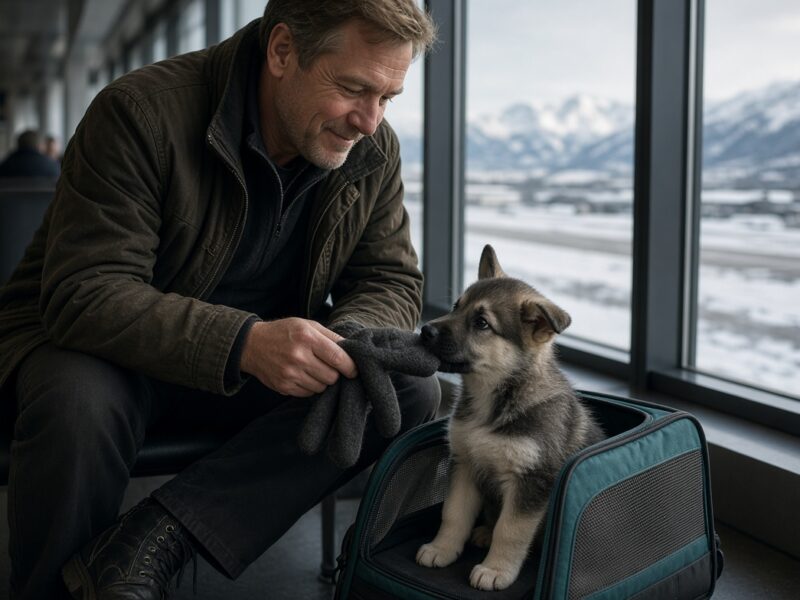
He Only Agreed to Pick Up His Daughter’s Puppy for 24 Hours — Then the Glove-Stealing German Shepherd Changed Everything
A tiny gray-and-white German Shepherd pressed her trembling nose against the mesh of an airline carrier while winter turbulence shook the cabin around her.
Beside her sat a quiet forty-six-year-old veteran who had promised himself this was just a twenty-four-hour errand: pick up his daughter’s puppy, fly home, and get back to the life he already understood.
But Micah had other plans.
She stole his glove, chewed his shoelace, and somehow made him laugh for the first time in months.
Then, after a diverted landing in snowy Montana, one careless moment sent the frightened puppy running through a crowded airport.
What Carter found when he caught up with her changed the rest of the journey.
Because this stubborn little dog was not only heading home to his daughter.
She was about to expose two hidden plans, reopen a broken father-daughter bond, and teach a family what it really means to come back.
By seven in the morning, Whitefish looked as if someone had turned the whole town toward the light.
Snow had fallen through most of the night, soft and steady, covering porch rails, pickup beds, cedar fences, and the shoulders of the road in clean white layers.
When the clouds finally broke, winter sun struck the mountains beyond town and threw pale gold across the valley.
Roofs glittered.
Chimney smoke rose almost straight into the blue.
Carter Voss stood in his kitchen with a mug of coffee cooling beside his hand and looked at the small carrier sitting near the door.
It was teal and gray, airline-approved, with mesh panels on three sides.
It looked absurdly small.
He checked the zipper, then checked it again.
On the counter lay a folder containing vaccination records, adoption paperwork, the rescue organization’s contact number, and a handwritten list from his thirteen-year-old daughter: food, water, chew toy, extra towel, poop bags, do not let her eat random stuff.
The last item had been underlined twice.
Carter had packed everything exactly as written.
He was good at lists.
Lists did not change their minds.
Lists did not remember the Saturday you said you would come and did not.
Lists did not answer the phone with a quiet, careful, “It’s okay, Dad,” when both people knew it wasn’t.
He picked up the carrier.
“Twenty-four hours,” he said to the empty kitchen.
The room gave him nothing back.
That was fine.
Twenty-four hours was manageable.
Fly west, pick up dog, fly home—a job with a beginning, a sequence, and an end.
Carter had spent most of his adult life trusting that kind of thing.
At forty-six, he still carried himself like a man accustomed to narrow spaces and loud machinery, shoulders broad, movements economical, nothing wasted.
Years in Navy aviation support had taught him to notice the sound a machine made before it failed, and the way people moved when they were pretending not to be afraid.
Machines had remained easier.
He wore an old NWU Type III blouse with the identifying tapes and insignia removed long ago, a charcoal thermal henley underneath, dark work pants, and brown leather boots polished only by use.
The fabric at his elbows had faded softer than the rest.
His hair, dark blond threaded heavily with silver at the temples, had been cut two days earlier because he had needed something uncomplicated to do with his hands.
On his left wrist, the bezel of an old black-faced aviation watch clicked once beneath his thumb.
A habit.
He stopped.
The phone on the counter lit up.
Sadi: You awake?
Carter stared at the message, then typed, Already packed.
Three dots appeared.
Did you pack the blue chew ring?
He looked toward the bag.
He had.
Yes.
Another pause.
And the towel?
Yes.
The good towel or one of your weird shop towels?
Carter glanced at the folded yellow microfiber cloth he had almost packed before remembering Sadi’s list.
The good towel.
This time the answer came immediately.
Wow. Growth.
The corner of his mouth moved.
Not quite a smile.
Close.
Almost a year earlier, Sadi had begun talking about getting a dog.
At first, Carter had assumed it was one of those ideas that arrived intensely in a thirteen-year-old’s life and disappeared two weeks later under another obsession.
It had not disappeared.
She read about breeds, watched training videos, made a budget, volunteered Saturdays at a pet supply store for store credit and a little cash.
She shoveled snow from three neighboring driveways before school.
She watched an elderly couple’s beagle whenever they visited family in Helena.
Every few weeks, she sent Carter a photograph of another German Shepherd.
Sometimes there was a caption.
Look at those ears.
Or: This one learned place in four days.
Once: I could train one better than you train yourself to text back.
Carter had deserved that one.
The application had eventually gone through Laurel because Sadi was too young to sign the adoption contract herself.
The rescue network had approved the family weeks earlier after references, veterinary planning, and several phone calls that Sadi had treated with the seriousness of a college interview.
Then came Micah, a ten-week-old female German Shepherd fostered outside Seattle.
Smaller than the other puppies from the same intake, silver, gray, and white, one ear beginning to stand, the other apparently refusing to cooperate.
Sadi had fallen in love with her from three photographs and a thirty-second video.
The rescue had a firm rule for puppies placed across state lines.
An approved adult had to collect the dog in person.
They would not put a young puppy into cargo and send her alone.
Laurel couldn’t get away during the last week of December.
So Sadi called Carter.
Not texted.
Called.
He still remembered staring at her name on the screen before answering.
“Hey.”
“Hi.”
There had been a pause.
Not uncomfortable exactly, just familiar.
Their conversations had accumulated pauses over the years, little spaces filled with everything neither of them knew how to repair.
Then Sadi said, “I need to ask you something.”
Carter had stood straighter without realizing it.
“What?”
“Could you go get Micah?”
Not: Can you pay for something?
Not: Can you sign this?
Not even: Can you give me a ride?
She needed him to show up somewhere.
For months, Carter had become skilled at being useful from a distance.
Money transferred on time.
Birthday gifts delivered early.
School fundraiser links opened within minutes.
Actual presents had been less reliable.
A delayed maintenance call at an airport in Bozeman.
A snow closure.
A crew shortage.
An emergency repair in Spokane.
There was always a reason.
Good reasons, mostly.
That had not made them good enough.
“I can go,” he had said.
Sadi had gone quiet.
Then, “Really?”
Something about the surprise in that single word had stayed with him longer than he wanted.
“Yeah,” he said. “I’ll get her.”
Now, standing in his kitchen with the carrier in his hand, Carter felt the same unpleasant pressure beneath his ribs.
He told himself it was only a dog.
He told himself this was not a test.
He told himself a lot of things.
His laptop sat closed on the far end of the table.
Inside it was an email he had opened six times and answered zero.
Fairbanks, Alaska.
Four-month contract offer.
Ground support equipment.
Winter operations.
Housing included.
Nearly twice what his current Montana contract paid.
Completion bonus.
His contract here ended soon after New Year’s.
Fairbanks could wipe out most of what remained from the divorce, legal bills, a refinanced truck, the ugly accumulation of smaller debts that somehow survived every responsible payment.
If he was careful, there would still be enough to open a real college fund for Sadi instead of the savings account that currently looked more hopeful than substantial.
To Carter, numbers had a brutal kind of honesty.
A dollar was either there or it wasn’t.
A debt was either paid or it wasn’t.
Four months away could buy years of security.
He had not told Sadi.
Not yet.
There was no point in telling her about something that was not decided.
At least, that was the phrase he used whenever the thought returned.
He put the carrier in the truck.
Twenty-four hours, one dog, then home.
Simple.
Seattle smelled like wet pavement.
By early afternoon, winter light had flattened beneath a low ceiling of gray cloud, and the streets around the rescue office shone dark from recent rain.
Carter stepped inside with cold air still clinging to his jacket and found a room much warmer and noisier than expected.
A printer hummed behind the reception desk.
A terrier barked somewhere through a closed door.
Metal bowls clinked.
There was the clean, medicinal smell of disinfectant mixed with dog food and damp fur.
“Mr. Voss.”
Carter turned.
Marabel Stone approached carrying a red clipboard covered in faded rescue stickers.
She was shorter than he expected, sturdy, dark curls tied low behind her head, with the quick eyes of someone who had already noticed everything about him before saying hello.
“Carter,” he said.
“Marabel.”
They shook hands.
“You made good time.”
“Flight was early.”
“Never say that in an airport. They’ll hear you.”
Carter almost asked who *they* were.
Marabel had already turned.
“Come meet your problem.”
“She’s not mine.”
Marabel glanced back over one shoulder.
“That’s what they all say in the first five minutes.”
They passed through a short hall into a quieter room with rubber flooring, two chairs, a low table, and a small exercise pen.
Micah was inside it.
For the first few seconds, Carter did nothing.
He had seen the photographs.
They had not prepared him for how unfinished she looked.
Her coat was a soft mixture of silver-gray and cold white, darker along the top of her head and back.
Her paws seemed one size too large for the rest of her.
Her tail looked borrowed from a bigger dog.
The right ear stood almost upright.
The left leaned outward as if skeptical of the entire idea.
Micah stared at him.
Dark amber eyes.
Black nose.
Stillness.
“That’s her?” Carter asked.
Marabel looked into the pen. “No, that’s an accountant. Micah’s on lunch.”
Carter looked at her.
Marabel didn’t smile.
Then she did.
Carter exhaled through his nose.
He crouched.
Micah’s gaze followed him.
“Hey.”
The puppy shifted backward.
Carter stopped.
He knew better than to push frightened animals.
That knowledge came less from dogs than from people, but he figured some rules transferred.
He held his hand low.
Micah leaned forward half an inch, sniffed the air, then backed away again.
“She’s cautious with new people,” Marabel said. “Good instinct. Don’t take it personally.”
“I wasn’t planning to.”
“You look like you’re taking it personally.”
Carter lowered his hand.
Micah sat.
One ear up, one ear sideways, judging him.
“Sadi says she’s friendly.”
“She is. Friendly isn’t the same as immediately trusting everyone who reaches for you.”
Something in the sentence landed closer than Carter expected.
Marabel opened the pen.
Micah stayed where she was.
Carter stood and began listening while Marabel reviewed feeding amounts, rest periods, vaccination timing, potty breaks, and what to watch for during travel.
He absorbed the information automatically.
Every number, every interval, every instruction.
“Carrier should stay closed in the terminal unless you’re in a designated pet area,” Marabel said.
“Got it.”
“She’ll probably complain.”
“I can handle complaining. Thirteen-year-old daughter.”
Carter looked at her.
Marabel tapped the paperwork. “It’s on the application.”
“Right.”
A soft scrape came from behind him.
Carter turned.
Micah had left the pen.
She was standing beside his chair.
Before he could bend down, she lunged—not at him, but at the wool glove sticking halfway out of his coat pocket.
“Hey.”
Micah grabbed it, then ran.
Marabel folded her arms.
Carter stared after the puppy.
“Micah.”
The dog accelerated.
She made one triumphant loop around the table, glove flapping from her mouth, tail high.
Carter moved left.
Micah went right.
He moved right.
She darted left.
Marabel said, “Excellent start. She’s ten weeks old. She’s winning.”
Carter finally cornered her near the chairs.
Micah ducked underneath one.
Carter stopped.
The glove disappeared farther into the shadows.
He closed his eyes for a second, then lowered himself onto one knee and reached beneath the seat.
Micah shuffled backward.
Carter reached farther.
His shoulder hit the chair frame.
Marabel made a small sound that suspiciously resembled a laugh.
“This funny?”
“A little.”
Carter ended up with one knee on the floor and half his upper body beneath the chair.
Micah stared at him from twelve inches away, the glove clenched firmly between tiny teeth.
“We can do this the easy way.”
Micah blinked.
“The easy way would be you giving that back.”
Micah wagged her tail.
Carter reached.
She released the glove.
For one victorious second, he thought she had surrendered.
Then she grabbed the cuff of his sleeve.
Carter froze.
Marabel laughed openly now.
He finally emerged from under the chair with his glove damp, his blouse wrinkled, and the puppy following him as if the entire exercise had been her idea.
Marabel wiped beneath one eye. “You have much experience with puppies?”
“No. Kids. One.”
She nodded toward Micah. “Then you’ve already trained one creature who doesn’t listen.”
Carter looked down at the puppy.
Micah sat on his boot.
“I don’t think my daughter would appreciate the comparison.”
“Then don’t tell her.”
For the first time that day, Carter smiled without catching himself.
The paperwork took another twenty minutes.
Marabel secured Micah’s dark teal Y-harness, checked the fit twice, then settled her into the carrier with the blue chew ring Sadi had insisted on.
Micah turned in a circle, pawed the towel, and immediately began investigating the zipper.
“She’s smart,” Marabel said.
“That’s what worries me.”
“Good means you’re learning.”
Carter lifted the carrier.
Micah pressed her nose to the mesh and watched him—not trusting, not afraid either, just watching.
Near the exit, Carter noticed something tucked along the side pocket of the carrier.
White paper folded twice.
“What’s this?”
Marabel glanced over. “Didn’t put it there.”
Carter pulled it free.
The handwriting answered the question before he opened it.
Sadi.
He unfolded the note.
There were only two lines.
“Micah doesn’t know who you are yet. Don’t make her trust you too fast.”
Carter stood very still.
Then he read the second line.
“I think that rule applies to both of us.”
Outside the windows, Seattle rain drew thin silver trails down the glass.
Behind him, phones rang softly at the rescue desk.
Somewhere down the hall, a dog shook its collar, and tags jingled once, then stopped.
Carter read the note again—not because he had misunderstood it, but because he hadn’t.
Micah shifted inside the carrier and gave one impatient scratch at the towel.
Carter folded the paper along its original creases.
Then, smaller, carefully, he opened his wallet and slipped the note behind his driver’s license, where it would not fall out.
He closed the wallet.
For several seconds, his hand remained around it.
Then Carter picked up the carrier.
Micah’s mismatched ears appeared behind the mesh.
One standing, one still deciding.
“So,” Carter murmured, “we’ve both been warned.”
Micah stared at him.
Carter headed for the door.
By the time Carter reached the gate, Seattle had turned the color of wet steel.
Beyond the terminal glass, evening pressed low over the airport.
Runway lights burned in neat lines through the drizzle—red and green and white, trembling in reflections on the pavement.
A jet eased away from the concourse with a deep mechanical hum Carter felt more than heard.
For the first time since leaving the rescue office, Micah stopped trying to chew something.
Carter sat the carrier on the empty chair beside the window while he shrugged out of his jacket and rearranged the strap on his carry-on.
The puppy went still.
Her silver-gray-and-white face pushed forward against the black mesh until her nose flattened slightly.
The right ear stood almost straight.
The left leaned sideways, as if the rest of her had committed to aviation while that one ear remained undecided.
Outside, a baggage tug rolled past.
Micah tracked it.
Then a fuel truck.
Then a taxiing aircraft.
Her whole head moved with each one.
Carter watched her for several seconds.
“You know those aren’t dogs, right?”
Micah did not look at him.
A plane turned onto the taxiway, and bright landing lights swept across the glass.
Her tail thumped once against the side of the carrier.
Carter folded his jacket over one arm.
“Great. I flew two states over for a puppy who’s more interested in ground equipment than I am.”
A woman across the aisle looked up from her phone and smiled.
Carter pretended not to notice.
He had spent enough years around aircraft that airports had become a language he no longer consciously translated.
The soft rise of turbine noise, the chirp of service carts reversing, the clipped voices over radios.
Even from behind glass, he could usually tell which piece of machinery needed maintenance by the sound it made.
It was familiar. Predictable.
The puppy beside him was neither.
Micah suddenly turned from the window and fixed him with an expression so serious that Carter almost expected a complaint.
Instead, she yawned, her pink tongue curled, then sneezed against the mesh.
Carter leaned back. “You’re charming.”
She pawed the carrier door.
“Also persuasive.”
His phone vibrated.
Sadi: Did you get her?
Carter took a picture.
Micah against the terminal window, one ear up, one ear sideways, aircraft lights glowing beyond the glass.
He sent it.
The reply came almost immediately.
Oh my god.
Then: Her left ear is still doing that.
Carter typed: Apparently.
Does she like you?
His thumb stopped.
Through the mesh, Micah had already turned back toward the runway.
Carter looked at the question longer than necessary.
Finally: She stole my glove.
The typing bubble appeared.
So, yes.
Carter almost wrote something else.
He didn’t.
The boarding announcement began overhead.
He slid the phone into his pocket.
“Come on, thief.”
Micah gave no indication that she had heard him.
Seat 14A was by the window.
Carter took 14B.
An elderly woman settled into 14C with the determined efficiency of someone who had packed for travel before Carter had been born.
She wore a long camel coat, pearl earrings, and carried a paperback novel with enough folded corners to suggest a private war against bookmarks.
Carter placed Micah’s carrier properly under the seat in front of him.
Checked the zipper.
Checked the harness through the mesh.
Then sat back.
The puppy immediately began scratching.
Not frantically, not even urgently.
Just one slow scrape.
Pause.
Another scrape.
Carter looked down.
Micah stared through the mesh.
“No.”
Another scrape.
“No.”
Her nose pressed forward.
“That doesn’t change the answer.”
The woman beside him glanced down. “Negotiating already?”
Carter looked over. “Apparently.”
“Who’s winning?”
He glanced at Micah.
The puppy scratched once more.
Carter said, “Too early to tell.”
The woman smiled and returned to her book.
As the cabin filled, Micah discovered another source of entertainment: shoelaces.
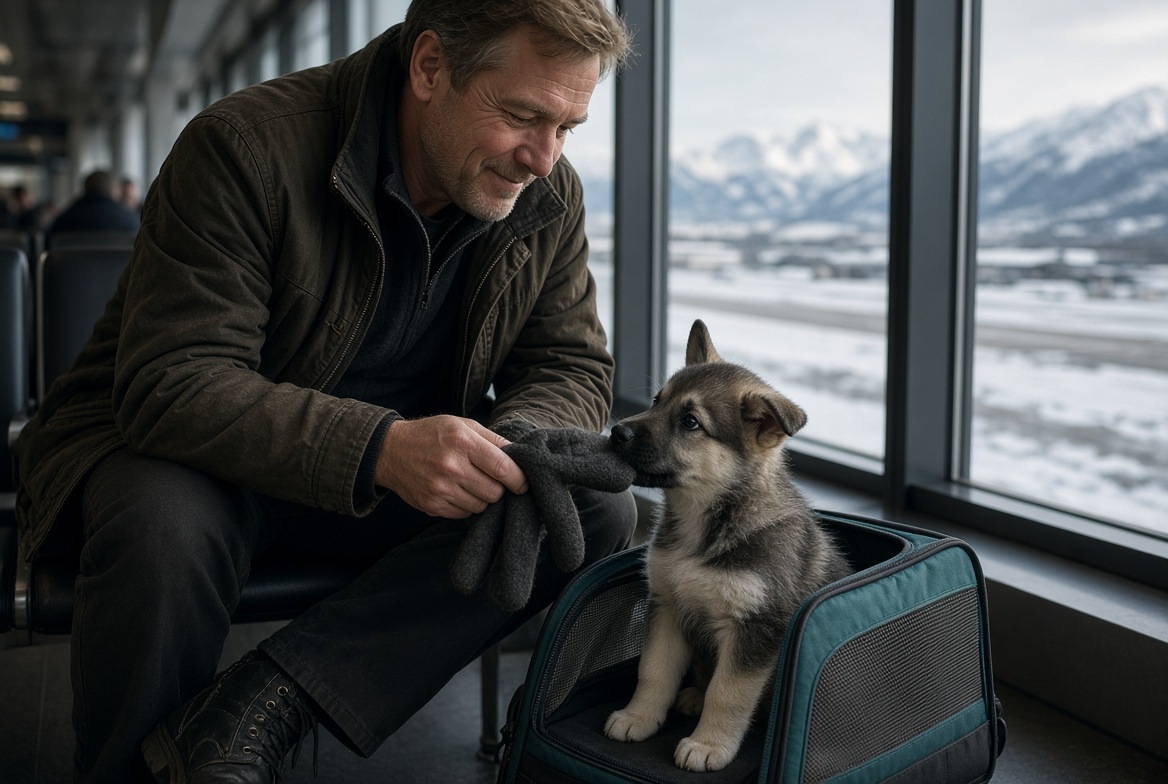
Carter felt a small tug near his right foot.
He looked down.
One lace had somehow worked close enough to the carrier for two tiny front teeth to catch it through the mesh.
“Ma—”
The tug stopped.
He waited.
Another tug.
Carter bent and pulled his foot back.
Micah’s eyes followed the shoe.
He tucked both feet farther away.
A soft whine came from beneath the seat.
“Absolutely not.”
The whine became slightly louder.
The woman at 14C turned a page. “Strong opinions.”
“She’s had them for several hours.”
“About?”
“Mostly my belongings.”
Micah let out another sound.
Carter leaned toward the carrier. “You have a chew toy.”
Micah ignored the blue ring inside the bag.
Her eyes remained fixed on his shoes.
“Use what you’ve been issued.”
That got a laugh from the woman.
Carter sat upright.
He realized what he had said.
The woman closed her book over one finger. “Military?”
“Used to be. Navy.”
Carter glanced down at the faded Type III blouse.
“That obvious?”
“Only to people who married it.”
She held up her left hand.
A thin gold band remained there.
“My husband did twenty-two years.”
Carter nodded.
He did not ask where the husband was now.
The woman did not volunteer it.
That small courtesy made him like her.
The cabin door closed.
Micah shifted as voices changed, bins clicked shut, and the tone of the aircraft moved from waiting to departure.
Carter rested his forearms on his thighs.
“You’ll be fine,” he murmured.
He wasn’t sure whether he meant the dog.
Once they were airborne, Micah settled for exactly nine minutes.
Carter knew because he checked his watch.
At minute ten, she began investigating the carrier zipper with her nose.
At minute twelve, she pawed the towel.
At minute fourteen, she noticed the pretzels.
The flight attendant had barely placed the small snack bag on Carter’s tray before Micah sat up beneath the seat as if responding to an alarm.
Carter opened the bag.
Crinkle.
Micah’s eyes appeared behind the mesh.
He ate one.
Her head tilted.
He ate another.
A tiny sound came from the carrier.
Carter ignored it.
Another sound.
He looked down.
“No.”
Micah stared at the pretzel bag.
“No.”
She stared harder.
“You’ve eaten.”
The old woman watched this exchange with open interest now.
Carter held up one pretzel. “This isn’t for you.”
Micah licked the mesh.
The woman said, “She seems willing to appeal.”
“Denied.”
Carter ate the pretzel.
Micah made a low, wounded grumble and dropped onto the towel.
The woman laughed.
Carter looked at her. “What?”
“Nothing.”
“That’s not nothing.”
She nodded toward the floor. “You talk to her like she’s a sailor who missed inspection.”
“She’s behaving like one.”
Micah moved just enough to stretch one front paw through the lower gap of the carrier.
The paw landed on the toe of Carter’s boot.
Then she closed her eyes.
The woman looked down. “Your dog?”
Carter answered without thinking. “Not mine. I’m just transporting her.”
The woman glanced at the small paw resting on his boot, then back at him.
“It appears the passenger disagrees.”
Carter tried not to smile.
He lasted maybe two seconds.
Then a laugh escaped him.
Not a polite breath.
Not the short sound people made when they knew they were supposed to appreciate a joke.
A real laugh.
It surprised him enough that he stopped almost immediately.
The woman smiled but did not comment.
That made it worse somehow.
Carter looked toward the darkening window.
Below them, clouds stretched in violet layers.
He could not remember the last time a stranger had seen him laugh—not chuckle at a coworker, not smile for a photograph.
Laugh.
Micah slept on.
Her paw remained on his boot.
Somewhere over eastern Washington, the sky changed.
The first sign was not turbulence.
It was the light.
The clear sunset glow vanished behind a dense wall of cloud.
The window darkened until Carter could see mostly the pale reflection of his own face.
Then the seat belt sign chimed.
The captain’s voice came over the speakers.
“Ladies and gentlemen, we’re expecting some rough air as we continue east. Please remain seated with your seat belts securely fastened.”
Carter automatically looked down.
Micah was still asleep.
The plane dipped lightly.
Nothing dramatic.
A few heads turned.
Then came another shudder, stronger this time.
Micah’s eyes opened.
Her right ear went upright.
The left followed halfway.
Carter lowered his hand toward the carrier.
“Easy.”
The aircraft moved again as wind curled around the mountains.
Micah stood abruptly.
Her nails clicked against the carrier floor.
Carter saw the change at once.
Not curiosity now.
Fear.
Her body lowered.
Her mouth closed.
Her eyes searched the dark space around her without understanding why the floor beneath her no longer behaved like a floor.
“Hey.”
Carter leaned down as far as the seat belt allowed.
He slipped two fingers through the mesh.
Micah froze.
For one second, she only stared.
Then she pressed her muzzle hard against his hand.
Carter felt the damp warmth of her nose.
“That’s it.”
Another vibration passed through the fuselage.
Micah trembled.
Carter kept his hand where it was.
Across the aisle, someone pulled a window shade down.
A cup rattled in a tray.
The cabin lights seemed suddenly too bright.
Carter’s old instinct surfaced before thought did.
Count sounds.
Watch movement.
Separate discomfort from danger.
Breathe before speaking.
A small voice came from the row ahead.
“Mom.”
Carter looked forward.
A boy of maybe seven or eight sat directly in front of him.
His fingers had locked around both armrests.
His mother had turned toward him, one hand on his shoulder.
“It’s okay,” she said.
Her voice was too fast.
The boy noticed.
“Children always did.”
The plane moved again.
He squeezed his eyes shut.
“I don’t like it.”
“I know, honey.”
“Make it stop.”
His mother looked helplessly toward the front of the cabin.
Carter knew that look—not because of airplanes, because he had seen people realize they could not fix the thing frightening someone they loved.
He leaned slightly toward the gap between the seats.
“Hey, buddy.”
The boy looked back.
Carter kept his voice low.
“You see the seat in front of you? A node. Pick one spot on it.”
The boy glanced forward.
“The silver button. Good. Keep looking at that.”
His mother looked back, too.
Carter spoke to both of them now.
“Slow breath in,” he demonstrated. “Then let it out slower than you took it.”
The boy tried.
His first breath came uneven.
“Again,” Carter said.
The plane shivered.
Micah pushed harder into his fingers.
Carter did not move his hand.
“What are you doing when you get off the plane?” he asked the boy.
The boy swallowed. “Seeing Grandpa.”
“Where?”
“Kalispell.”
“What’s he got planned?”
The boy’s eyes stayed on the silver seat button. “Snowmobile.”
His mother managed a small smile.
Carter nodded. “Good. Think about that.”
The boy breathed again.
“Grandpa’s waiting.”
“Yeah.”
“Then keep him in your head.”
The boy nodded.
Carter lowered his eyes.
Micah’s amber gaze was fixed on him through the mesh.
He stroked one finger along the bridge of her nose.
The strange thing was how familiar the moment felt.
Two frightened creatures.
Neither needed a speech.
Neither needed him to promise the sky would behave.
They needed him not to disappear while it didn’t.
The captain’s voice came back several minutes later.
The route into Glacier Park had worsened.
They would not continue north.
For safety and weather conditions, the aircraft would divert to Missoula.
A murmur moved through the cabin.
Phones came out.
People sighed.
Someone behind Carter muttered about a connection.
The old woman beside him closed her eyes briefly, then reopened her book.
Carter looked at his watch.
The clean twenty-four-hour plan had just broken in half.
Normally, that would have irritated him.
He had built his adult life around avoiding uncertainty whenever possible.
But Micah was still pressed against his fingers.
The boy in front was still breathing slowly.
Carter left his hand where it was.
Missoula appeared below them through torn clouds and evening snow.
Runway lights emerged first, blurred in mist, then sharpened as the aircraft descended.
The landing was firm.
Wheels touched pavement with a deep rolling roar.
Around the cabin, people exhaled almost together.
The boy in front turned around immediately.
“That wasn’t that bad.”
His mother laughed in relief.
Carter nodded. “Nope.”
The boy looked down toward the carrier. “Was the dog scared?”
Carter glanced at Micah. “Little bit.”
“Did you help her?”
Carter looked back at the boy. “She helped me stay busy.”
That answer seemed to satisfy him.
As the aircraft taxied toward the gate, Carter finally tried to pull his hand away from the mesh.
Micah moved.
One small gray-white paw came through the lower opening and settled across his fingers.
Carter stopped.
The paw was warm, far too small.
Her nails barely touched the back of his hand.
He could have moved easily.
He didn’t.
Outside the window, snow swept through the yellow lights of Missoula’s ramp.
Carter sat in Seat 14B with a delayed flight, a ruined schedule, Sadi’s note in his wallet, and a puppy’s paw resting on his hand.
For once, he let the delay remain exactly where it was and kept his fingers still.
Missoula International Airport had the particular kind of chaos that formed when too many plans arrived at once and none of them could continue.
The arrivals board kept changing.
Flights that should have gone north were delayed.
Others had been diverted from smaller airports along the valley.
Families stood in clusters beneath the monitors, looking up every few seconds as though staring hard enough might change the weather.
Rolling suitcases crowded the walkways.
Wet boots squeaked against the polished floor.
Children slept across coats.
Phones rang, buzzed, chimed, and died.
Outside the terminal windows, snow moved sideways beneath the floodlights.
Carter stood just beyond the jet bridge with Micah’s carrier in one hand and his phone in the other.
A gate agent was speaking through a tired smile.
“At the moment, Glacier Park is still below what they want for arrivals. We may get another update in two hours.”
“Two hours?” Carter repeated.
“Could be less. Could be more.”
The gate agent gave him the look of someone who had answered that exact sentence twenty times.
“Could be tomorrow morning.”
Carter glanced down at the carrier.
Micah stared back through the mesh.
Her right ear stood up.
The left one leaned to the side.
He had started to suspect that ear was not defective.
It was judgmental.
“Good,” Carter muttered.
The woman behind the counter blinked.
“Sorry, not you.”
Micah made a small noise.
The gate agent looked over the counter. “Is that a puppy?”
“Apparently.”
That earned him the first amused expression the woman had shown in several minutes.
“Pet relief areas down past baggage claim, near the far doors. Indoor sections open.”
“Thanks.”
Carter stepped away before the line behind him could become openly hostile.
His phone vibrated.
A text from the airline: Your flight has been delayed. Updated departure time pending.
Another vibration.
A voicemail notification from Sadi.
Then another, an email from his current contract supervisor.
Then, before he had even cleared the gate area, another email arrived.
Carter stopped walking.
Micah’s carrier swung slightly beside his knee.
He looked down at the screen.
Nothing urgent.
Still, he read it.
That was another habit.
Machines failed in sequence.
Problems accumulated if ignored.
You handled them one at a time.
He had lived by that rule long enough to mistake it for a philosophy.
The trouble was that people refused to line up properly.
The pet relief area smelled faintly of disinfectant, damp rubber, and the vague aftermath of several animals who had not enjoyed air travel.
Carter set the carrier down on a bench.
“All right.”
Micah pressed forward against the mesh.
“You’re getting five minutes of freedom. Try not to overthrow the building.”
He unzipped the carrier and reached for the dark teal Y-harness Marabel had fitted earlier.
Micah came out in pieces.
First her nose, then one paw, then the rest of her in an eager silver-gray tumble.
Her feet hit the rubber mat.
She froze.
New room.
New smells.
New sounds.
Carter clipped the leash.
Or thought he did.
His phone vibrated again.
Sadi: Did you land?
He looked at the screen.
He typed with one thumb: Missoula. Diverted. We’re okay.
Immediately: How’s Micah?
Carter glanced down.
The puppy was investigating the base of a wall with deep professional interest.
Still a criminal.
The typing bubble appeared.
So she likes you.
Carter was halfway through a reply when another message dropped over the top of Sadi’s—his supervisor, then the airline, then a subject line from Alaska that he did not open but noticed anyway.
His attention divided for perhaps three seconds.
Four.
That was enough.
A service cart rolled past the doorway outside.
One of its metal panels slammed against the frame with a sharp, hollow bang.
Micah jumped.
Carter felt the leash pull.
“Ma—”
The puppy twisted backward.
The harness shifted.
Something was wrong.
Carter dropped the phone.
“Micah.”
She pulled again.
The loose clip gave way.
The harness slipped off her front leg.
For one suspended instant, Carter and the puppy looked at each other.
Then Micah ran.
Not toward anything.
Away.
Her nails skittered across the floor.
Carter lunged for the leash and caught nothing but air.
“Ma—”
She disappeared through the open doorway.
Carter was moving before the harness hit the ground.
His phone remained on the floor behind him.
He saw the tip of a gray-white tail vanish around the corner.
Then nothing.
The terminal was too full.
People everywhere—carry-ons, coats, children, legs.
Too many places for a ten-week-old dog to disappear beneath.
“Ma—” Heads turned.
Carter did not care.
He moved fast without running blindly, scanning under rows of chairs, around luggage, behind columns.
A man holding coffee stepped aside as Carter passed.
“You lose something?”
“Dog.”
“Big?”
“No.”
Carter checked under another bench.
Nothing.
His chest had tightened.
Not from exertion.
Not yet.
From the unbearable fact that this had happened while the leash was in his hand.
Because he had looked at his phone.
Because he had assumed a clip was locked without checking.
He knew better.
That was the part that hurt.
People like to think experience protected them from mistakes.
Carter knew experience only made certain mistakes more embarrassing.
“Micah.”
No answer.
Of course, there was no answer.
She had barely learned the sound of her own name.
He turned toward baggage claim.
A flash of silver near a suitcase made him move, but it was only a child’s knit hat.
He kept going.
The calm, methodical part of his brain tried to reassert itself.
Small dog, startled, likely seeking distance from noise.
Would avoid crowds if possible.
Could hide beneath seating.
Could follow walls.
Could—
“Ma—” His own voice cut through the terminal harder than he intended.
A security employee stepped into his path.
“Sir.”
Carter stopped.
The man was broad, middle-aged, wearing a dark airport security jacket and an expression that said he had already dealt with too much tonight.
“You looking for somebody?”
Carter bent slightly, catching his breath.
“German Shepherd.”
The guard waited.
“Small,” Carter said.
Still waiting.
“Ten weeks. Silver, gray, white legs. One ear up.”
Carter made a motion beside his head. “The other one still deciding.”
The security officer blinked, then pointed toward the quieter end of the terminal.
“Someone called in a loose puppy near the west windows about a minute ago.”
Carter was gone before the man finished the sentence.
The west end of the terminal had fewer people.
Most travelers had clustered closer to the gates and food counters, leaving the stretch of windows dimmer, quieter, almost forgotten.
Snow whispered against the glass.
Carter slowed.
Then he saw her.
Micah was beside a row of molded seats near the wall.
No harness, no leash, no glorious reunion, no miracle.
She was simply lying on the floor beside a little girl.
Carter stopped several yards away.
The girl looked about eight, maybe nine.
A purple coat too large for her.
Pink gloves, a knit hat with one pompom missing.
She sat with her knees pulled up and her back against the seat.
Her face was blotchy from crying.
Micah’s body was tucked close to her boots.
The puppy’s head rested on the floor.
The girl had one gloved hand extended.
Micah sniffed it.
The girl did not move closer.
Neither did the dog.
Carter understood immediately.
This was not some extraordinary act.
Micah had not found a child in need and decided to save her.
She had found a quiet corner.
So had the girl.
Two frightened creatures had simply ended up in the same place.
The girl whispered something Carter could not hear.
Micah’s left ear shifted.
The girl touched the top of her head.
Once.
Carefully.
Micah stayed.
Carter felt his breathing slow.
Not because the problem was over.
Because it had become small enough to see.
He approached without rushing.
“Hey.”
The girl looked up.
Micah’s head snapped toward him.
Her tail tapped the floor once.
Carter crouched several feet away.
“Ma—” The puppy stood.
For one second, Carter thought she might run again.
Instead, she took two uncertain steps toward him, stopped, looked back at the girl.
The girl wiped under one eye with her sleeve.
“Is she yours?”
The question caught him off guard.
He had answered it earlier without hesitation.
“Not mine. Just transporting her.”
Now he looked at the puppy standing between them.
“She’s my daughter’s.”
The girl nodded.
“I lost my dad.”
Carter’s focus changed at once.
“When?”
She shrugged—a child’s measurement of panic.
“Over there.”
She pointed vaguely toward the main terminal.
“There were too many people.”
“What’s his name?”
“Eric.”
“Your last name?”
“Palmer.”
Carter held his hand out toward Micah, palm down.
She came close enough to sniff his fingers.
This time he didn’t reach for her immediately.
He let her decide.
After a moment, she stepped against his knee.
Carter put one hand gently around her chest and lifted her.
She did not fight.
The girl looked at the puppy. “She was scared, too.”
“Yeah,” Carter said.
“So was I.”
The girl seemed relieved that he had not corrected her.
Carter stood and looked toward the terminal.
“We’ll get your dad.”
The little girl hesitated. “Can she come?”
Carter looked down at Micah.
“She already caused the trip.”
The girl gave a tiny laugh.
That was when Carter realized she had stopped crying.
Security arrived within minutes.
The officer Carter had spoken with came first, followed by an airport employee carrying a radio.
The girl’s father came behind them at a near run.
He was younger than Carter had expected, maybe mid-thirties, with a black winter jacket half-zipped and fear still bright on his face.
“Ellie.”
The girl stood.
“Dad.”
He dropped to his knees and wrapped both arms around her.
Carter turned slightly away—not because the moment was private, because something about watching it felt too direct.
The father held his daughter longer than she seemed to think necessary.
“I’m okay,” she said into his shoulder.
“I know you were crying.”
“I wasn’t. You were.”
The security officer looked at the ceiling.
Carter looked at Micah.
Micah looked at everybody.
The father finally stood and noticed Carter.
“Thank you.”
Carter shook his head. “She found a quiet place. That’s all.”
The man looked down at Micah. “That’s your dog?”
Carter paused again.
“My daughter’s.”
The answer felt different this time.
The man nodded. “Still. Thank you.”
Carter did not know what to do with gratitude for something he had not meant to accomplish.
So he gave the only reply that felt honest.
“Glad she’s okay.”
The father took his daughter’s hand.
Before leaving, Ellie looked back at Micah.
Micah wagged her oversized tail, then tried to chew Carter’s sleeve.
He pulled the fabric away. “Don’t ruin the moment.”
Ellie laughed.
Her father did too.
They disappeared into the crowd.
Carter remained where he was.
For several seconds, the terminal seemed strangely quiet.
Then the usual sounds returned: announcements, rolling luggage, a child calling for juice, someone arguing with an airline representative.
Carter looked toward the direction the father and daughter had gone.
Something inside his chest had become heavy.
Not painful.
Heavier than that.
Recognizable.
He knew what it was and refused to name it.
That worked for about three seconds.
Then he saw Sadi in his mind.
Not at thirteen.
Younger—seven, maybe—standing outside a school auditorium in a red coat, scanning the parking lot while Laurel pretended not to check the time.
Carter had arrived forty minutes late.
By then, the performance was over.
Sadi had said the same thing she would say many times later.
“It’s okay.”
He had hated those words.
Not because they forgave him, because they made forgiveness unnecessary.
She had learned to lower the expectation first.
Back at the pet relief area, Carter found his phone on the floor where he had dropped it.
The screen was intact.
The harness lay nearby.
He picked both up.
Then he sat on the bench.
Micah sat between his boots.
Carter examined the harness carefully.
One side clip had never fully seated.
His mistake.
No mystery.
No defective equipment.
No bad luck.
He clipped it properly.
Click.
Then tugged.
Secure.
He checked it again.
Micah watched him.
“Yeah,” he said. “I know.”
The puppy yawned.
Carter reattached the leash.
Then his phone buzzed.
A message from Sadi.
He opened it.
“Dad, don’t tell mom I told you. I heard her talking to someone about a job in Arizona.”
Carter went still.
Micah nudged his boot.
The message sat there.
Simple.
No punctuation except the period at the end.
That bothered him more than it should have.
Sadi used punctuation when she was serious.
He read it again.
Arizona.
Laurel had said nothing.
Carter’s first reaction was irritation, then concern, then something less comfortable.
Had Laurel accepted?
Was she planning to move?
Was Sadi going with her?
Of course she would.
She lived with Laurel most of the time.
The questions arrived too quickly.
He began typing.
What job?
Stopped.
Deleted it.
Typed again.
Did she say she’s taking it?
Deleted that, too.
Before he could decide what not to say, a new email notification appeared at the top of the screen.
The subject line filled the narrow banner.
Fairbanks Contract—Confirmation Required Friday.
Carter stared at it.
Sadi’s message beneath.
The Fairbanks email above.
Two places.
Two adults.
Two plans.
Micah lowered herself onto his boot and began chewing gently at the edge of his shoelace.
Carter barely noticed.
For days, he had told himself Fairbanks was responsible.
Good money, housing included, debts reduced, college savings started—a practical decision.
Laurel probably had reasons, too.
Better salary, better schedule, a cleaner future.
Maybe Arizona made perfect sense.
Maybe Alaska did, too.
That was the problem.
Good reasons could still rearrange a child’s whole life.
Carter looked at Sadi’s message again.
“Don’t tell mom I told you.”
Not: I don’t want to go.
Not: Stop her.
Just a child passing information between adults because she did not know whether she was supposed to be part of it.
Carter leaned back against the wall.
Across the terminal, the departure board flashed another line of red delays.
Micah finally succeeded in pulling one lace loose.
Carter looked down.
“You’re persistent.”
The puppy lifted her head, one ear up, one ear undecided.
Carter rested his forearms on his knees.
Laurel might leave Montana.
He might leave Montana.
Both of them could explain exactly why.
Both of them could produce numbers, dates, contracts, schedules, responsible reasons.
And somewhere between those reasons stood a thirteen-year-old girl who had spent a year saving money for a dog because she wanted something in her life she could count on.
Carter looked at the two messages glowing on the screen.
Then at Micah.
The puppy had stopped chewing.
She was sitting close enough that her shoulder touched his boot.
For the first time, Carter wondered whether the hardest part of making the right decision was not knowing what the right decision was.
It was noticing who had never been asked.
By morning, the storm had loosened its grip.
Snow still clung to everything outside Missoula, but the sky had opened into a hard winter blue, bright enough to make the plowed parking lots shine.
The mountains stood farther off, pale and sharp beneath the sun.
Roads north were open again, though the airline still could not promise Carter a useful connection before late afternoon.
He stopped waiting.
At ten past eight, he rented a dark gray SUV, loaded Micah’s carrier into the rear seat, checked the harness twice, then once more because he no longer trusted the phrase “I already checked it.”
Micah watched him through the mesh.
“Don’t start.”
Her left ear tipped sideways.
Carter shut the rear door.
The drive north on Highway 93 stretched through winter fields, frozen rivers, and long walls of pine.
Snow lay deep along the shoulders.
Sunlight flashed through gaps in the trees and crossed the windshield in clean white bands.
Micah slept through most of it.
She had discovered Carter’s spare glove.
Not stolen this time.
He had placed it beside the carrier deliberately after she spent ten minutes pawing at the towel and refusing the chew ring Sadi had packed.
The glove worked.
Micah curled around it, nose tucked against the wool, breathing slow and even.
Carter noticed that more than once.
He told himself he was only making sure she was comfortable.
At a rest stop north of Ravalli, she woke, drank water, stepped into the snow, immediately sank belly-deep, and looked up at Carter as if he had personally designed winter badly.
He almost laughed.
“Montana,” he said. “You’ll adjust.”
Micah took three determined steps, then tried to eat the snow.
“Or not.”
By the time Flathead Lake appeared through the trees, the light had begun shifting toward afternoon.
The lake was dark steel between white banks, broad and cold beneath the mountains.
Traffic thickened near Kalispell.
Carter’s phone, mounted on the dash, showed two unread messages from Sadi.
He did not open them until he stopped at a light.
The first: How far?
The second, sent four minutes later: Dad, seriously, how far?
He typed: Twenty minutes.
Three dots appeared instantly.
I’m outside already.
Carter looked at the temperature on the dashboard.
Twenty-two degrees.
He typed: Go inside.
The reply: No.
That felt familiar enough to make him smile.
Sadi was waiting at the edge of Laurel’s driveway in a rust-red quilted vest over her slate-blue hoodie, both hands jammed into her pockets.
She had ignored the instruction to go inside.
Naturally.
Snowbanks rose on either side of the drive, reflecting the late afternoon sun.
A string of white lights still ran beneath the porch roof from Christmas.
Laurel stood near the front door, holding a mug, sensible enough to stay closer to the heat.
Carter barely had the SUV in park before Sadi came down the driveway.
Micah heard her before she saw her.
The puppy shot upright inside the carrier.
Her head turned.
Then Sadi called, “Micah.”
The effect was immediate.
The carrier began rocking.
Carter opened his door.
“Wait.”
Sadi stopped three feet away but bounced once on her heels.
“She knows me.”
“She knows a voice.”
“She knows my voice.”
“Same thing at the moment.”
Carter opened the rear door.
Micah pressed both front paws against the carrier opening.
“Give me a second.”
He clipped the leash to the harness, checked it, pulled once.
Secure.
Sadi watched, impatient. “Dad—”
“I lost her yesterday.”
Sadi’s expression changed.
Not dramatically.
Just enough.
Carter looked at her. “I found her.”
“You didn’t tell me.”
“I was going to.”
“When?”
He had no useful answer.
Micah whined between them.
Sadi exhaled and held out both hands. “Can I?”
Carter opened the carrier.
Micah launched forward with all the coordination of a thrown blanket.
The leash looped around Sadi’s ankle.
Sadi tried to step out.
Micah changed direction.
Sadi went down backward into the snowbank.
For half a second, Carter thought she might be upset.
Then the sound came.
A laugh.
Big.
Unrestrained.
Not polite.
Not cautious.
Sadi lay half-buried in the snow while Micah climbed across her chest and attempted to lick every exposed part of her face at once.
“You’re terrible,” Sadi said between laughs. “You’re actually terrible.”
Micah wagged harder.
Her tail slapped Sadi’s hood.
Carter stood beside the SUV and watched.
He had heard Sadi laugh before, of course—over the phone, in short videos Laurel sent once, months ago, from across a school gymnasium where he had arrived after the program had already begun.
But this was different.
There was no distance in it.
No glass, no screen, no reason for Carter to wonder if he had missed the best part.
He was standing there when it happened.
That realization landed quietly.
Quiet things had become the ones he trusted least.
Laurel walked down from the porch.
“Are we getting a dog or burying our daughter?”
Sadi sat up, snow in her hair. “Both.”
Micah tried to climb into her lap.
Laurel looked at Carter. “You made it.”
“Eventually.”
Her eyes dropped to Micah, then to the leash, then back to Carter.
Something passed between them.
Not warmth, not hostility.
Recognition.
They had spent too many years handing responsibilities back and forth to mistake one completed task for anything larger.
Still, Laurel said, “Thank you.”
Carter nodded.
Micah found Sadi’s mitten, and the afternoon became noisy again.
For two hours, the house revolved around the puppy.
Sadi showed Micah every corner of the living room, even though Micah understood none of it.
“This is your bed.”
Micah ignored the bed.
“This is the water bowl.”
Micah stepped in it.
“No.”
Micah sneezed.
“This is the toy basket.”
Micah stole the edge of a throw pillow.
Carter sat on the arm of a chair, watching Sadi negotiate with ten weeks of complete disregard for property rights.
Laurel stood in the kitchen, one hip against the counter.
“She’s been planning this for almost a year.”
“I know.”
“No, I mean *planning*.”
Laurel opened a drawer and pulled out a printed schedule.
Feeding times, potty times, training blocks, veterinary appointments.
Carter looked at it. “She made that version six.”
He lifted an eyebrow. “Six?”
“She may be my child.”
Laurel almost smiled.
Then the smile disappeared before it fully formed.
Carter saw it.
So did something in the room.
The day had been too pleasant for too long.
They both knew it.
Sadi was on the rug teaching Micah to touch her palm with her nose.
The puppy succeeded entirely by accident.
Sadi celebrated as if she had won a championship.
Carter looked toward Laurel again.
“You need to tell her.”
Laurel’s face sharpened. “Tell her what?”
“Arizona.”
Silence.
Sadi stopped moving.
Not because she had heard the whole thing.
Because she had heard enough.
Micah pawed her knee.
Sadi looked at her mother.
“What about Arizona?”
Laurel closed the drawer.
“Come sit down.”
Sadi did not move. “That sounds bad.”
“It isn’t bad.”
“Then you can say it while I’m standing.”
Carter recognized the tone.
Not anger yet.
Preparation for it.
Laurel placed both hands on the kitchen counter.
“I was contacted about a position in Scottsdale.”
Sadi stared. “Like a trip?”
“No.”
The room seemed to lose some heat.
Micah wandered between them, carrying a rope toy.
Laurel continued. “It would be a promotion. Better salary, better hours, mostly weekdays.”
Sadi said nothing.
“I haven’t accepted it.”
“You’re thinking about it.”
“Yes.”
“How long?”
Laurel hesitated.
That hesitation answered the question.
Sadi looked away.
Carter knew that moment.
The moment information became history—the point where a child realized adults had been discussing something before inviting her into the room.
Laurel stepped closer. “I found out after Micah’s application was already approved.”
Sadi looked at the puppy. “What does that have to do with her?”
“Nothing yet.”
“That means something.”
Laurel took a breath. “I started looking at apartments. Just looking. Some of the places near the office don’t allow German Shepherds.”
Sadi’s face changed.
Not much.
Enough.
“So you were going to move and leave her?”
“No.”
“Laurel,” Carter said quietly.
She turned toward him. “Don’t.”
He knew exactly what the word meant.
Don’t become the reasonable one now.
Don’t stand on the outside and judge a decision you were not responsible for making.
Carter kept his mouth closed.
Laurel looked back at Sadi. “I was trying to figure out the options before I scared you over something that might not happen.”
Sadi gave a short laugh with no humor in it. “So you wanted to wait until it was almost decided.”
“That’s not what I said.”
“It’s what you do.”
The words landed harder than Sadi seemed to expect.
Laurel went very still.
Micah dropped the rope toy.
Carter looked down.
He had the sudden uneasy feeling that the puppy noticed shifts in silence better than people did.
Sadi folded her arms. “Are we moving?”
“I don’t know.”
“Is Micah staying?”
“I don’t know.”
“Then what do you know?”
Laurel’s voice softened. “Then I’m trying to make sure we’re okay.”
Sadi looked toward Carter.
For one second, he thought she wanted him to say something.
Defend her.
Defend Laurel.
Pick a side.
He had no idea which.
Then his phone lit up on the coffee table.
Bright screen.
Dark room.
One line visible from across the rug.
Fairbanks Contract—Final Terms.
Sadi saw it.
Carter knew she saw it because her eyes stopped.
Not at the phone.
At him.
“Fairbanks.”
Carter’s stomach tightened.
Laurel looked at the screen, then at him. “You didn’t tell her.”
There was no accusation in the question.
That made it worse.
Sadi stood. “Dad.”
Carter reached for the phone and turned the screen face down.
Too late.
“It’s a contract offer in Alaska.”
“Yes.”
“You’re going?”
“I haven’t decided.”
The same sentence Laurel had used.
Carter heard it as soon as it left his mouth.
So did Sadi.
Her eyes moved from one parent to the other.
“Wow,” Sadi said.
“No—”
She looked down at Micah.
The puppy had moved closer to her shoe.
Sadi crouched and put one hand on the silver-gray fur between Micah’s shoulders.
When she spoke again, her voice was very calm.
Too calm.
“I saved for almost a year.”
Carter said nothing.
“I shoveled Mrs. Garner’s driveway before school. I watched the Bells’ dog every time they went to Helena. I worked Saturdays.”
“I know.”
“I read everything.”
“I know.”
“I thought if I did it right, if I planned it all out, then maybe I could have one thing that didn’t change every five minutes.”
Laurel stepped toward her. “Sweetheart—”
Sadi stood again. “I wanted a dog because I wanted at least one thing in this house that wasn’t making plans to disappear.”
The silence afterward was complete.
Carter felt the sentence in his chest.
Laurel looked as if Sadi had reached across the room and slapped something out of her hands.
Sadi saw it.
Regret flickered across her face, but she did not take the words back.
Neither Carter nor Laurel could honestly tell her she was completely wrong.
That was the worst part.
Micah sat.
Looked at Sadi.
Then at Carter.
Then at Laurel.
Three people.
Three directions.
No idea what any of them wanted.
Marabel answered the video call on the third ring.
She appeared under fluorescent light with the red clipboard tucked beneath one arm.
“Everything okay?”
Carter looked at Laurel.
Laurel looked at Sadi.
Sadi looked at Micah.
Carter said, “Complicated.”
“That word usually means no.”
“No one’s giving her up,” Sadi said immediately.
Marabel’s expression softened slightly. “Okay, then tell me what changed.”
They did.
Arizona.
The housing problem.
Fairbanks.
Though technically it had nothing to do with Laurel’s application.
Marabel listened without interrupting.
When they were finished, she explained that Micah’s placement had not yet reached final adoption.
“It’s still foster-to-adopt,” she said. “That’s normal for a placement this young and this far from our network.”
Sadi sat forward. “So she’s not ours?”
“Not legally final yet.”
Sadi’s jaw tightened.
Marabel added, “That isn’t punishment. It’s protection for Micah and for you.”
Laurel nodded. “What do you need from us?”
“A stable temporary plan first, then a realistic long-term one.”
Carter looked toward the window.
Beyond the glass, evening had turned the snow blue.
His own house sat less than twenty miles away.
Small, quiet, fenced backyard, no landlord, no pet restrictions.
He spoke before he could overthink it.
“She can stay with me.”
Sadi turned.
Laurel did too.
Carter continued, “My yard’s fenced. I’m off between contracts. I can do the daily care while we sort this out.”
Marabel studied him through the screen. “Temporary foster?”
“Yes,” Sadi said. “I can come over every day.”
Laurel looked at Carter.
He met her eyes.
After a second, she nodded. “During break?”
“Yes.”
Marabel sighed. “Fine, but I want to see the house.”
“Now?”
“Now.”
Ten minutes later, Carter was driving back toward Whitefish with Laurel and Sadi following behind.
Micah slept through the entire journey.
Of course she did.
The video home check became the most thorough inspection Carter’s house had received since he bought it.
Marabel made him show the backyard gate latch.
He aimed the camera higher.
He raised it.
Fence line.
He walked through ankle-deep snow.
“Any gaps?”
“No.”
“You checked?”
“Yes.”
“Good answer.”
Inside, she inspected the kitchen, food storage, trash can, cleaning products, where Micah would sleep.
Then, cords.
Carter looked toward the living room.
A charging cable ran down beside the couch.
He unplugged it.
Another behind the lamp.
He moved it.
Sadi followed him with Micah in her arms. “You’re puppy-proofing.”
“I’m being audited.”
“Same thing.”
Marabel asked, “Dog toys?”
Carter stopped.
He looked around his nearly bare living room.
Gray sofa, coffee table, books, tool catalog.
No toys.
“No.”
A scratching sound came from Sadi’s arms.
Micah had gotten hold of Carter’s wool glove again.
Marabel watched from the phone. “I see she sourced her own.”
Sadi laughed.
Even Laurel smiled.
Carter looked at the glove hanging from Micah’s mouth. “I’m beginning to regret owning hands.”
Marabel checked one final item, then sat back on her end of the call.
“All right.”
Sadi immediately straightened. “Does that mean yes?”
“It means Micah can remain with Carter as the approved temporary foster while we keep the file open.”
“For how long?”
“Ten days.”
Carter counted automatically.
The remainder of Sadi’s winter break.
Marabel continued, “During that time, Sadi participates in feeding, basic training, and care. All adults involved need to decide what the long-term home actually looks like.”
Laurel asked, “And if we don’t?”
“Then we talk again before anybody makes a bad decision out of panic.”
Sadi sat beside Micah on the rug. “Ten days.”
Marabel nodded. “Ten days.”
The call ended.
For a while, nobody moved.
Then Laurel pulled on her coat. “I’ll bring more of Sadi’s things tomorrow.”
Carter looked at his daughter.
Sadi was scratching under Micah’s chin. “You staying tonight?”
She glanced up. “Can I?”
The question was casual, almost.
Carter felt that same pressure beneath his ribs from the morning before—the thing that happened whenever Sadi asked for something small and he understood it was not small at all.
“Yeah,” he said. “You can.”
Sadi nodded and returned her attention to the puppy.
Micah rolled onto one side, still holding Carter’s glove.
Carter stood in the middle of his living room and looked at the three of them.
Ten days.
That was all.
A temporary arrangement, a practical solution.
Somewhere inside him, the part that trusted schedules and defined terms found comfort in the number.
Ten days.
He did not yet understand what he had actually agreed to.
Not ten days with a dog.
Ten days of breakfast.
Ten days of doors opening.
Ten days of a thirteen-year-old girl knowing exactly where to find him.
For the first time in years, Carter had put himself on a schedule that required more than arriving.
It required staying.
Carter learned on the first morning that a German Shepherd puppy had very little respect for cleared ground.
At 5:37 a.m., while the sky over Whitefish was still dark blue and the thermometer outside the kitchen window read fourteen degrees, Carter stood in the backyard wearing his old NWU blouse over a thermal shirt, boots unlaced at the top, and one glove because Micah had hidden the other.
He had spent twelve minutes shoveling a neat patch through the fresh snow.
Micah inspected it, sniffed once, then walked three feet to the left and disappeared chest-deep into untouched powder.
Carter stared. “Ma—”
Only one silver-gray ear remained visible.
“Micah.”
The ear moved.
Then the puppy began digging.
Not casually.
With commitment.
Snow flew backward between her oversized paws.
Carter looked at the perfectly cleared patch, then at the hole being excavated beside it.
“I made you a place.”
Micah dug harder.
“You watched me make it.”
Her tail appeared, then vanished again.
From the kitchen doorway, Sadi said, “Maybe she didn’t like the neighborhood.”
Carter turned.
Sadi stood wrapped in her hoodie, hair tangled from sleep, holding a mug with both hands.
“You’re supposed to be asleep.”
“You’re arguing with a dog before six.”
“I’m not arguing.”
Sadi looked at Micah.
Micah barked once into the hole.
Sadi looked back at her father. “Sure.”
Carter exhaled slowly through his nose.
There were machines at airports worth hundreds of thousands of dollars that had made him less tired than this puppy.
Machines failed for reasons.
Hydraulic pressure dropped.
Relays burned out.
Belts slipped.
Fuel contaminated.
Micah seemed to malfunction according to personal preference.
By day two, she had declared war on the snow shovel.
By day three, Carter had found one of his socks beneath the dining table, another behind the sofa, and a third in Micah’s bed, although he could not remember leaving any sock where she could reach it.
By day four, she had stolen a kitchen towel and dragged it through the house like a victory flag.
The blue chew ring Sadi had carefully selected remained almost untouched.
Carter’s gloves had become priceless objects of canine desire.
“She has toys,” Carter said one afternoon, after retrieving his left glove from beneath the coffee table.
Sadi sat cross-legged on the floor, holding a piece of kibble above Micah’s nose. “She likes your stuff better.”
“Why?”
“It smells like you.”
Carter looked at the damp glove. “That is not comforting.”
Sadi smiled. “Sit.”
Micah sat instantly.
Carter narrowed his eyes.
He waited until Sadi lowered the treat.
Then he tried.
“Sit.”
Micah looked at him.
No movement.
“Sit.”
Micah turned her head toward the window.
Sadi covered her mouth.
Carter pointed at the floor. “You understood the word thirty seconds ago.”
Micah scratched behind one ear.
Sadi lost the battle and laughed.
Carter looked at her. “What?”
“Nothing.”
“That’s twice this week someone said that while laughing at me.”
“You’re very educational.”
Carter lowered himself in front of Micah. “Sit.”
Nothing.
Sadi held up a piece of kibble.
Micah’s rear hit the floor so quickly it made a soft thump.
Carter stared at the dog.
Sadi said, “Welcome to the illegal training camp of Mr. Voss.”
“I trained recruits.”
“Micah doesn’t care.”
Carter looked at the puppy.
Micah looked at the kibble.
For once, Carter had no argument.
Dana Rourke’s puppy class met in a converted feed store warehouse south of town.
The room smelled of rubber mats, sawdust, coffee, and dog treats.
Snow melted from boots along the doorway.
Five puppies occupied five different worlds.
A Labrador trying to greet everyone at once.
A tiny terrier barking at a plastic cone.
A retriever asleep against its owner’s shoe.
An Australian Shepherd staring at the room as if already calculating its weaknesses.
And Micah.
Micah was trying to eat the edge of Carter’s pant leg.
Dana noticed immediately.
She was fifty-one, compact and weathered, with silver threaded through short dark curls.
A graphite vest hung open over a gray-red flannel shirt.
A small silver whistle rested against her chest, though Carter never saw her use it.
“You’re Carter?”
“Yes.”
Dana looked down. “And that must be the criminal.”
Micah released Carter’s pants and stared at her.
“Sadi said she likes gloves more.”
“Excellent. Every great dog has a specialty.”
Carter was still deciding whether Dana was serious when she moved on.
The first twenty minutes went badly, or Carter thought they did.
Dana seemed perfectly happy.
Micah broke her sit, forgot her name, attempted to meet the Labrador, then lost interest in the Labrador because someone three stations away dropped a treat.
Carter shortened the leash. “Micah, sit.”
His voice sharpened automatically.
Micah stopped, but instead of sitting, she lowered her head.
Dana appeared beside him again. “Sit. Not like you’re inspecting a flight deck.”
Carter looked at her. “I’m saying one word.”
“You’re putting fifteen years of authority inside it.”
Sadi made a tiny choking noise behind him.
Carter glanced back.
She was pretending to cough.
Dana crouched near Micah. “You don’t need to win against the dog.”
“I’m not trying to win.”
Dana raised one eyebrow.
Carter reconsidered. “Fine. What am I supposed to do?”
“Make it easy for her to understand what you want.”
Dana took a treat.
She waited until Micah looked at her, guided the puppy into position, then marked the instant her rear touched the mat.
“Good.”
Micah sat.
No pressure.
No repetition.
No contest.
Dana handed the treat pouch back to Carter.
“Dogs don’t speak English. Saying the same word louder doesn’t improve their vocabulary.”
Sadi turned away again.
Carter said, “You can laugh.”
“I know.”
They spent the next half hour working on consistency.
Then Dana discovered that Sadi used “down” while Carter used “lie down.”
“That stops today,” Dana said.
Sadi looked at Carter. “Which one?”
“Down.”
“Fine.”
Dana continued, “One cue. Same expectation, same reward.”
Then she found out Sadi occasionally allowed Micah onto the couch while Carter did not.
Dana stopped. “Pick one.”
Sadi immediately said, “Couch.”
Carter said, “Floor.”
Dana folded her arms.
Micah sat between them.
The Labrador barked across the room.
Dana looked from Carter to Sadi. “A puppy does not need two sets of laws depending on which human is standing in the room.”
Silence.
Carter looked at Sadi.
Sadi looked at him.
Neither said what crossed both faces.
Dana waited.
Finally, Carter said, “Couch only when invited.”
Sadi considered. “Deal?”
Dana nodded. “Look at that. Diplomacy.”
On the drive home, Sadi stared out the passenger window for several minutes.
Snow-covered pine slipped past in the afternoon light.
Then she said, “She wasn’t just talking about Micah.”
Carter kept his eyes on the road. “No.”
Sadi waited.
Neither of them added anything.
They did not need to.
By the middle of the ten days, the house developed a rhythm Carter had not planned.
Micah woke early.
Therefore, Carter woke early.
Sadi sometimes appeared in the kitchen before sunrise, sometimes slept until nine and came downstairs with one sleeve inside out.
Breakfast happened—not beautifully, but repeatedly.
Carter learned Sadi liked scrambled eggs softer than he did.
He learned she no longer liked orange juice in the morning because it made her stomach feel strange.
He learned her favorite teacher that year was a woman named Miss Avery, who taught science and let students argue respectfully if they could support their point.
Sadi learned Carter owned exactly three mugs and disliked all three.
She learned he listened to weather radio while making coffee.
She learned he always cut sandwiches diagonally, even though he insisted that made no difference.
On the fifth evening, he made hot chocolate.
Sadi took one sip and grimaced.
“What?”
“Too sweet.”
“It’s hot chocolate.”
“That doesn’t mean it has to taste like melted Halloween.”
The next evening, Carter used half as much mix.
Sadi noticed.
She did not say thank you.
She drank the whole mug.
That was enough.
One afternoon, Sadi went looking for a spare phone charger and opened the wrong drawer in Carter’s bedroom.
Inside was a small cardboard box.
Photos—printed ones, some bent at the corners, some years old.
Sadi at nine holding a science fair ribbon.
Sadi at ten on a horse.
Sadi missing two front teeth.
Sadi in a school choir, taken from somewhere far back in an auditorium.
She sat on the edge of the bed with the box in her lap when Carter found her.
He stopped in the doorway.
“You kept these?”
He looked at the box. “Yeah. All of them. Probably.”
“You never said.”
Carter leaned one shoulder against the doorframe. “I didn’t know I was supposed to.”
Sadi looked down at a photograph of herself wearing a ridiculous purple winter hat.
“You keep everything but conversations.”
Carter had no defense ready, so he said nothing.
Sadi placed the photographs back carefully.
That silence followed them into the evening.
On day seven, snow began falling again after dark.
Micah was learning “stay.”
Learning was a generous word.
She understood that if she sat still, food sometimes arrived.
The philosophical details remained unresolved.
Carter stood three feet away.
Sadi knelt beside the puppy.
“Stay.”
Micah stayed.
Carter stepped backward.
Micah stayed.
Another step.
Micah stood.
“No,” Carter said.
Sadi reset her again.
This time Carter reached four feet.
Micah held.
Five.
Her tail swept the floor.
Carter returned and rewarded her.
“Good.”
Sadi smiled. “She’s getting it.”
“Slowly.”
“So are you.”
Carter looked at her.
Sadi was watching Micah, not him.
Then, almost casually, she asked, “Why do you disappear after you miss something?”
Carter went still.
Micah chose that moment to scratch her neck.
“What?”
“You heard me.”
He had.
He wished he hadn’t.
Carter sat on the edge of the sofa.
Outside, snow softened the yard beneath the porch light.
Sadi remained on the floor.
He could have answered the way he usually did.
Work, travel, things got complicated.
He opened his mouth, then closed it.
Micah walked toward him.
Carter stared at the puppy for a moment.
“When I missed something,” he said, “I knew you were disappointed.”
Sadi waited.
“I’d tell myself I’d call when I had a good explanation.”
“You always had explanations.”
“Yeah. That wasn’t the problem. I know that now.”
Carter rubbed his thumb against the bezel of his watch.
“One missed call became tomorrow, then the next day. And once it had been a week, calling felt worse.”
“Why?”
“Because then I had to explain the missed thing and the week.”
Sadi looked at him. “So you waited longer.”
“Yeah.”
“How does that make sense?”
“It doesn’t.”
The answer came so quickly that Sadi blinked.
Carter leaned forward, forearms resting on his knees.
“I think every time I disappointed you, I felt like I was proving something I already suspected.”
“What?”
He looked at the floor. “That I wasn’t very good at being your dad.”
The words sounded worse spoken aloud.
Sadi’s face softened, but she did not rescue him from them.
Carter continued. “So I started thinking maybe making fewer promises was safer. If I couldn’t disappoint you, maybe I couldn’t make things worse.”
Sadi’s eyes shone. “But you disappearing was the thing making it worse.”
“I know.”
“You could have just called.”
“I know.”
“You could have said you messed up.”
“I know.”
Carter looked at her.
Sadi wiped quickly beneath one eye, irritated by the tear, more than embarrassed by it.
“I don’t need you to never mess up.”
Carter stayed silent.
“I just need you not to disappear every time you do.”
Micah stood between them.
For once, neither had noticed what she was doing.
The puppy walked toward Carter’s boots and picked up the wool glove he had dropped earlier.
Then she crossed to the chair where Sadi had left her own glove.
Micah gathered that one, too.
Two gloves jammed awkwardly into a mouth designed for neither.
She carried them three determined steps, dropped one, picked it up again, then collapsed between Carter and Sadi, placing her front paws over both gloves as though she had solved something complicated.
Sadi laughed through the wetness in her eyes.
Carter laughed too, quietly.
Micah looked pleased with herself.
Neither father nor daughter said anything else about disappearing that night.
They didn’t need to.
The sentence remained in the room long after the laughter faded.
Caring for Micah also taught Carter something he had not expected.
Consistency was exhausting.
Not difficult in one dramatic moment.
Difficult in a thousand unimpressive ones.
Food at 6:30.
Outside afterward.
Clean the floor.
Refill water.
Training.
Walk.
Vet reminder.
Another trip outside.
Find the missing sock.
Move the trash can.
Wake at five because a puppy could not read clocks.
Repeat.
There was no applause for any of it.
No one congratulated him because the water bowl had been clean for seven straight days.
One night, Laurel came to pick Sadi up after dinner.
Micah had finally fallen asleep beneath the table.
Sadi was upstairs looking for her backpack.
Laurel stood near the door, fastening her coat.
Carter said, “I owe you something.”
She looked at him carefully. “What?”
He glanced toward the sleeping puppy.
“I’ve spent a week making sure that thing eats, sleeps, goes outside, gets where she needs to be.”
Laurel waited.
“And I’m tired.”
A corner of her mouth moved. “Strong confession.”
Carter nodded.
Then his expression changed.
“You did a harder version of this for years.”
Laurel’s smile disappeared.
Carter looked toward the stairs.
“I think I confused sending money on time with showing up on time.”
Laurel said nothing for several seconds.
He had not expected forgiveness.
He realized suddenly that asking for it would only turn the moment back toward him.
Finally, Laurel zipped her coat.
“At least now you understand there’s a difference.”
No warmth softened the sentence.
No cruelty sharpened it either.
It was simply true.
Carter nodded.
Upstairs, Sadi called that she had found her bag.
Micah woke at the sound of her voice.
The puppy stood, stretched, and padded toward the stairs.
Carter watched her go.
Tomorrow there would be another breakfast, another cold yard, another training session, another chance to get something wrong and still return to it.
For years, Carter had believed reliability was something a person either possessed or didn’t.
Now, watching a ten-week-old puppy learn one repetition at a time, he began to suspect it was much less dramatic than that.
You came back.
You tried again.
And then the next day, you did it again.
By the final weekend of winter break, Whitefish had learned how to make darkness look warm.
Strings of amber bulbs hung between snow-heavy pines near the lake, their light catching in the branches and breaking into hundreds of small reflections.
The frozen ground had been packed smooth beneath boots.
Music drifted from somewhere near the skating rink, half lost beneath laughter, barking dogs, and the hiss of propane heaters.
Someone had built an archway from fir branches at the entrance to the festival.
Someone else had hung a wooden sign beneath it.
“Winter Lights. Keep Moving. Keep Warm.”
Carter read it once as they walked under.
Then again.
Sadi noticed. “You planning to obey what the sign?”
Carter looked back. “Which part?”
“Keep moving.”
He gave her a flat look.
Sadi smiled and pulled Micah closer before the puppy could investigate a discarded napkin frozen into the snow.
Micah wore her dark teal harness, silver-gray coat bright beneath the lights.
Her right ear stood proudly.
The left had improved only enough to become more opinionated.
The festival seemed determined to overwhelm her.
Children skated beneath music.
A line formed outside the hot chocolate booth.
A team of sled dogs waited near the demonstration area, coats steaming faintly in the cold.
Somewhere farther down the lakeside path, bells chimed from a horse-drawn wagon.
Micah stopped every six feet.
She inspected everything.
A snowman.
A stroller.
A paper cup.
A pine cone.
A boy wearing a hat with moving antlers.
The antlers nearly caused an international incident.
“Micah,” Sadi said.
The puppy crouched.
The antlers moved again.
Micah gave one suspicious bark.
The boy barked back.
Carter looked at him.
The boy’s mother hurried him away.
Sadi covered her mouth.
“Don’t.”
“I didn’t say anything.”
“You were about to.”
“I was going to compliment his communication skills.”
Laurel, walking beside them, shook her head.
For a moment, it almost felt easy.
That was dangerous.
Easy moments had a way of inviting people to imagine they meant more than they did.
Carter knew better.
He and Laurel were not getting back together.
Sadi had not suddenly forgotten years of disappointment.
Micah was still in a foster-to-adopt window that ended soon.
Arizona still existed.
Fairbanks still existed.
Nothing had been solved.
They were simply walking together beneath winter lights.
Carter decided that was enough for one evening.
The puppy training booth had been set up near the edge of the main square.
Dana Rourke stood beneath a canvas canopy wearing her graphite vest, red-gray flannel, and the expression of someone who had already watched twelve families discover their puppy did not care about public dignity.
“Micah,” Dana said as they approached.
Micah pulled forward.
Dana held up one finger.
The puppy stopped—not because she understood the gesture, because Dana had cheese.
Sadi looked betrayed. “She listens to you better than me.”
Dana handed her a tiny treat. “No, I’m better equipped.”
Carter nodded. “Finally, an honest trainer.”
Dana pointed toward a simple obstacle area marked with cones and low poles.
“Take her through twice. Keep it loose. Let her look around.”
Sadi led Micah in.
The puppy stepped over the first pole, avoided the second, attempted to steal a mitten from a basket used as a distraction exercise.
Sadi laughed and redirected her.
Carter stood outside the ropes with Laurel.
For a while, they watched without speaking.
Under the lights, Sadi looked younger, then older.
Both, somehow.
She crouched and praised Micah after a clean sit.
The puppy’s tail swept the snow.
Carter slipped both hands into his jacket pockets.
Laurel said, “She’s good with her.”
“Better than me.”
“That isn’t a very high bar.”
He looked at her.
She was watching Sadi.
“That was a joke,” Laurel said.
“I know. You used to recognize those.”
“I’ve had a complicated week.”
“So has your furniture, apparently.”
Carter glanced toward Micah. “That dog has a personal issue with textiles.”
Laurel almost smiled.
Then the sound of skates cutting across ice filled the space between them.
A group of teenagers raced past the edge of the rink.
Someone rang a bell at the cider stand.
Carter knew what was coming before Laurel spoke.
“Arizona called again.”
He looked at her. “When?”
“This morning.”
“You answer?”
“Yes. And I told them I needed more time.”
Carter waited.
Laurel pulled her gloves tighter around her fingers.
“They increased the salary.”
The words were quiet.
Serious.
Carter looked back toward Sadi.
“She know the new number?”
“Does she know they called?”
“No.”
He almost said something.
Laurel turned toward him. “Careful.”
Carter closed his mouth.
She had read the reaction before he voiced it.
“You think I’m doing it again?”
“I didn’t say that.”
“You were going to.”
He looked at the snow beneath his boots.
Laurel continued, “They want an answer because they’re trying to fill a position. That doesn’t mean I’ve made a decision.”
Carter nodded.
“I know. The schedule would be better.”
She spoke more firmly now, as if the facts had been waiting too long.
“Mostly weekdays, fewer closing shifts. Health coverage would cost less. I could actually know when I’m coming home instead of getting a call at four in the afternoon telling me someone didn’t show up.”
Carter listened.
“I’m not trying to drag Sadi away from you.”
“I know.”
“I’m not even sure I want Arizona.”
“I know.”
“Stop saying that if you don’t—”
Carter looked at her.
Laurel’s cheeks were pink from the cold.
She looked tired.
Not angry.
Tired was worse.
He said, “I do.”
For several seconds, neither spoke.
Then Laurel asked, “What about Alaska?”
Carter’s hand went instinctively toward his watch.
The bezel turned once.
Click.
Laurel noticed. “You still haven’t answered them.”
“No.”
“When’s the deadline?”
“Friday.”
“That’s soon.”
“Yeah.”
Sadi and Micah moved to the next station.
Micah was supposed to walk between two rows of cones.
She made it halfway, spotted a dropped glove, and abandoned civilization.
Dana intercepted her.
Sadi doubled over laughing.
Carter watched the scene.
“The completion bonus would cover most of what I still owe.”
Laurel went still.
He had never told her that part.
Carter continued. “Housing’s included. Four months. Maybe less if they finish early.”
“And the rest?”
“College fund.”
Laurel looked at him. “Sadi’s?”
“Who else?”
“How much?”
Carter told her.
Laurel’s expression changed—not approval, understanding, that was somehow harder to face.
He said, “If I do four months there, I can come back with almost everything cleared.”
“You’d miss most of winter and the start of spring.”
“I know.”
“You’d miss school stuff.”
“I know.”
“You’d miss—”
“I know.”
His voice came out sharper than he intended.
Laurel stopped.
Carter exhaled. “Sorry.”
She looked at him for a long moment.
Then she said, “You’re still trying to do it.”
“What?”
“Be a father from a distance by solving something measurable.”
Carter looked away.
The sentence went in clean.
No drama.
No accusation louder than it needed to be.
Just accuracy.
Laurel continued, “You send money. You pay bills. You fix things. You pick up a dog three states away.”
“Two.”
“What?”
“Two states.”
Laurel stared at him.
Carter regretted it immediately.
She said, “That is exactly the kind of correction that makes people want to throw snow at you.”
“Fair.”
Her mouth twitched.
Then the seriousness returned.
“You’re good at solving things you can put numbers around.”
Carter watched Sadi praise Micah.
“And bad at the rest.”
“I didn’t say bad.”
“You didn’t have to.”
Laurel looked at him.
“I think you believe if you can pay for college, that somehow makes up for missing Tuesday.”
Carter said nothing.
Laurel lowered her voice.
“Sadi doesn’t live ten years from now.”
That one stayed.
Across the training area, Sadi straightened.
She had been closer than Carter realized.
Not close enough to hear everything.
Enough to hear Alaska.
Enough to hear Arizona.
Enough to hear “answer Friday.”
Her smile disappeared.
Carter did not see it.
Micah did.
The puppy looked up when Sadi stopped moving.
Sadi handed the leash to Dana. “I’m going to get warm.”
Dana nodded toward the pavilion. “Stay inside the festival area.”
“I will.”
Sadi walked away.
Micah watched her go, then turned back toward Carter.
Five minutes later, Carter realized the leash in Dana’s hand had no Sadi attached to it.
“Where is she?”
Dana nodded toward the lakeside path. “Warming pavilion.”
Carter’s chest tightened anyway. “How long ago?”
“Few minutes.”
Laurel looked toward the path. “I’ll go.”
Carter was already moving.
Dana handed him Micah’s leash.
“She saw her go.”
“What?”
“Ma—” The puppy had planted all four feet toward the same direction Sadi had taken.
Carter took the leash.
Micah pulled—not frantically, simply certain.
“She’s not tracking,” Dana said behind him. “She watched.”
Carter nodded once.
He followed.
The pavilion sat beyond the skating rink, maybe a hundred and fifty yards from the main square.
It was a low timber building with large windows glowing yellow from within.
Micah trotted ahead.
Carter could see Sadi before reaching the door.
She sat on a bench beside one of the windows, arms folded, face turned toward the frozen lake.
A festival volunteer stood near the entrance with a paper cup, close enough to supervise, wise enough not to interfere.
Carter slowed.
Laurel caught up.
Micah scratched once at the glass door.
Sadi looked over.
Her face said she had been expecting them.
That did not make the room easier to enter.
The pavilion smelled of wet wool, pine boards, and cinnamon.
Carter sat at the opposite end of the bench.
Laurel remained standing for a moment, then took a chair nearby.
Micah moved directly to Sadi.
Sadi put one hand on her back.
No one spoke.
Finally, Sadi said, “I heard enough.”
Carter rested his forearms on his knees. “How much?”
“Enough to know you’re still thinking about Alaska.”
He nodded.
“And Mom’s still thinking about Arizona.”
Laurel said, “Yes.”
Sadi looked between them. “I’m not asking you to turn it down.”
She looked at Carter first. “I’m not asking you not to go to Alaska.”
Then Laurel. “And I’m not asking you not to go to Arizona.”
Laurel opened her mouth.
Sadi raised one hand. “Please.”
Laurel stopped.
Sadi swallowed.
Her anger was holding something shakier behind it.
“I just don’t want to find out my life is changing after you’ve already decided.”
Carter felt his first instinct arrive.
Reassure her.
Tell her he would stay.
Tell her nothing would change.
Offer certainty he did not actually possess.
He recognized the instinct for what it was: a way to make the discomfort stop.
He let it pass.
Then he sat back.
“All right.”
Sadi frowned. “That’s it?”
“No.”
Carter looked at her.
“What do you want the next six months to look like?”
Sadi blinked.
The question had apparently not been the answer she prepared for.
“I don’t know.”
“That’s okay.”
“You’re asking me?”
“Yes.”
Laurel moved her chair closer.
Sadi looked suspiciously between them. “You’re both going to actually listen?”
Carter said, “That’s the idea.”
Sadi stared down at Micah.
The puppy had settled against her boots for nearly a minute.
No one filled the silence.
Then Sadi said, “Tuesday dinner.”
Carter frowned. “What?”
“I want dinner with you every Tuesday.”
“Okay.”
“And not a fake dinner where you pick me up and take a work call for forty minutes.”
“Fair.”
“Saturday training with Micah.”
Carter nodded. “Okay.”
Sadi looked directly at him. “If you miss something, call me.”
“I will.”
“No.” She shook her head. “Not three days later. Not when you figured out the perfect explanation.”
Carter took that.
“If I know I’m going to miss it, I call before. If something happens suddenly, I call as soon as I can.”
Sadi studied him. “Okay.”
She turned to Laurel.
“If Arizona is real enough that you’re looking at apartments, then I want to see it.”
Laurel nodded slowly. “All three of us go.”
Sadi looked at Carter.
He said, “If it gets that far, yes.”
“And school?”
Laurel said, “We’d look at schools together.”
“And Micah—we look at housing that works for her.”
Laurel said, “Yes.”
Sadi’s shoulders lowered by perhaps half an inch.
Then she said the last part.
“And if something big is going to happen, tell me before it stops being a choice.”
Neither adult answered immediately, because that was harder.
It meant bringing uncertainty into the house instead of shielding Sadi from it.
It meant admitting they did not always know.
Carter took his phone from his pocket.
The Fairbanks email sat unread near the top of the screen.
He looked at it.
Did not open it.
“I haven’t answered them.”
Sadi watched.
“I’m not answering tonight.”
Carter put the phone face down on the bench.
“We talk first.”
Sadi looked toward Laurel.
Laurel took off one glove and rubbed her thumb against the seam.
“I haven’t accepted Arizona.”
“Are you going to?”
“I don’t know.”
Sadi waited.
Laurel continued, “And I’m not going to decide tonight either.”
The answer did not solve anything.
It was not meant to.
Outside, festival lights reflected in the pavilion windows.
Skates scraped across ice.
Somewhere beyond the walls, the announcer introduced the next sled dog team.
Micah turned once in the small space between them, then lay down, her back pressed against Sadi’s boots.
One front paw touched Carter’s shoe.
Her tail rested beside Laurel’s chair.
No symbolism required.
No miracle.
The puppy was simply tired and had found the warmest place available.
Carter looked down at her.
Three people.
He still sometimes thought of Sadi that way when she spoke like this, then remembered she was thirteen and one dog sitting inside a wooden pavilion while every unresolved thing waited outside.
Fairbanks.
Arizona.
Money.
School.
Distance.
The adoption.
None of it had gone away.
For once, nobody rushed to make it disappear.
Sadi leaned back against the window.
Laurel folded her coat tighter around herself.
Carter left the phone face down.
And beneath the low hum of the heater, with winter lights glowing on the snow outside, they stayed there long enough for uncertainty to become something other than an emergency.
They did not solve the future that night.
That mattered.
For years, Carter had treated uncertainty like a mechanical fault.
Identify it, isolate it, correct it before it spread.
But the days after the winter festival did not behave like a repair manual.
There was no single conversation that fixed everything.
There were several.
Some lasted fifteen minutes.
Some ended because Sadi had homework.
One was interrupted when Micah dragged an oven mitt through the living room and forced all three of them to stop arguing long enough to retrieve it.
Another happened at Laurel’s kitchen table over reheated soup.
The Fairbanks contract sat printed beside Carter’s elbow.
Arizona existed on Laurel’s laptop in the form of salary numbers, health insurance information, apartment listings, and school districts.
Sadi sat between them with a notebook—not because anyone had asked her to take notes, because apparently she had inherited Carter’s belief that complicated things became less dangerous when written down.
At the top of the page, she had made three columns.
Montana.
Alaska.
Arizona.
Carter stared at them. “This looks official.”
Sadi kept writing. “It is.”
Laurel slid a bowl toward her. “Eat.”
Sadi wrote one more line before obeying.
Carter leaned over. “What did you put under Alaska?”
Sadi covered the page. “Private.”
“It’s about me.”
“Still private.”
Laurel said, “Good boundary.”
Carter looked at her. “You two are getting very comfortable with that phrase.”
Sadi smiled into her soup.
It was not always easy.
That was the important part.
Sadi liked some things about Arizona when Laurel showed her pictures.
She liked the idea of a school with a robotics club.
She hated the heat before even experiencing it.
She worried about leaving friends.
She worried Micah would burn her paws on pavement.
Laurel explained the salary honestly—not as bait, not as proof that moving was correct, just information.
Then Carter showed them Fairbanks.
Four months, housing provided.
Winter equipment allowance.
Completion bonus.
A number large enough to make Sadi whistle.
“That’s a lot.”
“It is.”
“What would you do with it?”
Carter could have said debt, could have said savings, could have reduced the whole thing to responsible adulthood.
Instead, he said, “Most of the debt first. Then start putting real money away for college.”
Sadi looked at him. “You don’t have to pay for my whole life.”
“I know.”
“Do you?”
Carter almost answered automatically, then stopped.
“Yes.”
Sadi nodded.
Laurel watched him.
No one said anything more.
That conversation stayed with Carter long after he drove home.
He sat at his kitchen table that night with the Fairbanks contract open on his laptop.
Micah slept under the chair.
Snow tapped lightly against the dark window.
The offer was good.
There was no trick hidden inside it.
No reason to reject it that could be written in a spreadsheet and defended objectively.
That was what made the decision difficult.
The money was real.
The debt was real.
The college fund mattered.
So did something else.
Carter looked at the calendar hanging beside the refrigerator.
Tuesday had a small note written in Sadi’s handwriting.
“Dinner.”
“Ziggi’s.”
Saturday.
“Micah class.”
Two entries.
Small enough to disappear inside four months of better pay.
Large enough that he kept looking at them.
He thought about airports, security lines, rental cars, hotel rooms with identical lamps, microwaved dinners eaten standing over sinks, the strange loneliness of waking in a city and needing two seconds to remember which one.
For years, Carter had told himself that was freedom.
More accurately, it had been useful.
Movement gave him an excuse to be difficult to reach.
Distance made missed things feel inevitable instead of chosen.
Fairbanks would pay him well.
But for the first time, he admitted the part he had avoided.
He did not want another life measured in boarding passes.
Not now.
Not because Sadi had demanded a sacrifice.
She hadn’t.
That made the choice clearer.
Carter opened the email.
He read the offer one last time, then wrote a short reply declining it.
His hand hovered over the mouse.
Micah woke beneath the table and put her chin on his boot.
Carter clicked send.
No music played.
Nothing inside him transformed.
The debt still existed.
The future did not become easy.
But the kitchen felt quieter afterward.
Not empty.
Quiet.
There was a difference.
Two days later, Carter found Beckett Shaw near the maintenance bay at Glacier Park International Airport.
Beckett stood beside a ground power unit with yellow hearing protection hanging around his neck and a wrench tucked into one back pocket.
He glanced at Carter. “You come to borrow something?”
“No.”
“Then this is already suspicious.”
Carter leaned against the workbench. “That permanent equipment position still open?”
Beckett stopped for half a second.
He looked genuinely surprised.
Then he returned to the panel in front of him. “Maybe.”
“Helpful.”
“You turned down Fairbanks?”
“Yes.”
Beckett looked at him properly now. “Fairbanks pays more.”
“I know.”
“A lot more.”
“I know.”
“Here you rotate weekends.”
“I know.”
“No housing.”
“I know.”
Beckett stared at him.
Carter waited.
Finally, Beckett said, “You rehearsed this?”
“No.”
“Sounds rehearsed.”
“I’ve had the argument with myself already.”
Beckett grunted.
Then he wiped his hands on a rag. “Local position isn’t glamorous.”
“That helps.”
“You’ll still get called early.”
“I can handle early.”
“Occasional late shift.”
“Fine.”
Beckett studied him another second, then said, “At least the schedule belongs to you.”
Carter looked toward the open hangar door.
Beyond it, snowbank shone beneath a pale morning sky.
“That’s the idea.”
Beckett nodded once. “Application closes tomorrow.”
“I’ll have it in today.”
“No promises.”
“I didn’t ask for one.”
“Good.”
Carter turned to leave.
Behind him, Beckett said, “Voss.”
Carter looked back.
Beckett pointed at his old NWU blouse. “If you get the interview, wear something that doesn’t look like you slept under an aircraft tug.”
Carter glanced down. “This is my formal one.”
Beckett shook his head and went back to work.
Laurel did not turn down Arizona either.
That surprised Carter at first.
Then he realized it shouldn’t have.
The entire point was not to replace one rushed decision with another.
She called the company, asked for more time, asked whether the start date could move, asked if there were related openings closer to Montana, asked questions she might once have considered inconvenient.
The company gave her several weeks.
Arizona remained possible.
So did other things.
When Laurel told Sadi, she did not say, “Don’t worry.”
She said, “Nothing is decided.”
Then added, “If it becomes a real option, you’ll know while it’s still an option.”
Sadi listened carefully, then nodded.
That was enough for now.
Micah’s foster-to-adopt period ended three days later.
Marabel handled the final call.
This time, the red clipboard barely appeared.
Most of the conversation was paperwork: vaccination schedule, spay agreement when age appropriate, microchip registration, training expectations.
Then Marabel asked Sadi, “Still want her?”
Sadi looked offended.
Micah was lying across both of her boots.
“Yes.”
Marabel smiled. “Good answer.”
The adoption became official that afternoon.
Micah belonged to Sadi legally.
Practically, the dog seemed less interested in legal ownership.
She still spent several nights a week at Carter’s house.
There was now a second dog bed beside his sofa, a food container in the pantry, a hook by the back door for the teal harness, and—despite Carter’s objections—a basket of actual dog toys.
Micah still preferred his gloves.
Some principles survived change.
A month later, Dana’s beginner obedience class held its final session.
Snow fell lightly outside the warehouse windows, soft and slow, turning the parking lot white again.
Inside, six dogs lined up across the rubber floor.
Most of them had improved.
None of them had become impressive enough to fool anyone into thinking puppyhood was over.
Micah could now sit reliably.
Stay, if the world was not too interesting.
Come, unless someone dropped food.
Leave it, provided the object in question was not one of Carter’s personal belongings.
Dana called each team forward for a simple recall.
Sadi walked Micah to one end of the training floor.
Carter waited along the side with Laurel.
Micah stared at Sadi, right ear upright, left ear now almost standing, though it still leaned outward when she got excited.
Dana raised one hand. “Ready.”
Sadi crouched slightly. “Micah, come.”
The puppy launched forward.
For six beautiful seconds, everything worked.
Straight line, focused eyes, tail high.
Then Carter shifted his hands.
His glove slipped free.
It hit the mat.
Micah saw it.
The puppy stopped so abruptly her front paws skidded.
The whole class began laughing before she even turned.
Carter closed his eyes.
“No.”
Micah ran to the glove.
“No.”
She grabbed it.
Dana folded her arms. “Well.”
Carter looked at her. “You trained this dog.”
“No, I trained you.”
“Results vary.”
Sadi was laughing hard enough to lose her posture.
“Micah.”
The puppy looked up.
Sadi held out both arms. “Come.”
Micah hesitated.
Glove in mouth.
Carter stared.
Micah stared back.
Then she turned and ran straight to Sadi.
The glove bounced from her mouth with every step.
Sadi dropped to her knees as Micah reached her.
The puppy collided gently against her legs, tail whipping the air.
Sadi wrapped both arms around her.
The class applauded.
Carter walked across the mat.
Micah still had his glove.
He held out his hand. “Give.”
Micah looked at him.
“Give.”
After several seconds of moral consideration, she released it.
The wool was wet.
Carter held it between two fingers. “This dog learned nothing.”
Sadi looked up at him.
Her face was flushed from laughing.
“Yes, she did.”
“Name one thing.”
Sadi scratched Micah beneath the chin.
“She learned to come back.”
Carter stopped.
It was such a simple sentence that it almost passed through him.
Almost.
He looked down at the puppy, then at his daughter.
He did not answer.
Outside, snow moved softly past the windows.
The drive home was quiet.
Not awkward, just tired.
Micah slept across the back seat with her head resting on Sadi’s backpack.
Carter’s glove had somehow returned to her possession.
Both front paws rested protectively over it.
Streetlights passed across the windshield.
Gold.
Dark.
Gold again.
Sadi watched the snowbanks outside for several miles before speaking.
“Dad.”
“Yeah.”
“You could still move someday.”
Carter kept his eyes on the road.
It was not phrased as a question, but he understood it as one.
“Yeah.”
Sadi looked toward him. “Like actually move somewhere else.”
“Could happen.”
She went quiet.
Carter could have offered the old answer.
No, never.
I’m staying forever.
People loved promises that sounded permanent.
Permanent promises were especially comforting when nobody could prove them yet.
Carter had become suspicious of those.
He said, “If that day comes, you’ll know before it becomes a decision.”
Sadi looked at him. “When it’s still a choice?”
“When it’s still a choice.”
She nodded.
No dramatic smile.
No tears.
She simply settled deeper into the passenger seat.
Carter thought that might be what trust looked like before it was fully grown.
Not certainty.
Room.
Nothing returned to the way it had been.
That was another thing they eventually stopped treating as failure.
Carter and Laurel did not reunite.
There was no late realization that divorce had been a mistake.
They had become different people living separate lives.
What changed was that they stopped using Sadi as the space between those lives.
Tuesday dinners became real.
Not perfect, real.
Sometimes Carter cooked.
Sometimes they ordered pizza.
Once he burned chicken badly enough that Sadi opened two windows in January and Micah refused to enter the kitchen.
Saturday training continued after the class ended.
On weeks when Carter worked, he called before.
When he missed something, he stopped waiting until he could explain himself well.
He called badly, awkwardly, immediately.
Laurel kept exploring career options.
Sadi remained part of the conversation.
Micah grew.
Her paws slowly became proportional to her body.
Her left ear finally stood almost straight.
She became braver around strange sounds.
She still startled sometimes.
She still made mistakes.
She still chased gloves.
And when she wandered too far in the yard, Sadi would call, “Micah, come.”
Most days she did.
Some days it took twice.
But she came back.
That mattered more than perfection.
Sadi had once believed safety meant finding something that would never leave.
Carter had once believed love meant staying away when he feared he would disappoint someone again.
Micah taught them something smaller, something harder.
Leaving was not always the betrayal.
Life moved.
Jobs changed.
Children grew.
People made mistakes.
The question was what happened afterward.
Did you call?
Did you return?
Did you sit at the table on Tuesday, even when the conversation was uncomfortable?
Did you show up Saturday morning when it would have been easier to sleep?
Did you apologize without vanishing afterward?
Did you keep coming back often enough that someone who had stopped expecting you finally looked toward the door again?
Carter did not rebuild his life in one heroic act.
There was no heroic act.
There was dinner.
There was a leash hanging beside the door.
There were wet gloves drying over the heater.
There was a thirteen-year-old girl leaving a backpack on his kitchen chair because she expected to be back soon.
There was a gray-and-white German Shepherd asleep beside the sofa.
And there was Carter standing in the middle of a house that no longer felt like a place he waited between jobs.
He looked toward the window.
Snow fell quietly over the yard.
Behind him, Micah lifted her head at the sound of Sadi calling from the other room.
The puppy stood, turned, and went back to her.
Carter watched her disappear through the doorway.
Then he followed.
Sometimes love is not proven by never failing.
It is proven by coming back after you do.
Carter could not repair the years he had missed, and Micah could not make every hard choice disappear.
But one small dog taught a family something worth remembering.
Trust is rebuilt in ordinary moments, in the call you finally make, the dinner you keep, the apology you stay long enough to live out.
If someone in your life is still waiting for you to show up, perhaps today is a good day to begin.









