He Left Her for an Influencer… Then Discovered She Controlled His Entire Career
Julian stumbled back into the ballroom feeling as though the floor had shifted beneath his feet.
He needed a drink.
More than that, he needed a moment to think, to reconstruct the world that had existed before Anastasia had stepped onto that balcony and shattered everything he believed about himself.
He found Tiffany near the buffet, arguing with a waiter.
“I specifically asked for a Diet Coke, not water. Do you people understand English?”
“I’m afraid we do not serve soft drinks during the formal reception, madam,” the waiter replied, his expression professionally blank.
Tiffany turned away from him and noticed Julian.
“There you are! Where have you been? Who was that woman? Why did everyone act like she was some kind of goddess?”
“Keep your voice down.”
“Don’t tell me to keep my voice down. I’ve been standing here for twenty minutes while some old man explained his family tree to me.”
Julian grabbed her arm and drew her aside.
“That woman is my boss.”
Tiffany blinked.
“What?”
“She controls the company. She’s the Grand Duchess of Caris, and she has enough money to buy every building you can see from this window.”
Tiffany stared at him.
Then she laughed nervously.
“You’re joking.”
“I wish I were.”
“But you said your ex-wife worked in a bookstore.”
“She restored books.”
“Same thing!”
“No, Tiffany. Apparently, it isn’t.”
His voice rose, and several guests glanced in their direction.
Julian lowered it again.
“Listen to me. We have to behave. No livestreaming, no shouting, no touching anything that doesn’t belong to us. Do you understand?”
Tiffany pulled her arm free.
“You’re hurting me.”
“I’m trying to save us.”
“Save us from what? We look better than everyone in this room.”
Julian looked around.
Near the windows, a distinguished man in a wheelchair was speaking quietly with a European prime minister. Across the room, a woman in her seventies wore an emerald necklace whose stones looked large enough to have been carved from pieces of the earth itself.
Nobody was trying to impress anyone.
Nobody was checking whether their clothes were being photographed.
They had no need to announce their importance.
They already knew who they were.
Tiffany, with her spray tan, glittering crimson gown, and restless search for a camera, suddenly seemed like a neon sign in a cathedral.
And Julian, standing beside her, felt like an impostor who had wandered into the wrong building.
“Come on,” he muttered. “The auction is starting.”
“Why?”
“Because I have to survive the night.”
He walked toward the center of the ballroom, and Tiffany followed, although her expression had hardened into the particular look she wore whenever she believed someone had insulted her.
The charity auction was about to begin.
An internationally known British comedian had taken the stage as auctioneer, and a collection of extraordinary items had been arranged for bidding.
There were paintings from private collections, rare manuscripts, historic jewelry, and invitations to exclusive events.
Then the auctioneer announced the next item.
“Ladies and gentlemen, we now present a remarkable automobile: a vintage 1962 Ferrari 250 GTO, restored to exceptional condition. We will begin bidding at $20 million.”
A murmur swept through the ballroom.
Julian nearly choked.
Twenty million dollars was close to his entire personal net worth.
And that figure depended on the assumption that his investments were worth what he claimed they were.
A hand rose from the front row.
Anastasia.
“Twenty-five million.”
Her tone was casual, as though she had ordered another glass of champagne.
A Saudi prince raised his hand.
“Thirty million.”
“Thirty-five,” Anastasia replied.
The prince considered the matter.
“Forty million.”
Anastasia turned slightly in her chair and glanced toward Julian.
“Fifty million.”
The room fell quiet.
Then she added, “And I intend to donate the automobile to a local children’s charity, which can sell it and use the proceeds to support its programs.”
Applause erupted.
The prince lowered his hand and inclined his head in acknowledgment.
Julian watched in disbelief.
This was the woman who had once been delighted when the neighborhood grocery store offered strawberries at a discount.
The woman who had saved old newspapers to wrap delicate objects.
The woman who had told him that a beautiful book deserved to be repaired rather than replaced.
She was now committing fifty million dollars to a charity auction without the slightest visible hesitation.
A hand touched Julian’s shoulder.
He turned.
Rickard stood behind him, pale and sweating despite the cool air.
“Julian, we need to talk.”
“Not now.”
“Now.”
Julian followed him a few steps away from the crowd.
Rickard lowered his voice.
“Did you know who she was?”
“No.”
“She’s the majority shareholder of the bank that owns our division.”
“I know.”
“No, you don’t understand. She just removed the entire board of directors from their positions through a series of decisions finalized this evening.”
Julian stared at him.
“What?”
“She retained a handful of senior managers. You and I are among them.”
“Why?”
Rickard looked toward Anastasia.
“Because she has a special arrangement in mind for us.”
Julian felt a cold sensation move down his spine.
Before he could ask another question, the music changed.
A waltz began.
The master of ceremonies stepped forward.
“Her Serene Highness requests the honor of the first dance with Mr. Julian Thorne.”
A spotlight swept across the ballroom.
It found Julian and held him in its unforgiving brightness.
Every conversation stopped.
Tiffany turned toward him with an expression of open disbelief.
“Why does she want to dance with you?”
“Because,” Julian whispered, “she wants to step on my toes.”
He had no choice.
He crossed the ballroom toward Anastasia, his legs feeling strangely unreliable.
She waited in the center of the dance floor, her gloved hand extended.
“May I?” she asked.
He took it.
Her hand was cold.
“I don’t know how to waltz,” he whispered. “You know that. We danced to pop music at our wedding.”
“I remember.”
She smiled faintly.
“Follow my lead, Julian. And try not to trip. Every camera in Europe is watching.”
The orchestra began Johann Strauss II’s The Blue Danube.
Anastasia moved gracefully, guiding him into the rhythm.
Julian tried to match her steps.
“You look terrible,” she observed.
“Is it the guilt, or are you afraid of losing your money?”
“Please, Anna. Can we discuss this privately?”
“We are discussing it.”
She turned him through another sequence.
“You wanted to be seen, Julian. Now everyone sees you.”
He glanced toward the surrounding guests.
They were watching closely, whispering behind their glasses.
“Do you know what they know?” Anastasia asked.
He shook his head.
“They know you were married to the Grand Duchess of Caris. They know you left her for an influencer. And they know you believed your career would become more important without her.”
Julian missed a step.
Anastasia caught him before he stumbled.
Her grip was firm.
“You never did have much balance,” she murmured.
A ripple of laughter traveled through the ballroom.
His face burned.
Then Anastasia leaned closer.
“By the way, your fiancée is attempting to network with the Duke of Northland. He is a traditional man who dislikes public spectacles. I suspect this conversation will be brief.”
Julian turned his head.
Across the room, Tiffany was standing beside an elderly aristocrat with a cane.
She was talking rapidly, gesturing toward her dress and repeatedly trying to turn his attention toward her phone.
The duke looked increasingly uncomfortable.
“Tiffany,” Julian whispered.
Anastasia guided him through another turn.
“One, two, three. One, two, three.”
Then the music stopped.
Tiffany’s voice carried across the ballroom.
“Do you know who I am? I have two million followers! Julian and I were invited here! We’re rich!”
Two security officers approached her.
“Madam, we must ask you to accompany us.”
“Don’t touch me!”
She pulled away, nearly knocking over a tray.
“I demand to speak to the hostess!”
The officers remained professional.
“Her Highness has already made her decision.”
Tiffany looked toward Julian.
“Julian! Tell them who we are!”
The entire room seemed to hold its breath.
Anastasia released Julian’s hand and stepped back.
“I believe your guest is leaving, Mr. Thorne.”
Julian looked at Tiffany.
Her makeup was flawless, her dress spectacular, and her expression furious.
She was the woman he had chosen because he believed she would make him look successful.
Now she was the most visible symbol of his terrible judgment.
“You have a choice,” Anastasia said.
“You can leave with her and never return to this world, or you can stay, finish the evening, and make an honest attempt to preserve your professional future.”
Tiffany was still shouting.
“Julian! Don’t you dare leave me with these people!”
He looked at Anastasia.
Then at the crowd.
Then at the woman he had promised to marry.
For a brief moment, he remembered the first evening he had met Tiffany. She had laughed at his jokes, admired his watch, and told him he looked like a man who was going places.
He had mistaken admiration for love.
Now he was making the same mistake again, only with far greater consequences.
“I’ll stay,” he said.
Tiffany stared at him as though he had struck her with the words.
“You’re choosing her over me?”
“I’m choosing my career.”
The sentence tasted like ash.
Her expression changed from disbelief to fury.
“You pathetic coward!”
She turned toward the guests, demanding that someone explain why a woman with millions of followers could be treated this way.
The guards escorted her toward the doors.
She continued shouting until the heavy panels closed behind her.
The sound echoed through the ballroom.
Julian stood alone.
Anastasia regarded him for a moment.
“I thought you might make that choice.”
“You told me I could keep my job.”
“I told you that you had a chance to earn it.”
She turned away.
“Don’t confuse the two.”
The guests resumed their conversations.
The orchestra began playing again.
Julian remained beneath the chandelier, realizing that he had just abandoned one relationship for the same reason he had abandoned the first.
He was afraid of losing what he wanted.
And that fear was beginning to cost him everything.
“Mr. Thorne.”
The voice belonged to the head of security.
“Her Highness expects you in the library.”
Julian straightened his tie.
“For what?”
“The game.”
“What game?”
The guard’s expression remained unchanged.
“Poker.”
The library was a cavernous room lined with books that smelled of old leather, polished wood, and centuries of accumulated knowledge.
A round mahogany table stood in the center.
Three men were seated around it, leaving one chair empty.
Julian recognized Victor Volkov, a Russian energy magnate whose business dealings had made him famous for ruthless negotiations.
Beside him sat Sir Alistair Sterling, owner of one of Europe’s largest media conglomerates.
The third man was unfamiliar. He had a scar along his jaw and shuffled a deck of cards with unnerving precision.
Anastasia stood beside the bar, pouring herself a glass of whiskey.
“Sit, Julian.”
He obeyed.
The chair was upholstered in dark velvet, but he felt as though he were sitting in an examination room awaiting a verdict.
Volkov lit a cigar.
“The buy-in is five million dollars.”
Julian’s throat tightened.
“Five million? I don’t have that much liquid capital available.”
“I know,” Anastasia said.
She took her seat opposite him.
“I’ve arranged your stake. Consider it a loan.”
“And if I win?”
“You keep the pot.”
“And if I lose?”
Her gray eyes met his.
“You owe me.”
“How much?”
“Everything you have pledged.”
Julian stared at the table.
“That could ruin me.”
“Then you should play carefully.”
The dealer began shuffling.
Julian had played Texas Hold’em for years. He had paid for part of his MBA by winning games against wealthy students who believed they were too clever to lose.
He understood probabilities, betting patterns, and the psychological value of a well-timed bluff.
For the first time that evening, he felt something resembling confidence return.
Cards were numbers.
Numbers were predictable.
And unlike aristocrats, numbers could not humiliate him with a raised eyebrow.
The first few hands were cautious.
Julian folded when his cards were weak and observed his opponents closely.
He won a small pot from Sterling.
Then another.
His shoulders relaxed.
Perhaps Anastasia had overestimated him. Perhaps the night was still recoverable.
Then the dealer laid three cards on the table: the king of hearts, the ten of spades, and the two of clubs.
Anastasia examined her cards.
“Tell me something, Julian. How did we meet?”
He glanced at his hand.
“A coffee shop. University Place.”
“I dropped my books, and you helped me pick them up.”
“You told me you wanted to run Wall Street one day.”
“I did.”
“And I told you I wanted to write stories.”
Julian placed a bet.
“I was being realistic, Anna. Stories don’t pay the rent.”
Anastasia called.
“Is that what you believed?”
“It’s what I knew.”
She looked at him for a moment.
“No. It’s what you wanted to believe.”
The turn card was the jack of hearts.
Volkov folded.
Sterling raised the stakes.
Julian called.
Anastasia called, her expression unreadable.
The river card landed.
The queen of hearts.
Julian looked at his cards.
He held three kings, a strong hand.
But the board presented a dangerous possibility for anyone holding the ace and nine of hearts.
He looked at Anastasia.
She was studying the queen of hearts with a faint expression of sadness.
She’s thinking about herself, Julian decided.
She’s emotional.
She doesn’t have the cards.
He pushed his remaining chips forward.
“All in.”
The room became still.
“Five million dollars,” he added, trying to make his voice sound steady.
Sterling folded immediately.
Anastasia raised her eyes.
“Are you certain, Julian? You’ve always been overconfident when you thought you had the upper hand.”
“I’m certain.”
He smiled.
“Unless you want to fold, Your Highness.”
“I never fold on a good investment.”
She placed her chips forward.
“I call.”
Julian turned over his cards.
“Three kings.”
He leaned back.
“Read them and weep.”
Anastasia did not weep.
She did not even blink.
She turned over her cards.
The ace of hearts.
The nine of hearts.
A royal flush.
For several seconds, Julian could only stare.
His calculations had failed him.
His instincts had failed him.
His confidence had failed him.
“You lose,” Anastasia said.
She drew the chips toward herself.
“Five million dollars, plus the agreed interest.”
“You cheated.”
Volkov laughed, a deep, rumbling sound.
“Cheated? The dealer is an experienced professional. Nobody cheats at this table without everyone noticing.”
Anastasia stood.
“I didn’t cheat, Julian. I simply knew you.”
She leaned forward.
“I knew you would see the king and imagine yourself a king. I knew you would become so fascinated by the hand you believed you held that you would forget to consider what I might have.”
Her eyes narrowed.
“You always forget the queen.”
Julian felt the blood drain from his face.
The words reached somewhere deeper than the money.
He had forgotten the queen when she was his wife.
He had forgotten her patience, her intelligence, her quiet ambitions, and her willingness to build a life without applause.
Now he had forgotten her again, sitting across a poker table, because he had mistaken silence for weakness.
Anastasia gathered the final stack of chips.
“Your debt is now five million dollars, plus interest, under the terms you agreed to.”
She placed the signed loan document before him.
“And because your other accounts are already under review, I will be exercising the rights provided in the agreement.”
Julian looked at the paper.
His signature stared back at him.
He had signed it without reading every clause, assuming that Anastasia would never allow him to lose.
It was exactly the kind of decision he had made throughout his career.
He had relied on someone else’s money while taking credit for the result.
“What do you want from me?” he asked.
“Dinner.”
He stared at her.
“Dinner?”
“The main course is about to be served. You will return to the ballroom, take your assigned seat, and behave with dignity.”
“After all this?”
“Especially after all this.”
She smoothed her skirt.
“You wanted to be part of this world, Julian. You should at least learn how to sit at its table.”
The grand dining hall was a masterpiece of gold leaf, crystal, and polished marble.
A long table stretched through the room, accommodating nearly two hundred guests.
Anastasia sat at the head.
Julian was seated at the far end, near the doors leading to the kitchens.
It was a place reserved for guests with little influence or importance.
To his left sat a deaf duke who appeared to fall asleep almost immediately.
To his right was an empty chair.
Tiffany’s chair.
Julian stared at it for several seconds before turning toward his plate.
The food was exquisite.
There was caviar, truffle soup, and roasted pheasant served with vegetables arranged as carefully as jewelry.
He could barely swallow.
He drank wine, then more wine, hoping to quiet the panic building inside him.
Halfway through the meal, the lights dimmed.
A spotlight illuminated Anastasia.
She stood, holding a champagne flute.
“My esteemed guests, tonight we celebrate heritage. We celebrate truth. And we celebrate the courage to recognize what no longer serves us.”
Polite applause moved along the table.
“Many of you know that I spent five years in America living as an ordinary person. It was a personal experiment. I wanted to understand what life looked like beyond the walls of a palace, beyond inherited privilege and the obligations of a family name.”
She paused.
“I learned that some people struggle with dignity. Others struggle because they have never learned to take responsibility for their own choices.”
Her gaze moved through the hall.
It stopped at Julian.
“I was married in America to a man who is here tonight.”
Every head turned.
Julian felt his stomach contract.
“Mr. Julian Thorne, would you please stand?”
He remained motionless.
“Mr. Thorne.”
Her voice hardened.
“Stand up.”
He scrambled to his feet, knocking over his wineglass.
Red wine spread across the white tablecloth.
The stain looked enormous beneath the spotlight.
Anastasia watched him for a moment.
“This man once told me that I was boring. He told me I lacked ambition and that I could never understand the world he wanted to enter.”
She lifted her glass.
“When he decided to leave me, he gave me a check for $100,000. He called it a severance package, as though five years of marriage had been a job from which he was dismissing me.”
A gasp moved through the room.
Julian could barely breathe.
“He then purchased a penthouse, acquired expensive cars, and began displaying a new relationship to the world. He believed these things proved that he had become successful through his own abilities.”
Anastasia placed her champagne flute on the table.
“But appearances can be deceiving.”
She reached beneath the table and picked up a remote control.
A large screen descended behind her.
“Three years ago, I became aware that Mr. Thorne’s division was struggling. His position was in danger, and several of his most important investments were failing.”
Documents appeared on the screen.
Julian recognized the first set of financial records.
He felt a chill spread through his body.
“I did not want him to fail. I still loved him, and I believed that he might eventually become the man I had once thought he was.”
Anastasia continued.
“So I used my private trust to support certain investments through independent holding companies. I purchased positions in companies he had recommended. I arranged for experienced consultants to assist with troubled strategies. I provided financial backing where it was needed.”
She turned toward Julian.
“I did this without telling him.”
The documents changed.
Names of holding companies appeared, followed by transaction records and correspondence.
Caris Holdings.
Romanov Ventures.
The Montclair Trust.
Julian stared at the screen.
His greatest professional victories were listed one after another.
The merger he had celebrated as a masterpiece of negotiation.
The technology company whose public offering had earned him a substantial bonus.
The portfolio that had convinced his superiors he possessed an extraordinary instinct for the markets.
Behind each success was a network of investments and interventions he had never understood.
“It was my money, Julian,” Anastasia said.
“My advisers. My connections. My trust.”
She paused.
“Your achievements were not entirely yours. I supported them because I wanted you to succeed.”
“No,” Julian whispered.
The word was barely audible.
“No, that’s not true.”
“Isn’t it?”
Anastasia pressed another button.
A video appeared on the screen.
It showed Julian in his London office, sitting with Rickard and laughing over a glass of whiskey.
His own voice filled the dining hall.
“I’m a genius, Rick. I could sell ice to people living in the Arctic. Anna never understood it. She thinks luck is real. I am the luck.”
Laughter erupted from the surrounding tables.
Julian stared at the screen, remembering the conversation.
He had believed the room was private.
He had believed that nobody important was listening.
He had believed that the woman he mocked could never influence the world in which he operated.
Anastasia allowed the video to finish.
“You are not the genius you believe yourself to be, Julian. You are a man who received help and mistook it for proof of his superiority.”
The laughter faded.
“For a time, I continued supporting you because I wanted to believe that you would eventually learn the difference between confidence and arrogance.”
She pressed another button.
A financial graph appeared.
The line descended sharply.
“But after you left me, I stopped providing that support. Your performance began to deteriorate. Your accounts have been losing money for months, and your division has been struggling to meet its obligations.”
She let the guests examine the figures.
“You came to Vienna hoping to secure another major investor, someone wealthy enough to protect the position you believed you had earned.”
She lifted her glass.
“You found one.”
Her eyes met his.
“But I am finished financing a man who refuses to acknowledge the people who helped him.”
She sat down.
The spotlight disappeared.
For a moment, the entire dining hall remained silent.
Then applause began.
Julian stood alone beneath the chandeliers, his wine-soaked shirt clinging to his skin.
He had spent years constructing an identity around the belief that he was exceptional.
Now the woman he had dismissed as ordinary had shown him how much of that identity had been built on foundations he had never bothered to examine.
He wasn’t simply facing financial trouble.
He was facing the possibility that he had never understood his own life.
He sank into his chair.
The applause sounded to him like dirt falling onto a coffin.
For the remainder of the dinner, he sat in a daze.
Waiters passed his place without replenishing his wine.
Guests at the far end of the table quietly shifted their chairs away from him.
Nobody wanted to be associated with a man whose reputation had collapsed so publicly.
The grandfather clock in the corner began striking midnight.
Each chime seemed to announce the end of another illusion.
The gala was over.
Guests gathered their coats and gloves, discussing private parties in Monaco and the Swiss Alps as though nothing extraordinary had happened.
Julian rose slowly.
His tuxedo, worth thousands of dollars, was stained and wrinkled.
He looked toward the head table.
Anastasia was gone.
He intended to leave through the main entrance, hoping to disappear before the waiting reporters learned where he was.
He had taken only a few steps when the head of security appeared beside him.
“Not that way, Mr. Thorne.”
“I’m leaving.”
“Your coat has been retrieved. Her Highness requests that you use the west exit to avoid the press.”
Julian swallowed.
The press.
Of course.
Outside the palace gates, reporters would already be preparing headlines about the disgraced financier and the duchess he had abandoned.
He accepted his cashmere overcoat.
“Fine. Show me.”
The guard led him through a corridor lined with portraits of the Caris ancestors.
Their painted eyes seemed to follow him.
There was a duke from the eighteenth century whose features were strikingly similar to Anastasia’s.
Julian had once considered history a collection of useless stories about dead people.
Now he was walking through a building in which history seemed to have a longer memory than he did.
They passed through a service corridor, leaving the warmth and grandeur of the palace behind.
The plush carpets gave way to cold stone.
The scent of perfume disappeared, replaced by floor wax and winter air.
The guard stopped at a heavy steel door reinforced with iron bands.
He opened it.
A blast of freezing wind swept through the doorway.
Snow was falling hard, covering the courtyard in a thick white blanket.
“Her Highness is waiting,” the guard said.
Julian stepped outside.
The courtyard was enclosed by high stone walls covered in ivy, the frozen vines resembling dark sculptures against the snow.
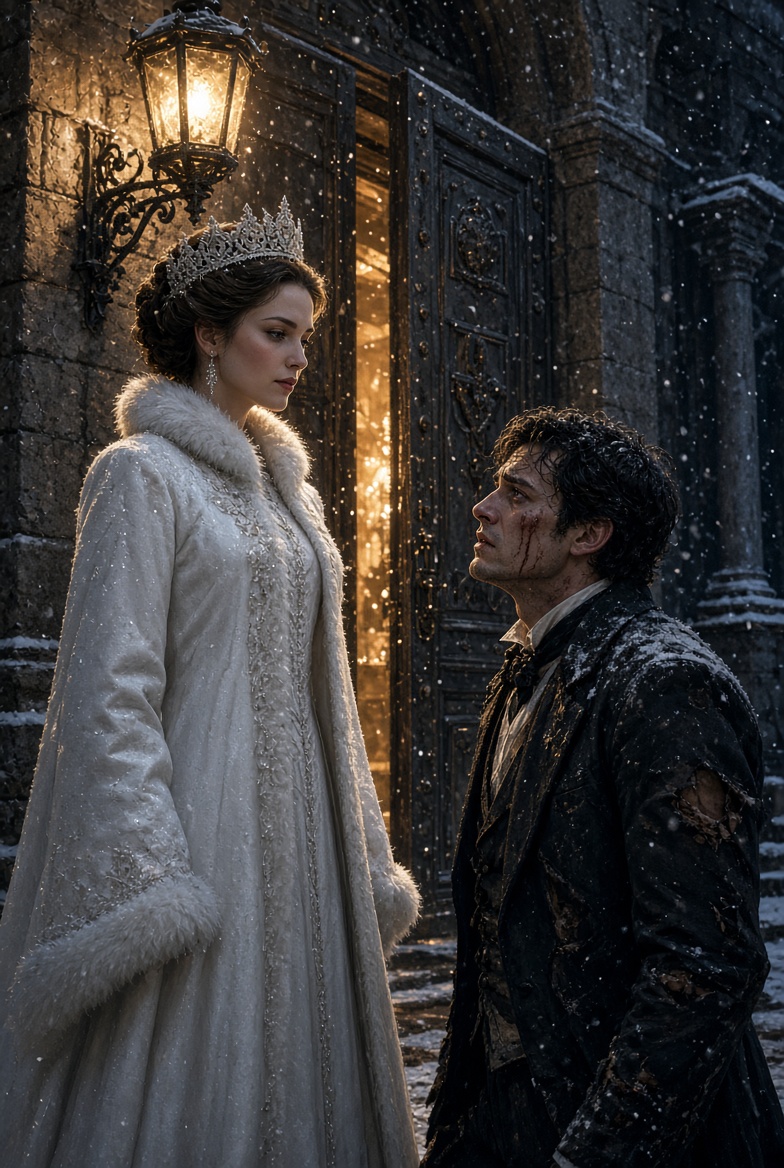
A single gas lantern cast a pool of amber light over the courtyard.
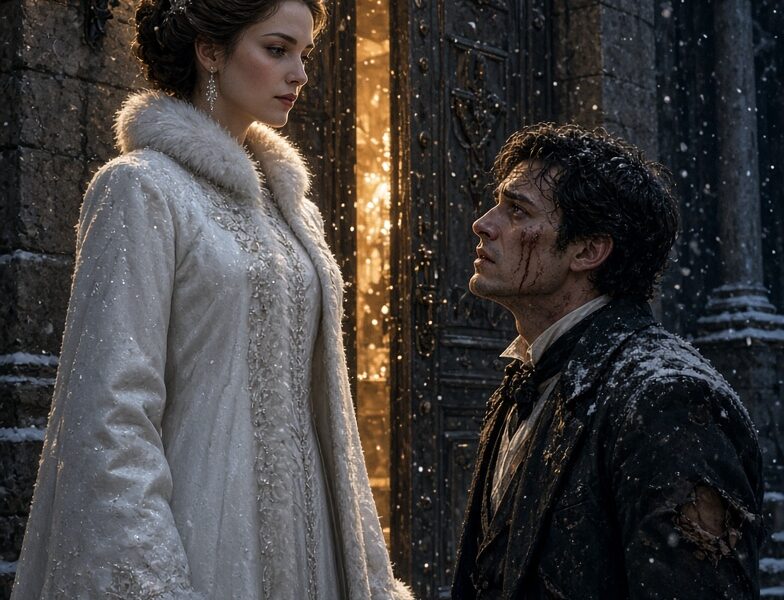
Beneath it stood Anastasia.
She had changed out of her midnight-blue gown and now wore a long white winter coat that blended with the falling snow.
Her tiara remained in place, diamonds catching the lantern light.
But something about her posture had changed.
The commanding woman who had controlled the ballroom was gone.
In her place stood someone who looked exhausted.
Julian approached slowly.
“Anna?”
She did not turn immediately.
She watched the snow drift across the courtyard.
“It’s peaceful out here, isn’t it?” she asked.
“Inside, everything is noise, calculation, and strategy. Out here, the snow doesn’t care who you are.”
She turned toward him.
“It covers the king and the beggar in exactly the same way.”
Her gray eyes rested on his face.
For the first time that evening, she did not look angry.
She looked disappointed.
And somehow, that was worse.
“Why?” Julian asked.
His voice trembled from the cold.
“Why did you do all of this? You destroyed my reputation in front of the entire world. Was it revenge? Did it make you feel better?”
Anastasia sighed.
“Revenge is a small thing, Julian. I didn’t do this for revenge.”
“Then why?”
“For closure.”
He laughed bitterly.
“You exposed my failures, humiliated me, and made me the laughingstock of every financial institution in Europe. How is that closure?”
“Because you needed to see yourself.”
She took a step closer.
“For five years of marriage, and three years after it, you told yourself the same story. You convinced yourself that you were a genius, a titan of finance, a man held back by a boring wife.”
Her voice softened.
“You believed that story so completely that you stopped questioning it.”
Snow settled on Julian’s shoulders.
He did not brush it away.
“I had to break the mirror,” she continued. “I had to show you the cracks. Otherwise, you would have gone on forever believing that your life had been diminished by my mediocrity.”
She reached into her coat and removed a thick envelope sealed with a dark blue wax crest.
Julian stared at it suspiciously.
“What is that? Another lawsuit? A restraining order?”
“Take it.”
He accepted the envelope.
“Open it.”
His numb fingers struggled with the seal.
Inside were several documents.
The first was a deed transferring ownership of his Kensington penthouse.
The second was a bank statement confirming that a substantial outstanding loan had been paid in full by the Caris Trust.
The third was an employment agreement guaranteeing him a position as a regional manager within the London division of his firm.
Julian read the documents twice.
“You’re giving me the apartment?”
“And settling the debt covered by the agreement.”
“Why?”
“I don’t want your money, Julian. I never did. And I certainly don’t want that apartment. It smells of perfume, expensive furniture, and desperation.”
He looked up, tears gathering in his eyes.
“Then why save me?”
Anastasia’s expression barely changed.
“Because I don’t hate you.”
The words struck harder than any insult she had delivered that evening.
“Hate would mean that I still wanted something from you. It would mean that I needed you to suffer for me to feel whole.”
She glanced toward the palace.
“I don’t need that anymore.”
Julian stared at the papers.
“You’re giving me back my life?”
“No. I’m giving you the chance to build one.”
She pointed to the employment agreement.
“You will have a job. You will have a home. You will have the opportunity to start again without pretending that you are someone you are not.”
She paused.
“You are back at zero, Julian. There is no shame in that.”
“I don’t want to be at zero!”
The words burst from him.
He dropped the papers into the snow and grabbed her shoulders.
The guards near the door immediately stepped forward.
Anastasia raised one hand, stopping them.
“Please,” Julian begged.
“I can change. I understand now. I see who you are. I see how powerful you are, how intelligent you are, how extraordinary you are.”
He clutched the fur of her coat.
“We could still be together. We could build something incredible. You could be the Grand Duchess, and I could be the man who stands beside you. I could learn. I could become the husband you deserve.”
His voice cracked.
“Take me back, Anna. Please. Don’t leave me out here in the cold.”
Anastasia looked down at his hands.
She did not pull away.
She simply studied them as though they were leaves that had fallen onto her coat.
“You still don’t understand.”
She gently removed his fingers one by one.
“You don’t want me, Julian. You want the spotlight that shines on me.”
He opened his mouth, but she continued.
“You are looking at my crown, not my eyes. You’re looking at my fortune, not my heart. You’re imagining what my name could do for your career.”
She stepped back.
“The Anastasia you married is gone. You killed her with a thousand small acts of disrespect.”
Her voice trembled for the first time.
“You killed her when you forgot her birthday. When you laughed at her poetry. When you treated her interests as childish and her kindness as weakness. When you decided that the woman who loved you was less valuable than the woman who could make other people admire you.”
Julian shook his head.
“I didn’t mean to hurt you.”
“I know.”
She looked away briefly.
“That was the problem. You never thought about what you were doing to me. You were too busy thinking about yourself.”
The snow continued falling.
“I loved you, Julian. I loved you enough to hide a kingdom from you because I wanted to know whether you could love a woman without knowing what she was worth to everyone else.”
Her voice softened.
“But love is not enough without respect.”
For a moment, the Grand Duchess disappeared.
The woman standing before him was the Anna who had once sat across from him in a tiny Manhattan apartment, mending his socks while he told her about the future he planned to conquer.
She had loved him then.
She had wanted to build something ordinary and enduring.
And he had mistaken that ordinary life for a prison.
Now she straightened, and the royal composure returned to her face.
“Pick up your papers, Julian.”
He hesitated.
“Anna—”
“Pick them up.”
Slowly, he knelt in the snow and gathered the documents.
The deed was damp at the edges.
He pressed the papers against his chest.
“Go home,” Anastasia said. “Return to London. Do your job. Be a good manager. Find someone who appreciates the things you appreciate.”
She paused.
“There is no shame in living an ordinary life, Julian. There is only shame in pretending to be a king when you refuse to learn how to be a decent man.”
She turned toward the steel door.
“Goodbye, Julian.”
“Anna!”
She did not stop.
She walked toward the warm rectangle of golden light spilling from the palace.
For one brief moment, Julian saw the ballroom behind her: the chandeliers, the guests, the servants moving silently through the corridors.
Everything he had spent years chasing was just beyond that door.
Anastasia stepped inside.
The guard looked at Julian once, his expression unreadable.
Then he closed the door.
The steel slammed into place.
The bolt slid home with a harsh metallic sound.
Julian was alone.
He stood in the courtyard for a long time, staring at the closed door.
He waited for it to open.
He waited for Anastasia to return and tell him that the entire evening had been a test, that he had finally shown humility, and that everything could still be repaired.
But the door remained closed.
Snow gathered on his shoulders.
His phone began vibrating inside his pocket.
Once.
Twice.
Then continuously.
He pulled it out.
The screen was cracked, but the display still worked.
Notifications flooded the screen.
Tagged in a post by Tiffany.
Ex-husband exposed at royal gala.
Julian Thorne: The financier who lost a duchess for an influencer.
The Duchess and the Dud.
He opened Tiffany’s latest video.
After a brief buffering delay, her face appeared on the screen.
She was sitting in the back of a luxury taxi, her makeup smeared, holding a glass of champagne.
“Okay, guys, real talk,” she announced.
“Julian is history. I just found out he’s basically broke, and his ex-wife is actual royalty. She literally exposed him in front of everybody.”
She laughed.
“It was honestly unbelievable.”
She took a sip of champagne.
“Anyway, I’m heading to an afterparty with the Duke of Northland. He has a castle, so I guess that’s an upgrade. Never settle for less, ladies.”
The video ended.
Julian stared at the screen.
She had left him within hours of discovering that he could no longer provide the lifestyle she wanted.
The same woman he had chosen because he believed she represented success had abandoned him because he no longer looked successful.
He opened the comments.
One read, “Imagine losing a literal duchess because you thought she was boring.”
Another said, “I worked with Thorne. The guy always took credit for everyone else’s work. Glad the truth finally came out.”
A third read, “She didn’t just expose him. She gave him a way to start over. That’s more mercy than most people would show.”
Julian watched the view count rise.
Five hundred thousand.
Six hundred thousand.
One million.
The world was laughing.
Not with him.
At him.
He turned off the phone.
Its black screen reflected his face: exhausted, wet, and almost unrecognizable.
He looked down at the documents in his hand.
The deed to his apartment.
The employment agreement.
The confirmation that his debt had been settled.
He had wanted these things all evening.
Now they felt strangely heavy.
Anastasia had given him back the life he had possessed before meeting her, but she had stripped away the illusions he had used to make that life feel extraordinary.
He would return to the apartment and look at the furniture, the paintings, and the expensive watch on his wrist.
He would remember that the person he had mocked had helped finance the success he had claimed as his own.
He would have to live with the knowledge that he had received more kindness than he had earned.
Julian placed the documents inside his coat.
Then he turned toward the street.
The walk to the main road was only a hundred yards, but the snow made every step difficult.
He emerged into Vienna’s Christmas-lit streets.
Garlands of pine and holly decorated the streetlamps. Couples walked arm in arm, laughing as snowflakes settled on their hair.
A taxi approached with its yellow light glowing against the darkness.
Julian raised his hand.
The driver slowed, looked at his soaked tuxedo, and studied the exhausted expression on his face.
Then the taxi accelerated and disappeared around the corner.
Julian lowered his arm.
He kept walking.
He passed the Hotel Sacher, where he had checked in two days earlier believing he had arrived as a conqueror.
He could not bring himself to enter.
He passed the luxury boutiques, their windows filled with watches, handbags, and immaculate suits.
Once, he had walked through those stores with the confidence of a man who believed that money could transform him into someone important.
Now the mannequins seemed to stare at him through the glass.
Eventually, he reached a bridge overlooking the Danube.
The water below was dark and restless, reflecting the scattered lights of the city.
He stopped beside the railing.
For several minutes, he watched the current carry broken reflections downstream.
Then he reached into his pocket and removed the invitation.
The thick cream-colored card.
The gold edges.
The double-headed eagle holding a rose.
He remembered opening it in his London office, feeling his heart race as he imagined the doors it might open.
He had believed the invitation proved that he had finally become someone important.
Now he understood that it had merely placed him in a room where his assumptions could no longer protect him.
He closed his fist around the card.
The edges bent.
The gold leaf cracked.
Then he threw it into the river.
The card vanished into the darkness.
Julian stood watching the water long after it disappeared.
“Ordinary,” he whispered.
The word sounded different now.
Not like an insult.
Not like a sentence.
Just a description of a life he had spent years believing he was too good to live.
He pulled his coat tighter around his shoulders and began walking toward the train station.
He would take the train to the airport.
He would fly back to London.
He would return to his office, accept the position Anastasia had offered, and begin the slow, uncomfortable process of learning how to work without pretending that every success was proof of his superiority.
He would no longer be the man who imagined himself a king.
He would be Julian Thorne.
Nothing more.
Nothing less.
And perhaps, for the first time, that would have to be enough.
The following months were not easy.
The headlines continued circulating for weeks, appearing in business publications, entertainment magazines, and social media feeds.
Some people treated Julian as a joke.
Others questioned the ethics of Anastasia’s public disclosure, arguing that private marital grievances should never have been presented before an audience of powerful people.
There were debates about whether she had been justified in exposing his professional record.
Some commentators praised her restraint in settling his debt and offering him employment.
Others believed that no amount of generosity could erase the humiliation of being publicly identified as the man who had discarded a duchess.
Julian read almost every article.
At first, he wanted to defend himself.
He drafted statements explaining that he had not known Anastasia’s identity, that he had been under enormous professional pressure, and that the financial arrangements surrounding his career were more complicated than the public understood.
But every time he reread the drafts, he found the same thing.
Excuses.
He deleted them.
He issued no public rebuttal.
Instead, he returned to London and accepted his new position.
The regional manager’s office was smaller than the corner suite he had once occupied, but it had a window overlooking the Thames.
He arrived early.
He studied the accounts himself.
He asked questions he would once have considered embarrassing.
When a junior analyst pointed out a flaw in one of his assumptions, Julian listened rather than interrupting.
It was an uncomfortable experience.
He had spent years believing that admitting ignorance was a sign of weakness.
Now he began to understand that refusing to admit ignorance was far more expensive.
Rickard did not fare as well.
The internal review of the division revealed a pattern of inflated projections, questionable decisions, and failures that had been concealed behind the appearance of success.
Rickard resigned before the review was complete.
Several other executives left the firm.
Julian was required to cooperate with the investigation, providing records and explanations for decisions he had previously attributed to instinct and experience.
For the first time, he had to distinguish between the work he had actually done and the opportunities others had created for him.
It was humbling.
It was also necessary.
He never again received an invitation to the Winter Solstice Royal Gala.
He never met the Duke of Northland.
He never heard from Tiffany again, except through the occasional article announcing another engagement, another luxury vacation, or another highly publicized relationship.
Eventually, her name disappeared from his daily thoughts.
Anastasia’s did not.
He saw her occasionally in newspapers and magazines.
She appeared at charitable foundations, cultural events, and diplomatic gatherings, always composed, always elegant, always surrounded by people who respected her for reasons that had nothing to do with her clothes.
She funded restoration projects for historic libraries.
She supported scholarships for young people from modest backgrounds.
She helped establish a program that trained conservators to preserve rare books and manuscripts.
When Julian read about that last initiative, he sat for a long time without moving.
He remembered the little restoration shop in the East Village.
He remembered Anna’s hands, carefully repairing a torn page.
He remembered telling her that the work was pointless.
He had been so certain that he understood the world.
He had simply never understood her.
Years passed.
Julian remained in financial management, holding a respectable position and earning a comfortable salary.
He never became a billionaire.
He never acquired another penthouse.
He never married again.
His life became quieter than he had once imagined possible.
There were no photographers waiting outside his home, no strangers asking for his opinion on the latest market movements, and no glamorous parties where he could measure his worth by the number of important people who remembered his name.
Some evenings, he cooked dinner in his apartment and read books he had once considered beneath him.
He learned to enjoy long walks without checking his phone.
He began giving money to a local literacy program, never attaching his name to the donations.
He did not consider these acts a path to redemption.
They were simply things he could do without expecting applause.
On the third anniversary of the Vienna gala, a magazine published a photograph of Anastasia standing beside a group of children at the opening of a restored historic library.
She was smiling.
Not the cold, controlled smile she had worn in the ballroom.
A genuine smile.
For a moment, Julian could almost see the woman he had known in New York, standing beside a battered kitchen table with a book open in front of her.
He read the article twice.
Then he folded the magazine and placed it on his desk.
He did not contact her.
He had finally learned that loving someone did not give him the right to demand access to her life.
He could regret what he had done without asking her to make that regret easier to bear.
He could wish her happiness without expecting to be included in it.
And he could acknowledge that she had once loved him without pretending that her love obligated her to continue doing so.
Sometimes, late at night, he remembered the courtyard.
The snow.
The gas lantern.
The envelope in his hands.
Most of all, he remembered the door.
He had spent years believing that success meant finding the right entrance, obtaining the right invitation, and convincing the right people that he belonged.
Anastasia had shown him that a person could enter every palace in Europe and still remain a stranger to himself.
He had received the invitation he wanted.
He had worn the suit he wanted.
He had stood beneath the chandeliers he had imagined for years.
And none of it had made him the man he believed he was.
The invitation had been a piece of cream-colored paper with gold edges.
He had treated it as proof that he had finally arrived.
In the end, it became the symbol of everything he had misunderstood.
Because the most valuable things in life rarely announce their worth.
They do not always glitter.
They do not always attract attention.
Sometimes they sit quietly across a kitchen table, repairing a damaged book, preparing a simple meal, or listening to someone else’s dreams.
And sometimes, by the time a person realizes what those things were worth, the door has already closed.
Julian Thorne learned the lesson too late to save his marriage.
But he learned it in time to understand the difference between wealth and worth.
He had once believed that class meant wearing the right suit, driving the right car, and knowing the right people.
He eventually discovered that genuine class was knowing the value of what you had before you lost it.
Royalty, he learned, was not simply a matter of bloodlines or inherited fortunes.
It was also a matter of character.
Anastasia possessed both the crown and the character to carry it.
Julian had possessed neither.
And the woman he had once dismissed as ordinary had given him one final gift: the opportunity to stop pretending.
The rest was up to him.
So what do you think?
Did Anastasia go too far by exposing Julian in front of the entire royal gathering, or was her decision justified after years of disrespect and betrayal?
Would you have forgiven Julian, or would you have closed that door forever?
Share your thoughts, because sometimes the most revealing part of a story isn’t the moment someone loses everything.
It’s the moment they finally understand what they lost.
And remember: be careful who you discard on your way up.
You may meet them again on your way down.









