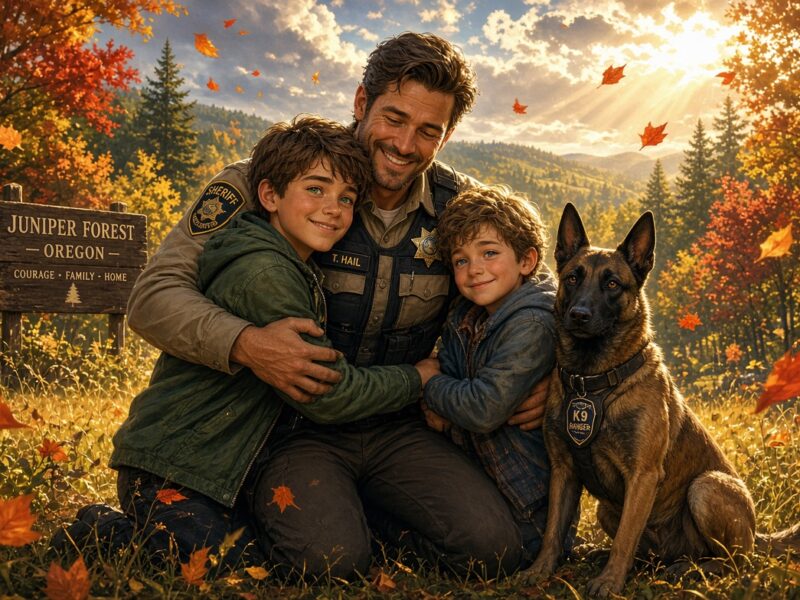
He Lay Dying in the Storm With Only His Dog Beside Him… Until Two Lost Boys Refused to Walk Away
The rain fell in sheets across Juniper Forest, turning the fallen autumn leaves into a slick carpet of gold and crimson. Deputy Travis Hail lay face down in the mud, blood mixing with rainwater as it streamed down his neck and soaked into the collar of his uniform. His radio was gone—knocked from his belt during the ambush. His backup was nonexistent. His only hope was the four-legged partner who refused to leave his side, even as the storm intensified and the temperature dropped toward freezing.
Ranger whined softly, nudging Travis’s limp hand with his wet nose. The Belgian Malinois was injured too—a gash along his left flank from where one of the attackers had swung a boot heel into his ribs. But the dog’s amber eyes remained alert, scanning the darkening forest for any sign of movement. Any sign of hope.
—
Two miles away, beneath the rotting eaves of an abandoned cabin that had stood empty since the Reagan administration, two boys huddled together for warmth. Eli, twelve years old and already carrying the weight of the world on his narrow shoulders, had fashioned a makeshift shelter from plywood scraps and a tarp he’d found behind the hardware store on Main Street. His younger brother Micah, just eight, pressed close against him, shivering despite the threadbare blanket wrapped around them both.
The cabin had no electricity. No running water. But it had walls, a roof that mostly kept the rain out, and a door that locked. For two kids who had been sleeping in drainage culverts and behind dumpsters for the better part of a year, it was practically the Ritz.
“Eli,” Micah whispered, his voice barely audible over the drumming rain. “I’m hungry.”
Eli reached into his jacket pocket and pulled out half a granola bar—the last of the supplies he’d swiped from the convenience store two days ago. He’d been careful, only taking what they needed, never enough to draw attention. The clerk, an older woman named Dorothy who always seemed to be looking the other way when they came in, had pretended not to notice.
“Here,” Eli said, pressing the bar into Micah’s small hands. “I already ate.”
It was a lie. It was always a lie. But Micah was too young to know the difference between a lie told for cruelty and a lie told for love.
—
Ranger’s ears perked up at the sound of something moving through the underbrush. Not human footsteps—too light, too erratic. A deer, maybe. Or a raccoon. The dog’s training kicked in, years of military service and law enforcement drills flooding back despite his exhaustion. He needed to find help. He needed to save his partner.
But he couldn’t leave Travis. Not like this. Not bleeding and unconscious in the middle of nowhere.
The dog made a decision. He would stay. He would guard. And if anyone came—anyone at all—he would fight until his last breath.
—
Back at the cabin, Eli couldn’t sleep. Something was nagging at him, a persistent itch in the back of his mind that wouldn’t go away. He’d heard the sirens earlier—distant, muffled by the rain, but unmistakable. Juniper Creek was a small town. Nothing ever happened here. At least, nothing that required police sirens.
“Micah,” he whispered, gently shaking his brother’s shoulder. “Wake up. Something’s wrong.”
Micah stirred, his blue eyes blinking sleepily. “What is it?”
“I don’t know yet. But I’m going to find out.”
—
The rain had stopped by the time Eli slipped out of the cabin, leaving Micah huddled beneath the blanket with strict instructions to stay put and stay quiet. The forest was dark, the kind of dark that seemed to swallow light and sound alike. But Eli knew these woods. He’d spent months exploring them, learning every trail and hidden path, mapping out escape routes in case they ever needed to run.
He moved quietly, his worn sneakers squelching in the mud as he made his way toward the main road. The trees loomed overhead like silent sentinels, their branches dripping with rainwater. Somewhere in the distance, an owl hooted—a lonely sound that made Eli’s skin prickle.
That’s when he heard it. A whimper. Soft, pained, barely audible over the dripping leaves.
Eli froze, his heart hammering in his chest. He wasn’t afraid of animals—he’d encountered plenty of strays in his time on the streets. But this sound was different. It was the sound of something hurting. Something desperate.
Slowly, cautiously, Eli followed the sound. It led him off the main trail, deeper into the forest, where the trees grew thicker and the underbrush was tangled and wild. And then he saw it.
A dog. A big dog. Lying beside a man in a sheriff’s uniform, both of them soaked and bloodied and barely moving.
—
For a long moment, Eli just stood there, frozen in place. He knew he should run. Knew he should go back to the cabin, grab Micah, and pretend he’d never seen anything. That’s what survival required. That’s what logic demanded.
But the dog was looking at him.
Those amber eyes—so intelligent, so knowing—seemed to pierce right through him. The dog didn’t growl. Didn’t bare its teeth. It just looked at Eli with an expression that seemed to say: *Help us. Please.*
And Eli, despite every instinct screaming at him to flee, took a step forward.
—
The man was unconscious, his breathing shallow and irregular. Eli knelt beside him, his hands trembling as he checked for a pulse—just like his mother had taught him, years ago, before the cancer took her. Before their father disappeared into a bottle and never came back.
There was a pulse. Weak, but there.
“Hey,” Eli said, his voice cracking. “Hey, mister. Can you hear me?”
No response.
The dog whined again, nudging Eli’s hand with its nose. And that’s when Eli noticed the radio. It was lying in the mud a few feet away, its antenna bent, its casing cracked. But when Eli picked it up and pressed the button, a faint crackle of static emerged.
“Hello?” Eli said into the radio, not knowing what else to do. “Is anyone there? There’s a man hurt. A sheriff. Please, someone…”
Static. Then silence.
Eli tried again. “Please! He’s bleeding! I don’t know what to do!”
More static. Then, impossibly, a voice.
“This is Sheriff Dana Clark. Who is this? What’s your location?”
—
Eli didn’t know the exact coordinates. He was twelve years old, not a cartographer. But he knew landmarks—the old oak tree that had been struck by lightning three years ago, the creek that ran behind the abandoned mill, the cluster of red maples that always turned crimson first in autumn.
“I’m in Juniper Forest,” he said, his voice shaking. “Near the old logging road. There’s a big pine tree with a split trunk—you can’t miss it. Please hurry. He’s hurt bad.”
“Stay on the line,” the voice said. “We’re coming.”
—
What happened next would later be described by the townspeople of Juniper Creek as nothing short of a miracle. Two homeless boys—children, really, forgotten by society and left to fend for themselves—had stumbled upon a wounded deputy and his loyal K9 in the middle of a storm. And instead of running away, instead of protecting themselves, they had chosen to help.
Sheriff Dana Clark arrived with Deputy Caleb Nolan and a team of paramedics within twenty minutes. They found Eli kneeling beside Travis, applying pressure to the wound on his head with a piece of his own torn shirt. They found Micah, who had followed his brother despite the instructions to stay put, huddled against Ranger for warmth.
And they found Ranger—injured, exhausted, but still guarding his partner with a ferocity that brought tears to the eyes of even the most hardened officers.
—
Travis Hail was rushed to Juniper Creek Memorial Hospital, where he underwent emergency surgery for a fractured skull and internal bleeding. Ranger was treated for his injuries at the veterinary clinic run by Dr. Patricia Okonkwo, a no-nonsense woman in her sixties who had seen more than her fair share of wounded animals in her decades of practice.
The boys were taken to the sheriff’s office, where Dana Clark herself wrapped them in blankets and gave them hot chocolate from the break room vending machine. She didn’t ask questions—not yet. She just let them sit in the warmth, let them breathe, let them process what they had just been through.
But questions would come. They always did.
—
Three days later, Travis Hail opened his eyes in a hospital bed, his head wrapped in bandages, his body aching with a pain that seemed to reach all the way down to his bones. The first thing he saw was Ranger, lying on a blanket on the floor beside his bed, tail wagging weakly.
“Hey, buddy,” Travis croaked, his voice hoarse from disuse. “You look worse than I do.”
Ranger’s tail wagged faster.
The second thing Travis saw was Sheriff Dana Clark, standing in the doorway with a look on her face that he couldn’t quite read. It was part relief, part something else. Something darker.
“We need to talk,” she said.
—
The story that unfolded over the next several hours was one that would change Juniper Creek forever. Travis had been investigating a tip about illegal firearms trafficking in the forest—weapons being smuggled through the national park and sold to buyers in Portland and Seattle. The tip had come from an anonymous source, someone who claimed to have evidence of a network that stretched back decades.
But the tip had been a trap. Someone had known Travis was getting close. Someone had wanted him silenced.
“The men who attacked you,” Dana said, her voice steady but tense. “We’ve identified two of them. Both have ties to a militia group operating out of the eastern part of the state. But they’re not the ones calling the shots.”
“Who is?” Travis asked.
Dana hesitated. Then she pulled out a photograph—a faded, yellowed image of a man in a sheriff’s uniform, standing in front of the Juniper Creek courthouse. The man was smiling, his eyes bright with the confidence of youth.
“Your father,” Dana said. “Deputy Daniel Hail. He was investigating the same network twenty years ago. And he disappeared before he could expose it.”
—
Travis had known his father had died when he was young—killed in the line of duty, or so he’d been told. But the truth, as he was now discovering, was far more complicated. Daniel Hail hadn’t died in a shootout or a car accident. He had been murdered. Silenced. Buried somewhere in the forest he had sworn to protect.
And the men who had killed him were still out there. Still operating. Still profiting from the same illegal enterprise that Daniel had died trying to expose.
“I’m going to find them,” Travis said, his voice hard. “I’m going to find out what happened to my father, and I’m going to bring them to justice.”
Dana nodded slowly. “You won’t be alone.”
—
Meanwhile, in a small room at the back of Becky Langford’s grocery store, two boys were learning what it meant to be wanted. Becky had taken them in—temporarily at first, just until the county could figure out what to do with them. But the more time she spent with Eli and Micah, the more she realized she couldn’t let them go.
Becky had lost her own son, Adam, to leukemia five years earlier. The grief had nearly destroyed her, had left her hollow and numb and unable to connect with anyone. But these boys—these brave, broken, beautiful boys—had awakened something in her. Something she thought she’d lost forever.
“You don’t have to go,” she told them one evening, as they sat around her kitchen table eating homemade chicken soup. “You can stay here. With me. If you want.”
Eli looked at her, his green eyes wary but hopeful. “For how long?”
Becky smiled, tears glistening in her eyes. “For as long as you need. For as long as you’ll have me.”
—
The adoption process took weeks—mountains of paperwork, background checks, home visits from social services. But in the end, it was worth it. Eli and Micah became Langfords, officially and legally, on a crisp November morning. The judge, a kindly older man named Harold Pemberton who had known Becky since she was a girl, wiped his eyes as he signed the final documents.
“Congratulations,” he said. “You’re a family now.”
—
The story of what Eli and Micah had done—the story of how they had saved Deputy Travis Hail and his K9 partner—spread through Juniper Creek like wildfire. The local newspaper ran a front-page article. The television news in Portland sent a crew to interview the boys. Even the governor’s office issued a statement praising their courage.
But the boys didn’t feel like heroes. They just felt like kids. Kids who had finally found a place to belong.
—
One month after the ambush, the town of Juniper Creek held a ceremony to honor Travis, Ranger, Eli, and Micah. The event was held on the town green, beneath a canopy of golden autumn leaves. Nearly everyone in town showed up—farmers and shopkeepers, teachers and retirees, even the grumpy old man who ran the hardware store and never smiled at anyone.
Sheriff Dana Clark presided over the ceremony, her voice steady and proud as she recounted the events of that fateful night. She presented Travis with a medal for bravery, Eli and Micah with certificates of commendation, and Ranger with a special award for valor—a shiny silver medal that he wore around his neck with obvious pride.
“These individuals,” Dana said, “remind us of what it means to be a community. They remind us that courage isn’t about being fearless—it’s about doing what’s right, even when you’re afraid. And they remind us that heroes can come from the most unexpected places.”
—
But the ceremony was only the beginning. Travis had made a promise—to himself, to his father, to the town—that he would uncover the truth about what had happened twenty years ago. And he intended to keep that promise.
He spent his days poring over old case files, interviewing witnesses, following leads that had long since gone cold. He discovered that his father had been investigating a network of corrupt officials and businessmen who had been using the national forest as a staging ground for illegal activities—weapons trafficking, drug smuggling, even human trafficking.
The network had tentacles everywhere. In the sheriff’s department. In the prosecutor’s office. In the town council. Men who had sworn to protect the community had been secretly working against it, lining their pockets with blood money while the people of Juniper Creek remained blissfully unaware.
—
The breakthrough came in December, when Travis received an anonymous tip from someone claiming to have information about Daniel Hail’s murder. The caller, a man with a gravelly voice and a noticeable tremor, agreed to meet Travis at a remote location outside town—an old hunting cabin that had been abandoned for years.
Travis went alone, despite Dana’s protests. He didn’t want to scare off the informant, didn’t want to risk losing his only lead. But he carried his service weapon, and he kept his phone on, with the location sharing enabled.
The cabin was dark when he arrived, its windows boarded up, its roof sagging under the weight of accumulated snow. Travis approached cautiously, his hand on his holster, his breath forming clouds in the cold air.
“Hello?” he called out. “I’m here. I’m alone.”
A figure emerged from the shadows—an old man, gaunt and weathered, with deep-set eyes and a scraggly gray beard. He moved slowly, his joints creaking with age, but there was something sharp in his gaze. Something knowing.
“You’re Daniel’s boy,” the man said. It wasn’t a question.
Travis nodded. “And you are?”
The man smiled, a thin, humorless smile. “Name’s Wittman. I used to work for the Forest Service. Back when your father was investigating the trafficking ring.”
—
What Wittman told Travis over the next several hours would change everything. He had been a young ranger twenty years ago, idealistic and eager to make a difference. But he had stumbled onto something he wasn’t supposed to see—a meeting between several prominent townspeople and a group of outsiders with out-of-state plates.
He had reported what he’d seen to Daniel Hail, who had been investigating the trafficking ring for months. Daniel had promised to protect him, promised to bring the criminals to justice. But before he could, Daniel had disappeared—murdered, Wittman believed, by the very people he had been trying to expose.
“I was too scared to come forward,” Wittman said, his voice heavy with guilt. “I thought they’d kill me too. So I ran. Hid. Lived like a hermit for twenty years, waiting for someone to finish what Daniel started.”
Travis felt a surge of anger—not at Wittman, but at the men who had terrorized him into silence. “Do you know who they are? The ones who killed my father?”
Wittman nodded slowly. “I know some of them. But you have to understand—these are powerful men. They’ve got connections. They’ve got money. Going after them won’t be easy.”
“I don’t care about easy,” Travis said. “I care about justice.”
—
The investigation that followed was the most complex and dangerous of Travis’s career. With Dana’s help—and the reluctant cooperation of the FBI, who had been monitoring the trafficking network for years—he began building a case against the men who had murdered his father.
The evidence was damning. Financial records showing millions of dollars in illegal transactions. Wiretap recordings of incriminating conversations. Testimony from witnesses who had been too afraid to speak out before.
But the closer Travis got to the truth, the more dangerous his situation became. He received threats—anonymous phone calls, notes left on his windshield, a dead rat on his doorstep. Someone wanted him to back off. Someone was willing to do whatever it took to keep the past buried.
—
The final confrontation came on a cold January night, when Travis and a team of FBI agents raided a warehouse on the outskirts of town. Inside, they found crates of illegal weapons—assault rifles, handguns, ammunition—destined for buyers in Portland and beyond. They also found the man who had orchestrated the whole operation: a former sheriff’s deputy named Marcus Reeves, who had been Daniel Hail’s partner and best friend.
Reeves didn’t go down without a fight. He opened fire on the agents, wounding two before he was finally subdued. As he was dragged away in handcuffs, he locked eyes with Travis and smiled—a cold, cruel smile that made Travis’s blood run cold.
“Your father begged for his life,” Reeves said. “Did you know that? He begged. And I watched him die.”
—
The trial was held in Portland, far from the prying eyes of Juniper Creek. Reeves and his co-conspirators—seven men in total, including two former town council members and a local judge—were convicted on charges ranging from racketeering to first-degree murder. They were sentenced to life in prison without the possibility of parole.
For Travis, the verdict was bittersweet. Justice had been served, but it couldn’t bring his father back. Nothing could. Still, there was a sense of closure—a sense that Daniel Hail had finally been vindicated.
—
Spring came to Juniper Creek like a long-awaited reprieve, melting the snow and coaxing green shoots from the frozen earth. The town seemed different somehow—lighter, freer, as if a heavy weight had been lifted from its collective shoulders. People smiled more. They lingered on street corners, chatting with neighbors they’d previously avoided. There was a sense of renewal in the air, a feeling that the worst was behind them.
Travis Hail stood on the porch of his father’s old house—a modest two-bedroom bungalow on the edge of town that he had inherited after the trial. He had spent the winter renovating it, painting the walls, fixing the plumbing, replacing the rotting floorboards. It was his home now—his and Ranger’s.
The dog lay at his feet, basking in the warm afternoon sun, his tail thumping lazily against the wooden planks. He had recovered fully from his injuries, though he still walked with a slight limp—a permanent reminder of that night in the forest.
“Hey, boy,” Travis said, reaching down to scratch behind Ranger’s ears. “You ready for a walk?”
Ranger’s ears perked up, and he scrambled to his feet, tail wagging enthusiastically.
—
They walked through town, past Becky’s grocery store, where Eli and Micah were helping customers and stocking shelves. The boys had flourished under Becky’s care—they were healthier, happier, more confident than they had ever been. Eli had even joined the local Boy Scout troop, and Micah had made friends with a group of kids his own age.
Becky waved as Travis passed by, and he waved back. She looked different too—younger, somehow, as if the burden of grief she had carried for so long had finally begun to lift.
—
The trail through Juniper Forest was familiar to Travis—he had walked it a hundred times before. But today it felt different. The trees seemed taller, the air sweeter, the sunlight warmer. It was as if the forest itself was welcoming him home.
He stopped at a clearing near the old logging road—the place where Eli and Micah had found him, bleeding and unconscious in the mud. Someone had erected a small wooden sign there, carved with the words: “In memory of Deputy Daniel Hail. He died protecting this town.”
Travis knelt beside the sign, his hand resting on the rough-hewn wood. Ranger sat beside him, head bowed, as if paying his respects.
“I found them, Dad,” Travis whispered. “I found the men who killed you. And I made sure they’ll never hurt anyone again.”
The wind stirred the leaves overhead, and for just a moment, Travis could have sworn he heard his father’s voice—faint, distant, but unmistakably proud.
—
The story of Travis Hail and Ranger, of Eli and Micah, of the small town of Juniper Creek, spread far beyond the borders of Oregon. It was told and retold—in newspapers, on television, on social media. It became a symbol of hope, a reminder that even in the darkest of times, there are people willing to stand up for what’s right.
But for the people who had lived it—for Travis, for Becky, for Eli and Micah, for Dana and Caleb and all the others who had been touched by that fateful night—the story was more than just words. It was a testament to the power of courage, compassion, and the unbreakable bonds that form between those who choose to stand together.
And it all began with a dog who refused to give up, and two boys who refused to look away.
—
*One year later*
The annual Juniper Creek Autumn Festival was in full swing, the town green transformed into a wonderland of twinkling lights and colorful banners. Vendors sold hot cider and caramel apples, children ran laughing through piles of fallen leaves, and somewhere in the distance, a band played folksy tunes that made everyone tap their feet.
Travis Hail stood at the edge of the festivities, a cup of coffee in one hand, Ranger sitting attentively at his feet. He had been promoted to lieutenant—Dana’s recommendation, approved by the town council—and he wore his new insignia with quiet pride.
“Lieutenant Hail,” a voice said behind him. “I thought I might find you here.”
Travis turned to see Nora Evans, the town librarian, approaching with a smile. She was holding a large, leather-bound book—a town history she had been working on for the past year.
“I wanted you to have this,” she said, handing him the book. “It’s a first edition. I included a chapter about your father—about what he did, and what you did to honor his memory.”
Travis opened the book to the marked page and felt a lump form in his throat. The chapter was titled “The Deputy Who Wouldn’t Give Up,” and it was illustrated with a photograph of Daniel Hail, smiling in his uniform, standing in front of the Juniper Creek courthouse.
“Thank you,” Travis said, his voice rough. “This means more than you know.”
—
Across the green, Eli and Micah were helping Becky set up her stall, arranging muffins and pastries on a folding table. They had grown taller, stronger, more confident—but their eyes still held that same quiet wisdom that had marked them as heroes on that long-ago night.
“Hey, Eli,” Micah said, nudging his brother. “Look.”
Eli followed his gaze and saw Travis approaching, Ranger padding alongside him. The deputy—no, the lieutenant—was smiling, and Eli felt a warmth spread through his chest.
“Hey, boys,” Travis said, stopping in front of them. “You got a minute?”
Eli nodded, suddenly nervous. “What’s up?”
Travis reached into his pocket and pulled out something small and shiny—a silver medal, identical to the one Ranger had received. “I wanted you to have this,” he said, pressing it into Eli’s hand. “It’s a challenge coin. From the sheriff’s department. You don’t get it for doing something heroic—you get it for being someone I trust. Someone I’d want watching my back.”
Eli stared at the coin, his throat tight with emotion. “I don’t know what to say.”
“You don’t have to say anything,” Travis said. “Just promise me you’ll keep being who you are. Keep protecting your brother. Keep doing the right thing, even when it’s hard.”
Eli nodded, clutching the coin tightly. “I promise.”
—
As the sun dipped below the horizon and the festival lights flickered to life, Travis stood with Ranger, watching the town celebrate. He thought of his father—of the man who had died trying to protect this community—and felt a sense of peace settle over him.
The past would always be there. The scars would always remain. But so would the love, the courage, the hope. So would the bonds forged in the darkness and tested by fire.
Ranger looked up at him, amber eyes bright, and wagged his tail.
“Yeah, buddy,” Travis said, smiling. “I think we’re going to be okay.”
—
*The end of one story, and the beginning of another.*
—
The legend of Juniper Creek continued to grow long after that autumn festival, carried on the lips of townspeople and visitors alike. They told of the deputy who had been ambushed and left for dead, of the K9 who had risked everything to save him, of the two homeless boys who had become heroes and found a family in the process.
But the story didn’t end there. It couldn’t. Because stories like that—stories of courage and sacrifice and love—they don’t have endings. They have beginnings. New chapters. New characters who pick up the mantle and carry it forward.
Eli and Micah grew up in Juniper Creek, surrounded by people who loved them and a community that would always have their backs. Eli became a sheriff’s deputy, just like Travis and Daniel before him. Micah went to college, studied veterinary medicine, and returned home to open a practice that served both the town and the surrounding forest—and always, always offered free care to service animals.
Becky lived to see her boys become men, her heart full to bursting with pride. She never remarried, never had more children—but she didn’t need to. She had Eli and Micah. She had a family.
Dana Clark served as sheriff for another decade before retiring, but not before she saw the last of the trafficking ring brought to justice. She spent her retirement writing her memoirs, tending her garden, and spoiling her grandchildren—Eli’s kids and Micah’s kids and all the others who came to think of her as a grandmother.
And Travis Hail? He kept the oath he had sworn. He protected his town, honored his father’s memory, and lived each day with the knowledge that he was surrounded by people who loved him. He never married, but he was never alone. He had Ranger. He had his friends. He had a purpose.
—
Years passed. Seasons changed. Autumn gave way to winter, winter to spring, spring to summer, and back again. The forest grew and changed and healed. The town grew and changed and healed. And the people—the people learned to do the same.
But the memory of that night—the night two boys found a dying deputy and a loyal dog refused to leave his side—never faded. It was carved into the heart of Juniper Creek, a story that would be told for generations to come.
A story of courage. A story of compassion. A story of hope.
A story that reminded everyone who heard it that heroes don’t always wear capes. Sometimes they wear dog collars and threadbare jackets. Sometimes they’re just ordinary people who choose to do extraordinary things.
Sometimes—and this was the most important lesson of all—sometimes the bravest thing you can do is simply refuse to look away.
—
*If this story touched your heart, share it with someone who might need to believe in hope again. Leave a comment saying “Amen” if you agree that courage, kindness, and faith can change our world. And remember—even in life’s storms, you are never truly alone.*
*May God bless you and keep you, always.*









