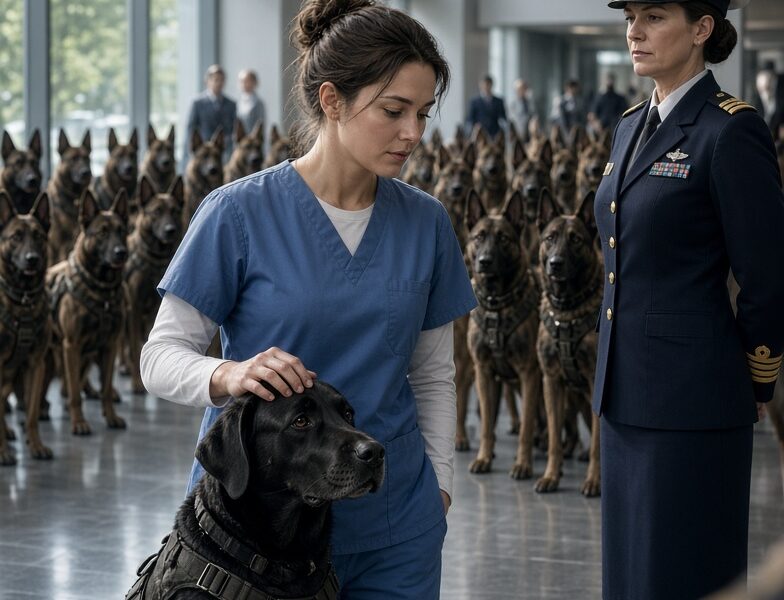
He Laughed When She Said She Worked With SEALs… Then 50 Military Dogs Walked In
She was twenty-nine years old, wore a plain white uniform, and carried a patient transfer form in her hand.
Lieutenant Marcus Voss read it for exactly four seconds before he laughed.
Not a quiet laugh. The kind that fills a hallway. The kind that makes other people look up from their desks.
“You’re telling me,” he said loud enough for the entire nursing station to hear, “that you worked alongside SEAL Team operators. You.”
He dropped the paperwork on the counter like it was trash.
“Go back to your ward, nurse. Leave the real military business to people who’ve actually been there.”
Thirty seconds later, the front doors of Harlo Military Medical Center blew open, and fifty service dogs walked in.
The morning had started the way most mornings did at Harlo Military Medical Center, with the smell of industrial floor cleaner, the low hum of ventilation systems, and the sound of someone’s monitor alarm going unanswered for a few seconds too long before a tired nurse finally silenced it.
Emily Carter had been awake since five.
She’d checked on seven patients before six, refilled two IV bags, updated three charts, and argued with the overnight pharmacist about a dosage discrepancy that turned out to be a data entry error, not hers.
By 7:15, she had already put in more work than some of her colleagues would manage before noon, and she didn’t particularly think about that.
It was just how she moved through a day.
She was twenty-nine, five-foot-four, the kind of person who looked smaller than she was until you watched her work, and then something shifted in the air around her.
Other nurses on the ward had noticed it early on. The way she remained completely still when a patient coded. The way her hands didn’t shake during a chest compression. The way she made decisions without waiting for someone to give her permission.
Nobody had ever asked her directly about it.
People rarely asked Emily Carter anything directly.
She had a way of being present that somehow discouraged casual conversation.
She kept her hair pulled back tight. She wore the standard-issue scrubs and a plain white jacket with her ID clipped to the front pocket.
Nothing about her looked unusual. Nothing about her invited questions.
That morning, she had a patient transfer request to deliver.
The request was for Corporal Dean Ashworth, twenty-six, combat injury sustained in a training accident, currently recovering on Ward 4.
The paperwork authorized his movement to a specialized rehabilitation unit located at the Kesler Veterans Complex, forty miles northeast.
The forms had been signed off by the attending physician, Dr. Naomi Ren, and countersigned by the ward supervisor.
Emily needed one final authorization stamp from the administrative duty officer before the transport could be arranged.
The administrative duty office was on the first floor, which meant passing through the east corridor, the one where the senior officers kept their workspaces, where everything smelled like old coffee and printer paper, where people walked faster than they needed to because being seen walking slowly in that corridor made you look like you didn’t have somewhere important to be.
Emily walked at her normal pace.
The duty office was staffed that morning by a specialist named Greer, who was clearly dealing with something on her computer and did not look up when Emily entered.
There was a second person in the office, standing near the window with a paper cup in his hand, reading something on his phone.
He was tall, good-looking in the way that some officers were, like they’d been told that enough times for it to become part of how they carried themselves.
His uniform was pressed sharp. The nameplate on his chest read Voss.
“Morning,” Emily said to the room generally. “I have a transfer request for Ward 4. Needs the duty stamp.”
Greer finally looked up, reached toward the inbox pile on her desk, then stopped.
“Oh, that one needs a senior authorization. The patient’s a vet with classified medical history flags. SOP says a commissioned officer has to sign it.”
Emily nodded. She’d dealt with this before.
“Okay. Is there someone available?”
Voss looked up from his phone.
He glanced at Emily, glanced at the paperwork she was holding, glanced back at Emily.
There was something in the look, brief but real, like he was cataloging her and reaching a conclusion faster than the information warranted.
“I can take a look,” he said.
He set down his coffee and held out a hand.
Emily gave him the folder.
He opened it, skimmed the top sheet, then slowed down at the section listing the requested receiving facility and the nature of the patient’s case.
He flipped to the second page. He looked at the third.
“This patient’s case has a SOCOM tag on it,” he said.
“Yes,” Emily said. “He was assigned to a support unit under SOCOM before his injury. It’s noted in the intake records.”
“And you’re the transfer nurse?”
“I’m the attending nurse on Ward 4. Yes.”
Voss looked up.
“You have clearance for SOCOM-tagged case files.”
“The transfer request doesn’t require clearance access to the patient’s service record. It only requires authorization to move him to a certified VA rehabilitation facility, which is what Dr. Ren has already signed off on.”
Voss tilted his head slightly.
“You seem pretty confident about the process.”
“I’ve done this before.”
He looked back at the paperwork.
“Who authorized your original intake on this case?”
“Dr. Ren. It’s on the form.”
“And before that. What’s your background, Carter?”
He said her name the way people said names when they’d just read them off a page and wanted you to know they could do that.
“What’s your prior service?”
Emily paused.
It was brief, barely a beat, but she registered the shift in the conversation.
This had stopped being about the paperwork.
“I served as a medical specialist before transitioning to civilian nursing certification,” she said. “My qualifications are on file with HR.”
“Medical specialist.” He said it slowly, like he was tasting something. “Where?”
“Several postings. Some of them restricted.”
That landed wrong with him. She could see it in the way his jaw moved.
“Restricted,” he said. “Okay. And what units were you attached to?”
“Some of that I’m not at liberty to discuss.”
He looked at her for a long moment. Then he smiled, not warmly.
“You’re not at liberty to discuss.”
He closed the folder and set it on the edge of the desk.
“I want to be real with you for a second, Carter. I’ve been in this office for three years. I process these transfer requests about twice a week. And occasionally I get nurses, usually newer ones, sometimes just people who’ve watched one too many movies about special ops, who come in here with this kind of energy, like they’ve got some big classified history that explains why we should fast-track their paperwork.”
“I’m not asking you to fast-track anything,” Emily said. “I’m asking for a duty stamp.”
“Right. But you just told me your background is partly classified, which is something I hear about once a year, and it’s never true. It’s usually someone who did a regular deployment, maybe got close to an interesting unit, and decided that counts.”
The room had gotten very quiet. Specialist Greer had stopped typing.
Emily did not raise her voice. She did not change her posture.
She said, “The patient is cleared for transport. The doctor has signed. The receiving facility has confirmed availability. I need the stamp.”
“I’d also like to hear more about these restricted postings,” Voss said, “because if you’re claiming a background that justifies special access to SOCOM-tagged patients, I have an obligation to verify that.”
“You don’t need to verify my background to stamp a transfer request.”
“I disagree.”
He picked up the folder again and flipped back to the front page.
“It says here you listed previous service with—and this is an interesting choice of words—multi-domain support operations. That’s not a job title. That’s a description somebody writes when they don’t want to say what they actually did.”
He looked at her again.
“So I’m going to ask you directly. What did you actually do?”
Emily looked at him for three seconds without speaking.
“I worked with several SEAL teams in an operational support capacity,” she said. “Medical and extraction functions. Some of it is documented. Some of it isn’t. If you need to verify that, there are channels for it.”
The silence that followed was different from the one before.
Voss stared at her. Then the smile came back, wider this time.
“You,” he said slowly, “worked with SEAL teams.”
“Yes.”
“In an operational support capacity.”
“Yes.”
He set the folder down on Greer’s desk, turned fully to face Emily, and crossed his arms.
“I’ve worked with three SEAL teams in my career. I know what their support personnel look like. I know their backgrounds, their training pipelines, their clearance profiles. And what you’re describing—a nurse who worked with multiple SEAL units in classified operational roles—that is not a thing that looks like you.”
The air in the room had changed.
Emily was aware of Greer watching from behind her monitor. She was aware of the sound of the hallway outside, the footsteps, the distant intercom.
She was aware that Voss had made a decision about her before she’d opened her mouth, and that nothing she said in the next five minutes was going to change his mind through argument.
“I need the stamp,” she said. “The patient has a transport window at 1400.”
“I’m going to need to review your file before I authorize this. That could take days.”
“Then we wait days.”
Emily looked at him steadily.
“Corporal Ashworth has been cleared for transfer by his physician. Delaying that transfer without cause is a patient care issue.”
“I’ll be the judge of what constitutes cause.”
“Lieutenant,” she said, his rank without inflection. “I’m asking you to do your job.”
Something shifted in his face. Not anger, exactly. More like the particular displeasure of someone who isn’t used to being spoken to that way by someone they’ve already decided doesn’t matter.
“Let me tell you something about your job,” he said. “Your job is patient care, wound management, medication administration, maybe some light triage if you’re lucky. You come in here with a patient file and you wait for someone with actual authority to review it. You don’t come in here claiming a background you can’t prove and expecting me to wave things through because you’ve decided you deserve special treatment.”
“I haven’t asked for special treatment.”
“You implied it. The whole restricted postings thing, the channels for verification. That’s you telling me I should give you the benefit of the doubt because of something you claim you did that I can’t check.”
“I never asked for the benefit of the doubt. I asked for a transfer stamp.”
“And I’m telling you that’s not happening today.”
He picked up his coffee cup.
“Go back to your ward, Carter. If you have a concern about the patient’s transfer timeline, take it up with your supervisor through the standard process.”
He turned back toward the window.
Emily stood there for a moment.
There was a choice available to her, the one most people in that situation would take.
Walk out. Submit the complaint form. Wait. Let the machine grind slowly and eventually get Ashworth his transfer through whatever alternate route opened up.
It would take longer. Ashworth would spend more days on a ward bed instead of in a rehabilitation unit designed for people with his specific injuries.
That was the cost of the machine grinding, and most people in her position would absorb it quietly.
She picked the folder up from the desk.
“Dr. Ren will be contacting the duty command directly,” she said. “I’ll make sure she’s aware of the reason for the delay.”
Voss didn’t turn around.
“You do that.”
Emily left.
She walked back through the east corridor at the same pace she’d arrived, and she did not look at her hands until she turned the corner into the main hallway, where she could see the nursing station and the elevator bank and the front entrance about sixty feet ahead.
Her hands were completely steady.
She hadn’t always known if they would be in situations like that.
The first time someone had talked to her the way Voss just had, years ago, a different kind of room, a different kind of authority, her hands had shaken for two hours afterward.
She told herself at the time it was adrenaline. Later she’d understood it was something else. The particular cost of holding still while someone dismantles you.
She’d had a long time to practice.
She was three steps from the nursing station when the front doors opened.
Not a person. Not a single person pushing through.
Both panels swung open at once, and the first thing she heard was the sound.
Not barking, not chaos, but something almost rhythmic. Nails on linoleum, controlled, measured, in sequence.
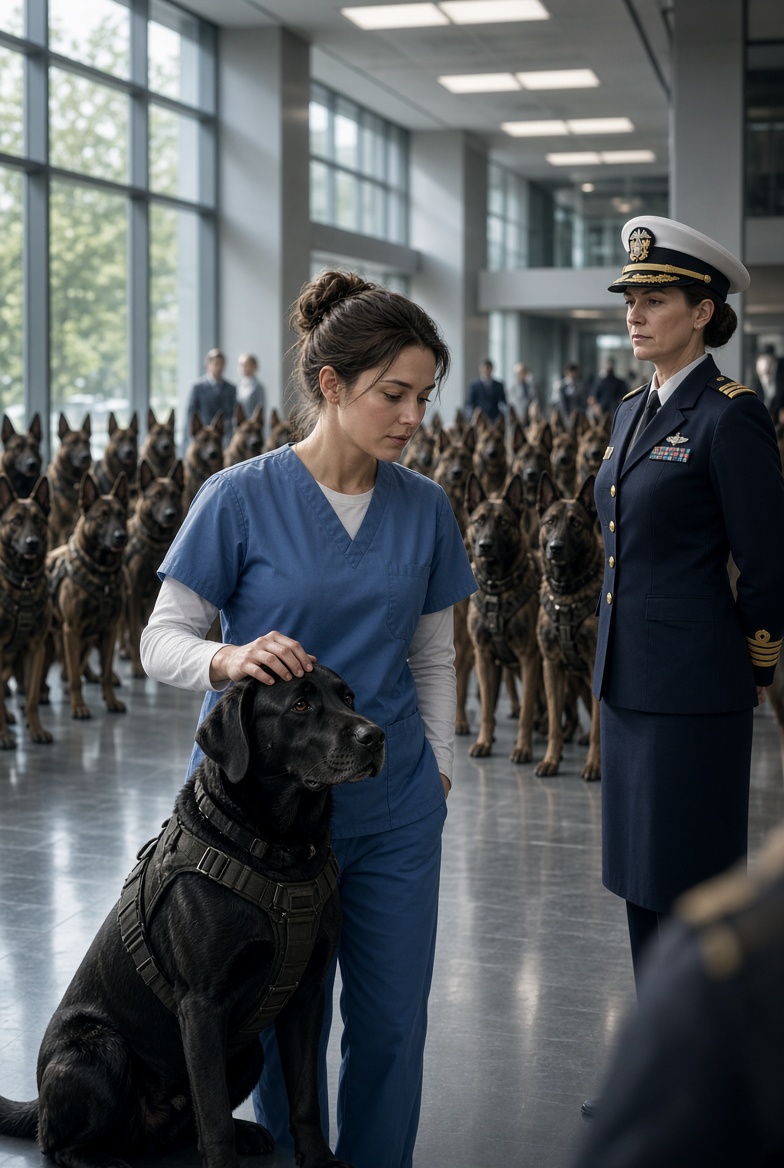
And then they were inside. Fifty dogs.
She stopped walking.
They were military working dogs. German shepherds, mostly. Two Belgian Malinois she could identify from the door. One enormous black Labrador that she knew immediately and specifically.
And they moved in a formation that was unmistakably tactical. Not loose, not wandering. Column pairs, spacing maintained, each animal tracking straight ahead.
Three handlers in full dress uniform walked among them, but they weren’t directing. The dogs were simply moving the way they’d been trained to move, which was with a precision that looked almost choreographed, except it wasn’t. It was just discipline.
The lobby went silent.
A corpsman standing near the reception desk physically took a step back. A woman in civilian clothes dropped her phone and didn’t reach for it.
Somewhere behind Emily, she heard someone say, “What the—” and then stop.
The dogs halted in formation near the center of the lobby, and one of the handlers, a woman in a Navy chief’s uniform, graying at the temples, face like someone who had been making hard decisions for twenty years and was comfortable with it, stepped forward and looked around the lobby with the relaxed attention of someone who’d walked into a thousand rooms and evaluated all of them.
Her eyes found Emily, and she smiled.
“Carter,” she said. Not loud. Just clear.
Emily felt something release in her chest, something she hadn’t been aware was clenched until it wasn’t anymore.
“Chief Ramos,” she said.
Chief Petty Officer Dolores Ramos crossed the lobby in thirteen steps, extended a hand, and when Emily took it, pulled her into a grip that said more than a handshake usually did.
“You look like you’ve been working,” Ramos said.
“I have been.”
“Good.”
Ramos glanced around the lobby at the staring faces, the frozen corpsman, the woman still not picking up her phone.
“Looks like we made an entrance.”
“You always did.”
The black Labrador at the front of the nearest column had turned its head and was looking directly at Emily with an expression that on a dog was impossible to call recognition, and yet was clearly exactly that.
“Duke,” Emily said.
The dog’s tail moved once, controlled, almost restrained, like even the Labrador had been trained to hold it together in formation.
Ramos watched this.
“He’s been doing that since we turned onto the base road. Like he could smell the building.”
“He probably could.”
Emily crouched down briefly, and Duke crossed the foot of space between them and pressed his head against her shoulder for exactly two seconds before pulling back and returning to position.
From somewhere behind Emily, from the direction of the east corridor, she heard footsteps and then a voice she recognized.
“What is going on out here?”
Lieutenant Voss had followed the noise.
He stood at the entrance to the main hallway, coffee still in hand, taking in the lobby with the expression of someone trying to process too many variables at once.
His eyes moved from the dogs to the handlers to Ramos to Emily and then back to Ramos, because Ramos was in Navy dress and carried the kind of presence that made ranking officers reflexively assess.
“Lieutenant,” Ramos said pleasantly. “Is there a private space where we can have a short conversation involving your commanding officer? Ideally.”
Voss blinked.
“Who are you?”
Ramos didn’t answer immediately. She reached into the inside breast pocket of her jacket and produced a credentials holder, flipped it open, and held it toward him.
He read it. His expression did something complicated.
“Chief Ramos,” she said, closing the credentials and returning them to her pocket. “Liaison to Naval Special Warfare Command, Joint Medical Support Division. And you are Lieutenant Voss, if I’m reading the nameplate correctly.”
“Yes,” he said. His voice was different now, slightly tighter.
“I’m here because of a flag that came through our system this morning. A patient transfer request was initiated for Corporal Dean Ashworth, SOCOM support history, currently on your Ward 4. The request was properly submitted and properly documented, and our system shows it was held for review.”
She tilted her head slightly.
“By you specifically.”
The lobby was still entirely silent except for the sound of fifty dogs breathing.
Voss looked at Emily.
Emily looked back at him without expression.
“I was reviewing the qualifications of the submitting nurse,” Voss said. “There were questions about the submitting nurse.”
“The submitting nurse,” Ramos said, “is Emily Carter. Former master-at-arms medical support specialist attached to Naval Special Warfare Group 2 for approximately three years before transitioning out of active service. Her file has a classification level that would not appear in standard HR records, which is likely why you were unable to verify it.”
She paused.
“Were you trying to verify it, Lieutenant?”
Voss opened his mouth, then closed it.
“We’re also here,” Ramos continued, “because fourteen of these dogs served alongside Corporal Ashworth’s unit in three separate deployment rotations. They’re part of a comfort and rehabilitation visitation program that Naval Special Warfare runs for injured personnel. Duke there—”
She nodded toward the black Labrador specifically.
“—was present during the incident that resulted in Ashworth’s injury. There is therapeutic value in the visit. It’s been scheduled for three weeks.”
Voss looked at the dogs. He looked at Emily. He looked at Ramos.
“I wasn’t aware,” he said.
“No,” Ramos said. “It appears there were several things you weren’t aware of.”
She looked at Emily again, and her voice shifted. Something warmer and more direct in it.
“How long has he been waiting for the transfer?”
“Since 0700,” Emily said. “Dr. Ren cleared him yesterday. The transport window is 1400. We have time.”
Ramos turned back to Voss.
“I think what would be most productive right now is if you and I and your commanding officer sat down together and had a very clear conversation about this morning’s events. Do you want to make that call, or should I?”
Voss looked like a man standing on ground that had been solid a few minutes ago and was now doing something different under his feet.
“I’ll make the call,” he said quietly.
“Good.”
Ramos glanced once more at the lobby, the watching faces, the frozen personnel, the fifty dogs standing in perfect silence.
She said, almost to herself, “I always forget how quiet they get when they’re indoors.”
Then she looked at Emily.
“You okay?”
Direct. No performance in it.
Emily considered the question. She thought about the hallway. The folder dropped on the counter. The laughter. The way Voss had said you like it was a punchline.
“I’m fine,” she said.
Ramos studied her for a moment. She’d known Emily long enough to hear what wasn’t being said, and long enough to know that pushing on it in a lobby full of strangers wasn’t the right move.
“We’ll talk later,” she said.
Emily nodded.
Down the hallway, Voss was already on his phone. His posture had changed completely. The easy confidence replaced with something more careful and measured. He was not standing the way men stand when they think they’re right.
Emily looked at the black Labrador.
Duke had turned his head toward the elevator bank, nose working, already tracking the route to Ward 4 like he’d memorized the building layout from a map he’d studied somewhere before arriving.
She thought about Corporal Ashworth, twenty-six years old, two shattered vertebrae, a dog he’d worked with through three deployments coming to see him before transport.
She thought about the transfer window at 1400 and about how if the authorization came through in the next two hours, he’d make it.
She thought about the paperwork on the counter dropped like trash.
She thought about Chief Ramos’s hand and the two seconds Duke had spent with his head against her shoulder and the way all fifty dogs had walked into the building without a single command being spoken out loud.
She did not think about Voss at all.
She had more important things to do.
She went back to work.
Ward 4 smelled like antiseptic, old carpet, and the particular staleness of recycled air that had been cycling through the same building for thirty years.
Emily had stopped noticing it months ago, the way you stop noticing the sound of traffic if you live close enough to a highway.
It was just the texture of the place. Background.
She pushed through the ward door with her shoulder, hands occupied with a fresh IV bag and a medication tray, and did a fast visual sweep of the room the way she always did.
Not dramatically, not consciously. Just a habit so deeply embedded it happened before she decided to do it.
Six beds, four occupied. Ashworth in bed three, awake, staring at the ceiling with the expression of a man who had been staring at ceilings for too long and had started to develop opinions about them.
“You’re still here,” he said when he saw her.
“Obviously,” Emily said.
She set the tray down, checked his IV line, noted the drip rate.
“Transfer’s been held up. Working on it.”
“I heard dogs,” Ashworth said.
“You did.”
He turned his head toward her.
He was twenty-six but looked older in the way that some service members did. Not aged exactly. More like compressed. Like experience had reduced the distance between moments in his face.
His right arm was in a brace from the elbow down, and he moved it with the deliberate carefulness of someone who had been told not to twist too quickly.
“What kind of dogs?” he said.
Emily looked at him.
“Duke’s here.”
Ashworth went very still.
She watched it move through him. Not emotion exactly, not right away. First just stillness. Then something in his jaw.
Then he looked back at the ceiling and didn’t say anything for a few seconds.
“You doing okay?” he finally asked. “Look good to me. Coat clean? Moving well?”
Ashworth nodded. His throat moved.
“Good,” he said. “That’s good.”
Emily adjusted his pillow angle without being asked, because she’d noticed two days ago that he always listed slightly to the left and never complained about it.
She didn’t say anything about it. She just fixed it.
“Transfer is still happening today,” she said. “1400 is the target. Don’t pack anything heavy.”
“I don’t have anything heavy.”
“Don’t pack that either.”
He almost smiled. Not quite, but the corners of his mouth did something.
She left him and moved to the next bed, and the one after that, and by the time she was done with her morning rounds, the clock above the nurse’s station read 9:47, and her feet had already put in the kind of miles that would start announcing themselves around two in the afternoon.
She was writing in a chart when she heard the voices from the corridor.
Not loud, contained, the way voices got when people were trying to have a serious conversation in a building where walls were thin and everyone was professionally trained to eavesdrop.
She didn’t move toward the sound. She kept writing. But she listened.
Two voices. Voss was one of them. The other was a man she didn’t recognize. Older, measured cadence, the kind of deliberate slowness that came from rank, not age.
“The transfer request was properly submitted,” the second voice said.
“I understand that now,” Voss said.
“At the time there were questions about—”
“There were no questions that justified a hold. The physician had signed. The receiving facility had confirmed. Your role at that point is administrative, Lieutenant. Stamp and process.”
A pause.
“Yes, sir.”
“The nurse, Carter. What was the nature of your interaction with her?”
Another pause, longer.
“I questioned her background.”
“On what basis?”
“She claimed prior experience with SOCOM units. I wasn’t able to verify it through standard channels because it wouldn’t be in standard channels.”
The older voice was not loud. That was the thing about it. It didn’t need to be.
“That’s the definition of a classified record, Lieutenant. Its absence from standard channels is not evidence of falsification. It is evidence of classification.”
Emily heard Voss say nothing.
“I’m going to need a written account of the interaction. Timeline. Exact language used. Your reasoning at each decision point. I want it on my desk by 1400.”
“Yes, sir.”
Footsteps. The older voice moved away. Voss did not.
Emily kept writing in the chart.
Her handwriting was the same as it always was. Precise. Slightly compressed. The particular legibility that medical professionals developed because illegible charts got people hurt.
Thirty seconds later, the ward door opened, and Voss was standing in the frame.
She looked up.
He looked at her, and then around the ward, and then back at her, and she could see him doing the calculation. The one about whether to speak and what words would accomplish anything if he did.
His face was doing something effortful.
“The transfer request,” he said. “I’ve authorized it. Greer is processing the stamp now.”
“Thank you,” Emily said.
Flat. Professional. Neither warm nor hostile.
He stood there a half second longer than necessary.
“Carter, I—”
“I need to finish these charts before transport prep,” she said. “Was there something else?”
He looked at her. She looked at her chart.
“No,” he said. “That’s all.”
He left.
Emily put the cap back on her pen. She set the chart down and looked at the window across the ward, which showed a square of gray November sky and the corner of a parking structure.
She thought about nothing specific for about four seconds.
Then she picked up the pen again and kept writing.
Chief Ramos found her in the breakroom at 11:15.
Emily was eating a granola bar over the sink because the table was covered in someone’s leftover orientation materials and she hadn’t bothered to move them.
Ramos looked at the table, looked at Emily, and sat down in one of the chairs and moved the orientation materials to the floor without ceremony.
“Sit down,” Ramos said.
“I’m fine standing.”
“I know you are. Sit down anyway.”
Emily sat down.
Ramos put her elbows on the table and looked at Emily the way she’d been looking at Emily for six years, which was with the particular directness of someone who had long ago stopped accepting performance in place of truth.
Ramos had two decades in Naval Special Warfare medical support. She had been in rooms and situations that would be genuinely difficult to describe to people who hadn’t been there.
She did not impress easily, and she did not comfort easily, and both of those things were part of why Emily trusted her.
“Tell me what he said,” Ramos said. “Not the official version. The actual version.”
Emily ate the last of the granola bar and crumpled the wrapper.
“He said I was a nurse who didn’t know anything about special operations. He implied I was exaggerating my service record. He said SEAL support personnel don’t look like me.”
“Don’t look like you meaning what?”
“He didn’t specify.”
Ramos was quiet for a moment.
“And what did you do?”
“I asked for the transfer stamp four times. Then I left.”
“You didn’t—”
“No.”
Ramos studied her.
“You wanted to.”
“I always want to,” Emily said. “I don’t.”
That landed between them with the weight of something both of them understood. The particular discipline of not becoming what the situation is trying to make you become.
It was one of the first things they talked about, years ago, in a different context entirely. How you hold the shape of who you are when external pressure is specifically designed to deform it.
“His CO is handling it,” Ramos said. “I know. I heard.”
“There’ll be a formal review of the interaction. You’ll be asked to give a statement.”
“I know that, too.”
Ramos leaned back in the chair. She was quiet for a moment, and then:
“Duke knew you were in the building before we were within two blocks. Started pacing in the van.”
Emily looked at her hands.
“He was always like that. More now, I think. Since—”
Ramos stopped.
“You can say it,” Emily said.
“Since the thing in the Korangal corridor.”
Ramos said it carefully, the way people said things they weren’t sure they had the right to reference.
“He was there. You were there. That creates something in dogs that does something to them permanently.”
Emily didn’t respond to that immediately. The thing in the Korangal corridor was not something she kept a filing system for. It was more like background texture, something that had receded to the same status as the smell of floor cleaner in this building.
You stop noticing it until something makes you notice it again. And then you notice everything about it all at once, and then you put it back.
“How’s the program running?” she asked.
“Well. We’re at sixty-three certified pairs now. The therapeutic visit program has expanded to nine medical centers.”
Ramos tilted her head.
“You could be part of it. You know. Officially. Your background, what you did, the pipeline you went through—that’s exactly the kind of experience the program needs. On the advisory side.”
“I’m a nurse.”
“You’re also the person who designed half the protocols we use for handler/K-9 psychological integration during high-casualty scenarios.”
“I made some notes.”
Ramos said her name the way adults said the names of other adults when they were trying not to be exasperated.
“You wrote a forty-page operational framework that we still use verbatim. That is not making some notes.”
Emily said nothing.
“I’m not pushing,” Ramos said. “I’m just leaving the door open in case you want to walk through it sometime.”
“I know where the door is.”
Ramos accepted that.
She stood up, straightened her jacket, and looked at the window for a moment.
“Ashworth’s going to be okay. The facility at Kesler is good. They’ve worked with his injury profile before.”
“I know.”
“He asked about you when I went up there this morning with Duke. He said—and this is direct quote—’How is she doing?’ Not hello, not is she busy. How is she doing?”
Ramos looked at Emily.
“I think he knows more about your history than his file would suggest.”
“He was present for some of it,” Emily said quietly.
Ramos held her gaze for a moment. Then she nodded once, the kind of nod that closes a chapter rather than ending a conversation, and picked up her jacket from the back of the chair.
“I’ll be here until transport,” she said. “If anything comes up.”
“It won’t.”
“Probably not,” Ramos said. “But I’ll be here anyway.”
She left.
Emily sat at the table for another minute. Not eating anything. Not looking at her phone. Just sitting with the low hum of the ventilation and the distant sound of the ward and the square of November sky through the breakroom window.
Then she got up and went back to work.
The transport vehicle arrived at 1320, forty minutes early, which in Emily’s experience either meant the logistics were unusually competent or someone had made a phone call.
Given Ramos’s presence in the building, she assumed the latter.
Ashworth was ready.
He’d been ready since noon, sitting on the edge of his bed with his go-bag on his knees, watching the door with the disciplined patience of someone who had learned that waiting and readiness were not the same thing and you had to maintain both simultaneously or one of them slipped.
Duke had been allowed up to Ward 4 for forty-five minutes mid-morning, handlers present, the visit structured and calm in the way that the program had apparently refined over years of testing.
Emily had not been in the room for most of it. She’d had other patients.
But she’d passed the door twice, and both times through the small window, she’d seen the same thing.
Ashworth, with one hand on Duke’s back, not talking. Just sitting.
Duke completely still, head slightly down. The posture of an animal that understood what its presence was doing and was doing it deliberately.
She had not gone in. It wasn’t her moment. It was theirs.
At 13:45, Emily went through the transfer checklist with the transport medic, a young sergeant named Okafor, who was thorough and efficient and asked the right questions, which she appreciated.
He double-checked the medication schedule, confirmed the receiving unit contact at Kesler, verified the IV supplies for the vehicle.
He did not need to be told anything twice.
“He’s going to try to walk out himself,” Emily said as they were finishing. “Don’t let him. He’ll say his legs are fine. They’re not fine.”
“Noted,” Okafor said.
“He’ll also probably try to carry his own bag. Also noted.”
“He’s going to be polite about it. He’s not going to argue. He’s just going to do it if you’re not watching.”
Okafor looked at her.
“You know this patient pretty well.”
“I’ve had him for six weeks.”
“That’s not usually enough for this level of—” He gestured vaguely.
Emily shrugged.
“He’s good at not asking for things. You have to watch for it.”
Okafor wrote something in his notes. Emily did not ask what.
They were walking Ashworth to the transport at 13:58.
Okafor with the wheelchair, Emily alongside, one of Ramos’s handlers walking Duke on a short lead ahead of them through the lobby.
When the doors to the administrative wing swung open, and Voss walked out, he stopped when he saw the group.
Ashworth looked at him, then looked away, back toward the front doors, with the deliberate neutrality of someone who had decided not to spend energy on something that wasn’t worth it.
Voss looked at Emily.
She held his gaze for a moment. Not hard, not pointed. Just level.
He looked at Ashworth. Something moved in his face. Hard to name. Not guilt exactly. More like the particular discomfort of a man who has been made to see a consequence he didn’t think far enough ahead to predict.
“Corporal,” Voss said. His voice was different. Quieter. “Safe travels.”
Ashworth didn’t look at him.
“Thank you, sir,” he said, and his voice was even.
And that evenness was the most precise kind of dismissal Emily had ever heard.
They kept moving.
At the front doors, Emily stopped.
Transport was Okafor’s jurisdiction now. She’d done her part. The weeks of care, the medication management, the charts, the IV adjustments at two in the morning, the pillow she’d quietly fixed because he never asked. That was done.
Ashworth looked back at her from the wheelchair.
“Carter,” he said.
“Ashworth.”
He wanted to say something. She could see it in the way he held himself. The kind of thing that, in a different context, in a different version of both their lives, might have come easier.
He was twenty-six and his body was badly damaged. And he was about to travel forty miles to a facility where people would spend months trying to put him back together.
And the dog that had been there for the worst night of his life had just spent forty-five minutes sitting quietly beside him.
And Emily had been the person who’d made all of that happen without ever making him feel like a project.
“You didn’t have to fight for the transfer,” he said.
“I wasn’t fighting,” she said. “I was just asking.”
He looked at her for a moment longer. Then he nodded once, the same way Ramos had nodded, with that quality of closure, of something acknowledged.
Okafor pushed the wheelchair through the doors. Duke went last, walking beside the chair with the same measured calm he’d maintained since entering the building.
At the threshold, he paused just briefly and turned his head back toward Emily with an expression that she had spent years refusing to anthropomorphize and was going to go ahead and anthropomorphize just this once.
He looked at her like he was checking. Like he wanted to make sure she was still there.
“Go,” she said quietly. “You’re working.”
Duke turned back around and walked through the doors.
Emily stood in the lobby and watched the transport vehicle pull away until it turned the corner and was gone.
The lobby had thinned out. Lunch hour still pulling people toward the cafeteria. The administrative bustle of midday redistributed to other corridors.
It was almost quiet.
Almost.
Behind her, she heard the administrative wing doors open again.
She turned around.
It wasn’t Voss.
It was a woman she hadn’t seen before. Late forties, civilian clothing, but wearing it the way former military wore civilian clothing, which was with a certain purposefulness in every seam.
She had a leather portfolio under one arm and a phone in her other hand, and she was looking at Emily with the focused attention of someone who had been waiting for a specific moment.
“Nurse Carter,” she said. “Yes. I’m Agent Dana Foresight, Naval Criminal Investigative Service.”
She said it without producing a badge, which meant she assumed Emily would either take her word for it or knew enough to know that NCIS agents didn’t always flash credentials in open lobbies.
“I’m sorry to catch you at a difficult moment. I understand you’ve had an eventful morning.”
“It’s calmed down,” Emily said.
“Good.”
Foresight glanced toward the front doors, then back.
“I’d like to talk to you about something unrelated to this morning’s incident. Something we’ve been looking into for the past several months.”
She paused.
“It involves a series of patient record discrepancies in this hospital’s SOCOM-tagged case files. And based on what our investigation has uncovered so far—”
She looked at Emily steadily.
“Your patient, Corporal Ashworth, is not the only person whose records have been tampered with.”
The lobby hummed quietly around them.
Emily looked at Foresight.
“How many?” she said.
“At least eleven,” Foresight said. “Possibly more. And Carter—”
She lowered her voice, not out of uncertainty, but with the precision of someone choosing exactly how much to say in an open space.
“The access logs show that whoever was doing it had clearance levels they shouldn’t have had. The kind of clearance levels that come from inside this facility.”
She held Emily’s gaze.
“We think someone in this building has been altering service records for injured SOCOM personnel. We don’t know why yet. But we know it’s been going on since before you arrived here.”
Emily said nothing for a moment.
“And you’re talking to me?” Emily said slowly.
“Because three of the eleven affected records belong to service members you personally cared for. And because your own file—the classified portions—appear to have been accessed by the same system user who accessed theirs.”
The ventilation hummed somewhere above them. The building creaked in the November wind.
“Someone’s been reading my file,” Emily said.
“Reading it,” Foresight said, “and copying it.”
She held Emily’s gaze.
“We need to know what’s in it, Carter. The portions we can access aren’t enough. And since the classified sections require your explicit authorization to unseal—”
She left the sentence open.
Emily looked at the front doors where the transport vehicle had been. She looked at the empty space where the fifty dogs had stood in the lobby three hours ago.
She thought about the Korangal corridor and the forty-page framework and the notes she’d made that weren’t just notes.
And she thought about Ashworth’s hand on Duke’s back.
And she thought about someone sitting in a back room somewhere in this building, accessing records they had no right to access, and reaching inside a life that had been very deliberately sealed away.
She thought about all of it for approximately four seconds.
“My office,” she said. “Give me twenty minutes.”
Foresight nodded.
And Emily Carter, who had come to work that morning with a patient transfer form and gone home every night for six months as a quiet woman in a plain white uniform, felt something shift underneath the surface of everything she’d built here.
Quietly, without warning, like a fault line that had been still for a long time, deciding it was done being still.
The twenty minutes she’d asked for became fifteen, because that was how long it actually took, and Emily had stopped padding time requests somewhere around year two of her service when she’d realized that saying you needed more time than you did was a form of dishonesty she couldn’t sustain.
She changed out of her nursing jacket in the staff locker room, hung it on the hook with the same care she always did—not obsessive, just deliberate—and sat on the bench for approximately ninety seconds doing nothing.
Not meditating. Not processing. Just letting her nervous system catch up to the day’s events before asking it to do more work.
Her office was not really an office.
It was a repurposed supply room on the second floor that the ward supervisor had given her three months ago because Emily kept doing paperwork in the break room and someone had decided that was inefficient.
It had a desk, a chair, a filing cabinet with a broken bottom drawer, and a window that looked directly into the exterior wall of the building’s east wing.
She had not decorated it. There was nothing on the walls. There was a coffee mug on the desk that had been there since she moved in and that she had never used.
Foresight arrived with two minutes to spare and closed the door behind her without being asked.
She placed her portfolio on the desk, opened it, and laid out a single printed document.
Not a report, not a brief. Just a one-page summary with several items listed and a series of access timestamps running down the right margin.
“I want to be clear about what I’m asking,” Foresight said. “I’m not asking you to give me the contents of your classified file. That requires a formal unsealing process with NCIS legal oversight and Naval Special Warfare Command authorization. What I’m asking is whether you’re willing to initiate that process.”
“What does initiating it do?”
“It gives us legal standing to subpoena the access records in full. Right now, we can see that your file was accessed. We can see the timestamp and the system user ID. What we can’t see is what they pulled, because the file itself is behind a clearance wall we can’t breach without your authorization as the subject.”
Emily looked at the timestamp column.
The most recent entry was dated six weeks ago. The entry before that was four months ago. The one before that was eight months before she’d even arrived at Harlo.
“Someone was reading this before I got here,” she said.
“Yes.”
“Which means they weren’t interested in me specifically. Or not only me.”
“That’s our assessment, too.”
Emily sat back.
“The eleven affected records. What kind of alterations?”
Foresight reached into the portfolio and produced a second sheet.
“Mostly documentation gaps. Treatment timelines that don’t match injury dates. In three cases, the nature of the injuries themselves was reclassified in the records. Changed from combat-sustained to training accident.”
“Why does that matter?”
“Benefits eligibility. Compensation classifications. Combat injury designations come with different long-term care authorizations under military medical code. If you reclassify it, you can affect what a veteran is entitled to over the course of decades.”
Foresight’s voice stayed even, but something behind it didn’t.
“In some cases, the alteration would reduce lifetime care coverage by several hundred thousand.”
Emily was quiet.
“Eleven people,” she said.
“Minimum eleven.”
She looked at the timestamps again. The system user ID was a string of numbers and letters that meant nothing to her at the surface level, but she recognized the prefix. A classification that indicated administrative access above standard nursing or physician credentials.
Someone with back-end record access. Someone whose job put them in contact with the medical records system at an administrative level.
“You have a suspect,” Emily said.
Foresight didn’t answer immediately, which was its own answer.
“We have a range of persons with the technical access required,” Foresight said carefully. “We don’t have sufficient evidence to pursue any of them without broader record access. Which is where the unsealing process becomes significant. Because your file and the files of the other ten affected personnel collectively form a pattern. The pattern is what builds the case.”
“And the other ten. Have you approached them?”
“Seven of them. Four have agreed to initiate the unsealing process. Three declined.”
Foresight paused.
“Some people, for reasons I understand, do not want their classified history opened, even under controlled legal circumstances.”
Emily understood that, too.
She’d thought about it for the ninety seconds on the locker room bench, and she was thinking about it again now.
The file wasn’t just dates and assignments. It was events. Decisions made in conditions that most administrative review processes were not designed to contextualize properly.
Things that had been sealed, not just for operational security, but because some of what was in there required the particular kind of packaging that only a classification stamp could provide.
Opening it meant other people reading it. People who had not been there. People who would form opinions about what they read the same way Voss had formed opinions about her before she’d opened her mouth.
She had worked very hard to be in a place where her daily reality was a supply room office and a broken filing cabinet and seven patients and a commute that took eleven minutes.
She had built that deliberately.
“How long does the process take?” she said.
“If you initiate today, we can have legal framework in place within forty-eight hours. The actual review would happen under controlled conditions. NCIS legal, a Naval Special Warfare liaison, and a representative of your choosing.”
“Ramos,” Emily said immediately.
“Chief Ramos is acceptable.”
Emily put her hands flat on the desk. She looked at the document in front of her.
She thought about eleven people, possibly more. She thought about Ashworth in a wheelchair being told his injury was a training accident in a record somewhere that he’d never been shown.
“Get me the paperwork,” she said.
Foresight left at 2:45.
Emily had signed three documents and initialed seven pages, and the whole process had taken the kind of concentrated effort that wasn’t physically exhausting but used up something else.
The particular energy that serious decisions consumed, whether they were right or wrong.
She was back on the ward by three.
The afternoon was quieter than the morning, the way hospital afternoons usually were, the administrative machinery having burned through its daily output, the staff settling into the longer rhythms of evening care prep.
Emily did her rounds, updated two charts, caught a medication timing error that the pharmacy had introduced in a dosage change, and corrected it before it reached the patient.
Standard work. The kind that didn’t feel important until you thought about what happened when it didn’t get done.
She was at the nurse’s station at 4:20 when Dr. Naomi Ren appeared from the direction of the elevator with a look on her face that Emily had learned to read over six months of working together.
A look that meant something had happened and Ren was in the stage between learning about it and deciding what to do.
Ren was fifty-one, attending physician, the kind of doctor who had reached a point in her career where she was no longer impressive because she was trying to be impressive and had become impressive simply by knowing what she was doing and doing it.
She had the slightly threadbare quality of someone who worked too many hours and didn’t sleep enough and had decided that was the cost of the job and paid it without complaining.
She stopped beside Emily and lowered her voice.
“You want to tell me what happened this morning?”
“Voss held the transfer request. Ramos arrived. Voss was spoken to by his CO. The transfer went through.”
“That’s the official version.”
“That’s what happened.”
Ren studied her.
“Three people came to me between noon and 2:30 to ask if you were in trouble.”
Emily frowned slightly.
“Who?”
“Martinez from overnight. Huang from pharmacy. Specialist Greer from the duty office. Which surprised me.”
Ren paused.
“Greer said she wanted me to know that Voss’s tone during the interaction was, quote, beyond what I’d call acceptable. She came to me on her own.”
Emily absorbed that without responding.
“I want to file a formal complaint on the ward’s behalf,” Ren said. “I should have been consulted before a transfer I signed off on was held. That’s a patient care issue, and I’m the attending physician of record.”
“His CO is already handling it.”
“His CO handling it and the attending physician documenting a formal objection are not mutually exclusive.”
Ren’s voice was dry but not unkind.
“You don’t have to do everything alone, Carter. That’s not a character flaw I’m pointing out. I’m just noting it.”
Emily looked at the chart in her hands.
“I know.”
“Do you want me to file it?”
“Yes,” Emily said after a moment. “File it.”
Ren nodded, made a note on her phone, and then:
“Ramos stopped by my office before she left. She said to tell you Duke handled the lobby visit well, and that the van smelled terrible on the way out because apparently thirty seconds after leaving the base road, one of the shepherds got carsick.”
Emily exhaled. Not quite a laugh, but something adjacent to it. The first one all day.
“That would be Ranger,” she said. “He’s always been bad in vehicles.”
“You know this dog’s name?”
“I know most of their names.”
Ren looked at her for a moment in a way that was slightly different from how she usually looked at Emily. Not clinical, not supervisory. More like the look people gave when they were revising an understanding they’d thought was complete.
“Go home at a reasonable hour,” Ren said.
“Define reasonable.”
“Before eight.”
“I’ll try.”
Ren left.
Emily went back to the chart.
She was still there at 5:50 when her phone buzzed with a text from a number she didn’t have saved, which turned out to be Foresight.
Unsealing authorization received by NSW command. Process initiated. Preliminary access granted within 24 hours. One development you should know about. The system user ID from the access logs matched to an account. Working on confirmation. We’ll contact you tomorrow morning.
Emily stared at the text for a moment.
Then she put the phone in her pocket and stood up from the nurse’s station and looked at Ward 4’s door.
She needed to check on her patients. She needed to update two more charts. She needed to verify the night shift handover with Martinez, who was good but young and occasionally got overconfident with pain management calls.
She did all of it.
She drove home at 7:43, which was close enough to reasonable.
She ate something standing at her kitchen counter because sitting down to eat alone had always struck her as an exercise in noticing the quiet too deliberately.
She took a shower.
She looked at her phone twice before bed and both times put it down without opening anything.
She slept four hours and woke at 2:15 and lay in the dark with the particular alertness of someone whose body had been trained to treat the middle of the night as a time when things happened.
Nothing happened.
She made herself stay in bed until four.
Foresight called at 7:48 the next morning, which was twelve minutes before Emily’s shift started.
Emily was already in the building.
“The account ID belongs to a staff member,” Foresight said. “Records management. His name is Arthur Beiel. He’s been at Harlo for four years.”
Emily knew the name. She didn’t know him well.
Records management was a back-office function, the kind of department that nurses interacted with when something in a patient’s file needed to be corrected or retrieved.
She’d put in maybe three requests in six months. She had a visual impression of someone at a desk in a hallway that always smelled like printer toner. Medium height, mid-forties, the kind of institutional invisibility that came from having been in a building long enough that people stopped seeing you.
“Is he here today?” she said.
“Yes. He badged in at 7:15. We are not moving on him yet. We need the full record review to establish the scope before we can make an approach that will hold in prosecution. If we move too early and he destroys anything—”
“I understand.”
“What I need from you today is to act normally. Do not change your patterns. Do not interact with Beiel differently than you would on any other day. If he approaches you, respond normally.”
“Has he ever approached me?”
A pause.
“Once. About three months ago. Records flag shows he accessed your file for the first time two days after that interaction.”
Emily stood in the east corridor with the morning foot traffic moving around her and thought about three months ago and tried to locate the specific conversation and realized she didn’t remember it at all, which said something about how invisible Beiel was in the texture of the building.
“What did we talk about?” she said.
“You put in a request to pull a historical record for a patient. He processed it. Basic interaction, under two minutes by the security camera timestamp.”
“And two days later he was reading my file.”
“And three weeks after that, the first patient record alteration in our timeline occurs.”
Emily looked at the end of the corridor where the records management department was located, around a corner to the left, in a hallway she passed every single morning.
“All right,” she said. “I’ll act normally.”
“Thank you. I’ll have an update by end of day.”
She hung up and stood there for a moment, recalibrating.
The morning around her was doing what mornings did. Nurses and corpsmen and administrators moving through established patterns. The building running on the accumulated momentum of all its daily systems.
Nothing looked different. Nothing felt different.
Somewhere around the corner, forty feet away, a man she barely knew had been reading her life.
She went to work.
The morning was normal in the way that mornings after large decisions were sometimes normal. Surface texture intact. Underlying architecture shifted.
She did her rounds. She caught a patient on Ward 4 trying to adjust his own IV flow rate because it felt slow, which it was, because he’d kinked the line by lying on his arm, and she fixed it without making him feel stupid about it.
She answered four questions from the night shift handover notes that Martinez had flagged.
At 9:15, she was passing the records corridor when she saw Beiel.
He was standing at the photocopier in the hallway just inside the department entrance, which put him in direct sightline from where she was walking.
He was doing something with the machine. Paper jam, from the look of it. The particular frustrated patience of someone who has cleared the same paper jam enough times to have opinions about it.
He looked up as she passed.
“Morning,” he said. Automatic. The greeting of someone who greets everyone in a hallway without thinking about it.
“Morning,” Emily said, and kept walking at exactly the pace she’d been walking before.
She did not look back.
At 10:40, something happened that she had not anticipated.
She was in the break room—same break room, same table, same square of November sky through the window—when Martinez appeared in the doorway, looking like someone who had absorbed bad news and hadn’t finished deciding where to put it.
“Carter, you need to come to Ward 4.”
She was moving before he finished the sentence.
The patient was in bed two. A staff sergeant named Holloway, admitted four days ago for complications following a shrapnel removal procedure, who had been progressing slowly but without alarm until apparently he wasn’t anymore.
She heard the monitor before she reached the door.
The rhythm was wrong. Not chaotic, not V-fib, not the catastrophic wrongness that meant certain crisis, but irregular in the specific way that post-surgical cardiac complications presented.
The kind of rhythm that walked a line and could fall either direction depending on the next ten minutes.
Holloway was awake. That was either good or made things harder, depending on him. He was looking at the ceiling with the concentrated calm of someone working very hard not to panic.
“Hey,” Emily said at his bedside, two fingers already on his wrist because the monitor was one measure and her hands were another and she used both. “How long have you been feeling this?”
“Maybe twenty minutes,” he said. “Didn’t want to—”
“Don’t finish that sentence.”
She looked at Martinez.
“Page Ren. Get the crash cart to the doorway. Not in yet, just to the doorway. And I need a twelve-lead now.”
Martinez moved.
“Am I—” Holloway started.
“You’re awake and talking and your blood pressure is reading okay on the monitor,” Emily said, which was accurate and was also the most useful thing she could tell him at this moment. “That’s good. I need you to stay still and breathe normally. Can you do that?”
“Yes.”
“Good.”
The twelve-lead took four minutes to set up and read, which were four minutes that had a different texture from regular minutes.
Holloway stayed still. Emily watched the monitor and watched him and did the math that experienced medical personnel did automatically. The variables. The trajectories. The decision tree running parallel to everything else.
Ren arrived at minute three, looked at the monitor, looked at Emily, and said nothing beyond “twelve-lead,” because the question answered itself when Emily handed her the printout.
Ren read it.
Atrial flutter. Rate elevated but controlled.
She looked at Holloway.
“Any chest pain?”
“Pressure,” he said. “Not pain. More like—”
“I know what you mean.”
Ren was already on her phone calling the cardiac consult. She stepped to the corner of the room, and Emily moved back to Holloway and stayed beside him, which was not strictly a medical intervention but was the thing that most needed doing.
“You’re not having a heart attack,” Emily told him quietly. “Your heart’s doing something annoying, and we’re going to address it.”
“Define annoying,” he said.
“Beating too fast in the wrong chamber. It’s fixable.”
“How fixable?”
“Very. But I need you to stop asking me questions for a few minutes and focus on breathing.”
He closed his eyes.
His hands, she noticed, were gripping the bed rail in the way hands did when they were doing the work the rest of the body was trying not to do.
She put one hand over his on the rail. Not dramatically. Just there.
He loosened his grip slightly.
It took forty minutes to stabilize Holloway to the point where the cardiac team took over and Ren was satisfied with the trajectory.
Emily spent most of those forty minutes doing specific tasks and the rest of them doing the thing that didn’t have a clinical name. The being present. The keeping the room’s anxiety at a level that didn’t make the patient’s job harder.
By 11:45, Holloway was stable. The cardiac team had him, and Emily was at the nurse’s station writing the most thorough nursing note she’d written in weeks, because thorough notes in cases like this were what protected Holloway later, when decisions about his care had to be traced back through what had been observed.
She was three paragraphs in when her phone buzzed.
Not Foresight this time. A number she didn’t recognize, with a Harlo base prefix.
She answered.
“Carter.”
The voice was male. Clipped. Professional. She didn’t know it.
“This is Commander Dale Pritchard, base legal office. I’ve been briefed by NCIS Agent Foresight on the investigation currently in progress. I need you to come to my office at 1300. Dr. Ren has been notified. She’s covering your afternoon.”
A pause.
“I apologize for the short notice. There’s been a development.”
Emily’s hand tightened slightly on the phone.
“What kind of development?”
“The access logs Foresight pulled this morning. The system user ID connected to Beiel. When our team ran a full audit of his access history, they found something beyond the eleven cases we already knew about.”
She waited.
“He accessed thirty-seven files,” Pritchard said. “Not eleven. Thirty-seven. And Carter—”
Another pause, shorter.
“Fourteen of those belong to personnel currently assigned to an ongoing NSW operation. Active status. If the information in those files has been passed to a third party, we’re not looking at record tampering for financial fraud.”
Emily felt the bottom of the situation drop away.
“You’re looking at a security breach,” she said.
“We’re looking at potential intelligence exposure,” Pritchard said, and his voice had the particular flatness of someone delivering information they would rather not be delivering. “Which is why I need you at 1300. Because your file—the classified portions—is one of the thirty-seven. And based on what Foresight tells me about your background, you may be the most operationally qualified person in this building to help us understand what was in there and what it would mean if someone outside this facility has it.”
The nurse’s station hummed around Emily. Somewhere down the ward, a monitor beeped twice and then settled.
Thirty-seven files. Active personnel.
Somewhere in this building, a man who smelled like printer toner and cleared paper jams and had been here four years had been methodically reaching into the lives of people whose job required that their lives be unreachable.
“I’ll be there at 1300,” Emily said.
She hung up.
She looked at the ward. She looked at her notes. She thought about the conversation in the east corridor at 9:15 and Beiel’s automatic greeting and her own automatic response and the fact that forty feet had separated them and she hadn’t known and he hadn’t shown it.
And somewhere behind the records management door, the damage had already been done.
She thought about active personnel. Operational files. The particular category of information that got people killed when it reached wrong hands.
And then the ward phone rang.
Not her cell. The ward landline. The number that patients’ families called.
And Martinez answered it, and his face did something she’d seen faces do before, and he turned to her with the receiver extended and said:
“Carter, it’s Kesler. It’s about Corporal Ashworth.”
She took the receiver.
“This is Carter.”
The voice on the other end was a woman’s. Calm. Clinical. The particular calm of someone who delivered difficult information regularly and had developed a tone specifically for it.
“Nurse Carter, this is Charge Nurse Delgado at Kesler Veterans Complex. Corporal Ashworth arrived safely and is being settled into his unit. That’s not why I’m calling.”
Emily waited.
“He asked us to contact you directly. He said—and I’m quoting because he was specific about this—’Tell Carter that the file they moved with me isn’t the right one.’ He said you’d understand what that meant.”
Emily understood exactly what it meant.
“His medical file,” she said. “The one that came with transport.”
“It has his name and ID number, but the treatment history doesn’t match his intake assessment. Our admitting physician flagged it within twenty minutes of arrival. The injury classification in the transferred file reads as training accident. Our physician says the physical presentation is inconsistent with that classification.”
“Combat injury reclassified in transit. Or reclassified before transit.”
“And the altered version was what Okafor carried in the transport van forty miles north, while the real file sat in Harlo’s record system with Beiel’s fingerprints on it.”
“Is Ashworth’s care affected?” Emily said.
“Not immediately. We’re working from our admitting assessment. But the official record affects his long-term authorization. Without the correct classification, we can’t submit for the specialized rehabilitation funding his injury requires.”
“I know,” Emily said. “I’m going to fix it. Can you document the discrepancy formally on your end?”
“Already started.”
“Good. Don’t send him back. Keep him there and keep documenting.”
Emily looked at Martinez, who was watching her with the attentiveness of someone who understood that whatever was happening was above the register of normal ward business.
“I’ll be in contact within the hour.”
She hung up.
She stood at the nurse’s station for four seconds.
Then she picked up her phone and called Foresight.
Foresight answered on the second ring.
“Ashworth’s transferred file has been altered,” Emily said. “Injury reclassification. It went out with transport this morning, which means the alteration either happened in the last eighteen hours or the file in the system was already corrupted and nobody caught it because nobody was looking.”
A pause that was not surprised but was recalibrating.
“How confident is the receiving facility?”
“Admitting physician flagged it in twenty minutes.”
“All right.” Foresight’s voice had shifted into a register Emily recognized, the particular compression of someone who had just moved a timeline forward. “This changes the approach. If he moved a file after we initiated the unsealing process, he may know the investigation is active.”
“Or he moved it before, and we’re only seeing it now. Either way, we can’t wait until end of day.”
“I’m contacting Pritchard. I’m meeting Pritchard at 1300 regardless. Move it up now if you can.”
“Where are you?”
“Ward 4.”
“Stay there. I’ll come to you.”
Foresight arrived in eleven minutes, which meant she’d been somewhere in the building already, which meant the investigation had been more active in the building that morning than Emily had been told, and she decided not to spend energy being bothered by that.
They stood in the corridor outside Ward 4. Not the break room, not the supply office. The corridor, where the foot traffic provided enough ambient noise to make a quiet conversation genuinely private in a way that closed rooms sometimes weren’t.
“The timing,” Emily said. “Beiel accessed Ashworth’s file. When?”
Foresight looked at her phone.
“Last access was six days ago. Before I initiated the unsealing process.”
“So the alteration was already in place. The transport just moved the corrupted version.”
“Correct.”
“Which means the Kesler flag isn’t evidence that Beiel knows we’re looking. It’s evidence that his alterations were thorough enough to survive a transfer.”
Foresight looked up.
“It also means Ashworth’s file wasn’t the only one moved in a corrupted state.”
“If any of the other thirty-seven cases involved transferred or discharged patients, those files went with them,” Emily said. “To other facilities. To VA offices. To benefits processors.”
Foresight said nothing for a moment, because the scope of that didn’t need elaborating.
“I need you at Pritchard’s office,” Foresight said. “Now.”
Commander Dale Pritchard was the kind of military lawyer who had arrived at his current position through a series of decisions that prioritized competence over advancement, which meant he was better at his job than his rank suggested and slightly more direct than his rank usually permitted.
He was fifty-three, sat behind a desk that was extremely organized in the way that organized desks belonged to people who had too much to manage, and he looked at Emily when she entered his office with Foresight like someone who had been briefed and was now updating the briefing in real time.
“Sit down,” he said. “Both of you.”
They sat.
“Here’s where we are,” Pritchard said. “The thirty-seven file accesses. We’ve now cross-referenced against discharge and transfer records. Fourteen of those individuals are still active duty. Of those fourteen, eight have been transferred to other installations since their records were accessed, which means eight potentially corrupted files are now sitting in eight different medical systems at eight different bases.”
Emily looked at him.
“What’s your timeline for containment?”
“We’ve already flagged the other installations. They’re conducting audits now. What I need from you—”
He looked at her steadily.
“—is specific. Your file was accessed twice. The first access was eight months before your arrival here, which means Beiel wasn’t targeting you personally. He was working through a list. But the second access, three months ago, happened after an interaction with you that our records show lasted less than two minutes. He processed a record request, during which you gave your name, your patient’s name, and the nature of the request. Routine. But two days later, he pulls your classified file. And six days after that, he accesses three other files belonging to service members you had previously cared for.”
Pritchard set his hands flat on the desk.
“That’s not random. That’s someone who became specifically interested in you.”
Emily considered that. It sat uncomfortably, not because it was frightening exactly, but because it meant there was a version of the last three months in which she had been watched by someone she’d exchanged a thirty-second greeting with in a printer-toner hallway and never thought about again.
“What’s in my file that would be valuable?”
“That’s what I need you to tell me.” Pritchard glanced at Foresight. “The unsealing authorization cleared overnight. We have legal access, but the classified operational sections require subject contextualization. Meaning you’re the only person in this room who can tell us what the information in those sections means in practical terms.”
Emily looked at the window. The November sky outside Pritchard’s office was the same gray as it had been outside the supply room, outside the break room, outside every window in this building. A consistent, undifferentiated gray.
“The operational sections cover three deployments,” she said. “Two in theater. One that was domestic intelligence support. The theater deployments involved combat medical and extraction work with NSW units. The domestic one—”
She paused.
“The domestic one involved identification of compromised personnel. Individuals within military support structures who were passing information to outside parties.”
Pritchard was very still.
“You were part of a counterintelligence operation,” he said.
“Support role. Medical cover. But yes.”
“And the identities of the individuals identified during that operation.”
“Some of them are in the file. Not all, but some.”
The silence in the room had a different quality than the silences before it.
“If those identities were extracted,” Foresight said carefully, “and passed to whoever Beiel is working for—”
“Then someone knows who was identified,” Emily said. “And potentially who was never identified.”
Pritchard stood up. He moved to the window, which was what people did when they needed a moment to absorb something that required absorption.
“How many names in my file specifically?”
“Four. The broader operation involved more, but those files are separate. Different classification tier.”
“Four,” Pritchard said. “And you have no way of knowing whether Beiel extracted that specific data or just accessed the file.”
“No way to know without seeing the access logs at a more granular level.”
Pritchard turned back from the window.
“NCIS Cyber is working on that right now. It could take—”
He looked at Foresight.
“Four to six hours for a full extraction report,” Foresight said.
“In four to six hours,” Emily said, “Beiel is still in this building with system access.”
“He’s been flagged for monitoring. He can’t—”
“Can he print?”
A pause.
“His print access hasn’t been suspended yet,” Foresight said. “We didn’t want to trigger awareness.”
“Then he can extract without leaving digital traces beyond what you already have.”
Emily looked at both of them.
“You need to pull his access now. Whatever you lose in the investigation by tipping him off, you lose less than if he walks out of this building with printed copies of anything.”
Pritchard looked at Foresight. Foresight looked at her phone.
“I’ll make the call,” Foresight said, and she was already standing.
The access suspension happened at 13:42.
Emily was in the corridor outside Pritchard’s office when her phone showed the time, and she did the math.
Beiel had had approximately four hours since she’d said good morning to him in the hallway. Four hours of normal building operations. System access unmonitored for the specific activity they were now looking for.
She went back to the ward.
She could not do anything about the next four to six hours except what she was already doing, which was her job, which meant Holloway and the two other patients and the chart work and the handover prep for the evening shift.
She did all of it.
Her hands were steady. Her mind was running two tracks simultaneously, which was not comfortable but was manageable, and she had enough practice managing it that the two tracks didn’t interfere with each other in ways that mattered.
At 15:20, Ren appeared at the ward door and looked at Emily with an expression that contained several things at once.
“What?” Emily said.
“Records management is locked down,” Ren said quietly. “Building security is at the department entrance. I’ve had four people come to me in the last twenty minutes asking what’s happening.”
“What did you tell them?”
“That I don’t know. Which is true.”
Ren looked at her.
“Is it related to this morning?”
“Yes.”
Ren absorbed that. She was not the kind of person who asked follow-up questions when the answer to the follow-up questions was clearly something she didn’t have clearance to know.
“Is there anything you need from me?”
“Keep the ward running,” Emily said. “And if anyone from administration comes asking about specific patient files, document exactly what they ask for and who they are before you answer anything.”
Ren looked at her for a moment. Then she nodded and left.
At 15:55, Foresight called.
“He tried to print,” she said without preamble. “At 13:31. Eleven minutes before we pulled his access. The print job was intercepted by building security. They’ve been monitoring the physical printers since this morning as a secondary measure. Seven pages.”
Emily closed her eyes briefly.
“Eleven minutes. What was on them?”
“Three pages were from your file. Four pages were from the files of two currently active NSW personnel. The information is significant.”
“Did he get them?”
“No. The print queue was flagged. The job was held at the printer level. Security retrieved them before he could reach the machine.”
A pause.
“He was at the printer when security arrived. He told them there had been a technical error and he was just checking on a stuck job.”
“Did they detain him?”
“Not yet. We need the cyber extraction report before we can formally charge. But he’s been escorted back to his office, and his workstation has been physically secured. He’s not going anywhere.”
Foresight’s voice was level, but something underneath it wasn’t.
“Carter, the pages he tried to print—the ones from your file. They included the four names from the counterintelligence operation.”
Emily stood at the nurse’s station with the phone against her ear and the afternoon ward sounds around her, and she thought about four names and what it meant that someone had tried to pull them onto seven pieces of paper eleven minutes before a shutdown that had come eleven minutes too late.
Except it hadn’t. Because a secondary measure nobody had told her about had been in place, and the gap had been closed by a printer queue flag and a building security officer who’d been in the right place.
“Eleven minutes,” she said.
“What’s the current assessment on whether he passed anything prior to today?”
“That’s the part we’re still working on. The cyber extraction will show us his full activity. What he opened, what he copied, what he sent externally. If anything left this building electronically, we’ll find it in the report.”
Foresight paused.
“If he passed anything physically—printed on a previous occasion, for example—that’s harder.”
“How long has he had unsupervised access?”
“Four years.”
Emily did not say anything to that.
“I know,” Foresight said.
The cyber extraction report came at 18:10, two hours earlier than the estimate, because the NCIS technical team had apparently decided the timeline warranted working without breaks.
Foresight called Emily as she was finishing the evening chart review.
“No external transmissions,” Foresight said, and the relief in her voice was real but controlled. “No emails, no file transfers, no remote access sessions to outside networks. Everything stayed within the facility system.”
“Print history?”
“Today was the first attempt to print any of the flagged files. Before today, his access pattern was read-only. He was building a picture, we think. Compiling.”
“Today was the first time he tried to extract something physical.”
“Why today?”
A pause.
“We don’t know yet. Could be a deadline. Could be a response to something that changed in his environment. We’re looking at his communications, personal phone records, email, to see if there was an external prompt.”
Emily thought about Beiel in the hallway at 9:15. The paper jam. The automatic greeting. His expression had been exactly the same as every other time she’d had a thirty-second non-interaction with him in this building. Tired. Slightly distracted. Institutional.
Nothing in it.
But something had made him move today.
“Is it possible,” she said slowly, “that someone told him the investigation was active?”
The silence on Foresight’s end was different from the silences before it.
“That’s a question we’re taking seriously,” Foresight said.
“How many people knew about the investigation before this morning?”
“Within NCIS, a contained team. Pritchard and two members of his staff. The NSW command liaison who received the unsealing authorization.”
Foresight’s voice was careful now.
“And whoever flagged your file in the first place. Which is what initiated our review three months ago.”
“Someone flagged it.”
“An automated anomaly alert in the access log system. A file at your classification level being accessed by a user at Beiel’s clearance tier should have triggered an immediate flag. It didn’t. It was caught by a manual audit eleven weeks later.”
Foresight stopped.
“Which means either the automated system failed, or someone suppressed the initial alert.”
Emily looked at the nurse’s station, at the ward beyond it, at the building around her that she’d been moving through for six months without fully understanding its architecture.
“You have a second problem,” Emily said.
“Yes,” Foresight said. “We do.”
At 19:20, with the evening shift settled and the ward handed over and no further immediate reason to be in the building, Emily gathered her things.
From the supply room office, she took her jacket from the hook. She looked at the coffee mug she’d never used.
She picked it up, carried it to the hallway, and put it in the break room cabinet, which was where it had probably always belonged.
She was in the east corridor heading for the exit when she heard voices from the administrative wing.
Specifically, she heard Voss’s voice, loud enough to carry, the way voices did when the person speaking them had stopped caring about volume.
And then a second voice, one she recognized as belonging to Colonel Hart, the base medical commander, who Emily had interacted with exactly once in six months and who had struck her as a man who did not raise his voice because he had never needed to.
She did not slow down, but she caught fragments.
“The written account you submitted does not accurately reflect—”
“I stand by my assessment of the situation.”
“Lieutenant, the question is not what you assessed. The question is what you said. Specialist Greer’s statement, Dr. Ren’s complaint, and the duty camera footage are not consistent with the account you submitted.”
She was past the corridor entrance before she heard Voss’s response, and she didn’t try to catch it.
She kept walking.
Outside, the November air was cold and smelled like rain that hadn’t arrived yet.
The parking lot was half empty at this hour. The evening shift’s cars clustered near the main entrance. The day shift’s gap scattered across the asphalt.
She found her car, got in, and sat for a moment without starting it.
She thought about the eleven minutes. About the four names that had not left the building. About the automated alert that had been suppressed, and the question of who could have suppressed it, and what that meant about the shape of what she’d walked into six months ago when she’d taken a job here because it was quiet and felt like a place where she could do work that mattered without the work requiring anything of her that cost too much.
She thought about thirty-seven files. About eight installations. About active personnel whose records had been sitting corrupted in foreign systems for months.
She started the car.
She was pulling out of the parking lot when her phone buzzed on the passenger seat.
She stopped at the exit and looked at it.
A text from Foresight.
Beiel is cooperating. Gave us a name twenty minutes ago. Not the person we expected. Pritchard needs you back tomorrow at 0800. Prepare yourself. The name Beiel gave us is someone you’ve interacted with.
Emily stared at the text.
The parking lot exit waited. The road beyond it led to the highway and eleven minutes to her apartment and the kitchen counter and the recycled quiet of a life she’d built to be simple.
She put the phone down.
She did not sleep much that night.
And at 7:58 the next morning, she walked into Commander Pritchard’s office two minutes early, sat down across from him and Foresight, and looked at the photograph that Foresight slid across the desk toward her without preamble.
She looked at the face in it for a long moment.
Then she looked up.
“How long?” she said.
“We think eighteen months,” Foresight said. “Possibly longer.”
Emily looked back at the photograph. At the face of Lieutenant Marcus Voss, taken from his personnel file, looking back at her with the particular confidence of a man who had decided she wasn’t worth a second thought.
“He wasn’t reviewing my file because of the transfer request,” Emily said. It wasn’t a question.
“No,” Foresight said. “He was reviewing it because he already knew what was in it. Or knew enough to know he needed to confirm it.”
She paused.
“Beiel didn’t approach Voss. Voss approached Beiel eighteen months ago, shortly after Voss was assigned to Harlo. He identified Beiel as someone with the system access he needed and spent three months building a relationship before making the ask.”
Emily thought about the hallway. The laughter. “Go back to your ward, nurse.” The particular confidence of it. The performance of contempt so complete that she’d filed it under institutional arrogance and moved on.
It hadn’t been arrogance. It had been misdirection.
“He delayed the transfer request to buy time,” Emily said.
“To see what I’d do. To see if I’d push.”
“We think so. Your arrival at Harlo wasn’t on his radar until the record request you made three months ago flagged your name to Beiel. And Beiel mentioned it to Voss. And Voss cross-referenced your background.”
Foresight looked at her steadily.
“Your classified history overlaps with the counterintelligence operation. Voss needed to know how much you knew. The transfer delay was a test. Of you. Of your connections. Of who showed up when you pushed back.”
Fifty service dogs had walked through the front doors of this building. Chief Ramos had crossed the lobby in thirteen steps. Whatever test Voss had designed, the result had told him something he hadn’t wanted to know.
“He tried to accelerate after that,” Foresight continued. “Pushed Beiel to move on the files, which is why yesterday was the first print attempt. He needed physical copies before whatever he understood was coming actually arrived.”
Emily set the photograph down on the desk.
She looked at Pritchard.
“Where is he now?”
“Building security took him into custody at 1940 last night,” Pritchard said. “Thirty minutes after Beiel gave us his name. He’s currently being held pending formal charges. Naval Criminal Investigative Service is taking primary jurisdiction with JAG oversight.”
He paused.
“He did not go quietly. He spent forty minutes insisting the entire thing was a misunderstanding generated by a personnel dispute over a transfer request.”
Emily looked at the photograph one more time. At the confidence in it. At the man who had stood in the duty office and dropped her paperwork on the counter like punctuation and laughed like she was the punchline of a joke he’d already told a hundred times.
She slid the photograph back across the desk.
“What do you need from me?” she said.
Pritchard looked at her steadily.
“Everything,” he said. “We need everything you know about the counterintelligence operation, the four names in your file, and any interactions with Voss prior to yesterday morning that you may have discounted at the time.”
He folded his hands on the desk.
“Because if Voss passed information before Beiel’s access was suspended, if anything left this building through a channel we haven’t identified yet, we need to know exactly what was in your file to understand the exposure.”
Emily looked at him.
She thought about the locked door she’d built around a particular section of her life. The one she’d been very deliberate about. The one that required something specific to open.
She thought about thirty-seven files. Active personnel. Eight installations. A four-year head start.
“Get Ramos on the phone,” she said. “She needs to be here for this.”
Pritchard nodded and reached for his desk phone.
And in the chair across from him, Emily Carter, who had arrived at work two days ago with a patient transfer form and a coffee mug she’d never used, sat with both feet on the floor and her hands in her lap.
And the particular stillness of someone who had been in rooms like this before, and knew exactly what the next part cost, and had already decided to pay it.
Ramos arrived at 8:47.
She came through Pritchard’s office door without knocking because she was Ramos, and she looked at Emily first and Pritchard second and Foresight third, and then pulled the spare chair from the corner of the room and sat down like she’d been called to this meeting a long time ago and had simply been waiting for the date to be confirmed.
“Tell me where we are,” she said.
Pritchard told her. He was efficient about it. The thirty-seven files. Beiel. Voss. The print attempt. The name given. The custody.
Ramos listened without interrupting, which was something she did when the information was serious enough to deserve the full shape of it before she responded.
When Pritchard finished, Ramos was quiet for a moment. Then she looked at Emily.
“You didn’t know?”
“No.”
“The morning in the lobby. The transfer delay. You thought it was just a lieutenant with a problem.”
“I thought it was institutional arrogance,” Emily said. “It looked exactly like that. Because it was designed to.”
Ramos looked at the photograph of Voss, which was still on the desk. She looked at it the way people looked at things that required them to revise a category.
“How much of the operation does he know?”
“That’s what we need to establish,” Foresight said. “Which is why we need Carter to walk us through the classified sections in detail. Specifically the counterintelligence overlap, the four names, the operational structure, the geographic scope.”
Ramos looked at Emily. Emily looked back.
There was a conversation in that look that nobody else in the room could fully read. It covered the Korangal corridor and the forty-page framework and three years of working in conditions that required a specific kind of trust between people. The kind that wasn’t built through paperwork but through the accumulation of moments where one person needed the other to make the right call, and they did.
Ramos had been there for most of Emily’s operational history. She understood what unlocking it meant.
“Do you want me to stay?” Ramos asked. Not assuming. Asking.
“Yes,” Emily said. “I want you to stay.”
So she talked.
She talked for two hours and fourteen minutes, with Foresight recording and Pritchard taking notes and Ramos occasionally asking precise clarifying questions that only someone with operational context could have asked.
Emily was accurate, and she was thorough, and she was not clinical. She described the work the way it had actually been, which was imperfect and complicated and conducted by people who were doing their best in conditions that rarely allowed for best.
She described the domestic counterintelligence operation without euphemism. Four individuals identified as passing information from within military support structures to external parties. The methods of identification. The evidentiary standards applied. The outcomes.
Two of the four had been prosecuted. One had been separated from service with a sealed record for reasons she’d never been fully briefed on. One was still, as of her last knowledge, under a long-term monitoring arrangement.
When she finished, the room was quiet.
Pritchard looked at his notes.
“The one still under monitoring,” he said carefully.
“If Voss accessed that name and passed it, either to whoever he’s working for or as leverage, then the monitoring arrangement may be compromised,” Emily said.
“The subject would need to be moved.”
“We’ll handle that,” Foresight said. She was already typing. “I’m flagging it to the counterintelligence division now.”
Ramos looked at Emily.
“Are you okay?”
“I’m fine.”
Ramos did not press it, which was another form of trust.
The formal charges against Marcus Voss were filed at 11:15 that morning.
Emily was not in the room when it happened, but Foresight texted her the timestamp, which she looked at once and then put her phone back in her pocket.
She was on Ward 4 by then, because she had patients, and the patients didn’t stop needing care because the rest of the day had decided to be something else entirely.
Holloway was doing better. His cardiac rhythm had stabilized overnight. The flutter resolved with medication, and he was in the specific mood of someone who had frightened themselves and was now slightly embarrassed about it and covering it with performance.
“I was fine,” he told her when she came in.
“You were not fine.”
“I was handling it.”
“You were gripping the bed rail with both hands, and your heart was beating in the wrong pattern.”
She checked his monitor.
“You’re better now. That’s what matters.”
“You grabbed my hand,” he said.
“I put my hand over your hand. It’s not the same thing.”
“It helped.”
Emily looked at him. He was forty-one, broad across the shoulders, a career that had been built on physical capability, now requiring him to lie in a hospital bed and let other people fix things, which was its own particular indignity.
She understood the indignity. She had sat with it herself once, in a different room under different circumstances, and the person who had been most helpful was not the one who had said the most.
“You’re going to be discharged in four days,” she said. “Assuming your rhythm stays clean. Do you have someone at home?”
“My sister. She’s been briefed.”
“Good. She’s going to try to do too much. Let her.”
He almost smiled. Same as Ashworth almost.
“Is that a medical recommendation?”
“Consider it strongly worded advice.”
She left him and moved to the next patient and the one after, and by noon she had done the full round and the medication checks and answered two questions from the day nurse who had come on at seven and been following Emily’s notes with the attention of someone who’d learned that Emily’s notes were worth following closely.
At 12:30, Ren appeared.
“Voss has been formally charged,” Ren said without preamble. “It’s gone through the building.”
“I know.”
“People are asking questions. They will be for a while.”
Ren looked at her with the expression she’d had yesterday. The one that was revising and understanding.
“How much of this morning can you tell me about?”
“Not much officially.”
“Unofficially?”
“Also not much.”
Emily paused.
“What I can tell you is that the patient records issue is being addressed. The affected files are being corrected through proper channels. Ashworth’s record at Kesler will have the correct classification restored by end of business today.”
Ren absorbed that.
“And Voss?”
“That’s a legal matter now.”
Ren was quiet for a moment.
“Then he sat in this hospital for however long he was here and treated people like they were furniture. Like they existed to be categorized and dismissed.”
She said it without heat, which made it land harder.
“I filed the formal complaint. I want you to know it’s on record.”
“I know.”
“Thank you.”
“Don’t thank me. It should have been filed faster.”
Ren looked briefly like someone being honest with herself about something she’d rather not be.
“I saw the way he spoke to staff. I noted it. I didn’t act on it quickly enough.”
Emily looked at her.
“You acted on it. Late. Late is different from not at all.”
Ren held her gaze for a moment, then nodded once, with the quality of someone accepting a true thing they hadn’t expected to find comforting.
The building had a particular sound to it that afternoon. Not louder than usual, but differently textured. The way institutions sounded when something had happened that everyone knew about but nobody had been officially briefed on, which meant conversation filled the gaps with varying degrees of accuracy.
Emily moved through it without contributing to it. She had nothing to add, and everything she did have was either classified or still active, and she’d spent enough years in situations that required discipline about information to find the restraint genuinely natural.
At 14:00, Foresight called.
“The monitoring subject has been moved,” she said. “Safely. The counterintelligence division made contact this morning. Less than three hours after you gave us the flag.”
A pause.
“It moved fast because of you. Because of the detail you gave us.”
Emily was in the east corridor, far enough from the administrative wing to see the records management department entrance, which had a building security seal on it now. Tape across the door. Not dramatic. Just present.
Beiel’s office behind that door was presumably being processed by people who were very good at determining the shape of what had been done in a room over a period of time.
“What happens to Beiel?” she said.
“He’s cooperating fully. That will be weighed. But the alteration of patient records affecting veteran benefits, the access to classified files at his clearance tier, the facilitation of Voss’s operation—he’s looking at significant federal exposure regardless of cooperation level.”
“He seemed invisible,” Emily said. It came out as observation rather than excuse. “That’s the thing. He was in this building for four years, and he was wallpaper. Nobody saw him.”
“That’s usually how it works,” Foresight said. “The ones who do the most damage are the ones whose presence nobody questions. They don’t make noise. They don’t generate friction. They just exist inside systems until the systems trust them. And then they use the trust.”
Emily thought about Voss. The confidence. The volume. The contempt. How utterly unconcealed it had all been.
“And the ones who generate noise are often covered,” Foresight said. “Whether they know it or not.”
Emily looked at the sealed door. “Voss knew Beiel was invisible and used it.”
“Voss recruited Beiel specifically because of it. Our assessment is that Voss spent his first two months at Harlo mapping the building’s social architecture. Who was noticed. Who wasn’t. Who had access. Who had grievances. Beiel had all three of the relevant qualities.”
Foresight paused.
“He also had a financial pressure point we’re still investigating. We’ll know more in the coming weeks.”
“And Voss himself. Who was he working for?”
“That’s the question that takes longer to answer. He’s not talking. His lawyer arrived at 13:00 and the cooperation window closed.”
Foresight’s voice was level.
“But the investigation doesn’t stop because he stopped talking. We have his communications, his financial records, his travel history. We’ll build it from the outside.”
Emily said nothing for a moment. The east corridor was quiet around her. The afternoon settling.
“Foresight,” she said. “The automated alert that was suppressed. The one that should have flagged Beiel’s first access to my file. Do you know yet whether it was deliberate?”
A pause that was slightly longer than the other pauses.
“We believe so,” Foresight said. “We believe Voss had access to someone with administrative authority over the alert system. We don’t know who yet. It’s a secondary line of investigation.”
“So there may be a third person.”
“There may be. We don’t know the scope yet.”
Foresight’s tone was the careful tone of someone being honest without being alarmist.
“What I can tell you is that the investigation is now large enough that it’s been elevated above the base command level. NSW command is directly involved. JAG has a senior team on it. This is no longer something that gets managed quietly and filed away.”
Emily thought about that. About what it meant that a transfer form and a paper jam and eleven minutes had cracked something that had been running for at least eighteen months in a building full of people who were supposed to be good at this.
“Good,” she said.
She went back to the ward.
She always went back to the ward.
At 16:30, she got a call from a number she recognized as the Kesler Veterans Complex main line, and she answered it with the particular attention she’d been giving Kesler-related calls since yesterday.
It was Ashworth. Not Delgado. Ashworth himself, on what she assumed was a personal cell or a ward phone, his voice carrying the slightly strained quality of someone sitting up when their body had opinions about it.
“I heard something happened,” he said.
“A few things happened,” she said. “My record’s being corrected. You’ll have the right classification in the system by tonight.”
A silence. Not a comfortable one. More like someone processing something they’d been prepared for but hadn’t fully accepted until it became real.
“How long was it wrong?”
“We’re still establishing the full timeline. Months, at minimum.”
“And my benefits authorization will be recalculated from the correct classification. Kesler’s administrative team has been briefed. It’ll take a few weeks to process, but you’ll receive the full scope of what you’re entitled to.”
She paused.
“All of it, Ashworth. Everything they tried to take.”
The silence on his end was different from the one before. She couldn’t see his face, but she’d spent six weeks learning to read him, and she could construct it accurately enough. The jaw. The looking-at-the-ceiling thing. The hands probably doing something his arms weren’t supposed to do.
“Duke okay?” he said after a moment. His voice had changed. Changing the subject, which meant he needed to change the subject.
“I imagine so. Ramos has him.”
“Tell her—” He stopped. “Tell them both. I said thanks.”
“You can tell them yourself. The program does follow-up visits.”
“Yeah.” A breath. “Yeah. Okay.”
She said what she’d been intending to say since the Kesler call yesterday.
“You knew something was wrong with the file.”
“The intake physician had this look,” Ashworth said. “When she was reading it. The look of someone doing math that isn’t adding up. I’ve had medics make that face over my body before, so I know what it means.”
He paused.
“I knew you’d fix it.”
“That’s a lot of confidence in a nurse you’ve had for six weeks.”
“Carter.” His voice was quiet but direct. “I know who you are. Some of it. Enough.”
Another pause, shorter.
“You didn’t have to fight for me this hard.”
“I know,” she said.
“But you did.”
“Finish your rehabilitation,” she said. “Don’t try to walk without the brace before they clear you. Don’t carry your own bag when they tell you not to. And call Duke Duke when you see him, because he responds to it better than his operational designation.”
She heard something that might have been a real laugh. Brief and startled.
“Roger that,” he said.
She hung up.
At 17:00, she submitted her own formal statement to Foresight’s office.
Fourteen pages, typed. Covering her interactions with Voss from the initial meeting in the duty office through every subsequent encounter, with timestamps where she had them and estimated times where she didn’t.
She was precise, and she was complete, and she included the things that were difficult to include. Which was the specific language Voss had used. The specific dismissals. The specific performance of contempt that she’d observed and cataloged and put away because in the moment there had been more important things to do.
It cost something, writing it all down. Not because it was painful exactly, but because setting it on paper made it official in a way that living through it hadn’t. And official things had a permanence that moments didn’t.
She submitted it anyway.
At 17:45, with one hour left in her shift, she received a message from NSW command through Foresight.
Formal. Brief. Carrying the particular weight of institutional language being deployed in the service of something genuine.
The message acknowledged the unsealing of her classified record. It acknowledged her service in the operational roles documented therein. It stated, in the flat procedural language that official documents used for things that actually mattered, that her record had been reviewed at the command level and that a formal commendation for the counterintelligence operation was being added to her permanent file.
A commendation that had existed in classified form for years and was now being attached to the unclassified portions accessible within appropriate security tiers.
At the bottom, in a section that was clearly added by a human and not template-generated, were two sentences.
Your service was not invisible. It was never invisible.
Emily read those two sentences three times.
Then she closed the message and went to check on Holloway.
The days that followed had a different texture than the days before.
Not dramatic. Nothing resolved itself dramatically, because real things rarely did. It was more like a structure that had been off-level for months being slowly, methodically corrected.
Voss was formally charged under the Uniform Code of Military Justice on four counts, including unauthorized access to classified information, conspiracy to commit fraud against military personnel, and conduct unbecoming an officer.
The charges were public record. The base knew. People who had watched him move through the building for however long he’d been here now had the particular discomfort of revising what they’d observed in light of what they now knew.
And Emily found she had limited patience for the specific version of that discomfort that presented as surprise.
She had not been surprised. She had been briefly fooled by the surface presentation. That was different.
Beiel entered a cooperation agreement. His access to the record system, the nature and scope of his alterations, and his eighteen-month facilitation of Voss’s operation were all documented in the case file that JAG built with the efficiency of people who had everything they needed and knew how to use it.
His face was not a face Emily had thought about much, and after the case was filed, she thought about it less.
The thirty-seven affected records were corrected. All of them. Through a process that took eleven days and involved coordination across nine different military medical facilities and three VA administrative offices.
Emily knew this because Foresight kept her informed, which was a courtesy she hadn’t expected and appreciated without saying so.
On the ninth day after the charges were filed, she received a call from a veteran she didn’t know.
A woman named Sergeant First Class Daria Okafor, no relation to the transport medic, currently at a rehabilitation facility in Ohio. One of the thirty-seven.
The woman had found Emily’s name through a process Emily didn’t fully understand and probably wasn’t supposed to.
“I heard you’re the one who broke it open,” Okafor said.
“I submitted a transfer request,” Emily said. “That’s what started it.”
“That’s not—” Okafor paused. “That’s not all of it.”
“It was a team effort.”
A silence.
“My record said I fell during a training exercise. I didn’t fall. I was hit by vehicle debris during an active convoy, and I pulled two people out of a burning truck before I went down.”
Her voice was even. The evenness of someone who had had time to be angry and had moved past the acute phase into something more durable.
“For fourteen months, that’s what my official record said. That I fell.”
Emily said nothing, because nothing she said would be adequate to that.
“I just—” Okafor stopped, started again. “I wanted to call someone who would understand why it mattered. Not just the benefits. The—what it means. That someone decided that what I did wasn’t what I did.”
“I understand,” Emily said.
“I thought you might.”
They talked for seven minutes.
Emily did not tell Okafor what her own record contained or what had been done with it, because that wasn’t the point of the call. The point of the call was that Okafor needed to speak to someone who had been in a room where true things were made official, and Emily was that person, and she listened with the same quality of attention she brought to everything. Fully. Without performance.
After the call, she sat in her supply room office, the one with the broken filing cabinet and the empty walls, and thought about the particular violence of having something true made false in a document.
How it compounded the original cost. How it asked the person it happened to, on top of everything else, to carry the additional weight of knowing that the record of what they’d survived was wrong and that the people processing their future were reading the wrong version of their past.
She thought about this for a while. She did not arrive at neat conclusions. Neat conclusions were for people who had not been inside the thing they were trying to conclude about.
Ramos came back to Harlo three weeks after the charges.
She came with Duke and two other dogs and three handlers, running a scheduled therapeutic visit for the ward, because the program ran on schedule regardless of what else was happening, and scheduled things for veterans mattered.
Emily was in Ward 4 when they arrived on the floor, and she watched Duke scan the room with his nose working and then locate her from across the ward with the accuracy of an animal who had decided at some point that she was a fixed point.
“He does this every time,” one of the handlers said to no one in particular.
Emily crouched down, and Duke crossed the distance between them in six steps and pressed his head against her collarbone.
And she put both hands on the back of his neck and held him there for a moment. Not dramatically, not for anyone watching. Just because he was warm and solid and had been present for some of the worst hours of her life and was now standing in a ward on a Thursday afternoon with clean fur and good health.
And that was a genuinely good thing.
She let him go after a few seconds. He stepped back and sat, looking at her with the expression she’d decided months ago she was allowed to interpret.
Ramos was watching from the doorway.
“I have something for you,” she said when Emily came over.
She held out a folder. Inside was a single printed document. The formal commendation, now fully processed, with a cover letter from NSW command acknowledging Emily’s service in terms that were specific and deserved and did not traffic in the language of exceptional, considering, or surprising given.
Just what she had done, stated plainly, in the record, permanently.
“Took long enough,” Ramos said.
“It took what it took.”
Emily looked at the document. Her name on it, printed above a list of things that were true about her and had always been true and had been sealed away in the particular packaging of classified files and institutional silence for years, waiting.
“I didn’t do any of it for this.”
“I know. That’s why it matters.”
Emily looked at her.
“The people who need the recognition to do the work,” Ramos said, “stop doing the work when the recognition doesn’t come. You kept going.”
She said it without sentimentality, because Ramos was not a sentimental person and neither was Emily, and that was part of why the statement landed as cleanly as it did.
“That’s the actual thing. The document just catches up to it.”
Emily folded the cover letter back into the folder.
She thought about the morning that had started all of it. The transfer form. The east corridor. The laughter. The paperwork dropped on the counter like it was nothing.
She thought about standing there and making the decision to stay still and not become the thing the situation was trying to make her become.
She thought about all the years before that. All the rooms and corridors and moments that had taught her how to hold the shape of herself under pressure.
She thought about Okafor in Ohio and Ashworth at Kesler and Holloway’s hands loosening their grip on the rail.
The work was the work. It had never needed the document to be real.
“You said the advisory role was still open,” Emily said.
Ramos looked at her.
“The program. The handler/K-9 integration protocols. You said you wanted someone with operational medical experience on the advisory side.”
Emily held Ramos’s gaze.
“I want to talk about what that looks like. How it fits with the ward schedule.”
Ramos was quiet for a moment. Not surprised. Ramos was rarely surprised. More like someone who had been patient about something for a long time and was now allowing herself a small private acknowledgment that the patience had been worth it.
“We can make it fit,” Ramos said.
“It can’t interfere with patient care.”
“Agreed.”
“And I’m not leaving the ward. I’m a nurse. That’s the job.”
“I know what you are,” Ramos said.
Duke, who had been sitting beside Emily since she’d stopped walking, made a sound. Not a bark. Something quieter. The sound dogs made when the room had stayed still too long and they were ready for the next thing.
Emily looked down at him.
“All right,” she said. “Let’s go to work.”
And she walked back into Ward 4 with Duke beside her and the folder under her arm and the commendation inside it that said plainly, in the permanent record, that she had been there and done the things she’d done, and that the silence around it had been protective and not punitive, and was now finally resolved.
The ward was the same as it had always been. The monitor sounds. The recycled air. The particular staleness of a building that had been running continuously for thirty years.
Her patients were in their beds. There were charts to update and medications to check and a dozen small decisions to make that would matter more than they looked like they mattered.
She had learned over a long time that the work that looked small from the outside was often the work that held things together from the inside.
That the person who seemed like nobody was sometimes the person the whole situation turned on.
That being dismissed was not the same as being wrong. And being underestimated was not the same as being less.
And the record, official or unofficial, sealed or open, was never the whole truth of a person.
The truth was what you did when no one was watching.
The truth was what you kept doing anyway.
Emily Carter picked up her chart and got back to it.









