He Heard Nothing… But the Tiny Puppy Heard Everything
At 4:15, on a freezing winter afternoon in Wyoming, an 8-week-old Belgian Malinois puppy suddenly stopped playing.
His tiny body went completely still.
One floppy ear lifted toward an old ventilation grill, and his dark brown eyes remained fixed on the wall.
Somewhere inside the building, a 15-year-old girl had disappeared.
People were calling her name, searching hallways, checking rooms, but the little puppy seemed to hear something no one else could.
Three faint knocks.
Just days earlier, that same puppy had done something nobody expected.
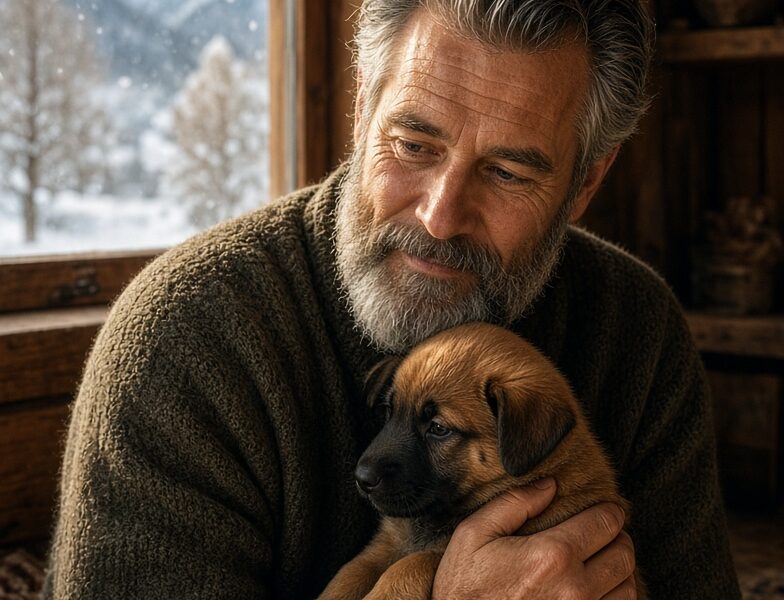
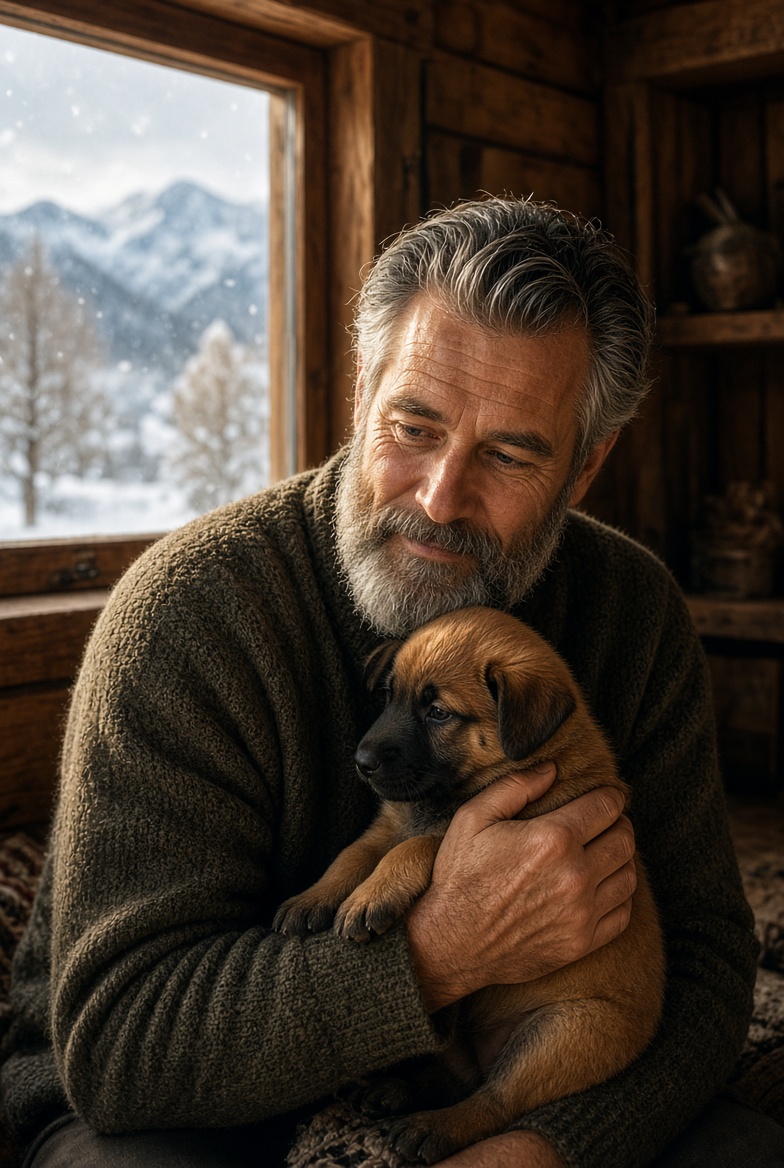
He had walked straight past his toys toward Tobin Hargrove, a 55-year-old retired Navy SEAL with silver-gray temples, a weathered face, and a heart hardened by years of loss.
Tobin had returned to his snow-covered hometown to sell his father’s house and leave his past behind.
He hadn’t called the puppy.
He hadn’t offered him food.
Yet the tiny Belgian Malinois had gently pressed his forehead into the veteran’s rough hand, trusting a man who had almost forgotten how to trust anyone.
Now, as the puppy listened to the mysterious sounds behind that wall, Tobin was about to discover something that would change far more than one winter afternoon.
Because sometimes God’s greatest miracles arrive on the smallest paws.
And what this little puppy heard next would lead the lonely Navy SEAL toward a door he never thought he’d have the courage to open again.
Snow drifted past the windows of an old community building in northern Wyoming, turning the world outside into a quiet blur of white.
Inside a small, warm room, an 8-week-old Belgian Malinois puppy stopped playing and stared at a stranger who had just entered.
The puppy was tiny, with a short reddish-fawn coat, a distinctive black mask covering his muzzle, dark brown eyes, and oversized paws that seemed almost too large for his body.
Both ears were still soft, although his left occasionally tried to stand before folding again.
His name was Flint.
He had been curious about everyone that morning, yet something about this particular man made him unusually still.
The stranger was tall, broad-shouldered, and weathered by years of difficult living.
His short, dark brown hair was silver at the temples.
His neatly trimmed salt-and-pepper beard framed a square, rugged face, and his gray-blue eyes carried an exhaustion that sleep alone could never cure.
He wore a dark olive-green winter parka over a charcoal shirt, dark jeans, and worn brown leather boots.
Without calling or offering food, he lowered one hand beside his chair.
Flint slowly approached, sniffed his fingers, and gently pressed his little forehead against his palm.
The man froze.
For the first time in years, someone had chosen to come close without asking anything of him.
His name was Tobin Hargrove, and at 55, the retired Navy SEAL had spent much of his adult life learning how to survive situations other men feared.
He had served nearly 28 years in the United States Navy, eventually becoming a senior chief.
Eighteen years earlier, a difficult withdrawal operation overseas had cost the life of Gavin Stout, one of his closest teammates.
Gavin had been a broad-shouldered man with close-cropped light brown hair, gray-green eyes, and an easy smile that could lift the mood of an exhausted team.
The official review had never placed the blame on Tobin.
That had not stopped him from wondering whether a different decision might have brought his friend home.
After retiring, he worked as a private safety and risk-management consultant, moving between short contracts and keeping relationships carefully distant.
He had convinced himself that people were safer when they expected nothing from him.
Unfortunately, the distance meant to protect others had slowly become the very thing that hurt them.
Earlier that morning, Tobin had driven his aging Ford F-250 into North Lantern, a small fictional town near the eastern foothills of Wyoming’s Bighorn Mountains.
The late January wind swept across frozen fields and pushed loose snow along the road.
He had returned because his father, Graham Hargrove, had died the previous September, leaving behind an old wooden house and a modest woodworking shop.
Graham had been a patient carpenter in his late 70s with thick silver hair, a silver mustache, and rough hands that always smelled faintly of pine.
Tobin remembered him wearing plaid flannel shirts beneath a brown canvas apron, teaching his young son that even the simplest piece of wood deserved care.
Now the workshop stood silent.
Tobin intended to inventory the remaining property, prepare the house for sale, and leave within 10 days.
He considered the trip an obligation, not a homecoming.
His younger sister, Ellen Hargrove, was waiting when he arrived.
At 49, Ellen was a practical woman of medium height with shoulder-length chestnut hair tied into a low ponytail, warm hazel eyes, and a directness that sometimes made people uncomfortable.
She wore a camel-colored winter coat and a teal scarf wrapped tightly against the cold.
Unlike Tobin, she had remained connected to North Lantern, helping organize donations and winter assistance through the local community house.
She greeted him with a brief embrace, then showed him the paperwork and the boxes their father had intended to donate.
Tobin wanted to begin packing immediately.
Ellen asked him to deliver several wooden storage boxes to the community building first.
He agreed reluctantly, explaining that he still had considerable work to finish.
Ellen studied his face for a moment.
She knew that her brother had become remarkably efficient at finishing tasks and equally skilled at avoiding conversations.
The community house occupied an old school building that had been adapted for meetings, volunteer programs, and winter supply distribution.
A separate office suite was rented by a small animal rescue organization managed by Avery Quinn.
Avery was 39, a capable, soft-spoken woman with dark brown hair pulled into a low ponytail, attentive brown eyes, and a forest-green fleece beneath a navy utility vest.
She cared deeply about animals but approached rescue work with practical responsibility rather than sentiment alone.
When Tobin delivered two smaller wooden boxes intended for pet supplies, Avery thanked him and invited him into the clean room where Flint was having a short supervised socialization session.
The puppy had recently been surrendered by a family unable to keep him.
His veterinary records and initial care were documented, and Avery was carefully limiting his exposure while he completed his puppy vaccinations.
Tobin washed his hands as instructed and sat quietly, expecting nothing more than a brief visit.
What happened next surprised Avery more than Tobin understood.
Flint had spent the morning investigating toys, cautiously exploring the room, and greeting visitors before wandering away again.
But when Tobin sat down, the puppy seemed to forget the toys altogether.
He approached the retired SEAL, examined his weathered hand, and rested his forehead against it.
Tobin felt the small warmth of the puppy’s body and an unexpected tightening in his chest.
His fingers moved carefully across Flint’s short coat.
Then the puppy backed into an empty plastic bowl, startled himself with the noise, and sat down staring at it in complete confusion.
A laugh escaped Tobin before he could stop it.
Avery smiled while Ellen, standing in the doorway, stared at her brother in astonishment.
She could not remember the last time she had heard him laugh without forcing it.
Tobin stayed longer than he intended.
He watched Flint explore a cloth toy, pause to listen to distant footsteps, and eventually settle on the clean rug near his chair.
Avery explained that the puppy was not a trained military working dog, despite belonging to a breed often associated with demanding service roles.
At 8 weeks old, Flint needed gentle guidance, rest, veterinary care, and a suitable home.
Tobin nodded, recalling the disciplined working dog teams he had encountered during his military career.
Flint knew nothing about those years.
He knew nothing about the rank Tobin had held or the loss he carried.
The little dog simply seemed comfortable beside him.
When Tobin finally stood to leave, Flint raised his head and watched quietly.
Avery remarked that the puppy appeared to appreciate his calm presence.
Tobin dismissed the observation with a faint smile, but he found himself looking back through the doorway once more.
Later, while sorting his father’s belongings, Ellen brought up the subject Tobin had been avoiding.
His 30-year-old daughter, May, lived near Sheridan, where she taught music and raised her six-year-old son, Theo.
May had inherited her father’s determination but not his tendency to retreat.
Her softly wavy auburn-brown hair and clear green eyes reminded Ellen of their mother, and behind May’s composed manner lay years of disappointment.
Tobin had missed school performances, family gatherings, and promises he had made himself.
Five years earlier, he had canceled a particularly important concert where May was directing her students for the first time.
It had not been a military emergency.
He had accepted another consulting assignment because working felt easier than confronting the distance between them.
“You should see her while you’re here,” Ellen said.
Tobin kept folding a stack of old blankets.
“She has her own life.”
Ellen answered gently, “She always did, Tobin. She just wanted you to be part of it.”
He said nothing, because there was no convincing answer.
That evening, Tobin entered Graham’s woodworking shop alone.
The room smelled of pine shavings, old leather, and the faint trace of machine oil.
His father’s tools hung neatly above the workbench, just as they had when Tobin was a boy.
In a drawer beneath the table, he found a small unfinished wooden horse.
Its body had been carefully shaped, but one side of the mane remained rough.
On the bottom, written in his father’s familiar carving, were four words.
For Theo, Christmas.
A folded note showed Graham had begun the gift the previous summer, hoping to finish it before the holidays.
Tobin pictured Theo from a photograph May had once sent.
A small boy with short light brown hair, bright brown eyes, and a smile that seemed to belong to a family Tobin barely knew anymore.
His father had spent his final months preparing something loving for that child.
Tobin, meanwhile, had spent years finding reasons not to visit.
He carried the wooden horse into the kitchen and placed it beside his phone.
Outside, snow gathered on the porch railing, and the old red lantern Graham once hung near the door moved gently in the wind.
Tobin opened May’s message thread and scrolled past unanswered invitations and birthdays acknowledged with far too few words.
He began typing, stopped, and erased the sentence.
He tried again, then set the phone down across the room.
The wooden horse waited beneath the kitchen light.
Unfinished, but not beyond repair.
Tobin remembered Flint’s tiny forehead against his hand, and the strange comfort of being trusted without first proving himself useful.
He did not send the message that night, but neither did he close the conversation.
For the first time since returning to North Lantern, the thought of leaving in 10 days no longer brought him relief.
At 5:20 the following morning, Tobin Hargrove opened his eyes before the alarm could ring.
Outside, North Lantern lay beneath another blanket of snow, its quiet streets disappearing into the pale blue darkness of a Wyoming winter.
The 55-year-old retired Navy SEAL sat on the edge of his father’s old bed, listening to the heating system hum through the wooden walls.
For almost 28 years, his mornings had begun with schedules, responsibilities, and decisions that could not wait.
Retirement had changed the uniform he wore, but not the discipline beneath his skin.
He pulled on a charcoal-gray Henley, dark jeans, and his worn brown boots before entering the kitchen.
The unfinished wooden horse still rested beside his phone.
May’s unanswered conversation remained on the screen exactly where he had left it the night before.
Tobin turned the phone face down and poured himself a cup of black coffee.
There were practical things to accomplish today.
Practical things had always been easier than apologies.
By 8:00, he had organized three boxes of his father’s woodworking tools and loaded several wooden shelves into the back of his Ford F-250.
His younger sister, Ellen, arrived shortly afterward, brushing snow from her camel-colored coat and adjusting the teal scarf around her neck.
She had spent most of her adult life in North Lantern, developing the kind of patient determination that came from helping neighbors who rarely asked for assistance until they desperately needed it.
She told Tobin that North Lantern Community House could use the shelves for sorting winter donations.
He initially reminded her that he had an appointment with a property agent later that week.
Ellen simply pointed toward his truck.
“You’ve already loaded them.”
Tobin looked at the boxes, then at his sister.
“That doesn’t mean I’ve agreed to become your delivery service.”
Ellen smiled.
“Of course not. Delivery services are usually friendlier.”
He shook his head.
But 15 minutes later, they were driving toward the old school building.
Inside the community house, volunteers were arranging donated blankets, winter coats, and household supplies beneath the warm fluorescent lights.
The person directing the activity was Marian Bell, a 62-year-old woman with a chin-length silver bob, thin rectangular glasses, and attentive brown eyes.
She wore a beige cardigan over a pale blue blouse, and every movement suggested someone who preferred order without making others feel unwelcome.
Marian had once managed the school’s library before the building was converted into a community center.
She knew its narrow corridors, aging storage rooms, and inconvenient corners better than almost anyone in North Lantern.
After greeting Tobin, she examined the wooden shelves and explained where they would be most useful.
He noticed that two supply carts partially blocked an interior passage and suggested a different arrangement.
Marian appreciated the observation, particularly after hearing he had spent recent years working in safety consulting.
Tobin made one thing clear.
He could help organize movement through the building, but any questionable doors or mechanical equipment needed inspection by qualified maintenance workers.
Marian agreed and showed him the updated floor plan.
Near the sorting table stood Hazel Finch, a 15-year-old volunteer with dark blonde hair gathered into a loose braid, bright blue eyes, and a scattering of freckles across her fair cheeks.
Her plum-colored hoodie was slightly too large, and she kept pushing the sleeves away from her hands while writing inventory numbers.
Hazel was curious, energetic, and determined to be helpful, sometimes more determined than cautious.
Her mother had given permission for her to volunteer, and Marian supervised her assignments.
When Hazel learned that Tobin had once served as a Navy SEAL, her expression brightened.
“Were you ever afraid?” she asked as he placed a box on a low shelf.
Tobin glanced at her.
“Plenty of times.”
She looked surprised.
“I thought Navy SEALs weren’t supposed to be scared.”
He adjusted the box before answering.
“Fear tells you something matters. The important part is deciding what to do with it.”
Hazel considered that for a moment, then returned to her inventory sheet.
Tobin found himself wondering when he had last spoken so easily to someone who expected nothing beyond an honest answer.
Around midday, Tobin stopped by the separate rescue office suite where Avery Quinn had arranged a short supervised visit with Flint.
The 39-year-old rescue coordinator greeted him with the same practical warmth he remembered from their first meeting.
Her dark brown hair was tied in a low ponytail, and she wore a forest-green fleece beneath a navy utility vest.
Flint, the 8-week-old male Belgian Malinois, was playing inside the designated clean room, away from public foot traffic and unfamiliar animals.
His reddish-fawn coat looked almost golden beneath the soft light, contrasting with a black mask around his small muzzle and dark brown eyes.
His oversized puppy paws made his careful movements faintly comical, while his soft left ear rose halfway whenever something interested him.
Avery explained that Flint still needed substantial rest and carefully controlled experiences as his vaccination schedule continued.
Tobin washed his hands, sat beside the rug, and allowed the puppy to approach voluntarily.
Flint sniffed his fingers, briefly rested against his boot, then wandered away to investigate a cloth toy.
Watching him, Tobin felt an unfamiliar relief.
The puppy did not require constant attention or proof of affection.
He was simply learning that the world could be trusted.
Later, while Marian reviewed the building’s storage arrangements, Tobin noticed an old metal return-air grill along the wall of Avery’s office.
The original school had undergone several renovations, leaving some older ventilation passages connecting rooms that now served different purposes.
A supply cart crossing a doorway outside produced a faint metallic vibration through the grill.
Flint immediately stopped playing and turned his head toward the sound.
His soft ears shifted, and his little body became perfectly still for a moment.
Tobin had barely registered the noise himself.
Avery noticed his curiosity and explained that puppies often reacted to unfamiliar sounds long before people understood what had caught their attention.
“He isn’t warning us about anything,” she said. “He’s learning the difference between ordinary noises and things he hasn’t heard before.”
Flint blinked, sneezed unexpectedly, and returned to his toy.
Tobin smiled.
He had spent years watching for danger.
Flint, by contrast, seemed to find mystery in the smallest ordinary things.
That afternoon, Hazel approached Tobin while he was helping carry the last of the lightweight supply boxes.
“Can I ask something else?” she said.
“When soldiers come home, why do some of them stop talking to people?”
The question caught him more deeply than she could have imagined.
Tobin looked toward a window where snow was gathering against the glass.
“Sometimes they don’t know how to explain what they’re feeling,” he answered. “And sometimes they convince themselves silence is easier.”
Hazel nodded thoughtfully.
“My dad drives trucks across three states. Sometimes he’s gone for days, but he always calls if he’s going to miss dinner.”
She paused.
“Mom says knowing someone is coming back matters more than knowing exactly when.”
Tobin felt those words settle into a place he had carefully avoided for years.
Hazel returned to her work, unaware that a casual observation had reminded a hardened veteran of every empty chair his daughter had once saved for him.
A little later, Ellen found Tobin examining the inventory notes.
She told him that May would probably appreciate knowing he was spending time in the town again.
Tobin kept his eyes on the paper.
“She knows I’m here.”
Ellen folded her arms.
“Knowing you’re in Wyoming isn’t the same as knowing you want to see her.”
He offered no reply.
She softened her voice and reminded him that relationships were not assignments that could be completed and filed away.
Tobin understood what she meant, but understanding had never been his greatest difficulty.
He could examine a complicated situation, identify every risk, and still fail to do the simplest necessary thing when that thing required emotional honesty.
Across the room, Hazel laughed as she corrected an inventory mistake.
Tobin remembered her words about her father’s phone calls.
His own daughter had once waited for messages he kept postponing.
The realization left him quieter than before, though his silence no longer felt quite as comfortable.
By 4:00, the light outside had faded into a cold, gray afternoon, and Marian began preparing to close the public areas before the evening wind strengthened.
Volunteers finished labeling boxes and checked their assignments against the inventory sheets.
Hazel discovered that the blanket count was short by one container.
Remembering a box stored in the older west-side supply room, she decided to retrieve it quickly without interrupting Marian, who was discussing the closing checklist with Ellen.
Hazel left her phone charging at the sorting table and walked down the corridor alone.
The storage room was well lit, with orderly shelves and a heavy wooden door fitted with an aging lever handle.
She found the missing box almost immediately.
But when the self-closing door settled shut behind her, an internal part of the latch mechanism failed.
Hazel returned to the doorway and pressed the handle.
It moved loosely without releasing the latch.
She tried again, then called for help.
Outside, rolling carts, conversation, and wind against the window swallowed her voice.
Her excitement faded into worry.
Hazel carefully set the box down and tried calling again, louder this time.
Nothing answered.
She remembered the old ventilation grill low on the wall and noticed that sound traveled strangely through its metal opening.
Kneeling beside it, she tapped three times and waited.
Meanwhile, in the separate office next door, Avery had returned for a brief late-afternoon stop to collect supplies and prepare to take Flint home.
The puppy lay on his clean rug, occupied with a soft chew toy.
Suddenly, his small jaws stopped moving.
He lifted his head, turned toward the wall, and listened.
Avery noticed the change but heard only the building’s heating system.
Flint remained motionless, his dark eyes fixed on the grill.
At approximately 4:15, Marian returned to the sorting table and realized Hazel was missing.
Her phone was still connected to its charger.
After calling the girl’s name and checking the nearby work areas, Marian asked Ellen whether she had seen her leave.
Ellen immediately shook her head and began helping check the rooms.
Tobin, who had been securing boxes in his truck, heard his sister call from the doorway.
He returned at once, leaving the engine switched off and the keys in his pocket.
Inside Avery’s office, Flint continued staring at the ventilation grill.
Then, as the heating fan briefly fell quiet, three faint metallic knocks traveled through the wall.
The tiny Belgian Malinois tilted his head, listening more intently than before.
Somewhere beyond that wall, Hazel waited for someone to hear her.
The wind rattled the windows of North Lantern Community House as Tobin Hargrove hurried back through the entrance, his worn brown leather boots leaving damp footprints across the old wooden floor.
Outside, the Wyoming afternoon was disappearing beneath gathering snow clouds.
Inside, something felt terribly wrong.
His younger sister, Ellen, stood near the sorting tables, her normally composed expression tightened with concern.
Hazel Finch, the 15-year-old volunteer with dark blonde braided hair and bright blue eyes, had been missing for nearly 15 minutes.
Her phone remained charging beside an unfinished inventory sheet.
Marian Bell, the 62-year-old community coordinator, was checking the volunteer list with trembling fingers beneath her thin rectangular glasses.
Tobin felt a familiar pressure building in his chest.
Eighteen years earlier, he had experienced that same sensation when communication with his Navy SEAL teammate Gavin Stout suddenly disappeared during an overseas mission.
Gavin had never returned.
Tobin pushed the memory aside.
Hazel was somewhere inside a community building, and fear would not help anyone find her.
“Where was she last seen?” Tobin asked, his gray-blue eyes moving between Marian and the surrounding hallways.
Marian explained that Hazel had been counting winter blankets, but no one had seen her leave the sorting area.
Tobin asked Ellen to contact the building manager and verify whether anyone had watched Hazel exit.
Marian began checking the nearby rooms while the remaining volunteers searched their assigned areas.
Tobin reminded everyone to report which spaces they had inspected rather than repeatedly checking the same places.
His voice was controlled, almost quiet.
Years of military service had taught him to organize information under pressure.
But he also understood that a missing teenager was not a battlefield problem.
The people around him were neighbors, not soldiers, and he needed their knowledge of the building as much as they needed his composure.
As Tobin approached the western corridor, Avery Quinn appeared at the doorway of her animal rescue office.
The 39-year-old woman, with dark brown hair tied in a low ponytail and concerned brown eyes, looked unusually distracted.
“Tobin, there’s something strange about Flint.”
Inside the clean room, the 8-week-old Belgian Malinois puppy had abandoned his soft chew toy.
His short reddish-fawn coat glowed beneath the warm overhead light, while the distinctive black mask around his little muzzle made his dark brown eyes appear especially alert.
His oversized paws were planted on the rug, and his soft ears angled toward an old metal ventilation grill.
Flint was not barking or attempting to leave.
He simply sat motionless, listening.
Avery explained that he had been reacting to the wall for several minutes.
Tobin remembered the old return-air passage connecting this office with the adjacent storage rooms.
He approached the grill and asked everyone nearby to remain quiet.
At first, he heard nothing except the heating fan and distant voices from the hallway.
Then the fan briefly stopped as the thermostat cycled.
Three faint metallic knocks passed through the wall.
Tobin straightened immediately.
He waited, listening to the silence.
Another uneven sequence followed.
Flint tilted his small head, his left ear lifting halfway before folding again.
Tobin looked at Avery.
“That’s not the heating system.”
He called Marian and asked which rooms shared the old ventilation passage.
She consulted the building plan and identified the west storage room, a space used for blankets and seasonal supplies.
Tobin moved down the corridor, followed by Marian and Ellen.
At the heavy wooden door, he knocked firmly.
“Hazel, this is Tobin. Can you hear me?”
For several uncomfortable seconds, there was only silence.
Then a young voice answered from behind the door.
“I’m here. Please. I can’t get out.”
Relief swept across Marian’s face.
Tobin leaned closer and asked Hazel whether she was hurt.
The girl explained that she had come to retrieve a missing box of blankets, but the door had closed behind her and the handle would no longer release the latch.
Her phone was still at the sorting table.
She was frightened, but she could breathe normally and had not fallen or injured herself.
Tobin kept his voice steady.
“We know where you are now, Hazel. You’re not alone.”
Marian hurried to retrieve the building’s master key while Ellen updated the local emergency responders.
Tobin spoke through the door again, asking Hazel to remain in a comfortable position away from the doorway.
His pulse was racing, although his voice revealed nothing.
The last time he had desperately wanted to hear an answer from someone trapped beyond his reach, the radio had remained silent.
This time, a living voice was answering him.
Marian returned with the master key, but the moment she tested the door, her expression changed.
The lock was not the problem.
The lever moved loosely without releasing the damaged internal latch.
Tobin examined the door and instinctively stepped closer, feeling the old urge to solve the problem himself before another second passed.
Then Hazel called through the wood.
“Mr. Hargrove, are you still there?”
He closed his eyes for the briefest moment.
In his memory, another voice seemed to echo across 18 years.
Gavin, somewhere beyond the reach of his team, waiting for an answer.
Tobin placed his palm against the door.
“I’m right here, Hazel.”
He wanted to force it open, but there was no sign of immediate danger, and an uncontrolled attempt could make matters worse.
Instead, he stepped back and let the trained responders handle the damaged mechanism.
For perhaps the first time in his life, Tobin understood that refusing to act recklessly could also be an act of courage.
While they waited, Tobin continued talking with Hazel through the closed door.
He asked about her volunteer work and whether she enjoyed living in North Lantern.
Gradually, her frightened answers became steadier.
When he asked about school, she mentioned playing music and attending a community workshop led by a teacher named May Hargrove.
Tobin went still.
“May Hargrove,” he repeated.
“Yes,” Hazel answered. “She’s really nice. She remembers everyone’s name, even when we mess up.”
Tobin lowered his gaze.
He had spent years convincing himself that his daughter was better off without his presence.
Yet here was a girl speaking warmly about the woman May had become.
“She’s my daughter,” he said softly.
Hazel sounded surprised.
“Really? Then you must be proud of her.”
Tobin swallowed.
“I am,” he answered.
And for once, he allowed himself to feel that pride without immediately covering it with regret.
Deputy Ellis Roe arrived with local firefighters shortly afterward.
At 44, Ellis was a broad-built man with a square jaw, short dark brown hair beginning to gray at the temples, a neatly trimmed beard, and thoughtful brown eyes.
His dark navy winter law enforcement jacket carried a small sheriff’s star.
Ellis had spent years serving rural Wyoming communities, where calm cooperation often mattered more than dramatic displays of authority.
He listened to Marian’s explanation, checked on Hazel’s condition through the door, and coordinated with the firefighters.
The crew assessed the damaged latch and safely released it with suitable equipment.
Tobin remained nearby, speaking reassuringly to Hazel until the doorway was clear.
When the door finally opened, the teenager stepped into the corridor, her loose braid falling over one shoulder, her blue eyes bright with exhausted relief.
She was shaken but uninjured.
Hazel’s mother arrived soon afterward, a tired-looking woman with dark blonde hair escaping from beneath a knitted winter hat and a burgundy scarf dusted with snow.
She hurried toward her daughter and wrapped both arms around her.
Hazel held on tightly.
Tobin watched from several steps away as the firefighters completed their assessment and confirmed that Hazel showed no obvious signs of significant injury or cold exposure.
The girl looked over her mother’s shoulder.
“Thank you, Mr. Hargrove.”
Tobin shook his head gently.
“You did the right thing by making noise and letting us know where you were.”
Hazel managed a small smile.
“I thought nobody could hear me.”
Tobin glanced toward Avery’s office.
“Someone heard something,” he replied. “And everyone helped from there.”
Marian immediately arranged for the defective storage room to remain closed until qualified maintenance workers could inspect and repair the door.
She also began reviewing the volunteer check-in procedures and the requirement for younger volunteers to tell a supervisor before changing work areas.
Avery, meanwhile, returned to Flint, who had resumed playing with his soft toy, blissfully unaware of the attention surrounding his unusual reaction.
When Ellen called him a little hero, Avery smiled but gently corrected her.
Flint was still an ordinary puppy, not a trained search-and-rescue dog.
He had simply noticed a faint sound that people had overlooked in the noisy building.
Tobin stepped into the clean room, washed his hands, and crouched beside the rug.
Flint approached, sniffed his fingers, and rested his chin against them.
Tobin whispered, “Good boy.”
The words carried more feeling than he expected.
That evening, Tobin returned to his father’s woodworking shop.
The snow had settled into a quiet white covering over the porch, and the red lantern beside the door swayed gently in the cold wind.
He sat at Graham’s old workbench and stared at the unfinished wooden horse intended for his grandson.
Throughout the afternoon, one detail had troubled him.
No single person had rescued Hazel alone.
Flint had noticed the sound.
Avery had recognized his unusual attention.
Marian had known the building.
Ellen had helped organize the response.
Ellis and the firefighters had opened the door.
Tobin had contributed what he could, then trusted others to do their part.
For 18 years, he had carried Gavin’s death as though every terrible outcome must have been his responsibility.
Tonight, he remembered that even the strongest people could not control every moment, every decision, or every loss.
He had known that intellectually for years.
Accepting it in his heart was something different.
His phone vibrated against the wooden table.
A message from May appeared on the screen.
Ellen had told her about Hazel, whom May remembered from the music workshop.
“I’m glad Hazel is safe,” the first message read.
Tobin felt a cautious warmth at seeing his daughter’s name.
Then another message arrived.
“Ellen says you helped find her, Dad. I know you’ve helped a lot of people over the years, but I never needed you to save the whole world. I just wanted you to show up when you said you would.”
Tobin read the words once, then again.
There was no cruelty in them, only a truth he could no longer avoid.
He looked at the wooden horse, remembering how his father had continued reaching toward the family Tobin had kept at a distance.
Then he opened May’s message and began typing.
His hands hesitated, but this time he did not immediately erase every word.
For nearly 10 minutes, Tobin Hargrove sat alone at his father’s wooden workbench, staring at the unfinished message on his phone.
Outside, snow whispered against the windows, and the old red lantern swayed beneath the porch roof.
His daughter May’s words remained on the screen.
“I never needed you to save the whole world. I just wanted you to show up when you said you would.”
At 55, Tobin had survived nearly 28 years of Navy SEAL service, faced decisions that could never be undone, and buried memories he rarely allowed himself to revisit.
Yet four simple sentences from his daughter had left him more vulnerable than he had felt in years.
He looked at the unfinished wooden horse his late father had carved for his grandson Theo.
Then he returned to his message.
“You’re right. I wasn’t there when you needed me. I’m sorry. I know those words don’t fix anything, but I want you to know I’ve heard what you said.”
His thumb hovered over the screen before he finally pressed send.
There was no immediate reply.
Tobin set the phone down and remained in the quiet workshop, realizing that an apology was only the beginning of a responsibility he had avoided for far too long.
Over the following days, North Lantern Community House gradually returned to its familiar routines.
Hazel Finch, the 15-year-old volunteer who had become trapped in the storage room, rested at home before returning to help with supervised activities.
The defective door remained out of service until qualified maintenance workers completed repairs and safety checks.
Marian Bell, the silver-haired coordinator, revised the volunteer procedures so everyone would report before entering storage areas or changing assignments.
Tobin helped Ellen rearrange supply shelves and prepare winter donation boxes.
But something about his behavior had changed.
In the past, he would have volunteered to solve every problem himself, working until exhaustion while refusing assistance.
Now, when Marian offered to handle the inventory, he accepted.
When Ellen suggested that another volunteer could finish loading the supplies, he stepped aside.
It felt surprisingly difficult to surrender responsibility for something so ordinary, but each small decision reminded him of Hazel’s rescue.
Nobody had needed to become a hero alone.
His visits with Flint continued according to Avery Quinn’s schedule.
The little Belgian Malinois was now approximately 9 weeks old.
Still unmistakably a young puppy with a short reddish-fawn coat, a deep black mask around his muzzle, dark brown eyes, and slightly oversized paws.
His left ear occasionally lifted before folding again, giving him a permanently curious expression.
Inside Avery’s carefully maintained clean room, Flint investigated a soft toy, wandered across the rug, and then approached Tobin’s familiar brown boots.
Tobin sat quietly in his charcoal-gray sweater, his weathered face relaxing as the puppy sniffed his hand.
When Flint placed his chin across Tobin’s fingers, the retired SEAL felt something unfamiliar settle inside him.
There was no demand to explain his past, no expectation to be impressive, only a small living creature learning whom he could trust.
For several minutes, Tobin simply watched Flint breathe and listened to the soft sounds of the room.
Avery eventually pulled up a chair beside him, with her dark brown hair tied back and her forest-green fleece sleeves rolled to her wrists.
She looked every bit the practical rescue coordinator Tobin had come to respect.
“You’ve been asking questions about raising Malinois puppies,” she observed.
Tobin gave a reluctant smile.
“I suppose I have.”
Avery explained that Flint would not remain this small, quiet companion forever.
Belgian Malinois often matured into energetic, demanding dogs requiring consistent training, daily engagement, and careful socialization.
And although the breed was associated with military and police work, Flint was not a trained K-9 and might never be suited to such a role.
Tobin looked at the puppy, who was now struggling to decide whether a cloth toy or his own front paw was more interesting.
“I don’t need him to be anything special,” Tobin said.
Avery studied him thoughtfully.
“Then make sure you’re choosing the life that comes with him, not just the feeling he gives you today.”
That evening, Ellen found Tobin in the woodworking shop, carefully sorting their father’s old notebooks.
She had changed out of her camel-colored coat into a plum-colored sweater, and her chestnut hair was loosely tied behind her neck.
She watched her older brother turn another page before asking whether May had replied.
Tobin shook his head.
“I sent her a message. That’s all.”
Ellen pulled a chair beside him.
For a while, neither spoke.
Finally, Tobin admitted something he had never fully explained to her.
Eighteen years earlier, after losing Gavin Stout during an overseas operation, he had begun believing that closeness carried a terrible price.
He knew the official review had not blamed him.
Yet every family milestone he missed seemed easier to justify than the possibility of loving someone he could disappoint or lose.
“I thought keeping my distance would spare people the worst parts of me,” he said.
Ellen’s hazel eyes filled with sadness.
“Tobin, May was never asking you to protect her from every painful thing in life. She was asking you not to become one of them.”
The words struck him harder because they were spoken without anger.
While searching for an old sanding block, Tobin discovered a narrow notebook wedged beneath the back of his father’s workbench drawer.
Inside were sketches of wooden toys, measurements for small bookshelves, and dates beside the names of May and Theo.
Graham Hargrove had kept a quiet record of the things he hoped to make for his family.
Near the final pages, Tobin found a drawing of the unfinished wooden horse.
Beneath it was a sentence written in his father’s careful handwriting.
“You cannot rebuild yesterday, but you can still choose what you build tomorrow.”
Tobin read it twice.
His father had never been a man of elaborate speeches.
He had shown love by repairing broken chairs, remembering birthdays, and leaving the porch light on when the weather turned dangerous.
Now, months after his death, those simple words seemed to reach across the empty workshop.
Tobin looked toward the window where snowflakes moved through the yellow light.
For years, he had believed his life was defined by the people he could not bring back.
But what if the people still waiting for him mattered just as much?
The following morning, Tobin made two decisions he had been postponing.
First, he contacted a veteran support service to arrange a conversation with a qualified counselor about the guilt and emotional withdrawal that had followed him since his military career.
He understood that neither Flint nor his family should carry the responsibility of healing wounds he had never properly addressed.
Second, he called Avery and asked to begin the formal adoption process.
He did not ask to take Flint home immediately.
Instead, he requested a clear explanation of what would be expected from him.
Avery outlined the rescue organization’s requirements, including suitable housing, veterinary care, realistic time commitments, and a plan for the puppy’s development.
Tobin listened, asked questions, and wrote everything down.
He had spent much of his life preparing for dangerous assignments.
For once, the planning was for something gentle, ordinary, and full of possibility.
Over the next several days, Tobin explored rental homes near Sheridan, where May and Theo lived.
His military retirement income, savings, and flexible consulting work would allow him to provide for Flint without accepting constant travel assignments.
He found a modest house with an enclosed yard and a landlord who permitted dogs.
After discussing his schedule with Avery, he arranged veterinary appointments, purchased appropriate puppy supplies, and identified Ellen as a trusted backup caregiver when necessary.
Avery reviewed the arrangements and explained that the remaining paperwork and transition preparations would still take time.
Tobin accepted that without complaint.
He was not rescuing Flint from an immediate emergency, and there was no reason to rush a lifelong commitment.
Meanwhile, Ellen helped him sort the final belongings in Graham’s house.
The property would still be listed for sale, but the tools Graham had intended for community use would be donated appropriately, and his red lantern would become a keepsake displayed at the community house.
A few days later, Avery invited Tobin to discuss his adoption application.
Flint, now around 10 weeks old, rested nearby after a short play session.
His reddish-fawn coat looked warm beneath the afternoon sunlight, while one soft ear bent sideways as he slept.
Avery reviewed Tobin’s preparations, then asked one final question.
“If Flint grows up to be an ordinary, stubborn, energetic dog who never performs a remarkable act again, will you still want him?”
Tobin studied the sleeping puppy.
He remembered the faint knocks that had helped them find Hazel.
But he also remembered the first quiet moment when Flint had approached a stranger and trusted him.
“I don’t want him because he heard something through a wall,” Tobin answered. “I want him because he’s Flint. And if I’m going to ask him to trust me, I intend to give him a home he can count on.”
Avery smiled.
His application was approved, with a final transfer arranged for after his move and the remaining care preparations were complete.
That night, Tobin was working on the unfinished wooden horse when his phone vibrated.
May had replied.
“I heard your message, Dad. I don’t know how to trust you again yet. But if you really want to talk, we can meet Sunday afternoon at a coffee shop in Sheridan. Just us. Please don’t make a promise you can’t keep.”
Tobin read the message slowly.
He could feel the weight of every missed birthday, every unanswered invitation, every excuse he had once mistaken for necessity.
Then he opened his calendar and marked the appointment.
He checked the weather forecast and planned to confirm travel conditions before leaving.
He would not accept any conflicting consulting work.
Across the bench lay the unfinished horse, his father’s notebook, and the adoption documents bearing Flint’s name.
Tobin picked up a piece of fine sandpaper and gently smoothed the last rough edge of the wooden mane.
He could not undo yesterday, but for the first time in 18 years, he was beginning to believe tomorrow was still something he could help build.
The little house outside Sheridan, Wyoming, was nothing like the places Tobin Hargrove had called home during his years of military service.
It had a narrow wooden porch, a modest kitchen, two bedrooms, and a fenced backyard overlooking a field still covered in February snow.
There were no military photographs on the walls, no carefully packed travel bags waiting beside the door, and no plans to leave for another assignment.
For the first time in years, Tobin had chosen a place because he wanted to stay.
At 55, the retired Navy SEAL still looked like a man shaped by difficult experiences.
His square, weathered face carried deep lines around his gray-blue eyes.
His short, dark brown hair was silver at the temples, and his neatly trimmed salt-and-pepper beard made his expression appear sterner than he intended.
But something had changed behind those watchful eyes.
After completing the rental arrangements and the rescue organization’s final requirements, Tobin had brought Flint home.
The young Belgian Malinois was now nearly 11 weeks old, with short reddish-fawn fur, a distinctive black facial mask, dark brown eyes, and paws that seemed to grow faster than the rest of him.
His left ear occasionally stood upright while the right remained folded, giving him a permanently inquisitive appearance.
As Flint explored the living room, Tobin watched from a nearby chair and quietly realized that this was the first home he had prepared for someone besides himself.
Living with a puppy was considerably less predictable than Tobin’s carefully organized life had been.
Flint needed regular meals, frequent bathroom breaks, gentle training, supervised play, and plenty of sleep.
Some mornings he woke before sunrise and announced his presence with a small, impatient whine.
Other times he became fascinated by an ordinary cardboard box or spent several minutes investigating his reflection in a glass cabinet.
Tobin quickly discovered that raising a Belgian Malinois required consistency without harshness.
He followed Avery Quinn’s guidance, rewarding calm behavior and creating an environment where Flint could learn safely.
When the puppy became tired or overwhelmed, Tobin gave him space to rest instead of demanding obedience.
The experience was unexpectedly humbling.
For decades, Tobin had measured success through discipline and completed objectives.
Flint seemed entirely uninterested in such measurements.
Sometimes their greatest achievement was a peaceful afternoon with no overturned water bowl.
And strangely, Tobin had begun to enjoy those afternoons more than he ever expected.
On the first Sunday after moving, Tobin drove into Sheridan beneath a pale winter sky.
Flint remained safely at home with Ellen, who had agreed in advance to care for him during the appointment.
Tobin arrived at a quiet coffee shop 15 minutes early and selected a table near the window.
He was wearing a charcoal-gray shirt beneath his dark olive-green winter coat, with clean dark jeans and his familiar brown leather boots.
When the door opened, he immediately recognized his daughter.
May Hargrove was 30, with shoulder-length auburn-brown hair falling in soft waves around her face, clear green eyes, and the composed posture of a woman accustomed to managing a classroom full of children.
She wore a navy wool coat over a cream-colored sweater, with a burgundy scarf wrapped loosely around her neck.
Tobin remembered the little girl who had once climbed onto his shoulders and asked him to explain the stars.
The woman approaching his table looked confident and independent.
Yet there was something guarded in her expression.
She had learned not to expect too much from him.
Tobin stood.
“Hi, May.”
She offered a restrained smile.
“Hi, Dad.”
Their conversation began awkwardly, with questions about the weather, her teaching schedule, and the house Tobin had rented.
Eventually, May sat down her coffee and looked directly at him.
“Why now?” she asked.
Tobin could have described the rescue of Hazel Finch or the remarkable little puppy waiting at home.
He could have spoken about the death of his father or the memories of his lost Navy SEAL teammate, Gavin Stout.
Instead, he answered the question she had actually asked.
“Because I kept telling myself I was protecting you by staying away, and I finally realized I was only protecting myself from having to face what I’d done.”
May lowered her eyes.
She told him about school performances where she had searched the audience for his face, birthdays when his calls came days late, and the disappointment of introducing her own son to a grandfather who was rarely present.
Tobin listened without interrupting.
When she finished, he said quietly, “You deserved better from me.”
He did not ask her to forgive him.
He knew that listening once could not undo years of absence.
May remained silent for a moment before explaining that she would not allow her six-year-old son Theo to build expectations that might be broken.
Tobin accepted her concern.
He suggested they begin with occasional phone calls and short visits whenever she felt comfortable.
There would be no grand promises, no sudden attempts to become the center of her family.
May finally nodded.
“We can try.”
It was not the reunion Tobin had imagined during his long drive to Wyoming.
There were no dramatic embraces or declarations that everything had been forgotten.
But when May stood to leave, she paused and said, “I’m glad you came.”
Tobin watched her walk toward the door, feeling both relieved and painfully aware of how much time had been lost.
Then he drove home, where Flint greeted him with a wagging tail, inspected his boots, and promptly returned to the important business of chewing his favorite toy.
Over the next two weeks, Tobin and May began building something fragile but real.
He called when they had agreed, listened when she talked about her students, and respected the moments when she needed space.
He continued arranging support for the emotional difficulties he had carried since leaving military service, understanding that loving Flint and reconnecting with family did not erase the need to care for his own well-being.
As the days passed, May noticed that her father no longer filled every silence with explanations.
He asked questions and remembered the answers.
Eventually, she agreed to bring Theo for a short visit.
The boy arrived wearing a sky-blue winter jacket and a red knitted hat, his short light brown hair peeking beneath the edge.
His warm brown eyes were wide with curiosity.
Theo was energetic and talkative, but he became unexpectedly quiet when he saw Flint resting behind a low puppy gate.
Tobin explained that the little dog was still learning how to behave around people, especially children.
Under close supervision, Theo sat on a clean rug and allowed Flint to approach voluntarily.
The puppy sniffed his shoes, examined his outstretched hand, and touched it gently with his nose.
Theo giggled.
“Grandpa, I think he likes me.”
Tobin felt his throat tighten.
It was the first time the boy had called him Grandpa so naturally.
A week later, May invited Tobin to a school music performance she was directing.
Theo would also be participating with a small group of younger children.
Tobin accepted immediately.
But two days before the concert, an old consulting client contacted him with a profitable assignment scheduled for the same afternoon.
Years earlier, Tobin would have accepted without hesitation, telling himself he could explain the conflict later.
This time, he stared at the invitation on his phone and remembered a young May looking toward an empty seat in a school auditorium.
He also remembered Hazel Finch saying that sometimes knowing someone would come back mattered more than knowing exactly when.
Tobin called the client and offered another date.
When that proved inconvenient, he politely declined the assignment.
He did not mention the decision to May.
He did not want praise for doing something a father should have done years ago.
But as he placed his phone on the kitchen table, Flint approached and rested his small chin against Tobin’s knee.
The old SEAL gently touched the puppy’s black-masked face.
“Some things,” he whispered, “are worth being there for.”
The afternoon of the performance arrived beneath a clear, cold sky.
Tobin arranged for Ellen to watch Flint, then drove carefully to the school and entered the auditorium before the program began.
He wore a simple blue-gray shirt beneath his winter coat and took a seat near the back.
Families filled the rows around him, chatting quietly while children gathered near the stage.
When May appeared to direct the student musicians, Tobin sat straighter.
She looked confident beneath the auditorium lights, her auburn hair falling against the shoulders of her cream-colored sweater.
He remembered helping her learn the notes of a simple melody when she was very young.
Somehow, in the years since, she had become the kind of teacher who could encourage nervous children with nothing more than a reassuring smile.
Later, Theo joined several other young students for a short song.
His small voice was almost lost among the others, but Tobin heard it clearly.
He watched every moment, and when the performance ended, he stood with the audience and applauded until his hands began to ache.
Afterward, May spotted him waiting near the auditorium doors.
Something softened in her face when she realized he had stayed for the entire program.
Theo came running toward him, excitedly describing how he had almost forgotten one line before remembering it at the last moment.
Tobin laughed and knelt to listen.
Then he reached into the small bag he had brought and removed the wooden horse his father, Graham Hargrove, had started carving before his death.
Tobin had carefully finished its mane, smoothed the remaining rough edges, and preserved the inscription beneath its base.
“For Theo, Christmas.”
May recognized her grandfather’s familiar carving style almost immediately.
She touched the small wooden figure, her green eyes filling with tears.
“Grandpa started this,” she whispered.
Tobin nodded.
“Last summer. I found it in his workshop. I thought Theo should have it.”
May turned the horse over in her hands.
“And you finished it.”
Tobin looked at his daughter.
“He taught me how.”
Theo accepted the gift carefully, studying the tiny carved details with wonder.
May did not suddenly forget the past, and Tobin did not expect her to.
But before they parted, she invited him to dinner the following weekend.
He accepted, grateful for another small step forward.
By early March, the snow banks around Sheridan had begun to shrink, revealing patches of frozen grass beneath the afternoon sunlight.
Flint was approaching 14 weeks old, still a reddish-fawn Belgian Malinois puppy, with his distinctive black muzzle, dark brown eyes, and one ear standing more confidently than the other.
One quiet afternoon, Tobin sat reading in his living room while the puppy rested nearby.
Then three gentle knocks sounded at the front door.
Flint lifted his head and looked toward the entrance.
Tobin smiled once.
Unexpected sounds had once reminded him of uncertainty and loss.
Now he recognized the familiar rhythm of someone arriving exactly when promised.
He crossed the room and opened the door.
May stood outside holding a small bag of pastries, with Theo beside her wearing his bright blue jacket.
“Hi, Grandpa,” the boy called.
Tobin stepped aside to welcome them in, watching Flint approach with happy curiosity.
For years, he had believed that loving people meant being strong enough to protect them from everything.
Now he understood something simpler and far more difficult.
Love meant showing up.
Keeping promises.
And allowing others to become part of his life.
Perhaps God’s grace had arrived not through a grand miracle, but through a small puppy who had trusted a lonely man before that man remembered how to trust himself.
Tobin looked at his daughter, his grandson, and the little dog waiting beside his feet.
Then he opened the door a little wider.
This time, he was not going anywhere.
Sometimes God’s greatest miracles do not arrive with thunder, bright lights, or extraordinary signs.
Sometimes they come quietly on four tiny paws, with innocent eyes and a heart full of unconditional love.
Tobin Hargrove spent years believing that his past mistakes and painful losses had taken away his chance to be happy again.
But God had not finished writing his story.
Through a little Belgian Malinois named Flint, Tobin discovered that even the most wounded heart can find a reason to open again.
And perhaps that is the lesson God wants us to remember in our own lives.
We cannot change yesterday.
We cannot bring back every moment we have lost.
But we can choose to forgive, reach out to someone we miss, keep a promise, or simply be present for the people who love us.
Sometimes the miracle we are praying for is already standing right in front of us, waiting for us to open the door.
So if you are carrying sadness, regret, or loneliness today, please remember this.
Your story is not over.
God still has a purpose for your life, and His grace can reach you even in your darkest season.
If this story touched your heart, please share it with someone who needs a little hope today.
Leave a comment below and tell us: do you believe God sometimes sends animals into our lives for a special reason?
And if you believe in kindness, loyalty, faith, and second chances, please like this video and subscribe to our channel.
Your support helps us continue sharing heartfelt stories of courage, love, and the incredible bond between humans and animals.
May God bless you and your family, protect your loved ones, bring peace to your heart, and fill your home with love, health, and happiness.
May He guide your steps, strengthen you through difficult times, and remind you that you are never truly alone.









