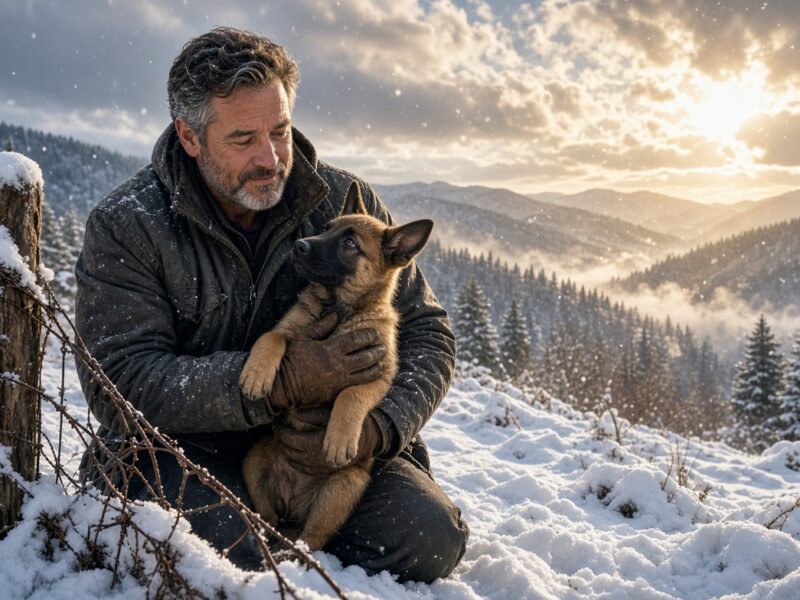
He Heard a Faint Cry Behind a Snowy Fence — And Found the Second Chance He Thought He’d Lost Forever
The Belgian Malinois puppy didn’t bark when Dawson Kincaid first heard him.
He barely had enough strength left to cry.
Dawson was driving alone through a narrow mountain road in western Virginia when the sound slipped through the winter wind.
Small, broken, almost swallowed by the snow.
He drove another hundred yards before something in him refused to keep going.
For twenty-seven years as a Navy SEAL, Dawson had learned to recognize the difference between noise and a signal.
So he turned the truck around.
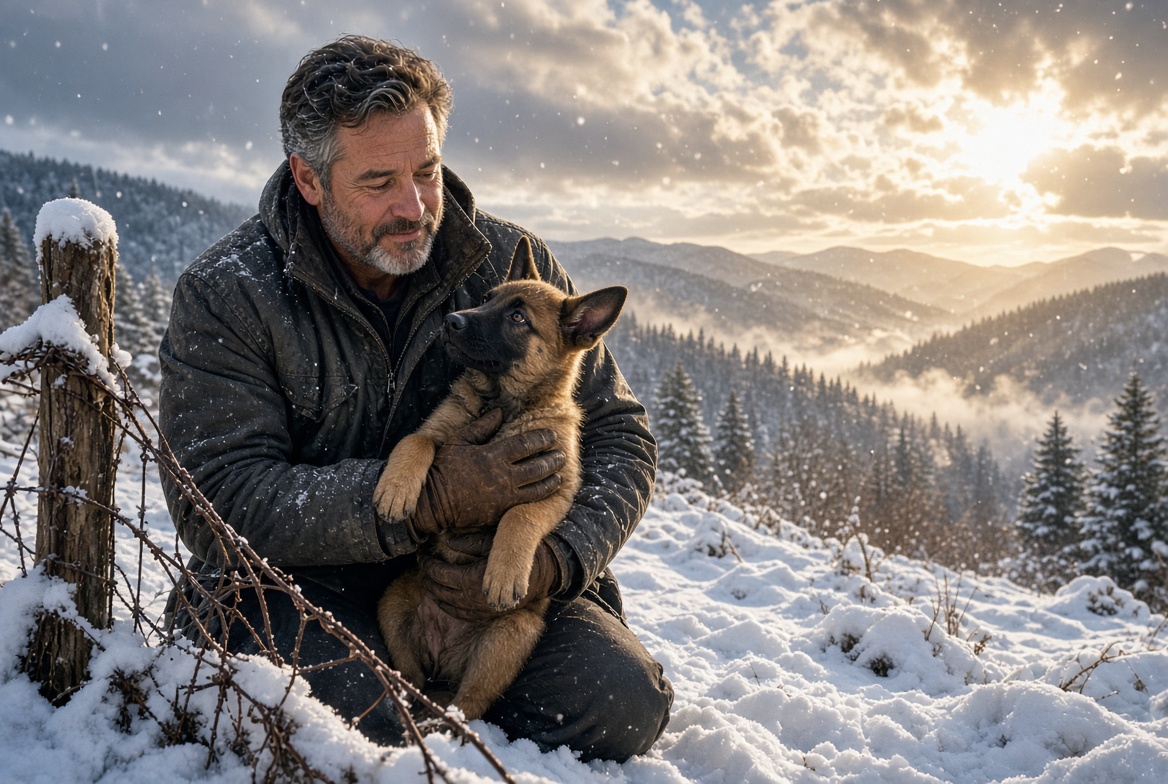
Behind an old roadside fence, half hidden beneath frozen grass, he found a three-month-old Belgian Malinois puppy with one front leg twisted inside the wire.
Beside him lay half of a sandwich, cold and wet from the snow, as if hunger had been the reason he had tried to squeeze through.
Dawson went back to his truck, grabbed a pair of wire cutters, and returned.
He cut the fence carefully, freed the puppy, then stepped back.
“Go on,” he said.
The little dog tried.
One step, two, three.
Then the injured leg gave out, and the puppy lowered himself into the snow.
Dawson stood there watching him.
He had already done what was necessary.
He could have left.
But the puppy turned his head and looked back at him.
Not begging, not crying, just waiting.
And for reasons Dawson could not yet explain, that look reminded him of another kind of silence.
A daughter who had stopped answering his letters years ago.
Dawson walked back through the snow, lifted the puppy into his arms, and carried him toward the truck.
He thought he was rescuing a dog.
He had no idea that this frightened little Malinois was about to lead him back to the one person he had failed to reach for nearly a decade.
The sound was so faint that Dawson Kincaid almost let the wind have it.
It came through the cracked driver’s side window as something between a whimper and a breath, swallowed almost immediately by the hiss of tires over wet pavement.
Dawson had already driven another hundred yards before his right foot eased off the accelerator.
Snow moved sideways through the headlights of his old dark gray pickup.
Thin at first, then suddenly thicker whenever the wind pushed down from the Blue Ridge.
Hawthorne Gap lay another fifteen minutes ahead, tucked into the folds of western Virginia, where two-lane roads twisted between abandoned pastureland, dark tree lines, and farmhouses whose porch lights often stood miles apart.
At fifty-two, Dawson had the broad shoulders and still powerful frame of a man who had spent most of his adult life demanding more from his body than it had any reason to give.
His dark brown hair was clipped short and silvered heavily at both temples, and a neat salt-and-pepper beard sharpened a weathered angular face that rarely revealed what he was thinking.
His blue-gray eyes still moved the way they had during twenty-seven years in the Navy SEALs.
Mirror, shoulder, tree line, road, movement, exit.
Three years into retirement, the habit had not faded.
Neither had his preference for silence.
The radio in the truck had worked perfectly for years.
Dawson simply rarely turned it on.
Silence let him hear what did not belong.
He glanced into the rearview mirror.
Nothing but pale road disappearing beneath falling snow.
For a moment he told himself it had been a branch scraping wire.
A bird in the brush.
Maybe the wind pushing through one of the drainage pipes under the road.
Then the sound came again.
Short.
High.
Alive.
Dawson’s hands tightened slightly on the steering wheel.
He had spent enough years learning the difference between random noise and a signal to know when his own instincts were refusing to let something go.
He slowed, found a gravel turnout wide enough for the truck, and made a careful three-point turn.
“Probably nothing,” he muttered, though there was no one in the cab to convince.
Five minutes earlier, he had been thinking about the replacement fuel line lying in a paper bag on the passenger side floor and the generator he had promised to repair for an elderly neighbor before the temperature dropped overnight.
Now he drove back toward an empty stretch of roadside because somewhere beneath the winter wind, something had asked to be heard.
He stopped beside an old pasture enclosed by a woven wire livestock fence.
The place looked unused.
The field beyond it washed gray beneath a gathering layer of snow, with dried weeds bent low along the fence line.
Dawson pulled on brown leather work gloves, zipped his charcoal field jacket higher against his throat, and stepped out.
Cold immediately pressed through the fabric of his dark work pants.
He stood still for several seconds, listening.
Nothing.
Then a small cry came from his left.
Dawson followed it twenty feet along the shoulder until he reached a clump of dead grass and thornless brush pressed against the lower fence.
He crouched and carefully pulled the grass apart.
Two amber-brown eyes stared back at him.
The Belgian Malinois puppy could not have been more than twelve or thirteen weeks old.
He was lean beneath a short warm fawn coat with a distinct black mask covering his muzzle and much of his young face.
His paws were slightly oversized in the way puppy paws often were, promising the athletic dog he might eventually become.
One ear stood almost upright, while the other tilted uncertainly to the side.
Under different circumstances, the uneven ears might have looked comical.
Out here, they made him seem painfully young.
His front leg had slipped through one of the lower squares of the woven wire, and his paw had turned just enough to prevent him from pulling it back through.
There was no severe wound, only damp fur, a few superficial scrapes, and the trembling exhaustion of an animal that had apparently spent too long trying the same useless movement.
Beside his muzzle lay half of a sandwich, the bread stiff from the cold, its wet wrapper trapped under grass.
Dawson looked from the food to the fence opening and understood.
The puppy had probably smelled it, pushed his head and shoulders toward the other side, then caught the leg while trying to reach farther.
Dawson lowered himself onto one knee.
The puppy tensed immediately.
“Easy,” he said.
His voice was deep and restrained, more accustomed to being obeyed than soothing frightened animals.
He softened it anyway.
“I see you.”
The Malinois pulled once against the wire, then stopped when Dawson did not reach for him.
That restraint mattered.
Dawson had learned long ago that panic could make a manageable problem dangerous.
Whether the frightened creature had two legs or four, he kept his hands visible.
He did not stare directly into the puppy’s eyes.
Snow collected along the shoulders of his jacket while the two of them remained there, separated by less than three feet and something much harder to measure.
Trust.
Then the puppy did something Dawson did not expect.
Instead of looking at the trapped leg, he lifted his head and stared past Dawson toward the pickup.
For several seconds, he seemed to listen to something farther down the road.
His entire small body went still.
Dawson turned instinctively, expecting headlights, a person, perhaps someone calling for a missing dog.
The road was empty.
When he looked back, the puppy’s eyes were on him again.
There was no struggling now, no barking, only a strange watchful patience, as if the animal had made a decision Dawson himself had not yet made.
The look unsettled him for a reason he could not explain.
It carried no demand.
It simply waited to see whether he would leave.
“I’m coming back,” Dawson said.
The words left his mouth before he thought about them.
For a fraction of a second, something tightened beneath his ribs.
There had been a time when those words belonged to other people.
Other rooms, other promises.
Dawson shut the thought down before it could fully form.
He stood and walked back to the pickup.
From the metal toolbox behind the cab, he retrieved a compact pair of wire cutters, a heavy blanket, and a second pair of gloves.
By the time he returned, the puppy remained exactly where he had left him.
Dawson draped part of the blanket loosely around the little dog’s shoulders, limiting his view of the cutters and giving him something warm to press against.
“You’re going to hate this for about thirty seconds,” he murmured.
“Then we’re done.”
He studied the wire carefully before touching it.
Pulling the leg backward, wrist tightening the angle.
Instead, he cut one section above the trapped paw, then another below it.
The old wire flexed open.
Dawson supported the puppy’s leg with one gloved hand and gently widened the gap with the other until the paw slipped free.
The puppy scrambled backward, then froze.
Dawson stayed crouched.
“There you go.”
The Malinois stared at him.
Dawson expected him to bolt.
That would have been the cleanest outcome.
There were farmhouses scattered beyond the rise, and the puppy could have belonged to one of them.
If he ran confidently toward a house, Dawson could follow at a distance, confirm where he belonged, and be on his way.
So Dawson stood and stepped back.
The puppy rose cautiously.
He put weight on three legs, then tested the fourth.
One step, another, a third.
His gait was uneven, but he continued away from the fence.
Dawson felt a small measure of relief.
“Go on,” he said quietly.
“Find home.”
The puppy made it perhaps fifteen feet.
Then he stopped.
He sat.
After several seconds, he tried to stand again, took two unsteady steps, and lowered himself into the snow-dusted grass.
Dawson remained beside the broken section of fence, wire cutters still in one hand.
The practical part of his mind began listing options.
Call animal control.
Wait in the heated truck.
See whether a nearby property owner recognized the dog.
Someone else would eventually handle it.
Someone else.
He stared at the puppy.
The temperature was dropping.
The animal was barely three months old, thin, damp, and unable to walk normally.
There was no collar around his neck, no tag catching the headlights, and no human voice coming from the surrounding fields.
Dawson had spent much of his life believing responsibility had clear borders.
Your mission, your team, your sector, your problem.
Retirement had shown him how convenient that belief could become.
He walked toward the puppy.
The little Malinois lifted his head but did not try to move away.
Up close, Dawson could see the fine snow melting across the black fur of his muzzle.
His amber eyes tracked Dawson’s hands carefully.
“You gave it a fair shot,” Dawson said.
He slipped one arm beneath the puppy’s chest and the other beneath his hindquarters.
The dog stiffened for one heartbeat, then surrendered his weight into Dawson’s arms.
He was lighter than he should have been.
Something about that bothered Dawson more than he wanted to admit.
He carried him to the truck and settled him on the passenger seat over the folded blanket.
Before leaving, Dawson photographed the cut section of fence, marked the location on his phone, and called the county non-emergency line to report both the dog and the damage he had made while freeing him.
The dispatcher took the information and told him an animal control report could be filed from the veterinary clinic.
“Veterinary clinic,” Dawson repeated.
So that was apparently where they were going.
Back inside the pickup, warm air slowly filled the cab.
The puppy curled on the blanket with his injured leg resting carefully in front of him.
Dawson pulled onto the road, heading away from Hawthorne Gap and toward the nearest clinic still open that evening.
For the first several miles, neither of them made a sound.
Then Dawson noticed something.
Every time the truck slowed at a curve or intersection, the puppy opened his eyes and looked at him.
Not at the road, not out the window.
At Dawson.
As though checking whether he was still there.
“Yeah,” Dawson said finally.
“I’m still here.”
He placed his right hand on the edge of the seat without reaching toward him.
The Malinois watched it.
After several seconds, he stretched his narrow head forward and sniffed Dawson’s knuckles.
Then he settled back onto the blanket.
Outside, the Blue Ridge disappeared beneath snow and darkness.
Dawson kept both eyes on the road, but the words he had spoken beside the fence stayed with him.
I’m coming back.
He did not yet understand why they had felt heavier than they should have, and he had no idea that the small animal breathing beside him would eventually force him to confront the one promise in his life that had remained unfinished far longer than any mission ever had.
By the time Dawson Kincaid pulled into the parking lot of Hawthorne Gap Veterinary Clinic, the snow had begun sticking to the edges of the pavement.
The building was small, one-story, with warm yellow light spilling through the front windows and a hand-painted wooden sign swinging slightly above the entrance.
Dawson killed the engine and looked across the cab.
The Belgian Malinois puppy had not moved much during the drive.
He lay curled on the folded blanket, his injured front leg stretched carefully ahead of him, but his amber-brown eyes opened the instant the engine went quiet.
They went first to the windshield, then to Dawson, checking again.
Dawson had noticed the pattern.
Whenever something changed, the truck slowing, a door opening, the heater switching off, the puppy looked at him as if making sure the arrangement had not suddenly ended.
“Still here,” Dawson murmured.
He stepped out, came around the passenger side, and lifted the little dog carefully against his chest.
Doctor Aaron Caldwell was waiting just inside the clinic.
She was forty-four, tall without being imposing, with dark brown hair pulled into a low ponytail and clear green eyes that seemed to register details before people finished explaining them.
She wore navy veterinary scrubs beneath a gray fleece vest, practical shoes, and no jewelry except a plain watch.
Aaron had the calm manner of someone who had spent years around frightened animals and worried owners and had learned that raising her voice almost never improved either one.
Dawson had met her twice before when helping an elderly neighbor bring in a farm dog, but they knew each other only enough to exchange names.
“What happened?” she asked, already moving toward an examination room.
“Found him caught in a fence off Mill Creek Road,” Dawson said.
“Front leg. I cut the wire around him. He walked maybe fifteen feet and quit.”
Aaron glanced at the puppy.
“Collar?”
“None. Any idea who owns him?”
“No.”
“All right, put him here.”
The puppy stiffened when Dawson lowered him onto the padded examination table.
Aaron did not immediately touch him.
She stood sideways, letting him see her, and spoke quietly while Dawson kept one hand close without restraining him.
Only when the dog’s breathing slowed did she begin.
She checked his gums, ribs, paws, ears, and neck, then gently examined the leg that had been caught.
The puppy flinched once but did not snap or growl.
“That’s encouraging,” Aaron said.
“He’s scared, but he’s still thinking.”
She ran the microchip scanner over his shoulders and along both sides of his body.
No signal.
The X-ray showed no fracture.
The leg had suffered a mild soft tissue sprain, and there were several superficial scrapes hidden beneath the damp fur, but nothing severe.
He was slightly dehydrated and thinner than Aaron liked for a puppy his age.
“Twelve weeks,” she said, studying his teeth.
“Maybe thirteen. Male Belgian Malinois. And whoever he belongs to hasn’t been keeping him very well fed lately, or he’s been loose longer than one night.”
Dawson looked down at the puppy.
“How long before he can walk normally?”
“With rest? Probably not long. But that isn’t the first question.”
Dawson’s eyes shifted to her.
“The first question is where he belongs.”
Aaron scanned again just to be certain.
Nothing.
She explained that county animal control would need a found dog report, photographs, the location where Dawson discovered him, and a reasonable attempt to locate an owner.
Dawson could take the puppy home as a temporary foster while the process played out, provided he followed the restrictions and returned him if a verified owner came forward.
“Or I can arrange for him to go through the county shelter,” she added.
The Malinois had moved close enough that one oversized paw now rested against Dawson’s wrist.
Dawson looked at it.
“I can keep him for a few days.”
Aaron’s mouth twitched almost imperceptibly.
“Of course. Until the leg heals.”
“Of course.”
“You say that like you don’t believe me.”
“I’ve been doing this eighteen years,” she said.
“I’ve heard that sentence before.”
Dawson gave her a flat look, but Aaron was already filling out the paperwork.
On the drive home, he realized he needed something to call the puppy.
Dog seemed unnecessarily rude, and Malinois was not a name.
He tested two or three possibilities in his head and rejected all of them.
Then he remembered standing beside the road, hearing that small sound return through the snow after he had almost convinced himself it was nothing.
“Echo,” he said.
The puppy lifted his head.
Dawson glanced sideways.
“Don’t make too much of that.”
The puppy kept looking at him.
“Echo,” Dawson repeated.
One ear rose higher than the other.
“Fine.”
By the time they reached Dawson’s house at the edge of Hawthorne Gap, the name had stayed.
That first night, Echo refused to sleep on the blanket Dawson had prepared near the heater.
Instead, the puppy dragged himself several feet across the living room and settled beside Dawson’s boots at the base of the couch.
Dawson moved the blanket closer.
Echo moved closer again.
Eventually, Dawson stopped trying to correct him.
Near midnight, he woke in the chair and found the puppy asleep with his nose touching the leather of one boot.
It should have meant nothing.
A frightened dog choosing the nearest source of safety.
But Dawson sat in the dark longer than necessary, staring at the small animal pressed against something that smelled like him.
Years ago, someone else had waited for the sound of his boots coming through a doorway.
The thought arrived without permission.
A little girl with chestnut hair sitting on the stairs long after bedtime because her father had promised he would be home.
Dawson stood abruptly and went to the kitchen for water.
Echo woke and followed him as far as the doorway.
The next ten days changed the rhythm of the house in ways Dawson had not anticipated.
Echo was suspicious of the stairs and offended by the vacuum cleaner.
The first time the refrigerator compressor started, he barked twice and backed behind Dawson’s legs.
He also had a habit of taking part of his food from the bowl and hiding it beneath the edge of a towel.
Dawson noticed but did not stop him.
If the puppy had learned that food disappeared, repeated full bowls would eventually teach him otherwise.
So meals came at the same times every day.
Water stayed in the same place.
Dawson kept his movements predictable.
By the sixth day, Echo would eat while Dawson remained in the room.
By the ninth, he no longer carried kibble away to hide it.
Dawson also discovered that a Malinois puppy with a healing leg could still create remarkable amounts of trouble without traveling very far.
One glove disappeared beneath the couch.
A dish towel somehow reached the hallway.
Echo became fascinated by the laces on Dawson’s winter boots.
Dawson began teaching simple commands, partly for structure and partly for his own sanity.
Sit, Echo learned quickly.
Wait, less quickly.
Leave it, that one became an ongoing negotiation.
Dawson had spent much of his military career working around highly trained dogs and their handlers, enough to respect what the breed could become under disciplined guidance.
But Echo was not a working dog.
He was a puppy whose left ear still sometimes folded sideways when he became tired, and who once barked at his own reflection in the dark oven door.
The house had been quiet for years now.
Dawson heard himself speaking even when no other person was present.
“No.”
“Down.”
“That is not food.”
“Where did you get that?”
And more often than he expected, “Good boy.”
On the eleventh evening, Dawson was repairing a flashlight at the kitchen table when he heard paper tearing softly in the living room.
“Echo.”
Silence.
That was rarely a good sign.
Dawson walked in and found the puppy crouched beside a low cabinet, gripping the corner of an envelope that had slipped from a half-open drawer.
Dawson crossed the room faster than necessary and took it gently from his mouth.
The envelope was old.
Across the front in Dawson’s own block handwriting were two words.
Clare Kincaid.
He stood motionless.
Echo sat down.
The drawer had opened several inches.
Inside were dozens of envelopes tied loosely in bundles.
Some had stamps and old postmarks.
Some had been returned during the years Clare had moved between apartments.
Others had never been mailed at all.
Dawson slowly sat on the floor.
There were birthday letters, Christmas letters, letters written on the anniversary of Rebecca’s death, a letter written the night Dawson retired after twenty-seven years in uniform.
Another that contained nothing except three paragraphs he had rewritten until the words no longer sounded like him.
He opened one at random.
Clare had been twenty-two.
He had written that he hoped she was well, that he understood if she did not want to speak to him yet, that there were things about the past he wished he could explain better.
He stopped reading.
That had always been the problem.
Explain.
He had spent years trying to explain.
Clare had spent those same years remembering.
She had been born while Dawson was overseas.
Rebecca alone in the hospital except for her sister Helen.
Dawson arrived home nearly two weeks later with gifts, photographs, and a promise that there would be other firsts.
There were, but he missed enough of them that promises gradually became something Clare learned not to arrange her life around.
The deepest fracture came when Rebecca became ill.
For a while, treatment worked well enough that everyone allowed themselves to believe there was time.
Dawson was approaching the final years of his operational career when another deployment came.
Rebecca told him to go.
He had gone because duty mattered, because his team mattered, and because somewhere inside him lived the dangerous belief that family could always be repaired.
Later, Rebecca’s condition worsened unexpectedly.
The emergency message reached his command.
His return was authorized.
It still took time.
Too much.
When Dawson reached home, his wife was already gone.
Clare was nineteen.
She had sat beside her mother during the hours Dawson had spent trying to get back.
After the funeral, Clare did not scream at him.
Dawson sometimes wished she had.
Anger could be answered.
Silence could not.
Echo nosed the edge of another envelope.
Dawson looked down at him.
“Those aren’t yours.”
The puppy blinked.
Dawson gathered the letters but did not put them back into the drawer.
For years, he had told himself he was respecting Clare’s wishes by staying away.
She never answered the letters, never returned his calls.
He had decided that forcing his presence into her life would only make things worse.
But sitting on the floor with Echo beside him and nine years of unfinished words spread around his knees, Dawson confronted another possibility.
Maybe he had been giving Clare space.
And maybe he had also been hiding inside it.
Echo lowered himself beside Dawson’s leg and rested his black muzzle across the nearest unopened envelope.
Dawson almost moved him.
Instead, he let the puppy stay.
For a long time, neither of them moved, while snow tapped softly against the windows, and the house that had been silent for years held the weight of all the things Dawson Kincaid had never managed to say face to face.
Three weeks after Dawson Kincaid found Echo beside the fence on Mill Creek Road, the county closed the found dog report.
No microchip had surfaced, no matching lost pet notice had appeared, and nobody had come forward with photographs, veterinary records, or any other proof that the young Belgian Malinois belonged to them.
By then, Echo’s injured leg was almost fully recovered.
He had filled out slightly through the ribs.
His warm fawn coat had regained its healthy sheen, and the black mask around his muzzle made his amber-brown eyes appear even more alert.
His right ear now stood proudly most of the time.
The left still tilted whenever he was tired, a small imperfection Dawson had begun to recognize as part of him rather than something waiting to correct itself.
At the clinic, Doctor Aaron Caldwell slid the adoption paperwork across the counter and watched Dawson sign.
“Still temporary?” she asked.
Dawson glanced toward the floor where Echo lay across the toes of his brown leather boots as if the question had already been settled weeks ago.
“His leg might relapse,” Dawson said.
Aaron looked at the puppy, who had spent the previous five minutes trying to steal a tennis ball from a basket.
“Severe case.”
Dawson ignored the smile in her voice and signed the final line.
That evening, Echo received a simple brown leather collar with a small brass tag.
Dawson had not planned anything ceremonial.
He buckled it around the puppy’s neck at the kitchen table, checked that two fingers fit comfortably beneath the leather, and said, “Only there.”
Echo shook his head hard enough to make the tag jingle, then tried to bite it.
Dawson stopped him, and for a brief second, he caught himself smiling.
The sound of the tag followed Echo through the house for the rest of the evening.
A soft metallic reminder that something which had arrived without a name now officially belonged somewhere.
The letters to Clare were still on the low cabinet where Dawson had left them.
He had not returned them to the drawer.
For days he walked past them.
For days he told himself he was thinking.
On the fourth night, he finally admitted that thinking had become another word for waiting.
So he found a number in his contacts he had not called in more than a year.
Helen Mercer answered after the third ring.
“Dawson.”
Her voice had changed less than he expected.
Helen was Rebecca’s older sister, fifty-seven now, a medium-height woman with a practical, almost austere way of carrying herself.
Her chin-length hair had once been the same warm brown as Rebecca’s but was now threaded heavily with gray, and she wore thin reading glasses that seemed perpetually halfway down her nose whenever Dawson remembered her.
Helen had always been the kind of person who could comfort a grieving child, organize a funeral reception, and tell an adult exactly how badly he had behaved without ever raising her voice.
Rebecca’s death had made her gentler with Clare and considerably less patient with excuses.
“I want to see Clare,” Dawson said.
Helen was quiet for several seconds.
“You know where she lives.”
“That’s not what I’m asking.”
“No, I’m asking you to ask her.”
The silence changed.
Dawson looked toward the living room.
Echo sat watching him, head slightly tilted.
“If she says no,” Dawson continued, “I don’t go.”
Helen exhaled slowly.
“That’s new.”
“I know.”
“You’re asking me to stand in the middle.”
“No. I’m asking you to give her the choice before I show up.”
Helen did not answer immediately.
Then she said, “I’ll call her once. I won’t pressure her. That’s all I want.”
Clare’s first answer was no.
Helen called Dawson the next afternoon and delivered it without decoration.
Dawson said he understood.
He did not ask Helen to try again.
Two days later, Helen called back.
“Sunday, eleven in the morning, my house.”
Dawson stood motionless beside his kitchen counter.
“She agreed?”
“She agreed to twenty minutes.”
Listen carefully, Helen said.
“She can leave after two minutes if she wants. You do not follow her. You do not block the door. You do not give her a speech about service, duty, sacrifice, or what Rebecca understood.”
Dawson’s jaw tightened, but not from anger.
“Understood.”
“And Dawson?”
“Yes.”
“Don’t go there expecting forgiveness. Go there prepared to listen.”
Sunday arrived under a low gray sky.
Dawson almost left Echo home, then decided against it because the puppy was still learning to tolerate being alone for extended periods.
Helen had said bringing him was fine.
The drive took a little over an hour through mountain roads edged with old snow.
Dawson arrived ten minutes early and remained in the truck until exactly eleven.
Helen’s house sat on a wooded lot outside the neighboring town, a modest brick home with a deep porch and smoke rising from the chimney.
She opened the door wearing a dark burgundy sweater and jeans, reading glasses pushed up into her brown and gray bob.
Time had sharpened the lines around her mouth, but her brown eyes were still steady.
She looked at Dawson, then at Echo.
“That him?”
Echo sat automatically.
“That’s him.”
Helen crouched, offered the back of her hand, and waited.
Echo sniffed once, then accepted a scratch beneath the chin.
“At least one Kincaid learned patience,” she said.
Dawson nearly answered.
Then a car pulled into the driveway.
He forgot what he had been about to say.
Clare stepped out wearing a camel-colored wool coat over a cream sweater, dark jeans, and brown ankle boots.
At twenty-eight, she was no longer the nineteen-year-old Dawson had preserved in his memory.
She was about five-six, slim without looking fragile, with shoulder-length chestnut brown hair moving lightly in the wind and hazel eyes that carried more green than he remembered.
Her face had Rebecca’s soft oval shape and the same slight tightening at one corner of the mouth when she was uncertain.
For one terrible second, Dawson saw his wife walking toward him.
Then Clare looked directly at him, and whatever warmth the resemblance had created vanished behind nine years of distance.
Dawson had rehearsed dozens of first sentences.
Everyone disappeared.
The word sweetheart rose instinctively to his throat.
He stopped it there.
“Thank you for coming,” he said.
Clare’s eyes flicked briefly toward Echo, then back to her father.
“Twenty minutes, I know.”
And Dawson understood that whatever happened next would depend less on what he could explain than on whether he could finally resist explaining at all.
Inside, Helen had arranged three chairs in the living room but wisely did not sit between them.
Clare chose the one nearest the front door.
Dawson sat opposite her.
Echo remained beside his left boot, brown leather collar and brass tag catching a small line of window light.
For several seconds, nobody spoke.
Dawson had faced armed men with less awareness of his own breathing.
Clare broke first.
“Helen said you found a dog.”
Dawson nodded.
“On Mill Creek Road.”
Echo heard the change in attention and stood.
Clare looked down for the first time since arriving.
The tension in her face shifted.
Not gone, just redirected.
Echo approached two steps, stopped, and watched her.
“He’s a Malinois?” she asked.
“Yes.”
“How old?”
“About three months when I found him.”
Clare slowly lowered one hand beside her chair rather than reaching over his head.
Echo stretched his neck forward and sniffed her fingers.
Then, after considering the matter, he sat directly in front of her.
Clare’s mouth softened almost imperceptibly.
“What happened to his leg?”
Dawson explained the old woven wire fence, the half sandwich, and how the puppy had caught a front paw while trying to reach the food.
He kept it simple.
No dramatics.
“You heard him from the road?”
“Barely.”
“And you turned around?”
“Yes.”
“You didn’t know whose dog he was?”
“No.”
“You didn’t even know if anyone else was coming.”
“No.”
Clare stopped petting Echo.
Something changed in her expression.
“Of course you stopped.”
Dawson felt the room tighten.
Clare looked at him now, not the dog.
“You’ve always been good at that.”
“At what?”
“Showing up when somebody needs help.”
Dawson did not answer.
“You’d cross a country for a stranger. You’d risk anything for your team.”
Her voice remained controlled, which somehow made every word heavier.
“I just never understood why you couldn’t figure out when Mom and I needed you.”
Helen shifted slightly near the doorway but did not intervene.
Dawson could feel the old answers forming automatically.
Orders, deployments, operational commitments.
Rebecca told me to go.
I tried to come home.
Every statement contained truth.
None of them answered what Clare had actually said.
He looked down once, then back at her.
“You’re right.”
Clare stared at him.
Dawson continued.
“There were things I couldn’t control. But I used those things for a long time to avoid talking about the choices I did have.”
Her expression hardened.
“Mom told you to go.”
“Yes.”
“You always say that.”
“I know.”
“So was it her fault?”
“No.”
The answer came so quickly that Clare visibly paused.
Dawson leaned forward, forearms on his knees.
“Your mother said she was stable. I wanted to believe her. I wanted to believe there would be time after that deployment. I made that choice.”
Clare’s eyes began to shine, but her voice stayed firm.
“And when I was born, you weren’t there. Christmas when I was twelve, you weren’t there. My graduation, I got there after it ended. You always had a reason.”
Dawson nodded once.
“Yes.”
Clare seemed almost irritated by the lack of resistance.
“That’s it?”
“No.”
His voice lowered.
“But I don’t think giving you twenty-seven years of reasons changes what those absences felt like to you.”
The room fell silent.
Echo looked from Clare to Dawson.
Then he walked between them and laid down on the rug as if the empty space had bothered him.
Clare looked at him.
Despite herself, she gave a short breath that was almost a laugh.
“He does that constantly.”
Helen checked the clock but said nothing.
Eighteen minutes had passed.
Clare noticed too.
She stood.
“I should go.”
Dawson stood but remained where he was.
“Thank you for coming.”
Clare picked up her scarf.
Then Helen’s phone sounded from the kitchen.
She glanced at the screen.
Her expression changed.
“What?” Clare asked.
Helen turned the phone so they could see the weather alert.
A fast-moving snow squall had crossed the ridge sooner than forecast.
Visibility had dropped sharply on the mountain road Dawson needed to take home, and local deputies had temporarily closed a steep section after several vehicles slid off the pavement.
Clare checked her own phone.
“The road toward my apartment goes through the same ridge.”
Helen folded her arms.
“No one’s driving anywhere until that passes.”
Clare looked at Dawson.
Dawson looked toward the window, where snow that had been light twenty minutes earlier now swept almost horizontally across the yard.
“I can wait in the truck,” he said.
Helen stared at him.
“No, you cannot.”
Clare said nothing.
Helen pointed toward the living room sofa.
“You’re staying here until the road opens. Clare, your old room is made up.”
“I’m not twelve.”
“I didn’t say you were.”
Echo trotted to the window, stared at the snow, and sneezed against the glass.
Clare looked at him, then at Dawson.
“This doesn’t mean we’re continuing the conversation.”
Dawson nodded.
“Understood.”
Helen walked toward the kitchen.
“Good, because nobody is fixing nine years before dinner anyway.”
Dawson sat slowly back down.
Clare remained standing near the window.
Echo turned from the glass and settled on the rug exactly between them again.
The twenty minutes Clare had agreed to were over, but outside the road had disappeared beneath snow.
And for the first time in nine years, neither father nor daughter had anywhere else to go.
The snow thickened after dark, pressing against Helen Mercer’s windows in soft wind-driven sheets until the yard, driveway, and road beyond seemed to disappear into the same pale gray.
The power held, though the lights flickered once around seven, enough to make Echo lift his head from the rug and stare suspiciously at the ceiling.
Helen had made vegetable soup and grilled cheese without asking anyone whether they were hungry.
It was the kind of practical kindness Dawson remembered from years earlier when Helen had shown up after Rebecca’s first chemotherapy appointment carrying three freezer meals and a handwritten schedule because she knew sympathy alone did not keep a household running.
She still moved with that same purposeful calm now, chin-length brown and gray hair tucked behind one ear, burgundy sweater sleeves pushed to her elbows as she crossed between stove and table.
Clare sat at one end of the kitchen with both hands around a mug of tea.
Dawson sat at the other.
Echo occupied the space beneath the table, his warm fawn body stretched between their boots as if he had chosen the exact midpoint and intended to defend it.
Conversation stayed safely ordinary at first.
Helen talked about the weather, a fallen tree near the county road, a neighbor whose furnace had failed the previous week.
Clare answered when required.
Dawson did not force anything.
The silence between them was not comfortable, but it was no longer openly hostile either.
Echo seemed to dislike that distinction.
He had spent the past weeks discovering that human objects became more interesting in direct proportion to how strongly humans wanted them left alone.
At one point, he emerged from the hallway carrying one of Dawson’s brown leather gloves.
Dawson stared at him.
“Where did you get that?”
Echo trotted directly to Clare and dropped the glove at her feet.
Clare looked down, then slowly up at Dawson.
“Is this normal?”
“Unfortunately.”
Five minutes later, Echo vanished again and returned with one of Clare’s wool socks dangling from his mouth.
This time, he carried it to Dawson.
Helen leaned against the kitchen counter and folded her arms.
“I can’t decide whether that dog is trying to repair this family or rob all of you.”
Clare tried not to laugh.
The effort failed.
It was only a small sound, but Dawson had not heard his daughter laugh in nearly a decade.
Something in his chest tightened so quickly that he had to look down at Echo instead of at her.
Later, Helen made up the spare room for Clare and left a pillow and blanket on the living room sofa for Dawson.
Nobody spoke about leaving anymore.
The county road remained temporarily closed, and the snow squall showed no sign of passing before midnight.
Around ten, Helen said good night and disappeared down the hallway, leaving Dawson and Clare alone in the living room with Echo sprawled between them.
A lamp beside the couch cast warm light across the room.
Outside, wind pushed snow against the glass.
Dawson sat in an armchair, elbows resting loosely on his knees.
Clare sat at the opposite end of the sofa, shoes removed, one leg folded beneath her.
She had taken off her camel coat and now wore only the cream knit sweater underneath.
Without the barrier of outdoor clothing, she somehow looked younger to Dawson.
Not nineteen again, but close enough to remind him of the girl who had once sat at the kitchen table waiting for calls that sometimes came hours late.
Clare looked at Echo for a long time before speaking.
“Did you know Mom asked about you that night?”
Dawson’s breathing changed almost imperceptibly.
“Yes.”
Clare looked up.
“Helen told you.”
“No.”
“Then how?”
Dawson’s eyes moved toward the dark window.
“Because that was your mother.”
Clare studied him.
“She could be angry with me and still ask whether I’d eaten,” Dawson continued.
“She could barely want to speak to me and still wonder if I was safe. That was Rebecca.”
Clare’s expression tightened.
“She asked twice,” she said.
Dawson closed his eyes for a moment.
Clare kept going, not cruelly, but because she had carried the memory too long to soften it now.
“The second time, she was already tired. She looked at the door when she asked.”
Dawson’s hands clasped together.
“I told her you were coming.”
“You believed that.”
“I had to.”
Dawson nodded.
“You were nineteen.”
Clare’s voice sharpened.
“Everyone keeps saying that like it explains something. It doesn’t.”
“Then stop saying it like I was a child.”
Dawson looked directly at her.
“I’m saying it because you shouldn’t have had to carry what you carried at nineteen.”
Clare’s eyes filled but did not spill.
For several seconds, neither spoke.
Then she said, “Everyone told me you were on a mission. They kept repeating it like that was supposed to make me stronger.”
Her voice dropped.
“But nobody told me what my mission was supposed to be.”
Dawson stared at her.
Clare swallowed.
“I was calling nurses. I was calling Helen. I was pretending Mom wasn’t scared because if she knew I was scared, she would start comforting me. I didn’t want her doing that. She was the one dying.”
Dawson lowered his head.
“You shouldn’t have had a mission,” he said quietly.
Echo suddenly rose from the rug.
He did not go to Dawson.
He walked straight to Clare, placed his black muzzle gently on her knee, and stayed there.
Clare stopped speaking.
Her fingers moved almost automatically into the short fur behind his ear.
Echo’s right ear remained upright.
The left, tired from the long day, folded slightly sideways.
For a moment, the room became completely still.
Dawson watched the puppy choose not the person who fed him, trained him, or brought him home, but the person whose breathing had changed first.
There was nothing supernatural about it.
Dawson knew.
Dogs noticed posture, scent, tension, tone.
Still, the timing landed somewhere deeper than explanation.
Echo was not trying to fix Clare.
He was simply staying close while she hurt.
Dawson had spent most of his life solving problems, extracting people, completing objectives, making bad situations manageable.
Sitting there watching a three-month-old dog do nothing more than remain present, Dawson wondered how many times his family had needed exactly that from him.
Clare kept one hand on Echo’s neck.
Then she asked the question Dawson had feared for nine years.
“If you could go back, would you still leave on that deployment?”
He did not answer.
Clare looked at him.
“You’ve had nine years to think about it.”
“I know.”
“So?”
The easy answer was no.
Dawson could say he would have stayed.
Clare might hear what she needed.
The night might become simpler.
But it would be a lie designed to purchase forgiveness.
“I don’t know,” he said.
Clare pulled her hand away from Echo.
“Of course.”
“Clare, no. That tells me everything.”
“No, it doesn’t.”
She stood.
Dawson stayed seated.
“I’m not saying I would go,” he said.
“I’m saying I don’t know who I would have been in that exact moment if I knew only what I knew then.”
Clare turned toward him.
“I believed in the work. I believed in the men I served with. I still do.”
Dawson’s voice remained steady, but there was no defensiveness in it now.
“And I believed your mother when she told me she was stable. But there was another truth I didn’t understand then.”
“What?”
“I always thought there would be time.”
Clare said nothing.
Dawson continued.
“Time after the deployment. Time after the next assignment. Time after retirement. Time to explain things to you when you were older. Time to make up birthdays and Christmases and everything else I missed.”
His voice roughened.
“I treated time like something I had stored somewhere.”
From the hallway, a floorboard creaked.
Helen stood there.
Neither Dawson nor Clare had heard her approach.
She hesitated, then came into the room.
“Rebecca said something like that once.”
Dawson looked at her.
Helen lowered herself into a chair near the doorway.
“Not long before she got worse.”
Clare was listening now.
Helen folded her hands.
“She said Dawson always thinks he has another time.”
Dawson went completely still.
Helen’s expression was not accusing.
That made it worse.
“She wasn’t angry when she said it,” Helen continued, mostly tired.
Dawson stared at the floor.
“She loved you,” Helen said.
“That didn’t mean waiting never hurt her.”
Dawson nodded once, barely.
Clare sat back down.
The silence afterward felt different.
Not easier.
More honest.
After a while, Clare asked, “Do you still have the letters?”
Dawson looked at her.
“All of them?”
“Most. The ones you never sent to?”
“Yes.”
Clare rubbed her thumb along the rim of her mug.
“I’m not saying I want them.”
“I understand.”
“And I’m not promising to read them.”
“I know.”
She looked toward Echo.
“Just don’t throw them away.”
Dawson felt the words more deeply than he let show.
“I won’t.”
The next morning arrived cold and bright.
The squall had passed before dawn, leaving several inches of fresh snow across Helen’s yard and a sky so clear it almost looked polished.
County alerts showed the roads reopening in stages.
Dawson loaded his overnight things into the pickup and clipped Echo’s leash onto the brown leather collar.
He did not ask Clare when he could see her again.
He did not ask whether last night had changed anything.
He had finally begun to understand that demanding evidence of progress could destroy progress.
“Drive carefully,” Helen told him from the porch.
Dawson nodded.
“Thank you.”
Clare stood beside her aunt, arms folded against the cold.
Dawson looked at her.
“Thank you for yesterday.”
She gave a small nod.
Then Dawson opened the passenger door.
Echo trotted toward the truck, made it halfway across the snowy walkway, then stopped.
He turned around.
Clare was watching him.
“Go,” she said.
Echo remained where he was.
Dawson almost smiled.
Clare crouched and rubbed both hands gently along the sides of Echo’s face.
“You’re making this weird.”
Echo licked the air near her chin.
Clare stood.
She looked past him toward Dawson.
“I’m free Sunday morning.”
Dawson did not move.
“There’s a trail near my school,” she added.
“Easy one.”
“All right. Ten. I’ll be there.”
Clare pointed at Echo.
“Bring him.”
Dawson glanced at the puppy.
“I had a feeling he was the actual invitation.”
The corner of Clare’s mouth lifted, probably.
Dawson got into the truck.
As he pulled away, Echo stood with his front paws against the passenger window, watching Clare until the house disappeared behind the trees.
For nine years, Dawson had measured the distance between himself and his daughter in unanswered calls, unopened letters, and all the things he could no longer change.
That morning, for the first time, the distance had a different measurement.
Six days until Sunday.
Six days later, Dawson Kincaid arrived at the trailhead at 8:55 in the morning.
Clare had said ten.
Dawson had spent most of his adult life believing five minutes early was barely on time, and retirement had not changed that.
He parked his old dark gray pickup beneath a stand of bare oaks and waited with Echo in the passenger seat rather than walking ahead.
The young Belgian Malinois had grown noticeably since the day Dawson found him beside the fence.
His ribs no longer showed beneath the short fawn coat.
The injured front leg carried weight normally, and the brown leather collar sat comfortably beneath the black fur of his neck.
His right ear stood straight.
The left still occasionally leaned outward when he was tired.
At exactly ten, Clare’s car appeared.
She wore a dark forest green parka, jeans, hiking boots, and a cream scarf wrapped loosely around her neck.
She did not hug Dawson.
Dawson did not try.
She crouched first for Echo, who greeted her with such enthusiasm that his entire back end twisted from side to side.
“At least one of you looks happy to see me,” Clare said.
Dawson looked down at the dog.
“He has poor judgment.”
Clare almost smiled.
It was not forgiveness, but it was something.
That first walk lasted forty minutes.
They talked about Echo more than themselves.
Clare asked about his leg, his food, whether he still stole socks.
Dawson learned that Clare taught fourth grade and that one of her students had recently brought a live caterpillar to class in a pencil box because he believed it deserved an education.
Dawson laughed.
Clare looked surprised, as if she had forgotten he knew how.
The next Sunday, they walked again.
Then not the Sunday after that, because Clare canceled by text.
Dawson typed three different replies before sending only understood.
Another time she contacted him five days later.
They met for coffee.
Two weeks after that, they argued when Dawson referred to one of the years he had been overseas as a difficult year for all of us.
Clare quietly answered, “You weren’t there for most of mine.”
The old Dawson would have explained what he meant.
Instead, he said, “That was badly put.”
They finished the coffee anyway.
Spring came slowly to Hawthorne Gap.
Snow retreated from the shaded fields, first in patches, then all at once.
Water ran beneath the roadside ice, and the Blue Ridge changed from iron gray to the faint green of new leaves.
Echo grew with the season.
By six months old, both ears stood upright.
His chest had begun to broaden, and the awkward long-legged puppy had become a young Malinois who seemed to possess twice as much energy as Dawson had room for.
Dawson began giving him simple scent games.
He would let Echo smell a leather glove, hide it somewhere near the yard, then release him with an easy command.
Echo was fast but imperfect.
Sometimes he found the glove in thirty seconds.
Sometimes he became distracted by a squirrel and abandoned the entire concept of discipline.
Clare started joining them.
One Saturday she hid behind a thick oak while Dawson held Echo by the collar.
“Find Clare.”
Echo shot across the yard, ran in the wrong direction for fifteen yards, corrected, and disappeared behind the tree.
A second later, Clare laughed as the Malinois bounced against her knees.
“A light operator,” she said when Dawson approached.
“He’s six months old. What’s your excuse?”
Dawson gave her a look.
Clare laughed again.
Those moments never erased the harder ones.
There were days Clare did not answer his messages.
There were conversations about Rebecca that stopped halfway because neither of them could continue.
Sometimes Dawson caught Clare studying him as though comparing the man standing in front of her with the father she remembered.
He understood that he could not control which version won.
So he stopped trying.
He simply kept returning.
One rainy afternoon in April, Clare came to Dawson’s house for the first time in nearly ten years.
She stepped into the living room and immediately stopped.
On the bookshelf, beside several old hardcovers Rebecca had loved, stood a framed photograph Clare had not seen since she was nineteen.
Rebecca was in the center, healthy then, her chestnut brown hair moving in a summer breeze.
Clare, fourteen, stood beside her with one arm around her mother’s waist.
Dawson was behind them, younger, clean-shaven, his hand resting on Clare’s shoulder.
Clare stared at the picture.
“You kept it out.”
Dawson misunderstood.
“I can put it away.”
“No.”
Clare stepped closer.
“I thought you would have packed everything up.”
Dawson looked toward Rebecca’s photograph.
“I packed some things. I couldn’t pack her.”
Clare’s eyes moved to him.
For a moment, neither spoke.
Then Echo wandered into the room carrying one of Dawson’s work gloves.
He dropped it directly beneath the family photograph and sat as if awaiting instructions.
Clare looked from the dog to the three people frozen inside the frame.
“He has strange timing.”
Dawson nodded.
“He does.”
Something in Clare’s expression changed.
Not forgiveness, but perhaps the realization that grief had not belonged only to her.
Dawson brought out the box of letters.
He placed it on the dining table.
“That’s everything.”
“Almost.”
Clare touched the lid but did not open it.
“You don’t have to read them.”
“I know.”
“I’m not giving them to you because I think they explain anything.”
Clare looked at him.
“Then why?”
Dawson considered the question.
“Because they belong to you more than they belong to me.”
He left the box there and went outside with Echo.
That was another thing he had learned.
If Clare chose to open a door, he did not have to stand behind her watching.
Through the kitchen window, he could see her sitting alone at the table.
She opened one letter, then another.
An hour later, she came onto the porch carrying the box.
Her eyes were red, but her voice was controlled.
“You wrote one the night you retired.”
“Yes.”
“You said you kept thinking there would be some moment where you’d suddenly know how to be my father again.”
Dawson looked down.
“I remember.”
Clare sat beside him.
“You were wrong.”
He nodded.
“I know.”
“You don’t get to become my father again.”
Dawson’s chest tightened, but he forced himself to stay still.
Clare continued.
“You have to learn who I am now.”
He looked at her.
After a moment, Dawson said, “I’d like to.”
Clare nodded.
“Good.”
It was the closest thing to permission he had received.
The anniversary of Rebecca’s death came in early May.
Dawson did not contact Clare that morning.
In past years, he had always sent a letter or left a voicemail, and none had been returned.
This year, he decided the day belonged to Clare unless she invited him into it.
At 8:17, his phone rang.
“Dad.”
It was the first time she had used the word naturally since they began seeing each other again.
Dawson stood motionless in the kitchen.
“I’m going to the cemetery,” Clare said.
“Do you want to come?”
“Yes.”
Rebecca’s grave sat beneath an old maple on a quiet rise outside town.
Clare brought white tulips.
Dawson carried nothing.
He had stopped trying to find objects large enough to represent twenty-nine years of marriage.
Echo walked between them on a loose leash.
Clare placed the flowers at the headstone and remained standing.
After a long silence, she said, “I’m still angry with you.”
Dawson nodded.
“I know.”
“I don’t know when that stops.”
“It doesn’t have to stop because I want it to.”
Clare looked at the engraved name.
“What are we supposed to do with it, then?”
Dawson took his time answering.
“Maybe we don’t do anything with it today.”
Clare looked at him.
“Maybe we just keep coming back.”
The answer seemed to settle between them.
Clare reached for his hand.
She held it only a few seconds, but she did not pull away immediately.
Echo sat against both their legs.
No miracle happened.
Rebecca remained gone.
Nine years did not disappear.
But for once, nobody asked the moment to become more than it was.
Several weeks later, Clare drove to Hawthorne Gap carrying a small paper envelope.
She found Dawson on the porch repairing a loose hinge while Echo slept in a rectangle of late afternoon sunlight.
“I brought him something.”
Echo woke instantly.
Clare crouched and removed the brass tag from his collar.
Then she clipped on a new one.
Dawson bent closer.
The front read Echo Kincaid.
Below it was Dawson’s phone number.
He turned the tag over.
A second number had been engraved beneath the words Second Contact.
Clare.
Dawson looked at his daughter.
“You sure?”
Clare scratched Echo behind one ear.
“If he ever gets stuck somewhere again, there should be two people coming to get him.”
Dawson swallowed.
He could have thanked her.
Could have told her what it meant.
Could have ruined the moment by trying to name it.
Instead, he nodded.
Echo suddenly bounded off the porch after a drifting leaf, then returned seconds later and dropped it between Dawson’s boots as though he had accomplished something important.
Clare sat on the top step.
Dawson sat beside her.
There was still space between their shoulders, but not much.
Months earlier, Dawson had been driving through winter snow when he heard a faint cry behind a roadside fence.
He had turned around because training had taught him not to ignore a signal that did not belong.
It had taken him far longer to understand the silence of his own daughter.
Echo had never rescued Clare.
Clare had never needed rescuing.
What the young Malinois had done was simpler.
He had reminded Dawson that love was not proved by what a person intended to do someday.
It was proved by who came back, who stayed, who kept showing up after the first conversation went badly, after forgiveness failed to arrive on schedule, after the easy words were gone.
Echo climbed onto the porch and settled between them.
Dawson looked toward Clare.
Clare looked back.
Their family was not restored to what it had been.
Maybe that was never the goal.
They were building something new.
Something slower.
Something honest.
And for the first time in many years, when Dawson thought about the future, he did not assume there would always be another chance.
He understood that the chance was already here, and this time he intended to stay.
Sometimes the miracles God sends into our lives do not arrive with thunder, bright lights, or answers we immediately understand.
Sometimes they come quietly in the sound of a puppy crying behind a fence, in a road we almost keep driving down, in a phone call we are afraid to make, in a second chance we thought had already passed us by.
Dawson believed he was the one who rescued Echo that winter afternoon.
But perhaps God had placed that little dog along his path for another reason.
Echo needed someone to stop, turn around, and stay.
And in learning to do that for him, Dawson began to understand what his own daughter had needed for years.
Maybe that is how grace works sometimes.
God does not always erase the past.
He does not always remove every scar or restore everything exactly as it once was.
Sometimes He gives us the courage to face what we have avoided, the humility to admit where we were wrong, and another opportunity to show up differently.
There may be someone in your own life you have been meaning to call, someone you need to forgive, someone who may be waiting for an apology, a conversation, or simply proof that you still care.
Do not assume there will always be another day, another holiday, another chance to say what matters.
If God puts someone on your heart, maybe there is a reason.
You may not be able to change yesterday, but you can choose what you do today.
And sometimes that small choice to turn around, reach out, come home, or stay when it would be easier to leave can become the beginning of a miracle you never expected.









