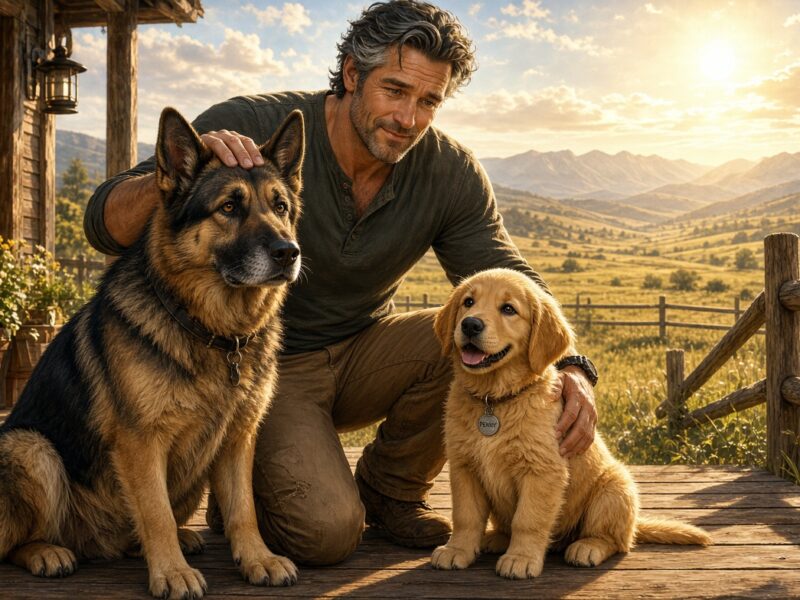
He Had Weeks Left… But the Old War Dog Still Laid Down in Front of the Truck to Keep His Puppy
The German Shepherd stood in the center of the living room and did not move.
Not a step back. Not a step forward.
He simply stood there, all 92 pounds of him, amber eyes locked on the small bundle of golden fur that had just been set on the hardwood three feet away.
The bundle was trembling. Whimpering. Pawing at the floor with the urgent helplessness of something that did not yet understand the world it had been dropped into.
Outside, a Ford pickup ticked as its engine cooled in the gravel drive, and the Wyoming wind leaned against the windows like it wanted to see too.
Rex had not made a sound.
That was what Logan noticed first.
Eleven years of watching that dog work had taught him that silence, in Rex’s language, was never neutral.
It was a sentence.
And right now, Logan Cain could not tell what the sentence said.
Logan was forty-three years old, and he carried himself the way men carry something heavy for so long that it becomes indistinguishable from posture.
He was tall, six-foot-one, with a build that had been constructed through necessity rather than ambition.
Broad shoulders. Forearms marked with the particular density of someone who had worked with his hands in places that did not allow rest.
His hair was dark and close-cut, beginning its turn toward silver at the temples faster than he had expected.
He had long since stopped thinking about it.
His jaw was square and frequently unshaved.
His nose had been broken once in a training accident in Coronado, California, in his third year as a SEAL. Not in combat, which he considered an appropriate irony.
It had healed at a slight angle that gave his face a quality people tried to describe without quite finding the word.
Earned.
His eyes were the feature people noticed last but remembered longest.
A pale, quiet gray-green, they did not move quickly. They settled. They measured.
They had the stillness of eyes that had spent years scanning for what was wrong in an environment before deciding what was right about it.
That habit had not come off with the uniform.
He had served twelve years with Naval Special Warfare Command. Two years at SEAL Team Three. A decade with SEAL Team Six.
Then a shattered knee in the Panjshir Valley, on his fourth deployment, made the decision for him.
Six surgeries.
Fourteen months of physical therapy.
A medical separation he signed without complaint, because the mission does not negotiate with the body’s limitations, and he had always respected that logic, even when it was applied to himself.
He came home to Whitmore, Wyoming, population 4,000, pressed up against the Bighorn foothills.
His grandfather had left him land.
And he could not think of a single reason to go anywhere else.
He did not talk about his deployments.
He worked the land, took contract jobs when the knee allowed it, and kept the company of a dog who understood without being told.
Rex had been a military working dog with a Naval Special Warfare support group.
A German Shepherd certified in explosive detection and patrol, he had deployed alongside SEAL teams on six operations.
Then, in 2019, a vehicle-borne explosive in Kandahar Province compressed two vertebrae in his spine and ended his operational career at four years old.
Logan had been on that operation.
He carried Rex 330 yards to the extraction point with the dog’s blood soaking through his sleeve.
He sat with him through two surgeries at Lackland Air Force Base in San Antonio, Texas.
He started the adoption paperwork before Rex was even cleared for discharge.
The process took eight months and three appeals.
On the morning the final approval came through, Logan read the email twice, closed his laptop, and sat on the edge of his bed in the dark for a long time.
Then he drove to the hardware store in town and bought a brass nail.
He hammered it into the doorframe beside the back door, at exactly the height of his own shoulder.
It was where Rex’s collar would hang.
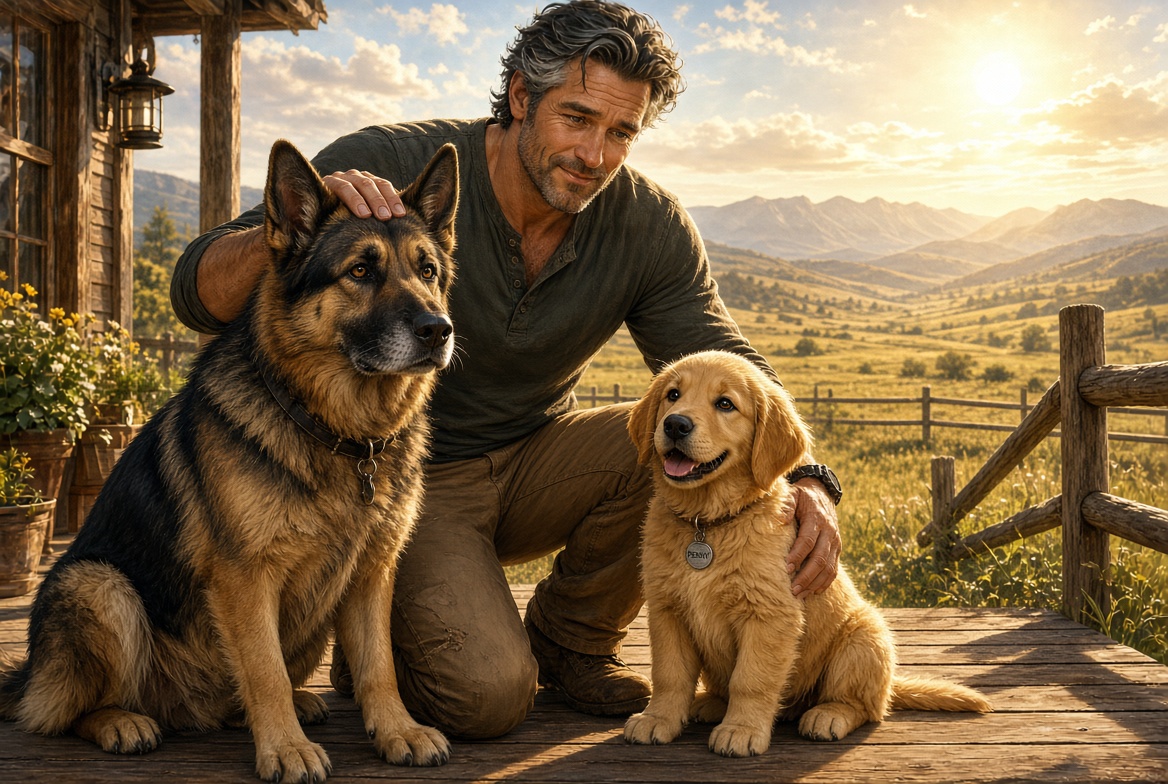
The collar was old leather, dark with years of sweat and weather, the stitching re-done twice by hand.
On it hung a brass tag stamped with four short lines: REX. K9. NSWSG. And a serial number Logan could recite in his sleep.
The tag had a dent in its upper corner.
Kandahar.
Logan had never once tried to hammer it flat.
Rex came home to Whitmore in January of 2020.
He moved through every room with the careful attention of a dog taking a professional inventory.
Then he chose the kitchen as his resting spot. Specifically, the far corner. The one with the most sightlines to the doors.
Logan had not been surprised.
“You picked the same spot I would have,” he told the dog that first night.
Rex had looked at him the way a colleague looks at you when you’ve said something obvious.
That was six years ago.
Rex was eleven now.
He was large for a German Shepherd, with a coat that ran from deep sable along his back and ears through rich amber on his flanks.
His chest was broad enough that strangers in the Walmart parking lot in Sheridan sometimes stopped to stare.
“Is he friendly?” they’d ask.
“He’s professional,” Logan would answer.
Most people took that as a yes.
There was a slight hitch in his right rear stride.
The veterinarians called it a permanent consequence of spinal trauma.
Logan called it a reminder.
Rex appeared to call it nothing at all. He simply moved the way he moved, without apology and without accommodation.
His muzzle had gone silver over the past two years.
Logan watched it happen the way he watched the Wyoming seasons change. Slowly. Unmistakably. With a grief he kept entirely to himself.
Rex still ran the fence line every morning.
He still patrolled the house at night.
He still sat beside Logan in the hours after midnight, when the dreams came back and the ceiling fan turned into a rotor and the dark turned into something else.
He had simply slowed.
The way all things slow that have given everything they have.
Whitmore, in early November, looked the way it always did at the start of the season that mattered most.
Stripped. Stark. Quietly beautiful in the manner of things with nothing left to hide.
The aspens had gone bare.
The grass along Callaway Road had turned the same amber as Rex’s flanks before lying down flat under the first frost.
The mornings ran ten degrees colder than the week before.
The evenings came forty minutes earlier.
Logan’s twelve acres ran from scrub pine to open grassland, with a barn he had rebuilt himself and a two-bedroom house comfortable in the way of houses lived in by one person for a long time.
No excess.
Everything exactly where it was needed.
The kitchen smelled of coffee and wood smoke.
The porch sagged pleasantly on the east corner.
The Bighorn foothills rose against the morning sky, gray-purple and enormous.
One man. One dog. Twelve acres.
The geometry of a life that had found its balance.
And into that geometry, on a Saturday in November, came eleven pounds of chaos.
Her name was Penny.
Eight weeks old. A golden retriever. Eleven pounds of uncoordinated energy and raw physical need.
She had been brought over by his neighbor, Carol Dawes, who ran a small rescue on the property north of Logan’s.
Carol had called three nights earlier.
She had used the tone of someone who already knows she is going to get what she wants and is simply choosing the most efficient route there.
“Logan, it’s Carol. You got a minute?”
“I’ve got a minute.”
“I’ve got a puppy.”
“No.”
“You haven’t heard the rest.”
“I don’t need the rest, Carol.”
“Her mama was surrendered down in Sheridan. Seven pups. Six of them went home in two weeks.”
Logan said nothing.
Carol knew how to use his silences. She’d had three years of practice.
“She’s got a heart murmur,” Carol went on. “Mild. But you put the word ‘cardiac’ on a puppy’s paperwork, and folks walk right past the pen like she’s got a sign around her neck.”
“What’s the actual grade?”
Carol smiled on the other end of the line. He could hear it.
That was the question of a man who was already halfway in.
“Grade two. I took her to a cardiologist in Cody. Paid the $340 out of my own pocket. Prognosis is excellent. She’ll likely outgrow most of it.”
“I’m not a puppy person.”
“I know.”
“Rex isn’t a puppy dog.”
“I know that too.”
“So why me?”
Carol was quiet for a beat.
“Because she needs somebody who will take the time,” she said. “And you’re the only man I know who doesn’t rush anything.”
Logan said nothing for four seconds.
Carol, after three years as his neighbor, recognized that as agreement.
“I’ll bring her Saturday,” she said. “Have coffee on.”
Now, Saturday had come.
Carol stood in the doorway with her truck keys still in her hand, holding her breath.
Penny sat on the kitchen floor in a small, trembling heap.
Rex stood three feet away and did not move.
Logan watched from the doorway, arms crossed, coffee going cold in his right hand.
Rex’s ears were forward and fixed.
His nostrils were working in the rapid intake pattern Logan associated with active threat assessment.
His body was perfectly still. Not the relaxed stillness of an animal at ease, but the loaded stillness of an animal making a decision.
His tail was neither raised nor tucked.
It was held level.
That was the detail Logan watched most carefully.
A raised tail meant aggression. A low tail meant submission.
Level, in Rex’s vocabulary, meant something else entirely.
Level meant he had not yet decided.
“Should I pick her up?” Carol whispered.
“No,” Logan said quietly. “Let him read her.”
“What if he doesn’t like what he reads?”
“Then he’ll tell us. Rex doesn’t bluff.”
Penny looked up at Rex with the uncomplicated directness of a creature that had not yet learned to fear anything.
She took two clumsy steps forward.
Rex’s ears rotated back.
Not aggressively. Precisely.
His nostrils worked harder.
Penny sat down and made a small sound. Not quite a bark, not quite a whimper. Somewhere in between.
She gazed up at the big dog above her with absolute trust, in a situation that had given her no reason at all to extend it.
Rex lowered his head.
It was slow. It was deliberate.
He brought his muzzle all the way down to the level of the small dog and held it there, close enough that Penny could feel the warmth of his breath on her face.
For three seconds, neither dog moved.
Carol’s hand tightened around her keys.
Then Penny sneezed.
Directly into Rex’s face. With the explosive force that only very small animals can manage.
Rex pulled back exactly one inch.
And blinked.
Carol laughed out loud, then slapped a hand over her mouth.
Logan exhaled.
He realized he had not been breathing.
“Well,” Carol said, wiping her eyes. “That’s either the start of a beautiful friendship or a declaration of war.”
“Neither,” Logan said.
“Then what?”
Logan watched Rex turn, walk to his corner with that familiar hitch, and lie down facing the puppy.
“That’s a dog who just got handed an assignment,” he said. “And he hasn’t read the whole file yet.”
Rex did not curl up next to Penny that first night.
He did not play with her.
He did not acknowledge her with any gesture that could reasonably be called affection.
He moved around her with the careful, deliberate attention of someone navigating a space that had changed without his permission.
Then he settled into his corner, the far one, the one with the most sightlines, and watched the small dog sleep in the crate Logan had set beside the wall heater.
His expression could only be described as professional.
He had not accepted her.
But he had not driven her away.
In Rex’s economy, Logan understood, that was a form of decision.
Before he went to bed, Logan reached up and touched the collar hanging on its brass nail by the back door.
He did it without thinking. The way some men touch a doorframe for luck.
The tag swung once and caught the light from the stove.
Below it, in the crate, Penny shifted in her sleep and let out a tiny sigh.
In the corner, Rex lifted his head and watched her until she settled.
What Logan did not yet know, what he would not understand until much later, was that Rex was not deciding whether to accept the puppy.
He was deciding what the puppy needed from him.
Those were not the same question.
And the fact that Rex seemed to understand the difference without being told was something Logan would never quite be able to talk about afterward without his throat tightening in a way that surprised him.
Because by spring, one of them would be gone, and the other would be carrying everything he left behind.
The week that followed was loud.
Penny had not yet learned that the world sometimes required silence.
She approached every waking moment as a problem to be solved with maximum noise and maximum velocity.
She chewed.
She knocked things over.
She discovered the roll of paper towels on Tuesday and redecorated the living room with it by Tuesday afternoon.
“That’s government property,” Logan told her, holding up a shredded strip.
Penny wagged so hard she fell over.
Rex, from his corner, closed his eyes in what Logan could only interpret as disappointment in everyone involved.
She woke Logan at 4:00 in the morning with the breathless, urgent crying of a creature that had never been alone before.
And Logan got up every single time.
He was constitutionally unable to ignore a call for help.
Even from something that weighed eleven pounds and had just chewed clean through the leg of his grandmother’s kitchen chair.
The chair had survived the Dust Bowl, two moves across state lines, and a grease fire in 1971.
It had not survived Penny.
On Wednesday, Carol called to check in.
“How’s my girl?”
“Your girl ate a chair.”
“A whole chair?”
“One leg. She’s pacing herself.”
Carol laughed. “And Rex?”
Logan glanced at the corner.
Rex was lying with his chin on his paws, eyes half open, tracking Penny as she attacked a pine cone she had smuggled in from the porch.
“Rex is watching,” Logan said.
“Watching how? Like he wants to eat her?”
“No.”
“Like he wants her gone?”
Logan considered the question honestly.
“Like he’s taking notes.”
Carol didn’t say anything for a moment.
“Logan, if it’s too much for him, you tell me. I can find her another place. It’d take time, but I can do it.”
“I know you can.”
“I mean it. He’s earned his peace and quiet.”
“I’ll let you know,” Logan said.
He hung up and looked at the brass nail by the door.
The collar hung there, still and silent.
He did not know yet that the question Carol had asked would come back to him. Harder. At the worst possible moment.
On the third night, at 4:17 in the morning, the crying started again.
Logan came out of the bedroom, rubbing his face, and stopped dead in the kitchen doorway.
The crate was open.
He had left the latch undone on purpose, at the veterinarian’s recommendation, to let Penny learn to self-soothe by exploring on her own terms.
Penny was not in the crate.
And the crying had stopped.
He found her in Rex’s corner.
She was curled against Rex’s flank in the compact, specific way that very small animals curl against very large, warm things.
She was silent.
Asleep.
Rex had his chin resting on the floor between his front paws.
His amber eyes were open and tracking the room, the doors, the windows, the dark.
His expression was the expression of a soldier who has accepted a responsibility he never asked for and does not intend to perform halfway.
Rex’s eyes moved to Logan in the doorway.
They held there for a moment.
Then they went back to the room.
The message could not have been clearer if it had been spoken out loud.
I’ve got the watch. Go back to bed.
Logan stood there a long time.
The kitchen clock ticked. The wall heater hummed. Outside, a coyote called once from somewhere up in the pines and was not answered.
Then Logan went back to bed.
He slept better that night than he had in three months.
He did not examine why.
The next morning, he wrote the time on a strip of masking tape and stuck it to the inside of the pantry door.
4:17.
He didn’t know why he did that either.
Only that some moments deserve a record, even when nobody else will ever read it.
The trouble announced itself quietly.
That was the way trouble almost always came, in Logan’s experience.
Not with a declaration. With a small thing that nagged at the edge of awareness until it became impossible to ignore.
The small thing was Rex’s walk.
It was not the old hitch from Kandahar. Logan knew that hitch the way he knew his own gait.
This was something different.
In the second week of December, six weeks after Penny’s arrival, Logan noticed Rex was rising from his corner more slowly than he had the week before.
Not dramatically.
Not enough that a stranger would have seen it.
But Logan was not a stranger to Rex.
And he saw it.
There was a half-second pause now, at the top of the movement, when Rex’s back legs gathered under him.
A half-second where the dog seemed to be negotiating with his own body.
Then he would stand, shake out his coat, and walk on as though nothing had happened.
Logan watched for three days.
On the morning of the fourth day, Rex stopped halfway down the porch steps and stood there, one rear paw lifted slightly, for eleven full seconds.
Logan counted.
Penny bounded back up the steps and pushed her head under Rex’s chin, whining softly.
Rex set the paw down and continued.
Logan went inside and called the clinic.
Dr. Nadia Weller had been practicing in Whitmore for nineteen years.
She had built her clinic on two things: diagnostic precision and honesty that did not flinch.
Rural communities either come to trust a veterinarian like that or they don’t.
Logan had trusted her absolutely since the week he’d brought Rex home.
She was fifty-one. Gray-haired. Direct, in a way he had always found respectful.
She examined Rex with the thorough attention the examination deserved.
She ran the imaging herself.
Then she asked Logan to step into her office, which was a small room with a window that looked out over the parking lot and the grain elevator beyond it, and she closed the door.
Logan had sat in rooms like this before.
Rooms where the door closing was the first part of the message.
“Sit down, Logan.”
“I’ll stand.”
Nadia nodded. She didn’t argue. She never did with him.
She turned her monitor so he could see the images.
“These are his lower vertebrae. L4 and L5. Here’s what they looked like eighteen months ago.”
She clicked.
“Here’s what they look like today.”
Logan didn’t need a veterinary degree to see it.
The spaces between the bones were narrower. The edges looked rougher. Crowded.
“The compression from Kandahar never stopped,” Nadia said. “It’s been slowly progressing for four years. And now there’s new narrowing here and here.”
“Is he in pain?”
“Some. Less than you’d think from these pictures. He’s very good at hiding it.”
“He was trained to.”
“I know.”
Nadia sat on the edge of her desk.
“He’s not in crisis. I want to be clear about that. But the trajectory is clear, and it isn’t going to reverse.”
“Options.”
She gave them to him the way he would have wanted. Plainly. In order.
“Option one is pain management. An anti-inflammatory protocol, a nerve medication, gentle activity modification. That runs about $190 a month. It won’t stop the progression, but it can keep him comfortable for a good while.”
“Option two.”
“Surgery. A decompression procedure. There’s a specialist in Fort Collins, Colorado, who’s the best I know.”
“What does it cost?”
“The estimate she gave me for a dog with his history is $11,800. Could run higher.”
Logan didn’t blink.
“Money isn’t the question, Nadia. What are the odds?”
Nadia held his gaze.
“At his age, with old trauma, with the anesthesia risk? I’d put it at roughly one in three that something goes seriously wrong. On the table or in the weeks after.”
The room got very quiet.
“And if it goes right?”
“If it goes right, he could gain some mobility back. Maybe more time. But the recovery is twelve weeks of strict crate rest. No stairs. No running. No fence line. Twelve weeks, Logan, at the age of eleven.”
Logan looked out the window at the grain elevator.
A pickup was pulling into the lot. A rancher climbed out with a border collie at his heels and walked toward the front door.
Ordinary. Uncomplicated. Another Tuesday.
“How much time?” Logan asked. “Without surgery.”
Nadia looked at him with the directness he trusted her for.
“Well managed, another year. Possibly two. It depends on the rate of progression and how he responds to the anti-inflammatory protocol.”
Logan nodded.
“You don’t have to decide today,” she said gently.
“I know.”
“Take him home. Start the meds. Watch him. Then call me.”
He did not say anything else in the clinic.
He paid.
He lifted Rex carefully into the truck, one arm under the chest and one under the hindquarters, the way he had lifted him in Kandahar.
Rex let him. That alone told Logan more than the images had.
He drove home on the two-lane road that ran along the Callaway Creek drainage.
The winter fields lay flat and pale on both sides.
The Bighorn foothills stood dark against the afternoon sky.
Rex rode in the passenger seat the way he always rode. Chin up. Eyes forward. Alert.
Logan drove without music, the way he always drove.
Nothing outside the truck would have told you anything inside it had changed.
But something had.
When he pulled into the drive, Penny was waiting on the porch where Carol had dropped her off after a visit.
She exploded down the steps and raced to the passenger door, spinning in circles, barking at the window.
Logan opened the door.
Penny jumped, couldn’t quite make it, and fell back into the gravel.
She got up and tried again.
Rex looked down at her.
Then, very slowly, he lowered his head out of the open door until his nose touched hers.
Penny went perfectly still.
Logan stood beside the truck, holding the door, and felt something in his chest come loose that he had kept tied down for a very long time.
That night, Logan sat at the kitchen table long after Penny had gone to sleep in Rex’s corner.
The house was quiet in the way it was always quiet after 10:00. The quiet of a place far enough from everything that the absence of sound becomes its own kind of presence.
On the table in front of him was the surgical estimate.
$11,800.
He had the money. That was never the issue.
The issue was the other number.
One in three.
And behind it, the number nobody had said out loud but that sat in the room anyway.
Twelve weeks in a crate.
Logan did the math the way he had been trained to do math in the field. Coldly, first. Feelings afterward, if there was time.
If Rex had a year left, twelve weeks was a quarter of it.
A quarter of what remained of a life spent running toward things, spent behind a wire door.
And if the surgery went wrong, there would be no year at all.
He looked at the corner.
Rex was awake. Of course he was.
The old dog’s eyes caught the light from the stove and held it, steady and amber.
Penny was sprawled across his front legs like a spilled bag of flour.
“What do you want, buddy?” Logan asked quietly.
Rex didn’t move.
But his gaze shifted, slowly and deliberately, down to the puppy asleep on his legs.
Then back up to Logan.
Logan sat very still.
He had seen that look before.
Not on a dog.
On a man named Danny Hutchins, in a valley eight thousand miles away, who had looked at Logan, then at the wounded kid he was shielding, then back at Logan.
The look that says: I know what I’m spending. Don’t you dare take this away from me.
That was the night Logan understood he was not the only one in the house who had made a choice.
He thought about what Nadia had said.
He thought about what he had watched Rex do over the past six weeks.
He thought about 4:17 and the kitchen doorway.
And he thought about the way Rex moved around Penny now.
Not with the wariness of those first days.
With a careful, deliberate attention Logan recognized, because he had seen it before. In the men he had served with.
The attention of someone who has accepted a responsibility and is carrying it.
Rex knew.
Logan did not know how, exactly. The way one never knows exactly how with things like this.
But Rex knew his time was shortening, and he had decided what to do with what remained.
He was teaching the puppy.
It was not a metaphor.
Logan began to see it with the specificity he brought to any observation that mattered.
Rex walked the fence line in the mornings more slowly now, with more deliberate pauses.
Penny would run ahead, circle back, run ahead again.
Rex watched her with the tracking focus of an instructor on a range.
When Penny came back to him at the south corner gate, Rex would turn toward the house.
And Penny, after a moment of her own assessment, would fall in at his left heel.
Not his right.
His left.
Logan had never taught her that position. He had never taught her any position at all.
She had adopted it from watching Rex.
And Rex had allowed it, with a quality of allowance that was impossible to tell apart from instruction.
When someone came onto the property, a delivery driver, Carol from next door, the county road crew rumbling past on Callaway Road, Rex would position himself between the stranger and the house.
Penny, twelve weeks old and still physically absurd by comparison, would take position at Rex’s left shoulder and sit.
She would look at Rex.
Rex would look at the approaching person.
And when Rex’s body language settled, when his ears went from alert to easy and his weight shifted back off his front legs, Penny’s tension dissolved with it.
She was reading him.
She was learning the language.
One afternoon, a UPS driver named Marcus, who had been delivering to Callaway Road for nine years, stopped at the porch steps and stared.
“Mr. Cain, I’ve been bringing packages to that dog for six years.”
“I know, Marcus.”
“He’s never once let me get closer than this step.”
“I know.”
“Now there’s two of them doing it.”
Marcus set the box down and pointed at Penny, who was sitting at Rex’s shoulder with her chest puffed out and her ears doing their very best impression of a German Shepherd’s.
“That little one’s giving me the exact same look,” Marcus said. “Like she’s running my plates.”
Logan almost smiled.
“She’s in training.”
“Who’s training her?”
Logan looked at Rex.
“Senior instructor,” he said.
Marcus laughed all the way back to his truck.
It was the week before Christmas when everything nearly came apart.
It had snowed four inches overnight, and the county plow came down Callaway Road just after 8:00 in the morning, orange lights spinning, blade throwing a wall of white onto the shoulder.
Logan was in the barn.
He heard the plow before he saw it.
Then he heard something else.
Penny’s bark. High and excited and moving fast.
He came out of the barn at a run, bad knee and all, and saw it happening in a single frozen frame.
The front gate had blown open in the night. The latch had iced and failed.
And Penny, fourteen weeks old and dizzy with joy at the enormous, roaring, glittering thing coming down the road, was sprinting straight for it.
Forty yards to the road.
Thirty.
Logan shouted her name.
She didn’t hear him. Or she didn’t care.
The plow kept coming. The driver, high up in the cab, couldn’t possibly see something that small against all that white.
Twenty yards.
Logan knew, with the cold certainty of a man who had measured distances under worse conditions, that he was not going to make it.
Then a dark shape crossed his vision.
Rex.
The old dog came off the porch in a way Logan had not seen him move in two years.
Not the careful, hitching gait of December. The full, flat, ground-eating stride of the dog who had once cleared compounds in the dark.
He cut the angle the way he had been trained to cut it.
He did not chase Penny. He intercepted her.
He hit the gap between the puppy and the road three strides ahead of her and turned broadside, planting his body across her path like a wall.
Penny crashed into his ribs and tumbled into the snow.
The plow roared past eight feet away, throwing a spray of slush over both of them.
The driver never knew.
For a moment, everything was still.
Penny scrambled up, shaking snow from her ears, looking up at Rex with wide, startled eyes.
Rex lowered his head and pressed his nose hard against the side of her neck.
It was not gentle.
It was a correction. Firm, unmistakable, and instantly understood.
Penny dropped onto her belly in the snow and stayed there.
Then Rex tried to turn back toward the house.
And his back legs gave out.
They simply folded beneath him, and he sat down hard in the snow with a sound Logan had heard only once before.
In Kandahar.
Logan reached him in seconds and dropped to his knees.
“Easy. Easy, buddy. I’ve got you.”
Rex was panting hard. His eyes were clear, but his rear legs trembled.
It took Logan nearly ten minutes to get him back to the house.
Penny walked the whole way pressed against Rex’s left side, her shoulder touching his, exactly where a handler walks beside a working dog.
Nobody had taught her that either.
Nadia came out that afternoon.
She examined Rex on the kitchen floor while Penny watched from under the table, unusually silent.
“He strained the area badly,” Nadia said finally. “Nothing’s broken. Nothing’s ruptured. But he’s going to be very sore for a week, and that kind of exertion takes something out of him he doesn’t get back.”
“How much?”
“I can’t put a number on it, Logan.”
“Try.”
Nadia sighed.
“Weeks. Maybe. Off the far end. I’m sorry.”
After she left, Logan stood on the porch in the cold for a long time.
The gate was fixed now. He’d replaced the latch with a heavy-duty slide bolt from the farm supply store in Buffalo. $34. Should have done it in October.
He’d done the math again.
The math was simple and it was brutal.
Penny had cost Rex weeks.
Maybe she would cost him more. Every bark at a passing truck, every bolt across the yard, every puppy emergency at 4:00 in the morning was something an old dog with a failing spine would answer, because that was who he was.
He would answer until there was nothing left to answer with.
Logan went inside and picked up the phone.
“Carol. It’s Logan.”
“I heard about this morning. Nadia called me. Is he okay?”
“He’s resting.”
A pause.
“You’re calling about Penny,” Carol said quietly.
It wasn’t a question.
“You said if it got to be too much for him, I should tell you.”
“I did say that.”
“I’m telling you.”
Carol was silent for a long time.
“Logan, are you sure? She loves him. Anybody can see that.”
“That’s the problem. She loves him, and he’ll run himself into the ground for her.”
“Maybe that’s his choice.”
“He’s a dog, Carol.”
“So was he in Kandahar.”
Logan closed his eyes.
“Come get her tomorrow morning,” he said. “Please.”
He hung up before she could answer.
He did not sleep that night.
Around 2:00, he got up and walked into the kitchen.
Rex was in his corner, lying on his side, his breathing slow.
Penny was not pressed against his flank the way she usually was.
She was curled against his spine, along the length of his lower back, right over L4 and L5.
Keeping it warm.
Logan stood in the doorway and told himself it was a coincidence.
He almost believed it.
Carol’s truck pulled into the drive at 8:30 the next morning.
She climbed out slowly, like she was walking toward something she did not want to see.
Logan carried Penny out in his arms.
The puppy didn’t struggle. She just kept twisting her head to look back at the house.
At the door.
At the corner of the kitchen she couldn’t see from here.
“Her food’s in the bag,” Logan said. His voice came out flat. “And her toy. The ugly rope one. She likes it.”
“Logan.”
“She’s started to heel on the left. Don’t let anybody change that.”
“Logan, look.”
He turned.
Rex was coming down the porch steps.
It took him a long time. He took them one at a time, back legs stiff, pausing on each step.
Logan had left him lying in the corner. He had left the door only half shut.
Rex had gotten up anyway.
The old dog crossed the gravel without hurrying, the hitch in his stride worse than Logan had ever seen it.
He walked past Logan without looking at him.
He walked to the front of Carol’s truck.
And he lay down.
Directly in front of the bumper. Square in the path of the tires.
He put his chin on his front paws, and he looked at Logan.
And he did not move.
Nobody spoke.
The wind moved through the bare cottonwoods along the creek. Somewhere up the road, a cow called for her calf.
“Well,” Carol said finally, very softly. “I’m not driving over a war hero.”
“Rex,” Logan said. “Up.”
Rex had obeyed that command for eleven years.
He had obeyed it under fire. He had obeyed it bleeding.
He did not obey it now.
He just kept looking at Logan with those steady amber eyes, and the look said everything the night at the kitchen table had said, only louder.
This is mine. You don’t get to take it.
In Logan’s arms, Penny began to whimper.
Then she began to squirm, harder and harder, until he had to set her down or drop her.
She ran to Rex.
She didn’t jump on him. She didn’t play.
She lay down at his left shoulder, pressed against him, chin on her paws.
Exactly the way he was lying.
Two dogs. One old and silver-muzzled and failing. One young and golden and barely bigger than a loaf of bread.
Both of them lying in the gravel in front of Carol’s truck. Both of them looking at Logan.
Carol pressed the back of her hand against her mouth.
Logan stood there with his arms empty.
And for the first time since a valley eight thousand miles away, he did not know what to do.
That afternoon, after Carol had gone home alone, Logan did something he had not done in almost two years.
He called Danny Hutchins.
Hutch picked up on the third ring. In the background, Logan could hear kids yelling and a TV playing a football game.
“Cain? Is somebody dead?”
“Not yet.”
“That’s a hell of a way to say hello, brother.”
Logan told him.
All of it. The puppy. The fence line. The plow. The truck.
Hutch didn’t interrupt. He’d always been good at that.
When Logan finished, there was a long silence on the line.
“You remember the Korengal?” Hutch said.
“I remember.”
“You remember what you told me when Doc wanted to medevac me out before we got the kid clear?”
Logan closed his eyes. He remembered.
“I told him you’d earned the right to finish it.”
“That’s right. And I’d have never forgiven any of you if you’d taken it from me.”
The football game roared in the background. Somebody scored.
“Logan, listen to me. You’re trying to buy that dog more days. I get it. I’d do the same.”
“But.”
“But he doesn’t want more days. He wants the days he’s got to count for something. And he’s already found it. You just tried to ship it off in Carol’s truck.”
Logan didn’t answer.
“Let him finish the job, brother,” Hutch said. “That’s the only thing any of us ever wanted.”
That night, Logan made his choice.
He put the surgical estimate, $11,800 and one in three, into the woodstove and watched the edges curl and blacken.
He called Nadia in the morning and told her: pain management. Full protocol. Whatever it took to keep Rex comfortable.
No surgery. No twelve weeks in a crate.
And Penny stayed.
When he hung up, Logan went into the kitchen and stopped.
The brass nail by the back door was empty.
For a moment his heart lurched.
Then he saw it.
The collar was in Rex’s corner.
It must have fallen when Carol slammed the screen door on her way out the day before. Logan hadn’t noticed.
Rex had.
The old dog had carried it to his corner and laid it on the blanket, right between his front paws and the spot where Penny slept.
And Penny was asleep now, her chin resting on the leather, her small golden nose pressed against the dented brass tag.
REX. K9. NSWSG.
Logan didn’t pick it up.
He didn’t hang it back on the nail.
Some things you leave exactly where they’ve been placed, because you understand that the one who placed them knew more than you did.
Christmas came and went quietly on Callaway Road.
Carol brought over a pecan pie and a bag of venison jerky for the dogs, and she stood in the kitchen doorway watching Penny sleep against Rex’s back.
“I owe you an apology,” Logan said.
“For what?”
“For calling you. For trying to send her back.”
Carol shook her head.
“You were trying to protect him. That’s not something anybody needs to apologize for.”
She was quiet a moment.
“But I’m glad he overruled you.”
“He outranks me,” Logan said. “Always has.”
In January, the anti-inflammatory medication began to help.
Rex moved better in the mornings.
He still rose slowly, but the afternoon stiffness that had worried Logan most began to ease.
Nadia came to the property twice for monitoring visits.
Each time, with the professional restraint she maintained in Logan’s presence, she noted that Rex’s quality of life was good and the protocol was working.
Logan thanked her each time with the same brevity he used for everything.
On the second visit, as she was packing up her bag, she paused at the back door and looked at the empty brass nail.
“You moved his collar?”
“No,” Logan said. “He did.”
He nodded toward the corner, where the old leather lay on the blanket between the two dogs.
Nadia looked for a long moment.
She didn’t ask anything else.
In February, Penny turned five months old and began to look less like an accident and more like a dog.
She was growing into herself. Long-legged. Bright-eyed.
She had the particular golden quality of a young retriever that seemed to carry light in it, even on the grayest Wyoming days.
She played with everything.
She chased the barn cats with a joyful earnestness that the cats had long since learned to manage with dignity.
She learned her name faster than Logan expected and came every single time he called.
He did not take that for granted.
She still slept against Rex every night.
Logan had stopped setting up the crate altogether. In the second week of February, he folded it flat and carried it out to the barn.
It had become a piece of furniture nobody used.
One evening, sitting at the kitchen table with a legal pad, Logan did a calculation he had been avoiding.
Rex had come home in January of 2020.
He had run the fence line every morning since, rain, snow, wind, and the one August when wildfire smoke turned the sky the color of a rusted nail.
Logan counted the years. Then the days.
Roughly 2,190 mornings.
Two thousand, one hundred and ninety times, that dog had walked out into the dark and checked every foot of the perimeter so the man inside could sleep.
Logan sat looking at the number for a long time.
Then he tore the page off the pad, folded it once, and put it in his shirt pocket.
He did not know yet that he would be counting backward soon.
The first morning that Rex did not walk the fence line, Logan knew before he saw it that something had changed.
Rex rose from his corner at the usual time, just after 6:00, as Logan was starting the coffee.
But he did not go to the back door.
He walked to the center of the kitchen, and he sat.
And he looked at Penny.
Something passed between them that Logan, for all his training in reading environments and bodies and signals, could not fully describe.
Except that it looked like a conclusion.
Penny walked to the back door.
She waited.
She looked back at Rex.
Rex did not move.
He held her gaze for a long moment.
Then he lowered his chin to his front paws.
The coffee maker gurgled and hissed. Neither dog looked at it.
Logan set his mug down very carefully.
He walked to the door and opened it.
Penny walked out into the cold February morning.
She went directly to the fence line, and she ran it.
The full perimeter. South corner to north corner to the barn and back.
Logan stood on the porch in his socks in nineteen-degree air and watched her the whole way.
She ran it in the same direction Rex had always run it.
She paused at the same two points. The south gate. The corner near the old galvanized water tank.
The exact two places Rex had always paused, nose up, reading the wind.
Then she came back to the porch, sat at the door, and waited for Logan to let her in.
He let her in.
She went straight to Rex and touched her nose to his.
Then she lay down at his left shoulder.
Logan looked at Rex.
Rex looked back at him with the quiet, complete expression of a dog who has nothing left to communicate, because everything necessary has already been said.
That afternoon, Logan called Nadia.
Nadia came the following morning.
She examined Rex thoroughly, slowly, on the kitchen floor, with Penny watching every movement of her hands.
When she was finished, she sat back on her heels and said what Logan already knew, with the honesty he had always trusted her for.
“It’s accelerated, Logan.”
“How much?”
“The meds are still working. He’s not suffering today. But the window is closing. We’re measuring in weeks now. Not months.”
Logan nodded slowly.
They talked for a long time after that.
Not about the clinical details. Those were settled.
They talked about Rex.
Logan told her about the fence line. About the heel position Penny had adopted without being taught.
He told her about the plow, and the truck, and the collar.
He told her about the morning at 4:17.
He reached into his shirt pocket and unfolded the page with the number on it and slid it across the floor to her.
Nadia read it.
2,190.
She was quiet for a moment. Then she folded the paper and handed it back.
She had spent nineteen years with animals. She had learned that the things that cannot be measured clinically are sometimes the most important things in the room.
“He did his job,” she said.
“Yeah,” Logan said.
“He’s ready.”
Logan looked at Rex.
The old dog was lying near the kitchen wall with Penny pressed against his side. Both of them still.
Rex’s breathing was slow and even and measured.
“Not yet,” Logan said. “But soon.”
Nadia nodded.
She scheduled a follow-up for two weeks out and told him to call before that if anything changed.
She left without pressing the point.
She was wise enough to know that the people who take the most careful care of their animals are also the people who need to come to this moment in their own time.
And they always do.
Those last three weeks were the gentlest of Rex’s life.
Logan carried him out to the porch every afternoon and laid him on a folded wool blanket in the patch of sun on the east side, the side with the sagging corner.
Rex would lie there with his eyes half closed and his nose working, reading the wind off the foothills.
Penny would run the fence line, then come back and lie beside him.
Then, an hour later, she would get up and run it again.
Nobody had told her to do it twice.
Carol came by most evenings. She didn’t stay long. She would sit on the porch steps and rub Rex’s ears and tell him what a good boy he was, and then she’d wipe her eyes and go home.
Hutch called on the second Sunday.
“How’s our guy?”
“Finishing up,” Logan said.
“And the pup?”
Logan looked out the window. Penny was at the south gate, nose up, perfectly still.
“She’s got the watch.”
Hutch didn’t say anything for a while.
“Tell him I said thank you,” he said finally. “For looking after you when we couldn’t.”
Logan didn’t trust his voice. So he just said, “I will.”
That night, he did.
Three weeks after Nadia’s visit, on a Tuesday morning in early March, the sky over Whitmore turned the particular blue that belongs to the tail end of winter.
Cold. High. Impossibly clear.
Logan Cain sat on the kitchen floor with his back against the wall and Rex’s head in his lap.
Nadia Weller arrived at 9:00, exactly as she had said she would.
She knocked softly. She let herself in.
Penny lay along Rex’s back, pressed close.
She did not move.
She had not left his side since the evening before. She had not eaten. She had not run the fence line. For the first time in three weeks, she had let the perimeter go unwatched, because the only thing in the world worth guarding was here.
The old collar lay on the floor beside them, where Logan had set it that morning.
The brass tag caught the light from the window. The dent in its corner threw a small, bent shadow on the floorboards.
Logan rested his hand in the deep fur behind Rex’s ears, the way he had rested it there ten thousand times in eleven years.
Rex’s eyes were open and very still.
They held the particular quiet of the eyes of very old things that have finished with the urgency of the world and rest now in something larger.
“You did good, buddy,” Logan whispered. “You did so good. You can stand down now.”
Rex’s tail moved once against the floor.
Just once.
Nadia worked without speaking.
There was nothing to be said.
Rex went quietly.
He did not resist. He did not struggle. He had never done those things.
He simply let go, the way he had always operated. Without drama. Without waste. Doing the thing that was needed and doing it cleanly.
The kitchen was very quiet.
Outside, a meadowlark sang from the fence post by the south gate, the first one of the year.
Penny stayed pressed against Rex’s back for a long time.
Then she stood up.
She walked to Logan, and she sat at his left side.
And she put her head in his lap.
And she stayed there.
Logan finally let himself cry then. For the first time since Kandahar. Silently, the way men like him do, his hand on one dog’s head and the other on the dog he had carried 330 yards through a war, and in the corner the morning light lay across the empty blanket like something keeping watch.
Six months later, the property on Callaway Road looked the same from the road.
Twelve acres. A barn. The house with the sagging east corner of the porch that Logan kept meaning to repair and somehow never did.
But inside the fence line, things had changed.
They had changed in the particular way things change when something important has happened, and life has continued past it, and grown around it, the way life always grows.
Penny was ten months old now.
Enormous. Uncontainable. All legs and feathered gold.
And she ran the fence line every morning, the way Rex had taught her.
South corner to north corner to the barn and back.
Pausing at the south gate. Pausing at the old water tank.
Returning to sit at Logan’s left side before he opened the door.
In August, at Carol’s insistence, Logan drove Penny to a trainer in Sheridan who specialized in working dogs.
His name was Walt Brennan. He was sixty-two, and he had trained search-and-rescue dogs for three Wyoming counties and two National Parks.
He spent two hours with Penny in a fenced field behind his house while Logan leaned against the truck and watched.
Walt called him the following day.
“Where did she come from?”
“My neighbor’s rescue,” Logan said.
“No. I mean her training.”
“She doesn’t have any.”
Walt laughed, short and disbelieving.
“Mr. Cain, I’ve been doing this for thirty-four years. That dog has working fundamentals I’ve never seen in a dog this young without formal training. Drive. Focus. Heel discipline. She checks a perimeter like she’s been doing it for years. She reads a room.”
Logan said nothing.
“When I brought my own dog into the field, she didn’t greet him,” Walt went on. “She put herself between him and your truck and watched me until I relaxed. Then she relaxed. Who trained her?”
Logan was quiet for a moment.
He looked out the kitchen window at the corner where the blanket used to be.
“A friend,” he said.
“A friend.”
“He took the time.”
He did not explain further.
Walt, to his credit, did not push.
“Well, whoever he was,” Walt said, “he knew exactly what he was doing.”
“Yes,” Logan said. “He always did.”
Walt offered him a spot in his formal training program. Twelve weeks. $2,400. Certification at the end, if Logan wanted it.
Logan declined. Politely, and finally.
Penny’s education was already complete in the ways that mattered most.
And everything else she needed from the world, he was capable of giving her himself.
On the first of October, Logan drove into town to the small Veterans of Foreign Wars hall on Cedar Street.
Each fall, the post held a modest ceremony for the working dogs of the region who had passed that year.
There was a folding table at the front of the room, covered with a flag. On it stood a row of framed photographs.
A border collie who had worked cattle on a ranch outside Kaycee for fourteen years.
A bloodhound from the Johnson County Sheriff’s Office who had found two lost hunters in the Cloud Peak Wilderness.
A black Lab who had been a service dog for a Vietnam veteran in Buffalo, and who had died, the post commander said, only eleven days after the man he served.
Logan brought a photograph of Rex.
It had been taken on the porch the summer before his last winter.
The old dog lay in the afternoon light, muzzle silver, amber eyes clear and composed.
In the background, slightly out of focus, a bright gold shape sat at his left shoulder.
Already in position.
The post commander, a retired Army master sergeant named Ray Delgado, took the frame from him and studied it for a long moment.
“Navy?” Ray asked.
“Naval Special Warfare. Six operations. Kandahar, 2019.”
Ray nodded slowly. He set the photo at the center of the table.
“And the pup in the back?”
“His replacement,” Logan said. Then he corrected himself. “His successor.”
Ray looked at him, and something passed between two men who had both carried things they didn’t talk about.
“You want to stay for the reception, Mr. Cain? We’ve got coffee. Ladies auxiliary brought pie.”
“Thank you. I’ll pass.”
He was not built for receptions.
Ray shook his hand, firmly and a little longer than necessary.
“He’ll be on the wall by Veterans Day,” Ray said. “Right where people will see him.”
Logan nodded once and walked out into the October evening.
Penny was waiting in the truck with her nose pressed against the passenger window.
He drove home on Callaway Road with the Bighorn foothills going purple against the sky.
Penny rode in the passenger seat the way Rex had always ridden.
Chin up. Eyes forward. Alert.
Logan drove without music.
The fields on either side of the road held the last color of the season, amber and gold, before everything went still.
When they got home, Logan did something he had been putting off since March.
He went to the barn and found the old collar, where he had laid it in a cedar box on the workbench the day after Rex died.
He carried it back to the house.
He hung it on the brass nail beside the back door, at the height of his own shoulder.
The tag swung once and caught the light from the stove.
REX. K9. NSWSG.
The dent in the corner threw its small, bent shadow on the wall.
Then Logan unbuckled Penny’s collar, a simple red nylon one Carol had bought her at the farm supply store, and hung it on the same nail.
Right next to Rex’s.
Two collars. One nail.
One old, dark leather and dented brass. One new, bright and unmarked.
Penny sat at his left side and looked up at the nail for a long time.
Then she walked to the corner of the kitchen. The far one. The one with the most sightlines to the doors.
She turned around three times and lay down, chin on her paws, eyes open, watching the room.
Logan stood in the doorway and watched her.
For a moment, in the low light, the shape in the corner was so familiar that his breath caught.
Then Penny’s tail thumped once against the floor, and she was herself again.
And that was right too.
That night, at 4:17 in the morning, Logan woke for no reason he could name.
He lay in the dark and listened.
The house was quiet. The wall heater hummed. Outside, the wind moved down off the foothills and across the frozen grass.
And through the bedroom door, he could hear it.
The soft, steady, unhurried sound of a dog walking the house.
Checking the doors. Checking the windows.
Then the click of nails on the floorboards, and the sigh of a body settling back into the corner.
The watch was being kept.
Logan closed his eyes.
And he slept.
Sometimes miracles do not arrive with thunder or with fire.
Sometimes they arrive limping slightly on a rear leg.
They stay with you for years.
And they do the most important work of their lives quietly, in the corner of a kitchen, in the dark hours before morning, when no one is watching.
God does not always offer us the length of time we would choose.
Sometimes He offers something better.
The chance to use the time we are given in a way that continues past us.
Through the ones we have shaped.
Into days we will never see, but whose goodness we made possible.
Rex Cain carried his duty until it was done.
And then he laid it down.
What he left behind was not grief alone.
It was a dog who knows how to read a room. Run a fence line. Sit at a left heel. Hold a position when the world requires steadiness.
It was a collar on a brass nail, with a smaller one hanging beside it.
It was proof that loyalty does not end.
It passes forward.
Love does not disappear.
It teaches.
And nothing that is truly loved is ever entirely gone.









