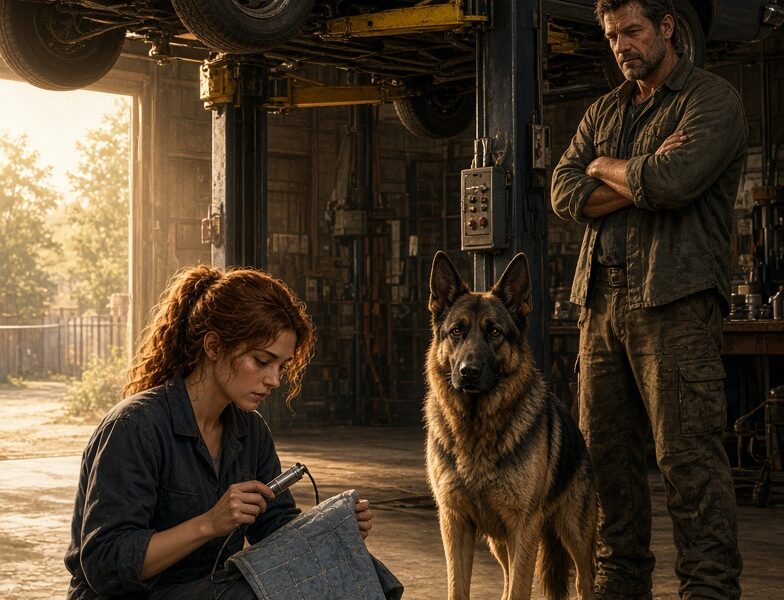
He Found a Woman Asleep Under a Raised Car… Then His Dog Refused to Let Him Lower It
At dawn, a former Navy SEAL found a young woman asleep beneath a station wagon raised high inside his garage.
As he reached to lower it, his German Shepherd blocked the controls and stared at the chassis.
The woman woke holding a vibration sensor beside a faded blue cloth marked with a strange grid.
A falsified warning had once cost the veteran’s teammate his hearing.
He would not ignore another sign.
He locked out the lift, risking a paying bay and a legal deadline to give her two hours to prove the car held something fragile.
Then three hollow knocks sounded above them, and the dog pressed one paw onto the cloth.
At 5:42 on a clear May morning, Evan Cole unlocked Northline Garage and knew something was wrong before the lights came on.
Atlas, his five-year-old German Shepherd, did not trot toward the biscuit jar or shake dew from his sable coat.
He stood rigid at bay three, the small silver-white tuft on his back lifted like a brush, his notched right ear angled toward the floor.
Evan set down his canvas satchel.
At thirty-three, he moved with the economical balance that had survived his years as a Navy SEAL, though the scar through his left eyebrow and the vigilance in his steel-blue eyes remained more visible than the history behind them.
He wore his usual charcoal shirt beneath an open olive field shirt, sleeves rolled over strong forearms.
Nothing about the quiet garage called for the old instincts, yet they arrived anyway.
The 1971 blue-gray station wagon had been sitting on Walt Mercer’s four-post lift since before Evan bought the business.
Its tires rested on two steel runways six feet above the floor.
All four mechanical locks engaged.
Beneath it, on a mechanic’s creeper between the runways, slept a young woman.
A faded blue quilted cloth covered her from shoulder to boots.
Copper auburn curls had escaped a low-braided knot and lay across a freckled cheek.
One hand still held a small sensor.
A gray equipment bag sat zipped beside her head, its cables neatly looped.
She was breathing evenly.
She had not collapsed.
She had chosen the worst possible place in his building to fall asleep.
Evan crossed to the disconnect and locked out the lift before speaking.
“Ma’am, wake up. But don’t stand yet.”
Her light green-hazel eyes opened at once.
She looked not at his hands but at his mouth, then slid off the creeper and sat within the empty center lane.
Two tiny hearing aids curved behind her ears.
“You must be Evan Cole,” she said.
Her voice was rough with exhaustion but steady.
“I’m Harper Vale. I can explain.”
“Explain from outside the lift.”
She obeyed without argument.
That mattered.
Once beyond the yellow line, she produced an old brass key, a probate order, a storage receipt, and a letter in Walt’s slanted handwriting.
She also showed Evan a timestamped video.
1:20 a.m.
The side door opening with the key.
The lift untouched.
Every lock photographed before she went beneath the car.
“I drove from Madison,” she said.
“I meant to document the underbody and wait in my car. I sat down for five minutes. Five hours. That would explain my neck.”
Her dry answer almost softened him.
Almost.
Walt had been dead eleven months, and dead men did not get to authorize visitors in somebody else’s shop.
Evan told her a liquidation truck was due at nine.
The estate had ordered the wagon removed, and he intended to put it on the ground.
The instant his palm neared the control box, Atlas moved.
Claws scraped hard across concrete.
The dog drove one broad shoulder between Evan and the steel column, planted both forepaws, and stared toward the wagon’s rear floor.
For one suspended second, the garage held nothing but the faint tick of cooling metal.
“Atlas, back.”
The dog stepped away from Evan’s leg but refused to leave the column.
He did not bark.
His amber-brown eyes stayed fixed above them.
Harper removed her hearing aids and crouched, placing her palm flat on the concrete.
Evan nearly stopped her, then saw the concentration in her face.
“There,” she whispered.
“A repeating vibration. Very weak. Do you have a compressor on another circuit?”
“Bay one. Automatic tank cycle.”
“Something in that car is answering it.”
Evan disliked conclusions born before measurements.
He disliked lowering unknown equipment more.
Years earlier, he had watched a warning report become cleaner as it passed upward through a chain of command.
He had known the wording was wrong and had not pressed hard enough.
A teammate had come home with permanent hearing loss.
Since then, Evan trusted pauses more than confidence.
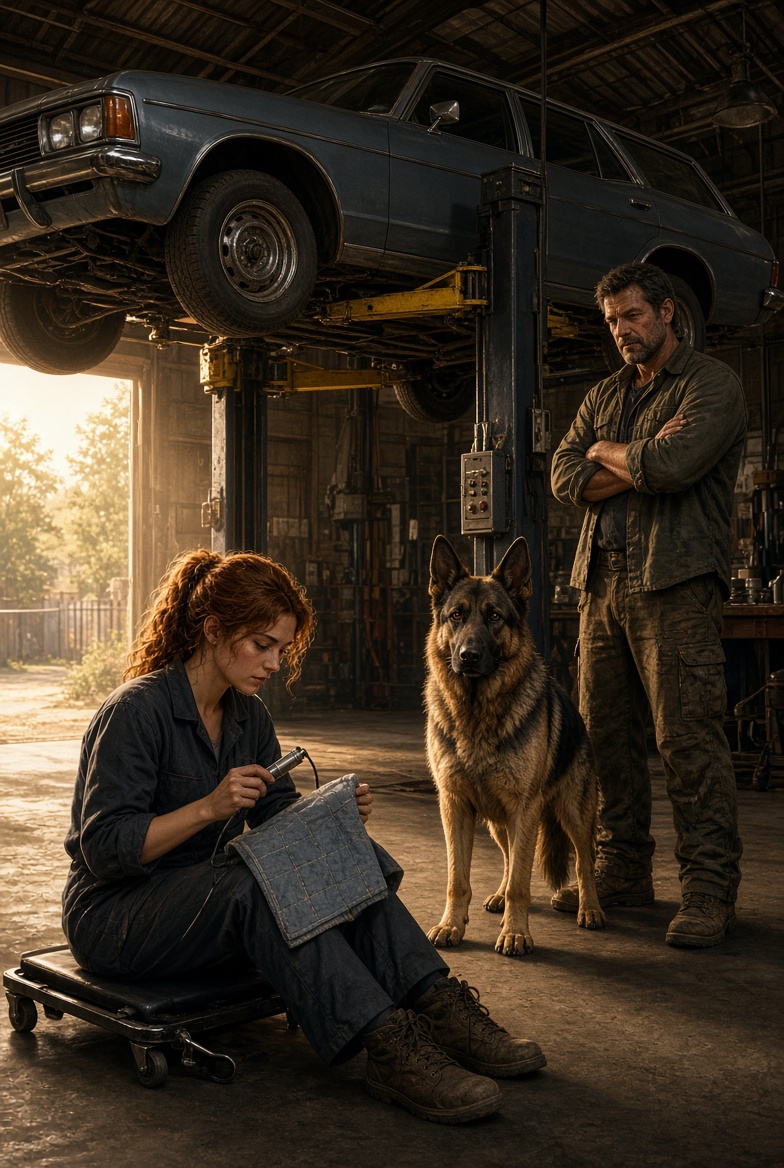
He hung a red lockout tag on the controls.
“Two hours. You show me a preservation risk or a safety risk. Otherwise, the wagon leaves.”
Harper’s shoulders dropped a fraction.
“Two hours is enough to prove there’s a system. Not enough to tell you what it means.”
“Start with what exists.”
By 6:15, the first employee would arrive.
Evan took Harper to the breakroom, set coffee and bread on the table, and brought a clean wool blanket.
He did not ask why she had slept in his garage instead of a motel.
Pride could survive hunger better when nobody named it in public.
Harper studied the food.
“Is this being added to storage fees?”
“No.”
“Does accepting it give you an interest in the car?”
“It gives you toast.”
Only then did she eat.
The speed of the first two bites told him more than an explanation would have.
Back at the lift, she spread the blue cloth across a clean bench.
It was not a blanket at all.
Colored thread formed a measured grid.
Small brass eyelets marked intersections, and faded numbers had been written beside them in grease pencil.
Evan climbed a rolling stair and shone his light under the wagon.
Eight non-factory metal rings ran along the floor pan.
Their spacing matched the cloth.
Harper touched one worn square.
“My grandmother used to put this over my shoulders when I waited in her workshop. I thought it was just the thing she didn’t mind getting dirty.”
Her mouth tightened with a memory she would not display for a stranger.
“She was measuring something.”
Atlas came beside the bench and sniffed once, then ignored the cloth’s old human scent.
When the compressor started in bay one, a low tremor traveled through the slab.
The dog lifted a paw and set it directly on square thirty-one.
Three hollow knocks sounded from beneath the station wagon.
Harper went still.
Evan felt the final knock through his boots.
He called the liquidation company and delayed pickup for two hours, then called Grace Nolan, the estate attorney named on Harper’s papers.
As the line rang, he looked at the woman gathering her instruments with tired, careful hands.
She had not come asking him to rescue her.
She had come to keep something from being destroyed before either of them understood it.
For the first time that morning, Evan wondered whether Walt had known she would.
Grace Nolan answered on the fourth ring and refused to confirm anything until Evan sent photographs of every page.
Forty-three and spare in both dress and speech.
She arrived twenty minutes later wearing a navy coat over court clothes, silver-streaked black hair pinned at her neck.
She read standing beside the lift while Harper adjusted her hearing aids and Atlas watched from outside the yellow line.
“Harper is temporary representative for Miriam Vale’s estate,” Grace said.
“That permits inspection and preservation. It does not permit her to sell an unidentified device separately from the vehicle. You control safety inside this building, Evan. You can remove her from any work zone.”
“Understood,” Harper said before Evan could answer.
Grace looked over her glasses.
“And the liquidation deadline remains unless I can show the court a reason to preserve the property.”
They had ninety-six minutes.
Harper opened her equipment bag and explained her work without turning it into a lecture.
She calibrated assistive devices, systems that translated sound into light, touch, or patterned vibration for people who could not rely on ordinary alarms.
Her own hearing loss had begun in childhood.
She could follow conversation well with her devices and lipreading, but certain low frequencies disappeared into silence.
“You don’t hear the vibration,” Evan said.
“I feel it. Then I measure it. Hearing people confuse those two things more often than you’d think.”
She showed him a photograph of a younger Miriam Vale beside the same wagon.
Miriam had Harper’s freckles and a mechanic’s square posture.
The blue cloth hung beneath the chassis like a surveyor’s map.
Evan fitted two vibration sensors to the lift while Harper entered coordinates from the cloth.
He would not let her crawl underneath again.
When she reached for a fastener, he stopped her.
“No removal until Grace clears it and we have an anti-static plan. The panel is mild steel. The device behind it may not be.”
Her eyes narrowed.
“I do this for a living.”
“And I run this floor. Expertise doesn’t cancel procedure.”
She stepped back.
Her irritation remained visible, but so did her decision to respect the boundary.
Evan appreciated both.
The compressor in bay one kicked on.
Atlas walked slowly along the right runway, stopped beneath the rear quarter, and cocked his head.
A narrow peak rose on Harper’s laptop.
When the compressor stopped, the peak vanished.
Then a sharp metallic hum shivered through the wagon.
Dust jumped from the rocker panel in a silver line.
Atlas retreated one pace and looked at Evan.
Nobody moved.
Harper exhaled.
“Mechanical resonance. The compressor isn’t powering anything. Its vibration is exciting a component at the same frequency.”
Evan traced the underbody with a light.
Several screws holding the floor shield were newer than the car but older than the lift.
Behind one opening lay cloth-wrapped wiring no factory diagram would include.
That was enough for Grace to request a temporary preservation order, but not enough to guarantee it.
Harper’s phone vibrated.
She turned partly away, though the garage made privacy impossible.
“Dad, I found it,” she said.
A man’s voice answered, loud enough to carry.
Weary rather than angry.
“Stop digging up that failure. Sign Malcolm’s offer before the creditors take the choice away.”
Harper’s fingers tightened around the phone.
“We don’t know what he is buying.”
“We know what he is paying.”
After the call, she busied herself coiling a cable twice.
Evan said nothing until she looked at him.
“My grandmother’s care cost more than the house,” she said.
“Dad did most of it. I left my contract for the final seven months. Malcolm Rusk collects transportation technology. His offer clears everything.”
An email arrived while she spoke.
The figure was $240,000.
The conditions transferred the wagon, every notebook and image, and exclusive rights to describe Miriam’s history.
The proposed exhibition title called her invention “a perfected system buried by industry betrayal.”
“He wrote the ending before he saw the machine,” Evan said.
“Maybe he has other records.”
“Maybe he has a story worth $240,000 only if the evidence behaves.”
Harper bristled, then reread the clause.
Hope did not leave her face.
It became more guarded.
“My grandmother spent thirty years being called a fraud. I won’t apologize for wanting someone to have stolen from her.”
“Theft can be proven. Failure just sits there.”
Grace returned from Evan’s office holding Walt’s original storage receipt.
“There’s an addendum.”
Her voice had changed.
Evan recognized the careful tone lawyers used when facts were about to become personal.
She read aloud.
“Do not lower the vehicle from the lift until the bearer of the blue cloth is present.”
The fluorescent fixture above them buzzed once and went dark, leaving the faded wagon cut in half by morning sun from the open door.
Grace turned the receipt over.
“Walter signed this six days before he died.”
Evan remembered that week.
Walt had been in hospice, sometimes lucid, sometimes asking for tools he had sold years earlier.
Evan had sat beside him and promised to keep Northline honest.
He had never heard Harper’s name.
Grace photographed the addendum and called the judge’s clerk.
The vibration data, unusual wiring, and disputed storage instruction earned a forty-eight-hour hold.
It was not ownership.
Not vindication.
Not money.
It was time.
Harper closed her eyes briefly.
“Thank you.”
“Thank the evidence,” Grace said.
“And don’t touch the panel.”
Before leaving, Grace made both of them sign a preservation log.
Harper signed first, pressing hard enough to emboss the sheet beneath.
Evan noticed the tremor in her fingers only after she capped the pen.
She had won forty-eight hours and looked as if time itself had become heavier.
When she left, Evan remained beneath Walt’s handwriting.
The man had given him work when he had nowhere useful to put his hands.
He had also left a locked door inside that gift.
Evan could treat the signature as the last request of the man who saved him, or as one more burden Walt had arranged for someone else to carry.
Either way, the wagon would stay in the air for forty-eight more hours.
Harper laid the blue cloth on a sheet of clean plywood and asked Evan for a ruler, a low-angle lamp, and chalk that would not shed dust.
He supplied all three, then built a waist-high inspection frame beside bay three.
Every removed fastener would go into a numbered tray.
Every tool would be counted before the wagon moved.
“You inventory bolts like evidence,” Harper said.
“Bolts become evidence when somebody later asks who changed what.”
She considered that and wrote her initials on the first tray.
It was the first time she joined one of his procedures instead of merely tolerating it.
Under the slanted light, the cloth changed.
Faint blue and yellow threads formed axes.
Brass eyelets marked fixed points, while handwritten numbers repeated in groups.
63.
125.
250.
“Frequencies,” Harper explained.
“Not dates.”
Dark arcs around the eyelets showed that the cloth had been stretched beneath the wagon many times.
“She covered me with a calibration grid,” Harper said.
“I used to think that was affection.”
“Could be both.”
Her hand paused above the fabric.
“You say things like that often?”
“No.”
“Good. It would damage your reputation.”
With Grace’s written permission, Evan removed the floor shield while Harper filmed from outside the lift.
Behind it lay rows of palm-sized metal housings attached to handmade brackets.
Thin cloth-wrapped leads converged toward the center tunnel.
No coins spilled out.
No jeweled box appeared.
Yet Harper leaned so close to the yellow line that her boot touched it.
“Transducers,” she whispered.
“They turn an electrical signal into physical vibration. Forty-eight of them if the empty mounts continue forward.”
She looked at him.
“Commercial systems used four or six back then.”
Evan felt the particular unease that came when workmanship was too deliberate to be accidental.
Each bracket carried a tiny stamped coordinate matching the cloth.
Whoever had made the array had expected it to be measured, corrected, and measured again.
Atlas wandered toward the opening.
Harper raised one flat hand without thinking.
“Stay.”
The dog stopped instantly.
His rust-red harness shifted as he sat, attentive but relaxed.
Evan had taught him visual commands for noisy shop days, though Atlas routinely ignored gestures from delivery drivers and half the people Evan knew.
“Traitor,” Evan told him.
“My signals are clearer.”
“You’ve known him three hours.”
“Clarity doesn’t require seniority.”
The remark landed somewhere Evan did not want to inspect.
For years, he had mistaken louder instructions and tighter control for safety.
Atlas had obeyed Harper because she had offered one clean request and waited.
At the center of the array, they found a sealed aluminum box no larger than a lunch pail.
Its lead closure bore Miriam Vale’s initials.
Harper asked to open it.
Evan said no until an independent engineer arrived.
The air wrench in bay two cracked against a stubborn lug nut.
The sound rang through the steel building, and every small housing beneath the wagon answered with a faint rippling buzz.
Forty-eight points trembled in sequence above Evan’s head.
Harper went pale.
Not from fear.
Recognition.
She pressed both hands to the inspection frame and waited for the ripple to fade.
“Directional pattern,” she said.
“That wasn’t random. It traveled left to right.”
Evan marked the time and shut down the neighboring airline.
He did not need to understand the design to understand that lowering the wagon without documentation could damage it.
They spent the afternoon photographing mounts.
Harper never crossed the line without asking.
Evan, in return, moved the monitor so she could see every angle and let her direct the sequence.
Cooperation came less like trust than two people placing boards across a stream, one at a time.
During a pause, Harper found a smudged photograph tucked inside her instrument case.
She was eight in it, small and solemn beneath the oversized blue cloth, while Miriam adjusted a sensor nearby.
Harper had drawn a red heart on the white border.
“I thought she kept me there because she liked having me close,” she said.
“Dad said the machine always came first.”
Evan studied Miriam’s bent head.
“A photograph can hold two true things and still leave most of the day outside the frame.”
Harper rubbed the childish heart with her thumb.
“You’re irritatingly careful with conclusions.”
“Occupational hazard.”
She returned the photograph to its sleeve, but not before he saw her mouth steady itself.
The machine was not merely an inheritance.
It was the place where Harper had spent years trying to decide whether she had been loved or merely present.
Near closing, he showed her the breakroom.
A folding cot fit against the far wall.
“You can use this for two nights. One-dollar occupancy agreement. No labor exchanged for lodging, and it doesn’t affect the estate.”
Harper read the one-page agreement twice.
“You drafted this today?”
“Grace did. I supplied the bad coffee.”
“I have thirty-eight dollars until Friday.”
He kept his face neutral so she would not have to defend the number.
“Then keep thirty-seven.”
She signed and placed a dollar on the table.
Later, she recalibrated the garage’s flashing noise alarm because, she said, “A safety system that startled everyone and informed no one was badly designed.”
Evan wrote her a separate work order for the exact amount.
Her expression softened when she saw the distinction.
At dusk, he returned to the lift with a mirror and found lettering on the edge of the removed shield.
Two sets of initials had been scratched side by side.
MV in narrow, careful strokes.
WM cut deeper, by a mechanic’s heavy hand.
Harper stood below him, the blue cloth folded over one arm.
“Walt worked on it.”
“Looks that way.”
“Then why did he never tell us?”
Evan climbed down slowly.
Walt had spoken about engines, baseball, taxes, and the proper way to sharpen a drill bit.
He had spoken about dying with more irritation than fear.
He had never mentioned Miriam Vale.
Evan turned the shield toward the last light.
The initials were not proof of theft or partnership, only proof that two people had stood at the same piece of metal and left their names there.
“I don’t know,” he said.
It was an honest answer.
Harper seemed to hear the cost of it.
Dr. Imani Brooks arrived from Duluth carrying two instrument cases and no patience for legends.
She was a compact Black woman in her late forties with close-cropped hair, bright red glasses, and the habit of becoming quieter when other people became certain.
After reading the preservation log, she inspected the array without touching it.
“Directional tactile warning system,” she said.
“At least that was the intention. A siren approaching from the left should produce a different pattern than one from the right. Braking danger, horn, emergency vehicle, each gets its own pathway through the seat, wheel, or pedals.”
Harper stared up at the wagon.
“In 1986. Ambitious in any year.”
Under camera, Imani broke the lead seal on the aluminum box.
Inside were an analog controller, compact data tapes, calibration cards, and a division of worksheet.
Miriam’s initials filled the columns for signal logic and user response.
Walt’s marked brackets, vibration isolation, and road shielding.
Harper ran a finger above the page without touching it.
“He was her mechanic.”
Evan heard the word “her” or “her partner.”
“We don’t know that exactly.”
Imani looked over her red frames.
“If either of you needs the dead to be saints, leave now. Machines are less considerate.”
The rebuke worked.
They cataloged instead of arguing.
Hours on the sheet showed sustained collaboration.
They did not establish ownership, but they erased the comforting idea that one person had merely watched the other work.
Imani asked Evan to identify the fabrication methods without reading the initials.
He pointed out Walt’s favored three-hole brackets, the rounded weld starts he used after arthritis stiffened his right thumb, and later mounts cut on Northline’s old band saw.
Harper then identified Miriam’s color system.
Yellow for a confirmed response.
Blue for interference.
Red for danger.
Their knowledge did not compete.
It covered different halves of the same object.
At lunch, Harper found a grease mark on her sleeve and remembered waiting on a stool while Miriam tapped patterns against the floor with a rubber mallet.
Her grandmother would ask which foot felt the knock first.
Harper had thought it was a game designed because ordinary conversation tired them both.
Imani suggested it might have been both research and play.
“Does everything have to be two things?” Harper asked.
“Most things involving family are at least three,” Imani said.
Imani located an old tape player compatible with the data reels.
Through static came Miriam’s voice, confident and low.
She described a driver who could receive direction through touch without taking her eyes from the road.
Harper leaned toward the speaker, even though her hearing aids could not clean the damaged recording.
Evan turned on a small transcription display so she would not have to ask.
Miriam laughed at something outside the microphone.
Harper flinched.
The sound was brief and ordinary, but it emptied the room of air.
Harper gripped the bench until the laugh ended, then pretended to adjust a cable.
“I hadn’t heard that since before her stroke,” she said.
Evan wanted to offer comfort and found every prepared phrase insulting.
He simply replayed the ten seconds after she nodded.
Daniel Vale arrived near noon in a faded work jacket, shoulders rounded by years of lifting somebody else’s weight.
At fifty-three, he had Harper’s green-hazel eyes but none of her readiness to challenge a room.
Receipts filled the folder under his arm.
“Mr. Cole, I appreciate the delay,” he said.
“But delay is what we bought with the house, then the retirement account, then the truck.”
He spread nursing bills and tax notices on Evan’s desk.
He explained how classmates had called Miriam’s invention “the magic seat,” how investors disappeared, how his mother answered every question with silence.
Malcolm’s offer could clear the care debt and return what Daniel believed his family had paid for her pride.
Harper said, “We may have proof she was right.”
“And if you prove she was wrong?”
The question hurt because it was not cruel.
Evan watched Harper’s hand close over the edge of the blue cloth.
Malcolm’s contract still waited on Daniel’s phone.
Evan did not tell him what to choose.
He asked only that no equipment leave until Imani completed a safety review.
Daniel agreed to one more day, but his signature looked like a man dividing himself.
After Daniel left, Harper collected bills he had forgotten beneath a chair.
Evan glimpsed ambulance mileage, nighttime nursing, a hospital bed rental, and meals delivered after Miriam could no longer swallow safely.
Harper pressed the folder to her chest.
“He learned every machine that kept her alive,” she said.
“And I act as if he failed her because he wants one machine sold.”
Evan answered that exhaustion could make money feel like the only measurable form of justice.
Harper sat alone in her car for five minutes before returning.
Late that afternoon, they cleaned the next tape.
Miriam counted test conditions.
Dry road.
Wet road.
Engine load.
Exterior temperature.
At the mention of cold, Imani sat straighter.
Static burst from the speaker loud enough to make Atlas rise.
Then Miriam’s voice returned, stripped of confidence.
“At thirty below, left becomes right.”
A violent clang ended the recording.
Harper froze over the transcription.
Evan stopped the player.
The last waveform remained on the screen like a door slammed in darkness.
“Could be a sensor reversal,” Imani said.
“Could be test damage. We do not guess.”
But Harper had already understood what the sentence meant.
A driver trusting the system might turn toward the ambulance she was trying to avoid.
Before locking up, Harper replayed Miriam’s laugh once more, but stopped before the warning.
She wrote the time code on a card and filed it with the evidence.
Evan understood the gesture.
Joy belonged in a truthful record, too, and preserving it did not require hiding what came afterward.
The invention beneath the wagon was no longer simply a treasure somebody had hidden.
It might be the very reason Miriam Vale had hidden herself for so long.
Imani arranged a controlled cold test at a technical college in Duluth.
They removed one documented module, sealed it in a padded case, and drove east beneath a sky so clear the lakes looked cut from metal.
Harper rode beside Evan while Atlas occupied the rear seat, his muzzle between them whenever conversation slowed.
The college chamber was a white insulated room with cables passing through a sealed wall.
Evan built a rigid jig to reproduce the wagon’s mounting angle.
Harper mapped the signals.
Imani operated the chamber and reminded them that hope was not a test variable.
Harper had designed the test matrix herself.
She varied one condition at a time and asked to blind the input so she could not favor the answer she wanted.
Evan watched through the observation glass.
Her hands stayed calm even when results turned against her.
That steadiness was not absence of feeling.
It was the structure she built to keep feeling from changing a measurement.
During a warm-up cycle, a student asked whether the device would make deaf drivers normal.
Harper answered without anger.
“It should make information accessible. Normal isn’t a destination.”
The student apologized, and she showed him how the foot plate carried patterns.
Soon he was helping refine its mounting pressure.
Evan filed away the exchange.
Correction without humiliation.
Firmness without control.
At twenty degrees Fahrenheit, the left and right patterns remained distinct.
At five degrees, the response lagged.
At ten below zero, the left-side input traveled to the right pedal.
Harper reset the instruments.
They repeated the test with a new sensor.
The reversal remained.
She checked Evan’s jig, then her own software, then requested a third run.
“Harper,” Imani said gently, “the result is stable.”
“I need to know whose work failed.”
She inspected the solder beneath magnification.
Evan watched her face change before she spoke.
The joints were Miriam’s, matching the photographs and handwritten process notes.
No later modification had created the error.
The chamber compressor shut off with a deep thump.
In the sudden quiet, frost cracked across the observation window in a branching white line.
Harper lifted her hand from the microscope.
For several seconds, she looked eight years old and entirely alone beneath a blue cloth.
“It was hers,” she said.
She did not ask Imani to soften the finding.
She entered it in the official log herself.
On the drive back, Harper told Evan why she had left her last contract.
Her employer had featured her hearing aids in a promotional campaign about inclusion while excluding her from the final safety review.
When she objected, they called her emotional investment a conflict.
“I don’t mind being part of the story,” she said.
“I mind becoming proof of somebody else’s goodness.”
Evan kept his eyes on the road.
“I once watched a warning report get revised until danger sounded manageable. I knew. I argued once, then accepted the order.”
He told her only what belonged to him.
The distorted alert.
The teammate who lost his hearing.
The years spent imagining that one louder objection might have changed the day.
Harper did not absolve him.
“What did you do afterward?”
“Learn to make stopping easier than proceeding.”
“Then don’t take away my chance to stop this.”
At Northline, Daniel waited with Malcolm Rusk.
Malcolm was a silver-haired man in an immaculate tan coat, pleasant in the practiced way of someone who preferred agreement but had prepared for refusal.
When he heard the test result, his offer did not disappear.
“Arrival could have altered the circuit,” he suggested.
“The public understands betrayal. Technical hesitation is harder to exhibit.”
He raised the offer by $30,000 if the Vales signed a confidentiality clause and permitted his curators to frame the failure as sabotage by an unnamed male collaborator.
Evan saw Harper recoil.
Daniel did not.
His eyes had found the new number.
“That’s the mortgage,” he whispered.
“All of it.”
Malcolm left the contract for review.
He did not threaten anyone.
That made the choice worse.
Harper returned to Miriam’s notebooks and searched until dusk.
On a page dated weeks before the canceled launch, she found the cold reversal circled three times in red.
Beside it, Miriam had written, “Do not demonstrate. Directional error could cause fatal avoidance response.”
Harper sat on the floor rather than trust her knees.
From her folder, she removed the notes she had prepared for a lawsuit against the old manufacturer.
She tore them once, then again.
Evan crouched several feet away.
“You don’t have to destroy your anger tonight.”
“I’m not.”
Her voice shook.
“I’m destroying the argument that required her not to know.”
Daniel picked up one torn piece.
It listed damages Harper had hoped to claim from a company that no longer existed.
“Your grandmother promised we would be all right,” he said.
“Then every winter there was less heat and one more box of parts.”
Harper’s anger rose, then broke against the tiredness in his face.
“I know you paid. I just don’t know how to honor that without selling the part of her that refused to risk somebody else’s life.”
Daniel folded the scrap into a small square.
“Find another way by noon tomorrow.”
It was not forgiveness or agreement.
It was one more day, given by a man who had almost nothing left he believed he could afford.
Atlas settled between them, warm flank touching neither until Harper rested her hand on his harness.
She had wanted theft because theft promised a thief, a payment, and an ending.
Miriam’s choice offered none of those.
It offered only a woman who had seen danger in her own dream and stopped.
She folded the remaining legal notes instead of tearing them.
Daniel watched her place them in a folder marked “questions we asked too early.”
Evan brought coffee.
Nobody called the moment reconciliation.
They simply stayed at the same table after there was no argument left to win.
For the first time, Harper began looking for her grandmother rather than the victory she had built around her.
The notebooks placed Miriam’s decision beyond dispute.
Two days before a public demonstration, she had canceled the event and returned the investors’ advance.
Letters from the company were angry, not triumphant.
They demanded the controller.
Miriam refused to ship it because the safety review was incomplete.
One unsent letter began, “Daniel, someday you may hate me for choosing strangers on a road over the roof above us. I hope you live long enough to understand why I could not sell certainty I did not have.”
The next paragraph was harder.
Miriam admitted pawning her wedding ring to refund a supplier and hiding that from Daniel.
Harper remembered the pale band on her grandmother’s finger and the story that the ring had fallen down a sink.
The lie had been meant to spare a child, yet it left him believing carelessness where there had been sacrifice.
Harper photographed the page but did not send it.
Truth delivered without preparation could be another way of choosing for someone.
Harper read the line twice and closed the notebook.
“He was twelve.”
Evan leaned against the bench.
“Doing the right thing doesn’t erase who pays for it.”
“That’s what people say when they aren’t the child who paid.”
He accepted the blow because it was not truly aimed at him.
While tracing parts invoices, Evan found Walt’s shop codes on purchases made years after Miriam’s canceled launch.
Several had been charged to ordinary customer jobs that never used those components.
Walt had hidden prototype expenses in Northline’s books.
Evan’s first response came before thought.
“I’ll reimburse the estate and correct the accounts.”
Harper looked up.
“Quietly?”
“Completely.”
“Those aren’t the same word.”
He explained that Walt had not enriched himself.
Harper replied that motives did not grant ownership of other people’s money.
“If Miriam had to be remembered with her error intact, Walt did, too.”
“He gave me this place,” Evan said.
“Then maybe he trusted you to tell the truth about it.”
The old airline snapped on in bay one, and a tray of washers danced against the steel bench with a bright, frantic clatter.
Atlas seized his rubber ball and dropped it between them.
Neither moved.
The dog waited, sighed with theatrical disappointment, and carried it away.
Harper laughed first.
It came out wet and unwilling, but it loosened the room.
Evan rubbed a hand across his stubble.
“I was going to protect his name,” he said.
“I know. I was going to protect hers.”
Evan carried the false invoices to his office but could not dial Grace.
On the shelf stood Walt’s dented red thermos.
After Evan left the service, Walt had hired him without asking for war stories.
When nightmares made enclosed rooms impossible, Walt left the bay door cracked through Minnesota winters and pretended it was for exhaust.
Gratitude had grown around Evan’s judgment like rust around a bolt.
Harper appeared at the doorway but did not enter.
“You can love what he did for you and still report what he did to others.”
Evan called Grace.
She asked three precise questions and scheduled an audit.
When the call ended, nothing looked different.
Yet the garage no longer felt wholly inherited.
It felt chosen again, at a price he had not finished calculating.
They apologized without excusing themselves.
Evan agreed to give Grace the invoices.
Harper acknowledged that she had accused Walt of theft before the evidence justified it.
The later notebooks revealed something neither expected.
Miriam and Walt had continued testing until 2001.
New insulators reduced the cold reversal.
Revised brackets separated engine vibration from alerts.
They never drove the system on public roads and never claimed the problem was solved.
Harper traced the dates.
“They kept working after everybody stopped watching.”
“Maybe watching was never the point.”
Grace called just before closing.
The court would not extend preservation again without agreement from the estate or evidence of immediate cultural value.
At noon the next day, the hold would expire.
Malcolm had scheduled a licensed transporter to collect the wagon if Daniel signed.
Harper stared through the office window at the elevated car.
The late northern sun made every scratch in its paint visible.
“One day we can seek an emergency appeal,” Evan said.
“On what money?”
He began calculating what he could sell.
She saw it happen.
“No,” she said.
“You don’t get to bankrupt the garage so I can postpone choosing. I can carry a short closure. That is still you deciding what I should be willing to cost.”
The words stopped him.
He had believed help became pure when the giver demanded nothing.
Harper was showing him that unasked sacrifice could create its own debt.
They worked until darkness, copying records and pricing lawful alternatives.
Sell non-essential period accessories.
License reproductions.
Negotiate care debt.
Preserve the controller.
None produced Malcolm’s money by noon.
Harper drew three columns on a whiteboard.
Money now.
Truth preserved.
Future use.
Every option failed at least one.
They called the hospital and learned a hardship review could pause collection for thirty days, not erase the balance.
They identified accessories whose sale would not dismantle the prototype.
Small measures did not feel heroic.
They did make tomorrow survivable.
When Harper finally went to the breakroom, Atlas followed her to the door, then returned to Evan.
The dog looked from one to the other as if a hallway were a problem only humans could complicate.
Evan switched off the overhead lights one row at a time.
Bay three remained lit.
Through the office glass, he saw Harper asleep at the desk, cheek against crossed arms, the hardship review form beneath one hand.
Evan covered her with the clean wool blanket, not the blue evidence cloth, and left the decision board where she could find it on waking.
Then he sat outside the door with Atlas until dawn, guarding time without pretending it belonged to him.
Evan remained beneath the station wagon.
Forty-eight hours earlier, he had thought the danger was lowering it too soon.
Now the greater danger was simpler.
A beautiful lie could leave his garage at noon, and every person involved had a reasonable reason to let it go.
Daniel returned before ten, carrying Malcolm’s contract and a yellow legal pad filled with figures.
He did not sit until Harper cleared a place beside the blue cloth.
For an hour, he showed them the full cost of Miriam’s final years.
Home equity.
Retirement withdrawals.
Harper’s interrupted contract.
A private loan from Daniel’s foreman.
Each number belonged to a day somebody had stayed beside a bed.
“I don’t want to be the villain because I need money,” he said.
“You’re not,” Harper answered.
“Then stop looking at me like signing means I loved her less.”
Harper lowered her eyes.
Evan saw her fight the instinct to answer with evidence.
Instead, she asked which debt frightened him most.
Daniel pointed to the house.
It was the first useful question either had asked the other in months.
Malcolm arrived at eleven in his tan coat, accompanied by a quiet attorney.
He did not crowd the room.
He reviewed the cold test summary, acknowledged the failure, and restated his offer.
His museum would buy the wagon and originals, digitize selected records, and construct an exhibit around an inventor betrayed by her collaborator and industry.
“You know that isn’t what the records show,” Harper said.
“Records do not speak without curation. Neither do omissions.”
Malcolm spread his hands.
“My offer resolves real harm. Your preferred interpretation creates years of research and no guarantee of income.”
Grace, attending by phone, warned Evan that the old storage addendum might not survive a challenge.
He could claim unpaid storage and delay removal, but Walt’s irregular billing could make that claim misleading.
Evan looked through the office glass at Walt’s lift.
Once he had stayed quiet because a superior had made danger sound manageable.
Using Walt’s paperwork now would be the same silence wearing loyalty’s face.
“I won’t assert a lien until the audit establishes one,” Evan said.
Harper turned sharply.
The decision removed their easiest shield.
It also told her he would not demand truth from Miriam while hiding Walt.
She presented an alternative.
Preserve the controller and notebooks.
Sell period accessories unconnected to the prototype.
License complete digital copies.
Apply for a hardship schedule.
Publish all safety data.
Daniel rubbed both hands over his face.
“Honor does not pay a mortgage.”
“No,” Harper said.
“But a mortgage cannot tell us which lie is affordable.”
At noon, Leyon Park arrived with three members of a regional driving access group.
Leyon was a lean Korean American man in his thirties whose deliberate movements made crowded rooms calmer.
Among the visitors was Ruth Ellis, a retired teacher with white hair and quick hands.
She described giving up driving after failing to hear an ambulance until it filled her mirror.
“I don’t need your grandmother to have been perfect,” Ruth told Harper.
“I need the next device to tell me what it cannot do.”
The garage went quiet, except for a ratchet in bay two.
Harper looked toward the wagon, and some private demand in her face loosened.
Atlas crossed to Ruth.
She asked permission, then gave him Harper’s flat-palmed stay signal.
Despite the pneumatic tools cracking behind him, he sat.
Harper released him with a small sweep of two fingers.
The dog returned to Evan, pleased with the clarity of the transaction.
Evan understood what he had missed.
Communication was not forcing a command through noise.
It was building a language the other person could receive.
He placed a desk key, a list of experts, and written authorization for bay three access in front of Harper.
“These are tools, not instructions. Use them until the deadline. Choose what you choose.”
Her eyes shone, but she did not thank him in a way that created debt.
She simply took the key.
“Understood.”
Daniel uncapped Malcolm’s pen.
The click sounded unnaturally loud.
Harper did not reach for his hand.
“If we refuse, I’ll take my share of the care debt in writing. I will not leave you alone with it. But I won’t sell a story Grandma spent her life refusing to tell.”
The pen hovered over the signature line.
Daniel’s knuckles whitened, then eased.
He set the pen down without signing.
“I said noon,” he told Malcolm.
“I didn’t say yes.”
Malcolm gathered nothing.
“My offer remains until tomorrow morning.”
After he left, Daniel folded the contract into his coat.
He had not joined Harper.
He had only postponed choosing against her.
Ruth remained after the others left.
She told Harper about surrendering her license after an ambulance appeared in her mirror close enough that she saw fear on the driver’s face.
No crash occurred, yet she never drove again.
“Independence isn’t refusing help,” Ruth said.
“It is having enough information to choose what help you accept.”
Harper glanced toward Evan.
The sentence crossed the garage without becoming an accusation.
Malcolm had paused beside the wagon on his way out.
“Museums compete for attention,” he had said.
“Certainty sells tickets.”
Harper answered, “Then sell the courage to stop.”
He did not agree, but he folded his contract instead of leaving another copy like a threat.
Daniel found a crude line of red stitches near one corner of the blue cloth.
Harper recognized her own childhood work.
Miriam had allowed her to mend a tear with a needle too large for her hand.
Daniel remembered protesting.
Harper remembered Miriam saying, “Let her learn where the sharp part is.”
Father and daughter smiled at the same memory, then lost the smile for different reasons.
Their family had not been only debt and silence.
Harper stood by the elevated wagon and pressed both palms to the blue cloth.
Integrity had sounded noble when it belonged to Miriam in an old notebook.
Now it had Daniel’s house attached to it.
For the first time, Harper fully understood that choosing the truth would matter only if she was willing to live with its invoice.
She folded the hardship form into her bag beside the desk key.
One promised burden.
The other offered tools.
Neither promised an easy rescue.
Evan waited until the garage closed before opening Walt’s personal safe.
The combination was the date Northline received its business license, a number Walt had made every apprentice memorize.
Inside were ledgers, letters from Miriam, and a confession that had never been mailed.
Walt admitted charging experimental parts to unrelated jobs.
He listed every amount and wrote that none had gone into his pocket.
The distinction mattered morally but not financially.
He had used other people’s money without consent.
Beneath the confession lay a letter addressed to Evan.
“I chose you because you check what trusted men tell you,” Walt had written.
“If gratitude ever stops you from checking me, then I taught you the wrong thing.”
Evan read the sentence three times.
The red thermos sat on the shelf above him, dented where Walt had dropped it while teaching Evan to rebuild a transmission.
Memories supplied the old man’s laugh so cleanly that Evan looked up.
The shop was silent.
He called Grace and surrendered the documents.
She warned that an audit could freeze Northline’s summer credit line.
Evan accepted the risk and asked her not to tell Harper until he had a plan.
Grace told her anyway, because the project budget affected the estate.
Harper entered the office the next morning with controlled fury.
“You gave me tools and choice, then tried to hide the cost you were taking. It is my garage and our preservation plan. You don’t get to create a sacrifice and send me the receipt after.”
He started to defend himself, then heard the truth inside her wording.
They made a budget together.
Project expenses would be documented and reimbursed if funds arrived.
Personal losses stayed personal.
Harper accepted three evenings of remote calibration work and rented a room above June’s diner rather than continue using Northline’s cot.
“You can stay,” Evan said.
“I know leaving is not rejection. It is me owning where I sleep.”
He carried her equipment upstairs but did not offer to pay the rent.
That afternoon, they reached the final joint test page.
Miriam and Walt had reduced the cold reversal but never eliminated it.
Across the bottom, in two different inks, ran one sentence.
“Do not sell safety when all we can sell is hope.”
Harper made a sound so small Evan nearly missed it.
She sat on the garage floor with the notebook in her lap.
Tears slipped over her freckles, and she wiped them away angrily.
“She used to cover me with that cloth,” Harper said.
“Even when she couldn’t fix the machine, she knew I was cold. I spent years trying to decide which one she loved more.”
Evan sat several feet away.
He did not tell her Miriam had loved her.
The dead were not his to translate.
“I think I wanted the lawsuit because money would prove I mattered more,” Harper said.
“What kind of granddaughter does that make me?”
“One who was eight years old for longer than she realized.”
Her breath broke.
She held out a hand, and only then did Evan take it.
Atlas laid his head across Harper’s boots, then leaned his back against Evan’s knee, distributing his seventy pounds with ridiculous fairness.
Harper laughed through tears.
“The only creature here who understands shared load.”
The phone rang with a shrill pulse that split the tenderness without erasing it.
Imani had found a modern polymer whose response stayed stable in extreme cold.
Testing it required opening one original transducer and replacing its internal suspension.
The change would be documented and partly reversible, but collectors would value an untouched array far more.
Harper looked at the wagon.
Daniel’s mortgage existed.
So did Ruth’s stopped driving.
So did Miriam’s refusal to sell uncertainty.
“If we cut it,” Harper said, “we reduce the only offer that can clear the debt.”
“If we don’t, we preserve an object.”
“You say that like objects don’t matter.”
“They matter. They just don’t get to choose their purpose.”
They placed the question before the family instead of deciding alone.
Preserve all forty-eight units and maximize historical value, or sacrifice one damaged module so the unfinished work could continue.
That night, Harper carried the blue cloth to her rented room but returned it before bed.
It belonged with the evidence now, not around her shoulders.
She used the clean wool blanket Evan had first offered instead.
June Bell, the diner owner, had shown Harper the upstairs room without pity.
Broad-shouldered, sixty, and unimpressed by drama, she named rent low enough to manage but high enough to be real.
When Harper asked whether Evan had arranged it, June snorted.
“He asked if I had a vacancy. You and I arranged the rest.”
The room had yellow curtains, a narrow bed, and a view of the lake between rooftops.
Harper set her hearing aid charger beside the lamp and said it was the first place she had chosen since Miriam became ill.
Evan carried her cases upstairs but stopped at the threshold until invited.
He did not pay the rent or suggest where the desk belonged.
On the back stairs that night, Harper found him waiting only because Atlas refused to leave until her light came on.
She gave the dog a release signal from the landing.
Atlas turned away immediately.
No inspection.
No argument.
No demand that she prove she was safe.
Care had come to her door and stopped there.
Earlier, Evan had walked the bays after learning the audit might freeze his credit.
The compressor needed a valve.
A customer’s minivan waited for parts.
Two employees depended on regular hours.
He disclosed the audit without sharing Harper’s private history and promised written schedules if work changed.
Both chose to stay.
Their trust made his decision heavier rather than heroic.
For the first time, simple warmth did not feel like something she had to earn by surrendering her own future.
She turned off the lamp herself and slept soundly without listening for cautious footsteps in the hallway anymore.
Harper arranged the meeting around the clean bench in bay three.
She gave everyone the same packet.
Three options, their costs, legal risks, likely returns, and what each would destroy.
Daniel, Grace, Imani, Leyon, Malcolm, and Evan received identical information.
No one was asked to trust a private summary.
Daniel read slowly.
“I don’t want history to remember me as the son who sold his mother’s work.”
“I don’t want history to remember you as anything simple,” Harper said.
“You cared for her when I could leave the room. I turned her reputation into a problem because it was easier than looking at what you carried.”
He did not forgive her.
He moved his chair closer.
Grace drafted an agreement dividing both debt and authority.
Harper assumed a defined share of care costs.
Daniel retained a vote.
Neither could sell the technical archive alone.
The paper did not heal them, but it prevented their next argument from deciding ownership by exhaustion.
Malcolm offered to buy the station wagon body after the array was removed, provided his exhibit could still call the system perfected.
Harper refused that clause but did not reject every transaction.
Grace negotiated the sale of duplicate period instruments and licensed annotated digital copies.
Malcolm disliked the conditions.
He also respected a collection with clean provenance.
Evan offered bay three for twelve weeks of testing at documented cost.
Insurance.
Power.
Lost appointments.
Labor.
All appeared as real numbers.
“I can help,” he said.
“But Northline has to survive helping.”
Harper gave him a quiet look of approval.
Months earlier, though it had only been days, he might have offered the whole garage and called the damage generosity.
The family voted on opening one already damaged module.
Daniel voted last.
“Money matters,” he said.
“That’s why I needed it placed on the page instead of treated like shame.”
He marked yes.
Evan removed the module under Imani’s supervision.
As he loosened the mount, Atlas rose from his mat and pressed one paw against the floor beneath the driver’s seat.
A pulse traveled through the concrete, shorter and sharper than the array’s ordinary response.
This time, no one followed the dog as if he possessed an answer.
Evan stopped the work, isolated nearby equipment, and attached a meter.
The pulse came from a protective relay hidden beneath the seat rail.
When he exposed it, sunlight flashed on a stamped date.
Harper inhaled.
The relay had been manufactured three months after Miriam’s last recorded visit.
Walt had continued alone.
For a moment, Evan felt the old reflex to claim the relay as proof Walt had solved the problem, to balance Miriam’s sacrifice with his mentor’s triumph.
Then he noticed the unpolished solder and the handwritten warning tied around the lead.
“Delay unresolved. Do not road test.”
“He didn’t hide a victory,” Evan said.
Harper touched the tag through a protective sleeve.
“He preserved a boundary.”
The compressed air dryer released with a sudden hiss.
Malcolm startled.
Atlas did not.
The dog remained focused on Evan, waiting for instruction.
Evan gave the release signal and watched him return to his mat.
Leyon suggested the relay might point to later data.
Evan searched Walt’s handwritten tool index.
No secret compartment appeared.
There was only a reference to “Diag Cart 2,” an obsolete diagnostic computer gathering dust in storage.
Harper smiled faintly.
“A clue filed under the correct equipment name. Scandalous.”
They powered nothing.
The machine’s old storage media required a specialist.
Evan tagged it for recovery and recorded the chain of custody.
Daniel stood beneath the station wagon with his hands in his pockets.
“All these years, I wanted one person to blame,” he said.
“Then I could send him the bill.”
“I wanted one person to credit,” Harper replied.
“Then I could call us repaid.”
Evan looked from Miriam’s red-circled failure to Walt’s warning tag.
The evidence offered no thief and no solitary genius.
It showed two flawed people carrying an unfinished task as far as they could, then choosing not to sell what they could not make safe.
Before the meeting ended, Daniel admitted he had hidden two bills so Harper could finish a certification exam.
Harper admitted she had paid one supplier by credit card and never told him.
Each had tried to protect the other through secrecy, then resented being alone with the result.
Grace amended their agreement to require monthly statements accessible to both.
When Evan opened the damaged module, Harper photographed every step and asked Daniel to witness the cut line.
Its suspension had hardened into brittle flakes.
“She really kept trying,” Daniel said.
Harper answered, “So did you.”
Neither asked the sentence to do more than it could.
Evan entered both Miriam and Walt in the recovery log with separate contributions.
Miriam created the tactile language and identified the fatal fault.
Walt engineered the mount and documented an incomplete relay.
Accuracy respected them better than vague equal credit.
During the final paperwork, Malcolm surprised them by asking permission to photograph the warning tag.
Harper agreed only after Grace attached the caption.
He read it and said, “Visitors prefer triumph.”
Ruth, still near the doorway, replied that most older people had survived because somebody admitted uncertainty before it became disaster.
Malcolm wrote down her sentence.
Whether he used it was his choice.
Whether the archive preserved the context was theirs.
Daniel asked to hold one brittle suspension fragment.
Imani refused because the material had not been cleared for handling.
He accepted the answer.
A week earlier, he might have heard refusal as another expert taking his family away.
Now he watched the fragment sealed in a labeled pouch and said, “Good. Then nobody has to remember it differently.”
Evan finished the log while Harper checked every serial number.
Their shoulders nearly touched, but neither rushed the closeness.
Trust had become ordinary enough to survive paperwork.
“I thought sharing credit would make her smaller,” Harper said.
“Does it?”
“No. It makes the work large enough that one person didn’t have to become a myth to carry it.”
The treasure in bay three had become less valuable with every honest page they opened.
It had also become more worth finishing.
The data recovery specialist worked from a forensic copy of Walt’s old memory card.
The original remained sealed in Grace’s file box.
What returned was not a confession or a hidden patent, only test tables labeled accurately enough that nobody had thought them mysterious.
Walt’s relay corrected the directional reversal between ten below and ten above zero.
On rough surfaces, however, it waited nearly two seconds before delivering a warning.
At road speed, two seconds could turn information into an obituary.
Evan read the results without disappointment.
Walt had not become a secret genius.
He had become what Miriam had been: a careful person facing the edge of his knowledge.
Imani installed the modern polymer in the damaged module while Evan built a removable mounting jig.
Harper designed the stimulus sequence, including vibration patterns likely to overlap on gravel.
They set the rig in Northline’s fenced rear yard.
It could simulate load but could not propel the wagon.
The first runs passed cold stability.
Left remained left.
Response time stayed within the proposed threshold.
Leyon began to smile.
Then Harper stopped the sequence.
“Again at seventy percent intensity,” she said.
Evan wanted one clean result after weeks of uncertainty.
“The instruments show separation.”
“My body doesn’t.”
At reduced intensity, the emergency pattern and hard-braking pattern overlapped enough to produce sensory confusion.
Imani confirmed it after two blinded runs.
Harper reached for the emergency stop.
Leyon asked for one more test.
Even Evan said, “We have the setup.”
She looked at both men.
“Then it will still be here after we understand why.”
Her hand came down.
The rig wound into silence.
There was no applause and no accusation of failure.
Imani wrote “stopped by operator: ambiguous user response” across the log and signed beneath Harper’s name.
The act was small to Harper.
It repaired something no success could have repaired.
This time, a woman stopped an unsafe test, and everyone treated the stop as work.
A delivery truck arrived early.
The driver opened the yard gate despite the red “TEST CLOSED” sign.
The latch struck its post with a metallic snap.
Atlas sprang from his mat, raced to the lane, and planted himself broadside before the truck.
One bark cracked through the yard.
Evan hit the emergency cutoff while Leyon waved the driver back.
The rig stopped before its lateral arm crossed the lane.
No one was hurt.
Atlas returned at Evan’s signal, tail low but steady.
Evan knelt to check his paws, then looked at the open gate.
The dog had not understood the test.
He had recognized two movements converging where they should not.
That was enough to change a human decision.
They added an electrical interlock tying the rig to the gate.
Harper added a visual indicator and a vibration alert for the operator.
“Safety,” she said, “was rarely one brilliant device. It was several imperfect warnings, refusing to depend on the same sense.”
That evening, they reviewed the corrected run.
The polymer approach qualified for a restricted development application, not road approval.
The application required complete publication of the original prototype’s faults, including Miriam’s directional reversal and Walt’s delayed relay.
Harper held the final report above the signature line.
Her grandmother’s name appeared on every failure table.
“If I sign this,” she said, “anyone searching her will see what went wrong before they see why she stopped.”
“Yes,” Imani said.
“And if you don’t,” Evan added, “somebody may repeat it without knowing.”
Harper set down the pen.
“One night. Not to change the report. To tell my father before strangers read it.”
Nobody pushed her.
They covered the rig and shut the yard.
On the walk to her room, Evan did not offer an answer.
Atlas moved between them, choosing every puddle.
Harper laughed once when the dog splashed Evan’s boots.
“A good design doesn’t make a person need nobody,” she said.
“It admits what they cannot receive and offers another path.”
Evan thought of keys, budgets, boundaries, and the cut she had chosen to leave.
“So does good help.”
At June’s stairway, Harper faced him.
“You’re learning slowly.”
“Slow can be safe.”
Ruth had participated in the test as a user consultant, not an inspirational guest.
She identified two patterns that felt distinct through Evan’s boots but nearly identical through her softer shoes.
Harper changed the pad density and documented it.
Laboratory clarity, Evan learned, was not the same as information reaching a real body.
During a reset, Daniel tapped twice against the yard rail.
He told Harper that Miriam used the same rhythm after kitchen arguments when both were too proud to speak.
It meant “still here.”
Harper tapped twice in reply.
The exchange lasted one second and carried thirty years.
Imani showed Harper the public database where the failure report would remain searchable.
Other abandoned projects appeared there.
Many stopped responsibly but were remembered as empty promises because nobody recorded why.
Publishing Miriam’s fault might wound her reputation for a season.
Hiding it could erase the bravest thing she had done.
Harper opened Miriam’s unsent letter on her laptop and placed it beside the fault table.
One document recorded what the circuit did.
The other recorded why a mother accepted poverty rather than gamble with strangers.
Neither was complete alone.
Harper began drafting a plain-language summary so families, not only engineers, could understand the choice.
Evan reviewed only the mechanical terms.
He resisted improving her conclusion.
The restraint felt awkward, like setting down a wrench before a bolt was tight.
But this was not his sentence to finish.
She went upstairs carrying the report.
Evan walked back to Northline with Atlas and understood that the next signature belonged to Harper alone.
At the garage, he marked the test incomplete, left her signature line blank, and set the pen beside it.
Harper would find the document without a folded corner, penciled suggestion, or helpful conclusion waiting to become pressure.
Standing quietly near her right now was not the same as holding her hand down on the page.
Harper read the report to Daniel in Northline’s office the next morning.
She did not begin with the invention’s promise.
She began with the cold reversal, the delayed relay, and the sensory overlap.
Daniel listened with his coat still buttoned, as if he might leave before the words settled.
“Will people laugh at her again?” he asked.
“Some might.”
Harper kept her hands open on the desk.
“But the record will show she found the fault and refused to pass it to a driver. Failure wasn’t what ruined her. Silence around the failure did.”
Daniel looked through the window at the wagon.
“Put in what it cost us. The technical report. Not as an excuse. As part of the history. She protected strangers, and her son still lost his heat some winters. Both happened.”
Harper added a contextual statement describing the returned investment, the family debt, and the unpaid labor.
Daniel signed consent beneath it.
His hand shook, but not from uncertainty.
Harper signed next.
No music rose.
A printer began feeding pages with ordinary mechanical clicks.
Yet Evan, waiting behind the yellow line rather than at Harper’s shoulder, saw her close her eyes at the first sheet.
The story she had carried for years had ended.
Her relationship with Miriam had not.
Evan submitted Walt’s ledgers to the audit.
Northline’s bank reduced its credit line but accepted a repayment plan because he had disclosed the problem before a claim.
To cover the immediate gap, he sold the half-restored motorcycle he had kept under canvas for three years.
Harper found the empty space.
“You loved that bike.”
“I loved planning to finish it. That’s not the same.”
“I’m starting to notice.”
He did not accept money from her.
He also did not pretend the sale cost nothing.
Malcolm withdrew the $240,000 offer.
After two days of negotiation, he purchased duplicate instruments and period-correct accessories at a fair appraisal.
His museum funded non-exclusive digitization and received the right to display annotated copies.
Grace made the annotation requirement impossible to hide in fine print.
An assistive technology institute offered a one-year fee for access to the modified module and test data.
The payment cleared part of the care debt.
The remainder went onto a schedule shared by Daniel and Harper.
Daniel read the balance aloud at the meeting.
It was still large.
Saying it did not destroy him.
“I kept thinking debt meant I failed to provide,” he said.
Harper reached across the table.
“It means care cost more than we had.”
He took her hand, not as forgiveness completed, but as work begun.
Evan presented Harper with a formal key and a twelve-week bay rental agreement.
She checked the rate, insurance, and cancellation clause before signing.
When she looked up, amusement had returned to her face.
“You charged me for electricity.”
“You calibrate equipment for a living. You know electricity exists.”
“Romance is alive in northern Minnesota.”
The word hung between them.
Evan felt heat rise under his collar.
Harper smiled but did not rescue him from it.
Her phone flashed with an email.
She read it once, then again.
The Duluth Institute had offered her leadership of the continuing test program, full benefits, and a salary that would let her carry her share of the debt.
The position began after the wagon was lowered the next morning.
Atlas bumped her knee, expecting the smile to mean play.
Harper scratched behind his notched ear.
“This is good,” Evan said.
“It is.”
He congratulated her too quickly.
She heard what he omitted but did not force it into the room.
That evening, Evan stood alone beneath the raised wagon.
He wanted to ask Harper to remain in Bayfield.
But if he tied the request to the room he had offered, the project they shared, or the help he had given, affection would become another contract written by the person with the keys.
Atlas lay on the spot where Harper had once slept and watched him.
“I know,” Evan said.
“Clear signal.”
Before Harper signed, Daniel produced a photograph of Miriam asleep in a kitchen chair with a soldering manual in her lap.
“I kept it because it made me angry,” he said.
On the back, Miriam had written, “Ask Harper if page 214 solves the footplate lag.”
Daniel sat down.
The work he thought had displaced the family had carried Harper’s name inside it.
Harper pressed the photograph to her lips, then returned it.
It belonged to him too.
They calculated the remaining debt together.
Harper’s new salary could cover more, but Daniel refused to transfer the whole burden.
“Shared is not transferred,” he said, repeating Grace’s language.
They entered the first payment dates into their calendars.
Healing looked less like a tearful promise than two reminders set for the same morning.
Evan sat beside Atlas and remembered Harper asking whether toast gave him an interest in the car.
He understood now.
Too many kindnesses in her life had arrived with clauses.
If he wanted something personal, he needed to make refusal safe.
He wrote “Friday dinner. No project” on a sticky note.
Atlas sniffed it, found no food, and lowered his head.
Across the bay, Harper packed her instruments for Duluth.
She left the desk key on the bench, then reconsidered and slipped it onto her ring beside the key to her own apartment.
Evan saw the choice and said nothing.
She was not staying because she lacked somewhere else to go.
She was choosing a connection that could be unlocked from either side.
When Harper passed him, she noticed the sticky note visible in his pocket.
“Friday, if you want.”
“I do.”
The answer was small enough to be free.
Evan felt no need to enlarge it with promises.
Atlas thumped his tail once against the concrete, satisfied by a decision that required no command.
He would ask for dinner, not a life.
She could answer without owing him for breakfast, shelter, or time.
For once, restraint did not feel like fear.
It felt like leaving a door wide enough for another person’s choice.
Nearly six weeks after Evan found Harper beneath the wagon, bay three filled with morning light.
He inspected all four lift locks, cleared the floor, and required everyone to stand beyond the yellow line.
Harper waited with the blue calibration cloth folded across her arms.
Atlas sat beside her at a flat-palm signal.
Evan released the locks in sequence.
The lift descended with a measured hydraulic hum.
The station wagon’s tires touched concrete one by one, carrying the weight they had avoided for seventeen years.
Nothing miraculous happened.
The engine still needed rebuilding.
The estate still owed money.
The redesigned alert system had permission for controlled development, not public roads.
Yet when the lift stopped, nobody had sold a lie to reach the ground.
Harper walked to the car only after Evan removed the lockout tag.
She rested one hand on its faded roof.
“Grandma used to say a machine told the truth if you listened long enough.”
“Machines usually have help hiding it,” Evan said.
“So do families.”
Daniel arrived carrying gas station pastries in a cardboard box.
He apologized twice for not buying from a bakery.
Harper opened the box and chose the crushed bear claw.
“We’re trying to stop turning every small thing into a verdict on whether we cared enough,” she said.
Daniel nodded.
Together, they spread the blue cloth over the rear seat for transport.
For the first time, it was neither a blanket hiding exhaustion nor a legend hiding failure.
It was a tool returned to its purpose.
Harper told Evan she had accepted the Duluth job on terms she negotiated.
Three days at the institute.
Two days running field tests at Northline.
She had leased a small apartment on Lake Street.
The decision was complete before she offered it to him, and that made his happiness cleaner.
“Friday dinner,” he said.
“Not a project meeting. Not repayment. No room key included.”
Harper pretended to consider.
“Is Atlas invited?”
“He decided this in chapter one.”
She laughed.
“Then yes.”
Evan did not kiss her beside the lift as if one brave choice entitled him to another.
He touched her hand, and she turned her palm upward.
Six months later, snow pressed white against Northline’s windows while Ruth Ellis sat in a modern sedan inside bay three.
The new tactile alert system had passed independent reviews for a limited pilot.
Harper supervised calibration.
Leyon taught Ruth the patterns.
Evan completed the mechanical installation and made her repeat every limitation back to him before signing.
An ambulance signal from the test unit produced three pulses under Ruth’s left foot.
She identified the direction without looking away from the simulated road display.
“Again,” she said, smiling.
They ran it again.
Success arrived not as applause but as repetition, producing the same safe result.
Daniel managed the project archive two afternoons a month.
He had learned to scan Miriam’s notebooks without correcting her spelling or removing the pages that showed failure.
Malcolm’s museum opened a small exhibit titled “Two People Who Knew When to Stop.”
Walt and Miriam received equal credit, along with a full description of the family’s cost.
Northline had not become rich.
The institute contract stabilized bay three.
The reduced credit line still pinched, and Evan sometimes missed the motorcycle.
Harper’s debt payment left little room for luxuries.
Their Friday dinners alternated between June’s specials and sandwiches on the garage steps.
That evening, Atlas stretched on a padded mat exactly where Harper had once slept.
The station wagon now rested on the floor beside him.
Harper draped a clean shop cloth over his back, and he accepted it with the grave patience of a dog tolerating human ceremony.
The original blue calibration cloth hung in a sealed display case.
Beneath it was one sentence chosen by Harper and Daniel together.
“An honest design begins by recording where it failed.”
The bay door rolled upward.
Cold sunset poured across the concrete in a band of gold.
Evan watched Harper hand Ruth the keys to her adapted car, then step back so the older woman could decide when to drive.
He understood what had happened on that first morning.
He had not saved Harper with money or solved her life by offering shelter.
He had stopped the lift long enough for her to preserve a choice.
She had done the harder work herself, and in doing it had taught him that protection without freedom was only a softer kind of control.
Harper joined him at the open door.
Atlas settled between them, silver-touched bright in the last light.
“Cold,” Evan said.
“Observant.”
He offered his hand.
She took it because she wanted to, not because either of them owed the other a future.
When the wagon first reached the floor, Daniel stood at the opposite fender.
Harper offered him its key.
He closed her fingers around it.
“You came for this?”
“We came,” she corrected.
Before opening the driver’s door, he asked permission.
That small request did more than any apology to show the rules between them had changed.
Evan and Harper’s relationship grew without dramatic declarations.
She learned he went silent when afraid of asking too much.
He learned she joked when she needed another second to read a room.
They argued about schedules, apologized without gifts, and kept separate homes.
On difficult evenings, Atlas chose whichever doorstep had been quiet too long.
Ruth’s first independent trip was only to the grocery store and back, with Leyon following at a distance.
She returned holding a carton of eggs.
“None broken,” she announced.
Everyone laughed.
Then Ruth cried.
Harper cried with her.
The miracle was not speed or distance.
It was choosing her own groceries on a winter afternoon.
Behind them stood a flawed machine, two truthful names, and a garage that had learned to make room for unfinished work.
Ahead of them, Ruth’s new warning system pulsed once beneath her feet, and she drove safely into the northern evening.
Evan closed the bay after her taillights disappeared.
Harper helped pull the chain, their hands spaced apart on the same work.
Atlas waited inside.
When the latch settled, the three remained in the warm shop light.
Not rescued from ordinary life.
Finally free to live it honestly.
At dawn, a former Navy SEAL found a young woman asleep beneath a station wagon raised high inside his garage.
His German Shepherd blocked the controls.
The woman woke holding a vibration sensor and a blue cloth marked with a grid.
A falsified warning had once cost the veteran’s teammate his hearing, and he would not ignore another sign.
He gave her two hours.
Those two hours became weeks.
The weeks became a choice.
And the choice became a life that none of them had planned but all of them had earned.









