He Found a Woman and Her German Shepherd Adrift at Sea — The Strap on the Dog’s Harness Changed Everything
Three weak barks broke across the silver sea, then vanished beneath the wind.
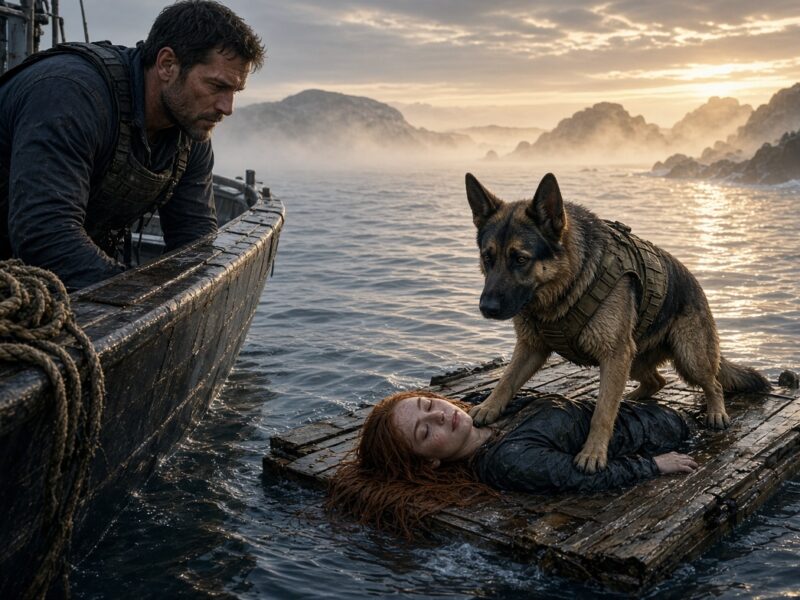
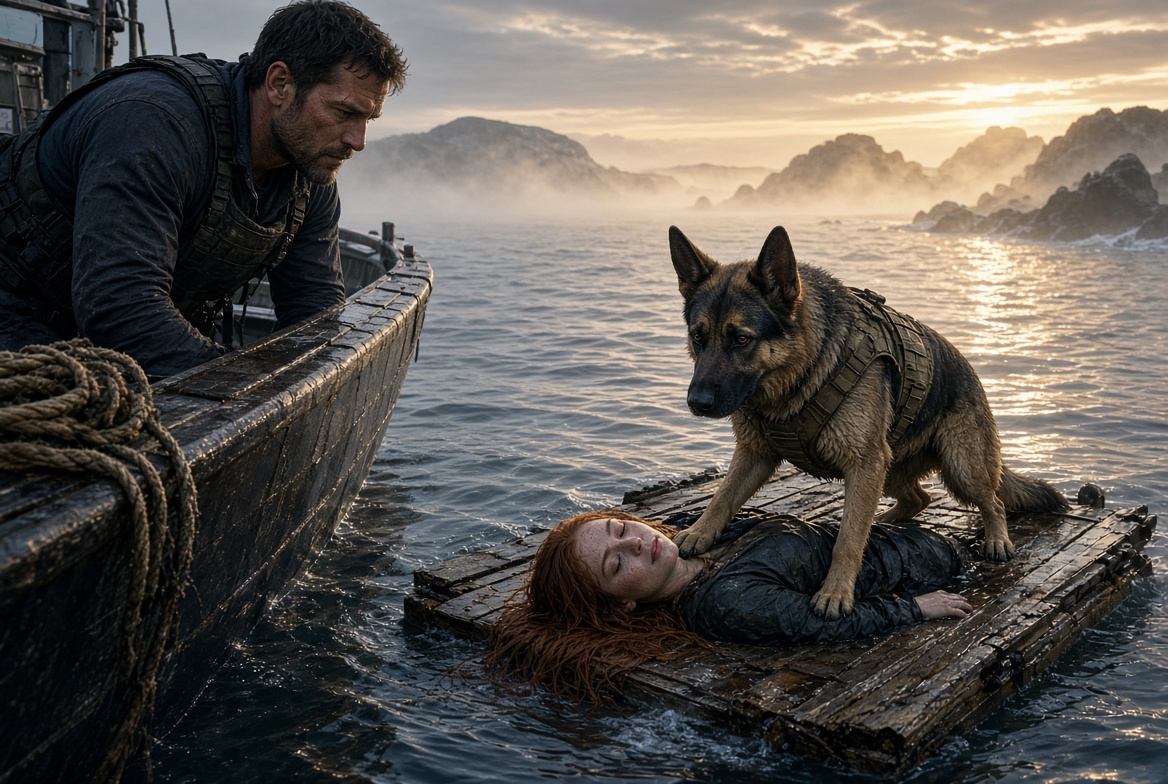
A former Navy SEAL turned his boat and found a young reporter barely breathing on a rotting hatch cover.
Her German Shepherd stood over her, salt-burned and trembling after two days of drift.
Caught in his harness was a severed orange strap stained with unfamiliar blue-green paint.
Then a rescue boat approached, and one broken note from its engine made the dog recoil while the woman lay silent.
Someone began building a story that made her look guilty.
The sea looked innocent in morning light.
That was what Callum Reed distrusted most about it.
After twelve hours of searching empty water east of Port Mercy, the Atlantic had polished itself blue.
Callum stood behind the wheel of the Mercy Bell, his forty-two-foot salvage boat.
At thirty-eight, he was broad-shouldered and wind-browned, with dark hair, a graying short beard, and a thin scar across his left eyebrow.
He had spent sixteen years as a Navy SEAL, much of it in maritime operations, before leaving the service three years earlier.
His deeper wound came from losing his younger sister before rescuers reached her.
Since then, he measured distance in minutes.
The arithmetic never ended.
The false distress signal had repeated from the same coordinates until dawn.
Three Coast Guard vessels and two civilian boats had found no oil, wreckage, or floating cushion.
Fog now forced Callum home along a northern route beside low granite islands.
His fuel sat below one quarter, and his eyes burned, but he kept watching.
The ocean punished anyone who believed he had already seen everything.
Something dark lifted against the silver edge of the water.
Callum leaned toward the windshield.
The shape vanished behind a swell, returned, and seemed to stand upright for half a second.
He pulled the throttle back.
The Mercy Bell settled heavily into the trough.
Then came three barks, thin with distance but unmistakable.
The sound cut through the engine and gull cries.
After it came a silence so complete Callum heard blood moving in his ears.
He turned north through binoculars.
The shape became a dog balanced on a broken hatch cover.
The male German Shepherd was perhaps four, with a strong working build diminished by exhaustion.
His sable coat lay salt-flat black across the back and warm gold along the legs.
A black mask framed intelligent brown eyes, and a pale gold crescent marked the fur above his right eye.
He wore a coyote-brown harness and dark collar.
Beneath him lay a woman.
Callum radioed his position, reporting two possible survivors.
An air ambulance launched from shore.
He approached downwind.
The panel was an insulated hatch cover, its wooden skin split while the sealed core kept it afloat.
One of the woman’s wrists was tied to a reinforced corner with a harness strap.
Her other arm curved around the dog, as if she had feared the sea might take him first.
The dog rose when the Mercy Bell came close.
His legs shook.
A desperate growl began in his chest.
“I see her,” Callum said quietly. “And I see you.”
The dog stared at him.
Callum shut the propeller, pulled on an exposure suit, clipped a safety line to the rail, and entered through the side gate with a flotation sling.
Up close, the woman appeared about thirty, tall and athletic beneath soaked clothes.
Copper-red hair clung to pale skin.
She had a heart-shaped face, high cheekbones, a soft jaw, and lips cracked by salt.
There were no obvious severe wounds, only the stillness of someone whose body had spent everything it possessed.
The German Shepherd caught Callum’s sleeve.
He did not bite down.
He held the fabric and looked from Callum to the woman.
“I’m not taking you away from her,” Callum said.
He slipped the sling beneath her shoulders.
“I’m taking both of you home.”
He cut her strap only after securing her to himself.
As the hatch rolled, the dog slipped beneath the surface.
Callum caught his harness and pulled him against the sling.
The animal found the woman’s sleeve and held it until all three reached the ladder.
On deck, Callum worked from Navy trauma training rather than hope.
Her pulse was faint, and her breathing shallow.
He removed wet outer layers, protected her from wind, and began controlled warming while relaying her condition.
The dog collapsed beside her.
When Callum shifted him to reach her arm, he pressed his muzzle to her fingers and refused to move farther.
“Stay there, then,” Callum whispered.
A helicopter arrived as a bright moving spark above the eastern islands.
Its rotors beat the quiet morning apart.
The dog flinched but did not leave the woman.
Only when Callum leaned close and said, “I’ve got her now,” did his teeth release her sleeve.
The flight medic found identification sealed inside her inner pocket.
Mara Voss, thirty, with a press credential naming her as a trainee reporter for the North Coast Ledger.
Callum looked at the hands that had tied herself to failing wood without abandoning the dog.
Whatever happened aboard the Sea Lark, she had fought until nothing remained.
As the medical crew prepared to lift her, a strip of orange nylon caught against the buckle of the dog’s harness.
It was not part of the harness.
The severed end was clean, and one side bore a smear of unusual blue-green primer.
Callum left it in place and pointed it out to the Coast Guard officer boarding from the helicopter.
The officer photographed it but decided not to remove anything until the dog could be examined safely.
A sleek rescue launch approached from the south.
Silas Vale stood beneath its canopy, silver-haired, straight-backed, and immaculate in a navy windbreaker.
At fifty-one, he had the composed face Port Mercy knew from charity dinners and televised rescues.
He raised one hand and ordered his crew to stand by.
The launch’s engine missed a beat, one hard metallic cough beneath its polished hum.
The German Shepherd’s head snapped around.
He backed into Mara’s empty stretcher straps, every muscle suddenly rigid.
Callum placed a steady hand near his shoulder but did not touch him.
A frightened dog could react to any unfamiliar machine.
Still, Callum stored the sound where he kept details that did not yet have names.
Silas praised the rescue and offered fuel.
Callum barely heard him.
The helicopter rose with Mara toward a hospital in Bangor while the Shepherd watched until it became a fleck against the sun.
Then he turned toward the coughing engine and did not blink.
The Coast Guard confirmed that Mara was one of six people aboard the Sea Lark when it vanished nearly forty-eight hours earlier.
She was the first found.
Captain Owen Pike, engineer Lina Cho, photographer Ben Avery, marine biologist Ruth Kell, and sponsor Victor Dane remained missing.
The officer asked who could take temporary custody of the dog.
The helicopter could not safely carry him.
The hospital would not admit him, and the county animal facility was two hours away.
Callum looked down.
The Shepherd swayed on his feet, his body angled toward the sky where Mara had disappeared.
On the inside of his collar, a stamped name remained readable beneath the salt.
Rook.
Callum had planned to sleep for a day.
Instead, he crouched and held out his hand.
Rook smelled his knuckles for a long moment, then lowered his head against Callum’s wrist with the full weight of surrender.
“Until she wakes up,” Callum said.
Rook closed his eyes.
Behind them, Silas Vale’s launch idled on the bright water, its engine giving one more soft, uneven cough.
By the time Callum brought the Mercy Bell into Port Mercy, the harbor had filled with sunlight and questions.
He answered the Coast Guard first, surrendering his radio log, coordinates, and photographs before leading Rook onto the pier.
The Shepherd walked without pulling, but every few steps he stopped and searched the sky.
At the veterinary clinic, he endured warm fluids, paw treatment, and an examination only while Callum held Mara’s salt-stiff jacket near his nose.
Doctor Evelyn Shaw, a compact woman in her sixties with cropped white hair and patient brown eyes, said his heart sounded strong.
“He is exhausted, not broken,” she added.
Callum wished hospitals offered conclusions that clean.
Mara had been transferred to the intensive care unit in Bangor.
The hospital allowed no animals beyond a glass entry vestibule, so Callum sat there with Rook while a critical care physician came down to meet them.
Doctor Priya Nandakumar was tall and fine-boned, with black hair braided over one shoulder and the deliberate calm of someone who knew frightened families remembered every word.
Mara had severe dehydration, dangerous cooling, muscle injury, and pneumonia from inhaled seawater.
Swelling caused by oxygen deprivation required close monitoring.
The medical team had sedated and intubated her so her body could recover without fighting the ventilator.
“Not waking today is part of the treatment,” Priya said. “It is not a verdict.”
Callum nodded as if information could contain fear.
His years as a Navy SEAL had trained him to act inside emergencies, not wait outside a locked room after every useful action ended.
Through a distant window, he saw only the end of a bed and green monitor light.
Rook could not see even that.
He lay against the threshold and refused food.
Callum drove him to the small apartment above his marine workshop that evening.
Rook stood in the center of the kitchen, wet nose moving through unfamiliar air.
He ignored the blanket Callum placed near the radiator and settled beside Mara’s jacket instead.
When Callum offered boiled chicken, the dog turned his face away.
“She needs you alive when she comes back,” Callum said.
The words struck him with embarrassing force.
He sat on the floor and ate one piece himself.
Rook watched, accepted the next, then stopped after three.
During the night, Callum woke to the metallic click of the dog’s tag.
Rook had found one of his work gloves and carried it to the front door.
He placed it beside Mara’s jacket, lay between the two objects, and exhaled.
The gesture was simple: two missing people reduced to scent.
Callum remained on the floor until dawn, one hand close to the dog’s shoulder without claiming contact.
At the hospital the next morning, a veteran nurse named June Bell quietly arranged a compromise.
June was a broad, soft-spoken woman with copper-brown skin, silver threaded through her dark curls, and a habit of addressing every patient as though consciousness were a door that might open from either side.
After infection control staff cleaned Rook and approved the visit, June let him stand in the outer ICU corridor, separated from Mara by glass.
The ventilator released a measured sigh.
Rook froze for one second.
The fluorescent corridor seemed to narrow around that sound.
Then his tail struck the floor once.
He carried Callum’s glove to the glass, set it beneath the door, and lay down facing the bed he could barely see.
June turned away under the pretense of checking a chart.
Callum placed his palm against the glass.
He had spent eight years believing grief was love that arrived after usefulness ended.
Watching Rook wait, he wondered if grief might also be love refusing to leave its post.
A woman in a charcoal suit approached before noon.
Special Agent Naomi Price was forty-six, medium height, with close-cut dark curls, a strong square face, and gray eyes that gave nothing away.
Accidentally, she displayed FBI credentials, then asked about the harness and the strip of orange material.
Callum heard ownership in her questions and disliked it immediately.
“You knew Mara?” he asked.
“I knew her brother,” Price explained.
Adrian Voss had been an FBI special agent, and his current status was not available for public discussion.
He had left Rook with Mara seven months earlier.
The dog was personal, not Bureau property, though Adrian had trained him extensively.
Price wanted the harness examined under a warrant and returned as soon as possible.
At the clinic, Rook stepped between her and the harness without growling.
Price stopped rather than challenge him.
When Callum placed Mara’s jacket beside the examination table, Rook allowed Doctor Shaw to undo the buckles.
The orange strip remained trapped deep behind one metal loop.
Investigators photographed and bagged it.
The material looked like commercial life-raft webbing, and the blue-green residue had dried into the weave.
Rook sniffed the sealed evidence bag, then pulled toward the workshop adjoining Callum’s apartment.
Inside, he paused beside a shelf of marine supplies and looked back.
Callum saw a can of common gray primer, but the dog was interested in a rag stained with engine oil.
He did not paw or bark.
He simply inhaled, returned to the bag, and repeated the comparison.
“Recognition,” Callum said.
“Possibly,” Price said. “Possibility is where bad investigations become bad accusations.”
It was the first thing she said that he trusted.
Laboratory results arrived late that afternoon.
The blue-green coating was an uncommon industrial primer absent from the Sea Lark’s maintenance records.
Purchase data narrowed the local buyers of that exact batch to two rescue operators.
One was a company on the northern islands.
The other was Vale Maritime.
Silas responded before anyone accused him.
He offered complete access to his fleet, employee list, and paint inventory, then sent food to the families of the missing.
His cooperation traveled across Port Mercy faster than the evidence.
By evening, local news described him as the man helping hold the harbor together.
Callum stood outside Mara’s room while Rook slept against the glass.
He could hear the ventilator’s patient rhythm.
Somewhere beyond the city, five families were listening for telephones that did not ring.
Inside an evidence locker sat a strip of nylon that might mean everything or nothing.
“We wait for proof,” he told Rook.
The Shepherd opened his eyes.
Waiting, Callum realized, was not the same as doing nothing.
The first accusation reached the hospital before sunrise.
A television in the family lounge showed Mara wearing a press badge and holding a notebook, beside the words “Reporter Changed Doomed Boat’s Route.”
Callum muted the screen, but the damage had already entered the room.
Rook stood before Mara’s door with Callum’s glove beneath one paw, indifferent to the story strangers had begun telling about her.
Detective Helen Ward of the Maine State Police arrived with a search warrant and none of Silas Vale’s practiced warmth.
Ward was lean and freckled, nearing fifty, with sandy hair tied at her neck and a plain manner that made reassurance sound suspicious.
She explained that harbor server records showed Mara’s account changing the Sea Lark’s route the evening before departure.
A receipt linked the same account to a replacement intake valve.
An email from Mara to an unnamed source read, “I need to make the boat stop long enough for us to talk.”
“That sounds bad,” Callum said.
“It sounds specific,” Ward answered. “Bad comes after verification.”
Mara’s editor met them at the North Coast Ledger.
Samuel Ortiz was a heavyset man of fifty-four with warm brown skin, tired black eyes, and sleeves permanently rolled to the elbows.
He had hired Mara because she listened longer than most young reporters, but he admitted she had pursued allegations against maritime companies after being told her evidence was incomplete.
The Sea Lark trip was meant to cover Ruth Kell’s pollution survey.
Mara had persuaded Captain Owen Pike to add a stop near Bellwether Shoal without telling Samuel why.
Samuel opened a drawer and showed Ward six rejected drafts.
In each, Mara had removed a claim when she could not confirm it twice.
Callum read the edits in red pencil and saw restraint rather than recklessness.
Questions narrowed.
Adjectives crossed out.
Certainty postponed.
Samuel said being the younger sister of an FBI agent had taught Mara to guard sources too closely, but she had never fabricated one.
That history could not clear her.
It did mean the sensational version of her character had been manufactured as carefully as the headline downstairs.
Ward collected Mara’s computer and notebooks.
Callum had no official reason to remain, yet Samuel addressed him because Mara could not.
“She is a trainee, but she checks harder than reporters twice her age,” he said. “For Mara, asking a question means accepting the cost of its answer.”
The line offered no comfort.
Callum had seen disciplined people make fatal decisions.
He returned to the hospital carrying the knowledge that the woman he pulled from the sea might have steered five others toward it.
Price waited near the elevators.
Callum confronted her about Adrian, the secret case, and why Mara had been looking at rescue companies.
Price’s face remained controlled, but fatigue had darkened the skin beneath her gray eyes.
“Adrian is not a fugitive,” she said. “I can give you that much.”
“Is he dead?”
“I don’t know.”
The elevator chimed behind her.
The bright sound landed like a dropped tool.
Price did not move for several seconds, and in that pause Callum saw the answer cost her something.
Then the doors closed empty, reflecting the two of them as distorted strangers.
Price said Adrian disappeared during a protected investigation seven months earlier.
Public disclosure could expose sources, and if anyone had been taken alive, get them killed.
Callum accused the Bureau of protecting a case at Mara’s expense.
Price accepted the anger without defending herself.
“If I wanted her blamed,” she said, “I would not be standing where every camera can see me.”
The strongest evidence arrived that afternoon.
An anonymous sender provided store surveillance showing Mara entering a marine supply shop, accepting a boxed valve, and paying with her card.
The timestamp matched the receipt.
News stations replayed the silent clip until the transaction looked like confession.
Callum watched once.
Mara wore jeans and a dark field jacket, her copper hair tied back, moving with the quick attention of a reporter afraid to miss a detail.
She examined the label before taking the box.
Nothing in the image showed sabotage, yet every caption beneath it supplied intent.
At the hospital property desk, Rook began scratching at a sealed plastic tote containing Mara’s belongings.
Ward authorized an inspection.
Inside were wet clothes, a ruined phone, a waterlogged notebook, and a small digital recorder.
Rook ignored everything except the recorder, touching it once with his nose before sitting.
A technician recovered only fragments.
Most were surf, wind, and broken voices from before the sinking.
One segment held the hollow ring of a navigation buoy.
The bell sounded twice, paused, then twice again.
Callum listened with his eyes closed.
He had worked every approach to Port Mercy.
Bellwether Shoals buoy rang irregularly in that pattern because one clapper was damaged.
It stood north of the official last position, not east where the tracking server placed the Sea Lark.
Ward refused to treat memory as proof.
She requested buoy maintenance records and weather data, then sent the audio for analysis.
Callum respected her more for slowing down when he wanted speed.
He returned to ICU after dark.
Mara remained under sedation, copper hair combed away from her face, one hand visible beyond the blanket.
Callum told her about the valve, the changed route, and the recorder.
“I don’t know which part belongs to you,” he said quietly. “But they don’t get to decide before you speak.”
Rook stood and pressed his nose to the glass.
The monitor beyond it continued its measured green climb and fall.
Across town, police opened a second anonymous package.
It contained a longer version of the store video and a typed statement claiming Mara had planned the sinking to expose safety failures.
By morning, a judge had authorized searches of her apartment and newsroom desk.
The story against an unconscious woman now had a route, a purchase, a sentence, and pictures.
It was almost perfect.
Callum looked at the recorder sealed in Ward’s evidence case.
From its damaged speaker came one faint, impossible bell.
The Sea Lark had been somewhere the official record said it never went.
The search of Mara’s apartment produced no explosives, secret payments, or plan to harm the Sea Lark.
It did produce maps, shipping manifests, and a wall covered with photographs of rescue vessels.
To the public, that looked obsessive.
To Detective Ward, it looked like reporting.
She refused to characterize it until every note was read.
Callum studied the store video at the police annex while Rook rested under the table.
The Shepherd lifted his head whenever Adrian’s name was spoken, then settled again.
On the screen, Mara accepted the valve.
Behind her, a delivery man crossed the shop carrying a canvas tool bag.
Rook rose before Callum noticed him.
He approached the monitor, sniffed the speaker uselessly, then touched his nose to the man’s blurred image.
Ward replayed the clip.
“He can’t smell a recording.”
“No, but he recognizes something.”
The delivery man’s uniform belonged to Vale Maritime.
His face resolved in a clearer frame.
Noah Baines, twenty-six, a lean mechanic with pale skin, shaggy blond hair, and a nervous habit of pulling one sleeve over his hand.
Ward brought him in voluntarily.
When Noah entered the interview room, Rook’s restraint vanished.
The dog leaned into his knees, tail sweeping the floor.
Noah’s relief looked genuine.
He said Adrian had once helped him after a workplace injury and later asked questions about missing fuel.
Noah had fed Rook during those meetings.
He also admitted delivering equipment to the marine supply shop but denied knowing why Mara purchased the valve.
Callum wanted the dog’s welcome to mean Noah was safe.
Price, allowed to observe from behind the glass, warned him against it.
“Familiar is not innocent,” she said. “Rook is telling us they shared a past. Nothing more.”
Ward obtained the original store invoice.
Mara had bought a decommissioned valve with a visible serial number, not the newer model believed to have damaged the Sea Lark.
Her notebook showed she intended to trace the production batch and deliver the part to a source.
The discovery weakened the accusation but did not erase the changed route or explain where the purchased valve went.
Noah claimed he had not seen Mara after the purchase.
While speaking, he kept rubbing a pale scar along his wrist, the mark left by the accident Adrian had helped him survive.
Callum noticed that Noah answered direct questions but volunteered nothing.
Gratitude and fear appeared to occupy him in equal measure.
Ward released him without accusation and arranged discreet surveillance, treating his omissions as a reason to verify rather than proof of guilt.
Audio analysis provided a firmer contradiction.
Bellwether Shoals’ damaged buoy produced the exact double strike recorded by Mara.
Wind direction and background engine noise placed the Sea Lark within several miles of it after the tracking server claimed the vessel was already far east.
Someone had altered the digital trail.
The recorder clicked at the end of playback, then a voice surfaced beneath the static.
“Cut the raft.”
Everyone stopped.
A second sound followed: sharp fabric tension and a dog’s bark, before the file collapsed into noise.
The room seemed to hold its breath.
Ward replayed the fragment only once.
She would not allow imagination to become transcript, but the words were clear enough to change the search.
If someone cut a raft after the sinking, the five missing people might not have vanished with the boat.
At the Coast Guard evidence garage, an investigator showed Callum the orange strip removed from Rook’s harness.
From Navy maritime training, he recognized its width and stitching as emergency raft webbing.
But the severed edge was cleaner than storm damage.
Rook sniffed the sealed bag, then walked to a spare life raft stored for comparison.
He touched its orange retention strap and sat.
The behavior did not prove who cut it.
It established why that material had been tangled around him when Callum found him.
The blue-green primer offered another direction.
Purchase records showed two local operators had bought the same batch.
The smaller company documented using every can on a ferry renovation.
Vale Maritime reported three cans lost in a warehouse leak, supported by photographs submitted after investigators requested records.
The explanation was plausible and remarkably ready.
When Callum returned to the Mercy Bell, he noticed the cabin door sitting half an inch open.
He had locked it.
Rook entered behind him, nose low, then stopped at the evidence shelf where Callum had once placed Mara’s jacket before police collected it.
A dark print marked the floor near the cabinet.
Someone had searched the boat.
Callum backed out and called Ward.
He did not touch the print, chase shadows along the pier, or let anger make a second mistake.
Officers found that nothing valuable was missing.
Whoever entered had wanted the orange strap or had not known it was already in police custody.
Harbor footage showed a person boarding the Mercy Bell in a Vale Maritime search team jacket.
The hood concealed the face.
When Ward contacted Silas, he arrived within twenty minutes, bringing access logs and apologizing before anyone accused his company.
His composed expression tightened as he watched the video.
“That uniform makes this my responsibility,” he said. “Give me an hour.”
He identified the jacket as assigned to a temporary deckhand, fired the man by telephone, and offered Callum private security.
His decisiveness impressed the officers at the pier.
It unsettled Callum.
Silas had supplied a culprit too quickly, just as his company had supplied photographs of missing paint before the question fully formed.
Rook approached Silas without growling.
For an instant, Callum doubted every suspicion.
Then an engine started across the Vale dock and missed one metallic beat.
The Shepherd spun toward the sound, ears high, body rigid.
It was not Silas’s face he remembered.
It was a machine.
Silas followed the dog’s stare and smiled faintly.
“Old fuel injector,” he said. “We’ve been meaning to fix it.”
Callum watched the launch vibrate against its ropes.
Somewhere in the harbor, an unconscious woman carried the memory that could explain that sound.
Until she woke, Rook was the only witness able to react, and no court could ask him why.
Silas Vale turned grief into an event.
By Friday, he arranged six empty chairs on the Port Mercy Pier, one for Mara and five for those still missing, although the hospital had repeatedly confirmed Mara was alive.
White ribbons moved in the wind.
Families received hotel rooms, meals, and envelopes for expenses from the Vale Foundation.
A camera crew filmed Silas embracing Owen Pike’s wife beneath a banner promising that no one would be forgotten.
Callum stood beyond the crowd with Rook.
The Shepherd wore his dark collar but not the harness, held as evidence.
His paws had begun healing, and strength had returned to his stance, yet he watched every boat engine that passed.
When Silas invited Callum onto the stage to receive public thanks, Callum declined.
By noon, online comments called him bitter, unstable, and jealous of a better man.
Alison Pike approached before leaving with her son.
She did not ask whether Owen was alive.
She asked why Silas had placed Mara’s chair among the missing when the hospital said she was recovering.
Callum had no answer.
Alison removed the white ribbon from that chair and tied it around Rook’s collar.
“A person in a bed is not an empty chair,” she said.
Her quiet correction reached no camera, but Callum carried it with him.
Price found him near the workshop.
She had obtained temporary care authorization from Mara’s signed veterinary records and the county animal officer, preventing Silas from moving Rook to a secure training facility.
Callum thanked her reluctantly.
Price said gratitude was unnecessary.
“Paperwork exists precisely for moments when charm tries to outrun law.”
Noah Baines arrived after dark carrying photocopied maintenance logs.
His pale face looked sleepless, and his blond hair was hidden beneath a wool cap.
The record showed an unidentified contractor boarding the Sea Lark three nights before departure.
Noah had copied them before Silas’s office replaced the entry with routine fuel delivery.
“Why bring this now?” Callum asked.
Noah looked at Rook, who leaned warmly against his leg.
“Adrian gave me a chance to stop being useful to bad people,” he swallowed. “I wasted most of it.”
He would not explain further.
He left through the rear door after making Callum promise to give the logs directly to Ward.
Rook tried to follow him.
That uncomplicated affection weakened Callum’s caution exactly as Price had warned.
The next morning, Callum loaded Rook into his truck to deliver the copies.
The dog stopped beside the driver’s door, sniffed the pavement, and barked once.
A sharp chemical odor rose near Callum’s boot, but he saw only a small dark stain.
Rook refused the front seat, moving instead to the truck bed and staring underneath.
Callum drove anyway.
Halfway down the steep Harbor Road, the brake pedal softened.
The truck gathered speed behind the Mercy Bell’s empty trailer.
Callum shifted down, kept the wheel straight, and guided the rig against a gravel safety bank.
Metal groaned.
The truck stopped inches from the lower intersection.
Rook remained braced behind the cab, trembling but unhurt.
For several seconds, the only sound was gravel ticking from the tires.
Then Callum smelled the same harsh fluid that had marked his boot.
He closed his eyes.
Rook had warned him.
He had translated caution into inconvenience because he was tired of being afraid.
The failure felt horribly familiar: not the sea taking his sister, but the instant before it, when he had believed there was still time.
Ward secured the vehicle.
A technician found deliberate damage to the brake line and a strand of numbered security seal caught nearby, the kind used at police evidence storage.
Callum became both target and suspect.
His Navy SEAL background gave investigators a plausible argument that he possessed the discipline to stage danger convincingly.
Ward asked whether he had removed the orange strap and manufactured the attack to strengthen his story.
“No,” he said.
She studied him, unhappy rather than hostile.
“Then someone wants us asking that question.”
Noah’s telephone had gone silent.
His room stood empty, and his supervisor claimed he had quit without notice.
Callum gave Ward the copied log, but without Noah its origin was difficult to prove.
At the hospital, Mara suffered a seizure associated with swelling and metabolic stress.
Priya’s team stabilized her, adjusted medication, and warned that the next day mattered.
Callum sat outside the locked unit with Rook, his hand still carrying the shaking memory of the downhill road.
June brought him a basin and showed him how to clean road dust from Rook’s healing pads without reopening them.
Callum followed every instruction twice.
Caring for the dog gave his hands a task small enough to complete, unlike the investigation, Mara’s injured brain, or the road that had nearly delivered him to the same family silence he feared.
Rook tolerated the water, then placed one damp paw on Callum’s knee as if returning the favor.
“I don’t know you,” he told the woman beyond the glass. “I don’t know whether you made a bad choice. But I know somebody tried to make sure neither of us got to explain.”
Rook placed Callum’s recovered glove at the door and rested his chin on it.
When June offered food, he refused until Callum took a piece and held it beneath his nose.
The dog ate slowly from his palm.
By evening, Silas had offered publicly to pay for Callum’s truck repairs and privately suggested he leave town until the danger passed.
His concern sounded reasonable.
That made it worse.
Ward returned with two uniformed officers because the security seal fragment came from her department’s evidence system.
Internal investigators required Callum to submit to questioning.
He was not arrested, but cameras outside made the distinction meaningless.
As officers led him toward an unmarked car, Rook stood behind the hospital glass, unable to follow.
The Shepherd struck one paw against the door.
Callum looked back.
Rook did it again, not frantic but deliberate, the same refusal he had shown on the sea when Mara was being taken from him.
“Stay with her,” Callum said.
For the first time since the rescue, he walked away from the dog by choice.
Callum spent six hours beneath fluorescent lights answering the same questions in different shapes.
Vehicle data showed he had braked repeatedly before the line lost pressure, disproving the theory that he staged the failure.
Tool marks did not match anything from his workshop.
By dawn, he was released, though suspicion had left a film on every conversation.
Price met him outside with coffee and news.
Federal supervisors had authorized limited disclosure because the Sea Lark case now overlapped Adrian’s disappearance.
Adrian had investigated a network called Black Wake, which used legitimate salvage and rescue access to divert cargo, alter records, and reach distressed vessels before law enforcement.
He believed someone near Port Mercy coordinated the routes.
Then he vanished.
“Silas?” Callum asked.
“A theory is not a name,” Price replied.
She looked older in the morning, the discipline around her face unable to hide seven months of failure.
Adrian understood that.
It may be why he stayed alive as long as he did.
The Coast Guard had located the Sea Lark in shallow water off the northern islands.
A remotely operated camera showed damage around the cooling intake inconsistent with ordinary failure.
By afternoon, a recovery team raised part of the assembly.
Marine engineer Daniel Cho, no relation to missing engineer Lina Cho, examined it under Ward’s supervision.
Daniel was a small, careful man with wire-framed glasses and hands permanently darkened at the nails by machinery.
He found a secondary valve concealed within the damaged line.
It could admit seawater after a remote signal without immediately triggering the main alarm.
The finding changed accident into sabotage.
Daniel demonstrated the failure on a transparent training diagram rather than activating the damaged part.
The concealed leak had resembled ordinary mechanical trouble until the pump lost capacity.
Lina Cho could have followed every correct emergency step and still fallen behind water already spreading through hidden spaces.
That mattered to her parents, who had begun receiving messages accusing their daughter of negligence.
Ward called them before releasing the finding publicly, giving truth a short head start over another rumor.
It did not identify the saboteur.
Owen Pike’s electronic signature appeared on a maintenance authorization, and a time card placed him at the boatyard when the work occurred.
News reports shifted blame from Mara alone to a conspiracy between reporter and captain.
Rook inspected the sealed canvas bag that had carried the recovered valve.
He inhaled, walked to the evidence bag containing the orange webbing, and sat.
Laboratory comparison later found the same brand of engine oil on both items.
The product was sold widely, but the shared residue supported contact with one maintenance environment.
A sudden hammering erupted against the garage roof.
Everyone looked up.
Rain had begun without warning, hard enough to erase the harbor beyond the open door.
Rook moved against Callum’s leg for a moment, the recovered valve, evidence bags, and official voices disappearing behind water noise.
And Callum saw Mara again on the floating hatch, two days of weather written across her still face.
The mechanism on the table was small.
Its consequences had occupied an ocean.
Radio records supplied the second half of the plan.
A distress transmission had begun twenty-seven miles east minutes before the Sea Lark’s emergency system stopped reporting.
The signal repeated automatically, drawing search assets away.
Callum had spent the night inside that false grid.
If he had not taken the fog detour home, he would never have crossed Mara’s drift line.
Guilt arrived with a familiar argument: a Navy SEAL should have known.
Price interrupted it.
“You responded to the information available. Someone designed that information to use trained people.”
“The result is the same.”
“Not to the person you found.”
Investigators traced a new fastener inside the recovered valve to a production lot sold to three companies, including Vale Maritime.
Ward began preparing a search warrant.
Before a judge signed it, smoke rose over the South Harbor.
Vale’s parts warehouse burned hot enough to destroy paper files and damage stored equipment.
Fire crews contained it without casualties.
Silas stood before cameras, ash on his windbreaker, insisting Black Wake had attacked him because he was helping.
The timing did not prove Silas ordered the fire.
Someone had entered with a valid employee code, and Vale provided a list of thirty-seven workers, including Noah.
His name let Silas redirect suspicion toward the missing mechanic while appearing transparent.
Ward warned Callum that a guilty organization could still contain frightened employees and innocent workers.
Treating every Vale deckhand as an enemy would only help the owner hide among them.
Callum left the spectacle and drove to Owen Pike’s home.
His wife Allison was a sturdy woman with weather-reddened cheeks and blond hair cut bluntly at her jaw.
Their eight-year-old son Eli sat on the porch beneath a light that remained on despite daylight.
Six toy boats had been arranged along the railing.
Five faced home.
One faced the road.
“They say Dad broke his own boat,” Eli said.
Callum crouched so they were level.
He could have promised Owen was innocent or alive.
Instead he said, “The record they showed on television was changed. We are still learning who changed it.”
“Did he try to come back?”
Callum looked at the porch light.
“I believe he did. I promise we will keep looking for where he was taken.”
The boy turned the sixth boat toward home.
That small movement struck Callum harder than the accusations against him.
Five missing people had become evidence in his mind.
Here, one of them was a father whose shoes remained beside a door.
Ward called before he left.
The fasteners lot had been confirmed, but the warehouse fire destroyed Vale’s inventory records.
Silas now claimed the suspect parts were stolen during the blaze.
Investigators still lacked proof connecting him to the Sea Lark.
Callum watched rainwater run down the windshield in branching lines.
Sabotage was real.
The false signal was real.
So was the altered route.
Yet every path toward the person responsible seemed to burn, disappear, or point at someone unable to answer.
On the porch behind him, Eli carried all six boats inside before nightfall.
The evidence against Adrian arrived on Mara’s fifth day in intensive care.
Silas delivered the files through an attorney, explaining that backups from an off-site server had survived the warehouse fire.
One video showed Adrian meeting Owen Pike behind a fuel depot and passing him a thick envelope.
Another showed Mara arguing with Owen beside the Sea Lark.
A ledger listed payments beside Adrian’s initials.
By noon, federal supervisors removed Price from direct access while they examined whether she had concealed misconduct by her missing agent.
She surrendered her credentials for the inquiry with a face like stone.
Callum followed her into the corridor and accused her of knowing Adrian had met Owen.
“I knew they spoke,” she said. “Owen was a source.”
“You let everyone call him a criminal.”
“I protected the possibility that he was alive.”
Callum heard only another institution deciding who could carry the truth.
Price’s composure finally cracked.
“Do you think silence costs nothing because you cannot see the bill?” she asked. “Every day I withheld his name, Mara hated us more. Every day I considered releasing it, I pictured whoever held him moving a weapon closer. There was no clean choice.”
The video looked devastating.
Ward arranged forensic review but warned that authentic footage could still show a crime.
In the hospital family room, Callum watched Adrian hand over the envelope.
Rook lay beside him until a faint whistle came through the speakers.
The dog sprang up and hurried to the door, searching for the man who used to call him.
Callum paused the image on Adrian’s face.
The missing agent was thirty-five, tall and spare, with the same high cheekbones as Mara, short auburn-brown hair, and a narrow scar beside his mouth.
Unlike Mara’s open, searching attention, Adrian seemed angled toward every exit.
In the frozen frame, he looked exhausted rather than corrupt.
Callum distrusted the sympathy this resemblance created and forced himself to examine the envelope, shadows, and Owen’s hands as if the man were a stranger.
Callum replayed the moment.
Adrian’s mouth did not move, yet the whistle continued across a camera cut and ended over a different background noise.
Its presence was tiny, almost affectionate, and wrong.
The room’s air conditioner shut off.
In the sudden quiet, a second defect became audible.
The fuel pump behind Adrian changed pitch without any visual interruption.
Years of studying imperfect surveillance before SEAL missions made Callum distrust continuity that looked too smooth.
The video had not merely been shortened.
Separate moments had been stitched together beneath continuous sound.
A forensic analyst confirmed repeated frames near the envelope exchange.
Title shadows in the Morrow footage belonged to late afternoon, although the embedded time showed morning.
The people and meetings were real.
The criminal sequence was manufactured.
That distinction mattered.
A convincing lie had been built from pieces no witness could completely deny.
Rook paced while Callum described the result to him, then scratched at his collar.
Salt damage had split the brass name tag along one edge.
Callum removed it to prevent a cut and discovered the tag was thicker than it should have been.
Two layers separated under gentle pressure, revealing a micro SD card sealed inside.
Ward documented the discovery and transferred the card to a federal laboratory.
Most of it was encrypted.
Only the label of one protected directory remained visible.
Bellwether.
Price, still excluded from the case, learned about it from Ward but refused to guess the password.
Adrian had hidden evidence on the one living thing he trusted to reach Mara.
The discovery changed the threat around Rook.
Ward assigned an officer to the veterinary entrance and moved the dog through staff corridors.
Callum objected until she reminded him that whoever searched the Mercy Bell had probably wanted exactly what he had found.
Rook was no longer merely a witness to Mara’s survival.
He had carried Adrian’s unfinished investigation for seven months without anyone knowing, protected by an ordinary tag and the assumption that a dog could not hold evidence.
At ICU, Priya began reducing Mara’s sedation.
Her oxygen needs had improved, but swelling and infection still made every step provisional.
“She may move without being awake,” Priya warned. “Do not turn reflex into recovery.”
Callum understood the instruction and disobeyed it emotionally.
Infection control staff allowed Rook into the room after careful cleaning.
For the first time, the Shepherd stood beside Mara rather than behind glass.
Tubes and monitors changed her shape but not the hand he remembered gripping the ruined hatch cover.
Rook approached slowly, placed his muzzle across her fingers, and released a breath that sounded almost human.
The white ribbon Allison had tied to his collar moved gently with every breath.
Callum sat on the other side.
“You do not have to wake for the case,” he said. “You do not owe us answers. Wake because he has been waiting. Wake because there are mornings the sea hasn’t touched.”
Mara’s fingers moved.
They closed weakly around a small fold of fur above Rook’s muzzle.
Her eyes remained shut.
Priya checked the monitor and repeated that purposeful response could not yet be confirmed, but Rook held perfectly still, afraid even hope might disturb her.
An alarm sounded in the corridor.
Not Mara’s monitor.
The security system.
June entered, closing the room behind her.
A staff access card reported stolen that morning had just opened the ICU stairwell.
Security cameras showed a man in hospital scrubs moving toward Mara’s floor with his face hidden behind a mask.
Callum did not run into the hall.
He pressed the emergency call button, stayed between Mara and the door, and obeyed June when she told him to move Rook behind the bed.
Locks engaged along the unit with a sequence of heavy clicks.
Mara’s hand relaxed.
Her eyes did not open.
Outside, footsteps approached, stopped, then changed direction as security officers closed from both ends of the corridor.
The man who had entered the hospital believed Mara might wake soon enough to destroy a carefully built story.
For the first time, Callum believed it too.
Security caught the false orderly thirty feet from Mara’s room.
He carried no identification, only a disposable phone and a prepared syringe containing a drug dangerous to a weakened respiratory patient.
Investigators found no message naming Silas or Black Wake.
They found one instruction: “Before she talks.”
Mara opened her eyes three hours later.
Callum was watching rain slide down the window when Rook rose without sound.
The Shepherd placed both front paws beside the bed and stared.
Mara’s eyelids lifted slowly, revealing green eyes clouded by medication and ringed with exhaustion.
Panic came before recognition.
She felt the breathing tube, heard machines, and tried to pull away.
Priya moved into view and spoke in a low, even voice.
Callum stepped back.
Rook could not.
He made one small sound from his chest.
Mara turned toward him.
The frantic line on the heart monitor eased.
“Rook is safe,” Priya told her. “You are in Bangor. You were rescued. Do not try to speak.”
Mara closed her eyes, but this time she opened them again.
Her hand searched across the blanket until Rook placed his muzzle beneath it.
Callum watched her fingers find the pale crescent above his right eye.
The gesture contained memory.
It also contained grief, as if touching the dog proved something else had been lost.
She was extubated later that day after passing a breathing assessment.
Priya limited questions and removed everyone except June.
Hours passed before Mara could swallow ice chips and form more than a whisper.
Ward waited outside with Price, whose access remained restricted.
Callum sat on the floor beside Rook, prepared for another night.
At dusk, June opened the door.
She asked for the dog and the man from the boat.
Mara looked smaller awake, not because her body had changed but because effort had entered every movement.
Copper hair framed a heart-shaped face drained of color.
Her green eyes, bright around a faint amber ring, moved first to Rook.
He approached at June’s signal and rested his head beside her hip.
Mara tried to say his name.
No sound came.
She touched the healing sores on his paws, and tears gathered without falling.
“Sorry,” she finally breathed.
Rook licked the hand that had tied them together on the sea.
The monitor gave a soft rising tone as her pulse quickened.
Everyone stopped until it settled.
In that pause, Callum looked away.
He had seen reunions performed for cameras.
This one was too quiet for witnesses, and that made it sacred.
Ward asked if Mara remembered the Sea Lark.
Mara nodded once.
Her first complete sentence emerged broken but unmistakable.
“They took the other five. Rook saw the boat.”
Ward leaned forward.
Callum did not.
Mara described water flooding the engine compartment and Owen ordering everyone into the raft.
A dark vessel arrived without navigation lights.
Masked men boarded the raft and pulled people away.
Rook bit through or tore at a restraint while Mara held him.
The other vessel accelerated, its wake overturning part of the damaged raft and throwing Mara, Rook, and the insulated hatch cover aside in darkness and rain.
Their captors apparently believed both had drowned.
She remembered counting for Rook through the first night, using the cadence Adrian had taught him during searches.
By the second morning, she could no longer form every number, so the dog pressed against her whenever her voice stopped.
She had tightened the harness strap before her hands failed, knowing it might injure her wrist but keep them together.
The memory ended with sunlight on Rook’s back and her trying to shade his head with one sleeve.
She remembered no face.
She remembered an engine that missed one metallic beat every few seconds, blue-green paint along a boarding rail, and someone saying “Bellwether” as the men searched Victor Dane.
Ward stopped her when fatigue blurred sequence.
A witness recovering from oxygen deprivation needed rest, corroboration, and freedom from suggestion.
Callum told her the missing people might still be alive.
He also told her Adrian’s disappearance appeared connected.
Mara’s restraint broke.
Seven months of unanswered calls and official phrases moved across her face.
She had boarded the Sea Lark because a postcard arrived showing a single brass bell.
Adrian had used that symbol when he needed her to follow instructions without calling.
It directed her toward Bellwether Shoal.
Victor Dane then bought a sponsor’s place on the survey trip and repeatedly tried to speak to her alone.
Before he could explain, the engine alarm began.
Ward showed her only the name of the encrypted folder, not its contents.
Mara asked to see Rook’s split tag when it arrived in an evidence sleeve.
She whispered a sentence Adrian used during scent games.
“Home is where you return what was lost.”
The laboratory tried the phrase as a key derivation.
The protected directory opened.
Inside were fuel records, photographs, and partial coordinates for a floating storage platform.
A transfer schedule showed the structure would be moved within eighteen hours.
Another file proved the postcard was false.
It contained surveillance notes describing Adrian’s bell signal and an instruction to reproduce it for Mara.
Black Wake had learned the private code while holding him and used it to lure her and the data hidden in Rook’s tag onto the Sea Lark.
Victor had joined the trip to warn her.
Mara turned her face toward the dog.
“I walked you into their trap.”
Callum answered before guilt could settle into fact.
“They built the trap. You kept him alive for two days after it closed.”
She looked at him properly for the first time, even through exhaustion.
The trainee reporter in her was already separating what he knew from what he assumed.
“They said you were a Navy SEAL. You came back for us.”
“Former SEAL,” Callum said. “And I heard him.”
Rook lifted his head at the sound of his own importance.
Mara’s mouth trembled into the beginning of a smile, revealing one dimple in her left cheek.
Then the expression collapsed into tears.
Callum did not tell her to stop crying.
He remained beside the bed while Rook leaned against them both, and Ward carried the coordinates into a night suddenly shortened to eighteen hours.
The FBI reopened Price’s access under supervision before midnight.
She entered Mara’s room without her former authority, carrying a legal pad instead of a case file.
Mara listened while Price explained that Adrian’s card documented Black Wake fuel purchases, false rescue calls, and cargo transfers, but the final page naming clients remained locked.
The evidence established a criminal network.
It did not yet prove who ordered the Sea Lark attack.
Mara had strength for twenty minutes at a time.
Her voice remained rough, and standing required two nurses.
Still, her mind returned to sequence: postcard, research voyage, Victor’s nervous attempts to speak, the alarm, the raft.
She remembered writing a second phrase in her notebook after receiving the postcard, because Adrian had taught her never to trust a single code.
The notebook was in police evidence, but when Ward brought it, several pages were missing.
The missing sheets mattered for more than encryption.
Mara had written the names of everyone who knew she planned to alter the route: Samuel, Owen, Victor, and an anonymous caller claiming to represent Adrian.
If investigators recovered the impressions left on the page below, they might identify the number.
A document examiner used angled light to reveal part of it.
The prefix belonged to a disposable service purchased through one of Vale’s subcontractors, turning Mara’s private mistake into a deliberately guided choice.
Chain-of-custody records showed the bag had been opened during transfer after the warehouse fire.
One seal number matched the fragment found beneath Callum’s damaged truck.
An evidence technician named Paul Dyer failed to report for duty.
Ward did not announce an inside conspiracy.
She issued a warrant for Dyer and began reviewing every file he had touched.
Rook sniffed the notebook, paced to the hospital service entrance, and became alert when a thin man in a rain jacket appeared across the parking lot.
Noah Baines raised both hands before officers approached.
One cheek was bruised, and fatigue had hollowed his face.
Rook pulled toward him with a low whine.
Callum’s first instinct was relief.
His second was Price’s warning: familiar was not innocent.
Noah surrendered the missing pages.
He admitted Dyer had been paid through a Vale subcontractor and that Noah himself had erased harbor footage, delivered unlogged equipment, and helped replace maintenance records.
Adrian discovered him months earlier but offered protection in exchange for testimony.
Noah lost courage after Adrian vanished.
When the Sea Lark sank, he stole Mara’s pages before Dyer could destroy them, then hid.
“Rook trusted you,” Callum said.
Noah looked at the dog beside him.
“He remembered the day I tried to be better. He doesn’t know how many days I wasn’t.”
The sentence stripped sentiment from the reunion.
Noah would face charges.
His cooperation did not erase what he had done.
It made repair possible.
The recovered pages unlocked a second data container.
Coordinates placed a floating storage platform near Bellwether Island, but a recent tug order showed it already moving.
Fuel records identified the Morrow tide.
Mara closed her eyes as audio of its engine played.
One cylinder skipped at a steady interval, the metallic cough she remembered from the dark rescue vessel.
Noah identified the same tug from maintenance work.
Silas had delayed replacing the damaged injector because its irregular rhythm helped crews recognize the vessel in fog without radio.
The shortcut, once treated as harmless harbor folklore, now corroborated Mara’s memory.
Ward documented both sources separately so neither witness could unknowingly shape the other’s account.
For an instant, the hospital room seemed filled with that sound.
Rook’s ears rose.
Mara’s fingers tightened in his fur.
No one spoke until she opened her eyes again.
“That’s it,” she said. “Don’t make me hear it twice.”
The order listed Silas Vale as emergency transfer authority.
It was not proof he planned murder, but it provided grounds for coordinated surveillance and a search request.
Price assembled FBI, Coast Guard, and State Police representatives.
Callum offered the Mercy Bell and his experience as a former Navy SEAL in confined maritime approaches.
They accepted his boat, charts, and expertise, not independent authority.
Mara demanded to go.
Priya refused before anyone else could answer.
Mara could walk only a few steps, still needed oxygen intermittently, and risked complications.
Anger flushed her pale face.
Callum understood it as fear wearing usable clothing.
“They were taken because they were with me,” she said.
“They were taken because Black Wake chose them,” Callum replied, repeating the distinction he had given her earlier. “Help us find the correct door. Let people who can breathe carry you through it.”
She hated the truth enough to accept it.
Drone surveillance could not see through Bellwether Island’s granite, but thermal cameras detected warm exhaust from concealed vents.
Guards carried food containers into a tidal tunnel despite records showing the site abandoned.
Power draw indicated a generator running below ground.
Those facts supported the possibility of living captives without pretending technology could count them.
Noah identified the island as Black Wake’s emergency holding site.
Adrian had once photographed it from offshore.
He also warned that high tide closed the main tunnel and that Silas would destroy the platform if he believed the ledger had opened.
As dawn approached, the Morrow tide changed course.
It was not towing the platform toward open sea as its filed plan claimed.
It was taking it directly toward Bellwether Island.
Price received intercepted notice of a “storm loss protocol” scheduled for the next tide.
There was no storm forecast.
The phrase could mean only that Silas intended to create one final maritime accident large enough to bury prisoners, records, and the place Adrian had vanished.
Mara reached beneath her blanket and unclipped a woven bracelet Adrian had made during training years earlier.
She handed it to Callum.
“This carries his scent better than anything at my apartment.”
Callum closed his hand around it.
“Do not promise you’ll bring him back alive,” she said. “Promise you won’t leave without the truth.”
Rook stood between them, waiting for someone to give the command that would turn seven months of absence into a direction.
The operation began three hours before high tide.
A Coast Guard cutter held beyond Bellwether Island while two smaller boats entered beneath the cover of routine navigation.
FBI tactical officers led the rescue.
Callum joined as a former Navy SEAL and civilian pilot because he knew confined maritime operations and the channel’s submerged granite.
His old qualification did not place him in command.
He accepted a radio call sign, a designated route, and the authority of Commander Elise Grant, a short, muscular Coast Guard officer with iron-gray hair and a voice that never needed volume.
Rook traveled with certified handler Miguel Santos, who had spent the previous hours learning Adrian’s hand signals from Mara.
Miguel was thirty-three, long-faced, quiet, and careful not to pretend one night made the dog his partner.
Callum carried the woven bracelet in a sealed scent bag.
At the hospital command room, Mara watched vessel tracks beside Price and Ward.
Oxygen tubing rested beneath her nose.
She contributed only what she knew: the engine cadence, Victor’s words, and the possibility that captors wore Vale gear without actually belonging to a rescue crew.
When the boats disappeared behind the island, her hand found the empty place where Rook usually lay.
Priya had agreed to the command room only if Mara remained a patient first.
A nurse checked her oxygen level and ended every conversation when her concentration slipped.
Mara resented those limits but obeyed them, remembering that discipline was not always forward motion.
Sometimes it meant allowing another person to carry the weight while she stayed useful in smaller, precise ways.
The tidal entrance resembled a black seam at the base of the cliff.
Callum guided the Mercy Bell near enough to deploy the team, then held position inside.
Miguel gave Rook the bracelet scent.
The Shepherd moved past spilled fuel, wet ropes, and machinery, choosing a raised passage where air flowed outward.
Every choice was relayed by radio and mapped behind him, preserving a route back before the tide erased it.
Two trails separated at a steel junction.
Fresh human scent and food odors rose toward a storage chamber.
Adrian’s older scent ran deeper beside the machinery tunnel.
Commander Grant divided trained teams rather than sending Callum after either alone.
He joined the upper rescue group as local guide while Miguel and federal officers followed Rook below.
The upper chamber held the five people from the Sea Lark.
They were weak, frightened, and guarded by two men who surrendered when officers entered from both doors.
Owen Pike had lost weight, but his first question concerned his son.
Lina Cho supported Ruth Kell, whose white hair had been roughly cut after becoming tangled.
Ben Avery, a narrow-shouldered young man with dark skin and broken glasses, clutched a waterproof recorder.
Victor Dane was older than his promotional photographs, with a balding head and a banker’s soft hands marked by captivity.
Callum identified himself before approaching, then let the medical team assess them.
Ruth resisted leaving without knowing where Mara was.
During the sinking, Mara had given Ruth her flotation strap before securing herself to the broken hatch.
Lina carried guilt for failing to stop the flooding, even though investigators had already proven the system was sabotaged.
Callum told her Daniel’s findings in one sentence.
Her shoulders dropped, not with relief but with the first permission to stop solving an impossible failure.
“Mara?” Owen asked.
“Alive,” Callum said.
The room changed.
Lina covered her face.
Ben lowered the recorder.
Owen sat down as though the word had removed the structure holding him upright.
Victor explained that Black Wake kept all five because he claimed someone else possessed the ledger.
The lie bought them time.
He had hidden the real copy before the voyage in a place Silas never found.
Below them, Rook located Adrian’s weathered FBI jacket beside a generator.
He stopped, pressed his nose into the fabric, and looked toward Miguel for one painful moment.
The jacket seemed like the end of the trail.
Miguel gave the sentence Mara had taught him.
“Find the person, not the keepsake.”
Rook left it.
A deep impact shuddered through the island.
Dust moved from the ceiling in a gray sheet.
Over the radio, Commander Grant reported that the Morrow tide had accelerated, pushing the floating platform toward the tunnel entrance.
Silas was using thousands of tons of steel as a plug.
Once it struck, rising water could trap everyone inside.
Callum helped move the five survivors toward the Mercy Bell.
He wanted to go after Rook, but Grant ordered him to remain with the evacuation route.
Trusting another team felt like standing still while his sister’s boat vanished again.
This time he obeyed.
Rook tracked the older scent to a steel wall.
Nothing appeared beyond it.
He sniffed along the lower seam, then scratched three times at a section covered by a tool rack.
Officers moved the rack and found a maintenance hatch welded around the edges.
Rook struck it again.
From the other side came three faint knocks.
Miguel radioed the discovery.
A portable camera slipped through a vent revealed a man lying in a narrow chamber while water entered through a floor drain.
His auburn-brown hair had grown to his shoulders.
His face was gaunt, and one leg lay unnaturally still.
He raised a hand against the light.
Adrian Voss was alive.
Rescue technicians began cutting the hatch while the platform’s bow appeared beyond the cave mouth.
Callum saw it from the Mercy Bell, an industrial wall moving across bright morning water.
Behind him, Owen whispered his son’s name.
Above the radio came Mara’s voice from command, controlled despite the tremor underneath.
“Callum, the platform has an emergency release on its port tow frame. Victor says opening it will swing the stern away with the current.”
Grant assigned a marine unit to the release.
Callum kept his hands on the wheel.
He had promised truth, not heroics.
Deep inside the island, Rook lay against the hot steel hatch and listened to the man on the other side continue tapping, each answer weaker than the last.
The cutting tool opened a narrow gap before seawater reached Adrian’s waist.
Rook pushed his muzzle through first.
On the other side, Adrian stared at the pale crescent above the dog’s eye as if it belonged to a memory rather than a living animal.
“You kept her,” he whispered.
Rook answered with a sound Miguel had not heard from him before, low and broken.
Adrian pressed his forehead to the dog’s muzzle until technicians widened the opening enough to reach him.
He could not stand.
Months of confinement had damaged one leg, and exhaustion reduced speech to fragments.
Officers placed him on a rescue litter and began the climb.
Black Wake had kept him alive because he had encrypted the client identities in Victor’s ledger and convinced his captors that copies would release if he died.
It was partly a bluff.
It had bought seven months.
Adrian had marked time by meal deliveries and changing tide noise through the drain.
Whenever guards demanded the key, he gave them one more plausible layer to break, extending the work by days.
He had no way to know whether Mara received Rook or whether the dog still carried the hidden card.
Hope had not felt noble in the chamber.
It had felt repetitive and humiliating, a decision he was forced to make again each morning without evidence that anyone was searching.
At the tunnel junction, Rook stopped and barked toward a side passage.
Miguel heard the scrape of a boot behind machinery and warned the tactical team.
A hidden guard carrying a remote control surrendered after officers surrounded him.
The device was secured without being activated.
Rook’s warning prevented the man from reaching fuel controls linked to the generator chamber.
Outside, the floating platform struck the first granite shelf.
The island shook again.
A Coast Guard boarding team reached the Morrow tide while Silas fled toward a small launch.
Over an open channel, he threatened to destroy the platform if officers followed.
He also called directly to Callum, claiming only the Mercy Bell could reach trapped workers on the far side.
The lie targeted exactly what Callum feared: one more person beyond his reach, one more chance to be late.
He looked toward the route Silas described.
No heat signature, radio call, or team report indicated workers there.
“Confirm before diverting,” Grant ordered.
Callum did.
Surveillance found an empty deck.
He kept the Mercy Bell on evacuation station while authorized boats closed around Silas.
The SEAL he had once been knew how quickly initiative could become recklessness outside a commander’s plan.
The decision felt nothing like courage.
It felt like refusing the most persuasive voice inside himself.
The platform’s port release opened under the marine team’s tools.
Current caught it, and the stern began swinging away.
But one corner still blocked the cave mouth.
Grant ordered ballast containers flooded to reduce the impact.
Doing so would wash stored evidence into the channel.
Callum saw Ward’s expression on the video link.
Years of proof might disappear.
Victor, already aboard the Mercy Bell, raised his head.
“The ledger isn’t there,” he said. “I placed the copy in a bank deposit before we sailed.”
Grant released the ballast.
Water moved through the platform, shifting its weight.
The stern cleared the entrance by yards.
Evidence scattered, but the escape lane opened.
Smoke then rolled from the generator passage.
Evacuation lights failed, turning the cave into a black throat.
Rook seized a trailing guide rope and carried it back toward the rescue litter, giving officers a line through smoke and rising water.
Callum saw the team emerge one by one: Miguel, two technicians, the litter, and finally Rook, still gripping the rope.
Mara watched from Bangor as Adrian’s medical signal appeared on the command screen.
Price said his name aloud.
Mara did not answer.
Her hands covered her mouth, and tears moved between her fingers.
Priya kept one hand near her shoulder without interrupting the moment.
The signal briefly vanished inside the tunnel.
Mara stopped breathing until Priya touched the oxygen tubing and told her to follow its flow.
Price repeated the rescue team’s last confirmed status without inventing reassurance.
Those forty seconds stretched longer than Mara’s remembered hours at sea.
When Adrian’s signal returned, she bowed over her hands and whispered the childhood nickname she had refused to use since he disappeared.
On the island, Silas’s launch lost room between two Coast Guard boats.
He surrendered without injury, still insisting he was a rescuer being framed by criminals inside his own company.
His polished composure survived the handcuffs.
The cave count appeared complete until Rook turned back toward the smoke.
Miguel called him.
The dog disappeared for several seconds and returned carrying Ben Avery’s waterproof recorder by its strap.
Ben had dropped it during evacuation.
On the device was audio captured while the five prisoners were questioned, including Silas demanding Victor’s ledger and ordering the Sea Lark made to look like a fatal accident.
The recording was powerful, but Ward immediately said it would require authentication.
No single dramatic discovery would replace the rest of the case.
Ben told Callum he had kept the recorder running because Mara once said a reporter’s first duty during fear was to preserve what fear tried to blur.
He had hidden it inside an insulation tear, retrieving it only when the guards moved them.
His courage did not resemble a charge toward danger.
It consisted of pressing one button and enduring the uncertainty that followed.
Rook finally collapsed beside Adrian’s litter, conscious but trembling from fatigue.
A helicopter carried Adrian and the most fragile captives toward Bangor.
Mara moved under medical supervision to a secured receiving area, waited in a wheelchair with a blanket around her shoulders.
When Rook arrived later with Callum, he pulled once toward her.
Callum released the leash.
The Shepherd crossed the floor, placed his muzzle in Mara’s hands, and closed his eyes.
Behind a glass partition, medics rolled Adrian past.
Brother and sister could not touch yet.
Mara lifted one hand.
Adrian raised two fingers from the litter.
Rook saw him, saw her, and remained between their two paths as if guarding both.
Callum stood behind Mara’s chair.
She reached backward without looking and found his hand.
The sea had returned six people that day.
It had not returned them unchanged.
Black Wake did not collapse because of one heroic recording.
It came apart through accumulation.
Victor’s bank ledger matched Adrian’s fuel records.
The recovered valve matched purchase lots and maintenance entries Noah had copied.
Server experts documented altered routes and stitched video.
Five captives described the same transfer from separate rooms.
Ben’s recorder captured Silas’s voice, while warehouse footage and financial transfers connected Paul Dyer to Vale subcontractors.
Search warrants followed evidence instead of rumor.
Silas Vale was charged with offenses tied to the sabotage, abductions, obstruction, and criminal shipping operation.
Other cases would take years.
Ward reminded reporters that an indictment was not a conviction.
Port Mercy, which had once accepted Silas’s generosity as proof of character, now had to face how easily public rescue could conceal private harm.
The North Coast Ledger printed its correction on the front page.
Mara and Owen were formally cleared of causing the sinking.
Lina Cho’s emergency actions were credited with giving everyone time to reach the raft.
Noah entered a cooperation agreement while still facing consequences for erased footage and false records.
Mara visited him once under supervision.
She thanked him for returning the pages but did not absolve him.
“Doing one brave thing matters,” she said. “It doesn’t erase the days you chose fear.”
Noah accepted both halves.
Price came to Mara’s room without a suit jacket or badge visible.
She admitted that protecting Adrian’s operation had caused harm the Bureau could not excuse merely by invoking secrecy.
Mara admitted she had treated every silence as proof of betrayal.
Neither offered forgiveness on behalf of Adrian.
They agreed to let him speak for himself when he could.
That agreement was modest, but it was honest.
Neither woman asked it to become reconciliation before trust had time to regrow.
Adrian survived, but recovery was slow.
Nerve damage weakened his left leg, and months of confinement left him unable to tolerate closed doors.
The first time Mara entered his rehabilitation room, he could not lift his arms to hug her.
She sat beside the bed and placed two fingers against his.
He pressed back.
Rook lay between their beds.
For once, every member of his family was within reach.
For several minutes, nobody spoke.
Then Adrian looked at the healing mark around Mara’s wrist where the harness strap had held.
“You used the wrong knot,” he said faintly.
Mara laughed once and began crying.
“It held. Then it was the right knot.”
Rook rolled onto his side with a sigh so deep that both siblings laughed through tears.
Callum, waiting near the door, stepped out to give them privacy.
Mara called him back.
The request changed something neither was ready to name.
Summer moved across Maine.
Mara advanced from wheelchair to walker and then to a cane.
Her lungs tired easily, and some memories returned only as flashes of engine noise or cold light.
She did not turn recovery into another test of discipline.
When her body required rest, she rested.
Callum brought two coffees to rehabilitation each morning and never asked whether the second cup meant he belonged there.
Her first published investigation centered not on Silas or herself but on the families who kept porch lights burning and the ordinary responders who checked one more piece of water after the official grid failed.
She described evidence carefully, withheld details that could endanger future prosecutions, and named every person aboard the Sea Lark.
Samuel Ortiz printed the story without changing its final sentence.
Three months after the rescue, all six survivors gathered at Port Mercy.
Adrian used a cane.
Ruth Kell wore a bright scarf over her short hair.
Ben had replaced his glasses but kept the repaired recorder.
Lena stood with her parents.
Victor remained under protection.
Owen’s son Eli brought six painted wooden boats and placed them facing the harbor.
Mara returned to the Mercy Bell wearing a dark green field shirt, weatherproof khaki trousers, brown deck boots, and the black watch Adrian had given her when she joined the Ledger.
Her copper-red hair was secured in a low, practical knot, one curl resting near her right temple.
A reporter’s notebook filled one pocket.
She looked like neither a victim nor a symbol, only the woman she had fought to become.
Callum helped her aboard without pretending she did not need the hand.
Rook followed in his coyote-brown harness, the pale crescent above his right eye bright in the sun.
Adrian had given him a new brass tag.
Mara’s telephone number appeared on one side.
Callum’s appeared on the other.
“You sure?” Callum asked.
Mara rubbed Rook’s ears.
“If he ever gets lost at sea again, I want two people turning around.”
The harbor bell rang across the water.
Rook moved to the bow and stared toward the horizon.
Everyone grew quiet, watching him face the place where instinct, training, and love had kept two lives attached to rotting wood.
After a long moment, he turned his back on the sea.
He walked between Mara and Callum, circled once, and lay down across both their boots.
The movement was small enough to miss.
It stopped Callum cold.
As a Navy SEAL, he had believed rescue meant reaching someone before loss became final.
Mara and Rook taught him another meaning.
Rescue could continue after the helicopter left.
It could look like waiting outside an ICU, believing evidence over applause, obeying a team when guilt demanded heroics, or bringing coffee to someone learning to walk again.
Mara touched his hand.
There was no promise that every wound would close or every trial end cleanly.
Adrian still woke from nightmares.
Five families were learning the difference between return and restoration.
Callum still counted minutes when boats ran late.
But the Mercy Bell left the pier under a bright northern sky, carrying people who no longer mistook survival for completion.
Behind them, six wooden boats rested on the railing, all facing home.
This time, when the harbor disappeared behind granite islands, Callum did not search the wake for what had been lost.
He looked beside him at who had stayed.
Sometimes a miracle does not look like the storm suddenly ending or every wound disappearing.
Sometimes it looks like a tired man changing course because he heard three weak barks beneath the wind.
Sometimes it is a dog refusing to release the sleeve of the person he loves.
Sometimes it is a woman opening her eyes after everyone around her has spent days believing on her behalf.
Callum did not rescue Mara and Rook merely because he had once been a Navy SEAL or by strength alone.
His training helped, but he reached them because he kept watching when exhaustion said there was nothing left to see.
Mara survived because she used the last of her strength to keep another living creature beside her.
Rook helped bring an entire family home because loyalty to him was not an emotion.
It was an action repeated through cold, fear, hunger, and uncertainty.
Their story reminds us that the most convincing person is not always the most truthful, that public generosity does not replace private integrity, and that evidence matters when fear makes easy answers attractive.
It also reminds us that courage is not always charging into danger.
Courage may mean admitting what we do not know, waiting for proof, accepting help, obeying wise limits, or returning to repair harm after we have failed.
Animals often teach this lesson without language.
They do not measure love by speeches or promises about someday.
They notice who comes back, who protects the vulnerable, who offers patience, and who stays when staying becomes difficult.
Loving an animal means more than enjoying companionship.
It means accepting responsibility for a life that trusts us completely, providing safety, medical care, training, gentleness, and a home that will not disappear when care becomes inconvenient.
Perhaps God does not always remove the sea in front of us.
Perhaps He sometimes sends a light, a voice, a faithful animal, or another person willing to turn around.
Grace may not restore life exactly as it was.
Adrian still had to learn to walk with pain.
Mara carried memories the ocean could not wash away.
Callum did not forget the sister he lost.
Yet none of them had to carry those burdens alone anymore.
In everyday life, someone near us may be waiting outside a different kind of storm.
A neighbor may need one phone call.
A family member may need an apology without excuses.
An abandoned animal may need food, shelter, or a safe hand.
We may not be able to solve everything, but we can notice.
We can stop.
We can return.
We can refuse to leave love as an intention for another day.









