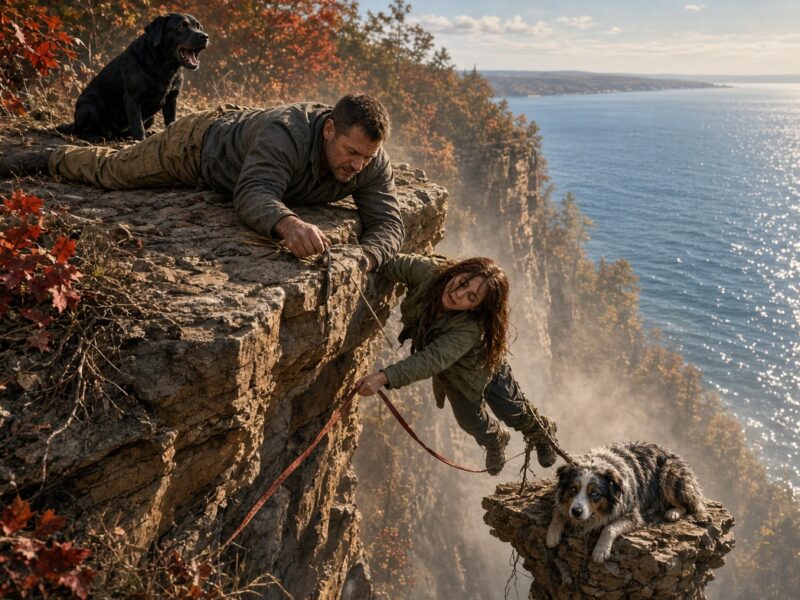
He Found a Woman and Her Dog Hanging Over a Cliff — What the Dog Was Carrying Changed Everything
A dry crack split the bright morning air at the edge of the cliff.
An unconscious young woman hung halfway over open space, held by one failing vine.
Her numb hand still gripped a leash, and below her an injured dog was slipping from a narrow ledge.
The Navy SEAL dropped to the ground as roots tore loose and stones vanished into the lake.
His retired search dog barked behind him, but the rescue team was still minutes away.
Then he saw what was clipped to the dog’s harness and knew this was no hiking accident.
The first red leaves had begun to show along Copper Lantern Trail, bright as warning flags against the green.
Elias Mercer noticed them because he had trained himself to notice whatever did not belong.
At thirty-nine, the former Navy SEAL still carried the square shoulders and spare build of a man accustomed to hard work, though his healing right shoulder swung less freely than the left.
His dark hair was clipped short, and a pale line marked his jaw.
He had come to Michigan’s Upper Peninsula to recover where nobody knew his record.
Harbor trotted beside him, a five-year-old black Labrador with a broad head, a silver scratch on his muzzle, and the patient disposition that had made him valuable in search work.
Though retired after an inner-ear illness, he still treated every breeze as a message.
Lake Superior flashed between the trees, blue and cold beneath a high September sun.
Eli kept a measured pace, counting steps between the dull pulls in his shoulder.
At step forty-seven, Harbor changed.
The Labrador stopped panting, shortened his stride, and turned his nose toward a narrow break in the ferns.
Eli continued two paces before the silence beside him registered.
Harbor stood rigid, tail level, looking not at the lake but at a tangle of alder branches that appeared undisturbed.
“Trail,” Eli said.
Harbor glanced back, then faced the opening again and gave two low barks.
It was his trained human-find signal.
Eli’s discomfort disappeared beneath a cleaner kind of attention.
He unclipped the short lead but kept Harbor under voice control.
“Show me.”
The dog pushed through the ferns without charging.
Eli followed a crushed path through wet leaves, the heel marks too deep for an ordinary hiker.
A water bottle lay flattened near a tire rut.
Farther on, two parallel disturbances crossed the soil as if weight had been dragged.
The path ended near an old maintenance road, then sloped toward the rain-softened cliff.
One set of bootprints appeared briefly beside the drag marks and ended well before the rim.
Harbor stopped on firm stone and wind.
A pebble clicked once below them.
Then came a faint metallic tap, followed by silence so complete that Eli could hear wind passing through Harbor’s whiskers.
He dropped to one knee.
The earth at the edge showed fresh cracks, thin dark lines opening through pale sand.
Beyond them lay the back of a young woman’s legs.
Her lower body remained on the ground, but everything above her waist had gone over the cliff.
A loop of old vine had caught around her left boot and ankle.
Its roots were threaded through shallow soil, and each breath of wind shifted them.
Her canvas field pants were torn at one knee.
She did not move.
Eli flattened himself and spread his weight across forearms and knees.
From that angle, he could see her face hanging below the rim, partly hidden by long auburn-brown hair.
She was perhaps twenty-seven, lean from fieldwork rather than a gym, with freckles across skin gone pale from exposure.
Her green work jacket bore a county geology patch.
One hand dangled empty; the other remained twisted around a red leash.
Eli followed the line downward and saw a second body on a narrow shelf eight feet below.
An Australian Shepherd lay on her side, blue-merle coat mottled gray, black, and white.
The dog’s hindquarters rested on the shelf while her chest hung partly beyond it.
The leash was clipped to a padded harness, not her collar, but the loose stones beneath her were slipping one at a time into the bright distance.
Eli checked the woman’s neck from where he could reach.
A pulse answered, faint but present.
Her breathing was shallow.
“My name is Eli,” he said, although she showed no sign of hearing. “I found you. I’m calling help.”
His phone caught one bar, lost it, then caught it again.
He gave the dispatcher the trail marker, the maintenance road junction, two suspended patients, unstable ground, and the need for a technical rope team and veterinary support.
The call broke after the dispatcher repeated the location.
Eli sent the coordinates by text and watched the message hesitate before showing delivered.
His first impulse was to pull the woman back.
Training overruled it.
A hard pull could release the vine, shift an unseen injury, or drag the dog from the shelf through the leash clenched in her hand.
He examined the nearest pine, a living trunk set well back from the fractured rim, and wrapped his personal safety line around its base.
It was not a rescue system.
It was permission to move close enough to prevent the situation from worsening.
Harbor remained on the patch of firm stone.
“Down. Speak.”
The Labrador lay flat and barked three times toward the hidden path, a steady beacon for the rescuers who would soon be searching through trees.
Eli crawled forward with a trekking pole and a loop made from the spare line in his pack.
His injured shoulder trembled as he extended the pole.
The loop slid beneath the woman’s left arm but caught on her jacket.
He withdrew it, slowed his breathing, and tried again.
This time the line passed beneath both armpits.
He eased it snug without lifting her, then took up only enough slack to support her chest.
Below, the Australian Shepherd’s ribs moved.
She was alive.
Eli spoke to her in the same calm voice.
One unfinished ear twitched, but her eyes stayed closed.
The woman’s fingers loosened.
Eli caught the slipping leash against the rock with his pole, formed a friction hitch around it, and clipped it to his temporary line.
The arrangement could not lift the dog, but it could keep one movement from becoming two falls.
Harbor barked behind him.
Far away, an engine answered among the pines.
Help was coming, but distance on a map did not measure distance on unstable ground.
The woman slid an inch.
Soil whispered beneath her jacket.
Eli tightened the supporting line with his left hand while protecting his damaged shoulder.
Below, the shelf shed a fan of sand, and the Australian Shepherd settled lower.
The old vine around the woman’s boot drew straight.
For one suspended moment, everything held: the roots, the leash, the two unconscious bodies, and Eli’s breath.
Then a dry crack snapped through the sunlight.
One root tore and lifted from the earth.
Eli saw the remaining fibers stretch white beneath the bark, and he understood that the cliff had reduced the world to seconds.
Saving the woman first might pull the dog down.
Reaching for the dog might release the woman.
He lowered his center of gravity, locked the temporary line, and chose the only order that could keep both alive.
Eli did not pull.
He shifted his weight backward until the line beneath the woman’s arms accepted part of her load, then stopped the instant the soil moved.
The old vine still held her ankle, but it no longer carried everything.
He secured the line with a friction knot that could be adjusted without releasing tension.
His right shoulder burned, a deep heat that reminded him of the rehabilitation therapist’s warning.
Strength returned before judgment if a man let pride set the schedule.
Pride had no place at the edge.
He used the trekking pole to guide the red leash away from a sharp stone and fixed it to the same temporary system, keeping only gentle tension on the Australian Shepherd’s harness.
The dog’s shelf continued to crumble, but neither body moved farther.
Harbor’s barking changed from regular calls to a single sharp answer.
Voices rose through the trees.
Four rescuers emerged carrying rope bags, a rigid litter, and edge protection.
Their leader was Mara Keen, a compact woman in her mid-forties with weather-brown skin, iron-gray hair braided beneath her helmet, and the decisive calm of someone who had learned that speed meant nothing without order.
Eli gave her a concise report: two living patients, both unconscious, unstable sandstone, temporary support only, possible injuries unknown.
He included every knot he had tied and every point he had touched.
Mara studied the lines once.
“You bought us time,” she said. “Now let us make it safe.”
Eli backed away only when a rescuer clipped him to a team belay.
Two certified anchors went around separate pines.
Edge pads protected the main ropes from sandstone.
A rescuer crossed to a stable shoulder of ground beyond the cracked strip, but the safest route left him without the light messenger cord needed to draw the primary line into place.
Harbor could cross the narrow firm lane without approaching the rim.
Mara looked at Eli, then at the dog.
“Still works?”
“When the job is clear.”
Eli clipped the feather-light cord to Harbor’s vest and pointed to the waiting rescuer.
“Across. Place.”
Harbor moved low and deliberate, pausing to find the solid patches.
The man received the cord, unclipped it, and Harbor returned at once.
No cheering broke the concentration.
Eli pressed his hand briefly to the Labrador’s neck, feeling the fast heartbeat beneath the black coat.
The ropes came tight with a low hum.
Then the vine at Rowan’s ankle gave another papery crack.
Everyone froze.
A leaf spun into the open air, gold on one side and brown on the other, and seemed to hang there before falling.
Mara raised one hand.
The rescuers moved only after the line supporting the woman’s chest had been transferred to the main system.
One technician descended far enough to place a proper harness around her without bending her spine.
Another reached the Australian Shepherd with a soft animal sling.
Eli’s temporary hitch remained untouched until both independent systems were ready.
“On three,” Mara said.
They lifted together, separating the woman’s weight from the leash without allowing either patient to swing.
The woman reached level ground first.
A medic cut the vine from her boot rather than forcing the swollen ankle through it, stabilized her neck, and checked her breathing.
The dog came up moments later inside the sling.
She weighed perhaps forty-five pounds and looked about three years old, her mottled coat dusty but well cared for.
Her name, Cricut, was stitched on the blue harness.
Harbor approached one step, then turned sideways and lowered himself.
Cricut did not wake.
A veterinary technician wrapped her in a thermal blanket and reported a steady pulse that seemed too slow for the stress of a fall.
Sheriff Lena Ortiz arrived before the litter left the trail.
She was fifty, tall and spare, with dark curls threaded by silver and thoughtful brown eyes that rarely settled on the most obvious object in a scene.
Her father had been a public defender, and she had inherited his suspicion of conclusions reached before evidence.
Ortiz photographed the drag marks and asked Eli to walk her through his approach while another deputy recorded.
He showed her where the bottle lay, where the bootprints ended, and where his own knees and rope had disturbed the ground.
He did not interpret.
At the maintenance road, Ortiz found a wooden barrier with two bolts recently removed and replaced by hand.
Tire impressions stopped near the concealed path.
Rowan Vale’s county badge identified her during transport.
At Pinewood Medical Center, doctors took her through one set of doors while Cricut crossed the service drive to a veterinary clinic.
Eli went with the dog because Harbor refused to leave the carrier until someone took responsibility for it.
Dr. Miles Chen met them inside.
He was a slender Chinese American man of forty-two with close black hair, rimless glasses, and careful hands that became even gentler when an animal was afraid.
He had grown up helping in his parents’ rural clinic and disliked the romantic idea that animals hid pain out of bravery.
To him, silence was simply another symptom humans had a duty to notice.
Cricut’s X-rays showed bruising and a strained hip, but no major fracture.
What troubled Chen was her sluggish response.
A fall did not explain it.
Beneath the fur near one shoulder, he found a recent injection mark.
Blood samples were sent for toxicology.
Blue-green dust packed between her pads also seemed wrong for the pale sandstone at Copper Lantern.
Ortiz arrived with an evidence technician and authorized photographs before anything was cleaned.
Eli watched through the glass, his hand resting on Harbor’s head.
The Labrador’s attention remained fixed on Cricut, not demanding movement, only waiting for it.
Ortiz returned from a call with the hospital.
Rowan had a concussion, a broken collarbone, and hypothermia, but the physician expected her to survive the night.
Relief moved through Eli without settling.
“If the toxicology matches,” Ortiz said, “somebody may have sedated them.”
Eli pictured the drag marks and the missing barrier bolts.
“They didn’t walk to that edge,” he said.
Ortiz nodded once.
It was a working possibility, nothing more.
Chen began cutting a damaged strap so the harness could be removed without twisting Cricut’s shoulder.
His scissors touched something that gave a small metallic ring.
The sound was delicate, almost pleasant, yet every person in the room stopped.
Hooked behind the harness’s D-ring was a steel sample tube, no longer than a finger.
Mud obscured most of its surface, but three engraved characters remained visible.
C14.
Chen lifted his hands away.
Ortiz asked him not to touch it again.
The little tube had survived the cliff with the dog, and whatever it contained might explain why someone had wanted both of them to disappear.
The steel tube stayed where it was until an evidence technician photographed every side of Cricut’s harness.
Only then did Dr. Chen cut the remaining strap, allowing the tube and its metal clip to fall onto a clean sheet.
Sheriff Ortiz sealed them together.
She explained the process to Eli, not because he had asked, but because careful procedure was how she kept a discovery from becoming a rumor.
The tube would be opened at the county laboratory, its contents divided for testing, and every transfer recorded.
Harbor sat beyond the examination room door, black ears tilted forward.
Cricut lay under warming blankets, breathing more evenly now.
The two dogs had no understanding of warrants or custody logs.
Yet both seemed to recognize the human stillness that gathered around an important scent.
By morning, the laboratory reported that C14 held damp blue-green drilling dust and a few drops of mineral-rich water.
A waterproof label beneath the cap listed coordinates and a time from the previous afternoon.
There was no hidden memory card or secret message.
The physical sample mattered precisely because it was ordinary.
County records placed those coordinates inside the Copper Lantern conservation boundary, where no drilling permit had ever been issued.
A geologist warned Ortiz that the unusual color might indicate cobalt-bearing rock, but a full analysis would take time.
Ortiz obtained limited access to Rowan’s county account.
Several photographs had uploaded automatically before her phone went offline.
They showed a rough tunnel, unmarked chemical drums, and fresh drill cuttings beneath electric work lights.
A saved draft contained one unfinished sentence.
“If I do not file the report, check Borehole 14.”
At the hospital, Rowan remained unconscious.
Without dust and cold on her face, she looked younger than she had at the cliff.
Her auburn-brown hair had been cleaned away from a bandage, and freckles crossed her nose above an oxygen line.
A doctor told Eli that the swelling around her brain required observation, not predictions.
He accepted the boundary.
The Navy had taught him to build plans around incomplete information.
Injury had taught him that some uncertainty refused to obey planning.
An older man arrived carrying a canvas coat.
Although the day was warm, Amos Vale was seventy-four, broad through the chest and slightly stooped, with a white mustache, miner’s hands, and pale blue eyes that seemed permanently narrowed against underground grit.
He had spent thirty-six years working iron and copper seams before the mines closed.
Hard labor had made him patient with machines and impatient with people, especially himself.
When he saw Rowan through the glass, his weathered face tightened.
“You found her?” he asked Eli.
“Harbor did.”
Amos looked down.
The Labrador allowed the old man to rest one scarred hand on his head.
That simple permission broke something Amos had been holding upright.
A monitor sounded once inside Rowan’s room, bright and abrupt.
Amos’s hand clenched in Harbor’s fur, then loosened when a nurse silenced the alarm.
For three heartbeats, nobody spoke.
The old man watched his granddaughter’s chest rise again.
“Her father died underground,” he said at last. “Six years ago. North Meridian called it his own fault.”
Caleb Vale had supervised safety inspections for the mining company.
The official report said he entered a restricted tunnel after drinking and was killed in a collapse.
Amos had believed the report because it contained signatures, measurements, and language he recognized from a lifetime in mines.
Rowan never had.
Ortiz joined them with printed copies of the synchronized photographs.
She was careful not to show Amos anything graphic.
He moved slowly through the images until one made his hand stop.
A brass tag hung from a valve in the background, small enough that Eli had taken it for a lock.
Amos asked for magnification.
When Ortiz enlarged the picture, stamped numbers appeared above a crescent-shaped nick.
“Caleb made that mark with a file,” Amos said. “Couldn’t tell his tag from another man’s in bad light.”
Mining crews once carried numbered safety tags, hanging them at an entrance so supervisors knew who remained below.
Caleb’s number was 271.
The accident inventory said tag 271 had been recovered, logged, and destroyed when the old system was retired.
Ortiz did not treat Amos’s recognition as proof.
She sent the image for metadata authentication and requested the original equipment ledger.
Still, the tag created a question that official paper could not answer.
How had an item supposedly removed six years earlier appeared inside an unauthorized tunnel photographed yesterday?
Across the service road, Cricut woke for less than a minute.
She was an alert-looking dog, even in weakness, with one blue eye and one brown, a white blaze dividing her face, and ears that tipped forward at different angles.
When a delivery truck idled outside, the diesel vibration reached the examination table.
Her body tightened, and she tried to retreat despite the blanket.
Chen dimmed the lights and reduced the noise.
Harbor entered only after permission.
He did not approach nose first.
He turned his side toward her, lay down, and looked away.
Cricut’s breathing gradually slowed.
She did not move closer, but she stopped trying to escape.
Near noon, a North Meridian attorney called the sheriff’s office and demanded the return of company property allegedly stolen by Rowan.
Ortiz answered that ownership had not been established and that items recovered from an attempted-killing scene would remain secured under lawful process.
The caller objected to her description.
Ortiz corrected herself without yielding.
“A suspicious injury scene.”
Words she knew had to remain smaller than the evidence until the evidence caught up.
Eli stood beside Amos at the hospital window while sunlight traveled across the floor.
Below them, Harbor waited outside Cricut’s enclosure, a black shape made still by choice.
Amos studied the enlarged image again.
The brass tag caught the work light in the photograph, throwing back one hard yellow spark.
“I signed the settlement,” he said. “I let them say my boy was drunk.”
Eli heard shame searching for a punishment and refused to provide one.
“You believed a report designed to be believed.”
Amos shook his head. “Rowan didn’t.”
Beyond the glass, his granddaughter remained silent, but the sample her dog had carried and the photograph her phone had saved had begun speaking for her.
Six years after Caleb Vale’s death, a piece of brass listed as destroyed had returned from beneath the protected ridge.
The equipment ledger arrived before the image analysis.
Sheriff Ortiz read it in the hospital cafeteria with Amos, Eli, and a deputy present.
Tag 271 had been checked out to Caleb Vale on the morning of his final shift.
Three days after the collapse, a supervisor signed a line stating that it had been recovered from the entrance board and destroyed with obsolete equipment.
The supervisor was Grant Voss.
Ortiz circled nothing and made no accusation.
She requested the destruction record, the names of the recovery crew, and the original accident photographs.
“A false line is possible,” she told Amos. “A clerical mistake is possible, too. We establish which one.”
Amos looked offended by the patience until Eli saw him understand its purpose.
The old man had already lost six years to a conclusion formed too quickly.
Amos folded his large hands around untouched coffee.
He admitted that North Meridian had offered a settlement after Caleb’s death.
Medical bills from his wife’s last illness had consumed his savings, and Rowan had been preparing for college.
Company lawyers brought a report filled with measurements and witness statements.
Amos signed.
Worse, in his own judgment, he told Rowan to stop challenging men who knew mines better than she did.
“She studied geology because I wouldn’t listen,” he said.
The fluorescent light made every crease in his face seem deeper.
Eli told him about the extraction that ended his operational career.
He had pulled a wounded teammate to cover while debris shifted, saving the man’s life but worsening injuries to them both.
For months, Eli had believed a different grip could have produced a perfect outcome.
“Survival isn’t proof that every choice was right,” he said. “And regret isn’t proof you meant harm.”
Ortiz received confirmation that Rowan’s photographs were taken by her registered county phone and uploaded within minutes.
The brass tag’s shape and damage matched an old image from Caleb’s personnel file.
That still did not prove who left it underground, but it justified returning to Copper Lantern with a formal search team.
Eli went only because Ortiz requested Harbor’s sensibility.
He accepted her conditions: search for missing property and possible human presence, touch nothing outside immediate safety, report alerts without interpreting them.
At the trailhead, Harbor took scent from a clean pad that had been held against Cricut’s harness before it was removed.
The Labrador followed the maintenance road, then turned toward the hidden path.
His pace slowed near a hollow cedar.
He pushed his nose beneath low branches and sat.
Rowan’s orange survey bag lay inside, protected from the rain.
Ortiz photographed it before opening the flap.
The logbook was present, along with sampling tools and three empty sleeves.
One page repeated C14 beside a rough elevation.
The compartment labeled sample tubes was empty.
Everyone had assumed 14 described a missing instrument.
Now it appeared more likely to identify a place.
The bag also contained wool socks, an old apple, and a birthday card Rowan had intended to mail.
Those ordinary items affected Amos more than the evidence.
They proved she had expected a next day.
Eli watched Ortiz separate personal property from potential evidence.
A victim’s life, he realized, could not be allowed to shrink into whatever part supported a prosecution.
A deputy called from the cliff.
Sunlight flashed once from a newly exposed bolt, bright enough to sting Eli’s eyes.
Then the wooden barrier shifted in the wind with a hollow knock.
Beneath it, investigators found marks showing the bolts had been removed and loosely returned.
Along the hidden path, drag marks began where tire impressions stopped.
Fibers caught in the vine matched the torn cuff of Rowan’s field pants.
Their direction showed that her ankle snagged only after she slid.
Whoever left her there had not designed the vine as part of the scene.
Chance had interrupted the plan.
That answer created another question.
A person intending to make two unconscious victims fall would normally wait long enough to see them disappear.
County traffic footage supplied the reason he had not.
A silver North Meridian pickup entered the locked road shortly before dawn.
Less than twenty minutes later, a marked park service truck approached from the opposite direction.
The pickup emerged at speed and turned away.
Its plate was obscured by mud, but company fleet records and a distinctive dent narrowed it to the vehicle assigned to Grant Voss.
Ortiz interviewed Grant at the sheriff’s office with counsel present.
He was fifty-two, thick through the shoulders, with close gray-brown hair, a trimmed beard, and the composed friendliness of a man accustomed to sponsoring public events.
Years earlier, after a young worker died during his first week as a supervisor, Grant had built a reputation for funding rescue equipment and speaking about safety.
Whether that reputation came from remorse or calculation remained unclear.
He said he had inspected storm damage on the road but hadn’t seen Rowan.
He claimed she resented North Meridian and might have entered company property illegally.
At the veterinary clinic, a North Meridian security employee delivered paperwork related to Cricut’s alleged trespass.
The smell of his rain jacket reached the dog before he entered the room.
Cricut flattened beneath her blanket and began trembling.
Harbor rose but did not threaten.
He placed himself between her enclosure and the door.
Chen ended the visit.
Later, an evidence swab from the jacket indicated residue consistent with a veterinary sedative, though Ortiz cautioned that the employee transported livestock supplies and had not been placed at the cliff.
Cricut’s fear gave investigators a direction, not a verdict.
That afternoon, Rowan’s condition remained stable but unchanged.
Eli sat outside her room with Harbor while Amos read her field notes aloud, hoping familiar words might reach where ordinary conversation could not.
Near sunset, the windows gave a faint rattle.
A cup trembled against its saucer.
Harbor lifted his head before the motion stopped.
The county seismic station reported a shallow disturbance beneath protected land north of Copper Lantern.
North Meridian’s public permit listed no blasting there.
Ortiz compared the coordinates with C14 and the old tunnel maps.
The points formed a line beneath the ridge.
Someone was still working underground while Rowan lay unable to explain what she had found.
The shallow tremor gave Sheriff Ortiz enough support to seek a limited search warrant, but not enough to enter every North Meridian building.
She built the request around three facts: drilling residue recovered from protected land, synchronized photographs from Rowan’s county phone, and unpermitted seismic activity beneath the same coordinates.
A fourth fact added urgency.
Ben Harlo, a county survey contractor who had worked with Rowan, failed to report after sending his sister a message that he was meeting her near the ridge.
Ortiz classified him as endangered, allowing Harbor to search for a person while investigators remained within the boundaries authorized by the judge.
Ben’s sister provided an unwashed workshirt.
Harbor took the scent at the old access gate and led the team east through maples, turning red at their crowns.
The dog’s black coat shone blue beneath gaps in the canopy.
Eli followed on a long line, protecting his shoulder by keeping both hands low and his pace even.
Search work had once felt like control to him.
Now he understood it as disciplined uncertainty.
Harbor could say where scent traveled, not why.
Fifty yards inside the boundary, the Labrador crossed a row of survey stakes and continued toward a cabin.
A county land specialist following the team stopped at the stakes.
Their numbered caps had been moved.
On paper, the line placed excavation outside the conservation tract.
On the ground, the original pin locations showed it well within.
Harbor circled the cabin, sniffed beneath the door, and gave his sit alert.
Ortiz announced the search team.
A weak impact answered from inside.
Deputies entered under the warrant and found Ben locked in a storage room, dehydrated and bruised but conscious.
He was thirty-one, lanky and fair-skinned, with sandy hair falling across one swollen eye and the apologetic manner of someone who had spent his life trying not to inconvenience others.
Even while a medic checked him, he asked whether Rowan had made it to safety.
Ortiz told him she was alive.
The news seemed to return weight to his body.
Ben said he and Rowan had recorded nighttime vibrations for three weeks.
She believed North Meridian was drilling across the legal boundary.
Grant confiscated their phones when he caught them near a ventilation shaft, but Rowan carried a second county device set to upload photographs.
Ben escaped through a drainage cut and planned to meet her.
Company guards found him first.
He did not see what happened at Copper Lantern.
His statement established threats and concealment, not the attempted killing.
Ortiz made the distinction clear before anyone could turn his fear into more than he had witnessed.
The medic asked Ben to conserve his strength.
So Ortiz limited herself to immediate safety questions: whether anyone else was confined, where hazardous material might be stored, and whether the cabin contained weapons.
Ben answered no to the first and third.
For the second, he pointed toward the north wall and described blue barrels moved after midnight.
He kept apologizing for not reaching Rowan.
Eli crouched far enough away not to crowd him.
“You stayed alive long enough to tell the truth,” he said. “That is not nothing.”
Ben looked toward Harbor, whose tail touched the floor once, and finally allowed the medic to continue treating him.
From beneath the cabin came a soft scrape.
Harbor pressed his nose to a floorboard and looked at Eli.
Ben managed a tired smile. “I hid the old map under there before they took my bag.”
Ortiz checked that the cabin fell within the warrant and authorized removal of the loose board.
Below it lay a rolled geological plan bearing Caleb Vale’s signature.
The map showed a natural water-bearing layer running from the proposed exploration zone toward the municipal wells.
A newer North Meridian map omitted that connection.
The cabin lights flickered.
A dull pulse traveled through the floor, too soft to knock anything over but strong enough to make dust drift from a roof beam.
Everyone stopped.
Harbor’s ears rose.
Somewhere under the bright forest, machinery continued its hidden work.
Ben looked toward the floor as if it had spoken his name.
He explained that the company called the pulses stability tests, although no lawful test should have occurred there.
Investigators found invoices in a desk for a veterinary sedative purchased through a mobile animal care company that existed only as a mailbox.
The batch notation matched preliminary markers in Cricut’s blood.
Rowan’s toxicology remained pending.
A work schedule listed a series of stability tests whose dates aligned with unexplained seismic readings.
The final entry was set for dawn the following day.
Beside it appeared the phrase “final closure” and a quantity far beyond any routine test.
Ortiz called the state geologist, Dr. Naomi Fisk, a tall woman in her late fifties with cropped white hair and a voice made blunt by decades of explaining preventable failures after they happened.
Fisk compared Caleb’s map with the vibration data.
She said a large collapse near the water-bearing layer could crack the tunnel, carry contaminated runoff toward town wells, and erase evidence of unauthorized exploration.
It might also destabilize a section of Lakeside Cliff.
The exact outcome could not be predicted without inspection, which was itself the danger.
County officials began planning road closures and water precautions.
North Meridian denied that the notation described explosives, claiming closure meant paperwork.
Ortiz refused to argue through press releases.
She used the schedule, false stakes, hidden map, and risk to living people to request a broader emergency order.
Eli stayed with Harbor beside the ambulance until Ben was transported.
The Labrador rested his head on Eli’s boot, exhausted now that the missing man had become somebody else’s patient.
Ortiz returned from the cabin carrying a clear evidence sleeve containing the schedule.
Sunset struck the plastic, turning the final line briefly gold.
The time printed beside final closure was 5:40 a.m.
State inspectors could not reach the ridge before midnight.
If the notation meant what Dr. Fisk feared, they had less than twelve hours to locate the charges, warn the town, and stop a mountain from being used as a shredder.
The pleasant autumn forest remained motionless around them, but beneath its roots, the countdown had already begun.
County sirens did not sound.
Sheriff Ortiz and emergency managers chose targeted alerts to prevent panic while deputies closed Copper Lantern Trail and contacted households nearest the wells.
Tanker trucks were placed on standby.
North Meridian responded within an hour, releasing an engineering statement that described the tremors as harmless settling from historical excavation.
Grant Voss appeared on local television in a clean field jacket beside a rescue vehicle his company had helped purchase.
He expressed concern for Rowan while suggesting grief over her father had influenced her judgment.
His tone contained no open cruelty.
That made it more effective.
Pinewood had depended on mining money for generations.
Some residents believed the company because their pensions, stores, and children’s jobs depended on believing it.
Others filled plastic jugs before dawn.
Amos watched the broadcast in Rowan’s hospital room, jaw tight beneath his white mustache.
He wanted to call the station and accuse Grant publicly.
Eli persuaded him to wait for Ortiz.
Anger might satisfy the hour, but a careless claim could help North Meridian portray the Vales as irrational.
Amos disliked the advice because it resembled the silence he had practiced for six years.
Eli drew the difference plainly.
Silence protected the company.
Verified records would protect Rowan.
Outside, uncertainty reorganized ordinary life.
A school custodian shut off drinking fountains.
A diner offered bottled water to emergency crews.
North Meridian employees found deputies redirecting them from work, leaving families to wonder whether the closure protected them or threatened their livelihoods.
Ortiz ordered every verified water reading published with its collection time.
Trust would not return through reassurance alone.
Shortly after midnight, Rowan opened her eyes.
Dr. Helen Ward, the attending neurologist, was a broad-faced Black woman of forty-six with short curls and a calm authority sharpened by years of protecting injured patients from other people’s urgency.
She checked whether Rowan could follow light and recognize Amos.
Rowan’s gaze wandered before finding her grandfather.
Her lips moved.
The first sound was too faint to understand.
Ward leaned closer without supplying words.
“Fourteen,” Rowan whispered.
After a long pause, she added, “Bell underwater.”
Her pulse rose when Ortiz entered the doorway.
Ward lifted one hand.
No formal interview would occur until Rowan could tolerate it.
The phrase passed through the room like wind beneath a door.
Amos started to ask what it meant, but Ward stopped him.
“Her brain is working through an injury. Do not make her carry our need for answers.”
Rowan drifted back to sleep, not unconscious now but exhausted.
Eli wrote the exact words in time for Ortiz.
He did not improve their grammar or attach an interpretation.
Seeing Rowan awake should have felt like a finish, yet it revealed how long recovery might be.
She recognized Amos but not the month.
Her hand reached once toward empty space, perhaps seeking Cricut, then settled when her grandfather placed the blanket beneath her fingers.
Bringing someone to safety did not bring everything back at once.
Across the service road, Chen played a recording of Rowan saying Cricut’s name.
The Australian Shepherd raised her mismatched eyes, struggled upright, and took a little food from his hand.
A diesel delivery truck started outside, and she flinched, but Harbor lay beyond the enclosure with his muzzle on his paws.
After watching him, Cricut remained standing.
Nobody placed a map before her or asked her to solve what humans could verify.
Her task was simply to recover.
Chen ended the session after three minutes, explaining that improvement would come through short experiences that stopped before fear overwhelmed her.
Cricut rested one paw against the speaker.
Harbor rose only after she settled, stretching with a soft groan.
The dog supplied no miracle, only one calm example followed by one voluntary choice.
At dawn, a bell rang once across the lake.
The note rolled through the hospital window, low and hollow, then stopped so abruptly that Eli looked up.
The old navigation buoy offshore normally answered every set of waves with an irregular chime.
Now the water moved in silver bands without another sound.
“Bell underwater,” he said.
Ortiz did not accept the connection on instinct alone.
She requested harbor maintenance records, satellite images, and permits for every structure around the buoy.
The records showed that North Meridian had paid to service the abandoned buoy through a subsidiary.
No legal drilling project existed offshore, yet recent images revealed a work barge beside it on three nights when seismic stations recorded disturbances.
An engineering diagram from Caleb’s old file placed a ventilation shaft beneath the buoy’s anchor line.
The bell was not literally underwater.
Rowan had used the landmark to identify an entrance hidden below the lake-facing ledge.
Amos brought Caleb’s remaining files to the sheriff’s office in two metal boxes.
He had kept them unopened after signing the settlement because shame made even the handwriting difficult to see.
Ortiz logged each folder before state engineers reviewed it.
One page showed the same ventilation shaft and a handwritten warning that drilling beyond it could connect contaminated rock with the town’s aquifer.
Amos agreed to let the county release the page publicly after authentication.
“If they call my son a drunk again,” he said, “they can do it beside his own measurements.”
Dr. Fisk’s team determined that the scheduled dawn event had been delayed, perhaps because the search at the cabin exposed the plan.
The danger had not passed.
Equipment signals suggested activity near the buoy, and the emergency warrant now covered the offshore access.
Coast Guard personnel prepared to inspect it after sunrise.
Eli was assigned only to surface search support with Harbor.
His shoulder excluded him from diving, a limitation he accepted aloud, even while resentment moved through him.
Fisk also ordered continuous sampling at the municipal intake.
The first readings remained below emergency limits, which officials announced carefully.
Safe at present did not mean safe forever.
Volunteers delivered water to nursing homes before fear became shortage.
Amos helped load cases until his hands shook.
“Caleb used to say rock remembers pressure,” he murmured.
Eli looked toward the ridge.
People remembered it, too.
Sometimes in scars, sometimes in habits they mistook for personality.
Night settled over Pinewood.
From the clinic courtyard, the buoy’s dark shape was barely visible against the moonlit water.
Waves should have moved its bell.
Nothing sounded.
Harbor stood beside Eli, nose raised toward the lake.
Then a small service light appeared near the buoy and vanished.
Ortiz received a call from the harbor patrol.
The bell assembly had been unbolted and lowered, exposing a maintenance collar around the old ventilation shaft.
Someone had silenced the landmark to open the hidden route below it.
The phrase Rowan carried out of unconsciousness was no longer a fragment.
It was a location, and people were moving there before the county could arrive.
Morning revealed the old buoy lying silent beside a Coast Guard cutter, its bell assembly lowered onto the deck like the mouth of an extinguished instrument.
The maintenance collar beneath it surrounded a vertical shaft built into the lakeside ledge.
Lieutenant Owen Price commanded the water operation.
He was a lean man of forty with wind-reddened cheeks, a shaved head, and the clipped courtesy of someone who had learned to make instructions survive engines and waves.
Price barred Eli from diving before Eli could volunteer.
The shaft’s condition was unknown, and an injured shoulder could turn one rescuer into another patient.
Eli accepted surface duty and fitted Harbor with a search vest.
The work barge found near the buoy appeared empty.
Its deck held coiled hose, battery lamps, and mud tracked from boots.
Harbor sampled the air, crossed toward a rusted ventilation housing, and sat.
A second breath brought a low bark.
Price’s team lowered a camera through the shaft.
At first, the screen showed wet concrete and cables.
Then two workers appeared behind a flood door, one waving a jacket toward the lens while water pulled around their boots.
The door had jammed after a power loss.
Whether anyone intended to trap them remained unknown, but the rising water did not care about motive.
The rescue team opened an exterior maintenance panel while Eli used a speaking tube to tell the workers what was happening.
Their names were Dana Cole and Marcus Reed.
Dana, a sturdy woman in her fifties with cropped blonde hair, supported Marcus, a young mechanic whose sleeve had been scorched by a failed electrical box.
Neither injury was described over the open channel.
Eli kept his voice level and gave them one task at a time.
“Stay below the smoke. Move only when the light flashes. Answer every thirty seconds.”
Dana answered for both until Marcus could speak.
Price divided the deck into zones so hoses, rescue ropes, and evidence personnel did not obstruct one another.
A paramedic prepared warmed blankets near the stern.
Ortiz remained outside operational space, recording decisions rather than commanding specialists whose work she did not direct.
Eli appreciated the arrangement.
Competence rarely looked dramatic from inside it.
It looked like labeled lines, repeated checks, and people willing to say when a task belonged to somebody else.
Harbor waited at the vent, his nose testing each draft from below.
A metal bang erupted below.
The camera jumped sideways, its light spinning across black water, and the picture vanished.
For a breath, the only sound on deck was the soft slap of the lake.
Harbor barked into the vent.
Three seconds later, three knocks answered from beneath.
Price redirected the camera cable and found the workers crouched beyond a fallen conduit.
They were still alive.
The interruption had cost visibility, not the route.
Rescuers freed the outer panel and rigged a protected passage across the wet chamber.
When a stone fragment trapped the primary guideline, the gap remaining was too tight for a fully equipped person.
Price approved a canine carry only after engineers confirmed the ledge was stable and the chamber held breathable air.
Harbor wore a lightweight messenger cord, crossed to a waiting rescuer, and returned immediately.
The cord drew a stronger line through, allowing the team to guide Dana and Marcus out one at a time.
Eli touched Harbor’s wet head as the dog came back.
Working beside the lake, he thought, meant learning how quickly silence could change its meaning.
Dana told Ortiz that Grant ordered the crew to prepare an old borehole network for closure.
When she refused to activate unfamiliar equipment, he took two portable initiation units and left.
She had locked down the main control board before the power failed, preventing any remote sequence through the installed system.
Marcus carried the encryption key in a waterproof pouch.
Their account reduced the immediate threat but did not eliminate it.
The portable units could still trigger isolated charges if Grant reached the local connections.
In the control room, investigators found an industrial seismic recorder bolted inside a protective cabinet.
Its display showed recent events and years of archived capacity.
The index for the period surrounding Caleb’s death had been deleted, but the raw storage had not been securely erased.
Ortiz seized the entire unit.
A forensic engineer warned that recovery could take days and that corrupted sound should not be trusted until verified against timestamps and radio logs.
Amos waited without demanding a miracle.
By evening, technicians restored a short segment.
The first sound was mechanical vibration, followed by a man’s strained radio call.
Caleb identified himself and reported that he was alive behind a collapse.
Another sound came through in three measured barks.
Amos recognized the signal from Caleb’s old field dog, Juniper, trained to mark air moving through a confined space.
Rowan had later taught Cricut the same pattern.
It was a family method passed by patients rather than mystery.
The recovered clock drifted by several seconds, so technicians aligned it with archived dispatch traffic and a surface sensor that had kept independent time.
Only after all three sources matched did Ortiz allow Amos to hear the segment.
She warned him he could stop it whenever he wished.
Amos placed both hands flat on the table and listened to his son’s voice without moving.
Eli stood near the door, close enough to help and far enough not to turn private grief into an audience.
Then Grant’s younger voice entered the recording through a nearby radio.
He told another supervisor that opening the tunnel would expose unauthorized work.
A second man urged him to summon rescue.
Grant answered, “Let the tunnel bury him.”
The statement was brief, followed by static and another three-part bark.
Nobody in the evidence room spoke after it ended.
The audio still required authentication, but Amos bowed his head as if six years had suddenly acquired weight.
Ortiz sealed the restored copy and sent it for independent review.
Eli found Amos outside beside the water.
The old man did not ask whether Caleb had suffered.
He asked whether his son had known anyone heard him.
Eli could not answer.
Across the courtyard, Cricut heard a recording of Rowan’s voice and lifted one uneven ear.
Harbor settled beside her enclosure.
The same three-bark signal had once pointed toward a pocket of air beneath a mountain.
Now it had carried a dead man’s warning into the light.
Dr. Ward allowed Rowan’s first interview the next afternoon, limiting it to ten minutes and remaining beside the bed.
Rowan could name Amos, Cricut, and the county where she worked, but she needed several seconds to find the year.
Her voice was rough, and her left arm rested in a sling against the broken collarbone.
Ortiz asked open questions and never supplied names.
Rowan remembered following vibration readings to the buoy with Cricut.
Behind the maintenance collar, she found a tunnel extending beneath protected land.
At Borehole 14, blue water seeped through fresh rock.
She filled a steel tube and clipped it to Cricut’s harness because her own pack might be taken.
Rowan’s memory arrived by sensation rather than chronology.
She recalled the mineral smell, cold water inside one boot, and Cricut’s nails clicking on a metal grate.
Ward let silence remain when a word would not come.
Amos sat outside the room because Rowan had asked him not to hear the first account.
She feared watching his face would make her protect him instead of answering honestly.
Eli understood the request.
Care could become pressure when a wounded person felt responsible for everyone else’s reaction.
Grant found her near the shaft.
Rowan remembered him taking her phone and demanding the sample.
He did not know the county device had already uploaded photographs.
After that came fragments: diesel vibration, darkness inside a vehicle, and Cricut breathing against her knee.
She remembered neither the maintenance road nor the cliff.
Fear crossed her face when she discovered memory would not obey effort.
Ortiz closed her notebook.
“The case does not depend on you forcing the missing pieces back,” she said. “We have physical evidence and other witnesses.”
Ward ended the session when Rowan’s pulse increased.
Amos explained the three-bark signal after Rowan rested.
Caleb had trained Juniper, a brown farm collie, to indicate moving air while he inspected abandoned workings.
As a child, Rowan had followed them with a plastic helmet and copied every command.
Years later, she taught Cricut the same game using culverts and hollow logs.
The story brought a small change to Rowan’s expression.
“She found the vent,” she whispered.
Amos nodded. “Just like he taught you.”
The connection did not turn either dog into something supernatural.
It showed how useful knowledge could survive a person when love carried it forward.
At the clinic, Chen prepared Cricut for a controlled reunion.
The dog entered the rehabilitation room slowly, favoring her sore hip.
Rowan waited in a wheelchair, unable to lift or reach far.
Cricut stopped at the smell of hospital soap.
Then Rowan lowered her hand.
The Australian Shepherd crossed the final feet and placed her divided-color face beneath Rowan’s palm.
Her tail touched the floor once.
Harbor remained near the doorway, body turned sideways to give them space.
Rowan laughed softly, then cried without embarrassment.
Neither response alarmed Cricut.
She simply leaned closer.
A metal cart struck a door frame in the corridor with a sudden clang.
Cricut dropped low.
The room went still.
Harbor raised his head but stayed down.
Rowan did not tighten the leash or flood the dog with praise.
“You’re here,” she said.
Cricut watched Harbor, took two careful breaths, and stood again.
The pause lasted less than a minute, yet it contained the difference between being pulled through fear and choosing to move beyond it.
Toxicology linked the substance in Rowan’s blood with the one used on Cricut and with containers recovered from the survey cabin.
Manufacturing markers indicated the same lot.
Fleet data placed Grant’s truck near Copper Lantern, while the Park Service camera explained his hurried departure.
None of those facts alone completed the case.
Together, they reduced the space available for coincidence.
Grant responded through a media consultant.
A video appeared online showing Rowan entering the tunnel and handling company equipment.
Edited cuts made her appear to damage a control box.
Pinewood divided again.
Some residents called her courageous.
Others accused her of risking jobs for a family grievance.
Amos wanted to answer every comment.
Eli helped him release Caleb’s authenticated map and let independent engineers explain what it showed.
Facts moved more slowly than outrage, but they did not tire as quickly.
The public pressure reached the hospital.
Ward restricted calls after strangers left messages demanding that Rowan confess or become the town’s hero.
Both roles asked her to perform before she could walk to the bathroom alone.
Rowan chose one statement through the county.
Protect the water.
Preserve the evidence.
Do not threaten workers whose families depended on the mine.
Her refusal to divide Pinewood into innocent and guilty camps made the statement harder to dismiss.
Amos read it twice and said she sounded like Caleb.
Rowan answered that she hoped she also sounded like herself.
Dr. Fisk presented initial results from C14.
The sample contained cobalt-bearing waste and concentrations of other metals inconsistent with natural surface runoff.
More important, its chemistry matched seepage near the municipal aquifer.
The town water remained within emergency limits, yet continued blasting could change that.
State regulators suspended all North Meridian activity pending inspection.
Ortiz returned to Rowan with one clarification.
Investigators had treated 14 as a possible instrument number because her notebook listed C14 beside missing equipment sleeves.
Rowan shook her head, speaking cost effort, so she formed each word carefully.
“Not a device. Borehole 14.”
She explained that the permanent recorder remained at the bottom, sealed in a steel housing that logged vibration, command codes, and pressure.
When Grant came, she detached its surface display but dropped the recording core back down the shaft, where he could not easily retrieve it.
Ortiz asked no more.
Borehole 14 lay inside the newly authorized search zone, and Rowan’s sample provided its coordinates.
If the recorder remained there, it could distinguish suspicion from measurement and connect each hidden blast to whoever ordered it.
As Chen wheeled Cricut back across the courtyard, the dog looked over her shoulder until Rowan disappeared behind the door.
The most important thing she had carried from the tunnel was not concealed in her harness.
It was the location of a witness made of steel, waiting under stone and water.
After the room emptied, Rowan asked Eli whether he had been afraid at the cliff.
He considered giving the reassuring answer and rejected it.
“Yes.”
She nodded, relieved rather than disappointed.
Courage presented without fear would have made her own terror feel like failure.
Eli told her Harbor had been afraid of unstable surfaces after his illness and had returned to work through short, safe repetitions.
Rowan looked toward the courtyard where Cricut had gone.
“Then we start short,” she said.
It was the first plan she made for a future beyond the next medical test.
The warrant for Borehole 14 required no one to enter the unstable tunnel.
Dr. Fisk’s team lowered a waterproof camera through the shaft from the secured lakeside collar.
A hundred feet down, the lens found the recorder wedged above a narrowed section of casing.
Its steel housing bore the county calibration mark.
A mechanical retrieval clamp took three attempts to catch the handle.
Each time the cable tightened, grit clouded the water and erased the image.
On the fourth attempt, the recorder rose.
Ortiz filmed the recovery continuously from the moment it cleared the shaft until it entered an evidence container.
Forensic technicians made an exact copy before opening the data.
The recorder had logged pressure, vibration, and control instructions for months.
It showed repeated blasts beyond permitted limits and identified command credentials assigned to Grant.
Chemical sensor readings aligned with contamination found in Rowan’s C14 sample.
Older partitions contained records from six years earlier, including a shutdown override issued while Caleb’s emergency radio remained active.
The system could not prove every human intention, but it proved that Grant knew someone was trapped when he prevented the rescue alarm from reaching the external network.
Financial records supplied the motive.
North Meridian planned to sell its regional holdings to an international buyer at the end of the week.
Reports submitted for the transaction inflated the cobalt estimate while omitting treatment costs for contaminated groundwater.
A controlled collapse would bury unauthorized workings before state inspectors arrived, preserving the false valuation long enough for signatures and payment.
Grant had not been protecting a productive mine.
He had been protecting the price of a lie.
Ortiz obtained an arrest warrant.
Deputies found Grant’s house empty and his assigned truck abandoned behind a closed equipment yard.
Two portable initiation units were missing.
Ben, who had been recovering at the county clinic, was scheduled for transfer to protected lodging during the water evacuation.
Grant used an old management credential to stop the marked transport at a service gate, injured the driver without killing him, and took Ben in the North Meridian utility vehicle.
The vehicle camera captured enough of the encounter to identify Grant and show Ben alive.
The driver, a gray-haired county orderly named Louis Kemp, stayed conscious long enough to trigger the vehicle alarm and described the direction Grant took.
Ortiz reviewed why an old credential had still opened the gate.
North Meridian managed that section of the evacuation route, and its access database had not yet been transferred to county control.
She ordered every company credential disabled.
The failure was painful but specific.
Naming it allowed the county to close the gap instead of pretending no system could have anticipated betrayal by an authorized manager.
An emergency alert sounded from every phone in the command room at once.
The overlapping tone struck like glass, then stopped.
For a moment, faces remained lit by the warning screens.
Ben’s phone had transmitted one brief location before going dark: an abandoned observation station above the town reservoir.
Drone images showed a vehicle beneath the tower and two cable runs extending toward old mine supports.
Grant was no longer merely fleeing.
He had brought the remaining initiation units to ground capable of sliding toward the water system.
Harbor took scent from Ben’s recovered clinic blanket and led the search team along an unused rail bed.
Rain began as a fine mist, darkening the red leaves and softening the slope.
Eli wanted to move faster.
The desire came from fear, not tactics, and he recognized it before it governed him.
Ortiz ordered the team to wait for bomb technicians and structural rescue.
Eli obeyed, kneeling beside Harbor beneath dripping branches.
Discipline was not the absence of urgency.
It was the refusal to let urgency choose the wrong person to endanger.
The drone showed Ben bound inside the lower station room.
A transmitter sat near him.
Two main charges appeared fixed to old supports beyond the wall, but wires disappeared into the tunnel where cameras could not follow.
Grant moved between levels carrying a second control unit.
Dr. Fisk warned that the amount visible could damage the old gallery and begin a slope failure.
Whether it could destroy the entire ridge was uncertain, but uncertainty did not make the people below safer.
Rowan, speaking through Ward, remembered a narrow ventilation run on Caleb’s map.
It entered behind the station and was too small for a person wearing rescue equipment, but a medium-sized search dog could pass.
Eli did not accept the idea until engineers inspected the entrance with a camera.
Air quality was safe.
The route showed no visible wiring, and it opened into a storage space separated from Grant’s position.
Harbor could carry a camera and communication pouch to Ben without touching the suspected devices.
Ortiz approved the plan under the bomb commander’s authority.
Eli checked Harbor’s vest twice.
The Labrador leaned briefly against his knee, not reassurance exactly, but contact.
At the ventilation mouth, darkness absorbed the dog’s black coat until only the reflective strip remained.
“Find Ben,” Eli said.
Harbor entered at a steady crawl.
Eli watched the feed without speaking.
The camera showed places too narrow for him to follow, and his unused hands felt heavier than equipment.
Years earlier, he would have called helplessness a failure of preparation.
Rehabilitation had changed the definition.
Harbor had training, a safe route, and a team monitoring the air.
Following merely to ease Eli’s anxiety would add danger.
He kept one hand around the return line and trusted the dog to perform the part that belonged to him.
On the monitor, stone passed inches from the camera.
Water ticked from the ceiling.
Then the passage widened, and Ben appeared, conscious, watching a thin line near his ankle.
Harbor stopped several feet away and gave his trained down alert.
He did not touch the line.
The camera provided the angle technicians needed to identify it as a warning trap rather than a primary firing circuit.
Harbor released the communication pouch beside Ben and returned when Eli called.
The first safe route into the station now existed, but the drone revealed Grant descending toward the tunnel with the second transmitter.
Rain ran in silver threads across the screen.
Below the station, the old mountain waited under loads it had never been meant to carry.
Harbor’s camera had shown the warning line near Ben’s ankle without disturbing it.
Bomb commander Rachel Sae, a small, muscular woman with a shaved temple and a habit of repeating critical facts in plain language, identified a safe approach through an upper service opening.
She had lost a colleague years earlier to a device everyone thought they understood, and she never allowed confidence to replace verification.
Her team sent a wheeled camera ahead, traced the line to a simple alarm, and isolated it.
Through the communication pouch Harbor delivered, Ben received instructions to remain still until a rescuer reached him.
Grant moved below the station, outside the drone’s view.
The second transmitter signal flickered on a frequency monitored by Sae.
She warned that blocking it indiscriminately might trigger a backup response.
Nobody touched the main circuit until its design was known.
Ortiz maintained the perimeter while structural crews supported the upper opening.
Eli waited with Harbor behind the entry team.
His assignment remained search support, not pursuit.
The first rescuer reached Ben and covered his eyes while technicians removed the alarm line.
A soft click came through the radio.
Everyone paused.
Rain tapped the station roof.
Dozens of tiny impacts made enormous by attention.
Nothing followed.
Sae confirmed the circuit had opened safely, and the team moved Ben into a protective litter.
He kept asking whether the driver from the transport had survived.
Ortiz answered through the channel that Louis Kemp was stable.
Only then did Ben stop fighting the straps meant to protect him.
The rescuer placed the communication pouch against Ben’s shoulder so he could hear Ortiz directly.
She told him what the team needed and what it did not.
He did not have to remember every wire, guess Grant’s intentions, or be brave for the camera.
He needed only to describe the route he had seen.
Ben identified a blue junction cabinet beyond the lower stairs and warned that one support had been cut years earlier.
Sae marked both facts on the operations board.
A frightened witness had become useful without being made responsible for his own rescue.
A separate blast struck the old stairwell below.
Dust pushed through the upper room, and the floor tilted several inches before the temporary supports caught it.
The charge had not been connected to Ben’s alarm.
Grant had placed it to close the route behind him.
Eli and two rescuers were briefly separated from the main exit.
Sae ordered them to shelter until engineers confirmed the remaining floor could carry weight.
Eli covered Ben’s litter while Harbor pressed low beside it.
He felt the familiar urge to move simply because stillness resembled helplessness.
This time he obeyed.
When the dust cleared, a rescue line came through the upper opening.
Ben was raised first.
Harbor followed in a canine harness.
Eli came out last among that group, not because he needed to prove anything, but because his position beside the litter had determined the order.
Paramedics carried Ben downhill.
Harbor shook rain from his coat and immediately turned back toward the station.
Sae’s technicians traced the main charges through the control cabinet description Ben provided.
One circuit could be isolated at a junction outside the tunnel.
The second disappeared deeper into the rock.
Grant still carried its transmitter.
Ortiz had grounds to arrest him and every reason not to send officers blindly after him.
She asked Harbor to search only from the reinforced threshold.
Eli presented Grant’s scent from a glove recovered in the utility vehicle.
Harbor moved along the safe corridor, stopped at a junction, and indicated the lower passage.
Before the dog advanced farther, a support beam groaned.
Eli recalled him.
Engineers installed braces while a fiber-optic camera examined the next section.
The delay felt unbearable, but every minute spent making the route safe prevented urgency from creating another rescue.
At the hospital, Rowan remained outside the operation.
Through Dr. Ward, she recalled a narrow ventilation line on Caleb’s map that joined the lower passage near a sealed chamber.
Ortiz relayed the information to engineers, who found its exterior opening beyond the observation station.
Harbor could inspect the vent after air monitors cleared it.
The dog crawled inside with a camera, but no communication pouch this time.
The passage bent sharply, revealing a chamber empty of Grant.
It did reveal fresh boot marks and a cable running toward the old mine.
Ward kept the call brief.
Rowan became frustrated when the word for ventilation shaft disappeared, so she drew its shape with one finger on a tablet.
Dr. Fisk recognized the mark from Caleb’s map and supplied the technical name only after Rowan finished.
The exchange preserved both accuracy and dignity.
Rowan was not directing a field operation from a hospital bed.
She was contributing one remembered fact, which specialists then verified before acting on it.
Sae followed the cable from the exterior junction and disconnected the first primary charge using a remote tool.
The second remained beyond reach.
Grant’s transmitter appeared again for two seconds, proving he was still underground.
Ortiz ordered no pursuit until the path was supported and gas readings completed.
Ben, receiving oxygen in the ambulance, told Ortiz that Grant believed an abandoned lakeside gallery provided another exit.
Caleb’s older map lay in the command vehicle.
Dr. Fisk examined it and found that the gallery had been sealed with concrete after the fatal collapse.
Grant had entered a corridor with no escape.
The realization did not make him harmless.
A trapped man with a transmitter could be more dangerous than a fleeing one.
Harbor returned to the station threshold after the braces were set.
He sampled the draft, walked past the junction, then stopped so abruptly that the leash drew straight.
Instead of following the cable, he turned toward a low crack in the wall and gave his human-find alert.
Eli could hear nothing beyond it.
The camera cable passed through and showed the edge of a boot.
Then Grant crouched inside a valve room with the remaining transmitter in his hand.
Harbor planted all four paws and refused to leave the scent.
The man they sought had not escaped or been buried.
He was alive, cornered beside the last firing circuit and listening to the rescuers gather outside.
Sheriff Ortiz took charge of the negotiation from behind the reinforced junction.
She introduced herself, stated that Ben was safe, and asked Grant to set the transmitter on dry ground.
His answer came through the valve room door, distorted by stone.
He accused Rowan of stealing data, Ben of betrayal, and the county of destroying hundreds of jobs.
Ortiz did not debate the entire history.
She returned to the immediate facts.
The route behind him was supported.
The old lakeside gallery was sealed.
Rescue remained possible if he put down the device.
Grant demanded to speak with Eli.
Ortiz asked why.
“Because he started this when his dog found her.”
The statement revealed more than Grant intended.
He knew exactly whom Harbor had found and where, contradicting his claim that he never saw Rowan.
Ortiz noted the admission but did not interrupt the negotiation to celebrate it.
She allowed Eli to speak only from beside her, with every sentence guided by the team.
A deputy wrote Grant’s words with the time, while the body cameras continued recording.
Ortiz quietly reminded everyone that an agitated statement underground would still require context and corroboration.
The case already held tire data, toxicology, the transport video, and Rowan’s physical injuries.
They did not need to provoke a confession.
Their immediate objective was to prevent another harm.
Eli found the discipline reassuring.
Justice looked strongest when it did not need to gamble a life for a dramatic sentence.
Grant’s voice sounded different without cameras around him.
The polished warmth was gone, leaving exhaustion and resentment.
He said Eli had no understanding of what one failed mine could do to a town.
Eli looked at the old supports, the cable disappearing into darkness, and thought of Pinewood volunteers carrying water to neighbors whose opinions they did not share.
“A town is not the number on your sale contract,” he said. “Ben is out. The records are copied. There is nothing left in here you can erase.”
A scraping sound came from the low crack.
Harbor backed away and barked once.
Sae’s gas technician raised a detector.
Methane levels were increasing inside the valve room, likely released through rock disturbed by the stairwell blast.
The reading remained below immediate danger but was climbing.
Any spark, including a damaged battery connection, could create an unpredictable ignition.
Ortiz told Grant the exact reading and its trend.
She did not exaggerate.
Truth had more force because she refused to shape it for effect.
For several seconds, only water could be heard dripping inside the chamber.
Then the transmitter struck the floor with a plastic knock.
Everyone froze.
Sae watched its signal remain active but unchanged.
Ortiz instructed Grant to slide it toward the doorway without touching the controls.
A gloved hand appeared and pushed the unit into view.
A remote clamp drew it behind a shield, where Sae’s team isolated the battery and confirmed that the second firing circuit could no longer receive a command.
Grant still refused to emerge.
He asked whether Ortiz could guarantee the company would survive.
She said she could guarantee only lawful treatment and medical care.
The sealed gallery denied him escape.
The copied recorder denied him silence.
The gas denied him time.
When he finally stepped through the doorway, he looked smaller than he had on television.
His gray-brown beard was wet with sweat, and dust dulled the company emblem on his jacket.
He placed both hands where deputies could see them.
Ortiz arrested him without ceremony.
Paramedics examined Grant before transport, because arrest did not cancel medical duty.
He looked toward Eli while a cuff was adjusted and asked whether Rowan had lived.
Eli did not offer comfort or punishment.
“She is recovering.”
Grant lowered his eyes.
Whatever he felt belonged to him and would not be mistaken for remorse without action.
Ortiz read the charges supported at that stage and made clear that additional counts would depend on evidence, not public anger.
No tunnel collapsed behind them.
Engineers activated controlled drainage, installed additional supports, and preserved the site for investigators.
The absence of a dramatic destruction mattered.
Evidence did not vanish merely because the villain had been removed, and the mountain did not arrange itself around a satisfying ending.
Crews would spend weeks making the gallery safe enough to document.
Harbor was examined for dust exposure and found unharmed.
Eli sat beside him under the command tent while rain softened to mist.
His shoulder throbbed from shielding Ben, but he had not worsened the injury.
The operation succeeded because Sae understood circuits, Fisk understood rock, Ortiz understood authority, Ben remembered the junction, and Harbor found a living person behind stone.
Eli’s part had been necessary and limited.
For the first time since leaving active duty, limitation did not feel like failure.
At sunrise, Amos received a call from the forensic laboratory.
Technicians had restored the final portion of Caleb’s recording after authenticating the timing.
Ortiz brought a certified copy to Rowan’s room.
Ward allowed them to play only the last message.
Caleb’s voice was strained but clear enough.
He said that if Rowan ever heard the recording, she must not spend her life avenging him.
“Keep asking what the stone remembers,” he said, “but leave room for what the living still need.”
The message ended with Juniper’s three barks and Caleb thanking the dog.
Amos covered his mouth.
Rowan listened a second time, only after Ward confirmed she wanted to, then asked for the recording to be turned off.
She did not owe grief repeated performance.
Ortiz promised a copy would remain available whenever she chose to hear it again.
Rowan closed her eyes.
Amos bowed over their joined hands and apologized to his son, then to her.
She did not offer instant forgiveness.
“Stay,” she said.
It was a smaller word and a harder promise.
Amos remained beside the bed.
Across the courtyard, Cricut stood during a rehabilitation exercise.
A metal latch dropped unexpectedly, producing a sharp clang.
She lowered herself but did not collapse.
Harbor, resting outside the enclosure, lifted his head and settled again.
Cricut watched him, placed one paw forward, then another.
She could not know that Grant had surrendered or that Caleb’s voice had returned.
She knew only that the frightening sound had come and the room was still safe.
For that morning, one safe step was enough.
Grant Voss was charged with attempted murder, kidnapping, unlawful confinement, environmental crimes, obstruction, and offenses connected to Caleb Vale’s death.
Prosecutors charged other North Meridian employees according to what each person knew and did.
Some had falsified reports.
Others had followed ordinary work orders without knowing the tunnel crossed protected land.
Ortiz resisted demands to name every employee part of one conspiracy.
Accountability depended on distinctions, the same way rescue depended on assigning the right task to the right person.
The sale of the mine was suspended.
A court froze company funds for groundwater treatment, worker support, and victim compensation.
Independent engineers mapped the hidden galleries before sealing them safely.
Town water never crossed the emergency threshold, though monitoring continued.
Caleb’s accident finding was formally amended.
He had been performing authorized safety work, reported the illegal excavation, and was knowingly denied timely rescue.
His brass tag returned to Amos after the trial court released it, no longer an object listed as destroyed.
Ben testified under protective conditions and later accepted a county surveying position.
Dana and Marcus helped investigators distinguish legitimate maintenance from concealed drilling, allowing ordinary workers to keep their jobs during cleanup.
Louis Kemp recovered and returned to driving only after the gate system was replaced.
Pinewood’s repair was practical before it was symbolic: clean water, honest payrolls, open records, and people no longer punished for reporting danger.
Amos did not heal through one apology.
He and Rowan began counseling after she left the hospital.
Some sessions ended in silence; others reached the old settlement and stopped there.
He learned not to call difficult days failures.
Rowan learned that accepting help with stairs did not erase independence.
Dr. Ward warned her that headaches, missing words, and sudden fatigue might continue for months.
Recovery would not move in a straight line merely because the case had found one.
Eli continued physical therapy for his shoulder.
He declined an early return to operational training and accepted a position advising the county search team on risk assessment and canine deployment.
The decision surprised people who assumed every warrior wanted only to go back.
He had begun to understand that service could change shape without becoming smaller.
Harbor came to team practices, where his steadiness mattered more than speed.
Cricut’s hip healed, and the sedative left no lasting physical damage.
Noise remained difficult.
Chen designed short sessions around engines, metal doors, and unfamiliar rooms, always giving her distance and a choice.
Harbor often lay nearby, never used as a cure, simply present as another dog whose body remained calm.
Cricut learned to recover after each startle.
Rowan called that progress, because Chen taught her not to demand perfection from an injured nervous system, canine or human.
Three months after the rescue, Copper Lantern Trail reopened with a reinforced overlook set well back from the unstable edge.
The first snow had not arrived, but frost silvered the shaded ferns.
Rowan returned with a cane, Amos beside her, and Cricut in a new blue harness.
Eli and Harbor met them at the trailhead.
Rowan’s auburn-brown hair had grown over the healing mark at her temple.
She still paused when the lake appeared between the trees, yet she chose the pace.
Near the hidden path, a woodpecker struck a dead trunk.
The sudden knocking rolled through the bright cold air.
Cricut stopped.
One front paw lifted.
Harbor looked back at her and then lowered his muzzle.
Rowan kept the leash loose.
After several breaths, Cricut placed her paw down.
The four of them continued.
The overlook no longer permitted anyone near the place where Rowan had hung above the lake.
She did not ask for an exception.
From the safe rail, she could see the shelf that had held Cricut and the dark line of vines rooted above it.
Chance had caught her boot that morning.
Training, evidence, and many people doing limited jobs had carried both of them the rest of the way.
Rowan rested one hand on the rail, then removed it when she was ready.
She had retired Cricut’s damaged harness but kept the steel C14 tube in a display at the county geology office after the court released it.
The exhibit did not call Cricut a hero or pretend a sample solved the case alone.
It explained how measurements, records, witnesses, and lawful investigations supported one another.
School groups visited the office to learn why groundwater moved beneath property lines and why a protected boundary mattered even when nobody could see it underground.
Amos carried Caleb’s brass tag in his pocket rather than around his neck.
“Grief,” he said, “should be remembered without becoming a uniform.”
He and Rowan stood together without forcing conversation.
Their relationship remained unfinished, which was another way of saying it remained alive.
Eli watched Harbor settle beside Cricut in a patch of sun.
Rowan thanked him for saving them.
He answered that Harbor found them, Mara’s team built the anchors, Chen cared for Cricut, and Ward protected her recovery.
“You always divide the credit.”
“It was divided when it happened.”
She considered that, then nodded.
Nobody had survived alone, and no one needed to own the entire rescue to know his presence mattered.
Below them, Lake Superior moved against the cliffs with a sound too large to hurry.
Rowan removed Cricut’s old identification tag from her pocket.
She had kept it, not because it contained secret evidence, but because her hand had held its leash when almost everything else was slipping away.
She closed her fingers around the tag, then opened them again.
Harbor listened to a child laughing farther up the trail and did not rise.
Not every distant sound required a search.
Wind traveled through the bare upper branches, carrying the clean mineral scent of cold water.
Harbor lay down beside Cricut.
Rowan took one more step toward the sunlit section of trail, Cricut first, her dog matching the pace she chose.
She did not need to forget the cliff.
She needed only to refuse it the power to determine every direction that followed.
Behind them, the reinforced overlook remained quiet.
Ahead, the path curved through red leaves toward ordinary ground.
The story of Eli, Rowan, Harbor, and Cricut reminds us that courage is rarely one grand act performed by one extraordinary person.
More often, it is a chain of ordinary decisions made with care.
It is a wounded woman refusing to release the leash of the animal depending on her.
It is a rescue dog stopping on a bright trail because the wind carries a truth no human has noticed.
It is a sheriff choosing patient evidence over an easy accusation, a grandfather admitting that shame kept him silent, and a frightened witness speaking even when his voice shakes.
Loyalty does not mean ignoring danger or following authority without question.
Real loyalty protects life, tells the truth, and accepts responsibility when something has gone wrong.
Harbor and Cricut could not explain what happened beneath the ridge.
Yet their trust, training, and simple presence helped people find the path toward the truth.
Animals give human beings an extraordinary kind of faith.
They rely on our hands for food, shelter, medical care, safety, and kindness.
Loving them means more than feeling affection.
It means becoming worthy of the trust they place in us.
This story also teaches us that rescue does not end when someone is pulled away from an edge.
Rowan still had to heal.
Cricut still had to learn that a loud sound did not always mean danger.
Amos still had to rebuild a relationship damaged by years of silence.
And Eli had to discover that a life of service could continue even when his body would not return to what it had been.
Healing can be slow, uneven, and quiet.
A difficult day does not erase yesterday’s progress.
Sometimes the bravest step is simply the next safe one.
Perhaps miracles do not always arrive as the impossible.
Sometimes a miracle is an old vine holding for a few seconds longer.
Sometimes it is a dog choosing the hidden path, a photograph reaching the cloud before a phone is taken, or the right people arriving with different skills and trusting one another enough to use them.
Faith does not promise that pain will never enter our lives.
It reminds us that God can place courage, compassion, knowledge, and faithful companions along the road between danger and home.
In everyday life, we may never stand beside a cliff or enter a dark tunnel, but we face smaller versions of the same choice.
We decide whether to notice the neighbor who has become quiet, believe the worker who reports a danger, help an injured animal, admit an old mistake, or remain beside someone whose recovery takes longer than we expected.
We cannot solve every problem alone, and we were never meant to.
What matters is that we do not look away simply because another person’s need interrupts our plans.









