
He Found a Stranger on the Street… She Whispered the Only Words His Dead Father Ever Said
Part 1
The rain had been falling since before sunrise, the thin cold kind that finds every gap in a collar and settles there like it plans to stay.
I drove to the old Charlotte Transit Hub on Tryon Street alone, without my site manager, without a hard hat, without an inspection clipboard.
Just a habit.
Walk the ground before the machines arrive.
I had been doing it since the very first building I ever took down twenty-three years ago, a condemned warehouse on the south side that I bought for forty thousand dollars and turned into the first Hail Infrastructure project.
The habit cost me an hour of my morning.
I kept it anyway.
The station had been closed for seven years.
The city had rerouted its transit lines, boarded the windows, and fenced the perimeter.
We had been trying to buy the parcel for three of those years, and when we finally closed the deal, I walked the exterior the morning of the signing instead of going out to celebrate with my team.
They gave me a hard time about it.
They always did.
What I found that morning was not what I expected to find.
A small group had gathered near the covered breezeway at the back of the building, that semi-covered overhang that stayed dry even in rain like this and had become the kind of place certain people knew about, even when the station itself was locked.
I walked toward the group without planning to.
Twenty years in this business teaches you to notice what other people walk past.
An old woman was lying against the station wall on a flattened piece of cardboard, wrapped in an oversized jacket several sizes too large for her frame.
She wore two pairs of socks, different colors visible below the cuffs of her trousers.
Her hair was matted at one side from lying on the wet ground, and her right fist was closed so tightly around something that even as she lay there barely conscious, her knuckles had gone white.
Someone had already called 911.
I crouched down beside her the way I would crouch beside any stranger in trouble, not reaching for her, not touching her, just getting low so I was at her level.
The rain tapped against the overhangs above us.
She was breathing, but it was shallow and slow, like a building’s electrical system running on backup.
I did not know who she was.
She was a stranger.
That was all she was to me in that moment.
Then she opened her eyes.
She looked directly at my face, the way people look when they are past the point of deciding whether to trust someone, just looking with whatever clarity they have left.
And she said two words.
“True north.”
I have been asked many times what it felt like to hear those words.
I have never fully managed to explain it.
The phrase itself is simple, but my father, Robert Hail, had said it every Sunday morning of his adult life, quietly to himself while he stood at the kitchen window with his coffee before driving our family to Calvary Baptist Church in Raleigh.
He said it the way other people say a prayer, a small private ritual that meant only what it meant to him.
He never explained it to anyone.
He never wrote it anywhere that I know of.
And he died of a heart attack in the spring of my twenty-second year, two months before the accident that I was told had taken my mother from me as well.
Nobody alive should have known that phrase.
I called my physician before I called my office.
I did not make a show of it.
I stepped a few feet away and spoke quietly.
When I turned back, she had closed her eyes again, but her fist was still clenched.
I told the bystanders help was coming, and I sat down beside her in the rain in my work jacket and waited.
When the physician arrived, I was the one who rode with her in the car to the house on Hillcrest instead of waiting for a transport service.
I did not fully understand the decision I was making.
I only knew I was not going to leave her in that breezeway.
The drive took eighteen minutes.
She drifted in and out.
She said things in that half-conscious register that I caught in pieces, a street name in Raleigh, a hymn fragment I recognized from childhood, and once, with complete clarity, my father’s full name.
Not his professional name.
His full name.
Robert Aldis Hail, the way only someone who had known him would say it.
My phone rang four times before we reached the house.
Serena asking why I wasn’t home, reminding me the foundation’s press preview began in two hours and the photographer was already setting up in the garden.
I did not tell her what I was bringing home.
I told her I’d been delayed on the site and I would explain when I arrived.
Serena met me at the side entrance.
She was dressed for the press preview in pale blue, the kind of composure you have to earn over eighteen years of foundation galas and donor dinners.
She took in the woman in my arms, the mismatched socks, the closed fist, and she said nothing for three full seconds.
That silence was its own kind of answer.
“Who is she?” she asked.
“I don’t know yet,” I said, which was not entirely true.
I carried the woman upstairs to the east guest room myself.
Serena followed as far as the doorway and stood there with her arms folded, watching me lay a stranger down on eight-hundred-thread-count sheets.
The physician arrived twenty minutes later and began an assessment.
Serena and I went downstairs.
“Thomas,” her voice was precise. “You took an unknown woman off the street and brought her to our home on the morning of the press preview.”
“She needed medical attention.”
“There are hospitals.”
“I know.”
“You know.” A pause. “Is there something you haven’t told me?”
I looked at my wife for a moment.
Eighteen years.
A woman I had built a life with, a foundation with, a name with, a woman who had never once not known what to say in any room we’d walked into together.
“Not yet,” I said. “Give me tonight.”
I went back upstairs after the physician finished the initial assessment.
The woman was asleep now, her breathing more even.
Her fist had finally opened.
Whatever she had been holding had been placed on the bedside table by the physician’s assistant.
A small brass object, round, about the size of a pocket watch.
A compass, old, worn smooth at the edges, the brass gone soft and warm with decades of handling.
I picked it up.
I carried it down the hall to my bedroom and stood in front of the credenza.
On top of it sat the photograph I had moved there from my office two years ago when I had the office renovated.
My parents on their wedding day.
My mother in a pale dress, my father in his good suit, both of them looking not at the camera but at each other, the way people look when they haven’t yet learned to pose.
And at my mother’s collar, just visible at the edge of the frame, a small brass pendant on a short chain.
A compass.
I held the worn compass from the bedside table next to the photograph for a long moment.
The shape was the same.
The size was the same.
The brass had the same quality of warmth that comes from being carried, not stored.
I set it down very carefully on the credenza beside the photograph.
Then I stood there for a while in the quiet, listening to the rain against the windows, not sure yet whether what I was feeling was hope or something closer to fear.
I brought the wedding photo to her room the next morning.
I told myself I was testing something, though I knew somewhere behind the testing that I had already begun to believe.
She was sitting up in bed when I came in, her hands folded in her lap, her hair brushed and pinned at the back.
Someone had helped her, or she had managed it herself in the private room’s small bathroom.
She looked less like the woman from the breezeway and more like what she must have been before all of this.
A person with composure, with a history.
I held the photo out without saying anything.
She reached for it with both hands.
She held it at the distance you hold something when your eyesight isn’t what it was.
And then she was quiet for a long time.
“He wore that tie to our first Easter together,” she said. “I told him it made him look like a proper deacon, even though he was never ordained. He kept the tie for thirty years.”
She traced the edge of the frame with one finger, very lightly.
“He called you his best project. He said that every Sunday.”
“Your father had a lot of sayings,” she repeated. “But that one, he said like he meant it fresh every time.”
I knew about the tie.
I had worn it myself once to a funeral and then hung it back in his closet when I inherited his things and couldn’t bring myself to move anything.
“There is a scar,” she said then, without looking up from the photo. “Your left forearm, just below the elbow. You got it at nine years old when you climbed the fence behind the Raleigh house and caught your arm on a rusted section of the rail. You wouldn’t cry. Your father cleaned it with hydrogen peroxide and you sat perfectly still and didn’t make a sound. And afterward he said you were either very brave or very stubborn, and you said, ‘Why couldn’t you be both?'”
She looked up.
Her eyes were clear and steady.
I pushed back my jacket sleeve and looked at my left forearm.
The scar was faint now, decades faint, a thin raised line that most people who knew me had never noticed or asked about.
My physician hadn’t remarked on it.
Serena had never mentioned it.
I sat down in the chair beside the bed.
For a while, neither of us spoke.
“The compass,” I said finally.
“Yes.”
“I took it from my jacket pocket. I had been carrying it since last night, not thinking about it exactly, just aware of its weight.”
I held it out to her and she took it in both hands and turned it over.
Her thumb found something at the seam of the back plate, a small notch barely visible that I had not found myself.
She pressed.
A section of the back panel swung open on a nearly invisible hinge, revealing a cavity perhaps a centimeter deep.
Inside were two pieces of paper folded very small, the folds gone soft with age.
“Your father put those there,” she said. “He said if anything happened to him before he could sort out Harold, these would tell you what you needed to know. He said to wait until you needed them more than you needed the not knowing.”
She closed her fingers around the compass again.
“I have been waiting thirty years for someone to ask me to open that.”
I took the folded papers from the compartment.
They were fragile at the creases, the way paper gets when it has been folded for a very long time.
I opened the first one slowly.
My father’s handwriting, a careful upright script I recognized immediately from the cards he’d left in my school books and the notes he’d folded into my jacket pockets.
The letter was addressed to my mother and dated three months before he died.
It spoke of his love for her in the way people speak of things when they are no longer pretending they have unlimited time.
He wrote about specific mornings, specific conversations, a particular Sunday walk they had taken along the Neuse River when I was twelve.
He wrote about the house and the garden and the sound she made when she was laughing at something that genuinely surprised her.
And in the second-to-last paragraph, in the same careful script, he wrote:
“If Harold ever tries to convince you to sign anything, anything at all, do not do it without a lawyer who is not his. He has been trying to restructure the estate in ways I do not agree with, and I am running out of time to argue it properly. He means to have more than his share. I am telling you this not to frighten you, but because you deserve to know what the ground actually is.”
And then at the bottom, one more line.
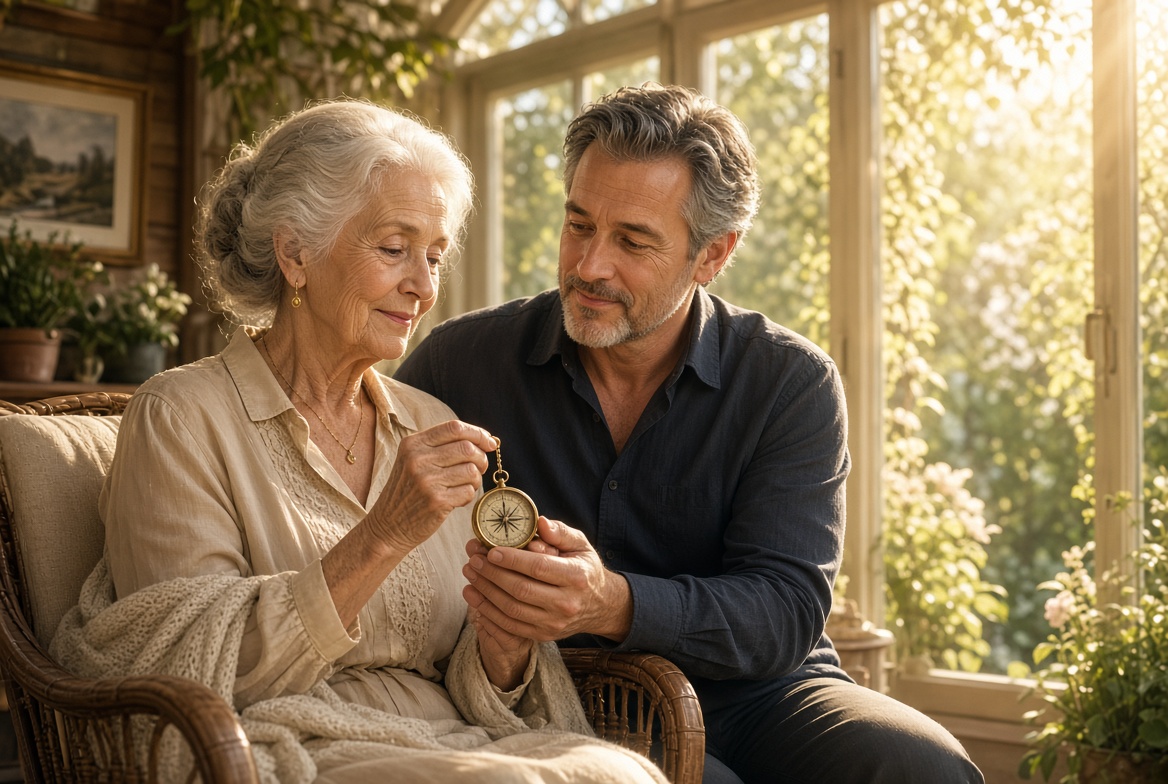
“You are my true north. Whatever happens, remember that I knew which direction I was facing.”
I folded the letter along its original creases and held it in both hands for a moment.
The woman in the bed did not speak.
She had read this letter before.
She knew what it said.
She was giving me time with it.
“What is the second letter?” I asked.
“The second one is for later,” she said. “When you need it more, you’ll know when.”
I put both letters back into the compass backing and pressed it closed.
I held the compass for a moment and then I handed it back to her, because it was hers.
“My name is Jean Monroe Hail,” she said. “I was born in Durham, North Carolina. I married your father, Robert Aldis Hail, at Calvary Baptist Church in Raleigh on a Saturday in June. You were present, though you won’t remember it because you were not yet three months old and you slept through the entire ceremony.”
I said nothing.
“I am not asking you to believe me without proof. I understand why you can’t do that simply on a name and a scar. I am only asking you not to send me away before the proof exists.”
I left her to rest and went to my study.
I sat at my desk for a long time before I did anything else.
The compass letters were still in my jacket pocket.
Harold, my father’s brother, dead now six years, a man I had always found cold and careful and efficient, had been the executor of my father’s estate.
He had been the one to call me from the hospital the day my mother died in the accident.
He had been the one to manage everything that followed.
I had never questioned it because he was family, because grief takes up the space where questions would otherwise live, and because he had always handled everything so thoroughly that there was never anything left to investigate.
I was thinking about the last line of the letter.
He means to have more than his share.
I was thinking about Martin Croft, who had been our estate attorney for the past eleven years and who had come recommended to us by Harold before Harold died.
I was thinking about the fact that I had never asked, in all those years, to see the original probate filings for my father’s estate.
I had signed documents.
I had received summaries.
I had trusted the process because I trusted the people managing it.
My executive assistant, Roz Archer, appeared at the study doorway at ten o’clock.
Twenty-two years with the company.
She had a quality of stillness about her that I had always trusted, the kind of person who does not speak unless she has something to say.
She stood in the doorway for a moment before coming in.
And when she sat down across from me, she folded her hands in her lap with a deliberateness that told me she was about to say something she had been holding.
“You already know, don’t you?” she said, not a question about who she was.
“I think I do,” I said.
“Then trust it.” She said it simply, the way she gave me most of her opinions, without decoration, without hedging. “You’ve been reading people in this industry for twenty-three years. You know what it looks like when someone is telling the truth. Trust what you’re reading.”
She left the room after that.
I sat alone for another half hour, turning the compass over in my mind.
I had thought all morning that what I needed was evidence.
What Roz was saying was that the evidence was already in the room.
I was simply waiting for permission to act on it.
That evening, Serena came to my study and closed the door behind her.
She sat across from me in the chair that clients used when they came to discuss contracts.
She folded her hands the same way she did in board meetings when she was about to present a position she had already decided on before walking in.
“I think we need a DNA test,” she said. “Before this goes any further.”
“She’s not asking for money, Serena.”
“No, she’s asking for something that goes far beyond money.” Her voice was even. “I’m not saying she’s lying. I’m saying we don’t know. And the responsible thing, for you, for the foundation, for everything we’ve built, is to establish the truth through a process that neither of us can argue with later.” She paused. “A physician can arrange it quietly. A week and we know.”
She was not wrong that certainty would matter.
That was the part that was so difficult about Serena in every conversation like this.
She was never entirely wrong.
She always had a portion of the right answer arranged around a center I couldn’t yet see clearly.
“Fine,” I said. “We do the test, but she stays here while we wait.”
Serena agreed.
She stood, smoothed her jacket, and went to bed.
I sat in the study for a while longer.
I thought about her hands folded in her lap, composed, certain.
I thought about Jean’s hands, one around the compass and one in her lap, equally still, but carrying a different kind of weight.
The weight of someone who has been very patient for a very long time and is trying not to rush the end of the story.
I did not sleep well.
But when I finally did, the compass was on my nightstand, and in the morning, I understood without quite saying it to myself that it was going to stay there.
Part 2
The Hail Foundation’s annual donor gala was held two nights later on the main floor of our Hillcrest home.
Forty-seven guests, catered by the same company we had used for eleven years.
Serena had chosen the menu, the music, the table arrangement, and the lighting design herself, as she always did.
The event ran as smoothly as it always did because Serena ran it and she had not yet, in my memory, allowed anything to be otherwise.
Jean came downstairs at Serena’s invitation.
I want to be clear that it was an invitation Serena had suggested it herself, which surprised me at the time.
She had said it was better than having Jean remain upstairs and become a subject of speculation among the guests.
Better to introduce her on their own terms.
She had said this so reasonably that I had agreed before I fully considered what their own terms might mean in practice.
Jean wore a navy dress that Roz had quietly found for her.
Her own things were in poor condition, and Roz had handled it without being asked, without making anything of it.
Jean carried herself the way a person carries themselves when they have been through things that cannot be undone and have decided to continue anyway.
She was not fragile.
She was not performing strength.
She was simply there, in the way of someone who has learned not to waste energy on pretense.
Serena introduced her to the room.
“This is Jean,” she said, her voice warm and carrying easily above the ambient music. “A woman Thomas encountered in a difficult situation this week. We’re supporting her while we determine the best path forward for everyone.” A pause, a smile that reached all the way to the appropriate corners. “Thomas has such a generous heart. We’re grateful to be in a position to help.”
The room absorbed this the way rooms absorb information quickly without questioning it.
Forty-seven people who trusted Serena’s assessment of any situation recalibrated around Jean in less than thirty seconds.
I watched it happen and said nothing.
Jean was seated at the far end of the second table.
A donor named Philip Weston, whose firm had been contributing to the foundation for seven years, leaned toward the woman beside him and said something I could not hear but could read by shape and angle.
His companion glanced toward Jean and then away with the particular kind of courtesy that is designed to look like it isn’t avoiding something.
A woman near the dessert arrangement asked the question outright, loudly enough to carry.
“So there’s a question of who she actually is.”
Serena answered before I could turn around.
“We’re being thoughtful,” she said. “That’s all. We care about protecting Thomas from situations that are emotionally complicated.”
I looked down the table at Jean.
She was holding her napkin in her lap and looking at nothing in particular, the middle distance between the table and the wall.
Not shutting down, just somewhere else.
I had seen that expression before.
I realized I had seen it on the faces of people who have learned to be in the room without quite being present in it, because presence costs too much when the room is arranged against you.
Roz was standing near the kitchen passage, half in and half out of the event.
She was watching Jean with the particular stillness of someone who is thinking very carefully about something and not yet ready to say it.
I caught her eye.
She looked away.
I went to Jean’s end of the table between the first and second courses.
I sat beside her for a few minutes and asked her about the music.
The foundation had selected a string quartet playing Ellington arrangements, which turned out to be a subject she had strong opinions on.
She talked about it quietly, with a precision that surprised the nearest guests into listening.
I watched one of them soften slightly before they remembered they had already decided what to think.
After the guests left, past eleven, I found Serena in the kitchen reviewing the cleanup schedule with the catering coordinator.
I waited until we were alone and then I told her what I had watched her do.
“I did not put Jean in a difficult position,” Serena said.
Her voice was level and certain.
“I gave her access to this room. I could have asked her to remain upstairs. You framed her as someone whose story needs to be verified in front of every donor we have because it does.”
She set down her pen.
“Thomas, I understand what you feel. I am not asking you not to feel it. I am asking you to see that what I am doing is protecting you. Protecting this foundation from what happens if the story doesn’t hold. If she is who she says she is, a week makes no difference. If she isn’t, a week saves us from a very public mistake.”
I had no answer for that that she would accept.
Not without the evidence I didn’t yet fully have.
I went upstairs to check on Jean before going to bed.
She was awake, sitting by the window in the guest room with the lights off, looking at the back garden in the dark.
“You don’t have to explain it,” she said without turning around.
“I’m sorry,” I said. “For tonight.”
“I have been called a problem by people in polished shoes before, Thomas.” She turned then and looked at me directly. “It has never once made me less of your mother.”
I sat on the edge of the chair near the window for a few minutes.
She told me unprompted that Harold had used almost this exact framing when speaking about her years ago, that she was a complication his brother had taken on that the family couldn’t afford.
That Harold had been saying some version of this since before my father died, and that my father had argued against it every time, right up until he didn’t have the time anymore.
I went to bed thinking about Harold, about Martin Croft, about the way the original estate probate had been handled by Croft’s predecessor at the same firm and had never been something I’d looked at directly.
In the morning, Serena came to the kitchen first.
She poured coffee.
She was wearing her weekend reading glasses, which meant she’d been up early reviewing documents.
She looked up when I came in and said, very calmly, as if reporting the weather:
“One of my pearl bracelets is missing from my vanity. The set from our trip to Savannah. I don’t want to make assumptions. I just thought you should know.”
She said it so quietly and reasonably that for a moment I simply nodded and poured my own coffee and did not say anything at all.
I didn’t say anything, but I noticed that she watched me very carefully as I processed the information.
She had the look of someone who has placed a document on a desk and is watching to see whether the right person picks it up.
The bracelet turned up the following morning.
One of the house staff found it during a sweep of the front hallway, inside the pocket of an old canvas jacket that hung on a hook near the door.
A coat I had seen Jean wear once, briefly, when she’d stepped out to the covered porch to get some air two afternoons ago.
Serena did not call it a theft.
She was careful about that.
She simply stood in the doorway of my study with the bracelet in her palm and looked at me with something that was arranged to look like sorrow rather than satisfaction.
And she said, “I think we have to acknowledge what this is.”
I went to Jean’s room first.
I knocked.
She was sitting at the small desk by the window, writing something in a notebook she’d asked Roz to find for her.
She looked up, and I showed her the bracelet.
I watched her face.
“I have not touched that coat since the morning I wore it to the porch,” she said. “I would not take something from your home, Thomas. I have been asking only for what is mine. Nothing more than that.”
Her hands resting on the desk did not move.
Her voice did not shake the way a person shakes when they are caught in a lie.
It shook the way a person shakes when they have told the truth all their life and have just come face to face with the possibility that the truth may not be enough.
I believed her.
I want to be clear about that.
In the room, in that moment, I believed her.
The problem was that belief and certainty are two different things, and Serena was very good at working in the gap between them.
I went back downstairs.
Roz was in the main hallway when I passed through.
She had been helping coordinate the weekly foundation deliveries and was moving a stack of folders toward the office.
She stopped when she saw me.
Something passed across her face quickly, like weather moving through.
“Roz,” I said.
“Mr. Hail.” A pause. She held the folders against her chest.
“Do you know anything about the bracelet?” I asked.
She held my gaze for a moment.
Then she looked down at the folders.
“No,” she said. “I don’t.”
She went into the office.
I stood in the hallway for a moment watching the door close behind her.
Something in the way she said it, not the word itself, but the slight downward movement before it.
The way the answer came a half-beat later than it should have.
It settled in my chest like a stone I couldn’t identify.
Martin Croft arrived that afternoon.
He came without being called, which told me he had been in contact with Serena before I knew he was coming.
He sat across from me in the formal sitting room with a folder on his knee and explained, in the measured cadence he used for difficult conversations, that there was a recommendation he needed to put to me.
A professional evaluation for Jean, cognitive and psychological, conducted at a private facility in Morsville.
And during that evaluation period, a temporary guardianship arrangement to ensure her well-being and protect all parties from decisions made under ambiguous circumstances.
He presented this as protection.
Protection for Jean, protection for me, protection for the foundation.
“She is a vulnerable adult,” he said. “Whatever the truth of her identity turns out to be, if you take on responsibility for her care without a formal structure, you expose yourself to significant legal liability.”
He put the folder on the coffee table between us.
I looked at it without picking it up.
“You have forty-eight hours to consider it,” he said, “but I would encourage you not to wait longer than that.”
After he left, I went to find Serena.
She was in the foundation office reviewing the upcoming board meeting agenda.
She looked up without any particular urgency.
“He came at your request.”
“He came because I asked him to look into what options were available.” Her voice was even. “Thomas, I am not trying to harm this woman. I am trying to give you a structure that protects everyone while we wait for results that will tell us what we’re actually dealing with. You signed the DNA consent yesterday. That takes a week. Forty-eight hours to decide on a temporary arrangement is not unreasonable.”
I went back to my study and sat for a long time looking at the folder on my desk where I’d set it after Croft left.
The bracelet, the evaluation recommendation, the guardianship papers.
I kept thinking about Jean’s hands still on the desk.
Not the hands of a guilty person.
Not the hands of a person who had learned to hide guilt, either.
I had spent twenty years in a business full of people who had learned that particular skill, and I could identify it.
What I had seen was something else.
The stillness of a person who had been in this position before, accused by context rather than by evidence, and who had learned to wait without breaking.
That evening, I went to Jean’s room with the compass in my hand.
I told her I needed to ask her something.
She set down the notebook.
“Tell me everything,” I said. “Not what I already know. Everything.”
She looked at me for a moment.
Then she opened the compass and took out the second letter, the one she had told me to wait for.
She set it on the desk between us.
“Read this first,” she said. “Then I’ll tell you the rest.”
It was in my father’s handwriting.
Shorter than the first letter, less polished, more urgent, the script of a man writing fast against a deadline he could feel.
He named Harold directly.
He wrote that Harold had been pressuring Jean for months to sign a financial power of attorney that would give Harold unilateral control over the family estate in the event of Robert’s death or incapacitation.
He wrote that he had refused to sign the companion document from his own side, but that he was afraid Harold would find a way around him through Jean, who trusted Harold because he was family and she had no reason yet not to.
He wrote: “If something happens to me before I can get this properly sorted, do not trust anything Harold brings to you. Do not sign anything. Go to Calvary Baptist and speak to Deacon Coleman. He knows where I’ve left what you’ll need.”
And at the bottom: “Jean, whatever happens. True north.”
I folded the letter slowly.
Jean watched me.
“After your father died,” she said, “Harold came to me within the week. He brought papers. He said they were standard estate documents. He said Robert would have wanted this handled quickly, and that a lawyer would be expensive and unnecessary for something this routine.” A pause. “I signed. I didn’t know yet what I had signed. I only knew I was alone and grieving and he was the only family I had left.”
She told me the rest in the measured way of someone who has told a story many times in her own head.
What happened after the accident.
Three months later, the facility in Rutherford County, the name in the admission records that was not hers, the months of disorientation, and the long years of trying to reach anyone who would listen.
The closed doors.
The people who looked through her because she had no paper trail connecting her to who she said she was.
I listened to all of it.
I did not interrupt.
When she finished, I sat with it for a long moment.
I was thinking about the letter.
I was thinking about Martin Croft, whose firm had been recommended to me by Harold, and whose predecessor at the firm had handled the original estate.
I was thinking about the Rutherford facility and whether I could find any record of it.
I was also thinking about the folder on my desk, the guardianship papers.
“I need a day,” I said.
She nodded.
She did not argue.
She picked up her notebook and went back to what she’d been writing, and I left her to it.
I went to bed that night knowing what I should do.
The problem was that I also knew what I was going to do, and the two things were not the same.
I lay there for a long time in the dark beside Serena, who was already asleep.
And I thought about my father’s handwriting and about Jean’s hands still on the desk and about the half-second pause before Roz said no.
None of it was enough.
That was the thing about being caught between two versions of a story.
The truth doesn’t always arrive with the weight it deserves in the moment when it matters most.
Part 3
I went to Jean’s room the next morning before Serena was awake.
Jean was already dressed, sitting in the chair by the window with the compass in her lap and the notebook open but untouched.
She looked at me when I came in, read something in my face, and put the notebook aside without comment.
She had been waiting for this conversation for more than thirty years.
She knew what it looked like when it was finally arriving.
“Tell me from the beginning,” I said. “Everything. All of it.”
She did.
She began with the accident itself.
A December evening, the highway outside Raleigh, a patch of ice that nobody had marked, a truck whose driver had been awake too long.
She had been driving home from a meeting at the church.
The accident was real.
She had been taken to a hospital.
She was alive.
What happened in the hospital was what Harold had arranged.
She had been, by her account, confused for the first days.
Head trauma, they told her, mild but disorienting.
When she surfaced enough to ask where she was, she was told she was in a care facility, a different facility than the one she remembered arriving at.
She had a wristband with a name she did not recognize.
When she tried to correct this, the staff were gentle and careful and told her the confusion was a normal part of recovery.
It went on for months.
By the time her mind was clear enough to understand what had happened, she had been placed in a long-term psychiatric unit under a name that was not hers.
When she asked to contact her family, her son, her son specifically, a man named Thomas Hail in Charlotte, she was told her records showed no family and that attempts to locate next of kin had been unsuccessful.
Harold had arranged all of it.
She did not understand the full shape of it until years later, when a social worker who was leaving the facility quietly told her she had a right to see the original admission documents.
The documents listed her under a false name.
The admission authorization had been signed by a family representative.
It bore Harold’s signature.
She was eventually released when the facility closed for financial reasons and its records were transferred to state custody.
By then, twenty years of her life had passed.
She had no documentation under her real name.
The social security records for Jean Monroe Hail showed her as deceased.
The estate had been settled.
Her death certificate had been filed in Rutherford County.
She had spent the intervening years in shelters, in church assistance programs, in the kind of sustained poverty that grinds people down to a residue of who they were.
She had written letters to addresses that no longer corresponded to anyone she knew.
She had tried government offices and been told there was nothing to verify her identity against.
She had gone to Charlotte twice and stood outside a building with Thomas Hail’s company name on it and not been able to bring herself to go in.
“Why not?” I asked.
“Because I was afraid,” she said. “That you knew I was alive and had chosen not to come. Harold could have told you anything. I was afraid that the reason no one had ever answered my letters was that you had read them and decided I was better off gone.”
I sat with that.
She told me she had found the station breezeway six weeks ago and had been living there because it stayed dry when it rained.
And because she had heard the building was going to be torn down soon, and she had wanted to see it one more time before it disappeared.
It was close to the neighborhood where I had grown up, and she had come to Charlotte on the chance of seeing the company name on a sign somewhere, and knowing at least that her son was still alive.
When she finished, the room was quiet.
Serena appeared in the doorway.
She had come down without making noise, which was unusual for her.
Serena moved through a house the way she moved through a board meeting, with intention and announcement.
This was something else.
She had been there long enough to hear the last portion of what Jean had said.
I thought she stood in the doorway with her arms at her sides and her face composed and unreadable.
“Jean,” she said, “I believe that what you have experienced is real. I believe that you have had a terrible time of it and that the people who should have helped you did not.” A pause. “I also believe that what you’re describing, if true, is an extraordinary claim that requires extraordinary verification. Not because I doubt your pain, because I love my husband and I will not stand by while he makes an irreversible decision based on an unverified account.”
She moved into the room and placed a folder on the end of the bed.
The guardianship papers, already flagged where signatures were required.
“Thomas,” she said, “I am asking you as your wife, not your opponent, to let a professional assessment proceed before we go any further. One week, that’s all.”
I looked at Jean.
She was looking at me with the expression of someone who already knows what is going to happen but has decided to let the other person arrive at it on their own.
I said, “Give me an hour.”
I went to my study.
I sat behind my desk.
I laid out the three things I was holding: my father’s second letter, the guardianship papers, and the compass.
I thought about my company.
Thirty-one years of building something.
The foundation, the upcoming board review.
Croft’s voice telling me about liability and structure.
Serena’s voice telling me she was protecting me.
The room of forty-seven guests rearranging themselves around Jean like water finding a new level.
The sound of Jean’s voice saying, “I was afraid you knew I was alive and had chosen not to come.”
I picked up the pen.
I want to tell you that I hesitated.
I did.
But I signed the papers anyway.
I signed them because I was afraid, not of Jean, but of the space between what I believed and what I could prove, and of what would happen to everything I had built if I chose wrong.
I signed them because Serena was in the room, and the room had always tilted in her direction, and I had never found a way to stand upright against that tilt without more ground under my feet than I had at that moment.
I signed them because I was a coward that morning, and I knew it while I was doing it, and I did it anyway.
The transport came the next morning.
Jean was ready.
She had packed the small bag Roz had put together for her.
She had very little.
There was not much to pack.
She carried the compass in her coat pocket.
At the door, she stopped and looked at me.
She did not try to argue or beg or remind me of the letters.
She just looked at me with the patience of someone who has been patient for longer than most people have had to be.
“I walked away from you once because I had no choice,” she said. “Don’t do this unless you can live with it.”
I said nothing.
The car drove away down the hill.
I stood at the window for a few minutes and then I went to the office because I did not know what else to do.
I sat at my desk for four hours and did not sign a single document.
I could not look at any of it.
That evening, Serena believed I was in a meeting.
I wasn’t.
I drove past the transit hub on Tryon Street.
It was raining again.
The covered breezeway was empty.
I parked across the street and sat there for a long time with the engine running, looking at the place where I had found her, thinking about what she had said about walking away because there was no choice.
When I drove home, Serena was on the phone in her private office.
The door was open just enough that I could hear her voice, not the words, but the tone.
Brisk, certain, the voice she used when she was giving instructions rather than having a conversation.
I stopped walking and stood in the hallway.
I heard her say, “She’s gone. We need to move the reserves before the board meeting next month.”
I stood in the hallway for a moment after the voice stopped.
Then I turned around and went back to my study and closed the door.
Four days passed.
I went to the office every morning.
I signed documents, sat in meetings, spoke to contractors, reviewed site projections for a project in the warehouse district that should have had my full attention.
I did none of it well.
My site manager asked me twice if I was all right.
I told him I was fine.
He had known me long enough to know that was not an answer.
I kept thinking about Jean’s last words.
Don’t do this unless you can live with it.
I was finding that I could not.
Not completely.
Not even close to completely.
On the fourth afternoon, Roz came to my study and closed the door.
This was unusual.
Roz operated on a principle of efficiency.
She did not close doors unless a conversation was going to require it.
I watched her cross the room and sit down across from me, and I noticed that her hands, usually so precise with folders and devices and the tools of managing a complicated schedule, were folded in her lap without anything to hold.
“I have to tell you something,” she said. “I have been not telling you for five days, and I can’t keep not telling you.”
I waited.
“The bracelet,” she said. “I saw her put it in that coat. Two mornings before it was reported missing. I was in the hallway. I was coming from the guest suite with a delivery, and I saw Serena go to that coat on the hook by the door and put the bracelet into the pocket. I watched her do it. I knew what it was going to be used for.”
I looked at her for a long moment.
“And you didn’t say anything.”
“No.” She didn’t look away. “I needed my job. I told myself I must have misread what I saw. That surely she wouldn’t do that. That there was some other explanation. And every day I stayed quiet, it became harder to say something, because the longer you wait, the more it looks like you were choosing silence. And that is exactly what I was doing.”
She steadied her voice.
“I am sorry. I should have told you immediately. I didn’t. And that was cowardice, not caution. And I want you to know I understand the difference.”
I sat with that for a moment.
“Is there anything else?”
“There may be more,” she said. “But I needed to know if you want me to look.”
I did.
I asked Roz to go to the Charlotte courthouse and pull the probate records for my father’s estate.
Not through Croft’s firm, not through any channel that touched Serena’s operations, but directly, independently, as a public document request.
She could do that without raising any flags.
She had done similar document research for the company before.
It was within the ordinary scope of due diligence work.
She came back the following morning with a printout and set it on my desk without comment.
The death certificate for Jean Monroe Hail was filed in Rutherford County, not Charlotte County, where the accident had occurred.
It was dated three months after the accident.
It had been signed not by a hospital physician, but by the administrator of a private facility, a facility I had never heard of, whose administrative records were listed in the probate filing as having been managed by a law firm.
The name of the firm was Wentworth and Croft LLP.
Martin Croft had become the sole named partner of Wentworth and Croft after the original partners retired.
His firm had handled our estate administration for eleven years.
His predecessor at the firm had been managing the Hail family’s legal affairs for nearly forty years.
I read this twice.
Then I set the printout down and looked at the wall.
“There’s one more thing,” Roz said.
She was still standing by the desk, still holding herself in that precise, careful way.
“I was looking at the old administrative infrastructure while I was pulling the estate records. The house on Hillcrest has a backup security server. It’s a legacy system from before the Foundation took over building operations. It predates Serena’s management of the Foundation systems by about six years.”
I looked up.
“If that server is still running,” she said, “it may have footage that the primary system doesn’t.”
I told her to find out.
Then I called the Morsville facility and asked to speak with the attending physician assigned to Jean Monroe Hail.
I was told she was stable, resting, and had been quiet since arrival.
I asked whether she had been told when she might leave.
The physician very gently said, “That would depend on the evaluation timeline and the decisions of the legal guardian of record.”
I thanked him and ended the call.
I sat at my desk after that and thought about a man named Harold Hail, whom I had always thought of as cold and careful and thorough, and whose thoroughness I was beginning to understand in a new and very specific way.
Harold had managed my father’s estate.
Harold had recommended Martin Croft.
Harold had handled everything so completely that there was never any gap for me to look through.
And Harold had been dead for six years, which meant the only living person who had full access to what Harold had done and had chosen not to tell me was sitting downstairs in the foundation office reviewing a board meeting agenda.
I picked up the compass from my desk.
I turned it over in my hand.
I pressed the back plate and heard the small click of the hidden compartment opening.
It was empty now.
I had taken out the letters and stored them safely.
But the compartment itself still worked.
My father had built that into it deliberately.
A hidden place that no one would look because it didn’t look like it had a hidden place.
He hid things in places nobody thought to look.
Jean had told me he learned that from losing things nobody thought to protect.
I closed the compass and put it in my jacket pocket.
I thought about Roz standing at the door of my study five days ago, saying no, and the half-beat pause before the word.
I thought about what it had cost her to come back and say what she’d actually seen.
I thought about what it had cost her to stay quiet in the first place.
Then I went downstairs to find out whether the backup server had footage we could recover.
Roz met me in the corridor outside the building’s utility room an hour later.
Her face, which had been carefully neutral all morning, shifted slightly when she turned toward me.
“It’s there,” she said. “The footage from the week of the bracelet incident. It hasn’t been overwritten. The primary system was updated during the foundation’s infrastructure upgrade three years ago, but this server, it runs on an independent power loop. It kept recording. Serena’s upgrade never touched it because as far as the upgrade team knew, this server had already been decommissioned.”
I stood in the utility room hallway for a moment.
“Pull it,” I said. “All of it.”
She did.
It took two hours.
When she brought the drive to my study and we played the relevant footage, we watched Serena walk to the coat hook in the hallway, take the pearl bracelet from her jacket pocket, and drop it into the canvas coat that Jean had worn to the porch.
The timestamp read two mornings before Serena reported the bracelet missing.
I watched it twice.
The second time, I stopped it and sat for a long moment with the still frame on the screen.
I was not angry yet.
What I felt was quieter and colder than anger, the feeling of seeing in a single image the full dimensions of what I had agreed to be complicit in.
I had signed those papers.
I had done it with doubt in my chest and hope in the letter on my desk, and I had signed them anyway because I was afraid.
And the person I had deferred to had known the whole time that the bracelet was not Jean’s doing.
She had arranged that reality herself.
I saved the footage to two locations.
One on a drive in my desk, one in the cloud backup service the company used for sensitive documents, registered under my private credentials.
Then I called the Morsville facility and left a message for the attending physician.
I told him to make a note in Jean’s file that I would be coming to collect her within the week, and that any further decisions about her placement would require my direct authorization, not Martin Croft’s.
And then, for the first time in four days, I felt something that was not just waiting.
I felt like I was moving.
Part 4
The call came from Petra Lennox at 7:15 on a Wednesday morning.
I had not spoken to Petra in nearly two years.
She was the daughter of Harold’s first marriage, my cousin technically, though we had never been close.
And since Harold’s death, the connection had grown thinner still.
She was forty years old, a landscape architect in Asheville, and she had been dealing with Harold’s estate piece by piece, the way you deal with a large man’s accumulated life when there is no clear order left for any of it.
“I found something in the storage unit,” she said. “I don’t know what to do with it.”
She described a metal box, sealed and labeled in Harold’s handwriting.
Robert Estate. Jean. Do not discard.
“I didn’t open it at first,” she said. “I almost set it aside, but something about the label, the fact that he wrote it at all and then wrote do not discard. I opened it.” A pause. “Thomas, I think you need to see what’s inside.”
She drove to Charlotte the same day.
I met her in the parking structure beneath my office building because I did not want Serena to know she was there.
We sat in Petra’s car.
She set the box on the center console between us.
I have worked in a business that deals in the material weight of things for thirty years.
Concrete, steel, timber.
I understand the physics of load-bearing.
But I was not prepared for what it felt like to open a cardboard box in a parking structure and have the last thirty years of a false story simply end.
Inside: Harold’s signed commitment order for Jean Monroe Hail, admitting her under the name of a person who did not exist, to the Rutherford facility.
A payment receipt from Harold’s personal account to the facility administrator.
Letters between Harold and a man named Wentworth, the founding partner of what would become Croft’s firm, discussing the matter with a bureaucratic calm that was more disturbing than anger would have been.
And beneath all of that, separated from the rest by a thin sheet of paper, a note in handwriting I recognized.
Serena’s.
Dated five years ago.
Keep this separate. Don’t mention to T.
I read it twice.
I read it a third time.
Petra was watching me.
She had known Harold as her father and had no illusions about who he had been.
She had told me once, years ago, that growing up with Harold was like growing up near a machine that performed the functions of a parent without quite having the warmth required to be one.
She did not seem surprised by what was in the box.
She seemed sad in the particular way of someone who had suspected the shape of a thing for a long time and is now looking at the shape confirmed.
“She knew,” I said.
Petra said nothing.
“Serena found this box five years ago.” I held the note. “She read it. She understood what it was, and she kept it. For five years she knew my mother was alive and she said nothing.”
“Yes,” Petra said. “That’s what I thought when I saw it.”
I set the note down on top of the other documents and looked at the box for a long moment.
The parking structure was quiet except for the occasional sound of a car moving through the levels above us.
The fluorescent light overhead was very even and very cold.
Five years.
During those five years, Jean had been on the street.
Jean had been in shelters.
Jean had been sleeping in the covered breezeway of an old transit station and living without an identity that anyone would accept.
During those five years, Serena and I had attended fourteen foundation galas, hosted twenty-two donor dinners, and managed a twenty-million-dollar endowment that I was beginning to understand had been built on the financial proceeds of a lie.
An insurance payout on a death that had not happened.
“Why didn’t she tell me?” I said, though I already knew.
The answer was in the financial records I was going to look at next.
In the offshore transfers Roz had flagged, in the pattern of a person protecting something larger than a secret.
Petra opened her hands in her lap.
“I can’t answer for her,” she said. “I can only tell you what I found.”
I gathered the documents into the box and closed it.
I held it on my knee for a moment.
“I’m sorry,” Petra said. “For my father. I don’t know if that changes anything.”
“It doesn’t change what he did,” I said. “But I appreciate that you brought this to me instead of putting it back on the shelf.”
“I thought about that,” she said, “for about twenty minutes. Then I decided that a wrong that nobody ever names just becomes a piece of furniture.”
I thanked her.
I got out of the car with the box under my arm.
I went up to my office and called Roz.
She appeared within three minutes.
I set the box on the conference table and went through the contents with her methodically, the way we would go through a contract that had problems.
Each page, each document, noting the dates, the names, the institutional connections.
“The Rutherford facility,” Roz said when we reached the payment receipt. “That’s the same facility that administered the death certificate we found in the probate records.”
“Yes.”
“And Wentworth, the man Harold was writing to, was Croft’s predecessor at the same firm.”
I turned the correspondence over.
“Croft has been our attorney for eleven years,” I said. “He was managing this arrangement when he came to us. Everything I have ever trusted him to handle, every estate decision, every legal structure for the foundation, he knew the whole time.”
Roz sat back in her chair and said nothing for a moment.
“The note,” she said finally.
She was looking at Serena’s handwriting on the small sheet of paper.
“She found this five years ago.”
“Yes.”
“She knew Jean was alive.”
“Yes.”
Roz looked at the note for another long moment.
Then she said, “The offshore reserve transfers I flagged last week, the ones I couldn’t account for in the foundation’s standard operating budget.”
“That’s how she was planning to protect the money before anyone started asking where it came from,” I said.
We looked at each other across the conference table.
“She’s calling an emergency board meeting,” Roz said. “She sent the notification this morning. She’s framing it as a mental health concern about you, that you’ve been making decisions under emotional distress and the foundation needs temporary protective oversight.”
I had not checked my email.
I had been in the parking structure with Petra.
“When is the meeting?” I asked.
“She’s called it for day after tomorrow. Eleven in the morning.”
I looked at the box on the table, at my father’s letters, at Harold’s signature on the commitment order, at Serena’s handwriting.
Don’t mention to T.
“Then we have thirty-six hours,” I said.
“Yes,” said Roz. “We’re going to use them.”
I drove to Raleigh alone.
I had not been to Calvary Baptist Church in nearly twenty years.
My father had directed the choir there for twelve years, and I had grown up watching him from the third pew every Sunday, understanding the music before I understood the words.
After he died and I moved to Charlotte to build the company, the church had become one of those places that existed more in memory than in geography, present in the way childhood places are present, specific and unchangeable and somehow farther away than the miles actually account for.
The church was still there.
That was the first thing I noticed.
Not that it was smaller than I remembered, which it was, but that it was still standing at all, still on the same corner with the same white paint and the same slightly crooked cross above the entrance that had been slightly crooked my entire childhood and apparently had continued in that vein.
Father Deacon Coleman was seventy-two now and moved more slowly than I remembered, but his eyes were the same, a clear, unhurried brown that gave you the impression he had already considered most of what you were about to say and had arrived at a position about it before you sat down.
He met me in the small office off the main vestibule and offered coffee from a thermos that appeared to have been made hours ago.
I accepted it.
We sat.
“Your mother,” he said before I’d finished explaining why I had come.
I stopped.
“I’ve been wondering when you’d come,” he said. “I was sorry not to reach you sooner.”
He cleared his throat.
“After the accident, I tried for a while to find out what had happened to her. The hospital in Raleigh told me she had been transferred to a specialist facility. Then the trail stopped. When I asked Harold, he was the one handling the estate, he told me she had not survived.”
He folded his hands on the desk.
“I believed him. He was family and I had no reason not to. But I want you to know I did try to find out.”
He told me that Robert had come to him with the sealed box perhaps six months before he died.
Robert had said he was worried about Harold, specifically about what Harold would do if Robert died before he had time to properly restructure the estate through an attorney he trusted.
He asked Coleman to keep the box and give it to Jean or to Thomas, whichever one came first, if he ever died without having resolved the situation on his own terms.
“Did you ever hear from my mother?” I asked.
“No. And I looked, Thomas. I made inquiries through the diocese, through the women’s shelter network, through the hospital, and eventually I stopped because I had been told she was gone and there was nothing left to look for.” He paused. “I should have looked longer.”
He retrieved the box from a storage room off the side corridor.
It was a fireproof metal box, exactly as Jean had described it.
Small, sealed, with a combination lock whose numbers my father had sent to Coleman in a separate envelope, which Coleman had kept in his filing cabinet for three decades.
The numbers were my parents’ wedding anniversary.
I knew them.
The box opened on the first try.
Inside: my father’s letter, longer than the ones inside the compass, in the same careful script, explaining Harold’s behavior in full detail over several pages.
Specific conversations, specific financial demands, specific threats Harold had made when Robert refused to cooperate.
A copy of Jean’s admission records from the Raleigh Hospital, her real name, her real date of admission, the transfer notation to a specialist facility, documentation that proved she had been alive and physically present in the hospital system under her own name before Harold redirected her.
A handwritten note in Robert’s handwriting confirming that he had arranged Jean’s first two months at the Rutherford facility himself, paying directly because Harold had offered to handle it and Robert did not trust Harold to handle it in the way he intended.
And then, in a separate envelope, a notation in Robert’s hand: the name and phone number of a woman named Patricia Oakey, a physician he trusted, who had agreed to serve as a backup contact if anything went wrong and neither Robert nor Jean could be reached.
I read all of it slowly, there in the small office, while Coleman sat across from me and did not speak.
When I finished, I sat for a moment with the papers in my lap.
“He tried,” I said. “He ran out of time.”
Coleman said, “That’s not the same thing as not trying.”
“No,” I said. “No, it isn’t.”
Coleman agreed to provide an affidavit, a formal statement confirming everything he knew.
That he had known both Robert and Jean Hail personally for over a decade.
That he had held the box at Robert’s request.
That he was prepared to testify in any legal proceeding to the facts of what he had been told and what the documents contained.
He also confirmed that he had blessed the compass pendant at a Sunday service years before I was born.
That he remembered it specifically because Robert had made a point of having it blessed, which was unusual even for a man who took his faith seriously.
He could identify the pendant from memory.
I drove back to Charlotte with the box on the passenger seat and Coleman’s signed affidavit in my jacket.
The highway was clear and the afternoon was going gray at the edges when my phone rang through the car speakers.
Roz.
“The offshore transfer,” she said. “Serena initiated it last night. A half million from the foundation’s offshore reserve account to a holding structure in a name I don’t recognize.”
“Can it be stopped?”
“I have co-signatory authority on the foundation’s primary accounts. That extends to the reserve account under the operating agreement Serena herself set up two years ago because she needed a backup signatory. I don’t think she ever thought I’d use it.” A pause. “I froze the transfer forty minutes ago. It will hold for seventy-two hours before the system automatically processes it.”
“Then we have seventy-two hours.”
I glanced at the box beside me.
“It’ll be enough, Thomas.” Her voice was careful. “She’s going to know I froze it, probably within the hour.”
“Good. Let her know.”
I ended the call and drove the last twenty miles with both hands on the wheel and my mind working through the sequence of what had to happen in the next thirty hours.
The foundation board, the evidence, the order in which everything needed to be presented and by whom.
The legal filings that would need to be in motion by the time the board meeting ended.
And Jean.
I needed to go to Morsville.
I pulled into the driveway of the house a little after seven.
Serena’s car was in the garage.
The foundation office lights were on.
I did not go in.
I went directly to my study, locked the door, and called the Morsville facility.
I left a message I was certain they would relay.
I would be coming to collect Jean Monroe Hail personally in the morning.
Any attempt to prevent that through the existing guardianship paperwork should be understood as a legal matter that I was prepared to contest immediately.
Then I called Elaine Marsh.
Elaine was sixty-four and had been on the foundation board for nine years.
She had worked in nonprofit financial oversight for thirty of those years before joining the board.
And she was the kind of person who asked the questions that made fund managers slightly uncomfortable and then waited with complete patience until they were answered.
I had always respected her.
So had Serena, which was why Serena had never managed to maneuver her off the board, despite several attempts to restructure the committee.
“I need an hour of your time tonight,” I said. “Off the calendar. My office.”
She came at eight.
I showed her the documents.
I showed her Coleman’s affidavit.
I showed her the offshore transfer record and Roz’s freeze, and the shell company pattern that Roz had mapped from the foundation’s ledgers over the past three years.
Elaine went through it all with the same unhurried attention she brought to everything.
She asked three questions, specific, financial, the kind that told me she had already seen the shape of what I was showing her and was confirming the details she needed.
When she was done, she closed the folder and looked at me.
“She called the board meeting,” Elaine said. “I received the notification this morning.”
“I know.”
“She framed it as a wellness concern.”
“I know.”
“Then I’ll chair it instead,” Elaine said. “And I’ll have a different agenda ready when she walks in.”
She picked up the folder.
“Get some sleep, Thomas. You need to be clear in that room tomorrow.”
I thanked her and walked her to the door.
After she left, I stood in the quiet of the house for a moment.
Somewhere upstairs, Serena was in her office.
I could see the light under the door.
I did not go up.
I went back to my study and sat until past midnight, going through the order of presentation one more time, making sure every document was where it needed to be and every connection was traceable to its source without any single piece of evidence that relied on only my account of events.
The compass was on my desk.
I picked it up and held it for a moment, the way you hold something when you need to remember what you’re doing this for.
Then I went to bed.
Part 5
In the morning, I drove to Morsville and brought Jean home.
Jean was ready when I arrived at the Morsville facility.
I had called ahead.
The staff were cooperative.
The attending physician had reviewed the legal situation and understood that the guardianship arrangement was under active challenge and that my arriving to collect Jean was well within the bounds of what I had the right to do.
He was clear-eyed about it and professional, and I thanked him for treating her with care during the days she had been there.
She was sitting in a chair near the window of the common room with the compass in her lap when I found her.
She was wearing the same navy dress Roz had found for her.
Someone on staff had laundered it.
She looked up when I came through the door, and her expression did not change the way most people’s expressions change at news they have been waiting for.
She did not smile.
She did not reach out.
She just looked at me steadily, the same way she had looked at me from the breezeway, with the patience of someone who has been measuring her hope very carefully for a very long time.
“I came to bring you home,” I said.
She stood.
She picked up the compass and put it in her coat pocket.
She said, “All right.”
We walked out together.
We did not speak much on the drive back.
Somewhere past the edge of Morsville, she looked out the window at the last of the November color in the trees and said, “Are you doing this because it’s right or because you’re angry?”
I thought about it honestly before I answered.
“Both,” I said. “Is that enough?”
She was quiet for a moment.
“It’s a start,” she said. “It’s a start.”
I drove.
The road was clear.
The compass was in her pocket, and I could see the slight weight of it there, the familiar shape of something that had been carried for thirty years.
I did not take her back to the house first.
I drove to Croft’s office.
I left Jean with Roz in the parking level and went up alone.
Croft’s assistant tried to stop me in the reception area.
Mr. Croft was in a meeting, and I told her that what I had in my hands superseded the meeting and that Martin Croft would want to know I was there before the meeting continued.
The assistant made a phone call.
Thirty seconds later, Croft appeared at the door to the conference room and looked at the box I was carrying.
We went to his office.
I set the box on his desk and let him open it.
He went through it with his professional composure completely intact, which I had expected.
Croft was a very good attorney, which meant he was very good at absorbing information without revealing that it was affecting him.
He went through Harold’s commitment order, the payment records, the correspondence with Wentworth.
He picked up Serena’s note last and read it and set it back down with the same even attention.
When he was done, he looked at me.
“Your mother was in a vulnerable situation after Robert died,” he said. “Harold believed he was acting in the best interests of everyone involved. I’m not going to pretend that justifies what the documentation shows, but I want you to understand that the intention was to remove your mother from the picture so Harold could manage the estate unilaterally.”
“The intention is documented in the correspondence you just read,” I said. “Don’t present it to me as protective.”
A pause.
“Wentworth was the partner of record,” Croft said. “I inherited the client relationship when he retired. I was aware that there were certain administrative arrangements associated with the estate that predated my tenure, and you maintained them.”
He said nothing.
“Your fee arrangement with Serena,” I said. “The one in Harold’s papers, the arrangement that carried over when Wentworth retired and you took the account. The one that required you to keep the estate irregularities undisclosed as a condition of the ongoing relationship.”
He looked at the desk.
“I will be presenting this material to the foundation board in approximately three hours,” I said. “I will also be filing a referral to the North Carolina State Bar this afternoon. If you have anything to say in your own defense that might be relevant to those proceedings, I would suggest you contact your own attorney before the day is out.”
I collected the box and left.
I drove to the house.
Roz brought Jean inside and got her settled in the east guest room again.
I did not see Serena.
Her car was gone and the foundation office was locked.
She would be preparing for the board meeting.
She expected to control it.
At 10:30, Petra Lennox arrived.
She had agreed when I called the night before to be present at the board meeting and to provide her testimony about the storage box and how she had found it.
She sat in my study with a cup of coffee and was quiet and steady in the way of someone who has already made her decision and is now simply waiting to carry it through.
At 10:45, Roz confirmed the DNA results had been returned to the physician who had processed the test.
I had arranged this when Jean arrived nine days ago.
The physician confirmed the match.
Jean Monroe Hail was Thomas Hail’s biological mother to a statistical certainty that left no room for ambiguity.
I noted it.
I did not feel what I expected to feel.
The confirmation had become, somewhere in the last forty-eight hours, a formality.
I had known before the test told me.
That was the strange part.
The certainty arrived before the proof, and the proof simply confirmed what was already true.
At 11:00, we drove to the foundation offices.
Serena was already there.
She was standing at the head of the long conference table in the boardroom with three board members seated and Elaine Marsh at the far end.
When I walked in with Petra and Roz behind me, Serena’s expression did not change.
But her eyes moved across the people I’d brought with me, and I watched her calculate.
She had prepared for a wellness intervention.
She had prepared to sit at the head of a table and present a narrative about an emotionally compromised husband making decisions beyond his capacity.
She had not prepared for what was actually in the room.
Elaine Marsh looked up and said, “Good morning, Thomas. I’ll be chairing today. We have some documents to go through.”
Serena turned to Elaine.
“Elaine, I called this meeting.”
“I know why you called it,” Elaine said. “And we’ll come back to your agenda after Thomas has presented what he’s brought.”
She looked at me.
“Whenever you’re ready.”
I set the box on the table.
I went through it the way I had gone through a thousand project presentations, methodically, in order, with the supporting documents laid out where they could be seen and verified by anyone in the room who wanted to look.
Harold’s commitment order, the payment records, the correspondence with Wentworth, Croft’s ongoing fee arrangement.
Father Coleman’s affidavit confirming he had known Jean personally, had held the box at Robert’s request, and could identify her by the compass pendant Robert had given her.
The hospital records under Jean’s real name, proving she had been alive and admitted to a real facility under her own identity before Harold switched her name in the system.
The estate insurance payout records, the payout that had seeded the foundation’s endowment, which was itself tied to a death certificate signed by a facility connected to Harold and Croft’s predecessor.
And then the backup security footage.
I played it without comment.
The timestamp, Serena’s hands, the bracelet going into the coat pocket, two mornings before it was reported missing.
I played it once.
The boardroom was very quiet.
Then I placed Serena’s note on the table.
The note from Harold’s box, in her handwriting, dated five years ago.
Keep this separate. Don’t mention to T.
“I said my mother was alive,” I said. “She has been alive for thirty years. She was in this city for weeks before I found her sleeping on the ground outside a station my company held the demolition permit for. My wife found documentation of this five years ago and chose not to tell me. The foundation’s endowment was built in part on a financial instrument, an insurance payout tied to a death that did not occur. The offshore transfers initiated this week represent an attempt to protect those funds from an audit that was becoming increasingly likely.”
I looked at Serena.
“The DNA results confirm Jean Monroe Hail is my mother,” I said. “Though I expect everyone in this room already understands that proof is not the part of this that matters most.”
Serena stood at the head of the table.
Her composure was still present, though it had changed quality.
It was no longer the composure of someone who controls a room, but the composure of someone who is deciding how to leave one.
“I built this foundation,” she said.
Not an excuse.
Something smaller than that.
An accounting of labor that had cost her something.
“I built all of it.”
“You built it on a lie,” I said. “A lie that cost my mother thirty years. That’s not a legacy. That’s a debt.”
Elaine Marsh picked up the documents.
She reviewed the offshore transfer records and set them down.
She looked at the board members on either side of her.
“I’m moving to freeze all foundation accounts pending an independent audit,” she said, “and to remove the sitting director from operational authority pending the outcome of that review.”
The vote was unanimous.
Serena left the board meeting without raising her voice.
I had expected, in some version of how I imagined this moment, that there would be a scene.
Twenty-three years of marriage, eighteen of them, to a woman who had built the Hail Foundation from a seed fund and a borrowed conference room into something that legitimately helped people, and who had also, when it served her purposes, helped herself.
I had expected the ending of something that large to require volume.
It didn’t.
She stood at the table while Elaine moved through the administrative steps.
She listened, and then she picked up her folder and walked out of the conference room and down the corridor and through the front door, and the only sound was the soft close of the door behind her.
Roz met me in the hallway afterward.
She did not say anything.
She didn’t need to.
She had been with me through twenty-two years and four significant crises, and she understood that the appropriate response to some things is simply to be present and not fill the space.
We drove back to the house.
Jean was in the sunroom when we arrived.
She had found it that morning while I was gone.
The long room off the back of the house that faced east and caught the morning light in a way the rest of the house didn’t.
She was sitting in one of the old chairs with the compass in her lap and a cup of tea on the table beside her.
She looked up when I came in.
“How did it go?” she asked.
“The way it needed to,” I said.
I sat down across from her.
For a moment, we just sat there in the morning light, which had the particular quality it gets in November in North Carolina, thin and gold and honest, without the weight of summer.
Martin Croft’s referral to the North Carolina State Bar was filed that afternoon, with copies of the fee arrangement documentation and the estate irregularities to which he had been party.
The foundation accounts remained frozen pending the outside audit, which would take three months to complete.
The offshore transfer Roz had frozen was reversed into the foundation’s domestic accounts during the first week of the audit and tagged for review.
The insurance payout that had seeded the foundation’s endowment, the payout tied to Jean’s false death certificate, was identified in the audit as an instrument that required resolution through the estate correction process.
The probate attorney I retained to begin Jean’s legal restoration filed the petition for correction of the death certificate the following week.
Father Coleman’s affidavit, the hospital records under Jean’s real name, the documentation from Robert’s box, and the DNA results together made the evidentiary record strong enough that the Rutherford County Court issued a preliminary correction within thirty days.
The final correction took another two months.
Legal processes do not move at the speed of truth, but it moved, and it concluded.
And at the end of it, Jean Monroe Hail had a valid social security record, a corrected death certificate that now read “Error: person is living,” and a state-issued identification card that bore her actual name and her actual face.
She held the identification card for a long time the day it arrived.
She did not say anything.
She ran her thumb across her own name on the laminate the way you touch something you have waited very long to touch.
“First time in thirty years,” she said finally.
“I know,” I said.
“I used to imagine what I would feel,” she said. “I thought I’d cry or laugh or feel something big.”
She set the card down on the table.
“Mostly, I just feel like myself.”
Serena and I completed the separation agreement in January.
We had not lived in the house together since the board meeting.
She had gone to stay with her sister in Greensboro the day after, and we had conducted the process through attorneys.
There was no shouting.
There was, in the end, very little of anything except two people arriving at the legal terminus of a road they had been on in some form for several years already.
I do not hate her.
I understand her, which is different.
Petra came to Charlotte twice in the following months.
She and Jean discovered a shared interest in the kind of old gospel music that neither of them could fully explain their attachment to.
And they would sometimes sit in the sunroom together on Sunday mornings with the record player on.
I would pass the door and hear them talking about songs the way people talk about things that have been in the background of their whole lives and only recently moved to the foreground.
Roz was named to the interim board of the restructured foundation.
She served as the administrative bridge during the audit and the board reconstitution.
And when the new director was selected, she worked for a month alongside them to transfer the institutional memory she had been carrying in her head for twenty-two years.
She told me once that transferring all of that felt like finally being able to put down a very heavy bag.
I told her I wished she had put it down sooner.
She said she hadn’t known she was allowed to.
We built the Thomas and Jean Hail Foundation for Family Reconnection on the east side of the old transit hub on Tryon Street.
The building I had come to walk the morning I found Jean.
The building I chose not to demolish.
We kept the structure and renovated the interior: legal services for elderly individuals whose identities had been severed or falsified, emergency housing units in the renovated rear section, and a records assistance program that helped people navigate the specific bureaucratic maze of proving who they are when the paper trail has been deliberately disrupted.
The fund was named in both our names, and Jean’s full name appeared on every piece of letterhead and signage the fund ever produced, because there had been enough of her years spent in places where her name did not exist in any official register, and I did not intend to add to that count.
At the dedication, Jean was asked to say a few words.
She stood at the small podium with the compass around her neck on a chain now, worn openly, and she said:
“I am not going to tell you that what happened to me was the worst thing that can happen to a person, because I have met people for whom it was only the beginning of worse. What I will tell you is that there is a particular kind of invisibility that comes from having no documentation of your own existence. And there is a particular kind of visibility that comes from having someone hand you a card with your name on it and say, ‘This is you, and we can prove it.’ That is what this fund is for. That is all I have to say.”
She stepped down from the podium and came to stand beside me.
She put the compass in her palm for a moment, turned it over, and pressed the back plate.
The hidden compartment opened.
She looked at it, empty now, the letters long since removed and kept elsewhere.
And then she closed it again.
“You know what I think about sometimes?” she said.
“What?”
“That first morning you were about to walk past. I could see you starting to walk past.”
“But I didn’t.”
“No,” she said. “You didn’t.”
I thought about what she had said in the car from Morsville.
It’s a start.
And about the compass on the windowsill of the sunroom, catching morning light.
And about the framed wedding photograph on the wall that now had two photographs beside it: one of Robert and Jean, and one I had taken on a Sunday morning of Jean in the sunroom with her tea and her record player, the compass around her neck, and the November light coming through the east window.
The story I had built my life on had been a lie chosen for me by someone else.
The story I was building now was my own.
If you have someone you’ve been meaning to call, someone you’ve let too much time go by with, don’t wait to find the right moment.
There’s rarely a right moment.
There’s only the morning you decide to stop walking past.









