He Found a Starving Pregnant Dog Under His Barn… Then Four Puppies Changed Everything
had buried two things in the same year: his wife and his belief that anything in this world could be trusted to stay.
By February, Garrett Cole had become a man who preferred his coffee black, his conversations short, and his Montana property empty enough that he could hear the snow falling against the windows.
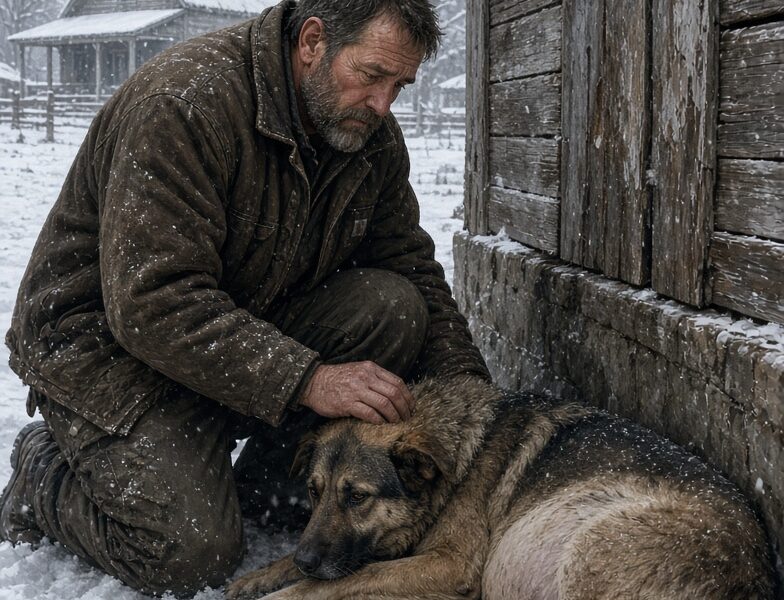
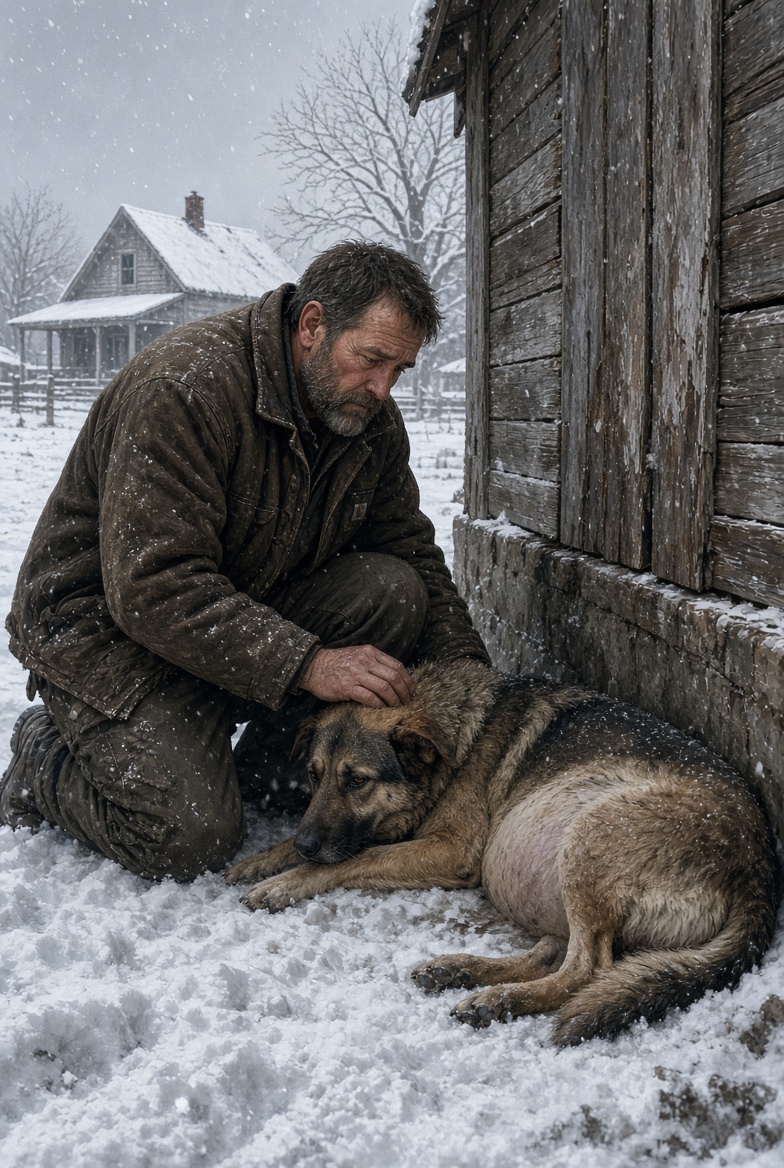
Then, on a morning when the temperature had dropped to eleven degrees, he discovered a starving German Shepherd beneath the north side of his barn.
She was barely breathing, covered in frozen mud, and unmistakably pregnant.
Garrett stared at her for several seconds before muttering, “No. Absolutely not. Whatever you’re thinking, the answer is no.”
The dog lifted her head.
Her ears twitched.
Then she placed one trembling paw against his boot, and something deep inside the fifty-one-year-old former Navy SEAL shifted in a way he hadn’t felt since before the funeral.
He didn’t know it yet, but four puppies were about to turn his carefully constructed silence into a circus of muddy paws, stolen socks, midnight emergencies, and one very expensive veterinarian’s opinion.
And somewhere between the laughter and the sleepless nights, Garrett would discover that sometimes the things God sends into a broken man’s life arrive looking nothing like an answer to prayer.
Sometimes they arrive covered in snow, carrying four tiny heartbeats, and determined to move into his house without permission.
Garrett had buried two things in the same year, his wife and his belief that anything in this world could be trusted to stay.
He didn’t talk about Claire much anymore.
He didn’t talk about much of anything, which was partly the point of moving to a twenty-three-acre property outside Bozeman, Montana, where the nearest neighbor was a retired schoolteacher named Holt who waved from his pickup truck about once a week and had the decency not to expect a wave back.
Garrett had chosen the property in November, when the mountains were already white and the silence pressed against his ears like cupped hands.
He stood on the porch of the old farmhouse, looked out at nothing but the tree line and gray sky, and felt something close to relief for the first time in fourteen months.
At fifty-one, he had spent twenty-two years as a Navy SEAL.
He had worked in places whose names he still couldn’t say aloud in mixed company, lost men he carried in his chest, and survived enough nights that sleep sometimes felt like an activity reserved for people with easier memories.
He had come home from all of that and somehow built a life worth having.
There had been a daughter named Ellie, a house in Bozeman that smelled like Claire’s bread on Sunday mornings, and a black Labrador named Rook who slept across Garrett’s feet every night.
Rook had possessed a remarkable talent for recognizing when his owner was awake at two in the morning pretending not to be.
He would lift his heavy head, move closer, and settle again without demanding anything.
Sometimes that was all Garrett needed.
Then Claire got sick.
The doctors used careful language and offered treatment plans, appointments, and the kind of hope that comes with a calendar full of dates.
Garrett learned the hospital corridors, the parking garage elevators, and which vending machine carried the crackers Claire liked.
He learned how to smile when she was watching and how to sit perfectly still when she fell asleep holding his hand.
He also learned that there were battles a man could prepare for his entire life and still have no idea how to fight.
Claire died in June.
Rook, who was eleven and had been living with a tumor the veterinarian had monitored for two years, declined rapidly that spring.
Garrett lost him in September.
Four months separated the two goodbyes.
After the second one, Garrett stood alone in the kitchen with Rook’s empty water bowl in his hand and realized that something in him had finally run out of instructions.
He put the bowl in a cabinet.
He didn’t throw it away.
That distinction seemed important, although he couldn’t have explained why.
Ellie called every Sunday.
Garrett answered most of the time and told her he was fine.
She knew he wasn’t, but she had two children under four, a husband with a demanding job, and the exhausting responsibility of keeping a young family moving through every ordinary emergency life could invent.
Garrett refused to add his weight to hers.
He had spent a career learning to carry difficult things without making them someone else’s problem.
He was good at it.
He had also begun to suspect that being good at something didn’t automatically make it healthy.
He didn’t want another dog.
He told Ellie this three months after Rook died.
He told Holt the same thing when the older man mentioned that his cousin’s golden retriever had a litter coming.
He told himself every morning when he walked the property at first light, passing the corner of the porch where Rook used to sit and watch deer in the eastern meadow.
He didn’t want another dog.
He didn’t want another living thing looking at him as though he were worth following.
He didn’t want to become responsible for a creature’s happiness when he wasn’t entirely convinced he knew how to manage his own.
The quiet was honest.
The quiet didn’t make promises.
The quiet didn’t leave an empty bowl in the kitchen.
That was Garrett’s position when February arrived with eleven-degree mornings and three consecutive days of snow blowing sideways across the valley.
He spent his time splitting wood, reading old paperbacks, repairing things that didn’t need repairing, and going to bed earlier than he had since he was eight years old.
He liked his routines because routines didn’t ask questions.
Every morning, he made coffee at 5:15, checked the weather station mounted beside the kitchen window, and wrote a short list of tasks on a yellow legal pad.
The pad had belonged to Claire.
She used to write grocery lists on it, adding little notes in the margins whenever she remembered something funny one of the grandchildren had said.
Garrett had kept the pad after she died.
He told himself it was practical.
He also kept the old Labrador’s bowl in the cabinet, Claire’s blue mug on the top shelf, and a red wool blanket folded across the back of his armchair.
Practicality, he had discovered, could become an impressive disguise for grief.
On the fourth morning of the storm, Garrett pulled on his boots and Carhartt jacket and walked to the north side of the barn to check the woodpile beneath its tarp.
That was when he saw the dog.
She was a German Shepherd, or most of one.
Her fur was matted with dirt and ice, and she was so thin that the word seemed almost insulting.
She had dragged herself into the narrow space between the woodpile and the barn wall and was lying on her side in the snow.
For one terrible second, Garrett thought she was dead.
Then she lifted her head.
Her ears rose, sharp and alert, and her dark eyes fixed on him with an exhausted intensity that made something in his chest tighten.
Garrett stood still.
The dog didn’t growl.
She didn’t try to crawl away.
She simply watched him, as if she had reached the end of whatever journey she had been making and had no idea whether the person standing before her represented the end of her trouble or the beginning of something worse.
The wind moved through the trees.
Snow gathered on Garrett’s shoulders.
“Well,” he said quietly, “you picked a miserable day to go sightseeing.”
The dog blinked.
Garrett looked toward the house, then back at her.
He was not going to stand there and watch an animal freeze to death on his property.
That wasn’t a moral debate.
It was a fact.
He went inside, grabbed a thick blanket, filled a bowl with water, and collected the last of the roasted chicken he had cooked two nights earlier.
When he returned, the dog had lowered her head again.
“Easy,” he said.
He approached slowly, watching her eyes, her breathing, and the position of her paws.
She let him come close.
That told him she had probably known human kindness once.
It also told him she was too exhausted to be afraid.
He placed the bowl near her muzzle.
She drank for a long time, pausing only to breathe.
Then she ate the chicken in four careful bites, as though some part of her remembered manners even when the rest of her body had nearly given up.
Garrett spread the blanket beneath her and worked one arm under her chest.
“You’re heavier than you look,” he muttered.
She weighed almost nothing.
He carried her into the farmhouse, kicked the door shut behind him, and laid her beside the woodstove.
Warm air moved over her dirty fur.
The dog stretched her neck, closed her eyes, and released a long, shaky breath.
Garrett stood over her with his hands on his hips.
“This is temporary,” he announced.
The dog did not respond.
“I’m not adopting you. I’m providing emergency shelter. There’s a difference.”
One ear moved.
Garrett pointed at her.
“Don’t look at me like that.”
She looked at him exactly like that.
He turned away before he could say anything else.
He was reaching for the telephone to call the veterinarian when he noticed the shape of her abdomen beneath the tangled fur.
He stopped.
Looked again.
Then he slowly lowered the receiver.
“Oh, you’ve got to be kidding me.”
The dog lifted her head.
Garrett rubbed his forehead.
“Of course you’re pregnant.”
For the first time that morning, the farmhouse felt considerably smaller.
He called the veterinary clinic in Bozeman and explained the situation.
The woman who answered listened carefully, asked several questions, and transferred him to Dr. Patel.
“Keep her warm,” the veterinarian instructed. “Offer water in small amounts, and don’t force her to eat. I’ll need to examine her as soon as the roads are safe.”
“How long?”
“With this weather? Hopefully tomorrow.”
Garrett looked at the dog.
“She’s pregnant.”
“I gathered that from your description.”
“I don’t know how far along she is.”
“Then we’ll find out when you get here. Has she shown any signs of labor?”
“Not that I’ve noticed.”
“Good. Keep your phone nearby. If her condition changes, call me.”
Garrett thanked her and hung up.
He made broth, allowed it to cool, and brought it to the dog in a low bowl.
She drank slowly while he held it steady.
Her eyes remained on his face.
Rook used to do that.
He would watch Garrett with a quiet confidence that suggested the world could be confusing, but the man holding the bowl could be trusted.
Garrett looked away.
“You’re not him,” he whispered.
The dog kept drinking.
He sat beside her until she finished.
Then he got up, checked the stove, and went to the kitchen to make coffee.
He didn’t know why he felt the need to keep moving.
He only knew that the farmhouse had changed the moment he carried her through the door.
The quiet was still there.
It simply wasn’t empty anymore.
By the following morning, the storm had buried the driveway.
Snow rose nearly to the kitchen windows, and the wind rattled the old farmhouse hard enough to make the porch railing creak.
Garrett checked the dog before he made coffee.
Her breathing had changed.
It was shorter and more deliberate, and she looked at him with an expression he had learned to recognize in people facing difficult work.
She was concentrating.
“Oh, no,” he said.
The dog shifted beneath the blanket.
Garrett glanced at the clock.
It was 6:42 a.m.
He called Dr. Patel.
“Tell me exactly what’s happening,” she said.
He did.
He described the dog’s breathing, her position, the changes he could see, and the way she kept looking toward her abdomen.
Dr. Patel listened without interrupting.
“Garrett, it sounds like she’s going into labor.”
He closed his eyes briefly.
“How many?”
“We won’t know until she’s finished.”
“Of course we won’t.”
“Have you delivered puppies before?”
“No.”
“Have you handled emergencies before?”
“Yes.”
“Then take a breath. You can do this. I’ll stay on the phone if you need me.”
Garrett glanced at the dog.
She looked back.
“All right,” he said. “Let’s get to work.”
For the next several hours, the former SEAL approached the birth of four puppies with the same steady attention he had once brought to complicated field situations.
He washed his hands, gathered clean towels, prepared warm water, and followed Dr. Patel’s instructions.
He kept the room warm and the lights low.
When the first puppy arrived, he barely had time to process the tiny, damp creature before the mother began caring for it.
The puppy made a small, indignant sound.
Garrett stared.
“That’s a lot of noise for something that weighs less than a sandwich.”
Dr. Patel laughed on the other end of the telephone.
“That’s a good sign.”
The second puppy arrived soon afterward.
The third followed.
The fourth was smaller than its siblings and slower to respond.
Garrett’s expression changed immediately.
He followed the veterinarian’s instructions carefully, working with patient hands while the mother watched him.
For several long moments, the little puppy seemed determined to remain asleep.
Then it moved.
A faint sound emerged.
Its tiny body shifted beneath Garrett’s hand.
He released a breath he hadn’t realized he was holding.
“There you go,” he whispered. “That’s it. Stay with us.”
Dr. Patel’s voice softened.
“Good work. Keep following the instructions.”
By noon, all four puppies were nursing.
The mother had eaten half a can of the food Dr. Patel had recommended, and her breathing had settled into a more comfortable rhythm.
Garrett sat on the floor with his back against the armchair.
He looked at the mother.
Then at the four puppies.
Then at the ceiling.
“I want it officially recorded,” he said to the empty room, “that none of this was in the plan.”
One of the puppies squeaked.
“That’s not a response.”
Another puppy wriggled closer to its mother.
Garrett looked down at them, and a sound escaped him that he hadn’t heard from himself in months.
It was almost a laugh.
Small.
Rusty.
But unmistakable.
He sat there until the light outside began to fade.
At some point, he noticed that he had stopped thinking about what he had lost.
He was thinking about whether the smallest puppy was getting enough milk.
That frightened him more than he wanted to admit.
Because concern was a door.
And he had spent months making certain every door in his life stayed closed.
Three days later, the roads finally cleared.
Garrett loaded the mother into his truck, placing the puppies in a laundry basket lined with the softest blanket he owned.
It had belonged to Claire.
He had not used it since her death.
He nearly replaced it with an older blanket, then stopped himself.
The puppies were warm.
The mother was comfortable.
And Claire had always believed the best things in a house were the things used by the people who lived there.
Garrett folded the blanket around the basket and drove into Bozeman.
Dr. Patel was waiting when he arrived.
She was a small woman with reading glasses pushed up on her head and the brisk, warm manner of someone who had spent thirty years caring deeply about animals and had learned not to waste time pretending that every situation was simple.
She examined the mother, checked the puppies, and listened to Garrett’s account of the birth.
When she finished, she looked at him.
“Remarkably healthy, considering the circumstances.”
“All five?”
“All five.”
Garrett nodded.
“Good.”
Dr. Patel checked the mother’s teeth and examined the condition of her coat.
“She was someone’s dog. Well cared for at some point. I’d estimate two or three years old.”
“Any identification?”
“No microchip.”
“Can you find the owner?”
“We’ll check the local reports and contact animal services. You should also file a found-animal report.”
“All right.”
“Meanwhile, I’ll contact the rescue organizations I work with. A nursing mother and four puppies will need a suitable foster home.”
“That’s what I was hoping you’d say.”
Dr. Patel looked over her glasses.
Garrett recognized the expression.
It was the same look Claire used to give him when he claimed that buying a second toolbox would somehow make the garage more organized.
“I’m not in a position to keep a dog,” he explained.
“Hmm.”
“Let alone five.”
“Hmm.”
“I have twenty-three acres to maintain. The house is too large for one person already. I travel occasionally, and I have no experience raising puppies.”
“Those are all reasonable concerns.”
Garrett waited.
Dr. Patel smiled.
“They’re also the kind of concerns people usually mention when they’ve already begun making room for an animal in their lives.”
“I haven’t made room for anything.”
“Of course not.”
He looked at the puppies.
The smallest one had managed to crawl away from the others by approximately two inches.
“Three weeks,” he said. “I can manage three weeks.”
Dr. Patel wrote something on her chart.
“Three weeks.”
“Until the rescue has space.”
“Certainly.”
“And this is not an adoption.”
“Naturally.”
He left the clinic feeling that he had negotiated a temporary arrangement with a person who had understood the outcome before he had even arrived.
For the first week, Garrett maintained his position with military precision.
The mother stayed near the woodstove.
The puppies remained in their basket, except when they needed feeding, cleaning, or attention.
Garrett washed towels, followed the veterinarian’s feeding recommendations, and recorded their progress in a small notebook.
He weighed the puppies as instructed.
He monitored the mother’s appetite.
He checked their bedding before going to bed and again before making coffee.
At night, he placed the notebook beside the yellow legal pad on the kitchen table.
The legal pad held his tasks.
The notebook held four tiny lives.
He told himself that was simply how a responsible person handled a temporary situation.
Then, on the eighth day, one of the puppies escaped the basket.
Garrett discovered this at 5:07 a.m. while walking into the kitchen for water.
He turned on the light.
A small German Shepherd puppy sat directly in front of the refrigerator.
The puppy looked up at him.
Garrett looked down.
“How?”
The puppy wagged its tail.
Garrett checked the basket.
Three puppies remained inside.
He looked at the escapee.
“That basket has sides.”
The puppy stood, took two uncertain steps, and fell over.
Garrett sighed.
“Outstanding.”
He carried the puppy back and placed it among its siblings.
By the time he reached the hallway, the same puppy had somehow climbed over the edge again.
Garrett stopped.
The puppy stopped.
They stared at each other.
“Are you trying to make a point?”
The puppy sneezed.
Garrett leaned against the wall and laughed.
It wasn’t a polite laugh or a brief sound of amusement.
It came out of him unexpectedly, deep and rough, and kept going long enough that he had to put one hand over his face.
The puppy watched him with bright, curious eyes.
When he finally recovered, Garrett pointed at it.
“You are going to be a problem.”
The puppy wagged its tail.
Garrett went to make coffee.
He was still smiling when the machine finished brewing.
He didn’t notice until he caught his reflection in the dark kitchen window.
The smile disappeared almost immediately.
But it had been there.
And that mattered.
The puppies opened their eyes during the second week.
It was as though four small personalities had been waiting behind closed doors, and now every one of them wanted access to the entire house.
The biggest was a male with a black saddle marking and the unshakable belief that he had been appointed supervisor of the other three.
He climbed over his siblings, claimed the warmest part of the blanket, and barked at objects that had done nothing to offend him.
Garrett began calling him Major.
The name seemed appropriate.
The second puppy was a female with pale fur along her ears.
She was quieter than the others and possessed a strange talent for appearing in rooms without Garrett noticing her arrival.
He would turn around while making coffee and find her sitting behind him.
He would step into the living room and discover her watching from the doorway.
Once, he opened the pantry and found her sitting inside.
Garrett stared at her.
She stared back.
“How did you get in here?”
She blinked.
He carried her out, closed the pantry door, and returned to the stove.
When he turned around, she was sitting beside his boots.
He named her Ghost.
The third puppy was a darker male with a gift for turning ordinary activities into physical comedy.
He fell over his own feet.
He chased his tail with professional commitment.
He once managed to get his head stuck inside Garrett’s boot and walked around the kitchen for thirty seconds before freeing himself.
When the boot finally came off, the puppy shook his head with such deep indignation that Garrett had to sit down.
“That’s what happens when you ignore safety procedures,” he informed him.
The puppy barked.
Garrett named him Trip.
The fourth was the smallest, the pale female who had needed extra attention during the first hours of her life.
She had a quieter approach to the world.
She studied things before moving toward them.
She seemed to recognize Garrett’s footsteps and would lift her head whenever he entered the room.
He tried not to notice.
He failed.
One evening, Garrett sat on the living room floor surrounded by paperwork from Claire’s estate.
Ellie had sent the documents two months earlier, explaining that several forms required his attention and offering to help him finish them during her next visit.
Garrett had stacked them beside the armchair.
Then he had moved them to the desk.
Then he had brought them back to the armchair.
That evening, he finally opened the envelope.
He put on his reading glasses and began sorting the papers.
The puppies were playing nearby.
Major was attempting to climb over a cushion.
Ghost was watching dust move through a shaft of late-afternoon sunlight.
Trip was attacking a rolled-up sock.
The smallest puppy approached Garrett’s knee.
She sniffed his trousers, placed one paw on his leg, and began climbing.
Garrett looked down.
“Where do you think you’re going?”
She continued.
He lifted one hand to help her, then stopped when she settled into his lap.
The puppy circled once.
She placed her head against his stomach and fell asleep.
One tiny paw rested against his hand.
Garrett stopped reading.
He looked at the papers scattered around him, at the familiar handwriting on one of the envelopes, and at the little dog sleeping as though she had found the safest place in the world.
For a moment, he could almost hear Claire in the kitchen.
He could imagine her looking through the doorway, smiling at the sight of a grown man sitting on the floor with a puppy in his lap and paperwork forgotten around him.
She would have said something about the puppy having excellent judgment.
Then she would have brought him a cup of tea.
The memory hurt.
It also warmed him.
Garrett sat very still, afraid that if he moved, he might lose the feeling.
He had spent months believing that the only way to survive grief was to avoid anything that reminded him of what he had lost.
But the puppy was reminding him of Claire, and the world hadn’t ended.
The pain was there.
So was the warmth.
They occupied the same moment without canceling each other out.
He looked down at the sleeping puppy.
“Lucky,” he whispered.
The name seemed to settle into the room.
He said it again.
“Lucky.”
The puppy moved one paw.
Garrett smiled.
And just like that, he had named all four of them.
He didn’t remember giving himself permission.
Apparently, that wasn’t required.
On Sunday, he called Ellie.
He intended to mention the weather, ask about the children, and tell her that the roof needed a little work before spring.
Instead, the first thing he said was, “I’ve got a dog.”
Silence.
Then Ellie asked, “Dad, how long have you had a dog?”
“Three and a half weeks.”
“Three and a half weeks?”
“Approximately.”
“You told me you didn’t want another dog.”
“I didn’t.”
“Then why do you have one?”
Garrett looked toward the living room.
Major was trying to climb the leg of the armchair with a focus that suggested he had identified a personal challenge.
Ghost sat beside the window, watching something outside that Garrett couldn’t see.
Trip had fallen asleep in his water bowl.
Not beside it.
In it.
Lucky was resting on Garrett’s boot.
“The mother is going to a foster home next week,” he explained. “The puppies will be old enough for the rescue soon.”
Ellie was quiet for a moment.
“Are you going to let them go?”
Garrett looked at the puppies again.
He could have answered immediately.
He had rehearsed the answer for days.
The mother would go to a foster home.
The puppies would go to the rescue.
The rescue would find appropriate families.
Everything would proceed exactly as planned.
Instead, he said, “I don’t know.”
The words surprised him.
He hadn’t spoken them so honestly in fourteen months.
Ellie’s voice softened.
“That’s okay, Dad.”
“It’s a temporary arrangement.”
“Sure.”
“I have to be realistic.”
“Of course.”
“They’re four dogs. Four German Shepherds. That’s a considerable responsibility.”
“I imagine.”
“I can’t make decisions based on emotion.”
Ellie laughed gently.
“You’re the man who once drove forty minutes because I called you crying about a flat tire.”
“That was a mechanical problem.”
“You changed the tire, then drove me to dinner because I said I hadn’t eaten.”
“You were twenty years old and had a terrible sense of direction.”
“I was twenty-two.”
“That makes it worse.”
She laughed again.
For several seconds, Garrett listened to the sound without feeling the familiar pressure in his chest.
Then Ellie asked, “What are their names?”
He looked at Major, who had finally conquered the chair leg and was now attempting to climb the cushion.
“Major.”
“Naturally.”
“Ghost.”
“That sounds like a dog you’d end up with.”
“Trip.”
Ellie burst out laughing.
Garrett looked at the puppy sleeping in the water bowl.
“It’s an accurate description.”
“And the fourth?”
“Lucky.”
Ellie became quiet.
“That’s a good name, Dad.”
Garrett looked down at the little dog beside his boot.
“She’s the smallest.”
“I remember you saying one needed extra attention.”
“She did.”
“And now?”
“Now she’s fine.”
He paused.
“Mostly she follows me around.”
Ellie didn’t answer immediately.
Then she said, “Maybe she knows you needed somebody to follow you around, too.”
Garrett looked toward the window.
Outside, the snow had begun to melt from the lower branches of the pines.
“Maybe,” he said.
It was the closest thing to an admission he could manage.
The mother left on a Wednesday.
Garrett had prepared himself for it.
He had confirmed the foster home’s arrangements, checked the travel carrier, and packed the dog’s food according to Dr. Patel’s instructions.
The rescue had found an experienced foster handler who understood nursing mothers and had a quiet home with a secure yard.
It was the right decision.
Garrett repeated that to himself several times.
When the transport vehicle arrived, he carried the mother outside.
She walked beside him slowly, her body stronger than it had been on the morning he found her.
The snow was beginning to soften beneath the pale February sun.
Garrett opened the carrier and helped her inside.
She turned around once.
Through the metal door, she looked at him with the same dark, steady eyes that had watched him over the water bowl on the first night.
For a moment, he felt the familiar instinct to look away.
Instead, he met her gaze.
“You’re going somewhere good,” he told her. “They’ll take care of you.”
The dog remained still.
Garrett rested one hand against the carrier.
“Thank you,” he whispered.
He wasn’t sure why he said it.
Perhaps because she had trusted him when she had almost nothing left to give.
Perhaps because four tiny lives had arrived in his house when he had stopped believing he could care about anything without eventually losing it.
Perhaps because she had reminded him that a man could still do something good even when he felt broken.
The driver secured the carrier.
Garrett stepped back.
The vehicle pulled away down the driveway.
He stood outside long after it disappeared around the bend.
The house felt strangely quiet when he went back inside.
The puppies were in their basket.
Major lifted his head.
Ghost watched him from beside the stove.
Trip rolled onto his back and kicked both hind legs.
Lucky walked directly to Garrett’s boot.
He looked down at her.
“Don’t start,” he said.
She sat.
He shook his head.
“All right.”
He didn’t know what he was agreeing to.
Lucky wagged her tail anyway.
Three weeks became four.
Four became six.
By week nine, the puppies were growing rapidly, eating solid food, exploring the farmhouse, and discovering that almost every object in a house could be investigated with the mouth.
Garrett’s socks disappeared at an alarming rate.
His shoelaces became popular toys.
A paperback about World War II acquired several small teeth marks.
Major developed a particular fascination with the yellow legal pad Claire had left on the kitchen table.
Garrett caught him dragging it across the floor one morning.
“Drop it.”
Major pulled harder.
“Major.”
The puppy looked over his shoulder.
Garrett slowly crouched.
“Listen carefully. That is a very important document.”
Major growled playfully.
Garrett reached for the pad.
Major ran.
The ensuing chase lasted three minutes and involved a kitchen chair, a hallway rug, one overturned laundry basket, and a deeply offended Trip, who had been peacefully sleeping until Major ran over his tail.
When Garrett finally recovered the legal pad, it had one corner covered in tiny tooth marks.
He stared at it.
Then he looked at Major.
The puppy sat down and wagged his tail.
“You’re fortunate you’re cute.”
Major sneezed.
Garrett placed the pad on a higher shelf.
That evening, he wrote the day’s tasks on a different sheet of paper.
He added one more item beneath the others.
Buy chew toys.
The list looked ordinary.
He had never been so grateful for ordinary things.
The rescue organization called during the tenth week.
Garrett was repairing a loose hinge on the barn door when his phone rang.
“Mr. Cole, this is Amanda from the rescue. I wanted to check on the puppies.”
“They’re doing well.”
“Wonderful. Have you given any thought to the adoption process?”
Garrett tightened the hinge.
“I’m still evaluating the logistics.”
Amanda was silent for a moment.
“Of course.”
“The property is large enough.”
“That’s good.”
“The fence needs some repairs.”
“We can discuss ways to make sure the dogs are safe.”
“And I’d need to arrange for someone to check on them if I travel.”
“Yes.”
Garrett put down the screwdriver.
“There are several considerations.”
“Absolutely.”
He waited for her to suggest a deadline.
Instead, Amanda said, “You know, Mr. Cole, you don’t have to make a decision today.”
Garrett glanced toward the farmhouse.
Through the kitchen window, he could see Trip carrying a dish towel.
Ghost was following him at a measured distance.
Major appeared to be supervising.
Lucky was sitting on the porch steps, waiting for Garrett to come back inside.
“I appreciate that,” he said.
After the call, he stood in the barn for several minutes.
He had spent years planning for uncertainty.
He had learned to anticipate problems, prepare alternatives, and make decisions without waiting for perfect information.
Yet he had managed to turn four puppies into a logistical problem that required endless evaluation.
He knew what he wanted.
The realization was so simple that he almost resented it.
He wanted them to stay.
He was afraid of what that meant.
Because keeping them meant allowing himself to love something again.
And love, in his experience, came with the possibility of a goodbye.
He looked at the screwdriver in his hand.
Then he returned to the hinge.
He would have to figure out the rest later.
At week thirteen, Lucky found the coyote.
The eastern edge of Garrett’s property held a narrow trail that wound through pine and scrub before reaching a ridge overlooking the valley.
He walked it every morning.
On clear days, the view was the kind that made a person believe the world had been thought through carefully.
The puppies had been accompanying him since they were old enough to handle the walk.
The property was fenced, the route familiar, and Garrett kept them under close supervision.
They had developed their own habits.
Major walked ahead as if leading a patrol.
Ghost drifted toward the tree line and reappeared without warning.
Trip ran into things.
Lucky stayed near Garrett’s left side.
That last detail had begun as a coincidence.
Over time, it became a quiet ritual.
Rook had always walked on Garrett’s left.
He hadn’t realized how much he missed that until Lucky began doing the same thing.
On the morning of the thirteenth week, the sky was pale and clear.
The temperature had climbed above freezing, and the snow beneath the trees had begun to settle.
Garrett carried a thermos of coffee in one hand.
Major was investigating a pine cone.
Trip was trying to catch a patch of sunlight on the ground.
Ghost had disappeared behind a cluster of pines.
Lucky stopped.
Garrett took several more steps before noticing she was no longer beside him.
He turned.
She stood thirty feet behind him, ears raised, nose working.
She was staring into the trees to the north.
She wasn’t barking.
She wasn’t moving.
She was simply still.
Garrett recognized that kind of stillness.
He had seen working dogs display it when they detected something that deserved attention.
“Lucky.”
She didn’t look at him.
She took three steps toward the trees and stopped again.
Garrett followed.
“All right. Show me.”
Lucky led him off the trail, moving carefully through the thinner snow beneath the pines.
She stopped beside an old tree that had fallen during the previous spring.
Its exposed roots rose above a shallow depression near a dry creek bed.
Garrett looked beneath the root ball.
A young coyote lay trapped between two thick roots.
One rear leg had become wedged in the narrow opening.
The animal was alive, but barely moving.
Its fur was damp, and its eyes followed Garrett with exhausted fear.
It had probably been trapped for days.
Garrett crouched at a distance.
“Easy there.”
The coyote shifted weakly.
Lucky sat beside him.
She didn’t approach the animal.
She didn’t bark.
She simply waited.
Garrett looked at the roots, the angle of the trapped leg, and the unstable weight of the fallen tree.
He could not pull the animal free without risking further injury.
He needed tools.
He also needed to keep the coyote calm enough that it wouldn’t struggle when he worked.
He backed away slowly.
“Stay here,” he told Lucky.
She watched him.
He returned to the farmhouse, collected a small tool kit, a blanket, and a sturdy wooden support.
When he came back, Lucky was still near the fallen tree.
The coyote had barely moved.
Garrett worked carefully, positioning the support beneath the root mass and creating enough space to free the trapped leg.
He paused several times to assess the situation.
The coyote watched every movement.
“Almost there,” Garrett murmured.
Lucky remained beside him.
Not pushing.
Not demanding.
Just present.
After several minutes, the pressure eased.
Garrett guided the leg free.
The coyote lay still for a moment.
Then it gathered itself and stood.
Its weight shifted uncertainly.
One hind leg trembled.
But it stood.
Garrett moved back.
“Go on.”
The coyote looked at him.
For one brief second, the two of them remained motionless beneath the pines.
Then the animal turned and moved toward the trees.
It disappeared into the brush.
Garrett watched until he could no longer see it.
He had spent much of his adult life learning how to rescue people from difficult situations.
He had never imagined that a puppy he had nearly sent away would lead him to a wild animal trapped in the woods behind his house.
He looked down at Lucky.
She sat beside his boot.
Her tail moved once across the snow.
“Good girl,” he said.
The words came out naturally.
He didn’t have to force them.
Lucky stood and moved to his left side.
They walked back toward the trail together.
Major had discovered a pine cone of exceptional interest and was carrying it with the gravity of someone transporting important cargo.
Trip had managed to get a stick caught between two trees and was attempting to walk backward without releasing it.
Ghost materialized from the tree line and joined the group as though she had been there the entire time.
Garrett looked at the four puppies.
He thought about the mother dog in the snow.
He thought about the four small bodies curled together beside the woodstove.
He thought about Claire’s blanket, the yellow legal pad, and the little black Labrador who had spent eleven years sleeping across his feet.
He thought about how many times he had mistaken loneliness for peace simply because loneliness asked less of him.
Then he understood something in the particular quiet way men like him often understand things.
Not with words first.
With the body.
With the breath.
With something in the chest finally settling after months of refusing to rest.
He wasn’t going to call the rescue organization.
He wasn’t going to ask Amanda for another week.
He wasn’t going to describe the decision as a temporary arrangement or a practical experiment.
He was keeping the dogs.
All four of them.
He stopped on the trail and took out his phone.
Ellie answered on the third ring.
“Dad? Everything okay?”
“Yes.”
“That sounded suspiciously brief.”
“I’m keeping them.”
There was a pause.
Then Ellie said, “All four?”
“All four.”
She laughed, and Garrett found himself smiling before he could stop it.
“Well,” she said, “I guess I should have known.”
“I’ve considered the logistics.”
“I’m sure you have.”
“The fence needs repairs. I’ll need a reliable veterinarian. I should probably arrange for someone to check on them if I travel.”
“Dad.”
“What?”
“You can just say you love them.”
Garrett looked at Lucky.
She was watching him with her head tilted slightly to one side.
“I love them,” he said.
The words felt unfamiliar.
Not wrong.
Just unfamiliar.
Ellie became quiet.
Then she said, “I’m glad.”
Garrett looked out through the pines toward the valley.
“I think your mother would have liked them.”
Ellie’s voice softened.
“She absolutely would have.”
He swallowed.
For fourteen months, he had struggled to mention Claire without feeling as though the memory itself might knock him to the ground.
Now, standing on a snowy trail with four puppies and a phone pressed to his ear, he could remember her smile without immediately trying to escape it.
The grief was still there.
It would always be there.
But it no longer occupied every inch of the room.
“She would have liked Lucky,” he said.
“Why Lucky?”
“She found a coyote. It was trapped under a fallen tree. Lucky led me to it.”
Ellie was silent for a moment.
“She knew you’d help it.”
Garrett considered that.
“Maybe.”
“No, Dad. She knew.”
He looked at the puppy standing beside him.
He didn’t argue.
When the call ended, he put his phone away and continued down the trail.
The decision had been made.
The consequences, he suspected, were going to be ridiculous.
He had no idea how ridiculous.
The first sign arrived that afternoon.
Garrett had barely finished his lunch when Major discovered the pantry door.
The puppy stood in front of it, sniffing beneath the gap.
Garrett watched him from the kitchen table.
“Don’t.”
Major sniffed again.
“I mean it.”
The puppy placed one paw against the door.
Garrett pointed at him.
“That is not an invitation.”
Major sat.
Garrett returned to his sandwich.
Three minutes later, he heard a soft thump.
Then another.
He turned.
The pantry door was open.
Major had somehow pushed it far enough to squeeze through.
Trip was following him.
Ghost stood outside, apparently waiting to see whether the operation would be successful.
Lucky was sitting beside Garrett’s chair.
Garrett closed his eyes.
“How did you even do that?”
Major emerged carrying a bag of dog treats.
Garrett stared at him.
The puppy dropped the bag and wagged his tail.
Trip seized one corner.
The bag ripped.
Treats scattered across the kitchen floor.
Four puppies descended on them with the enthusiasm of a small search-and-rescue team that had located a missing supply cache.
Garrett stood.
“Everybody freeze.”
Nobody froze.
“Major, drop it.”
Major grabbed another treat.
“Trip.”
Trip ran behind the table.
“Ghost.”
Ghost calmly ate a treat she had apparently found beneath the refrigerator.
“Lucky, don’t you start.”
Lucky sat down and looked at him.
Garrett looked at the ceiling.
“Lord, I hope You know what You’re doing.”
Then he realized what he had said.
He hadn’t prayed aloud in months.
Perhaps longer.
The words had emerged before he could edit them, and now he stood in the kitchen with four puppies eating stolen treats while the farmhouse smelled faintly of coffee and woodsmoke.
He started laughing again.
The dogs looked at him.
Major barked.
Trip slid on a treat and bumped into a chair.
Ghost continued eating.
Lucky wagged her tail.
Garrett leaned against the counter, laughing until his eyes watered.
For a moment, he couldn’t tell whether he was laughing because the situation was absurd or because he had finally found a way to cry without feeling as though he were falling apart.
Maybe both.
When the kitchen was finally clean, he repaired the pantry latch.
He also ordered four sturdy food containers, two more dog beds, and enough chew toys to occupy a small daycare.
The total came to $186.42.
Garrett stared at the receipt.
He had spent more money on four puppies in one afternoon than he had spent on himself in the previous month.
He folded the receipt and placed it beside the yellow legal pad.
Then he added a new item to the list.
Build a better pantry latch.
Underneath it, he wrote four names.
Major.
Ghost.
Trip.
Lucky.
He looked at them for a long time.
Then he underlined Lucky.
Spring arrived slowly in Montana.
Snow retreated from the southern slopes first, leaving patches of brown earth beneath the pines.
The meadow began to reveal its winter-hidden grasses.
Water moved through the creek bed again, and the mornings smelled of damp soil and pine needles.
The puppies grew into their legs.
Major became larger, louder, and even more convinced that he was in charge.
Ghost perfected her talent for appearing in places where Garrett had not expected her.
Trip remained a walking collection of improbable accidents.
Lucky became his shadow.
She followed him to the barn, waited outside the workshop, and settled near the porch steps whenever he repaired something in the yard.
At night, she slept beside his bed.
He had tried to place her in a dog bed near the door.
She had accepted the arrangement for approximately forty minutes.
Then he woke to find her curled beside his slippers.
The following night, he tried again.
The third night, he gave up.
“You’re not Rook,” he told her as he switched off the lamp.
Lucky rested her chin on her paws.
“I know that.”
She looked at him.
“But you can stay.”
He reached down and touched her head.
She leaned into his hand.
Garrett lay back against the pillow.
The house settled around him.
For the first time in months, he didn’t feel compelled to stay awake until exhaustion made sleep unavoidable.
He listened to the wind outside.
He heard Lucky breathing beside the bed.
And he fell asleep.
The nightmares didn’t disappear.
Some nights, he still woke abruptly, his heart racing, the old memories moving through his mind with the same unwelcome clarity.
But now, when he sat on the edge of the bed and tried to steady his breathing, there was often a soft movement beside him.
Lucky would lift her head.
Sometimes she would approach and rest her chin on his knee.
Sometimes she would simply sit nearby.
She didn’t understand the past.
She didn’t need to.
Garrett had once believed that only a fellow SEAL could understand certain kinds of silence.
Rook had taught him otherwise.
Lucky was teaching him again.
In April, Ellie brought the grandchildren to visit.
Garrett spent three days preparing the farmhouse.
He repaired the loose porch step, cleaned the guest room, checked the smoke detectors, and bought groceries.
He also attempted to establish a system for keeping four German Shepherds from overwhelming two small children.
The system lasted eleven seconds after the front door opened.
“Grandpa!”
His four-year-old grandson ran toward him.
Major ran toward the grandson.
Trip ran toward Major.
Ghost appeared beside the coat rack.
Lucky moved between the child and the other puppies, not aggressively, but with the quiet confidence of a dog who seemed to understand that little people required extra room.
Garrett caught Major by the collar.
“Easy.”
Ellie stood in the doorway holding her younger child.
She surveyed the scene.
“Dad, they’re enormous.”
“They’re thirteen weeks old.”
“They’re going to be enormous.”
“That’s generally how German Shepherds work.”
She laughed.
Then she looked at the farmhouse.
The repaired shelves.
The clean kitchen.
The dog beds lined neatly beside the woodstove.
The framed photograph of Claire that Garrett had finally placed on the mantel.
Her smile softened.
“You’ve been busy.”
“There’s always something to fix.”
She looked at the four puppies.
“Apparently.”
The children spent the afternoon exploring the property under adult supervision.
Garrett showed them the meadow, the old barn, and the trail through the pines.
Major attempted to carry a stick that was nearly as long as he was.
Trip tripped over the stick.
Ghost disappeared behind a tree and reappeared beside Ellie.
Lucky remained close to the children, watching them with an alert, gentle expression.
At one point, Garrett found his grandson sitting on the porch steps beside Lucky.
The boy had placed one small hand on the dog’s shoulder.
Lucky was sitting perfectly still.
“She’s soft,” the boy announced.
“She is.”
“She likes me.”
“I think she does.”
The boy leaned against her.
“Can she come to my house?”
Garrett looked at the dog.
Lucky glanced up at him.
“No,” he said.
His grandson frowned.
“Why?”
“Because she lives here.”
The boy considered that.
Then he nodded solemnly.
“Okay. I can visit.”
Garrett felt something warm move through him.
“That’s right. You can visit.”
When the children went inside, Ellie remained on the porch with him.
They watched the puppies move through the grass.
“Dad,” she said, “I haven’t seen you like this in a long time.”
“Like what?”
“Here.”
Garrett looked at her.
She searched for the right words.
“Not just physically here. I mean, really here. You’re listening. You’re laughing. You’re paying attention to everything.”
He looked toward the meadow.
“I didn’t realize I had stopped.”
“I know.”
He rested his forearms on his knees.
“I thought I was doing the right thing by not burdening you.”
Ellie shook her head gently.
“You weren’t a burden.”
“You had enough to manage.”
“I did. But I still wanted my dad.”
The words landed harder than he expected.
Garrett looked down at his hands.
For months, he had imagined that keeping his grief to himself was a way of protecting his daughter.
He hadn’t considered that his silence might have left her grieving alone, too.
“I’m sorry,” he said.
Ellie moved closer.
“You don’t have to apologize for missing Mom.”
“I know.”
“Do you?”
He took a breath.
“I’m learning.”
She leaned her head against his shoulder.
For a while, neither of them spoke.
Below the porch, Trip discovered a loose patch of earth and began digging with such determination that he soon buried his front paws.
Major watched him for several seconds.
Then he began digging beside him.
Ghost sat on the steps.
Lucky rested against Garrett’s boot.
Ellie started laughing.
“What are they doing?”
“Preparing a defensive position.”
“Against what?”
“Apparently, the garden.”
They watched the two puppies dig until Garrett finally stood and redirected them toward a pile of toys.
Ellie wiped her eyes.
“Mom would have loved this.”
Garrett looked at Claire’s photograph through the open doorway.
“Yes,” he said. “She would have.”
And for once, the memory didn’t make him turn away.
It made him smile.
By May, Garrett had stopped describing the dogs as temporary.
He no longer explained their presence by referring to the storm, the rescue organization’s capacity, or the fact that the puppies had already become accustomed to the farmhouse.
They were his dogs.
All four of them.
He enrolled them in basic obedience training with a local trainer named Marissa, who arrived one Saturday morning carrying a treat pouch and an expression of cheerful determination.
Garrett had expected the sessions to be straightforward.
He had trained men in demanding environments.
He had managed complicated operations, maintained discipline under pressure, and learned to recognize when a person was about to make a poor decision.
Surely four puppies couldn’t be that difficult.
Marissa watched Major ignore the first command.
She watched Trip wander off to investigate a fence post.
She watched Ghost sit perfectly still while pretending not to hear her.
Then she looked at Garrett.
“Have you ever trained puppies before?”
“No.”
“Have you ever trained a group of adults who thought they were smarter than you?”
“Yes.”
“Then this will feel familiar.”
Garrett almost smiled.
The first lesson involved teaching the puppies to respond to their names.
Major responded to everything except his name.
Ghost responded to her name when she felt like it.
Trip responded to the word “treat” with remarkable enthusiasm.
Lucky learned all four names before the session ended.
Marissa looked at Garrett.
“That one’s paying attention.”
Garrett glanced at Lucky.
“She usually does.”
“She watches you more than the others.”
He looked away.
“She’s a good dog.”
Marissa didn’t push the matter.
She showed him how to reward the behaviors he wanted, how to redirect the ones he didn’t, and how to establish a consistent routine.
Garrett took notes.
He asked precise questions.
He followed every instruction.
At the end of the session, Marissa looked at the yellow legal pad in his hand.
“You know, most people don’t take this many notes.”
“I like knowing what I’m doing.”
“That’s understandable.”
She smiled.
“But the best thing you can give them isn’t a perfect routine.”
“What is it?”
“Your time.”
Garrett looked at the four puppies.
Major was chewing on the edge of his leash.
Trip had fallen asleep beside the water bowl.
Ghost was sitting behind Marissa.
Lucky was watching Garrett.
He thought about Claire.
He thought about Rook.
He thought about how often he had measured the worth of a day by what he had accomplished instead of who had shared it with him.
“All right,” he said.
Marissa nodded.
“Good. We’ll work on the leash manners next week.”
After she left, Garrett walked the dogs to the eastern meadow.
He carried no tools.
He had no repairs planned.
He didn’t check his phone.
He simply walked.
Major moved ahead.
Ghost disappeared among the pines.
Trip found a stick and immediately tripped over it.
Lucky stayed beside Garrett.
The afternoon sunlight spread across the valley.
For the first time in years, Garrett allowed himself to be unproductive without feeling guilty about it.
He sat on a fallen log and watched the dogs explore.
Nothing needed fixing.
Nothing needed explaining.
Nothing needed to be earned.
The world was still imperfect.
The past was still there.
But the afternoon was beautiful, and he was present to see it.
In June, the first anniversary of Claire’s death approached.
Garrett had marked the date on the kitchen calendar months earlier.
He hadn’t intended to do anything special.
He thought he might drive to the cemetery, leave flowers, and return home before the day became too difficult.
The morning arrived clear and warm.
He made coffee, fed the dogs, and stood at the kitchen window for several minutes.
Claire’s blue mug sat on the counter.
He had finally begun using it again.
He poured coffee into it and carried it to the porch.
The dogs followed.
Major sat beside the steps.
Ghost stretched out in the shade.
Trip attempted to climb into a flowerpot.
Lucky rested against Garrett’s leg.
He looked toward the mountains.
He remembered Claire’s laugh, the way she sang while kneading bread, and the way she would stop in the middle of a sentence whenever something outside caught her attention.
A bird.
A strange cloud.
The first snow of the season.
She had possessed an unusual ability to become completely still with wonder at things the rest of the world had already learned to ignore.
Garrett had admired that about her.
He had also spent much of their marriage pretending he was too busy to stop and look at the things she wanted him to see.
He wished he could tell her that now.
He wished he could tell her about the puppies, the coyote, the pantry disaster, and the way Lucky slept beside his bed.
He wished he could hear her say, “I told you that house was too quiet.”
He closed his eyes.
The grief arrived.
It was not gentle.
For a few moments, the farmhouse seemed to disappear around him, leaving only the terrible knowledge that the person he wanted to speak to was no longer somewhere he could reach.
His fingers tightened around the mug.
Lucky lifted her head.
She moved closer and placed her chin on his knee.
Garrett looked down at her.
He reached out and rested his hand on her back.
“I’m okay,” he whispered.
He wasn’t entirely okay.
But he was here.
He could breathe.
He could feel the warmth of the mug in his hands and the solid presence of a dog beside him.
He could remember Claire without pretending she had never existed.
He sat with the grief until it softened enough for him to stand.
Then he went inside, found the small box where he kept photographs, and selected one of Claire standing beside the old farmhouse.
She was wearing a blue sweater.
Her hair was pulled back.
She was laughing at something outside the frame.
Garrett carried the photograph to the living room and placed it on the mantel beside the picture of Rook.
The dogs watched him.
He looked at the photographs.
“Thought you should meet the new crew,” he said quietly.
Trip barked.
Major stood.
Ghost tilted her head.
Lucky sat beside his boot.
Garrett smiled through the ache in his chest.
“Your mother would have liked them,” he told the dogs.
Then he turned toward the kitchen and began making lunch.
The anniversary remained difficult.
It did not become easy because he had four dogs.
It did not disappear because the house had become louder.
But it no longer felt as though the day demanded that he spend every minute proving how much he had lost.
He could miss Claire and still laugh at Trip.
He could miss Rook and still enjoy Lucky’s quiet company.
He could feel the absence without surrendering everything that remained.
That evening, he drove to the cemetery with a small bouquet of wildflowers he had purchased in Bozeman.
He stood beside Claire’s grave and spoke aloud.
He told her about Ellie and the grandchildren.
He told her about the house.
He told her that the pantry latch had been repaired three times.
Then he told her about Lucky finding the coyote.
“I think she knew I’d help,” he said.
He paused.
“You always said animals notice things people miss.”
The wind moved gently through the trees.
Garrett looked down at the flowers.
“I miss you,” he said.
The words were simple.
They were also true.
He remained there for several minutes, allowing himself to remember without rushing away from the pain.
When he finally returned to the truck, he felt tired.
But he also felt lighter in a way he couldn’t quite explain.
At home, the dogs greeted him at the door.
Major nearly knocked over the umbrella stand.
Trip ran into the wall.
Ghost appeared beside the kitchen table.
Lucky came straight to his feet.
Garrett bent down and scratched her ears.
“All right,” he said. “Let’s get dinner.”
Life continued.
There were veterinary appointments, training sessions, muddy paw prints, and the occasional discovery that Trip had eaten something he absolutely should not have eaten.
There were mornings when Major barked at his own reflection in the glass door.
There were afternoons when Ghost disappeared so thoroughly that Garrett would walk through the house calling her name before finding her asleep beneath the desk.
There were evenings when Lucky rested against his leg while he read.
And there were nights when all four dogs somehow managed to occupy the exact spot where Garrett wanted to put his feet.
He learned to step over them.
He learned that German Shepherd puppies could produce a remarkable amount of laundry.
He learned that a dog who appeared perfectly innocent while sitting beside a broken flowerpot was usually not innocent at all.
He learned that Trip could become tangled in a leash while standing perfectly still.
He learned that Major considered the delivery truck a personal adversary.
He learned that Ghost preferred to watch the world before deciding whether to participate in it.
And he learned that Lucky seemed happiest when she could see him.
One evening, Holt stopped by with a box of tomatoes from his garden.
He stood on the porch and watched the dogs racing around the yard.
“I heard you got yourself some company,” Holt said.
“Apparently.”
“Four German Shepherds.”
“That’s what the veterinarian tells me.”
Holt laughed.
“You told me you didn’t want another dog.”
“I remember.”
“And now?”
Garrett looked at the yard.
Major was carrying a stick.
Trip was chasing Major.
Ghost was following them at a safe distance.
Lucky was sitting beside the porch steps.
“Now I don’t have much say in the matter.”
Holt nodded as though this made perfect sense.
“Funny how that works.”
He handed Garrett the box.
Then he looked toward the house.
“You doing all right?”
Garrett considered giving the usual answer.
He could say he was fine.
He could say the weather was improving, the property needed work, and the dogs were keeping him busy.
Instead, he said, “Some days are better than others.”
Holt nodded.
“That’s about the size of it.”
They stood together for a while, watching the dogs.
Holt didn’t ask Garrett to explain anything.
He didn’t offer advice.
He simply remained on the porch until the sun began to sink behind the mountains.
When he left, Garrett carried the tomatoes inside and placed them on the counter.
He looked at the kitchen.
The yellow legal pad lay beside the telephone.
The veterinarian’s number was written on a card near the refrigerator.
Claire’s blue mug sat beside the sink.
The farmhouse no longer looked like a place where someone had gone to hide.
It looked like a home.
Not the same home he had shared with Claire.
Nothing could make it that.
But a home nonetheless.
In July, Garrett received a letter from the rescue organization.
Amanda had sent a photograph of the mother dog in her foster home.
The dog looked healthier.
Her coat had filled out, and she was lying in a patch of sunlight beside a woman who had one hand resting gently on her shoulder.
Beneath the photograph, Amanda had written a short note thanking Garrett for caring for the mother and her puppies.
She also mentioned that the mother had been adopted by an experienced family who lived on a quiet property outside Helena.
Garrett read the note twice.
He placed the photograph on the kitchen table and looked at it for a long time.
He was happy for the dog.
He truly was.
Still, he remembered the first night, the blanket beside the woodstove, and the way she had watched him while drinking water.
He hoped she was happy.
He hoped she never had to face another winter alone.
Lucky approached the table and sniffed the photograph.
Garrett smiled.
“That’s your mother.”
Lucky looked at him.
He touched the edge of the picture.
“She did a good job.”
Lucky wagged her tail.
He put the photograph in the same box as Claire’s letters and Rook’s old collar.
Then he closed the lid.
For the first time, the box didn’t feel like a place where he was storing things he couldn’t bear to lose.
It felt like a place where he could keep them safe.
The summer passed with long walks, warm evenings, and more visits from Ellie and the grandchildren.
The dogs grew into their adult size.
Major remained convinced that every visitor had arrived specifically to admire him.
Ghost developed a habit of sitting on the porch railing that Garrett still couldn’t explain.
Trip discovered the creek and developed an enthusiastic but imperfect relationship with water.
Lucky continued to walk beside Garrett’s left side.
Sometimes, when the evening light fell across the meadow, Garrett would catch himself looking at her and expecting to see Rook.
The resemblance was never exact.
It was a movement.
A posture.
The way Lucky settled against his boot while he watched the sunset.
For a moment, the old ache would return.
Then Lucky would lift her head, and Garrett would remember that she was not a replacement.
She was herself.
Rook had given him eleven years of companionship.
Lucky was beginning a different chapter.
One did not diminish the other.
That was something Garrett was only now learning to understand.
By autumn, the farmhouse had developed a rhythm that no longer required Garrett to think about every movement.
The dogs knew the morning routine.
They knew where their food was stored.
They knew which doors were off-limits, although Major continued to test the pantry door whenever he suspected Garrett wasn’t watching.
They knew the sound of Ellie’s car.
They knew that the grandchildren meant extra attention and the possibility of dropped crackers.
And they knew that when Garrett sat on the porch in the evening, he preferred to have them nearby.
He had begun talking to them without realizing it.
He narrated repairs.
He commented on the weather.
He explained why a particular pine tree needed trimming.
Once, while fixing a loose board on the barn, he spent ten minutes explaining to Trip why carrying away the screws was not a useful contribution to the project.
Trip listened with an expression of complete concentration.
Then he stole the screwdriver.
Garrett sat back on his heels.
“You’re doing that on purpose.”
Trip ran.
Garrett followed.
The screwdriver was recovered.
The board was repaired.
The story became one Ellie requested every time she called.
“You know,” she said one Sunday, “I think Mom would be delighted that you’ve become the kind of man who argues with a puppy about tools.”
“I’m not arguing.”
“What would you call it?”
“Instruction.”
“Of course.”
He heard her smiling through the phone.
Then she asked, “Are you happy, Dad?”
The question caught him off guard.
He looked toward the porch.
The sun was setting.
Major lay beside the steps with his head on a pine cone.
Ghost watched the meadow from the railing.
Trip was asleep on his back, paws moving as he dreamed.
Lucky rested beside Garrett’s boot.
He considered the question carefully.
Happiness was not a word he trusted easily.
It seemed too broad.
Too temporary.
Too dependent on circumstances that could change without warning.
He had once believed that happiness meant having everything he loved within reach.
Now he knew better.
Love could remain even when the person was gone.
Grief could remain even when the day was beautiful.
A life could be wounded and still contain moments worth protecting.
“Yes,” he said at last.
Ellie was quiet.
Then she asked, “Really?”
Garrett looked at the mountains.
“Not every minute.”
“Nobody is.”
“But yes.”
He rubbed Lucky’s ears.
“I think I am.”
Ellie let out a small breath.
“I’m glad.”
After the call, Garrett remained on the porch.
The evening air was cool.
The first stars had begun to appear over the mountains.
He thought about the man he had been the previous February, standing in the snow and looking down at a starving dog.
He had believed he was offering her a few hours of shelter.
He had believed that he was making a small, temporary decision.
He had believed that he could remain untouched by whatever happened next.
But the dog had brought four puppies into his house.
The puppies had brought noise into his mornings.
The noise had brought laughter into his kitchen.
And the laughter had made room for memories he had been afraid to revisit.
None of it had erased his grief.
Nothing could.
Claire was still gone.
Rook was still gone.
There were still mornings when Garrett woke and reached instinctively toward an empty side of the bed, or turned toward the kitchen expecting to hear Claire moving around.
There were still moments when he missed the uncomplicated comfort of Rook sleeping across his feet.
He had not stopped missing them.
He had simply stopped believing that missing them meant he had to stop living.
Lucky shifted against his boot.
Garrett rested his hand on her back.
“You know,” he said quietly, “I didn’t ask for any of this.”
Lucky looked up at him.
“I wanted a little peace and quiet.”
Her tail thumped once against the porch.
Garrett laughed.
“Yeah. I know. That was my first mistake.”
Major lifted his head.
Trip rolled onto his side.
Ghost turned from the meadow and walked toward the porch door.
Four dogs.
Four different personalities.
Four small lives that had arrived in the middle of a winter Garrett thought he would spend alone.
He looked toward the kitchen window.
Claire’s blue mug sat on the counter.
The yellow legal pad lay beside it.
The old black Labrador’s photograph rested on the mantel.
And beside the fireplace, four dog beds occupied the space where Garrett had once imagined he would sit alone for the rest of his life.
He thought about the coyote, moving through the snowy trees after Lucky had led him to it.
He hoped the animal had recovered.
He hoped it had found shelter.
He hoped that somewhere beyond the fence, in the wide and complicated world, it was still moving toward home.
The wind stirred the pines.
The mountains darkened.
Garrett reached down and scratched Lucky behind the ears.
He had once believed that peace meant the absence of noise, the absence of need, and the absence of anything that might leave him grieving again.
He had mistaken emptiness for safety.
Now he understood that peace could sound like paws moving across an old wooden floor.
It could sound like Major barking at a passing rabbit, Trip tumbling over his own feet, and Ghost walking quietly through the hallway.
It could sound like Ellie laughing on the telephone.
It could sound like his own voice saying Claire’s name without breaking.
It could even sound like a man talking to God in the kitchen while four puppies dismantled a bag of dog treats.
Garrett didn’t know whether the dog had appeared by chance.
He couldn’t prove that the timing meant anything.
He couldn’t explain why the smallest puppy had found him, why Lucky walked on his left side, or why the coyote had been trapped in the trees on the morning Garrett finally decided to keep the dogs.
But he knew what had happened afterward.
He had opened the door.
He had carried a freezing animal into the warmth.
He had stayed when things became complicated.
And somewhere along the way, he had allowed himself to care again.
Maybe that was what grace looked like.
Not a life without sorrow.
Not a promise that nothing would ever leave.
Just an unexpected reason to get out of bed in the morning, a warm body beside your feet, and the courage to open the door when something needed help.
The stars emerged one by one over Montana.
Garrett sat on the porch with four German Shepherds and watched the night settle across the valley.
Major guarded his pine cone.
Ghost watched the meadow.
Trip dreamed of running after something he would probably trip over.
Lucky rested against Garrett’s boot.
He thought of Claire standing at the kitchen window, watching the first snow of the season.
He thought of Rook shifting closer during the long nights when the past became too heavy.
He thought of the mother dog looking at him through the carrier door, trusting him to do one final good thing for her.
The hollow place inside him was still there.
He no longer expected it to disappear.
But it had changed.
It held memories now, and laughter, and the quiet weight of a small dog who believed there was nowhere else she needed to be.
Garrett took a slow breath.
The night was cold.
The mountains were dark.
The farmhouse glowed behind him, warm and imperfect and full of life.
He had asked the world for silence.
Instead, he had received four German Shepherd puppies, a thousand unexpected responsibilities, and the kind of happiness that arrived muddy, loud, and completely uninterested in following instructions.
For the first time in a long time, he didn’t need the night to end before he could face the morning.
He didn’t need to pretend that he was finished grieving.
He didn’t need to know what tomorrow would bring.
He only needed to sit there for another minute, with Lucky on his foot and the other three scattered around the porch, listening to the wind move through the pines.
Then he smiled into the darkness.
“All right, Lord,” he whispered. “I get it.”
Lucky lifted her head.
Garrett scratched behind her ears.
“But next time, could You send a little less paperwork?”
From somewhere near the porch steps came a sudden crash.
Trip had knocked over the metal water bowl.
Major barked.
Ghost appeared in the doorway.
Lucky stood up and stepped directly onto Garrett’s other foot.
He looked at the ceiling of the porch.
Then he started laughing.
And this time, he didn’t stop himself.
The silence he had wanted was gone.
In its place was something messier, warmer, and far more alive.
Garrett Cole, former Navy SEAL, widower, father, and reluctant owner of four very determined German Shepherds, leaned back in his chair and let the night carry on around him.
He had lost people he loved.
He would miss them for the rest of his life.
But love had not ended when they left.
It had simply found new ways to reach him.
Sometimes through a daughter who called every Sunday.
Sometimes through a memory that no longer hurt quite as sharply.
Sometimes through a small dog who refused to leave his side.
And sometimes, apparently, through four puppies who believed every room in the house belonged to them.
Garrett looked toward the farmhouse, where the kitchen light spilled across the porch.
Tomorrow, there would be food bowls to fill, paws to wipe, a pantry latch to check, and another long walk through the pines.
Tomorrow, Trip would probably steal something.
Major would probably bark at it.
Ghost would probably appear somewhere impossible.
And Lucky would probably be waiting on Garrett’s left side before he had finished tying his boots.
He could live with that.
He could live with the noise.
He could live with the uncertainty.
He could even live with the possibility of loving something he could not keep forever.
Because the alternative, he had finally discovered, was not protection.
It was simply being alone.
And he had spent enough of his life surviving.
Now, at last, he was learning how to live.
The last of the light disappeared behind the mountains.
Garrett rose from his chair, and four dogs rose with him.
“Come on,” he said. “Let’s go inside.”
They followed him through the door, carrying muddy paws, ridiculous energy, and the quiet promise of another ordinary morning.
Behind them, the stars shone over the Montana valley.
The world remained uncertain.
Grief remained real.
But the farmhouse was warm, the coffee would be ready in the morning, and no one would have to face the day alone.
Garrett closed the door against the cold.
For the first time in fourteen months, he wasn’t closing it to keep the world out.
He was closing it because there was a home on the other side.
And inside that home, four German Shepherd puppies were already looking for trouble.









