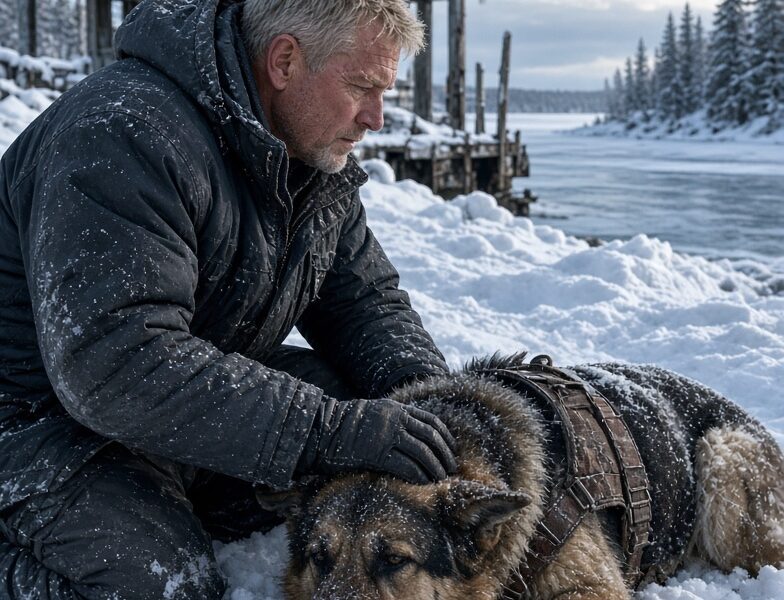
He Found a Dying Dog Guarding a Frayed Red Rope… and Uncovered the Secret That Had Haunted a Bridge for Six Years
The Navy SEAL had survived years of dangerous missions, brutal winters, and decisions that followed him long after the danger had passed. But nothing prepared Bennett Crossley Ward for the sight of an old German Shepherd buried beneath the snow beside an abandoned ferry landing in northern Wisconsin, guarding a broken piece of red rescue rope as if it were the last thing keeping the world together.
The dog had crossed twelve miles of frozen countryside to reach that place. His paws were raw, his body trembling, and his amber eyes carried a kind of exhaustion Bennett recognized from men who had spent too long fighting battles nobody else could see.
Then Bennett discovered where the dog refused to go.
Three miles into the forest stood an old service bridge. Six years earlier, the German Shepherd had been separated from the man he loved somewhere along that same road.
Now, the dog could not bring himself to cross it.
And as Bennett began uncovering what had really happened that winter, he realized that the broken rope was not simply a reminder of a man who never came home. It was the beginning of a truth that a grieving widow, a haunted survivor, and a former Navy SEAL had all spent years trying to understand.
By the time the next winter storm arrived, Bennett would have to decide whether he believed in the same rule that had governed his life for years: once you chose a direction, you kept moving forward, no matter what it cost.
Because sometimes, the hardest thing a man can do is turn around.
And sometimes, the bravest thing a dog can do is finally come home.
By the end of January, Silver Wake Bay had become a place made almost entirely of light.
Snow covered the rooftops, the pine-covered hills, the abandoned docks, and the dark stone edges of Lake Superior until the entire northern Wisconsin shoreline seemed brighter than it had any right to be in the middle of winter.
The sky was a hard, clean blue, and the lake beyond the trees looked like hammered steel beneath the morning sun.
Bennett had been in town for four days.
That was long enough to discover which coffee shop served a tolerable cup of coffee, which roads the county plowed first, and which locals would answer a simple question with a sentence instead of a thirty-minute account of their family history.
It was not long enough to belong.
Bennett preferred it that way.
At forty-four, he had made a profession out of temporary places. Six weeks in Montana, three months in Wyoming, a cold-weather safety contract in Colorado, and a wilderness medical assessment somewhere in the mountains that most people visited only when the weather was pleasant.
His latest assignment was supposed to last six weeks.
Perfect.
He drove north that morning in a county utility truck, one hand resting loosely on the steering wheel.
Standing just under six feet three inches, Bennett was built less like a weight-room athlete than a man who had spent years carrying equipment across difficult terrain.
His dark ash-blond hair was clipped short along the sides, with a narrow streak of silver cutting through the front. A faint scar crossed the outer edge of his right eyebrow.
His years in the Navy remained visible in the way he sat, straight without stiffness, alert without appearing nervous.
But Bennett no longer dressed like a man expecting a firefight.
A coyote-brown insulated field jacket covered a forest-green wool layer. Charcoal winter work pants disappeared into weathered brown boots, and a dull silver carabiner hung from his belt loop, clicking softly whenever he shifted.
His current assignment was considerably less dramatic than his former life.
At least on paper.
The county wanted to reopen North Bell Ferry Landing as a winter safety station. The ferry had stopped operating commercially years earlier after a new road made the crossing unnecessary, but the landing still occupied a useful position along the bay.
Emergency management wanted it available for storms, power failures, stranded motorists, maintenance crews, and anyone unfortunate enough to discover that northern Wisconsin winters could become dangerous faster than a person could get back to the warmth of a vehicle.
Bennett had been hired to examine the service roads, shelters, navigation markers, radio repeaters, access routes, and old incident reports.
Mara Ellery, the county emergency management director, had summarized the job during their first meeting.
“Find the things that fail before they fail.”
Bennett had liked that.
Machines were honest. Roads were honest. Ice was brutally honest.
People were more complicated.
The snow squall the previous night had lasted less than three hours, but it had left several inches of fresh powder across the North Bell access road.
As Bennett rounded a bend, the abandoned ferry building appeared between the trees.
It had once been painted white. Now the siding was faded gray, with long strips of paint peeled away by years of wind.
A rusted bell hung beneath the overhang beside the old boarding gate.
Beyond it, Lake Superior stretched into the distance, enormous and cold beneath the morning sun.
Bennett almost drove past the first paw print.
Then he saw the second.
He slowed.
A line of tracks crossed the fresh snow from the trees on his left. The prints were deep, clean, and unmistakably canine.
A large dog had passed through after the storm.
Bennett stopped the truck.
He studied the tracks through the windshield, then looked ahead toward the abandoned landing.
The prints did not wander. There was no circling, no searching pattern, and no sign that the animal had been chasing deer.
They followed the road directly toward North Bell.
Bennett switched off the engine and stepped into the cold.
“All right,” he muttered. “What do you know that I don’t?”
Only the wind answered.
He followed the tracks on foot.
They crossed the parking area, passed the old terminal building, and continued toward a snowbank piled along the service fence by a county plow.
Then the prints disappeared.
Bennett stopped.
For several seconds, he heard nothing except the lake wind moving through the frozen pine branches.
Then came a faint metallic sound.
Clink.
He turned his head.
A few seconds later, it came again.
Clink.
Something was moving weakly against metal.
Bennett climbed the snowbank, where the ground dropped sharply toward an old maintenance lane.
He saw black fur first, then tan, and finally two amber-brown eyes watching him from beneath a crust of blown snow.
“Ah, hell.”
The German Shepherd was trapped between the lower service fence and a length of wire half-buried in ice.
A weathered brown working harness covered his chest. One strap had twisted around the wire near a fence post, and every attempt to move had pulled the dog tighter against it.
The animal was large, or had once been.
Now his deep chest looked too narrow beneath his coat. Snow clung to the black saddle along his back, while the golden-tan fur on his legs had frozen into dark, wet strands.
Gray showed around his muzzle.
One ear stood erect. The left had a small triangular notch along its outer edge.
His legs trembled with deep, involuntary shudders.
Bennett did not approach immediately.
He lowered himself into a crouch several yards away.
The shepherd lifted his head, and a growl emerged from somewhere deep in his chest.
It was weak, almost apologetic.
“Fair enough,” Bennett said.
The dog stared at him.
Bennett removed one glove and rested his bare hand against his knee.
“I wouldn’t trust me either.”
Another growl followed, slightly stronger this time.
“That’s actually encouraging.”
The dog shifted, and Bennett noticed what he had been protecting.
Beneath his chest lay a short length of old red rescue rope, approximately three feet long. The fibers were weathered and frayed, and one end looked as though it had been torn or cut years earlier.
Despite barely being able to remain upright, the dog had positioned himself over it.
Bennett looked from the rope to the animal.
“Yours?”
The shepherd lowered his head over the faded red fibers.
That answered the question.
Bennett could have moved faster. His years of training had taught him a hundred ways to control a difficult situation.
But control was not what this dog needed.
So Bennett sat down in the snow.
Five minutes passed.
Then ten.
He talked occasionally, mostly so the animal could hear the shape of his voice.
He complained about the truck’s heater. He criticized Silver Wake’s coffee. He informed the shepherd that if he intended to freeze beside an abandoned ferry landing, he had selected a particularly inconvenient morning.
The dog did not appear impressed.
Eventually, however, the growling stopped.
Bennett moved one foot closer.
The dog’s head rose.
Bennett stopped and waited.
Little by little, the distance disappeared.
When he finally reached the shepherd, Bennett did not touch his head. He placed one hand against the harness and examined the twisted strap.
The wire had not cut into the animal.
That was good.
The harness was simply caught badly enough that pulling against it would make matters worse.
Bennett took a multitool from his jacket.
The shepherd watched every movement.
“Easy. I’m not taking anything from you.”
He cut through the trapped strap.
The tension released, and the dog sagged for half a second.
Bennett thought he might try to run.
Instead, the shepherd collapsed onto one foreleg.
“Okay. I’ve got you.”
Bennett caught him beneath the chest before he rolled onto his side.
The dog made a small sound that was not quite a whine.
It was exhaustion.
Bennett pulled an emergency blanket from his pack and wrapped it around the animal.
Then he slid one arm beneath the dog’s chest and the other under his hindquarters.
The shepherd’s head snapped toward the ground.
Toward the rope.
Even now.
Bennett stopped.
“You’re kidding.”
The dog tried to reach it. One paw scraped weakly through the snow.
Bennett looked at the faded red fibers again.
Whatever the rope meant, it mattered more to this animal than warmth. Perhaps more than food.
He reached down and picked it up.
“All right. This comes too.”
He tucked it inside the emergency blanket.
The shepherd immediately stopped struggling.
That bothered Bennett more than it should have.
He lifted the dog. The animal was lighter than a healthy German Shepherd of that size ought to be.
As Bennett climbed the snowbank, the dog’s body rested heavily against his chest.
For a moment, the shepherd’s head settled against Bennett’s shoulder.
Then he lifted it suddenly.
Not toward the truck.
Not toward the road.
Toward North Bell, the abandoned terminal, the locked gate, and the rusted bell beneath the overhang.
Nothing moved there.
No ferry waited beyond the dock. No people stood beneath the building.
Still, the dog stared.
His ears rose, and his exhausted body became strangely attentive.
Bennett followed his gaze.
There was nothing to see.
He looked back at the shepherd.
“You came here on purpose.”
The dog continued watching the empty landing.
And for the first time that morning, Bennett felt the situation change.
He had found an injured animal. That was simple.
But a dog crossing twelve miles of winter country to reach a place no longer in use, carrying an old piece of rescue rope he refused to leave behind, was something else entirely.
Bennett had spent years learning to recognize the difference between a problem and a pattern.
He had a feeling he was looking at the beginning of one.
At Silverwake Veterinary Clinic, Dr. Celia Norwood took one look at the dog in Bennett’s arms and abandoned whatever question she had been about to ask.
“Exam two. Now.”
Celia was fifty-eight, lean and sharp-featured, with deep auburn hair turning silver near the temples and narrow glasses hanging from her scrub collar.
Her movements were efficient without being rushed.
Bennett carried the shepherd inside.
Warm fluids, blankets, and a careful examination followed.
The dog’s temperature was low. He was dehydrated and badly exhausted, but nothing appeared to be broken.
Celia checked his paws, joints, teeth, and heartbeat.
“Here’s the good news,” she said. “I don’t see a fracture, and I don’t think we’ve missed a major injury.”
Bennett leaned against the wall.
“And the bad?”
She glanced at him.
“You look disappointed that there isn’t more.”
“I prefer complete lists.”
“So do accountants.”
“That sounded insulting.”
“It was.”
Bennett almost smiled.
Celia ran a scanner over the dog’s shoulder.
A beep sounded.
She looked at the screen, and her expression changed.
Not dramatically.
Just enough for Bennett to notice.
“What?”
Celia read the registration information aloud.
“Keel.”
At the sound of his name, the German Shepherd opened one amber eye.
Celia glanced at the screen again.
“Owner of record: Lenora Vale.”
Bennett waited.
“You know her?”
“I know of her.”
“That usually means yes with extra steps.”
Celia ignored the comment and walked to the phone.
The call took less than five minutes.
The first person through the clinic door was not Lenora.
Joan Harker arrived wearing a forest-green quilted barn jacket dusted with snow. At sixty-four, she was short and sturdy, with warm gray-brown hair tied low at the back of her neck.
The moment she saw Keel through the examination-room doorway, she pressed one hand against her chest.
“Oh, thank God.”
Keel lifted his head.
His tail struck the blanket once.
Joan approached immediately, but she did not throw her arms around him. She knelt, offered her hand, and let him smell her fingers before rubbing the side of his neck.
“You miserable old escape artist.”
Her voice cracked on the final word.
Keel closed his eyes.
Joan explained that she had been caring for him while Lenora recovered from a fall.
Keel had disappeared from Joan’s property almost two days earlier.
“A delivery driver must have left the gate open,” she said. “I went outside twenty minutes later, and he was gone. We searched the roads, called the sheriff, contacted animal control. Everybody.”
Bennett studied her.
“You live twelve miles from North Bell?”
Joan nodded.
“We searched everywhere we could think of.”
Her eyes fell on the chair beside Bennett.
The red rope lay there.
She stopped speaking.
The change was immediate.
Not fear.
Recognition.
Joan walked over slowly, but she did not touch it.
Bennett watched her face.
“That important?”
Joan took a breath.
“It belonged to Caleb.”
“Who’s Caleb?”
For several seconds, Joan said nothing.
Behind her, Keel slept beneath a warmed blanket, one forepaw resting near the rope as though he still needed to know it was there.
Finally, Joan looked back at him.
“Caleb Vale was Lenora’s husband.”
Bennett waited.
Joan’s gaze drifted toward the clinic window, where snow gleamed beneath the winter sun.
“He was the last person to go down the road Keel is trying to get back to.”
Bennett looked at the dog.
The shepherd had closed his eyes again, but one paw remained close to the red rope.
Something had happened six years earlier.
And Keel, after all that time, had carried part of it back into the light.
The next morning, Celia called before Bennett had finished his first coffee.
“Your patient is awake, eating, and complaining about confinement.”
“Good signs?”
“Excellent signs. He’s also decided that my assistant is personally responsible for the existence of thermometers.”
“Sounds like a difficult patient.”
“He has opinions.”
By late morning, Bennett had permission to take Keel for a short, leashed walk behind North Bell.
Partly to see how he moved.
Partly because the shepherd had become increasingly restless indoors.
Bennett expected him to sniff around, investigate the parking lot, or perhaps head toward the road back to Joan’s farm.
Instead, Keel turned toward the forest.
Immediately.
With purpose.
Bennett followed.
The old service trail was narrow but visible beneath the snow. Within the first half mile, it became obvious that Keel knew the route.
At every fork, the German Shepherd chose without hesitation.
He passed a stand of white pine, crossed an old maintenance clearing, and continued along a ridge where the lake flashed between the trees.
Bennett said very little.
The dog did not seem lost.
He seemed to be retracing something.
Nearly three miles from North Bell, the trail descended.
An old service bridge appeared between the trees.
It was not particularly large, just a steel-and-timber structure crossing a narrow ravine, its railings rimmed with snow.
Keel stopped so suddenly that Bennett almost walked into him.
The shepherd’s body changed.
His head lowered. His weight shifted backward. His left ear folded slightly.
One front paw lifted from the snow but did not move forward.
Bennett looked at the bridge, then at the dog.
“That’s it?”
Keel did not move.
Bennett walked several steps onto the bridge.
The boards held firm beneath his boots.
He turned.
“Come on.”
Keel backed away.
One step.
Then another.
Bennett stepped off the bridge, and the dog stopped retreating.
He stared across the ravine, neither barking nor pulling away, simply unable to cross.
Bennett looked back at the trail they had followed.
Twelve miles through winter to return to North Bell.
Nearly three more miles through the forest without hesitation.
And now nothing.
A dog strong enough to find his way across frozen roads and unfamiliar ground stood motionless before an ordinary bridge.
Whatever waited on the other side had been there for six years.
And Keel still could not make himself go back.
Bennett did not force him.
He stood beside the shepherd until the animal’s breathing steadied, then turned toward the trail.
Keel followed.
That should have been the end of the morning’s walk.
But as they returned to the truck, Bennett understood that the bridge was no longer simply part of the county’s winter infrastructure.
It was the center of a question he could not yet answer.
And he had never been particularly good at leaving unanswered questions alone.
Lenora Vale did not look like a woman waiting to be reunited with her dog.
She looked like a woman trying very hard not to hope.
The rehabilitation center stood on the eastern edge of Silver Wake, a low brick building with wide windows facing a stand of white pine.
Winter sunlight filled the lobby so brightly that the polished floor reflected the snow outside.
Lenora waited near the end of the main corridor.
At seventy-two, she was slender, with silver-gray hair cut neatly to her chin. A dark navy cardigan lay over a cream sweater, and one hand rested on the grip of a walker.
Her other hand was clenched at her side.
Keel saw her.
Everything changed.
For the first several yards, he pulled Bennett forward hard enough to tighten the leash.
“Easy.”
Keel ignored him.
Then, strangely, the shepherd slowed.
His steps became shorter. His ears relaxed. The urgency disappeared.
By the time he reached Lenora, he was walking almost carefully, as though he understood that whatever had happened to her required gentleness.
Lenora lowered one trembling hand.
Keel smelled her fingers.
Then he pressed forward and laid his silvering muzzle across her knee.
That was all.
No barking.
No jumping.
No theatrical celebration.
Lenora stared down at him.
“You stupid old fool.”
The words came out dry enough to almost be teasing.
Then her mouth trembled.
She laughed once and began to cry.
Keel did not move.
He simply leaned more of his weight against her leg.
Bennett turned toward the window. He had never been particularly comfortable with moments that clearly belonged to someone else.
Behind him, Lenora whispered something too softly for him to hear.
When Bennett finally looked back, her hand was buried in the thick fur behind Keel’s ears.
The dog’s eyes were closed.
Whatever connection Caleb Vale had shared with Keel, Bennett understood something now that he had not understood at the bridge.
Keel had not spent six years loving a dead man alone.
He loved this woman deeply, and Lenora’s face made it equally clear that the feeling had never been one-sided.
“You found him?” she asked.
Bennett nodded.
“North Bell.”
Her fingers stopped moving for half a second, then continued.
“Of course.”
The response bothered him, not because it sounded mysterious, but because it sounded tired.
As though North Bell was exactly where she had feared Keel would go.
Joan explained that Lenora’s fall had happened on an icy set of exterior steps several weeks earlier.
Nothing catastrophic, but enough to leave her with ongoing balance problems and a rehabilitation plan that could take months.
She could walk.
She simply could not safely manage a nearly ninety-pound German Shepherd if he pulled suddenly on ice.
“And I can’t pretend my farm is Fort Knox anymore,” Joan admitted. “One delivery driver leaves a gate wrong, and apparently Keel decides he’s Lewis and Clark.”
Lenora looked down at the dog.
“Lewis and Clark knew where they were going.”
Apparently, that quieted the room.
County Animal Services had already been contacted through Celia. The simplest arrangement was temporary foster placement until Lenora’s mobility improved or a longer-term decision could be made.
Unfortunately, there was one practical problem.
Keel had already demonstrated that he could leave Joan’s property and cover twelve miles when sufficiently motivated.
Joan could not guarantee she could contain him safely.
Lenora could not take him back yet.
Which left Bennett standing in a rehabilitation center while three women slowly organized his life without consulting him.
“No,” he said.
Lenora looked up.
Joan folded her arms.
Keel opened one eye.
“No what?” Joan asked.
“No fostering. You need to find somebody else.”
“You have a cabin.”
“That isn’t the definition of qualification.”
“You know dogs.”
“I removed one from a fence.”
Lenora’s mouth twitched.
“An impressive résumé.”
Bennett looked at her.
She looked entirely too pleased with herself for someone using a walker.
His phone rang before he could answer.
Mara Ellery.
Bennett stepped into the hallway.
The county emergency management director did not bother with greetings.
“Celia called.”
“Of course she did.”
“Animal Services has no issue with temporary placement if you agree.”
“I don’t.”
A pause.
Then Mara said, “Explain that to him.”
Bennett looked through the open doorway.
Keel was staring directly at him.
Not Lenora.
Not Joan.
Him.
Bennett closed his eyes briefly.
“This is extortion.”
“No. Extortion usually involves money.”
The call ended.
Twenty minutes later, Bennett left the rehabilitation center with paperwork, dog food, medication instructions, a leash, and a German Shepherd who had somehow acquired temporary residence in his cabin without ever being consulted.
Lenora watched them from the window.
Before Bennett reached the truck, she tapped lightly on the glass.
Keel turned.
For an instant, his body pulled backward toward her.
Then he looked at Bennett.
Bennett opened the passenger door.
“Your choice.”
Keel hesitated.
Then he climbed in.
It was the first time Bennett had seen him choose movement over return.
He did not yet understand how important that would become.
Over the next several days, Keel recovered faster than Bennett expected.
Food helped.
Warmth helped.
Sleep helped most.
The dog’s ribs became a little less visible beneath his golden-tan coat. His gait strengthened, and the stiffness in his shoulders gradually eased.
His personality arrived in pieces.
Keel disliked vacuum cleaners.
He approved of scrambled eggs.
He considered Bennett’s side of the cabin couch an administrative error that needed correcting.
He also possessed an extraordinary ability to appear asleep until Bennett opened anything resembling food packaging.
“You’re recovering suspiciously well,” Bennett told him one evening.
Keel stared at the piece of turkey in Bennett’s hand.
“Yes, your medical condition is tragic.”
The dog drooled onto the floor.
Bennett sighed and handed over the turkey.
“But outdoors, something different emerged.”
Whenever Bennett drove toward North Bell for work, Keel became alert before the terminal was even visible.
He watched the trees and smelled the air through the cracked truck window.
The first time Bennett took the service road toward Marorrow Point again, Keel walked ahead with confidence.
At the first fork, the dog turned right without hesitation.
At the second, left.
He knew the trail.
Bennett deliberately stopped at one junction and waited.
Keel looked back at him with what could only be described as disappointment.
“I’m testing you.”
Keel turned away.
“Apparently, I failed.”
They continued.
White pine gave way to birch and spruce. Old county route markers appeared beside the trail, their orange paint faded by years of exposure.
Then the bridge came into view.
Keel stopped.
Exactly as before.
One moment he was walking; the next, he was motionless.
His breathing changed first, becoming shorter and faster.
His left ear flattened, and his head lowered.
Then one front paw lifted several inches above the snow and remained suspended there.
He did not pull the leash.
He waited.
Keel stared toward the bridge.
The structure was unremarkable in daylight: steel beams, timber decking, and a shallow ravine beneath it.
Snow collected along the rails.
Nothing moved.
Bennett stepped sideways.
Keel’s eyes tracked him immediately.
“I’m not going to make you.”
The dog remained tense.
Bennett took one step backward, away from the bridge.
Keel’s lifted paw touched down.
Another step back.
The shepherd exhaled.
That detail stayed with Bennett, not because it was dramatic, but because it was physical.
The dog was not making a decision about history.
His body was reacting before any decision could happen.
Celia confirmed as much when Bennett brought Keel for a follow-up examination.
“You keep wanting him to explain himself,” she said.
“I haven’t asked him anything.”
“You don’t have to speak to anthropomorphize.”
Bennett leaned against the examination table.
“That’s a large word for accusing me of being stupid.”
“I’m a veterinarian. We have specialized vocabulary.”
Keel stood patiently while Celia examined his paws.
She continued, “Dogs can associate a location with fear, stress, noise, injury, or separation. They don’t need to reconstruct an event the way we do. If something happened near that bridge, the environmental cues can be enough.”
“So he remembers it.”
Celia tilted her head.
“Maybe. But be careful with that word.”
She scratched Keel beneath the chin.
“His body recognizes something there as unsafe. That’s enough.”
Bennett thought of the way Keel’s paw had hung above the snow.
“What do I do for now?”
“Nothing heroic.”
“That sounds personal.”
“It is.”
She met his eyes.
“Don’t drag him over. Don’t make crossing the bridge a test of courage. Let him decide how close he can get.”
That afternoon, Bennett called Lenora.
He did not start with Caleb.
He told her Keel was eating well, that his weight was improving, and that he had stolen half a piece of toast despite showing no previous interest in toast.
Lenora said, “He prefers butter.”
“Useful information after the theft.”
Then Bennett mentioned Marorrow Point.
The silence changed.
Not long.
Just enough.
“He knows the road,” Lenora said.
“Yes.”
Another silence.
Bennett did not fill it.
Finally, Lenora spoke again.
“Caleb crossed that bridge the last time Keel saw him. Nothing more.”
Bennett waited.
Lenora did not continue.
He could have asked.
Instead, he said, “All right.”
For the first time since he had met her, Lenora sounded surprised.
“You’re not going to press?”
“No.”
“That seems unlike you.”
“You barely know me.”
“I’ve met military men before. That isn’t the same thing.”
“No,” Bennett said quietly. “I suppose it isn’t.”
After the call, Bennett returned to the work he had actually been hired to do.
North Bell’s records occupied two gray filing cabinets and a badly organized digital archive in the county operations office.
Most of the material was dull.
Generator maintenance.
Plow schedules.
Ice reports.
Replacement invoices.
Radio tests.
Bennett preferred dull records.
Dull usually meant nobody had been hurt.
Then he found the Marorrow Point incident report.
Six years earlier, late winter.
Snow squall.
County utility vehicle immobilized near the western bridge approach.
Operator: Gideon Shaw.
Responding maintenance supervisor: Caleb Vale.
Canine present: Keel.
Bennett sat straighter.
He read the official narrative.
It was unusually short.
Weather deteriorated unexpectedly. Caleb Vale and Keel approached Gideon Shaw’s disabled vehicle. Shaw was moved from the exposed area. Additional response units were dispatched. Communications later failed.
Then one sentence.
A fatality occurred during the rescue response.
Bennett reread it.
It was the kind of sentence bureaucracies used when reality was too large to fit inside a box.
Gideon Shaw survived.
Caleb Vale did not.
That evening, Bennett visited Lenora again.
She was in a small common room at the rehabilitation center, working through crossword clues with a mechanical pencil the color of dark wine.
She looked at his face once.
“You read it?”
“Yes.”
She set the pencil down.
“Which version?”
“The official incident report.”
“That isn’t a version. That’s a skeleton.”
Bennett sat opposite her.
“Caleb went back for Gideon.”
“Yes.”
“Keel went with him.”
“Yes.”
“Gideon survived.”
Lenora’s expression did not change.
“Yes.”
Bennett hesitated before asking the obvious question.
“Caleb died because he went back to rescue Gideon.”
Lenora looked toward the window.
Snow was falling again, light enough that each flake remained visible against the dark pines.
“That,” she said, “is the story people tell.”
Bennett studied her.
“It isn’t true?”
Lenora picked up her mechanical pencil again and rolled it slowly between two fingers.
“I didn’t say that.”
“Then what are you saying?”
Her steel-green eyes lifted to his.
“I said it isn’t complete.”
Bennett left without asking another question.
Not because his curiosity had disappeared, but because he recognized a boundary when someone drew one clearly.
Back at the cabin, Keel slept in front of the wood stove, his paws twitching occasionally in whatever world dogs visited when they dreamed.
Bennett made coffee and opened the archived North Bell technical logs on his laptop.
He was not searching for a secret.
He was checking infrastructure, radio coverage, service-road timestamps, dispatch records, weather-station failures, and the kind of details Mara had hired him to examine.
Near midnight, he found the original response timeline.
He read it once.
Then again.
At 6:42 p.m., Caleb Vale reached Gideon Shaw.
At 6:56 p.m., Gideon was moving toward the designated shelter point.
At 7:09 p.m., the secondary response crew confirmed physical contact with Gideon.
Gideon Shaw was safe.
Bennett scrolled down.
Caleb Vale’s final confirmed radio contact occurred at 7:46 p.m.
Bennett leaned back.
Nearly forty minutes.
Keel lifted his head from the rug.
Bennett looked at the numbers again.
The story everyone remembered said Caleb had gone back to rescue Gideon.
That part was true.
But Gideon had already been out, already safe, nearly forty minutes before Caleb disappeared.
Bennett closed the laptop halfway.
Outside, wind brushed snow against the cabin windows.
Across the room, Keel watched him in silence.
If Caleb had already saved Gideon, then whatever had taken him back toward Marorrow Point had been something else entirely.
Bennett had no interest in becoming the kind of man who arrived in a town, asked too many questions, and started believing every old silence concealed a conspiracy.
He had met men like that.
They usually carried folders.
They always said things like, “Nothing adds up.”
Bennett preferred things that added up.
Unfortunately, Marorrow Point did not.
The next morning, Mara Ellery dropped a county file on his desk.
“If North Bell is going back into service,” she said, “I need to know why the old response system failed.”
Bennett flipped through the file.
“You mean Caleb Vale?”
“I mean everything around Caleb Vale.”
Mara stood on the other side of the operations room in her charcoal waterproof jacket, a yellow clipboard tucked beneath one arm.
“Road access. Radio coverage. Warning systems. Personnel decisions. Equipment. Weather. All of it.”
“So I’m auditing a six-year-old incident.”
“You were already doing that.”
“I was hoping you hadn’t noticed.”
“I notice most things I pay for.”
Bennett closed the folder.
Mara pointed to a page.
“Gideon Shaw.”
The name had appeared throughout the Marorrow Point records.
Survivor.
County road maintenance employee.
Utility vehicle operator.
Retired four years earlier.
Current address in a small town almost three hours southwest of Silver Wake.
Bennett looked toward the window.
Keel sat outside the office beside the truck, watching a snowplow move across the county yard.
Mara followed his gaze.
“You planning to take him?”
“He dislikes being left alone.”
“So do you.”
Bennett looked at her.
Mara smiled without warmth.
“Drive safe.”
Three hours later, Bennett found Gideon Shaw living in a cedar-sided house at the edge of a small town where the snowbanks were high enough to hide most mailboxes.
The driveway had been cleared neatly.
The porch had not.
Bennett knocked twice.
A large man answered, or rather, someone who had once been large.
Gideon was sixty-eight, broad through the shoulders but leaner now, with weathered hands and a face that seemed built from square pieces.
His hair was thick and white-gray. A short horseshoe mustache framed a mouth that looked naturally skeptical.
He wore a rust-brown canvas coat over a faded denim shirt.
His first look at Bennett was cautious.
His second was irritated.
“Can I help you?”
“Bennett Ward. Silver Wake County Emergency Management.”
“That’s supposed to mean something to me?”
“We’re reviewing the Marorrow Point response.”
Gideon’s expression changed.
Not fear.
Closure.
The conversation was over before it had begun.
“No.”
Bennett had expected resistance.
He had not expected a door moving toward his face.
“I only need—”
“I said no.”
“Caleb Vale—”
The door stopped.
For half a second, Gideon looked as if the name had physically struck him.
Then his jaw tightened.
“That’s exactly why.”
He started closing the door again.
Behind Bennett, truck tires shifted slightly on packed snow.
Then came the soft scrape of claws against the porch steps.
Gideon froze.
Keel stood behind Bennett.
The dog had climbed out through the passenger door Bennett had left cracked for ventilation.
For once, Bennett decided not to correct the behavior.
Gideon stared at him, his face suddenly empty.
“Keel.”
The German Shepherd did not rush toward him.
He did not shrink away.
He simply stood at the edge of the porch, his black saddle dark against the snow, amber-brown eyes fixed on the older man.
Gideon slowly removed one glove and lowered his hand.
Keel watched.
Several long seconds passed.
Then the dog stepped forward once and stopped.
Gideon swallowed.
“He got old.”
“So did you,” Bennett replied.
Gideon glanced at him.
“That your idea of diplomacy?”
“No.”
Keel took another step.
Gideon crouched with difficulty.
The dog sniffed his fingers.
No dramatic recognition followed.
No bark.
No frantic wagging.
Keel simply breathed in the scent of a man from another part of his life.
Then he sat.
Gideon looked at the dog for a long time.
When he stood again, the anger had not disappeared, but the door remained open.
“Coffee?”
Bennett nodded.
“Black.”
“Good. I don’t keep anything useful to ruin it with.”
Inside, Gideon’s house smelled faintly of cedar, coffee, and machine oil.
Old road maps hung framed on one wall. A steel thermos, dented in three places, sat beside the sink.
Keel settled near the wood stove.
Gideon remained standing.
He looked like a man who had spent six years deciding which memories were allowed into a room and which had to remain outside.
“You want to know why Caleb went back?” he asked.
Bennett did not pretend otherwise.
“Yes.”
Gideon poured coffee.
“I’ve wanted to know the same thing.”
The snow squall had arrived faster than forecast.
Gideon had been driving a county utility vehicle toward Marorrow Point to check a drainage gate when visibility collapsed.
“The road didn’t disappear,” he said. “That would’ve almost been easier.”
He stared into his mug.
“You could still see just enough to believe you knew where it was.”
The vehicle slid off the packed route near the western bridge approach and settled against a snowbank.
There was no major injury, but Gideon could not drive out.
Radio contact became unreliable.
Caleb Vale was already nearby with Keel.
“He came back.”
Gideon remembered seeing the shepherd first, a dark shape moving through white, then Caleb.
“He was yelling something. I couldn’t hear him over the wind.”
Caleb carried a red rescue rope.
The same type Bennett had found beneath Keel.
He secured the line and used it to keep Gideon oriented as they moved toward the safer side of the service route.
Keel stayed close.
“Too close,” Gideon said.
“Caleb kept ordering him behind. The dog ignored him.”
Bennett looked toward Keel.
“That sounds familiar.”
Gideon gave the faintest smile.
Then it disappeared.
Near the bridge approach, a tree came down somewhere ahead of them.
Not onto anyone.
Close enough.
The sound, the movement, and the sudden shower of snow sent Keel into a panic.
He tried to go backward, then forward, unable to settle.
“Caleb stopped,” Gideon said. “He knelt beside Keel and tapped the side of the harness twice. Some kind of familiar cue.”
Keel focused on him.
Then Caleb pointed back toward North Bell.
“Go home.”
The dog refused.
Caleb tapped the harness again and pointed.
“Lenora.”
Even through the storm, Gideon remembered the frustration in Caleb’s voice.
Not anger.
Urgency.
Finally, Keel turned.
He ran.
“Did he cross the bridge?” Bennett asked.
Gideon shook his head.
“No. We were still on the western side when the tree came down. Caleb sent him back before we crossed.”
Bennett looked toward the dog beside the stove.
That mattered.
Keel’s fear was not necessarily about watching Caleb disappear across the bridge.
It might have been tied to the storm itself, the falling tree, the sudden separation, and the chaos of that route.
A body could remember what language could not explain.
Gideon continued.
“Caleb got me to the designated shelter point. Another response crew reached us there. They checked me over and put me in a heated cab.”
He rubbed both hands around his mug.
“Caleb could’ve gotten in with me, but he didn’t.”
“No.”
“Why?”
Gideon looked at him.
“I asked.”
Outside, snow slid softly from the roof.
“I saw him turn around.”
“You saw him leave?”
“Yes.”
“I yelled after him.”
Bennett waited.
“What did you say?”
Gideon stared past him.
“‘Caleb, don’t.'”
“And he answered?”
A long pause followed.
“Something still out there.”
Bennett did not speak.
Gideon looked toward Keel.
“For six years, I thought he meant a person.”
The sentence changed the room.
Not because of what it revealed, but because of what it did not.
Bennett felt his old operational instincts sharpen.
Personnel.
Vehicles.
Routes.
Accountability.
A rescue scene could be chaotic, but eventually somebody counted.
“Was anyone missing?”
“I assumed there was.”
“You never checked?”
Gideon’s eyes hardened.
“I was half frozen and being evacuated. By the time I heard Caleb hadn’t come back, I wasn’t interested in reading paperwork.”
“Later?”
“Later, I was interested in leaving Silver Wake.”
There was no self-pity in the answer, only exhaustion.
“I spent enough years thinking he died because he came for me.”
Keel lifted his head at Gideon’s voice.
The older man looked at him.
“Maybe I didn’t want to find out there was someone else.”
Bennett understood that more than he wanted to.
If there was someone else, Gideon became only one piece of the story.
If there was not, the question became worse.
Bennett returned to Silver Wake that evening.
The first thing he did was check the personnel list.
No one missing.
Every county employee assigned to Marorrow Point that day had been accounted for. Contractors were accounted for. Snowplow crews were accounted for.
There was no stranded civilian report, no second vehicle, no unnamed person.
He checked twice.
Then a third time.
Nothing.
Gideon had spent six years believing Caleb returned for someone, but according to every roster Bennett could find, there had been no one left to rescue.
The next morning, Mara introduced him to Warren Pike.
Warren was sixty-seven and lived in a narrow house near the old harbor communications shed.
He had the lean, weathered build of someone who had spent decades climbing ladders in bad weather and no longer saw the appeal.
He wore a gray wool overshirt and glasses thick enough to make his eyes seem permanently skeptical.
“You’re the SEAL,” Warren said.
“Former.”
“Everybody says former right before telling you about it.”
“I didn’t.”
Warren considered that fair.
Unlike Gideon, Warren had no interest in recounting the emotional history of Marorrow Point.
He cared about equipment.
That made him easier for Bennett to understand.
They sat side by side at an old county terminal while Warren navigated archived communications logs.
“Portable beacons were simple,” Warren said. “Ugly, heavy, dependable until they weren’t.”
“Everything’s dependable until maintenance gets deferred.”
Warren gave him a sidelong look.
“You’re going to fit in around here.”
A few minutes later, Warren stopped scrolling.
“There.”
One portable emergency beacon had been assigned to the Marorrow Point crew.
Unit MP4.
Its function was not merely location tracking during poor visibility. It also broadcast a warning signal to county snowplows and service vehicles approaching the western bridge sector.
“If this beacon goes down,” Warren explained, “what happens depends on whether the drivers have radio contact and whether they can see the temporary closure markers.”
“And if they can’t?”
Warren pointed to the log.
“MP4 lost transmission minutes after Gideon reached shelter.”
Then something else caught Bennett’s attention.
A second road crew had still been approaching from the north.
They were not yet in the danger zone, but they were moving toward it.
Would they know the bridge approach was compromised?
Warren leaned closer.
“If radio coverage holds.”
“And if it doesn’t?”
Warren said nothing.
They both knew.
Bennett sat back.
Gideon’s memory returned.
Something still out there.
Not someone.
Something.
Caleb had not necessarily turned back for another trapped person.
He might have gone back for the beacon.
Not to save a man standing in front of him, but to warn men he could not even see.
The discovery did not feel heroic.
It felt worse because Bennett understood exactly why someone like Caleb would make that choice.
A broken beacon was equipment.
Equipment could be repaired.
But when equipment was the only thing standing between unseen people and a dangerous road, it became something else.
Bennett looked at Warren.
“Do we know if Caleb got it running again?”
Warren shook his head.
“Not from this log.”
“Why not?”
“The archive ends after the repeater dropped.”
“Backup paper records might exist?”
“Might.”
Bennett gave him a tired look.
“I was hoping for one miracle today.”
“That’s not in the budget.”
By afternoon, Bennett had enough to return to Lenora.
He found her at the rehabilitation center packing personal items into a cardboard box.
Her balance had improved enough that she now used a cane indoors instead of the walker.
Keel entered first.
Lenora smiled.
“Still eating Bennett out of house and home?”
“Financially devastating.”
“Good.”
Bennett placed the red rope on the table.
Lenora stopped.
Not sharply.
Completely.
“I spoke with Gideon,” Bennett said. “He remembered Caleb saying something was still out there.”
Her expression did not change.
“There wasn’t another person,” he continued. “I checked the personnel records. We found a portable beacon that failed near the bridge.”
Lenora looked at him.
For the first time, Bennett saw recognition before she managed to hide it.
“Did Caleb go back for it?”
Lenora did not answer.
Instead, she reached into the cardboard box beside her chair.
Inside were ordinary things: a framed photograph, a pair of old work gloves, a folded county map, and a small metal flashlight.
Then Lenora removed another length of red rope.
Old.
Weathered.
Cut at one end.
Keel stood.
Bennett picked up the piece he had found with the dog.
Lenora placed hers beside it.
The ends were too frayed to fit together neatly, but the faded weave pattern continued across both pieces.
The same red line.
Once, one rope.
Keel lowered his head and smelled them.
Lenora ran her thumb across the frayed edge of the piece that had belonged to Caleb.
Bennett looked at her.
“The night at Marorrow Point?”
She nodded.
Keel stood between them.
One old dog.
Two broken lengths of rope.
And a road neither of them had yet been able to finish.
Lenora did not cry when Bennett told her the beacon had failed.
She looked at the two pieces of rescue rope lying on the table, then folded her hands in her lap.
Keel stood beside her chair.
Bennett had expected the discovery to matter more.
Maybe that was the problem.
He had spent the last several days arranging facts as though enough of them might eventually become an answer.
Gideon had been rescued.
Caleb had gone back.
The emergency beacon had stopped transmitting.
A second road crew had been moving toward Marorrow Point.
The rope Keel carried had belonged to Caleb.
Every piece fit.
And yet Lenora looked at the evidence with the expression of someone being shown a photograph she already knew by heart.
“You knew about the beacon,” Bennett said.
“Yes.”
“You knew that was why Caleb went back.”
“Yes.”
“Why didn’t you say that?”
Lenora raised one eyebrow.
“You never asked me why he went back. I asked if Gideon was the reason he died, and I told you that story was incomplete.”
Bennett leaned back.
“You enjoy making people work for information?”
“No. I spent thirty years in communications. I enjoyed people asking accurate questions.”
There it was again, that dry edge.
Not warmth exactly, but something alive.
Bennett had begun to notice that Lenora was funniest whenever the subject was least funny.
She reached toward the rope, then stopped before touching it.
“Caleb always went back.”
Bennett waited.
This time, she continued without being pressed.
“If he forgot his gloves, he went back. If I forgot my gloves, he went back. He complained the entire way, then acted as though he’d crossed the Arctic for me.”
Keel settled at her feet.
“If somebody got stuck along the county road, Caleb stopped. It didn’t matter if we were late.”
“He sounds exhausting,” Bennett said.
“He was.”
The smile stayed for half a second longer.
“Someone forgot a tool. He went back. Someone needed an extra set of hands. He went back. A neighbor’s generator quit in January, and Caleb was halfway out the door before the poor man finished calling.”
Bennett looked at the rope again.
“And you hated that?”
“I loved that.”
She met his eyes.
“And I hated it.”
There was no contradiction in the way she said it.
Only marriage.
Six years earlier, Lenora had been sitting in the North Bell communications room when the snow squall came through Marorrow Point.
She remembered the fluorescent lights above her desk, the dry heat from the wall vent, and a coffee cup Caleb had left there that morning with a crack running down one side.
Outside, wind had already begun pressing snow across the windows.
Inside, the radio came alive with fractured voices.
Gideon’s vehicle had slipped off the service route. Visibility had dropped so quickly that road markers appeared and vanished between gusts.
Caleb was nearest.
Of course, he went back.
“He called in when he reached Gideon,” Lenora said.
Her voice had changed.
Not softer.
More precise.
A professional voice returning to an old frequency.
“He said Gideon was cold but mobile. The vehicle was stuck, not overturned. No major injury.”
“What about Keel?” Bennett asked.
“With him? Keel went everywhere Caleb could get away with taking him.”
The rescue itself had been straightforward compared with what followed.
Caleb used the red rope to keep Gideon oriented through the blowing snow. He moved with them until the tree came down near the bridge approach.
Even over the radio, Lenora heard the noise.
A deep crack.
Then static.
Then Caleb shouting at the dog.
She could not hear every word, only the repeated command.
“Home.”
Keel eventually turned back.
Lenora found him less than twenty minutes later near North Bell, snow packed into the fur beneath his chest, his leash gone, his eyes wide and frantic.
At the time, she had not understood why he refused to settle.
“Keel kept looking behind him,” she said.
Bennett said nothing.
“Maybe that’s just me putting human thoughts on a dog. Celia would complain.”
“She usually does.”
For a moment, the room loosened.
Then Lenora continued.
“Caleb got Gideon to the shelter point. Another crew confirmed contact. I ordered Caleb to withdraw.”
“He acknowledged?”
“Yes.”
She looked at the rope.
“Then, less than a minute later, the beacon dropped.”
Bennett already understood what that meant operationally.
But hearing Lenora describe it made it feel different.
The Marorrow Point beacon was portable, ugly, and usually reliable. In poor visibility, it warned approaching county vehicles that the bridge sector was compromised.
The North Road crew had been redirected, but weather and terrain could swallow radio signals.
“I told Caleb to leave it,” Lenora said.
“The crew had a route change. I told him that twice.”
“What did he say?”
“That he didn’t trust they’d received it.”
“And you?”
“I told him I didn’t care.”
Bennett looked at her.
Lenora’s face hardened at the memory.
“I said exactly that. I don’t care about the beacon. Get out.”
Caleb answered that if the North crew lost radio contact in the whiteout, the beacon was the last warning they had before the bridge approach.
Lenora told him the equipment was replaceable.
He agreed.
Then he went back anyway.
“His line was always the same,” she said.
Bennett waited.
Lenora gave a tired little shake of her head.
“If I can still help, then I’m not done.”
It sounded less noble coming from her.
That was the point.
To everyone else, Caleb’s words had probably become something worthy of a plaque.
To Lenora, they were the same words that had made him late to dinner, late to appointments, and late home from work.
The same instinct that made him generous was the same instinct that had taken him away from her.
She had been the last person to hear his voice clearly over the radio.
No speech.
No farewell.
No acknowledgment that the next few minutes might become the dividing line in everyone else’s life.
Lenora told him again to leave.
Caleb replied, “I’ll be right back.”
That was all.
The beacon came back online later.
A rescue team approaching from the north received the warning and rerouted.
By the time conditions improved enough for a larger search, a tree had damaged the small shelter near the relay site, and the bridge approach had become impassable from one side.
Caleb never made it back across.
He died from exposure before rescuers reached him.
Lenora did not describe the recovery.
Bennett did not ask.
Nothing useful lived in those details.
For a while, the only sound in the room was Keel breathing.
Then Lenora said, “Everybody told me I should be proud.”
Bennett looked up.
“The paper called him a hero. The county put his picture up in North Bell for a while. People brought food, flowers, cards.”
“Sounds normal.”
“It was.”
That made the next sentence harder.
“They kept saying, ‘You must be so proud of him.'”
Lenora stared at the window.
“No one asked if I was angry.”
Something inside Bennett shifted.
Not because he was surprised, but because he understood the sentence before she explained it.
“I was furious at Caleb,” she said.
The word did not shake.
“I was furious with a dead man for doing exactly what everyone loved him for.”
She laughed once without humor.
“What kind of wife does that make me?”
Bennett answered immediately.
“A married one.”
Lenora looked at him.
He shrugged.
“You said you loved the same thing you hated.”
“That simple?”
“No.”
“Good.”
She looked down at Keel.
“I wanted one person to say I was allowed to wish he had left the beacon broken.”
Her voice finally lost its hard edge.
“I wanted to say I wished he had been selfish once. Just once, for me.”
The room went still.
That was the confession.
Not guilt.
Not shame over a bad decision.
Something harder to admit.
She wished a good man had been less good.
Just once.
But Silver Wake Bay had turned Caleb into a story almost immediately.
The man who went back.
The man who saved Gideon.
The man who restored the warning beacon.
The man who protected people he never even saw.
And Lenora became part of the story, too.
Not Lenora Vale.
Not the communications specialist who had trained half the staff at North Bell.
Not the woman who could identify radio interference by sound.
Not the person who once won thirty dollars from Warren Pike by proving he had mislabeled a frequency map.
She became Caleb Vale’s widow.
People lowered their voices around her.
They asked about Caleb.
They remembered Caleb.
They praised Caleb.
Every kindness narrowed her life.
“The first year, I stopped correcting people,” Lenora said.
“About what?”
“When they introduced me as Caleb’s wife.”
She looked at Bennett.
“I was still Caleb’s wife, but I was other things, too.”
Bennett thought of North Bell.
Of the old reports in which Caleb’s name appeared everywhere.
“I understand why you never wanted the full story turned into some public correction,” he said.
“No, you don’t.”
The reply was sharp enough to surprise him.
Lenora shifted forward.
“You think Caleb was wrong?”
Bennett held her gaze.
“Yes.”
No diplomacy.
No softening.
Lenora almost smiled.
“Because he went back.”
“The beacon was equipment. The beacon was warning people. The warning could have been handled another way.”
“Could it?”
“Maybe.”
“Ah.”
She leaned back.
“There it is.”
Bennett frowned.
“What?”
“Maybe.”
He disliked the word instantly.
Lenora knew it.
“What if the crew hadn’t received the route change?”
“They did. After Caleb turned the beacon back on.”
“You don’t know that was the only reason.”
“No.”
She paused.
“Neither do you.”
Bennett said nothing.
Lenora’s eyes narrowed slightly.
“What if someone you left behind still needed you?”
The question landed harder than Bennett expected.
For several seconds, he was no longer in the rehabilitation center.
He was on a mountain six years earlier, not in uniform, but working civilian rescue.
A friend named Thomas Avery had an injured leg and was leaning heavily against him. Another team member was farther upslope.
Thomas had wanted to turn back.
Bennett had refused.
Conditions were deteriorating.
He had chosen the descent.
Another team later reached the man upslope.
He lived.
Thomas died from complications after evacuation.
No investigation blamed Bennett.
No one told him he had chosen wrong.
That was almost worse.
He gave Lenora the shortened version, not because he wanted sympathy, but because she had earned the answer.
“When Thomas wanted to go back, I made him keep moving.”
Lenora listened.
“The other man was rescued later.”
“Yes.”
“And Thomas died after you got down.”
“Yes.”
“I’m sorry.”
Bennett nodded once.
She did not ask whether he carried guilt.
Instead, she asked, “Were you wrong?”
Bennett stared at the floor.
“I don’t know.”
Lenora’s face softened, but not kindly.
With recognition.
“That’s what you hate.”
He looked at her.
She continued.
“You don’t hate Caleb because he went back. You hate that you don’t know whether the choice you made was the right one.”
“You don’t know me well enough to tell me what I hate.”
“No, but I know men who build rules after something hurts them.”
That irritated him because it was true.
Bennett had built one.
Once a route was chosen, keep moving.
Do not reopen decisions.
Do not turn back because emotions suddenly made the other road look better.
It was disciplined.
It sounded rational.
It also made leaving easier.
Jobs.
Places.
People.
If he kept moving, he never had to return and discover whether something might have been repaired.
Caleb had lived at the opposite extreme.
Always back.
Always one more person, one more task, one more chance to help.
Bennett had spent years treating forward motion like wisdom.
Caleb had treated returning like duty.
Both could save someone.
Both could cost someone.
Neither made a man immune to consequence.
When Bennett left Lenora that afternoon, Keel came with him.
The dog paused at the rehabilitation center door and glanced back.
Lenora lifted two fingers in farewell.
“Take care of him.”
Bennett looked at Keel.
“Which one of us?”
“Dealer’s choice.”
Outside, snow had begun to fall.
Not a storm.
Just small flakes drifting between parked cars.
Bennett drove straight to Celia’s clinic.
She was finishing paperwork when he arrived.
Keel immediately walked behind the front counter as if he owned the building.
Celia looked down at him.
“You’re becoming entitled.”
“He learned from Lenora.”
“That tracks.”
Bennett leaned against the counter.
“What happens if I keep bringing him to the bridge?”
Celia stopped writing.
“Depends what you mean by bringing.”
“I don’t drag him. He gets close, stops, and I wait.”
“Good.”
She set the pen down.
“If you actually want to help him, stop treating crossing as the goal.”
Bennett frowned.
“The bridge is the problem.”
“No. Fear is the problem.”
“So what do I do?”
“Let him approach until he’s uncomfortable, then turn around.”
Bennett stared at her.
Celia shrugged.
“Teach him that going back is safe.”
The words followed Bennett out of the clinic.
Keel climbed into the truck.
Bennett stood beside the open door a moment longer.
Going back is safe.
It was advice for a dog.
He knew that.
But as Bennett looked at the snow-covered road behind him, he also understood why the sentence had made him uncomfortable.
For years, he had built his entire life around believing the opposite.
The first time Bennett deliberately turned away from the bridge, Keel looked confused.
That was better than terrified.
Three mornings after Celia’s advice, Bennett drove the service road toward Marorrow Point under a pale winter sun.
The previous night’s snow had settled cleanly over the forest floor, softening old tire marks and filling the spaces between exposed roots.
He parked well before the bridge.
No challenge.
No test.
No attempt to prove anything.
Keel stepped from the truck and immediately recognized the trail.
His ears rose, and his pace quickened.
Bennett let the leash stay loose.
They walked until the old steel-and-timber structure appeared through the trees.
Keel slowed.
Bennett stopped before the dog’s breathing changed.
“That’s enough.”
Keel looked toward the bridge, then at Bennett.
Bennett turned around.
The shepherd remained where he was for a moment, visibly uncertain.
Everything in the routine seemed incomplete.
They had approached.
They were supposed to keep going or fail trying.
Instead, Bennett walked away.
After several seconds, Keel followed.
No pulling.
No panic.
Just a quiet return to the truck.
The next day, they went a little farther, then turned back.
The day after that, Bennett stopped at the same distance but stayed long enough for Keel to smell the snowbank, investigate a birch trunk, and become interested in something other than the bridge.
Then they left.
Bennett began to understand what Celia had meant.
He had spent years treating difficult ground as something to cross.
Measure it.
Assess it.
Commit.
Move.
But Keel did not need another route forced into submission.
He needed evidence that approaching the place did not trap him there, that he could leave, that returning was allowed.
A week passed.
Keel’s body began changing before the distance did.
His left ear no longer flattened as soon as the bridge appeared. His breathing stayed steadier.
The lifted front paw still came occasionally, but not every time.
One morning, he walked close enough to the old approach that Bennett could see the scratches in the steel rail.
Then Keel stopped.
Bennett waited.
The dog stared ahead.
Bennett expected the familiar retreat.
Instead, Keel turned on his own.
Not running.
Not pulling.
He simply pivoted and began walking back along the trail.
Bennett followed.
Halfway to the truck, Keel stopped beside a pine and buried his nose in fresh snow with intense concentration.
Bennett stood there looking at him.
The dog had approached the place that frightened him, decided he’d had enough, and moved on to something else.
No trembling.
No collapse.
No dramatic breakthrough.
Just a German Shepherd investigating what was probably a rabbit.
Bennett smiled despite himself.
“You have no respect for symbolism.”
Keel sneezed snow onto his boots.
That afternoon, Bennett told Lenora.
She listened without interrupting.
“So he turned around by himself?”
“Yes.”
“And what happened?”
“He smelled a rabbit.”
Lenora nodded solemnly.
“A decorated rabbit.”
But her face changed when she looked away, a small loosening around the eyes.
Relief.
A few days later, Lenora asked to come.
Bennett did not say yes immediately.
Not because he wanted to keep her away, but because he had learned enough to stop assuming every return was automatically brave.
“You sure?”
“No.”
“That wasn’t the question.”
“It was the honest answer.”
So he took her.
Lenora had progressed from the walker to a cane for shorter distances, though uneven ground still demanded care.
Bennett parked well back from the bridge and chose a section of trail with packed snow.
Keel walked between them.
He seemed unusually attentive to Lenora, constantly adjusting his pace whenever she slowed.
They did not reach the bridge the first time.
Lenora stopped when the upper steel rail became visible through the trees.
Her hand tightened around the cane.
Bennett said nothing.
Neither did Keel.
After a minute, Lenora turned around.
They went home.
On the second visit, she went farther.
Still not across.
Still not even to the near end.
She stood looking at the structure for several minutes while winter sunlight flashed along its rails.
“I thought it would look bigger,” she said.
Bennett understood.
Places that shaped a life usually did.
“You want to leave?”
“Yes.”
They left.
On the third visit, Keel reached the point where he had previously begun to panic.
He stopped, looked toward the bridge, then back at Lenora.
Lenora said nothing.
Keel remained still for several seconds.
Then he turned away and walked toward her.
He touched his nose to the back of her gloved hand.
Lenora stared at him.
Bennett saw the thought arrive before she spoke.
“He came back.”
Bennett looked at Keel.
“Yes.”
Lenora smiled faintly.
“No, I mean he knew he could.”
That sentence stayed with Bennett.
For six years, the bridge had been a place where one direction mattered.
Caleb had gone toward Marorrow Point.
Keel had been sent away.
Now, for the first time, turning around was becoming its own decision instead of an act of fear.
That was the quietest victory Bennett had ever witnessed.
And perhaps because life had a habit of refusing to leave meaningful moments alone, Gideon Shaw returned to Silver Wake the following week.
He called Lenora first.
Bennett only learned about it because she asked him for a ride.
Gideon was waiting near North Bell when they arrived, leaning against an old pickup with his dented steel thermos in one hand.
His rust-brown work coat was zipped to the throat.
Keel noticed him immediately.
The dog approached without urgency.
Gideon lowered one hand.
Keel sniffed it, then moved on.
Gideon watched him go.
“Apparently, I’ve become less interesting.”
Lenora stepped carefully from the truck.
“You always were.”
Gideon looked at her for a moment.
Neither smiled.
Neither seemed to know how people were supposed to greet each other after six years of carrying the same dead man from opposite sides.
They drove partway toward Marorrow Point and walked the rest.
No one suggested crossing the bridge.
Gideon stopped before it.
Lenora stood several feet away.
Keel wandered between them, his nose low to the snow.
Bennett stayed back.
This was not his conversation.
Gideon broke first.
“Caleb died because of me.”
Lenora’s answer came immediately.
“No.”
“If I hadn’t gotten stuck—”
“He got you out.”
“He wouldn’t have been there.”
“He was the maintenance supervisor. He was already there.”
“He came back for me.”
“Yes.”
Gideon stared at the bridge.
“And then he went back again for the beacon.”
“Yes.”
“That doesn’t change the first part.”
Lenora rested both hands over the top of her cane.
“No, it doesn’t.”
Gideon looked at her.
Bennett expected comfort.
Lenora offered accuracy instead.
“Caleb came for you because that was his job and because that was Caleb.”
Gideon’s voice dropped.
“You don’t blame me?”
Lenora breathed out slowly.
“I blamed everyone.”
He waited.
“The county. The weather. Gideon Shaw, on several particularly bad mornings. God, on a few especially difficult ones.”
A pause.
“And Caleb. He would have hated being excluded.”
For a second, Gideon stared.
Then a laugh escaped him.
Not loud.
A tired, broken little sound that somehow carried warmth.
“Yeah,” he said. “That sounds like something he’d find fair.”
Lenora laughed, too.
Bennett noticed it because of what did not follow.
No sudden silence.
No collapse into grief.
She laughed at something about Caleb and allowed the laughter to remain laughter.
Keel returned from the snowbank and stood beside her.
The bridge stayed where it was.
Nothing had been defeated, but something had shifted.
Back at North Bell, Mara was waiting.
Her yellow waterproof clipboard was tucked beneath one arm, which Bennett had learned usually meant paperwork or trouble.
Sometimes both.
“We have a schedule change,” she said.
Bennett looked toward the operations room.
Maps covered one table. A weather model glowed on the monitor.
Mara pointed to Marorrow Point.
The county had approved installation of a new communications and weather relay near the old beacon sector.
The equipment would improve radio coverage along the service road and provide better wind and ice-condition data before North Bell reopened fully as a winter safety station.
A three-person maintenance crew was scheduled to install it before the next major cold system.
“The window looks good,” Mara said.
Bennett studied the forecast.
“It did.”
“Did?”
Mara pointed to the latest model.
The front was accelerating.
The original forecast had given the crew most of the day. The updated projection shortened the safe working window considerably.
Not enough to cancel immediately.
Enough to watch closely.
The crew had already departed.
Their lead technician was Nolan Dwire, sixty, a veteran county electrician with a reputation for treating every equipment failure as a personal insult.
Two younger, fully experienced maintenance workers traveled with him.
All adults.
All trained.
All equipped for winter operations.
Nothing about the decision to send them out had been reckless.
That mattered.
Bad outcomes did not always require foolish beginnings.
For the next two hours, conditions remained manageable.
Then the wind changed.
The first report came through from Nolan.
Visibility was dropping, and snow was beginning to drift across the service road.
Mara ordered the crew to secure the new relay and return early.
They acknowledged.
Twenty minutes later, the service road reported an obstruction.
A tree had come down across the primary return route.
Not a catastrophe, but enough to prevent the maintenance vehicle from passing.
Nolan’s crew moved toward a sheltered position and reported their location.
Mara’s expression changed.
Not panic.
Work.
North Bell transformed around her.
Radios came alive.
Maps were cleared.
Weather updates appeared on the monitor.
Warren Pike took a communications position without needing to be asked twice.
Lenora stood near the back of the operations room.
For one second, Bennett wondered if she should be there.
Then he saw her eyes.
Not distant.
Not trapped six years in the past.
Focused.
Mara established incident command.
Bennett checked his cold-weather gear, medical pack, radio, rope, and route map.
Two county rescue personnel would go with him.
Keel stood beside the truck outside.
The dog watched Bennett load equipment.
For a moment, Bennett considered him, then dismissed the thought.
Keel was not a rescue K9. He was eight years old, recently recovered, and still working through his own response.
Taking him into worsening weather would be irresponsible.
Bennett crouched.
“You’re staying.”
Keel looked toward the open truck door.
“No.”
The shepherd looked at Bennett, then at the truck again.
“Don’t negotiate.”
Lenora appeared behind them.
“I’ll keep him.”
Bennett stood.
Keel moved closer to him.
The gesture pulled unexpectedly at Bennett’s chest.
He handed the leash to Lenora.
“Bring yourself back,” she said.
Not heroic.
Not sentimental.
Just practical.
Bennett nodded.
Inside, Mara traced the primary rescue route with one finger.
“If the service road stays usable, you go north and approach from the ridge.”
“And if it doesn’t?”
“The secondary access brings you toward the bridge sector.”
Bennett studied the map.
“I can use the bridge route.”
“Maybe.”
“I know the terrain.”
“So does the weather.”
Bennett looked at her.
Mara met his gaze.
“The primary route may disappear before you get there.”
“Then I take the bridge.”
“And if the bridge approach is bad?”
“I’ll find a way through.”
Mara’s expression went still.
“No.”
One word.
Bennett frowned.
“If they’re trapped, I know where they are. I lose time going around.”
“And I lose a rescue team if you force a bad route because you’ve already committed to it.”
That landed closer to home than Mara knew.
Or perhaps she knew more than he thought.
She pointed at the map again.
“If the bridge route is unsafe—”
Bennett waited.
“You turn back.”
Bennett said nothing.
Outside, snow began striking the North Bell windows harder.
Across the room, Keel stood beside Lenora, watching Bennett through the glass.
The dog had spent days learning that turning back did not mean failure.
Bennett was beginning to suspect his own lesson would be harder.
By the time Bennett’s team reached the first junction above Marorrow Point, the weather had stopped resembling the forecast entirely.
Snow no longer fell.
It moved sideways.
Wind drove it through the trees in white sheets, erasing tracks almost as quickly as boots made them.
Visibility came and went in waves.
One moment, Bennett could see fifty yards ahead.
The next, the world narrowed to a few dark trunks and the reflective strip on the jacket of the man walking in front of him.
Three people moved with Bennett.
Two county rescue technicians carried medical and cold-weather equipment.
The third handled route marking and communications relay.
Nobody talked unless necessary.
Their primary route had already become useless.
A tree had come down across the service road in a position that made clearing it unrealistic under current conditions.
More importantly, wind had begun loading snow across the exposed section beyond it.
Bennett shifted toward the secondary route.
The bridge approach.
The route he had walked with Keel again and again.
Only this time there was no dog beside him, no therapeutic distance, and no option to stop simply because someone became uncomfortable.
Three maintenance workers were waiting at Marorrow Point.
Bennett checked his radio.
“North Bell, Ward. Moving toward Bridge Junction. Visibility poor but manageable.”
Mara answered immediately.
“Copy. Keep moving, but report any changes.”
He could hear other voices behind hers.
Warren on communications.
Weather updates.
Equipment checks.
Somewhere in that room, Lenora would be listening.
Bennett tried not to think about that.
They continued.
The bridge route was shorter than the ridge access by enough distance to matter.
Not dramatically, but in winter rescue, small differences could become large ones.
Nolan Dwire and the other maintenance workers were sheltered, but they had already spent hours in falling temperatures.
Their portable heat was limited.
One worker had reported numbness in both hands.
They needed to get out.
The bridge route offered speed.
Speed was something Bennett understood.
The first half went well.
That was almost worse.
The trail remained visible.
The wind, though ugly, had not yet buried the route markers.
The bridge itself appeared through the snow as a black horizontal shape between pale trees.
Bennett stopped before the approach.
Keel’s bridge.
The thought arrived unwanted.
He pushed it aside.
This was not about Keel, Caleb, or Thomas Avery.
It was a route assessment.
Nothing more.
Bennett moved forward far enough to study the approach.
Snow had accumulated heavily against the right side.
The timber deck remained visible.
No obvious break.
No movement in the steel structure.
He checked the slope beside the nearest support.
“Looks passable,” one rescue technician said.
Bennett agreed.
“Probably.”
The word hung there.
Probably.
His radio crackled.
“Ward.”
Mara.
“Hold where you are.”
Bennett looked across the bridge.
“We have a line.”
“I know.”
“Conditions are holding.”
“Not according to the latest wind reading.”
He felt irritation rise immediately.
“What changed?”
“Gust direction. We’re getting cross-loading above the west approach.”
Bennett looked up toward the slope.
Trees bent.
Snow streamed through their branches.
Still manageable.
“I can get across before it builds.”
Mara did not answer for a moment.
Then she spoke again.
“The drone is launching.”
Bennett closed his eyes briefly.
“Mara, hold. We’re more than halfway in.”
“I know exactly where you are.”
“Then you know the ridge route costs us time.”
“Yes.”
Bennett looked again at the bridge.
He could cross it.
He knew that.
The old part of him trusted movement more than information.
Move first.
Adjust on the other side.
Solve whatever appeared.
Standing still felt worse.
The drone took several minutes to reach them.
Long enough for Bennett to watch the bridge remain apparently unchanged.
Long enough for doubt to become impatience.
Long enough for his own instincts to begin sounding more reasonable than the voice on the radio.
He could almost hear Thomas again.
Bad mountain weather.
An injured teammate.
Another man farther upslope.
We can go back.
Bennett had refused.
Keep moving.
One route.
One decision.
Finish it.
Now he stood in another winter landscape with the opposite temptation.
He had already come this far.
Therefore, he should continue.
It was remarkable how easily stubbornness could borrow the vocabulary of discipline.
The radio came alive.
Mara’s voice changed.
“Ward, drone visual is in.”
Bennett waited.
“Go.”
“There is a compromised tree above the outer approach. Leaning downslope, snow load increasing.”
Bennett looked up.
He could see branches.
Nothing obvious.
Mara continued.
“More importantly, there’s a partial washout at the base near the western support. The drone angle isn’t ideal, but I don’t want four people carrying equipment across it.”
Bennett’s eyes dropped.
Snow covered most of the ground there.
“What size?”
“Unknown.”
He studied the route.
Still possible.
He could lighten the loads.
Send one person first.
Test the footing.
Use a line.
Every solution arrived instantly, years of training generating methods before judgment had time to interfere.
“I can manage it.”
Mara’s answer came without hesitation.
“No.”
Bennett’s jaw tightened.
“The crew is waiting, and they’re sheltered temporarily.”
“Correct.”
“So every minute matters.”
“So does not creating four more patients.”
The wind struck them hard enough that one of the rescue technicians turned a shoulder into it.
Bennett looked across the bridge.
The shortest path.
The path already beneath his feet.
The path that justified every step they had taken to reach it.
Mara spoke again.
“Turn back for a second.”
Bennett said nothing.
Not because he had not heard.
Because he had heard too clearly.
The words felt larger than the situation deserved.
A route was unsafe.
That was all.
Professionals changed routes every day.
But Bennett’s body reacted as though something more serious had been asked of him.
Walking back meant admitting the first plan was no longer the right plan.
It meant allowing new information to overrule momentum.
It meant refusing the seductive logic that effort already spent had to be defended.
Bennett stared ahead.
He thought of Caleb, always going back because someone might still need him.
He thought of himself, always moving forward because going back felt too much like admitting uncertainty.
Two men.
Two rules.
Both capable of becoming dangerous when mistaken for virtue.
One of the rescue technicians looked at him.
“Your call.”
Bennett breathed once, then keyed the radio.
“North Bell, Ward.”
Mara answered.
“Go.”
“Copy. We’re turning back.”
Nothing in Mara’s tone changed.
“Copy that.”
It helped.
No congratulations.
No lesson.
Just work.
Bennett turned toward the junction.
The team followed.
Nobody questioned him.
Nobody looked disappointed.
Nobody treated the retreat like failure.
They simply moved.
At the junction, Bennett shifted them north toward the ridge access.
It added distance.
The climb was worse.
Wind hit harder along the exposed section, but the route remained stable beneath their feet.
No hidden washout.
No loaded tree leaning over the approach.
Just slower ground.
Sometimes slower ground was the safer answer.
By the time Marorrow Point came into view from the north, Bennett’s legs were burning beneath his winter gear.
The maintenance shelter sat low beside the relay station.
A dim work light glowed through the blowing snow.
Nolan Dwire came outside first.
His face was pale, his beard crusted with snow.
“About time.”
Bennett looked at him.
“You want us to leave?”
“No.”
“Then improve your greeting.”
Nolan almost smiled.
The other two workers were inside.
One was stable but exhausted.
The other had become increasingly cold and frightened after losing sensation in his fingers.
There were no catastrophic injuries.
That was the first good news.
The second was that the shelter had done its job.
Bennett’s team warmed the workers gradually, checked circulation, replaced damp outer layers, provided warm fluids, and prepared the return.
The frightened worker kept asking about the road.
“Same way we came?” he asked.
“No,” Bennett said.
The man looked alarmed.
“What happened?”
“We found a better way.”
That answer surprised Bennett as much as the worker.
Not a longer way.
Not a fallback.
A better way.
For the conditions they faced, that was exactly what it was.
They returned by the ridge, slower and careful.
No one complained.
At North Bell, Lenora had spent the entire operation seated near the communications table.
Keel stayed with her.
At first, he paced whenever the radio crackled, then stopped, listened, and paced again.
Lenora did not grip the leash.
She did not order him down.
She simply rested one hand against his back whenever he passed close enough.
A reminder, not restraint.
When the wind rattled the terminal windows, Keel’s head snapped toward the sound, his body tightening.
Lenora kept her hand where it was.
“Not everything is yours to fix,” she said softly.
Keel looked at her, then sat.
Whether he understood the words did not matter.
The hand remained.
So did he.
Hours later, the first rescue vehicle pulled into North Bell.
The doors opened.
Nolan stepped down under his own power.
The second worker followed.
The third needed more help.
Cold and exhaustion had done more to him than injury.
Inside the station, he lowered himself onto a bench near the wall.
His breathing came too quickly.
His hands shook even after warm gloves replaced the wet ones.
People moved around him.
Too many voices.
Too many questions.
Keel watched from across the room.
Lenora did not send him over.
The dog made the choice himself.
He crossed half the room, stopped several feet from the technician, then lay down.
No paw.
No nudge.
No attempt to force contact.
Just presence.
The technician noticed him for several seconds.
They looked at one another.
Then the man’s shoulders lowered a little.
His breathing slowed.
He removed one glove and reached down.
Keel waited until the hand came to him.
Only then did he move closer.
The man’s fingers rested on the silvering fur between Keel’s ears.
Lenora watched.
Something in her face softened.
For years, Keel had poured his loyalty toward a road that led backward.
Now he was doing something simpler.
Sitting beside someone who had come home.
The outer door opened again.
Bennett walked in last, snow coating his shoulders and the front of his jacket.
He looked tired enough that Mara almost smiled.
Almost.
She stood near the operations table with her yellow clipboard tucked beneath one arm.
“You turned back.”
Bennett removed one glove.
“Don’t make a thing out of it.”
Lenora looked over from beside Keel.
“Too late. I’m considering a statue.”
Bennett gave her a flat look.
“If you build a statue, I’m leaving town.”
Lenora nodded.
“Never mind, then. We’ll just fix the office for you.”
Bennett stopped for a fraction of a second.
Mara suddenly became extremely interested in a weather display.
Lenora looked innocent.
Poorly.
Bennett glanced toward the operations room, the rebuilt radio station, the fresh maps, and a small desk he had used several times during the audit.
Nothing dramatic.
No one said stay.
No one asked him to make Silver Wake home.
But for the first time since arriving, the idea did not feel like a trap.
The next morning, the storm was gone.
Winter had scrubbed the sky clean.
Sunlight flashed across the snow so brightly that Bennett had to narrow his eyes.
He took Keel back toward the old service trail.
No emergency.
No equipment.
No objective.
They walked quietly.
The bridge appeared through the trees.
Keel slowed, then stopped.
Same place.
Same steel rails.
Same ravine.
Bennett stood beside him.
He did not step forward.
He did not test the bridge.
He did not call.
Keel looked ahead, then at Bennett.
For a moment, Bennett thought about every time he had stood at a decision and treated forward motion like proof of strength.
Then he turned around.
Simply turned.
Started walking back.
Behind him, Keel stayed still.
One second.
Two.
Then came the soft crunch of paws in the snow.
Bennett did not look back immediately.
He let the sound come closer.
Keel caught up and walked beside him.
No pulling.
No lowered ears.
No hesitation.
Together, man and dog followed their own tracks away from the bridge.
For once, neither needed the road ahead to prove anything.
North Bell reopened without a ribbon-cutting ceremony.
Mara Ellery had refused one.
“There are scissors in the supply cabinet if anybody feels strongly about it,” she said.
Nobody did.
By the middle of February, the old ferry landing had become something quieter and more useful than a memorial.
The waiting room had been stripped, insulated, and rebuilt into a small winter operations station.
Two radio consoles sat along the north wall.
A generator occupied the utility room behind the building.
Emergency blankets filled one cabinet.
Medical supplies filled another.
Winter road maps were pinned beneath clear plastic sheets.
A battered coffee pot lived permanently on the counter.
Above it, someone had hung a simple whiteboard with black letters.
Come back safe.
That was all.
No bronze plaque.
No portrait of Caleb Vale.
No heroic paragraph polished until the man disappeared inside it.
Lenora preferred it that way.
So did Bennett.
She came to North Bell twice during the first week, then three times the next.
Not every day that mattered.
For years, other people had decided what Caleb’s memory required of her.
Now Lenora decided when she wanted to come and when she did not.
The first morning, she returned officially as a communications adviser.
Mara handed her a visitor badge.
Lenora looked at it.
Printed beneath the county seal were the words: Lenora Vale, Communications Consultant.
She read it twice, then clipped it to her navy cardigan.
“No widow?” she asked.
Mara did not look up from her yellow clipboard.
“We ran out of space.”
Lenora smiled.
It was a small moment.
Bennett noticed anyway.
People around Silver Wake still remembered Caleb.
Of course they did.
But North Bell slowly stopped behaving like a shrine.
Road crews came through for weather briefings.
Snowplow drivers drank terrible coffee and argued about tire chains.
New volunteers learned where the radios were kept and how to read route closures.
Warren Pike complained about everyone touching his communications equipment.
Gideon Shaw appeared every few weeks to help train younger road workers on winter vehicle recovery.
He and Lenora never became friends in the sentimental way people liked stories to end.
They did not suddenly discover six years of shared affection.
Sometimes they disagreed.
Sometimes sharply.
But they could sit at the same table.
They could say Caleb’s name.
They could even disagree about him without the room turning cold.
That was enough.
Joan Harker remained what she had always been: Lenora’s friend rather than a character in Caleb’s mythology.
She brought soup nobody had requested.
She criticized the station’s chairs.
She once arrived with a knitted blanket for Keel that the German Shepherd ignored completely in favor of Bennett’s jacket.
Joan regarded this as a personal betrayal.
Celia continued checking Keel’s weight, joints, and recovery.
The dog had regained most of what the winter had taken from him.
His black saddle shone again, and the rich golden-tan fur along his legs looked warmer against the snow.
His muzzle remained silver.
That was age, not damage.
“He’s eight,” Celia reminded Bennett during one appointment.
“He thinks he’s four.”
“Most men do.”
Bennett looked at her.
“Veterinary science. Decades of observation.”
Keel leaned heavily against Bennett’s leg.
He was becoming better at that, too.
Not clinging.
Just choosing contact.
Bennett had started to understand the difference.
His six-week contract was almost finished when Mara left a folder on his desk.
Not a temporary desk anymore.
Somebody had put his name on the drawer.
That irritated him more than it should have.
He opened the folder.
Winter Operations Coordinator.
Permanent county position.
North Bell.
Full responsibility for winter response planning, route assessment, training, and interagency coordination.
He closed the folder.
Mara stood in the doorway.
“No.”
“You haven’t read the salary?”
“No.”
“Benefits?”
“No.”
“Dental.”
Bennett looked at her.
“You’re negotiating badly.”
“I haven’t started negotiating.”
“I don’t do permanent.”
“So you’ve mentioned.”
Mara stepped inside.
“What do you do?”
“Contracts. Six weeks. Sometimes eight.”
“Rebellious.”
Bennett slid the folder back across the desk.
“I have Montana next.”
Mara nodded.
She already knew.
A private cold-weather contractor had offered him a six-week assessment job outside Bozeman.
Exactly the kind of work Bennett had spent years choosing.
New place.
Defined problem.
End date printed before he arrived.
Clean.
Safe.
Mara picked up the folder.
“All right.”
That answer annoyed him, too.
“You’re not going to argue?”
“No. You usually argue.”
“I usually argue when I think it changes something.”
She walked toward the door.
“Think about it.”
“I just did.”
“No. You reacted.”
Then she left.
Bennett sat alone in the office.
Keel slept beneath the desk.
The permanent-position folder was gone.
Montana waited.
Bennett had always liked that word.
Waited.
It did not demand anything.
He could leave.
He knew how to leave.
The harder question was whether he still wanted to.
Two days later, Bennett packed.
Keel watched from the cabin rug.
The same duffel Bennett had carried across half a dozen temporary jobs lay open on the bed.
Shirts.
Cold-weather gear.
Books.
Radio accessories.
A shaving kit.
Keel rested his head on his paws.
Bennett folded another sweater.
“You’re judging me.”
Keel blinked.
“Lenora’s been talking to you.”
No response.
“You understand this is a job?”
Keel sighed.
Bennett stopped folding.
The sound was ridiculous.
So was the fact that it made him feel accused.
He sat on the edge of the bed.
Montana was a good contract.
Good people.
Good money.
Nothing wrong with it.
That was the problem.
For years, Bennett had told himself he moved because the work was needed somewhere else.
Sometimes that was true.
Not always.
Sometimes he moved because staying changed the nature of responsibility.
A six-week job asked what he could fix.
A permanent one asked what he would maintain.
A contract asked what he knew.
A home asked who he intended to become after the useful part was finished.
Bennett looked at Keel.
“You don’t have any wisdom, do you?”
Keel rolled onto one side.
“Thought so.”
The next morning, Bennett loaded the duffel into the truck.
Keel climbed into the passenger seat.
They drove south.
At the highway junction, Bennett stopped.
Left went toward the interstate and Montana.
Eventually, right went back toward North Bell.
Keel looked through the windshield.
Bennett rested both hands on the wheel.
There was no revelation.
No sudden certainty.
Only a quiet realization that the road to Montana felt familiar for exactly the wrong reason.
He turned right.
North Bell appeared twenty minutes later beneath a bright blue sky.
Mara stood outside the operations building holding a coffee cup.
She watched the truck pull in.
Bennett parked, got out, opened the rear door, and pulled down the duffel.
Mara looked at it.
“Montana?”
“No.”
“Then what’s in the bag?”
Bennett unzipped it.
Folders.
His personal field radio.
Two books.
A small toolkit.
A bag of coffee significantly better than whatever North Bell currently served.
Several personal items from the cabin that he wanted in the office.
Mara looked inside, then at him.
“I thought you hated permanent jobs.”
“I’ve decided to try a temporary permanent one.”
“That sounds stupid.”
“That’s why I think it suits me.”
Mara took another drink of coffee.
“When do you start?”
Bennett looked toward the station.
Warren was already inside arguing with someone about a radio cable.
Lenora sat at the communications table reading a weather update.
Joan had apparently delivered cinnamon bread.
Keel pushed past Bennett and trotted toward the door like he had signed the employment paperwork himself.
Bennett watched him go.
“Apparently, ten minutes ago.”
Mara nodded.
“Good.”
That was all.
No handshake.
No speech.
Bennett carried the duffel inside.
Weeks later, winter remained over Silver Wake, but its grip had changed.
The mornings were brighter.
Snow softened along south-facing roofs by noon and froze again after sunset.
North Bell settled into routine.
Routine, Bennett discovered, had its own kind of courage.
Nothing dramatic happened every day.
That was not failure.
Sometimes the radio stayed quiet.
Sometimes the most important task was replacing generator fuel or updating a road closure.
Sometimes Lenora spent an entire morning correcting trainees who thought speaking louder made a weak radio signal better.
Sometimes Gideon and Warren argued over a storm from twenty years earlier.
Neither could remember it accurately.
Keel usually slept beneath Bennett’s desk until someone opened food.
Life did not become less meaningful because nobody needed saving.
That lesson took Bennett longer than he intended to admit.
One bright morning, Lenora asked if he wanted to walk.
Not train.
Not test Keel.
Walk.
The three of them followed the old Marorrow Point route.
There had been no storm overnight, no emergency call, and no weather warning.
Sunlight filtered through pine branches and laid long blue shadows over the snow.
Keel moved ahead on a loose leash.
Not far.
Just enough to investigate everything first.
Lenora used her cane on uneven sections, but her pace had improved.
Nobody talked much.
They did not need to.
Then the bridge appeared.
Keel slowed.
Bennett felt it through the leash before he saw it in the dog’s posture.
A slight loss of forward momentum.
A change in stance.
The German Shepherd stopped.
The old bridge stood exactly as it always had.
Steel rails.
Timber deck.
Snow along the edges.
The ravine below.
Nothing had changed.
That mattered, too.
Healing had not required the world to rebuild the bridge into something harmless.
Keel simply had to become different in its presence.
Bennett stopped beside him.
Lenora remained several steps behind.
No one called.
No one encouraged.
No food appeared from a pocket.
No one tightened the leash.
Keel stared across.
His breathing remained steady, but his body was tense.
One front paw lifted, hovered, then touched down on the first section of the approach.
He stopped.
Bennett said nothing.
Keel took another step.
Then another.
At the edge of the bridge, he paused again.
Bennett could feel every instinct in himself wanting to help.
A word.
A touch.
Forward pressure.
Something.
Instead, he let the leash hang loose.
Keel looked up at him.
Bennett met those dark amber eyes.
“Your call.”
That was all.
Keel looked forward again.
Then he stepped onto the bridge.
One pace.
Two.
Slowly.
Halfway across, Keel stopped and turned.
Bennett remained on the near side.
For a moment, man and dog simply looked at each other.
Then Bennett stepped onto the bridge.
Not ahead.
Beside him.
Keel started walking again.
They crossed together.
Lenora followed at her own pace, one hand resting on the rail where the snow had melted beneath the sun.
On the far side, Keel stopped.
He sniffed the ground.
A pine trunk.
A patch of snow.
Then another scent caught his attention, and he walked several yards into the trees.
That was it.
No hidden object.
No sign from Caleb.
No answer buried under snow.
The other side of the bridge contained exactly what Bennett should have expected.
More road.
Lenora reached them.
She watched Keel investigate a cluster of brush.
“Took him long enough.”
Bennett looked at the shepherd.
“He’s eight.”
Lenora glanced at him.
“I was talking about you.”
Bennett laughed.
A real laugh.
Keel looked back briefly, decided nothing important had happened, and continued down the trail.
Bennett followed.
Lenora walked beside him.
None of them turned to look at the bridge.
They did not need to erase it.
They did not need to pretend what had happened there no longer mattered.
Some roads were meant to be left.
Some were meant to be revisited.
Some required turning back before a person was ready to admit the first direction had been wrong.
And some bridges could only be crossed when a person stopped trying to become whoever had once stood on the other side.
Ahead of them, Keel moved deeper into the winter light.
Bennett and Lenora followed.
The road continued.
So did they.
Sometimes healing does not mean forgetting the road behind us.
It means reaching the place that once stopped us and discovering that we are finally free to keep walking.
Keel never forgot Caleb.
Lenora never stopped loving him.
Neither could erase the choices that had shaped his life.
But none of them had to remain trapped where the loss happened.
Maybe that is one of God’s quieter gifts.
Not removing every painful memory, but giving us enough grace to carry it without letting it decide every step ahead.
If you are standing at your own difficult bridge today, may you find the courage to move at your own pace and the peace to know that turning back, resting, or trying again can all be part of moving forward.
And remember the old red rescue rope.
At first, it was the only thing Keel would not leave behind.
Then it became evidence of a choice that had been misunderstood for six long years.
Finally, it became a reminder that love can remain real even when the people who carry it make imperfect decisions.
Caleb went back because he believed there was still something he could do.
Bennett turned back because he finally understood that there were times when continuing forward could cost more than changing course.
Lenora learned that loving someone did not require her to approve of every decision he had made.
And Keel, after traveling twelve miles through the snow to return to the place that held his memories, learned that coming home did not mean he had to remain there forever.
Perhaps that is the most important lesson of all.
We cannot always change what happened.
We cannot always know whether another choice would have brought a different ending.
But we can choose what we do with the road that remains.
We can allow ourselves to grieve without surrendering every day to grief.
We can honor the people we have lost without turning them into perfect heroes who were never allowed to make mistakes.
We can admit that love sometimes comes with anger, that courage sometimes requires retreat, and that moving forward does not always mean walking straight ahead.
Sometimes, it means stopping long enough to understand what the journey has been asking of us.
Sometimes, it means accepting a hand beside us instead of trying to cross alone.
And sometimes, as one old German Shepherd proved, the first step toward healing is simply discovering that we are allowed to turn around.
If this story touched your heart, share the moment that meant the most to you in the comments.
Tell us where you’re watching from, and consider liking and subscribing as we continue working toward 5,000 subscribers and bringing you more stories of courage, loyalty, and hope.
May God give you peace for what cannot be changed, strength for the road still ahead, and gentle company along the way.
And if you ever find yourself standing before a bridge you cannot yet cross, remember this:
You do not have to prove your strength by forcing yourself forward.
You are allowed to pause.
You are allowed to turn back.
You are allowed to try again when you are ready.
The road will still be there.
And sometimes, the people and companions who truly belong beside you will be waiting on the other side of your fear, not to push you across, but to walk with you when you finally choose to go.
Because the most important thing is not always reaching the far side.
Sometimes, it is learning that you are no longer alone.
Tighten the repetitive healing passagesReduce the repeated moral and CTA ending









