He Fixed a Dying Harley for a Stranger… Then 247 Hells Angels Rode In to Save His Life
The Mojave Desert doesn’t care if you are seventeen, terrified, and running for your life.
It only cares if you have water.
Leo Gallagher had barely a canteen’s worth left.
For three weeks, he had been a ghost.
He had slipped out of a second-story window of a foster home in Flagstaff, Arizona, fleeing the brutal iron-fisted rule of Hank Dawson.
Hank wasn’t just a bad foster parent.
He was a man who used the system to fund his gambling habits while treating the kids in his care like indentured servants.
When Hank had broken two of Leo’s ribs over a misplaced twenty-dollar bill, Leo knew he wouldn’t survive another year under that roof.
So he ran.
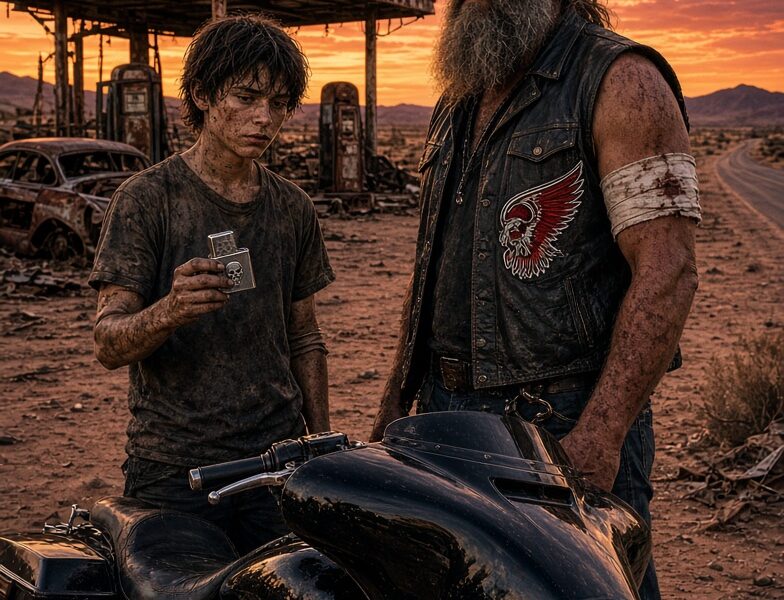
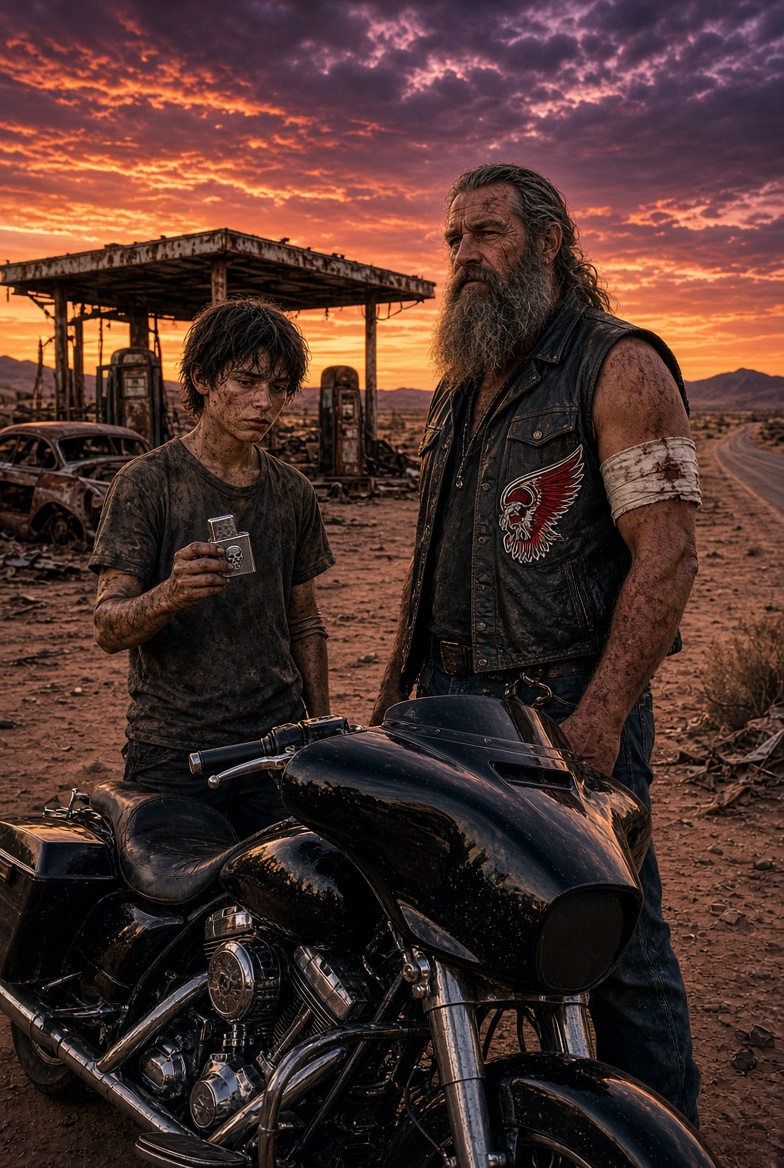
He ended up off a dead stretch of old Route 66, forty miles outside of Kingman, taking shelter in a collapsed, rusted-out Sinclair gas station.
It was a graveyard of 1950s Americana — decaying cars, blown-out tires, and mountains of twisted scrap metal.
For a kid whose late father had been a master mechanic, it was a familiar if grim sanctuary.
It was dusk, the sky bruised with purple and violent red, when the silence was torn apart by the sound of a dying engine.
—
Leo peeked through a shattered window.
A man was wrestling a massive 1998 Harley-Davidson Road King down the gravel shoulder.
The bike was violently backfiring, thick black smoke pouring from the exhaust before it finally gave a metallic shriek and died.
The rider kicked the kickstand down with a heavy steel-toed boot.
He was a mountain of a man, easily six-foot-four, wearing faded denim and a heavily patched leather cut.
Even from a distance, Leo recognized the iconic red and white winged death’s head on the back.
A Hells Angel.
Leo held his breath.
He knew the stories — you didn’t approach these men, and you certainly didn’t spy on them.
The biker tore off his helmet, revealing a scarred face, a thick graying beard, and eyes that looked like they had seen the devil and beat him in a fistfight.
His name was Jack Sullivan, though the patch on his chest simply read “Sully — Sergeant at Arms.”
Sully cursed, throwing a heavy wrench into the dirt.
He was bleeding from a deep gash on his left shoulder, the leather of his jacket torn.
He hadn’t just broken down.
He had been run off the road.
—
Leo watched as Sully frantically tried to patch a severely ruptured fuel line and a cracked primary drive case with a roll of electrical tape.
It was a fool’s errand.
The oil was pooling in the sand, and the gas was evaporating into the hot evening air.
Sully kicked the front tire in absolute rage.
He was stranded, bleeding, and vulnerable — a dangerous combination.
Before his brain could catch up with his survival instincts, Leo pushed the rusted door open and stepped out of the shadows.
“Tape isn’t going to hold that,” Leo said, his voice cracking slightly.
Sully whipped around, his hand instinctively dropping to the heavy fixed-blade K-Bar knife strapped to his belt.
His eyes locked onto the skinny, dirt-smudged teenager.
“Who the hell are you, kid?” the biker growled. “Back away before you get hurt.”
“I’m Leo,” he said, keeping his hands up and visible. “And I can fix your bike.”
Sully let out a harsh, barking laugh that held no humor.
“You?” he scoffed. “Fix a knucklehead with a cracked casing? Beat it, kid. I’m not in the mood.”
—
Leo felt the familiar pull — the magnetic draw of broken machinery that had been his only comfort since his father died.
“You’ve got a ruptured high-pressure line and a cracked crankcase,” he said, his eyes darting to the fresh blood on Sully’s sleeve.
“You’re bleeding oil and gas. If you stay out here tonight, whoever ran you off the road is going to find you.”
Sully stared at the boy.
There was a cold calculation in the biker’s eyes.
He looked down the empty, darkening highway, knowing the rival club that had ambushed him was likely circling back.
“Give me an hour,” Leo pressed. “If I can’t get it running, you can do whatever you want to me.”
The words hung in the air like a dare.
Sully studied the kid’s face, looking for fear.
He found something else instead — a desperate, burning need to prove himself.
“You got tools?” the biker finally asked.
“A few,” Leo said, nodding toward the ruined garage. “And a lot of junk.”
—
Sully wheeled the heavy Harley into the cavernous bay of the abandoned station.
Leo immediately went to work, his fear melting away as he touched the cold metal of the engine.
This was his language.
This was where he made sense of the world.
First, the fuel line.
Leo scavenged through a pile of discarded refrigerators in the back lot and snapped off a length of copper tubing from a compressor unit.
Using Sully’s heavy Leatherman tool and a rusted pipe bender he’d found days earlier, he flared the ends of the copper, creating a makeshift heat-resistant bypass for the torn rubber line.
“Where do you learn to wrench like that?” Sully asked, leaning against a rotting workbench while clutching his bleeding shoulder.
“My dad,” Leo answered quietly, not looking up. “He built custom choppers in Reno. Died when I was ten.”
Sully remained silent, but his sharp gaze never left the boy’s hands.
—
Next was the cracked casing.
Leo couldn’t weld it properly — there was no power.
But he had found a half-dead battery from a wrecked Ford F-150 and a pair of frayed jumper cables.
He stripped the casing off an old, thick copper wire.
“I need you to hold these clamps,” Leo instructed the intimidating biker.
“When I say go, touch them to the metal. It’s going to arc. I’m going to use a piece of scrap aluminum as a filler rod.”
Sully raised an eyebrow but grabbed the heavy clamps.
“You’re crazy, kid,” he said. “This is going to blow the battery.”
“Just for three seconds,” Leo said. “Ready? Go.”
Sparks violently showered the dark garage.
The blinding light cast erratic, monstrous shadows of the two figures against the peeling paint.
Leo carefully guided the molten aluminum over the hairline fracture on the casing.
“Stop!” he yelled.
—
The garage plunged back into darkness, smelling sharply of ozone and burnt oil.
Leo wiped the sweat from his forehead, smearing grease across his cheek.
He grabbed a handful of dirt and threw it onto the hot patch to help cool and solidify it quickly.
“Try it,” Leo said, stepping back.
Sully swung a leg over the bike.
He turned the key and hit the ignition.
The starter whined, choked, and then with a deafening thunderous roar, the massive V-twin engine fired to life.
It idled aggressively, shaking the concrete floor.
But there were no leaks.
The copper held the fuel, and the crude weld sealed the oil.
Sully cut the engine, the silence deafening in the aftermath.
He looked at the patch job.
Then he looked at Leo.
—
The biker reached into his leather vest and pulled out a heavy, tarnished silver Zippo lighter.
It had an intricate skull carved into the front.
“I don’t have cash on me, kid,” Sully said, his voice gravelly. “Lost my saddlebags in the wreck.”
He tossed the lighter to Leo, who caught it clumsily.
“Keep that. My name is Jack Sullivan. The club calls me Sully. You just saved my life, Leo.”
The words carried weight, more than any payment could.
“And the Hells Angels do not forget a debt.”
With that, Sully fired up the bike again, roaring out into the pitch-black desert night.
Leo was left alone once more, the heavy silver lighter warm in his palm.
—
For three days, the memory of the giant biker felt like a fever dream.
Leo was back to his grim reality — starving, rationing his last few drops of dirty water, and jumping at every sound the desert wind made.
He spent his days trying to fix up a rusted-out bicycle he had found, hoping he could ride it to a town where he could work under the table.
He kept Sully’s heavy silver lighter in his pocket, turning it over and over with his thumb.
It was the only valuable thing he owned.
But more than that, it was a token of respect.
For one hour, he hadn’t been a worthless runaway.
He had been a mechanic.
And that mattered more than any amount of money ever could.
—
But Leo’s luck was about to run out in the most violent way possible.
It was a blistering Tuesday morning.
Leo was out by a dried-up creek bed digging into the mud to find ground moisture when he heard the crunch of tires on gravel.
He scrambled up the bank and peered through the dead sagebrush.
A dusty white Ford Explorer with a police light bar sat idling in front of the garage.
Next to it was a beat-up silver Dodge Ram.
Leo’s blood ran cold.
He recognized the truck immediately.
It was Hank Dawson’s.
Stepping out of the police cruiser was Deputy Carl Higgins, a notoriously corrupt county cop known for doing dirty favors for locals who paid well.
Hank stepped out of the truck, his face red with heat and fury.
He was holding a thick wooden bat.
—
“Check the back rooms,” Hank barked at the deputy. “Little rat can’t have gone far. Someone at the diner down the highway said they saw him digging through the dumpster two nights ago.”
Leo panicked.
He backed away slowly, trying to slip unnoticed into the vast desert scrub.
But his foot caught on a buried piece of rusted barbed wire.
He tripped, falling hard into a pile of dry branches with a loud crack.
“There!” Hank yelled, his eyes snapping toward the creek bed.
Before Leo could get his bearings, Deputy Higgins was on him, grabbing him by the scruff of his neck and hauling him up like a stray dog.
He dragged Leo back to the concrete apron of the gas station and threw him violently to the ground.
Leo gasped for air, the wind knocked out of him.
He looked up to see Hank standing over him, a sinister grin spreading across his face.
—
“Thought you were clever, huh, boy?” Hank sneered, tapping the wooden bat against his palm.
“Thought you could just run off? Cost me my monthly stipend from the state. Made me look like a fool in front of the social workers.”
“Let me go, Hank,” Leo pleaded, his voice trembling despite his efforts to sound brave.
“I won’t tell anyone what you do to the kids. Just let me disappear.”
“Oh, you’re going to disappear all right,” Hank laughed, stepping closer.
“Right into the basement back in Flagstaff. You’re going to work off every dime you cost me.”
Deputy Higgins leaned against his cruiser, completely indifferent to the abuse.
“Hurry it up, Hank,” he called out. “I ain’t got all day, and I want my cut.”
Hank reached down and grabbed Leo by his jacket, hauling him to his feet just to slam him back against the rusted gas pump.
The impact rattled Leo’s teeth.
—
Hank began to pat him down, searching for anything of value.
His hand brushed against Leo’s front pocket, feeling the weight of the silver lighter.
Hank yanked it out.
He held the silver Zippo up to the sun, admiring the skull engraving.
“Well, well,” Hank mocked. “Look at this. Stealing from bikers now, Leo? You’re dumber than I thought.”
“Give it back,” Leo shouted, lunging forward.
Hank swatted Leo across the face with the back of his hand.
The teenager crumpled to the dust, blood immediately pooling in his mouth.
“It’s mine now,” Hank laughed, pocketing the lighter.
He grabbed Leo by the collar, dragging him toward the back of the silver truck.
“Get in the bed, boy. It’s a long ride home.”
—
Leo struggled, kicking up dust, tears of sheer frustration and terror streaming down his face.
He was going back.
The beating he would take when they got to Flagstaff would be unimaginable.
He had fought so hard, survived so much out here in the wasteland, only to be dragged back to hell.
“Hold up, Hank,” Deputy Higgins suddenly said, his voice losing its lazy drawl.
He stood up straight, turning his head toward the highway.
“What?” Hank snapped, annoyed by the interruption.
“Do you hear that?”
Leo stopped struggling.
Hank froze.
At first, it was just a low vibration, a hum that seemed to emanate from the very earth beneath them.
The dust on the hood of the police cruiser began to dance and skip.
Then the sound grew.
—
It wasn’t the sound of a truck or a passing semi.
It was a deep, guttural, synchronized thunder.
It sounded like an earthquake rolling over the horizon.
Hank let go of Leo’s collar, squinting down the long, shimmering mirage of the desert highway.
The heat waves distorted the view, but a massive black shadow was emerging from the haze.
The rumble escalated into an earth-shattering roar.
The ground shook violently under Leo’s hands.
“What the hell is that?” Hank muttered, his face draining of color.
Over the crest of the hill, tearing through the desert heat, came the vanguard.
Ten motorcycles riding two abreast.
Behind them, twenty more.
And behind them, a terrifying, endless sea of leather, chrome, and roaring V-twin engines.
—
They were riding tight, a military formation of mechanized outlaws.
It wasn’t a dozen bikers.
It wasn’t a gang.
It was an entire army.
Deputy Higgins stepped back, his hand instinctively resting on his service weapon.
But he knew a pistol was utterly useless against a tidal wave of 247 men.
“Hank,” Higgins stammered, his bravado entirely gone. “Get in the truck.”
But they were too late.
The massive pack of bikers descended upon the abandoned gas station.
They swarmed the area like angry hornets, encircling the police cruiser, the Dodge Ram, and the three people standing in the dirt.
247 Hells Angels cut their engines almost simultaneously.
The sudden silence that followed the deafening roar was somehow even more terrifying.
The air was thick with the smell of hot exhaust, dust, and raw intimidation.
—
At the front of the pack, riding a freshly repaired, gleaming 1998 Harley-Davidson Road King, was Jack “Sully” Sullivan.
He kicked his stand down and stepped off the bike.
His arm was bandaged beneath his cut, but his eyes were locked dead onto Hank Dawson.
And he did not look happy.
The silence in the Mojave Desert was heavier than the blistering afternoon heat.
247 men clad in black leather, denim, and heavy boots formed an impenetrable wall of muscle and steel around the dilapidated gas station.
The sheer scale of the ambush was paralyzing.
These weren’t just local riders — the patches on their backs read like a map of the West Coast: California, Nevada, Arizona, Oregon.
Sully had brought the entire regional charter, along with a nomadic faction, tearing across the asphalt to hunt down the rival club that had run him off the road.
Instead, they found a terrified teenager bleeding in the dirt, pinned down by a corrupt deputy and a monstrous foster father.
—
Sully dismounted his Road King with a deliberate, terrifying slowness.
The makeshift copper fuel line Leo had forged gleamed in the harsh sunlight, a testament to the boy’s desperate ingenuity.
Sully’s heavy boots crunched against the gravel as he walked past the police cruiser, not even sparing a glance at Deputy Carl Higgins.
His eyes, cold and dark as obsidian, were locked onto Hank Dawson.
Hank swallowed hard, the Adam’s apple bobbing in his thick neck.
He dropped the wooden baseball bat as if it had suddenly caught fire — it clattered against the cracked concrete.
“Afternoon,” Sully rumbled, his voice low and grating, cutting through the tense air.
Deputy Higgins, his uniform suddenly feeling three sizes too small, cleared his throat and puffed out his chest in a desperate bid for authority.
“Now hold on a minute,” he said. “I am Deputy Carl Higgins of the Mojave County Sheriff’s Department. This is an official police matter. You boys need to turn around and get back on the interstate.”
—
Sully stopped.
He turned his head slowly toward the deputy.
He didn’t say a word — he simply raised his left hand and snapped his fingers.
From the front row of the biker formation, a mountain of a man named Arthur “Ox” Callahan stepped forward.
Ox was six-foot-seven, weighing well over three hundred pounds with a thick braided beard and a jagged scar running down his throat.
He walked directly up to Higgins, invading the deputy’s personal space until their chests were mere inches apart.
Ox looked down, his expression completely devoid of emotion.
Higgins’s hand hovered over his holster, trembling violently.
“I suggest,” Ox whispered, a deep, resonant growl, “you keep your hands away from that leather, Deputy. Unless you plan on shooting 247 times without reloading.”
Higgins slowly, agonizingly, raised his hands, stepping back until his spine hit the door of his cruiser.
He was effectively neutralized.
—
Sully turned his attention back to Hank and the bleeding teenager on the ground.
Leo was clutching his bruised jaw, his heart hammering against his ribs like a trapped bird.
He looked up at Sully, a mixture of disbelief and raw hope flooding his wide eyes.
“Kid,” Sully said, nodding toward him. “You look a hell of a lot worse than you did three days ago.”
“This the guy who’s been chasing you?”
Leo spat a mouthful of blood into the dust and nodded.
“That’s Hank. He runs the foster house in Flagstaff.”
“Foster house?” Sully repeated, tasting the words as if they were venom.
He stepped closer to Hank.
The sheer physical presence of the Hells Angel forced Hank to take a staggering step backward.
“You make a habit of beating on mechanics who fix my bike, Hank?”
—
“Listen here,” Hank stammered, trying to muster a shred of his usual bullying bravado.
“This boy is a runaway. He’s a ward of the state. He’s my legal responsibility, and he stole from me. He’s a thief.”
“Is that right?” Sully asked, his voice deceptively calm.
Hank nodded frantically, sweat pouring down his flushed face.
“Yeah. He’s a dirty little thief. I caught him with a stolen lighter — a heavy silver Zippo. He probably boosted it off some tourist.”
The air in the desert seemed to instantly drop twenty degrees.
A collective murmur rippled through the ranks of the bikers behind Sully.
Every man in that pack knew exactly whose lighter that was.
And they knew exactly what it meant for someone outside the club to possess it without permission.
And what it meant for someone to steal it from a friend of the club.
Sully’s eyes narrowed into dangerous slits.
“A silver Zippo with a skull.”
“That’s right,” Hank said, thinking he had finally found a lifeline.
He reached into his pocket and proudly produced the tarnished silver lighter, holding it out.
“See? I confiscated it from the little rat. I was just enforcing the law.”
—
In a flash of movement so fast it defied his massive frame, Sully’s hand shot out.
He didn’t grab the lighter.
He grabbed Hank by the throat.
Hank choked out a panicked wheeze as Sully lifted him onto his tiptoes, slamming him brutally back against the side of the silver Dodge Ram.
The metal of the truck groaned under the impact.
Hank’s hands frantically clawed at Sully’s thick, leather-clad arm, but the biker’s grip was like an industrial vice.
“That boy didn’t steal that lighter,” Sully growled, his face inches from Hank’s terrified, bugging eyes.
“I gave it to him. He pulled me out of the fire when a coward’s ambush left me bleeding on the blacktop. He did what a hundred men wouldn’t do for a stranger. He earned that silver.”
Sully used his free hand to pry the Zippo out of Hank’s desperately tight grip.
He slipped it into his own vest pocket, never breaking eye contact with the choking man.
“You, on the other hand,” Sully whispered, “are standing in my desert, threatening my mechanic and holding my property.”
—
“Now I have to make a choice, Hank. Do I bury you out here where nobody will ever find you? Or do I let you live with a message?”
Hank’s face was turning a deep, mottled shade of purple.
He couldn’t speak — he could only emit a pathetic, strangled squeak, nodding his head in a desperate plea for mercy.
Sully let go.
Hank collapsed to the dirt, coughing violently, clutching his bruised throat, and gasping for the hot desert air.
“Leo!” Sully called out, not looking away from the pathetic figure on the ground.
Leo slowly pushed himself up, his ribs aching, his lip swollen and bleeding.
“Yeah, Sully?”
“You got anything left in that truck you want?”
Leo looked at the battered silver Dodge Ram, then at Hank, who was curled in the dust.
“Nothing,” Leo said firmly. “I don’t want anything of his.”
“Good,” Sully said.
—
He turned to the massive crowd of bikers waiting in the blistering sun.
“Boys,” he said, “the mechanic says the truck is scrap.”
Sully didn’t even have to raise his voice — he simply gave a sharp nod.
The desert exploded into a symphony of mechanized destruction.
Twenty heavily tattooed, leather-clad bikers descended on Hank Dawson’s silver Dodge Ram like locusts on a crop.
They didn’t swing wild sledgehammers or baseball bats — they used precision tools, heavy crowbars, and sheer brute strength to execute a terrifyingly efficient dismantling.
Within three minutes, the thick tires were slashed and violently stripped from the axles.
The spark plugs were crushed.
The alternator was ripped out of the engine bay and hurled into the dry creek bed.
A heavy steel-toed boot kicked the fuel line loose, letting the expensive diesel bleed out into the thirsty Mojave sand.
Hank watched from the dirt, clutching his bruised throat, wheezing in horror as his prized possession was rapidly reduced to a gutted metal corpse.
—
Deputy Higgins sat paralyzed in his police cruiser, sweating right through his uniform.
Sully walked over, his heavy boots crunching loudly on the gravel.
He leaned down, placing his massive scarred hands on the driver’s side door to trap the cop’s gaze.
“Put it in drive, Deputy,” Sully murmured, his voice calm but laced with absolute menace.
“Go back to whatever corrupt hole you crawled out of. If I ever hear you came looking for this kid again, or if you breathe a word of this to anyone, I promise you — a tin badge won’t stop what comes through your front door.”
Higgins didn’t even nod — he just threw the cruiser into drive and slammed the accelerator, abandoning Hank in a thick, choking cloud of dust.
Sully turned his back on the fleeing cop and looked down at Hank.
“Flagstaff is a hundred miles that way,” he said, pointing down the shimmering, heat-warped asphalt.
“Start walking before the coyotes wake up. And if I ever hear you laid a hand on another foster kid, you won’t get the chance to walk anywhere.”
—
Hank, utterly broken and humiliated, dragged himself to his feet and began the agonizing trek into the wasteland without looking back.
With the threat gone, the crushing tension evaporated.
A biker handed Leo a canteen of ice-cold water, which he drank desperately.
Sully approached the battered teenager, pulling the silver skull Zippo from his leather vest and tossing it back.
“I believe this belongs to you,” Sully said.
“The club doesn’t forget a debt.”
He surveyed the dilapidated gas station.
“You can’t stay out here, Leo. Our Phoenix clubhouse has a massive garage — forty bikes that need constant wrenching. We need a shop apprentice. It’s grueling work, but you’ll have a solid roof, three hot meals, and nobody will ever lay a hand on you again.”
Sully extended a massive calloused hand.
“What do you say? You want to be a ghost, or do you want to turn wrenches for the Hells Angels?”
—
Leo looked at the sea of bikers who had ridden across the state for a kid they didn’t know.
He looked at the silver lighter in his palm — the token of respect that had changed everything.
He thought about his father, who had taught him that a good mechanic could fix anything.
He thought about the long empty highway behind him and the endless road ahead.
He didn’t hesitate.
He gripped Sully’s hand firmly.
Minutes later, Leo climbed onto the back of the Road King as 247 engines fired up in a deafening, unified roar.
Leo left his past in the dust, riding away with a new family forged in steel and oil.
—
The wind whipped past his face as the desert blurred into streaks of brown and gold.
Leo held on tight, feeling the powerful vibration of the V-twin engine through his bones.
It was the same engine he had saved with copper tubing and scrap aluminum.
It was the same bike that had brought salvation roaring across the desert.
He thought about the foster homes, the beatings, the hunger, the constant fear.
He thought about the night he climbed out that window in Flagstaff with nothing but the clothes on his back.
He had been running for so long that he had forgotten what it felt like to stop.
Now, surrounded by the rumble of 247 motorcycles, he finally felt something he hadn’t felt in years.
Safety.
—
The pack rode for hours, cutting across the desert highway in a flawless formation.
Leo watched the bikers around him — tough, scarred, intimidating men who had dropped everything to answer a call.
They hadn’t come because of money.
They hadn’t come because of obligation.
They had come because Sully said the kid who fixed his bike was in trouble.
And that was enough.
The highway stretched endlessly ahead, ribbons of asphalt cutting through the harsh landscape.
The sun was beginning its slow descent, painting the sky in shades of orange and purple that reminded Leo of the dusk when this whole story began.
He wondered what his father would think.
His father had been a biker too — not a Hells Angel, but a man who loved the open road and the freedom of two wheels.
He would probably have smiled.
He would probably have said something gruff and kind, something about paying respect where respect was earned.
—
The Phoenix clubhouse appeared on the horizon like a mirage — a sprawling compound of concrete, steel, and American flags.
The pack rolled through the gates, engines echoing off the walls as they parked in perfect rows.
Leo dismounted, his legs shaky from the long ride.
He looked around at the massive garage Sully had promised — a cathedral of chrome and tools, with lifts and workbenches stretching into the distance.
“Welcome home, kid,” Ox said, clapping him on the shoulder with a hand the size of a dinner plate.
It was the first time anyone had used that word to Leo in years.
Home.
It sounded strange on his ears.
But as he looked around at the faces of the men who had saved him, he realized it was truer than any foster home had ever been.
—
The next morning, Sully took Leo into the garage and showed him the fleet.
Forty Harleys in various states of disrepair, waiting for hands that knew their language.
“This is your kingdom now,” Sully said, gesturing at the bikes.
“Every one of these machines has a story. Every one of them needs a mechanic who gives a damn. You think you can handle that?”
Leo ran his hand over the cold metal of a vintage Softail.
“I can handle it,” he said.
And he meant it.
For the first time in his life, he had a purpose that didn’t involve survival.
He had a skill that was valued.
He had a place where he belonged.
—
The days turned into weeks, and the weeks turned into months.
Leo threw himself into the work with a passion that surprised even him.
He rebuilt engines from the ground up, fabricated custom parts from scrap, and earned a reputation as the kid who could fix anything.
The bikers treated him like family — rough, crude, sometimes dangerous, but loyal to the bone.
They taught him to ride, to defend himself, and to stand up for what mattered.
He learned their stories — the wars they had fought, the losses they had endured, the bonds that had kept them together through everything.
And slowly, Leo started to heal.
The bruises faded, the hunger became a distant memory, and the fear that had driven him for so long began to loosen its grip.
—
But the past doesn’t always stay buried.
Six months after Leo rode into the Phoenix clubhouse, he heard a name that made his blood run cold.
Hank Dawson.
A biker named Shifty had just returned from a run up to Flagstaff with news.
“Hey, Leo,” Shifty said, his voice low. “You remember that guy who used to run the foster house? The one Sully sent walking out into the desert?”
Leo nodded, his jaw tightening.
“Heard he’s been trying to get back on his feet,” Shifty continued. “Telling anyone who’ll listen that a bunch of bikers stole his truck and his reputation. He’s got some lawyer — trying to make noise.”
Leo felt the old fear rising in his chest.
Hank wasn’t done with him.
He would never be done.
—
Sully caught Leo’s eye from across the garage.
He walked over, his expression unreadable.
“Leo, I need to talk to you.”
They stepped into the office, a small room cluttered with paperwork and motorcycle parts.
Sully closed the door behind them.
“I heard about Hank,” Leo said before Sully could speak.
“Word travels fast,” Sully acknowledged. “Look, kid, you don’t need to worry about him. The club has your back.”
“But what if he finds me? What if he—”
“Leo,” Sully interrupted, his voice firm. “You’re not that scared kid in the desert anymore. You’ve got skills. You’ve got people who care about you. And you’ve got the backing of 247 brothers who will do whatever it takes to protect you. Hank Dawson is nothing.”
Leo nodded slowly, but the fear lingered.
—
Sully reached into his vest and pulled out the silver Zippo lighter.
He held it out to Leo.
“You keep this with you, you understand?” he said. “This isn’t just a lighter. This is a symbol. It’s a reminder that you’re not alone. Every time you look at it, remember that you fixed a bike that nobody else could fix. Remember that you’re worth more than any piece of scrap metal you ever touched.”
Leo took the lighter, his fingers closing around the familiar weight.
It was warm from Sully’s pocket.
It was proof that he had earned something in this world.
“Thank you,” he said quietly.
“Don’t thank me,” Sully replied. “Thank yourself. You’re the one who walked out of the shadows. You’re the one who had the guts to help a stranger. The rest of us just showed up on time.”
—
Leo tucked the lighter into his pocket and felt something shift inside him.
The fear was still there — it would always be there, he realized.
But it no longer controlled him.
He had faced the worst the world had to offer and come out the other side.
He had fixed a broken bike with nothing but scrap metal and desperate courage.
And he had found a family in the most unlikely place imaginable.
He thought about the long desert highway, the roar of 247 engines, and the moment everything changed.
He thought about Sully’s words — “The club doesn’t forget a debt.”
And he knew, deep in his bones, that he would never have to run again.
—
Over the next few years, Leo became something of a legend in the biker community.
His custom builds were sought after from coast to coast.
He opened a small shop attached to the Phoenix clubhouse, employing a handful of mechanics who shared his passion.
He never forgot where he came from — the rusted gas station, the empty canteen, the terror of being hunted.
Those memories drove him to work harder, to be better, to earn every bit of respect he received.
And he always carried the silver Zippo lighter in his pocket.
It was a talisman, a reminder of the night he had stepped out of the shadows and into his own life.
—
Then one evening, Sully came to see him.
“Leo, I got a call from a friend up in Reno,” he said. “There’s a kid — seventeen years old, just like you were. He’s been running from a bad home situation. He ended up in a garage outside of town, trying to survive.”
Leo felt a chill run down his spine.
“What happened?” he asked.
“He’s in trouble, Leo. The guy who ran the foster house — different name, same story — he’s looking for him. The kid’s been hiding for weeks. He’s scared, alone, and he doesn’t have anyone.”
Sully paused, letting the weight of his words settle.
“I thought maybe you might know someone who could help him.”
—
Leo looked at the silver lighter in his hand.
He thought about the seventeen-year-old boy who had been freezing in an abandoned Arizona garage, who had nothing but rusty scrap and desperate courage.
He thought about the giant biker who had shown up and changed everything.
He thought about the debt that had been paid and the debt he now owed to the world.
“Yeah,” Leo said, a smile spreading across his face. “I think I know exactly who can help.”
He pulled out his phone and started making calls.
Within hours, a convoy was forming.
Forty Harleys, led by Leo Gallagher, were heading north to rescue a kid they had never met.
Leo had become the angel this time.
—
The story of Leo Gallagher spread through the biker community like wildfire.
A seventeen-year-old runaway who fixed a broken bike and earned the loyalty of 247 Hells Angels.
A kid who went from being a ghost in the Mojave Desert to being the most sought-after mechanic in Arizona.
A man who never forgot where he came from and dedicated his life to helping others find their way.
His journey was proof that salvation sometimes arrives on two wheels — and that a single act of courage can change everything.
The silver Zippo lighter became a symbol of that transformation.
Leo never went anywhere without it.
It was a reminder of the day he stepped out of the shadows and into the light.
—
Years later, Leo was standing in his shop when a young man walked through the door.
He was skinny, scared, and covered in grease.
His hands were shaking.
“Excuse me,” the boy said, his voice cracking. “I heard you help people like me. I don’t have anywhere to go. I don’t have anyone.”
Leo looked at the boy and saw himself.
He reached into his pocket and pulled out the silver Zippo lighter.
“You see this?” he asked. “This was given to me when I was your age, by a man who saved my life. It reminds me that you can always find a way through the darkness.”
The boy stared at the lighter, his eyes wide.
“Are you going to help me?” he asked.
Leo smiled.
“Yeah, kid,” he said. “I’m going to help you. That’s what we do here.”
—
The boy stayed at the shop, learning everything Leo could teach him.
He was a natural — just like Leo had been.
He had the same hunger, the same desperation, the same need to prove himself.
And Leo gave him the same chance he had been given.
He taught him to fix bikes, to ride, to stand up for himself.
He introduced him to the brothers, who welcomed him with open arms.
And he told him the story of the Mojave Desert, the broken Road King, and the day 247 engines changed everything.
“Remember,” Leo said, handing the boy a silver lighter of his own, “you’re never alone. Not as long as you’ve got the right people at your back.”
—
The boy looked at the lighter, then up at Leo.
“What’s your name?” he asked.
“Leo,” he said. “Leo Gallagher.”
“Thank you, Leo.”
“Don’t thank me,” Leo replied, echoing Sully’s words from so long ago.
“Thank yourself. You’re the one who walked through that door. The rest of us just showed up on time.”
The boy tucked the lighter into his pocket and smiled.
It was the first real smile Leo had seen on his face.
And Leo knew, deep in his heart, that the cycle would continue.
The debt had been paid forward.
And somewhere in the Mojave Desert, a ghost had become a legend.
The End.
—
**Part 2 — The Road Back**
Three months after the boy arrived, Leo decided it was time to make a pilgrimage.
He climbed onto a restored Heritage Softail and pointed it toward the Mojave Desert.
Sully rode beside him, his Road King gleaming in the morning sun.
They had been through so much together — the ambush, the rescue, the years of building something meaningful.
But there was one place Leo needed to see.
The abandoned Sinclair gas station.
The crumbling garage where everything had begun.
The rusted pumps and decaying cars that had once been his sanctuary.
—
They rode for hours, the desert unfolding around them like a vast, unforgiving ocean.
Leo remembered every mile of this highway.
He remembered the hunger, the thirst, the fear that had driven him to hide in the shadows.
He remembered the sound of Sully’s dying engine and the moment he had stepped out of the darkness.
The gas station appeared on the horizon, just as he remembered it.
Time had not been kind — the roof had collapsed further, the windows were shattered, and the piles of scrap metal had rusted into unrecognizable shapes.
Leo parked his bike and walked slowly toward the garage.
Sully followed, his boots crunching on the gravel.
—
“Hard to believe this is where it all started,” Leo said, his voice barely above a whisper.
“Yeah,” Sully agreed. “You were just a kid. Scared out of your mind. But you had more guts than most men I’ve ever met.”
Leo smiled.
“I wasn’t brave. I was just desperate.”
“Sometimes that’s the same thing,” Sully said.
Leo walked into the garage, running his hand over the rusted workbench where he had fixed the Road King.
The memory was vivid — the copper tubing, the jumper cables, the blinding sparks.
He could almost smell the ozone and burnt oil.
He could almost hear the roar of the engine when it fired to life.
—
Sully pulled out a flask and took a long drink.
“You know, Leo, I’ve been thinking about that day for a long time,” he said.
“What about it?”
“I was a dead man walking when I rolled into this place. That rival club had me outnumbered, outgunned, bleeding out. If you hadn’t fixed that bike, I would have died in this desert.”
Leo shook his head.
“You saved my life too, Sully. I was heading back to Hank. He would have killed me eventually.”
“Maybe,” Sully said. “But you earned your freedom. You earned your place in the club. And you’ve earned everything you’ve built since.”
—
Leo reached into his pocket and pulled out the silver Zippo lighter.
He flipped it open, watching the flame dance in the desert breeze.
“I still carry this everywhere,” he said. “It reminds me of who I was and who I became.”
“Keep it, Leo. It’s yours.”
Leo snapped the lighter shut and tucked it back into his pocket.
He looked around the ruined garage one more time.
This place had been his prison and his salvation.
It had been the end of one life and the beginning of another.
And now, standing in the dust of the Mojave Desert, he realized that he had finally come full circle.
—
“We should head back,” Sully said. “The boys are expecting us for dinner.”
Leo nodded, but he didn’t move.
He was thinking about all the kids out there, running from homes that weren’t safe, hiding in garages and abandoned buildings.
He was thinking about the seventeen-year-old boy he had been, terrified and alone, with nothing but a canteen of dirty water and a pocketful of desperate courage.
He was thinking about the man he had become.
The mechanic, the brother, the legend.
And he knew, with absolute certainty, that his story wasn’t over yet.
“Let’s ride,” Leo said.
—
They climbed onto their bikes and fired up the engines.
The roar of the V-twins echoed across the desert, a sound of power and freedom.
Leo looked back at the gas station one last time, then turned his gaze forward.
The highway stretched endlessly ahead, full of possibilities.
He thought about the boy back at the shop, learning to turn wrenches and find his way.
He thought about the 247 brothers who had shown up at his door and changed everything.
And he thought about the silver lighter in his pocket — the symbol of a debt that had been paid, a life that had been saved, and a future that had been forged in steel and oil.
—
The desert wind whipped past his face as he opened the throttle.
The miles flew by, the world blurring into streaks of brown and gold.
Leo Gallagher had come a long way from the starving runaway hiding in a broken gas station.
He had become something more.
He had become a beacon, a proof that even in the darkest moments, salvation could be found.
All it took was one act of courage.
One moment of stepping out of the shadows.
One broken bike, fixed with rusty scrap and desperate hope.
The Hells Angels didn’t forget a debt.
And neither would Leo.
—
The sun was setting when they pulled into the Phoenix clubhouse.
The yard was full of bikes and brothers, the smell of barbecue filling the air.
Leo parked his Softail and walked toward the crowd.
He saw the boy he had taken in, laughing with some of the younger members.
He saw Ox, towering over everyone, a massive grin on his face.
He saw Sully, his mentor and friend, standing by the bonfire with a bottle of whiskey.
And Leo felt a warmth spread through his chest that had nothing to do with the fire.
This was his family.
This was his home.
And he had earned every single part of it.
—
The boy spotted him and ran over.
“Leo! You’re back!” he exclaimed.
“Told you I would,” Leo said, ruffling the kid’s hair.
“I fixed the carburetor on that old Sportster today. By myself.”
“Yeah? How’d it go?”
“Fired up on the first try.”
Leo smiled.
“That’s my boy.”
The kid beamed, pride radiating from his face.
Leo knew that feeling — the satisfaction of fixing something broken, of making it right.
It was the same feeling he had experienced in that gas station, all those years ago.
And he was determined to pass it on.
—
That night, Leo sat by the fire with Sully, drinking whiskey and watching the stars.
“You did good, Leo,” Sully said. “With that kid. With everything.”
“I had a good teacher,” Leo replied.
“Bull. I just pointed you in the right direction. You did the rest.”
Leo laughed.
“Maybe. But I wouldn’t have made it without you.”
Sully was quiet for a moment.
“You know, Leo, I’ve seen a lot of men come and go in this life. Some of them strong, some of them weak. But you’re one of the few who truly understood what it means to be a brother.”
Leo looked at Sully, his eyes glistening.
“Thank you,” he said.
“Don’t thank me,” Sully said, echoing his own words from so long ago. “Thank yourself. You’re the one who walked out of the shadows.”
—
Leo looked up at the stars, scattered across the desert sky like diamonds.
He thought about his father, the master mechanic who had taught him everything he knew.
He thought about his mother, who had died when he was too young to remember her face.
He thought about Hank Dawson, the monster who had tried to destroy him.
And he thought about the Hells Angels, the unlikely family that had saved him.
He had been a ghost, drifting through the world with nothing to hold onto.
Now he was something more.
He was a builder, a fixer, a protector.
He was a man who had found his purpose in the most unexpected way.
And he was grateful.
—
The fire crackled, sending sparks spiraling into the night.
“Hey, Sully,” Leo said.
“Yeah?”
“You ever think about what would have happened if I hadn’t fixed that bike?”
Sully considered the question.
“I’d be dead. Plain and simple.”
“And me?”
“You’d be dead too, eventually. Hank would have found you, or the desert would have taken you.”
Leo nodded slowly.
“So we saved each other.”
“Guess we did,” Sully agreed.
“That’s what brothers do,” Leo said.
Sully raised his whiskey bottle in a toast.
“To brothers.”
Leo clinked his bottle against Sully’s.
“To brothers.”
—
The years that followed were good to Leo.
He expanded his shop, hiring more mechanics and taking on apprentices.
He became a fixture in the Hells Angels community, known for his skill and his integrity.
He never forgot where he came from, and he made sure every kid who walked through his doors knew his story.
He didn’t sugarcoat it — he told them about the fear, the hunger, the desperation.
But he also told them about the hope, the courage, and the salvation that came when you least expected it.
“You can always find a way through the darkness,” he would say.
“All it takes is one act of courage. One step out of the shadows. One moment of believing in yourself.”
—
And every time he told the story, he would pull out the silver Zippo lighter.
He would flip it open, let the flame dance for a moment, then snap it shut.
“This was given to me by a man who saved my life,” he would say.
“It reminds me that I am never alone. And neither are you.”
The kids would listen, their eyes wide with wonder.
They would see the scar on his lip, the callouses on his hands, the quiet confidence in his voice.
And they would believe him.
Because Leo Gallagher was living proof that salvation was real.
—
One evening, a reporter showed up at the shop.
She had heard the story of the runaway teen and the Hells Angels, and she wanted to write about it.
Leo was hesitant at first.
He wasn’t the type to seek attention — he just wanted to do his work and help his people.
But Sully convinced him.
“Your story could help people, Leo,” he said.
“It could show kids that there’s a way out. That even when everything seems hopeless, there’s still a chance.”
So Leo agreed.
He sat down with the reporter and told his story.
He told her about the abandoned gas station, the broken Road King, and the day 247 engines roared across the desert.
He told her about Hank Dawson, the corrupt deputy, and the moment everything changed.
And he told her about the silver lighter, the symbol of everything he had become.
—
The article was published in a national magazine.
It was titled “The Boy Who Fixed a Broken Bike and Found a Family.”
It went viral within days.
Leo’s story resonated with millions of people — foster kids, runaways, struggling families, and anyone who had ever felt alone.
Letters poured in from across the country.
People thanked him for sharing his journey.
They told him about their own struggles, their own moments of desperation and hope.
And Leo read every single letter.
He knew what it was like to feel invisible, forgotten, worthless.
He knew the power of having someone believe in you.
So he responded to as many letters as he could, offering encouragement and advice.
It was exhausting, but it was also deeply rewarding.
—
Sully came by the shop one day to find Leo buried in a stack of envelopes.
“You’re going to give yourself a heart attack,” he said, laughing.
“These people need help, Sully. I can’t just ignore them.”
“I know, kid. But you can’t save everyone.”
“I can try,” Leo said.
Sully shook his head, but there was pride in his eyes.
“You never change, do you?”
“Would you want me to?”
“Not for a minute,” Sully said.
—
The reporter’s article had another effect as well.
It caught the attention of the Arizona State Legislature.
A committee reached out to Leo, asking him to testify about his experiences in the foster care system.
Leo was nervous — he had never spoken in front of a committee before.
But he knew it was important.
If his story could help change the system, make it safer for kids like him, then he had to try.
He went to the state capitol and told his story to a room full of politicians.
He described the abuse he had suffered at Hank’s hands.
He described the corruption of Deputy Higgins.
He described the desperation of being a runaway, with nowhere to turn and no one to trust.
And he described the hope that had arrived on two wheels.
—
The committee was moved by his testimony.
They asked him questions, dug into the details, and listened to everything he had to say.
A few months later, the legislature passed a series of reforms designed to improve oversight of the foster care system.
More funding for caseworkers.
Stricter licensing requirements for foster homes.
Mandatory training on recognizing and reporting abuse.
It wasn’t a perfect solution — Leo knew there was still a long way to go.
But it was a step in the right direction.
And Leo had helped make it happen.
—
Sully threw a party at the clubhouse to celebrate.
The yard was full of bikes and brothers, the air thick with the smell of barbecue and the sound of laughter.
Leo stood by the fire, surrounded by the people who had become his family.
“I’m proud of you, kid,” Sully said, clapping him on the shoulder.
“I couldn’t have done it without you,” Leo replied.
“You’re the one who stepped out of the shadows, Leo. You’re the one who fixed that bike. The rest of us just showed up on time.”
Leo smiled.
He reached into his pocket and pulled out the silver lighter.
He flipped it open, watching the flame dance in the darkness.
Then he looked up at the stars, scattered across the desert sky like diamonds.
He thought about his father, his mother, and all the people who had helped him along the way.
He thought about the kids still out there, running from homes that weren’t safe.
And he made a promise to himself.
He would keep telling his story.
He would keep helping others find their way.
He would never forget where he came from — and he would never stop giving back.
—
The fire crackled, sending sparks spiraling into the night.
Leo looked at Sully, his mentor and friend.
“To brothers,” he said, raising his bottle.
“To brothers,” Sully echoed.
They drank, the whiskey warming them from the inside out.
And somewhere in the Mojave Desert, a ghost was finally at peace.
Because Leo Gallagher had found his place in the world.
And he had made it matter.
—









