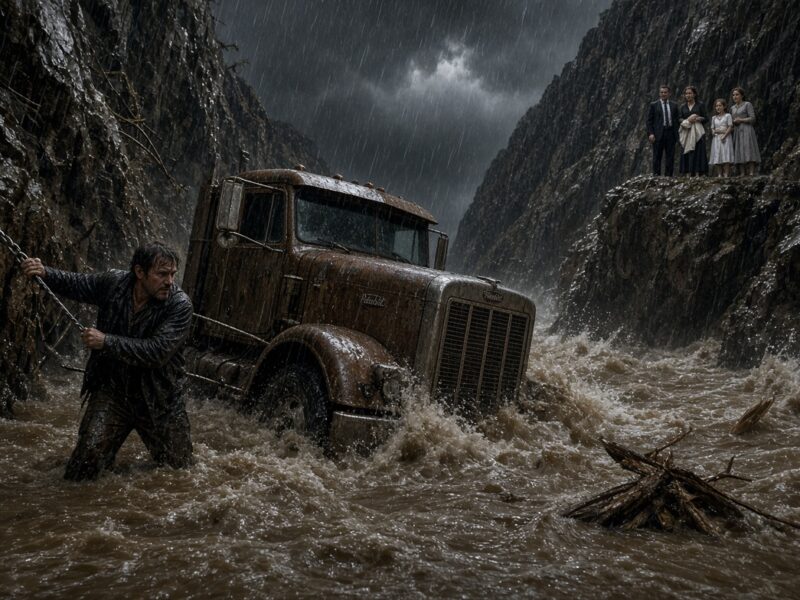
He Destroyed His Only Truck to Save a Wealthy Family — Then They Learned Who He Really Was
The rain had turned the mountain highway into a river before the Harrington family understood that their armored convoy was worth nothing.
Floodwater was coming down the canyon, pushing broken trees and boulders ahead of it.
The only man who turned around was not a rescue crew.
He was the truck driver Grant Harrington had mocked at a fuel stop an hour earlier.
Caleb Rourke looked at the water, looked at the stranded convoy, and did something that looked insane.
He swung forty tons of tractor sideways into the current.
Then Conrad Harrington read the faded name on the door.
It began years earlier with the family he was about to risk his life to save.
The storm had been moving across the western ranges for two days, and by six in the morning it had stopped behaving like weather and started behaving like a problem.
Caleb Rourke noticed it the way he noticed everything, which was early and without saying much about it.
He was running a load of transformer housings north through the pass, 41,000 pounds of steel riding behind an old Peterbilt with 390,000 miles on the clock and a paint job that had faded to the color of wet sand.
The wipers were on their highest setting and still losing.
Water was coming off the shoulders in sheets instead of trickles, which meant the ground above the road had already stopped absorbing anything.
He eased off the throttle a quarter mile before every blind curve, not because the schedule allowed it, but because the mountain did not care about schedules.
At seven, he pulled into a wide gravel turnout and called his daughter, because Mara never answered after nine and he had learned to work around her sleep.
She was eighteen.
She had been accepted at a state school four hundred miles east.
And she asked him the same three questions every week in the same order.
How was the run?
How was the truck?
Was he eating?
He told her the run was fine, which was a small and necessary lie, since he had picked up two extra legs that month to cover the housing deposit she did not know about.
He told her the mountains were pretty in the rain and that he would call Thursday.
And after he hung up, he sat for a moment with his thumb on the dark screen before he put the truck back in gear.
The fuel plaza at the summit was the expensive kind, built to serve a private resort ten miles farther on, with a stone facade and a coffee counter that charged nine dollars for something Caleb could make in his bunk.
He parked at the far edge of the lot, away from everything, and crawled under the trailer with a flashlight to check his brake adjustment, because the grade on the far side ran seven miles downhill, and a slack adjuster on a wet descent was not a thing a careful man tolerated.
He was still on the gravel, rain running off the back of his jacket, when the convoy arrived.
Three black sport utility vehicles with armored door seals, a chase car behind them, and a driver for each.
Umbrellas came out before anyone’s shoes touched the ground.
Grant Harrington was thirty-nine, and he had the specific impatience of a man who had never once waited for anything that could be bought.
He stood in the rain for four seconds, decided that was three seconds too many, and looked around for something to be irritated at.
He found it in the Peterbilt, which took up part of the turning area that his lead driver wanted for a clean exit.
He did not raise his voice.
He did not need to.
He said to no one in particular, and loudly enough to carry, that some people should learn where they belong, and he said it the way a man remarks on weather.
Caleb slid out from under the trailer, stood up, and did not answer.
He wiped his hands on a rag, checked the second axle, and kept working.
Victoria Harrington, forty-two, who would be running the company within the year, was more polite about it, which in practice meant she asked the station manager to have the truck moved rather than saying it to Caleb directly.
The manager, who knew exactly what a brake inspection on a mountain pass meant, looked uncomfortable and started toward him anyway.
Caleb listened to the request and then did something none of them expected.
He told them not to take the northern route.
He said the canyon road was going to flood, and he said it flatly, like a man reporting a load weight.
Grant laughed and asked what a truck driver knew that their navigation package and their weather subscription did not.
Caleb looked past him at the ridge line, where the cloud was sitting down on the rock instead of moving across it.
“Radar tells you where the rain is,” he said. “It doesn’t tell you what that canyon does with it.”
Nobody in the convoy heard a professional opinion in that sentence.
They heard a man in a wet jacket talking out of turn, and they were already walking back to the vehicles before he finished.
Caleb moved the truck.
He always moved the truck.
He watched the three vehicles pull out, red lights blurring through the water on his windshield, and he sat with his hand on the shift lever for a second longer than he needed to.
Then he pulled onto the highway going the other way, north, because north was his route, too.
Twenty minutes later, the citizens band radio crackled with a voice from a flatbed hauler somewhere ahead, saying that Black Ridge Canyon was taking on water faster than anything he had seen in eleven years of running the pass, and that the service road through the bottom was already wet across.
Caleb reached over and turned up the volume.
Then he looked at the folded map clipped above his visor, found the junction, and understood exactly which road the convoy had just chosen.
Inside the lead vehicle, the morning was running behind schedule, and the mood had gone cold in the way that money gets cold.
Conrad Harrington, sixty-eight, sat in the rear seat with his coat folded across his knees and had not spoken in fourteen miles.
He was two hours from announcing an agreement that would make Harrington Infrastructure Group the largest private builder of water control systems in four states, and he had the particular stillness of a man rehearsing something.
Victoria was reviewing the closing language on a tablet.
Grant was talking, because Grant was always talking, and what he was saying was that every problem in the world was either a scheduling problem or a pricing problem, and that both of those had the same solution.
Victoria did not entirely agree with her brother, though she would not have put it that way out loud.
Her confidence was different from his and in some ways more dangerous, because it was built on competence rather than inheritance.
She believed their drivers were trained beyond anything a commercial operator would bother with.
That their vehicles were built to standards most governments did not require.
That their logistics team was watching conditions in real time from a room nine hundred miles away.
All of that was true.
None of it was the same thing as knowing the mountain.
Conrad, who had spent thirty years signing off on structures that held water back, said nothing, and the silence in the back seat had a texture that Victoria had learned to leave alone.
The assistant in the chase car called ahead at 8:40 to report that the main highway had been closed at the second summit by a slide.
The routing came back inside a minute with an alternate, a county service road that cut through the bottom of Black Ridge Canyon and rejoined the resort access on the far side.
Victoria glanced up and said the name of the road out loud, and for half a second she remembered the man in the wet jacket, and then she dismissed the thought because it had arrived with no credentials attached.
Grant told the lead driver to take it.
Nobody voted.
Nobody ever voted.
The canyon took them in the way canyons do, with the sky narrowing overhead and the rock walls closing to within sixty feet on either side.
The road ran along the bottom, slightly above a dry wash that had not been dry since midnight.
Signal dropped at the second bend and stayed dropped.
The rain on the roof changed pitch, going from a drum to a hiss, and the lead driver slowed without being asked.
A thin sheet of water was running across the pavement, maybe an inch, braided and brown.
Four minutes later, it was six inches, and it was moving fast enough to push small stones along ahead of the convoy.
The lead driver got out with one of the security men to look at the crossing, and both of them came back quickly, which told Victoria more than anything they said.
The water had cut a channel on the downstream side of the road, and the shoulder was gone.
Turning three long vehicles around on a lane and a half of saturated county road, in reverse, with a rock wall on one side, was going to take time they could not accurately estimate.
Grant said they should simply go through, that the vehicles were rated for it, and he was in the middle of explaining the fording depth when they heard the sound.
It came from up canyon, low and continuous, the kind of noise a freight train makes before it is visible.
It was not thunder.
Thunder stops.
Grant looked in the side mirror and saw headlights behind them, high and wide, and his face did something unpleasant.
He asked whether that man was following them.
The Peterbilt came down the grade in low gear, engine brake chattering off the rock, and stopped forty yards back with its four-way flashers washing the canyon wall in amber.
Caleb climbed down with a radio in his hand and walked to them without hurrying, and the lack of hurry was somehow worse than panic would have been.
He told them to get the vehicles turned and moving back up the grade immediately, and he told them in the flat voice of a man reading a checklist.
Grant started to say that the Harrington team knew what it was doing.
Caleb did not argue.
He looked up at the slope above the road, at a seam of mud and shattered pine where the hillside had opened sometime in the last hour, and then he looked back down the canyon at the shape of the wash.
He said they had maybe three minutes.
Grant asked, with real contempt, “Three minutes until what?”
Caleb did not answer, because answering would have cost four seconds.
Upstream, something came around the bend in the water, turning slowly, and it took all of them a moment to understand that it was a ponderosa pine, ninety feet long, bark stripped white, riding across what had been a county road.
It struck the far bank, swung, and kept going.
Nobody in the convoy said anything at all.
Caleb read the canyon the way other men read a page.
Ahead of them, the crossing was already impassable and getting deeper by the second.
Behind them, two hundred yards up the grade, the slope had let go and laid a fan of mud and timber across the inside lane, which meant reversing out was now a question of inches and luck.
To the right stood ninety feet of vertical rock.
To the left, the ground dropped away into the old wash, a low shelf of gravel and brush that the water would claim first.
The convoy was sitting in a pocket with one open side, and the open side was upstream.
What he saw that none of them saw was the shape of the ground itself.
Forty feet above the roof, a natural berm of packed alluvium ran at an angle across the canyon floor, left over from some older flood, and below it sat the broken remains of a concrete wing wall from a bridge the county had abandoned decades earlier.
The main body of the water was going to come down the center of the wash, hit that berm, and ride up over the road at a shallow angle.
But if something large and heavy could be placed at the right point along that berm, the leading edge could be turned four or five degrees and sent into the old channel instead of across the pavement.
Four or five degrees was not much.
Four or five degrees was everything.
The only object within a mile heavy enough to do it was his truck.
Caleb walked back to the tractor, climbed up, and began pulling the release on the fifth wheel to drop the loaded trailer where it stood.
Grant followed him, shouting through the rain that this was insane, that forty tons of steel was not a dam.
Caleb kept working.
He was dropping the trailer because a loaded box would act like a sail in moving water and take the whole rig downstream, and because a bobtail tractor sitting low on its drive axles would dig in instead of float.
There was no time to educate a man who had already decided not to listen.
Victoria watched him and understood something before her brother did.
The man was not guessing.
He had not looked at the water and reacted.
He had looked at the ground, the gradient, and the debris line on the rock wall, and he had arrived at a plan with an angle in it.
She called out to ask what he needed, and he answered without turning around, telling her to get all three vehicles up the grade to the shelf of high ground on the inside bend, and to put every person above the highest water stain on the wall, which was eleven feet up.
Grant started to object to taking orders from a truck driver.
Victoria turned on him and said, with a clarity that surprised everyone, including herself, to be quiet and move the car.
Caleb brought the tractor down the grade in reverse, feeling for the berm through the seat and the steering, and set the frame nearly square across the line he had chosen.
The cab ended up facing the rock wall, drive axles buried to the hub in gravel, the whole machine sitting like a wedge at the top of the old wash.
Water was already arriving, not the flood yet, but its advance, climbing his tires inch by inch and pushing brown foam against the fuel tank.
He got out with the recovery gear from the side box and ran two industrial winch straps and a length of chain from the frame rails to the exposed rebar of the abandoned wing wall and around a stone pier that had been standing since before any Harrington signed anything.
One of the security men, a former combat engineer named Dale Fontaine, waited down to help him set the second strap and asked, half shouting over the noise, whether he had ever done this before.
Caleb pulled the ratchet two more clicks and said, “Not with a truck.”
Dale looked at him for a long moment through the rain, filed the sentence away, and went back up the slope without asking a second question.
Above them on the shelf, Conrad Harrington stood bareheaded in the downpour with his coat still folded over his arm, watching the man at the bottom of the canyon work.
His face had gone very still.
He was not looking at the water.
He was looking at the way the straps had been set.
The flood came around the bend at 11:09.
It was not a wave in the way the word suggests.
It was a moving hillside, twelve feet of brown and gray carrying root balls, fence posts, a section of someone’s livestock gate, and enough suspended rock to sound like gravel poured into a steel drum.
It hit the berm and it hit the tractor at almost the same instant.
The Peterbilt moved.
Forty thousand pounds of machine slid sideways three feet, then four.
The straps came up out of the water bar-tight and humming, the chain screaming against the rebar.
Caleb was still against the wheel, holding the front tires at the angle he needed so the frame would bite instead of pivot.
Victoria screamed at him to get out.
He did not get out, because the first ninety seconds were the only ninety seconds that mattered, and if the steering let go, the whole machine would turn broadside and be gone.
The water piled against the driver’s side and began to climb the glass.
Then the thing he had bet everything on happened.
The current, denied its straight line, rose over the berm and found the mouth of the old channel, and the main body of it peeled left with a sound like a door closing on a cathedral.
It went down the wash instead of across the road.
What crossed the pavement was the overflow, waist deep and violent, and it caught the rear vehicle of the convoy and spun it ninety degrees into the rock wall, where it stuck fast with its hood crushed and nobody inside it.
Caleb came out of the driver’s window as the cab began to lean, dropped into water that took his legs out from under him instantly, and caught the second strap with one arm.
Dale was already coming down with a rope, and between the two of them and the chain, Caleb got twenty feet upslope, and then hands were pulling at his jacket and his belt, and he was on the shelf on his knees, coughing, with the whole family standing over him.
Below, the Peterbilt tipped onto its passenger side, slid another fifteen feet, and wedged against the stone pier at an angle no tow operator would ever be able to undo.
Everyone in the Harrington party was alive, and every one of them had just watched a man destroy the single largest thing he owned.
For six or seven minutes, nobody spoke, because the canyon was too loud and because there was nothing available to say.
The water settled into a steady roar in the new channel.
Grant Harrington recovered first, which was in character.
And what he said was that the family would take care of it.
He said they would cover the vehicle, that it was not a problem, and that frankly they would put him in a new one, something current, something better than whatever that had been.
He said it generously.
He genuinely believed he was being generous.
Caleb was sitting on a rock with his forearms on his knees, watching the wreck of his tractor.
He did not look up when he answered.
“That was not the expensive part,” he said.
Grant asked what that was supposed to mean, and there was no cruelty in the question, only the blankness of a man who had never had to calculate the difference between a purchase and a livelihood.
The truck was eleven years of payments, finished two years early.
It was the authority Caleb carried, the insurance history, the maintenance log he had kept by hand, the reason a dispatcher in a city he had never visited would give him a load over a man he had never met.
Replacing the metal was simple.
Replacing the eleven years was not a thing money did.
Victoria heard it.
She had been raised to understand assets, and she recognized, with a discomfort she was not used to, that she had just watched someone liquidate theirs for her benefit.
She started to say something and stopped, because everything available to her sounded like a transaction.
Conrad had not moved.
He had been standing in the same place since the water turned, and he was staring at Caleb’s face the way a man stares at a photograph he cannot place.
Finally, he said one word.
“Rourke.”
Caleb looked at him for the first time.
The rain ran off both of them.
Conrad asked slowly, as though the name were heavier than it should be, whether he was Caleb Nathan Rourke.
Caleb did not answer, and the silence was its own kind of answer.
Grant looked from one to the other and demanded to know how his father could possibly know some driver from a mountain pass, and Conrad did not respond to his son at all.
He simply kept looking, and something in his jaw had come loose.
And for the first time in his adult life, Victoria saw her father afraid of an ordinary man.
Caleb stood up and walked to the edge of the shelf to look at the channel, because that was the useful thing to do and because being looked at had never been something he enjoyed.
Behind him, the tractor lay on its side with the water still working at it, and the lower half of the cab door had been scoured clean by sand and gravel.
Under the fleet lettering, in the place where the newer vinyl had been peeled away by eleven years of weather, an older logo had come up out of the paint.
Three words in a plain serif, faded but legible.
Rourke Emergency Engineering.
Victoria saw it.
She stood in the rain and read it twice, and the name set something moving in the back of her memory.
A conference room, a binder, a conversation she had been too junior to be part of.
She turned to ask her father about it, and that was when Caleb spoke from the edge of the shelf without turning around.
He said the canyon above them was still loading, that the slide had dammed a side drainage, and that when that let go, it would come down with less warning than the first one.
The shelf they were standing on would not be high enough.
They were not safe yet.
The climb took forty minutes.
There was an abandoned county maintenance station a mile up the old grade, a cinder block building with a steel roof sitting ninety feet above the canyon floor, and Caleb moved them toward it in a line, with Dale at the front and himself at the back.
Seven people, three umbrellas that nobody bothered opening, and a sixty-eight-year-old man who refused help on the steep sections.
The rain thinned to a cold drizzle, and the noise of the water fell away below them, which made conversation possible for the first time, and conversation was the last thing Caleb wanted.
Victoria walked beside him anyway.
She had spent the climb assembling a memory, and halfway up, she finished it.
She said the name of his company out loud, and then she said that he had been an engineer.
Caleb kept walking.
Twelve years earlier, Rourke Emergency Engineering had been nine employees in a leased building outside Boise, designing emergency response systems for dams, bridges, and industrial water handling, the unglamorous apparatus that is supposed to work on the worst day a structure ever has.
Harrington Infrastructure had contracted the firm for a secondary impoundment project in the high desert, a holding dam serving a mine expansion.
Grant, three steps behind them, heard enough of it to be amused and asked whether that meant Caleb had once worked for them.
Caleb said no.
He said he had worked on something their company owned.
It was a small distinction, and he put a hard edge on it.
What had happened was this.
Caleb had reviewed the emergency discharge design for the secondary structure and found that the sequencing could not clear volume fast enough under a specific failure condition, a condition that was uncommon but not rare, the exact kind that engineers are paid to care about and executives are paid to discount.
He wrote it up.
He sent it.
Eleven weeks later, during a heavy spring runoff, the discharge system did not perform, and a surge came through the lower works and into a crew area where men were setting forms.
One worker, a thirty-four-year-old named Rudy Alrech, did not get out.
Four others were hospitalized.
Within nine days, the public explanation had settled into a shape, and the shape was that the contractor’s engineer’s calculations had been wrong.
Caleb described all of it in the flattest voice any of them had ever heard applied to a catastrophe.
His contract was terminated.
The trade press printed his name in the first paragraph.
His professional license was suspended pending investigation, which meant that for nineteen months he could not legally do the only work he was trained for.
The firm folded in six weeks, because insurance does not cover a reputation.
A marriage that had been held together by schedule and habit came apart under the weight of it.
And when the dust settled, Caleb was the one raising a six-year-old girl in a rented duplex, and the only industry that would hire a man with his name attached to a dead worker was one that measured people in miles rather than history.
The investigation eventually closed without charges against him.
That sentence sounds like vindication and is not.
Nobody reprints a headline to say that a man was never actually guilty of the thing they implied.
Harrington Infrastructure settled quietly with the Alrech family, restructured the subsidiary, won two public contracts the following year, and grew.
Caleb got a commercial license, took a job pulling reefers for a produce broker, and spent the next decade learning the Western Interstate system the way he had once learned fluid dynamics.
He stopped answering calls from people who had known him before.
He kept one thing from the old life, which was the habit of looking at ground and understanding what water would do to it.
Victoria had stopped walking.
She was standing in the mud on an access road with rain running down the back of her collar, running the arithmetic, and the arithmetic was unbearable.
That project had been in her division.
She had been twenty-nine, and she had known, and she had sat in the briefing where a senior counsel explained the firm’s position, and she had accepted the explanation because it had been delivered by people she trusted and because accepting it was easier.
Grant, who had no such memory to confront, did what men like Grant do when a story makes them uncomfortable.
He said that it sounded convenient, that everyone blamed for something says they warned somebody, and that a man who had lost a truck might find it useful to have a grievance.
Caleb did not take the bait, and the refusal landed harder than an argument would have.
He said he had stopped needing them to believe him a long time ago.
Then he turned and kept climbing, and what unsettled Grant most was that the man did not even sound bitter.
He sounded finished with it.
Conrad Harrington had not said a word during any of it.
He walked at the rear with Sterling Voss at his elbow, and Voss, who was fifty-one and had been the family’s counsel and consigliere for nineteen years, was saying something very quietly that nobody else could hear.
The maintenance station had a padlock that Dale removed with a rock, a floor covered in forty years of dust, and on a shelf beneath a dead fluorescent fixture, a county emergency radio wired to a roof antenna and a bank of batteries that somebody had been diligent enough to maintain.
Caleb got it powered in four minutes.
The voice that came back on the county channel belonged to Sheriff Nolan Pierce, who had been coordinating three separate rescues since dawn and who confirmed that the canyon road was gone, that a helicopter was grounded until the ceiling lifted, and that a ground team could reach them by the upper grade in roughly two hours.
He asked for the names of everyone in the party, standard procedure, and Caleb gave his own last.
There was a pause on the channel long enough that Dale checked whether the connection had dropped.
Then Nolan asked him to repeat it.
Caleb repeated it.
The sheriff said slowly that he had been a deputy out of a different county twelve years back and that he had worked the evacuation at the Harrington secondary impoundment.
He asked whether this was the same Caleb Rourke in the cinder block room.
Every head turned.
Caleb said it was, and told the sheriff they would hold position, and reached to end the transmission, and Victoria put her hand on the radio to stop him.
What Nolan said next, he said in a voice that carried through the whole building.
He said the official account of that accident had always sat badly with him, because he had been on site within the hour and because he had seen the discharge assembly with his own eyes before the contractors sealed the area.
The hardware that failed was not the hardware in the original drawings.
It was a revised assembly, cheaper, with a smaller bore and a different actuator, approved after the fact.
The sheriff said he had told that to an investigator and had never once seen it in print.
Caleb had known the first half of this for twelve years.
He had submitted a safer design, costing somewhere near three million dollars more and adding five months to a schedule already sold to lenders.
A value engineering revision had come back through a subcontractor.
And when the final approval package surfaced during the investigation, his signature was on it.
He had said then, and had stopped saying after a while, that he had never seen the document before it was shown to him.
A suspended man insisting a signature is forged sounds exactly like a guilty man insisting a signature is forged.
That was the whole trap, and it had worked perfectly.
Conrad Harrington turned his head and looked at Sterling Voss.
He did not accuse him of anything.
He simply looked, for perhaps four seconds, and in a family that had spent two decades reading Conrad’s silences, four seconds was a verdict.
Voss responded immediately and smoothly, which was itself informative, saying that approval packages passed through dozens of hands, that the investigation had been thorough, and that a man standing in a storm with a destroyed vehicle and a daughter’s tuition to cover might find this a very advantageous afternoon to revisit old grievances.
He did not raise his voice.
He never raised his voice.
He had built an entire career on the idea that the calmest person in a room is assumed to be the honest one.
And then the thing happened that broke the logic of the accusation.
Caleb was not listening to Voss.
He had moved to the window and was looking up the drainage with a flashlight, counting something under his breath, because the side canyon above them had been filling for two hours behind a plug of timber and mud.
He asked Dale to get everyone’s wet outer layers off and to find out whether the station had a second exit.
He had, in the middle of being called an opportunist, simply gone back to work.
Victoria stood with her back against a cold wall and understood the arrangement of the facts in a way that made her slightly sick.
If Caleb Rourke had wanted revenge on her family, it had been handed to him at 8:40 that morning, free of cost and free of risk.
All he had to do was stay at the fuel plaza.
All he had to do was keep driving north.
Instead, he had turned a truck around, come down into a canyon he knew was lethal, destroyed his own livelihood at an angle he had calculated in under three minutes, and was now soaked and bruised, inventorying their medications.
The question she had been carrying since the climb began finally arrived in its real form.
He had not saved strangers.
He had known exactly whose convoy it was, and he had come anyway.
The side drainage let go at two minutes before noon.
It came without the long warning the first one had given, a shorter pulse but a heavier one, and it took the lower access road out in a single bite, cutting the maintenance station off from the grade the ground team was coming up.
Caleb watched it from the doorway and said without drama that the two hours had just become longer.
The second problem was worse.
The only vehicle still upright and reachable was the middle sport utility, sitting on the shelf 130 feet below them, and it held the medical kit, the satellite unit, and the auxiliary battery pack that would keep the station radio alive past nightfall.
Grant said they should send Dale down for it.
Caleb said no, and said it once.
The new channel had shifted the load against the basin of the shelf, and the gravel under that vehicle was being undercut, which meant the ground there was going to fail, and the only honest answer to when was not yet.
Grant heard a refusal from a man who had spent the entire morning giving orders to his family.
And something in him that had been standing on one leg since nine o’clock finally fell over.
He said Caleb liked being in charge.
He said it quietly, and he meant it.
And then he walked out the door before anyone could get in front of him.
He made it down most of the way.
The slope was steeper than it looked from above and slick with the fine clay that mountains produce only in a storm.
And seventy feet down, he lost his footing and went the last thirty in a long, uncontrolled slide that put him on the shelf in six inches of moving water with his left ankle folded under him.
He got up.
He got four steps.
Then the undercut gave way, the way Caleb had said it would.
The near corner of the shelf sheared off and dropped into the channel, taking the vehicle with it and leaving Grant on a narrowing tongue of gravel with water rising on three sides.
Caleb was already moving.
He took the recovery rope from the station, took Dale, and took Victoria, who did not ask permission to come.
He put Dale at a stump at the top with two wraps, put Victoria at the midpoint on a boulder as the second brake, and went down himself, because he weighed less than Dale and because he was the only one who could read which part of the remaining gravel would hold.
He reached Grant with the water at midthigh and the tongue of ground shrinking by the minute.
Grant looked at him, and his face did a thing that forty million dollars had never prepared it for.
Caleb got the rope under his arms and around his chest, tied a bowline without looking at his hands, and told him that when the slack came up, he was to walk, not climb, and to keep his weight on his good leg and his eyes on the rock wall.
Then he put his shoulder into Grant’s back, and they went up together, eighteen inches at a time, while Dale hauled and Victoria took the angle off the rope at the boulder.
When they came over the lip, Grant lay on his back in the mud and did not say thank you, because he could not yet get a sentence through his throat, and the silence was the most honest thing he had produced all day.
From where he lay, he could see down the canyon to where the Peterbilt was wedged against the stone pier with the water working it slowly to pieces.
He looked at it for a long time.
He was thirty-nine years old, and it occurred to him in a way that could not be unthought that a man had destroyed his only means of earning a living to keep the Harrington family alive, and that the same man had then gone down a failing slope for the one person in the party who had insulted him twice.
Grant had always understood debt.
He had never before understood a debt that could not be paid, and the understanding arrived like a physical weight on his chest.
The county ground team reached them at 4:15, coming up the ridge instead of the road.
Six people with litters and a rope kit, and Sheriff Nolan Pierce at the front with his jacket open and his hat gone somewhere in the trees.
He had the medical kit open before he had his breath back, and he got a splint on Grant’s ankle and a space blanket on Conrad.
Then he straightened up, and he looked across the room, and he found the man sitting on an overturned crate with his hands wrapped in a dry rag.
Nolan crossed the floor and stopped in front of him.
And what he said, he said in front of every Harrington in the building.
He said, “You are the engineer who stayed behind.”
Caleb said nothing.
Victoria asked what that meant, and Nolan, who had carried the story for twelve years and had never once been asked for it by anyone who mattered, told it.
On the day the discharge system failed, after the surge came through, the primary gates had jammed in a half position and the automated sequence had quit.
There was a manual bypass valve on the lower works, inside the flow path, accessible by a catwalk that was already underwater at the knees.
The contracted engineer had gone down that catwalk alone with a four-foot wrench and worked the valve open by hand, and had stayed on it for nineteen minutes while the water came up his legs, diverting enough volume into the spillway channel to drop the level in the crew area by about two feet.
Two feet was the difference between forty-one men walking out and a number nobody wanted to estimate.
Rudy Alrech had been pinned before Caleb ever reached the valve.
That had never stopped being the first fact of Caleb’s life.
But the forty-one who did walk out had walked out through water that one man was holding back with a wrench.
And the official account of the incident mentioned the manual intervention in a single subordinate clause, attributed to site personnel, with no name in it.
Nolan had been standing on the embankment when they pulled Caleb out.
He had remembered the face for twelve years and had never known what happened to it.
Victoria turned and looked at Sterling Voss, and this time she did not look away, because the question answered itself the moment it was asked.
If the record had shown that the contracted engineer had warned the company about the exact failure that occurred, and had then risked his life correcting it by hand, then every question afterward becomes a question about who received that warning, who priced it, and who decided it was negotiable.
There would have been no defensible position.
There would only have been a company that was told and chose otherwise.
So the record showed something else.
It showed a contractor whose design was under review, a man with a suspended license, a name that no longer needed to be answered.
Conrad Harrington stood up.
He was sixty-eight.
He had been cold and wet for seven hours, and he looked every hour of it.
He did not claim he had been deceived, which would have been the easy sentence, and which Voss had surely prepared for him years ago.
He said instead to the room that he had been presented with a strategy in a conference room in a bad month, that the strategy had a cost attached and a liability attached and a projected outcome attached, and that he had approved it.
He had not asked who the engineer was.
He had not asked what the original drawing said.
He had understood, somewhere beneath the level where a man keeps his explanations, that there were questions he was better off not asking.
Caleb stood up too, and the two men faced each other across a concrete floor for the second time that day.
He did not raise his voice.
He said that Conrad had not needed to ruin him personally.
He had only needed to decide that Caleb was cheaper to lose.
That was all.
One line in a risk assessment, one preference expressed without ever being spoken, and a man’s name became a cost that somebody else carried for twelve years.
Conrad Harrington had nothing to answer with, and for the first time in his life, he did not try to find something.
By the following morning, there were satellite trucks at the mouth of the canyon and a press officer from the company on a conference line, and the story had already found its preferred shape.
A billionaire family rescued by a working man is a shape that costs nothing and pays for years.
Victoria sat across from Caleb in a motel breakfast room in a town of nine hundred people and offered him a replacement tractor, a cash settlement, and four years of tuition and housing for his daughter, and she offered it with genuine shame rather than calculation.
Grant, on crutches, asked him what number he wanted.
Caleb sat down his coffee and said he did not want their money.
He wanted one thing.
He wanted the entire file on the secondary impoundment reopened in public: the original drawings as submitted, the value engineering revision and the memorandum that justified it, the approval chain with every initial on it, the correspondence about the warning he had sent eleven weeks before the surge, and the documents bearing a signature that had never been his.
The record opened, with whatever was inside it still inside it.
Conrad understood the price immediately, because the price was not a truck.
Sterling Voss understood it faster, and spent eleven minutes in a hallway explaining consequences, naming the exposure, the litigation window, the three state regulators who would reopen unrelated files the moment the first page became public, the investors who would ask what else had been buried.
Conrad listened to all of it, standing at a window that looked down the valley toward the canyon, where a tow operator was photographing a tractor nobody was going to recover.
And when Voss finished, Conrad said two words.
“Release everything.”
The investigation reopened in eleven days and ran for seven months.
The original drawings were authentic, and the revision was not his.
A forensic examiner established that the approval signature had been lifted from a transmittal letter and applied to the revised package.
The warning memorandum existed in three separate archives, timestamped, read, and acknowledged.
Two former division officers had chosen schedule over bore diameter and had written it down in language they must have believed no one would ever read aloud.
Sterling Voss left the company inside a week and was still answering questions a year later.
Conrad Harrington resigned from the board and from the chairmanship and issued a statement with no lawyer’s fog in it, saying that he had accepted a convenient account because verifying it would have been expensive, and that the difference between those two things was the whole of his failure.
Victoria took the restructuring and did not pretend to be clean.
In her first address to the engineering staff, she said that she had met Caleb Rourke on a mountain road and had assessed him in under four seconds based on his jacket, and that this was the same reflex, wearing different clothes, that had cost a man named Rudy Alrech his life.
Grant sent a letter, handwritten, three pages, no offer attached.
Caleb did not reply that everything was forgiven.
He wrote back one line, telling him to do better with the next person he decides does not matter.
Caleb went home to the duplex.
Mara came in from her second week of classes and sat on the kitchen counter the way she had since she was nine and asked him why he had turned down an amount of money that would have changed both their lives.
He told her that what the Harringtons had taken was not a thing that could be returned in a transfer, and that a man who accepts payment for his name has agreed quietly that the name was for sale.
His license was reinstated in March.
Two engineers he had not spoken to in a decade drove six hours to ask him to come back to the work.
He went back partway, which was the honest answer.
He did not sell the road, because the road had fed his daughter when the profession would not, and he had become somebody in those years that he was not willing to discard.
He started a small company instead, four people and two tractors, hauling heavy equipment and consulting on emergency response design for water control structures.
And he put the name on the door himself.
Rourke Response.
The first contract came from a county.
The second came from Victoria, through an open bid, which was the only way he would take it.
In August, he ran a new tractor through Black Ridge on a clear afternoon, with the canyon dry and gold and the new culverts finished.
He pulled onto the shoulder where the old wash met the road and shut the engine off.
The county had set a small marker on the bank, listing the people who worked the rescue that day.
The ground team, the sheriff, a former combat engineer named Dale Fontaine.
Caleb read down to the last line and found his own name on it, cut into the metal with everyone else’s.
He looked at it for a while in the quiet.
This time, nobody had taken it off.
Some people look ordinary only because you met them in the chapter of their life where they stopped needing to prove who they used to be.
Caleb Rourke did not stand in that water to put the Harrington family in his debt.
He did it because the way other people had treated him was never going to be allowed to decide what kind of man he became.
And sometimes an apology arrives too late, not because the injured party is gone, but because there are years and names and chances that no amount of money will ever buy back.









