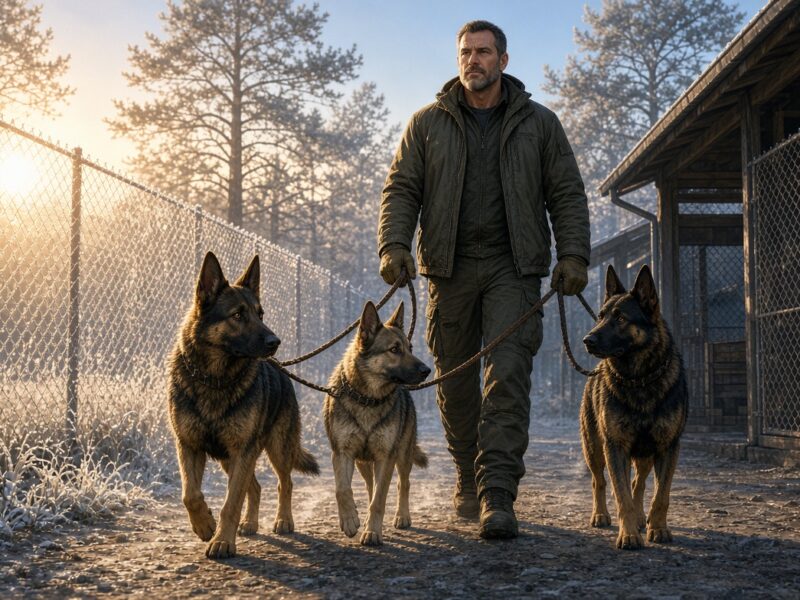
He Came to Adopt One Dog—Then the Other Two Refused to Let Him Leave
Ranger plants all four paws against the concrete as the other two dogs press silently against their kennel gate.
Ethan Cole stops with the adoption leash loose in his hand.
10 minutes earlier, the retired Navy SEAL had chosen Ranger from three German Shepherds at Blue Ridge Working Dog Center in Virginia.
Now the 7-year-old K9 refuses to leave.
Fluorescent lights hum above the kennel corridor, throwing pale bars across damp concrete.
The air smells of disinfectant, wet fur, and the sharp metal of chain-link fencing.
“Come on, buddy,” Ethan says.
Ranger looks at him, then over his shoulder.
Ekko stands behind the neighboring gate, black muzzle pushed between the steel diamonds.
Nova is beside him, smaller, sable-coated, one ear tipped slightly forward.
Neither barks.
That is what bothers Ethan.
Dogs being separated usually make noise.
These two simply watch.
Ranger lowers himself onto the cold floor.
Ethan gives the leash the gentlest pressure.
Nothing.
“He passed his adoption assessment yesterday,” says Marissa Hale, the center’s placement coordinator.
Her keys make a soft metallic chatter against her belt.
“He walked fine for everyone.”
Ethan releases the tension immediately.
16 years around working dogs taught him something civilians sometimes misunderstood.
Obedience and communication are not the same thing.
“Then he’s telling us something.”
He crouches.
Ranger’s amber eyes meet his for half a second before shifting back toward Ekko and Nova.
Ekko touches his nose to Nova’s cheek.
Nova steps closer to the gate.
Only then does Ranger rise.
Ethan notices the sequence.
Ranger checks Ekko.
Ekko checks Nova.
Nova looks at Ranger.
Three movements, almost automatic.
“Were they trained together?” Ethan asks.
Marissa shakes her head.
“Their files say no.”
A ventilation fan clicks on somewhere behind the kennels.
Ranger’s ears flick at the sound, but his eyes remain on the other dogs.
Ethan runs a thumb beneath Ranger’s weathered leather collar and feels something hard.
A narrow metal plate hangs underneath, nearly hidden by fur.
Its face has been scratched smooth with age except for three stamped marks.
A triangle, the number seven, and a short vertical line.
Ethan looks toward Ekko.
“Can I see his collar?”
Marissa hesitates, then opens the adjacent run.
Ekko does not approach Ethan.
He walks directly to Ranger instead and presses his shoulder against the gate, separating them.
Ethan kneels and finds another worn plate beneath Ekko’s collar.
Same metal, same size, different marks.
Two circles, a number four.
Nova begins pacing three steps left, three steps right, nails clicking against concrete.
When Ethan reaches her kennel, she stops.
Her plate carries a broken square and the number one.
“Inventory tags,” Marissa offers.
Ethan rubs the edge of Ranger’s plate.
“Not like any I’ve seen.”
He stands and tries something simple.
He leads Ranger 6 feet toward the exit.
Ranger follows perfectly until the automatic door hisses open and cold air rolls through, carrying the scent of pine and distant wood smoke.
Then Ranger freezes again.
Behind them, Ekko lowers himself against the gate.
Nova does the same.
Ranger turns.
No whining, no pulling.
He simply stares at the two dogs he is being asked to leave behind.
Ethan has seen that posture before in men waiting for the last member of a team to board before they move.
He walks Ranger back.
The instant the three dogs are within sight of one another, their bodies loosen.
Marissa exhales.
“Separation anxiety.”
Ethan studies the three worn metal plates, then the placement folders clipped outside each kennel.
Three dogs, three different intake dates, three different service histories, yet the collars have aged the same way, down to identical pale wear along the inner leather.
Ethan reaches for the folders.
“Maybe.”
Ranger quietly presses his nose against Ekko’s through the fence while Nova leans against Ekko’s flank.
Ethan looks again at the three symbols.
“But before I take one of them home, I want to know why all three are wearing pieces of the same thing.”
Ethan does not study the symbols again.
Not yet.
Instead, he asks Marissa for three slip leads and an empty training yard.
20 minutes later, the German Shepherds stand in separate chain-link runs beneath hard white security lights, each divided from the others by 30 feet of wet concrete.
The evening air has dropped below 40 degrees, carrying the smell of pine needles and kennel disinfectant, while somewhere beyond the fence a freight train sounds low through the Virginia hills.
“If it’s ordinary separation stress,” Marissa says, “distance should tell us.”
Ethan nods.
He starts with Ranger.
The dog heels beside him across the yard, shoulder aligned with Ethan’s knee, leash hanging in a relaxed curve.
At the first turn, Ethan changes direction without warning.
Ranger follows instantly.
At the second, Ethan stops.
Ranger sits.
Clean, precise.
Then Ekko disappears behind a plywood visual barrier.
Ranger’s head turns.
His body stays beside Ethan, but one ear locks toward the hidden run.
Ethan walks another 10 feet.
Ranger follows three steps, then stops.
Not toward Ekko.
Toward Nova.
Ethan looks across the yard.
Nova has begun pacing.
Three steps left, three right.
The same pattern from inside.
“Bring Ekko back into view,” Ethan says.
Marissa slides the barrier aside.
Ekko appears and immediately looks past Ranger toward Nova.
Nova stops pacing.
Ranger sits.
Ethan says nothing.
He changes the test.
Nova is moved into the exercise pen alone while Ranger and Ekko remain visible behind separate gates.
A maintenance cart rattles unexpectedly along the building, metal buckets knocking together.
Nova flinches and backs toward the fence.
Ekko rises at once.
Ranger does not look at the cart.
He watches Ekko.
Ekko watches Nova.
When Nova settles, Ekko sits.
Only then does Ranger lower his head.
Marissa folds her arms against the cold.
“They’re queuing off each other.”
“More than that.”
Ethan walks to Nova and kneels, letting her smell the back of his hand.
Her nose is cool against his knuckles.
He leads her toward the building.
At 20 feet, she stops and looks backward.
Ekko is standing.
Ranger remains down.
Ethan returns Nova to her run.
Ekko lies down immediately.
Ranger follows.
No command has been given.
Ethan repeats the exercise with Ekko.
Same result, different order.
Ekko will leave Ranger’s sight, but not Nova’s.
Ranger will move if Ekko can still see Nova.
Nova settles fastest when both males are visible.
It is not panic.
It is structure.
Ethan asks Marissa to open the center exercise yard.
She hesitates.
“Together?”
Together.
The three gates unlatch with sharp metallic clicks.
Ranger reaches the center first, but turns back.
Ekko emerges next, waiting until Nova crosses her threshold.
Then all three move toward Ethan as one loose formation.
No fighting, no frantic reunion.
Ranger takes Ethan’s left side.
Ekko positions himself several feet behind.
Nova walks between them.
Ethan slowly turns.
All three turn.
He stops.
They stop.
A chill moves across the yard, stirring dead leaves against the fence.
Marissa whispers.
“Their records say they came from three different programs.”
Ethan looks down at Ranger.
The dog is not watching him.
He is checking Ekko and Nova again, as if counting.
Ethan hands Marissa Ranger’s adoption leash.
“Don’t finalize my paperwork tonight.”
“Ethan, transport assignments for the other two are already being processed.”
He looks at the three dogs standing together under the security light, then frees them.
Marissa shakes her head.
“I can’t without a reason.”
Ethan steps between the dogs and the kennel doors.
“You have one now. Until somebody proves these three were never a team, nobody separates them.”
Ethan glances again at the three worn collar plates placed in the same order the dogs keep choosing.
Ranger, Ekko, Nova.
The triangle, paired circles, and broken square align into one old unit grid mark, while the numbers 7, 4, and 1 form the batch designation 741.
Separately, the symbols mean almost nothing.
Together, they point to a single military K9 transition group.
Ethan cannot yet explain why their records deny it, but he knows one thing now.
Those collars were designed to be read as a set.
Ethan waits until the three dogs are settled before he touches the collars again.
The center’s records room sits behind the kennel office, warmer than the yard but carrying the stale smell of copier toner, old paper, and burnt coffee.
Rain taps softly against the narrow window.
Ranger lies beside Ethan’s chair while Ekko and Nova rest behind a temporary mesh divider 10 feet away, close enough to see one another.
Marissa sets three intake folders on the steel desk.
“You have 15 minutes,” she says.
“Then I have to call regional placement.”
Ethan doesn’t answer.
He removes no documents and photographs nothing.
Instead, he places the three collar plates on a clean towel in the order the dogs had arranged themselves outside.
Ranger, Ekko, Nova.
Triangle, seven, vertical line.
Two circles, four.
Broken square, one.
Individually meaningless.
Together they bother him.
He rotates Ranger’s plate 90 degrees.
The triangle becomes an arrowhead.
Ekko’s circles resemble the military shorthand once used to mark paired search points.
Nova’s broken square looks less like damage when aligned with the others.
It completes the boundary of a simple unit grid symbol.
“These weren’t stamped separately,” Ethan says.
Marissa leans closer.
Under the desk lamp, tiny parallel scoring marks run across the edges of all three plates.
Ethan pushes them together.
The scratches continue from one plate to the next.
One original piece of metal had been cut into three sections.
Ranger rises before Ethan does.
The dog noses his plate, then touches Ekko, then Nova’s.
Same order as the yard.
Ethan rearranges them.
Nova begins pacing behind the divider.
He restores the sequence.
She stops.
“That’s not anxiety,” Ethan says quietly.
“That’s memory.”
He copies the combined markings onto a yellow legal pad, then checks the service classifications printed on the folders.
Ranger: mobility support evaluation after retirement.
Ekko: detection retraining.
Nova: behavioral rehabilitation.
Three programs.
Three intake dates separated by months.
Yet each folder contains a small administrative code in the upper corner.
BRT-741.
Ethan taps it.
“What’s BRT?”
Marissa types into the center database.
The keyboard clicks sharply in the quiet room.
“Nothing current. Search archived unit transfers.”
She does.
The screen returns one inactive entry.
Blue Ridge Transition Batch 741.
No dog names, no handler, just a transfer authorization from a decommissioned military working dog recovery program.
Marissa’s hand stops on the mouse.
“That could still be administrative coincidence.”
Ethan points to the plates.
“Three pieces cut from one tag. Three dogs filed under the same batch. And they won’t move unless they can account for each other.”
Ranger suddenly stands and walks to the divider.
Ekko rises.
Nova follows.
Ethan watches the order again.
Ranger checks Ekko.
Ekko checks Nova.
Nova looks back to Ranger.
A closed loop.
Not three dependent animals.
A team maintaining visual accountability.
Ethan opens the folders side by side.
Their official histories claim they never occupied the same facility, but one mundane detail repeats on every intake sheet.
Collar condition: weathered brown leather, brass buckle.
Owner provided.
Ethan runs his finger over Ranger’s pale inner collar edge.
Then Ekko’s.
Then Nova’s.
Same leather, same stitching, same hand-cut notch beside the buckle.
Someone had separated the paperwork.
Someone had not separated the collars.
Marissa’s phone rings.
She answers, listens, then looks directly at Ethan.
“Regional says the hold is denied. Ekko leaves at 6:00 tomorrow morning. Nova at 8.”
The room goes still except for the rain against the glass.
Ethan closes the three folders, places the divided metal tag between them, and stands.
Ranger rises with him.
Ekko and Nova are already standing.
“Then we have until 6,” Ethan says, “because those records say they were strangers, and everything these dogs are doing says the records are wrong.”
Marissa’s 15-minute limit had never been about keeping information from Ethan.
Center policy only allowed an adopter supervised access to archived service records while placement staff were present, and her overnight shift was ending just as regional processing opened.
Once she made that call, the transfer orders could be locked into the morning system, and she would no longer have authority to delay them on her own.
15 minutes was simply how long Ethan had before paperwork became motion and Ekko and Nova became two dogs headed in opposite directions.
At 1:17 a.m., Ethan is standing beside Marissa at an archive terminal while Ranger waits outside the records room with Ekko and Nova visible through the glass.
The building has gone quiet.
A vending machine compressor buzzes down the hall, and the fluorescent tubes cast a cold green tint over cardboard storage boxes.
Ethan has stopped searching for more symbols.
He is testing the records themselves.
“Show me the transfer chain for BRT-741,” he says.
Marissa opens the archived manifest.
Ranger and Ekko appear under different destinations, just as their current files claim.
Nova appears months later.
Ethan traces the dates with one finger, then stops.
“That transport number.”
Marissa zooms in.
The same vehicle identification code appears on Ranger’s and Ekko’s original transfer forms despite the documents claiming the dogs left facilities 430 miles apart within 40 minutes of each other.
“Impossible,” she whispers.
“Not impossible,” Ethan says.
“Altered.”
He pulls the physical folders closer.
One form has been photocopied repeatedly, its letters softened at the edges.
Another retains sharp type.
Someone rebuilt their histories from different generations of paperwork.
Marissa checks a retired media index connected to the batch number.
One thumbnail appears, a training photograph cataloged years before any of the three supposedly met.
She opens it.
Sunlight floods an outdoor obstacle course.
Ranger is unmistakable near a wooden wall, younger but carrying the same dark saddle across his back.
Ekko stands several feet away beside a handler whose face is outside the frame.
At the far right, the image ends abruptly at a vertical crop.
Only the front half of a sable tail remains.
Ethan leans toward the screen.
Behind that cut edge, painted on the obstacle wall, is the same broken square shape stamped onto Nova’s collar plate.
“Original file,” he says.
Marissa searches the media history.
A larger archived version exists on an old backup server.
It loads slowly, line by line.
The crop widens.
Nova appears beside Ekko.
Three dogs.
Same yard.
Same day.
Ranger lifts his head in the hallway as though the silence itself has changed.
Ethan prints the image.
Warm paper slides from the machine carrying the smell of heated toner.
He takes it outside.
Ranger sniffs first, then Ekko.
Nova pushes between them and touches her nose directly to the lower corner where her younger image stands.
Ethan crouches, holding the photograph at their eye level.
Ekko looks from the picture to Nova.
Ranger touches Ekko’s shoulder.
Again, the sequence.
Again, the count.
Marissa steps into the corridor with her phone pressed to her ear.
“Regional says the archived photograph doesn’t override signed placement records. Ekko’s transport still arrives at 6.”
Ethan checks the wall clock.
1:43.
4 hours and 17 minutes.
He turns the photograph over beneath the corridor light.
A faded handwritten notation runs across the back, almost lost beneath an inventory stamp.
BRT-741 team transfer.
Marissa stares at it.
“Then why were their files separated?”
Ethan looks through the kennel glass.
Ranger is standing between Ekko and Nova now, his body angled toward both doors.
“That’s the wrong question.”
He folds the photograph once and slips it into the clear evidence sleeve with the three folders.
“The question is why somebody needed three dogs who arrived as a team to look like they had never known each other.”
At that moment, headlights sweep across the dark kennel windows.
Tires hiss over wet asphalt outside.
Marissa checks the clock again.
Her face tightens.
“That’s not supposed to be here yet.”
A white transport van stops beneath the security lamp.
Its side door opens.
Ranger rises before anyone touches a kennel latch, then moves directly in front of Ekko and Nova.
Ethan steps beside him.
The driver enters carrying transfer papers.
“I’m here for Ekko.”
Ethan does not move.
Neither does Ranger.
“Then you’re early,” Ethan says.
The driver raises the paperwork.
“Orders changed.”
Ethan places the old photograph on the counter between them.
“So did the evidence.”
Ranger reaches it first, but Ethan knows the dogs are not recognizing an image the way a person would.
The warm print carries fresh toner, yet beneath it lingers the scent transferred from the original archive sleeve.
The same old leather, dust, and training yard residue preserved with the record.
Ranger noses the corner.
Ekko follows.
Nova presses closest where Ethan’s fingers had touched her younger figure.
More importantly, the photograph has brought Ethan back to a place their bodies never forgot.
The same obstacle wall, the same three-dog formation, the same order in which they still check one another.
The dogs are not proving the photograph is theirs.
Their behavior is proving the photograph matches a memory their paperwork says they should never have shared.
The transport driver reaches for Ekko’s kennel latch, and Ranger moves before Ethan can speak.
Not aggressively, not wildly.
The German Shepherd simply steps between the man and the gate, plants his paws on the damp concrete, and becomes still.
Rainwater glistens beneath the security lights.
The van’s diesel engine murmurs outside, and cold air carries the smell of wet asphalt through the open vestibule.
“Call him off,” the driver says.
Ethan looks at Ranger’s loose mouth, level tail, and fixed attention.
“He’s not on you.”
Marissa steps forward with the transfer order.
“Ekko was scheduled for six. Regional moved it up.”
The driver taps the paper.
“Nova’s pickup is coming after.”
Behind the chain link, Ekko stands shoulder-to-shoulder with Nova.
Ranger looks back at them.
Ekko touches Nova’s neck with his muzzle.
Nova stops shifting her weight.
Then Ranger turns to Ethan.
That sequence again.
Ethan had spent hours treating it like evidence of shared training.
Now, with the van waiting 20 feet away, he sees something he missed.
Ranger is not checking whether the other dogs are following commands.
He is checking whether they’re still there.
“Open Ranger’s run,” Ethan says.
Marissa studies him.
“Why? I already signed his preliminary release.”
“Let me take my dog to the exit.”
The driver shrugs impatiently.
Marissa unlatches the gate.
Ethan clips on Ranger’s adoption leash and walks toward the vestibule.
Ranger heels perfectly.
10 feet.
15.
The automatic door opens with a pneumatic hiss, spilling white light across the wet pavement.
Ranger reaches the threshold and stops.
Ethan waits.
No leash pressure.
No command.
Behind them comes the metallic click of Ekko’s kennel opening.
Ranger spins.
Ekko is being led toward the transport corridor while Nova remains behind the fence.
For the first time that night, Ranger breaks position completely.
He pulls free of Ethan’s relaxed grip, crosses the polished floor, and runs.
Not toward the outside door.
Not toward freedom.
Back toward Ekko.
His paws skid once on the wet concrete.
He reaches Ekko, circles him, then immediately runs to Nova’s gate and presses his chest against it.
Nova rises onto her hind legs, forepaws against the mesh.
Ekko strains toward them without barking.
Ranger moves between the two, touching one muzzle, then the other.
Ethan stands motionless near the dropped leash.
Something inside the scene changes shape.
He remembers the first moment.
Ekko and Nova pressed against their gate while Ranger refused to leave.
He had believed two dogs were begging for the one being taken away.
But Ranger had been answering them.
Three animals, each refusing to let the line break.
The driver reaches for Ekko again.
Ethan steps into his path and picks up Ranger’s leash.
“Nobody loads him.”
“You don’t have authority over Ekko.”
“No,” Ethan says.
“But you’re about to separate a documented team while the documentation is under dispute.”
The driver’s jaw tightens.
“My order is valid.”
“Then call whoever signed it and tell them a former Navy SEAL with 16 years around working dogs is standing here with an archived team photograph matching transfer codes, three pieces of one identification plate, and behavior consistent across every separation test.”
The diesel engine continues idling outside.
Marissa looks at the photograph on the counter, then at Ranger standing between the other two dogs.
Slowly, she reaches for the wall phone.
“I can request an emergency welfare hold.”
The driver checks his watch.
“Regional won’t like it.”
“They don’t have to.”
Ethan crouches beside Ranger.
The dog’s breathing is fast, but the moment Ekko and Nova are both behind closed gates again, his shoulders lower.
Ethan places one hand against the warm fur at his neck.
He had come here prepared to choose which dog belonged with him.
He finally understands that Ranger has been asking a different question all night.
Ethan looks up at Marissa as she waits with the receiver in her hand.
“File the hold under all three names.”
Then he turns toward the dogs.
“If I’m taking Ranger anywhere, I’m finding out who taught him that leaving the other two behind was never an option.”
The emergency hold buys Ethan 3 hours, but Ranger uses the first minute to lead him somewhere no paperwork has.
Marissa moves the dogs into a quiet rehabilitation room while regional reviews the dispute.
Rubber flooring softens their footsteps.
An old ceiling vent rattles above them, and the room smells of cedar training blocks and canvas bite sleeves stored along one wall.
Ethan enters carrying the archived photograph inside its clear sleeve.
Ranger ignores it.
Instead, he stops beside a gray equipment locker and lifts his nose.
Ekko does the same.
Nova sits behind them.
“What’s in there?” Ethan asks.
Marissa unlocks the cabinet.
“Retired leashes, faded harnesses, sealed training kits. Nothing dramatic.”
Then she pulls out an old canvas scent bag tagged BRT-741.
Ranger’s posture changes.
His nose works rapidly along the seam.
Ekko presses forward.
Nova gives one low breath and sits closer to Ekko.
Ethan smells it when Marissa opens the bag.
Old canvas, dust, and a faint petroleum odor like diesel soaked into fabric years ago.
Ranger touches the bag, then checks Ekko and Nova.
Ethan recognizes the behavior.
Not fear.
Recall.
Marissa searches the equipment ledger rather than another personnel file.
“This kit came from Naval Working Dog Recovery Detachment 7,” she says.
Ethan’s hand stops over the canvas.
“Read the assigned rehabilitation specialist.”
Marissa goes silent.
The vent rattles twice overhead.
“Daniel Cole.”
Ethan takes the ledger from her.
The name is typed plainly beside the batch number.
His younger brother has been dead for 4 years.
Daniel had served as a Navy K9 handler before moving into recovery work, but Ethan had never known the names of the dogs from his final program.
He looks at Ranger.
The dog is staring at him now.
Same eyes that had followed him from the kennel gate hours earlier.
Ethan pulls his wallet from his jacket and removes a worn photograph he has carried so long the corners have gone white.
Daniel stands beside a military truck, smiling into desert sunlight.
Ethan places it on the rubber floor.
Ranger approaches first.
He sniffs Daniel’s image, then the edge of the photograph.
Ekko follows.
Nova comes last.
Ranger sits.
Ekko sits.
Nova settles between them.
Ethan’s thumb presses against the photograph until the paper bends slightly.
“You knew him.”
Marissa says nothing.
Ethan straightens and returns to the equipment ledger.
Daniel’s final entry for BRT-741 contains three abbreviated initials corresponding to the dogs’ service identifiers.
Beside them is a handwritten notation.
“Maintain visual accountability during transition. Cohort separation contraindicated pending reassessment.”
Ethan reads it twice.
It explains the formation.
Ranger checks Ekko.
Ekko checks Nova.
Nova closes the loop.
Daniel had reinforced the behavior during recovery because keeping sight of one another helped all three function.
Ethan had mistaken their refusal to separate for dependency.
It had been part training, part trust.
But one detail refuses to fit.
The current placement files authorize individual adoption.
Ethan lays Daniel’s entry beside the signed transfer forms.
Same batch, same dogs, opposite instructions.
“Who changed this?” Marissa asks.
Ethan shakes his head.
“We don’t know that yet.”
He will not accuse someone because grief makes the answer convenient.
He checks dates instead.
Daniel’s instruction predates the separation authorization by 11 days.
His signature appears on both.
That means either Daniel changed his mind or someone wants the paperwork to say he did.
The wall phone rings.
Marissa answers.
Regional has reviewed the photograph and ledger.
The hold expires at 5:00.
48 minutes.
Ekko’s van remains outside.
Ethan looks at the three dogs, then at his brother’s name.
He folds the wallet photograph carefully and puts it away.
“Daniel taught them not to leave one another,” he says.
Ranger walks over and rests his muzzle against Ethan’s closed fist.
Ethan looks toward the transfer papers.
“Now I need to prove whether he was really the man who ordered them apart.”
Ethan’s voice nearly breaks on the last word.
For several seconds, he cannot look at Ranger.
He sees Daniel instead, his younger brother kneeling beside three shepherds, trusting someone to keep together what he would not live long enough to protect himself.
Ethan closes his fist around Daniel’s old identification in his pocket until the metal edge bites into his palm.
Then Marissa reminds him what the emergency welfare hold actually bought them.
Not a cancellation.
Only a temporary pause until 5:00 a.m., when regional placement can decide whether the evidence justifies extending it.
If the hold is rejected, Ekko and Nova can be reassigned before noon.
Ethan wipes one hand across his face and looks through the glass at all three dogs lying close enough for their paws to touch.
He has less than an hour to learn whether his brother abandoned that promise or whether someone made it look as though he did.
Ethan has 48 minutes to prove his dead brother did not betray the three dogs, and he refuses to spend one of them guessing.
He carries Daniel’s rehabilitation ledger and the individual transfer forms into the intake office, where amber security lights glow beyond rain-streaked windows and the printer gives off the dry heat of warm toner.
Ranger follows.
Ekko and Nova remain together behind the glass partition, close enough for Ranger to see them.
Ethan lays the documents side by side.
“Daniel wrote this 11 days earlier,” Marissa says, pointing to the instruction against separation.
“Maybe he changed his recommendation.”
“Then the change should follow the same administrative chain.”
Ethan checks the signatures first.
They match closely enough to fool a hurried reviewer.
Same long D, same compressed C.
He has seen Daniel’s handwriting on birthday cards, deployment notes, and the last Christmas cards still sitting unopened in a drawer at home.
But resemblance is not proof.
Ethan shifts to the forms themselves.
Daniel’s original rehabilitation entry identifies the dogs by service identifiers in BRT-741.
The later authorization lists three new placement numbers created after the recovery detachment closed.
Ethan taps the dates.
“He couldn’t have signed these identifiers 11 days later.”
Marissa looks at him.
“Why not?”
Ethan turns the transfer page toward her.
“Because according to your own intake history, these numbers weren’t issued until 6 weeks after Daniel’s signature date.”
The rain ticks harder against the glass.
Marissa pulls up the number generation log.
There it is.
6 weeks.
The signature may be Daniel’s.
The page beneath it cannot have existed when he signed.
Ethan exhales through his nose.
“They reused a signed sheet. Not necessarily maliciously. Not yet.”
He checks the archived closure procedure.
When the detachment shut down, emergency placement packets were assembled from scan records.
A notation appears beside BRT-741.
Supplemental cohort directive unavailable at digitization.
“Unavailable,” Marissa repeats.
“Not canceled.”
Ethan points to the three individual authorizations.
“And whoever rebuilt the packet treated missing as permission.”
The ugly shape of it is simpler than conspiracy.
Daniel had signed a general emergency release allowing each dog to be transferred if medical or operational necessity required it.
Later, after his death and the program’s closure, that signature was attached to individual placement packets.
The separate files made it appear that separation itself had been his instruction.
Ethan looks through the glass.
Nova has risen.
Ekko immediately turns toward her.
Ranger stands beside Ethan, watching both.
“He gave them an emergency exit,” Ethan says.
“Somebody turned it into the plan.”
Marissa checks another index.
“There should have been a supplemental directive. The one marked unavailable.”
Ethan walks to the old equipment shelf and takes down the BRT-741 canvas bag.
He does not search it for a miracle document.
Instead, he studies the exterior inventory markings already logged when the bag arrived.
Three colored bars have faded almost to gray beneath the batch number.
Ranger noses the first.
Ekko, watching through the glass, rises.
Nova steps beside him.
Ethan looks back at Daniel’s rehabilitation notation.
“Maintain visual accountability during transition. Cohort separation contraindicated pending reassessment.”
The instruction had never been absolute.
It had been conditional.
Keep them together unless necessity made separation unavoidable.
That distinction matters.
Ethan picks up the phone and calls regional placement himself.
“You have three dogs scheduled as independent placements under documents carrying identifiers created after the signer’s death,” he says.
Silence answers him.
Then a woman asks him to hold.
Minutes pass.
The transport driver waits in the corridor, arms folded.
Finally, regional returns.
They will suspend departure, but only until 8:00 a.m., when a compliance supervisor arrives to determine whether the missing cohort directive ever had legal force.
Marissa hangs up.
Outside, the eastern sky has begun turning from black to charcoal.
3 hours.
Ethan walks into the rehabilitation room and opens the divider between the dogs.
Ranger goes first to Ekko, then Nova.
This time, Ethan understands every movement.
He kneels among them and rests one hand against Ranger’s shoulder.
“Your paperwork says you can be separated,” he murmurs.
Ranger looks from him to the other two.
Ethan rises.
“By 8:00, we’re going to prove whether Daniel ever believed you should be.”
At 7:46 a.m., the compliance supervisor tells Ethan the dogs will leave separately unless he can prove separation creates a placement risk.
Morning light cuts pale gold through the kennel windows, warming the scratched concrete while the transport van idles outside with a low diesel trimmer.
Ranger stands between Ekko and Nova.
Ethan has 14 minutes.
The supervisor, Karen Willis, places Daniel’s emergency authorization beside the archived rehabilitation ledger.
“The missing supplemental directive cannot be enforced until it’s verified,” she says.
“And Mr. Cole, you’re approved to adopt Ranger. Not three dogs.”
Ethan looks at Ranger.
“Then don’t watch me. Watch him.”
He asks Marissa to open the rehabilitation room into the center exercise yard.
Cold air rushes through the doorway, carrying wet pine and exhaust.
Three handlers take positions, one beside each dog.
Ethan clips his adoption leash onto Ranger.
“Run the separation assessment once more.”
Karen frowns.
“We already have behavioral evaluations. Individual evaluations.”
Ethan points toward Ekko and Nova.
“That’s the mistake.”
The gates open.
Ethan walks Ranger toward the parking lot.
Another handler takes Ekko 20 feet toward the transport corridor.
Nova remains near the yard fence.
Ranger follows Ethan six steps.
Then Ekko disappears behind the building corner.
Ranger stops, but this time Ethan does not pull him forward.
“Watch where he looks.”
Ranger turns toward Nova first.
Nova stands rigid, staring toward the corner where Ekko vanished.
Ranger moves back to her, touches her shoulder, then faces Ekko’s direction.
Seconds later, Ekko reappears.
Ranger immediately steps aside.
Nova crosses toward Ekko.
Only when she reaches him does Ranger return to Ethan.
Karen writes something on her clipboard.
“Dependency.”
Ethan shakes his head.
“Run it again. Reverse the order.”
Nova is led away first.
Ekko watches until she disappears.
Ranger watches Ekko.
Ekko takes two steps after Nova.
Ranger moves with him, maintaining the triangle between their positions.
No whining, no frantic pulling, no loss of command response.
Ethan raises one hand.
Everyone stops.
“A dependent dog breaks function when the other animal disappears,” he says.
“These dogs are maintaining function to restore accountability.”
Karen looks toward Marissa.
“Meaning?”
Ethan walks to the center of the yard.
Gravel crunches beneath his boots.
“Daniel’s note said maintain visual accountability during transition. We thought it described rehabilitation. It describes the protocol he taught them.”
Ranger reaches Ekko.
Ekko turns toward Nova.
Nova closes the distance.
The three settle without a command.
“Ranger isn’t refusing adoption,” Ethan says.
“He’s refusing an incomplete team movement.”
The van driver checks his watch.
7:55.
Karen’s radio crackles.
Regional wants a decision.
She looks down at Daniel’s authorization, then toward the dogs.
“Even if I accept that interpretation, it doesn’t prove permanent separation is prohibited.”
“No,” Ethan says.
“But it proves your current evaluations are incomplete, because each dog was assessed as an individual when their trained behavior depends on the group.”
Karen stops writing.
Ethan has changed the question.
The issue is no longer whether a missing page can override valid transfer orders.
The issue is whether those orders were approved using invalid assessments.
At 7:58, Karen takes out her phone.
“Suspend both transports pending reassessment.”
The driver exhales sharply.
Marissa closes Ekko’s transfer folder.
The van engine shuts off, leaving the yard suddenly quiet except for wind moving through the chain link.
Ranger does not come to Ethan.
He stands between Ekko and Nova, looking at one, then the other, until both are beside him.
Only then does he walk across the yard and place his muzzle beneath Ethan’s hand.
Karen watches them for a long moment.
“This buys you 48 hours,” she says.
“And if Daniel’s missing directive is verified, we can reopen joint placement.”
Ethan looks at all three dogs.
“Then don’t reopen Ranger’s adoption.”
Karen raises an eyebrow.
Ethan removes the single-dog release form from his jacket and places it on her clipboard.
“Reopen mine.”
He is no longer asking the center to replace Ranger with another dog or simply delay the transfers.
He wants his application amended to adopt Ranger, Ekko, and Nova together, provided the restored records clear all three for joint placement.
It means changing his home inspection, accepting the cost and responsibility of three retired working dogs, and rebuilding the quiet life he had prepared for one.
Ethan looks at Ranger standing between Ekko and Nova and signs the new request.
“I came here ready to make room for one,” he says softly.
“I’ll make room for three.”
This time, when Ranger checks the other two, Ethan understands exactly what he is being asked to promise.
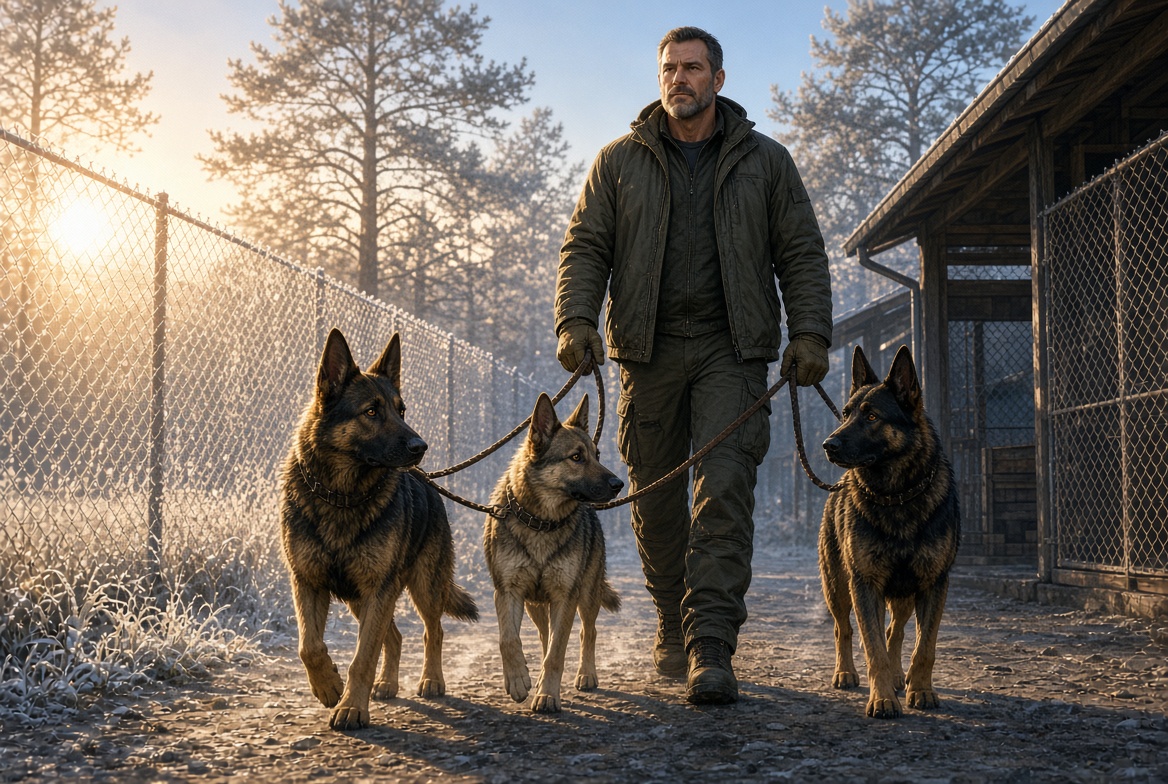
48 hours later, Ranger walks out of Blue Ridge only after Ethan clips three leashes into his hand.
The morning is clear and cold, sunlight flashing across frost along the chain link, while somewhere beyond the kennels a red-tailed hawk cries over the Virginia pines.
Ekko walks on Ethan’s right.
Nova stays between them.
Ranger takes the left, but every few yards his eyes move across the formation, counting.
The verification arrived before dawn.
During the closure review, regional compliance located the archived index for Daniel Cole’s missing supplemental directive.
Not hidden.
Not destroyed.
Simply filed under the recovery detachment’s old cohort number instead of the dogs’ later individual placement numbers.
The original page was recovered from federal records.
Daniel’s emergency authorization had allowed temporary separation only when medical necessity made it unavoidable.
His supplemental instruction was equally clear.
BRT-741 should remain together through retirement placement whenever a qualified home could accept the complete cohort.
No conspiracy.
No betrayal.
Just one lost page, three rebuilt files, and years of people asking each dog to live as though the other two had never existed.
Karen Willis personally voids the individual transfer orders.
Then she places a new packet on the counter.
Joint placement approved.
Ethan looks at the signature line.
His hand remains still for several seconds.
Three food schedules.
Three veterinary records.
Three beds he does not own yet.
A fenced yard that needs another gate latch.
A life built for one retired dog suddenly becoming something much larger.
Ranger stands beside him without moving toward the exit.
Behind the glass, Ekko and Nova wait.
Ethan signs.
Marissa opens all three kennel doors.
Ranger could reach Ethan first.
He doesn’t.
He crosses to Ekko, touches his muzzle gently to Ekko’s cheek, then turns toward Nova.
Nova steps forward.
Only when all three stand together does Ranger look at Ethan.
“Yeah,” Ethan whispers.
“I finally understand.”
That afternoon, Ethan’s pickup climbs the narrow road toward his house beneath bare oak branches.
The cab smells of old leather, dog fur, and the cedar blanket Marissa sent with them.
Ekko watches through the passenger window.
Nova sleeps across the back seat.
Ranger remains upright until the truck turns into Ethan’s driveway and the other two lift their heads.
3 weeks later, the house sounds different.
Nails click across hardwood before sunrise.
Water bowls scrape against kitchen tile.
Ekko sleeps beside the front door where he can hear every vehicle on the gravel road.
Nova claims the rug near the fireplace, her sable coat glowing copper whenever flames move across it.
Ranger still checks both before settling.
Ethan never stops him.
One evening, rain whispers against the roof while the fire burns low and warm.
Ethan opens the wooden box he has kept in his bedroom closet since Daniel’s funeral.
He removes his brother’s Navy dog tag and carries it to the mantle.
Beside it, he places the three old collar plates in their proper order.
Ranger’s triangle and seven.
Ekko’s two circles and four.
Nova’s broken square and one.
Separated, they had looked meaningless.
Together, their cut edges meet.
The scoring lines become continuous again.
Ranger approaches the mantle and sniffs Daniel’s tag.
Then he turns.
Ekko is at the door.
Nova is by the fire.
Both are safe.
Both are here.
Ranger looks back at Ethan.
For once, he does not return to the hallway to check another room.
He walks across the warm floor, lowers himself beside Ethan’s chair, and rests his head on Ethan’s knee.
Ethan’s fingers settle into the thick fur behind his ears.
Outside, rain moves softly through the pines.
Inside, Ekko releases a long breath.
Nova sleeps without lifting her head.
Ranger’s eyes finally close.
Ethan had arrived believing he was choosing one dog.
But Ranger had spent every step home teaching him what Daniel already knew.
Sometimes the one you save cannot be saved until no one he loves is left behind.









