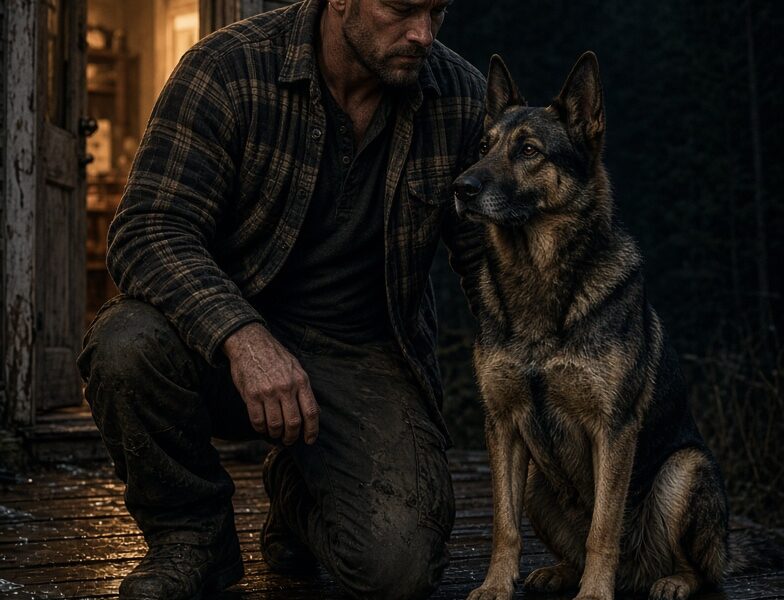
He Came Home to Surprise His Mother… and Found Her Bleeding on the Floor
The first thing Chief Petty Officer Derek Bowman noticed was the broken porch light.
The second was the silence.
On a quiet stretch of Pine Creek Road outside Bend, Oregon, where towering pines guarded old farmhouses and neighbors sometimes went days without seeing one another, silence was normal. But not at his mother’s house. Martha Bowman always left a light burning above her front door, and she always kept the kitchen window open just enough to hear the evening birds.
Tonight, the light lay shattered across the wooden steps.
Beside Derek, his retired military K9, Brutus, suddenly stopped breathing through his nose. The German Shepherd’s ears flattened, his muscles tightened, and a deep warning growl rolled from his chest.
Then Derek saw the front door hanging open.
He climbed out of his battered Ford F-150, staring at the splintered oak frame.
“Stay close, buddy,” he whispered.
Brutus ignored the usual calm in his handler’s voice and pulled toward the house.
Seconds later, a terrible howl erupted from the kitchen.
Derek ran.
And when he reached the doorway, he saw his sixty-two-year-old mother lying motionless on the floor, her white floral blouse stained with blood, while Brutus desperately nudged her hand.
For one unbearable second, twelve years of combat experience meant absolutely nothing.
Derek dropped beside her.
“Mom? Mom, look at me!”
He found a faint pulse.
Then he pressed his hands against her wounds, reached for his phone, and called 911.
But as the dispatcher sent emergency crews racing toward the farmhouse, Derek noticed something that would change everything.
Someone had entered his mother’s home without taking a single valuable thing.
And whoever had done it had left behind a clue that suggested this was never an ordinary break-in.
By sunrise, Derek would discover that the attack was connected to a fifteen-year-old secret, a missing man believed to be dead, and a powerful criminal network that had spent years making sure the truth stayed buried.
They had made one mistake, however.
They had left Martha Bowman’s son alive.
And they had underestimated the dog standing beside him.
Derek had spent twelve years in the United States Navy SEALs, operating in places where hesitation could cost a life. He had crossed the dust-choked valleys of Syria and served in the volatile coastal regions of Somalia. He had learned to recognize danger in a change of wind, a misplaced shadow, or a silence that lasted one second too long.
Yet nothing in those years had prepared him for the sight of his mother lying on her kitchen floor.
“Stay with me, Mom. You hear me? You stay with me.”
He pulled off his heavy flannel shirt, folded it into a thick pad, and held it against the wound on the side of her head.
Martha’s fingers moved faintly against the tile.
Derek leaned closer.
“It’s Derek. I’m here. Help is coming.”
Brutus paced beside them, whining softly. The dog nudged Martha’s hand, then looked up at Derek as if demanding an explanation his handler could not give.
The German Shepherd weighed approximately eighty pounds, with a broad chest, powerful shoulders, and a muzzle beginning to turn gray. He had been a multipurpose military working dog, trained to detect threats, locate people, and protect his handler. During their years together, Brutus had saved Derek’s life more times than the SEAL cared to count.
The dog had also learned to recognize the people Derek loved.
Martha had been one of his favorites from the beginning.
Whenever Derek visited home, she insisted on preparing an extra plate for Brutus, despite Derek’s repeated reminders that the dog had a carefully managed diet.
“He works harder than you do, sweetheart,” she would say.
“He’s a dog, Mom.”
“And you’re a grown man who still forgets to eat vegetables. I don’t see why either of you should be trusted to manage your own dinner.”
Brutus would sit beside her chair, his golden-brown eyes fixed on the food, and Martha would pretend not to notice when she slipped him a small piece of chicken.
Derek had never minded.
Those ordinary moments were the reason he had spent years looking forward to coming home.
Now, with Martha barely conscious beneath his hands, the memories felt like something cruelly borrowed from another life.
“911, what’s your emergency?”
“My mother has been attacked,” Derek said, forcing the words out clearly. “I’m at 4420 Pine Creek Road outside Bend. She’s bleeding badly and has a serious head injury. I need an ambulance immediately.”
“Sir, help is on the way. Is the attacker still inside the residence?”
Derek lifted his head and studied the room.
Two kitchen chairs lay overturned. A ceramic bowl had shattered near the refrigerator. Groceries had spilled across the floor, and the back door stood open, its curtains moving in the cold evening breeze.
Near the doorway, a muddy bootprint marked the tile.
“No one I can see,” Derek replied. “The house has been forcibly entered. Send police, too.”
“Stay with your mother. Do not approach anyone who may still be inside.”
Derek almost laughed at the instruction, but there was no humor in him.
He was already doing everything he could to keep Martha alive.
The ambulance arrived eleven minutes later.
Derek knew because he counted every second.
Paramedics rushed through the doorway carrying equipment, and one immediately took over pressure on Martha’s head wound while another assessed her breathing and circulation.
“Sir, I need you to step back.”
“She’s my mother.”
“I understand. We need room to work.”
Derek stepped aside, his hands trembling with the effort of keeping them still.
Brutus pressed against his leg.
For the first time since they had entered the house, the dog was quiet.
The paramedics placed Martha on a stretcher and hurried her toward the ambulance. Derek followed, answering questions about her age, medical history, medications, and the circumstances in which he had found her.
“Did she lose consciousness before you arrived?”
“I don’t know. She was unconscious when I found her.”
“Did you see the person responsible?”
“No.”
“Did you touch anything else in the house?”
Derek looked back at the broken door.
“Only what I needed to reach my mother.”
The paramedic nodded.
“We’ll get her to St. Charles. The emergency department will be ready for her.”
Derek climbed into the ambulance with Brutus remaining secured in the truck. He had arranged for the dog to be transported safely, but the thought of leaving him behind made the journey feel even longer.
As the ambulance pulled away, Derek watched the farmhouse disappear behind the trees.
He had driven those roads hundreds of times as a boy. He had ridden his bicycle along the same gravel shoulder, helped his father repair the old fence, and spent summer afternoons fishing with Martha at a nearby creek.
His father had died when Derek was twenty-three.
Since then, Martha had lived alone on her three-acre property, refusing to move into town despite Derek’s offers to help her find a smaller place.
“I raised you to stand on your own two feet,” she had told him. “I’m perfectly capable of standing on mine.”
Derek had respected her independence.
He had also installed motion lights, replaced the locks, and arranged for a neighbor to check on her when he was deployed.
He had believed those precautions were enough.
Now he stared at the ambulance doors, wondering how many times he had reassured himself that she was safe simply because he needed to believe it.
He had returned from Naval Amphibious Base Coronado after eight months of demanding training cycles and debriefings. He had not told Martha he was coming.
He had wanted to surprise her.
He had imagined the way her face would light up when he appeared in the kitchen. He had expected her to complain that he looked tired, insist that he eat something, and ask whether he had brought Brutus a new toy.
Instead, he had found her bleeding on the floor.
And the person responsible had vanished into the Oregon woods.
At St. Charles Medical Center, doctors rushed Martha into emergency treatment.
Derek stood outside the double doors until a nurse approached him.
“Mr. Bowman?”
He turned immediately.
“I’m her son.”
“I’m going to need you to complete some paperwork. The trauma team is treating her now.”
“How bad is it?”
The nurse’s expression softened.
“She’s seriously injured. The doctors are working to stabilize her, and they’ll speak with you as soon as they can.”
Derek looked through the narrow window in the doors.
“Can I see her?”
“Not yet.”
He signed the forms without reading them, then sat in the waiting area with his elbows resting on his knees.
A few minutes later, Brutus arrived with a trusted friend who had collected him from the farmhouse. The dog walked directly to Derek, sniffed his hands, and settled beside his chair.
Derek buried his fingers in the thick fur behind Brutus’s ears.
“It’s all right, buddy.”
The words sounded ridiculous even to him.
Nothing was all right.
For four hours, he waited beneath the harsh fluorescent lights while nurses moved between the emergency department and the intensive care unit.
Every time the doors opened, his head lifted.
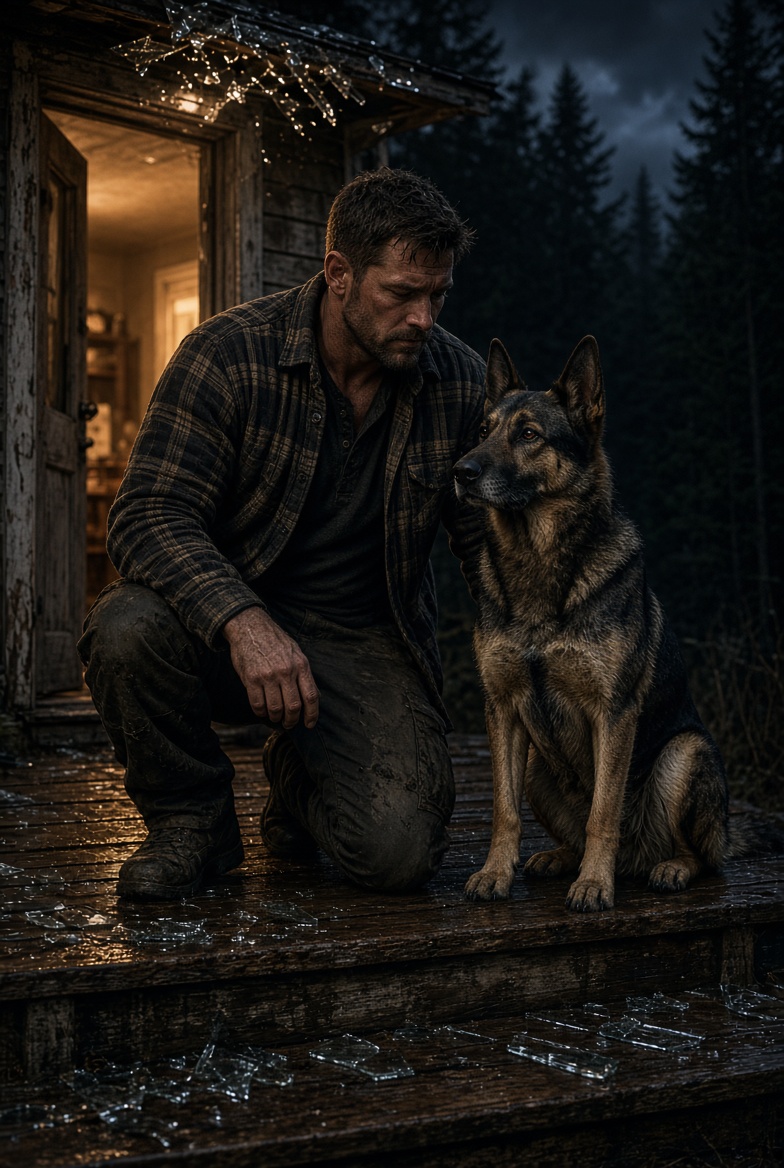
Every time a stranger walked past, Brutus watched them carefully.
Finally, a surgeon approached.
Dr. William Hayes was a seasoned trauma physician with tired eyes and a calm manner. He removed his surgical cap and introduced himself.
“Your mother is alive,” he said.
Derek’s entire body seemed to release a breath he had been holding since the kitchen.
“She’s alive?”
“Yes. She sustained a serious head injury and a deep wound to her left forearm. We’ve controlled the bleeding and treated the immediate injuries. There is swelling we need to monitor closely, and the next twenty-four hours will be important.”
“Can she hear me?”
“She’s sedated right now. We don’t know when she’ll be fully alert, but she’s receiving the care she needs.”
Derek nodded, struggling to absorb the information.
“Thank you, Doctor.”
Dr. Hayes rested a hand briefly on his shoulder.
“We’ll keep you informed.”
After the surgeon left, Derek leaned forward and covered his face with both hands.
Brutus pressed his head against his knee.
For several minutes, neither moved.
Then footsteps approached from the corridor.
A man in a rumpled dark suit stopped in front of Derek’s chair. He appeared to be in his late forties, with a thick mustache, a tarnished gold badge, and the weary expression of someone who had spent too many years dealing with other people’s problems.
“Derek Bowman?”
Derek stood.
“Yes.”
“Detective Mitchell Broady, Deschutes County Sheriff’s Office. I’m sorry about your mother.”
Broady opened a small notepad.
“I need to ask you a few questions about what happened tonight.”
Derek looked at the badge, then at the detective’s face.
“Did you find anything at the house?”
“We’re treating it as a home invasion. Probably a couple of opportunists who thought they could find something worth taking. Your mother may have surprised them.”
“They didn’t take anything.”
Broady paused.
“What?”
“The television is still there. Her purse was on the kitchen counter. There’s jewelry in the master bedroom. I saw it before the ambulance arrived.”
“People don’t always think clearly when a break-in goes wrong.”
“Neither do people who plan one carefully.”
The detective’s pen stopped moving.
Derek kept his voice level.
“The front door was forced inward. The back porch motion sensor had been unscrewed. Not smashed. Unscrewed.”
Broady looked up.
“You’re certain?”
“I know the difference between something broken in a hurry and something disabled deliberately.”
“We’ll dust for fingerprints and process the scene.”
“Good.”
“These cases can take time, Chief. You should focus on your mother and let us handle the investigation.”
Derek studied him.
“I intend to focus on my mother. But I want to know why someone would break into her house, injure her, and leave without taking anything.”
“Maybe she interrupted them.”
“Then why disable the light before they entered?”
Broady shut his notepad.
“You’re understandably upset. You have military experience, I assume?”
“Twelve years.”
“Then you understand that sometimes things aren’t as complicated as they appear.”
Derek’s expression did not change.
“And sometimes the simplest explanation is the one someone wants you to accept.”
For the first time, the detective seemed genuinely uncomfortable.
“We’ll contact you if we find anything.”
He walked away before Derek could respond.
Brutus followed him with his eyes, releasing a low rumble that vibrated against the chair.
Derek rested a hand on the dog’s head.
“Easy.”
The detective disappeared around the corner.
Derek remained standing, staring at the empty hallway.
Something about Broady’s manner bothered him.
It was not simply the detective’s assumption that the attack had been a random robbery. It was the way he had dismissed the disabled light, the untouched valuables, and the damage to the door without appearing particularly interested in any of them.
Derek had spent years working with people whose lives depended on noticing details.
He knew that suspicion was not proof.
But he also knew that a person who wanted to avoid a difficult question often tried to make the questioner feel foolish for asking it.
Broady had done exactly that.
Derek looked down at Brutus.
“Looks like we have some work to do.”
The dog lifted his head.
And for the first time that night, Derek felt the cold, familiar clarity of a problem he could begin to solve.
He did not know who had attacked Martha.
He did not know why.
But he knew the scene at the farmhouse had been arranged to resemble a crime that it was not.
And he intended to find out what the attacker had really come for.
By dawn, Derek was back at Pine Creek Road.
The farmhouse sat beneath a pale Oregon sky, its windows dark and its porch surrounded by yellow crime-scene tape. The police had completed their initial examination, and the property appeared deserted.
Derek had called the sheriff’s office to ask about retrieving a few personal items.
He had been told to wait until investigators finished processing the house.
He had also been told that someone would contact him.
No one had.
He stood beside his truck, looking at the shattered porch light.
Martha had installed that fixture more than twenty years earlier. Derek remembered helping his father hang it from the wooden beam when he was a teenager.
His father had insisted on using a ladder that was too short.
Martha had stood below them, holding the ladder steady and criticizing both men for refusing to buy the right equipment.
The memory arrived so clearly that Derek could almost hear her voice.
Then he noticed the broken glass scattered across the steps.
His jaw tightened.
He could not change what had happened, but he could refuse to let the person responsible disappear without answering for it.
He called the sheriff’s office again.
A deputy told him that the property was still part of an active investigation and that he should not enter without authorization.
Derek ended the call, took a breath, and looked toward the woods.
He would not contaminate the crime scene or interfere with the investigation.
But there was one thing the authorities had not yet considered.
Brutus had been trained to recognize and follow scents that ordinary people might overlook.
And the dog had been inside the farmhouse before the first officer arrived.
Derek arranged for an investigator to meet him at the property later that morning so Brutus could assist with an authorized search of the exterior.
Until then, he walked the public edge of the driveway, observing the ground without disturbing it.
The gravel held the marks of emergency vehicles, police cruisers, and his own truck. Beyond the driveway, the land sloped toward a narrow strip of brush that separated the farmhouse from the dense Oregon forest.
Derek remembered the muddy bootprint near the kitchen door.
It had been large, perhaps a size twelve, with a pronounced tread pattern.
He had seen enough footwear in his life to know that the pattern alone could not identify a person.
Still, it might become useful when compared with other evidence.
At nine o’clock, Deputy Laura Bennett arrived with a crime-scene technician.
Bennett was in her thirties, composed, and noticeably more attentive than Broady had been at the hospital.
“I understand you have experience working with military dogs,” she said.
“Brutus and I worked together for years. He’s retired now, but he’s still trained to detect certain scents and locate objects.”
“He’s not going to be allowed to disturb anything we’ve marked.”
“Understood.”
Bennett studied the dog.
“Can he work around other people?”
“Better than I can.”
That earned a brief smile.
The technician explained the search boundaries and documented Brutus’s involvement. Once the exterior area was cleared for the search, Derek gave the dog a familiar command.
“Find it, buddy.”
Brutus lowered his nose and began moving along the edge of the property.
He passed the damaged porch, circled the house, and followed the line of damp grass toward the back door.
Derek kept several feet behind him.
The dog paused where the ground became softer beneath a large cedar tree.
His ears moved forward.
He sniffed the earth, took two steps toward a rusted wire fence, and sat down sharply.
Brutus barked once.
Derek crouched beside him.
“What have you got?”
The dog remained focused on a patch of mud.
A distinct bootprint was pressed into the soil.
The tread was deep and angular, with a pattern resembling the mark Derek had noticed inside the kitchen.
The crime-scene technician photographed it from several angles and took measurements.
“Could be useful,” Bennett said. “We’ll compare it with the print from the house.”
Derek nodded.
Then he noticed a small black object partly buried beside the impression.
“Don’t touch that,” Bennett warned.
“I wasn’t going to.”
The technician marked the location and carefully collected the object using appropriate evidence procedures.
It appeared to be a small metal component, darkened and worn, with a series of precise grooves around one end.
Derek recognized the general type of hardware.
He had encountered similar components while working around specialized firearm equipment, though he could not identify this particular piece with certainty.
“Could be a firearm component,” he said. “Possibly from a suppressor.”
Bennett’s expression changed.
“You’re sure?”
“No. I’m saying it’s consistent with something I’ve seen before. The lab will have to identify it.”
The technician sealed the object in an evidence bag.
“If it is what you suspect, that could help explain why the attacker chose to approach the house the way they did.”
Derek looked toward the back door.
A suppressed firearm would suggest preparation.
The disabled motion light suggested preparation.
The untouched valuables suggested that the attack had not been motivated by ordinary theft.
Together, those details raised a question that Derek could no longer ignore.
Who had known Martha would be home?
And what had they expected to find?
His phone rang.
The number belonged to St. Charles Medical Center.
“Mr. Bowman?” a nurse asked. “Your mother briefly regained consciousness.”
Derek straightened.
“Is she all right?”
“She’s stable, but still confused. The doctors are monitoring her closely. She asked us to tell you something.”
“What did she say?”
There was a pause.
“She kept repeating a name. Wade.”
Derek went completely still.
“Wade?”
“Yes. She said, ‘Don’t let Wade find it.’ Then she asked us to protect a box.”
Derek closed his eyes.
For fifteen years, the name Wade Lawson had been a ghost in his family’s history.
Wade was Martha’s younger brother.
He had disappeared after a scandal involving a private military contracting firm in Seattle, a company that had been accused of financial misconduct and questionable overseas operations.
According to the last information Martha had shared with Derek, Wade had vanished after investigators began examining missing funds. Some relatives believed he had fled to South America. Others suspected he had assumed a new identity.
No one knew for certain.
Derek had been a young man when the scandal erupted. He remembered arguments between his mother and uncle, long telephone calls that ended abruptly, and a family gathering where Wade’s name had been mentioned only once.
After that, Martha had refused to discuss him.
Derek had assumed she wanted to forget the embarrassment.
Now, lying in a hospital bed after an apparent attempt on her life, she was asking people to keep something away from Wade.
Or someone who wanted what Wade had left behind.
“Did she say anything else?” Derek asked.
“Not that we could understand. She became agitated, so the medical team allowed her to rest.”
“Thank you for calling.”
He ended the call slowly.
Bennett watched him.
“Do you know someone named Wade?”
“My uncle. He’s been missing for fifteen years.”
“Do you think he’s connected to this?”
“I don’t know yet.”
Derek looked down at Brutus.
The dog had settled beside his boot, waiting for the next command.
“Dad always said secrets don’t disappear,” Derek murmured. “They just wait for someone to come looking.”
He looked back at the farmhouse.
“Let’s find the box.”
The first place Derek searched was the master bedroom.
He did not begin tearing through drawers or moving furniture. Instead, he waited until the investigators finished their examination and obtained permission to search the areas relevant to Martha’s statement.
He checked the places a person might choose for ordinary valuables.
The bedroom safe contained family documents and a modest amount of cash.
The jewelry box sat on the dresser, untouched.
The study held old tax records, school photographs, and several boxes of correspondence.
Nothing appeared unusual.
Brutus accompanied him through the rooms, occasionally pausing beside familiar furniture. The dog seemed unsettled by the smell of broken wood and cleaning products that investigators had used during their work.
Derek crouched beside him.
“Take your time.”
Brutus sniffed the lower edge of a cabinet, then moved away.
Derek opened a closet containing old coats and winter blankets. He checked the basement, the utility room, and the small storage area beneath the stairs.
The box was nowhere obvious.
Martha was a woman of habits.
She kept her gardening tools aligned in the shed, labeled the jars in her pantry, and organized her teaching materials by year. She had once spent an entire Saturday rearranging the kitchen because she disliked the direction in which the cabinet doors opened.
But she was not careless.
If Wade had entrusted her with something important, she would have hidden it somewhere that felt ordinary enough to escape notice.
Derek stood in the hallway, looking around the house.
Then he glanced toward the ceiling.
The attic.
He remembered the old brick chimney that ran through the center of the farmhouse. Years earlier, his father had removed a small vent grate near the chimney after discovering that it was no longer connected to the heating system.
Martha had insisted that the grate remain in place because removing it would leave an ugly hole in the brickwork.
Derek fetched a flashlight.
The attic ladder descended with a groan, releasing a cloud of dust into the hallway.
He climbed first, then helped Brutus reach the attic floor.
The space was crowded with Christmas decorations, old photo albums, folded quilts, and boxes of classroom supplies Martha had never been able to throw away.
Derek swept the flashlight across the rafters.
“Search, buddy.”
Brutus moved slowly through the clutter, sniffing around the stored boxes.
For several minutes, nothing happened.
Then the dog stopped near the brick chimney.
He lowered his head, sniffed the base of the wall, and pawed at a heavy iron vent grate.
Derek approached.
The grate was stained with age, its screws dark with rust.
He examined the edges.
Someone had recently disturbed the dust around the frame.
Derek called the crime-scene technician, who returned to document the location and help examine the cavity.
Once the grate was safely removed, Derek shone his flashlight into the narrow space.
A steel lockbox sat behind the brickwork.
He stared at it for several seconds.
“Well, Mom,” he whispered. “You certainly didn’t make this easy.”
The technician photographed the box before it was removed.
It was heavy, secured with a combination padlock, and clearly older than the recent damage to the house.
Derek recognized that opening it himself could complicate the evidence, so he waited for the investigators to document it properly.
When the box was finally opened under their supervision, the contents were carefully arranged inside.
There were financial records, several bearer bonds, a set of offshore account references, a thick leatherbound ledger, and a small titanium flash drive.
Derek looked at the ledger first.
The pages were filled with handwritten names, dates, payment amounts, company references, and brief notes about meetings.
Some entries described payments to contractors.
Others appeared to record money moving through intermediaries and shell companies.
The records were incomplete, and Derek could not determine their full meaning from a quick examination.
But one name stood out.
Mitchell Broady.
Beside it was a recurring monthly payment of $5,000, with references to a local law-enforcement contact and an incident described as a staged home invasion.
Derek read the line twice.
His stomach tightened.
Broady had come to the hospital within hours of the attack.
He had dismissed the evidence before Derek had finished describing it.
He had insisted that the case was simple and warned Derek not to ask too many questions.
Now his name appeared in a ledger that seemed to document payments to people connected with a much larger operation.
It was not proof that Broady had ordered the attack.
It was not even proof that the payment related to Martha’s case.
But it was enough to demand a serious investigation.
Derek photographed the relevant page through the evidence technician’s approved process.
“That name needs to go into the report,” he said.
Bennett examined the entry.
“It will.”
“And the flash drive?”
“That will be handled by digital forensics.”
Derek nodded.
For the first time since leaving the hospital, he felt that the attack might have a shape.
His mother had not been targeted because she owned something valuable.
She had been targeted because someone believed she possessed information.
The ledger might explain what that information was.
And if the person responsible believed the box was still hidden in the house, there was a chance they would return.
Derek looked toward the attic window.
Outside, the morning had darkened beneath a bank of clouds rolling over the Cascades.
Brutus stood beside him, alert and silent.
Derek placed a hand on the dog’s back.
“Good work.”
The German Shepherd looked up.
Then, somewhere below them, a vehicle door closed.
Brutus’s ears snapped toward the sound.
Derek moved to the attic window and looked down at the driveway.
Two black SUVs had turned off Pine Creek Road.
Their headlights were off despite the growing darkness.
Four men emerged from the vehicles.
They wore dark clothing and moved with an organized confidence that did not resemble the behavior of curious neighbors.
One looked toward the front door.
Another studied the windows.
The third appeared to be speaking into a small radio.
Derek stepped away from the window.
He did not know who the men were.
He did not know whether they had come for the ledger.
But he knew they had arrived shortly after the discovery of the box.
That timing could not be ignored.
He contacted Bennett and the responding officers, giving them the vehicles’ descriptions and asking for immediate assistance.
Then he secured the evidence with the investigators and moved to a safe location with Brutus.
The men approached the house.
One tried the front door.
Finding it secured, he looked toward his companions and gestured to the side entrance.
Derek watched through a narrow gap in the curtains.
He could hear the men speaking, but not clearly enough to understand every word.
A moment later, the side door shuddered beneath a heavy impact.
Then it gave way.
The men entered.
Derek’s pulse slowed into the controlled rhythm he had learned during years of demanding military training.
He kept Brutus close and stayed behind cover.
He had a pistol secured in its holster, but he did not draw it simply because strangers had entered the building.
His priority was to keep the evidence intact, protect anyone else on the property, and avoid turning a suspicious intrusion into a needless firefight.
One of the men called out.
“Check the rooms. Find the box.”
Derek’s eyes narrowed.
There it was.
The box.
They had come looking for exactly what Martha had hidden.
He signaled Brutus to remain beside him and relayed the words to Bennett over the phone.
The officers were on their way.
Inside the house, the intruders moved from room to room.
One reached the hallway and looked toward the attic ladder.
Derek held his position.
Brutus’s muscles tightened beneath his hand, but the dog remained silent.
Then a voice came from the kitchen.
“Nothing here.”
“Keep looking. Briggs wants the ledger.”
Derek felt a cold certainty settle over him.
Briggs.
Conrad Briggs had been the chief executive of Vanguard Tactical, the private military contracting company connected to Wade Lawson’s old scandal.
Derek remembered the name from newspaper articles and the occasional family argument. Briggs had cultivated powerful political relationships and built a reputation for turning troubled contracts into profitable ones.
Wade had disappeared fifteen years earlier.
Briggs had remained in business.
Now armed men were searching Martha’s house for a ledger associated with both of them.
The connection was becoming impossible to dismiss.
Derek waited until the officers arrived and announced themselves.
The intruders tried to leave through the rear of the property, but deputies intercepted them before they reached the road.
One man was detained near the fence.
Two others were apprehended beside the SUVs.
The fourth attempted to flee on foot but was found hiding among the trees after a brief search.
No one was seriously injured.
When the property had been secured, Derek stood on the porch while Bennett spoke with the suspects.
One of the men, a broad-shouldered individual with a close-cropped haircut, refused to provide his name.
He did, however, look directly at Derek.
“You have no idea what you’ve gotten yourself into.”
Derek stepped closer, stopping at a safe distance.
“Then explain it.”
The man smiled without humor.
“You should have stayed with your mother.”
Derek felt anger rise in his chest.
He kept his voice steady.
“That’s exactly where I intend to be.”
The man looked toward the house.
“Briggs doesn’t leave loose ends.”
Derek did not respond.
Bennett intervened and escorted the suspect toward a patrol vehicle.
Derek watched the man disappear behind the open door.
The warning had confirmed his worst suspicion.
Conrad Briggs knew about the ledger.
And he was prepared to send people to recover it.
But there was another question Derek needed answered.
Why had Briggs waited fifteen years?
What had changed now?
And why had Martha suddenly become the target?
The answer arrived that evening in a phone call from the hospital.
Martha was awake.
She was weak, disoriented, and struggling to speak for long periods, but Dr. Hayes believed she was ready for a brief visit.
Derek drove to St. Charles with Brutus secured in the truck.
When he entered the private room, Martha lay propped against several pillows. A white bandage covered part of her head, and her left arm rested in a sling.
She looked smaller than he remembered.
For a moment, Derek could not speak.
Then Martha opened her eyes and saw him.
“Derek?”
He crossed the room and took her hand.
“I’m here, Mom.”
Her fingers closed around his.
“I knew you’d come.”
He lowered his head.
“Of course I came.”
Martha looked toward the doorway.
“Where’s Brutus?”
“Outside. The hospital has rules about dogs in the room, but I’ll bring him to visit when they let us.”
She managed a faint smile.
“He’ll be upset with me.”
“He thinks everyone should be available to feed him.”
“That sounds like him.”
For a few seconds, the room felt almost normal.
Then Martha’s expression changed.
“Did you find it?”
“The box?”
She nodded.
“Yes.”
Her eyes closed briefly.
“Thank God.”
Derek pulled a chair closer to the bed.
“Mom, I need you to tell me what this is about.”
Martha looked toward the window.
“I hoped you would never have to know.”
“Someone nearly killed you.”
Her face tightened.
“I know.”
“Men came back to the house looking for the ledger. They mentioned Conrad Briggs.”
Martha’s grip on his hand strengthened.
“Briggs.”
“You know he’s connected to this.”
She swallowed.
“I know what he did to my brother.”
Derek waited.
Martha drew a careful breath.
“Fifteen years ago, Wade came to me because he was frightened. He had discovered that Vanguard Tactical was moving money through accounts that had nothing to do with its contracts. At first, he thought it was ordinary financial misconduct. Then he found payments to people who were supposed to investigate the company.”
“People like Broady?”
“I don’t know whether Broady was involved back then. Wade never told me every name.”
She paused, gathering her strength.
“He said that the company had become something he no longer recognized. Some people were using its government contracts to hide private deals. Money moved through companies that existed only on paper. Reports disappeared. Witnesses changed their statements.”
“Why didn’t he go to the authorities?”
“He tried.”
Martha’s eyes filled with tears.
“He gave documents to a lawyer in Seattle. A few weeks later, the lawyer withdrew from the case. Wade was told that he could be charged with stealing company property and mishandling confidential records. He believed the people behind the scheme could make the evidence disappear and leave him to take the blame.”
“So he vanished.”
“He disappeared because he thought it was the only way to stay alive.”
Derek looked toward the hospital window.
“And you kept the ledger.”
“Wade brought it to me before he left. He said it contained enough information to prove that the company had been paying people who were supposed to protect the public.”
“Why keep it for fifteen years?”
“Because I didn’t know who I could trust.”
Martha’s voice trembled.
“I wanted to turn it over to someone honest. But every time I thought I had found the right person, I remembered what happened to Wade’s lawyer. I was afraid that if I gave the records to the wrong person, I would never see you again.”
Derek looked down at their joined hands.
“You should have told me.”
“I wanted you to have a normal life.”
He gave a quiet, bitter laugh.
“Mom, I spent twelve years jumping out of airplanes and working in places most people couldn’t find on a map. Normal wasn’t exactly my specialty.”
Despite her pain, Martha smiled.
“Your father used to say the same thing.”
The smile faded as quickly as it had appeared.
“Wade called me three weeks ago.”
Derek lifted his head.
“What?”
“He used a number I didn’t recognize. He sounded older. Tired. He said he had spent years trying to collect enough information to prove what happened at Vanguard. He told me he had discovered that Briggs was preparing to move the remaining assets and destroy records that could expose the operation.”
“Did he say where he was?”
“No. He said he couldn’t risk telling me.”
“What did he ask you to do?”
Martha looked toward the ceiling.
“He asked me to keep the ledger safe until he could arrange a secure way to turn it over to federal investigators.”
Derek sat motionless.
“Did he know the box was in the attic?”
“I told him it was still where he’d left it.”
“Then someone found out.”
Martha’s eyes filled again.
“Two nights before the attack, a man came to the house. He said he was from a financial company and wanted to ask me questions about Wade. I told him I didn’t know anything.”
“Did you recognize him?”
“No. But he knew my name. He knew where you were stationed. He even knew that your father had died.”
Derek felt a chill move through him.
“Why didn’t you call the police?”
“I thought he was trying to frighten me. He left without doing anything.”
“Did he threaten you?”
“Not directly.”
Martha turned her face away.
“He said that old secrets could hurt the people who kept them.”
Derek sat back.
The first visit had likely been an attempt to confirm that Martha still possessed the records.
When she refused to cooperate, someone had returned.
This time, they had used force.
“Mom, listen to me. The ledger is in the investigators’ hands. The flash drive is being examined. You don’t have to protect this secret anymore.”
Martha’s eyes searched his face.
“What if they come back?”
“They won’t get near you.”
“Derek, I need you to promise me something.”
He leaned closer.
“Anything.”
“Don’t let this turn you into someone you don’t recognize.”
He looked at her for a long moment.
“I won’t.”
“Your father always worried that you would spend your whole life fighting other people’s battles.”
Derek swallowed.
“He also taught me not to abandon family.”
“I know.”
Martha squeezed his hand.
“But justice isn’t the same as revenge.”
The words settled between them.
Derek wanted to tell her that he understood.
He wanted to promise that every decision he made would be measured, lawful, and free from anger.
But the image of her lying on the kitchen floor remained painfully vivid.
So he gave her the only promise he could make honestly.
“I’ll do everything I can to make sure the people responsible answer for what they did.”
Martha nodded.
“That’s all I ask.”
Derek stayed beside her until she fell asleep.
Outside the room, he called the federal authorities and provided the information Martha had shared. He also asked for protection while the investigation proceeded.
He had no intention of confronting Briggs without support.
The men who had entered the farmhouse had shown that the danger was real. The ledger suggested that the problem extended beyond a single corrupt detective.
If the evidence was genuine, the case could involve a network of financial crimes, compromised officials, and people who had spent years protecting one another.
Derek knew what happened when an investigation was handled carelessly.
Evidence could be lost.
Witnesses could be intimidated.
And people who believed themselves untouchable could become even more dangerous when they sensed their control slipping away.
This time, he would not give them an opportunity to bury the truth.
The next forty-eight hours brought a series of developments.
Digital investigators recovered portions of the flash drive’s contents, including financial spreadsheets, correspondence, and encrypted files referencing Vanguard Tactical.
The records did not establish every allegation in the ledger, but several details matched information already known to federal investigators.
More importantly, the files included references to payments made through shell companies associated with individuals who had held public positions.
Some of those names were unfamiliar.
Others were not.
Mitchell Broady appeared repeatedly in documents dating back several years.
Conrad Briggs appeared in correspondence discussing the movement of money and the recovery of sensitive records.
There were also references to a former company accountant who had disappeared after agreeing to cooperate with an internal investigation.
The accountant’s name was Wade Lawson.
For the first time in fifteen years, federal agents had a credible lead on Martha’s missing brother.
Derek learned about the developments from Special Agent Rachel Morgan, who had been assigned to coordinate the federal investigation.
Morgan was direct, cautious, and unwilling to promise more than the evidence supported.
“We’re examining the ledger and the digital files,” she told him during a meeting at the federal building in Portland. “Some of the entries appear to correspond with transactions we’ve been investigating. Others need independent verification.”
“What about Briggs?”
“He’s a person of interest. We have grounds to investigate his connection to the records, but we need to establish what he personally knew and what he ordered.”
“And Broady?”
“We’re examining the financial entries and his conduct in your mother’s case.”
Derek folded his arms.
“He came to the hospital before the first interview was complete. He dismissed the evidence, discouraged questions, and tried to close the investigation as a random robbery.”
“That conduct will be reviewed.”
“That’s not enough.”
“It has to be enough to build a case that will stand up in court,” Morgan replied. “I understand that you’re angry. But we cannot arrest people simply because their names appear in a ledger.”
Derek held her gaze.
“Then tell me what you need.”
“Corroboration. Financial records. Communications. Witnesses who can explain the transactions. We also need to establish who entered your mother’s home and who directed them.”
“One of the men we detained mentioned Briggs.”
“That statement is being examined. We need more than an accusation from a suspect who may be trying to protect himself.”
Derek nodded reluctantly.
He disliked waiting.
He disliked watching people who might be responsible for hurting his mother remain free while investigators assembled paperwork and compared records.
But he understood the importance of evidence.
He had spent years working in teams where a single unverified assumption could put everyone at risk.
This was no different.
“What about the men who returned to the farmhouse?” he asked.
“They’re being questioned. We’re also examining their communications and financial connections.”
“Will you protect my mother?”
“Yes. We’ve coordinated with local authorities and the hospital. Her safety is a priority.”
Derek looked down at his hands.
For the first time, he allowed himself to consider that the investigation might succeed without him personally confronting every person involved.
It was a difficult thought.
But it was also the right one.
As he left the building, his phone vibrated.
A message had arrived from an unknown number.
YOU SHOULD HAVE LEFT THE BOX WHERE IT WAS.
Derek stopped on the sidewalk.
A second message followed.
YOUR MOTHER’S TROUBLE IS YOUR TROUBLE NOW.
He photographed the messages and forwarded them to Agent Morgan.
He did not reply.
Instead, he looked toward the street, where ordinary commuters hurried between office buildings and coffee shops.
The city carried on as if nothing had happened.
Somewhere beyond the windows and traffic lights, a man named Conrad Briggs was learning that the past he had tried to bury was coming back into view.
Derek put his phone away.
The messages did not frighten him.
They made one thing clear.
Someone had noticed that the investigation was moving forward.
And someone was becoming desperate.
Three nights later, Derek received another call.
This time, it came from an unknown number with a familiar voice on the other end.
“Derek?”
He froze.
The voice was older than he remembered, rougher around the edges, but unmistakable.
“Wade?”
A long silence followed.
“Your mother told you.”
“She told me enough to know that someone tried to kill her over a box you left in her attic.”
Wade exhaled.
“I was afraid this would happen.”
“Where are you?”
“I can’t tell you that.”
“You’re going to have to do better than that.”
“I know.”
Derek paced toward the window of his temporary apartment.
“Do you have any idea what you’ve put her through?”
“I never wanted Martha involved.”
“Then why did you leave her holding evidence that could get her hurt?”
“Because I thought the people who wanted it would never find out where it was.”
“You thought wrong.”
“I know.”
The answer contained so much exhaustion that Derek paused.
For fifteen years, he had imagined Wade as a coward who had run away from a scandal and left his family to deal with the consequences.
Now he heard a man who sounded as though he had spent those years waiting for something terrible to happen.
“Why call me now?” Derek asked.
“Because I heard about the men at the farmhouse. I heard about Broady. And I heard that the ledger is in federal custody.”
“How did you hear all that?”
“I have people I trust.”
“Do you?”
Wade did not answer immediately.
“Not many.”
Derek leaned against the wall.
“Tell me about Briggs.”
“He was never satisfied with making money. He wanted control over everyone who could threaten him. The company gave him access to government contracts, private security teams, and influential clients. He used that access to build relationships that went far beyond legitimate business.”
“Did he order the attack on Mom?”
“I don’t know who gave the final order. But Briggs knew about the ledger. He has wanted it back for years.”
“Why now?”
“Because the files on the drive include information that could connect him to a series of transactions he has spent a long time concealing. Some of those transactions involve people who are still in public office.”
Derek’s grip tightened around the phone.
“Why didn’t you send everything to the FBI years ago?”
“I tried. I sent documents through a lawyer, and the lawyer disappeared from the case. Then I learned that someone had accessed the files I had submitted.”
“That doesn’t prove the FBI was compromised.”
“I know. I never said it did. But I couldn’t tell who had seen the records or where they had gone afterward.”
Derek was silent.
Wade continued.
“I made mistakes. I trusted people I shouldn’t have trusted, and I waited too long to speak up. But I kept copies of the original records. The ledger was one part of it. The drive was another.”
“Where are you now?”
“I can’t give you an address over the phone.”
“Then meet with Agent Morgan.”
“I intend to.”
“When?”
“Soon.”
Derek let out a frustrated breath.
“That’s not good enough, Wade.”
“I know. But I have information that could help establish what Briggs did, and I need to make sure it reaches the right people.”
“Then stop running.”
The words came out harder than he intended.
For a moment, neither spoke.
Finally, Wade said, “You sound like your father.”
Derek closed his eyes.
“Don’t.”
“I’m sorry.”
“You don’t get to bring Dad into this after fifteen years of silence.”
“I know.”
The line went quiet.
Then Wade spoke again.
“I loved your mother. I never wanted her hurt. Tell her I’m sorry.”
“You can tell her yourself when you come forward.”
“I will.”
The call ended.
Derek remained by the window, staring at his reflection in the glass.
He had spent years believing the story of Wade Lawson was simple.
A man had been accused of wrongdoing, and he had disappeared.
Now Derek understood that the truth might be more complicated, even if that did not excuse the choices Wade had made.
His uncle had been afraid.
His mother had been afraid.
And fear had allowed a secret to survive for fifteen years.
Derek looked toward Brutus, who was lying beside the couch.
The dog lifted his head.
“At least one of us knows how to come when called,” Derek murmured.
Brutus thumped his tail once.
For the first time that week, Derek almost smiled.
But the feeling did not last.
The next morning, Agent Morgan called with an update.
A review of the financial records had identified a series of transfers connected to Vanguard Tactical and several companies that appeared to have no legitimate operations.
One account had received exactly $19,500 in payments over a six-week period shortly before Martha was attacked.
Investigators were still tracing the money, but the dates overlapped with the period in which an unknown visitor had questioned Martha about Wade.
The number caught Derek’s attention.
Nineteen thousand five hundred dollars.
Not a fortune for a man like Briggs, perhaps, but enough to pay people to ask questions, gather information, and arrange a break-in.
Morgan cautioned him against assuming the money was directly connected to the assault.
“We’re following the transactions,” she said. “At this stage, we don’t know who ultimately received the funds or what every payment was for.”
“Can the account be tied to Briggs?”
“One of the companies appears to be associated with an executive who worked for Vanguard. We’re seeking additional records.”
“What about the man who visited my mother?”
“We have a possible identification. One of the detained suspects has provided information about a contractor who was paid to locate the ledger.”
“Will he testify?”
“That’s being negotiated. If he cooperates, we’ll need to corroborate his account.”
Derek looked out at the gray sky.
“How long?”
“I can’t promise you a timeline.”
He understood.
Still, every delay felt like another hour his mother had spent lying helpless on the kitchen floor.
When the call ended, he walked to the hospital.
Martha was sitting up when he entered, carefully working through a bowl of oatmeal.
“You’re looking better,” he said.
“I’m eating hospital oatmeal. That means I’ve officially survived the worst part.”
Derek laughed softly.
“Don’t tell the doctor that. He’ll discharge you before you’re ready.”
Martha studied his face.
“What’s happened?”
He pulled a chair beside the bed.
“The investigators found a financial trail. There’s a payment of $19,500 connected to a company that may have ties to Vanguard. They’re still checking the details.”
Martha’s expression grew serious.
“That sounds like Wade’s records.”
“It might be. Nothing is confirmed yet.”
She nodded slowly.
“Your uncle always kept records. He said numbers were harder to intimidate than people.”
“Apparently, he wasn’t entirely right.”
“No,” Martha replied. “But he wasn’t entirely wrong, either.”
Derek told her about the phone call.
He watched carefully as she listened, uncertain whether she would be relieved or angry.
When he finished, Martha looked toward the window.
“He sounded frightened when he called me three weeks ago.”
“He sounded frightened when he called me, too.”
“Your uncle has spent a long time living with his choices.”
“That doesn’t mean he gets to stay hidden forever.”
“No. It doesn’t.”
Martha turned back toward him.
“But if he comes forward, I want you to listen before you judge him.”
Derek lowered his gaze.
“I’ll listen.”
She reached for his hand.
“And I want you to remember something else.”
“What?”
“You’re allowed to be my son. You don’t have to be a soldier every minute of the day.”
The words struck more deeply than he expected.
Derek had been trained to compartmentalize fear, anger, and exhaustion. He had learned to keep moving when people around him were frightened and to make decisions when the consequences were serious.
But in the hospital room, with his mother recovering and his uncle still missing, he could not solve everything by forcing himself to remain calm.
He was a son who had almost lost his mother.
He was a man who had spent fifteen years believing his family had already endured its share of tragedy.
And he was tired.
For the first time, he allowed himself to lean forward and rest his forehead against Martha’s hand.
“I’m trying, Mom.”
“I know, sweetheart.”
She stroked his hair with her uninjured hand.
“You always did try too hard.”
Brutus, who had been allowed a supervised visit that afternoon, rested his chin on the edge of the bed and watched them.
Martha smiled at him.
“See? Brutus knows how to relax.”
Derek looked at the dog.
“Brutus sleeps twelve hours a day.”
“And yet he’s still better at comforting people than you are.”
The remark was so familiar that Derek laughed.
It was a small sound, but it changed the room.
For a few minutes, the farmhouse, the ledger, and the men searching for secrets seemed far away.
Then Agent Morgan called again.
This time, she had news that changed the course of the investigation.
Federal investigators had located Conrad Briggs.
He was staying at a property outside Sisters, Oregon, a former logging facility that had been converted into a private storage and office complex.
The site was owned by a company connected to Vanguard Tactical.
Surveillance had documented several vehicles arriving after midnight and leaving before dawn.
Investigators believed the location might contain financial records and electronic equipment relevant to the case.
They were preparing to seek warrants.
Derek listened without interrupting.
“Do you have evidence that Briggs ordered the attack?” he asked.
“Not yet. We have evidence that people associated with his former company were searching for the ledger, and we have a statement linking the operation to him. We need to establish his personal involvement.”
“Then get the warrant.”
“We’re working on it.”
Derek looked toward Brutus.
The dog was lying quietly beside the hospital bed, his eyes half closed.
For a moment, Derek remembered the night he had found Martha on the floor. He remembered the broken porch light, the ruined door, and the blood on his hands.
He had imagined that the only way to make things right was to confront the person responsible himself.
Now he understood that the most important thing he could do was make sure the truth reached people who could act on it.
He would not give Briggs another excuse to portray the case as the work of an angry soldier.
He would give investigators the evidence they needed.
And he would stay with his mother.
That evening, Derek met Agent Morgan at the federal building.
They reviewed the records that had been recovered from the ledger and flash drive, comparing the entries with information gathered from the detained suspects.
A contractor had admitted that he was paid to identify the location of the ledger and report whether Martha still possessed it.
He claimed he had not been told to hurt her.
That claim remained under investigation.
Another suspect had identified a man who used the name Conrad Briggs during a meeting at the logging facility.
The information was not enough to establish the entire chain of responsibility, but it provided a clear direction for further inquiries.
Morgan placed a photograph on the table.
It showed a broad industrial building surrounded by trees and old machinery.
“This is the property,” she said. “We believe Briggs has been using it to store records and meet with associates.”
Derek studied the image.
“How many people are there?”
“We don’t know exactly. Surveillance suggests several employees and private security contractors. We’re not going to approach the site without the appropriate authorization and personnel.”
“Good.”
Morgan raised an eyebrow.
“You sound disappointed.”
“I’m disappointed that my mother was attacked. I’m not disappointed that you’re doing this properly.”
She nodded.
“That’s the answer I was hoping to hear.”
Derek leaned forward.
“If you find Wade, let me know.”
“We’ll notify you if he contacts us or if we locate him through the investigation.”
“He needs to testify.”
“If he has relevant information, we’ll encourage him to cooperate. But he has to make that decision himself.”
Derek stood.
“Then I hope he finally makes the right one.”
He left the building and drove back toward Bend.
The night was cold, and a thin layer of fog had begun to settle over the road.
Brutus sat in the passenger seat, watching the dark trees pass beyond the window.
Derek rested one hand on the steering wheel.
“Almost home, buddy.”
The words reminded him of the evening he had returned to Pine Creek Road, expecting to surprise his mother with an ordinary visit.
He had wanted peace.
Instead, he had found a mystery that reached back fifteen years and threatened to destroy the last safe place his family possessed.
But the farmhouse was still standing.
Martha was recovering.
The ledger was in federal custody.
And for the first time since the attack, Derek believed the people responsible might actually be forced to answer for what they had done.
He did not know how the case would end.
He did not know whether Wade would come forward or whether Briggs would find another way to delay the investigation.
But he knew that the truth was no longer hidden behind a rusted attic grate.
It had a record number.
It had witnesses.
And it had people willing to examine it.
For now, that was enough.
The following morning, Martha was transferred from intensive care to a private recovery room.
Her doctors were pleased with her progress, although they warned Derek that recovery from a serious head injury could take time. She would need follow-up appointments, physical therapy, and help with everyday tasks until she regained her strength.
Derek arranged for a trusted neighbor to check the farmhouse and contacted a local contractor about repairing the damaged doors and porch light.
He also made sure the property had temporary security measures in place.
When he returned to the hospital, Martha was looking through an old photo album.
She held up a picture of Derek at seventeen, standing beside his father in front of a fishing boat.
“You were so thin,” she said.
“I was seventeen.”
“You ate like a horse.”
“I was growing.”
“You were growing in every direction except upward.”
Derek shook his head.
“That’s not how I remember it.”
“That’s because you were the one eating everything in the refrigerator.”
She turned the page.
There was another photograph, this one showing Wade at a family barbecue. He stood beside Martha, grinning at the camera with a paper plate in one hand.
Derek looked at the picture.
“He looks happy.”
“He was happy then.”
“What changed?”
Martha studied the photograph for a long time.
“Perhaps nothing changed all at once. Perhaps he kept making small decisions until he found himself in a place he never imagined.”
“That doesn’t excuse what he did.”
“No,” she said. “But understanding how someone got lost can help you understand why they kept walking in the wrong direction.”
Derek sat beside her.
“Do you think he’ll come back?”
“I don’t know.”
“Do you want him to?”
Martha closed the album.
“I want him to tell the truth. I want him to take responsibility for his choices. And I want to know that the people who hurt us cannot do it again.”
She looked at her son.
“After that, we’ll see.”
Derek nodded.
It was a reasonable answer.
He wished the world were as simple as the military manuals he had studied, where the mission had a clear objective and the outcome could be measured by whether the team completed it.
Families did not work that way.
A person could be guilty of terrible mistakes and still be someone you remembered laughing at a summer barbecue.
A person could be afraid and still cause harm.
A person could love someone and still leave them alone with a burden they should never have carried.
The truth did not erase those contradictions.
It simply made them impossible to ignore.
Later that afternoon, Agent Morgan called with another update.
Federal agents had obtained the necessary authorization to search the logging facility.
They had recovered electronic equipment, financial records, and documents that appeared to be connected to the same network identified in the ledger.
They had also found evidence that several people had recently attempted to remove records from the site.
Briggs had been present when investigators arrived.
He was taken into custody for questioning.
Derek listened to the report without speaking.
For weeks, the name Conrad Briggs had represented an unseen threat, a man who could send people to his mother’s home and expect the world to look away.
Now Briggs was sitting in a room with federal investigators asking him questions he could no longer dismiss.
“What happens next?” Derek asked.
“Interviews, forensic analysis, and a review of the evidence. We have enough to pursue several lines of inquiry, but the case is still developing.”
“Can you prove he ordered the attack?”
“We’re examining communications and financial records that may establish that connection. I won’t promise an outcome before we’ve completed the work.”
Derek accepted the answer.
“Thank you.”
When he hung up, he sat beside Martha’s bed and told her the news.
She listened quietly.
“Is he going to prison?”
“If the evidence supports the charges and he’s convicted, he could face a substantial sentence.”
Martha looked down at the blanket.
“I never wanted this to happen.”
“Neither did I.”
“I wanted Wade to come home. I wanted the family to stop pretending the past didn’t exist.”
Derek reached for her hand.
“Maybe now we can start doing that.”
Martha nodded, but her eyes remained troubled.
“What about Wade?”
“We’ll keep looking.”
She squeezed his fingers.
“Don’t let him disappear again.”
“I won’t.”
The next week brought more developments.
Investigators confirmed that the ledger contained references to payments made through several intermediary companies. Some entries corresponded with financial transfers identified independently through bank records.
The recovered digital files contained communications between people associated with Vanguard Tactical and contractors who had been paid to locate Wade Lawson and recover the records he had left behind.
One message, sent shortly before the attack, referred to Martha as the last known custodian of the ledger.
Another discussed the need to recover the material before it reached federal investigators.
The documents did not, by themselves, establish who had authorized the assault. But when considered alongside witness statements, financial records, and the suspects’ communications, they strengthened the case that the attack had been part of a deliberate effort to recover evidence.
Mitchell Broady was suspended from duty pending further investigation.
Within days, federal agents obtained additional records connecting him to payments that had been concealed through intermediaries.
He was arrested at the sheriff’s office after investigators presented the results of their inquiry.
The news reached Derek while he was helping Martha walk a short distance along the hospital corridor.
She had one hand resting on his arm and the other gripping a walker.
“Slowly,” Derek said.
“I’m going slowly.”
“You’re trying to race the nurse.”
“She’s been walking behind us for ten minutes. I think she can survive another thirty seconds.”
Derek smiled.
His phone vibrated.
He glanced at the screen, then stopped.
Martha looked up.
“What is it?”
“Broady has been arrested.”
She closed her eyes.
For a moment, neither spoke.
Then she took a careful breath.
“Good.”
Derek waited.
Martha looked at him.
“I know we should be happy that the investigation is moving forward. But I keep thinking about how easily he sat beside you in that hospital and told you the attack was probably a random robbery.”
“I remember.”
“He looked you in the eye.”
“Yes.”
“And he knew what had happened to me.”
Derek’s jaw tightened.
“That’s why they’ll have to answer for it.”
Martha leaned against the walker.
“I hope the truth is enough.”
“It has to be.”
They continued down the corridor.
Step by step, Martha moved toward the windows at the far end of the hall.
Outside, the afternoon sun illuminated the tops of the trees, turning their branches gold.
She stopped beside the glass.
“I want to go home.”
“You will.”
“Not to the hospital. Not to someone else’s house. My home.”
Derek looked at her.
“Then we’ll make it safe again.”
Martha nodded.
“And the porch light?”
He smiled faintly.
“We’ll replace it.”
“With the same kind?”
“If you want.”
“I do.”
She looked out at the trees.
“Your father would have liked that.”
Derek felt the familiar ache in his chest.
“Yeah,” he said softly. “He would have.”
For the first time, the future seemed to contain something beyond court dates, evidence reports, and questions about a man who had vanished fifteen years earlier.
There would be repairs to make.
There would be meals to cook, appointments to attend, and a farmhouse that needed its old routines restored.
There would be difficult conversations with Wade, if he finally came forward.
And there would be a porch light shining above the front door again.
It was a small thing.
But after everything that had happened, small things mattered.
Two days later, Wade Lawson contacted Agent Morgan through an attorney.
He agreed to provide a statement and cooperate with the investigation.
He also agreed to meet Martha, but only after investigators completed the initial interview and established a secure location.
Derek received the news while sitting outside the hospital with Brutus.
He stared at his phone.
“He’s finally coming forward.”
Brutus rested his chin on Derek’s knee.
Derek rubbed the dog’s ears.
“You remember him, don’t you?”
The dog gave a small sigh.
“Wade used to sneak you pieces of steak at family dinners. Mom always blamed me when you refused to eat your regular food afterward.”
Brutus’s tail thumped against the pavement.
Derek laughed quietly.
For a moment, he could almost imagine the family gathered around the old kitchen table, arguing about football, the weather, and whether Brutus deserved another helping.
Then the image faded.
Wade’s return would not restore the past.
It would force the family to confront it.
But at least the conversation would happen in the open.
The meeting took place several days later in a secure federal office.
Derek arrived with Martha, who had been discharged from the hospital and was recovering at a nearby residence while repairs continued at the farmhouse.
Brutus waited with a handler outside the meeting room.
Wade stood when Martha entered.
He was thinner than Derek remembered, his hair almost completely gray, and his face lined with years of strain.
For several seconds, neither sibling spoke.
Then Martha said his name.
“Wade.”
He lowered his head.
“Martha.”
She walked toward him slowly.
He took one step forward, then stopped, uncertain whether he had the right to embrace her.
Martha answered the question by reaching for him.
They held each other in silence.
Derek stood near the doorway, watching.
He had imagined this moment as a confrontation. He had expected anger, accusations, and explanations that would never quite satisfy him.
Instead, he saw two people who had lost fifteen years to fear and secrecy.
When they finally separated, Martha wiped her eyes.
“You should have called.”
Wade nodded.
“I should have.”
“You should have trusted me.”
“I know.”
“And you should never have left me with that box without explaining what it could mean.”
Wade looked down.
“You’re right.”
Martha waited, perhaps expecting him to defend himself.
He did not.
“I was afraid,” he said. “I convinced myself that staying away was the only way to protect you. Then every year that passed made it harder to come back.”
“You could have written.”
“I could have.”
“You could have sent a message.”
“I could have.”
Martha’s voice trembled.
“You let me believe you might be dead.”
Wade’s eyes filled.
“I’m sorry.”
Derek stepped forward.
“Sorry isn’t going to give her those years back.”
“No,” Wade replied. “It won’t.”
“Then why now?”
Wade looked at his nephew.
“Because your mother almost died. Because people were hurt trying to recover something I should have taken to the authorities years ago. And because I finally understand that staying hidden doesn’t protect the people I love. It only leaves them to face the consequences without me.”
Derek studied him.
“Are you going to tell the truth about everything?”
“Yes.”
“Even if it means charges against you?”
Wade nodded slowly.
“Even then.”
The answer did not erase fifteen years of silence.
But it was the first answer Derek had heard from his uncle that did not sound like an attempt to escape responsibility.
The interview lasted several hours.
Wade described his role at Vanguard Tactical, the financial irregularities he had discovered, and the records he had collected before leaving the company.
He acknowledged that he had participated in decisions that later became part of the investigation. He also identified people who had helped move money through intermediary companies and described how he had attempted to preserve records that might otherwise have disappeared.
His statement gave investigators new leads.
It also exposed weaknesses in his own defense.
Wade had not been an innocent bystander to everything that had happened. He had waited too long to report some of the misconduct, and his own handling of company records would be examined.
He understood that cooperation did not guarantee immunity.
He agreed to provide additional documents and testify if required.
When the meeting ended, Martha stood beside him in the corridor.
“Will you come to the house when it’s ready?” she asked.
Wade looked at her.
“If you’ll let me.”
“I haven’t decided whether I can forgive you.”
“I understand.”
“But I don’t want another fifteen years of silence.”
He nodded.
“Neither do I.”
Derek watched them.
He still felt anger toward his uncle.
He still wanted to know why Wade had believed that disappearing was better than asking his family for help.
Those questions would not be answered in a single afternoon.
But Wade had finally stopped running.
For now, that was enough.
The federal investigation continued through the fall.
The recovered records led investigators to additional financial accounts, former employees, and people who had received payments connected to Vanguard Tactical.
Conrad Briggs was charged with offenses arising from the alleged financial scheme and his suspected role in efforts to recover the ledger. Additional allegations were still being examined as investigators reviewed the evidence.
The charges were serious, but the case would take time.
Briggs hired a prominent defense attorney and denied directing the assault on Martha.
His representatives described the allegations as an attempt to connect him to the misconduct of former employees.
Investigators responded by building a detailed timeline of payments, communications, and meetings.
They also examined the records recovered from the logging facility, comparing them with the documents Wade had preserved.
Several entries matched transactions independently documented by financial institutions.
Other entries remained unverified.
The investigation did not depend on the ledger alone.
It depended on whether the records could be authenticated, whether the witnesses could be corroborated, and whether prosecutors could establish the connection between the financial scheme and the people accused of carrying it out.
Derek followed the developments closely but resisted the temptation to interfere.
He provided information when asked.
He attended meetings with prosecutors.
He answered questions about the farmhouse and the men who had returned looking for the box.
And he spent as much time as possible with Martha.
The farmhouse repairs took three weeks.
The front door was replaced with a reinforced oak door that looked almost identical to the original.
The broken porch light was replaced with a matching fixture.
The kitchen floor was cleaned, the damaged cabinet repaired, and the shattered dishes removed.
Martha insisted on choosing every replacement herself.
“If I’m going to live here,” she told Derek, “I’m going to decide what belongs in my kitchen.”
He agreed.
They spent a Saturday afternoon unpacking new dishes and arranging them in the cabinets.
Brutus followed them from room to room, inspecting every box as if he had been appointed chief of household security.
At one point, Martha lifted a small ceramic bowl from a box.
It was pale blue, with a thin white line around the rim.
She turned it in her hands.
“This looks like the one that broke.”
Derek stopped unpacking.
For a moment, neither of them spoke.
Then Martha placed the bowl on the counter.
“I suppose I should be grateful it wasn’t something more important.”
Derek looked at her.
“Mom, you don’t have to pretend it doesn’t bother you.”
She sighed.
“It bothers me.”
Her eyes moved toward the kitchen doorway.
“I keep remembering the floor. The broken dishes. The door. I wake up sometimes and think I hear someone walking through the house.”
Derek set down the box he was holding.
“Have you told the doctor?”
“Yes. He says it’s normal to feel unsettled after something like this.”
“Then we’ll listen to him.”
Martha smiled faintly.
“Look at you, giving sensible advice.”
“Don’t get used to it.”
She laughed, and the sound filled the kitchen.
Brutus walked over and rested his head against her leg.
Martha stroked his fur.
“You were there when I needed you, weren’t you, boy?”
The dog leaned into her hand.
Derek watched them.
He had always thought of Brutus as a partner, a working dog whose training and instincts made him valuable in dangerous situations.
But the dog’s role in the farmhouse had been different.
He had not solved the case.
He had not identified the people responsible.
He had simply refused to leave Martha alone when she needed help.
Sometimes, Derek realized, that was the most important kind of loyalty.
The first night Martha slept in the repaired farmhouse, Derek stayed in the guest room.
He told her it was because the locks needed testing.
She told him she was perfectly capable of testing a lock.
He told her that Brutus had requested an overnight visit.
She looked at the dog.
“That sounds more believable.”
Brutus settled at the foot of her bed.
Derek turned off the hallway light and stood for a moment beside the front door.
The new porch light cast a warm circle across the wooden steps.
The gravel driveway stretched toward the road, and beyond it the trees stood dark beneath the Oregon sky.
He remembered arriving that first night, seeing the broken fixture, and feeling the world narrow to a single terrible possibility.
Now the light was burning again.
It did not erase what had happened.
It did not guarantee that the future would be free of danger.
But it marked the beginning of something different.
Derek walked back toward the guest room.
Behind him, Brutus gave a quiet sigh.
The house was no longer silent in the way it had been that first night.
The refrigerator hummed.
The grandfather clock ticked.
Martha moved in the bedroom, settling beneath her blankets.
And outside, the porch light shone steadily against the dark.
For the first time in weeks, Derek allowed himself to sleep.
The following morning, Martha woke early and began preparing breakfast.
Derek found her standing at the counter, carefully cutting apples into a bowl.
“You should be resting,” he said.
“I’ve rested enough.”
“The doctor said you should avoid overdoing it.”
“The doctor said I should take it easy. He didn’t say I had to surrender my kitchen.”
Derek poured coffee into two mugs.
Brutus sat beside the refrigerator, watching Martha’s hands.
“Don’t even think about it,” Derek told him.
Martha smiled.
“He thinks you mean him.”
“I do mean him.”
She slipped the dog a small piece of apple.
Brutus accepted it politely.
Derek stared at them.
“You’re both impossible.”
“You’re welcome to leave,” Martha replied.
He laughed.
For a few minutes, they ate breakfast in comfortable silence.
Then Martha looked at him.
“What happens now?”
Derek considered the question.
“The investigation continues. Briggs will have to answer the charges. Broady will face his own case. Wade will cooperate with the prosecutors, and they’ll decide what to do with the information he provides.”
“And us?”
Derek looked around the kitchen.
“We live.”
Martha smiled.
“That sounds simple.”
“It isn’t.”
“No,” she agreed. “But it sounds like a good place to start.”
She reached for her coffee.
Derek watched the sunlight move across the table.
There would be more difficult days.
Martha would have moments when the memories returned without warning. Wade would have to confront the consequences of his choices. The legal proceedings could take months, perhaps years, and not every question would receive a satisfying answer.
But the people responsible for the attack were no longer operating in the shadows without scrutiny.
The evidence had been preserved.
The witnesses had been identified.
And the investigation was moving forward.
For now, Derek could sit at his mother’s table and hear her complain about his eating habits.
He could watch Brutus sleep beneath the chair.
He could look at the porch light and know that the house was still theirs.
Several months later, the case reached a turning point.
Federal prosecutors announced that a grand jury had returned a series of indictments against Conrad Briggs and several associates.
The charges included racketeering-related offenses, financial crimes, conspiracy, and allegations connected to the effort to recover the ledger.
The indictment also described an alleged attempt to intimidate a witness and obstruct an investigation.
Briggs pleaded not guilty.
His attorney denied that he had ordered the attack on Martha and argued that the prosecution was drawing conclusions from incomplete records and the statements of people seeking reduced sentences.
The court would determine the truth.
Derek watched the announcement on television from the farmhouse living room.
Martha sat beside him with a blanket across her knees.
Brutus lay on the rug, his gray muzzle resting between his paws.
When the report ended, Martha turned off the television.
“Do you think it will be enough?”
“I think the prosecutors have evidence worth presenting. What happens in court is up to the judge and jury.”
She nodded.
“I hope Wade gets to testify.”
“So do I.”
Martha looked down at her hands.
“He was a different person when we were young.”
“People change.”
“Sometimes for the better.”
“Sometimes for the worse.”
She glanced at him.
“And sometimes they have to learn how to come back.”
Derek looked toward the window.
He had not fully forgiven Wade.
But he had stopped imagining that forgiveness would arrive as a single dramatic moment.
It would take time.
It would require honesty, accountability, and a willingness to face the damage that had been done.
Perhaps the same was true of the family itself.
The attack had changed the way Derek thought about home.
He had once believed that protecting his mother meant installing better locks, checking the motion lights, and calling her every few days when his schedule allowed.
Now he understood that protection also meant listening when she was afraid, asking questions when something seemed wrong, and refusing to let shame or secrecy isolate the people he loved.
It meant accepting help from others.
It meant trusting a process even when the process moved more slowly than anger demanded.
And it meant recognizing that justice was not the same as personally defeating every person who had caused harm.
Brutus rose from the rug and walked toward Derek.
The dog placed his head on Derek’s knee.
Derek scratched behind his ears.
“You did good, buddy.”
Brutus closed his eyes.
Martha smiled.
“He always does.”
A few weeks later, Derek received a letter from Wade.
It was handwritten, several pages long, and addressed simply to his nephew.
Wade did not ask for forgiveness.
He described the choices he had made at Vanguard, the fear that had driven him into hiding, and the shame that had kept him away long after the immediate danger had passed.
He admitted that he had allowed his family to carry the consequences of his silence.
He acknowledged that leaving the ledger with Martha had placed a burden on her that she had never asked to bear.
And he promised to continue cooperating with the investigation, even if the testimony exposed his own misconduct.
Derek read the letter twice.
Then he placed it on the kitchen table.
Martha found him there that evening.
“From Wade?”
He nodded.
“He’s sorry.”
“Does he explain himself?”
“Yes.”
“Does that make it easier?”
Derek thought about it.
“A little.”
Martha sat beside him.
“That’s something.”
Derek folded the letter.
“I don’t know if I can forgive him yet.”
“You don’t have to decide today.”
“What if I never do?”
Martha looked toward the window.
“Then you will have to learn how to live with that honestly. But don’t let anger make the decision for you before you’re ready.”
Derek nodded.
He understood what she meant.
He had spent weeks imagining a final confrontation that would bring every emotion into focus and leave him certain about what should happen next.
Real life had offered no such moment.
Instead, there was a letter.
A kitchen table.
A mother who was healing.
And a dog who had decided that the best place to sleep was directly beneath Derek’s chair.
He looked down at Brutus.
“At least you don’t complicate things.”
The dog opened one eye.
Then he went back to sleep.
Martha laughed.
And Derek found himself laughing with her.
Outside, the porch light glowed against the evening darkness.
It was the same kind of light Martha had insisted on keeping for twenty years.
A small circle of warmth above the front door.
A quiet promise that someone was home.
A reminder that even after the worst night of their lives, there were still ordinary things worth protecting.
Derek had returned to Oregon expecting a peaceful visit.
Instead, he had found his mother bleeding on the kitchen floor, his loyal K9 refusing to leave her side, and a mystery that reached deep into his family’s past.
The question he had shouted that night—”Who did this?”—had begun as a cry of fear and anger.
It had become the question that exposed a network of secrets, financial misconduct, and alleged corruption.
The answers had not arrived through revenge.
They had emerged through evidence, witnesses, patient investigation, and the courage of people who finally chose to speak.
Brutus had played his part by alerting Derek to danger and helping draw attention to the clues surrounding the farmhouse.
Martha had survived because emergency responders reached her in time and doctors fought to stabilize her injuries.
Wade had begun to face the consequences of his silence.
And Derek had learned that protecting the people he loved sometimes required more restraint than force.
The case was not finished.
The court proceedings would continue, and the final outcome would depend on evidence presented in court.
But the days of hiding the ledger in the attic were over.
The people named in it could no longer rely on silence alone to protect them.
One evening, Derek stood on the porch while Martha watered the flowers beside the steps.
Brutus sat near the door, watching the yard with the quiet attention of an old working dog who had never entirely abandoned his training.
Martha turned off the garden hose.
“Do you remember what you said the night you found me?”
Derek looked at her.
“I said a lot of things.”
“You shouted, ‘Who did this?'”
He stared toward the driveway.
“I remember.”
“You sounded so angry.”
“I was.”
“I know.”
Martha stepped closer.
“But I could hear you trying to keep your voice steady when you called 911. You were frightened, Derek. More frightened than I’d ever heard you.”
He looked down.
“I thought I was going to lose you.”
She took his hand.
“I’m still here.”
He squeezed her fingers.
“Yeah. You are.”
Brutus rose and pressed his shoulder against them both.
Martha laughed softly and stroked the dog’s head.
“You two make quite a team.”
Derek looked at the German Shepherd.
“He’s the one who found you.”
“And you were the one who called for help.”
“That’s what we’re supposed to do.”
Martha smiled.
“Then I suppose you both did your jobs.”
The evening breeze moved through the pine trees.
Beyond the driveway, the road curved toward Bend, where cars passed beneath streetlights and families gathered around dinner tables.
The world had not stopped because their lives had changed.
But inside the farmhouse, something had settled.
The kitchen was repaired.
The front door was secure.
The old family photographs had returned to their places on the shelves.
And above the porch, the light burned steadily.
Derek had spent twelve years learning how to enter dangerous places, assess threats, and bring people home.
He had believed that returning to Oregon would allow him to leave those skills behind for a while.
Instead, he had discovered that the most difficult battle was not always fought overseas.
Sometimes it began with a broken light, an open door, and a loved one lying helpless on the floor.
Sometimes the enemy was not a stranger at all, but a secret that had been allowed to grow in silence.
And sometimes the bravest thing a person could do was not to pursue revenge, but to stay beside the people who needed him while the truth came to light.
Brutus leaned against Derek’s leg.
Derek rested a hand on the dog’s back.
“Come on, buddy. Let’s get Mom inside.”
Martha gave them both a fond look.
“I can manage the door myself, thank you very much.”
Derek stepped aside with exaggerated politeness.
“After you.”
She walked into the farmhouse, smiling.
Brutus followed her.
Derek remained on the porch for one final moment, looking at the warm light above the door.
He remembered the first night, when that same light had been shattered across the steps and the house had seemed to hold its breath.
He remembered the fear, the unanswered questions, and the promise he had made beside his mother’s hospital bed.
He had promised that the people responsible would be held accountable.
That promise was still being tested.
But he no longer believed he had to carry the entire burden alone.
He switched off the porch light only after Martha had settled inside and the doors were locked.
Then he followed his family into the warmth of the house.
Behind him, the Oregon woods stood quiet beneath the night sky.
And for the first time since his truck had crunched onto the gravel driveway, the silence felt peaceful again.
Tighten the middle investigation arcClarify the timeline and evidence chain









