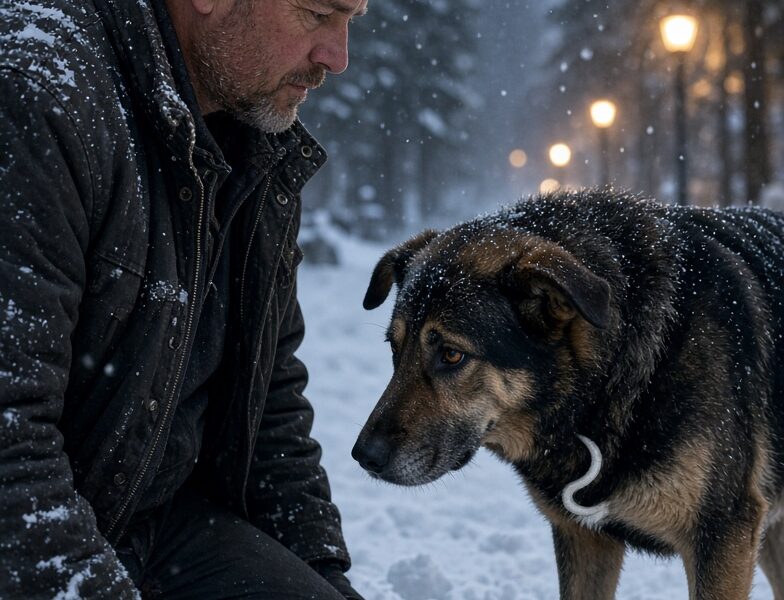
He Came Home to Divorce Papers… Then His Missing German Shepherd Returned Through the Snow With a Secret
Micah Ror came home to divorce papers, but the emptiest thing in the house was the missing place where Hondo used to sleep.
Weeks later, the old German Shepherd returned through Lake Snow, carrying a memory that would lead Micah to a forgotten house full of unfinished mercy.
Lake effect snow crossed Sturgeon Bay in pale sheets that morning, whitening the roofs, the moored boats, and the narrow road above the water.
The cold had a wet bite to it, the kind that came off Lake Michigan and found every weak place in a man’s coat.
Micah Ror drove slowly toward the house he had once called home.
At 44, he was still broad-shouldered and hard to startle, with dark hair cut close, silver at the temples, and eyes that made people lower their voices without knowing why.
He wore a charcoal canvas jacket over a navy thermal shirt, heavy jeans, snow boots, and the scratched dive watch he had carried from the SEAL teams into civilian silence.
He had been away too long.
Contract work, a recovery program, nights he had not admitted were becoming dangerous.
He had told himself coming back would hurt, but hurt could be repaired if a man brought enough tools.
The house stood near the bend above the bay.
White clapboard, narrow porch, green door he had painted during one hopeful May.
Hondo’s bed had always been under the kitchen window where the old German Shepherd could watch the driveway and judge the neighborhood.
Today, the porch was clean, too clean.
A pale rectangle marked the place where the bed had been.
Micah stood over it while his breath turned white.
He called.
The house did not answer.
Inside, the rooms were orderly in the way a life looks after one person has removed herself without wanting to break anything.
The couch remained.
The lighthouse print still hung crooked.
The kitchen clock still ran three minutes slow.
Hondo’s water bowl was gone from the mudroom.
His leash was missing from the peg.
The towel he used after winter walks was not by the stove.
Micah noticed those things before he saw the papers.
Because the body looks for the living before it accepts legal words.
The divorce documents sat on the kitchen table beneath a blue ceramic mug.
His name and Elise’s were printed in black type.
Beside them lay an envelope in her handwriting.
He opened it carefully.
She wrote that she had loved him through deployments, nightmares, hospital rooms, and years of sitting across from a man who answered pain with silence.
She wrote that she had grown lonely inside a marriage that still looked whole from the road.
She wrote, “I do not know how to keep losing you while you are standing in the same room.”
Micah did not sit.
He searched the house instead.
Laundry room, bedroom, basement, back porch.
The closet was half empty.
The bathroom drawer had been divided with painful fairness.
Then he saw the marks on the back door.
Four scratches cut low through the paint, fresh enough that the exposed wood looked pale.
He crouched and touched them with two fingers.
Hondo had been outside.
Hondo had wanted in.
The divorce papers were terrible, but human.
Humans failed with words, pride, fear.
A dog knew doors.
If Hondo scratched here, he believed someone would open.
A shovel scraped beyond the fence.
Across the yard, Dorothy Ames was clearing her walkway with the grimness of a woman who considered winter poor planning.
She was 78, small, wrapped in a plum wool coat, her white hair tucked under a green knit hat.
She saw Micah and froze.
“You’re back,” she said.
“Where is he, Dorothy?”
Her gloved hands tightened on the shovel.
There were fireworks down by the marina, not official, just some people with more noise than judgment.
After midnight, she looked toward the empty porch.
Hondo was howling.
Elise came out.
She tried sitting with him.
I could hear her through the wall.
Then the door opened.
I thought she was letting him into the yard, and he ran.
She looked the next day, drove around, put notices at the market and the clinic.
Then she stopped.
Micah felt the cold climb through his boots.
“She stopped?”
“She was ashamed,” Dorothy said.
“And tired. Those are not excuses. They are just true.”
Micah looked back at the scratches.
He had been called calm in places where calm kept men alive.
Yet in his own home, he had mistaken Elise’s quiet for strength because his own quiet had once been praised as discipline.
He had left her with a frightened dog, a cold house, and all the sounds he had carried back from war.
“I need his things,” he said.
In the pantry, he found the box Elise had packed.
Hondo’s brush, a cracked rubber ball, the old training leash, a metal tag from a collar long outgrown, and at the bottom, a gray towel folded with care.
He lifted it.
Dust, cedar, and the unmistakable warm ghost of Hondo rose from the wool.
Micah pressed it to his face once.
His hands shook, not from cold.
By dusk, he had packed two duffel bags, Hondo’s box, and the lighthouse print.
He left the divorce papers on the table because he was not ready to touch them again.
Vern Holt, who owned the boat repair yard near the canal, had a room behind the workshop and a stove that worked when insulted properly.
Dorothy watched from her porch as Micah loaded the truck.
“You going to look?” she asked.
Micah closed the tailgate.
“I’m going to find him.”
It did not sound like confidence.
It sounded like a vow built from guilt, love, and stubborn scraps.
He drove toward the yard lights by the water, leaving behind the green door and the porch where Hondo’s bed had been.
In the rearview mirror, the old house shrank under falling snow, and the empty corner vanished first.
Morning came gray over the Sturgeon Bay Canal, with gulls crying beyond the boat sheds and snow piled against chain-link fences in hard white ridges.
Vern Holt’s repair yard smelled of diesel, old rope, cold iron, and coffee that had surrendered all gentleness.
Micah awoke before five in the room behind the shop.
His body still believed danger began early.
The place held a cot, a table, a cracked sink, and a narrow stove that ticked as if considering whether to forgive the cold.
Hondo’s box sat beside the door.
The gray towel lay folded near the stove, waiting like a promise nobody had earned.
Micah made coffee, opened his laptop, and chose the clearest photograph.
Hondo by the bay, black and tan coat bright in late sun.
Amber eyes solemn.
The white hook-shaped mark on his chest plain enough for strangers to remember.
He typed slowly.
Missing German Shepherd. Hondo. Male. Seven years old. Black and tan. White hook-shaped mark on chest. Right ear tilts slightly when listening. Friendly but cautious. Please do not chase. Call Micah Ror.
He stared at the page, then added one line.
He is family.
The printer in Vern’s office jammed twice before accepting its mission.
Vern arrived at 6:30, square as a toolbox, with a beard the color of dirty snow and eyebrows permanently disappointed in machinery.
“You break my printer.”
“It was already broken.”
“That is how all relationships start around here.”
Vern studied Hondo’s face, then nodded toward the time clock.
“Put one there. Fishermen lose dogs, find dogs, borrow dogs, and claim dogs adopted them first. Someone will see it.”
Work suited Micah because machines told the truth.
A seized bearing did not insist.
It was only tired.
A cracked belt did not punish you for noticing.
By day, he repaired generators, heaters, and boat engines.
By evening, he carried tape, thumbtacks, and posters into town.
Sturgeon Bay looked almost too gentle in winter.
Shop windows glowing gold.
Snow on the fish market sign.
Men in wool caps discussing ice conditions like national policy.
Micah taped Hondo’s face beside notices for choir practice, used snow tires, church chili, and free firewood for anyone who could defeat the driveway.
The calls came.
A shepherd near a storage lot that turned out to be a husky with no respect for categories.
A dark shape by a barn that became a trash bag on a fence.
A man near Brussels who was certain the dog was black or tan or maybe a coyote.
Micah asked every question anyway.
He learned to keep his face still when people lowered expectations for him.
Pity had a sound softer than cruelty, thinner than help.
On the fifth night, his phone rang beneath the awning of a closed sporting goods store.
Unknown number.
He answered before the second ring.
“Ror, I think I saw your dog,” a young man said.
“Where?”
“Old Quarry Road. Big shepherd. Looked rough.”
“When?”
“Yesterday or maybe Sunday.”
“White mark on his chest?”
“Couldn’t tell. It was dark. Might have been a coyote.”
Micah closed his eyes while snow tapped the metal awning.
The answers shifted when he pressed for details, but he thanked the caller.
Afterward, he folded one ruined poster in half, then in half again, and put it carefully in his pocket instead of throwing it into the street.
The next morning, Vern found him replacing a starter assembly.
“You look like sleep filed a restraining order.”
“Appreciate the poetry.”
“Don’t. It encourages me.”
Vern leaned on the bench.
“False lead maybe.”
Vern grew quiet, which felt like weather changing.
“Lost a setter once. Gone three days. Came back smelling like swamp and victory. My wife cried. I called him a fool. Dog agreed with both of us.”
He scratched his beard.
“Dogs come back from strange places.”
He did not make it a promise.
Micah respected him for that.
That afternoon, Dr. Helen Park called from Bayside Animal Clinic.
Her voice was practical enough to cut rope.
“You’re Hondo’s person.”
The phrase caught Micah off guard.
“Not owner. Person. Yes, your poster needs work. The chest mark matters. People remember shapes. Bring me a better copy.”
Bayside Animal Clinic sat between a bakery and a marine supply shop because Sturgeon Bay believed medicine, sugar, and boat parts belonged within walking distance.
Inside, the air smelled of antiseptic, wet fur, and lavender losing a battle.
Helen came out in a navy fleece over scrubs, dark hair tied back, sharp brown eyes already reading him.
She marked the poster with a pen.
“Add that his ear tilts when he hears bells. He did it every time our desk bell rang. Judged our customer service.”
Micah almost smiled.
“He was usually right.”
Helen studied him, then opened an old file drawer.
“There’s something you should see.”
The record was two winters old.
Patient: Hondo Ror. Wellness check after exposure to cold. Brought in by Earl Branson.
“I don’t know him,” Micah said.
“Older man, Coast Guard jacket, white beard. Found Hondo near Cedar Watch Road during a storm. Warmed him, brought him here, then took him home by the tag. I assumed you knew.”
“No.”
Helen did not apologize.
That would have made it worse.
“Dogs remember safe places. When they’re scared, they don’t always run nowhere. Sometimes they run back to a kindness.”
Cedar Watch Road sat in Micah’s mind like a door he had walked past for years without seeing.
At St. Luke that evening, he smoothed a new poster beneath the glass board.
The church bell shifted in the wind above him.
He pressed the tape flat and whispered, “Come on, boy.”
From the line of pines beyond the churchyard came one rough bark.
Micah went still.
It came again, thin but unmistakable.
Hope did not feel clean.
It felt wounded, breathing, and terribly alive.
Snow fell almost straight outside St. Luke, softening the church steps and turning the street lamps into small yellow moons.
Beyond the road, the pines stood dark and patient, and between their trunks, Micah saw the shape that had ruled every hour of his waking life.
Hondo did not run to him.
That was the first pain.
In dreams, the German Shepherd came charging through the snow, all joy and forgiveness, knocking Micah backward like the world had been repaired by impact.
The real Hondo stood with his head low and ears forward, reading the distance.
Snow crusted his black and tan coat.
The white mark on his chest showed beneath the weather.
He seemed tired, not broken, cautious, not wild.
His amber eyes were Hondo’s eyes, serious and slightly offended by everything.
“Hondo,” Micah said.
The dog held still.
A car passed between them.
Headlights washed over Hondo’s face.
He stepped back once.
Micah made himself kneel in the snow.
His jeans soaked through.
Good.
Let the cold keep him honest.
He did not cross the road.
He did not call in command voice.
He took off one glove and held out his hand, palm down, fingers loose, the old invitation from better nights.
“Easy, boy. It’s me.”
Hondo’s right ear tilted.
The bell in the church tower gave a small metallic note.
Hondo lifted his head, and memory crossed his face faster than fear could stop it.
He stepped from the trees.
Halfway across the road, he paused.
Micah’s hands stayed out.
He did not plead.
The dog came the rest of the way and pressed his nose into Micah’s palm.
Micah bowed his head.
“Hey, old man.”
Hondo inhaled him.
Diesel, paper, coffee, wool, grief.
A tremor moved through the dog’s body.
Then he made a sound low in his throat.
Not bark, not whine.
Something pulled from the deep country where loyalty lived without language.
Micah opened his arms.
Hondo leaned in hard enough to make him sit back in the snow.
Damp fur, cold ears, living weight.
Micah held on.
People had stopped near the church steps.
Nobody came closer.
Maybe they understood that some reunions had to breathe before the world touched them.
Micah called Helen with one shaking hand.
“If this is another trash bag with ears, I am changing my number,” she said.
“I found him.”
Silence.
Then her voice turned brisk, which was how she handled mercy.
“Clinic now. Drive slow. Keep him warm. Do not crowd him.”
Hondo froze at the truck door.
Once he had loved trucks.
Now he stared into the cab as if it might close on him forever.
Micah stepped back.
“No rush.”
He laid the gray towel on the passenger floor.
Hondo smelled it.
Something in his shoulders lowered.
He climbed in slowly, then looked at Micah as if to ask whether he was coming, too.
At Bayside Animal Clinic, Helen waited under the entrance light in a parka over scrubs.
She wasted no tenderness on ceremony.
“Exam room two.”
Hondo stayed close to Micah’s leg.
The clinic, after hours, hummed with fluorescent light and smelled of disinfectant.
Helen let Hondo sniff the room, choose where to stand, and keep Micah’s hand on his shoulder.
“Good boy,” she murmured.
“You made a long trip.”
The exam was slow.
Hondo was tired, a little underweight, with cracked pads from ice and mild irritation where an old collar had rubbed too long during his wandering.
No broken bones.
No sign anyone had hurt him.
Helen said that clearly, and Micah did not realize he had been holding his breath until it left him like pain.
“He’s been surviving,” she said.
“Not trapped, not kept. More like weather and fragments of help. Porch here, shed there. Somebody fed him once. Somebody opened a garage. Enough small mercies to get him back.”
“Small mercies,” Micah repeated.
“Most big miracles are badly disguised small ones.”
Helen handed him paw balm, feeding instructions, and a stare that could stop a ferry.
“Small meals, warm water, short walks, no guilt-driven hikes. Guilt-driven hikes are common in men who think suffering proves sincerity.”
Hondo sneezed on her shoe.
Helen looked down.
“Medical criticism noted.”
Back at Vern’s room, Micah laid blankets near the stove.
Hondo inspected the room, door, window, stove, cot, the box of his old things.
Only when Micah sat on the floor did Hondo lower himself beside him.
He did it carefully, and Micah looked away to give him dignity.
That night, Micah slept in a chair with one hand hanging low enough for Hondo to smell.
Every time Hondo woke, Micah whispered, “Still here.”
By the tenth day, routines held the room together.
Small meals, warm water, paw balm, short walks under the yard lights.
Vern brought dog food and claimed it was a supplier error.
Dorothy brought a knitted blanket and said it was ugly but warm, like her late husband during football season.
Hondo accepted it with solemn judgment.
Then the signs began.
A noon bell from St. Luke made Hondo lift his head and stare west.
A tugboat horn made him stand too fast.
The third sign came with smoke.
Micah was stacking split wood when wind brought the sharp scent of wet cedar and old ash from inland.
Hondo rose, walked to the edge of the yard, and faced west.
“Hondo,” Micah said.
The dog looked back, then fetched his leash from the hook.
Helen had ordered short walks.
Micah obeyed mostly.
They started down the lane under a hard blue sky.
At the first turn, Micah tried guiding him back.
Hondo stopped and faced west again, toward Cedar Watch Road.
The leash tightened.
Micah could have forced him back.
The old Micah might have called that care.
Keep what returned close.
Control the danger.
Lock the door.
But Hondo had come home carrying something Micah did not own.
A memory, a debt, a direction.
Slowly, Micah loosened his grip.
“All right.”
Hondo turned toward the old road.
For the first time in their life together, Micah followed.
The sky over Door County had cleared into a hard winter blue, bright enough to make every drift shine like ground glass.
Cedar Watch Road curved away from the plowed county route and climbed through white pines, old maples, and fields where fence posts wore caps of snow.
Hondo walked ahead with the leash loose between him and Micah.
He did not hurry.
The urgency from the repair yard had become something quieter, almost ceremonial.
Every few minutes he stopped to test the air, then continued.
One ear tilted toward sounds Micah could not hear.
At the top of a low rise, the trees opened.
Cedar Watch House stood at the end of a rutted drive.
Two stories of weathered gray timber with a porch sagging on the left and old glass in the windows.
From the road, it looked abandoned.
Closer, it did not.
A narrow path had been shoveled.
Split wood sat under a tarp.
Fresh bootprints crossed the porch.
Hondo stopped at the bottom step.
He put one paw on the porch, then looked at Micah, not asking permission.
Inviting witness.
The front door opened with a push.
Cold air breathed out, carrying dust, cedar, old coffee, and faintly dog food.
Hondo entered first.
Inside, the front room spread beneath dark beams.
Six mismatched chairs formed a circle around a braided rug.
A fireplace faced them, blackened by years of use.
On the table sat chipped mugs, a tin of tea, a jar of instant coffee hardened at the bottom, a deck of cards, and two cans of dog food.
Beside them lay a cloth-covered notebook.
Micah stood just inside the door, unwilling to disturb anything.
Hondo crossed to the fireplace and lowered his nose to the hearth.
His breathing changed, slower, deeper, the way it sounded only when sleep had stopped feeling like a trick.
On the mantel were photographs.
Older men with reluctant smiles.
Women in winter coats holding paper plates.
Dogs seated at boots and chairs.
One picture showed Hondo on the porch, healthier then, proud and alert, wearing a red scarf so absurdly noble that Micah almost laughed and almost broke.
He opened the notebook.
The handwriting changed across the pages, but the entries were plain.
Clyde and Daisy came in before the wind shifted. Sent him with soup and batteries.
Elaine brought bread, would not take gas money.
Hondo waited by south window until lake wind eased. Gave him red scarf. Returned him at dusk.
Micah read Hondo’s name three times.
The words did not accuse him.
That made them worse.
They simply existed.
While he had been away or present but locked inside himself, Hondo had found warmth Micah had not known how to give.
The back door clicked.
Hondo turned first.
Micah closed the notebook and shifted so the table stood between him and the hall.
An older woman appeared in the kitchen doorway carrying kindling.
She was slight, early sixties, in a dark green coat, silver hair cut close, round glasses on a chain.
Then she saw Hondo.
“Oh,” she whispered.
“Well, look who finally decided to stop worrying everybody.”
Hondo walked to her with solemn courtesy.
She knelt, letting him come, and he pressed his nose into her coat.
She closed her eyes for one second, then opened them before grief could make a scene.
“You know him,” Micah said.
“I know one of his chapters.”
She scratched behind Hondo’s ear.
“This edition has collected weather and opinions. You’re Marian Lutz, and you’re Micah Ror.”
She offered a cool, steady hand.
“I work at the library three days a week and trespass for mercy the other four.”
He blinked.
“People often need a moment with that sentence.”
Marian set down the wood.
“This was Earl Branson’s house. Now it belongs to tax notices, insurance letters, and a cousin’s son who would rather have a clean balance sheet than a haunted building.”
“I don’t want to intrude.”
“You already did. So did most people who needed this place. That was rather the point.”
She moved through the kitchen as someone who knew every shelf.
Matches in a blue mug, water jug by the sink, dog biscuits in a metal can.
Not a thief.
A caretaker.
When she returned with tea, Micah asked what Cedar Watch had been.
“Never official,” Marian said.
“Earl disliked official things. Forms made him itchy. But he knew winter. Veterans who could get through July and vanish by January. Widows who fed their dogs better than themselves. Men living in trucks. He opened the house on bad weather days. Coffee, soup, dry socks, dog food. No speeches before the second cup.”
“Why didn’t anyone tell me?”
Her eyes were gentle, which was worse than accusation.
“Were you asking?”
The room went still.
Hondo sighed on the rug.
Micah looked at his hands.
He had been so fluent in his own pain that it had become a country with closed borders.
Marian did not press.
She handed him the photograph of Earl Branson in a battered Coast Guard jacket, one hand on Hondo’s back.
“Earl said a dog with that much dignity deserved one foolish article of clothing.”
Hondo lifted his head as if insulted.
Micah held the picture.
He had thought love meant Hondo returning to him.
Here was proof that love had also been another man’s fire, another woman’s keys, another room where no one demanded explanations before mercy.
Hondo rose and went to the south-facing window.
On the sill, shallow names had been pressed into the wood.
Clyde and Daisy, Elaine, Roy, Marion, Hondo, Earl B.
Micah ran his thumb over Hondo’s name.
“What happens to the house?” he asked.
Marian was quiet.
“It’s being sold. Earl died fourteen months ago. The property passed to Glenn Norris. His wife is ill. Taxes are overdue. Insurance is unpleasant. A marina group made an offer. He is not a villain. If that would make your day easier.”
“It would.”
“Trouble rarely offers that courtesy.”
Hondo leaned against Micah’s leg.
Micah looked around at the chairs, the notebook, the mugs, the names.
A house could die while still standing.
Not from fire or storm, but from paperwork, neglect, and everyone assuming someone else would remember.
“Give me Glenn’s number,” Micah said.
Marian’s face barely changed, but her eyes did.
Hope, Micah thought, was careful when it had been disappointed often.
Snow began before noon in Sturgeon Bay.
Fine white dust drifting across the hospital parking lots and the bare maples near the apartment buildings.
By late afternoon, the beige walls and identical doors looked softened by it, as if weather were trying to make temporary places gentler.
Micah sat in his truck longer than necessary.
Hondo was not with him.
The dog slept beside Vern’s stove under strict orders from Helen and the stricter supervision of Vern, who had declared himself assistant medical director despite having no qualifications except volume.
Micah had wanted to bring Hondo because some hurt part of him wanted Elise to see what had survived.
But Hondo was not evidence.
He was not punishment.
He was tired, healing, and allowed to choose the speed of forgiveness better than any human in the story.
Micah climbed the stairs and knocked.
Elise opened the door in slate blue scrubs under a gray cardigan, her brown hair tied low and badly.
She looked thinner than memory.
Or maybe Micah was finally looking without assuming she would always remain where he left her.
“Micah.”
“I’m not here to fight.”
Her mouth tried for a smile and failed.
“That usually means someone came to fight quietly.”
Then her eyes moved past him.
“Is he with you?”
“No, he’s resting.”
“He’s alive.”
“Yes.”
Elise stepped back, one hand going to the wall.
The relief on her face was not a performance or a request for forgiveness.
It was the look of someone struck by news she had prayed for and feared.
Micah entered only after she moved aside.
The apartment was clean, controlled, and bare.
A folded blanket on the couch.
Medical journals beside cold tea.
No photographs that hurt him more than he expected.
“How is he?” she asked.
“Tired, mild paw irritation, thin, but not badly. Helen says no sign anyone hurt him. He moved through weather and pieces of help.”
Elise closed her eyes at the word help.
“I found Cedar Watch House,” he said.
Her eyes opened.
No surprise.
There it was.
Micah felt anger rise, ready and too simple.
He kept his hands open.
“You knew.”
“I knew Earl Branson brought him back once, maybe twice.”
“Why didn’t you tell me?”
She looked toward the window where snow traced the glass.
“Because I was ashamed.”
“That’s not an answer.”
“It’s the only true one I have.”
The room crowded with old things, missed calls, shuttered mornings, Micah standing in kitchens as if silence were self-control.
He leaned against the counter because sitting felt like permission.
“Earl came one winter,” Elise said.
“You were gone. Contract work, I think, or treatment. Hondo had run during a storm. Earl found him near Cedar Watch Road, took him to Helen, then brought him home with that red scarf. He joked that Hondo had a social calendar.”
Her mouth trembled.
“I did not laugh. And the second time, Earl said, ‘This old boy knows where the soup is.’ Then he left before I could fall apart in front of him.”
Micah heard Marian’s question again.
Were you asking?
“I thought if I told you,” Elise said, “you would hear only failure. Not that Hondo found a safe porch, not that someone helped, just that I failed to keep him safe.”
Micah remembered his face from those years, the locked jaw, the clipped answers, the way disappointment entered the room before words did.
He had never raised a hand to Elise.
He had thought that made him harmless.
There were other ways to make a house hard to breathe in.
“The night he ran,” Micah said, “Dorothy told me about the fireworks.”
Elise sat on the edge of a chair.
“I had worked a double. A man died before dawn. His wife kept asking if he suffered. I came home and Hondo was pacing. Then the explosion started by the marina. He howled. I tried your commands. I tried food. I sat with him. I called you twice.”
He remembered the missed calls.
A motel outside Madison, a group session he hated.
He had told himself he would call in the morning.
Morning became another excuse.
“I didn’t call back.”
“No.”
No accusation.
Worse.
“The house felt full of something I could not get out. He scratched the door until I thought he would panic. I opened it because he had run the yard before and come back. He didn’t. I looked the next day. I did. I drove. Called Helen. Taped notices.”
Her voice broke, then steadied.
“Then I stopped. That is the part I hate. I can understand the tired woman who opened the door. I cannot forgive the woman who stopped looking.”
Micah had come carrying blame like a stone.
It was still there, but a crack had opened through it and let in air.
Air hurt.
“I wanted it to be all your fault,” he said.
Elise nodded.
“Some of it is. Yes.”
He looked at the bare wall.
“Some of it is mine.”
For a while, neither spoke.
It was not forgiveness.
It was two adults standing in the wreckage and choosing not to lie about who had broken what.
Elise wiped her cheek.
“Can I see him sometime?”
The cruel answer waited.
No, you lost the right.
Micah did not speak it.
Hondo had survived because other people opened doors when they could have judged.
“Not yet,” he said.
Elise nodded.
“When he’s ready,” Micah added.
Her eyes lifted.
It was not much.
It was not nothing.
As he reached the door, she said, “I kept his bowl. I couldn’t throw it away.”
“Bring it to Cedar Watch,” Micah said before he could plan the sentence.
“Not for me. For him. When he’s ready.”
Outside, his phone buzzed.
Marian had sent one line.
Glenn Norris is coming Friday. Bring facts, not thunder.
Micah looked at the falling snow and understood Hondo had led him to more than a safe house.
The house was asking whether he knew how to protect something without trying to own it.
Friday morning broke windy and raw over Cedar Watch Road, with loose snow sliding across the drive and the bay hidden behind white air.
The house looked older in that weather, not weaker exactly, but aware of its own bones.
Micah arrived early because he had slept badly and because work was easier than thinking.
Hondo came with him, secured in the truck, wearing the red scarf Marian had given him the day before.
He had sniffed it, sneezed as if offended by sentiment, and refused to let Micah remove it.
A dog could have dignity and ridiculous clothing at once.
Many humans failed at both.
Micah began with the porch railing.
One section wobbled hard enough to become a lawsuit with splinters.
He replaced rotten boards, reset the bracket, and sanded the sharp edges smooth.
Hondo lay near the front door where he could see the driveway, Micah, and any agency responsible for scarf complaints.
Marian came with library file boxes and coffee.
“You look like a man avoiding an emotion with carpentry.”
“It’s a sound strategy.”
“A popular one.”
Vern arrived in his old service van carrying a heater motor, wire, and donuts.
“I brought breakfast and threats for the furnace.”
“Treats work?”
“Only if specific.”
Helen Park came after lunch with donated dog food, clean towels, pet forms, and the expression of a woman already tired of future questions.
She checked Hondo’s paws first.
“Better. Short walk still means short, Mr. Ror.”
“I know.”
“Men say that the way dogs look when stealing socks.”
Hondo placed a paw over Micah’s glove.
Helen nodded.
“See, he supports diagnosis.”
By midafternoon, Deputy Neil Carter pulled in.
He wore a brown winter jacket over his uniform, shoulders broad, hair clipped close, face practical enough to make nonsense feel unwelcome.
He stood in the doorway and looked at the tools, coffee, extension cords, mismatched chairs, and Hondo’s red scarf.
“I am trying very hard not to say several discouraging things,” Neil said.
“Appreciate the effort.”
“You cannot open an old house to the public because it has feelings.”
From the furnace room, Vern called, “It also has furnace problems. Show respect.”
Neil ignored him with professional skill.
“If someone slips, if wiring fails, if a storm traps people here, good intentions will not keep anyone out of court.”
Micah felt irritation rise.
Then Hondo stood and walked to Neil.
The dog stopped a few feet away, scarf frayed, amber eyes steady.
Neil looked down.
Something in his face shifted.
“This Hondo. That’s him.”
Neil crouched slowly and offered the back of his hand.
Hondo sniffed, considered, and allowed one careful touch between the ears.
Neil exhaled.
“Well, that complicates my ability to be purely unpleasant.”
For the next hour, he walked the house with Micah and made a list.
Fire extinguisher, exit signs, cleared walkway, smoke alarms, carbon monoxide detector, occupancy limit, volunteer sign-in, no sleeping overnight without proper approval, no extension cords under rugs, no open flame unattended, no using charm as insurance.
Micah listened with his jaw tight at first, then with care.
Neil was not blocking the road.
He was marking the thin ice.
Marian opened Earl’s notebook on the front table.
Neil glanced at it, then stopped.
“May I?”
He read near the fireplace.
His expression changed.
“Ray Carter, your uncle?” Marian asked.
Neil touched the page.
“My mother’s brother. We thought he spent his last winters alone.”
“Earl did not ask him to perform gratitude,” Marian said.
“That helped.”
Neil closed the notebook gently.
“I can help with temporary community use requirements. No promises beyond that.”
“That’s enough.”
“It will not feel like enough.”
“I’m learning.”
People began arriving after that, though none admitted to being summoned.
Elaine Corbin came from St. Luke with bread, soup containers, clean mugs, and the firm belief that labels were a spiritual discipline.
She was 61, silver-haired, round-faced, wearing a red coat, and carrying more practical mercy than seemed physically possible.
“I made too much chicken soup,” she said.
Marian lifted an eyebrow.
“For whom?”
“For the amount of sadness in this county.”
No one argued.
Clyde Farmer drove up near sunset in an RV that coughed like it regretted its youth.
His dog Daisy, gray-muzzled and dignified, stepped down first.
Clyde was 69, tall but thin under his layers, with a navy cap pulled low and hands that trembled when he thought no one watched.
“I came to see if the seal knows which end of a broom to salute,” he said.
Micah held up the broom.
“This end negotiates.”
Clyde laughed, then coughed too long.
Daisy approached Hondo.
The two dogs sniffed with the formality of diplomats, then settled near the stove as if resuming an old meeting.
Clyde saw them and stopped talking.
“Earl let us pretend we were visiting him,” he said at last.
“Truth was, most of us came because it was warm and nobody asked why our hands shook.”
The room went quiet.
Listening quiet.
That evening, after the others left, Micah and Marian sorted records.
Hondo slept with Daisy’s borrowed blanket under his chin.
Micah found receipts for propane, dog food, soup, batteries.
One unsigned note read, “You never made me say I was lonely. Thank you for knowing anyway.”
Marian watched him.
“Glenn will say no if all we bring is sorrow.”
“Then we bring structure, money, volunteers, proof, and people brave enough to admit they were helped,” Micah said.
Marian looked at Earl’s notebook, then at Hondo’s sleeping form.
His phone buzzed.
Glenn Norris: I will be there at 2 tomorrow. I have one hour.
Micah showed Marian.
She began stacking papers.
“One hour is long enough for truth if nobody decorates it.”
Outside, wind pressed against the house.
The old place creaked but held.
Saturday afternoon arrived under a low pewter sky, with wet snow sliding from the eaves and dropping in soft thuds along the porch.
Cedar Watch House smelled of coffee, wood smoke, dog blankets, and the lemon cleaner Elaine had applied to everything that failed to escape.
Glenn Norris parked exactly where the drive had been cleared.
That detail bothered Micah.
He had expected carelessness, something useful to dislike.
Glenn stepped from a dark SUV wearing a charcoal parka, brown trousers, polished winter shoes, and a gray scarf tucked with accountant precision.
He was 65, thick through the middle, steel-gray hair combed flat, face tired rather than cruel.
He carried a worn leather document case.
“Mr. Ror.”
“Micah.”
Glenn nodded as if first names were acceptable but not binding.
He looked at the house.
“My wife told me to listen before deciding. Sounds like good advice. Pamela gives expensive advice for free.”
Inside, Marian offered coffee.
Glenn declined.
Elaine placed a mug in his hand as if refusal were a medical condition.
He accepted it and looked surprised.
They showed him the house without drama.
Micah pointed out the repaired railing, working furnace, smoke alarms, and Neil’s temporary use checklist.
Vern demonstrated the furnace with the pride of a man who had defeated a personal enemy.
Helen explained the pet support corner: donated food, warm blankets, referral information, scheduled wellness guidance, no claim of being a clinic.
Neil reviewed the key words Glenn needed: limited hours, no overnight stays, capacity limits, insurance, monthly inspections.
Marian spoke last about Earl.
She did not make him a saint.
She described him as stubborn, allergic to paperwork, faithful in bad weather, and convinced that a locked door during a storm was a moral failure if a person had soup inside.
Glenn listened.
Listening was not surrender.
Hondo lay by the south window wearing the red scarf.
Now and then Glenn’s gaze drifted to him as if the dog made human arguments look overcomplicated.
When Marian finished, Glenn set the mug down.
“My cousin should have put something in writing.”
Marian’s mouth tightened.
“Earl believed a handshake had bones.”
“Banks disagree.”
Glenn’s voice was not sharp, but it landed hard.
“I am not insulting him. I am stating the problem. Taxes are overdue. Insurance is difficult. The roof needs more than a patch. The marina group made a real offer. I have a wife in treatment and bills that do not care about photographs.”
The room stiffened.
Micah felt anger rise, hot and useful and too simple.
Then Glenn’s phone lit on the table.
Pamela — hospital.
He turned it face down quickly, but Micah saw.
There it was.
A man did not have to be greedy to stand in the way.
Sometimes he was afraid and doing math.
“What would pay them?” Micah asked.
Glenn looked at him.
“A sale. Other than that, silence.”
Helen leaned forward.
“A temporary lease could cover taxes while we form a nonprofit partnership. Small use fee. Donations. Clear limits.”
Neil added, “If they meet safety conditions, I can help guide a six-month community use proposal.”
Elaine said, “St. Luke can host a fundraiser. People will bake when government trembles.”
Vern grunted.
“I’ll keep the furnace from committing treason.”
“That’s not an official category,” Neil said.
“It is in my business.”
Clyde cleared his throat.
“I can build a proper ramp. Daisy will supervise and complain.”
No one laughed loudly.
The moment was too fragile.
Hondo rose, crossed to Micah, and leaned against his leg.
Glenn watched him.
“Is that yours?” he asked.
Micah looked down at Hondo.
Then around the room: Marian’s boxes, Elaine’s labels, Neil’s checklist, Vern’s tools, Clyde twisting his navy cap.
“He brought me here.”
Glenn did not know what to do with that.
So he looked at the document case.
“You understand I cannot carry this alone because people feel something here.”
“You shouldn’t have to,” Micah said.
That answer seemed to surprise him.
Marian opened Earl’s notebook.
“We are not asking you to pretend money is vulgar. Money is heat, medicine, gas, insurance. Earl knew that. He simply believed money should serve life, not erase it.”
Glenn read the open page.
Clyde and Daisy, Ray Carter, Hondo, Elaine brought bread. Mary, call before freeze.
His phone buzzed again.
He stepped into the hall.
The rest of them pretended not to listen, which meant they heard almost everything.
“Yes, Pam. I’m here. I am listening.”
A pause.
“That is not fair.”
Another pause, then a tired laugh.
“Yes. Efficient haunting. I heard you.”
When he returned, his face looked older, but less sealed.
“My wife says if I sell without hearing you all the way through, she will haunt me while still alive.”
“She sounds organized,” Elaine said.
“She is terrifying.”
This time the smile worked.
“I will attend a community hearing next Saturday. If you present a real plan, not a shrine, a plan, we will.”
“We will,” Micah said.
“I am not promising approval.”
“Understood.”
After Glenn left, the house erupted.
Marian made a call list.
Helen drafted pet support rules.
Neil corrected inspection language.
Elaine phoned St. Luke.
Clyde measured the ramp.
Vern accused the furnace of listening better than most committees.
Later, Micah sat on the floor because papers covered every chair.
Hondo wore the scarf sideways and rested his head against Micah’s chest.
“I thought this was about bringing you home,” Micah said.
His phone buzzed.
Elise: I found something Earl left. It may help. Can I bring it before the hearing?
Micah read it twice.
Hondo opened one eye.
He typed, Yes. Friday afternoon.
Outside, snow kept falling.
Inside, Micah understood the perimeter had widened again.
It now included an old house, a tired woman who was no longer his wife, a man with hospital bills, and every name Earl had written so nobody would vanish politely into winter.
The week before the hearing came in snow, thaw, and hard refreeze, turning Cedar Watch Road into a lesson in humility for every vehicle except Vern’s van.
The house answered each change with creaks, groans, and sharp pops that made Micah look up before remembering old timber had its own language.
Work filled the days until emotion had to wait its turn.
Vern and Micah sealed window drafts and replaced two cracked panes.
Neil returned with exit signs, fresh batteries, and the expression of a man who had wrestled optimism into compliance.
Helen brought clipboards for the pet support station, intake forms, consent sheets, vaccination guidance, and a sign that read Ask Before Petting.
Elaine arrived with St. Luke volunteers and a donation bin large enough to embarrass anyone who called her excessive.
Marian sat at the front table with Earl’s notebooks spread around her.
She built the proposal with a librarian’s reverence and a prosecutor’s caution.
No grand claims, no sentimental arithmetic.
Dates, names, weather records, supply receipts, proposed hours, volunteer roles, emergency contacts.
Micah watched her turn memory into a structure sturdy enough to stand in public.
Clyde came each morning in the RV with Daisy riding shotgun.
He built the new ramp, measured the angle twice, and complained about Vern’s screws until Vern replaced them out of irritation.
Daisy slept beside Hondo by the stove.
Hondo tolerated this with the solemn resignation of a host whose guest had taken the best rug.
On Wednesday, Micah went to St. Luke and found Elaine in the fellowship hall surrounded by soup containers, blankets, and three women debating whether muffins counted as breakfast or moral support.
“Both,” Elaine said.
“Next crisis, Reverend Paul offered the fundraiser and a support letter. Earl fixed our boiler twice. The second time he called it a spiritual emergency because the choir was singing in coats.”
“Schurr needed humbling,” Elaine said.
Micah smiled before he could stop himself.
The room did not become less serious because people laughed.
It became more survivable.
Friday afternoon brought Elise.
She came alone wearing a navy coat over scrubs, face pale from work and courage.
Micah saw her step from the car and felt Hondo change beside him.
The dog did not bark.
He stood, ears forward, body still.
Micah touched his collar lightly but did not hold him.
Elise stopped at the bottom step carrying a small cardboard box.
“Hi, old man,” she whispered.
Hondo remained on the porch.
Elise did not climb the steps or reach for him.
She let him decide.
After a long moment, Hondo walked down two steps, stopped three feet away, and lowered his nose.
Elise held out her hand, palm down, trembling.
He sniffed, touched his nose briefly to her fingers, then stepped back to Micah’s side.
Elise closed her eyes.
“That’s more than I deserved.”
Micah did not answer.
Hondo had answered enough for one afternoon.
Inside, Elise set the box on the table.
Marian, Helen, Neil, Vern, Elaine, and Clyde watched with the careful stillness people use when apology enters the room in work clothes.
Elise opened the box.
“Earl brought these after the second time he found Hondo. I put them away because I could not stand looking at them. That was wrong.”
She removed a photograph of Hondo wearing the red scarf on Cedar Watch’s porch, a Bayside Animal Clinic receipt paid by Earl Branson, and Earl’s handwritten note.
Marian read it aloud after Elise nodded.
Elise — Hondo found the road because fear had nowhere else to go. That is not a crime. But next time call someone before shame locks the door. Storms get worse when people face them alone. — Earl.
Nobody spoke for a while.
Elise looked at the table, not at Micah.
“This house helped Hondo when Micah and I could not. That does not make my mistake smaller. It makes the house real.”
Marian placed the note beside the proposal.
“Thank you.”
“I can testify if you want,” Elise said.
Micah looked at her.
In the old life, he might have heard guilt trying to buy release.
Today, he heard a tired woman choosing not to hide.
“Only if you want.”
“I don’t.”
She gave a small, painful smile.
“Which probably means I should.”
That evening, final preparations filled the house.
Neil rehearsed safety points.
Helen trimmed her explanation because Vern said anything longer than five minutes made civilians imagine fees.
Elaine packed letters into labeled folders.
Marian polished Earl’s notebook cover.
Clyde practiced two sentences, forgot one, invented three more, and was told by Daisy’s stare to keep it simple.
Near dusk, Micah went onto the porch.
The sky had cleared into cold blue.
Hondo followed and sat at his left side, scarf bright against the dimming world.
“I spent years thinking if I controlled everything, nothing important would get lost,” Micah said.
“Then I lost you anyway.”
Hondo leaned lightly against him.
Not enough to solve anything.
Enough to stay.
Marian came out with two mugs of coffee.
“You should sleep. Probably.”
“That was grammar, not agreement.”
She handed him a mug.
“Are you ready for the hearing? For people to see that this matters to you?”
Micah watched Hondo’s breath turn white.
For years, he had survived by making need invisible.
But the people in Earl’s notebook had been hurt by the opposite.
No one seeing need until winter had almost finished its work.
“No,” he said.
Marian nodded.
“Good. Ready people are sometimes dangerous.”
His phone buzzed.
Glenn Norris: Pamela wants me to tell you she expects the dog to attend.
Micah showed Hondo.
“Public demand.”
Hondo sneezed.
“Reluctant agreement,” Micah said.
Behind them, Cedar Watch House glowed.
For once, the light in the window did not look like something he was approaching too late.
It looked like something still waiting.
Saturday morning came pale over Sturgeon Bay, with snow drifting against the tall windows of the town hall.
The room did not look like a place where mercy expected to win.
Metal chairs, humming lights, a clock with bureaucratic confidence, coffee in the back that tasted as if someone had waved beans over hot water and trusted memory to help.
People came anyway.
They arrived with folders, photographs, vet receipts, safety forms, church letters, small checks, large doubts, and dogs resting under chairs.
Hondo lay beside Micah in the front row, the red scarf loose around his neck.
Daisy slept near Clyde’s boots.
Neil stood along the sidewall in uniform, officially neutral and visibly not.
Helen held a folder thick enough to discourage interruption.
Marian held Earl’s notebook with both hands.
Elaine had brought a covered basket despite being told food was unnecessary, which proved Town Hall had not met Elaine.
Glenn Norris sat near the front with his document case on his lap.
He looked tired, carefully dressed, and alone in the particular way of people carrying medical bills in public.
Twice his phone lit up.
Twice he checked it and set it face down.
Micah saw Pamela’s name once and looked away.
It was easier to fight a man before you knew who waited for him at home.
The council chair, Judith Lane, explained the question: whether Cedar Watch House could receive a six-month temporary community use arrangement while a formal nonprofit partnership, lease, or purchase fund was explored.
No overnight shelter, no clinic designation, no permanent approval.
That morning, Vern leaned toward Micah.
“She makes hope sound like a plumbing permit.”
“Sometimes permits prevent floods.”
Vern considered this.
“Don’t mature at me.”
Glenn spoke first.
He did not attack anyone.
That made it harder.
He explained the inheritance, taxes, insurance, repair burden, marina offer, and Pamela’s treatment.
He used exact numbers.
Exact numbers have a cold dignity.
They refused to be shamed by tears.
“I am not trying to erase history,” Glenn said.
“I am trying not to drown in obligations attached to a house I did not ask to inherit. Meaning does not repair wiring. Sentiment does not pay premiums. If someone gets hurt there, memories will not protect them.”
No one had an easy answer.
Sometimes truth arrived in the mouth of the person standing in your way.
Marian rose next.
She did not plead or turn Earl into a statue.
She opened the notebook and read entries: dates, names, weather warnings, soup delivered before the harbor froze, calls made to people who had not answered, dog food left on porches without a note.
Ray Carter came in during deep freeze. Said he was only checking the roads for coffee.
Hondo waited by south window until lake wind eased. Returned home at dusk.
Earl’s handwriting made the room smaller and warmer.
Marian looked at the council.
“Earl Branson did not create a program. He kept a door unlocked in winter. That sounds small until you meet the people who had nowhere else to knock.”
Helen spoke after her and did what Helen did best.
Turned tenderness into procedure.
She explained the pet support station for older veterans, isolated residents, and people who sometimes had to choose between their groceries and their dog’s food.
Cedar Watch would offer donated food, blankets, referral information, basic wellness guidance, and signed consent forms.
It would not pretend to be a clinic.
“Compassion without structure burns out,” Helen said.
“Structure without compassion becomes a waiting room. We are trying for something better than both.”
“Annoyingly good,” Vern muttered.
Elaine whispered, “Try learning from it.”
Neil confirmed the safety checklist: exits, capacity limits, walkway maintenance, alarms, extinguishers, no overnight stays, monthly review, volunteer logs.
His voice stayed official until the final page.
Then he paused.
“My uncle Ray’s name is in Earl’s notebook,” he said.
“My family thought he spent his last winters alone because he refused every invitation we gave him. Turns out he accepted one from a man who did not call it help. I cannot ignore what that means simply because the paperwork came late.”
The room shifted.
Glenn looked down.
Clyde was next, surprised when called, as if civic process might forget him.
He shuffled to the microphone while Daisy watched from the aisle.
“Name’s Clyde Farmer. United States Navy. Once upon a time, nobody calls me Mr. Farmer unless I owe them money or broke something expensive.”
A small laugh moved through the room.
“Earl Branson fixed my RV heater during the cold snap of 2018 with a screwdriver, a soup ladle, and language unfit for this noble institution.”
The laugh grew, then faded as Clyde looked at his hands.
“That heater kept me and Daisy alive. I don’t mean spiritually. I mean alive. I had parked behind the closed bait shop because I didn’t want anybody seeing how bad things had gotten. Earl saw anyway. Didn’t make me pray out loud. Just said, ‘Clyde, you planning to freeze dramatic or come drink coffee?'”
The room became still.
“Most of us get real artistic about pretending we’re fine,” Clyde said.
“Earl let us pretend a little. Then he helped anyway.”
His voice broke.
He coughed and wiped his face so quickly mercy could call it irritation.
Daisy rose and pressed against his knee.
Then Judith called Micah’s name.
He stood under his coat.
Dog hair clung to one sleeve.
He had noticed it before leaving Cedar Watch and left it there.
Hondo rose with him.
Micah touched the dog’s head once and walked to the microphone.
Faces waited, hopeful, doubtful, tired.
People who wanted a good ending but not a blank check.
People who had loved someone difficult.
People who had been difficult.
“When I came back to Sturgeon Bay,” he said, hands on the podium, “I thought I had lost my wife and my dog.”
His voice sounded rough but held.
“I was right. I was also wrong.”
The room waited.
Outside the town hall, snow moved across Sturgeon Bay in loose white threads, brushing the sidewalks and gathering along the courthouse steps.
Inside, the room was quiet enough for Micah to hear Hondo’s tag click once when the dog shifted beside the front row.
“I thought Hondo belonged to me because I loved him,” Micah said.
“Then I learned he had been saved by people I never knew to thank. Earl Branson. Marian Lutz. Some of you here. Some who are gone. People who opened a door, left soup, fixed a heater, or sat in a chair long enough for somebody else not to be alone.”
His hands tightened on the podium.
He made them loosen.
“I am not asking anyone to pretend bills do not exist. They do. I am not asking Mr. Norris to carry a burden that should have belonged to a community long before today.”
Glenn looked up.
“I am asking for six months. Not a miracle. Not a monument. Six months to prove that a warm room, a safe place for a dog to lie down, a pot of coffee, and a list of names can be part of how a town survives winter.”
He paused because his throat had stopped cooperating.
“I spent a long time believing strength meant not needing a door open for me. Hondo knew better. He found one. I am here because my dog had the wisdom to go where people were still kind.”
No applause came.
Something else moved through the room, quieter and heavier.
Micah stepped back.
Hondo met him before he reached his chair, pressing his shoulder against Micah’s leg.
Judith thanked him and asked if additional evidence remained.
The back door opened before anyone answered.
Elise entered carrying the cardboard box.
She did not make a scene or look around for sympathy.
She wore her navy coat over scrubs, cheeks pale from work and courage.
Hondo lifted his head.
Elise stopped in the aisle until Micah gave the smallest nod.
Not permission over her.
Permission over the dog beside him.
Hondo remained standing, watchful, but calm.
Elise walked to the microphone.
“My name is Elise Ror,” she said.
“I was Micah’s wife. I was Hondo’s person, too, though I did not always deserve that word.”
Micah looked down.
Hondo did not move.
Elise placed three items on the table: the photograph of Hondo in Earl’s red scarf, the clinic receipt paid by Earl, and Earl’s note.
She told the room about the fireworks, Micah’s missed calls, her exhaustion, the door opening, the search she began, and the search she stopped.
She did not defend herself.
She did not turn guilt into a performance.
“This house helped Hondo when Micah and I could not,” she said.
“That does not make our mistakes smaller. It makes the house real. I thought I was the only person failing in that house. I wasn’t. I just did not know there was somewhere people went when failing became too heavy.”
Judith called a recess.
People stood, stretched, murmured, made too much noise with paper cups.
Glenn stepped into the hallway to answer Pamela’s call.
Through the glass panel, Micah saw him listen with his head bowed.
When Glenn returned, his face looked drawn, but not shattered.
Micah approached him near the back wall.
“You don’t have to be the villain in this.”
Glenn gave a tired laugh.
“Is that supposed to comfort me?”
“No. Just seemed worth saying.”
Glenn looked toward the front, where Marian and Helen reviewed forms, Elaine tried to make the council chair accept a muffin, and Vern and Neil argued quietly over inspection language.
Hondo stood beside Elise.
She lowered her hand.
Hondo sniffed it, then sat.
He did not lean into her.
He did not turn away.
Elise closed her eyes as if that small neutral mercy had weight.
“Pamela said this morning that if I sell without trying, I may solve one problem and become a smaller man.”
“She sounds direct.”
“She once told a surgeon his bedside manner needed continuing education.”
Glenn’s mouth lifted.
“She is direct.”
When the council returned, the decision was not a victory carved in marble.
It was smaller, fragile, and believable.
Six months.
Temporary community use.
Limited weekend hours.
No overnight stays.
Proof of insurance within 30 days.
Monthly safety review.
Volunteer logs.
Glenn would retain ownership while accepting a low-cost lease paid through donations and a tax relief fund.
At the end of six months, Cedar Watch could apply for extension, partnership, or purchase talks.
The room applauded anyway, not because everything was solved, but because the door had not closed.
Glenn shook Marian’s hand, then Micah’s.
“Do not make me regret this.”
“We won’t.”
“You might.”
“Then we will fix what we break.”
Glenn studied him.
“That is a more useful promise.”
Three weeks passed like a long exhale that forgot to be restful.
Cedar Watch became workshop, pantry, office, argument, prayer list, and coffee station.
Vern replaced the furnace controller and called it less treasonous.
Neil signed off the first safety review with only three sighs.
Helen organized the pet station.
Marian filed the right forms and warned everyone not to call it a nonprofit until law blessed the noun.
Elaine raised more money with soup than Micah thought possible.
Clyde finished the ramp and pretended not to care when Daisy used it first.
The sign went up on a bright cold morning.
Clyde carved it from reclaimed cedar.
The letters leaned slightly upward at the end, as if the words had begun climbing.
HONDO HOUSE. COME IN BEFORE THE LAKE WIND GETS WORSE.
Hondo sat beneath the porch light, scarf bright, eyes half closed, allowing the house to take his name without appearing impressed.
Opening day waited just beyond the next snowfall.
Opening day arrived under a clean winter sky, with sunlight turning the snowbanks silver-blue along Cedar Watch Road.
The bay wind had softened for once, as if even Lake Michigan had decided to give the old house one morning without an argument.
Hondo House did not look new.
That mattered.
The porch still leaned a little despite Clyde’s repairs.
The gray siding still showed its years.
The chairs still failed to match in ways that seemed almost intentional.
But smoke rose from the chimney.
The walkway was clear.
Coffee warmed in the kitchen.
Soup simmered in two slow cookers, and dog blankets were folded beneath the south window where Hondo had once waited out storms before Micah knew the house existed.
Micah arrived early, though Marian and Elaine had beaten him there and were pretending not to be tired.
Marian arranged Earl’s notebooks on a shelf with a sign that read: READ GENTLY. THESE NAMES TRUSTED US.
Elaine checked pantry labels.
Helen set out pet food by size and need, with a clipboard guarding each category.
Neil walked the exits one more time and looked faintly disappointed that everything was compliant.
“You all are taking the fun out of warning people,” he told Micah.
“Vern can create a hazard if you miss it.”
Vern called from the furnace room, “I heard respect.”
Clyde sat near the ramp with Daisy, wearing a navy cap and a clean shirt he claimed was accidental.
“I am only here for quality control of muffins,” Elaine said.
“Infrastructure.”
Daisy’s nose was dusted with crumbs.
At ten, the first car came up the drive.
Elise stepped out carrying Hondo’s old metal bowl.
Micah had known it would be hard to see.
He had not expected the smallness of it to undo him.
The bowl had a dent along the rim from the year Hondo chased it across the kitchen because ice cubes had offended him.
Elise held it with both hands.
“I washed it,” she said, then made a face.
“That sounds ridiculous.”
“It doesn’t.”
They stood side by side looking toward the open door.
No vows returned.
No easy repair offered itself like a ribbon around years of strain.
There was only the ache of two people who had hurt each other and still wished somewhere under the wreckage that the other might be warm.
Hondo walked to Elise.
She did not reach until he nudged the bowl with his nose.
She set it near the water station.
Hondo sniffed it, looked at Micah, then drank from it with ordinary thirst.
Elise covered her mouth.
Micah looked away because some moments needed privacy even when everyone was watching politely.
“Thank you,” he said.
She nodded, unable to answer.
The visitors came quietly.
An older veteran named Walt Severson arrived with a small terrier tucked inside his coat, both of them shivering more from nerves than cold.
Helen greeted the dog by name after one glance at the sign-in sheet and gained Walt’s loyalty forever.
A widow named Carol brought knitted hats and stayed to pour coffee because Elaine’s glance suggested volunteering could happen without paperwork.
A man in his fifties stopped twice on the walkway, turned halfway back to his truck, then froze when Hondo stepped onto the porch.
The man’s name was Dennis.
Micah learned it later.
At first, Dennis kept his eyes down and his hands jammed into his coat pockets.
Hondo approached and sat a few feet away, not demanding, not performing.
Waiting.
Micah stepped aside and pulled the door wider.
Warm air spilled onto the porch, carrying coffee, cedar, soup, old books, and dog fur.
“Come in,” he said.
“I don’t need anything,” Dennis said.
“Good. Coffee is better when it isn’t emergency coffee.”
Behind Micah, Vern muttered, “Debatable.”
Dennis almost smiled.
Almost was enough.
He crossed the threshold.
A chair scraped inside.
Someone laughed softly.
Daisy sneezed.
Clyde accused her of being dramatic.
The room kept breathing.
The hours filled slowly.
No speeches.
Marian helped a woman find her late husband’s name in Earl’s notebook and sat with her while she cried without noise.
Neil taught volunteers how to log ice melt without turning the clipboard into a novel.
Helen examined an old hound’s stiff joints while the owner failed at pretending not to worry.
Elaine kept soup moving and corrected three people who called themselves burdens.
Vern stood near the furnace, listening to it with the pride of a man who had negotiated peace with fire.
Micah made coffee, carried wood, shoveled the step twice, and learned that leadership sometimes looked like knowing where the spare towels were.
Hondo moved through the house like a quiet law.
When Clyde talked too loudly to hide his shaking hands, Hondo laid his chin on the man’s knee.
When Dennis stood abruptly and stared at the door, Hondo walked there first and sat, not blocking him, only offering a choice.
Dennis stayed.
Late afternoon turned gold.
Glenn arrived near closing.
He stood in the doorway, hesitant.
Pamela had sent a letter and a small check.
Marian took both with care.
Glenn looked around at the chairs, the labeled pantry, the pet station, people washing mugs, dogs asleep by the stove.
“It looks lived in,” he said.
“It is,” Marian answered.
After everyone left, Micah stayed to bank the fire.
Elise had gone back to the hospital.
Vern locked the tool shed.
Elaine carried leftover soup to her car with the satisfied exhaustion of a general after battle.
Hondo ate dinner from his old bowl, then placed his head on Micah’s boot.
“You did good,” Micah said.
The dog leaned against him.
The house was not saved forever.
Six months was a thin bridge.
Bills waited.
Forms needed signatures.
Winter still had teeth.
Yet for one day, no one had faced the wind alone at the door.
The old house filled not with triumph but with warmth.
Micah was beginning to understand that warmth protected carefully could be a kind of courage.
Spring came slowly to Door County, not with trumpets but with meltwater ticking from gutters and pale green showing at the edges of brown fields.
Hondo House stood under a softer sky now, the snowbanks reduced to gray memories along the drive, the cedar sign dry and bright above the porch.
Six months had not made anything simple.
Simple was not one of God’s common gifts to grown people.
The monthly safety reviews continued.
Neil still found things to circle on his forms, though his sighs had become less severe.
The insurance payment nearly failed once until Elaine’s church supper raised enough in one evening to make Vern claim meatloaf should be regulated as currency.
Glenn still owned the house.
Pamela still fought her illness.
Marian still worried over numbers after closing and pretended she was checking punctuation.
Micah still woke some nights with his hand reaching for a weapon that was not there.
But the house lived.
On Saturdays, coffee began at nine.
On Sundays, the pet support corner opened after church.
Helen rotated with two vet techs who volunteered because, in her words, “If everyone keeps asking politely, I will run out of excuses.”
Clyde maintained the ramp and appointed Daisy assistant inspector.
Dennis, the man who had almost turned back on opening day, arrived early to stack firewood without announcing himself.
Hondo approved of that.
Micah learned new rhythms.
He checked the furnace before the coffee.
He salted the steps before anyone asked.
He called three names from Earl’s old list each week, sometimes reaching family, sometimes disconnected numbers, sometimes a voice that went quiet before saying, “I wondered if anyone remembered him.”
He listened more than he fixed.
That was harder.
Repairing a latch gave a man the satisfaction of completion.
Listening rarely ended so neatly.
Elise came when her shifts allowed.
At first, she brought supplies and left.
Then she stayed for coffee.
Later, she helped Elaine sort pantry goods and discovered that soup labels could start arguments strong enough to replace cable television.
Hondo did not rush to her, but he no longer measured every step.
One rainy Saturday in April, he rested his chin on her shoe while she filled out donation receipts.
Elise went still.
Micah saw it from across the room and kept working, giving both of them the dignity of being unobserved.
Their divorce proceeded.
That sentence remained true.
They did not pretend a warm house had rebuilt a marriage cracked through its foundation.
Yet they stopped talking like opponents.
They learned to say things before silence grew teeth.
Some evenings after closing, they walked Hondo down the drive together.
Not husband and wife restored.
Not strangers.
But two people practicing honesty with a dog between them and no easy script ahead.
Glenn came more often after Pamela’s strength improved enough for short drives.
The first time she visited, she stayed in the car at the bottom of the ramp, wrapped in a blue shawl, face thin but eyes bright.
Hondo walked down to greet her without being called.
Pamela placed one hand on his head and looked at Glenn.
“Well,” she said, “I see the board president has arrived.”
Glenn laughed.
Later, Pamela wrote a letter supporting the formal nonprofit partnership, then corrected two paragraphs because, as she told Marian, sentiment should still use proper commas.
Marian nearly loved her on the spot.
The extension hearing came in late May.
This time, the council room felt less like an arena and more like a room where people had brought evidence of weather survived.
Reports showed 84 visits, 31 pet support contacts, 17 welfare calls completed, no safety incidents, and one furnace repair Vern described as preventive diplomacy.
Glenn agreed to extend the lease another year while the new board raised money toward purchase.
No one pretended the future was guaranteed.
They signed anyway.
That evening, Micah stood on the porch of Hondo House while sunset laid gold across the thawed road.
Inside, Marian and Pamela argued cheerfully over bylaws.
Elaine packed muffins for three people who had insisted they did not need food.
Vern explained to Dennis that every toolbox required one wrench nobody liked but everyone needed.
Helen sat on the steps, letting Daisy and Hondo occupy both sides of her coat.
Hondo came to Micah.
The dog moved well now.
On cold mornings, he was a little stiff, but Helen called that age, not tragedy, and Hondo treated medical opinions as suggestions beneath his station.
His black and tan coat had regained its shine.
The white hook on his chest caught the last light.
“You brought me home,” Micah said.
Hondo leaned against him.
Elise stepped onto the porch with Hondo’s bowl.
“He left this in the middle of the pantry like a legal objection.”
“He has concerns about inventory.”
“He has concerns about everyone.”
They smiled.
Small, real.
A truck slowed at the road.
A woman Micah did not know sat behind the wheel, staring at the sign.
Beside her, an old shepherd mix lifted its head from the passenger seat.
The woman looked as if she might drive on.
Hondo stepped down from the porch first, slow, welcoming, not demanding.
Micah opened the door wider behind him.
Warmth spilled out, carrying coffee, cedar, old books, soup, clean blankets, and the murmur of people no longer pretending winter could not touch them.
“Come in,” he called.
The woman parked.
Hondo sat at the edge of the walkway, red scarf moving lightly in the spring wind.
Micah stood behind him and understood at last that the story had never been only about a dog finding his way back.
It was about what he remembered on the way.
Sometimes healing does not mean getting life back.
Sometimes grace arrives through a loyal dog, an open door, a neighbor who still remembers your name, or one small act of kindness that keeps someone from facing the storm alone.
Micah thought Hondo came home so Micah could save him.
But Hondo had carried a wider message.
Love is not possession.
Love is a lamp kept burning for whoever is still trying to find the road.
And in a forgotten house on Cedar Watch Road, where the coffee was always warm and the door was never locked against the cold, that lamp stayed lit.
For Earl.
For Clyde and Daisy.
For Ray Carter and Walt and Dennis and every name pressed into the windowsill.
For a tired woman learning to stop hiding.
For a man learning that strength could mean asking for help.
And for an old German Shepherd with a white hook on his chest, who had known all along that the shortest way home was through mercy.









